EP4177745A1 - Procédé de planification de ressources, dispositif électronique et support de stockage - Google Patents
Procédé de planification de ressources, dispositif électronique et support de stockage Download PDFInfo
- Publication number
- EP4177745A1 EP4177745A1 EP21834695.5A EP21834695A EP4177745A1 EP 4177745 A1 EP4177745 A1 EP 4177745A1 EP 21834695 A EP21834695 A EP 21834695A EP 4177745 A1 EP4177745 A1 EP 4177745A1
- Authority
- EP
- European Patent Office
- Prior art keywords
- intelligent application
- resource
- model
- task
- instance
- Prior art date
- Legal status (The legal status is an assumption and is not a legal conclusion. Google has not performed a legal analysis and makes no representation as to the accuracy of the status listed.)
- Pending
Links
Images





Classifications
-
- G—PHYSICS
- G06—COMPUTING OR CALCULATING; COUNTING
- G06F—ELECTRIC DIGITAL DATA PROCESSING
- G06F9/00—Arrangements for program control, e.g. control units
- G06F9/06—Arrangements for program control, e.g. control units using stored programs, i.e. using an internal store of processing equipment to receive or retain programs
- G06F9/46—Multiprogramming arrangements
- G06F9/50—Allocation of resources, e.g. of the central processing unit [CPU]
- G06F9/5005—Allocation of resources, e.g. of the central processing unit [CPU] to service a request
- G06F9/5027—Allocation of resources, e.g. of the central processing unit [CPU] to service a request the resource being a machine, e.g. CPUs, Servers, Terminals
- G06F9/5055—Allocation of resources, e.g. of the central processing unit [CPU] to service a request the resource being a machine, e.g. CPUs, Servers, Terminals considering software capabilities, i.e. software resources associated or available to the machine
-
- G—PHYSICS
- G06—COMPUTING OR CALCULATING; COUNTING
- G06F—ELECTRIC DIGITAL DATA PROCESSING
- G06F9/00—Arrangements for program control, e.g. control units
- G06F9/06—Arrangements for program control, e.g. control units using stored programs, i.e. using an internal store of processing equipment to receive or retain programs
- G06F9/46—Multiprogramming arrangements
- G06F9/48—Program initiating; Program switching, e.g. by interrupt
- G06F9/4806—Task transfer initiation or dispatching
- G06F9/4843—Task transfer initiation or dispatching by program, e.g. task dispatcher, supervisor, operating system
- G06F9/4881—Scheduling strategies for dispatcher, e.g. round robin, multi-level priority queues
-
- G—PHYSICS
- G06—COMPUTING OR CALCULATING; COUNTING
- G06F—ELECTRIC DIGITAL DATA PROCESSING
- G06F9/00—Arrangements for program control, e.g. control units
- G06F9/06—Arrangements for program control, e.g. control units using stored programs, i.e. using an internal store of processing equipment to receive or retain programs
- G06F9/46—Multiprogramming arrangements
- G06F9/50—Allocation of resources, e.g. of the central processing unit [CPU]
- G06F9/5005—Allocation of resources, e.g. of the central processing unit [CPU] to service a request
- G06F9/5027—Allocation of resources, e.g. of the central processing unit [CPU] to service a request the resource being a machine, e.g. CPUs, Servers, Terminals
- G06F9/505—Allocation of resources, e.g. of the central processing unit [CPU] to service a request the resource being a machine, e.g. CPUs, Servers, Terminals considering the load
-
- G—PHYSICS
- G06—COMPUTING OR CALCULATING; COUNTING
- G06F—ELECTRIC DIGITAL DATA PROCESSING
- G06F9/00—Arrangements for program control, e.g. control units
- G06F9/06—Arrangements for program control, e.g. control units using stored programs, i.e. using an internal store of processing equipment to receive or retain programs
- G06F9/46—Multiprogramming arrangements
- G06F9/54—Interprogram communication
- G06F9/544—Buffers; Shared memory; Pipes
-
- G—PHYSICS
- G06—COMPUTING OR CALCULATING; COUNTING
- G06F—ELECTRIC DIGITAL DATA PROCESSING
- G06F9/00—Arrangements for program control, e.g. control units
- G06F9/06—Arrangements for program control, e.g. control units using stored programs, i.e. using an internal store of processing equipment to receive or retain programs
- G06F9/46—Multiprogramming arrangements
- G06F9/54—Interprogram communication
- G06F9/546—Message passing systems or structures, e.g. queues
-
- G—PHYSICS
- G06—COMPUTING OR CALCULATING; COUNTING
- G06F—ELECTRIC DIGITAL DATA PROCESSING
- G06F2209/00—Indexing scheme relating to G06F9/00
- G06F2209/50—Indexing scheme relating to G06F9/50
- G06F2209/5019—Workload prediction
Definitions
- the present disclosure relates to the technical field of intelligent applications, and more particularly, to a resource scheduling method, an electronic device and a storage medium.
- Intelligent application refers to the application of intelligent technology and management which focuses on artificial intelligence application and is led by intelligent big data.
- An intelligent application model database is created, and frequently-used intelligent application models are stored in the database, so that corresponding intelligent application models in the database are directly invoked in different intelligent application scenarios (for example, intelligent home, intelligent transportation, intelligent education, intelligent retail, etc.) without repeating the process of creating intelligent application models, thereby speeding up the deployment of intelligent applications, which is of great significance to the deployment and promotion of intelligent applications.
- system resources for example, CPU cores, GPU, memory, chip resources, etc.
- CPU cores, GPU, memory, chip resources, etc. are occupied when invoking intelligent application models, and known intelligent application models are deployed on a device with limited system resources. Due to the limited system resources of the device, it is easy to cause problems such as poor deployment flexibility of intelligent application models, low overall operating efficiency of the device, affected operation of existing functional modules of the device, and the like.
- Embodiments of the present disclosure provide a resource scheduling method, an electronic device and a storage medium.
- an embodiment provides a resource scheduling method.
- the method includes: acquiring an intelligent application processing request; acquiring current resource usage information; matching an intelligent application instance according to the intelligent application processing request; and creating a task according to the resource usage information and the intelligent application instance, to process the intelligent application processing request.
- an embodiment provides an electronic device.
- the electronic device includes a memory, a processor, and a program stored in the memory and executable by the processor which, when executed by the processor, causes the processor to carry out the resource scheduling method described above.
- an embodiment provides a storage medium configured for computer readable storage, where the storage medium stores at least one program which, when executed by at least one processor, causes the at least one processor to carry out the resource scheduling method described above.
- the intelligent application models include a face/fingerprint recognition model, an image/file classification model, a network traffic/data traffic/telephone traffic control model, and the like.
- a corresponding face recognition model is queried in a model database or an instance corresponding to the face recognition model is directly queried according to the application demand for face recognition, and idle computing resources of a system may be utilized to run the face recognition instance to create a face recognition task, and thus face recognition is performed through the face recognition task.
- intelligent application models are generally deployed on a device (such as a server) with "unlimited” (dynamically extendible) system resources.
- This method has the problems of high latency, poor flexibility, difficult management of intelligent application services, high data security risk, and the like.
- a common method to deploy intelligent applications is to use system resources on an existing server (such as the server) in a core network to add one or more intelligent application services for specific models onto the server, while an edge device such as the base station sends requests such as reasoning (prediction) and the like through a network interface, and the server processes the requests and return a result.
- This method has the following disadvantages:
- the method to deploy intelligent application models in the base station has the following problems:
- system resources can be adaptively scheduled, and system idle resources can be utilized to invoke intelligent application models, such that the resource utilization rate is improved, thereby effectively improving the flexibility of intelligent application model deployment and the overall operating efficiency of the device, without affecting the operation of the existing functional modules of the device.
- an embodiment provides a resource scheduling method.
- the method includes following steps S0110 to S0140: At S0110, an intelligent application processing request is acquired.
- an intelligent application instance is matched according to the intelligent application processing request.
- a task is created according to the resource usage information and the intelligent application instance, to process the intelligent application processing request.
- one task is configured to process one intelligent application processing request, and one intelligent application instance is configured to process only one task at a certain time.
- One intelligent application processing request is acquired, one corresponding intelligent application instance is matched for the intelligent application processing request, and a resource demand of the intelligent application instance and current resource usage information are acquired. If there are idle resources currently and an idle resource amount is not less than an estimated resource amount of the intelligent application instance, one task is created by means of the intelligent application model, and the task is used to process the intelligent application processing request.
- the resource usage information includes information about resources that the system is using and current idle resource information.
- a resource demand of one intelligent application instance is a resource amount required to run the intelligent application instance, that is, an estimated resource amount of the intelligent application instance.
- the resource amount actually occupied by the intelligent application instance is recorded when the intelligent application instance is run, and take the resource amount as the estimated resource amount which may be the actual resource amount recorded when the intelligent application instance is run once, or may be an average resource amount, a lowest resource amount or a highest resource amount calculated according to an actual resource amount recorded each time when the intelligent application instance is run many times.
- the method further includes following steps of S0210 to S0220.
- At S0210 at least one intelligent application model is acquired according to the intelligent application processing request.
- At S0220 at least one intelligent application instance is created according to the intelligent application model, a resource demand corresponding to the intelligent application model, and the resource usage information.
- One intelligent application processing request is acquired, and one corresponding intelligent application instance is matched for the intelligent application processing request. If there is no corresponding intelligent application instance currently, one intelligent application instance is required to be created.
- one intelligent application model is acquired, and then one corresponding intelligent application model is matched for the intelligent application processing request by traversing a model database, and a resource demand of the intelligent application model and current resource usage information are acquired. If there are idle resources currently and the amount of the idle resources is not less than an estimated resource amount of the intelligent application model, one intelligent application instance is created by means of the intelligent application model, and the intelligent application instance is configured to create one task.
- the resource usage information includes information about resources that the system is using and current idle resource information.
- a resource demand of one intelligent application model is the resource amount required to run the intelligent application model, that is, an estimated resource amount of the intelligent application model. If the estimated resource amount is unknown, the resource amount actually occupied by the intelligent application model is recorded when the intelligent application model is run, and take the resource amount as the estimated resource amount which may be the actual resource amount recorded when the intelligent application model is run once, or may be an average resource amount, a lowest resource amount or a highest resource amount calculated according to the actual resource amount recorded each time when the intelligent application model is run many times. In some embodiments, by traversing the model database once according to the intelligent application processing request, at least one corresponding intelligent application model can be found, and each intelligent application model is used to create a corresponding intelligent application instance.
- additional intelligent application instances are created.
- the intelligent application model matched with the intelligent application processing request is re-executed, and each intelligent application model is used again to create a corresponding intelligent application instance.
- only one intelligent application instance may be created in each traversal, or multiple intelligent application instances may be created in one traversal.
- multiple intelligent application instances may be created according to one intelligent application model through one traversal, or through multiple traversals with only one corresponding intelligent application instance created according to one intelligent application model in each traversal.
- a network topology architecture of the model, a weight obtained by training, data information, and the like may also be acquired.
- Each model has at least one instance corresponding to the model, and the total number of models satisfies the following conditions: the total number of models is not greater than the total number of instances, and each model may provide services and functions externally.
- Each task has an instance corresponding to the task, and the number of active tasks meets the following condition: the total number of active tasks is not greater than the total number of active model instances.
- S0220 includes following steps of S0310 to S0350.
- a first estimated resource amount is acquired according to the resource demand corresponding to the intelligent application model.
- a current idle resource amount is acquired according to the resource usage information.
- the first estimated resource amount is compared with the idle resource amount, if the first estimated resource amount is not greater than the idle resource amount, S0340 is executed; and if the first estimated resource amount is greater than the idle resource amount, S0350 is executed.
- At S0340 at least one intelligent application instance is created according to the intelligent application model.
- the intelligent application processing request is cached.
- one intelligent application model is acquired, and then one corresponding intelligent application model is matched for the intelligent application processing request, and a resource demand of the intelligent application model and current resource usage information are acquired. If there are idle resources currently and an idle resource amount is not less than a first estimated resource amount of the intelligent application model, one intelligent application instance is created by means of the intelligent application model, and the intelligent application instance is used to create one task. If there is no idle resource currently, the intelligent application processing request is cached in a queue, to wait for scheduling of the queue.
- the number of queues is not less than the number of intelligent application models stored in a model unit, and the scheduling of queues may be performed by means of a Round Robin scheduling algorithm or according to a first-in-first-out rule.
- the method further including following steps S0410 to S0430.
- priority ranking is performed on intelligent application models in the model database to acquire priority information.
- one intelligent application model is acquired according to the intelligent application processing request and the priority information.
- At S0430 at least one intelligent application instance is created according to the intelligent application model, a resource demand corresponding to the intelligent application model, and the resource usage information.
- the intelligent application models in the model database are prioritized, and an intelligent application model with high priority is used first.
- the model with high priority has an advantage in initial resource allocation, and an initialization priority may be configured by default or artificially.
- Priorities may be set according to usage frequencies of various intelligent application models, and an intelligent application model with high usage frequency may be set to have high priority. If multiple intelligent application models have identical priority, one intelligent application model is randomly selected for invoking. One intelligent application processing request is acquired, one corresponding intelligent application model is matched for the intelligent application processing request according to the priority information of the intelligent application model, and a resource demand of the intelligent application model and the current resource usage information are acquired. If there are idle resources currently and an idle resource amount is not less than a first estimated resource amount of the intelligent application model, one intelligent application instance is created by means of the intelligent application model, and the intelligent application instance is used to create one task.
- S0430 includes following steps S0510 to S0570.
- scheduling information of the intelligent application models is acquired according to the priority information.
- an intelligent application model to be scheduled is determined according to the scheduling information.
- a second estimated resource amount is acquired according to a resource demand of the intelligent application model to be scheduled.
- a current idle resource amount is acquired according to the resource usage information.
- the second estimated resource amount is compared with the idle resource amount, if the second estimated resource amount is not greater than the idle resource amount, S0560 is executed; and if the second estimated resource amount is greater than the idle resource amount, S0570 is executed.
- At S0560 at least one intelligent application instance is created according to the intelligent application model to be scheduled.
- the intelligent application processing request is cached.
- one intelligent application model is acquired.
- a scheduling order of the intelligent application models is acquired according to the priority of the intelligent application models.
- a corresponding intelligent application model namely an intelligent application model to be scheduled, is matched for the intelligent application processing request from front to back according to the scheduling order, and a resource demand of the intelligent application model to be scheduled and current resource usage information are acquired. If there are idle resources currently and an idle resource amount is not less than a second estimated resource amount of the intelligent application model, one intelligent application instance is created by means of the intelligent application model to be scheduled, and the intelligent application instance is used to create one task. If there is no idle resource currently, the intelligent application processing request is cached in a queue, to wait for scheduling of the queue.
- the number of queues is not less than the number of intelligent application models stored in the model unit, and the scheduling of queues may be performed by means of the Round Robin scheduling algorithm or according to the first-in-first-out rule. If there is no idle resource currently, the intelligent application processing request is cached in a queue, to wait for scheduling of the queue.
- the number of queues is not less than the number of intelligent application models stored in the model unit, and the scheduling of queues may be performed by means of the Round Robin scheduling algorithm or according to the first-in-first-out rule.
- the method further includes a following operation that the intelligent application processing request and a current to-be-processed request are merged, cached or ranked according to current to-be-processed request information.
- One intelligent application processing request is acquired. If there is no idle resource currently, the intelligent application processing request needs to be cached in a queue in which multiple to-be-processed intelligent application processing requests may be cached.
- the to-be-processed request information includes the number of to-be-processed intelligent application processing requests cached in the queue, the scheduling order of queues and data information of each to-be-processed intelligent application processing request. If there are multiple identical or identical types of to-be-processed intelligent application processing requests in the queue, the multiple to-be-processed intelligent application processing requests may be merged into one to-be-processed intelligent application processing request.
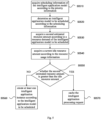
- S0140 includes following steps S0610 to S0630.
- state information of the intelligent application instance is acquired.
- a task is created according to the intelligent application instance, the state information of the intelligent application instance and the task concurrency information.
- the task concurrency information includes a task concurrency number which refers to the number of tasks processed simultaneously.
- the state information of the intelligent application instance refers to whether the intelligent application instance is in an idle state or a running state.
- the current state information of one intelligent application instance depends on the current resource usage information and the resource demand of the intelligent application instance.
- the current resource usage information is affected by a current task concurrency number, the larger the current task concurrency number is, the more the resources being used are and the less the corresponding idle resources are.
- One intelligent application processing request is acquired, and if there is no idle resource currently, the intelligent application processing request needs to be cached in a queue in which multiple to-be-processed intelligent application processing requests may be cached.
- a processing order of the intelligent application processing request is determined according to the scheduling order of queues.
- the intelligent application processing request corresponds to one intelligent application instance.
- the intelligent application instance is in an idle state currently, one task may be created by means of the intelligent application instance, and the task is used to process the intelligent application processing request. If the intelligent application instance is in a running state currently, the intelligent application processing request continues to be cached in the queue.
- S0640 includes following steps S0710 to S0740.
- a task concurrency number is acquired according to the task concurrency information.
- the task concurrency number is compared with a maximum task concurrency number, if the task concurrency number is not greater than the maximum task concurrency number, S0730 is executed; and if the task concurrency number is greater than the maximum task concurrency number, S0740 is executed.
- a task is created according to the intelligent application instance and the state information of the intelligent application instance.
- the intelligent application processing request continues to be cached.
- the current state information of one intelligent application instance depends on the current resource usage information and the resource demand of the intelligent application instance.
- the current resource usage information is affected by a current task concurrency number. The larger the current task concurrency number is, the more the resources being used are and the less the corresponding idle resources are. Before the state information of the intelligent application instance is determined, the current resource usage information is confirmed.
- the maximum task concurrency number may be acquired, which is an upper limit of the task concurrency number, and is limited by the system resource amount. If the current task concurrency number is not greater than the maximum task concurrency number, it is considered that there are idle resources currently; and if the current task concurrency number is greater than the maximum task concurrency number, it is considered that there is no idle resource available for scheduling currently.
- One intelligent application processing request is acquired, if there is no idle resource currently, the intelligent application processing request needs to be cached in a queue in which multiple to-be-processed intelligent application processing requests may be cached.
- a processing order of the intelligent application processing request is determined according to the scheduling order of queues.
- the intelligent application processing request corresponds to one intelligent application instance. If the current task concurrency number is not greater than the maximum task concurrency number, it indicates that there are idle resources currently.
- the intelligent application instance is in an idle state, one task may be created by means of the intelligent application instance, and the task is used to process the intelligent application processing request. If the intelligent application instance is in a running state currently, the intelligent application processing request continues to be cached in the queue.
- the current resource usage information can be known, and then the state information of the intelligent application instance can be acquired according to the current resource usage information and the resource demand of the intelligent application instance.
- the method further includes: acquiring a current wait task number, and if the current wait task number is greater than a preset wait task number threshold, adjusting the maximum task concurrency number according to a current maximum task concurrency number, a maximum number of tasks in the system and a preset adjustment factor.
- the wait task number refers to the number of tasks cached in the queue. If at a certain time, the number of tasks cached in the queue exceeds an upper limit of a cached number, that is, the current wait task number is greater than the preset wait task number threshold, the current maximum task concurrency number is required to be adjusted.
- a represents the adjustment factor, and a is a natural number.
- the current maximum task concurrency number is adjusted by means of the adjustment factor, and the adjusted maximum task concurrency number is compared with the maximum number of tasks in the system. If the adjusted maximum task concurrency number is greater than the maximum number of tasks in the system, the maximum number of tasks in the system is determined as the maximum task concurrency number at a next time. If the adjusted maximum task concurrency number is less than the maximum number of tasks in the system, the adjusted maximum task concurrency number is determined as the maximum task concurrency number at the next time. If the adjusted maximum task concurrency number is equal to the maximum number of tasks in the system, the adjusted maximum task concurrency number or the maximum number of tasks in the system is determined as the maximum task concurrency number at the next time.
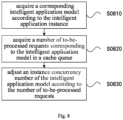
- the method further includes following steps S0810 to S0830.
- a corresponding intelligent application model is acquired according to the intelligent application instance.
- an instance concurrency number of the intelligent application model is adjusted according to the number of to-be-processed requests.
- One intelligent application model may be used to create at least one intelligent application instance, one intelligent application instance may be used to create at least one task, and one task may be used to process one intelligent application processing request. Therefore, one intelligent application instance has one corresponding intelligent application model, and one intelligent application processing request has one corresponding intelligent application instance, that is, one intelligent application model may be used to process at least one intelligent application processing request. All the to-be-processed requests corresponding to one intelligent application model may be extracted from the to-be-processed request information, so as to know the number of to-be-processed requests corresponding to the intelligent application model.
- the instance concurrency number is the number of instances running at the same time, and the setting of the instance concurrency number is limited by the system resource amount.
- the current resource usage information is affected by the instance concurrency number, the larger the current instance concurrency number, the more the resources occupied by running instances, and the less the idle resources available for scheduling. If at a certain time, the number of to-be-processed requests corresponding to a certain intelligent application model reaches the upper limit of the cached number, the instance concurrency number corresponding to the current intelligent application model is required to be increased. If in a certain period of time, an intelligent application instance corresponding to a certain intelligent application model has always been in an idle state, that is, a to-be-processed request corresponding to the intelligent application model has not been processed, the instance concurrency number corresponding to the current intelligent application model needs to be reduced.
- the method further includes following steps S0910 to S0960.
- At S0910 at least two corresponding intelligent application models are acquired according to the current concurrent intelligent application instances.
- priority information of each intelligent application model is acquired.
- weight information corresponding to each intelligent application model is acquired according to the number of the to-be-processed requests corresponding to the intelligent application model.
- a priority of the intelligent application model is adjusted according to the priority information and the weight information.
- an instance concurrency number corresponding to the intelligent application model is adjusted according to the priority of the intelligent application model and the number of the to-be-processed requests.
- the current instance concurrency number needs to be increased. If the current concurrent intelligent application instances involve several different intelligent application models, the priority of each intelligent application model is determined and the instance concurrency number corresponding to each intelligent application model is adjusted according to the priority order.
- Each intelligent application model has an initial priority, which does not take into account the to-be-processed requests in the cache queue. The initial priority is determined by prioritizing all intelligent application models in the model database, and an intelligent application model with high priority is used first. Initial priorities may be set according to usage frequencies of various intelligent application models, and an intelligent application model with high usage frequency may be set to have high priority.
- the initial priority information of each intelligent application model may be acquired.
- the to-be-processed requests corresponding to each intelligent application model may be extracted from the to-be-processed request information, such that the number of the to-be-processed requests corresponding to each intelligent application model and the number of all the to-be-processed requests can be obtained, and then the weight information of the number of the to-be-processed requests corresponding to one intelligent application model accounting for the number of all the to-be-processed requests can be acquired.
- the weight information may be set according to the importance or urgency of the to-be-processed requests corresponding to the intelligent application model or the size of a data volume.
- the priority of the intelligent application model is adjusted according to the initial priority information of one intelligent application model and the weight information corresponding to the intelligent application model, and then the priority of each intelligent application model can be acquired.
- the instance concurrency number corresponding to each intelligent application model is adjusted according to the priority order.
- Cache i represents the number of to-be-processed requests of model i in a period of time
- Cache j represents the number of to-be-processed requests of all models in this period of time.
- system resources can be adaptively scheduled, and idle resources of the system can be utilized to invoke intelligent application models, such that the resource utilization rate is improved, and thus the intelligent application processing requests can be processed quickly and effectively, the processing efficiency of intelligent applications is improved, the flexibility of intelligent application model deployment and the overall operating efficiency of the device are improved without affecting the operation of existing functional modules of the device.
- the computing resources and computing tasks can be dynamically adjusted to strike a balance therebetween.
- a resource scheduling system 1000 which can perform the resource scheduling method in the above embodiments.
- the resource scheduling system 1000 include a model unit 1010, an instance unit 1020, a task unit 1030 and a resource monitoring unit 1040.
- the model unit 1010 is configured to store at least one intelligent application model and record a first resource demand and a first concurrency demand of each intelligent application model.
- the instance unit 1020 is connected to the model unit 1010 and configured to store at least one intelligent application instance and record a second resource demand and a second concurrency demand of each intelligent application instance.
- the task unit 1030 is connected to the instance unit 1020 and configured to acquire at least one intelligent application processing request and process the intelligent application processing request.
- the resource monitoring unit 1040 is connected to the model unit 1010, the instance unit 1020 and the task unit 1030 respectively, and is configured to monitor a resource usage of the resource scheduling system 1000 in real time and acquire resource usage information.
- a first resource demand of one intelligent application model is a resource amount required to run the intelligent application model, that is, an estimated resource amount of the intelligent application model. If the estimated resource amount is unknown, the resource amount actually occupied by the intelligent application model is recorded when the intelligent application model is run, and take the resource amount as the estimated resource amount, which may be an actual resource amount recorded when the intelligent application model is run once, or may be an average resource amount, a lowest resource or a highest resource amount calculated according to the actual resource amount recorded each time when the intelligent application model is run many times.
- the first concurrency demand of one intelligent application model is the number of models expecting to run the intelligent application model at the same time, and the number of models is preset to 1 and may be adjusted according to actual task requests.
- a second resource demand of one intelligent application instance is the resource amount required to run the intelligent application instance, that is, an estimated resource amount of the intelligent application instance. If the estimated resource amount is unknown, the resource amount actually occupied by the intelligent application instance is recorded when the intelligent application instance is run, and take the resource amount as the estimated resource amount which may be an actual resource amount recorded when the intelligent application instance is run once, or may be an average resource amount, a lowest resource amount or a highest resource amount calculated according to the actual resource amount recorded each time when the intelligent application instance is run many times.
- the second concurrency demand of one intelligent application instance is the number of instances expecting to run the intelligent application instance at the same time, and the number of instances is preset to 1 and may be adjusted according to actual task requests.
- one task is configured to process only one intelligent application processing request. If there are not enough resources to process all the intelligent application processing requests, unprocessed intelligent application processing requests are cached in queues.
- the number of the queues is not less than the number of intelligent application models stored in the model unit.
- the scheduling of the queues may be performed by means of a Round Robin scheduling algorithm or according to a first-in-first-out rule.
- To create one task one instance which can process the task is found. If an estimated resource amount of the instance is not greater than a current idle resource amount, one task is created according to the instance. If the estimated resource amount of the instance is greater than the current idle resource amount, a corresponding intelligent application processing request is cached in a queue, to wait for scheduling of the queue.
- the resource monitoring unit monitors the resource usage of the resource scheduling system in real time, and synchronizes the resource usage information to the model unit, the instance unit and the task unit in real time, to further adjust the relationship between resources and operation.
- the resource usage information includes information about resources that the system is using and current idle resource information. For any request, the resource monitoring unit searches whether a model corresponding to the request has instances in an active state and idle state, if yes, a task is created by means of the request and the instances and resources are allocated for running; otherwise, a decision is made as to whether to cache the request and wait, or directly feeds back a failure according to a strategy.
- the resource monitoring unit dynamically track the running of tasks and the activity status of the instances, and adjust an upper limit of the number of instances and the number of tasks when necessary, that is, establish a closed loop between occupation and distribution of system resources, so as to achieve the purpose of reasonable utilization of resources by dynamically adjusting the model concurrency number and the task concurrency number.
- the system reports the number of active tasks, wait tasks, active instances or cached requests, and the resource monitoring unit monitors the running and outputs an adjusted number of active tasks, wait tasks, active instances or cached requests.
- the model unit is further configured to set priorities of intelligent application models, and an intelligent application model with high priority is used first.
- the model with high priority has an advantage in initial resource allocation, and an initialization priority may be configured by default or artificially. Priorities may be set according to usage frequencies of various intelligent application models, and an intelligent application model with high usage frequency is set to have high priority. If multiple intelligent application models have identical priority, one intelligent application model is randomly selected for invoking.
- the model unit is further configured to store a network topology architecture of each intelligent application model, weight and data information.
- the instance unit is further configured to create an intelligent application instance according to the intelligent application model, a resource demand corresponding to the intelligent application model, and current resource usage information.
- One intelligent application model may be configured to create at least one intelligent application instance, one intelligent application instance may be configured to create at least one task, and one task may be configured to process only one intelligent application processing request. At a certain time, one intelligent application instance can only process only one task, so that the task concurrency number should not be greater than an instance concurrency number.
- the task concurrency number refers to the number of tasks processed simultaneously, and the instance concurrency number refers to the number of instances running simultaneously.
- the number of models, an estimated resource amount of the models and an expected concurrency number of the models, a corresponding active model instance number is determined, and a corresponding number of running instances are created for all models.
- a corresponding active model instance number is determined, and a corresponding number of running instances are created for all models.
- it is determined whether to create a task for execution or cache data for a created task, according to a current task concurrency situation of the system, it is determined whether to process the task immediately or wait.
- model i if it has a demand for concurrent task processing, it is considered that there is a need to create additional active instances (that is, for model i, a total number of instances is greater than or equal to 2). If there is a need to create additional active instances, it is judged whether the resources requested by the model i are less than the idle resources of the system, if yes, a new instance is created for the model i; otherwise, it is judged whether all the models have been traversed. If no additional active instances need to be created, it is judged whether all the models have been traversed, if yes, the whole process is terminated; otherwise, a next model is executed to continue the traversing.
- the system ensures that system resources and models are initially balanced during power-on.
- each model has at least one instance corresponding to the model, and the total number of models satisfies the following conditions: the total number of models is not greater than the total number of instances, and each model may externally provide services and functions.
- Each task has an instance corresponding to the task, and the number of active tasks meets the following conditions: the total number of active tasks is not greater than the total number of active model instances.
- the resource scheduling system ensures, through a hierarchical control of the models, instances and tasks, that the required inference and training functions are provided, and at the same time, the resource utilization efficiency is maximized. An intelligent inference and training system required can be built by means of existing idle computing resources without affecting original functions.
- Models can be flexibly deployed and scheduled to make full use of resources without waste, and computing resources and computing tasks can be dynamically adjusted to strike a balance therebetween.
- computing resources and computing tasks can be dynamically adjusted to strike a balance therebetween.
- an embodiment provides an electronic device.
- the electronic device includes a memory, a processor, and a program stored in the memory and executable by the processor which, when executed by the processor, causes the processor to carry out the resource scheduling method provided in some embodiments of the present application.
- the electronic device may be a mobile terminal device or a non-mobile terminal device.
- the mobile terminal device may be a mobile phone, a tablet computer, a laptop computer, a palmtop computer, a vehicle-mounted terminal device, a wearable device, a super mobile personal computer, a netbook, a personal digital assistant, or the like.
- the non-mobile terminal device may be a personal computer, a television, a teller machine or self-service machine, or the like, which will not be specifically limited in the embodiments of the present disclosure.
- an embodiment further provides a storage medium configured for computer readable storage, where the storage medium stores at least one program which, when executed by at least one processor, causes the at least one processor to carry out the resource scheduling method provided in some embodiments of the present disclosure.
- An embodiment of the present disclosure includes: acquiring an intelligent application processing request; acquiring current resource usage information; matching an intelligent application instance according to the intelligent application processing request; and creating a task according to the resource usage information and the intelligent application instance, to process the intelligent application processing request.
- system resources can be adaptively scheduled, and system idle resources can be adopted to invoke intelligent application models, such that the resource utilization rate is improved, and thus the flexibility of intelligent application model deployment and the overall operating efficiency of the device are effectively improved without affecting the operation of existing functional modules of the device.
- a physical component may have multiple functions, or a function or step may be cooperatively performed by multiple physical components.
- Some or all of the physical components may be implemented as software executed by a processor, such as a central processing unit, a digital signal processor or a microprocessor, or as hardware, or as an integrated circuit, such as an application specific integrated circuit.
- a processor such as a central processing unit, a digital signal processor or a microprocessor, or as hardware, or as an integrated circuit, such as an application specific integrated circuit.
- Such software may be distributed on a computer-readable medium, and the computer-readable medium may include a computer storage medium (or a non-transitory medium) and a communication medium (or a transitory medium).
- the term "computer storage medium” includes volatile and nonvolatile, removable and non-removable media implemented in any method or technology for storing information such as computer readable instructions, data structures, program modules or other data.
- a computer storage medium may include a RAM, a ROM, an EEPROM, a flash memory or other memory technologies, a CD-ROM, a digital versatile disk (DVD) or other optical disk storages, a magnetic cassette, a magnetic tape, a magnetic disk storage or other magnetic storage devices, or any other media that can be used to store desired information and can be accessed by a computer.
- the communication medium may generally include computer readable instructions, data structures, program modules or other data in a modulated data signal such as a carrier wave or other transmission mechanism, and may include any information delivery medium.
Landscapes
- Engineering & Computer Science (AREA)
- Software Systems (AREA)
- Theoretical Computer Science (AREA)
- Physics & Mathematics (AREA)
- General Engineering & Computer Science (AREA)
- General Physics & Mathematics (AREA)
- Stored Programmes (AREA)
- Management, Administration, Business Operations System, And Electronic Commerce (AREA)
Applications Claiming Priority (2)
| Application Number | Priority Date | Filing Date | Title |
|---|---|---|---|
| CN202010635990.1A CN113886030B (zh) | 2020-07-03 | 2020-07-03 | 资源调度方法、电子设备及存储介质 |
| PCT/CN2021/104248 WO2022002247A1 (fr) | 2020-07-03 | 2021-07-02 | Procédé de planification de ressources, dispositif électronique et support de stockage |
Publications (2)
| Publication Number | Publication Date |
|---|---|
| EP4177745A1 true EP4177745A1 (fr) | 2023-05-10 |
| EP4177745A4 EP4177745A4 (fr) | 2023-08-30 |
Family
ID=79013309
Family Applications (1)
| Application Number | Title | Priority Date | Filing Date |
|---|---|---|---|
| EP21834695.5A Pending EP4177745A4 (fr) | 2020-07-03 | 2021-07-02 | Procédé de planification de ressources, dispositif électronique et support de stockage |
Country Status (4)
| Country | Link |
|---|---|
| US (1) | US20230273833A1 (fr) |
| EP (1) | EP4177745A4 (fr) |
| CN (1) | CN113886030B (fr) |
| WO (1) | WO2022002247A1 (fr) |
Families Citing this family (10)
| Publication number | Priority date | Publication date | Assignee | Title |
|---|---|---|---|---|
| CN115033338B (zh) * | 2022-04-26 | 2025-01-14 | 京东科技控股股份有限公司 | 应用实例配置方法及装置 |
| CN115237554A (zh) * | 2022-06-13 | 2022-10-25 | 际络科技(上海)有限公司 | 任务流并发调度方法、系统、电子设备、存储介质 |
| CN115357610B (zh) * | 2022-06-14 | 2025-11-18 | 国家计算机网络与信息安全管理中心 | 采集资源调度方法及系统 |
| US12314757B1 (en) * | 2022-06-23 | 2025-05-27 | Vista Tech LLC | Efficient resource scheduling using adaptive scheduling criteria |
| CN115061800A (zh) * | 2022-06-30 | 2022-09-16 | 中国联合网络通信集团有限公司 | 边缘计算任务的处理方法、边缘服务器及存储介质 |
| CN115499439B (zh) * | 2022-09-13 | 2024-11-22 | 阿里巴巴(中国)有限公司 | 用于云服务的通信资源调度方法、装置及电子设备 |
| US20240296314A1 (en) * | 2023-03-03 | 2024-09-05 | Microsoft Technology Licensing, Llc | Generative artificial intelligence (ai) system |
| CN117649069B (zh) * | 2023-11-07 | 2025-01-21 | 北京城建设计发展集团股份有限公司 | 基于遗传算法的多片区运维资源统筹调度方法 |
| CN118426936B (zh) * | 2024-07-04 | 2024-09-10 | 浪潮通用软件有限公司 | 一种容器集群应用资源调度方法、设备及介质 |
| CN119179593B (zh) * | 2024-11-25 | 2025-03-21 | 成都赛力斯科技有限公司 | 大模型服务调用方法、装置和计算机设备 |
Family Cites Families (8)
| Publication number | Priority date | Publication date | Assignee | Title |
|---|---|---|---|---|
| CN105975340A (zh) * | 2016-03-24 | 2016-09-28 | 国云科技股份有限公司 | 一种虚拟机应用分配部署算法 |
| US20180129524A1 (en) * | 2016-11-10 | 2018-05-10 | International Business Machines Corporation | Managing pre-allocated virtual machine instance pools |
| US10530887B1 (en) * | 2016-12-06 | 2020-01-07 | Amazon Technologies, Inc. | Pre-caching data for use upon execution of program code |
| WO2018120813A1 (fr) * | 2016-12-27 | 2018-07-05 | 华为技术有限公司 | Procédé et terminal intelligents de recommandations |
| CN109561024B (zh) * | 2017-09-27 | 2022-08-02 | 南京中兴软件有限责任公司 | 容器调度处理方法及装置 |
| CN113852787A (zh) * | 2018-08-09 | 2021-12-28 | 华为技术有限公司 | 智能应用部署的方法、装置和系统 |
| CN109960591B (zh) * | 2019-03-29 | 2023-08-08 | 神州数码信息系统有限公司 | 一种面向租户资源侵占的云应用资源动态调度的方法 |
| CN110515710A (zh) * | 2019-08-06 | 2019-11-29 | 深圳市随手科技有限公司 | 异步任务调度方法、装置、计算机设备和存储介质 |
-
2020
- 2020-07-03 CN CN202010635990.1A patent/CN113886030B/zh active Active
-
2021
- 2021-07-02 EP EP21834695.5A patent/EP4177745A4/fr active Pending
- 2021-07-02 US US18/014,125 patent/US20230273833A1/en active Pending
- 2021-07-02 WO PCT/CN2021/104248 patent/WO2022002247A1/fr not_active Ceased
Also Published As
| Publication number | Publication date |
|---|---|
| WO2022002247A1 (fr) | 2022-01-06 |
| CN113886030A (zh) | 2022-01-04 |
| CN113886030B (zh) | 2025-10-03 |
| US20230273833A1 (en) | 2023-08-31 |
| EP4177745A4 (fr) | 2023-08-30 |
Similar Documents
| Publication | Publication Date | Title |
|---|---|---|
| EP4177745A1 (fr) | Procédé de planification de ressources, dispositif électronique et support de stockage | |
| EP4242843A1 (fr) | Procédé et appareil de gestion de mémoire de carte graphique, dispositif et système | |
| US12081454B2 (en) | Systems and methods for provision of a guaranteed batch | |
| CN112988390B (zh) | 一种算力资源分配方法及装置 | |
| CN112486642B (zh) | 资源调度方法、装置、电子设备及计算机可读存储介质 | |
| CN106775990A (zh) | 请求调度方法和装置 | |
| US20210153112A1 (en) | Method for controlling the admission of slices into a virtualized telecommunication network and the congestion likely to be generated between services instantiated on said slices | |
| US9817698B2 (en) | Scheduling execution requests to allow partial results | |
| CN120179395A (zh) | 一种自适应微服务资源管理方法及装置 | |
| CN116450328A (zh) | 内存分配方法、装置、计算机设备和存储介质 | |
| CN114155026A (zh) | 一种资源分配方法、装置、服务器及存储介质 | |
| CN117632509A (zh) | 算力管理方法及装置、算力调度设备、存储介质 | |
| EP4400968A1 (fr) | Procédé et appareil de planification de ressources et dispositif informatique et support lisible | |
| CN117667324A (zh) | 用于处理任务的方法、装置、设备和存储介质 | |
| CN116827949A (zh) | 资源调度方法及装置、设备、存储介质 | |
| CN116701126A (zh) | pod容量控制方法及装置 | |
| CN114201273A (zh) | 资源使用方法、设备和计算机程序产品 | |
| CN113590326B (zh) | 服务资源调度方法和装置 | |
| CN115391042B (zh) | 一种资源分配方法、装置、电子设备及存储介质 | |
| Sutagundar et al. | Development of fog based dynamic resource allocation and pricing model in IoT | |
| Zhang et al. | An Efficient Method for Preemptive Scheduling of Resources in Kubernetes | |
| CN115334011A (zh) | 一种服务质量控制方法、装置、服务器及存储介质 | |
| CN120670099A (zh) | 资源调度方法、电子设备及存储介质 | |
| CN119806833A (zh) | k8s集群自适应调度方法、装置、计算机设备和存储介质 | |
| CN120066773A (zh) | 一种资源分配方法及装置、存储介质、计算机程序产品 |
Legal Events
| Date | Code | Title | Description |
|---|---|---|---|
| STAA | Information on the status of an ep patent application or granted ep patent |
Free format text: STATUS: THE INTERNATIONAL PUBLICATION HAS BEEN MADE |
|
| PUAI | Public reference made under article 153(3) epc to a published international application that has entered the european phase |
Free format text: ORIGINAL CODE: 0009012 |
|
| STAA | Information on the status of an ep patent application or granted ep patent |
Free format text: STATUS: REQUEST FOR EXAMINATION WAS MADE |
|
| 17P | Request for examination filed |
Effective date: 20230202 |
|
| AK | Designated contracting states |
Kind code of ref document: A1 Designated state(s): AL AT BE BG CH CY CZ DE DK EE ES FI FR GB GR HR HU IE IS IT LI LT LU LV MC MK MT NL NO PL PT RO RS SE SI SK SM TR |
|
| A4 | Supplementary search report drawn up and despatched |
Effective date: 20230802 |
|
| RIC1 | Information provided on ipc code assigned before grant |
Ipc: G06F 9/50 20060101ALI20230727BHEP Ipc: G06F 9/48 20060101AFI20230727BHEP |
|
| DAV | Request for validation of the european patent (deleted) | ||
| DAX | Request for extension of the european patent (deleted) | ||
| STAA | Information on the status of an ep patent application or granted ep patent |
Free format text: STATUS: EXAMINATION IS IN PROGRESS |
|
| 17Q | First examination report despatched |
Effective date: 20240320 |