EP4177864A1 - Système de guidage visuel d'amarrage - Google Patents
Système de guidage visuel d'amarrage Download PDFInfo
- Publication number
- EP4177864A1 EP4177864A1 EP21207145.0A EP21207145A EP4177864A1 EP 4177864 A1 EP4177864 A1 EP 4177864A1 EP 21207145 A EP21207145 A EP 21207145A EP 4177864 A1 EP4177864 A1 EP 4177864A1
- Authority
- EP
- European Patent Office
- Prior art keywords
- aircraft
- approaching
- visual
- docking
- guidance system
- Prior art date
- Legal status (The legal status is an assumption and is not a legal conclusion. Google has not performed a legal analysis and makes no representation as to the accuracy of the status listed.)
- Pending
Links
Images

Classifications
-
- G—PHYSICS
- G08—SIGNALLING
- G08G—TRAFFIC CONTROL SYSTEMS
- G08G5/00—Traffic control systems for aircraft
- G08G5/20—Arrangements for acquiring, generating, sharing or displaying traffic information
- G08G5/21—Arrangements for acquiring, generating, sharing or displaying traffic information located onboard the aircraft
-
- G—PHYSICS
- G08—SIGNALLING
- G08G—TRAFFIC CONTROL SYSTEMS
- G08G5/00—Traffic control systems for aircraft
- G08G5/20—Arrangements for acquiring, generating, sharing or displaying traffic information
- G08G5/22—Arrangements for acquiring, generating, sharing or displaying traffic information located on the ground
-
- G—PHYSICS
- G08—SIGNALLING
- G08G—TRAFFIC CONTROL SYSTEMS
- G08G5/00—Traffic control systems for aircraft
- G08G5/20—Arrangements for acquiring, generating, sharing or displaying traffic information
- G08G5/26—Transmission of traffic-related information between aircraft and ground stations
-
- G—PHYSICS
- G08—SIGNALLING
- G08G—TRAFFIC CONTROL SYSTEMS
- G08G5/00—Traffic control systems for aircraft
- G08G5/50—Navigation or guidance aids
- G08G5/51—Navigation or guidance aids for control when on the ground, e.g. taxiing or rolling
-
- G—PHYSICS
- G08—SIGNALLING
- G08G—TRAFFIC CONTROL SYSTEMS
- G08G5/00—Traffic control systems for aircraft
- G08G5/80—Anti-collision systems
Definitions
- the invention refers to a visual docking guidance system.
- a visual docking guidance system provides visual guidance to the pilot of an approaching aircraft during parking the aircraft at an airport stand. Although the systems known today already provide good assistance to the pilot, there is still room for improvement. It is therefore an object of the present invention to provide an improved VDGS.
- VDGS Visual docking guidance system
- the VDGS is adapted to determine the type of the approaching aircraft via two independent determination methods. In case that both determination methods deliver two different aircraft types a warning signal is issued, in particular a stop signal is provided to the pilot of the approaching aircraft.
- the first determination method may be performed by analysing a signal broadcasted by the approaching aircraft.
- the signal may be a signal which is ongoing sent by the aircraft.
- the signal is an ADS-B signal, containing information about the aircraft type.
- the second determination method may be performed by optical scanning of the approaching aircraft, in particular by laser scanning.
- the scan result is analysed, in particular by comparing the scan result with prestored models related to several aircraft types. In case the scan result matches to the aircraft type determined by analysing the signal, the aircraft type of the approaching aircraft is validated and aircraft type information can be used for further guidance.
- Laser scanning can be performed by one or more lidars.
- a lidar may be placed at a VDGS main housing or outside and/or remote to the VDGS main housing.
- the lidar scans the apron are and in particular generates a point cloud of points on the aircraft fuselage as a scan result.
- a computer of the VDGS may process the obtained scan result and calculate the azimuth, stopping distance, aircraft speed etc. This information is sent to the display to be shown to the pilots.
- the data obtained from the lidar by scanning may be used detect obstacles on the apron.
- the VDGS comprises a display unit, in particular placed in a manner so that it is clearly visible to pilots of the approaching aircraft.
- the relation between the actual speed, target speed and tolerated excess speed may eb visualized on the screen by colour or by numbers (e.g. by showing "SLOW DOWN".
- the VDGS is adapted to provide an information, in particular a stop signal, in case a speed of the approaching aircraft exceeds a maximum allowed speed.
- the maximum allowed speed is dependent on the distance of the aircraft from the stop position.
- the maximum allowed speed is decreasing with the distance of the aircraft from the stop position is decreasing. In other words: the maximum allowed aircraft speed gets smaller the more the aircraft approaches the stop position.
- VDGS may have the problem that the text on the display is often hard to read for pilots when far out.
- the invention solves this problem by making the font size dependent of the distance to the stop position. As the aircraft is approaching the font gets smaller and more information can be displayed at once.
- the VDGS is adapted to provide visual information in the display in a manner, that in a first docking situation an information is visually displayed on the display in a first font size, and that during the first docking situation the aircraft has a first distance to the stop position.
- a second docking situation the same or similar information is visually displayed on the display in a second font size, wherein during the second docking situation the aircraft has a second distance to the stop position.
- the first distance to the stop position is larger than the second distance to the stop position
- the first font size is larger than the second font size.
- VDGS are not able to guide aircraft reliably on curved lead in lines, because the nose of the aircraft is not sufficiently visible at all times.
- the present invention solves this this problem with intelligent curve guidance technology.
- the position of the aircraft is known in particular at all time during approaching of the aircraft (also if only other parts than the nose of the aircraft can be seen by the scanner). Also, the distance between the front and rear wheel is known as the aircraft type is known.
- the VDGS is in particular able to locate an aircraft position and orientation (pitch, roll, yaw) in real-time.
- the VDGS provides curve guidance depending on the aircraft type. In most stands on airports there is a curved turn in lead in line to help pilots "overturn" so that the aircraft will end up straight. The problem with this is that all aircraft models have different turn radius. This is why bigger aircraft is making bigger overturns than the painted line proposes. Since, according the invention, the aircraft type is known by the VDGS the VDGS can provide type individual curve guidance.
- the VDGS is adapted to provide type-individual curve guidance.
- the aircraft type is determined and based on the determined aircraft type a recommended type-individual path for driving through a curve is determined. The latter determination can be done by consulting a database in which a relation between the aircraft type and the related type-individual path is stored. A visual guidance to the pilot is provided in dependency on the determined type-individual path.
- Figure 1 shows an apron area of an airport.
- the airport has a plurality of gates 3, each having a respective stand 2 on which an aircraft 5 can be parked.
- a passenger boarding bridge 7 is provided, through which passengers can enter or leave the aircraft 5.
- On the apron ground there is painted a lead in line 6, along which a front wheel of the aircraft 5 is guided when approaching from a taxiway 4.
- a VGDS (Visual docking guidance system) 20 is provided to support the pilot controlling the aircraft 5 while driving the aircraft 5 to a stop position S.
- Several stop positions S are painted on the apron ground at lead in line 6, indicating the position where a part of the front end of the aircraft (in most cases the front wheel) should be aligned with during parking.
- a gate can comprise more than one passenger boarding bridge 7, more than one lead-in-line 6 and/or more than one VDGS 20.
- the VDGS 20 comprises a display 22, on which information can be displayed to the pilot.
- the display 22 is selectively inserted and shows isolated the information presented on the display in the respective context.
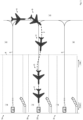
- each phase is illustrated by an aircraft, marked by an arrow A to E, where the arrows indicate the phase of docking A to E.
- the phases are described below.
- a first phase A the aircraft 6 is detected by the VDGS (visual docking guidance system) 20.
- the VDGS 6 may have received data relating an approaching aircraft via a flight database (not shown).
- the first phase may comprise a detection step and identification step. For more details regarding detecting and identifying an approaching aircraft 5 reference is made to the below description of figure 2 .
- a second phase B the aircraft 5 is further approaching the stand, thereby performing curve movement.
- the curve may have an angle of more than 45°.
- VDGS provides guidance to the pilot of the aircraft.
- the curve movement reference is made to the below description of figure 3 .
- a third phase C the approaching aircraft the pilot can correct the orientation relative to the lead in line 6.
- the front wheel needs to be as soon as possible to be aligned with the lead in line 6 so that also the in the further movement of the aircraft the rear wheels get also centred with the lead in line 6.
- a fourth phase D 6 the aircraft is aligned with the lead in line and a distance to the stop position is getting smaller, so that the aircraft speed needs particular attention. Reference is made to figure 4 .
- a fifth phase E the aircraft is stopped at the stop position S.
- FIG. 2 shows more details of the detection and identification steps.
- the approaching aircraft 5 permanently broadcasts an ADS-B signal via an aircraft antenna 51, which is received by a VDGS antenna 21 (the VDGS antenna 21 may be located anywhere on the airport, not necessarily located at a main housing of the VDGS).
- the ADS-B signal contains position data indicating the position of the sending aircraft and ID data relating to the identity of the sending aircraft and the type of aircraft.
- the VDGS 20 receives a plurality of ADS-B signal from a plurality of aircrafts, so the VDGS needs to filter the plurality of ADS-B signals to the approaching aircraft located at the respective stand. By comparing the position date of the ADS-B signal with the known position of the stand 2 the relevant ADS-B signal can be selected. From the selected ADS-B signal the VDGS 20 can determine the aircraft type of the approaching aircraft 5. For more details reference is made to EP 2 660 152 B1 . From the ADS-B signal the VDGS can determine that in this example the type of the approaching aircraft is a A320.
- VDGS scans the stand via a laser scanner 22 to optically detect the approaching aircraft 5.
- WO 2020/065093 A1 Reference is made to WO 2020/065093 A1 .
- Section I in figure 2 shows a scan 5S of the approaching aircraft obtained by laser scanning.
- the scan result is here a point cloud 5S representing a surface portion of the approaching aircraft, illustrated by a plurality of stars.
- Section II in figure 2 illustrates a comparison of the scan result 5S with a digital model 5M of a first aircraft type, here the surface model of e.g. an A320.
- the scan 5S matches with the model 5M. So the scan result validates the above detection of the aircraft type via ADS-B. On the display 22 the validated aircraft type A320 is shown.
- a failure signal is issued. This may lead to issuance of a STOP signal on the VDGS display 22, requesting the pilot of the approaching aircraft to stop immediately.
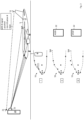
- Figure 3 shows details of the curve movement and curve movement.
- different aircraft types are approaching the aircraft.
- a smaller aircraft e.g. a A319
- a medium sized aircraft e.g. a A321
- a larger aircraft e.g. a A350
- a recommended path P is shown which in a curved section may deviate from the painted lead in line 6.
- the front wheel ideally takes an individual path P to get also the rear wheels as fast as possible centred with the following straight lead in line 6 within the stand.
- the table in the right area of figure 3 is an allocation table between different aircraft types and the optimum path P for the front wheel which should be the basis for guiding the aircraft in the curve.
- VDGS provides type-individual curve guidance for each aircraft type.
- this type-individual guidance may have two aspects as illustrated in figure 3 .
- an individual turn radius is illustrated, which conforms to the turn radius of the path P. So a larger turn radius is illustrated with a smaller arrow (see display 22c); a smaller turn radius is illustrated with a bigger arrow (see display 22a). There are plenty of other possibilities to visually indicate the size of the radius, in particular by using a certain colour for a certain radius.
- an arrow is displayed as soon as the aircraft, in particular the front wheel, has reached the curve in the path P. So in the docking situation of stand 3b the turning command in display 22B is displayed earlier than in the docking situation of Stand 3c.
- the position and angle orientation of the aircraft is permanently monitored.
- the arrow shown in the display 22 may be enlarged or may be blinking, which is a hint to the pilot to increase the steering angle.
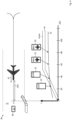
- Figure 4 shows the approaching aircraft in the fourth phase.
- the pilot is controlling the speed in a manner that the aircraft gets well aligned with the stop position in a short time.
- a stop signal is issued by the VDGS and presented on the display 22.
- the VDGS In case the actual speed v5 of the aircraft 5 is not greater than the allowed speed vmax, the VDGS as usual provides guidance information. As soon as the speed is higher than the allowed speed vmax, the VDGS issues a stop signal which is presented on the display 22.
- a warning speed vw is provided below the maximum allowed speed. In case the actual speed v5 reaches the warning area vw a warning signal "SLOW DOWN" is issued, indicating the pilot to immediately reduce the speed.
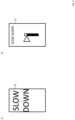
- Figure 5a shows the display 22 of the VDGS 20. On the display there is shown a slow down signal, because the aircraft speed is too high but still below the maximum allowed speed vmax. The distance to stop position d2S of the aircraft 5 is large, so a larger font is used.
- Figure 5b shows the display 22 of the VDGS 20. On the display there is also shown a slow down signal, because the aircraft speed is too high but still below the maximum allowed speed vmax.
- the distance to stop position d2S of the aircraft 5 is small, so a smaller font is used, compared to figure 5a . Consequently, there is more space left on the display 22 to provide additional information, e.g. a guidance information that the aircraft should move more rightwards.
Landscapes
- Engineering & Computer Science (AREA)
- Aviation & Aerospace Engineering (AREA)
- Physics & Mathematics (AREA)
- General Physics & Mathematics (AREA)
- Traffic Control Systems (AREA)
- Radar, Positioning & Navigation (AREA)
- Remote Sensing (AREA)
Priority Applications (4)
| Application Number | Priority Date | Filing Date | Title |
|---|---|---|---|
| EP21207145.0A EP4177864A1 (fr) | 2021-11-09 | 2021-11-09 | Système de guidage visuel d'amarrage |
| PCT/EP2022/081311 WO2023083878A1 (fr) | 2021-11-09 | 2022-11-09 | Système de guidage visuel pour l'accostage |
| CN202280074523.3A CN118215952A (zh) | 2021-11-09 | 2022-11-09 | 视觉泊位引导系统 |
| US18/708,441 US12586474B2 (en) | 2021-11-09 | 2022-11-09 | Visual docking guidance system |
Applications Claiming Priority (1)
| Application Number | Priority Date | Filing Date | Title |
|---|---|---|---|
| EP21207145.0A EP4177864A1 (fr) | 2021-11-09 | 2021-11-09 | Système de guidage visuel d'amarrage |
Publications (1)
| Publication Number | Publication Date |
|---|---|
| EP4177864A1 true EP4177864A1 (fr) | 2023-05-10 |
Family
ID=78592611
Family Applications (1)
| Application Number | Title | Priority Date | Filing Date |
|---|---|---|---|
| EP21207145.0A Pending EP4177864A1 (fr) | 2021-11-09 | 2021-11-09 | Système de guidage visuel d'amarrage |
Country Status (4)
| Country | Link |
|---|---|
| US (1) | US12586474B2 (fr) |
| EP (1) | EP4177864A1 (fr) |
| CN (1) | CN118215952A (fr) |
| WO (1) | WO2023083878A1 (fr) |
Citations (9)
| Publication number | Priority date | Publication date | Assignee | Title |
|---|---|---|---|---|
| WO2001035327A1 (fr) | 1999-10-29 | 2001-05-17 | Safegate International Ab | Identification d'aeronef et systemes de guidage pour l'atterrissage |
| EP0855065B1 (fr) * | 1995-10-12 | 2003-08-06 | Northrop Grumman Corporation | Systeme d'accostage d'avion |
| WO2007108726A1 (fr) | 2006-03-21 | 2007-09-27 | Safegate International Ab | Dispositif d'atterissage amélioré pour des aéronefs |
| US20080231472A1 (en) * | 2007-03-23 | 2008-09-25 | Dew Engineering And Development Limited | System and method for identifying an aircraft during approach to a stopping position |
| US20130060457A1 (en) * | 2011-07-06 | 2013-03-07 | Holger Breuing | Distance determination and type of aircraft determination during docking at the gate |
| US20190106223A1 (en) * | 2016-03-21 | 2019-04-11 | Adb Safegate Sweden Ab | Optimizing range of aircraft docking system |
| EP2660152B1 (fr) | 2012-04-30 | 2019-09-04 | thyssenkrupp Airport Solutions, S.A. | Procédé d'identification d'un avion en connexion avec le stationnement de l'avion à une station |
| WO2020065093A1 (fr) | 2018-09-28 | 2020-04-02 | thyssenkrupp Airport Solutions, S.A. | Procédé de fonctionnement d'un système de guidage d'amarrage au niveau d'un stand d'aéroport |
| US20210070467A1 (en) * | 2018-06-18 | 2021-03-11 | Adb Safegate Sweden Ab | Method and a system for guiding a pilot of an approaching aircraft to a stop position at a stand |
Family Cites Families (3)
| Publication number | Priority date | Publication date | Assignee | Title |
|---|---|---|---|---|
| US3729262A (en) | 1971-07-20 | 1973-04-24 | Burroughs Corp | Optical lens docking system |
| CN105302151B (zh) * | 2014-08-01 | 2018-07-13 | 深圳中集天达空港设备有限公司 | 一种飞机入坞引导和机型识别的系统及方法 |
| CN105373135B (zh) * | 2014-08-01 | 2019-01-01 | 深圳中集天达空港设备有限公司 | 一种基于机器视觉的飞机入坞引导和机型识别的方法及系统 |
-
2021
- 2021-11-09 EP EP21207145.0A patent/EP4177864A1/fr active Pending
-
2022
- 2022-11-09 US US18/708,441 patent/US12586474B2/en active Active
- 2022-11-09 CN CN202280074523.3A patent/CN118215952A/zh active Pending
- 2022-11-09 WO PCT/EP2022/081311 patent/WO2023083878A1/fr not_active Ceased
Patent Citations (9)
| Publication number | Priority date | Publication date | Assignee | Title |
|---|---|---|---|---|
| EP0855065B1 (fr) * | 1995-10-12 | 2003-08-06 | Northrop Grumman Corporation | Systeme d'accostage d'avion |
| WO2001035327A1 (fr) | 1999-10-29 | 2001-05-17 | Safegate International Ab | Identification d'aeronef et systemes de guidage pour l'atterrissage |
| WO2007108726A1 (fr) | 2006-03-21 | 2007-09-27 | Safegate International Ab | Dispositif d'atterissage amélioré pour des aéronefs |
| US20080231472A1 (en) * | 2007-03-23 | 2008-09-25 | Dew Engineering And Development Limited | System and method for identifying an aircraft during approach to a stopping position |
| US20130060457A1 (en) * | 2011-07-06 | 2013-03-07 | Holger Breuing | Distance determination and type of aircraft determination during docking at the gate |
| EP2660152B1 (fr) | 2012-04-30 | 2019-09-04 | thyssenkrupp Airport Solutions, S.A. | Procédé d'identification d'un avion en connexion avec le stationnement de l'avion à une station |
| US20190106223A1 (en) * | 2016-03-21 | 2019-04-11 | Adb Safegate Sweden Ab | Optimizing range of aircraft docking system |
| US20210070467A1 (en) * | 2018-06-18 | 2021-03-11 | Adb Safegate Sweden Ab | Method and a system for guiding a pilot of an approaching aircraft to a stop position at a stand |
| WO2020065093A1 (fr) | 2018-09-28 | 2020-04-02 | thyssenkrupp Airport Solutions, S.A. | Procédé de fonctionnement d'un système de guidage d'amarrage au niveau d'un stand d'aéroport |
Also Published As
| Publication number | Publication date |
|---|---|
| WO2023083878A1 (fr) | 2023-05-19 |
| CN118215952A (zh) | 2024-06-18 |
| US20250006068A1 (en) | 2025-01-02 |
| US12586474B2 (en) | 2026-03-24 |
Similar Documents
| Publication | Publication Date | Title |
|---|---|---|
| CN109817021B (zh) | 一种激光雷达路侧盲区交通参与者避让方法和装置 | |
| EP3474259B1 (fr) | Procédé et système de concaténation contextuelle d'alertes d'affichage, sonores et vocales | |
| RU2753006C1 (ru) | Способ и система информационной поддержки пилота заходящего на посадку воздушного судна | |
| EP2669703B1 (fr) | Systèmes et procédés de filtrage d'informations de capteur de bout d'aile | |
| US11136141B2 (en) | Methods and systems for avoiding a collision between an aircraft and an obstacle using a three-dimensional visual indication of an aircraft wingtip path | |
| US8022978B2 (en) | Autotiller control system for aircraft utilizing camera sensing | |
| US9959774B2 (en) | Systems and methods for displaying obstacle-avoidance information during surface operations | |
| EP3064407B1 (fr) | Systèmes de freinage automatique d'aéronef augmentés pour empêcher des incursions de pistes et procédés associés | |
| US20130297102A1 (en) | Electric taxi auto-guidance and control system | |
| DE3939731C2 (fr) | ||
| CN111399498B (zh) | 用于至少部分自动化引导机动车的方法和设备及存储介质 | |
| US20080157947A1 (en) | System and method for guiding an aircraft to a stopping position | |
| CN118212814A (zh) | 当飞行器正在机场的航道上滑行时帮助飞行器的飞行员的方法和系统 | |
| CN118405053A (zh) | 一种道路沿线危险的获取系统及方法 | |
| US12586474B2 (en) | Visual docking guidance system | |
| US11774597B2 (en) | Laser rangefinder systems with divergent lenses for aircraft wingtip collision avoidance systems | |
| US20240203270A1 (en) | Method And System For Assisting The Avoidance Of A Collision With An Obstacle For An Aircraft Taxiing On An Aerodrome | |
| US20240203274A1 (en) | Method And System For Assisting In The Avoidance Of An Incursion Onto A Runway By An Aircraft Taxiing On An Airfield | |
| WO2020207934A1 (fr) | Revêtement d'air | |
| WO2020127660A1 (fr) | Procédé de détection d'un obstacle sur un poste de stationnement d'aéronef | |
| HK40018679B (en) | A method and a system for guiding a pilot of an approaching aircraft to a stop position at a stand | |
| HK40018679A (en) | A method and a system for guiding a pilot of an approaching aircraft to a stop position at a stand | |
| HK40052824A (en) | Method and system for collision avoidance when aircraft moving on the ground |
Legal Events
| Date | Code | Title | Description |
|---|---|---|---|
| PUAI | Public reference made under article 153(3) epc to a published international application that has entered the european phase |
Free format text: ORIGINAL CODE: 0009012 |
|
| STAA | Information on the status of an ep patent application or granted ep patent |
Free format text: STATUS: THE APPLICATION HAS BEEN PUBLISHED |
|
| AK | Designated contracting states |
Kind code of ref document: A1 Designated state(s): AL AT BE BG CH CY CZ DE DK EE ES FI FR GB GR HR HU IE IS IT LI LT LU LV MC MK MT NL NO PL PT RO RS SE SI SK SM TR |
|
| STAA | Information on the status of an ep patent application or granted ep patent |
Free format text: STATUS: REQUEST FOR EXAMINATION WAS MADE |
|
| 17P | Request for examination filed |
Effective date: 20231009 |
|
| RBV | Designated contracting states (corrected) |
Designated state(s): AL AT BE BG CH CY CZ DE DK EE ES FI FR GB GR HR HU IE IS IT LI LT LU LV MC MK MT NL NO PL PT RO RS SE SI SK SM TR |
|
| STAA | Information on the status of an ep patent application or granted ep patent |
Free format text: STATUS: EXAMINATION IS IN PROGRESS |
|
| 17Q | First examination report despatched |
Effective date: 20250502 |
|
| REG | Reference to a national code |
Ref country code: DE Ref legal event code: R079 Free format text: PREVIOUS MAIN CLASS: G08G0005000000 Ipc: G08G0005210000 |
|
| GRAP | Despatch of communication of intention to grant a patent |
Free format text: ORIGINAL CODE: EPIDOSNIGR1 |
|
| STAA | Information on the status of an ep patent application or granted ep patent |
Free format text: STATUS: GRANT OF PATENT IS INTENDED |
|
| RIC1 | Information provided on ipc code assigned before grant |
Ipc: G08G 5/21 20250101AFI20260224BHEP Ipc: G08G 5/22 20250101ALI20260224BHEP Ipc: G08G 5/26 20250101ALI20260224BHEP Ipc: G08G 5/51 20250101ALI20260224BHEP Ipc: G08G 5/80 20250101ALI20260224BHEP |
|
| INTG | Intention to grant announced |
Effective date: 20260330 |
|
| RAP3 | Party data changed (applicant data changed or rights of an application transferred) |
Owner name: TK AIRPORT SOLUTIONS, S.A. |