EP4177934A1 - Procédé de préparation de structure semi-conductrice, structure semi-conductrice et mémoire semi-conductrice - Google Patents
Procédé de préparation de structure semi-conductrice, structure semi-conductrice et mémoire semi-conductrice Download PDFInfo
- Publication number
- EP4177934A1 EP4177934A1 EP21948687.5A EP21948687A EP4177934A1 EP 4177934 A1 EP4177934 A1 EP 4177934A1 EP 21948687 A EP21948687 A EP 21948687A EP 4177934 A1 EP4177934 A1 EP 4177934A1
- Authority
- EP
- European Patent Office
- Prior art keywords
- dielectric layer
- peripheral area
- layer
- isolation wall
- semiconductor
- Prior art date
- Legal status (The legal status is an assumption and is not a legal conclusion. Google has not performed a legal analysis and makes no representation as to the accuracy of the status listed.)
- Granted
Links
Images



Classifications
-
- H—ELECTRICITY
- H10—SEMICONDUCTOR DEVICES; ELECTRIC SOLID-STATE DEVICES NOT OTHERWISE PROVIDED FOR
- H10B—ELECTRONIC MEMORY DEVICES
- H10B12/00—Dynamic random access memory [DRAM] devices
- H10B12/01—Manufacture or treatment
- H10B12/09—Manufacture or treatment with simultaneous manufacture of the peripheral circuit region and memory cells
-
- H—ELECTRICITY
- H10—SEMICONDUCTOR DEVICES; ELECTRIC SOLID-STATE DEVICES NOT OTHERWISE PROVIDED FOR
- H10B—ELECTRONIC MEMORY DEVICES
- H10B12/00—Dynamic random access memory [DRAM] devices
- H10B12/30—DRAM devices comprising one-transistor - one-capacitor [1T-1C] memory cells
- H10B12/31—DRAM devices comprising one-transistor - one-capacitor [1T-1C] memory cells having a storage electrode stacked over the transistor
-
- H—ELECTRICITY
- H10—SEMICONDUCTOR DEVICES; ELECTRIC SOLID-STATE DEVICES NOT OTHERWISE PROVIDED FOR
- H10B—ELECTRONIC MEMORY DEVICES
- H10B12/00—Dynamic random access memory [DRAM] devices
- H10B12/30—DRAM devices comprising one-transistor - one-capacitor [1T-1C] memory cells
- H10B12/34—DRAM devices comprising one-transistor - one-capacitor [1T-1C] memory cells the transistor being at least partially in a trench in the substrate
-
- H—ELECTRICITY
- H10—SEMICONDUCTOR DEVICES; ELECTRIC SOLID-STATE DEVICES NOT OTHERWISE PROVIDED FOR
- H10B—ELECTRONIC MEMORY DEVICES
- H10B12/00—Dynamic random access memory [DRAM] devices
- H10B12/50—Peripheral circuit region structures
-
- H—ELECTRICITY
- H10—SEMICONDUCTOR DEVICES; ELECTRIC SOLID-STATE DEVICES NOT OTHERWISE PROVIDED FOR
- H10D—INORGANIC ELECTRIC SEMICONDUCTOR DEVICES
- H10D84/00—Integrated devices formed in or on semiconductor substrates that comprise only semiconducting layers, e.g. on Si wafers or on GaAs-on-Si wafers
- H10D84/80—Integrated devices formed in or on semiconductor substrates that comprise only semiconducting layers, e.g. on Si wafers or on GaAs-on-Si wafers characterised by the integration of at least one component covered by groups H10D12/00 or H10D30/00, e.g. integration of IGFETs
- H10D84/82—Integrated devices formed in or on semiconductor substrates that comprise only semiconducting layers, e.g. on Si wafers or on GaAs-on-Si wafers characterised by the integration of at least one component covered by groups H10D12/00 or H10D30/00, e.g. integration of IGFETs of only field-effect components
- H10D84/83—Integrated devices formed in or on semiconductor substrates that comprise only semiconducting layers, e.g. on Si wafers or on GaAs-on-Si wafers characterised by the integration of at least one component covered by groups H10D12/00 or H10D30/00, e.g. integration of IGFETs of only field-effect components of only insulated-gate FETs [IGFET]
- H10D84/8314—Integrated devices formed in or on semiconductor substrates that comprise only semiconducting layers, e.g. on Si wafers or on GaAs-on-Si wafers characterised by the integration of at least one component covered by groups H10D12/00 or H10D30/00, e.g. integration of IGFETs of only field-effect components of only insulated-gate FETs [IGFET] the IGFETs characterised by having gate insulating layers with different properties
-
- H—ELECTRICITY
- H10—SEMICONDUCTOR DEVICES; ELECTRIC SOLID-STATE DEVICES NOT OTHERWISE PROVIDED FOR
- H10P—GENERIC PROCESSES OR APPARATUS FOR THE MANUFACTURE OR TREATMENT OF DEVICES COVERED BY CLASS H10
- H10P50/00—Etching of wafers, substrates or parts of devices
- H10P50/20—Dry etching; Plasma etching; Reactive-ion etching
- H10P50/28—Dry etching; Plasma etching; Reactive-ion etching of insulating materials
-
- H—ELECTRICITY
- H10—SEMICONDUCTOR DEVICES; ELECTRIC SOLID-STATE DEVICES NOT OTHERWISE PROVIDED FOR
- H10D—INORGANIC ELECTRIC SEMICONDUCTOR DEVICES
- H10D84/00—Integrated devices formed in or on semiconductor substrates that comprise only semiconducting layers, e.g. on Si wafers or on GaAs-on-Si wafers
- H10D84/01—Manufacture or treatment
- H10D84/0123—Integrating together multiple components covered by H10D12/00 or H10D30/00, e.g. integrating multiple IGBTs
- H10D84/0126—Integrating together multiple components covered by H10D12/00 or H10D30/00, e.g. integrating multiple IGBTs the components including insulated gates, e.g. IGFETs
- H10D84/0128—Manufacturing their channels
-
- H—ELECTRICITY
- H10—SEMICONDUCTOR DEVICES; ELECTRIC SOLID-STATE DEVICES NOT OTHERWISE PROVIDED FOR
- H10D—INORGANIC ELECTRIC SEMICONDUCTOR DEVICES
- H10D84/00—Integrated devices formed in or on semiconductor substrates that comprise only semiconducting layers, e.g. on Si wafers or on GaAs-on-Si wafers
- H10D84/01—Manufacture or treatment
- H10D84/0123—Integrating together multiple components covered by H10D12/00 or H10D30/00, e.g. integrating multiple IGBTs
- H10D84/0126—Integrating together multiple components covered by H10D12/00 or H10D30/00, e.g. integrating multiple IGBTs the components including insulated gates, e.g. IGFETs
- H10D84/0144—Manufacturing their gate insulating layers
-
- H—ELECTRICITY
- H10—SEMICONDUCTOR DEVICES; ELECTRIC SOLID-STATE DEVICES NOT OTHERWISE PROVIDED FOR
- H10D—INORGANIC ELECTRIC SEMICONDUCTOR DEVICES
- H10D84/00—Integrated devices formed in or on semiconductor substrates that comprise only semiconducting layers, e.g. on Si wafers or on GaAs-on-Si wafers
- H10D84/01—Manufacture or treatment
- H10D84/0123—Integrating together multiple components covered by H10D12/00 or H10D30/00, e.g. integrating multiple IGBTs
- H10D84/0126—Integrating together multiple components covered by H10D12/00 or H10D30/00, e.g. integrating multiple IGBTs the components including insulated gates, e.g. IGFETs
- H10D84/0165—Integrating together multiple components covered by H10D12/00 or H10D30/00, e.g. integrating multiple IGBTs the components including insulated gates, e.g. IGFETs the components including complementary IGFETs, e.g. CMOS devices
- H10D84/0167—Manufacturing their channels
-
- H—ELECTRICITY
- H10—SEMICONDUCTOR DEVICES; ELECTRIC SOLID-STATE DEVICES NOT OTHERWISE PROVIDED FOR
- H10D—INORGANIC ELECTRIC SEMICONDUCTOR DEVICES
- H10D84/00—Integrated devices formed in or on semiconductor substrates that comprise only semiconducting layers, e.g. on Si wafers or on GaAs-on-Si wafers
- H10D84/01—Manufacture or treatment
- H10D84/0123—Integrating together multiple components covered by H10D12/00 or H10D30/00, e.g. integrating multiple IGBTs
- H10D84/0126—Integrating together multiple components covered by H10D12/00 or H10D30/00, e.g. integrating multiple IGBTs the components including insulated gates, e.g. IGFETs
- H10D84/0165—Integrating together multiple components covered by H10D12/00 or H10D30/00, e.g. integrating multiple IGBTs the components including insulated gates, e.g. IGFETs the components including complementary IGFETs, e.g. CMOS devices
- H10D84/0172—Manufacturing their gate conductors
- H10D84/0177—Manufacturing their gate conductors the gate conductors having different materials or different implants
-
- H—ELECTRICITY
- H10—SEMICONDUCTOR DEVICES; ELECTRIC SOLID-STATE DEVICES NOT OTHERWISE PROVIDED FOR
- H10D—INORGANIC ELECTRIC SEMICONDUCTOR DEVICES
- H10D84/00—Integrated devices formed in or on semiconductor substrates that comprise only semiconducting layers, e.g. on Si wafers or on GaAs-on-Si wafers
- H10D84/01—Manufacture or treatment
- H10D84/02—Manufacture or treatment characterised by using material-based technologies
- H10D84/03—Manufacture or treatment characterised by using material-based technologies using Group IV technology, e.g. silicon technology or silicon-carbide [SiC] technology
- H10D84/038—Manufacture or treatment characterised by using material-based technologies using Group IV technology, e.g. silicon technology or silicon-carbide [SiC] technology using silicon technology, e.g. SiGe
-
- H—ELECTRICITY
- H10—SEMICONDUCTOR DEVICES; ELECTRIC SOLID-STATE DEVICES NOT OTHERWISE PROVIDED FOR
- H10D—INORGANIC ELECTRIC SEMICONDUCTOR DEVICES
- H10D84/00—Integrated devices formed in or on semiconductor substrates that comprise only semiconducting layers, e.g. on Si wafers or on GaAs-on-Si wafers
- H10D84/80—Integrated devices formed in or on semiconductor substrates that comprise only semiconducting layers, e.g. on Si wafers or on GaAs-on-Si wafers characterised by the integration of at least one component covered by groups H10D12/00 or H10D30/00, e.g. integration of IGFETs
- H10D84/82—Integrated devices formed in or on semiconductor substrates that comprise only semiconducting layers, e.g. on Si wafers or on GaAs-on-Si wafers characterised by the integration of at least one component covered by groups H10D12/00 or H10D30/00, e.g. integration of IGFETs of only field-effect components
- H10D84/83—Integrated devices formed in or on semiconductor substrates that comprise only semiconducting layers, e.g. on Si wafers or on GaAs-on-Si wafers characterised by the integration of at least one component covered by groups H10D12/00 or H10D30/00, e.g. integration of IGFETs of only field-effect components of only insulated-gate FETs [IGFET]
- H10D84/85—Complementary IGFETs, e.g. CMOS
Definitions
- the present disclosure relates, but is not limited, to a method for preparing a semiconductor structure, a semiconductor structure and a semiconductor memory.
- HKMG high-k metal gate
- Embodiments of the present disclosure are expected to provide a method for preparing a semiconductor structure, a semiconductor structure and a semiconductor memory, which can avoid excessive elimination of a surface structure and reduce the risk of depression during processing an integrated circuit.
- the embodiments of the present disclosure provide a method for preparing a semiconductor structure, which may include the following operations.
- An initial semiconductor structure is formed in a substrate.
- the initial semiconductor structure is etched to form an array area structure and a peripheral area structure.
- the array area structure and the peripheral area structure have different heights on the substrate;
- the peripheral area structure includes a peripheral area gate structure and the array area structure and the peripheral area structure respectively include a first dielectric layer.
- An isolation wall surrounding the peripheral area gate structure is formed on the substrate where the peripheral area structure locates.
- a second dielectric layer is deposited on the peripheral area gate structure including the isolation wall and on the array area structure.
- the second dielectric layer, the first dielectric layer and the isolation wall are etched to form the semiconductor structure with a flat surface.
- the embodiments of the present disclosure further provide a semiconductor structure, which is prepared by the method of the above solution.
- the embodiments of the present disclosure further provide a semiconductor memory, which includes the semiconductor structure in the above solution.
- the same substrate is often divided into areas with different functions as required, and longitudinal structures of each area are different. Therefore, there is a height difference between semiconductor structures in each area.
- the thickness of a gate oxide layer of a thin gate structure is less than that of a thick gate structure, and the thickness difference there between may be 30 ⁇ 40 ⁇ (Angstrom).
- the height of the thin gate structure may be 20 ⁇ 30 ⁇ less than that of the thick gate structure.
- HKMG high-k metal gate
- FIG. 1 is an optional flowchart of a method for preparing a semiconductor structure according to an embodiment of the disclosure, which will be described with reference to the steps shown in FIG. 1 .
- an initial semiconductor structure is formed in a substrate.
- the initial semiconductor structure may be firstly form on the substrate by a semiconductor device.
- the substrate is a wafer made of a semiconductor single crystal material, and usually is a single crystal silicon material.
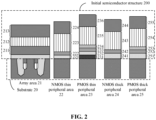
- FIG. 2 is a diagrammatic cross-section of the initial semiconductor structure according to an embodiment of the disclosure.
- the initial semiconductor structure 200 is formed on the substrate 20.
- the substrate 20 is divided into an array area 21, an NMOS thin peripheral area 22, a PMOS thin peripheral area 23, an NMOS thick peripheral area 24 and a PMOS thick peripheral area 25.
- the initial semiconductor structure on the array area 21 includes a third dielectric layer 211, a conductive layer 212 and a first dielectric layer 213.
- the initial semiconductor structure on the NMOS thin peripheral area 22 includes a gate oxide layer 221, a high-k material layer 222, a conductive layer 223 and a first dielectric layer 224.
- the initial semiconductor structure on the thin PMOS peripheral area 23 includes a strained layer 231, a gate oxide layer 232, a high-k material layer 233, a work function layer 234, a conductive layer 235 and a first dielectric layer 236.
- the initial semiconductor structure on the NMOS thick peripheral area 24 includes a gate oxide layer 241, a high-k material layer 242, a conductive layer 243 and a first dielectric layer 244.
- the initial semiconductor structure on the PMOS thick peripheral area 25 includes a gate oxide layer 251, a high-k material layer 252, a work function layer 253, a conductive layer 254 and a first dielectric layer 255.
- the initial semiconductor structures in different areas are not the same and have a height difference.
- the initial semiconductor structures in the NMOS thin peripheral area 22, the PMOS thin peripheral area 23, the NMOS thick peripheral area 24 and the PMOS thick peripheral area 25 respectively include the high-k material layers 222, 233, 242 and 252, and the initial semiconductor structure in the array area 21 does not.
- the initial semiconductor structures in the PMOS thin peripheral area 23 and the PMOS thick peripheral area 25 respectively include work function layers 234 and 253, and the initial semiconductor structures in the array area 21, the NMOS thin peripheral area 22 and the NMOS thick peripheral area 24 do not.
- the initial semiconductor structure in the PMOS thin peripheral area 23 includes the strained layer 231, and other areas do not.
- the gate oxide layers 241 and 251 in the NMOS and PMOS thick peripheral areas 24 and 25 are thicker than the gate oxide layers 221 and 232 in the NMOS and PMOS thin peripheral areas 22 and 23.
- the structures or the materials of the conductive layers 212, 223, 235, 243, and 254 in different areas may be different, which will also result in differences of heights of the initial semiconductor structures in different areas.
- the operation that the initial semiconductor structure 200 is formed on the substrate 20 by a semiconductor device may be completed through the following processes.
- a high-k material is deposited on the third dielectric layer 211 of the array area 21 and the gate oxide layers 221, 232, 241 and 251 of the peripheral areas 22, 23, 24 and 25.
- the high-k material on the third dielectric layer 211 is removed, thereby leaving the high-k material layers 222, 233, 242 and 252 of the peripheral areas 22, 23, 24 and 25.
- a conductive material is deposited and processed on the third dielectric layer 211 of the array area 21 and the high-k material layers 222, 233, 242 and 252 of the peripheral areas 22, 23, 24 and 25, thereby forming the conductive layers 212, 223, 235, 243 and 254 of the array area 21 and the peripheral areas 22, 23, 24 and 25.
- first dielectric layers 213, 224, 236, 244 and 255 are deposited on the conductive layers 212, 223, 235, 243 and 254 of the array area 21 and the peripheral areas 22, 23, 24 and 25, thereby forming the initial semiconductor structure 200.
- the deposition processes with a semiconductor device may be various processes such as diffusion, chemical vapor deposition (CVD), physical vapor deposition (PVD), etc., which is not limited here.
- CVD chemical vapor deposition
- PVD physical vapor deposition
- the initial semiconductor structure is etched to form an array area structure and a peripheral area structure.
- the array area structure and the peripheral area structure have different heights on the substrate.
- the peripheral area structure includes a peripheral area gate structure.
- the array area structure and the peripheral area structure respectively include a first dielectric layer.
- the initial semiconductor structure may be etched by a semiconductor device to form the array area structure and the peripheral area structure including the peripheral area gate structure.
- the array area structure and the peripheral area structure have different heights on the substrate.
- the array area structure and the peripheral area structure respectively include the first dielectric layer.
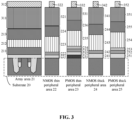
- FIG. 3 is a diagrammatic cross-section after the mask layer and the patterned photoresist layer is formed, on the basis of FIG. 2 .
- the mask layers 311, 321, 331, 341 and 351 are formed by a semiconductor device on the first dielectric layers 213, 224, 236, 244 and 255 in each area, and then the patterned photoresist layers 312, 322, 332, 342 and 352 are formed on the mask layers 311, 321, 331, 341 and 351 by a photo masking process, respectively.
- the mask layers 311, 321, 331, 341, and 351 are configured to cooperate with the formation of the photoresist layers 312, 322, 332, 342, and 352, such as increasing the adhesion of photoresist and preventing photoresist from penetrating downward.
- the photoresist layers 312, 322, 332, 342 and 352 are patterned and contain all plane pattern information of the semiconductor structures to be formed in subsequent processes in each area, so that the corresponding semiconductor structure can be manufactured in subsequent processes.
- the photoresist layer 312 covers all the top sections of the array area 21, and the respective photoresist layers 322, 332, 342 and 352 only cover the middle parts of the top sections of the peripheral areas 22, 23, 24 and 25. Therefore, the semiconductor structures, formed in subsequent processes, of the array area 21 and the peripheral areas 22, 23, 24 and 25 are different.
- the mask layers may be formed by diffusion, CVD, PVD, spin-on coating and other processes, and is not limited here.
- the mask layers may be etched at least once by a semiconductor device based on the patterned photoresist layers to form the array area structure and the peripheral area structure.
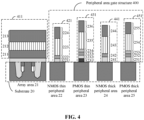
- FIG. 4 is a diagrammatic cross-section after etching based on FIG. 3 . Taking FIG. 4 as an example, the array area 21 and the middle sections of the peripheral areas 22, 23, 24 and 25 are covered with the photoresist layers, and are protected by the photoresist layers. The parts covered by the photoresist layers remain, and the parts exposed by the photoresist layers are etched away.
- parts of the first dielectric layers 213, 224, 236, 244, and 255, that are not covered by the photoresist layers 322, 332, 342, and 352, are etched away in subsequent etching processes, that is, parts of both sides of the sections of the peripheral areas 22, 23, 24, and 25, which are not protected by the photoresist layers 322, 332, 342, and 352, are etched away till the top of the substrate 20.
- the peripheral area gate structure 400 is formed in the peripheral areas 22, 23, 24 and 25.
- peripheral area gate structure 400 by the semiconductor device, different recipe may be correspondingly employed for etching several times according to the materials of each layer in the peripheral areas 22, 23, 24 and 25.
- an isolation wall surrounding the peripheral area gate structure is formed on the substrate of the peripheral area structure.
- the isolation wall which surrounds the peripheral area gate structure on the substrate of the peripheral area structure, may be formed by a semiconductor device.
- the isolation wall is configured to insulate and protect the peripheral area gate structure.
- the structure of the isolation wall may be an N-O-N (SiN-SiO-SiN) structure, namely, a silicon nitride-silicon oxide-silicon nitride structure.
- FIG. 5 is a diagrammatic cross-section after the isolation wall is formed on the basis of FIG. 4 .
- the isolation walls of the N-O-N structure surrounding the peripheral area gate structure on the peripheral areas 22, 23, 24 and 25 are formed.
- the isolation walls respectively include first silicon nitride layers 521, 531, 541 and 551, silicon oxide layers 522, 532, 542 and 552, and second silicon nitride layers 523, 533, 543 and 553.
- the peripheral area gate structure may be surrounded with a semiconductor device by firstly depositing the first silicon nitride layers 521, 531, 541 and 551; then depositing the silicon oxide layers 522, 532, 542 and 552 surrounding the first silicon nitride layers 521, 531, 541 and 551; and at last, depositing the second silicon nitride layers 523, 533, 543 and 553 surrounding the silicon oxide layers 522, 532, 542 and 552.
- the isolation wall of the N-O-N structure is formed.
- the deposition of the isolation wall may executed by a semiconductor device with any of various processes such as diffusion, CVD and PVD, which is not limited here.
- a second dielectric layer is deposited on the peripheral area gate structure including the isolation wall and on the array area structure.
- the second dielectric layer may be deposited on the peripheral area gate structure including the isolation wall and on the array area structure by a semiconductor device.
- FIG. 6 is a diagrammatic cross-section after the second dielectric layer is deposited on the basis of FIG. 5 .
- second dielectric layers 611, 621, 631, 641 and 651 are deposited by a semiconductor device on the array area structure of the array area 21 and outside the isolation walls on the peripheral areas 22, 23, 24 and 25.
- the second dielectric layers 611, 621, 631, 641 and 651 may be used as consumable materials to protect the semiconductor structure below them in subsequent consuming processes, and as isolation areas among the areas to insulate the areas.
- the material of the second dielectric layer may be silicon oxide.
- the deposition of the second dielectric layer may be executed by a semiconductor device with any of various processes such as diffusion, CVD and PVD, which is not limited here.
- the second dielectric layers, the first dielectric layers and the isolation wall are etched to form a semiconductor structure with a flat surface.
- the second dielectric layers, the first dielectric layers and the isolation wall may be etched by a semiconductor device to form the semiconductor structure with a flat surface, that is, the height of the structure of each area on the substrate is consistent and there is no depression.
- the second dielectric layer, the first dielectric layer and the isolation wall may be etched by the semiconductor device in a manner that the etching rate ratio of silicon oxide to silicon nitride is 1: 1.
- the etching rate ratio of silicon oxide to silicon nitride is 1: 1, which means that the silicon nitride material and silicon oxide material are consumed at the same rate in the etching process. In this way, in the etching process, the second dielectric layer, the first dielectric layer and the isolation wall are consumed at the same rate, so that surfaces are always flush, and finally the semiconductor structure with a flat surface is formed.
- a specific recipe may be adopted for etching.
- the specific recipe may include the following operations.
- a first gas introduced into a reaction chamber at a first flow rate and a second gas introduced into the reaction chamber at a second flow rate are as an etching gas.
- the etching gas is treated to form plasma.
- the second dielectric layer, the first dielectric layer and the isolation wall are etched for a first duration with the plasma.
- the first gas may be carbon tetrafluoride, and the first flow rate is 80-120 sccm (standard milliliter/minute); the second gas may be nitrogen, and the second flow rate is 180-220 sccm.
- the first pressure is 3-7 torr.
- the first temperature is 20-50 degrees centigrade, which goes downward in the first duration.
- the first duration is 20-40 seconds.
- FIG. 7 is a diagrammatic cross-section after etching is executed on the basis of FIG. 6 . Taking FIG. 7 as an example, the surface of the first dielectric layer 213 in the array area 21 is taken as the etching endpoint in the semiconductor device, and the semiconductor structures in the peripheral areas 22, 23, 24 and 25 are etched to be flush with the etching endpoint.
- peripheral area gate structure is formed in the semiconductor device first, and the second dielectric layer, the first dielectric layer and the isolation wall are deposited for protection, so that excessive elimination of a semiconductor surface structure can be avoided and the risk of depression is reduced. Meanwhile, the second dielectric layer, the first dielectric layer and the isolation wall are etched with a specific etching rate ratio, so that the surface of the formed semiconductor structure is guaranteed to be flat.
- S801 shown in FIG. 8 is further included between S104 and S105 shown in FIG. 1 , which will be explained with reference to each step.
- thinning processing is executed to the second dielectric layer to reduce the thickness of the second dielectric layer.
- thinning processing to the second dielectric layers may be also performed in a semiconductor device to reduce the thickness of the second dielectric layer.
- the thinning processing may be completed with a chemical mechanical polishing (CMP) process, which can make the surface of the second dielectric layer flatter.
- CMP chemical mechanical polishing
- FIG. 9 is a diagrammatic cross-section after the thinning processing on the basis of FIG. 6 . Taking FIG. 9 as an example, the thicknesses of the second dielectric layers 611, 621, 631, 641 and 651 is reduced in FIG. 9 compared with FIG. 6 .
- S102 shown in FIG. 1 may be implemented with S1001 to S1003 shown in FIG. 10 , which will be explained with reference to each step.
- a mask layer is formed on the initial semiconductor structure.
- the mask layer may be formed on the initial semiconductor structure first.
- the mask layer is configured to cooperate with the formation of the photoresist layer, such as increasing the adhesion of photoresist and preventing photoresist from penetrating downward.
- the mask layer may be formed by diffusion, CVD, PVD, spin-on coating or any other processes, which are not limited here.
- the patterned photoresist layer is formed on the mask layer.
- the patterned photoresist layer on the mask layer may be formed by a photo masking process by a semiconductor device.
- the photoresist layer is patterned and includes all desired pattern information of the semiconductor structures to be formed in subsequent processes, so that the needed semiconductor structure can be manufactured in subsequent processes.
- the mask layer is etched based on the patterned photoresist layer to form the array area structure and the peripheral area structure.
- the mask layer may be etched at least once based on the patterned photoresist layer to form the array area structure and the peripheral area structure.
- the material of a first dielectric layer includes silicon nitride
- the material of a second dielectric layer includes silicon oxide
- the isolation wall includes the silicon nitride-silicon oxide-silicon nitride structure.
- the peripheral area gate structure at least includes a first NMOS structure, a first PMOS structure, a second NMOS structure and a second PMOS structure.
- the array area structure, the first NMOS structure, the first PMOS structure, the second NMOS structure and the second PMOS structure may all have different heights on the substrate.
- the first NMOS structure 421 is on the NMOS thin peripheral area 22.
- the first PMOS structure 431 is on the PMOS thin peripheral area 23.
- the second NMOS structure 441 is on the NMOS thick peripheral area 24.
- the second PMOS structure 451 is on the PMOS thick peripheral area 25.
- the array area structure 411 is on the array area 21.
- the array area structure 411, the first NMOS structure 421, the first PMOS structure 431, the second NMOS structure 441 and the second PMOS structure 451 may all have different heights on the substrate.
- S105 in FIG. 1 may be implemented by S 1051, which will be explained with reference to each operation.
- the lowest height on the substrate among the heights of the array area structure, the first NMOS structure including the isolation wall, the first PMOS structure including the isolation wall, the second NMOS structure including the isolation wall and the second PMOS structure including the isolation wall is taken as the etching endpoint to form the semiconductor structure with a flat surface.
- a semiconductor device may take the lowest height on the substrate among the heights of the array area structure, the first NMOS structure including the isolation wall, the first PMOS structure including the isolation wall, the second NMOS structure including the isolation wall and the second PMOS structure including the isolation wall as the etching endpoint to form the semiconductor structure with a flat surface.
- S105 in FIG. 1 may be implemented by S 1052, which will be explained with reference to each operation.
- the surface of the first dielectric layer in the array area structure is taken as the etching endpoint to form the semiconductor structure with a flat surface.
- the semiconductor device may take the surface of the first dielectric layer in the array area structure as the etching endpoint to form the semiconductor structure with a flat surface.
- S105 in FIG. 1 may be implemented by S1053, which will be explained with reference to each operation.
- the second dielectric layer, the first dielectric layer and the isolation wall are etched at an etching rate ratio of silicon oxide to silicon nitride.
- the second dielectric layer, the first dielectric layer and the isolation wall may be etched with the etching rate ratio of silicon oxide to silicon nitride by a semiconductor device, so as to keep the surface of the semiconductor structure to be flat.
- S105 in FIG. 1 may be implemented by S1054, which will be explained with reference to each operation.
- the second dielectric layer, the first dielectric layer and the isolation wall are etched for the first duration under an environment with a first pressure and a first temperature by using an etching gas including the first gas and the second gas.
- the first gas is introduced into a reaction chamber at the first flow rate
- the second gas is introduced into the reaction chamber at the second flow rate.
- a semiconductor device may introduce the first gas into the reaction chamber at the first flow rate and introduce the second gas into the reaction chamber at the second flow rate as the etching gas.
- the etching gas is subjected to plasma to form Plasma.
- the second dielectric layer, the first dielectric layer and the isolation wall are etched for the first time by using the plasma.
- the etching rate ratio of silicon oxide to silicon nitride is 1: 1. In this way, when the first dielectric layer of the silicon nitride material, the second dielectric layer of the silicon oxide material and the isolation wall of the silicon nitride-silicon oxide-silicon nitride structure are etched in the semiconductor device, the surface of the semiconductor structure can be kept flat.
- the first gas includes carbon tetrafluoride, and the first flow rate is 80-120 standard milliliter/minute; the second gas includes nitrogen, and the second flow rate is 180-220 standard milliliter/minute; the first pressure is 3-7 torr, the first temperature is 20-50 degrees centigrade and shows a downward trend in the first time, which is 20-40 seconds.
- the array area structure further includes a third dielectric layer.
- the peripheral area structure also includes a high-k layer and a gate oxide layer.
- the array area structure and the peripheral area structure respectively further include: a conductive layer.
- the array area structure 411 includes the third dielectric layer 211.
- the peripheral area structures in the peripheral areas 22, 23, 24 and 25 respectively include the high-k layers 222, 233, 242 and 252 and the gate oxide layers 221, 232, 241 and 251.
- the array area structure 411 and the peripheral area structures also respectively include the conductive layers 212, 223, 235, 243 and 254 formed by various conductive materials.
- the first PMOS structure further includes a work function layer and a strained layer
- the second PMOS structure further includes a work function layer.
- the first PMOS structure 431 is formed on the PMOS thin peripheral area 23 and further includes the work function layer 234 and the strained layer 231.
- the second PMOS structure 451 is formed on the PMOS thick peripheral area 25 and further includes the work function layer 253.
- the material of the conductive layer includes one or more of tungsten, titanium nitride, polysilicon or lanthanum oxide.
- the material of the third dielectric layers includes silicon nitride.
- the material of the gate oxide layer includes silicon oxide.
- the material of the work function layer includes alumina.
- the material of the strained layer includes silicon germanium.
- the conductive layers in different areas may have different structures or materials, which will also bring height differences to the initial semiconductor structures in different areas.
- the first dielectric layer is deposited by a heat treatment process.
- the second dielectric layer is a spin-on coating dielectric layer.
- the embodiments of the disclosure further provide a semiconductor structure 110, as shown in FIG. 11 .
- the semiconductor structure 110 is formed by the preparation method provided by the above embodiments. Accordingly, excessive elimination of the semiconductor surface structure can be avoided, and the risk of recess is reduced. Meanwhile, etching is executed with a specific etching rate ratio, so that the surface of the formed semiconductor structure 110 is guaranteed to be flat.
- the embodiments of the present disclosure further provide a semiconductor memory 120.
- the semiconductor memory 120 at least includes the semiconductor structure 110 shown in FIG. 11 .
- the semiconductor memory 120 shown in FIG. 12 at least includes a dynamic random access memory (DRAM).
- DRAM dynamic random access memory
- serial numbers of the embodiments of the disclosure are merely for description and do not represent the advantages or disadvantages of the embodiments.
- the methods disclosed in several method embodiments provided in the present disclosure may be arbitrarily combined without conflict to obtain a new method embodiment.
- the characteristics disclosed in several product embodiments provided in the present disclosure may be arbitrarily combined without conflict to obtain a new product embodiment.
- the characteristics disclosed in the several method or device embodiments provided in the present disclosure may be arbitrarily combined without conflict to obtain a new method embodiment or device embodiment.
- the embodiments of the present disclosure provide a method for preparing a semiconductor structure, a semiconductor structure and a semiconductor memory.
- the method includes the following operations.
- An initial semiconductor structure is formed in a substrate.
- the initial semiconductor structure is etched to form an array area structure and a peripheral area structure including a peripheral area gate structure.
- an isolation wall surrounding the peripheral area gate structure is formed on the substrate where the peripheral area structure locates.
- a second dielectric layer is deposited on the peripheral area gate structure including the isolation wall and on the array area structure.
- the second dielectric layer, a first dielectric layer and the isolation wall are etched to form a semiconductor structure with a flat surface.
- the peripheral area gate structure is formed first, and the second dielectric layer, the first dielectric layer and the isolation wall are deposited for protection, so that excessive elimination of the semiconductor surface structure can be avoided, and the risk of depression is reduced.
Landscapes
- Engineering & Computer Science (AREA)
- Manufacturing & Machinery (AREA)
- Insulated Gate Type Field-Effect Transistor (AREA)
- Element Separation (AREA)
Applications Claiming Priority (2)
| Application Number | Priority Date | Filing Date | Title |
|---|---|---|---|
| CN202110853063.1A CN115692321B (zh) | 2021-07-27 | 2021-07-27 | 一种半导体结构的制备方法、半导体结构和半导体存储器 |
| PCT/CN2021/112845 WO2023004893A1 (fr) | 2021-07-27 | 2021-08-16 | Procédé de préparation de structure semi-conductrice, structure semi-conductrice et mémoire semi-conductrice |
Publications (3)
| Publication Number | Publication Date |
|---|---|
| EP4177934A1 true EP4177934A1 (fr) | 2023-05-10 |
| EP4177934A4 EP4177934A4 (fr) | 2024-02-28 |
| EP4177934B1 EP4177934B1 (fr) | 2025-04-02 |
Family
ID=85039374
Family Applications (1)
| Application Number | Title | Priority Date | Filing Date |
|---|---|---|---|
| EP21948687.5A Active EP4177934B1 (fr) | 2021-07-27 | 2021-08-16 | Procédé de préparation de structure semi-conductrice, structure semi-conductrice et mémoire semi-conductrice |
Country Status (2)
| Country | Link |
|---|---|
| US (1) | US12262525B2 (fr) |
| EP (1) | EP4177934B1 (fr) |
Family Cites Families (13)
| Publication number | Priority date | Publication date | Assignee | Title |
|---|---|---|---|---|
| US6355524B1 (en) * | 2000-08-15 | 2002-03-12 | Mosel Vitelic, Inc. | Nonvolatile memory structures and fabrication methods |
| US8822287B2 (en) | 2010-12-10 | 2014-09-02 | Samsung Electronics Co., Ltd. | Methods of manufacturing semiconductor devices |
| JP2013051250A (ja) * | 2011-08-30 | 2013-03-14 | Elpida Memory Inc | 半導体装置及びその製造方法 |
| CN103390625B (zh) | 2012-05-10 | 2016-03-23 | 台湾积体电路制造股份有限公司 | 用于bsi图像传感器的背面结构和方法 |
| US8709854B2 (en) | 2012-05-10 | 2014-04-29 | Taiwan Semiconductor Manufacturing Company, Ltd. | Backside structure and methods for BSI image sensors |
| JP6029989B2 (ja) | 2013-01-25 | 2016-11-24 | ルネサスエレクトロニクス株式会社 | 半導体装置の製造方法 |
| KR20140108982A (ko) * | 2013-03-04 | 2014-09-15 | 삼성전자주식회사 | 메모리 장치 및 그 제조 방법 |
| US9812569B2 (en) * | 2014-01-15 | 2017-11-07 | Taiwan Semiconductor Manufacturing Co., Ltd. | Semiconductor device and fabricating method thereof |
| JP5861069B2 (ja) * | 2014-03-27 | 2016-02-16 | パナソニックIpマネジメント株式会社 | 可搬型決済端末装置 |
| US9425206B2 (en) | 2014-12-23 | 2016-08-23 | Taiwan Semiconductor Manufacturing Co., Ltd. | Boundary scheme for embedded poly-SiON CMOS or NVM in HKMG CMOS technology |
| CN108598081B (zh) | 2018-04-25 | 2019-12-10 | 长江存储科技有限责任公司 | 三维存储器件及其制造方法 |
| CN111968911A (zh) | 2020-08-26 | 2020-11-20 | 上海华虹宏力半导体制造有限公司 | 铜制程平坦化的方法 |
| CN111968985B (zh) | 2020-08-26 | 2023-08-15 | 长江存储科技有限责任公司 | 三维存储器的制造方法 |
-
2021
- 2021-08-16 EP EP21948687.5A patent/EP4177934B1/fr active Active
-
2022
- 2022-02-10 US US17/668,661 patent/US12262525B2/en active Active
Also Published As
| Publication number | Publication date |
|---|---|
| EP4177934B1 (fr) | 2025-04-02 |
| EP4177934A4 (fr) | 2024-02-28 |
| US20230031509A1 (en) | 2023-02-02 |
| US12262525B2 (en) | 2025-03-25 |
Similar Documents
| Publication | Publication Date | Title |
|---|---|---|
| US6780708B1 (en) | Method of forming core and periphery gates including two critical masking steps to form a hard mask in a core region that includes a critical dimension less than achievable at a resolution limit of lithography | |
| JP5105824B2 (ja) | マスク構造物の形成方法及びこれを利用した微細パターン形成方法 | |
| CN103227101B (zh) | 半导体器件及其制造方法 | |
| US20150118832A1 (en) | Methods for patterning a hardmask layer for an ion implantation process | |
| WO2023104455A1 (fr) | Métal à fonction de travail multicouche dans des empilements de nanofeuilles utilisant un matériau d'oxyde sacrificiel | |
| EP4177934B1 (fr) | Procédé de préparation de structure semi-conductrice, structure semi-conductrice et mémoire semi-conductrice | |
| US20070048920A1 (en) | Methods for dual metal gate CMOS integration | |
| US11450659B2 (en) | On-chip decoupling capacitor | |
| US20080113515A1 (en) | Methods of Forming Semiconductor Devices | |
| JP7801500B2 (ja) | Dramのキャパシタモールドパターニング用炭化ルテニウム | |
| US6365487B2 (en) | Method of manufacturing a capacitor in a semiconductor device | |
| US20230238424A1 (en) | Method of manufacturing capacitor array | |
| CN115692321B (zh) | 一种半导体结构的制备方法、半导体结构和半导体存储器 | |
| US20130285202A1 (en) | Semiconductor device | |
| US20210384071A1 (en) | Method of manufacturing semiconductor device | |
| US7037777B2 (en) | Process for producing an etching mask on a microstructure, in particular a semiconductor structure with trench capacitors, and corresponding use of the etching mask | |
| US12080561B2 (en) | Method of processing substrate | |
| US12506033B2 (en) | Method of manufacturing semiconductor device | |
| CN112825300A (zh) | 半导体器件及其制备方法 | |
| US20250287562A1 (en) | Semiconductor structure having dielectric liner and method of manufacturing the same | |
| CN100594597C (zh) | 氮化硅只读存储器及其字线的制造方法 | |
| KR20260025076A (ko) | 고종횡비(har) 특징부의 증착 방법 | |
| CN121751736A (zh) | 半导体器件的制备方法 | |
| TW389990B (en) | Method for forming cascade metal contact | |
| KR20020050368A (ko) | 반도체 소자의 캐패시터 제조 방법 |
Legal Events
| Date | Code | Title | Description |
|---|---|---|---|
| STAA | Information on the status of an ep patent application or granted ep patent |
Free format text: STATUS: UNKNOWN |
|
| STAA | Information on the status of an ep patent application or granted ep patent |
Free format text: STATUS: THE INTERNATIONAL PUBLICATION HAS BEEN MADE |
|
| PUAI | Public reference made under article 153(3) epc to a published international application that has entered the european phase |
Free format text: ORIGINAL CODE: 0009012 |
|
| STAA | Information on the status of an ep patent application or granted ep patent |
Free format text: STATUS: REQUEST FOR EXAMINATION WAS MADE |
|
| 17P | Request for examination filed |
Effective date: 20230110 |
|
| AK | Designated contracting states |
Kind code of ref document: A1 Designated state(s): AL AT BE BG CH CY CZ DE DK EE ES FI FR GB GR HR HU IE IS IT LI LT LU LV MC MK MT NL NO PL PT RO RS SE SI SK SM TR |
|
| REG | Reference to a national code |
Ref country code: DE Ref legal event code: R079 Free format text: PREVIOUS MAIN CLASS: H01L0021320500 Ipc: H01L0021311000 Ref country code: DE Ref legal event code: R079 Ref document number: 602021028715 Country of ref document: DE Free format text: PREVIOUS MAIN CLASS: H01L0021320500 Ipc: H01L0021311000 |
|
| A4 | Supplementary search report drawn up and despatched |
Effective date: 20240129 |
|
| RIC1 | Information provided on ipc code assigned before grant |
Ipc: H01L 27/092 20060101ALI20240123BHEP Ipc: H01L 27/088 20060101ALI20240123BHEP Ipc: H01L 21/8238 20060101ALI20240123BHEP Ipc: H01L 21/8234 20060101ALI20240123BHEP Ipc: H10B 12/00 20230101ALI20240123BHEP Ipc: H01L 21/311 20060101AFI20240123BHEP |
|
| DAV | Request for validation of the european patent (deleted) | ||
| DAX | Request for extension of the european patent (deleted) | ||
| GRAP | Despatch of communication of intention to grant a patent |
Free format text: ORIGINAL CODE: EPIDOSNIGR1 |
|
| STAA | Information on the status of an ep patent application or granted ep patent |
Free format text: STATUS: GRANT OF PATENT IS INTENDED |
|
| INTG | Intention to grant announced |
Effective date: 20241204 |
|
| P01 | Opt-out of the competence of the unified patent court (upc) registered |
Free format text: CASE NUMBER: APP_1889/2025 Effective date: 20250111 |
|
| GRAS | Grant fee paid |
Free format text: ORIGINAL CODE: EPIDOSNIGR3 |
|
| GRAA | (expected) grant |
Free format text: ORIGINAL CODE: 0009210 |
|
| STAA | Information on the status of an ep patent application or granted ep patent |
Free format text: STATUS: THE PATENT HAS BEEN GRANTED |
|
| AK | Designated contracting states |
Kind code of ref document: B1 Designated state(s): AL AT BE BG CH CY CZ DE DK EE ES FI FR GB GR HR HU IE IS IT LI LT LU LV MC MK MT NL NO PL PT RO RS SE SI SK SM TR |
|
| REG | Reference to a national code |
Ref country code: GB Ref legal event code: FG4D |
|
| REG | Reference to a national code |
Ref country code: CH Ref legal event code: EP |
|
| REG | Reference to a national code |
Ref country code: IE Ref legal event code: FG4D |
|
| REG | Reference to a national code |
Ref country code: DE Ref legal event code: R096 Ref document number: 602021028715 Country of ref document: DE |
|
| REG | Reference to a national code |
Ref country code: NL Ref legal event code: MP Effective date: 20250402 |
|
| PG25 | Lapsed in a contracting state [announced via postgrant information from national office to epo] |
Ref country code: NL Free format text: LAPSE BECAUSE OF FAILURE TO SUBMIT A TRANSLATION OF THE DESCRIPTION OR TO PAY THE FEE WITHIN THE PRESCRIBED TIME-LIMIT Effective date: 20250402 |
|
| REG | Reference to a national code |
Ref country code: AT Ref legal event code: MK05 Ref document number: 1782174 Country of ref document: AT Kind code of ref document: T Effective date: 20250402 |
|
| PG25 | Lapsed in a contracting state [announced via postgrant information from national office to epo] |
Ref country code: FI Free format text: LAPSE BECAUSE OF FAILURE TO SUBMIT A TRANSLATION OF THE DESCRIPTION OR TO PAY THE FEE WITHIN THE PRESCRIBED TIME-LIMIT Effective date: 20250402 Ref country code: ES Free format text: LAPSE BECAUSE OF FAILURE TO SUBMIT A TRANSLATION OF THE DESCRIPTION OR TO PAY THE FEE WITHIN THE PRESCRIBED TIME-LIMIT Effective date: 20250402 Ref country code: PT Free format text: LAPSE BECAUSE OF FAILURE TO SUBMIT A TRANSLATION OF THE DESCRIPTION OR TO PAY THE FEE WITHIN THE PRESCRIBED TIME-LIMIT Effective date: 20250804 |
|
| PGFP | Annual fee paid to national office [announced via postgrant information from national office to epo] |
Ref country code: DE Payment date: 20250820 Year of fee payment: 5 |
|
| REG | Reference to a national code |
Ref country code: LT Ref legal event code: MG9D |
|
| PG25 | Lapsed in a contracting state [announced via postgrant information from national office to epo] |
Ref country code: GR Free format text: LAPSE BECAUSE OF FAILURE TO SUBMIT A TRANSLATION OF THE DESCRIPTION OR TO PAY THE FEE WITHIN THE PRESCRIBED TIME-LIMIT Effective date: 20250703 Ref country code: NO Free format text: LAPSE BECAUSE OF FAILURE TO SUBMIT A TRANSLATION OF THE DESCRIPTION OR TO PAY THE FEE WITHIN THE PRESCRIBED TIME-LIMIT Effective date: 20250702 |
|
| PG25 | Lapsed in a contracting state [announced via postgrant information from national office to epo] |
Ref country code: PL Free format text: LAPSE BECAUSE OF FAILURE TO SUBMIT A TRANSLATION OF THE DESCRIPTION OR TO PAY THE FEE WITHIN THE PRESCRIBED TIME-LIMIT Effective date: 20250402 |
|
| PG25 | Lapsed in a contracting state [announced via postgrant information from national office to epo] |
Ref country code: BG Free format text: LAPSE BECAUSE OF FAILURE TO SUBMIT A TRANSLATION OF THE DESCRIPTION OR TO PAY THE FEE WITHIN THE PRESCRIBED TIME-LIMIT Effective date: 20250402 |
|
| PGFP | Annual fee paid to national office [announced via postgrant information from national office to epo] |
Ref country code: GB Payment date: 20250820 Year of fee payment: 5 |
|
| PG25 | Lapsed in a contracting state [announced via postgrant information from national office to epo] |
Ref country code: HR Free format text: LAPSE BECAUSE OF FAILURE TO SUBMIT A TRANSLATION OF THE DESCRIPTION OR TO PAY THE FEE WITHIN THE PRESCRIBED TIME-LIMIT Effective date: 20250402 |
|
| PG25 | Lapsed in a contracting state [announced via postgrant information from national office to epo] |
Ref country code: AT Free format text: LAPSE BECAUSE OF FAILURE TO SUBMIT A TRANSLATION OF THE DESCRIPTION OR TO PAY THE FEE WITHIN THE PRESCRIBED TIME-LIMIT Effective date: 20250402 |
|
| PG25 | Lapsed in a contracting state [announced via postgrant information from national office to epo] |
Ref country code: RS Free format text: LAPSE BECAUSE OF FAILURE TO SUBMIT A TRANSLATION OF THE DESCRIPTION OR TO PAY THE FEE WITHIN THE PRESCRIBED TIME-LIMIT Effective date: 20250702 |
|
| PG25 | Lapsed in a contracting state [announced via postgrant information from national office to epo] |
Ref country code: IS Free format text: LAPSE BECAUSE OF FAILURE TO SUBMIT A TRANSLATION OF THE DESCRIPTION OR TO PAY THE FEE WITHIN THE PRESCRIBED TIME-LIMIT Effective date: 20250802 |
|
| PG25 | Lapsed in a contracting state [announced via postgrant information from national office to epo] |
Ref country code: LV Free format text: LAPSE BECAUSE OF FAILURE TO SUBMIT A TRANSLATION OF THE DESCRIPTION OR TO PAY THE FEE WITHIN THE PRESCRIBED TIME-LIMIT Effective date: 20250402 |
|
| REG | Reference to a national code |
Ref country code: DE Ref legal event code: R097 Ref document number: 602021028715 Country of ref document: DE |
|
| PG25 | Lapsed in a contracting state [announced via postgrant information from national office to epo] |
Ref country code: SM Free format text: LAPSE BECAUSE OF FAILURE TO SUBMIT A TRANSLATION OF THE DESCRIPTION OR TO PAY THE FEE WITHIN THE PRESCRIBED TIME-LIMIT Effective date: 20250402 Ref country code: DK Free format text: LAPSE BECAUSE OF FAILURE TO SUBMIT A TRANSLATION OF THE DESCRIPTION OR TO PAY THE FEE WITHIN THE PRESCRIBED TIME-LIMIT Effective date: 20250402 |
|
| PG25 | Lapsed in a contracting state [announced via postgrant information from national office to epo] |
Ref country code: CZ Free format text: LAPSE BECAUSE OF FAILURE TO SUBMIT A TRANSLATION OF THE DESCRIPTION OR TO PAY THE FEE WITHIN THE PRESCRIBED TIME-LIMIT Effective date: 20250402 |
|
| PG25 | Lapsed in a contracting state [announced via postgrant information from national office to epo] |
Ref country code: EE Free format text: LAPSE BECAUSE OF FAILURE TO SUBMIT A TRANSLATION OF THE DESCRIPTION OR TO PAY THE FEE WITHIN THE PRESCRIBED TIME-LIMIT Effective date: 20250402 |
|
| PG25 | Lapsed in a contracting state [announced via postgrant information from national office to epo] |
Ref country code: SK Free format text: LAPSE BECAUSE OF FAILURE TO SUBMIT A TRANSLATION OF THE DESCRIPTION OR TO PAY THE FEE WITHIN THE PRESCRIBED TIME-LIMIT Effective date: 20250402 |
|
| PG25 | Lapsed in a contracting state [announced via postgrant information from national office to epo] |
Ref country code: IT Free format text: LAPSE BECAUSE OF FAILURE TO SUBMIT A TRANSLATION OF THE DESCRIPTION OR TO PAY THE FEE WITHIN THE PRESCRIBED TIME-LIMIT Effective date: 20250402 |
|
| PLBE | No opposition filed within time limit |
Free format text: ORIGINAL CODE: 0009261 |
|
| STAA | Information on the status of an ep patent application or granted ep patent |
Free format text: STATUS: NO OPPOSITION FILED WITHIN TIME LIMIT |
|
| REG | Reference to a national code |
Ref country code: CH Ref legal event code: L10 Free format text: ST27 STATUS EVENT CODE: U-0-0-L10-L00 (AS PROVIDED BY THE NATIONAL OFFICE) Effective date: 20260211 |
|
| PG25 | Lapsed in a contracting state [announced via postgrant information from national office to epo] |
Ref country code: RO Free format text: LAPSE BECAUSE OF FAILURE TO SUBMIT A TRANSLATION OF THE DESCRIPTION OR TO PAY THE FEE WITHIN THE PRESCRIBED TIME-LIMIT Effective date: 20250402 |
|
| 26N | No opposition filed |
Effective date: 20260105 |
|
| REG | Reference to a national code |
Ref country code: CH Ref legal event code: H13 Free format text: ST27 STATUS EVENT CODE: U-0-0-H10-H13 (AS PROVIDED BY THE NATIONAL OFFICE) Effective date: 20260324 |
|
| PG25 | Lapsed in a contracting state [announced via postgrant information from national office to epo] |
Ref country code: MC Free format text: LAPSE BECAUSE OF FAILURE TO SUBMIT A TRANSLATION OF THE DESCRIPTION OR TO PAY THE FEE WITHIN THE PRESCRIBED TIME-LIMIT Effective date: 20250402 |
|
| PG25 | Lapsed in a contracting state [announced via postgrant information from national office to epo] |
Ref country code: LU Free format text: LAPSE BECAUSE OF NON-PAYMENT OF DUE FEES Effective date: 20250816 |
|
| PG25 | Lapsed in a contracting state [announced via postgrant information from national office to epo] |
Ref country code: CH Free format text: LAPSE BECAUSE OF NON-PAYMENT OF DUE FEES Effective date: 20250831 |