EP4178951B1 - Deuterierte und tritiierte n-(4,5-dimethylthiazol-2(3h)-yliden)-2,2,3,3-tetramethylcyclopropan-1-carboxamid-derivate und deren verwendung - Google Patents
Deuterierte und tritiierte n-(4,5-dimethylthiazol-2(3h)-yliden)-2,2,3,3-tetramethylcyclopropan-1-carboxamid-derivate und deren verwendung Download PDFInfo
- Publication number
- EP4178951B1 EP4178951B1 EP21752633.4A EP21752633A EP4178951B1 EP 4178951 B1 EP4178951 B1 EP 4178951B1 EP 21752633 A EP21752633 A EP 21752633A EP 4178951 B1 EP4178951 B1 EP 4178951B1
- Authority
- EP
- European Patent Office
- Prior art keywords
- group
- compound
- general formula
- ion
- iodonium
- Prior art date
- Legal status (The legal status is an assumption and is not a legal conclusion. Google has not performed a legal analysis and makes no representation as to the accuracy of the status listed.)
- Active
Links
Images


Classifications
-
- C—CHEMISTRY; METALLURGY
- C07—ORGANIC CHEMISTRY
- C07D—HETEROCYCLIC COMPOUNDS
- C07D277/00—Heterocyclic compounds containing 1,3-thiazole or hydrogenated 1,3-thiazole rings
- C07D277/02—Heterocyclic compounds containing 1,3-thiazole or hydrogenated 1,3-thiazole rings not condensed with other rings
- C07D277/20—Heterocyclic compounds containing 1,3-thiazole or hydrogenated 1,3-thiazole rings not condensed with other rings having two or three double bonds between ring members or between ring members and non-ring members
- C07D277/32—Heterocyclic compounds containing 1,3-thiazole or hydrogenated 1,3-thiazole rings not condensed with other rings having two or three double bonds between ring members or between ring members and non-ring members with hetero atoms or with carbon atoms having three bonds to hetero atoms with at the most one bond to halogen, e.g. ester or nitrile radicals, directly attached to ring carbon atoms
- C07D277/38—Nitrogen atoms
- C07D277/44—Acylated amino or imino radicals
- C07D277/46—Acylated amino or imino radicals by carboxylic acids, or sulfur or nitrogen analogues thereof
-
- C—CHEMISTRY; METALLURGY
- C07—ORGANIC CHEMISTRY
- C07D—HETEROCYCLIC COMPOUNDS
- C07D277/00—Heterocyclic compounds containing 1,3-thiazole or hydrogenated 1,3-thiazole rings
- C07D277/02—Heterocyclic compounds containing 1,3-thiazole or hydrogenated 1,3-thiazole rings not condensed with other rings
- C07D277/08—Heterocyclic compounds containing 1,3-thiazole or hydrogenated 1,3-thiazole rings not condensed with other rings having one double bond between ring members or between a ring member and a non-ring member
- C07D277/12—Heterocyclic compounds containing 1,3-thiazole or hydrogenated 1,3-thiazole rings not condensed with other rings having one double bond between ring members or between a ring member and a non-ring member with hetero atoms or with carbon atoms having three bonds to hetero atoms with at the most one bond to halogen, e.g. ester or nitrile radicals, directly attached to ring carbon atoms
- C07D277/18—Nitrogen atoms
-
- A—HUMAN NECESSITIES
- A61—MEDICAL OR VETERINARY SCIENCE; HYGIENE
- A61K—PREPARATIONS FOR MEDICAL, DENTAL OR TOILETRY PURPOSES
- A61K51/00—Preparations containing radioactive substances for use in therapy or testing in vivo
- A61K51/02—Preparations containing radioactive substances for use in therapy or testing in vivo characterised by the carrier, i.e. characterised by the agent or material covalently linked or complexing the radioactive nucleus
- A61K51/04—Organic compounds
- A61K51/041—Heterocyclic compounds
- A61K51/044—Heterocyclic compounds having nitrogen as a ring hetero atom, e.g. guanethidine, rifamycins
- A61K51/0453—Heterocyclic compounds having nitrogen as a ring hetero atom, e.g. guanethidine, rifamycins having five-membered rings with two or more ring hetero atoms, at least one of which being nitrogen, e.g. tetrazole
-
- A—HUMAN NECESSITIES
- A61—MEDICAL OR VETERINARY SCIENCE; HYGIENE
- A61P—SPECIFIC THERAPEUTIC ACTIVITY OF CHEMICAL COMPOUNDS OR MEDICINAL PREPARATIONS
- A61P25/00—Drugs for disorders of the nervous system
-
- C—CHEMISTRY; METALLURGY
- C07—ORGANIC CHEMISTRY
- C07B—GENERAL METHODS OF ORGANIC CHEMISTRY; APPARATUS THEREFOR
- C07B59/00—Introduction of isotopes of elements into organic compounds ; Labelled organic compounds per se
- C07B59/002—Heterocyclic compounds
Definitions
- the invention relates to deuterated and/or tritiated N- (4,5-dimethylthiazol-2( 3H )-ylidene)-2,2,3,3-tetramethylcyclopropane-1-carboxamide derivatives and their use for preparing radiofluorinated compounds.
- References to methods of treating the human or animal body in the following paragraphs are interpreted as references to compounds for use in methods of treating the human or animal body by therapy or diagnosis.
- the compounds of the general formula S-1 are known, which are described as ligands for the cannabinoid receptor 2 (CNR 2 or CB 2 ).
- the compounds of the general formula S-1 are intended to be suitable as therapeutics for the treatment of diseases related to CBR 2.
- the cannabinoid receptor 2 is a component of the endocannabinoid system and is predominantly found in the immune system.
- the receptor is involved in the regulation of processes in the body, in particular metabolism and immune functions. It mediates the perception of pain and influences neuronal activity. Influencing the cannabinoid receptor 2 can lead to relief of pain, especially chronic pain.
- the receptor mediates the effect of cannabinoids, such as (-)- ⁇ 9 - trans -tetrahydrocannabinol, in the immune system.
- the WO 2009/067613 A1 The known compounds are also said to be suitable for the treatment of inflammatory diseases, immune diseases, neurological disorders, cancers of the immune system, respiratory diseases and cardiovascular diseases.
- the 18 F-labeled compound [ 18 F]JHU94620 is prepared according to the state of the art ( Moldovan et al. J. Med. Chem. 2016, 59, 7840-7855 ) is produced by radiosynthesis starting from a bromine precursor.
- the bromine precursor corresponds to [ 18 F]JHU94620, except that a bromine atom is present as a leaving group in place of the [ 18 F] atom.
- [ 18 F]JHU94620 has low metabolic stability.
- N- (4,5-dimethylthiazol-2( 3H )-ylidene)-2,2,3,3-tetra-methylcyclopropane-1-carboxamide derivatives are to be specified which not only have a high affinity and selectivity towards CBR 2 , but also a high metabolic stability and can be used, for example, as radiopharmaceuticals or precursors for the production of radiotracers.
- a process for the production of N- (4,5-dimethylthiazol-2( 3H )-ylidene)-2,2,3,3-tetramethylcyclopropane-1-carboxamide derivatives is to be specified which enables their production with high radiochemical yields.
- a compound of the general formula I can be its ( E )-isomer, its ( Z )-isomer or a mixture of the ( E )- and ( Z )-isomer.
- the radicals X 1 , X 2 and X 3 contains a deuterium atom, it can be provided that the radicals X 1 , X 2 and X 3 do not contain a tritium atom.
- the compound of the general formula I is either a deuterated compound or a tritiated compound, but not a compound which - apart from its natural occurrence - contains deuterium and tritium.
- the compounds according to the invention are preferably Compounds of the general formula I are deuterated compounds.
- the deuterated compounds are preferably not tritiated compounds.
- deuterated compound refers to a compound that contains deuterium atoms but - apart from their natural occurrence - no tritium atoms.
- tritiated compound refers to a compound that contains tritium atoms but - apart from their natural occurrence - no deuterium atoms.
- the compound of general formula I is a compound of general formula IF or a compound of general formula IP: wherein X 1 , X 2 and X 3 have the meanings given in connection with formula I.
- AG denotes a leaving group selected from the group consisting of hydroxy, -NO 2 , chlorine, bromine, iodine, a diazonium ion, a diazonium salt, a trialkylammonium ion, a trialkylammonium salt, a dialkoxyarene, a sulfoxide, a boronic acid, a boronic acid ester, an organotin compound, an iodonium ion, an iodonium salt, an iodonium ylide and a sulfonate.
- a compound of the general formula IF can be its ( E )-isomer, its ( Z )-isomer or a mixture of the ( E )- and ( Z )-isomers.
- a compound of the general formula IP can be its ( E )-isomer, its ( Z )-isomer or a mixture of the ( E )- and ( Z )-isomers.
- the compound of formula IF is a compound of general formula I in which R is fluorine.
- the compounds of formula IF are deuterated and/or tritiated fluorinated compounds.
- the compound of general formula I is a compound of general formula [ 18 F]IF: wherein X 1 , X 2 and X 3 have the meanings given in connection with formula I.
- the compound of the formula [ 18 F]IF is a compound of the general formula I in which R is [ 18 F]fluorine.
- the compounds of the formula [ 18 F]IF are deuterated and/or tritiated radiofluorinated compounds.
- a compound of the general formula [ 18 F]IF can be its ( E )-isomer, its ( Z )-isomer or a mixture of the ( E )- and ( Z )-isomer.
- the compounds according to the invention have a high metabolic stability. This is particularly advantageous for the compounds of the general formula IF and [ 18 F]IF, because they are to be used in positron emission tomography (PET).
- PET positron emission tomography
- the high metabolic stability greatly reduces the amount of metabolites in the brain ( in vivo ).
- the use of compounds in PET imaging requires assumes that only small amounts of metabolites reach the brain.
- the compounds of the general formula I according to the invention in particular the general formula IF, for example the compounds of the general formula [ 18 F]IF, have a high binding affinity and selectivity towards CBR 2. Their binding affinity and selectivity correspond to those of the compounds which do not exhibit deuteration or tritiation. They can therefore be used as high-affinity and selective CBR 2 radiopharmaceuticals.
- the 18 F-labelled radiotracers of the general formula [ 18 F]IF according to the invention can be used for in vitro and in vivo studies of the expression and availability of CBR 2 in organisms by suitable detection methods such as positron emission tomography (PET). These studies make it possible to gain more precise knowledge about the effect of reference compounds and thus to develop other drugs in addition to the radiopharmaceutical and to evaluate them with regard to their potential effectiveness.
- PET positron emission tomography
- the compound of general formula IP is a compound of general formula I, where R is a leaving group AG.
- the compounds of general formula IP can be used in particular as precursors for the preparation of compounds of general formula [ 18 F]IF.
- AG is a sulfonate.
- sulfonate is understood to mean an R S -SO 2 -O- group.
- R S can be, for example, a branched or unbranched substituted or unsubstituted C 1 -C 6 alkyl group, an aryl group or an alkylaryl group.
- R S is CH 3 -, CF 3 - or CH 3 -C 6 H 4 -.
- the sulfonate can be selected, for example, from the group consisting of a toluenesulfonic acid ester group, a methylsulfonic acid ester group and a trifluoromethylsulfonic acid ester group.
- a toluenesulfonic acid ester group is understood to mean an -OTs group, where Ts is tosyl.
- a methylsulfonic acid ester group is understood to mean an -OMs group, where Ms is mesyl.
- a trifluoromethylsulfonic acid ester group is understood to mean CF 3 -SO 2 -O-.
- AG is -OMs or -OTs.
- AG -OTs is particularly preferred.
- AG is an organotin compound.
- This can be an organotin compound.
- the organotin compound can be, for example, alkyltin, the alkyl group(s) of which can be substituted or unsubstituted, where one or more of the alkyl groups optionally have one or more heteroatoms, or aryltin, the aryl group(s) of which can be substituted or unsubstituted, where one or more of the aryl groups optionally have one or more heteroatoms.
- the heteroatoms can be, for example, O, N, S or P.
- AG is a halogen selected from the group consisting of chlorine, bromine and iodine.
- the compounds [ 18 F]JHU94620-D4 and [ 18 F]JHU94620-D8 are compounds of the general formula [ 18 F]IF.
- the compounds JHU94620-D4 and JHU94620-D8 are compounds of the general formula IF.
- the compounds 3 and 4 are compounds of the general formula IP.
- Compound 3 can be used in particular as a precursor for the preparation of [ 18 F]JHU94620-D4 .
- Compound 4 can be used in particular as a precursor for the preparation of [ 18 F]JHU94620-D8 .
- the compounds of general formula I according to the invention are ligands for the cannabinoid receptor 2. They can therefore be used for the diagnosis and therapy of inflammatory diseases, immune diseases, neurological disorders, cancers of the immune system, respiratory diseases and cardiovascular diseases. They can also be used to relieve pain.
- the compounds of general formula I according to the invention can thus be used as a medicament, in particular as a medicament for inflammatory diseases, immune diseases, neurological disorders, cancers of the immune system, respiratory diseases and cardiovascular diseases. They can also be used as a medicament for relieving pain.
- a pharmaceutically acceptable salt of a compound of general formula I can be used as a medicament, in particular as a medicament for inflammatory diseases, immune diseases, neurological disorders, cancers of the immune system, respiratory diseases and cardiovascular diseases or as a medicament for relieving pain.
- Inflammatory diseases include, for example, inflammation of nerve tissue (also called neuroinflammation).
- a compound of the general formula IP for the preparation of a compound of the general formula [ 18 F]IF
- the compound of the general formula IP corresponds to the compound of the general formula [ 18 F]IF, except that the leaving group AG is replaced by [ 18 F]fluorine. All other substituents, ie X 1 , X 2 and X 3 including Z 1 and Z 2 , are unchanged and are in the same position.
- the substituents X 1 , X 2 , X 3 and AG in the formulas IP and [ 18 F]IF have the meanings given above.
- the compounds of the general formula IP are particularly suitable precursors for the preparation of compounds of the general formula [ 18 F]IF.
- compound 3 can be used as a precursor for the preparation of [ 18 F]JHU94620-D4 .
- the compound of formula 11 may be its ( E )-isomer, its ( Z )-isomer or a mixture of the ( E )- and ( Z )-isomers.
- Y is preferably Y -O-Ts or O-Ms, particularly preferably O-Ts, where Ts denotes a tosyl group and Ms a mesyl group.
- AG is also a sulfonate.
- Y and AG can each have the same meaning.
- both Y and AG can each be -O-Ts.
- An example of a compound of general formula II is butane-1,4-diyl-1,1,4,4- d 4 -bis(4-methylbenzenesulfonate) ( 12 ).
- Another example of a compound of general formula II is butane-1,4-diyl-1,1,2,2,3,3,4,4- d 8 -bis(4-methylbenzenesulfonate) ( 13 ).
- the reaction of compound 11 with a compound of general formula II provided for in step (a) of the process according to the invention can be carried out in an organic solvent.
- the organic solvent can be a non-protic, polar solvent such as acetonitrile (MeCN), dimethylformamide (DMF), N , N -dimethylacetamide (DMAA), N-methyl-2-pyrrolidone (NMP), dimethyl sulfoxide (DMSO) or mixtures thereof.
- Dimethylformamide is preferably used as solvent.
- the temperature is preferably between 0 and 100 °C, more preferably between 20 and 100 °C, even more preferably between 40 and 80 °C, particularly preferably at 60 °C.
- the reaction is preferably carried out at room temperature or an elevated temperature.
- the reaction is preferably carried out for a period of 10 minutes to 2 hours, more preferably from 30 minutes to 1.5 hours and particularly preferably 60 minutes.
- the reaction is preferably carried out at ambient pressure.
- the reaction is preferably carried out with agitation of the reaction mixture, for example with stirring.
- Compound 11 and the compound of the general formula II are preferably present in a molar ratio of 1:2 to 2:1, preferably 1:1.
- the reaction can be carried out in the presence of a hydride, preferably an alkali or alkaline earth metal hydride.
- a preferred hydride is sodium hydride (NaH).
- the reaction can be carried out under a protective gas atmosphere, for example under a nitrogen or argon atmosphere.
- the concentration of compound 11, the compound of the general formula II and, if provided, the hydride in the solvent should each be at least 10% by weight, based on the solution.
- Step (b) involves reacting the compound of general formula IP to the compound of general formula IF with a fluorinating agent.
- a fluorinating agent may depend on whether the compound of general formula IF is a compound of general formula [ 18 F]IF or is not radiofluorinated.
- the fluorinating agent can be [ 18 F]fluoride anions.
- the [ 18 F]fluoride anions can be present in a solution which is referred to below as a [ 18 F]fluoride-containing solution.
- the [ 18 F]fluoride anion can be produced by known methods to produce the [ 18 F]fluoride-containing solution.
- the [ 18 F]fluoride anion is produced in the zvklotron by irradiating at least 97% enriched H 2 18 O with Protons with an energy of 9.6 MeV are produced.
- the aqueous [ 18 F]fluoride-containing solution obtained in this way can be fixed on an anion exchange cartridge (QMA) and eluted using an aqueous solution of a base such as potassium carbonate, cesium carbonate, sodium hydride or tetraalkylammonium hydrogen carbonate.
- a base such as potassium carbonate, cesium carbonate, sodium hydride or tetraalkylammonium hydrogen carbonate.
- An aqueous solution of potassium carbonate is preferably used as the base.
- the basic [ 18 F]fluoride-containing solution is eluted into a reaction vessel containing a phase transfer catalyst (PTC), such as crown ethers, quaternary ammonium salts or alkali or alkaline earth salts.
- PTC phase transfer catalyst
- a [2,2,2]-cryptand (Kryptofix ® or K222), tetra-n-butyl ammonium phosphate, hydroxide, oxalate, toluene sulfonate, or optionally other crown ethers such as 18-crown-6 are preferably used as the PTC.
- the [ 18 F]fluoride complex obtained in this way can be subjected to azeotropic drying under vacuum.
- the organic solvent can be a non-protic, polar solvent such as acetonitrile (MeCN), dimethylformamide (DMF), N , N -dimethylacetamide (DMAA), N-methyl-2-pyrrolidone (NMP), dimethyl sulfoxide (DMSO) or mixtures thereof.
- Acetonitrile is preferably used as the solvent.
- the azeotropic drying is preferably carried out under thermal reaction conditions in a closed reaction vessel at elevated temperature. The temperature is preferably between 50 and 60 °C. The azeotropic drying can also be carried out with the aid of microwaves. Microwaves with a power of 50 to 150 W, preferably 65 to 85 W and particularly preferably 75 W can be used for this purpose.
- the azeotropically dried [ 18 F]fluoride complex is preferably dissolved in an organic solvent.
- the organic solvent can be a non-protic, polar solvent such as acetonitrile (MeCN), dimethylformamide (DMF), N , N -dimethylacetamide (DMAA), N-methyl-2-pyrrolidone (NMP), dimethyl sulfoxide (DMSO) or mixtures thereof.
- acetonitrile is used as solvent.
- the precursor of the general formula P-1 is then added to this solution.
- the precursor is previously dissolved in an organic solvent.
- Step (b) of the process according to the invention is preferably carried out at an elevated temperature.
- the temperature is preferably between 80 and 110 °C, particularly preferably 90 °C.
- step (b) is carried out for a period of 5 to 15 minutes and particularly preferably 10 minutes.
- Step (b) of the process according to the invention is preferably carried out at ambient pressure.
- Step (b) is preferably carried out with agitation of the reaction mixture, for example with stirring.
- the fluorinating agent may be a compound that enables nucleophilic fluorination of the compound of general formula IP.
- the fluorinating agent may be a tetraalkylammonium fluoride.
- the tetraalkylammonium fluoride may be selected from the group consisting of tetrabutylammonium fluoride (TBAF), tetraethylammonium fluoride (TEAF) and tetramethylammonium fluoride (TMAF).
- Step (b) can be carried out in an organic solvent.
- the organic solvent can be a non-protic, polar solvent such as tetrahydrofuran (THF), acetonitrile (MeCN), dimethylformamide (DMF), N , N -dimethylacetamide (DMAA), N-methyl-2-pyrrolidone (NMP), dimethyl sulfoxide (DMSO) or mixtures thereof.
- THF tetrahydrofuran
- MeCN acetonitrile
- DMF dimethylformamide
- DMAA N -dimethylacetamide
- NMP N-methyl-2-pyrrolidone
- DMSO dimethyl sulfoxide
- tetrahydrofuran is used as solvent.
- the temperature is preferably between 0 and 100 °C, more preferably between 20 and 80 °C, even more preferably between 40 and 60 °C, particularly preferably at 60 °C.
- the reaction is preferably carried out at room temperature
- the reaction is carried out for a period of 10 min to 2 h, more preferably from 30 min to 1.5 h and particularly preferably 60 min.
- the reaction is preferably carried out at ambient pressure.
- the reaction is preferably carried out with agitation of the reaction mixture, for example, with stirring.
- the compound of the general formula IP and the fluorinating agent are preferably present in a molar ratio of 1:3 to 2:1, preferably 2:1.
- the reaction can be carried out under a protective gas atmosphere, for example under a nitrogen or argon atmosphere.
- the concentration of the compound of the general formula IP and of the fluorinating agent should be at least 10% by weight in each case, based on the solution.
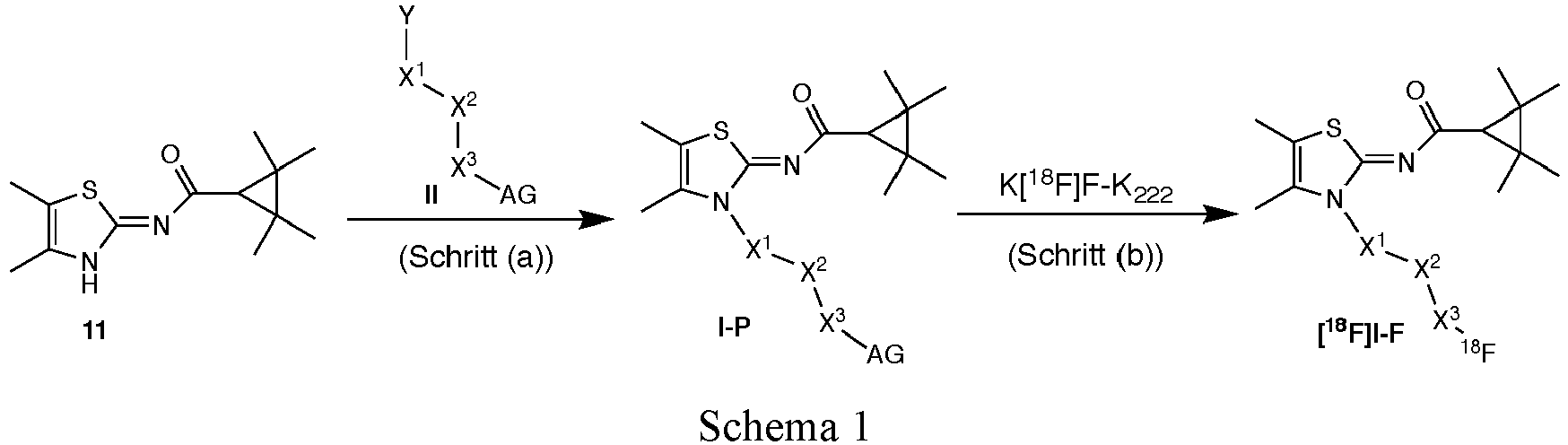
- Scheme 1 illustrates the preparation of a compound of the general formula [ 18 F]IF according to the process of the invention:
- Scheme 2 illustrates the preparation of a compound of general formula IF which does not contain [ 18 F]fluorine according to the process of the invention:
- Step (a) enables the preparation of the compounds of general formula IP.
- Step (a) is thus a process for preparing a compound of general formula IP.
- Scheme 3 illustrates the preparation of a compound of general formula IP:
- step (a) can also be used to prepare a compound of the general formula IF, with the difference that instead of a compound of the general formula II, a compound of the general formula III is used.
- X 1 , X 2 and X 3 have the meanings given in connection with general formula IF.
- Scheme 4 illustrates the preparation of a compound of general formula IF. It can be provided that compound III does not contain [ 18 F]fluorine.
- the invention enables in particular the radiosynthesis of deuterated compounds of the general formula [ 18 F]IF.
- the deuterated compounds of the general formula [ 18 F]IF can be used as radiotracers for nuclear medicine imaging of CBR 2 using positron emission tomography (PET).
- PET positron emission tomography
- the deuterated compounds of the general formula [ 18 F]IF have a high affinity and selectivity towards CBR 2 .
- a residue designated as deuterium or D is understood to mean a residue that has deuterium in an abundance that is at least 3000 times greater than the natural abundance of deuterium. Assuming a natural abundance of deuterium of 0.015%, a 3000 times higher abundance means a deuterium incorporation of 45%.
- a residue designated as tritium or T is understood to mean a residue that contains tritium in an abundance that is at least 4.5*10 16 times greater than the natural abundance of tritium. Assuming a natural abundance of tritium of 10 -15 %, a 4.5*10 16 times higher abundance means a tritium incorporation of 45%.
- isotopologues refers to molecules that differ only in their isotopic composition. They have the same chemical formula and the same bonding relationships between the atoms, but differ in at least one atom that has a different number of neutrons.
- the ratio between the abundance of an isotope in a compound and the natural abundance of the isotope is called the "isotope enrichment factor".
- the isotope enrichment factor should, as described above, be atom designated as deuterium may be at least 3000 (45% incorporation of deuterium with a remainder designated as deuterium).
- the isotopic enrichment factor may be at least 3500 (52.5% incorporation of deuterium), at least 4000 (60% incorporation of deuterium), at least 4500 (67.5% incorporation of deuterium), at least 5000 (75% incorporation of deuterium), at least 5500 (82.5% incorporation of deuterium), at least 6000 (90% incorporation of deuterium), at least 6333.3 (95% incorporation of deuterium), at least 6466.7 (97% incorporation of deuterium), at least 6600 (99% incorporation of deuterium) or at least 6633.3 (99.5% incorporation of deuterium).
- the isotope enrichment factor should, as described above, be at least 4.5*10 16 (45% incorporation of tritium with a remainder designated as tritium) for each atom designated as tritium.
- the isotope enrichment factor can be at least 5.25*10 16 (52.5% incorporation of tritium), at least 6 *10 16 (60% incorporation of tritium), at least 6.75*10 16 (67.5% incorporation of tritium), at least 7.5*10 16 (75% incorporation of tritium), at least 8.25*10 16 (82.5% incorporation of tritium), at least 9*10 16 (90% incorporation of tritium), at least 9.5*10 16 ,3 (95% incorporation of tritium), at least 9.7*10 16 (97% incorporation of tritium), at least 9.9*10 16 (99% incorporation of tritium) or at least 9.95*10 16 (99.5% incorporation of tritium).
- a compound which, according to the invention, is to have at least one deuterium atom or one tritium atom can be regarded as a group of isotopologues.
- the proportion of isotopologues which form a compound can vary.
- a compound which, according to the invention, is to have at least one deuterium atom or one tritium atom contains minor amounts of isotopologues which have hydrogen atoms instead of one or more of the specified deuterium atoms or tritium atoms.
- the relative amount of these isotopologues should, based on the compound, be less than 55% of the compound.
- the relative amount of these isotopologues is less than 50%, less than 47.5%, less than 40%, less than 32.5%, less than 25%, less than 17.5%, less than 10%, less than 5%, less than 3%, less than 1% or less than 0.5%.
- alkyl refers in particular to a saturated aliphatic hydrocarbon group having a branched or unbranched carbon chain of 1 to 12 carbon atoms, preferably 1 to 8 carbon atoms, and most preferably 1 to 6 carbon atoms.
- alkyl groups include, but are not limited to, methyl, ethyl, propyl, isopropyl, isobutyl, sec -butyl, tert -butyl, pentyl, n -hexyl, octyl, dodecyl, and the like.
- the alkyl group may optionally be substituted with one or more substituents, each substituent independently being hydroxy, alkyl, alkoxy, halogen, haloalkyl, amino, monoalkylamino, or dialkylamino, unless specifically stated otherwise.
- alkoxy refers particularly to a group of the formula -OR, wherein R is an alkyl group as defined herein.
- alkoxy moieties include, but are not limited to, methoxy, ethoxy, isopropoxy, and the like.
- the alkoxy group may optionally be substituted with one or more substituents, each substituent independently being hydroxy, alkyl, alkoxy, halogen, haloalkyl, amino, monoalkylamino, or dialkylamino, unless specifically indicated otherwise.
- aryl or "arene”, unless otherwise indicated, refers to a cyclic aromatic hydrocarbon group consisting of a mono-, bi- or tricyclic aromatic ring system having 5 to 15 ring atoms, preferably 5 or 6 ring atoms.
- the aryl group may optionally be a substituted aryl group.
- aryl groups include, but are not limited to, phenyl, naphthyl, anthracenyl, naphthalenyl, phenanthryl, fluorenyl, indenyl, pentalenyl, azulenyl, oxydiphenyl, biphenyl, methylenediphenyl, aminodiphenyl, diphenylsulfidyl, diphenylsulfonyl, diphenylisopropylidenyl, benzodioxanyl, benzofuranyl, benzodioxylyl, benzopyranyl, benzoxazinyl, benzoxazinonyl, benzopiperadinyl, benzopiperazinyl, benzopyrrolidinyl, benzomorpholinyl, methylenedioxyphenyl, ethylenedioxyphenyl and the like, including partially hydrogenated derivatives thereof.
- substituted aryl group refers in particular to an aryl group optionally substituted independently with one to four substituents, preferably one or two substituents, selected from alkyl, cycloalkyl, heteroalkyl, hydroxyalkyl, halogen, nitro, cyano, hydroxy, alkoxy, amino, acylamino, monoalkylamino, dialkylamino, haloalkyl, haloalkoxy, urea, amido, alkanesulfonyl, -COR (wherein R is hydrogen, alkyl, phenyl or phenylalkyl), -(CR'R") n -COOR (wherein n is an integer from 0 to 5, R' and R" are independently hydrogen or alkyl, and R is hydrogen, alkyl, cycloalkyl, cycloalkylalkyl, phenyl or phenylalkyl) or
- halogen refers, unless otherwise specified, to fluorine, chlorine, bromine or iodine.
- Scheme 5 shows the preparation of the compound according to the invention [ 18 F]JHU94620-D4 by reacting N -(4,5-dimethylthiazol-2(3H)-ylidene)-2,2,3,3-tetramethylcyclopropane-1-carboxamide ( 11 ) with butane-1,4-diyl-1,1,4,4- d 4 -bis(4-methylbenzenesulfonate) ( 12 ) to give the precursor ( 3 ) and the subsequent conversion of compound 3 to [ 18 F]JHU94620-D4
- Compound 12 is a compound of general formula II in which X 1 is CD 2 , X 2 is (CH 2 ) 2 , X 3 is CD 2 , Y is -OTs and AG is -OTs.
- K[ 18 F]FK 222 refers to the [ 18 F]F - /K 222 /K + complex, the preparation of which is described below.
- the aqueous [ 18 F]fluoride (2 to 3 GBq) obtained after irradiation was added to 1 ml of water, fixed on an anion exchange cartridge (QMA) and eluted with an aqueous K 2 CO 3 solution (1.8 mg in 300 ml of water) into a solution of 1 ml of MeCN and Kryptofix (K 222 , 5.6 mg).
- the azeotropic drying of the complex was carried out with microwave assistance (power cycling, 75 W, 50 - 60 °C, argon flow) under vacuum.
- the formed [ 18 F]F - K 222 /K + complex was treated with 2 mg of the precursor 3 (in 600 ml of MeCN). The reaction mixture was then stirred at 90 °C for 10 min.
- the radiotracer was purified and isolated by semi-preparative RP-HPLC (column: ReproSil-Pur 120 C18-AQ, 250 x 20 mm, 5 mm; eluent: 65% MeCN/20 mM NH 4 OAc aq.; flow: 4.2 ml/min).
- the collected product fraction was diluted with water (20 ml), sorbed on a Sep-Pak ® -C18-Plus cartridge and eluted with ethanol (EtOH) (1.0 ml).
- the solvent was then removed by heating in an argon stream and formulated in a 0.9% saline solution ( ⁇ 10% ethanol, v/v).
- a 0.9% saline solution ⁇ 10% ethanol, v/v.
- the radiochemical purity was ⁇ 99%.
- the radiochemical yield was about 20 to 25%.
- the molar activity was 200 ⁇ 20 GBq/ ⁇ mol.
- [ 18 F]JHU94620 was used as in Moldovan et al. J. Med. Chem. 2016, 59, 7840-7855 described, using a bromine precursor.
- [ 18 F]JHU94620 was obtained with a radiochemical yield of 16% and a molar activity of 170 GBq/ ⁇ mol.
- Scheme 6 shows the preparation of the compound JHU94620-D4 according to the invention by reaction of N -(4,5-dimethylthiazol-2(3H)-ylidene)-2,2,3,3-tetramethylcyclopropane-1-carboxamide ( 11 ) with butane-1,4-diyl-1,1,4,4- d 4 -bis(4-methylbenzenesulfonate) ( 12 ) to give the precursor ( 3 ) and the subsequent conversion of compound 3 to JHU94620-D4.
- TBAF stands for tetrabutylammonium fluoride.
- Step (a) of the process shown in Scheme 6 was carried out as described in Example 1, step (a).
- Scheme 7 shows the preparation of the compound [ 18 F]JHU94620-D8 according to the invention by reaction of N -(4,5-dimethylthiazol-2(3 H )-ylidene)-2,2,3,3-tetramethylcyclopropane-1-carboxamide ( 11 ) with butane-1,4-diyl-1,1,2,2,3,3,4,4- d 8 -bis(4-methylbenzenesulfonate) ( 13 ) to give the precursor ( 4 ) and the subsequent conversion of compound 4 to [ 18 F]JHU94620-D8.
- Compound 13 is a compound of general formula II in which X 1 is CD 2 , X 2 is (CD 2 ) 2 , X 3 is CD 2 , Y is -OTs and AG is -OTs.
- [ 18 F]JHU94620-D8 was prepared in the same manner as in Example 1, step (b), except that compound 4 was used instead of compound 3 .
- Scheme 8 shows the preparation of the compound JHU94620-D8 according to the invention by reaction of N -(4,5-dimethylthiazol-2(3H)-ylidene)-2,2,3,3-tetramethylcyclopropane-1-carboxamide ( 11 ) with butane-1,4-diyl-1,1,2,2,3,3,4,4- d 8 -bis(4-methylbenzenesulfonate) ( 13 ) to give the precursor ( 4 ) and the subsequent conversion of compound 4 to JHU94620-D8.
- Step (a) of the process shown in Scheme 8 was carried out as described in Example 1, step (a).
- JHU94620-D8 was prepared in the same manner as in Example 2, step (b), except that compound 4 was used instead of compound 3 .
- JHU94620 is the non-radiofluorinated and non-deuterated analogue of [ 18 F]JHU94620-D4 and [ 18 F]JHU94620-D8.
- the equilibrium dissociation constant K D was determined using a homologous competition assay.
- a constant amount of binding protein Homogenate of CHO cells stably transfected with human CBR 2 receptor; 2 million cells/ml mixture
- a constant amount of [ 18 F]JHU94620-D8 (0.101 nM in the mixture) and an increasing concentration of JHU94620 (0.01 nM - 10 ⁇ M in the mixture) for 60 minutes at room temperature in binding buffer (50 mM TRIS-HCl, pH 7.4, with 5 mM MgCl 2 , 1 mM EDTA, 1% BSA).
- the separation of receptor-bound and free radioligand was carried out by filtration through a GF/B glass fiber filter incubated with 0.3% polyethyleneimine.
- the quantification of receptor-bound radioligand was carried out by measuring the filter-bound radioactivity in a gamma counter.
- the nonspecific binding of [ 18 F]JHU94620-D8 was determined by co-incubation with CP55940 (10 ⁇ M in the mixture), and the adsorption of the radioligand to the glass fiber filter was determined by incubation without binding protein.
- K D IC 50 (M) - radioligand (M)
- K D 2.72 nM.
- CP55940 is a synthetic cannabinoid.
- K i IC 50 ( 1 + L K D the CBR 2 equilibrium dissociation constant K i of JHU94620 was determined.
- L denotes the concentration of the free ligand.
- the exchange of hydrogen atoms by deuterium ions should not have any influence on the K i value. This also applies to the exchange of hydrogen atoms by tritium ions.
Landscapes
- Chemical & Material Sciences (AREA)
- Organic Chemistry (AREA)
- Health & Medical Sciences (AREA)
- Life Sciences & Earth Sciences (AREA)
- Pharmacology & Pharmacy (AREA)
- Veterinary Medicine (AREA)
- Public Health (AREA)
- General Health & Medical Sciences (AREA)
- Animal Behavior & Ethology (AREA)
- Medicinal Chemistry (AREA)
- Proteomics, Peptides & Aminoacids (AREA)
- Epidemiology (AREA)
- Optics & Photonics (AREA)
- Physics & Mathematics (AREA)
- Engineering & Computer Science (AREA)
- Chemical Kinetics & Catalysis (AREA)
- Neurology (AREA)
- Neurosurgery (AREA)
- General Chemical & Material Sciences (AREA)
- Nuclear Medicine, Radiotherapy & Molecular Imaging (AREA)
- Bioinformatics & Cheminformatics (AREA)
- Biomedical Technology (AREA)
- Organic Low-Molecular-Weight Compounds And Preparation Thereof (AREA)
- Medicines Containing Antibodies Or Antigens For Use As Internal Diagnostic Agents (AREA)
Description
- Die Erfindung betrifft deuterierte und/oder tritiierte N-(4,5-Dimethylthiazol-2(3H)-yliden)-2,2,3,3-tetramethylcyclopropan-1-carboxamid-Derivate und deren Verwendung zur Herstellung radiofluorierter Verbindungen. Sie betrifft insbesondere Präkursoren für die Herstellung radiofluorierter deuterierter und tritiierter N-(4,5-Dimethylthiazol-2(3H)-yliden)-2,2,3,3-tetramethylcyclopropan-1-carboxamid-Derivate, die Verwendung der Präkursoren für diesen Zweck und radiofluorierte deuterierte und tritiierte N-(4,5-Dimethylthiazol-2(3H)-yliden)-2,2,3,3-tetramethylcyclopropan-1-carboxamid-Derivate. Bezugnahmen auf Methoden zur Behandlung des menschlichen oder tierischen Körpers in den folgenden Absätzen werden als Bezugnahmen auf Verbindungen zur Verwendung in Methoden zur Behandlung des menschlichen oder tierischen Körpers durch Therapie oder Diagnose interpretiert.
- Aus
WO 2009/067613 A1 sind Verbindungen der allgemeinen Formel S-1 bekannt,
- Die aus
WO 2009/067613 A1 bekannten Verbindungen sollen außerdem zur Behandlung von Entzündungskrankheiten, Immunkrankheiten, neurologischen Störungen, Krebserkrankungen des Immunsystems, Atemwegserkrankungen und kardiovaskulären Erkrankungen geeignet sein. - Ferner sind die nachstehend gezeigten radiomarkierten N-(4,5-Dimethylthiazol-2(3H)-yliden)-2,2,3,3-tetramethylcyclopropan-1-carboxamid-Derivate bekannt. Die Verbindung [11C]A836339 wurde von Horti et al. (Bioorg. Med. Chem. 2010, 14, 5202-5207) publiziert. Basierend auf dem (4,5-Dimethylthiazol-2(3H)-yliden)-2,2,3,3-tetra-methylcyclopropan-1-carboxamid-Grundgerüst wurden selektive, fluorierte CBR2-Liganden von Moldovan et al. (J. Med. Chem. 2016, 59, 7840-7855 und J. Nuc. Med. 2015, 56, 53, 1048) synthetisiert und in einem Mausmodell für Neuroinflammation (LPS) untersucht. Zu diesen Verbindungen gehörte [18F]JHU94620. Basierend auf Moldovan et al. (J. Med. Chem. 2016, 59, 7840-7855) wurde [18F]2f von Caille et al. (Mol. Pharmaceutics 2017, 11, 4064-4078) entwickelt.

- Die 18F-markierte Verbindung [18F]JHU94620 wird nach dem Stand der Technik (Moldovan et al. J. Med. Chem. 2016, 59, 7840-7855) über eine Radiosynthese hergestellt, die von einem Brom-Präkursor ausgeht. Der Brom-Präkursor entspricht dabei [18F]JHU94620, außer dass sich an der Stelle des [18F]-Atoms ein Bromatom als Abgangsgruppe befindet. [18F]JHU94620 weist jedoch eine geringe metabolische Stabilität auf.
- Für eine medizinische Anwendung von Verbindung [18F]JHU94620 und anderen N-(4,5-Dimethylthiazol-2(3H-yliden)-2,2,3,3-tetramethylcyclopropan-1-carboxamid-Derivaten sollten die Verbindungen eine höhere metabolische Stabilität aufweisen.
- Aufgabe der Erfindung ist es, die Nachteile nach dem Stand der Technik zu beseitigen. Es sollen insbesondere N-(4,5-Dimethylthiazol-2(3H)-yliden)-2,2,3,3-tetra-methylcyclopropan-1-carboxamid-Derivate angegeben werden, die nicht nur eine hohe Affinität und Selektivität gegenüber CBR2, sondern auch eine hohe metabolische Stabilität besitzen und beispielsweise als Radiopharmaka oder Präkursoren für die Herstellung der Radiotracer verwendet werden können. Außerdem soll ein Verfahren zur Herstellung von N-(4,5-Dimethylthiazol-2(3H)-yliden)-2,2,3,3-tetramethylcyclopropan-1-carboxamid-Derivaten angegeben werden, das deren Herstellung mit hohen radiochemischen Ausbeuten ermöglicht.
- Diese Aufgabe wird durch die Merkmale der Ansprüche 1, 8, 9, 11, 12 und 13 gelöst. Zweckmäßige Ausgestaltungen der Erfindungen ergeben sich aus den Merkmalen der Unteransprüche.
- Nach Maßgabe der Erfindung ist eine Verbindung der allgemeinen Formel I vorgesehen:

- X1 eine CD2-Gruppe oder eine CT2-Gruppe ist;
- X2 Sauerstoff oder eine Gruppe (CZ1Z2)n ist, wobei Z1 und Z2 bei jedem Auftreten unabhängig voneinander jeweils Wasserstoff, Deuterium oder Tritium sind und n eine Ganzzahl von 1 bis 12 ist;
- X3 eine CD2-Gruppe oder eine CT2-Gruppe ist; und
- R aus der Gruppe ausgewählt ist, die aus Hydroxy, -NO2, Halogen, einem Diazonium-Ion, einem Diazonium-Salz, einem Trialkylammonium-Ion, einem Trialkylammonium-Salz, einem Dialkoxyaren, einem Sulfoxid, einer Boronsäure, einem Boronsäureester, einer zinnorganischen Verbindung, einem Iodonium-Ion, einem Iodonium-Salz, einem Iodonium-Ylid und einem Sulfonat besteht.
- Bei einer Verbindung der allgemeinen Formel I kann es sich um deren (E)-Isomer, deren (Z)-Isomer oder ein Gemisch aus dem (E)- und (Z)-Isomer handeln.
- Es kann eine Verbindung der allgemeinen Formel I vorgesehen sein, worin
- X1 eine CD2-Gruppe oder eine CT2-Gruppe ist;
- X2 aus der Gruppe ausgewählt ist, die aus (CH2)n, (CD2)n, (CT2)n und O besteht, wobei n eine Ganzzahl von 1 bis 12 ist;
- X3 eine CD2-Gruppe oder eine CT2-Gruppe ist; und
- R aus der Gruppe ausgewählt ist, die aus Hydroxy, -NO2, Halogen, einem Diazonium-Ion, einem Diazonium-Salz, einem Trialkylammonium-Ion, einem Trialkylammonium-Salz, einem Dialkoxyaren, einem Sulfoxid, einer Boronsäure, einem Boronsäureester, einer zinnorganischen Verbindung, einem Iodonium-Ion, einem Iodonium-Salz, einem Iodonium-Ylid und einem Sulfonat besteht.
- Enthält zumindest einer der Reste X1, X2 und X3 ein Deuteriumatom, so kann vorgesehen sein, dass die Reste X1, X2 und X3 kein Tritiumatom enthalten. In diesem Fall ist die Verbindung der allgemeinen Formel I entweder eine deuterierte Verbindung oder eine tritiierte Verbindung, aber keine Verbindung, die - abgesehen von ihrem natürlichen Vorkommen - Deuterium und Tritium enthält. Bevorzugt sind die erfindungsgemäßen Verbindungen der allgemeinen Formel I deuterierte Verbindungen. Die deuterierten Verbindungen sind vorzugsweise keine tritiierten Verbindungen. Im Folgenden bezeichnet der Ausdruck "deuterierte Verbindung" eine Verbindung, die Deuteriumatome enthält, aber - abgesehen von ihrem natürlichen Vorkommen - keine Tritiumatome. Der Ausdruck "tritiierte Verbindung" bezeichnet hingegen eine Verbindung, die Tritiumatome enthält, aber - abgesehen von ihrem natürlichen Vorkommen - keine Deuteriumatome.
- Es kann eine Verbindung der allgemeinen Formel I vorgesehen sein, worin
- X1 eine CD2-Gruppe ist;
- X2 Sauerstoff oder eine Gruppe (CZ1Z2)n ist, wobei Z1 und Z2 bei jedem Auftreten unabhängig voneinander jeweils Wasserstoff oder Deuterium sind und n eine Ganzzahl von 1 bis 12 ist;
- X3 eine CD2-Gruppe ist; und
- R aus der Gruppe ausgewählt ist, die aus Hydroxy, -NO2, Halogen, einem Diazonium-Ion, einem Diazonium-Salz, einem Trialkylammonium-Ion, einem Trialkylammonium-Salz, einem Dialkoxyaren, einem Sulfoxid, einer Boronsäure, einem Boronsäureester, einer zinnorganischen Verbindung, einem Iodonium-Ion, einem Iodonium-Salz, einem Iodonium-Ylid und einem Sulfonat besteht. Eine solche Verbindung ist eine deuterierte Verbindung.
- Es kann eine Verbindung der allgemeinen Formel I vorgesehen sein, worin
- X1 eine CD2-Gruppe ist;
- X2 aus der Gruppe ausgewählt ist, die aus (CH2)n, (CD2)n und O besteht, wobei n eine Ganzzahl von 1 bis 12 ist;
- X3 eine CD2-Gruppe ist; und
- R aus der Gruppe ausgewählt ist, die aus Hydroxy, -NO2, Halogen, einem Diazonium-Ion, einem Diazonium-Salz, einem Trialkylammonium-Ion, einem Trialkylammonium-Salz, einem Dialkoxyaren, einem Sulfoxid, einer Boronsäure, einem Boronsäureester, einer zinnorganischen Verbindung, einem Iodonium-Ion, einem Iodonium-Salz, einem Iodonium-Ylid und einem Sulfonat besteht. Eine solche Verbindung ist eine deuterierte Verbindung.
- Es kann eine Verbindung der allgemeinen Formel I vorgesehen sein, worin
- X1 eine CD2-Gruppe ist;
- X2 (CH2)n oder (CD2)n ist, wobei n eine Ganzzahl von 1 bis 12 ist;
- X3 eine CD2-Gruppe ist; und
- R aus der Gruppe ausgewählt ist, die aus Hydroxy, -NO2, Halogen, einem Diazonium-Ion, einem Diazonium-Salz, einem Trialkylammonium-Ion, einem Trialkylammonium-Salz, einem Dialkoxyaren, einem Sulfoxid, einer Boronsäure, einem Boronsäureester, einer zinnorganischen Verbindung, einem Iodonium-Ion, einem Iodonium-Salz, einem Iodonium-Ylid und einem Sulfonat besteht. Eine solche Verbindung ist eine deuterierte Verbindung.
- Erfindungsgemäß ist n eine Ganzzahl von 1 bis 12. Es kann vorgesehen sein, dass n 1, 2, 3, 4, 5 oder 6 ist. In einem Beispiel ist n = 2. In diesem Fall trägt das N-Atom der Dimethylthiazol-Gruppe eine n-Butyl-Gruppe.
- Es kann vorgesehen sein, dass die Verbindung der allgemeinen Formel I eine Verbindung der allgemeinen Formel I-F oder eine Verbindung der allgemeinen Formel I-P ist:
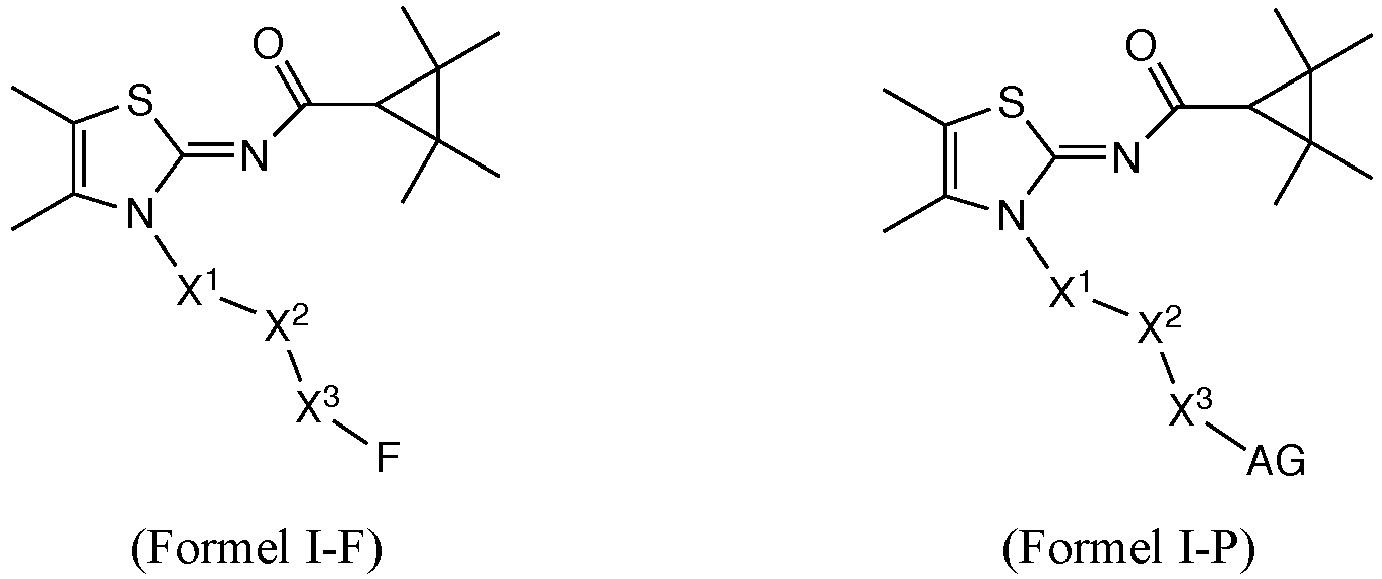
- Die Verbindung der Formel I-F ist eine Verbindung der allgemeinen Formel I, in der R Fluor ist. Die Verbindungen der Formel I-F sind deuterierte und/oder tritiierte fluorierte Verbindungen. Es kann vorgesehen sein, dass die Verbindung der allgemeinen Formel I eine Verbindung der allgemeinen Formel [18F]I-F ist:

- Die erfindungsgemäßen Verbindungen weisen eine hohe metabolische Stabilität auf. Das ist bei den Verbindungen der allgemeinen Formel I-F und [18F]I-F besonders vorteilhaft, weil die in Positronen-Emissions-Tomographie (PET) eingesetzt werden sollen. Die hohe metabolische Stabilität verringert die Menge an Metaboliten im Gehirn (in vivo) stark. Der Einsatz von Verbindungen bei der PET-Bildgebung setzt voraus, dass nur geringe Mengen an Metaboliten in das Gehirn gelangen. Die erfindungsgemäßen Verbindungen der allgemeinen Formel I, insbesondere der allgemeinen Formel I-F, beispielsweise der Verbindungen der allgemeinen Formel [18F]I-F, weisen eine hohe Bindungsaffinität und Selektivität gegenüber CBR2 auf. Ihre Bindungsaffinität und Selektivität entsprechen denen der Verbindungen, die keine Deuterierung oder Tritiierung aufweisen. Sie können daher als hochaffine und selektive CBR2-Radiopharmaka verwendet werden. Die erfindungsgemäßen 18F-markierten Radiotracer der allgemeinen Formel [18F]I-F können zu In-vitro- und In-vivo-Untersuchungen der Expression und Verfügbarkeit von CBR2 in Organismen durch geeignete Nachweisverfahren wie die Positronen-Emissions-Tomographie (PET) genutzt werden. Diese Untersuchungen ermöglichen es, genauere Kenntnisse über die Wirkung von Referenzverbindungen zu gewinnen und somit neben dem Radiopharmakon weitere Medikamente zu entwickeln und hinsichtlich ihrer potentiellen Wirksamkeit zu bewerten.
- Die Verbindung der allgemeinen Formel I-P ist eine Verbindung der allgemeinen Formel I, wobei R eine Abgangsgruppe AG ist. Die Verbindungen der allgemeinen Formel I-P können insbesondere als Präkursoren für die Herstellung der Verbindungen der allgemeinen Formel [18F]I-F verwendet werden.
- Es kann vorgesehen sein, dass AG ein Sulfonat ist. Unter dem Begriff "Sulfonat" wird eine RS-SO2-O-Gruppe verstanden. RS kann beispielsweise eine verzweigte oder unverzweigte substituierte oder unsubstituierte C1-C6-Alkylgruppe, eine Arylgruppe oder eine Alkylarylgruppe sein. Vorzugsweise ist RS CH3-, CF3- oder CH3-C6H4-. Das Sulfonat kann beispielsweise aus der Gruppe ausgewählt sein, die aus einer Toluolsulfonsäureester-Gruppe, einer Methylsulfonsäureester-Gruppe und einer Trifluormethylsulfonsäureester-Gruppe besteht. Unter einer Toluolsulfonsäureester-Gruppe wird eine -OTs-Gruppe verstanden, wobei Ts Tosyl ist. Unter einer Methylsulfonsäureester-Gruppe wird eine -OMs-Gruppe verstanden, wobei Ms Mesyl ist. Unter einer Trifluormethylsulfonsäureester-Gruppe wird CF3-SO2-O- verstanden. Vorzugsweise ist AG -OMs oder -OTs. Besonders bevorzugt ist AG -OTs.
- Es kann vorgesehen sein, dass AG eine zinnorganische Verbindung ist. Dabei kann es sich um ein Zinnorganyl handeln. Bei der zinnorganischen Verbindung kann es sich beispielsweise um Alkylzinn, dessen Alkylgruppe(n) substituiert oder unsubstituiert sein können, wobei eine oder mehrere der Alkylgruppen gegebenenfalls ein oder mehrere Heteroatome aufweisen, oder Arylzinn, dessen Arylgruppe(n) substituiert oder unsubstituiert sein können, wobei eine oder mehrere der Arylgruppen gegebenenfalls ein oder mehrere Heteroatome aufweisen, handeln. Bei den Heteroatomen kann es sich beispielsweise um O, N, S oder P handeln.
- Es kann vorgesehen sein, dass AG ein Halogen ist, das aus der Gruppe ausgewählt ist, die aus Chlor, Brom und Iod besteht.
- Bevorzugte Beispiele von Verbindungen der allgemeinen Formel I sind in der nachstehenden Tabelle 1 angegeben. Bei den in Tabelle 1 angegebenen Verbindung kann es sich jeweils um deren (E)-Isomer, deren (Z)-Isomer oder ein Gemisch aus dem (E)- und (Z)-Isomer handeln.
Tabelle 1 Verbindung Struktur Name [18F]JHU94620-D4 
N-(3-(4-([18F]Fluor)butyl-1,1,4,4-d 4)-4,5-dimethylthiazol-2(3H)-yliden)-2,2,3,3-tetramethylcyclopropan-1-carboxamid JHU94620-D4 
N-(3-(4-Fluorbutyl-1,1,4,4-d 4)-4,5-dimethylthiazol-2(3H)-yliden)-2,2,3,3-tetra-methylcyclopropan-1-carboxamid 3 
4-(4,5-Dimethyl-2-((2,2,3,3-tetramethylcyclopropan-1-carbonyl)-imino)thiazol-3(2H)-yl)butyl-1,1,4,4-d 4-4-methylbenzensulfonat [18F]JHU94620-D8 
N-(3-(4-([18F]Fluor)butyl-1,1,2,2,3,3,4,4-d 8)-4,5-dimethylthiazol-2(3H)-yli-den)-2,2,3,3-tetramethylcy-clopropan-1-carboxamid JHU94620-D8 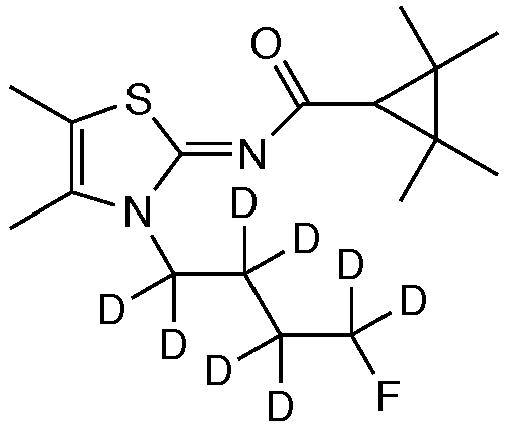
N-(3-(4-Fluorbutyl-1,1,2,2,3,3,4,4-d 8)-4,5-dimethylthiazol-2(3H)-yliden)-2,2,3,3-tetramethylcy-clopropan-1-carboxamid 4 
4-(4, 5-Dimethyl-2-((2,2,3,3-tetramethylcyclo-propan-1-carbonyl)imino)-thiazol-3(2H)-yl)butyl-1,1,2,2,3,3,4,4-d 8-4-methylbenzensulfonat - Die Verbindungen [18F]JHU94620-D4 und [18F]JHU94620-D8 sind Verbindungen der allgemeinen Formel [18F]I-F. Die Verbindungen JHU94620-D4 und JHU94620-D8 sind Verbindungen der allgemeinen Formel I-F. Die Verbindungen 3 und 4 sind Verbindungen der allgemeinen Formel I-P. Verbindung 3 kann insbesondere als Präkursor für die Herstellung von [18F]JHU94620-D4 eingesetzt werden. Verbindung 4 kann insbesondere als Präkursor für die Herstellung von [18F]JHU94620-D8 eingesetzt werden.
- Es hat sich herausgestellt, dass die erfindungsgemäßen Verbindungen der allgemeinen Formel I, insbesondere der allgemeinen Formel I-F, Liganden für den Cannabinoid-Rezeptor 2 darstellen. Sie können daher für die Diagnostik und Therapie von Entzündungskrankheiten, Immunkrankheiten, neurologischen Störungen, Krebserkrankungen des Immunsystems, Atemwegserkrankungen und kardiovaskulären Erkrankungen genutzt werden. Sie können darüber hinaus zur Linderung von Schmerzen genutzt werden. Die erfindungsgemäßen Verbindungen der allgemeinen Formel I können somit als Medikament, insbesondere als Medikament für Entzündungskrankheiten, Immunkrankheiten, neurologische Störungen, Krebserkrankungen des Immunsystems, Atemwegserkrankungen und kardiovaskuläre Erkrankungen genutzt werden. Sie können darüber hinaus als Medikament zur Linderung von Schmerzen genutzt werden. Ebenso kann ein pharmazeutisch akzeptables Salz einer Verbindung der allgemeinen Formel I als Medikament, insbesondere als Medikament für Entzündungskrankheiten, Immunkrankheiten, neurologische Störungen, Krebserkrankungen des Immunsystems, Atemwegserkrankungen und kardiovaskuläre Erkrankungen oder als Medikament zur Linderung von Schmerzen genutzt werden. Entzündungskrankheiten umfassen beispielsweise Entzündungen von Nervengewebe (die auch als Neuroinflammation bezeichnet werden).
- Nach Maßgabe der Erfindung ist ferner die Verwendung einer Verbindung der allgemeinen Formel I-P


- Die Verbindungen der allgemeinen Formel I-P sind besonders geeignete Präkursoren für die Herstellung von Verbindungen der allgemeinen Formel [18F]I-F. Beispielsweise kann Verbindung 3 als Präkursor für die Herstellung von [18F]JHU94620-D4 eingesetzt werden.
- Nach Maßgabe der Erfindung ist außerdem ein Verfahren zur Herstellung einer Verbindung der allgemeinen Formel I-F, z. B. einer Verbindung der allgemeinen Formel [18F]I-F, vorgesehen. Das Verfahren umfasst die Schritte:
- (a) Umsetzen einer Verbindung der Formel 11

- mit einer Verbindung der allgemeinen Formel II

- worin X1, X2, X3 und AG die im Zusammenhang mit der allgemeinen Formel I-P angegebenen Bedeutung haben und Y ein Sulfonat ist, zu einer Verbindung der allgemeinen Formel I-P; und
- mit einer Verbindung der allgemeinen Formel II
- (b) Umsetzen der Verbindung der allgemeinen Formel I-P zu der Verbindung der allgemeinen Formel I-F mit einem Fluorierungsmittel.
- Bei der Verbindung der Formel 11 kann es sich um deren (E)-Isomer, deren (Z)-Isomer oder ein Gemisch aus dem (E)- und (Z)-Isomer handeln.
- In der Verbindung der allgemeinen Formel II ist Y vorzugsweise Y -O-Ts oder O-Ms, besonders bevorzugt O-Ts, wobei Ts eine Tosylgruppe und Ms eine Mesylgruppe bezeichnet. Es kann ferner vorgesehen sein, dass AG ebenfalls ein Sulfonat ist. In diesem Fall können beispielsweise Y und AG jeweils dieselbe Bedeutung aufweisen. So kann in einer bevorzugten Ausführungsform sowohl Y als auch AG jeweils -O-Ts sein. Ein Beispiel einer Verbindung der allgemeinen Formel II ist Butan-1,4-diyl-1,1,4,4-d 4-bis(4-methylbenzensulfonat) (12). Ein anderes Beispiel einer Verbindung der allgemeinen Formel II ist Butan-1,4-diyl-1,1,2,2,3,3,4,4-d 8-bis(4-methylbenzensulfonat) (13).
- Die in Schritt (a) des erfindungsgemäßen Verfahrens vorgesehene Umsetzung von Verbindung 11 mit einer Verbindung der allgemeinen Formel II kann in einem organischen Lösungsmittel durchgeführt werden. Bei dem organischen Lösungsmittel kann es sich um ein nicht-protisches, polares Lösungsmittel wie Acetonitril (MeCN), Dimethylformamid (DMF), N,N-Dimethylacetamid (DMAA), N-Methyl-2-pyrrolidon (NMP), Dimethylsulfoxid (DMSO) oder Gemische davon handeln. Vorzugsweise wird Dimethylformamid als Lösungsmittel verwendet. Die Temperatur liegt bevorzugt zwischen 0 und 100 °C, stärker bevorzugt zwischen 20 und 100 °C, noch stärker bevorzugt zwischen 40 und 80 °C, besonders bevorzugt bei 60 °C. Die Umsetzung wird vorzugsweise bei Raumtemperatur oder einer erhöhten Temperatur durchgeführt. Bevorzugt wird die Umsetzung für einen Zeitraum von 10 min bis 2 h, stärker bevorzugt von 30 min bis 1,5 h und besonders bevorzugt 60 min durchgeführt. Die Umsetzung wird vorzugsweise bei Umgebungsdruck durchgeführt. Die Umsetzung wird vorzugsweise unter Bewegung des Reaktionsgemisches, beispielsweise unter Rühren, durchgeführt. Verbindung 11 und die Verbindung der allgemeinen Formel II liegen vorzugsweise in einem molaren Verhältnis von 1 : 2 bis 2 : 1, bevorzugt von 1 : 1 vor. Die Umsetzung kann in Gegenwart eines Hydrids, bevorzugt eines Alkali- oder Erdalkalimetallhydrids durchgeführt werden. Ein bevorzugtes Hydrid ist Natriumhydrid (NaH). Die Umsetzung kann unter einer Schutzgasatmosphäre, beispielsweise unter einer Stickstoff- oder Argonatmosphäre vorgenommen werden. Die Konzentration von Verbindung 11, der Verbindung der allgemeinen Formel II und, falls vorgesehen, des Hydrids in dem Lösungsmittel, sollte - bezogen auf die Lösung - jeweils wenigstens 10 Gew.-% betragen.
- Schritt (b) sieht das Umsetzen der Verbindung der allgemeinen Formel I-P zu der Verbindung der allgemeinen Formel I-F mit einem Fluorierungsmittel vor. Die Auswahl des Fluorierungsmittels und der Reaktionsbedingungen kann davon abhängen, ob die Verbindung der allgemeinen Formel I-F eine Verbindung der allgemeinen Formel [18F]I-F ist oder nicht radiofluoriert ist.
- Handelt es sich bei der Verbindung der allgemeinen Formel I-F um eine Verbindung der allgemeinen Formel [18F]I-F, so kann es sich bei dem Fluorierungsmittel um [18F]Fluorid-Anionen handeln. Die [18F]Fluorid-Anionen können in einer Lösung vorliegen, die im Folgenden als [18F]Fluorid-haltige Lösung bezeichnet wird. In Schritt (b) kann zur Herstellung der [18F]Fluorid-haltigen Lösung das [18F]Fluorid-Anion mittels bekannter Verfahren hergestellt werden. Beispielsweise wird das [18F]Fluorid-Anion im Zvklotron durch Bestrahlung von mindestens 97%-ig angereichertem H2 18O mit Protonen einer Energie von 9,6 MeV hergestellt. Die auf diesem Wege erhaltene wässrige [18F]Fluorid-haltige Lösung kann auf einer Anionentauscherkartusche (QMA) fixiert und mit Hilfe einer wässrigen Lösung einer Base, wie Kaliumcarbonat, Cäsiumcarbonat, Natriumhydrid oder Tetraalkylammoniumhydrogencarbonat eluiert werden. Vorzugsweise wird eine wässrige Lösung von Kaliumcarbonat als Base verwendet. Die Elution der basischen [18F]Fluorid-haltigen Lösung erfolgt in ein Reaktionsgefäß, das einen Phasen-Transfer-Katalysator (PTC), wie Kronenether, quartäre Ammoniumsalze oder Alkali- oder Erdalkalisalze, enthält. Als PTC werden vorzugsweise ein [2,2,2]-Kryptand (Kryptofix® oder K222), Tetra-n-Butyl-Ammonium-phosphat, -hydroxid, -oxalat, Toluensulfonat, oder wahlweise andere Kronenether wie 18-Krone-6 genutzt. Der auf diese Weise erhaltene [18F]Fluorid-Komplex kann einer azeotropen Trocknung unter Vakuum unterzogen werden. Bei dem organischen Lösungsmittel kann es sich um ein nicht-protisches, polares Lösungsmittel wie Acetonitril (MeCN), Dimethylformamid (DMF), N,N-Dimethylacetamid (DMAA), N-Methyl-2-pyrrolidon (NMP), Dimethylsulfoxid (DMSO) oder Gemische davon handeln. Vorzugsweise wird Acetonitril als Lösungsmittel verwendet. Die azeotrope Trocknung wird vorzugsweise unter thermischer Reaktionsführung im geschlossenen Reaktionsgefäß bei erhöhter Temperatur durchgeführt. Die Temperatur liegt vorzugsweise zwischen 50 und 60 °C. Die azeotrope Trocknung kann auch mit Unterstützung von Mikrowellen durchgeführt werden. Dazu können Mikrowellen mit einer Leistung von 50 bis 150 W, bevorzugt 65 bis 85 W und besonders bevorzugt 75 W verwendet werden.
- Zur Durchführung von Schritt (b) wird der azeotrop getrocknete [18F]Fluorid-Komplex vorzugsweise in einem organischen Lösungsmittel gelöst. Auf diese Weise wird die [18F]Fluorid-haltige Lösung erhalten. Bei dem organischen Lösungsmittel kann es sich um ein nicht-protisches, polares Lösungsmittel wie Acetonitril (MeCN), Dimethylformamid (DMF), N,N-Dimethylacetamid (DMAA), N-Methyl-2-pyrrolidon (NMP), Dimethylsulfoxid (DMSO) oder Gemische davon handeln. Vorzugsweise wird Acetonitril als Lösungsmittel verwendet. Zu dieser Lösung wird dann der Präkursor der allgemeinen Formel P-1 gegeben. Vorzugsweise wird der Präkursor zuvor in einem organischen Lösungsmittel gelöst. Bei diesem Lösungsmittel handelt es sich vorzugsweise um das gleiche Lösungsmittel, das als Lösungsmittel in der [18F]Fluorid-haltigen Lösung enthalten ist, also um Acetonitril. Der in dem Lösungsmittel gelöste Präkursor wird dann zu der [18F]Fluorid-haltigen Lösung gegeben. Schritt (b) des erfindungsgemäßen Verfahrens wird vorzugsweise bei einer erhöhten Temperatur durchgeführt. Die Temperatur liegt vorzugsweise zwischen 80 und 110 °C, besonders bevorzugt bei 90 °C. Vorzugsweise wird der Schritt (b) für einen Zeitraum von 5 bis 15 min und besonders bevorzugt 10 min durchgeführt. Schritt (b) des erfindungsgemäßen Verfahrens wird vorzugsweise bei Umgebungsdruck durchgeführt. Schritt (b) wird vorzugsweise unter Bewegung des Reaktionsgemisches, beispielsweise unter Rühren, durchgeführt.
- Handelt es sich bei der Verbindung der allgemeinen Formel I-F nicht um eine Verbindung der allgemeinen Formel [18F]I-F, so kann es sich bei dem Fluorierungsmittel um eine Verbindung handeln, die eine nukleophile Fluorierung der Verbindung der allgemeinen Formel I-P ermöglicht. Beispielsweise kann das Fluorierungsmittel ein Tetraalkylammoniumfluorid sein. Das Tetraalkylammoniumfluorid kann aus der Gruppe ausgewählt sein, die aus Tetrabutylammoniumfluorid (TBAF), Tetraethylammoniumfluorid (TEAF) und Tetramethylammoniumfluorid (TMAF) besteht.
- Schritt (b) kann in einem organischen Lösungsmittel durchgeführt werden. Bei dem organischen Lösungsmittel kann es sich um ein nicht-protisches, polares Lösungsmittel wie Tetrahydrofuran (THF), Acetonitril (MeCN), Dimethylformamid (DMF), N,N-Dimethylacetamid (DMAA), N-Methyl-2-pyrrolidon (NMP), Dimethylsulfoxid (DMSO) oder Gemische davon handeln. Vorzugsweise wird Tetrahydrofuran als Lösungsmittel verwendet. Die Temperatur liegt bevorzugt zwischen 0 und 100 °C, stärker bevorzugt zwischen 20 und 80 °C, noch stärker bevorzugt zwischen 40 und 60 °C, besonders bevorzugt bei 60 °C. Die Umsetzung wird vorzugsweise bei Raumtemperatur oder einer erhöhten Temperatur durchgeführt. Bevorzugt wird die Umsetzung für einen Zeitraum von 10 min bis 2 h, stärker bevorzugt von 30 min bis 1,5 h und besonders bevorzugt 60 min durchgeführt. Die Umsetzung wird vorzugsweise bei Umgebungsdruck durchgeführt. Die Umsetzung wird vorzugsweise unter Bewegung des Reaktionsgemisches, beispielsweise unter Rühren, durchgeführt. Die Verbindung der allgemeinen Formel I-P und das Fluorierungsmittel liegen vorzugsweise in einem molaren Verhältnis von 1 : 3 bis 2 : 1, bevorzugt von 2 : 1 vor. Die Umsetzung kann unter einer Schutzgasatmosphäre, beispielsweise unter einer Stickstoff- oder Argonatmosphäre vorgenommen werden. Die Konzentration der Verbindung der allgemeinen Formel I-P und des Fluorierungsmittels, sollte - bezogen auf die Lösung - jeweils wenigstens 10 Gew.-% betragen.
- Schema 1 veranschaulicht die Herstellung einer Verbindung der allgemeinen Formel [18F]I-F gemäß dem erfindungsgemäßen Verfahren:
- Schema 2 veranschaulicht die Herstellung einer Verbindung der allgemeinen Formel I-F, die kein [18F]Fluor enthält, gemäß dem erfindungsgemäßen Verfahren:

- Schritt (a) ermöglicht die Herstellung der Verbindungen der allgemeinen Formel I-P. Schritt (a) ist somit ein Verfahren zur Herstellung einer Verbindung der allgemeinen Formel I-P. Schema 3 veranschaulicht die Herstellung einer Verbindung der allgemeinen Formel I-P:

- Die im Zusammenhang mit Schritt (a) beschriebene Verfahrensweise kann auch zur Herstellung einer Verbindung der allgemeinen Formel I-F verwendet werden, mit dem Unterschied, dass anstelle von einer Verbindung der allgemeinen Formel II eine Verbindung der allgemeinen Formel III


- Die Erfindung ermöglicht insbesondere die Radiosynthese von deuterierten Verbindungen der allgemeinen Formel [18F]I-F. Insbesondere die deuterierten Verbindungen der allgemeinen Formel [18F]I-F können als Radiotracer für die nuklearmedizinische Bildgebung von CBR2 mittels Positronen-Emissions-Tomographie (PET) verwendet werden. Die deuterierten Verbindungen der allgemeinen Formel [18F]I-F weisen eine hohe Affinität und Selektivität gegenüber CBR2 auf.
- Es ist bekannt, dass Wasserstoff ein Mischelement ist. Bei der Herstellung der aus dem Stand der Technik bekannten Verbindung [18F]JHU94620 können daher geringe Menge an deuterierten und/oder tritiierten Isotopologen erhalten werden. Der Anteil der deuterierten und/oder tritiierten Isotopologe ist allerdings gering, weil er durch die natürliche Häufigkeit von Deuterium und Tritium bestimmt wird. In der vorliegenden Erfindung ist jedes Atom, das nicht ausdrücklich als spezielles Isotop benannt wird, ein stabiles Isotop. Sofern nichts anderes angegeben ist, wird unter einem Rest, der als Wasserstoff oder H bezeichnet ist, ein Rest verstanden, der Wasserstoff in seinem natürlichen Isotopenverhältnis aufweist. Sofern nichts anderes angegeben ist, wird unter einem Rest, der als Deuterium oder D bezeichnet ist, ein Rest verstanden, der Deuterium in einer Häufigkeit aufweist, die zumindest 3000 mal größer ist als die natürliche Häufigkeit von Deuterium. Unter Annahme einer natürlichen Häufigkeit von Deuterium von 0,015 % bedeutet eine 3000 mal höhere Häufigkeit einen Deuteriumeinbau von 45 %. Sofern nichts anderes angegeben ist, wird unter einem Rest, der als Tritium oder T bezeichnet ist, ein Rest verstanden, der Tritium in einer Häufigkeit aufweist, die zumindest 4,5*1016 mal größer ist als die natürliche Häufigkeit von Tritium. Unter Annahme einer natürlichen Häufigkeit von Tritium von 10-15 % bedeutet eine 4,5*1016 mal höhere Häufigkeit einen Tritiumeinbau von 45 %. Der Ausdruck "Isotopologe" bezeichnet Moleküle, die sich nur in ihrer Isotopenzusammensetzung unterscheiden. Sie haben die gleiche chemische Formel und die gleichen Bindungsverhältnisse zwischen den Atomen, unterscheiden sich aber durch zumindest ein Atom, das eine andere Zahl an Neutronen aufweist.
- Das Verhältnis zwischen der Häufigkeit eines Isotops in einer Verbindung und der natürlichen Häufigkeit des Isotops wird als "Isotopen-Anreicherungsfaktor" bezeichnet. Der Isotopen-Anreicherungsfaktor soll, wie vorstehend beschrieben, für jedes als Deuterium bezeichnete Atom zumindest 3000 (45 % Einbau von Deuterium bei einem als Deuterium bezeichneten Rest) betragen. Der Isotopen-Anreicherungsfaktor kann zumindest 3500 (52,5 % Einbau von Deuterium), zumindest 4000 (60 % Einbau von Deuterium), zumindest 4500 (67,5 % Einbau von Deuterium), zumindest 5000 (75 % Einbau von Deuterium), zumindest 5500 (82,5 % Einbau von Deuterium), zumindest 6000 (90 % Einbau von Deuterium), zumindest 6333,3 (95 % Einbau von Deuterium), zumindest 6466,7 (97 % Einbau von Deuterium), zumindest 6600 (99 % Einbau von Deuterium) oder zumindest 6633,3 (99,5 % Einbau von Deuterium) betragen. Der Isotopen-Anreicherungsfaktor soll, wie vorstehend beschrieben, für jedes als Tritium bezeichnete Atom zumindest 4,5*1016 (45 % Einbau von Tritium bei einem als Tritium bezeichneten Rest) betragen. Der Isotopen-Anreicherungsfaktor kann zumindest 5,25*1016 (52,5 % Einbau von Tritium), zumindest 6 *1016 (60 % Einbau von Tritium), zumindest 6,75*1016 (67,5 % Einbau von Tritium), zumindest 7,5*1016 (75 % Einbau von Tritium), zumindest 8,25*1016 (82,5 % Einbau von Tritium), zumindest 9*1016 (90 % Einbau von Tritium), zumindest 9,5*1016,3 (95 % Einbau von Tritium), zumindest 9,7*1016 (97 % Einbau von Tritium), zumindest 9,9*1016 (99 % Einbau von Tritium) oder zumindest 9,95*1016 (99,5 % Einbau von Tritium) betragen.
- Eine Verbindung, die nach Maßgabe der Erfindung zumindest ein Deuteriumatom oder ein Tritiumatom aufweisen soll, kann als Gruppe von Isotopologen angesehen werden. Der Anteil der Isotopologen, die eine Verbindung bilden, kann variieren. Eine Verbindung, die nach Maßgabe der Erfindung zumindest ein Deuteriumatom oder ein Tritiumatom aufweisen soll, enthält geringere Mengen an Isotopologen, die Wasserstoffatome anstelle eines oder mehrerer der angegebenen Deuteriumatome oder Tritiumatome aufweisen. Die relative Menge dieser Isotopologen sollte, bezogen auf die Verbindung, weniger als 55 % der Verbindung betragen. Es kann vorgesehen sein, dass die relative Menge dieser Isotopologen weniger als 50 %, weniger als 47,5 %, weniger als 40 %, weniger als 32,5 %, weniger als 25 %, weniger als 17,5 %, weniger als 10 %, weniger als 5 %, weniger als 3 %, weniger als 1 % oder weniger als 0,5 % beträgt.
- Der Ausdruck "Alkyl" bezieht sich, sofern nichts anderes angegeben ist, insbesondere auf eine gesättigte aliphatische Kohlenwasserstoff-Gruppe mit einer verzweigten oder unverzweigten Kohlenstoffkette mit 1 bis 12 Kohlenstoffatomen, vorzugsweise 1 bis 8 Kohlenstoffatomen und besonders bevorzugt 1 bis 6 Kohlenstoffatomen. Beispiele von Alkylgruppen umfassen, sind aber nicht beschränkt auf Methyl, Ethyl, Propyl, Isopropyl, Isobutyl, sec-Butyl, tert-Butyl, Pentyl, n-Hexyl, Octyl, Dodecyl und dergleichen. Die Alkylgruppe kann gegebenenfalls mit einem oder mehreren Substituenten substituiert sein, wobei jeder Substituent unabhängig Hydroxy, Alkyl, Alkoxy, Halogen, Halogenalkyl, Amino, Monoalkylamino oder Dialkylamino ist, wenn nicht speziell anders angegeben.
- Der Ausdruck "Alkoxy" bezieht sich, sofern nichts anderes angegeben ist, insbesondere auf eine Gruppe der Formel -OR, worin R eine Alkylgruppe ist, wie hierin definiert. Beispiele von Alkoxykomponenten umfassen, sind aber nicht beschränkt auf Methoxy, Ethoxy, Isopropoxy und dergleichen. Die Alkoxygruppe kann gegebenenfalls mit einem oder mehreren Substituenten substituiert sein, wobei jeder Substituent unabhängig Hydroxy, Alkyl, Alkoxy, Halogen, Halogenalkyl, Amino, Monoalkylamino oder Dialkylamino ist, wenn nicht speziell anders angegeben.
- Der Ausdruck "Aryl" oder "Aren" bezieht sich, sofern nichts anderes angegeben ist, auf eine cyclische, aromatische Kohlenwasserstoffgruppe, die aus einem mono-, bi- oder tricyclischen aromatischen Ringsystem mit 5 bis 15 Ringatomen, bevorzugt 5 oder 6 Ringatomen, besteht. Die Arylgruppe kann gegebenenfalls eine substituierte Arylgruppe sein. Beispiele von Arylgruppen umfassen, sind aber nicht beschränkt auf Phenyl, Naphthyl, Anthracenyl, Naphthalenyl, Phenanthryl, Fluorenyl, Indenyl, Pentalenyl, Azulenyl, Oxydiphenyl, Biphenyl, Methylendiphenyl, Aminodiphenyl, Diphenylsulfidyl, Diphenylsulfonyl, Diphenylisopropylidenyl, Benzodioxanyl, Benzofuranyl, Benzodioxylyl, Benzopyranyl, Benzoxazinyl, Benzoxazinonyl, Benzopiperadinyl, Benzopiperazinyl, Benzopyrrolidinyl, Benzomorpholinyl, Methylendioxyphenyl, Ethylendioxyphenyl und dergleichen, einschließlich teilweise hydrierte Derivate davon. Ein bevorzugtes Beispiel ist Phenyl. Der Ausdruck "substituierte Arylgruppe" bezieht sich insbesondere auf eine Arylgruppe, die gegebenenfalls unabhängig mit ein bis vier Substituenten, bevorzugt einem oder zwei Substituenten, ausgewählt aus Alkyl, Cycloalkyl, Heteroalkyl, Hydroxyalkyl, Halogen, Nitro, Cyano, Hydroxy, Alkoxy, Amino, Acylamino, Monoalkylamino, Dialkylamino, Halogenalkyl, Halogenalkoxy, Harnstoff, Amido, Alkansulfonyl, -COR (worin R Wasserstoff, Alkyl, Phenyl oder Phenylalkyl ist), -(CR'R")n-COOR (worin n eine Ganzzahl von 0 bis 5 ist, R' und R" unabhängig voneinander Wasserstoff oder Alkyl sind, und R Wasserstoff, Alkyl, Cycloalkyl, Cycloalkylalkyl, Phenyl oder Phenylalkyl ist) oder -(CR'R")n-CONRa'Rb' (worin n eine Ganzzahl von 0 bis 5 ist, R' und R" unabhängig voneinander Wasserstoff oder Alkyl sind und Ra' und Rb' unabhängig voneinander Wasserstoff, Alkyl, Cycloalkyl, Cycloalkylalkyl, Phenyl oder Phenylalkyl sind), substituiert ist. Beispiele eines Arens umfassen, sind aber nicht beschränkt auf Benzen, Naphthalin und Anthracen.
- Der Ausdruck "Acyl" bezieht sich, sofern nichts anderes angegeben ist, insbesondere auf eine Gruppe der Formel -C(=O)R, wobei R Wasserstoff oder Alkyl, wie hierin definiert, ist.
- Der Ausdruck "Halogen" bezieht sich, sofern nichts anderes angegeben ist, auf Fluor, Chlor, Brom oder Iod.
- Die Erfindung wird nachstehend anhand von Ausführungsbeispielen, die die Erfindung nicht einschränken sollen, unter Bezugnahme auf die Zeichnungen näher erläutert. Dabei zeigen
- Fig. 1
- ein UV-HPLC-Chromatogramm der Referenzverbindung JHU94620-D4;
- Fig. 2
- ein Radio-HPLC-Chromatogramm der erfindungsgemäßen Verbindung [18F]JHU94620-D4;
- Fig. 3
- ein Radio-HPLC-Chromatogramm von Hirnhomogenat 30 p.i. von [18F]JHU94620; und
- Fig. 4
- ein Radio-HPLC-Chromatogramm von Hirnhomogenat 30 p.i. von [18F]JHU94620-D4
- Schema 5 zeigt die Herstellung der erfindungsgemäßen Verbindung [18F]JHU94620-D4 durch Umsetzung von N-(4,5-Dimethylthiazol-2(3H)-yliden)-2,2,3,3-tetramethylcyclopropan-1-carboxamid (11) mit Butan-1,4-diyl-1,1,4,4-d 4-bis(4-methylbenzensulfonat) (12) zum Präkursor (3) und die anschließende Umsetzung von Verbindung 3 zu [18F]JHU94620-D4

- Bei Verbindung 12 handelt es sich um eine Verbindung der allgemeinen Formel II, in der X1 CD2 ist, X2 (CH2)2 ist, X3 CD2 ist, Y -OTs ist und AG -OTs ist. K[18F]F-K222 bezeichnet den [18F]F-/K222/K+-Komplex, dessen Herstellung nachstehend beschrieben ist.
- Zu einer Lösung von Verbindung 11 (1 eq, 0,6 mmol) und Verbindung 12 (1,5 eq, 0,9 mmol) in 3 ml DMF wurde NaH (60 %, 2 eq, 1,2 mmol) gegeben und die Mischung 1 h auf 60 °C unter Argonatmosphäre erhitzt. Anschließend wurde das Lösungsmittel am Rotationsverdampfer entfernt. Der Rückstand wurde in Ethylacetat (EA) aufgenommen (10 ml) und mit einer wässrigen 5%igen NaHCO3-Lösung (10 ml) und anschließend mit gesättigter NaCl-Lösung (100 ml) gewaschen. Trocknung über MgSO4 und Entfernen des Lösungsmittels ergaben ein gelbes Öl, welches mittels Säulenchromatographie (Kieselgel, EA : Petrolether (PE) von 1/20 bis 1/4) gereinigt wurde. Verbindung 3 wurde als weißer Feststoff mit einer Ausbeute von 33 % erhalten.
- 1H-NMR (400 MHz, CDCl3) δ 7,81 (d, J = 8,3 Hz, 2H), 7,36 (d, J = 8,0 Hz, 2H), 2,47 (s, 3H), 2,16 (s, 6H), 1,75 (m, 4H) 1,50 (s, 1H), 1,33 (s, 6H), 1,21 (s, 6H). HRMS (ESI+): m/z (%) = 483,2278, ber. 483,2284 für C24H31D4FN2O4S2 + [M+H]+.
- Das nach der Bestrahlung erhaltene wässrige [18F]Fluorid (2 bis 3 GBq) wurde zu 1 ml Wasser gegeben, auf einer Anionenaustauscherkartusche (QMA) fixiert und mit einer wässrigen K2CO3-Lösung (1,8 mg in 300 ml Wasser) in eine Lösung aus 1 ml MeCN und Kryptofix (K222, 5,6 mg) eluiert. Die azeotrope Trocknung des Komplexes erfolgte mikrowellenunterstützt (Power cycling, 75 W, 50 - 60 °C, Argonstrom) unter Vakuum. Der gebildete [18F]F-K222/K+-Komplex wurde mit 2 mg des Präkursors 3 (in 600 ml MeCN) versetzt. Anschließend wurde das Reaktionsgemisch bei 90 °C für 10 min gerührt.
- Zur Bestimmung der Markierungsausbeute wurde ein Aliquot entnommen und mit Radio-DC (49 ± 4 %, n = 3) und Radio-HPLC (48 ± 5 %, n = 2) untersucht. Die Reinigung und Isolation des Radiotracers erfolgte mittels semi-präparativer RP-HPLC (Säule: ReproSil-Pur 120 C18-AQ, 250 x 20 mm, 5 mm; Eluent: 65 % MeCN/20 mM NH4OAcaq.; Fluss: 4,2 ml/min). Die gesammelte Produktfraktion wurde mit Wasser verdünnt (20 ml), auf einer Sep-Pak®-C18-Plus-Kartusche sorbiert und mit Ethanol (EtOH) (1,0 ml) eluiert. Anschließend wurde das Lösungsmittel unter Erwärmen im Argonstrom entfernt und in einer 0,9%-igen Kochsalzlösung formuliert (≤ 10 % Ethanol, v/v). Innerhalb einer Synthesezeit von ca. 102 min wurde das Produkt [18F]JHU94620-D4 isoliert und durch Radio-HPLC und Radio-DC untersucht, wobei die Identität des Produktes durch Co-Injektion der Referenzverbindung bestätigt wurde (siehe
Figuren 1 und 2 ). Die radiochemische Reinheit war ≥ 99 %. Die radiochemische Ausbeute betrug etwa 20 bis 25 %. Die molare Aktivität betrug 200 ± 20 GBq/µmol. - Zu Vergleichszwecken wurde [18F]JHU94620, wie in Moldovan et al. J. Med. Chem. 2016, 59, 7840-7855 beschrieben, unter Verwendung eines Brom-Präkursors hergestellt. [18F]JHU94620 wurde mit einer radiochemischen Ausbeute von 16 % und einer molaren Aktivität von 170 GBq/µmol erhalten.
- Schema 6 zeigt die Herstellung der erfindungsgemäßen Verbindung JHU94620-D4 durch Umsetzung von N-(4,5-Dimethylthiazol-2(3H)-yliden)-2,2,3,3-tetramethylcyclopropan-1-carboxamid (11) mit Butan-1,4-diyl-1,1,4,4-d 4-bis(4-methylbenzensulfonat) (12) zum Präkursor (3) und die anschließende Umsetzung von Verbindung 3 zu JHU94620-D4.

- Schritt (a) des in Schema 6 gezeigten Verfahrens wurde wie in Beispiel 1, Schritt (a) beschrieben durchgeführt.
- Zu einer Lösung von Verbindung 3 (1 eq, 0,5 mmol) in 3 ml THF wurde TBAF (1M im THF, 2 eq, 1 mmol) gegeben und die Mischung 1 h auf 50 °C unter Argonatmosphäre erhitzt. Anschließend wurde das Lösungsmittel am Rotationsverdampfer entfernt. Der Rückstand wurde in Ethylacetat (EA) aufgenommen (10 ml) und mit einer wässrigen 5%igen NaHCO3-Lösung (10 ml) und anschließend mit gesättigter NaCl-Lösung (100 ml) gewaschen. Trocknung über MgSO4 und Entfernen des Lösungsmittels ergaben ein gelbes Öl, welches mittels Säulenchromatographie (Kieselgel, EA : Petrolether (PE) von 1/20 bis 1/4) gereinigt wurde. Verbindung JHU94620-D4 wurde als weißer Feststoff mit einer Ausbeute von 72 % erhalten.
- 1H-NMR (300 MHz, CDCl3) δ 2,20 (s, 3H), 2,18 (s, 3H), 1,55 (s, 1H), 1,36 (s, 6H), 1,24 (s, 6H). HRMS (ESI+): m/z (%) = 331,2152, ber. 331,2152 für C17H24D4FN2OS+ [M+H]+.
- Schema 7 zeigt die Herstellung der erfindungsgemäßen Verbindung [18F]JHU94620-D8 durch Umsetzung von N-(4,5-Dimethylthiazol-2(3H)-yliden)-2,2,3,3-tetramethylcyclopropan-1-carboxamid (11) mit Butan-1,4-diyl-1,1,2,2,3,3,4,4-d 8-bis(4-methylbenzensulfonat) (13) zum Präkursor (4) und die anschließende Umsetzung von Verbindung 4 zu [18F]JHU94620-D8.

- Bei Verbindung 13 handelt es sich um eine Verbindung der allgemeinen Formel II, in der X1 CD2 ist, X2 (CD2)2 ist, X3 CD2 ist, Y -OTs ist und AG -OTs ist.
- Verbindung 4 wurde in der gleichen Weise wie in Beispiel 1, Schritt (a) hergestellt, außer das anstelle von Verbindung 12 Verbindung 13 eingesetzt wurde.
- 1H-NMR (400 MHz, CDCl3) δ 7,81 (d, J = 8,3 Hz, 2H), 7,36 (d, J = 8,0 Hz, 2H), 2,47 (s, 3H), 2,16 (s, 6H), 1,50 (s, 1H), 1,33 (s, 6H), 1,21 (s, 6H). HRMS (ESI+): m/z (%) = 487,2537, ber. 487,2535 für C24H27D8N2O4S2 + [M+H]+.
- [ 18 F]JHU94620-D8 wurde in der gleichen Weise wie in Beispiel 1, Schritt (b) hergestellt, außer das anstelle von Verbindung 3 Verbindung 4 eingesetzt wurde.
- Schema 8 zeigt die Herstellung der erfindungsgemäßen Verbindung JHU94620-D8 durch Umsetzung von N-(4,5-Dimethylthiazol-2(3H)-yliden)-2,2,3,3-tetramethylcyclopropan-1-carboxamid (11) mit Butan-1,4-diyl-1,1,2,2,3,3,4,4-d 8-bis(4-methylbenzensulfonat) (13) zum Präkursor (4) und die anschließende Umsetzung von Verbindung 4 zu JHU94620-D8.

- Schritt (a) des in Schema 8 gezeigten Verfahrens wurde wie in Beispiel 1, Schritt (a) beschrieben durchgeführt.
- JHU94620-D8 wurde in der gleichen Weise wie in Beispiel 2, Schritt (b) hergestellt, außer dass anstelle von Verbindung 3 Verbindung 4 eingesetzt wurde.
- 1H-NMR (300 MHz, CDCl3) δ 2,20 (s, 3H), 2,18 (s, 3H), 1,93 - 1,81 (m, 2H), 1,77 - 1,68 (m, 2H), 1,55 (s, 1H), 1,36 (s, 6H), 1,24 (s, 6H). HRMS (ESI+): m/z (%) = 335,2402, ber. 335,2403 für C17H20D8FN2OS+ [M+H]+.
- Die metabolische Stabilität von [18F]JHU94620-D4 wurde gemäß dem von Moldovan et al., J. Med. Chem. 2016, 59, 7840-7855, beschriebenen Verfahren bestimmt. In gleicher Weise wurde die metabolische Stabilität von JHU94620 und [18F]JHU94620 bestimmt. Die in
Figuren 3 und 4 gezeigten Radio-HPLC-Chromatogramme wurde unter Verwendung einer ReproSil-Pur-C18-AQ-Säule 250 x 4,6 mm, 5 mm; Eluent: 10 - 90 - 10 % MeCN / 20 mM NH4OAc; Flow: 1 ml/min) bestimmt. JHU94620 weist folgende Formel auf:
- JHU94620 ist das nicht-radiofluorierte und nicht-deuterierte Analogon zu [18F]JHU94620-D4 und [18F]JHU94620-D8.
- Es ist in
Fig. 4 zu erkennen, dass in der In-vivo-Metabolitenstudie in weiblichen CD-1 Mäusen 30 min nach Injektion der Anteil von intaktem Radiotracer [18F]JHU94620-D4 im Gehirn ~80 % (Radio-HPLC, Extraktionsausbeute >97 %) und im Plasma ~15 % (Radio-HPLC, Extraktionsausbeute >95 %) betrug.Fig. 3 zeigt, dass der Anteil an intaktem Radiotracer [18F]JHU94620 nur 38 % betrug. [18F]JHU94620-D4 weist somit eine wesentlich höhere metabolische Stabilität als [18F]JHU94620 auf. - In der In-vivo-Metabolitenstudie in weiblichen CD-1-Mäusen betrug bei JΣIU94620 30 min nach Injektion der Anteil von intaktem Radiotracer im Gehirn 36 % (Radio-HPLC, n = 3, Extraktionsausbeute 93 %) und im Plasma 7 % (Radio-HPLC, n = 3, Extraktionsausbeute 94 %) der Gesamtaktivität.
- Die metabolische Stabilität von [18F]JHU94620-D8 ähnelt der von [18F]JHU94620-D4 in hohem Maße.
- Die Gleichgewichts-Dissoziationskonstante KD wurde mittels eines homologen Kompetitionsassays bestimmt. Dazu wurde eine konstante Menge an Bindungsprotein (Homogenat von stabil mit humanem CBR2-Rezeptor transfizierten CHO-Zellen; 2 Mio. Zellen/ml Ansatz) mit einer konstanten Menge an [18F]JHU94620-D8 (0,101 nM im Ansatz) und einer zunehmenden Konzentration von JHU94620 (0,01 nM - 10 µM im Ansatz) für 60 Minuten bei Raumtemperatur in Bindungspuffer (50 mM TRIS-HCl, pH 7,4, mit 5 mM MgCl2, 1 mM EDTA, 1 % BSA) inkubiert. Die Abtrennung von rezeptorgebundenem und freiem Radioliganden erfolgte durch Filtration über einen mit 0,3 % Polyethylenimin inkubierten GF/B-Glasfaserfilter. Die Quantifizierung von rezeptorgebundenem Radioliganden erfolgte durch Messung der filtergebundenen Radioaktivität in einem Gammacounter. Die Bestimmung der unspezifischen Bindung von [18F]JHU94620-D8 erfolgte durch Ko-Inkubation mit CP55940 (10 µM im Ansatz), die Bestimmung der Adsorption des Radioliganden an den Glasfaserfilter durch Inkubation ohne Bindungsprotein. Aus dem in diesem Experiment erhaltenen IC50-Wert (2,82 nM) kann über die entsprechend dem Versuchsansatz vereinfachte Cheng-Prusoff-Gleichung (KD = IC50 (M) - Radioligand (M)) der KD-Wert der Verbindung [18F]JHU94620-D8 gegenüber humanen CBR2-Rezeptoren des Radioliganden berechnet werden: KD = 2,72 nM. CP55940 ist ein synthetisches Cannabinoid.
- Unter Verwendung der Cheng-Prusoff-Gleichung

Claims (15)
- Verbindung der allgemeinen Formel I
 X1 eine CD2-Gruppe oder eine CT2-Gruppe ist;X2 Sauerstoff oder eine Gruppe (CZ1Z2)n ist, wobei Z1 und Z2 bei jedem Auftreten unabhängig voneinander jeweils Wasserstoff, Deuterium oder Tritium sind und n eine Ganzzahl von 1 bis 12 ist;X3 eine CD2-Gruppe oder eine CT2-Gruppe ist; undR aus der Gruppe ausgewählt ist, die aus Hydroxy, -NO2, Halogen, einem Diazonium-Ion, einem Diazonium-Salz, einem Trialkylammonium-Ion, einem Trialkylammonium-Salz, einem Dialkoxyaren, einem Sulfoxid, einer Boronsäure, einem Boronsäureester, einer zinnorganischen Verbindung, einem Iodonium-Ion, einem Iodonium-Salz, einem Iodonium-Ylid und einem Sulfonat besteht.
 - Verbindung nach Anspruch 1, dadurch gekennzeichnet, dassX1 eine CD2-Gruppe oder eine CT2-Gruppe ist;X2 aus der Gruppe ausgewählt ist, die aus (CH2)n, (CD2)n, (CT2)n und O besteht, wobei n eine Ganzzahl von 1 bis 12 ist;X3 eine CD2-Gruppe oder eine CT2-Gruppe ist; undR aus der Gruppe ausgewählt ist, die aus Hydroxy, -NO2, Halogen, einem Diazonium-Ion, einem Diazonium-Salz, einem Trialkylammonium-Ion, einem Trialkylammonium-Salz, einem Dialkoxyaren, einem Sulfoxid, einer Boronsäure, einem Boronsäureester, einer zinnorganischen Verbindung, einem Iodonium-Ion, einem Iodonium-Salz, einem Iodonium-Ylid und einem Sulfonat besteht.
- Verbindung nach Anspruch 1 oder Anspruch 2, dadurch gekennzeichnet, dassX1 eine CD2-Gruppe ist;X2 aus der Gruppe ausgewählt ist, die aus (CH2)n, (CD2)n und O besteht, wobei n eine Ganzzahl von 1 bis 12 ist;X3 eine CD2-Gruppe ist; undR aus der Gruppe ausgewählt ist, die aus Hydroxy, -NO2, Halogen, einem Diazonium-Ion, einem Diazonium-Salz, einem Trialkylammonium-Ion, einem Trialkylammonium-Salz, einem Dialkoxyaren, einem Sulfoxid, einer Boronsäure, einem Boronsäureester, einer zinnorganischen Verbindung, einem Iodonium-Ion, einem Iodonium-Salz, einem Iodonium-Ylid und einem Sulfonat besteht.
- Verbindung nach einem der vorstehenden Ansprüche, dadurch gekennzeichnet, dass n 1, 2, 3, 4, 5 oder 6 ist.
- Verbindung nach einem der vorstehenden Ansprüche, dadurch gekennzeichnet, dass R Fluor ist.
- Verbindung nach einem der vorstehenden Ansprüche, dadurch gekennzeichnet, dass R [18F]Fluor ist.
- Verbindung nach einem der vorstehenden Ansprüche, dadurch gekennzeichnet, dass sieN-(3-(4-([18F]Fluor)butyl-1,1,4,4-d 4)-4,5-dimethylthiazol-2(3H)-yliden)-2,2,3,3-tetramethylcyclopropan-1-carboxamid;N-(3-(4-Fluorbutyl-1,1,4,4-d 4)-4,5-dimethylthiazol-2(3H)-yliden)-2,2,3,3-tetramethylcyclopropan-1-carboxamid;4-(4,5-Dimethyl-2-((2,2,3,3-tetramethylcyclopropan-1-carbonyl)-imino)thiazol-3(2H)-yl)butyl-1,1,4,4-d 4-4-methylbenzensulfonat;N-(3-(4-([18F]Fluor)butyl-1,1,2,2,3,3,4,4-d 8)-4,5-dimethylthiazol-2(3H)-yliden)-2,2,3,3-tetramethylcyclopropan-1-carboxamid;N-(3-(4-Fluorbutyl-1,1,2,2,3,3,4,4-d 8)-4,5-dimethylthiazol-2(3H)-yliden)-2,2,3,3-tetramethylcyclopropan-1-carboxamid; oder4-(4,5-Dimethyl-2-((2,2,3,3-tetramethylcyclopropan-1-carbonyl)-imino)thiazol-3(2H)-yl)butyl-1,1,2,2,3,3,4,4-d 8-4-methylbenzensulfonat ist.
- Verbindung nach einem der Ansprüche 1 bis 7 zur Verwendung als Medikament.
- Verbindung nach einem der Ansprüche 1 bis 7 zur Verwendung als Medikament zur Diagnostik und Therapie von Erkrankungen, an denen ein Cannabinoid-Rezeptor 2 beteiligt ist.
- Verbindung nach Anspruch 8 oder Anspruch 9, dadurch gekennzeichnet, dass das Medikament ein Radiopharmakon zur nuklearmedizinischen Bildgebung des Cannabinoid-Rezeptors 2 mittels Positronen-Emissions-Tomographie (PET) ist.
- Medikament, enthaltend eine Verbindung nach einem der Ansprüche 1 bis 10 oder ein pharmazeutisch akzeptables Salz davon.
- Verwendung einer Verbindung der allgemeinen Formel I-P
 X1 eine CD2-Gruppe oder eine CT2-Gruppe ist;X2 Sauerstoff oder eine Gruppe (CZ1Z2)n ist, wobei Z1 und Z2 bei jedem Auftreten unabhängig voneinander jeweils Wasserstoff, Deuterium oder Tritium sind und n eine Ganzzahl von 1 bis 12 ist;X3 eine CD2-Gruppe oder eine CT2-Gruppe ist; undAG aus der Gruppe ausgewählt ist, die aus Hydroxy, -NO2, Chlor, Brom, Iod, einem Diazonium-Ion, einem Diazonium-Salz, einem Trialkylammonium-Ion, einem Trialkylammonium-Salz, einem Dialkoxyaren, einem Sulfoxid, einer Boronsäure, einem Boronsäureester, einer zinnorganischen Verbindung, einem Iodonium-Ion, einem Iodonium-Salz, einem Iodonium-Ylid und einem Sulfonat besteht,zur Herstellung einer Verbindung der allgemeinen Formel [18F]I-F
 worin X1, X2 und X3 die im Zusammenhang mit der allgemeinen Formel I-P angegebenen Bedeutung haben.
 - Verfahren zur Herstellung einer Verbindung der allgemeinen Formel I-F,
 X1 eine CD2-Gruppe oder eine CT2-Gruppe ist;X2 Sauerstoff oder eine Gruppe (CZ1Z2)n ist, wobei Z1 und Z2 bei jedem Auftreten unabhängig voneinander jeweils Wasserstoff, Deuterium oder Tritium sind und n eine Ganzzahl von 1 bis 12 ist; undX3 eine CD2-Gruppe oder eine CT2-Gruppe ist;wobei das Verfahren die Schritte umfasst:(a) Umsetzen einer Verbindung der Formel 11
 mit einer Verbindung der allgemeinen Formel II
 worinX1, X2 und X3 die im Zusammenhang mit der allgemeinen Formel I-P angegebenen Bedeutung haben;Y ein Sulfonat ist; undAG aus der Gruppe ausgewählt ist, die aus Hydroxy, -NO2, Chlor, Brom, Iod, einem Diazonium-Ion, einem Diazonium-Salz, einem Trialkylammonium-Ion, einem Trialkylammonium-Salz, einem Dialkoxyaren, einem Sulfoxid, einer Boronsäure, einem Boronsäureester, einer zinnorganischen Verbindung, einem Iodonium-Ion, einem Iodonium-Salz, einem Iodonium-Ylid und einem Sulfonat besteht;zu einer Verbindung der allgemeinen Formel I-P
 worin X1, X2, X3 und AG die im Zusammenhang mit der allgemeinen Formel II angegebenen Bedeutungen haben; und(b) Umsetzen der Verbindung der allgemeinen Formel I-P zu der Verbindung der allgemeinen Formel I-F mit einem Fluorierungsmittel.
 - Verfahren nach Anspruch 13, dadurch gekennzeichnet, dass Y -O-Ts oder O-Ms ist, wobei Ts eine Tosylgruppe und Ms eine Mesylgruppe bezeichnet.
- Verfahren nach Anspruch 13 oder Anspruch 14, dadurch gekennzeichnet, dass Y -O-Ts ist, wobei Ts eine Tosylgruppe bezeichnet.
Applications Claiming Priority (2)
| Application Number | Priority Date | Filing Date | Title |
|---|---|---|---|
| DE102020118255.4A DE102020118255A1 (de) | 2020-07-10 | 2020-07-10 | Deuterierte und tritiierte N-(4,5-Dimethylthiazol-2(3H)-yliden)-2,2,3,3-tetramethylcyclopropan-1-carboxamid-Derivate und deren Verwendung |
| PCT/DE2021/100600 WO2022008006A1 (de) | 2020-07-10 | 2021-07-09 | Deuterierte und tritiierte n-(4,5-dimethylthiazol-2(3h)-yliden)-2,2,3,3-tetramethylcyclopropan-1-carboxamid-derivate und deren verwendung |
Publications (2)
| Publication Number | Publication Date |
|---|---|
| EP4178951A1 EP4178951A1 (de) | 2023-05-17 |
| EP4178951B1 true EP4178951B1 (de) | 2024-12-11 |
Family
ID=77300709
Family Applications (1)
| Application Number | Title | Priority Date | Filing Date |
|---|---|---|---|
| EP21752633.4A Active EP4178951B1 (de) | 2020-07-10 | 2021-07-09 | Deuterierte und tritiierte n-(4,5-dimethylthiazol-2(3h)-yliden)-2,2,3,3-tetramethylcyclopropan-1-carboxamid-derivate und deren verwendung |
Country Status (4)
| Country | Link |
|---|---|
| US (1) | US20230312493A1 (de) |
| EP (1) | EP4178951B1 (de) |
| DE (1) | DE102020118255A1 (de) |
| WO (1) | WO2022008006A1 (de) |
Family Cites Families (2)
| Publication number | Priority date | Publication date | Assignee | Title |
|---|---|---|---|---|
| EP2222165B1 (de) | 2007-11-21 | 2013-07-31 | AbbVie Inc. | Neue verbindungen als cannabinoidrezeptorliganden und ihre verwendungen |
| TW201906818A (zh) * | 2017-05-31 | 2019-02-16 | 美商511製藥公司 | 新穎氘取代之正子發射斷層掃描(pet)顯影劑及其藥理應用 |
-
2020
- 2020-07-10 DE DE102020118255.4A patent/DE102020118255A1/de not_active Withdrawn
-
2021
- 2021-07-09 WO PCT/DE2021/100600 patent/WO2022008006A1/de not_active Ceased
- 2021-07-09 US US18/004,099 patent/US20230312493A1/en active Pending
- 2021-07-09 EP EP21752633.4A patent/EP4178951B1/de active Active
Also Published As
| Publication number | Publication date |
|---|---|
| EP4178951A1 (de) | 2023-05-17 |
| WO2022008006A1 (de) | 2022-01-13 |
| US20230312493A1 (en) | 2023-10-05 |
| DE102020118255A1 (de) | 2022-01-13 |
Similar Documents
| Publication | Publication Date | Title |
|---|---|---|
| JP2011501756A (ja) | 中枢神経系又は腫瘍のイメージング、診断及び/又は処理への使用のための化合物類 | |
| WO1995024218A1 (en) | Serotonin (5-ht1a) receptor ligands and imaging agents | |
| Lee Collier et al. | Synthesis of [18F]‐1‐(3‐Fluoropropyl)‐4‐(4‐cyanophenoxymethyl)‐piperidine: A potential sigma‐1 receptor radioligand for PET | |
| WO2018091043A1 (de) | Präkursoren für die radiofluorierung | |
| DE69010745T2 (de) | Verbindungen und Komplexe, besonders verwendbar für ärztliche Darstellung. | |
| DE4311023A1 (de) | Bifunktionelle chalkogenatom-unterbrochene Chelatbildner von Typ XN¶1¶S¶1¶O¶1¶ für radioaktive Isotope, deren Metallkomplexe sowie ihre Verwendung in Diagnostik und Therapie, diese enthaltende pharmazeutische Mittel und Verfahren zu ihrer Herstellung | |
| EP3986558A1 (de) | Deuterierte 7-(3-(4-(2-([18f]fluor)ethoxy)phenyl)propyl)-2-(furan-2-yl)-7h-pyrazolo[4,3-e][1,2,4]triazolo[1,5-c]pyrimidin-5-amin-derivate | |
| WO2017080770A1 (de) | Synthese von (z)-endoxifenhydrochlorid | |
| WO2019086074A1 (de) | 4-(furan-2-yl)-1h-pyrazolo[3,4-d]pyrimidin-6-amin-derivate und deren verwendung | |
| DE69326245T2 (de) | 4-amino-n-(4-methyl-4-piperidinyl)-2-methoxybenzamide, deren herstellung und deren verwendung als 5-ht2-antagonisten | |
| DE69828166T2 (de) | Verfahren zur herstellung von mit radioaktivem iod markierten, neurorezeptor-wirksamen mitteln | |
| DE102011052348B3 (de) | Präkursorverbindungen für die Radiosynthese von [18F]Norchlor-fluor-homoepibatidin | |
| DE102020118255A1 (de) | Deuterierte und tritiierte N-(4,5-Dimethylthiazol-2(3H)-yliden)-2,2,3,3-tetramethylcyclopropan-1-carboxamid-Derivate und deren Verwendung | |
| DE69728069T2 (de) | Herstellung von ferrocenylphenyltropan-analogen, und deren umwandlung zu technetium-markierten neurosonden zum erfassen von monoamin-wiederaufnahmestellen | |
| DE3880974T2 (de) | Radiojodhaltige benzamide und verfahren zu ihrer verwendung als radiobildende agenzien. | |
| CH617193A5 (de) | ||
| DE102024138695B3 (de) | Herstellung von 18F-markierten Verbindungen aus Nitroso-substituierten Arenen | |
| DE102019110904B4 (de) | N-(4-methoxy-7-morpholinobenzo[d]thiazol-2-yl)-acetamid-Derivate und deren Verwendung | |
| DE69121225T2 (de) | Feste orale zubereitung mit einer catecholverbindung | |
| DE102010063974B4 (de) | Pharmakologische Wirkstoffe und Radiodiagnostika mit 18F-markierter 3-Aryl- oder 3-Heteroaryl-1,2,4-oxadiazoleinheit und Verfahren zu deren Herstellung | |
| DE102018129693B4 (de) | Pyrrolopyridin-Derivate und deren Verwendung | |
| DE102019112040B4 (de) | 3-(4-Amino-2-methoxyphenyl)-2-cyanoacrylsäure-Derivate und deren Verwendung als Präkursoren für die Herstellung radiochemischer Verbindungen | |
| DE4405178A1 (de) | Substituierte 1,3,8-Triaza-spiro(4,5)-decan-4-on-Derivate als Vorstufen zur Herstellung von Pharmazeutika | |
| WO2025218864A1 (de) | Verbindungen mit einer 4,4,5,5-tetraalkyl-1,3,2-dioxaborolan-einheit | |
| EP0745064A1 (de) | 4,4-disubstituierte piperidinderivate als vierzahnige liganden zur komplexierung von nukliden in der nuklearmedizin |
Legal Events
| Date | Code | Title | Description |
|---|---|---|---|
| STAA | Information on the status of an ep patent application or granted ep patent |
Free format text: STATUS: UNKNOWN |
|
| STAA | Information on the status of an ep patent application or granted ep patent |
Free format text: STATUS: THE INTERNATIONAL PUBLICATION HAS BEEN MADE |
|
| PUAI | Public reference made under article 153(3) epc to a published international application that has entered the european phase |
Free format text: ORIGINAL CODE: 0009012 |
|
| STAA | Information on the status of an ep patent application or granted ep patent |
Free format text: STATUS: REQUEST FOR EXAMINATION WAS MADE |
|
| 17P | Request for examination filed |
Effective date: 20220826 |
|
| AK | Designated contracting states |
Kind code of ref document: A1 Designated state(s): AL AT BE BG CH CY CZ DE DK EE ES FI FR GB GR HR HU IE IS IT LI LT LU LV MC MK MT NL NO PL PT RO RS SE SI SK SM TR |
|
| DAV | Request for validation of the european patent (deleted) | ||
| DAX | Request for extension of the european patent (deleted) | ||
| GRAP | Despatch of communication of intention to grant a patent |
Free format text: ORIGINAL CODE: EPIDOSNIGR1 |
|
| STAA | Information on the status of an ep patent application or granted ep patent |
Free format text: STATUS: GRANT OF PATENT IS INTENDED |
|
| INTG | Intention to grant announced |
Effective date: 20240416 |
|
| GRAJ | Information related to disapproval of communication of intention to grant by the applicant or resumption of examination proceedings by the epo deleted |
Free format text: ORIGINAL CODE: EPIDOSDIGR1 |
|
| STAA | Information on the status of an ep patent application or granted ep patent |
Free format text: STATUS: REQUEST FOR EXAMINATION WAS MADE |
|
| INTC | Intention to grant announced (deleted) | ||
| GRAP | Despatch of communication of intention to grant a patent |
Free format text: ORIGINAL CODE: EPIDOSNIGR1 |
|
| STAA | Information on the status of an ep patent application or granted ep patent |
Free format text: STATUS: GRANT OF PATENT IS INTENDED |
|
| INTG | Intention to grant announced |
Effective date: 20240705 |
|
| GRAS | Grant fee paid |
Free format text: ORIGINAL CODE: EPIDOSNIGR3 |
|
| GRAA | (expected) grant |
Free format text: ORIGINAL CODE: 0009210 |
|
| STAA | Information on the status of an ep patent application or granted ep patent |
Free format text: STATUS: THE PATENT HAS BEEN GRANTED |
|
| AK | Designated contracting states |
Kind code of ref document: B1 Designated state(s): AL AT BE BG CH CY CZ DE DK EE ES FI FR GB GR HR HU IE IS IT LI LT LU LV MC MK MT NL NO PL PT RO RS SE SI SK SM TR |
|
| REG | Reference to a national code |
Ref country code: GB Ref legal event code: FG4D Free format text: NOT ENGLISH |
|
| REG | Reference to a national code |
Ref country code: CH Ref legal event code: EP |
|
| REG | Reference to a national code |
Ref country code: IE Ref legal event code: FG4D Free format text: LANGUAGE OF EP DOCUMENT: GERMAN |
|
| REG | Reference to a national code |
Ref country code: DE Ref legal event code: R096 Ref document number: 502021006089 Country of ref document: DE |
|
| REG | Reference to a national code |
Ref country code: LT Ref legal event code: MG9D |
|
| PG25 | Lapsed in a contracting state [announced via postgrant information from national office to epo] |
Ref country code: HR Free format text: LAPSE BECAUSE OF FAILURE TO SUBMIT A TRANSLATION OF THE DESCRIPTION OR TO PAY THE FEE WITHIN THE PRESCRIBED TIME-LIMIT Effective date: 20241211 |
|
| PG25 | Lapsed in a contracting state [announced via postgrant information from national office to epo] |
Ref country code: FI Free format text: LAPSE BECAUSE OF FAILURE TO SUBMIT A TRANSLATION OF THE DESCRIPTION OR TO PAY THE FEE WITHIN THE PRESCRIBED TIME-LIMIT Effective date: 20241211 |
|
| PG25 | Lapsed in a contracting state [announced via postgrant information from national office to epo] |
Ref country code: BG Free format text: LAPSE BECAUSE OF FAILURE TO SUBMIT A TRANSLATION OF THE DESCRIPTION OR TO PAY THE FEE WITHIN THE PRESCRIBED TIME-LIMIT Effective date: 20241211 |
|
| REG | Reference to a national code |
Ref country code: NL Ref legal event code: MP Effective date: 20241211 |
|
| PG25 | Lapsed in a contracting state [announced via postgrant information from national office to epo] |
Ref country code: ES Free format text: LAPSE BECAUSE OF FAILURE TO SUBMIT A TRANSLATION OF THE DESCRIPTION OR TO PAY THE FEE WITHIN THE PRESCRIBED TIME-LIMIT Effective date: 20241211 |
|
| PG25 | Lapsed in a contracting state [announced via postgrant information from national office to epo] |
Ref country code: NO Free format text: LAPSE BECAUSE OF FAILURE TO SUBMIT A TRANSLATION OF THE DESCRIPTION OR TO PAY THE FEE WITHIN THE PRESCRIBED TIME-LIMIT Effective date: 20250311 |
|
| PG25 | Lapsed in a contracting state [announced via postgrant information from national office to epo] |
Ref country code: LV Free format text: LAPSE BECAUSE OF FAILURE TO SUBMIT A TRANSLATION OF THE DESCRIPTION OR TO PAY THE FEE WITHIN THE PRESCRIBED TIME-LIMIT Effective date: 20241211 Ref country code: GR Free format text: LAPSE BECAUSE OF FAILURE TO SUBMIT A TRANSLATION OF THE DESCRIPTION OR TO PAY THE FEE WITHIN THE PRESCRIBED TIME-LIMIT Effective date: 20250312 |
|
| PG25 | Lapsed in a contracting state [announced via postgrant information from national office to epo] |
Ref country code: RS Free format text: LAPSE BECAUSE OF FAILURE TO SUBMIT A TRANSLATION OF THE DESCRIPTION OR TO PAY THE FEE WITHIN THE PRESCRIBED TIME-LIMIT Effective date: 20250311 |
|
| PG25 | Lapsed in a contracting state [announced via postgrant information from national office to epo] |
Ref country code: NL Free format text: LAPSE BECAUSE OF FAILURE TO SUBMIT A TRANSLATION OF THE DESCRIPTION OR TO PAY THE FEE WITHIN THE PRESCRIBED TIME-LIMIT Effective date: 20241211 |
|
| PG25 | Lapsed in a contracting state [announced via postgrant information from national office to epo] |
Ref country code: SM Free format text: LAPSE BECAUSE OF FAILURE TO SUBMIT A TRANSLATION OF THE DESCRIPTION OR TO PAY THE FEE WITHIN THE PRESCRIBED TIME-LIMIT Effective date: 20241211 |
|
| PG25 | Lapsed in a contracting state [announced via postgrant information from national office to epo] |
Ref country code: PL Free format text: LAPSE BECAUSE OF FAILURE TO SUBMIT A TRANSLATION OF THE DESCRIPTION OR TO PAY THE FEE WITHIN THE PRESCRIBED TIME-LIMIT Effective date: 20241211 |
|
| PG25 | Lapsed in a contracting state [announced via postgrant information from national office to epo] |
Ref country code: IS Free format text: LAPSE BECAUSE OF FAILURE TO SUBMIT A TRANSLATION OF THE DESCRIPTION OR TO PAY THE FEE WITHIN THE PRESCRIBED TIME-LIMIT Effective date: 20250411 |
|
| PG25 | Lapsed in a contracting state [announced via postgrant information from national office to epo] |
Ref country code: PT Free format text: LAPSE BECAUSE OF FAILURE TO SUBMIT A TRANSLATION OF THE DESCRIPTION OR TO PAY THE FEE WITHIN THE PRESCRIBED TIME-LIMIT Effective date: 20250411 |
|
| PG25 | Lapsed in a contracting state [announced via postgrant information from national office to epo] |
Ref country code: EE Free format text: LAPSE BECAUSE OF FAILURE TO SUBMIT A TRANSLATION OF THE DESCRIPTION OR TO PAY THE FEE WITHIN THE PRESCRIBED TIME-LIMIT Effective date: 20241211 |
|
| PG25 | Lapsed in a contracting state [announced via postgrant information from national office to epo] |
Ref country code: RO Free format text: LAPSE BECAUSE OF FAILURE TO SUBMIT A TRANSLATION OF THE DESCRIPTION OR TO PAY THE FEE WITHIN THE PRESCRIBED TIME-LIMIT Effective date: 20241211 |
|
| PG25 | Lapsed in a contracting state [announced via postgrant information from national office to epo] |
Ref country code: SK Free format text: LAPSE BECAUSE OF FAILURE TO SUBMIT A TRANSLATION OF THE DESCRIPTION OR TO PAY THE FEE WITHIN THE PRESCRIBED TIME-LIMIT Effective date: 20241211 |
|
| PG25 | Lapsed in a contracting state [announced via postgrant information from national office to epo] |
Ref country code: CZ Free format text: LAPSE BECAUSE OF FAILURE TO SUBMIT A TRANSLATION OF THE DESCRIPTION OR TO PAY THE FEE WITHIN THE PRESCRIBED TIME-LIMIT Effective date: 20241211 |
|
| PG25 | Lapsed in a contracting state [announced via postgrant information from national office to epo] |
Ref country code: SE Free format text: LAPSE BECAUSE OF FAILURE TO SUBMIT A TRANSLATION OF THE DESCRIPTION OR TO PAY THE FEE WITHIN THE PRESCRIBED TIME-LIMIT Effective date: 20241211 |
|
| REG | Reference to a national code |
Ref country code: DE Ref legal event code: R097 Ref document number: 502021006089 Country of ref document: DE |
|
| PG25 | Lapsed in a contracting state [announced via postgrant information from national office to epo] |
Ref country code: DK Free format text: LAPSE BECAUSE OF FAILURE TO SUBMIT A TRANSLATION OF THE DESCRIPTION OR TO PAY THE FEE WITHIN THE PRESCRIBED TIME-LIMIT Effective date: 20241211 |
|
| PGFP | Annual fee paid to national office [announced via postgrant information from national office to epo] |
Ref country code: DE Payment date: 20250731 Year of fee payment: 5 |
|
| PGFP | Annual fee paid to national office [announced via postgrant information from national office to epo] |
Ref country code: IT Payment date: 20250731 Year of fee payment: 5 |
|
| PGFP | Annual fee paid to national office [announced via postgrant information from national office to epo] |
Ref country code: GB Payment date: 20250724 Year of fee payment: 5 |
|
| PLBE | No opposition filed within time limit |
Free format text: ORIGINAL CODE: 0009261 |
|
| STAA | Information on the status of an ep patent application or granted ep patent |
Free format text: STATUS: NO OPPOSITION FILED WITHIN TIME LIMIT |
|
| PGFP | Annual fee paid to national office [announced via postgrant information from national office to epo] |
Ref country code: AT Payment date: 20251020 Year of fee payment: 5 Ref country code: FR Payment date: 20250723 Year of fee payment: 5 |
|
| REG | Reference to a national code |
Ref country code: CH Ref legal event code: L10 Free format text: ST27 STATUS EVENT CODE: U-0-0-L10-L00 (AS PROVIDED BY THE NATIONAL OFFICE) Effective date: 20251022 |
|
| 26N | No opposition filed |
Effective date: 20250912 |
|
| REG | Reference to a national code |
Ref country code: CH Ref legal event code: H13 Free format text: ST27 STATUS EVENT CODE: U-0-0-H10-H13 (AS PROVIDED BY THE NATIONAL OFFICE) Effective date: 20260224 |
|
| PG25 | Lapsed in a contracting state [announced via postgrant information from national office to epo] |
Ref country code: LU Free format text: LAPSE BECAUSE OF NON-PAYMENT OF DUE FEES Effective date: 20250709 |
|
| REG | Reference to a national code |
Ref country code: BE Ref legal event code: MM Effective date: 20250731 |
|
| PG25 | Lapsed in a contracting state [announced via postgrant information from national office to epo] |
Ref country code: BE Free format text: LAPSE BECAUSE OF NON-PAYMENT OF DUE FEES Effective date: 20250731 |
|
| PG25 | Lapsed in a contracting state [announced via postgrant information from national office to epo] |
Ref country code: CH Free format text: LAPSE BECAUSE OF NON-PAYMENT OF DUE FEES Effective date: 20250731 |