EP4187928A1 - Procédé de fonctionnement d'un instrument auditif - Google Patents
Procédé de fonctionnement d'un instrument auditif Download PDFInfo
- Publication number
- EP4187928A1 EP4187928A1 EP22209274.4A EP22209274A EP4187928A1 EP 4187928 A1 EP4187928 A1 EP 4187928A1 EP 22209274 A EP22209274 A EP 22209274A EP 4187928 A1 EP4187928 A1 EP 4187928A1
- Authority
- EP
- European Patent Office
- Prior art keywords
- wearer
- parameter
- stress level
- hearing
- critical stress
- Prior art date
- Legal status (The legal status is an assumption and is not a legal conclusion. Google has not performed a legal analysis and makes no representation as to the accuracy of the status listed.)
- Withdrawn
Links
Images



Classifications
-
- H—ELECTRICITY
- H04—ELECTRIC COMMUNICATION TECHNIQUE
- H04R—LOUDSPEAKERS, MICROPHONES, GRAMOPHONE PICK-UPS OR LIKE ACOUSTIC ELECTROMECHANICAL TRANSDUCERS; ELECTRIC HEARING AIDS; PUBLIC ADDRESS SYSTEMS
- H04R25/00—Electric hearing aids
- H04R25/50—Customised settings for obtaining desired overall acoustical characteristics
- H04R25/505—Customised settings for obtaining desired overall acoustical characteristics using digital signal processing
-
- A—HUMAN NECESSITIES
- A61—MEDICAL OR VETERINARY SCIENCE; HYGIENE
- A61B—DIAGNOSIS; SURGERY; IDENTIFICATION
- A61B5/00—Measuring for diagnostic purposes; Identification of persons
- A61B5/16—Devices for psychotechnics; Testing reaction times ; Devices for evaluating the psychological state
- A61B5/165—Evaluating the state of mind, e.g. depression, anxiety
-
- A—HUMAN NECESSITIES
- A61—MEDICAL OR VETERINARY SCIENCE; HYGIENE
- A61B—DIAGNOSIS; SURGERY; IDENTIFICATION
- A61B5/00—Measuring for diagnostic purposes; Identification of persons
- A61B5/48—Other medical applications
- A61B5/4836—Diagnosis combined with treatment in closed-loop systems or methods
-
- A—HUMAN NECESSITIES
- A61—MEDICAL OR VETERINARY SCIENCE; HYGIENE
- A61B—DIAGNOSIS; SURGERY; IDENTIFICATION
- A61B5/00—Measuring for diagnostic purposes; Identification of persons
- A61B5/68—Arrangements of detecting, measuring or recording means, e.g. sensors, in relation to patient
- A61B5/6801—Arrangements of detecting, measuring or recording means, e.g. sensors, in relation to patient specially adapted to be attached to or worn on the body surface
- A61B5/6813—Specially adapted to be attached to a specific body part
- A61B5/6814—Head
- A61B5/6815—Ear
- A61B5/6817—Ear canal
-
- G—PHYSICS
- G10—MUSICAL INSTRUMENTS; ACOUSTICS
- G10L—SPEECH ANALYSIS TECHNIQUES OR SPEECH SYNTHESIS; SPEECH RECOGNITION; SPEECH OR VOICE PROCESSING TECHNIQUES; SPEECH OR AUDIO CODING OR DECODING
- G10L25/00—Speech or voice analysis techniques not restricted to a single one of groups G10L15/00 - G10L21/00
- G10L25/48—Speech or voice analysis techniques not restricted to a single one of groups G10L15/00 - G10L21/00 specially adapted for particular use
- G10L25/51—Speech or voice analysis techniques not restricted to a single one of groups G10L15/00 - G10L21/00 specially adapted for particular use for comparison or discrimination
- G10L25/63—Speech or voice analysis techniques not restricted to a single one of groups G10L15/00 - G10L21/00 specially adapted for particular use for comparison or discrimination for estimating an emotional state
-
- H—ELECTRICITY
- H04—ELECTRIC COMMUNICATION TECHNIQUE
- H04R—LOUDSPEAKERS, MICROPHONES, GRAMOPHONE PICK-UPS OR LIKE ACOUSTIC ELECTROMECHANICAL TRANSDUCERS; ELECTRIC HEARING AIDS; PUBLIC ADDRESS SYSTEMS
- H04R25/00—Electric hearing aids
- H04R25/75—Electric tinnitus maskers providing an auditory perception
-
- A—HUMAN NECESSITIES
- A61—MEDICAL OR VETERINARY SCIENCE; HYGIENE
- A61B—DIAGNOSIS; SURGERY; IDENTIFICATION
- A61B5/00—Measuring for diagnostic purposes; Identification of persons
- A61B5/02—Detecting, measuring or recording for evaluating the cardiovascular system, e.g. pulse, heart rate, blood pressure or blood flow
- A61B5/024—Measuring pulse rate or heart rate
- A61B5/02416—Measuring pulse rate or heart rate using photoplethysmograph signals, e.g. generated by infrared radiation
-
- A—HUMAN NECESSITIES
- A61—MEDICAL OR VETERINARY SCIENCE; HYGIENE
- A61B—DIAGNOSIS; SURGERY; IDENTIFICATION
- A61B5/00—Measuring for diagnostic purposes; Identification of persons
- A61B5/103—Measuring devices for testing the shape, pattern, colour, size or movement of the body or parts thereof, for diagnostic purposes
- A61B5/11—Measuring movement of the entire body or parts thereof, e.g. head or hand tremor or mobility of a limb
-
- H—ELECTRICITY
- H04—ELECTRIC COMMUNICATION TECHNIQUE
- H04R—LOUDSPEAKERS, MICROPHONES, GRAMOPHONE PICK-UPS OR LIKE ACOUSTIC ELECTROMECHANICAL TRANSDUCERS; ELECTRIC HEARING AIDS; PUBLIC ADDRESS SYSTEMS
- H04R1/00—Details of transducers, loudspeakers or microphones
- H04R1/10—Earpieces; Attachments therefor ; Earphones; Monophonic headphones
- H04R1/1016—Earpieces of the intra-aural type
-
- H—ELECTRICITY
- H04—ELECTRIC COMMUNICATION TECHNIQUE
- H04R—LOUDSPEAKERS, MICROPHONES, GRAMOPHONE PICK-UPS OR LIKE ACOUSTIC ELECTROMECHANICAL TRANSDUCERS; ELECTRIC HEARING AIDS; PUBLIC ADDRESS SYSTEMS
- H04R2225/00—Details of deaf aids covered by H04R25/00, not provided for in any of its subgroups
- H04R2225/41—Detection or adaptation of hearing aid parameters or programs to listening situation, e.g. pub, forest
-
- H—ELECTRICITY
- H04—ELECTRIC COMMUNICATION TECHNIQUE
- H04R—LOUDSPEAKERS, MICROPHONES, GRAMOPHONE PICK-UPS OR LIKE ACOUSTIC ELECTROMECHANICAL TRANSDUCERS; ELECTRIC HEARING AIDS; PUBLIC ADDRESS SYSTEMS
- H04R2225/00—Details of deaf aids covered by H04R25/00, not provided for in any of its subgroups
- H04R2225/43—Signal processing in hearing aids to enhance the speech intelligibility
-
- H—ELECTRICITY
- H04—ELECTRIC COMMUNICATION TECHNIQUE
- H04R—LOUDSPEAKERS, MICROPHONES, GRAMOPHONE PICK-UPS OR LIKE ACOUSTIC ELECTROMECHANICAL TRANSDUCERS; ELECTRIC HEARING AIDS; PUBLIC ADDRESS SYSTEMS
- H04R2225/00—Details of deaf aids covered by H04R25/00, not provided for in any of its subgroups
- H04R2225/61—Aspects relating to mechanical or electronic switches or control elements, e.g. functioning
-
- H—ELECTRICITY
- H04—ELECTRIC COMMUNICATION TECHNIQUE
- H04R—LOUDSPEAKERS, MICROPHONES, GRAMOPHONE PICK-UPS OR LIKE ACOUSTIC ELECTROMECHANICAL TRANSDUCERS; ELECTRIC HEARING AIDS; PUBLIC ADDRESS SYSTEMS
- H04R2225/00—Details of deaf aids covered by H04R25/00, not provided for in any of its subgroups
- H04R2225/81—Aspects of electrical fitting of hearing aids related to problems arising from the emotional state of a hearing aid user, e.g. nervousness or unwillingness during fitting
-
- H—ELECTRICITY
- H04—ELECTRIC COMMUNICATION TECHNIQUE
- H04R—LOUDSPEAKERS, MICROPHONES, GRAMOPHONE PICK-UPS OR LIKE ACOUSTIC ELECTROMECHANICAL TRANSDUCERS; ELECTRIC HEARING AIDS; PUBLIC ADDRESS SYSTEMS
- H04R2430/00—Signal processing covered by H04R, not provided for in its groups
- H04R2430/01—Aspects of volume control, not necessarily automatic, in sound systems
Definitions
- the invention relates to a method for operating a hearing instrument and also to a hearing system with a hearing instrument.
- Hearing impairments can have many causes.
- the outer ear or the organs of the middle ear can be essentially mechanically obstructed, so that sound penetrating a person's auditory canal is not sufficiently transmitted to the nerve cells of the inner ear.
- the said nerve cells or the auditory nerve can show damage. Combinations of the two types of hearing loss mentioned are also possible.
- the invention is therefore based on the object of specifying a method by means of which the general well-being of a wearer of the hearing instrument can be improved in a manner that is as individually meaningful as possible when operating a hearing instrument can be taken into account.
- the invention is also based on the object of specifying a hearing system which includes a hearing instrument and with which the mentioned consideration of the general well-being of the wearer is made possible.
- the first-mentioned object is achieved according to the invention by a method for operating a hearing instrument, with the hearing instrument using a sensor, in particular a sensor of the hearing instrument, detecting a biometric parameter of a wearer of the hearing instrument and/or using at least one microphone of the hearing instrument to detect an electrical parameter from an ambient sound input signal is generated, and based on an analysis of the input signal, the presence of a specific acoustic environmental situation from a plurality of different acoustic environmental situations is detected, based on the detected biometric parameter or the detected acoustic environmental situation, a critical stress level of the wearer is concluded, and then depending on so developed critical stress level at least one parameter of a signal processing of the hearing instrument is set to a predetermined parameter value.
- Advantageous configurations some of which are inventive in themselves, are set out in the subclaims and in the following description.
- a hearing instrument is generally any device that is set up to generate a sound signal from an electrical signal - which can also be given by an internal signal of the device - and to feed it to the hearing of a wearer of this device, i.e. in particular a headphone ( e.g. as an "earplug"), a headset, data glasses with a loudspeaker, etc.
- a hearing instrument also includes a hearing aid in the narrower sense, i.e.
- a device which is set up to take care of the wearer's hearing impairment (as a main or a Auxiliary function), and in which an input signal generated from an ambient sound by means of a microphone is processed into an output signal and is in particular dependent on the frequency band is amplified, and an output sound signal generated from the output signal by means of a loudspeaker or the like is suitable for at least partially compensating for the hearing impairment of the wearer (in particular user-specific).
- the at least one parameter value is preferably defined in advance in such a way that processing of an internal signal - e.g. an input signal in the case of a hearing aid, but also generally any output signal which is to be converted into an output sound signal by a loudspeaker or similar of the hearing instrument - with the Parameter value for said parameter of the signal processing is intended for reducing the stress level of the wearer and is also suitable for this.
- This can be done, for example, based on psychoacoustic empirical values for the parameter, based on general medical knowledge about the generation and reduction of stress and the influence of sound on it, or also through an individual adjustment of the parameter during an adjustment by a hearing aid acoustician or similar.
- the biometric parameter detected by the sensor is preferably such that the stress level of the wearer can be inferred from the biometric parameter, ie in particular there is a correlation, preferably a monotonic relationship between the biometric parameter and the stress level.
- a critical stress level can also be defined directly via the biometric parameter: If the biometric parameter is above a critical value, it is concluded on the basis of biomedical considerations that a critical stress level has been reached.
- a characteristic of a cardiovascular activity of the wearer is recorded as a biometric parameter.
- a parameter of a cardiovascular activity of the wearer can preferably be given by a heart rate of the wearer and/or a rate of change of the heart rate and/or a systolic and/or diastolic blood pressure of the wearer and/or a duration of a contraction phase of the heart.
- the variables mentioned generally show a particularly high correlation with a subjectively felt level of stress.
- the heart rate or the systolic or diastolic blood pressure is preferably measured by means of photoplethysmography (PPG).
- the sensor is a PPG sensor.
- the heart rate change rate can then be derived directly from the heart rate.
- a PPG sensor can easily be integrated directly into the hearing instrument.
- the heart rate or the systolic or diastolic blood pressure can in particular also be measured by means of an auditory canal microphone which is directed into an auditory canal of the wearer when the hearing instrument is worn as intended.
- the auditory canal microphone can in particular be arranged in or on an earpiece, which the wearer inserts at least partially into the entrance of the auditory canal for wearing the hearing instrument as intended.
- the auditory canal microphone is preferably set up to also fulfill other functions of the hearing instrument, e.g. within the scope of suppressing acoustic feedback on the hearing instrument and/or suppressing an occlusion of the auditory canal by the hearing instrument.
- the rate of change of the heart rate can be directly derived from the heart rate.
- An acoustic environmental situation which can in particular also be referred to as a hearing situation, is preferably to be understood as a combination of potentially different individual events of the ambient sound to form a group, with one or more acoustic parameters such as absolute and relative sound levels, noise levels, noise backgrounds for each frequency band being used for the combination etc. are evaluated, and two individual events are combined in the same group if the evaluated parameters are sufficiently similar, i.e. assigned to the same acoustic bypass situation. This can be done, for example, via appropriate intervals for the evaluated parameters and/or a vector listing of the respectively evaluated parameters with subsequent determination of a vector distance (eg to a “base vector” for an acoustic environment).
- a vector distance eg to a “base vector” for an acoustic environment
- the aforesaid analysis is used to determine which of the different, predefined acoustic environmental situations the individual event given by a current environmental sound is to be assigned to.
- the normal operation of the hearing instrument can include continuous learning such that individual value ranges for the biometric parameter for detecting the critical stress level, individual acoustic environmental situations which can cause a critical stress level, and/or individual value ranges for the signal processing parameter for reducing the stress level can be captured and "learned" for future use.
- the signal processing with a parameter value which is intended to reduce the stress level of the wearer and is also suitable, has the following background: From a psychological point of view, stress is usually a reaction to various events that can arise from a person's relationship with their immediate environment or environment. Stress can be acute or chronic, whereby in addition to the usual meaning of the word “negative” stress (“distress”) there can also be positive “eustress", and the occurrence in each case depends on the exact circumstances.
- sensory gating The ability of the human brain to change or suppress sensitivity to sensory stimuli, which may be irrelevant or stressful, is commonly referred to as sensory gating.
- an output sound signal generated by a hearing instrument can fundamentally interfere with said sensory gating, as a result of which the body's own suppression of stress can be impaired.
- hearing impairment as a result of increased listening effort in a hearing-impaired person can lead to stress, as can uncomfortable wearing of a hearing instrument, for example when there is pressure or even pain.
- noise suppression directional or single-channel
- emphasis of useful signals e.g. speech by means of speech-specific measures
- Acoustic artefacts can generally also occur with the measures mentioned (in particular with noise suppression and the emphasis of useful signals), but in the case of a critical stress level, its reduction can be temporarily prioritized over a sound image that is as realistic as possible.
- the input signal can be analyzed for the presence of a speech signal around ambient noise. If a speech signal is present, the at least one parameter of the signal processing is preferably set to the previously defined parameter value in such a way that the directivity of a directional microphone is increased and/or the beginning of speech segments is emphasized and/or frequency bands with a high proportion of speech are raised. This emphasizes the speech signal as a whole. If the absence of a voice signal is determined, preferably a frequency band gain and/or a frequency band maximum output level is lowered, and/or a compression settling time is shortened and/or a compression decay time is lengthened, and/or an application strength of a noise suppression and/or a smoothing filter is increased become. This generally reduces exposure to excessive sound levels and/or high peak levels and drastic level changes.
- An application strength and/or a notch depth of a tinnitus masking signal can favorably be increased at a critical stress level, e.g. by increasing the overall volume for a tinnitus masking signal, lowering a center frequency and/or increasing a modulation depth. It is known that tinnitus is often significantly related to the stress level of the person affected, so improved masking of the tinnitus can help reduce stress levels.
- a movement state of the wearer is preferably determined by means of an acceleration sensor and/or a movement sensor, and for the critical stress level also the determined movement state of the wearer used.
- an increase in heart rate or systolic or diastolic blood pressure as a result of exercise can be detected, so that such increases are not assigned to a critical stress level or, in the case of vigorous physical activity, a value for the heart rate or blood pressure that is critical with regard to the stress level is set correspondingly higher .
- the recognized acoustic environmental situation and/or a time of day can also be used.
- the time of day can be particularly relevant if the wearer regularly takes medication that affects heart rate and/or blood pressure. A change in the heart rate or its rate of change can then be attributed according to the intake of the medication, and thus a value for the heart rate or blood pressure that is critical with regard to the stress level can be set correspondingly higher.
- An acoustic environmental situation can be taken into account accordingly, for example based on general empirical values.
- the presence of a specific acoustic environmental situation from the plurality of different acoustic environmental situations is recognized on the basis of the input signal when a critical stress level of the wearer is detected, in particular by a user input using an auxiliary device connected to the hearing instrument, such as a smartphone or a smartwatch , assigned to the critical stress level of the specific acoustic environmental situation, and based on the analysis of the input signal, the presence of the specific acoustic environmental situation is identified, and based on the identified acoustic environmental situation, the critical stress level of the wearer is inferred.
- the acoustic environment can be used as the sole criterion for the critical stress level, or it can be weighted together with the heart rate or its rate of change.
- a resting value for the characteristic of the cardiovascular activity is first determined, the detected characteristic of the cardiovascular activity is compared with the corresponding resting value, and the critical stress level of the wearer is inferred from this.
- a particularly high or low resting value for example for blood pressure, heart rate or the rate of change thereof, it can be assumed that blood pressure, heart rate or the rate of change for a critical stress level is correspondingly increased or reduced.
- the state of motion of the wearer which is determined using the acceleration sensor or the motion sensor, and/or a time of day and/or a parameter for an ambient sound, which is determined using a corresponding analysis of the input signal, are used to determine the rest value.
- the parameter for the ambient sound can be related in particular to background noise, a classified hearing situation, a speech component, one's own voice, an overall volume, and/or a frequency response of the ambient sound.
- Movement e.g. sporting activity
- the time of day can have an influence on the heart rate or its rate of change, especially in people who regularly take medication (e.g. antihypertensive drugs or similar) depending on this intake.
- Loud noises, especially background noise, but also speech signals in general, especially in a noisy environment (e.g. "cocktail party" listening situation) and even hearing one's own voice can generally increase the stress level.
- the values determined in corresponding time sequences for the parameter of the cardiovascular activity are not used, or only to a reduced extent, when determining the respective resting value.
- a critical value for the characteristic variable of cardiovascular activity is determined based on a user input made by the wearer using a user interface, in particular via an auxiliary device connected to the hearing instrument, such as a smartphone or a smartwatch, which corresponds to a critical stress level of the wearer at a later point in time, depending on the critical value for the characteristic variable of cardiovascular activity, the critical stress level is inferred, e.g. when blood pressure or the heart rate or the rate of change of the heart rate reaches or exceeds the corresponding critical value.
- the user interface is preferably implemented in an auxiliary device such as a smartphone or the like that can be connected to the hearing instrument in terms of data technology.
- the wearer can use the user input to signal that a critical stress level is present at the relevant point in time, so that the corresponding value for a blood pressure, the heart rate or its rate of change can be used as an indicator of the critical stress level.
- the user input can be made, for example, via a corresponding app on the smartphone.
- a hearing program previously assigned to the specific acoustic environmental situation is used for the signal processing of the input signal, which assigns a specific parameter value to said at least one parameter
- an evaluation of the hearing program by the user is recorded on the basis of a user input from the wearer, in a Detecting a critical stress level of the wearer in the case of a negative evaluation of the hearing program, the weighting of the negative evaluation is reduced in a user-assisted, automatic adjustment of the parameter value for the specific acoustic environmental situation, and/or in the case of a positive evaluation of the hearing program from the hearing program the subprogram comprising the parameter value is generated, the application of which takes place for the specific acoustic environmental situation at a critical stress level of the wearer.
- this makes it possible to filter out negative evaluations of hearing programs, which are based solely or essentially on an acute feeling of stress on the part of the wearer, for the generation of the parameter value for signal processing.
- hearing programs which have received a positive evaluation at a critical stress level can be used at a renewed critical stress level (ie used in later applications).
- a subprogram is defined from a hearing program in question, which is preferably used when an acoustic surrounding situation (“hearing situation”) and a critical stress level are present at the same time.
- a hearing program is to be understood in particular as the entirety of signal processing parameters which are applied to an input signal in a specific acoustic environmental situation in order to generate an output signal.
- a hearing system comprising a hearing instrument, a sensor for detecting a biometric parameter of a wearer of the hearing instrument, which provides information about a critical There is a stress level of the wearer, and a control device, wherein the control device is set up to operate the hearing instrument as a function of the biometric parameter for the critical stress level according to the method according to any one of the preceding claims.
- the hearing system can in particular include an auxiliary device that can be connected to the hearing instrument (e.g. a smartphone, a smartwatch or the like).
- the auxiliary device can include the control device and/or the or at least one sensor for detecting said biometric parameter and in particular can include means for detecting a user input.
- the hearing instrument is preferably designed as a hearing aid.
- the control device can also be given by a signal processing unit of the hearing instrument.
- the calculation steps required for the method can also be carried out partly on a processor unit of the auxiliary device and partly on the signal processing device of the hearing instrument. In the latter case, the control device is divided between the hearing instrument and the auxiliary device.
- the hearing system according to the invention shares the advantages of the method according to the invention.
- the advantages specified for the method and for its further developments can, mutatis mutandis, be transferred analogously to the hearing system.
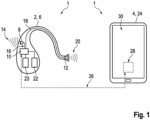
- a hearing system 1 is shown schematically in a block diagram, which includes a hearing instrument 2 and an auxiliary device 4 .
- the hearing instrument 2 is designed as a hearing aid 6 and accordingly has a microphone 8 , a signal processing device 10 connected to the microphone 8 and a loudspeaker 12 connected to the signal processing device 10 .
- the hearing aid 6 can also have other, in figure 1 have microphones, not shown, which are correspondingly connected to the signal processing device 10 .
- the microphone 8 is set up to generate an input signal 16 from an ambient sound 14 .
- the input signal 16 (and possibly further input signals from microphones, not shown) is processed in the signal processing device 10 to form an output signal 18 which is converted into an output sound signal 20 by the loudspeaker 12 .
- a hearing loss of a wearer of the hearing device 6 can be taken into account in particular in that the hearing loss is at least partially compensated for by a frequency band-dependent amplification and/or compression of the input signal 16.
- the hearing aid 6 also has a PPG sensor 22 which is also connected to the signal processing device 10 .
- the PPG sensor 22 is set up to measure a heart rate of the wearer, so that a rate of change of the heart rate can also be determined in the signal processing device 10 on the basis of the measured heart rate.
- the hearing aid 6 also has an acceleration sensor 23, which is also connected to the signal processing device 10 and by means of which a change in movement of the wearer of the hearing aid 6 can be detected. A movement of the wearer can thus also be detected by integrating the acceleration in the signal processing device 10 .
- the auxiliary device 4 embodied as a smartphone 24 is used, which can be connected to the hearing device 6 via a Bluetooth connection 26 .
- the hearing aid 6 and the smartphone 24 each have appropriately configured, in figure 1 Transmitting and receiving devices (for example antennas) not shown in detail for establishing said Bluetooth connection 26 .
- the smartphone 24 also has a processor unit 28 for the processing steps described below, as well as a touchscreen 30, by means of which user inputs can be made by the wearer of the hearing device 6 or the hearing system 1 via a corresponding application.
- figure 2 is shown schematically in a block diagram the sequence of a method by which the hearing instrument 2 after figure 1 can be operated depending on a critical stress level of the wearer of the hearing instrument 2 .
- relationships between the stress perception of the wearer of the treble instrument 2 are determined in the manner described below figure 1 , meaningful biometric parameters and parameters of signal processing, which indicate the stress level determined and thus "learned" (shown in the left half of the image).
- Biometric parameters 42 of the wearer of the hearing aid 6 are now determined with the aid of the PPG sensor 22 .
- these biometric parameters 42 are given by parameters 43 of a cardiovascular activity of the wearer, and include a heart rate HR of the wearer of the hearing aid 6, which is detected by the PPG sensor 22, and a rate of change HRV of the heart rate HR, which is recorded in the signal processing device 10 is determined from the heart rate HR.
- the parameters 43 of a cardiovascular activity can also include, for example, a systolic and/or diastolic blood pressure and/or a duration of a cardiac tension phase.
- a movement activity MOV of the wearer of the hearing aid 6 is determined on the basis of the acceleration sensor 23 .
- resting values HR-0 and HRV-0 are determined by comparing them with the determined movement activity MOV, in that the values of the heart rate HR and their rate of change HRV are only used in those time sequences in which no significant movement activity MOV is present.
- a time of day (particularly when medication is taken regularly) and/or a background noise level or background can also be used to determine the rest values HR-0, HRV-0.
- the heart rate HR of the wearer is also measured by the PPG sensor 22 and its rate of change HRV is determined accordingly.
- HR-0, HRV-0 the corresponding resting values HR-0, HRV-0, which were previously determined.
- a check is first carried out to determine whether, based on the Acceleration sensor 23 a currently existing movement activity MOV was determined (additionally, a comparison can also be made with regard to the time of day, see above). If this is not the case, a critical stress level CSL is inferred if the deviation of the heart rate HR or its rate of change HRV from their corresponding resting values is sufficiently high, ie assessed as critical.
- the input signal 16 which is generated by the microphone 8 of the hearing aid 6 from the ambient sound 14 at the current point in time, is subjected to a speech analysis 44, which checks whether a speech signal is present in the input signal 16 present. If this is not the case (path “n”), gain factors gj and maximum output levels Pmaxj for each frequency band are lowered for each frequency band, and noise suppression NR is increased. Furthermore, a settling time Tatc of a compression can also be reduced and a decay time Trls of the compression can be increased.
- the input signal 16 is processed into the output signal 18 in such a way that the output sound signal 20 correspondingly generated by the loudspeaker 12 is suitable for reducing the stress level of the wearer.
- the noise exposure for the wearer of the hearing aid 6 is reduced by lowering the frequency band-wise amplification factors gj, and the discomfort threshold, which can psychologically decrease when there is a high level of stress, is additionally avoided by lowering the maximum output level Pmaxj.
- greater application of noise reduction NR and/or "sharper" application of compression may make acoustic artefacts appear more easily, in the present case this is preferable to temporarily reduce the wearer's stress level.
- the measures mentioned, which are taken in each case when a speech signal is present or absent and the critical stress level CSL is present with regard to the processing of the input signal 16, can in particular be taken within the framework of a specific hearing program (which, depending on an acoustic environment situation, may require further signal processing measures included) are taken, which is provided in an acoustic environment specifically for the case of a critical stress level CSL.
- the measures can also be carried out “ad hoc” and independently of a hearing program, so that they are only used depending on the critical stress level CSL and possibly the speech analysis 44 .
- the parameter in question is set to a parameter value such that signal processing of the input signal 16 with the parameter value for the parameter is suitable for reducing the stress level, ie will lead to this as expected and without unforeseeable exceptional circumstances.
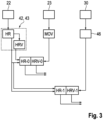
- figure 3 1 is a schematic block diagram of an alternative embodiment of that part of the method figure 2 shown, which relates to "learning" how to recognize the correct values of the biometric parameters 42 for the critical stress level CSL (left half of the figure in figure 2 ).
- the heart rate HR and from this its rate of change HRV are measured or determined as biometric parameters 42 and thus as parameters 43 of the cardiovascular activity of the wearer in order to compare the resting values HR-0, HRV-0 of the named biometric parameters 42 to determine.
- a user input 46 is recorded, which the wearer of the hearing device 6 can enter via the touchscreen 30 of the smartphone 24 in a corresponding app.
- the wearer uses the user input 46 to signal the hearing system 1 figure 1 that for him the stress level is uncomfortably high.
- HR and its rate of change HRV this means that the values HR-1 and HRV-1 determined as critical by the user input 46 correspond to a critical stress level CSL. in the in figure 3 application not shown (cf.
- the critical stress level CSL can now be recognized if the heart rate HR (or its rate of change HRV) determined by means of the PPG sensor 22 is sufficiently close to the value HR-1 (or HRV-1) determined for the critical stress level CSL or above lies.
- HR-1 or HRV-1
- HRV-0 the resting value HR-0 (or HRV-0) can be used for the value range to be considered critical.
- figure 4 is a further alternative to the method according to FIG figure 2 shown.
- a hearing program 50 previously assigned to the recognized acoustic environmental situation 48 is now selected, which has specific parameter values 52 for individual parameters 54 of the signal processing (such as, for example, those in the description of figure 2 mentioned parameters, which are applied to the input signal 16).
- the input signal 16 is now processed according to the parameter values 52 specified by the hearing program 50 for the parameters 54 and the resulting output signal 18 is converted by the loudspeaker 12 into the output sound signal 20 .
- the wearer (not shown) of the hearing aid 6 now “hears” this output sound signal and can use a user input 56 (in a way comparable to the user input 46). figure 3 ) make a positive or negative evaluation 58p or 58n of the hearing program 50.
- the wearer can use a user input 46 to report a subjectively perceived critical stress level CSL to the hearing system 1 .
- the negative evaluation 58n of the hearing program 50 can, according to the method, lead to a lower weighting of the associated parameter values 52 for a final adjustment of the hearing program 50 or to a change in the parameter values 52 when next occurrence of the acoustic environment situation 48 lead.
- a subprogram 51 can also be generated on the basis of the correspondingly used parameter values 52, which is intended for later use when the acoustic environmental situation 48 (to which the hearing program 50 is assigned) and the critical one are present at the same time Stress levels CLS (preferably to be determined using the biometric parameters 42) is provided.
- figure 2 and figure 3 can also, as biometric parameters 42, heart rate HR and from this its rate of change HRV and possibly also others than those in figure 2 parameters 43 of the cardiovascular activity shown are measured or determined (not shown). Furthermore, a comparison with the movement activity can be carried out MOV it can be ensured that potentially increased values of the heart rate HR of their rate of change HRV are not due to sporting activity or hard physical work or similar, but are sufficiently meaningful for the stress level of the wearer. The resting values determined in this way can be used at a later point in time (not shown) to identify a critical stress level in order to apply the sub-program 51 for signal processing, which is assigned to the acoustic environmental situation 48 at the critical stress level (instead of the hearing program 50).
- a hearing system 1 is shown schematically in a block diagram, which has a hearing instrument 2, which is an alternative to the figure 1 illustrated hearing instrument 2 forms.
- the hearing instrument 2 of figure 5 has an auditory canal microphone 60 instead of the PPG sensor 22 (in a further alternative variant, the hearing instrument can also have the PPG sensor 22 and the auditory canal microphone 60), which is arranged together with the loudspeaker 12 in an earpiece 62.
- the earpiece 62 is to be inserted at least partially by the wearer (not shown) into an entrance of one of his two auditory canals, so that the auditory canal microphone 60 is thereby directed into the auditory canal, and there an auditory canal sound 64 im through the earpiece 62 can accommodate the at least partially occluded auditory canal.
- the auditory canal microphone 60 generates an additional input signal 66 (dashed line) from the auditory canal sound 64 which is forwarded to the signal processing device 10 .
- the heart rate can be determined from the auditory canal sound 64 by means of a corresponding analysis and/or filtering of the additional input signal 66 in the additional input signal 66 .
- Said analysis or filtering of the additional input signal 66 can take place in the signal processing device 10 in particular.
- the auditory canal microphone 60 can in particular fulfill a further functionality, for example within the scope of occlusion suppression, which is preferably controlled by the signal processing device 10 .
Landscapes
- Health & Medical Sciences (AREA)
- Engineering & Computer Science (AREA)
- Life Sciences & Earth Sciences (AREA)
- General Health & Medical Sciences (AREA)
- Physics & Mathematics (AREA)
- Otolaryngology (AREA)
- Acoustics & Sound (AREA)
- Signal Processing (AREA)
- Molecular Biology (AREA)
- Public Health (AREA)
- Veterinary Medicine (AREA)
- Animal Behavior & Ethology (AREA)
- Surgery (AREA)
- Medical Informatics (AREA)
- Heart & Thoracic Surgery (AREA)
- Psychiatry (AREA)
- Biophysics (AREA)
- Pathology (AREA)
- Biomedical Technology (AREA)
- Neurosurgery (AREA)
- Hospice & Palliative Care (AREA)
- Child & Adolescent Psychology (AREA)
- Social Psychology (AREA)
- Psychology (AREA)
- Educational Technology (AREA)
- Developmental Disabilities (AREA)
- Computational Linguistics (AREA)
- Audiology, Speech & Language Pathology (AREA)
- Human Computer Interaction (AREA)
- Multimedia (AREA)
- Measuring Pulse, Heart Rate, Blood Pressure Or Blood Flow (AREA)
Applications Claiming Priority (1)
| Application Number | Priority Date | Filing Date | Title |
|---|---|---|---|
| DE102021213300.2A DE102021213300A1 (de) | 2021-11-25 | 2021-11-25 | Verfahren zum Betrieb eines Hörinstrumentes |
Publications (1)
| Publication Number | Publication Date |
|---|---|
| EP4187928A1 true EP4187928A1 (fr) | 2023-05-31 |
Family
ID=84361626
Family Applications (1)
| Application Number | Title | Priority Date | Filing Date |
|---|---|---|---|
| EP22209274.4A Withdrawn EP4187928A1 (fr) | 2021-11-25 | 2022-11-24 | Procédé de fonctionnement d'un instrument auditif |
Country Status (3)
| Country | Link |
|---|---|
| US (1) | US20230164496A1 (fr) |
| EP (1) | EP4187928A1 (fr) |
| DE (1) | DE102021213300A1 (fr) |
Families Citing this family (2)
| Publication number | Priority date | Publication date | Assignee | Title |
|---|---|---|---|---|
| US11832061B2 (en) * | 2022-01-14 | 2023-11-28 | Chromatic Inc. | Method, apparatus and system for neural network hearing aid |
| CN120434577B (zh) * | 2025-06-12 | 2025-10-31 | 杭州惠耳听力技术设备有限公司 | 基于血压监测下的助听器自适应调节方法 |
Citations (4)
| Publication number | Priority date | Publication date | Assignee | Title |
|---|---|---|---|---|
| DE102009043775A1 (de) * | 2009-09-30 | 2011-04-07 | Siemens Medical Instruments Pte. Ltd. | Verfahren zum Einstellen einer Hörvorrichtung anhand eines emotionalen Zustandes und entsprechende Hörvorrichtung |
| WO2012072141A1 (fr) * | 2010-12-02 | 2012-06-07 | Phonak Ag | Appareil auditif portable avec capteur d'humeur et procédé permettant de fournir à un individu des signaux destinés à être auditivement perçus par ledit individu |
| EP3009070A1 (fr) * | 2014-07-24 | 2016-04-20 | Goertek Inc. | Procédé de détection de la fréquence cardiaque applicable dans un écouteur et écouteur capable de détecter la fréquence cardiaque |
| EP3879853A1 (fr) * | 2020-03-12 | 2021-09-15 | Sonova AG | Réglage d'un dispositif auditif basé sur un niveau de stress d'un utilisateur |
Family Cites Families (3)
| Publication number | Priority date | Publication date | Assignee | Title |
|---|---|---|---|---|
| DK3232927T3 (da) * | 2014-12-19 | 2022-01-10 | Widex As | Fremgangsmåde til at betjene et høreapparatsystem og et høreapparatsystem |
| EP3883260B1 (fr) * | 2020-03-16 | 2023-09-13 | Sonova AG | Dispositif d'aide auditive pour fournir des informations physiologiques et son procédé de fonctionnement |
| US11477583B2 (en) | 2020-03-26 | 2022-10-18 | Sonova Ag | Stress and hearing device performance |
-
2021
- 2021-11-25 DE DE102021213300.2A patent/DE102021213300A1/de active Pending
-
2022
- 2022-11-23 US US17/993,146 patent/US20230164496A1/en not_active Abandoned
- 2022-11-24 EP EP22209274.4A patent/EP4187928A1/fr not_active Withdrawn
Patent Citations (4)
| Publication number | Priority date | Publication date | Assignee | Title |
|---|---|---|---|---|
| DE102009043775A1 (de) * | 2009-09-30 | 2011-04-07 | Siemens Medical Instruments Pte. Ltd. | Verfahren zum Einstellen einer Hörvorrichtung anhand eines emotionalen Zustandes und entsprechende Hörvorrichtung |
| WO2012072141A1 (fr) * | 2010-12-02 | 2012-06-07 | Phonak Ag | Appareil auditif portable avec capteur d'humeur et procédé permettant de fournir à un individu des signaux destinés à être auditivement perçus par ledit individu |
| EP3009070A1 (fr) * | 2014-07-24 | 2016-04-20 | Goertek Inc. | Procédé de détection de la fréquence cardiaque applicable dans un écouteur et écouteur capable de détecter la fréquence cardiaque |
| EP3879853A1 (fr) * | 2020-03-12 | 2021-09-15 | Sonova AG | Réglage d'un dispositif auditif basé sur un niveau de stress d'un utilisateur |
Also Published As
| Publication number | Publication date |
|---|---|
| DE102021213300A1 (de) | 2023-05-25 |
| US20230164496A1 (en) | 2023-05-25 |
Similar Documents
| Publication | Publication Date | Title |
|---|---|---|
| EP3222057B1 (fr) | Procédé et dispositif de détection rapide de la voix naturelle | |
| EP3873108B1 (fr) | Système auditif pourvu d'au moins un instrument auditif porté dans ou sur l'oreille de l'utilisateur, ainsi que procédé de fonctionnement d'un tel système auditif | |
| DE102017214164B3 (de) | Verfahren zum Betrieb eines Hörgeräts und Hörgerät | |
| EP3288293A1 (fr) | Procédé et dispositif de réglage d'un appareil de correction auditive | |
| EP3266222B1 (fr) | Dispositif et procédé pour l'excitation des compresseurs dynamiques d'un appareil auditif binaural | |
| EP1750481A2 (fr) | Ajustement de gain automatique d'une prothèse auditive | |
| DE102009043775A1 (de) | Verfahren zum Einstellen einer Hörvorrichtung anhand eines emotionalen Zustandes und entsprechende Hörvorrichtung | |
| DE60207867T2 (de) | Hörgerät und verfahren zur verarbeitung eines klangsignals | |
| EP2305117A2 (fr) | Procédé d'adaptation d'un appareil d'aide auditive ainsi qu'appareil d'adaptation d'appareils d'aide auditive | |
| EP4187928A1 (fr) | Procédé de fonctionnement d'un instrument auditif | |
| EP4134002B1 (fr) | Procédé et système de génération d'un audiogramme d'une personne soumise à l'essai au moyen d'un instrument auditif | |
| DE102018208657B3 (de) | Verfahren zur Verringerung eines Auftretens einer akustischen Rückkopplung in einem Hörgerät | |
| DE60016144T2 (de) | Hörhilfegerät | |
| EP3836139A1 (fr) | Procédé d'accouplement de deux appareils auditifs ainsi qu'appareil auditif | |
| EP3373600A1 (fr) | Procédé de fonctionnement d'un dispositif d'aide auditive ainsi que dispositif d'aide auditive pour compensation des acouphènes | |
| EP4080904A1 (fr) | Procédé de fonctionnement d'un appareil auditif | |
| DE102006015497B4 (de) | Audiosystem und Verfahren sowie Computerprogramm und Datenträger der das Computerprogramm enthält zur Anpassung der Übertragungsfunktion eines Audiosystems mittels Sprachsteuerung | |
| DE102023200581B4 (de) | Verfahren zum Betrieb eines Hörinstruments | |
| DE102022200810B3 (de) | Verfahren für ein Hörsystem zur Anpassung einer Mehrzahl an Signalverarbeitungsparametern eines Hörinstrumentes des Hörsystems | |
| EP3985994A1 (fr) | Procédé de fonctionnement d'un appareil d'aide auditive et appareil d'aide auditive | |
| DE102024205064B4 (de) | Verfahren zum Betreiben eines Hörgeräts | |
| EP3913618A1 (fr) | Procédé de fonctionnement d'un appareil auditif et appareil auditif | |
| EP4294053A1 (fr) | Procédé et système d'adaptation d'une prothèse auditive à un utilisateur | |
| WO2024104945A1 (fr) | Procédé de fonctionnement d'une prothèse auditive, et prothèse auditive | |
| EP4360335A1 (fr) | Procédé d'adaptation d'un appareil auditif |
Legal Events
| Date | Code | Title | Description |
|---|---|---|---|
| PUAI | Public reference made under article 153(3) epc to a published international application that has entered the european phase |
Free format text: ORIGINAL CODE: 0009012 |
|
| STAA | Information on the status of an ep patent application or granted ep patent |
Free format text: STATUS: THE APPLICATION HAS BEEN PUBLISHED |
|
| AK | Designated contracting states |
Kind code of ref document: A1 Designated state(s): AL AT BE BG CH CY CZ DE DK EE ES FI FR GB GR HR HU IE IS IT LI LT LU LV MC ME MK MT NL NO PL PT RO RS SE SI SK SM TR |
|
| STAA | Information on the status of an ep patent application or granted ep patent |
Free format text: STATUS: THE APPLICATION IS DEEMED TO BE WITHDRAWN |
|
| 18D | Application deemed to be withdrawn |
Effective date: 20231201 |