EP4200737B1 - Verfahren zur datenmanipulationserkennung von numerischen datenwerten - Google Patents
Verfahren zur datenmanipulationserkennung von numerischen datenwerten Download PDFInfo
- Publication number
- EP4200737B1 EP4200737B1 EP21749061.4A EP21749061A EP4200737B1 EP 4200737 B1 EP4200737 B1 EP 4200737B1 EP 21749061 A EP21749061 A EP 21749061A EP 4200737 B1 EP4200737 B1 EP 4200737B1
- Authority
- EP
- European Patent Office
- Prior art keywords
- vector
- data
- benford
- test
- numerical
- Prior art date
- Legal status (The legal status is an assumption and is not a legal conclusion. Google has not performed a legal analysis and makes no representation as to the accuracy of the status listed.)
- Active
Links
Images
Classifications
-
- G—PHYSICS
- G06—COMPUTING OR CALCULATING; COUNTING
- G06F—ELECTRIC DIGITAL DATA PROCESSING
- G06F21/00—Security arrangements for protecting computers, components thereof, programs or data against unauthorised activity
- G06F21/10—Protecting distributed programs or content, e.g. vending or licensing of copyrighted material ; Digital rights management [DRM]
-
- H—ELECTRICITY
- H04—ELECTRIC COMMUNICATION TECHNIQUE
- H04L—TRANSMISSION OF DIGITAL INFORMATION, e.g. TELEGRAPHIC COMMUNICATION
- H04L63/00—Network architectures or network communication protocols for network security
- H04L63/14—Network architectures or network communication protocols for network security for detecting or protecting against malicious traffic
- H04L63/1441—Countermeasures against malicious traffic
- H04L63/1466—Active attacks involving interception, injection, modification, spoofing of data unit addresses, e.g. hijacking, packet injection or TCP sequence number attacks
-
- G—PHYSICS
- G06—COMPUTING OR CALCULATING; COUNTING
- G06F—ELECTRIC DIGITAL DATA PROCESSING
- G06F11/00—Error detection; Error correction; Monitoring
- G06F11/36—Prevention of errors by analysis, debugging or testing of software
- G06F11/3668—Testing of software
- G06F11/3672—Test management
- G06F11/3688—Test management for test execution, e.g. scheduling of test suites
-
- G—PHYSICS
- G06—COMPUTING OR CALCULATING; COUNTING
- G06F—ELECTRIC DIGITAL DATA PROCESSING
- G06F21/00—Security arrangements for protecting computers, components thereof, programs or data against unauthorised activity
- G06F21/10—Protecting distributed programs or content, e.g. vending or licensing of copyrighted material ; Digital rights management [DRM]
- G06F21/12—Protecting executable software
- G06F21/121—Restricting unauthorised execution of programs
-
- G—PHYSICS
- G06—COMPUTING OR CALCULATING; COUNTING
- G06F—ELECTRIC DIGITAL DATA PROCESSING
- G06F21/00—Security arrangements for protecting computers, components thereof, programs or data against unauthorised activity
- G06F21/10—Protecting distributed programs or content, e.g. vending or licensing of copyrighted material ; Digital rights management [DRM]
- G06F21/12—Protecting executable software
- G06F21/121—Restricting unauthorised execution of programs
- G06F21/125—Restricting unauthorised execution of programs by manipulating the program code, e.g. source code, compiled code, interpreted code, machine code
-
- G—PHYSICS
- G06—COMPUTING OR CALCULATING; COUNTING
- G06F—ELECTRIC DIGITAL DATA PROCESSING
- G06F21/00—Security arrangements for protecting computers, components thereof, programs or data against unauthorised activity
- G06F21/60—Protecting data
- G06F21/64—Protecting data integrity, e.g. using checksums, certificates or signatures
-
- H—ELECTRICITY
- H04—ELECTRIC COMMUNICATION TECHNIQUE
- H04L—TRANSMISSION OF DIGITAL INFORMATION, e.g. TELEGRAPHIC COMMUNICATION
- H04L63/00—Network architectures or network communication protocols for network security
- H04L63/12—Applying verification of the received information
- H04L63/123—Applying verification of the received information received data contents, e.g. message integrity
-
- H—ELECTRICITY
- H04—ELECTRIC COMMUNICATION TECHNIQUE
- H04L—TRANSMISSION OF DIGITAL INFORMATION, e.g. TELEGRAPHIC COMMUNICATION
- H04L63/00—Network architectures or network communication protocols for network security
- H04L63/14—Network architectures or network communication protocols for network security for detecting or protecting against malicious traffic
- H04L63/1408—Network architectures or network communication protocols for network security for detecting or protecting against malicious traffic by monitoring network traffic
- H04L63/1425—Traffic logging, e.g. anomaly detection
Definitions
- the invention relates to a method for detecting data manipulation of numerical data values, in particular numerical access data to media data streams, using a testing device.
- the use of the Benford test is well known for authenticity testing of numerical data values.
- the disadvantage of this is that the data sets must be of random origin as a prerequisite for the use of the Benford test, so that a prior pre-selection or grouping of the data sets can falsify the result.
- the WO2018211060A1 a method which compares data sets obtained from different networks, for example different streaming platforms.
- the numerical data values of the data sets to be compared for example access numbers to media data streams of a song title over a certain period of time, are subjected to a composition data transformation.
- irregularities in this similarity behavior indicate a manipulation.
- the disadvantage of this is that a relatively specific data set consisting of data values from at least three different networks for the same observation period is required for this data manipulation detection. Accordingly, data manipulation detection can only be carried out for networks for which there are at least two reference networks that behave similarly in terms of data flow behavior.
- the invention is therefore based on the object of proposing a resource-saving and quickly implemented method for data manipulation detection, which allows a valid statement about potential data manipulation of data values assigned to groups, regardless of the degree of preparation and largely independent of the size of the data set, without having to rely on data values from reference networks.
- the invention solves the problem by first determining a Benford vector from the frequencies of predetermined initial digit groups expected according to the Benford distribution in a transformation unit of the test device by means of a composition data transformation in the form of a pivot composition data transformation that maps the frequencies in relation to one another, repeatedly generating randomly distributed numerical values using a random generator of the test device and a plurality of simulation vectors are determined from the frequencies of the initial digit groups of the randomly distributed numerical values by the transformation unit, for each simulation vector a simulation deviation from the Benford vector in the form of a Mahalanobis distance is determined by means of a detection unit and stored in a test memory of the test device, after which a group of numerical data values is read in via an input interface of the test device, a test vector is determined from the frequencies of the initial digit groups in the numerical data values of the groups by the transformation unit and a test deviation of the test vector from the Benford vector in the form of a Mahalanobis distance is determined by the detection unit, after which the relative number of those stored simulation deviations which are
- the invention is based on the consideration that a Benford test for preselected groups of numerical data values has insufficient accuracy for detecting manipulations because, on the one hand, the number of numerical data values can be relatively small and, on the other hand, the data values do not necessarily reflect natural growth behavior. In particular, this results in the difficulty that the limit value for a permissible deviation from the Benford distribution is unknown for a technical application.
- this difficulty can be overcome by determining the expected deviation of the frequencies of the initial digit groups of a preselected group of numerical data values from a Benford distribution using the simulation with randomly distributed numerical values and deriving therefrom a maximum permissible test deviation T for the numerical data values to be checked for data manipulation detection.
- the provision of a composition data transformation for the frequency of predetermined Initial digit groups have the significant advantage that it is not the frequencies of the initial digit groups themselves that are taken into account in the check, but rather their relationships to one another.
- the composition data transformation according to the invention thus increases the security against manipulation, because even if the frequencies of the initial digit groups themselves are within an acceptable range, manipulation can be detected if only their relationships to one another change.
- Such a composition data transformation can, for example, be a transformation of a vector of frequencies of the predetermined initial digit groups into pivot coordinates. Due to the composition data transformation and due to the fact that a large number of simulation vectors mapping the frequencies of the initial digit groups of a group of random numbers are required for valid data manipulation detection. e bi and their simulation deviation T i from a Benford distribution must be determined, the simulation is computationally intensive and thus time-consuming.
- a significant advantage of the invention is therefore that the simulation deviations T i are stored in a test memory of a test device after the simulation, so that numerical data values to be checked can subsequently be checked for possible manipulations in a resource-saving manner without carrying out simulations and without the need for comparison data sets.
- a first computationally intensive step is therefore carried out without the data values to be checked.
- the dimension D of the frequency vector b is therefore dependent on the number of predefined initial digit groups.
- the initial digit groups can be selected arbitrarily, but each data value to be checked must contain an initial digit group, so that depending on the data values, there are corresponding restrictions on the possible choice of initial digit groups.
- the dimension D of the Benford vector is reduced e b by 1, in which, for example, one component of the vector is expressed by the other components and the known total sum of all components. This usually requires a normalization of the vector.
- a plurality N s for example 1000 - 1000000, preferably 10000 - 100000, of sets of randomly distributed numerical values are determined, for which the frequencies of the selected initial digit groups per set are stored in a frequency vector b i and from this a simulation vector is created by the transformation unit e bi is created. If the randomly distributed numerical values are evenly distributed, the initial digit groups in each set generally follow the Benford distribution, but deviate from it in individual cases with a certain error, just as is to be expected for the data values to be checked. Accordingly, the simulation vectors also deviate e bi from the Benford vector z b .
- a simulation deviation T i from the Benford vector e b is determined and stored in a test memory of the test device.
- this first step requires a lot of computing power, the stored simulation deviations T i can be used to check any numerical data values that follow a sufficiently similar random distribution.
- the data values to be checked are read in via an input interface of the test device, after which a frequency vector is created in an analogous manner from the frequencies (x 1 , ..., x D ) of the selected initial digit groups, for example the initial digits 1 - 9, of the data values.
- x ⁇ x 1 , ... x D generated using a counting unit.
- the detection unit calculates a test deviation T between the test vector z and the Benford vector e b is determined.
- a pivot coordinate transformation has been found to be a suitable composition data transformation of the transformation unit.
- the transformation to the test vector e and to the simulation vectors e bi is done analogously.
- the use of the pivot coordinate transformation has the advantage that pivot coordinates are isometric and span an orthogonal vector space, so that the determination of the deviation between such pivot coordinates can be done particularly easily.
- Multivariate methods can be used to determine the simulation deviations T i and the test deviation T by the detection unit.
- the detection unit can be used for an incoming vector e , e bi for example its Mahalanobis distance to the Benford vector e b output.
- the subject matter of the invention is shown by way of example in the drawing.
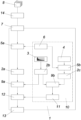
- the drawing shows a schematic flow diagram of the process according to the invention.
- a method according to the invention for data manipulation detection of numerical data values is carried out by a testing device 1, which comprises a transformation unit 2a, b, c.
- a transformation unit 2c receives data streams from a random generator 4, which generates sets of randomly distributed numerical values.
- a counting unit 5b determines the number of initial digit groups in the randomly distributed numerical values specified in a memory 6 and outputs N s random vectors from them.
- N s can be, for example, 1000 - 100000.
- a transformation unit 2a receives data values of a data set 8, with a counting unit 5a creating a frequency vector from the frequencies of the initial digit groups (x 1 , ..., x D ) of the data values.
- a detection unit 9a receives the data streams of the transformation unit 2a, 2b and then determines one of the test deviations T between the test vector e and the Benford vector e b .
- a test device according to the invention can comprise one or more transformation units 2a, 2b, 2c and one or more detection units 9a, 9b. In the drawing, several transformation units 2a, 2b, 2c and several detection units 9a, 9b are shown to better illustrate the data flows. The same applies to the counting units 5a and 5b.
- Multivariate methods can be used to determine the simulation deviations T i and the test deviation T by the detection unit 9a, 9b. For example, the calculation of the Mahalanobis distance between the simulation vectors is suitable for this. e bi and the Benford vector e b or between the test vector e and the Benford vector e b .
- the initial digit groups of the numerical data values are Benford distributed, which indicates a non-manipulated data set.
- a significantly lower p-value indicates data manipulation.
- the input interface 7 can be preceded by a filter unit 14 which selects categories from a data set 8 of numerical data values assigned to different categories using predefined filter parameters and only passes the numerical data values assigned to the selected categories as a group to the input interface 7. In this way, only a part of the data set can be checked, which means that, for example, only certain facts, such as the number of accesses to media data streams of a certain artist, can be checked.
Landscapes
- Engineering & Computer Science (AREA)
- Computer Security & Cryptography (AREA)
- Theoretical Computer Science (AREA)
- Software Systems (AREA)
- General Engineering & Computer Science (AREA)
- Computer Hardware Design (AREA)
- General Physics & Mathematics (AREA)
- Physics & Mathematics (AREA)
- Multimedia (AREA)
- Technology Law (AREA)
- Computing Systems (AREA)
- Computer Networks & Wireless Communication (AREA)
- Signal Processing (AREA)
- General Health & Medical Sciences (AREA)
- Bioethics (AREA)
- Health & Medical Sciences (AREA)
- Quality & Reliability (AREA)
- Complex Calculations (AREA)
Description
- Die Erfindung bezieht sich auf ein Verfahren zur Datenmanipulationserkennung von numerischen Datenwerten, insbesondere von numerischen Zugriffsdaten auf Mediendatenströme, mit einer Prüfvorrichtung.
- Bei der Authentizitätsprüfung von numerischen Datenwerten ist der Einsatz des Benfordtests bekannt. Der Benfordtest beruht auf der Beobachtung, dass bei einem Datensatz mit ausreichend vielen Zahlenwerten die Anfangsziffernhäufigkeit bj der Ziffern j= 1, ..., 9 unterschiedlich, nämlich gemäß einer Benfordverteilung

- Speziell zur Datenmanipulationserkennung von vorausgewählten Datenwerten ist aus der
WO2018211060A1 ein Verfahren bekannt, welches von unterschiedlichen Netzwerken, beispielsweise unterschiedliche Streamingplattformen, bezogene Datensätze miteinander vergleicht. Die zu vergleichenden numerischen Datenwerte der Datensätze, beispielsweise Zugriffszahlen auf Mediendatenströme eines Songtitels über einen bestimmten Zeitraum, werden dabei einer Kompositionsdatentransformation unterzogen. Unter der Annahme, dass sich die Datenwerte unterschiedlicher Netzwerke für einen gleichen Zeitraum ähnlich verhalten, deuten Irregularitäten in diesem Ähnlichkeitsverhalten zueinander auf eine Manipulation hin. Nachteilig daran ist allerdings, dass für diese Datenmanipulationserkennung bereits ein relativ spezifischer Datensatz, bestehend aus Datenwerten wenigstens drei unterschiedlicher Netzwerke für den gleichen Beobachtungszeitraum, notwendig ist. Demnach kann eine Datenmanipulationserkennung nur für Netzwerke erfolgen, für die es auch wenigstens zwei sich bezüglich des Datenstromverhaltens ähnlich verhaltende Referenznetzwerke gibt. - Der wissenschaftliche Aufsatz Badal-Valero Elena et al.: "Combining Benford's Law and machine learning to detect money laundering. An actual Spanish court case", Forensic Science International, Elsevier B.V., Amsterdam, NL, Bd. 282, vom 11. November 2017, S. 24-34, XP085313369, ISBN: 0379-0738, DOI: 10.1016/J.FORSCIINT.2017.11.008 lehrt ein Verfahren zum Erkennen manipulierter Daten bei Geldtransaktionen zwischen betrügerischen Firmen. Unter Anwendung des Benfordtests wird eine künstliche Intelligenz darin trainiert, ausgehend von bekannten betrügerischen Transaktionen weitere zu detektieren. Nachteilig an diesem Verfahren ist, dass es nicht ressourcenschonend arbeitet und nicht auf kleinere Datensätze angewendet werden kann.
- Der Erfindung liegt somit die Aufgabe zugrunde, ein ressourcenschonendes und rasch durchzuführendes Verfahren zur Datenmanipulationserkennung vorzuschlagen, welches unabhängig von Grad der Aufbereitung und weitgehend unabhängig vom Umfang des Datensatzes eine valide Aussage über potentielle Datenmanipulationen von Gruppen zugeordneten Datenwerten erlaubt, ohne dabei auf Datenwerte von Referenznetzwerken angewiesen zu sein.
- Die Erfindung löst die gestellte Aufgabe dadurch, dass zunächst aus den nach der Benfordverteilung erwarteten Häufigkeiten vorgegebener Anfangszifferngruppen in einer Transformationseinheit der Prüfvorrichtung durch eine die Häufigkeiten in Relation zueinander abbildende Kompositionsdatentransformation in Form einer Pivot- Kompositionsdatentransformation, ein Benfordvektor ermittelt wird, wiederholt mit einem Zufallsgenerator der Prüfvorrichtung zufallsverteilte Zahlenwerte erzeugt und aus den Häufigkeiten der Anfangszifferngruppen der zufallsverteilten Zahlenwerte durch die Transformationseinheit mehrere Simulationsvektoren ermittelt werden, für jeden Simulationsvektor mittels einer Detektionseinheit eine Simulationsabweichung vom Benfordvektor in Form eines Mahalanobis-Abstandes ermittelt und in einem Prüfspeicher der Prüfvorrichtung abgespeichert wird, wonach eine Gruppe von numerischen Datenwerten über eine Eingabeschnittstelle der Prüfvorrichtung eingelesen, aus den Häufigkeiten der Anfangszifferngruppen in den numerischen Datenwerten der Gruppen durch die Transformationseinheit ein Testvektor und eine Testabweichung des Testvektors vom Benfordvektor in Form eines Mahalanobis-Abstandes durch die Detektionseinheit ermittelt wird, wonach durch eine Prüfeinheit der Prüfvorrichtung die relative Anzahl jener abgespeicherter Simulationsabweichungen ermittelt wird, die größer als die Testabweichung sind und ein positiver Manipulationswert über eine Ausgabeschnittstelle ausgegeben wird, wenn die relative Anzahl einen vorgegeben Schwellwert unterschreitet.
- Der Erfindung liegt die Überlegung zugrunde, dass ein Benfordtest für vorausgewählte Gruppen von numerischen Datenwerten eine nur unzureichende Genauigkeit für die Erkennung von Manipulationen aufweist, weil einerseits die Anzahl der numerischen Datenwerte verhältnismäßig klein sein kann und andererseits die Datenwerte nicht notwendigerweise ein natürliches Wachstumsverhalten abbilden. Insbesondere ergibt sich daraus die Schwierigkeit, dass für eine technische Anwendung der Grenzwert für eine zulässige Abweichung von der Benfordverteilung unbekannt ist.
- Zufolge der erfindungsgemäßen Merkmale kann diese Schwierigkeit überwunden werden, indem die erwartete Abweichung der Häufigkeiten der Anfangszifferngruppen einer vorausgewählten Gruppe von numerischen Datenwerten von einer Benfordverteilung anhand der Simulation mit zufallsverteilten Zahlenwerten ermittelt und daraus eine für die Datenmanipulationserkennung maximal zulässige Testabweichung T für die zu überprüfenden numerischen Datenwerte abgeleitet werden. Darüber hinaus bringt das Vorsehen einer Kompositionsdatentransformation für die Häufigkeit vorgegebener Anfangszifferngruppen den wesentlichen Vorteil mit sich, dass nicht die Häufigkeiten der Anfangszifferngruppen für sich, sondern deren Verhältnisse zueinander bei der Überprüfung berücksichtigt werden. Die erfindungsgemäße Kompositionsdatentransformation erhöht somit die Manipulationssicherheit, weil selbst bei innerhalb eines akzeptablen Bereichs liegenden Häufigkeiten der Anfangszifferngruppen für sich eine Manipulation detektiert werden kann, wenn sich lediglich deren Verhältnisse zueinander ändern. Eine solche Kompositionsdatentransformation kann beispielsweise eine Transformation eines Vektors an Häufigkeiten der vorgegebenen Anfangszifferngruppen in Pivot-Koordinaten sein. Aufgrund der Kompositionsdatentransformation und aufgrund des Umstandes, dass für eine valide Datenmanipulationserkennung eine große Anzahl von die Häufigkeiten der Anfangszifferngruppen einer Gruppe von Zufallszahlen abbildenden Simulationsvektoren
z bi sowie deren Simulationsabweichung Ti von einer Benfordverteilung bestimmt werden müssen, ist die Simulation rechenintensiv und somit zeitaufwendig. Ein wesentlicher Vorteil der Erfindung besteht daher darin, dass die Simulationsabweichungen Ti nach der Simulation in einem Prüfspeicher einer Prüfvorrichtung abgespeichert werden, sodass zu überprüfende numerische Datenwerte in weiterer Folge ohne die Durchführung von Simulationen und ohne das Erfordernis von Vergleichsdatensätzen ressourcensparend auf etwaige Manipulationen überprüft werden können. - Ein erster rechenintensiver Schritt erfolgt somit ohne die zu überprüfenden Datenwerte. Hierzu wird zunächst ein Häufigkeitsvektor
b bestimmt, welcher die gemäß einer Benfordverteilung


b ist demnach von der Anzahl der vorgegebenen Anfangszifferngruppen abhängig. Grundsätzlich kann die Auswahl der Anfangszifferngruppen beliebig sein, jedoch muss jeder zu überprüfende Datenwert eine Anfangszifferngruppe enthalten, sodass sich je nach Datenwerten entsprechende Einschränkungen für die mögliche Wahl der Anfangszifferngruppen ergeben. - Der Häufigkeitsvektor
b wird durch eine Transformationseinheit der Prüfvorrichtung mittels Kompositionsdatentransformation zu einem Benfordvektor
z b um 1, in dem beispielsweise eine Komponente des Vektors durch die anderen Komponenten und der bekannten Gesamtsumme aller Komponenten ausgedrückt wird. Hierfür ist in der Regel eine Normalisierung des Vektors erforderlich. Neben der Ermittlung des Benfordvektorsz b wird eine Vielzahl Ns, beispielsweise 1000 - 1000000, vorzugsweise 10000 - 100000, an Sätzen zufallsverteilter Zahlenwerte ermittelt, für die die Häufigkeiten der gewählten Anfangszifferngruppen je Satz in einem Häufigkeitsvektorb i zusammengefasst und daraus durch die Transformationseinheit ein Simulationsvektorz bi erstellt wird. Sind die zufallsverteilten Zahlenwerte gleichverteilt, so folgen die Anfangszifferngruppen je Satz grundsätzlich der Benfordverteilung, weichen aber im Einzelfall mit einem gewissen Fehler davon ab, genauso wie dies auch für die zu überprüfenden Datenwerte zu erwarten ist. Dementsprechend weichen auch die Simulationsvektorenz bi vom Benfordvektor zb ab. Mittels einer Detektionseinheit wird zum Abschluss des rechenintensiven Schrittes für jeden Simulationsvektorz bi eine Simulationsabweichung Ti vom Benfordvektorz b ermittelt und in einem Prüfspeicher der Prüfvorrichtung abgespeichert. Zwar erfordert dieser erste Schritt große Rechenleistung, jedoch können die abgespeicherten Simulationsabweichungen Ti zum Überprüfen beliebiger numerischer Datenwerte herangezogen werden, die einer hinreichend ähnlichen Zufallsverteilung folgen. - Hierzu werden in einem zweiten, ressourcenschonenden und damit rasch durchzuführenden Schritt die zu überprüfenden Datenwerte über eine Eingabeschnittstelle der Prüfvorrichtung eingelesen, wonach in analoger Weise aus den Häufigkeiten (x1, ..., xD) der gewählten Anfangszifferngruppen, beispielsweise die Anfangsziffern 1 - 9, der Datenwerte ein Häufigkeitsvektor

x wird mit Hilfe der Transformationseinheit einer Kompositionsdatentransformation unterzogen, wodurch ein Testvektor
z b ermittelt. - In einem finalen Schritt ermittelt eine Prüfeinheit der Prüfvorrichtung die relative Anzahl p jener abgespeicherter Simulationsabweichungen Ti, die größer als die Testabweichung T sind.

- Bei Unterschreitung dieser relativen Anzahl p unter einen vorgegebenen Schwellwert wird ein positiver Manipulationswert für die über die Eingabeschnittstelle eingelesenen Datenwerte über eine Ausgabeschnittstelle ausgegeben.
- Zwar bietet bereits die Manipulationserkennung von numerischen Datenwerte eines Gesamtdatensatzes, beispielsweise sämtlicher Zugriffszahlen auf alle Mediendatenströme eines Netzwerks, Vorteile, allerdings ist in der Praxis relevant, ob die Datenwerte einer bestimmten Kategorie dieses Datensatzes manipuliert wurden. Beispielsweise soll also überprüft werden, ob die Zugriffszahlen auf Mediendatenströme eines bestimmten Künstlers oder eines bestimmten Musikstückes manipuliert wurden. Es ist daher im Sinne einer zeiteffizienten Datenmanipulationserkennung und einer an variierende Überprüfungsanforderungen anpassbaren Datenmanipulationserkennung, dass aus einem Datensatz von unterschiedlichen Kategorien zugeordneten numerischen Datenwerten mit einer Filtereinheit anhand vorgegebener Filterparameter Kategorien ausgewählt und die den Kategorien zugewiesenen numerischen Datenwerte als Gruppe an die Eingabeschnittstelle der Prüfvorrichtung übergeben werden. Gerade diese Vorauswahl beeinträchtigt eine zuverlässige Überprüfung per Benfordtest für sich und erst die erfindungsgemäßen Maßnahmen, insbesondere die Simulation einer Vielzahl solcher möglicher Gruppen, ermöglichen eine zuverlässige Manipulationserkennung, ohne dass Vergleichswerte aus anderen Datenquellen herangezogen werden müssten.
- Als geeignete Kompositionsdatentransformation der Transformationseinheit hat sich eine Pivot-Koordinatentransformation herausgestellt. Die Transformation beispielsweise eines Häufigkeitsvektors
b zum Benfordvektorz b kann demnach für die einzelnen Vektorkomponentenz j nach der Formel
z und zu den Simulationsvektorenz bi erfolgt analog. Der Einsatz der Pivot-Koordinatentransformation hat den Vorteil, dass Pivot-Koordinaten isometrisch sind und einen orthogonalen Vektorraum aufspannen, sodass die Bestimmung der Abweichung zwischen solchen Pivot-Koordinaten besonders einfach erfolgen kann. - Zur Ermittlung der Simulationsabweichungen Ti und der Testabweichung T durch die Detektionseinheit können multivariate Verfahren eingesetzt werden. Hierzu kann die Detektionseinheit für einen eingehenden Vektor
z ,z bi beispielsweise dessen Mahalanobis-Abstand zum Benfordvektorz b ausgeben. - Dieser Mahalanobis-Abstand zwischen den Simulationsvektoren
z bi und dem Benfordvektorz b bzw. zwischen dem Testvektor z und dem Benfordvektorz b. kann durch

- D ist dabei die Diagonalmatrix D = diag(S) der Kovarianzmatrix S der Simulationsvektoren
z bi.


- Da der Term

z bi abhängig ist, kann dieser ebenfalls unabhängig von den zu überprüfenden Datenwerten erfolgen und im Prüfspeicher hinterlegt werden. Die Verwendung einer rangreduzierten Korrelationsmatrix

- In der Zeichnung ist der Erfindungsgegenstand beispielsweise dargestellt. Die Zeichnung zeigt ein schematisches Fließschema des erfindungsgemäßen Verfahrens.
- Ein erfindungsgemäßes Verfahren zur Datenmanipulationserkennung von numerischen Datenwerten wird durch eine Prüfvorrichtung 1 durchgeführt, welche eine Transformationseinheit 2a, b, c umfasst. Eine Transformationseinheit 2b empfängt dabei Datenströme aus einem Benfordspeicher 3, auf dem Häufigkeitsvektoren
b , welcher die gemäß einer Benfordverteilung

- Eine Transformationseinheit 2c empfängt Datenströme von einem Zufallsgenerator 4, der Sätze zufallsverteilter Zahlenwerte erzeugt. Eine Zähleinheit 5b ermittelt die Anzahl der in einem Speicher 6 vorgegebenen Anfangszifferngruppen in den zufallsverteilten Zahlenwerten und gibt daraus Ns Zufallsvektoren
b i (i = 1 ...Ns) aus, welche die Häufigkeiten der vorgegebenen Anfangszifferngruppen der zufallsverteilten Zahlenwerte abbilden. Ns kann beispielsweise 1000 - 100000 betragen. Als zufallsverteilte Zahlenwerte können die Werte 10ul herangezogen werden, wobei ul Zufallszahlen aus einer Gleichverteilung sind, und I = 1, ..., N ist, wobei N beispielsweise gleichhoch wie Ns gewählt sein kann. Auf diese Weise kann sichergestellt werden, dass Ns Sätze von N Zahlenwerten erzeugt werden, wobei die Anzahl Anfangszifferngruppen mit Abweichungen der Benfordverteilung folgt. Eine Transformationseinheit 2a empfängt Datenwerte eines Datensatzes 8, wobei über eine Zähleinheit 5a aus den Häufigkeiten der Anfangszifferngruppen (x1, ..., xD) der Datenwerte ein Häufigkeitsvektor
- Die Transformationseinheiten 2a, 2b, 2c verarbeiten die Häufigkeitsvektoren
x ,b ,b i (i = 1 ...Ns) und führen für jeden Vektor eine Kompositionsdatentransformation durch, wodurch die durch die Koordinaten der Häufigkeitsvektorenx ,b ,b i (i = 1 ...Ns) repräsentierten Häufigkeiten der Anfangszifferngruppen in Relation zueinander gebracht werden. Dies kann durch Transformation in Pivot-Koordinaten erfolgen. - Eine Detektionseinheit 9a empfängt die Datenströme der Transformationseinheit 2a, 2b und ermittelt anschließend eine der Testabweichung T zwischen dem Testvektor
z und dem Benfordvektorz b. Eine Detektionseinheit 9b empfängt die Datenströme der Transformationseinheit 2b, 2c und ermittelt anschließend eine der Simulationsabweichungen Ti zwischen dem Simulationsabweichungen Ti (i=1 ,...,Ns) und dem Benfordvektorz b. Eine erfindungsgemäße Prüfvorrichtung kann ein oder mehrere Transformationseinheiten 2a, 2b, 2c und ein oder mehrere Detektionseinheiten 9a, 9b umfassen. In der Zeichnung sind zur besseren Illustration der Datenflüsse mehrere Transformationseinheiten 2a, 2b, 2c und mehrere Detektionseinheiten 9a, 9b dargestellt. Gleiches gilt für die Zähleinheiten 5a und 5b. Zur Ermittlung der Simulationsabweichungen Ti und der Testabweichung T durch die Detektionseinheit 9a, 9b können multivariate Verfahren eingesetzt werden. Hierfür eignet sich beispielsweise die Berechnung des Mahalanobis-Abstands zwischen den Simulationsvektorenz bi und dem Benfordvektorz b bzw. zwischen dem Testvektorz und dem Benfordvektorz b. - Da die Verfahrensschritte zum Erlangen der Simulationsabweichungen Ti (i=1, ..., Ns) unabhängig vom zu überprüfenden Datensatz 8 durchgeführt werden können, können diese zeitintensiven Schritte vorab in einem Bereich 10 durchgeführt und die Simulationsabweichungen Ti (i=1, ..., Ns) in einem Prüfspeicher 11 hinterlegt werden.
- Eine Prüfeinheit 12 kann auf die auf dem Prüfspeicher 11 hinterlegten Simulationsabweichungen Ti zugreifen und ermittelt die relative Anzahl jener abgespeicherten Simulationsabweichungen Ti, die größer als die von der Detektionseinheit 9a empfangene Testabweichung T sind. Bei Unterschreitung der relativen Anzahl p

- Ein p-Wert von p=1 bedeutet beispielsweise, dass alle Simulationsabweichungen Ti größer als T sind. In diesem Fall sind die Anfangszifferngruppen der numerischen Datenwerte benfordverteilt, was auf einen nicht manipulierten Datensatz hinweist. Ein signifikant niedrigerer p-Wert deutet hingegen auf eine Datenmanipulation hin.
- Der Eingabeschnittstelle 7 kann eine Filtereinheit 14 vorgeschaltet sein, welche aus einem Datensatz 8 von unterschiedlichen Kategorien zugeordneten numerischen Datenwerten anhand vorgegebener Filterparameter Kategorien auswählt und nur die den ausgewählten Kategorien zugewiesenen numerische Datenwerte als Gruppe an die Eingabeschnittstelle 7 übergibt. Auf diese Weise kann nur ein Teil des Datensatzes überprüft werden, wodurch beispielsweise nur bestimmte Sachverhalte, wie die Zugriffszahlen auf Mediendatenströme eines bestimmten Künstlers, überprüft werden können.
Claims (2)
- Verfahren zur Datenmanipulationserkennung von numerischen Datenwerten, insbesondere von numerischen Zugriffsdaten auf Mediendatenströme, mit einer Prüfvorrichtung (1), wobei zunächst aus den nach der Benfordverteilung erwarteten Häufigkeiten vorgegebener Anfangszifferngruppen in einer Transformationseinheit (2b) der Prüfvorrichtung (1) durch eine die Häufigkeiten in Relation zueinander abbildende Kompositionsdatentransformation in Form einer Pivot-Kompositionsdatentransformation, ein Benfordvektor (
z b) ermittelt wird, wiederholt mit einem Zufallsgenerator (4) der Prüfvorrichtung (1) zufallsverteilte Zahlenwerte erzeugt und aus den Häufigkeiten der Anfangszifferngruppen der zufallsverteilten Zahlenwerte durch die Transformationseinheit (2c), welche dieselbe Kompositionsdatentransformation wie für die Anfangsgruppenhäufigkeiten durchführt, mehrere Simulationsvektoren (z bi) ermittelt werden, für jeden Simulationsvektor (z bi) mittels einer Detektionseinheit (9b) eine Simulationsabweichung (Ti) vom Benfordvektor (z b) in Form eines Mahalanobis-Abstandes ermittelt und in einem Prüfspeicher (11) der Prüfvorrichtung (1) abgespeichert wird, wonach eine Gruppe von numerischen Datenwerten über eine Eingabeschnittstelle (7) der Prüfvorrichtung (1) eingelesen, aus den Häufigkeiten der Anfangszifferngruppen in den numerischen Datenwerten der Gruppen durch die Transformationseinheit (2a) ein Testvektor (z ) und eine Testabweichung (T) des Testvektors (z ) vom Benfordvektor (z b) in Form eines Mahalanobis-Abstandes durch die Detektionseinheit (9a) ermittelt wird, wonach durch eine Prüfeinheit (12) der Prüfvorrichtung (1) die relative Anzahl (p) jener abgespeicherter Simulationsabweichungen (Ti) ermittelt wird, die größer als die Testabweichung (T) sind und ein positiver Manipulationswert über eine Ausgabeschnittstelle (13) ausgegeben wird, wenn die relative Anzahl einen vorgegeben Schwellwert unterschreitet. - Verfahren nach Anspruch 1, dadurch gekennzeichnet, dass aus einem Datensatz (8) von unterschiedlichen Kategorien zugeordneten numerischen Datenwerten mit einer Filtereinheit (14) anhand vorgegebener Filterparameter Kategorien ausgewählt und die den Kategorien zugewiesenen numerischen Datenwerte als Gruppe an die Eingabeschnittstelle (7) der Prüfvorrichtung (1) übergeben werden.
Applications Claiming Priority (3)
| Application Number | Priority Date | Filing Date | Title |
|---|---|---|---|
| AT602572020 | 2020-08-19 | ||
| ATA50452/2021A AT524085B1 (de) | 2020-08-19 | 2021-06-02 | Verfahren zur Datenmanipulationserkennung von numerischen Datenwerten |
| PCT/AT2021/060258 WO2022036378A1 (de) | 2020-08-19 | 2021-07-23 | Verfahren zur datenmanipulationserkennung von numerischen datenwerten |
Publications (3)
| Publication Number | Publication Date |
|---|---|
| EP4200737A1 EP4200737A1 (de) | 2023-06-28 |
| EP4200737B1 true EP4200737B1 (de) | 2024-06-19 |
| EP4200737C0 EP4200737C0 (de) | 2024-06-19 |
Family
ID=80219836
Family Applications (1)
| Application Number | Title | Priority Date | Filing Date |
|---|---|---|---|
| EP21749061.4A Active EP4200737B1 (de) | 2020-08-19 | 2021-07-23 | Verfahren zur datenmanipulationserkennung von numerischen datenwerten |
Country Status (4)
| Country | Link |
|---|---|
| US (1) | US12242659B2 (de) |
| EP (1) | EP4200737B1 (de) |
| AT (1) | AT524085B1 (de) |
| WO (1) | WO2022036378A1 (de) |
Family Cites Families (9)
| Publication number | Priority date | Publication date | Assignee | Title |
|---|---|---|---|---|
| US20060287947A1 (en) * | 2005-06-16 | 2006-12-21 | Toms Alvin D | Non-payment risk assessment |
| US20080208946A1 (en) * | 2006-09-28 | 2008-08-28 | Boritz J Efrim | Method Of Data Analysis |
| US7937321B2 (en) * | 2007-01-16 | 2011-05-03 | Verizon Patent And Licensing Inc. | Managed service for detection of anomalous transactions |
| US9058285B2 (en) * | 2012-06-27 | 2015-06-16 | Alex Ely Kossovsky | Method and system for forensic data analysis in fraud detection employing a digital pattern more prevalent than Benford's Law |
| US20150046181A1 (en) * | 2014-02-14 | 2015-02-12 | Brighterion, Inc. | Healthcare fraud protection and management |
| US10536482B2 (en) * | 2017-03-26 | 2020-01-14 | Microsoft Technology Licensing, Llc | Computer security attack detection using distribution departure |
| CA3061682C (en) * | 2017-05-18 | 2020-09-15 | Technische Universitat Wien | Method and system to identify irregularities in the distribution of electronic files within provider networks |
| WO2019215729A1 (en) * | 2018-05-07 | 2019-11-14 | Cyber Sec Bi Ltd. | Beaconing detection using benford's law |
| EP3623965B1 (de) * | 2018-09-14 | 2024-10-30 | RTX Corporation | Verfahren zur erkennung von fabrizierten daten |
-
2021
- 2021-06-02 AT ATA50452/2021A patent/AT524085B1/de active
- 2021-07-23 WO PCT/AT2021/060258 patent/WO2022036378A1/de not_active Ceased
- 2021-07-23 US US18/042,320 patent/US12242659B2/en active Active
- 2021-07-23 EP EP21749061.4A patent/EP4200737B1/de active Active
Also Published As
| Publication number | Publication date |
|---|---|
| EP4200737A1 (de) | 2023-06-28 |
| AT524085A2 (de) | 2022-02-15 |
| US12242659B2 (en) | 2025-03-04 |
| WO2022036378A1 (de) | 2022-02-24 |
| EP4200737C0 (de) | 2024-06-19 |
| AT524085B1 (de) | 2024-12-15 |
| AT524085A3 (de) | 2024-10-15 |
| US20230315911A1 (en) | 2023-10-05 |
Similar Documents
| Publication | Publication Date | Title |
|---|---|---|
| DE2708569A1 (de) | System zur identitaetspruefung einer person | |
| EP2854045B1 (de) | Verfahren und System zum Bewerten von erhobenen Messwerten eines Systems | |
| DE112013000966T5 (de) | Vorrichtung, Programm und Verfahren zum Clustern einer Vielzahl von Dokumenten | |
| EP0875808A2 (de) | Verfahren und System zur Generierung eines Prozessmodells eines technischen Prozesses | |
| EP0925541B1 (de) | Verfahren und vorrichtung zur rechnergestützten generierung mindestens eines künstlichen trainingsdatenvektors für ein neuronales netz | |
| DE4121453C2 (de) | Näherungsschlußfolgerungsvorrichtung | |
| DE102020201183A1 (de) | Verfahren und Vorrichtung zur Simulation eines technischen Systems | |
| EP4200737B1 (de) | Verfahren zur datenmanipulationserkennung von numerischen datenwerten | |
| EP3812949A1 (de) | Konfigurierbarer digitaler zwilling | |
| DE102020213892A1 (de) | Verfahren zum Validieren von Simulationsmodellen | |
| WO2025108801A1 (de) | Verfahren zum bestimmen einer bauteilstückliste zum herstellen eines produkts mittels einer elektronischen recheneinrichtung, computerprogrammprodukt, computerlesbares speichermedium sowie elektronische recheneinrichtung | |
| CH695402A5 (de) | Verfahren zur Bestimmung eines charakteristischen Datensatzes für ein Tonsignal. | |
| EP1248095A2 (de) | Verfahren zur Ermittlung von Spannungs-Dehnungs-Kurven mittels Splineinterpolation auf Basis charakterischer Punkte und unter dem Einsatz neuronaler Netze | |
| DE69615288T2 (de) | Mustererkennung mit einem Quantisierungskodebuch | |
| DE69915817T2 (de) | Vorrichtung und verfahren zur spracherkennung | |
| WO2010124735A1 (de) | System zum herstellen eines durch einen verifikationscode geschützten gegenstands, verfahren zur herstellung eines entsprechenden gegenstands, verfahren zum verifizieren der echtheit eines gegenstands | |
| DE102022115101A1 (de) | Automatisierter entwurf von architekturen künstlicher neuronaler netze | |
| EP3757698A1 (de) | Verfahren und vorrichtung zur bewertung und auswahl von signal-vergleichsmetriken | |
| EP4377706B1 (de) | Unsicherheitsabschätzung einer positionsrekonstruktion von halbleiterbauteilen auf einem wafer | |
| DE102019218495A1 (de) | Verfahren zur Fehlermodellierung und zum Optimieren für ein künstliches neuronales Netzwerk | |
| DE102022207482B4 (de) | Computerimplementiertes Verfahren zum Bestimmen eines Datenqualitätsindex, Computerprogramm und Steuereinheit | |
| DE102023210939A1 (de) | Computerimplementiertes Verfahren, das in Ausführung eine Produktionsplanung für einen speziellen Produktionsprozess in einem Produktionssystem plant und das Produktionssystem gemäß der Produktionsplanung steuert und/oder regelt, und Computerprogramm für eine Produktionsplanungs- und Steuerungsvorrichtung eines Produktionssystems | |
| DE102024201802A1 (de) | Schätzungserfassungssystem und speichermedium | |
| DE102023103652A1 (de) | Computerimplementiertes Verfahren zur Berechnung einer Berechnungsausgangsgröße aus einer Berechnungseingangsgröße | |
| EP4216075A1 (de) | Verfahren zur bestimmung von ähnlichkeitsbeziehungen zwischen tabellen |
Legal Events
| Date | Code | Title | Description |
|---|---|---|---|
| STAA | Information on the status of an ep patent application or granted ep patent |
Free format text: STATUS: UNKNOWN |
|
| STAA | Information on the status of an ep patent application or granted ep patent |
Free format text: STATUS: THE INTERNATIONAL PUBLICATION HAS BEEN MADE |
|
| PUAI | Public reference made under article 153(3) epc to a published international application that has entered the european phase |
Free format text: ORIGINAL CODE: 0009012 |
|
| STAA | Information on the status of an ep patent application or granted ep patent |
Free format text: STATUS: REQUEST FOR EXAMINATION WAS MADE |
|
| 17P | Request for examination filed |
Effective date: 20230217 |
|
| AK | Designated contracting states |
Kind code of ref document: A1 Designated state(s): AL AT BE BG CH CY CZ DE DK EE ES FI FR GB GR HR HU IE IS IT LI LT LU LV MC MK MT NL NO PL PT RO RS SE SI SK SM TR |
|
| DAV | Request for validation of the european patent (deleted) | ||
| DAX | Request for extension of the european patent (deleted) | ||
| GRAP | Despatch of communication of intention to grant a patent |
Free format text: ORIGINAL CODE: EPIDOSNIGR1 |
|
| STAA | Information on the status of an ep patent application or granted ep patent |
Free format text: STATUS: GRANT OF PATENT IS INTENDED |
|
| RIC1 | Information provided on ipc code assigned before grant |
Ipc: H04L 9/40 20220101ALI20240110BHEP Ipc: G06F 21/64 20130101AFI20240110BHEP |
|
| INTG | Intention to grant announced |
Effective date: 20240205 |
|
| GRAS | Grant fee paid |
Free format text: ORIGINAL CODE: EPIDOSNIGR3 |
|
| GRAA | (expected) grant |
Free format text: ORIGINAL CODE: 0009210 |
|
| STAA | Information on the status of an ep patent application or granted ep patent |
Free format text: STATUS: THE PATENT HAS BEEN GRANTED |
|
| AK | Designated contracting states |
Kind code of ref document: B1 Designated state(s): AL AT BE BG CH CY CZ DE DK EE ES FI FR GB GR HR HU IE IS IT LI LT LU LV MC MK MT NL NO PL PT RO RS SE SI SK SM TR |
|
| REG | Reference to a national code |
Ref country code: GB Ref legal event code: FG4D Free format text: NOT ENGLISH |
|
| REG | Reference to a national code |
Ref country code: CH Ref legal event code: EP |
|
| REG | Reference to a national code |
Ref country code: DE Ref legal event code: R096 Ref document number: 502021004064 Country of ref document: DE |
|
| U01 | Request for unitary effect filed |
Effective date: 20240711 |
|
| U07 | Unitary effect registered |
Designated state(s): AT BE BG DE DK EE FI FR IT LT LU LV MT NL PT SE SI Effective date: 20240722 |
|
| U20 | Renewal fee for the european patent with unitary effect paid |
Year of fee payment: 4 Effective date: 20240730 |
|
| PG25 | Lapsed in a contracting state [announced via postgrant information from national office to epo] |
Ref country code: HR Free format text: LAPSE BECAUSE OF FAILURE TO SUBMIT A TRANSLATION OF THE DESCRIPTION OR TO PAY THE FEE WITHIN THE PRESCRIBED TIME-LIMIT Effective date: 20240619 |
|
| PG25 | Lapsed in a contracting state [announced via postgrant information from national office to epo] |
Ref country code: GR Free format text: LAPSE BECAUSE OF FAILURE TO SUBMIT A TRANSLATION OF THE DESCRIPTION OR TO PAY THE FEE WITHIN THE PRESCRIBED TIME-LIMIT Effective date: 20240920 |
|
| PG25 | Lapsed in a contracting state [announced via postgrant information from national office to epo] |
Ref country code: NO Free format text: LAPSE BECAUSE OF FAILURE TO SUBMIT A TRANSLATION OF THE DESCRIPTION OR TO PAY THE FEE WITHIN THE PRESCRIBED TIME-LIMIT Effective date: 20240919 Ref country code: HR Free format text: LAPSE BECAUSE OF FAILURE TO SUBMIT A TRANSLATION OF THE DESCRIPTION OR TO PAY THE FEE WITHIN THE PRESCRIBED TIME-LIMIT Effective date: 20240619 Ref country code: GR Free format text: LAPSE BECAUSE OF FAILURE TO SUBMIT A TRANSLATION OF THE DESCRIPTION OR TO PAY THE FEE WITHIN THE PRESCRIBED TIME-LIMIT Effective date: 20240920 Ref country code: RS Free format text: LAPSE BECAUSE OF FAILURE TO SUBMIT A TRANSLATION OF THE DESCRIPTION OR TO PAY THE FEE WITHIN THE PRESCRIBED TIME-LIMIT Effective date: 20240919 |
|
| PG25 | Lapsed in a contracting state [announced via postgrant information from national office to epo] |
Ref country code: PL Free format text: LAPSE BECAUSE OF FAILURE TO SUBMIT A TRANSLATION OF THE DESCRIPTION OR TO PAY THE FEE WITHIN THE PRESCRIBED TIME-LIMIT Effective date: 20240619 |
|
| PG25 | Lapsed in a contracting state [announced via postgrant information from national office to epo] |
Ref country code: IS Free format text: LAPSE BECAUSE OF FAILURE TO SUBMIT A TRANSLATION OF THE DESCRIPTION OR TO PAY THE FEE WITHIN THE PRESCRIBED TIME-LIMIT Effective date: 20241019 |
|
| PG25 | Lapsed in a contracting state [announced via postgrant information from national office to epo] |
Ref country code: CZ Free format text: LAPSE BECAUSE OF FAILURE TO SUBMIT A TRANSLATION OF THE DESCRIPTION OR TO PAY THE FEE WITHIN THE PRESCRIBED TIME-LIMIT Effective date: 20240619 |
|
| PG25 | Lapsed in a contracting state [announced via postgrant information from national office to epo] |
Ref country code: RO Free format text: LAPSE BECAUSE OF FAILURE TO SUBMIT A TRANSLATION OF THE DESCRIPTION OR TO PAY THE FEE WITHIN THE PRESCRIBED TIME-LIMIT Effective date: 20240619 Ref country code: SK Free format text: LAPSE BECAUSE OF FAILURE TO SUBMIT A TRANSLATION OF THE DESCRIPTION OR TO PAY THE FEE WITHIN THE PRESCRIBED TIME-LIMIT Effective date: 20240619 |
|
| PG25 | Lapsed in a contracting state [announced via postgrant information from national office to epo] |
Ref country code: ES Free format text: LAPSE BECAUSE OF FAILURE TO SUBMIT A TRANSLATION OF THE DESCRIPTION OR TO PAY THE FEE WITHIN THE PRESCRIBED TIME-LIMIT Effective date: 20240619 Ref country code: SM Free format text: LAPSE BECAUSE OF FAILURE TO SUBMIT A TRANSLATION OF THE DESCRIPTION OR TO PAY THE FEE WITHIN THE PRESCRIBED TIME-LIMIT Effective date: 20240619 |
|
| PG25 | Lapsed in a contracting state [announced via postgrant information from national office to epo] |
Ref country code: SM Free format text: LAPSE BECAUSE OF FAILURE TO SUBMIT A TRANSLATION OF THE DESCRIPTION OR TO PAY THE FEE WITHIN THE PRESCRIBED TIME-LIMIT Effective date: 20240619 Ref country code: SK Free format text: LAPSE BECAUSE OF FAILURE TO SUBMIT A TRANSLATION OF THE DESCRIPTION OR TO PAY THE FEE WITHIN THE PRESCRIBED TIME-LIMIT Effective date: 20240619 Ref country code: RO Free format text: LAPSE BECAUSE OF FAILURE TO SUBMIT A TRANSLATION OF THE DESCRIPTION OR TO PAY THE FEE WITHIN THE PRESCRIBED TIME-LIMIT Effective date: 20240619 Ref country code: PL Free format text: LAPSE BECAUSE OF FAILURE TO SUBMIT A TRANSLATION OF THE DESCRIPTION OR TO PAY THE FEE WITHIN THE PRESCRIBED TIME-LIMIT Effective date: 20240619 Ref country code: IS Free format text: LAPSE BECAUSE OF FAILURE TO SUBMIT A TRANSLATION OF THE DESCRIPTION OR TO PAY THE FEE WITHIN THE PRESCRIBED TIME-LIMIT Effective date: 20241019 Ref country code: ES Free format text: LAPSE BECAUSE OF FAILURE TO SUBMIT A TRANSLATION OF THE DESCRIPTION OR TO PAY THE FEE WITHIN THE PRESCRIBED TIME-LIMIT Effective date: 20240619 Ref country code: CZ Free format text: LAPSE BECAUSE OF FAILURE TO SUBMIT A TRANSLATION OF THE DESCRIPTION OR TO PAY THE FEE WITHIN THE PRESCRIBED TIME-LIMIT Effective date: 20240619 |
|
| REG | Reference to a national code |
Ref country code: CH Ref legal event code: PL |
|
| PG25 | Lapsed in a contracting state [announced via postgrant information from national office to epo] |
Ref country code: MC Free format text: LAPSE BECAUSE OF FAILURE TO SUBMIT A TRANSLATION OF THE DESCRIPTION OR TO PAY THE FEE WITHIN THE PRESCRIBED TIME-LIMIT Effective date: 20240619 |
|
| PG25 | Lapsed in a contracting state [announced via postgrant information from national office to epo] |
Ref country code: MC Free format text: LAPSE BECAUSE OF FAILURE TO SUBMIT A TRANSLATION OF THE DESCRIPTION OR TO PAY THE FEE WITHIN THE PRESCRIBED TIME-LIMIT Effective date: 20240619 |
|
| PG25 | Lapsed in a contracting state [announced via postgrant information from national office to epo] |
Ref country code: CH Free format text: LAPSE BECAUSE OF NON-PAYMENT OF DUE FEES Effective date: 20240731 |
|
| PLBE | No opposition filed within time limit |
Free format text: ORIGINAL CODE: 0009261 |
|
| STAA | Information on the status of an ep patent application or granted ep patent |
Free format text: STATUS: NO OPPOSITION FILED WITHIN TIME LIMIT |
|
| 26N | No opposition filed |
Effective date: 20250320 |
|
| PG25 | Lapsed in a contracting state [announced via postgrant information from national office to epo] |
Ref country code: IE Free format text: LAPSE BECAUSE OF NON-PAYMENT OF DUE FEES Effective date: 20240723 |
|
| U20 | Renewal fee for the european patent with unitary effect paid |
Year of fee payment: 5 Effective date: 20250711 |
|
| PGFP | Annual fee paid to national office [announced via postgrant information from national office to epo] |
Ref country code: GB Payment date: 20250724 Year of fee payment: 5 |
|
| PG25 | Lapsed in a contracting state [announced via postgrant information from national office to epo] |
Ref country code: CY Free format text: LAPSE BECAUSE OF FAILURE TO SUBMIT A TRANSLATION OF THE DESCRIPTION OR TO PAY THE FEE WITHIN THE PRESCRIBED TIME-LIMIT; INVALID AB INITIO Effective date: 20210723 |
|
| PG25 | Lapsed in a contracting state [announced via postgrant information from national office to epo] |
Ref country code: HU Free format text: LAPSE BECAUSE OF FAILURE TO SUBMIT A TRANSLATION OF THE DESCRIPTION OR TO PAY THE FEE WITHIN THE PRESCRIBED TIME-LIMIT; INVALID AB INITIO Effective date: 20210723 |