EP4201669A1 - Feuille décorative - Google Patents
Feuille décorative Download PDFInfo
- Publication number
- EP4201669A1 EP4201669A1 EP21217464.3A EP21217464A EP4201669A1 EP 4201669 A1 EP4201669 A1 EP 4201669A1 EP 21217464 A EP21217464 A EP 21217464A EP 4201669 A1 EP4201669 A1 EP 4201669A1
- Authority
- EP
- European Patent Office
- Prior art keywords
- film
- layer
- decorative
- print substrate
- equal
- Prior art date
- Legal status (The legal status is an assumption and is not a legal conclusion. Google has not performed a legal analysis and makes no representation as to the accuracy of the status listed.)
- Pending
Links
Images
Classifications
-
- B—PERFORMING OPERATIONS; TRANSPORTING
- B32—LAYERED PRODUCTS
- B32B—LAYERED PRODUCTS, i.e. PRODUCTS BUILT-UP OF STRATA OF FLAT OR NON-FLAT, e.g. CELLULAR OR HONEYCOMB, FORM
- B32B27/00—Layered products comprising a layer of synthetic resin
- B32B27/32—Layered products comprising a layer of synthetic resin comprising polyolefins
-
- B—PERFORMING OPERATIONS; TRANSPORTING
- B44—DECORATIVE ARTS
- B44C—PRODUCING DECORATIVE EFFECTS; MOSAICS; TARSIA WORK; PAPERHANGING
- B44C5/00—Processes for producing special ornamental bodies
- B44C5/04—Ornamental plaques, e.g. decorative panels, decorative veneers
-
- B—PERFORMING OPERATIONS; TRANSPORTING
- B32—LAYERED PRODUCTS
- B32B—LAYERED PRODUCTS, i.e. PRODUCTS BUILT-UP OF STRATA OF FLAT OR NON-FLAT, e.g. CELLULAR OR HONEYCOMB, FORM
- B32B25/00—Layered products comprising a layer of natural or synthetic rubber
- B32B25/04—Layered products comprising a layer of natural or synthetic rubber comprising rubber as the main or only constituent of a layer, which is next to another layer of the same or of a different material
- B32B25/08—Layered products comprising a layer of natural or synthetic rubber comprising rubber as the main or only constituent of a layer, which is next to another layer of the same or of a different material of synthetic resin
-
- B—PERFORMING OPERATIONS; TRANSPORTING
- B32—LAYERED PRODUCTS
- B32B—LAYERED PRODUCTS, i.e. PRODUCTS BUILT-UP OF STRATA OF FLAT OR NON-FLAT, e.g. CELLULAR OR HONEYCOMB, FORM
- B32B25/00—Layered products comprising a layer of natural or synthetic rubber
- B32B25/16—Layered products comprising a layer of natural or synthetic rubber comprising polydienes homopolymers or poly-halodienes homopolymers
-
- B—PERFORMING OPERATIONS; TRANSPORTING
- B32—LAYERED PRODUCTS
- B32B—LAYERED PRODUCTS, i.e. PRODUCTS BUILT-UP OF STRATA OF FLAT OR NON-FLAT, e.g. CELLULAR OR HONEYCOMB, FORM
- B32B27/00—Layered products comprising a layer of synthetic resin
- B32B27/06—Layered products comprising a layer of synthetic resin as the main or only constituent of a layer, which is next to another layer of the same or of a different material
- B32B27/08—Layered products comprising a layer of synthetic resin as the main or only constituent of a layer, which is next to another layer of the same or of a different material of synthetic resin
-
- B—PERFORMING OPERATIONS; TRANSPORTING
- B32—LAYERED PRODUCTS
- B32B—LAYERED PRODUCTS, i.e. PRODUCTS BUILT-UP OF STRATA OF FLAT OR NON-FLAT, e.g. CELLULAR OR HONEYCOMB, FORM
- B32B27/00—Layered products comprising a layer of synthetic resin
- B32B27/30—Layered products comprising a layer of synthetic resin comprising vinyl (co)polymers; comprising acrylic (co)polymers
-
- B—PERFORMING OPERATIONS; TRANSPORTING
- B32—LAYERED PRODUCTS
- B32B—LAYERED PRODUCTS, i.e. PRODUCTS BUILT-UP OF STRATA OF FLAT OR NON-FLAT, e.g. CELLULAR OR HONEYCOMB, FORM
- B32B3/00—Layered products comprising a layer with external or internal discontinuities or unevennesses, or a layer of non-planar shape; Layered products comprising a layer having particular features of form
- B32B3/26—Layered products comprising a layer with external or internal discontinuities or unevennesses, or a layer of non-planar shape; Layered products comprising a layer having particular features of form characterised by a particular shape of the outline of the cross-section of a continuous layer; characterised by a layer with cavities or internal voids ; characterised by an apertured layer
- B32B3/30—Layered products comprising a layer with external or internal discontinuities or unevennesses, or a layer of non-planar shape; Layered products comprising a layer having particular features of form characterised by a particular shape of the outline of the cross-section of a continuous layer; characterised by a layer with cavities or internal voids ; characterised by an apertured layer characterised by a layer formed with recesses or projections, e.g. hollows, grooves, protuberances, ribs
-
- B—PERFORMING OPERATIONS; TRANSPORTING
- B32—LAYERED PRODUCTS
- B32B—LAYERED PRODUCTS, i.e. PRODUCTS BUILT-UP OF STRATA OF FLAT OR NON-FLAT, e.g. CELLULAR OR HONEYCOMB, FORM
- B32B38/00—Ancillary operations in connection with laminating processes
- B32B38/06—Embossing
-
- B—PERFORMING OPERATIONS; TRANSPORTING
- B32—LAYERED PRODUCTS
- B32B—LAYERED PRODUCTS, i.e. PRODUCTS BUILT-UP OF STRATA OF FLAT OR NON-FLAT, e.g. CELLULAR OR HONEYCOMB, FORM
- B32B38/00—Ancillary operations in connection with laminating processes
- B32B38/14—Printing or colouring
- B32B38/145—Printing
-
- B—PERFORMING OPERATIONS; TRANSPORTING
- B32—LAYERED PRODUCTS
- B32B—LAYERED PRODUCTS, i.e. PRODUCTS BUILT-UP OF STRATA OF FLAT OR NON-FLAT, e.g. CELLULAR OR HONEYCOMB, FORM
- B32B2270/00—Resin or rubber layer containing a blend of at least two different polymers
-
- B—PERFORMING OPERATIONS; TRANSPORTING
- B32—LAYERED PRODUCTS
- B32B—LAYERED PRODUCTS, i.e. PRODUCTS BUILT-UP OF STRATA OF FLAT OR NON-FLAT, e.g. CELLULAR OR HONEYCOMB, FORM
- B32B2307/00—Properties of the layers or laminate
- B32B2307/40—Properties of the layers or laminate having particular optical properties
- B32B2307/402—Coloured
- B32B2307/4023—Coloured on the layer surface, e.g. ink
-
- B—PERFORMING OPERATIONS; TRANSPORTING
- B32—LAYERED PRODUCTS
- B32B—LAYERED PRODUCTS, i.e. PRODUCTS BUILT-UP OF STRATA OF FLAT OR NON-FLAT, e.g. CELLULAR OR HONEYCOMB, FORM
- B32B2307/00—Properties of the layers or laminate
- B32B2307/50—Properties of the layers or laminate having particular mechanical properties
- B32B2307/554—Wear resistance
-
- B—PERFORMING OPERATIONS; TRANSPORTING
- B32—LAYERED PRODUCTS
- B32B—LAYERED PRODUCTS, i.e. PRODUCTS BUILT-UP OF STRATA OF FLAT OR NON-FLAT, e.g. CELLULAR OR HONEYCOMB, FORM
- B32B2307/00—Properties of the layers or laminate
- B32B2307/50—Properties of the layers or laminate having particular mechanical properties
- B32B2307/584—Scratch resistance
-
- B—PERFORMING OPERATIONS; TRANSPORTING
- B32—LAYERED PRODUCTS
- B32B—LAYERED PRODUCTS, i.e. PRODUCTS BUILT-UP OF STRATA OF FLAT OR NON-FLAT, e.g. CELLULAR OR HONEYCOMB, FORM
- B32B2323/00—Polyalkenes
- B32B2323/10—Polypropylene
-
- B—PERFORMING OPERATIONS; TRANSPORTING
- B32—LAYERED PRODUCTS
- B32B—LAYERED PRODUCTS, i.e. PRODUCTS BUILT-UP OF STRATA OF FLAT OR NON-FLAT, e.g. CELLULAR OR HONEYCOMB, FORM
- B32B2451/00—Decorative or ornamental articles
-
- B—PERFORMING OPERATIONS; TRANSPORTING
- B32—LAYERED PRODUCTS
- B32B—LAYERED PRODUCTS, i.e. PRODUCTS BUILT-UP OF STRATA OF FLAT OR NON-FLAT, e.g. CELLULAR OR HONEYCOMB, FORM
- B32B2471/00—Floor coverings
-
- B—PERFORMING OPERATIONS; TRANSPORTING
- B32—LAYERED PRODUCTS
- B32B—LAYERED PRODUCTS, i.e. PRODUCTS BUILT-UP OF STRATA OF FLAT OR NON-FLAT, e.g. CELLULAR OR HONEYCOMB, FORM
- B32B2607/00—Walls, panels
-
- B—PERFORMING OPERATIONS; TRANSPORTING
- B32—LAYERED PRODUCTS
- B32B—LAYERED PRODUCTS, i.e. PRODUCTS BUILT-UP OF STRATA OF FLAT OR NON-FLAT, e.g. CELLULAR OR HONEYCOMB, FORM
- B32B2607/00—Walls, panels
- B32B2607/02—Wall papers, wall coverings
-
- B—PERFORMING OPERATIONS; TRANSPORTING
- B44—DECORATIVE ARTS
- B44F—SPECIAL DESIGNS OR PICTURES
- B44F9/00—Designs imitating natural patterns
- B44F9/02—Designs imitating natural patterns wood grain effects
-
- B—PERFORMING OPERATIONS; TRANSPORTING
- B44—DECORATIVE ARTS
- B44F—SPECIAL DESIGNS OR PICTURES
- B44F9/00—Designs imitating natural patterns
- B44F9/04—Designs imitating natural patterns of stone surfaces, e.g. marble
Definitions
- the present invention relates to a decorative film, in particular for a decorated wall or floor panel, the decorative film having a print substrate film with a first side and a second side opposite the first side, and a wear protection film contacting the first side of the print substrate film, with the second side having a decoration is at least partially applied to the print substrate film.
- the subject matter of the present invention is also a method for producing a decorative film according to the invention, a device for carrying out the method, a method for producing a decorative panel comprising the decorative film according to the invention, and a decorative panel produced by the method according to the invention.
- decorative panel is to be understood as meaning wall, ceiling, door or floor panels which have a decoration applied to a carrier plate.
- Decorative panels are used in a variety of ways both in the field of interior design of rooms and for decorative cladding of buildings, for example in trade fair construction.
- One of the most common areas of application for decorative panels is their use as floor coverings, to cover ceilings, walls or doors.
- Examples of such imitated natural materials are types of wood such as maple, oak, birch, cherry, ash, walnut, chestnut, wenge or exotic woods such as panga panga, mahogany, bamboo and bubinga.
- many Natural materials such as stone surfaces or ceramic surfaces imitated.
- wearing layers or top layers are usually applied above the decorative layer.
- Decorative panels are often produced as laminates, in which, for example, a decorative paper preprinted with a desired decoration is applied to a carrier plate, to which a so-called overlay is then in turn applied. After a backing paper has optionally been applied to the side of the carrier board opposite the decorative paper, the resulting layer structure is firmly bonded to one another using suitable pressure- and/or heat-activated adhesives.
- Decorative foils are also known per se and can, for example, be laminated onto carrier plates in order to obtain decorative panels.
- a problem with known decorative foils can be that the foil should on the one hand offer adequate protection against wear and tear and at the same time have to be easy to print on and also have to be easy to connect to a carrier.
- the invention thus proposes a decorative film, in particular for a decorated wall or floor panel, the decorative film being a print substrate film having a first side and a second side opposite the first side, and a first side of the Print substrate film has contacting wear protection film, wherein a decoration is at least partially applied to the second side of the print substrate film.
- such a decorative film is particularly easy to produce and also has particularly good processability.
- such a decorative film has particularly good wear properties with comparatively little consumption of raw materials.
- the decorative film has the advantageous properties in that the decoration is applied to the second side of the print substrate film and the wear protection film makes contact with the first side of the print substrate film.
- the comparatively low consumption of raw materials with particularly good wear properties can result in particular from the fact that both the print substrate film and the wear protection film protect the print when the decorative film is later applied.
- a decorative film having the decoration on the first side of the print substrate film would require a wear protection film that is thicker overall.
- the wear protection film can be selected to be thinner and correspondingly more resource-saving, because the print substrate film also acts as wear protection.
- the good processability can result from the fact that the print substrate film can be thin, so that in particular printers can be used to apply the decoration, which only allow a small mass of the printed webs in order to be able to compensate for web tension fluctuations and at the same time allow high printing speeds .
- the decorative film can be processed particularly well because it can be applied directly to a corresponding carrier. Surprisingly, it was found that the decorative film can easily be applied to a corresponding carrier, although the side with which the film is applied is provided with the decorative layer.
- the print substrate film when applied to a carrier, physically crosslinks with the carrier through the print layer.
- the term “decorative film” is to be understood in particular as meaning a film which can be applied to panels or other material, has a visually perceptible decoration and protects against wear.
- the decorative film is part of a decorative panel, for example, the term decorative film can in particular also be understood to mean a decorative layer.
- print substrate film is to be understood in particular as meaning a film onto which a decoration can be printed.
- print substrate film is part of the decorative film, the term print substrate film can in particular also be understood to mean a print substrate layer.
- wear protection film is to be understood in particular as meaning a film which protects against wear, in particular against wear on the surface of the decorative film.
- wear protection film can in particular also be understood to mean a wear protection layer.
- the above-described decorative film thus has, in particular, improved manufacturability that saves on raw materials and, in addition, good processability and good wear properties.
- the print substrate film and the sealing protection film each have a first polymer, the first polymer preferably having a vinyl polymer, more preferably a propylene-based vinyl polymer, particularly preferably a polypropylene copolymer.
- such polymers offer the advantage that the products made from them can be recycled very easily. This can also result in a reduction in manufacturing costs, for example.
- vinyl polymer is to be understood as meaning polymers made from monomers in which at least some of the monomers have a vinyl group.
- a vinyl group within the meaning of the present application is also called an ethenyl group.
- the term “vinyl polymer” is preferably understood to mean a halide-free vinyl polymer.
- the first polymer is a polypropylene copolymer with random distribution.
- the print substrate film has a layer that has the first polymer.
- the properties of the print substrate film can be adjusted by the choice of the first polymer.
- the print substrate film has a layer comprising the second polymer, has a layer comprising the third polymer or has a layer comprising the second polymer and a layer comprising the third polymer.
- the properties of the print substrate film can be adjusted particularly flexibly.
- the properties of the first and second side of the print substrate film are adjustable.
- the second polymer has a vinyl polymer, preferably a vinyl copolymer, more preferably a vinyl copolymer selected from the group consisting of a propylene-based vinyl copolymer, a vinyl terpolymer and mixtures thereof, particularly preferably selected from The group consisting of a propylene-ethylene random copolymer, a polypropylene-ethylene-butylene copolymer, an ethylene-propylene-diene monomer rubber, and blends thereof.
- a vinyl polymer preferably a vinyl copolymer, more preferably a vinyl copolymer selected from the group consisting of a propylene-based vinyl copolymer, a vinyl terpolymer and mixtures thereof, particularly preferably selected from The group consisting of a propylene-ethylene random copolymer, a polypropylene-ethylene-butylene copolymer, an ethylene-propylene-diene monomer rubber, and blends thereof.
- the print can be applied particularly well to the print substrate film and/or the wear protection film is connected particularly well to the print substrate film.
- the propylene-ethylene random copolymer has an ethylene content in a range from greater than or equal to 1% by weight to less than or equal to 10% by weight, based on the propylene-ethylene random copolymer, preferably greater than or equal to 2% by weight to less than or equal to 6% by weight, for example 4% by weight.
- A50 Vicat softening point
- the polypropylene-ethylene-butylene copolymer has a Vicat softening point (A50) measured according to ISO 306 in a range from greater than or equal to 80° C. to less than or equal to 110° C., preferably greater than or equal to 90° C to less than or equal to 100 °C.
- A50 Vicat softening point
- the third polymer has an adhesion promoter, preferably an adhesion promoter selected from the group consisting of a maleic anhydride-grafted polymer, an ethylene-based copolymer and mixtures thereof, particularly preferably selected from the group consisting of a maleic anhydride-grafted polypropylene, a maleic anhydride-grafted polyethylene, an ethyl acrylic acid copolymer, an ethyl (meth)acrylate, an ethyl butyl acrylate, an ethyl vinyl acetate, and mixtures thereof.
- an adhesion promoter selected from the group consisting of a maleic anhydride-grafted polymer, an ethylene-based copolymer and mixtures thereof, particularly preferably selected from the group consisting of a maleic anhydride-grafted polypropylene, a maleic anhydride-grafted polyethylene, an ethyl acrylic acid copolymer, an ethyl (meth)acrylate, an
- the maleic anhydride-grafted polypropylene has a Vicat softening point (A50), measured according to ISO 306, in a range from greater than or equal to 100°C to less than or equal to 140°C, preferably greater than or equal to 115°C to less than or equal to 125°C.
- A50 Vicat softening point
- the maleic anhydride-grafted polypropylene to have a melting point, measured according to ISO 11357-3, in a range from greater than or equal to 130° C. to less than or equal to 160° C., preferably greater than or equal to 140° C. to less than or equal to 150° C
- the maleic anhydride-grafted polyethylene has a Vicat softening point (A50) measured according to ISO 306 in a range from greater than or equal to 50° C. to less than or equal to 120° C., for example greater than or equal to 60° C. to less than or equal to 70 °C or greater than or equal to 80 °C to less than or equal to 85 °C.
- A50 Vicat softening point
- the maleic anhydride-grafted polyethylene has a melting point measured according to ISO 11357-3 in a range from greater than or equal to 100° C. to less than or equal to 130° C., preferably greater than or equal to from 110° C. to less than or equal to 120 °C
- the ethyl (meth)acrylate has a methyl acrylate content in a range from greater than or equal to 10% by weight to less than or equal to 30% by weight, based on the total weight of the ethyl (meth)acrylate, preferably greater than or equal to 20% by weight to less than or equal to 25% by weight.
- the ethyl butyl acrylate to have a melting point, measured according to ISO 11357-3, in a range from greater than or equal to 80° C. to less than or equal to 110° C., preferably greater than or equal to 90° C. to less than or equal to 100° C
- the ethyl butyl acrylate has a Vicat softening point (A50) measured according to ISO 306 in a range from greater than or equal to 45° C. to less than or equal to 75° C., preferably greater than or equal to 55° C. to less than or equal to 65oC.
- A50 Vicat softening point
- the ethyl vinyl acetate has a vinyl acetate content in a range from greater than or equal to 5% by weight to less than or equal to 25% by weight, based on the total weight of the ethyl vinyl acetate, preferably greater than or equal to 10% by weight % to less than or equal to 15% by weight.
- the ethyl vinyl acetate to have a melting point, measured according to ISO 11357-3, in a range from greater than or equal to 75° C. to less than or equal to 105° C., preferably greater than or equal to 85° C. to less than or equal to 95° C
- A50 Vicat softening point
- the print can be applied particularly well to the print substrate film and/or the wear protection film is connected particularly well to the print substrate film.
- the print substrate film can preferably be made to have a plurality of layers, with at least one of the layers preferably being a B layer.
- the print substrate film as a whole is, for example, particularly tear-resistant and easy to process.
- the print substrate film has a plurality of layers and the plurality of layers has a layer sequence between the first side of the print substrate film and the second side of the print substrate film, selected from the layer sequences A-B, B-A, B-B-B, A-B-C, A-B-A, A-B-B, A-B-C-B-A, A-B-C-B-B, and A-B-C-B-C, wherein the layer order is preferably selected from the layer orders B-B-B, A-B-C, and A-B-A.
- the layers of the print substrate film starting from the first side of the print substrate film, have A, B and C layers in the specified order.
- the print substrate film particularly preferably consists of the layers in the order given.
- the print substrate film has fewer than four, preferably fewer than three, for example exactly one or exactly two layers.
- the print substrate film consists of a B layer.
- the print substrate film consists of two layers, with the two layers having a layer sequence between the first side of the print substrate film and the second side of the print substrate film from AB or B-A, in particular from AB.
- the decoration applied at least partially to the second side of the printing substrate film comprises a decoration that imitates a decorative template.
- the decor can, for example, imitate a natural material.
- imitated natural materials or decor templates are types of wood such as maple, oak, birch, cherry, ash, walnut, chestnut, wenge or exotic woods such as panga-panga, mahogany, bamboo and bubinga.
- natural materials such as stone surfaces or ceramic surfaces are often imitated.
- a "decor template" in the sense of the present invention can be understood in particular as such an original natural material or at least a surface of such that the decor is intended to imitate or imitate.
- the decoration can preferably have a thickness in a range from ⁇ 5 ⁇ m to ⁇ 10 ⁇ m.
- the decoration can advantageously be applied directly to the second side of the print substrate film.
- the second side of the print substrate film is a B layer
- a primer layer is arranged between the second side of the print substrate film and the applied decoration.
- the decoration adheres particularly well to the print substrate film.
- the primer layer has a polyurethane-based primer.
- the print substrate film has a thickness of greater than or equal to 5 ⁇ m to less than or equal to 500 ⁇ m, preferably greater than or equal to 20 ⁇ m to less than or equal to 400 ⁇ m, more preferably greater than or equal to 50 ⁇ m to less than or equal to 300 ⁇ m , particularly preferably greater than or equal to 100 microns to less than or equal to 200 microns.
- the decorative film can be produced particularly well.
- it can be achieved in this way that the application of the decoration to the print substrate film can be implemented particularly well from a technical point of view.
- the print substrate film is a biaxially stretched polypropylene film, in particular with a thickness in a range from greater than or equal to 5 ⁇ m to less than or equal to 80 ⁇ m, a uniaxially stretched polypropylene film, in particular with a thickness in a range from greater than or equal to 50 ⁇ m to less than or equal to 150 ⁇ m, or an unstretched polypropylene film, in particular with a thickness in a range from greater than or equal to 50 ⁇ m to less than or equal to 300 ⁇ m. It could be shown that these are particularly suitable as print substrate foils and can be processed particularly well and are easy to recycle.
- the wear protection film can preferably be made for the wear protection film to have at least one B layer, with the B layer preferably having the first polymer. It can thereby be achieved that the properties of the anti-wear film can also be adjusted through the choice of the first polymer.
- the B layer of the print substrate film and the B layer of the wear protection film can be chosen to be the same.
- the wear protection film has at least one layer selected from the group consisting of an A layer and a C layer, wherein the A layer comprises the second polymer and the C layer comprises the third polymer.
- the A layer of the print substrate film and the A layer of the wear protection film can be chosen to be the same and/or the C layer of the print substrate film and the C layer of the wear protection film can be chosen to be the same.
- the wear protection film has a layer comprising the second polymer, has a layer comprising the third polymer or has a layer comprising the second polymer and a layer comprising the third polymer.
- the properties of the wear protection film can be set particularly flexibly.
- the properties of the surface of the decorative film and the side of the wear protection film that contacts the print substrate film can be adjusted.
- the anti-wear film has more than one, in particular more than two, for example three, layers
- the anti-seal film has a plurality of layers, with at least one of the layers preferably being a B-layer.
- the wear protection film has a plurality of layers and the plurality of layers has a layer sequence from one side of the Wear protection film to the opposite side of the wear protection film that contacts the print substrate film, selected from the layer orders AB, BA, ABA, AB-C, BBA, ABB, and CBA, in particular BBA.
- the layers of the anti-wear film have A, B, or C layers in the specified order, starting from one side of the anti-wear film.
- the wear protection film particularly preferably consists of the layers in the order given. In other words, this means, for example, that the wear protection film has an A layer in a layer sequence of A-B-C starting from one side of the wear protection film, followed by a B layer, which in turn is followed by a C layer, with in particular the C layer then contacted the first side of the print substrate film.
- the anti-wear film has fewer than four, preferably fewer than three, for example exactly one or exactly two layers.
- the wear protection film has only one layer, preferably a B layer.
- the anti-wear film consists of a B-layer.
- the wear protection film consists of two layers, with the two layers having a layer sequence from one side of the wear protection film to the opposite side of the wear protection film, which contacts the print substrate film, from A-B or B-A, in particular from B-A.
- the wear protection film can preferably be made for the wear protection film to have a surface structure, for example an all-over structure or a structure which is designed at least partially in sync with the decor. As a result, a surface with a particularly high-quality appearance can be produced with the decorative film.
- the print substrate film and the wear protection film together have a thickness in a range greater than or equal to 50 ⁇ m to less than or equal to 1000 ⁇ m, preferably greater than or equal to 100 ⁇ m to less than or equal to 750 ⁇ m, preferably greater than or equal to 200 ⁇ m to less than or equal to 600 ⁇ m, particularly preferably greater than or equal to 300 ⁇ m to less than or equal to 500 ⁇ m.
- the decorative film as a whole meets the requirements for wear protection films particularly well.
- the print substrate film and the wear protection film together have fewer than six, preferably fewer than five, particularly preferably fewer than four, for example two or three layers.
- the print substrate film consists of a B layer and the wear protection film consists of two layers, the two layers having a layer sequence from one side of the wear protection film to the opposite side of the wear protection film, which contacts the print substrate film, from B-A .
- the print substrate film consists of two layers, the two layers having a layer sequence between the first side of the print substrate film and the second side of the print substrate film from AB, and the wear protection film consists of a B layer.
- the decorative film additionally has a lacquer-containing top layer contacting the sealing protection film, the lacquer-containing top layer preferably having a top coat selected from the group consisting of melamine resin and acrylate-based plastic compositions, in particular polyurethane-modified acrylate plastic compositions.
- the method can be carried out particularly well and the decorative film obtained can have particularly good processability.
- the above-described method allows the print substrate film to be thin, so that printers in particular can be used to apply the decoration, which only allow a small mass of the printed webs in order to be able to compensate for web tension fluctuations and at the same time allow high printing speeds.
- the wear protection film can also be particularly thin because the print substrate film contributes to the wear protection of the decor.
- step a) of providing a print substrate film having a first side and a second side opposite the first side provision is firstly made in method step a) of providing a print substrate film having a first side and a second side opposite the first side.
- the print substrate film can be provided in particular as rolled goods and unwound for the method.
- a decoration is then applied to the second side of the print substrate film.
- this can in particular be the underside of the decorative film.
- the decor is preferably applied using counter printing or reverse printing. This is to be understood in particular as meaning that the print reproduces the decor or the decor template in a mirror-inverted manner and the decor obtained is viewed through the print background, ie through the print substrate film and the wear protection film.
- the decor can be applied by a so-called direct print.
- direct printing refers to the application of a decoration directly to the print substrate film.
- Different printing techniques such as flexographic printing, offset printing or screen printing, can be used.
- inkjet or laser printing processes for example, can be used as digital printing techniques. Each of these printing methods can be carried out in particular in the reverse printing method.
- thermally sealable printing inks are also to be understood in particular as inks that can be laminated.
- the laminatable ink has a radiation-curable ink, preferably in an amount, based on the laminatable ink, of ⁇ 50% by weight to ⁇ 99 % by weight, preferably ⁇ 70% by weight to ⁇ 95% by weight, particularly preferably from ⁇ 80% by weight to ⁇ 90% by weight, and a thermally activatable matrix material preferably in an amount based on the laminatable ink, from ⁇ 1% by weight to ⁇ 50% by weight, preferably ⁇ 5% by weight to ⁇ 30% by weight, particularly preferably from ⁇ 10% by weight to ⁇ 20% by weight, wherein the matrix material has at least one thermally activatable polymer, preferably in an amount, based on the laminatable ink,
- the second side of the print substrate film is an A layer or a C layer, with the application of the decoration to the second side of the print substrate film being applied directly to the second side or the A layer or C layer includes.
- the method can be carried out particularly easily, since no further treatment of the print substrate film is necessary.
- the second side of the print substrate film is a B-layer, with the application of the decoration to the second side of the print substrate film initially comprising the application of a primer. This ensures that the print also holds well on the B layer.
- a wear protection film is provided.
- the other, preferred features of the wear protection film reference is made to the description of the decorative film.
- the wear protection film can be provided as rolled goods and unwound for the method.
- the anti-wear film for the method can be produced in-line, for example with an extruder and a slot die.
- the wear protection film is connected to the first side of the print substrate film.
- the joining can preferably take place under the action of pressure and/or temperature, for example with a calender or a press.
- the wear protection film for the method is produced in-line, for example with an extruder and a slot die, it can be provided that the wear protection film is connected directly to the print substrate film when cooling with a calender. Provision can preferably be made for the connection to comprise a method comprising covering, laminating and/or sealing.
- the wear protection film is then embossed, with a surface structuring of the wear protection film being produced.
- a surface structuring of the wear protection film For example, an all-over structure or a structure that is at least partially configured synchronously with the decor can be produced.
- the embossing of the wear protection film is also understood to mean the embossing of the entire decorative film, with the structuring being introduced via the surface of the wear protection film.
- the structuring can also reach the print substrate film.
- method step e) takes place after method step d), with in particular an embossing device being used downstream of the joining or laminating.
- embossing device being used downstream of the joining or laminating.
- method step e) takes place together with method step d), with in particular a roller of the joining step or laminating step producing the embossing.
- no additional step is required for producing the surface structuring.
- step f) the wear protection film is coated. In this way, in particular, even better protection against wear and at the same time a surface that appears to be of high quality both visually and haptically can be obtained.
- step f) takes place before the decorative film is applied to a carrier.
- step f) takes place only after the decorative film has been applied to a carrier.
- method step f) is carried out after method step e).
- the method can be carried out in a particularly simple manner.
- method step f) is carried out before method step e).
- a particularly precise surface structuring can be achieved.
- the structure can be introduced particularly precisely.
- a paint is applied and first partially cured, for example thermally, and then in method step e) the wear protection film is embossed, with the paint then being finally cured, for example with UV radiation.
- the lacquer can preferably have an acrylate-based lacquer, in particular a polyurethane-acrylate lacquer.
- the decorative film can then go through a cooling process, in which different variants can be used.
- the cooling can take place, for example, via a calender roll system (polishing stack).
- a chill roll can also be used.
- An air knife and a vacuum chamber can ensure that the melt rests evenly on the chill roll. Such a procedure is known, for example, from the production of cast films.
- Also according to the invention is a device for carrying out the method described above, the device having means for carrying out the same method.
- the device having means for carrying out the same method.
- the carrier can be a web-like carrier or a plate-shaped carrier.
- a “web-like carrier” can be understood to mean a carrier which, for example in its production process, has a web-like length and is therefore significantly greater than its thickness or width and whose length can be greater than 15 meters, for example.
- a “plate-shaped carrier” can also be understood within the meaning of the present invention as a carrier which is formed from the web-like carrier by separation and is designed in the form of a plate. Furthermore, the plate-shaped carrier can already specify the shape and/or size of the panel to be produced. However, the plate-shaped carrier can also be provided as a large plate.
- a large panel within the meaning of the invention is in particular a carrier whose dimensions exceed the dimensions of the final decorative panels many times over and which is divided into a corresponding plurality of decorative panels during the manufacturing process, for example by sawing, laser cutting or water jet cutting. For example, the large plate can correspond to the web-shaped carrier.
- method step a) is initially provided, with a decorative film as described above being provided.
- the decorative film according to the invention can be provided as rolled goods or are produced in-line upstream of the process.
- a carrier is provided.
- the carrier can be a carrier which is also commonly used for producing decorated wall or floor panels.
- the carrier preferably has a sealable layer on one side and the decorative film is applied to the sealable layer.
- the sealable layer has a vinyl copolymer, the vinyl copolymer preferably comprising a vinyl terpolymer, more preferably a polypropylene-based vinyl copolymer, particularly preferably a polypropylene-ethylene-butylene copolymer.
- the decorative film can be connected to the sealable layer in a particularly simple manner.
- the sealable layer has a vinyl-alkyl acrylate copolymer, preferably a vinyl-butyl acrylate copolymer, particularly preferably an ethylene-butyl acrylate.
- the sealable layer comprises a masterbatch, preferably a vinyl polymer-based masterbatch, particularly preferably an LDPE-based masterbatch, the masterbatch preferably comprising white pigment, preferably titanium dioxide.
- a masterbatch preferably a vinyl polymer-based masterbatch, particularly preferably an LDPE-based masterbatch
- the masterbatch preferably comprising white pigment, preferably titanium dioxide.
- the sealable layer has a solid material, the solid material preferably being selected from the group consisting of calcium carbonate and kaolin.
- the sealable layer contains the vinyl copolymer in a range from greater than or equal to 50% by weight to less than or equal to 100% by weight, the vinyl-alkyl acrylate copolymer in a range from greater than or equal to 0% by weight to less than or equal to 50% by weight, the masterbatch has in a range of greater than or equal to 0% by weight to less than or equal to 10% by weight, and the second solid material in a range from greater than or equal to 0% by weight to less than or equal to 50% by weight.
- the decorative film is applied to the carrier.
- the decorative film can be unrolled onto the carrier, for example.
- method step c) additionally includes the application of a laminating adhesive between the carrier and the decorative film.
- a laminating adhesive can be applied to the surface of the carrier or to the decoration of the decorative film. Provision can preferably be made for the laminating adhesive to be selected from the group consisting of hot-melt adhesive and UV-curable adhesive.
- the decorative film is connected to the carrier to form the decorative panel.
- the joining can preferably take place under the action of pressure and/or temperature, for example with a calender or a press.
- the connection can preferably include pressing the decorative film to the carrier.
- the decorative film is additionally provided with a lacquer-containing top layer which contacts the sealing protection film, the lacquer-containing top layer preferably having a top coat selected from the group consisting of melamine resin and acrylate-based plastic compositions, in particular polyurethane-modified acrylate plastic compositions. This can preferably be provided if the decorative film itself was not provided with a top layer containing lacquer.
- the carrier provided with the decorative film can then be divided into individual panels by suitable mechanical methods. This can be done, for example, by cutting at regular intervals or at regular times. Equally long, cut panels can preferably be produced by this method step. In addition, the edges of the cut panels can be profiled, in particular with locking means.
- a decorative panel produced by the method according to the invention.
- preferred features of the decorative panel reference is made to the description of the method and the decorative film.
- advantages of the decorative panel according to the invention reference is also made explicitly to the advantages of the method according to the invention and to the advantages of the decorative film according to the invention.
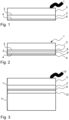
- the decorative film 1 has a print substrate film 2 with a first side 3 and a second side 4 opposite the first side 3 .
- the decorative film 1 has an anti-wear film 5 , the anti-wear film 5 making contact with the first side 3 of the print substrate film 2 .
- a decoration 6 is applied to the second side 4 of the print substrate film 2 .
- the decorative film 1 shown was produced using the method according to the invention, with the printing substrate film 2 being provided and the decoration 6 being applied to the second side 4 of the printing substrate film 2 .
- the wear protection film 5 was provided and then connected to the first side 3 of the print substrate film 2 .
- the decorative film 1 shown has in particular a print substrate film with a plurality of layers 7, 8, 9.
- the multiple layers have a layer sequence that is selected, for example, between the first side 3 of the print substrate film 2 and the second side 4 of the print substrate film 2 from BBB, ABC, ABA, ABB, ABCBA, ABCBB, and ABCBC.
- layer order ABC layer 7 is an A layer
- layer 8 is a B layer
- layer 9 is a C layer.
- FIG 3 shows schematically the cross section of a decorative panel 10 according to the invention produced by the method according to the invention, wherein the decorative film 1 from 1 was provided and a carrier 11 having a sealable layer 12 was provided.
- the decorative film 1 was applied to the carrier 11 and connected to the carrier 11 to form the decorative panel 10 .
Landscapes
- Laminated Bodies (AREA)
Priority Applications (8)
| Application Number | Priority Date | Filing Date | Title |
|---|---|---|---|
| EP21217464.3A EP4201669A1 (fr) | 2021-12-23 | 2021-12-23 | Feuille décorative |
| KR1020247022746A KR20240121285A (ko) | 2021-12-23 | 2022-12-23 | 장식 필름 |
| PCT/EP2022/087760 WO2023118578A1 (fr) | 2021-12-23 | 2022-12-23 | Film décoratif |
| CN202280085429.8A CN118434565A (zh) | 2021-12-23 | 2022-12-23 | 装饰膜 |
| MX2024006882A MX2024006882A (es) | 2021-12-23 | 2022-12-23 | Pelicula decorativa. |
| EP22844142.4A EP4452638A1 (fr) | 2021-12-23 | 2022-12-23 | Film décoratif |
| CA3241857A CA3241857A1 (fr) | 2021-12-23 | 2022-12-23 | Film decoratif |
| US18/716,992 US12565061B2 (en) | 2021-12-23 | 2022-12-23 | Decorative film |
Applications Claiming Priority (1)
| Application Number | Priority Date | Filing Date | Title |
|---|---|---|---|
| EP21217464.3A EP4201669A1 (fr) | 2021-12-23 | 2021-12-23 | Feuille décorative |
Publications (1)
| Publication Number | Publication Date |
|---|---|
| EP4201669A1 true EP4201669A1 (fr) | 2023-06-28 |
Family
ID=80122960
Family Applications (2)
| Application Number | Title | Priority Date | Filing Date |
|---|---|---|---|
| EP21217464.3A Pending EP4201669A1 (fr) | 2021-12-23 | 2021-12-23 | Feuille décorative |
| EP22844142.4A Pending EP4452638A1 (fr) | 2021-12-23 | 2022-12-23 | Film décoratif |
Family Applications After (1)
| Application Number | Title | Priority Date | Filing Date |
|---|---|---|---|
| EP22844142.4A Pending EP4452638A1 (fr) | 2021-12-23 | 2022-12-23 | Film décoratif |
Country Status (7)
| Country | Link |
|---|---|
| US (1) | US12565061B2 (fr) |
| EP (2) | EP4201669A1 (fr) |
| KR (1) | KR20240121285A (fr) |
| CN (1) | CN118434565A (fr) |
| CA (1) | CA3241857A1 (fr) |
| MX (1) | MX2024006882A (fr) |
| WO (1) | WO2023118578A1 (fr) |
Families Citing this family (1)
| Publication number | Priority date | Publication date | Assignee | Title |
|---|---|---|---|---|
| US20260034773A1 (en) * | 2024-08-01 | 2026-02-05 | Wilsonart Llc | Decorative engineered surface |
Citations (3)
| Publication number | Priority date | Publication date | Assignee | Title |
|---|---|---|---|---|
| KR20090104710A (ko) * | 2008-03-31 | 2009-10-06 | 다이니폰 인사츠 가부시키가이샤 | 장식 시트 및 그것이 적층된 장식재 |
| WO2012009514A1 (fr) * | 2010-07-14 | 2012-01-19 | Biovation, Llc | Ensemble composite biostratifié cellulosique et procédés associés |
| WO2017097705A1 (fr) * | 2015-12-07 | 2017-06-15 | Akzenta Paneele + Profile Gmbh | Panneau décoratif et procédé de fabrication dudit panneau |
Family Cites Families (7)
| Publication number | Priority date | Publication date | Assignee | Title |
|---|---|---|---|---|
| US4092198A (en) * | 1975-11-05 | 1978-05-30 | Exxon Research & Engineering Co. | Process for high pressure decorative laminate having registered color and embossing and resultant product |
| US20020136862A1 (en) * | 2000-12-11 | 2002-09-26 | Daojie Dong | Decorative and/or flame retardant laminates and processes of manufacture thereof |
| US7160605B2 (en) * | 2002-04-12 | 2007-01-09 | Fusco Luciano A | Decorated panel and process for making the same |
| US7288310B2 (en) * | 2003-01-23 | 2007-10-30 | Domco Tarkett, Inc. | Flooring tile and manufacturing process |
| BRPI0519338A2 (pt) * | 2004-12-16 | 2009-01-20 | Flooring Ind Ltd | painel de piso e mÉtodo para fabricar um painel de piso |
| US20060188757A1 (en) * | 2005-02-18 | 2006-08-24 | Tryggvi Magnusson | Simulated decorative surface |
| CN2892852Y (zh) * | 2006-01-04 | 2007-04-25 | 刘少华 | 双面叠衬错花玻璃 |
-
2021
- 2021-12-23 EP EP21217464.3A patent/EP4201669A1/fr active Pending
-
2022
- 2022-12-23 US US18/716,992 patent/US12565061B2/en active Active
- 2022-12-23 CA CA3241857A patent/CA3241857A1/fr active Pending
- 2022-12-23 EP EP22844142.4A patent/EP4452638A1/fr active Pending
- 2022-12-23 KR KR1020247022746A patent/KR20240121285A/ko active Pending
- 2022-12-23 MX MX2024006882A patent/MX2024006882A/es unknown
- 2022-12-23 WO PCT/EP2022/087760 patent/WO2023118578A1/fr not_active Ceased
- 2022-12-23 CN CN202280085429.8A patent/CN118434565A/zh active Pending
Patent Citations (3)
| Publication number | Priority date | Publication date | Assignee | Title |
|---|---|---|---|---|
| KR20090104710A (ko) * | 2008-03-31 | 2009-10-06 | 다이니폰 인사츠 가부시키가이샤 | 장식 시트 및 그것이 적층된 장식재 |
| WO2012009514A1 (fr) * | 2010-07-14 | 2012-01-19 | Biovation, Llc | Ensemble composite biostratifié cellulosique et procédés associés |
| WO2017097705A1 (fr) * | 2015-12-07 | 2017-06-15 | Akzenta Paneele + Profile Gmbh | Panneau décoratif et procédé de fabrication dudit panneau |
Also Published As
| Publication number | Publication date |
|---|---|
| KR20240121285A (ko) | 2024-08-08 |
| MX2024006882A (es) | 2024-06-20 |
| CA3241857A1 (fr) | 2023-06-29 |
| US12565061B2 (en) | 2026-03-03 |
| CN118434565A (zh) | 2024-08-02 |
| EP4452638A1 (fr) | 2024-10-30 |
| WO2023118578A1 (fr) | 2023-06-29 |
| US20250042195A1 (en) | 2025-02-06 |
Similar Documents
| Publication | Publication Date | Title |
|---|---|---|
| EP0562166B1 (fr) | Bande de lisière en résine polymérique, méthode de sa fabrication et son utilisation | |
| EP2990195B1 (fr) | Film composite multicouches gaufré et contrecollé par fusion | |
| EP3365171B2 (fr) | Profilé d'arête pour matériau en forme de plaque et matériau en forme de plaque | |
| EP3837112B1 (fr) | Plaque support en plastique multilaminaire et son procede de production | |
| DE102012022461B4 (de) | Abriebfestes dekoratives Beschichtungsmaterial, Verfahren zu dessen Herstellung und Verwendung des abriebfesten dekorativen Beschichtungsmaterials | |
| EP2223800B1 (fr) | Produit décoratif, procédé de fabrication d'un produit décoratif et utilisation d'un produit décoratif pour fabriquer une surface de support décorée | |
| EP1984191B1 (fr) | Procede de fabrication d'une languette profilee | |
| EP3837110B1 (fr) | Panneau décoratif doté d'une plaque porteuse en matière plastique multilaminaire et son procédé de fabrication | |
| WO2023118578A1 (fr) | Film décoratif | |
| EP1319502A1 (fr) | Feuille de surface destiné à être laminé sur un substrat | |
| EP0233633B1 (fr) | Films composites décoratifs pour recouvrements de surface, leur utilisation dans un composite multicouche et procédé de fabrication du composite multicouche | |
| DE69317848T2 (de) | Laminiertes bedrucktes Erzeugnis | |
| EP4058289B1 (fr) | Procédé de fabrication d'une couche de recouvrement exempte de chlorure de polyvinyle, couche de recouvrement exempte de chlorure de polyvinyle et élément de surfaçage | |
| EP3084099B1 (fr) | Element de plancher laminé | |
| EP3974176B1 (fr) | Feuille de protection de fermeture pour panneaux décoratifs | |
| EP2848403B1 (fr) | Feuille de protection de surface | |
| WO2025037007A1 (fr) | Feuille utilisée pour la formation d'un matériau en plaque et matériau en plaque | |
| DE20022048U1 (de) | Kunststoff-Flachmaterial zur Herstellung von Starkkanten von Möbeln | |
| EP3323606B1 (fr) | Composite de séparation | |
| DE10256040A1 (de) | Mehrschichtiges Kunststoffwerkstück sowie Verfahren zu seiner Herstellung | |
| DE102021003553A1 (de) | Sicherheitssubstrat | |
| DE2659192A1 (de) | Tapete und verfahren zur herstellung von tapeten | |
| EP1419976A2 (fr) | Matériau composite pour un couvercle avec un revêtement fabriqué par coextrusion | |
| WO2023198551A1 (fr) | Revêtement de surface et procédé de production | |
| EP3892796A1 (fr) | Panneau décoratif à bords non parallèles à l'axe longitudinal et procédé de fabrication |
Legal Events
| Date | Code | Title | Description |
|---|---|---|---|
| PUAI | Public reference made under article 153(3) epc to a published international application that has entered the european phase |
Free format text: ORIGINAL CODE: 0009012 |
|
| STAA | Information on the status of an ep patent application or granted ep patent |
Free format text: STATUS: THE APPLICATION HAS BEEN PUBLISHED |
|
| AK | Designated contracting states |
Kind code of ref document: A1 Designated state(s): AL AT BE BG CH CY CZ DE DK EE ES FI FR GB GR HR HU IE IS IT LI LT LU LV MC MK MT NL NO PL PT RO RS SE SI SK SM TR |
|
| P01 | Opt-out of the competence of the unified patent court (upc) registered |
Effective date: 20230705 |
|
| STAA | Information on the status of an ep patent application or granted ep patent |
Free format text: STATUS: REQUEST FOR EXAMINATION WAS MADE |
|
| 17P | Request for examination filed |
Effective date: 20231227 |
|
| RBV | Designated contracting states (corrected) |
Designated state(s): AL AT BE BG CH CY CZ DE DK EE ES FI FR GB GR HR HU IE IS IT LI LT LU LV MC MK MT NL NO PL PT RO RS SE SI SK SM TR |