EP3974176B1 - Feuille de protection de fermeture pour panneaux décoratifs - Google Patents
Feuille de protection de fermeture pour panneaux décoratifs Download PDFInfo
- Publication number
- EP3974176B1 EP3974176B1 EP20198094.3A EP20198094A EP3974176B1 EP 3974176 B1 EP3974176 B1 EP 3974176B1 EP 20198094 A EP20198094 A EP 20198094A EP 3974176 B1 EP3974176 B1 EP 3974176B1
- Authority
- EP
- European Patent Office
- Prior art keywords
- equal
- wear protection
- layer
- film
- less
- Prior art date
- Legal status (The legal status is an assumption and is not a legal conclusion. Google has not performed a legal analysis and makes no representation as to the accuracy of the status listed.)
- Active
Links
Images
Classifications
-
- B—PERFORMING OPERATIONS; TRANSPORTING
- B32—LAYERED PRODUCTS
- B32B—LAYERED PRODUCTS, i.e. PRODUCTS BUILT-UP OF STRATA OF FLAT OR NON-FLAT, e.g. CELLULAR OR HONEYCOMB, FORM
- B32B27/00—Layered products comprising a layer of synthetic resin
- B32B27/06—Layered products comprising a layer of synthetic resin as the main or only constituent of a layer, which is next to another layer of the same or of a different material
- B32B27/08—Layered products comprising a layer of synthetic resin as the main or only constituent of a layer, which is next to another layer of the same or of a different material of synthetic resin
-
- B—PERFORMING OPERATIONS; TRANSPORTING
- B32—LAYERED PRODUCTS
- B32B—LAYERED PRODUCTS, i.e. PRODUCTS BUILT-UP OF STRATA OF FLAT OR NON-FLAT, e.g. CELLULAR OR HONEYCOMB, FORM
- B32B27/00—Layered products comprising a layer of synthetic resin
- B32B27/30—Layered products comprising a layer of synthetic resin comprising vinyl (co)polymers; comprising acrylic (co)polymers
-
- B—PERFORMING OPERATIONS; TRANSPORTING
- B32—LAYERED PRODUCTS
- B32B—LAYERED PRODUCTS, i.e. PRODUCTS BUILT-UP OF STRATA OF FLAT OR NON-FLAT, e.g. CELLULAR OR HONEYCOMB, FORM
- B32B27/00—Layered products comprising a layer of synthetic resin
- B32B27/28—Layered products comprising a layer of synthetic resin comprising synthetic resins not wholly covered by any one of the sub-groups B32B27/30 - B32B27/42
- B32B27/283—Layered products comprising a layer of synthetic resin comprising synthetic resins not wholly covered by any one of the sub-groups B32B27/30 - B32B27/42 comprising polysiloxanes
-
- B—PERFORMING OPERATIONS; TRANSPORTING
- B32—LAYERED PRODUCTS
- B32B—LAYERED PRODUCTS, i.e. PRODUCTS BUILT-UP OF STRATA OF FLAT OR NON-FLAT, e.g. CELLULAR OR HONEYCOMB, FORM
- B32B27/00—Layered products comprising a layer of synthetic resin
- B32B27/30—Layered products comprising a layer of synthetic resin comprising vinyl (co)polymers; comprising acrylic (co)polymers
- B32B27/304—Layered products comprising a layer of synthetic resin comprising vinyl (co)polymers; comprising acrylic (co)polymers comprising vinyl halide (co)polymers, e.g. PVC, PVDC, PVF, PVDF
-
- B—PERFORMING OPERATIONS; TRANSPORTING
- B32—LAYERED PRODUCTS
- B32B—LAYERED PRODUCTS, i.e. PRODUCTS BUILT-UP OF STRATA OF FLAT OR NON-FLAT, e.g. CELLULAR OR HONEYCOMB, FORM
- B32B27/00—Layered products comprising a layer of synthetic resin
- B32B27/30—Layered products comprising a layer of synthetic resin comprising vinyl (co)polymers; comprising acrylic (co)polymers
- B32B27/308—Layered products comprising a layer of synthetic resin comprising vinyl (co)polymers; comprising acrylic (co)polymers comprising acrylic (co)polymers
-
- B—PERFORMING OPERATIONS; TRANSPORTING
- B32—LAYERED PRODUCTS
- B32B—LAYERED PRODUCTS, i.e. PRODUCTS BUILT-UP OF STRATA OF FLAT OR NON-FLAT, e.g. CELLULAR OR HONEYCOMB, FORM
- B32B27/00—Layered products comprising a layer of synthetic resin
- B32B27/32—Layered products comprising a layer of synthetic resin comprising polyolefins
-
- B—PERFORMING OPERATIONS; TRANSPORTING
- B32—LAYERED PRODUCTS
- B32B—LAYERED PRODUCTS, i.e. PRODUCTS BUILT-UP OF STRATA OF FLAT OR NON-FLAT, e.g. CELLULAR OR HONEYCOMB, FORM
- B32B37/00—Methods or apparatus for laminating, e.g. by curing or by ultrasonic bonding
- B32B37/12—Methods or apparatus for laminating, e.g. by curing or by ultrasonic bonding characterised by using adhesives
- B32B37/1207—Heat-activated adhesive
-
- B—PERFORMING OPERATIONS; TRANSPORTING
- B32—LAYERED PRODUCTS
- B32B—LAYERED PRODUCTS, i.e. PRODUCTS BUILT-UP OF STRATA OF FLAT OR NON-FLAT, e.g. CELLULAR OR HONEYCOMB, FORM
- B32B7/00—Layered products characterised by the relation between layers; Layered products characterised by the relative orientation of features between layers, or by the relative values of a measurable parameter between layers, i.e. products comprising layers having different physical, chemical or physicochemical properties; Layered products characterised by the interconnection of layers
- B32B7/04—Interconnection of layers
- B32B7/12—Interconnection of layers using interposed adhesives or interposed materials with bonding properties
-
- B—PERFORMING OPERATIONS; TRANSPORTING
- B44—DECORATIVE ARTS
- B44C—PRODUCING DECORATIVE EFFECTS; MOSAICS; TARSIA WORK; PAPERHANGING
- B44C5/00—Processes for producing special ornamental bodies
- B44C5/04—Ornamental plaques, e.g. decorative panels, decorative veneers
-
- C—CHEMISTRY; METALLURGY
- C08—ORGANIC MACROMOLECULAR COMPOUNDS; THEIR PREPARATION OR CHEMICAL WORKING-UP; COMPOSITIONS BASED THEREON
- C08G—MACROMOLECULAR COMPOUNDS OBTAINED OTHERWISE THAN BY REACTIONS ONLY INVOLVING UNSATURATED CARBON-TO-CARBON BONDS
- C08G77/00—Macromolecular compounds obtained by reactions forming a linkage containing silicon with or without sulfur, nitrogen, oxygen or carbon in the main chain of the macromolecule
- C08G77/04—Polysiloxanes
-
- C—CHEMISTRY; METALLURGY
- C08—ORGANIC MACROMOLECULAR COMPOUNDS; THEIR PREPARATION OR CHEMICAL WORKING-UP; COMPOSITIONS BASED THEREON
- C08L—COMPOSITIONS OF MACROMOLECULAR COMPOUNDS
- C08L33/00—Compositions of homopolymers or copolymers of compounds having one or more unsaturated aliphatic radicals, each having only one carbon-to-carbon double bond, and only one being terminated by only one carboxyl radical, or of salts, anhydrides, esters, amides, imides or nitriles thereof; Compositions of derivatives of such polymers
- C08L33/04—Homopolymers or copolymers of esters
-
- C—CHEMISTRY; METALLURGY
- C08—ORGANIC MACROMOLECULAR COMPOUNDS; THEIR PREPARATION OR CHEMICAL WORKING-UP; COMPOSITIONS BASED THEREON
- C08L—COMPOSITIONS OF MACROMOLECULAR COMPOUNDS
- C08L33/00—Compositions of homopolymers or copolymers of compounds having one or more unsaturated aliphatic radicals, each having only one carbon-to-carbon double bond, and only one being terminated by only one carboxyl radical, or of salts, anhydrides, esters, amides, imides or nitriles thereof; Compositions of derivatives of such polymers
- C08L33/04—Homopolymers or copolymers of esters
- C08L33/06—Homopolymers or copolymers of esters of esters containing only carbon, hydrogen and oxygen, which oxygen atoms are present only as part of the carboxyl radical
- C08L33/10—Homopolymers or copolymers of methacrylic acid esters
- C08L33/12—Homopolymers or copolymers of methyl methacrylate
-
- C—CHEMISTRY; METALLURGY
- C08—ORGANIC MACROMOLECULAR COMPOUNDS; THEIR PREPARATION OR CHEMICAL WORKING-UP; COMPOSITIONS BASED THEREON
- C08L—COMPOSITIONS OF MACROMOLECULAR COMPOUNDS
- C08L83/00—Compositions of macromolecular compounds obtained by reactions forming in the main chain of the macromolecule a linkage containing silicon with or without sulfur, nitrogen, oxygen or carbon only; Compositions of derivatives of such polymers
- C08L83/04—Polysiloxanes
-
- C—CHEMISTRY; METALLURGY
- C09—DYES; PAINTS; POLISHES; NATURAL RESINS; ADHESIVES; COMPOSITIONS NOT OTHERWISE PROVIDED FOR; APPLICATIONS OF MATERIALS NOT OTHERWISE PROVIDED FOR
- C09D—COATING COMPOSITIONS, e.g. PAINTS, VARNISHES OR LACQUERS; FILLING PASTES; CHEMICAL PAINT OR INK REMOVERS; INKS; CORRECTING FLUIDS; WOODSTAINS; PASTES OR SOLIDS FOR COLOURING OR PRINTING; USE OF MATERIALS THEREFOR
- C09D183/00—Coating compositions based on macromolecular compounds obtained by reactions forming in the main chain of the macromolecule a linkage containing silicon, with or without sulfur, nitrogen, oxygen, or carbon only; Coating compositions based on derivatives of such polymers
- C09D183/04—Polysiloxanes
-
- B—PERFORMING OPERATIONS; TRANSPORTING
- B32—LAYERED PRODUCTS
- B32B—LAYERED PRODUCTS, i.e. PRODUCTS BUILT-UP OF STRATA OF FLAT OR NON-FLAT, e.g. CELLULAR OR HONEYCOMB, FORM
- B32B37/00—Methods or apparatus for laminating, e.g. by curing or by ultrasonic bonding
- B32B37/12—Methods or apparatus for laminating, e.g. by curing or by ultrasonic bonding characterised by using adhesives
- B32B37/1207—Heat-activated adhesive
- B32B2037/1215—Hot-melt adhesive
-
- B—PERFORMING OPERATIONS; TRANSPORTING
- B32—LAYERED PRODUCTS
- B32B—LAYERED PRODUCTS, i.e. PRODUCTS BUILT-UP OF STRATA OF FLAT OR NON-FLAT, e.g. CELLULAR OR HONEYCOMB, FORM
- B32B37/00—Methods or apparatus for laminating, e.g. by curing or by ultrasonic bonding
- B32B37/12—Methods or apparatus for laminating, e.g. by curing or by ultrasonic bonding characterised by using adhesives
- B32B2037/1253—Methods or apparatus for laminating, e.g. by curing or by ultrasonic bonding characterised by using adhesives curable adhesive
-
- B—PERFORMING OPERATIONS; TRANSPORTING
- B32—LAYERED PRODUCTS
- B32B—LAYERED PRODUCTS, i.e. PRODUCTS BUILT-UP OF STRATA OF FLAT OR NON-FLAT, e.g. CELLULAR OR HONEYCOMB, FORM
- B32B2307/00—Properties of the layers or laminate
- B32B2307/50—Properties of the layers or laminate having particular mechanical properties
-
- B—PERFORMING OPERATIONS; TRANSPORTING
- B32—LAYERED PRODUCTS
- B32B—LAYERED PRODUCTS, i.e. PRODUCTS BUILT-UP OF STRATA OF FLAT OR NON-FLAT, e.g. CELLULAR OR HONEYCOMB, FORM
- B32B2307/00—Properties of the layers or laminate
- B32B2307/50—Properties of the layers or laminate having particular mechanical properties
- B32B2307/554—Wear resistance
-
- B—PERFORMING OPERATIONS; TRANSPORTING
- B32—LAYERED PRODUCTS
- B32B—LAYERED PRODUCTS, i.e. PRODUCTS BUILT-UP OF STRATA OF FLAT OR NON-FLAT, e.g. CELLULAR OR HONEYCOMB, FORM
- B32B2307/00—Properties of the layers or laminate
- B32B2307/50—Properties of the layers or laminate having particular mechanical properties
- B32B2307/558—Impact strength, toughness
-
- B—PERFORMING OPERATIONS; TRANSPORTING
- B32—LAYERED PRODUCTS
- B32B—LAYERED PRODUCTS, i.e. PRODUCTS BUILT-UP OF STRATA OF FLAT OR NON-FLAT, e.g. CELLULAR OR HONEYCOMB, FORM
- B32B2419/00—Buildings or parts thereof
-
- B—PERFORMING OPERATIONS; TRANSPORTING
- B32—LAYERED PRODUCTS
- B32B—LAYERED PRODUCTS, i.e. PRODUCTS BUILT-UP OF STRATA OF FLAT OR NON-FLAT, e.g. CELLULAR OR HONEYCOMB, FORM
- B32B2451/00—Decorative or ornamental articles
-
- B—PERFORMING OPERATIONS; TRANSPORTING
- B32—LAYERED PRODUCTS
- B32B—LAYERED PRODUCTS, i.e. PRODUCTS BUILT-UP OF STRATA OF FLAT OR NON-FLAT, e.g. CELLULAR OR HONEYCOMB, FORM
- B32B2479/00—Furniture
Definitions
- the present invention relates to anti-wear films and a method for producing anti-wear films, as well as decorative panels having an anti-wear film and a method for producing decorative panels having an anti-wear film.
- Decorative panels with a wear protection layer are known per se and are used in particular as panels for the decorative cladding of floors, walls, ceilings or doors.
- the term decorative panel is to be understood as meaning wall, ceiling, door or floor panels which have a decoration applied to a carrier plate.
- Decorative panels are used in a variety of ways both in the field of interior design of rooms and for decorative cladding of buildings, for example in trade fair construction.
- One of the most common areas of application for decorative panels is their use as floor coverings, to cover ceilings, walls or doors.
- the decorative panels often have a decoration and a surface structure which is intended to imitate a natural material.
- a decor pattern imitating surface structure is introduced, so that the surface of the decorative panel has a haptically perceptible structure, which is adapted to the applied decor in terms of shape and pattern, to such a to obtain a replica of a natural material that is as true to the original as possible, also in terms of haptics.
- layers of duroplastic plastics such as melamine resins
- wear protection layers have become established as wear protection layers for decorative panels.
- a disadvantage of such wear protection layers can be that they impair their recyclability, particularly when used on decorative panels.
- thermoset plastics it is difficult to produce layers of thermoset plastics as a semi-finished product, resulting in limitations in the process control in the production of decorative panels with a wear-resistant layer.
- document EP 3 632 700 A1 proposes a method for producing a structured anti-wear film.
- the method has the following process steps: providing a wear-protection base film, applying a formable paint-containing top layer to at least a portion of the wear-protection base film, at least partially structuring the paint-containing top layer using a digital printing process to produce a structure of the paint-containing top layer, and at least partial curing of the paint-containing top layer.
- a structured anti-wear film, the use of a structured anti-wear film and a decorative panel with a structured anti-wear film are also proposed.
- the method described above offers the advantage that a particularly detailed structuring of a wear protection surface can be obtained, that the structure can be aligned particularly easily in various ways relative to a decor, that economical production of small series is made possible and limitations in process management are reduced become.
- the light-emitting and reflective security sheet includes a base sheet, a light-emitting layer, a light-reflecting layer, a light-transmitting layer, a laminating layer, an adhesive layer, and the like.
- the light-emitting and reflective security film has the advantages that the light-emitting layer and the light-reflecting layer each contain a light-emitting agent and a light-reflecting agent, each made of light-emitting ceramic and ceramic beads, so the compatibility is good and the light-emitting and light-reflecting effect is good; the wear-resistant, light-resistant and moisture-proof properties are good, as well as the light-emitting and reflective.
- a wear protection film is proposed with the invention.
- the wear protection film has a thermoplastic carrier film and a thermoplastic carrier film on top of it arranged anti-wear layer, with an adhesion promoter layer being arranged at least partially between the thermoplastic carrier film and the wear-protection layer, with the thermoplastic carrier film having a thermoplastic, with the adhesion promoter layer having an adhesion promoter, and with the wear-protection layer having a mixture comprising a polymethyl methacrylate and polyorganosiloxane, the polyorganosiloxane being a number-average molecular weight in a range from greater than or equal to 50 kDa to less than or equal to 700 kDa, preferably from greater than or equal to 100 kDa to less than or equal to 500 kDa, more preferably greater than or equal to 150 kDa to less than or equal to 300 kDa.
- the wear protection film according to the invention can advantageously be produced as a semi-finished product, which results in a more flexible process control in the production of decorative panels.
- the anti-wear film has improved recyclability in conjunction with decorative panels. At the same time, no impairments with regard to the appearance of decorative panels provided with the wear protection film according to the invention can be seen.
- the term “wear protection film” is to be understood as meaning a film which can be applied to decorative panels or other materials and which protects against wear, in particular against physical influences.
- the term “wear protection layer” is to be understood as meaning a layer that protects against wear.
- thermoplastic plastics are understood to mean plastics which deform plastically in a specific temperature range let.
- polyvinyl chloride polyolefins such as polyethylene (PE) or polypropylene (PP), polyamides (PA), polyurethanes (PU), polystyrene (PS), acrylonitrile butadiene styrene (ABS), polymethyl methacrylate (PMMA), polycarbonate (PC ), polyethylene terephthalate (PET), polyetheretherketone (PEEK) or mixtures or copolymers of these thermoplastics.
- PE polyethylene
- PP polypropylene
- PA polyamides
- PU polyurethanes
- PS polystyrene
- ABS acrylonitrile butadiene styrene
- PMMA polymethyl methacrylate
- PC polycarbonate
- PET polyethylene terephthalate
- PEEK polyetheretherketone
- an “adhesion promoter” is to be understood as meaning a substance that is suitable for creating a better connection between two materials, in particular the adhesion between the carrier film and the wear-resistant layer.
- a wear protection film as described above can therefore in particular allow better recyclability of decorative panels provided with it and more flexible process control in their production.
- the wear protection film according to the invention has a thermoplastic carrier film.
- the carrier film has a thermoplastic material.
- the carrier film thus advantageously serves as a carrier for further layers of the wear protection film and can in particular prevent these from tearing unintentionally.
- the carrier film can also serve as a connecting layer in a later production of a decorative panel.
- the carrier film can allow easy handling of the wear protection film.
- the wear-protection film can be rolled up through the carrier film, which allows easy storage of the wear-protection film. Due to the thermoplastic properties of the carrier film, stresses in a decorative panel having a wear protection film according to the invention can also be avoided, since the thermoplastic carrier film can at least partially adapt to unevenness or tensile stresses during production.
- a wear protection layer is arranged on the thermoplastic carrier film.
- the wear protection layer has a mixture containing a polymethyl methacrylate and a polyorganosiloxane. Surprisingly, it could be shown that good anti-wear properties can be achieved by the mixture comprising polymethyl methacrylate and polyorganosiloxane. Without being bound to a theory, it is assumed that the polyorganosiloxane in the wear-resistant layer migrates to the surface of the wear-resistant film and forms an area there with high scratch resistance that cannot be wiped off.
- the wear protection film also has an adhesion promoter layer, with the adhesion promoter layer having an adhesion promoter. Surprisingly, it could be shown that the wear protection properties of the wear protection layer are not impaired by such an adhesion promoter layer and at the same time the adhesion between the wear protection layer and the thermoplastic carrier film is improved. In this way it can be achieved that the wear-protection layer is not unintentionally detached from the thermoplastic carrier film under stress, as a result of which the wear-protection properties would be severely impaired. In particular, it can be achieved in this way that the wear protection layer does not become detached from the thermoplastic carrier film, for example when the wear protection film is rolled up and stored for a longer period of time or during further processing of the wear protection film.
- the wear protection film can be recycled well as a whole without the individual layers having to be mechanically separated.
- the advantageous properties of the anti-wear film according to the invention result overall from the interaction of the different layers.
- thermoplastic carrier film is greater than or equal to 75% by weight, based on the thermoplastic carrier film, of the thermoplastic more preferably greater than or equal to 90% by weight, further preferably greater than or equal to 95% by weight, particularly preferably greater than or equal to 99% by weight.
- thermoplastic carrier film can also contain other substances in addition to the thermoplastic material, but essentially consists of the thermoplastic material.
- the thermoplastic carrier film can have additives that influence, for example, the color, the impact strength or also the flammability of the carrier film. It has been shown that the advantageous recycling properties and carrier properties of the thermoplastic carrier film are particularly pronounced in the specified ranges. In particular, however, the use of the structure according to the invention results in a decorative panel which is particularly advantageously recyclable overall.
- the adhesion promoter layer has greater than or equal to 75% by weight of the adhesion promoter, more preferably greater than or equal to 90% by weight, more preferably greater than or equal to 95% by weight, particularly preferably greater than or equal to equal to 99% by weight.
- the adhesion promoter layer consists essentially of adhesion promoter, but can also contain other substances.
- the adhesion promoter is present in a diluted or dispersed form in a plastic.
- the adhesion promoter can be easily processed during production of the wear protection film and can be applied thinly and simply to the thermoplastic carrier film.
- the advantages achieved by the adhesion promoter layer are particularly pronounced in the aforementioned areas.
- the anti-wear layer can contain other substances in addition to polymethyl methacrylate and polyorganosiloxane, but essentially consists of polymethyl methacrylate and polyorganosiloxane. It could be shown that other substances can be added to the anti-wear layer in this area, which advantageously change the impact strength, the flammability or the optical properties of the anti-wear layer, for example. In the aforementioned areas, the wear protection layer has particularly good wear protection properties.
- the thermoplastic is selected from the group consisting of polypropylene, polyvinyl chloride, polyethylene, copolymers thereof and mixtures thereof, the thermoplastic being in particular polypropylene.
- the polypropylene has a melt flow index (MFI) in a range between greater than or equal to 2 g/10min and less than or equal to 20 g/10min, in particular between greater than or equal to 5 g/10min and less than or equal to 19 g/10min on.
- MFI melt flow index
- the Melt Flow Index can be determined according to ISO 1133.
- the polypropylene is a nucleated homopolymer with high transparency or a rondomized copolymer with high transparency.
- thermoplastics can make it possible for the wear protection film to be recycled particularly well. In addition, it can be achieved that the wear protection film is particularly stable. Surprisingly, it has been shown that with the aforementioned thermoplastics, the thermoplastic carrier film can be made particularly thin without the mechanical properties of the wear protection film being impaired too severely. Without being bound by any theory, it is believed that these thermoplastics, and particularly polypropylene, are particularly compatible with the composition of the wear-resistant layer.
- the adhesion promoter is a polyolefin copolymer, preferably a polyolefin graft copolymer, particularly preferably a polypropylene graft copolymer, in particular a maleic anhydride-modified polypropylene graft copolymer, an acrylic acid-modified polypropylene or polyethylene, a maleic anhydride-modified polyethylene, a metallocene-catalyzed linear low density polyethylene (metallocene LLDPE), a metallocene catalyzed linear high density polyethylene (metallocene HDPE) or an ethylene vinyl acetate copolymer.
- a polyolefin copolymer preferably a polyolefin graft copolymer, particularly preferably a polypropylene graft copolymer, in particular a maleic anhydride-modified polypropylene graft copolymer, an acrylic acid-modified polypropylene or polyethylene,
- the maleic anhydride-modified polypropylene graft copolymer has a maleic acid content in a range from greater than or equal to 0.1% by weight to less than or equal to 5% by weight, based on the maleic anhydride-modified polypropylene graft copolymer, preferably greater than or equal to equal to 0.5% by weight to less than or equal to 1.5% by weight.
- thermoplastic carrier film In the specified ranges, a particularly strong and long-lasting adhesion between the thermoplastic carrier film and the wear protection film can be achieved in an advantageous manner.
- the polymethyl methacrylate to have an impact strength modifier, in particular in an amount in a range from greater than or equal to greater than or equal to 0.1% by weight to less than or equal to 5% by weight, based on the polymethyl methacrylate, preferably from greater than or equal to 0.5% to less than or equal to 1.5% by weight.
- the impact strength modifier is at least one compound selected from the group consisting of thermoplastic elastomers, ethylene glycol dimethacrylate, ethylene butyl acrylate, ethylene methyl acrylate copolymer and polybutyl acrylate.
- the impact strength of the wear protection layer could be improved in this way without impairing the wear properties, such as the scratch resistance.
- polydimethylsiloxane can certainly dissolve particularly well in polymethyl methacrylate. As a result, a particularly stable wear protection layer can be achieved. Furthermore, polydimethylsiloxane has an advantageous effect on the optical properties of the wear protection layer that is particularly small.
- the polyorganosiloxane has a number-average molecular weight in a range from greater than or equal to 50 kDa to less than or equal to 700 kDa, preferably from greater than or equal to 100 kDa to less than or equal to 500 kDa, more preferably greater than or equal to 150 kDa to less than or equal to equal to 300 kDa.
- number-average molecular weight is to be understood as meaning the mean value of the molecular weight of the corresponding polymer, with the relative number of polymers having a corresponding molecular weight being averaged.
- the number-average molecular weight indicates the expected molar mass of a polymer molecule randomly taken from the sample.
- the mixture comprising polymethyl methacrylate and polyorganosiloxane has polymethyl methacrylate in a range from greater than or equal to 90% by weight to less than 100% by weight, based on the mixture, preferably greater than or equal to 95% by weight to less than or equal to equal to 99.9% by weight, more preferably greater than or equal to 98% by weight to less than or equal to 99.5% by weight, particularly preferably greater than or equal to 98.5% by weight to less than or equal to 99% by weight.
- the mixture containing polymethyl methacrylate and polyorganosiloxane contains polyorganosiloxane in a range from greater than 0% by weight to less than or equal to 10% by weight based on the mixture, preferably greater than or equal to 0.1% by weight to less than or equal to 5% by weight %, more preferably greater than or equal to 0.5% by weight to less than or equal to 2% by weight, particularly preferably greater than or equal to 1% by weight to less than or equal to 1.5% by weight.
- thermoplastic carrier film to have a thickness in a range from greater than or equal to 0.1 mm to less than or equal to 1 mm, preferably from greater than or equal to 0.2 mm to less than or equal to 0.8 mm, more preferably from greater than or equal to 0.3 mm to less than or equal to 0.6 mm.
- the carrier film has particularly good stability.
- the carrier film has a sufficient thickness to compensate for stresses between the panel and the wear-resistant layer when used in a decorative panel.
- the adhesion promoter layer can preferably be made for the adhesion promoter layer to have a thickness in a range from greater than or equal to 1 ⁇ m to less than or equal to 0.1 mm.
- the wear protection layer has a thickness in a range from greater than or equal to 0.01 mm to less than or equal to 1 mm, preferably from greater than or equal to 0.1 mm to less than or equal to 0.8 mm, more preferably from greater than or equal to 0.4 mm to less than or equal to 0.6 mm.
- the thickness of the wear protection layer is greater than or equal to 5% to less than or equal to 30% of the total thickness of the film structure according to the invention made up of wear layer, adhesion promoting layer and carrier film.
- the polyorganosiloxane forms a layer with a particularly advantageous thickness on the surface of the anti-wear film. A particularly good and in particular long-lasting protection against wear can thus be achieved.
- a “web-like shape” can be understood in the sense of the present invention as a shape that has a significantly greater width than its thickness and a significantly greater length than its width, for example greater than 15 meters.
- the wear protection film can be used particularly well for the production of decorative panels.
- the wear-protection film can thus simply be rolled up and stored on rolls and used at a later point in time for the production of decorative panels.
- a sheet-like form can be produced continuously.
- a wear-protection film with a web-like form can accordingly be produced at the same time as other components of a decorative panel and can easily be brought together continuously with these components, for example using rollers.
- the wear protection layer has a paint-containing top layer arranged on the surface of the wear protection film, the paint-containing top layer preferably having a top paint selected from the group consisting of melamine resin and acrylate-based plastic compositions, in particular polyurethane-modified acrylate plastic compositions.
- the anti-wear properties are further improved.
- wear protection layers that only have a paint-containing top layer and no wear-protection layer having polymethyl methacrylate and polyorganosiloxane, such a further improvement in the wear protection properties can already be achieved with a particularly thin paint-containing top layer, which means that the recyclability deteriorates particularly little.
- a decorative panel is also proposed with the invention.
- the decorative panel has a carrier plate, at least one decorative layer, at least one laminating adhesive layer and a wear-resistant film according to the invention, the wear-resistant film being aligned with the carrier plate on the carrier film side, and the decorative layer and the laminating adhesive layer being arranged between the carrier plate and the thermoplastic carrier film.
- the wear protection film according to the invention is thermally laminated onto a carrier plate having a decorative layer.
- a decorative panel is proposed in an alternative embodiment which has a carrier plate, at least one decorative layer and a wear protection film according to the invention, the wear protection film being aligned with the carrier plate on the carrier film side, and the decorative layer being arranged between the carrier plate and the thermoplastic carrier film.
- the carrier plate provided with the decorative layer is preheated to a temperature of approx equal to 160°C, preferably between greater than or equal to 150°C to less than or equal to 160°C.
- decorative panels of this type have good wear properties in comparison to other decorative panels and at the same time can be manufactured more easily and flexibly.
- decorative panels of this type are easier to recycle, since in particular the use of melamine resins and lacquers, such as acrylate, polyurethane or epoxy lacquers, can be dispensed with.
- Carrier film side means that the wear protection film is aligned with the carrier plate with the side on which the carrier film is located.
- the decorative panel thus has a layered composite, comprising the carrier plate, the thermoplastic carrier film arranged on the carrier plate and the wear protection layer arranged on the carrier film, the adhesion promoter layer being arranged between the wear protection layer and the thermoplastic carrier film and the decorative layer and the optional laminating adhesive layer being arranged between the carrier plate and the thermoplastic carrier film are.
- the term “decor panel” is to be understood as meaning wall, ceiling, door or floor panels which have a decoration applied to a carrier plate.
- Decorative panels are used in a variety of ways both in the field of interior design of rooms, as well as for the decorative cladding of buildings, for example used in exhibition stand construction.
- One of the most common areas of application for decorative panels is their use as floor coverings, to cover ceilings, walls or doors.
- the decorative panels often have a decoration and a surface structure which is intended to imitate a natural material.
- a “carrier board” is understood to mean a layer serving as a core or base layer in a finished panel, which can in particular have a natural material such as a wood material, a fiber material or a material comprising a plastic.
- the backing plate may provide or add appropriate stability to a panel.
- wood-based materials within the meaning of the invention are also materials such as cross laminated timber, glued laminated timber, block laminated timber, veneer plywood, laminated veneer lumber, stripped veneer lumber and flexible plywood.
- wood-based materials within the meaning of the invention also include chipboard materials such as chipboard, extruded board, coarse chipboard (oriented structural board, OSB) and stripboard wood, as well as wood fiber materials such as wood fiber insulation boards (HFD), medium-hard and hard fiberboard (MB, HFH), and in particular medium-density Understand fiberboard (MDF) and high-density fiberboard (HDF).
- chipboard materials such as chipboard, extruded board, coarse chipboard (oriented structural board, OSB) and stripboard wood
- wood fiber materials such as wood fiber insulation boards (HFD), medium-hard and hard fiberboard (MB, HFH), and in particular medium-density Understand fiberboard (MDF) and high-density fiberboard (HDF).
- Modern wood-based materials such as wood-polymer materials (Wood Plastic Composite, WPC), sandwich panels made of a light core material such as foam, rigid foam or paper honeycomb and a layer of wood applied thereto, as well as mineral, e.g. cement, bonded chipboard form wood-based materials within the meaning of the invention.
- WPC Wood Plastic Composite
- sandwich panels made of a light core material such as foam, rigid foam or paper honeycomb and a layer of wood applied thereto, as well as mineral, e.g. cement, bonded chipboard form wood-based materials within the meaning of the invention.
- Cork is also a wood-based material within the meaning of the invention.
- Plastics that can be used in the production of corresponding panels or the carrier plates are, for example, thermoplastics such as polyvinyl chloride, polyolefins (e.g. polyethylene (PE), polypropylene (PP), polyamides (PA), polyurethanes (PU), polystyrene (PS) , Acrylonitrile Butadiene Styrene (ABS), Polymethyl methacrylate (PMMA), polycarbonate (PC), polyethylene terephthalate (PET), polyetheretherketone (PEEK) or mixtures or copolymers of these.
- the plastics can contain customary fillers, for example calcium carbonate (chalk), aluminum oxide, silica gel, quartz flour, wood flour, gypsum. They can also be colored in a known manner.
- the carrier plate can in particular be a web-like carrier plate or a plate-shaped carrier plate.
- a "web-like carrier plate” can be understood to mean a carrier plate which, for example, has a web-like length in its production process and is therefore significantly greater than its thickness or width and whose length can be greater than 15 meters, for example.
- a "plate-shaped carrier plate” can also be understood in the context of the present invention as a carrier plate which is formed from the web-like carrier plate by separating it and is designed in the form of a plate.
- the plate-shaped carrier plate can already specify the shape and/or size of a decorative panel in the size of commercially available panels.
- the plate-shaped carrier plate can also be provided as a large plate.
- a large panel within the meaning of the invention is in particular a carrier panel whose dimensions exceed the dimensions of the final decorative panels many times over and which is divided into a corresponding plurality of decorative panels in the course of the manufacturing process, for example by sawing, laser or water jet cutting.
- the large plate can correspond to the web-shaped carrier plate.
- a “decorative layer” is to be understood as meaning an optically perceptible layer which has a decoration.
- the decor can imitate a natural material.
- imitated natural materials are types of wood such as maple, oak, birch, cherry, ash, walnut, chestnut, Wenge or exotic woods such as panga panga, mahogany, bamboo and bubinga.
- natural materials such as stone surfaces or ceramic surfaces are often imitated.
- a “laminating adhesive layer” is to be understood as meaning a layer comprising a laminating adhesive which bonds adjacent layers to one another.
- the decorative layer contacts the carrier plate or contacts the thermoplastic carrier film or a first decorative layer contacts the carrier plate and a second decorative layer contacts the thermoplastic carrier film.
- the decorative panel can be produced particularly easily using known means.
- the decoration can be applied particularly precisely, because the carrier plate has a certain stability, which facilitates precise application of the decoration.
- the decorative layer By applying the decorative layer to the thermoplastic carrier film, the decorative element can be aligned particularly precisely to a structure on the wear-resistant layer.
- a first decorative layer on the carrier plate and a second decorative layer on the carrier foil advantageously allow depth effects to be achieved in the decoration.
- the decorative layer contacts the carrier plate and the laminating adhesive layer is arranged on the decorative layer, the thermoplastic carrier film being arranged on the laminating adhesive layer.
- the laminating adhesive layer contacts the carrier plate and on the Laminating adhesive layer, the decorative layer is arranged, wherein the thermoplastic carrier film is arranged on the decorative layer.
- a first decorative layer contacts the carrier plate and the laminating adhesive layer is arranged on the first decorative layer, with a second decorative layer being arranged on the laminating adhesive layer, which contacts the thermoplastic carrier film.
- the decoration can be applied particularly precisely and is particularly durable and has particularly high color fidelity.
- the laminating adhesive layer can preferably be made for the laminating adhesive layer to have a laminating adhesive selected from the group consisting of hot-melt adhesive and UV-curable adhesive, in particular acrylic-based UV adhesives.
- the carrier plate and thermoplastic carrier film have a particularly strong and durable connection.
- the carrier plate can preferably be made for the carrier plate to have polypropylene, polyethylene, polyvinyl chloride, copolymers thereof and mixtures thereof.
- the carrier plate is particularly well connected to the wear protection film and the decorative panel has good mechanical properties overall. Furthermore, it can be achieved that the decorative panel as a whole has a particularly good recyclability.
- the carrier plate can have a matrix material and a solid material, the matrix material being present in an amount of ⁇ 20% by weight to ⁇ 55% by weight, in particular ⁇ 35% by weight, based on the carrier plate. to ⁇ 45% by weight, and wherein the solid material is present in an amount, based on the carrier plate, of ⁇ 45% by weight to ⁇ 80% by weight, in particular from ⁇ 55% by weight to ⁇ 65% by weight. -%, is present, and wherein the matrix material and the solid material together, based on the carrier plate, are present in an amount of ⁇ 95% by weight, in particular ⁇ 99% by weight.
- the proportions of matrix material or solid material can be selected. As a result, good adaptability to the desired area of application can become possible. In principle, however, it can be preferred that the proportion of the solid material is greater than or equal to the proportion of the matrix material. It has been shown that a decorative panel according to the invention with a carrier board with the above-described composition is particularly easy to recycle and at the same time has particularly good mechanical properties.
- At least 50% by weight, in particular at least 80% by weight, in particular at least 95% by weight, of the solid material is formed from a solid composition consisting of at least one first layered silicate powder and a second layered silicate powder, and at least 50% by weight, in particular at least 80% by weight, in particular at least 95% by weight, of the matrix material, based on the matrix material, is formed by a plastic composition consisting of a homopolymer and at least a first copolymer and a second copolymer.
- Layered silicate powder is understood to mean, in a manner known per se, a powder made from a layered silicate.
- Layered silicates are known to refer to minerals from the Group of silicates whose silicate anions are usually arranged in layers.
- phyllosilicates are understood to mean minerals from the mica group, the chlorite group, the kaolinite group and the serpentine group.
- the solid material is advantageously formed at least for the most part from the mineral substance layered silicate, with this substance being able to be used in powder form or being present in the carrier plate in the form of particles.
- the solid material can consist of a powdered solid.
- Layered silicates offer the advantage that they can allow the production of a carrier with good mechanical properties and, at the same time, can be easily processed into corresponding powders due to their layered structure.
- the carrier board or the decorative panel has particularly preferred mechanical properties.
- Generally known methods such as laser diffractometry, can be used to determine the particle size distribution, with which particle sizes in the range from a few nanometers to several millimeters can become.
- This method can also be used to determine D 50 or D 98 values, which state that 50% (D 50 ) or 98% (D 98 ) of the measured particles are smaller than the specified value.
- D 50 or D 98 values which state that 50% (D 50 ) or 98% (D 98 ) of the measured particles are smaller than the specified value.
- These values can also preferably be determined by means of laser diffractometry. In the event of deviations in the measured values obtained using different measuring methods, the applicant considers the value determined using laser diffractometry to be decisive.
- the first layered silicate powder has a bulk density according to DIN 53468 in a range from ⁇ 2.4 g/cm 3 to ⁇ 3.6 g/cm 3 , for example in a range from ⁇ 2.9 g/cm 3 . cm 3 to ⁇ 3.1 g/cm 3 .
- the second layered silicate powder has a bulk density according to DIN 53468 in a range from ⁇ 3.4 g/cm 3 to ⁇ 4.6 g/cm 3 , for example in a range from ⁇ 3.9 g/cm 3 . cm 3 to ⁇ 4.1 g/cm 3 .
- the first layered silicate powder has a bulk density according to DIN 53468 which is less than or equal to the bulk density at which the second layered silicate powder is present.
- the homopolymer, the first copolymer and/or the second copolymer consists at least partially of recycled material.
- the proportion of recycled material per type of polymer or copolymer can be in a range from ⁇ 2% by weight to ⁇ 100% by weight, preferably ⁇ 5% by weight to ⁇ 90% by weight. %, in particular ⁇ 10% by weight to ⁇ 80% by weight, such as ⁇ 15% by weight to ⁇ 70% by weight. Provision can also be made for the proportion of recycled material to be different for each type of polymer or copolymer.
- At least one type of polymer or copolymer has a proportion of ⁇ 90% by weight of recycled material, while the other types of polymer or copolymer independently of one another have a proportion of recycled material ⁇ 50% by weight, in particular ⁇ 10% by weight.
- the matrix material has a plastic, such as a thermoplastic, it can be made possible, despite the high stability, for the decorative panel to be very elastic or resilient and/or flexible, which allows a comfortable impression when walking on and also the occurring Can reduce noise when walking compared to conventional materials and thus an improved impact sound can be realized.
- Polypropylene is particularly suitable as a matrix material because, on the one hand, it can be obtained inexpensively and, as a thermoplastic, also has good properties as a matrix material for embedding the solid material.
- the decorative panel is particularly easy to recycle.
- the first copolymer comprises a heterophasic polypropylene and the second copolymer comprises an ethylene-propylene copolymer and an isotactic polypropylene.
- the decorative panel is particularly easy to recycle.
- the second copolymer has an ethylene content of ⁇ 8% by weight to ⁇ 22% by weight, preferably from ⁇ 13% by weight to ⁇ 17% by weight.
- the homopolymer, based on the plastics composition in a proportion of ⁇ 10% by weight to ⁇ 40% by weight and/or that the first copolymer, based on the plastics composition, in a proportion of ⁇ 40% by weight. % to ⁇ 70% by weight and/or that the second copolymer, based on the plastics composition, is present in a proportion of ⁇ 10% by weight to ⁇ 40% by weight.
- the further solid has a bulk density in a range of ⁇ 2000 kg/m 3 , in particular ⁇ 1500 kg/m 3 , for example ⁇ 1000 kg/m 3 , particularly preferably ⁇ 500 kg / m 3 and / or that the other solid is selected from the group consisting of wood, expanded clay, volcanic ash, pumice, aerated concrete, inorganic foams and cellulose.
- the wear protection layer at least partially has a surface structuring and the surface structuring is at least partially synchronous with a decoration of the decorative layer.
- the decorative panel can imitate a template material particularly well.
- the invention also proposes a method for producing the wear protection film according to the invention.
- a thermoplastic is coextruded, extrusion-coated and/or laminated, preferably coextruded, to form a thermoplastic carrier film, an adhesion promoter to form an adhesion-promoting layer and a mixture comprising polymethyl methacrylate and polyorganosiloxane to form a wear-resistant layer to form the wear-resistant film.
- Coextrusion means in particular that the thermoplastic is coextruded to form the thermoplastic carrier film, the adhesion promoter to the adhesion promoter layer and the mixture comprising polymethyl methacrylate and polyorganosiloxane to form the wear protection layer to form the wear protection film.
- thermoplastic, the adhesion promoter and the mixture comprising polymethyl methacrylate and polyorganosiloxane are each extruded using an extruder and brought together directly, with the wear protection film being obtained directly.
- the wear protection film according to the invention can advantageously be produced particularly well by the method described above.
- Extrusion coating means in particular that at least one of the thermoplastic carrier film, the adhesion promoter layer and the wear protection layer is extruded separately in a first step and the remaining layers are extruded onto the first extruded layer in a second and third step.
- thermoplastic carrier film is produced in the first step, the adhesion promoter layer is extruded onto the thermoplastic carrier film in the second step and the wear protection layer is extruded onto the adhesion promoter layer in the third step.
- Lamination means in particular that the layers are all produced individually and connected to one another in a separate step.
- thermoplastic carrier film is produced in a first step and the adhesion promoter layer is extruded on in a second step.
- the wear protection layer can be extruded separately and then laminated onto the layered composite of thermoplastic carrier film and adhesion promoter layer.
- the thermoplastic carrier film and the adhesion promoter layer can be coextruded.
- the wear protection layer can then also be extruded separately and then laminated onto the layered composite of thermoplastic carrier film and adhesion promoter layer.
- thermoplastic plastic, the adhesion promoter and the mixture of polymethyl methacrylate and polyorganosiloxane or polymethyl methacrylate and polyorganosiloxane are provided as a pourable solid, in particular as granules, and are fed into the appropriate extruder.
- a "pourable” solid can be understood in particular as a solid which can be applied to a substrate by a pouring process or scattering process.
- a “granulate” or a “granular material” can be understood to mean a solid or a pile of a solid which comprises or consists of a large number of solid particles, such as grains or spheres. Granular or powdery materials are mentioned here as examples but not exhaustively.
- the decorative panel according to the invention can advantageously be produced particularly well by the method described above.
- the provision of the anti-wear film according to the invention can preferably include the method for producing the anti-wear film according to the invention.
- the wear protection film is produced separately from the decorative panel.
- the wear protection film is provided connected to the carrier plate.
- the method is carried out in a single process, with the process preferably being continuous.
- the wear protection film can be coextruded directly onto the applied laminating adhesive layer in accordance with the method according to the invention.
- the thermoplastic carrier film is extruded or laminated onto the laminating adhesive layer and then the adhesion promoter layer and the wear protection layer are extruded or laminated onto the thermoplastic carrier film.
- step c) the decorative layer is applied to the carrier board and in method step d) the laminating adhesive layer is applied to the decorative layer on the carrier board.
- step c) the decorative layer is applied to the carrier plate and in method step d) the laminating adhesive layer is applied to the carrier plate, which is to be understood as meaning that the laminating adhesive layer is applied to the decorative layer, which is already located on the support plate.
- a decorative panel can be produced which has a decorative layer which is applied to the carrier plate and is connected to the thermoplastic carrier film via the laminating adhesive layer.
- step c) the decorative layer is applied to the thermoplastic carrier film of the wear protection film and in method step d) the laminating adhesive layer is applied to the carrier plate.
- step c) the decorative layer is applied to the thermoplastic carrier film of the wear protection film and in method step d) the laminating adhesive layer is applied to the decorative layer.
- step c) a first decorative layer is applied to the thermoplastic carrier film and a second decorative layer is applied to the carrier board and in method step d) the laminating adhesive layer is applied to the carrier board or the thermoplastic carrier film.
- a paint-containing top layer is applied to the wear protection layer, the paint-containing top layer preferably having a top coat selected from the group consisting of melamine resin and acrylate-based plastic compositions, in particular polyurethane-modified acrylate plastic compositions.
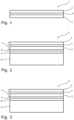
- the wear protection film 1 has a thermoplastic carrier film 2 and a wear protection layer 3 arranged on the thermoplastic carrier film 2, with an adhesion promoter layer 4 being arranged at least partially between the thermoplastic carrier film 2 and the wear protection layer 3.
- the wear protection film 1 is accordingly formed from a stack of at least the thermoplastic carrier film 2 , the adhesion promoter layer 4 and the wear protection layer 3 .
- the thermoplastic carrier film 2 has a thermoplastic plastic
- the adhesion promoter layer 4 has an adhesion promoter
- the wear protection layer 3 has a mixture containing a polymethyl methacrylate and polyorganosiloxane.
- the wear protection film 1 shown was produced using the process according to the invention by coextruding the thermoplastic to form the thermoplastic carrier film 2, the adhesion promoter to form the adhesion promoter layer 4 and the mixture comprising polymethyl methacrylate and polyorganosiloxane to form the wear protection layer 3 to form the wear protection film 1.
- the wear protection film 1 has a thermoplastic carrier film 2 and a wear protection layer 3 arranged on the thermoplastic carrier film 2, with an adhesion promoter layer 4 being arranged at least partially between the thermoplastic carrier film 2 and the wear protection layer 3.
- the wear protection film 1 is aligned with the carrier film side, ie with the side on which the carrier film 2 is located, to the carrier plate 6 , the decorative layer 7 and the laminating adhesive layer 8 being arranged between the carrier plate 6 and the thermoplastic carrier film 2 .
- the decorative layer 7 is arranged directly on the carrier plate 6 and the laminating adhesive layer 8 is arranged between the decorative layer 7 and the thermoplastic carrier film 2 .
- the laminating adhesive layer 8 is arranged directly on the carrier plate 6 and the decorative layer 7 is arranged between the thermoplastic carrier film 2 and the laminating adhesive layer 8 .
- the decorative panels shown were produced using the method according to the invention.
- the wear protection film 1 and the support plate 6 were provided.
- the decorative layer 7 was then applied to the carrier plate 6 .
- the laminating adhesive layer 8 was applied to the carrier plate 6 . Since the carrier plate 6 was already covered with the decorative layer 7, the laminating adhesive layer 7 does not contact the carrier plate 6 directly, but is located on the decorative layer 7 on the carrier plate 6.
- the wear protection film 1 and the carrier plate 6 provided with the decorative layer 7 and the laminating adhesive layer 8 under training of the in 2 illustrated decorative panels 5 connected to each other.
- the wear protection film 1 and the support plate were provided.
- the decorative layer 7 was then applied to the thermoplastic carrier film 2 of the sealing protection film 1 .
- the laminating adhesive layer 8 was applied to the carrier plate 6 in a subsequent or parallel step. Then the wear protection film 1 provided with the decorative layer 7 on the carrier film side and the carrier plate 6 provided with the laminating adhesive layer 8 were applied to form the in 3 illustrated decorative panels 5 connected to each other.
Landscapes
- Chemical & Material Sciences (AREA)
- Chemical Kinetics & Catalysis (AREA)
- Organic Chemistry (AREA)
- Health & Medical Sciences (AREA)
- Medicinal Chemistry (AREA)
- Polymers & Plastics (AREA)
- Life Sciences & Earth Sciences (AREA)
- Engineering & Computer Science (AREA)
- Materials Engineering (AREA)
- Wood Science & Technology (AREA)
- Laminated Bodies (AREA)
Claims (14)
- Film de protection anti-usure (1) caractérisé en ce que le film de protection anti-usure (1) présente un film support (2) thermoplastique et une couche de protection anti-usure (3) disposée sur le film support (2) thermoplastique, dans lequel une couche de promoteur d'adhésion (4) est disposée au moins partiellement entre le film support (2) thermoplastique et la couche de protection anti-usure (3),dans lequel le film support (2) thermoplastique présente une matière plastique thermoplastique,dans lequel la couche de promoteur d'adhésion (4) présente un promoteur d'adhésion, edans lequel la couche de protection anti-usure (3) présente un mélange présentant un poly méthyl méthacrylate et un poly organo siloxane, caractérisé en ce que le poly organo siloxane a un poids moléculaire moyen en nombre, mesuré comme décrit dans la description, dans une plage égale ou supérieure à 50 kDa à inférieure ou égale à 700 kDa, de préférence égale ou supérieure à 100 kDa à inférieure ou égale à 500 kDa, plus préférentiellement égale ou supérieure à 150 kDa à inférieure ou égale à 300 kDa.
- Film de protection anti-usure (1) selon la revendication 1, caractérisé en ce que la matière plastique thermoplastique est choisie dans le groupe constitué du polypropylène, du chlorure de polyvinyle, du polyéthylène, de copolymères de ceux-ci et de mélanges de ceux-ci, où la matière plastique thermoplastique est en particulier du polypropylène.
- Film de protection anti-usure (1) selon l'une des revendications 1 et 2, caractérisé en ce que le promoteur d'adhésion est un copolymère de polyoléfines, de préférence un copolymère greffé de polyoléfine, de manière particulièrement préférée un copolymère greffé de polypropylène, en particulier un copolymère greffé de propylène modifié à l'anhydride d'acide maléique.
- Film de protection anti-usure (1) selon la revendication 3, caractérisé en ce que le copolymère greffé de polypropylène modifié à l'anhydride d'acide maléique présente une proportion d'acide maléique dans une plage égale ou supérieure à 0,1 % en poids à inférieure ou égale à 5 % en poids, par rapport au copolymère greffé de polypropylène modifié à l'anhydride d'acide maléique, de préférence égale ou supérieure à 0,5 % en poids à inférieure ou égale à 1,5 % en poids.
- Film de protection anti-usure (1) selon l'une des revendications 1 à 4, caractérisé en ce que le poly méthyl méthacrylate présente une modification de la résistance aux chocs, en particulier, d'une valeur dans une plage égale ou supérieure ou supérieure ou égale à 0,1 % en poids à inférieure ou égale à 5 % en poids, par rapport au poly méthyl méthacrylate, de préférence, supérieure ou égale à 0,5 % en poids à inférieure ou égale à 5 % en poids.
- Film de protection anti-usure (1) selon l'une des revendications 1 à 5, caractérisé en ce que le poly organo siloxane est un poly diméthyl siloxane.
- Film de protection anti-usure (1) selon l'une des revendications 1 à 6, caractérisé en ce que le mélange présentant du poly méthyl méthacrylate et du poly organo siloxane présente du poly méthyl méthacrylate dans une plage égale ou supérieure à 90 % en poids à inférieure à 100 % en poids par rapport au mélange, de préférence égale ou supérieure à 95 % en poids à inférieure ou égale à 99,9 % en poids, plus préférentiellement égale ou supérieure à 98 % en poids à inférieure ou égale à 99,5 % en poids, de manière particulièrement préférée égale ou supérieure à 98,5 % en poids à inférieure ou égale à 99 % en poids,
dans lequel le mélange présentant du poly méthyl méthacrylate et du poly organo siloxane présente du poly organo siloxane dans une plage supérieure à 0 % en poids à inférieure ou égale à 10 % en poids par rapport au mélange, de préférence égale ou supérieure à 0,1 % en poids à inférieure ou égale à 5 % en poids, plus préférentiellement égale ou supérieure à 0,5 % en poids à inférieure ou égale à 2 % en poids, de manière particulièrement préférée égale ou supérieure à 1 % en poids à inférieure ou égale à 1,5 % en poids. - Panneau décoratif (5) caractérisé en ce que le panneau décoratif (5) présente une plaque support (6), au moins une couche de décor (7) et un film de protection anti-usure (1) selon l'une des revendications 1 à 8, où le film de protection anti-usure (1) est placé du coté film support par rapport à la plaque support (6) et où la couche de décor (7) et la couche d'adhésif de masquage (8) sont disposées entre la plaque support (6) et le film support (2) thermoplastique.
- Panneau décoratif (5) selon la revendication 8, caractérisé en ce qu'au moins une couche d'adhésif de masquage (8) est disposée entre la couche de décor (7) et le film de protection anti-usure (1).
- Panneau décoratif (5) selon la revendication 8 ou la revendication 9, caractérisé en ce que la couche de décor (7) est disposée sur la plaque support (6) et/ou le film support (2) thermoplastique.
- Panneau décoratif (5) selon l'une des revendications 9 ou 10, caractérisé en ce que la couche d'adhésif de masquage (8) présente un adhésif de masquage choisi dans le groupe constitué d'un adhésif fusible et d'un adhésif durcissable aux UV.
- Panneau décoratif (5) selon l'une des revendications 8 à 11, caractérisé en ce que la plaque support (6) présente du polypropylène, du polyéthylène, du chlorure de polyvinyle, des copolymères de ceux-ci et des mélanges de ceux-ci.
- Procédé de fabrication d'un film de protection anti-usure (1) selon l'une des revendications 1 à 7, dans lequel une matière plastique thermoplastique, pour former un film support (2) thermoplastique, un promoteur d'adhésion, pour former une couche de promoteur d'adhésion (4), et un mélange présentant du poly méthyl méthacrylate et du poly organo siloxane, pour former une couche de protection anti-usure (3) moyennant la formation du film de protection anti-usure, sont co-extrudés, revêtus par coextrusion et/ou laminés, de préférence co-extrudés, caractérisé en ce que le poly organo siloxane a un poids moléculaire moyen en nombre, mesuré comme décrit dans la description, dans une plage égale ou supérieure à 50 kDa à inférieure ou égale à 700 kDa, de préférence égale ou supérieure à 100 kDa à inférieure ou égale à 500 kDa, plus préférentiellement égale ou supérieure à 150 kDa à inférieure ou égale à 300 kDa.
- Procédé de fabrication d'un panneau décoratif (5) selon l'une des revendications 8 à 12, présentant au moins les étapes de procédé :a) de mise au point d'un film de protection anti-usure (1) selon l'une des revendications 1 à 8,b) de mise au point d'une plaque support (6),c) d'application d'une couche de décor (7) sur la plaque support (6) et/ou le film support (2) thermoplastique du film de protection anti-usure (1),d) éventuellement, d'application d'une couche d'adhésif de masquage (8) sur la plaque support (6) et/ou le film support (2) thermoplastique du film de protection anti-usure (1),e) de liaison du film de protection anti-usure (1) et de la plaque support (6) moyennant l'emploi du panneau décoratif (1).
Priority Applications (4)
| Application Number | Priority Date | Filing Date | Title |
|---|---|---|---|
| EP20198094.3A EP3974176B1 (fr) | 2020-09-24 | 2020-09-24 | Feuille de protection de fermeture pour panneaux décoratifs |
| US18/026,798 US20240025159A1 (en) | 2020-09-24 | 2021-09-24 | Antiwear film for decorative panel |
| CN202180062747.8A CN116249621B (zh) | 2020-09-24 | 2021-09-24 | 用于装饰面板的耐磨膜 |
| PCT/EP2021/076381 WO2022063999A1 (fr) | 2020-09-24 | 2021-09-24 | Film anti-usure pour panneau décoratif |
Applications Claiming Priority (1)
| Application Number | Priority Date | Filing Date | Title |
|---|---|---|---|
| EP20198094.3A EP3974176B1 (fr) | 2020-09-24 | 2020-09-24 | Feuille de protection de fermeture pour panneaux décoratifs |
Publications (2)
| Publication Number | Publication Date |
|---|---|
| EP3974176A1 EP3974176A1 (fr) | 2022-03-30 |
| EP3974176B1 true EP3974176B1 (fr) | 2023-08-16 |
Family
ID=72658986
Family Applications (1)
| Application Number | Title | Priority Date | Filing Date |
|---|---|---|---|
| EP20198094.3A Active EP3974176B1 (fr) | 2020-09-24 | 2020-09-24 | Feuille de protection de fermeture pour panneaux décoratifs |
Country Status (4)
| Country | Link |
|---|---|
| US (1) | US20240025159A1 (fr) |
| EP (1) | EP3974176B1 (fr) |
| CN (1) | CN116249621B (fr) |
| WO (1) | WO2022063999A1 (fr) |
Family Cites Families (14)
| Publication number | Priority date | Publication date | Assignee | Title |
|---|---|---|---|---|
| JPS5529542A (en) * | 1978-08-23 | 1980-03-01 | Mitsui Toatsu Chem Inc | Polyolefin resin composition |
| JPH1052893A (ja) * | 1996-06-06 | 1998-02-24 | Mitsubishi Chem Corp | プラスチック製共押出多層積層シート及びそれを使用した成形体の製造方法 |
| DE102005062687A1 (de) * | 2005-12-23 | 2007-07-05 | Röhm Gmbh | PMMA-Folie mit besonders hoher Witterungsbeständigkeit und hoher UV-Schutzwirkung |
| DE102007019179A1 (de) * | 2007-04-20 | 2008-10-30 | Center For Abrasives And Refractories Research & Development C.A.R.R.D. Gmbh | Verschleißschutzschicht |
| KR100960589B1 (ko) * | 2008-07-22 | 2010-06-07 | 엘지엠엠에이 주식회사 | 충격강도, 표면경도, 내마모성, 내후성 및 광택이 우수한캡스톡용 폴리메틸메타크릴레이트계 수지 조성물 |
| DE102010038288A1 (de) * | 2010-07-22 | 2012-01-26 | Evonik Röhm Gmbh | Transparente, witterungsbeständige Barrierefolie mit verbesserter Barrierewirkung und Kratzfesteigenschaften |
| US20140004336A1 (en) * | 2012-06-27 | 2014-01-02 | Toray Plastics (America), Inc. | Polyolefin laminate film for cardboard lamination |
| JP6835500B6 (ja) * | 2016-07-29 | 2021-03-24 | スリーエム イノベイティブ プロパティズ カンパニー | 加飾フィルム及びそれを貼り付けた物品 |
| CN106752128B (zh) * | 2016-11-21 | 2018-12-28 | 甘肃兰煤机械制造有限公司 | 一种矿井设备用发光反光安全膜及其制备方法 |
| ES2843536T3 (es) * | 2017-01-13 | 2021-07-19 | Akzenta Paneele Profile Gmbh | Panel de pared o de suelo con superficie estructurada y decorada, a base de placa de fibrocemento |
| CN106905649B (zh) * | 2017-03-15 | 2019-04-26 | 上海锦湖日丽塑料有限公司 | 改善耐磨性能的pmma树脂组合物及其制备方法 |
| CN110546201B (zh) * | 2017-04-25 | 2023-03-28 | 埃万特公司 | 呈现出改进的耐污性的热塑性弹性体配混物 |
| EP3611019A1 (fr) * | 2018-08-14 | 2020-02-19 | Akzenta Paneele + Profile GmbH | Panneau décoratif doté d'une plaque porteuse en matière plastique multilaminaire et son procédé de fabrication |
| EP3632700B1 (fr) * | 2018-10-02 | 2021-06-02 | Akzenta Paneele + Profile GmbH | Feuille de protection contre l'usure structurée par impression numérique |
-
2020
- 2020-09-24 EP EP20198094.3A patent/EP3974176B1/fr active Active
-
2021
- 2021-09-24 CN CN202180062747.8A patent/CN116249621B/zh active Active
- 2021-09-24 US US18/026,798 patent/US20240025159A1/en active Pending
- 2021-09-24 WO PCT/EP2021/076381 patent/WO2022063999A1/fr not_active Ceased
Also Published As
| Publication number | Publication date |
|---|---|
| CN116249621B (zh) | 2024-07-19 |
| WO2022063999A1 (fr) | 2022-03-31 |
| CN116249621A (zh) | 2023-06-09 |
| US20240025159A1 (en) | 2024-01-25 |
| EP3974176A1 (fr) | 2022-03-30 |
Similar Documents
| Publication | Publication Date | Title |
|---|---|---|
| EP1262607B1 (fr) | Procédé de fabrication d'un panneau pour revêtement de sol | |
| EP3178652B1 (fr) | Panneau de decoration et son procede de fabrication | |
| EP2540490B1 (fr) | Procédé destiné à la fabrication d'une plaque sandwich | |
| EP2699416B1 (fr) | Élément de plancher | |
| EP3323628B1 (fr) | Procédé de fabrication de panneaux décoratifs | |
| EP3215327B1 (fr) | Procédé de fabrication d'une plaque en matériau dérivé du bois, notamment un composite constitué de bois/plastique | |
| EP3532300B1 (fr) | Procédé de fabrication d'un panneau mural ou de sol décoré | |
| EP2759394A1 (fr) | Plaque de support pour panneau de décoration | |
| EP3837112B1 (fr) | Plaque support en plastique multilaminaire et son procede de production | |
| DE102010055733A1 (de) | Verfahren zur Herstellung eines Oberflächenelements | |
| EP3837110B1 (fr) | Panneau décoratif doté d'une plaque porteuse en matière plastique multilaminaire et son procédé de fabrication | |
| EP3999293B1 (fr) | Panneaux à surface de peinture structurée | |
| WO2014086532A1 (fr) | Couche anti-usure contenant des particules solides ellipsoïdales | |
| EP3974176B1 (fr) | Feuille de protection de fermeture pour panneaux décoratifs | |
| EP3544823A1 (fr) | Matériau de substrat pour panneau mural ou panneau de sol pourvu d'un décor | |
| EP3565724B1 (fr) | Support à base de matière plastique pour panneau de mur ou de plancher décoré | |
| DE8525341U1 (de) | Betonschalungsplatte | |
| EP3892796A1 (fr) | Panneau décoratif à bords non parallèles à l'axe longitudinal et procédé de fabrication | |
| EP3088205A1 (fr) | Procédé de fabrication d'un panneau mural ou de sol décoré |
Legal Events
| Date | Code | Title | Description |
|---|---|---|---|
| PUAI | Public reference made under article 153(3) epc to a published international application that has entered the european phase |
Free format text: ORIGINAL CODE: 0009012 |
|
| STAA | Information on the status of an ep patent application or granted ep patent |
Free format text: STATUS: THE APPLICATION HAS BEEN PUBLISHED |
|
| AK | Designated contracting states |
Kind code of ref document: A1 Designated state(s): AL AT BE BG CH CY CZ DE DK EE ES FI FR GB GR HR HU IE IS IT LI LT LU LV MC MK MT NL NO PL PT RO RS SE SI SK SM TR |
|
| STAA | Information on the status of an ep patent application or granted ep patent |
Free format text: STATUS: REQUEST FOR EXAMINATION WAS MADE |
|
| 17P | Request for examination filed |
Effective date: 20220922 |
|
| RBV | Designated contracting states (corrected) |
Designated state(s): AL AT BE BG CH CY CZ DE DK EE ES FI FR GB GR HR HU IE IS IT LI LT LU LV MC MK MT NL NO PL PT RO RS SE SI SK SM TR |
|
| GRAP | Despatch of communication of intention to grant a patent |
Free format text: ORIGINAL CODE: EPIDOSNIGR1 |
|
| STAA | Information on the status of an ep patent application or granted ep patent |
Free format text: STATUS: GRANT OF PATENT IS INTENDED |
|
| INTG | Intention to grant announced |
Effective date: 20230301 |
|
| GRAS | Grant fee paid |
Free format text: ORIGINAL CODE: EPIDOSNIGR3 |
|
| P01 | Opt-out of the competence of the unified patent court (upc) registered |
Effective date: 20230526 |
|
| GRAA | (expected) grant |
Free format text: ORIGINAL CODE: 0009210 |
|
| STAA | Information on the status of an ep patent application or granted ep patent |
Free format text: STATUS: THE PATENT HAS BEEN GRANTED |
|
| AK | Designated contracting states |
Kind code of ref document: B1 Designated state(s): AL AT BE BG CH CY CZ DE DK EE ES FI FR GB GR HR HU IE IS IT LI LT LU LV MC MK MT NL NO PL PT RO RS SE SI SK SM TR |
|
| REG | Reference to a national code |
Ref country code: CH Ref legal event code: EP Ref country code: DE Ref legal event code: R096 Ref document number: 502020004716 Country of ref document: DE |
|
| REG | Reference to a national code |
Ref country code: IE Ref legal event code: FG4D Free format text: LANGUAGE OF EP DOCUMENT: GERMAN |
|
| REG | Reference to a national code |
Ref country code: LT Ref legal event code: MG9D |
|
| REG | Reference to a national code |
Ref country code: NL Ref legal event code: MP Effective date: 20230816 |
|
| PG25 | Lapsed in a contracting state [announced via postgrant information from national office to epo] |
Ref country code: GR Free format text: LAPSE BECAUSE OF FAILURE TO SUBMIT A TRANSLATION OF THE DESCRIPTION OR TO PAY THE FEE WITHIN THE PRESCRIBED TIME-LIMIT Effective date: 20231117 |
|
| PG25 | Lapsed in a contracting state [announced via postgrant information from national office to epo] |
Ref country code: IS Free format text: LAPSE BECAUSE OF FAILURE TO SUBMIT A TRANSLATION OF THE DESCRIPTION OR TO PAY THE FEE WITHIN THE PRESCRIBED TIME-LIMIT Effective date: 20231216 |
|
| PG25 | Lapsed in a contracting state [announced via postgrant information from national office to epo] |
Ref country code: SE Free format text: LAPSE BECAUSE OF FAILURE TO SUBMIT A TRANSLATION OF THE DESCRIPTION OR TO PAY THE FEE WITHIN THE PRESCRIBED TIME-LIMIT Effective date: 20230816 Ref country code: RS Free format text: LAPSE BECAUSE OF FAILURE TO SUBMIT A TRANSLATION OF THE DESCRIPTION OR TO PAY THE FEE WITHIN THE PRESCRIBED TIME-LIMIT Effective date: 20230816 Ref country code: PT Free format text: LAPSE BECAUSE OF FAILURE TO SUBMIT A TRANSLATION OF THE DESCRIPTION OR TO PAY THE FEE WITHIN THE PRESCRIBED TIME-LIMIT Effective date: 20231218 Ref country code: NO Free format text: LAPSE BECAUSE OF FAILURE TO SUBMIT A TRANSLATION OF THE DESCRIPTION OR TO PAY THE FEE WITHIN THE PRESCRIBED TIME-LIMIT Effective date: 20231116 Ref country code: NL Free format text: LAPSE BECAUSE OF FAILURE TO SUBMIT A TRANSLATION OF THE DESCRIPTION OR TO PAY THE FEE WITHIN THE PRESCRIBED TIME-LIMIT Effective date: 20230816 Ref country code: LV Free format text: LAPSE BECAUSE OF FAILURE TO SUBMIT A TRANSLATION OF THE DESCRIPTION OR TO PAY THE FEE WITHIN THE PRESCRIBED TIME-LIMIT Effective date: 20230816 Ref country code: LT Free format text: LAPSE BECAUSE OF FAILURE TO SUBMIT A TRANSLATION OF THE DESCRIPTION OR TO PAY THE FEE WITHIN THE PRESCRIBED TIME-LIMIT Effective date: 20230816 Ref country code: IS Free format text: LAPSE BECAUSE OF FAILURE TO SUBMIT A TRANSLATION OF THE DESCRIPTION OR TO PAY THE FEE WITHIN THE PRESCRIBED TIME-LIMIT Effective date: 20231216 Ref country code: HR Free format text: LAPSE BECAUSE OF FAILURE TO SUBMIT A TRANSLATION OF THE DESCRIPTION OR TO PAY THE FEE WITHIN THE PRESCRIBED TIME-LIMIT Effective date: 20230816 Ref country code: GR Free format text: LAPSE BECAUSE OF FAILURE TO SUBMIT A TRANSLATION OF THE DESCRIPTION OR TO PAY THE FEE WITHIN THE PRESCRIBED TIME-LIMIT Effective date: 20231117 Ref country code: FI Free format text: LAPSE BECAUSE OF FAILURE TO SUBMIT A TRANSLATION OF THE DESCRIPTION OR TO PAY THE FEE WITHIN THE PRESCRIBED TIME-LIMIT Effective date: 20230816 |
|
| PG25 | Lapsed in a contracting state [announced via postgrant information from national office to epo] |
Ref country code: PL Free format text: LAPSE BECAUSE OF FAILURE TO SUBMIT A TRANSLATION OF THE DESCRIPTION OR TO PAY THE FEE WITHIN THE PRESCRIBED TIME-LIMIT Effective date: 20230816 |
|
| PG25 | Lapsed in a contracting state [announced via postgrant information from national office to epo] |
Ref country code: ES Free format text: LAPSE BECAUSE OF FAILURE TO SUBMIT A TRANSLATION OF THE DESCRIPTION OR TO PAY THE FEE WITHIN THE PRESCRIBED TIME-LIMIT Effective date: 20230816 |
|
| PG25 | Lapsed in a contracting state [announced via postgrant information from national office to epo] |
Ref country code: SM Free format text: LAPSE BECAUSE OF FAILURE TO SUBMIT A TRANSLATION OF THE DESCRIPTION OR TO PAY THE FEE WITHIN THE PRESCRIBED TIME-LIMIT Effective date: 20230816 Ref country code: RO Free format text: LAPSE BECAUSE OF FAILURE TO SUBMIT A TRANSLATION OF THE DESCRIPTION OR TO PAY THE FEE WITHIN THE PRESCRIBED TIME-LIMIT Effective date: 20230816 Ref country code: ES Free format text: LAPSE BECAUSE OF FAILURE TO SUBMIT A TRANSLATION OF THE DESCRIPTION OR TO PAY THE FEE WITHIN THE PRESCRIBED TIME-LIMIT Effective date: 20230816 Ref country code: EE Free format text: LAPSE BECAUSE OF FAILURE TO SUBMIT A TRANSLATION OF THE DESCRIPTION OR TO PAY THE FEE WITHIN THE PRESCRIBED TIME-LIMIT Effective date: 20230816 Ref country code: DK Free format text: LAPSE BECAUSE OF FAILURE TO SUBMIT A TRANSLATION OF THE DESCRIPTION OR TO PAY THE FEE WITHIN THE PRESCRIBED TIME-LIMIT Effective date: 20230816 Ref country code: CZ Free format text: LAPSE BECAUSE OF FAILURE TO SUBMIT A TRANSLATION OF THE DESCRIPTION OR TO PAY THE FEE WITHIN THE PRESCRIBED TIME-LIMIT Effective date: 20230816 Ref country code: SK Free format text: LAPSE BECAUSE OF FAILURE TO SUBMIT A TRANSLATION OF THE DESCRIPTION OR TO PAY THE FEE WITHIN THE PRESCRIBED TIME-LIMIT Effective date: 20230816 |
|
| REG | Reference to a national code |
Ref country code: CH Ref legal event code: PL |
|
| PG25 | Lapsed in a contracting state [announced via postgrant information from national office to epo] |
Ref country code: LU Free format text: LAPSE BECAUSE OF NON-PAYMENT OF DUE FEES Effective date: 20230924 |
|
| REG | Reference to a national code |
Ref country code: DE Ref legal event code: R097 Ref document number: 502020004716 Country of ref document: DE |
|
| REG | Reference to a national code |
Ref country code: BE Ref legal event code: MM Effective date: 20230930 |
|
| PG25 | Lapsed in a contracting state [announced via postgrant information from national office to epo] |
Ref country code: LU Free format text: LAPSE BECAUSE OF NON-PAYMENT OF DUE FEES Effective date: 20230924 Ref country code: MC Free format text: LAPSE BECAUSE OF FAILURE TO SUBMIT A TRANSLATION OF THE DESCRIPTION OR TO PAY THE FEE WITHIN THE PRESCRIBED TIME-LIMIT Effective date: 20230816 |
|
| PLBE | No opposition filed within time limit |
Free format text: ORIGINAL CODE: 0009261 |
|
| STAA | Information on the status of an ep patent application or granted ep patent |
Free format text: STATUS: NO OPPOSITION FILED WITHIN TIME LIMIT |
|
| REG | Reference to a national code |
Ref country code: IE Ref legal event code: MM4A |
|
| PG25 | Lapsed in a contracting state [announced via postgrant information from national office to epo] |
Ref country code: IE Free format text: LAPSE BECAUSE OF NON-PAYMENT OF DUE FEES Effective date: 20230924 |
|
| PG25 | Lapsed in a contracting state [announced via postgrant information from national office to epo] |
Ref country code: CH Free format text: LAPSE BECAUSE OF NON-PAYMENT OF DUE FEES Effective date: 20230930 |
|
| 26N | No opposition filed |
Effective date: 20240517 |
|
| PG25 | Lapsed in a contracting state [announced via postgrant information from national office to epo] |
Ref country code: IT Free format text: LAPSE BECAUSE OF FAILURE TO SUBMIT A TRANSLATION OF THE DESCRIPTION OR TO PAY THE FEE WITHIN THE PRESCRIBED TIME-LIMIT Effective date: 20230816 Ref country code: IE Free format text: LAPSE BECAUSE OF NON-PAYMENT OF DUE FEES Effective date: 20230924 Ref country code: FR Free format text: LAPSE BECAUSE OF NON-PAYMENT OF DUE FEES Effective date: 20231016 Ref country code: CH Free format text: LAPSE BECAUSE OF NON-PAYMENT OF DUE FEES Effective date: 20230930 Ref country code: SI Free format text: LAPSE BECAUSE OF FAILURE TO SUBMIT A TRANSLATION OF THE DESCRIPTION OR TO PAY THE FEE WITHIN THE PRESCRIBED TIME-LIMIT Effective date: 20230816 |
|
| PG25 | Lapsed in a contracting state [announced via postgrant information from national office to epo] |
Ref country code: BE Free format text: LAPSE BECAUSE OF NON-PAYMENT OF DUE FEES Effective date: 20230930 |
|
| PG25 | Lapsed in a contracting state [announced via postgrant information from national office to epo] |
Ref country code: BG Free format text: LAPSE BECAUSE OF FAILURE TO SUBMIT A TRANSLATION OF THE DESCRIPTION OR TO PAY THE FEE WITHIN THE PRESCRIBED TIME-LIMIT Effective date: 20230816 |
|
| PG25 | Lapsed in a contracting state [announced via postgrant information from national office to epo] |
Ref country code: BG Free format text: LAPSE BECAUSE OF FAILURE TO SUBMIT A TRANSLATION OF THE DESCRIPTION OR TO PAY THE FEE WITHIN THE PRESCRIBED TIME-LIMIT Effective date: 20230816 |
|
| GBPC | Gb: european patent ceased through non-payment of renewal fee |
Effective date: 20240924 |
|
| PG25 | Lapsed in a contracting state [announced via postgrant information from national office to epo] |
Ref country code: GB Free format text: LAPSE BECAUSE OF NON-PAYMENT OF DUE FEES Effective date: 20240924 |
|
| PG25 | Lapsed in a contracting state [announced via postgrant information from national office to epo] |
Ref country code: CY Free format text: LAPSE BECAUSE OF FAILURE TO SUBMIT A TRANSLATION OF THE DESCRIPTION OR TO PAY THE FEE WITHIN THE PRESCRIBED TIME-LIMIT; INVALID AB INITIO Effective date: 20200924 |
|
| PG25 | Lapsed in a contracting state [announced via postgrant information from national office to epo] |
Ref country code: HU Free format text: LAPSE BECAUSE OF FAILURE TO SUBMIT A TRANSLATION OF THE DESCRIPTION OR TO PAY THE FEE WITHIN THE PRESCRIBED TIME-LIMIT; INVALID AB INITIO Effective date: 20200924 |
|
| PGFP | Annual fee paid to national office [announced via postgrant information from national office to epo] |
Ref country code: DE Payment date: 20250924 Year of fee payment: 6 |
|
| PGFP | Annual fee paid to national office [announced via postgrant information from national office to epo] |
Ref country code: AT Payment date: 20251020 Year of fee payment: 5 |
|
| PG25 | Lapsed in a contracting state [announced via postgrant information from national office to epo] |
Ref country code: TR Free format text: LAPSE BECAUSE OF FAILURE TO SUBMIT A TRANSLATION OF THE DESCRIPTION OR TO PAY THE FEE WITHIN THE PRESCRIBED TIME-LIMIT Effective date: 20230816 |