EP4201964B1 - Procédé de production d'un produit d'amidon à faible viscosité, le produit pouvant être obtenu selon ce procédé et son utilisation - Google Patents
Procédé de production d'un produit d'amidon à faible viscosité, le produit pouvant être obtenu selon ce procédé et son utilisation Download PDFInfo
- Publication number
- EP4201964B1 EP4201964B1 EP21216347.1A EP21216347A EP4201964B1 EP 4201964 B1 EP4201964 B1 EP 4201964B1 EP 21216347 A EP21216347 A EP 21216347A EP 4201964 B1 EP4201964 B1 EP 4201964B1
- Authority
- EP
- European Patent Office
- Prior art keywords
- starch
- viscosity
- moisture
- product
- less
- Prior art date
- Legal status (The legal status is an assumption and is not a legal conclusion. Google has not performed a legal analysis and makes no representation as to the accuracy of the status listed.)
- Active
Links
Images
Classifications
-
- C—CHEMISTRY; METALLURGY
- C08—ORGANIC MACROMOLECULAR COMPOUNDS; THEIR PREPARATION OR CHEMICAL WORKING-UP; COMPOSITIONS BASED THEREON
- C08B—POLYSACCHARIDES; DERIVATIVES THEREOF
- C08B30/00—Preparation of starch, degraded or non-chemically modified starch, amylose, or amylopectin
- C08B30/12—Degraded, destructured or non-chemically modified starch, e.g. mechanically, enzymatically or by irradiation; Bleaching of starch
- C08B30/18—Dextrin, e.g. yellow canari, white dextrin, amylodextrin or maltodextrin; Methods of depolymerisation, e.g. by irradiation or mechanically
-
- A—HUMAN NECESSITIES
- A23—FOODS OR FOODSTUFFS; TREATMENT THEREOF, NOT COVERED BY OTHER CLASSES
- A23L—FOODS, FOODSTUFFS OR NON-ALCOHOLIC BEVERAGES, NOT OTHERWISE PROVIDED FOR; PREPARATION OR TREATMENT THEREOF
- A23L29/00—Foods or foodstuffs containing additives; Preparation or treatment thereof
- A23L29/20—Foods or foodstuffs containing additives; Preparation or treatment thereof containing gelling or thickening agents
- A23L29/206—Foods or foodstuffs containing additives; Preparation or treatment thereof containing gelling or thickening agents of vegetable origin
- A23L29/212—Starch; Modified starch; Starch derivatives, e.g. esters or ethers
-
- A—HUMAN NECESSITIES
- A61—MEDICAL OR VETERINARY SCIENCE; HYGIENE
- A61K—PREPARATIONS FOR MEDICAL, DENTAL OR TOILETRY PURPOSES
- A61K47/00—Medicinal preparations characterised by the non-active ingredients used, e.g. carriers or inert additives; Targeting or modifying agents chemically bound to the active ingredient
- A61K47/30—Macromolecular organic or inorganic compounds, e.g. inorganic polyphosphates
- A61K47/36—Polysaccharides; Derivatives thereof, e.g. gums, starch, alginate, dextrin, hyaluronic acid, chitosan, inulin, agar or pectin
Definitions
- the present invention concerns a process for the production of a low-viscosity starch product and a product obtainable by the process.
- starch is first subjected to a specific heat-moisture treatment or a specific acid-heat treatment, and thereafter to an extrusion process in an extruder in order to obtain a (ultra) low-viscosity starch product.
- the invention is also concerned with the (ultra) low-viscosity, cold water-soluble starch products obtainable by the process.
- starch products have to fulfil versatile functions in foods including volume expander, adsorbent properties for oils, spices and flavours, texturizer, structure and mouthfeel enhancer, carrier material, moisture regulator, film-forming agents, flowing aid in dry mixes, etc.
- volume expander adsorbent properties for oils, spices and flavours, texturizer, structure and mouthfeel enhancer
- carrier material e.g., water, moisture regulator, film-forming agents, flowing aid in dry mixes, etc.
- a majority of starch products is not suitable for these applications because of the accompanying thickening effect especially when starch products were used in higher concentrations.
- Oxidized starches used as food additive are produced by means of chemical modification.
- the use of sodium hypochlorite in a starch slurry results in low molecular weight starches labelled in the European Union under the E number 1404.
- Major disadvantages are high consummation of chemicals, emergence of wastewater and labelling issues for chemically modified starches.
- White and yellow dextrins are obtained by dry roasting of acidified starch. On a chemical basis, the dextrinization is accompanied by hydrolysis, transglycosidation and repolymerization reaction, whereas the starch kernels remain intact (crystallinity of starch granules is reduced).
- Commercial available white dextrins are not 100% cold water-soluble (CWS). Yellow dextrins show a higher CWS compared to white dextrins but may be also limited in food use by solubility issues and additionally by their coloring.
- Maltodextrins are obtained through partial hydrolysis of starch from crops like wheat, potatoes and maize.
- the cold water-soluble maltodextrins are typically produced by i) preparation of starch solution, ii) acid-/ or enzymatic conversion, iii) inactivation of enzymes and iv) spray-drying procedure.
- Maltodextrins are used for manifold reasons in foods, especially in dry food applications but also in the beverage industry. They comprise several functional properties like texturizing, gelling, emulsifying abilities, flowability enhancer, and filling and adhering ingredient in dry mixtures.
- maltodextrins have been described to be suitable to partly replace fat and gelatine from food recipes.
- maltodextrins Although the functional properties of maltodextrins are undisputed, there is a deficit in perception from a consumer's perspective. In addition, production of maltodextrins is cost-intensive and plant-specifically challenging because of the spray-drying process used in the conventional process. Maltodextrins can be classified by the dextrose equivalent (DE) value, expressing the content of reducing sugars. Starch conversion products exhibiting DE levels between 3 and 20 are claimed to be maltodextrins. DE levels between 20 and 100 describe glucose syrup, a DE of 100 equals to pure glucose and DE levels below 3 are claimed to be starch (Starch Europe). Processes for enzyme-related maltodextrin production have been widely described in literature and were subjects for patent applications (e.g. WO2006/047176A ).
- DE dextrose equivalent
- HMT heat moisture treatment
- JP H01 287101 A JAPAN MAIZE PROD 17 November 1989 discloses extrusion of starch in acidic medium.
- a first aspect of the present invention concerns a process for the production of a low-viscosity starch product comprising the following first step and (subsequent) second step:
- a further aspect of the present invention concerns a low-viscosity starch product obtainable according to the process above or described further herein.
- the low-viscosity starch product of the invention has a content of reducing sugars of less than 3 wt.-% (measured according to Luff-Schoorl), and a cold water solubility of 100 wt.-%.
- the low-viscosity starch product of the invention has an end viscosity of less than 50 BU, in particular less than 40 BU (measured according to standardized Brabender method).
- Yet a further aspect of the present invention concerns the use of the low-viscosity starch product described herein, obtainable according to the process above or described further herein, in a nutritional, pharmaceutical of veterinary composition, in particular as a substitute for maltodextrin.
- the inventors have found that the process of the invention as described herein surprisingly allows the production of a very low viscosity starch product without chemical modification in a convenient and economic way.
- the starch products according to the invention obtainable by the process of the invention, have advantageous properties comparable to or even superior to maltodextrins, without requiring the more cost- or energy-consuming steps of maltodextrin preparation according to the prior art.
- the starch products according to the invention are even superior to prior art starch products in their functional properties like texturizing, gelling, emulsifying abilities, use as flowability enhancer, filling and adhering ingredients in dry mixtures, and partial replacements for fat and gelatine in food recipes. They have a pure white colour and excellent flowability properties.
- the starch products according to the invention do not require a classification as maltodextrins in Europe.
- a starch in particular a native starch, as specified in the process described herein, advantageously enables preparation of an intermediate starch product which can conveniently be converted into a low starch product by conventional extrusion in an extruder as known in the art.
- the final product of the process according to the invention advantageously provides cold water solubility, very low end viscosity as defined herein, at least comparable to conventional maltodextrins, and a very low content of reducing sugars, below the conventional maltodextrins of the prior art. From a producer's prospective, it provides alternative products to maltodextrins and their production processes, saving production-related resources, waste streams and costs, and providing even superior properties.
- low viscosity starch product describes a starch product which provides properties corresponding to and even superior to commercial maltodextrins without being prepared in accordance with the prior art preparation of maltodextrins, and not requiring in Europe labelling as maltodextrins.
- Low viscosity sometimes called very low viscosity or ultra-low viscosity herein, shall preferably designate a starch or starch product having an end viscosity of less than 50 BU, in particular less than 40 BU, more particular less than 35 BU.
- the determination of Brabender viscosity is known to the skilled person. Any Brabender viscograph known in the art can be used for determining the Brabender viscosity as used herein.
- the (native) starch is subjected to a heat-moisture treatment, i.e. a combination of heat and a specific moisture content of the starch is used for this treatment step.
- a heat-moisture treatment i.e. a combination of heat and a specific moisture content of the starch is used for this treatment step.
- Heat moisture treatment in the prior art is a physical methodology for starch processing aiming at achieving highly viscous sauce thickeners exhibiting elevated gelatinization temperature.
- the present invention relates to the use of an overexpressed heat moisture treatment leading to a significant reduction of starch viscosity.
- overexpressed HMT starch (called “intermediate starch product” in the process of the invention) has been shown to be a very suitable feeding material for processing by means of extrusion in order to obtain a very advantageous final starch product as defined herein.
- intermediate starch product to obtain overexpressed HMT starch
- (native) starch is treated under "harsh” conditions regarding temperature and treatment time.
- the temperature used in the first step namely the heat-moisture treatment, is from about 105 °C to about 120 °C.
- the moisture content of the starch is slightly lowered to a range from about 16 to about 20 wt.-%, based on the total weight of the heat-moisture treated starch. It has been found that such a slight reduction of moisture or drying of the starch after the HMT is advantageous for an efficient extrusion when aiming at the low viscosity starch product as described herein.
- an acid-heat treatment also called AHT, may be performed.
- the (native) starch is adjusted to a moisture content of about 19 to 21 wt.-%.
- about 0.5 to about 3 wt.-%, in particular about 1 to about 2 wt.-% of a diluted aqueous acid solution are added, wherein the acid concentration is 4 to 10 wt.-%, based on the total weight of the aqueous acid solution, in order to obtain an acid-treated starch.
- Any acid conventional in the art may be used.
- Hydrochloric acid (HCl) is preferred.
- the acidification is performed for about 5 minutes to about 1 hour. The exact time is not critical and is normally achieved within short time.
- the starch, having the moisture content as adjusted above, and the diluted aqueous acid solution are usually mixed in order to allow a homogenous mixture of the acid with the starch.
- the mixing is preferably carried out for (at least) several minutes.
- Room temperature or a temperature different from room temperature may be used for adding the diluted aqueous acid solution and/or mixing.
- the acid-treated starch is dried to a moisture content of below about 6 wt.-%, in particular about 1 to 6 wt.-%, based on the total weight of the acid-treated starch, and then heated to a temperature within the range of about 105 °C to about 180 °C, preferably 120 to 180°C, more preferably 130 to150°C, for a time period of about 10 to about 50 minutes.
- treatment time is 10 to 30 minutes. More preferably, treatment time is 15 to 20 minutes.
- the starch is stirred during heat treatment at the adjusted temperature level.
- the resulting material will be preferably cooled to a certain temperature, ideally ambient temperature.
- the moisture content is adjusted to about 12 to about 20 wt.-%, in particular about 12 to about 15 wt.-%, based on the total weight of the acid-heat treated starch. It has further been found advantageous to (partially) achieve this adjustment in the moisture content by allowing the (dry) acid-heat treated starch to cool in an open atmosphere, absorbing moisture from the surrounding atmosphere (for the subsequent extrusion step).
- the intermediate starch product has a content of reducing sugars of less than 3 wt.-%, in particular less than about 2.5 wt.-%, more particular less than about 2 wt.-%. Determination of the content of reducing sugars is known to the person skilled in the art and can for example be measured as indicated in the Method section below.
- the intermediate starch product has a cold water solubility of less than 90 %, in particular less than 50 %, preferably in the range of 2 to 25 %, more preferably in the range of about 5 to 15%. The cold water solubility can be measured as indicated in the section Methods below.
- the intermediate starch product obtained after the first step (a1 or a2) of the process of the invention has a viscosity of less than 500 cp according to RVA at 50°C.
- the RVA viscosity as specified above can be determined as known in the art. Preferably, it is measured in a standardized RVA method as described in the Methods Section below.
- the intermediate starch product obtained from the first step is subjected to a second step, wherein the intermediate starch product is subjected to an extrusion process in an extruder in order to obtain the low viscosity starch product as described herein.
- the specific process step of the first step according to the inventive process allow preparing an intermediate product which is particularly suitable for subsequent extrusion, using standard extrusion devices and parameters, in order to obtain the desired low-viscosity starch product of the invention.
- extrusion to native starch is limited to a certain degree of viscosity in the extruded starch product and has disadvantages regarding the impact on the properties of final extruded product and its functional utility.
- An overexertion of extrusion conditions which may lead to production issues, such as blocking of barrels, an off-white colouring or partly burned starch, or non-desirable fluctuations of bulk-weight density in the end product is avoided by the present invention.
- the present invention combining a specific pre-treatment (first step) as described herein and subsequent extrusion allows to surprisingly obtain a low viscosity (CWS) starch product having the advantageous properties as described herein.
- Standard extruder devices and parameters are known to the skilled person and can be used in the present invention. According to a preferred embodiment of the invention, a twin-screw extruder device may be used.
- the starch has a moisture content of 21 to 28 wt.-%, in particular 22 to 25 wt.-%, based on the total weight of the native starch. It has been found that this moisture content allows a particularly advantageous HMT.
- a HMT process was used in order to delay and increase the viscosity development of a starch.
- a HMT process if the specific parameters as set out herein are followed, may be used in order to prepare an intermediate starch product not having an increased or delayed viscosity, but being adapted for transforming into a low viscosity starch product as described herein (having properties not only similar to but even superior to maltodextrins) by a simple extrusion process.
- the HMT is performed at a temperature of 105 °C to 115 °C.
- the moisture content is adjusted to 17-19 wt.-%, based on the total weight of the heat-moisture treated starch, following the HMT.
- a diluted aqueous acid solution preferably HCl solution
- the highest temperature in the extruder is about 130 to 180 °C if the intermediate starch product (used for extrusion) is obtained according to a HMT as described herein, and about 110 to 150 °C if the intermediate starch product is obtained according to the AHT as described herein.
- the inventors have surprisingly found that the present process of the invention, combining a simple pre-treatment step (first step in the process according to the invention) with a convenient extrusion step allows simple and continuous production of a very advantageous low viscosity starch product.
- the low viscosity starch product of the invention as described herein may be advantageously used in a nutritional, pharmaceutical or veterinary composition.
- it may be used, partially or completely, as a replacement for maltodextrins in such compositions.
- the nutritional composition may be a food or beverage composition, in particular a dry food or beverage composition.
- a further preferred embodiment of the present invention pertains to the use of the low viscosity starch product of the invention (as described herein) as an emulsifying agent, a flowability-enhancing agent, a filling, binding or adhering agent. It has surprisingly been found that the low viscosity starch product of the present invention, as described herein, provides advantageous in relation to the above uses desirable for the skilled person in the art.
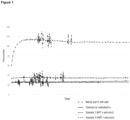
- Figure 1 shows the viscosity curves (Brabender viscosity determined as described above) of low viscosity starch products according to the invention (Examples 1 and 2) in comparison to non-treated (native) extruded starch and a commercial maltodextrin.
- RVA Rotary Visco Analyzer
- RVA viscosity values as indicated herein can be measured in a standardized RVA method: RVA (Rapid Visco Analyzer Super-4, NewPort Scientific) was used for viscosity measurement. 2.5g dry starch was added to 25g distilled water and subjected to RVA analysis. The slurry was heated to 95°C followed by a cooling phase to 50°C where the end viscosity was determined. "Dry starch” shall mean that the material was dried to constant weight at 120°C in an oven (normally achieved after about 8-10 min).
- the cold water solubility of starch can alternatively be determined by measuring the refractive index of a starch solution. 10g of starch on dry weight basis are dispersed in 90g distilled water. The suspension is filtrated through a folded filter and the obtained solution is measured by means of a refractometer. The determined refractive index is directly correlated to the degree of cold water solubility. "On dry weight basis” shall mean that the material was dried to constant weight at 120°C in an oven (normally achieved after about 8-10 min).
- the content of reducing sugars can be measured according to the method of Luff-Schoorl (see e.g. Reinhard Matissek, Gabriele Steiner, "Lebensstoffanalytik: Grundmov, Methoden, füren.” 3., vollst. überarb. Auflage, Springer Verlag, Berlin/Heidelberg 2006, ISBN 3-540-62513-5, pages 115 and following).
- the moisture or water contents in wt.-% as indicated herein are determined by drying the material to constant weight at 120°C in an oven and comparing the weight of the sample before and after drying.
- Example 1 AHT (acid-heat treatment) of native starch, followed by extrusion
- a diluted aqueous solution of hydrochloric acid (1 wt.-%) was sprayed on native potato starch and intensively mixed. After conditioning at ambient temperature for 15 minutes, the HCl-treated starch was dried to a water content less than 4%. Immediately after that, the starch was transferred to a pan and roasted for 15 minutes at 140°C. The resulting material was then rehydrated to 13 wt.-% moisture content (partially by allowing the heated starch after the roasting to absorb moisture from the environment) and exhibited a cold water-solubility (CWS) of 7%, a molecular weight of less than 100.000 g/mol, and a content of reducing sugars below 1%. It had a viscosity of 20 cp according to RVA at 50°C, measured as indicated above (Methods).
- CWS cold water-solubility
- the pre-treated starch (intermediate starch product) was used as feeding material (variable feeding rate 400 to 750kg/h) in a co-rotating Werner & Pfleiderer twin screw extruder (screw speed 280 rpm) equipped with two reverse elements, a volumetric feeding system, and temperature-controlled casing blocks. Standard parameters as indicated by the manufacturer were used for extrusion.
- Native potato starch was moistened to a water content of 22% and transferred to tightly closed vessels. After incubation for 14 hours at 110°C, the HMT starch was cooled down to ambient temperature in open atmosphere so that moisture could evaporate, and adjusted to a moisture content of 18%.
- the pre-treated starch (intermediate starch product) was used as feeding material for a standard extrusion as set out in Example 1 above.
- FIG. 1 shows the respective viscosity curves for the starch product of the invention obtained from Examples 1, Example 2, extruded native starch (comparison) and commercial maltodextrin (comparison), at a concentration of 10 wt.-% in distilled water.
- Measurement of reducing sugars in the described starch samples revealed contents of less than 3% (Example 1: 2%, Example 2: 0.4%, extruded native starch: ⁇ 0.2%, used commercial maltodextrin: 3%). It is evident from Figure 1 that the starch products according to the invention had a low viscosity even comparable to or better than the commercial maltodextrin, while having a white colour, excellent followability and low level of reducing sugars.
Landscapes
- Chemical & Material Sciences (AREA)
- Health & Medical Sciences (AREA)
- Life Sciences & Earth Sciences (AREA)
- Polymers & Plastics (AREA)
- Medicinal Chemistry (AREA)
- Engineering & Computer Science (AREA)
- Epidemiology (AREA)
- Pharmacology & Pharmacy (AREA)
- General Health & Medical Sciences (AREA)
- Public Health (AREA)
- Veterinary Medicine (AREA)
- Dispersion Chemistry (AREA)
- Nutrition Science (AREA)
- Animal Behavior & Ethology (AREA)
- Food Science & Technology (AREA)
- Inorganic Chemistry (AREA)
- Crystallography & Structural Chemistry (AREA)
- Biochemistry (AREA)
- Materials Engineering (AREA)
- Chemical Kinetics & Catalysis (AREA)
- Organic Chemistry (AREA)
- Polysaccharides And Polysaccharide Derivatives (AREA)
Claims (14)
- Procédé de production d'un produit d'amidon à faible viscosité comprenant la première étape et la deuxième étape consécutive qui suivent :a) dans la première étape, l'amidon natif est soumis àa1) un traitement thermique acide dans lequel- l'amidon natif est ajusté à une teneur en humidité de 19 à 21% en poids,- 0,5 à 3% en poids d'une solution acide aqueuse diluée sont ajoutés, dans lequel la concentration en acide est de 4 à 10% en poids, par rapport au poids total de la solution acide aqueuse, afin d'obtenir un amidon traité à l'acide,- séchage de l'amidon traité à l'acide jusqu'à une teneur en humidité inférieure à 6% en poids, par rapport au poids total de l'amidon traité à l'acide,- chauffage à une température dans la plage de 105°C à 180°C pendant une durée de 10 à 150 min,- ajustement de la teneur en humidité entre 12 et 20% en poids, par rapport au poids total de l'amidon traité à l'acide, oua2) un traitement par chaleur et humidité à une température de 105°C à 120°C pendant une durée supérieure à 10 heures à une teneur en humidité de l'amidon natif de 21 à 29% en poids, par rapport au poids total de l'amidon natif, suivi d'un ajustement de la teneur en humidité entre 16 et 20% en poids, par rapport au poids total de l'amidon traité par chaleur et humidité,afin d'obtenir un produit d'amidon intermédiaire ayant une teneur en sucres réducteurs inférieure à 3% en poids, par rapport au poids total du produit d'amidon intermédiaire, et une solubilité dans l'eau froide inférieure à 90%, en particulier inférieure à 50%,b) dans la deuxième étape, consécutive à la première étape, le produit d'amidon intermédiaire est soumis à un processus d'extrusion dans une extrudeuse, de préférence une extrudeuse à double vis,afin d'obtenir le produit d'amidon à faible viscosité, dans lequel le produit d'amidon à faible viscosité a une viscosité finale mesurée selon la méthode Brabender inférieure à 50 BU, une teneur en sucres réducteurs inférieure à 3% en poids et une solubilité dans l'eau froide de 100% en poids.
- Procédé selon la revendication 1, dans lequel, pendant le traitement par chaleur et humidité selon a2), l'amidon natif présente une teneur en humidité de 21 à 28% en poids, en particulier de 22 à 25% en poids, par rapport au poids total de l'amidon natif.
- Procédé selon l'une des revendications précédentes, dans lequel le traitement par chaleur et humidité selon a2) est effectué à une température de 105°C à 115°C.
- Procédé selon l'une des revendications précédentes, dans lequel, à l'étape a2) après le traitement par chaleur et humidité, la teneur en humidité est ajustée entre 17 et 19% en poids, par rapport au poids total de l'amidon traité par chaleur et humidité.
- Procédé selon l'une des revendications précédentes, dans lequel l'ajustement de la teneur en humidité entre 16 et 20% en poids selon a2) consiste à laisser l'amidon traité par chaleur et humidité refroidir dans une atmosphère ouverte, en éliminant l'humidité pour l'étape d'extrusion consécutive b).
- Procédé selon l'une des revendications précédentes, dans lequel le produit d'amidon intermédiaire a une viscosité RVA inférieure à 500 cp mesurée à 10% en poids dans de l'eau distillée à 50°C.
- Procédé selon l'une des revendications précédentes, dans lequel le produit d'amidon à faible viscosité a une viscosité finale mesurée selon la méthode Brabender inférieure à 40 BU.
- Procédé selon l'une des revendications précédentes, dans lequel l'amidon natif est un amidon de pomme de terre natif.
- Procédé selon l'une des revendications précédentes, dans lequel 1 à 2% en poids d'une solution acide aqueuse diluée sont ajoutés à l'étape a1).
- Procédé selon l'une des revendications précédentes, dans lequel la température la plus élevée dans l'extrudeuse est de 130 à 180°C si le produit d'amidon intermédiaire est obtenu selon a2), et de 110 à 150°C si le produit d'amidon intermédiaire est obtenu selon a1).
- Produit d'amidon à faible viscosité pouvant être obtenu selon le procédé selon l'une quelconque des revendications 1 à 10, ayant une viscosité finale, mesurée selon la méthode Brabender normalisée inférieure à 50 BU, en particulier inférieure à 40 BU, une teneur en sucres réducteurs, mesurée selon Luff-Schoorl inférieure à 3% en poids, et une solubilité dans l'eau froide de 100% en poids.
- Utilisation d'un produit d'amidon à faible viscosité selon la revendication 11 ou obtenu par un procédé selon l'une quelconque des revendications 1 à 9 comme substitut de la maltodextrine dans une composition nutritionnelle, pharmaceutique ou vétérinaire.
- Utilisation selon la revendication 12 dans une composition d'aliment ou de boisson, en particulier dans un aliment sec ou une boisson.
- Utilisation selon l'une des revendications 12 ou 13 comme agent émulsifiant, agent améliorant la fluidité, agent de remplissage, liant ou adhésif.
Priority Applications (3)
| Application Number | Priority Date | Filing Date | Title |
|---|---|---|---|
| PL21216347.1T PL4201964T3 (pl) | 2021-12-21 | 2021-12-21 | Sposób wytwarzania produktu skrobiowego o niskiej lepkości, produkt możliwy do otrzymania tym sposobem i jego zastosowanie |
| ES21216347T ES3008885T3 (en) | 2021-12-21 | 2021-12-21 | Process for the production of a low-viscosity starch product, the product obtainable by the process and its use |
| EP21216347.1A EP4201964B1 (fr) | 2021-12-21 | 2021-12-21 | Procédé de production d'un produit d'amidon à faible viscosité, le produit pouvant être obtenu selon ce procédé et son utilisation |
Applications Claiming Priority (1)
| Application Number | Priority Date | Filing Date | Title |
|---|---|---|---|
| EP21216347.1A EP4201964B1 (fr) | 2021-12-21 | 2021-12-21 | Procédé de production d'un produit d'amidon à faible viscosité, le produit pouvant être obtenu selon ce procédé et son utilisation |
Publications (3)
| Publication Number | Publication Date |
|---|---|
| EP4201964A1 EP4201964A1 (fr) | 2023-06-28 |
| EP4201964B1 true EP4201964B1 (fr) | 2024-11-27 |
| EP4201964C0 EP4201964C0 (fr) | 2024-11-27 |
Family
ID=79021825
Family Applications (1)
| Application Number | Title | Priority Date | Filing Date |
|---|---|---|---|
| EP21216347.1A Active EP4201964B1 (fr) | 2021-12-21 | 2021-12-21 | Procédé de production d'un produit d'amidon à faible viscosité, le produit pouvant être obtenu selon ce procédé et son utilisation |
Country Status (3)
| Country | Link |
|---|---|
| EP (1) | EP4201964B1 (fr) |
| ES (1) | ES3008885T3 (fr) |
| PL (1) | PL4201964T3 (fr) |
Family Cites Families (5)
| Publication number | Priority date | Publication date | Assignee | Title |
|---|---|---|---|---|
| GB2026837A (en) | 1978-07-31 | 1980-02-13 | Cpc International Inc | Starch containing food products |
| JPH01287101A (ja) * | 1988-05-13 | 1989-11-17 | Nippon Shokuhin Kako Co Ltd | 澱紛化工品の製造法 |
| FR2764294B1 (fr) * | 1997-06-10 | 1999-08-13 | Roquette Freres | Polysaccharides acariogenes et procede de fabrication de ces polysaccharides |
| AU2005299923A1 (en) | 2004-10-22 | 2006-05-04 | Cargill, Incorporated | Process for the production of maltodextrins and maltodextrins |
| FR3077959B1 (fr) * | 2018-02-22 | 2021-09-24 | Roquette Freres | Procede de fabrication de dextrine de pois resistante |
-
2021
- 2021-12-21 EP EP21216347.1A patent/EP4201964B1/fr active Active
- 2021-12-21 PL PL21216347.1T patent/PL4201964T3/pl unknown
- 2021-12-21 ES ES21216347T patent/ES3008885T3/es active Active
Also Published As
| Publication number | Publication date |
|---|---|
| EP4201964C0 (fr) | 2024-11-27 |
| PL4201964T3 (pl) | 2025-03-10 |
| ES3008885T3 (en) | 2025-03-25 |
| EP4201964A1 (fr) | 2023-06-28 |
Similar Documents
| Publication | Publication Date | Title |
|---|---|---|
| EP0485436B1 (fr) | Procede pour fabriquer une denree alimentaire a teneur en matiere grasse reduite | |
| Moore et al. | Applications of starches in foods | |
| Gunaratne et al. | Thermal, pasting, and gelling properties of wheat and potato starches in the presence of sucrose, glucose, glycerol, and hydroxypropyl β-cyclodextrin | |
| Shrestha et al. | Starch modification to develop novel starch-biopolymer blends: State of art and perspectives | |
| Remya et al. | Morphological, structural and digestibility properties of RS4 enriched octenyl succinylated sweet potato, banana and lentil starches | |
| Arp et al. | Production and characterization of type III resistant starch from native wheat starch using thermal and enzymatic modifications | |
| US20060257977A1 (en) | Slowly digestible starch | |
| EP1510527B1 (fr) | Amidon gélifiant à base de sago | |
| JP2010509930A (ja) | 化工でんぷんの天然相当物 | |
| WO2001019404A9 (fr) | Amidon pregelatinise a epaississement par cisaillement | |
| CN110770258B (zh) | 稳定蜡质淀粉及其使用方法 | |
| US4623549A (en) | Dry instant food composition | |
| JP2003501494A (ja) | オリゴ糖により製造される熱的に抑制されたデンプン | |
| US5904941A (en) | Use of enzymatically-treated starches as viscosifiers and their use in food products | |
| AU2020354508B2 (en) | Process for the preparation of pregelatinized starch and/or pregelatinized flour | |
| EP0897673A2 (fr) | Amidons et farines inhibés thermiquement puis hydrolysés par voie enzymatique | |
| US5928707A (en) | Food products having intact granular swollen starch and their preparation | |
| JP2018174925A (ja) | 食品およびその製造方法 | |
| WO2007113111A1 (fr) | Compositions d'amidon stables à la pasteurisation | |
| Liao et al. | Functional, thermal and structural properties of green banana flour (cv. Giant Cavendish) by de-astringency, enzymatic and hydrothermal treatments | |
| JPH1042804A (ja) | 高圧処理したデンプン | |
| EP0305499B1 (fr) | Compositions d'amidon et d'ethers de methylcellulose utilisees comme agents epaississants a des temperatures elevees | |
| JP2002538800A (ja) | 個別デンプン粒子を含有してなる食品 | |
| KR20190038839A (ko) | 지연 겔화 억제 전분 및 그의 사용 방법 | |
| EP4201964A1 (fr) | Procédé de production d'un produit d'amidon à faible viscosité, le produit pouvant être obtenu selon ce procédé et son utilisation |
Legal Events
| Date | Code | Title | Description |
|---|---|---|---|
| PUAI | Public reference made under article 153(3) epc to a published international application that has entered the european phase |
Free format text: ORIGINAL CODE: 0009012 |
|
| STAA | Information on the status of an ep patent application or granted ep patent |
Free format text: STATUS: REQUEST FOR EXAMINATION WAS MADE |
|
| 17P | Request for examination filed |
Effective date: 20220914 |
|
| AK | Designated contracting states |
Kind code of ref document: A1 Designated state(s): AL AT BE BG CH CY CZ DE DK EE ES FI FR GB GR HR HU IE IS IT LI LT LU LV MC MK MT NL NO PL PT RO RS SE SI SK SM TR |
|
| STAA | Information on the status of an ep patent application or granted ep patent |
Free format text: STATUS: EXAMINATION IS IN PROGRESS |
|
| 17Q | First examination report despatched |
Effective date: 20230808 |
|
| GRAP | Despatch of communication of intention to grant a patent |
Free format text: ORIGINAL CODE: EPIDOSNIGR1 |
|
| STAA | Information on the status of an ep patent application or granted ep patent |
Free format text: STATUS: GRANT OF PATENT IS INTENDED |
|
| INTG | Intention to grant announced |
Effective date: 20240905 |
|
| GRAS | Grant fee paid |
Free format text: ORIGINAL CODE: EPIDOSNIGR3 |
|
| GRAA | (expected) grant |
Free format text: ORIGINAL CODE: 0009210 |
|
| STAA | Information on the status of an ep patent application or granted ep patent |
Free format text: STATUS: THE PATENT HAS BEEN GRANTED |
|
| AK | Designated contracting states |
Kind code of ref document: B1 Designated state(s): AL AT BE BG CH CY CZ DE DK EE ES FI FR GB GR HR HU IE IS IT LI LT LU LV MC MK MT NL NO PL PT RO RS SE SI SK SM TR |
|
| REG | Reference to a national code |
Ref country code: GB Ref legal event code: FG4D |
|
| REG | Reference to a national code |
Ref country code: CH Ref legal event code: EP |
|
| REG | Reference to a national code |
Ref country code: DE Ref legal event code: R096 Ref document number: 602021022358 Country of ref document: DE |
|
| REG | Reference to a national code |
Ref country code: IE Ref legal event code: FG4D |
|
| U01 | Request for unitary effect filed |
Effective date: 20241227 |
|
| U07 | Unitary effect registered |
Designated state(s): AT BE BG DE DK EE FI FR IT LT LU LV MT NL PT RO SE SI Effective date: 20250114 |
|
| U20 | Renewal fee for the european patent with unitary effect paid |
Year of fee payment: 4 Effective date: 20250114 |
|
| REG | Reference to a national code |
Ref country code: GR Ref legal event code: EP Ref document number: 20240402994 Country of ref document: GR Effective date: 20250211 |
|
| REG | Reference to a national code |
Ref country code: ES Ref legal event code: FG2A Ref document number: 3008885 Country of ref document: ES Kind code of ref document: T3 Effective date: 20250325 |
|
| PG25 | Lapsed in a contracting state [announced via postgrant information from national office to epo] |
Ref country code: HR Free format text: LAPSE BECAUSE OF FAILURE TO SUBMIT A TRANSLATION OF THE DESCRIPTION OR TO PAY THE FEE WITHIN THE PRESCRIBED TIME-LIMIT Effective date: 20241127 Ref country code: IS Free format text: LAPSE BECAUSE OF FAILURE TO SUBMIT A TRANSLATION OF THE DESCRIPTION OR TO PAY THE FEE WITHIN THE PRESCRIBED TIME-LIMIT Effective date: 20250327 |
|
| PG25 | Lapsed in a contracting state [announced via postgrant information from national office to epo] |
Ref country code: NO Free format text: LAPSE BECAUSE OF FAILURE TO SUBMIT A TRANSLATION OF THE DESCRIPTION OR TO PAY THE FEE WITHIN THE PRESCRIBED TIME-LIMIT Effective date: 20250227 |
|
| PG25 | Lapsed in a contracting state [announced via postgrant information from national office to epo] |
Ref country code: RS Free format text: LAPSE BECAUSE OF FAILURE TO SUBMIT A TRANSLATION OF THE DESCRIPTION OR TO PAY THE FEE WITHIN THE PRESCRIBED TIME-LIMIT Effective date: 20250227 |
|
| PG25 | Lapsed in a contracting state [announced via postgrant information from national office to epo] |
Ref country code: SM Free format text: LAPSE BECAUSE OF FAILURE TO SUBMIT A TRANSLATION OF THE DESCRIPTION OR TO PAY THE FEE WITHIN THE PRESCRIBED TIME-LIMIT Effective date: 20241127 |
|
| PG25 | Lapsed in a contracting state [announced via postgrant information from national office to epo] |
Ref country code: SK Free format text: LAPSE BECAUSE OF FAILURE TO SUBMIT A TRANSLATION OF THE DESCRIPTION OR TO PAY THE FEE WITHIN THE PRESCRIBED TIME-LIMIT Effective date: 20241127 |
|
| REG | Reference to a national code |
Ref country code: CH Ref legal event code: PL |
|
| PG25 | Lapsed in a contracting state [announced via postgrant information from national office to epo] |
Ref country code: MC Free format text: LAPSE BECAUSE OF FAILURE TO SUBMIT A TRANSLATION OF THE DESCRIPTION OR TO PAY THE FEE WITHIN THE PRESCRIBED TIME-LIMIT Effective date: 20241127 |
|
| PLBE | No opposition filed within time limit |
Free format text: ORIGINAL CODE: 0009261 |
|
| STAA | Information on the status of an ep patent application or granted ep patent |
Free format text: STATUS: NO OPPOSITION FILED WITHIN TIME LIMIT |
|
| PG25 | Lapsed in a contracting state [announced via postgrant information from national office to epo] |
Ref country code: CH Free format text: LAPSE BECAUSE OF NON-PAYMENT OF DUE FEES Effective date: 20241231 |
|
| PG25 | Lapsed in a contracting state [announced via postgrant information from national office to epo] |
Ref country code: IE Free format text: LAPSE BECAUSE OF NON-PAYMENT OF DUE FEES Effective date: 20241221 |
|
| 26N | No opposition filed |
Effective date: 20250828 |
|
| U20 | Renewal fee for the european patent with unitary effect paid |
Year of fee payment: 5 Effective date: 20251209 |
|
| PGFP | Annual fee paid to national office [announced via postgrant information from national office to epo] |
Ref country code: GR Payment date: 20251215 Year of fee payment: 5 |
|
| PGFP | Annual fee paid to national office [announced via postgrant information from national office to epo] |
Ref country code: CZ Payment date: 20251209 Year of fee payment: 5 |
|
| PGFP | Annual fee paid to national office [announced via postgrant information from national office to epo] |
Ref country code: PL Payment date: 20251208 Year of fee payment: 5 |
|
| PGFP | Annual fee paid to national office [announced via postgrant information from national office to epo] |
Ref country code: ES Payment date: 20260119 Year of fee payment: 5 |
|
| PG25 | Lapsed in a contracting state [announced via postgrant information from national office to epo] |
Ref country code: CY Free format text: LAPSE BECAUSE OF FAILURE TO SUBMIT A TRANSLATION OF THE DESCRIPTION OR TO PAY THE FEE WITHIN THE PRESCRIBED TIME-LIMIT Effective date: 20241127 |
|
| PG25 | Lapsed in a contracting state [announced via postgrant information from national office to epo] |
Ref country code: TR Free format text: LAPSE BECAUSE OF FAILURE TO SUBMIT A TRANSLATION OF THE DESCRIPTION OR TO PAY THE FEE WITHIN THE PRESCRIBED TIME-LIMIT Effective date: 20241127 |
|
| PG25 | Lapsed in a contracting state [announced via postgrant information from national office to epo] |
Ref country code: HU Free format text: LAPSE BECAUSE OF FAILURE TO SUBMIT A TRANSLATION OF THE DESCRIPTION OR TO PAY THE FEE WITHIN THE PRESCRIBED TIME-LIMIT; INVALID AB INITIO Effective date: 20211221 |