EP4202128B1 - Système de détermination de position de forage, système de commande de forage et engin de chantier - Google Patents
Système de détermination de position de forage, système de commande de forage et engin de chantier Download PDFInfo
- Publication number
- EP4202128B1 EP4202128B1 EP21875154.3A EP21875154A EP4202128B1 EP 4202128 B1 EP4202128 B1 EP 4202128B1 EP 21875154 A EP21875154 A EP 21875154A EP 4202128 B1 EP4202128 B1 EP 4202128B1
- Authority
- EP
- European Patent Office
- Prior art keywords
- excavation
- bucket
- start position
- soil
- target
- Prior art date
- Legal status (The legal status is an assumption and is not a legal conclusion. Google has not performed a legal analysis and makes no representation as to the accuracy of the status listed.)
- Active
Links
Images



Classifications
-
- E—FIXED CONSTRUCTIONS
- E02—HYDRAULIC ENGINEERING; FOUNDATIONS; SOIL SHIFTING
- E02F—DREDGING; SOIL-SHIFTING
- E02F9/00—Component parts of dredgers or soil-shifting machines, not restricted to one of the kinds covered by groups E02F3/00 - E02F7/00
- E02F9/26—Indicating devices
- E02F9/261—Surveying the work-site to be treated
- E02F9/262—Surveying the work-site to be treated with follow-up actions to control the work tool, e.g. controller
-
- E—FIXED CONSTRUCTIONS
- E02—HYDRAULIC ENGINEERING; FOUNDATIONS; SOIL SHIFTING
- E02F—DREDGING; SOIL-SHIFTING
- E02F3/00—Dredgers; Soil-shifting machines
- E02F3/04—Dredgers; Soil-shifting machines mechanically-driven
- E02F3/28—Dredgers; Soil-shifting machines mechanically-driven with digging tools mounted on a dipper- or bucket-arm, i.e. there is either one arm or a pair of arms, e.g. dippers, buckets
- E02F3/36—Component parts
- E02F3/42—Drives for dippers, buckets, dipper-arms or bucket-arms
- E02F3/43—Control of dipper or bucket position; Control of sequence of drive operations
- E02F3/435—Control of dipper or bucket position; Control of sequence of drive operations for dipper-arms, backhoes or the like
-
- E—FIXED CONSTRUCTIONS
- E02—HYDRAULIC ENGINEERING; FOUNDATIONS; SOIL SHIFTING
- E02F—DREDGING; SOIL-SHIFTING
- E02F3/00—Dredgers; Soil-shifting machines
- E02F3/04—Dredgers; Soil-shifting machines mechanically-driven
- E02F3/28—Dredgers; Soil-shifting machines mechanically-driven with digging tools mounted on a dipper- or bucket-arm, i.e. there is either one arm or a pair of arms, e.g. dippers, buckets
- E02F3/30—Dredgers; Soil-shifting machines mechanically-driven with digging tools mounted on a dipper- or bucket-arm, i.e. there is either one arm or a pair of arms, e.g. dippers, buckets with a dipper-arm pivoted on a cantilever beam, i.e. boom
- E02F3/32—Dredgers; Soil-shifting machines mechanically-driven with digging tools mounted on a dipper- or bucket-arm, i.e. there is either one arm or a pair of arms, e.g. dippers, buckets with a dipper-arm pivoted on a cantilever beam, i.e. boom working downwardly and towards the machine, e.g. with backhoes
-
- E—FIXED CONSTRUCTIONS
- E02—HYDRAULIC ENGINEERING; FOUNDATIONS; SOIL SHIFTING
- E02F—DREDGING; SOIL-SHIFTING
- E02F3/00—Dredgers; Soil-shifting machines
- E02F3/04—Dredgers; Soil-shifting machines mechanically-driven
- E02F3/28—Dredgers; Soil-shifting machines mechanically-driven with digging tools mounted on a dipper- or bucket-arm, i.e. there is either one arm or a pair of arms, e.g. dippers, buckets
- E02F3/36—Component parts
- E02F3/42—Drives for dippers, buckets, dipper-arms or bucket-arms
- E02F3/43—Control of dipper or bucket position; Control of sequence of drive operations
- E02F3/435—Control of dipper or bucket position; Control of sequence of drive operations for dipper-arms, backhoes or the like
- E02F3/439—Automatic repositioning of the implement, e.g. automatic dumping, auto-return
-
- E—FIXED CONSTRUCTIONS
- E02—HYDRAULIC ENGINEERING; FOUNDATIONS; SOIL SHIFTING
- E02F—DREDGING; SOIL-SHIFTING
- E02F9/00—Component parts of dredgers or soil-shifting machines, not restricted to one of the kinds covered by groups E02F3/00 - E02F7/00
- E02F9/08—Superstructures; Supports for superstructures
- E02F9/10—Supports for movable superstructures mounted on travelling or walking gears or on other superstructures
- E02F9/12—Slewing or traversing gears
- E02F9/121—Turntables, i.e. structure rotatable about 360°
- E02F9/123—Drives or control devices specially adapted therefor
-
- E—FIXED CONSTRUCTIONS
- E02—HYDRAULIC ENGINEERING; FOUNDATIONS; SOIL SHIFTING
- E02F—DREDGING; SOIL-SHIFTING
- E02F9/00—Component parts of dredgers or soil-shifting machines, not restricted to one of the kinds covered by groups E02F3/00 - E02F7/00
- E02F9/26—Indicating devices
- E02F9/264—Sensors and their calibration for indicating the position of the work tool
- E02F9/265—Sensors and their calibration for indicating the position of the work tool with follow-up actions (e.g. control signals sent to actuate the work tool)
Definitions
- the present invention relates to a determination system for an excavation position to an excavation target having a mountain shape to be excavated by a working machine, relates to an excavation control system, and relates to the working machine.
- Patent Literature 1 describes a conventional excavation control by a working machine.
- a boom angle, an arm angle, and a slewing angle are calculated so that a coordinate of an arm distal end of a hydraulic backhoe and each excavation position agree with each other. Further, an angle of each of a boom, an arm, and a vehicle body is controlled to agree with the corresponding calculated value.
- Patent Literature 2 discloses a controller for an excavator having the features in the preamble of claim 1.
- Patent Literature 3 discloses further prior art.
- the arm distal end is moved to reach a preset excavation position, and excavation is executed in determined order.
- Patent Literature 1 fails to appropriately determine the excavation position in accordance with the shape or contour of the excavation target.
- An object of the present invention is to provide an excavation position determination system that achieves appropriate determination of an excavation start position in accordance with a shape or contour of the excavation target.
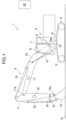
- the hydraulic excavator 1 can excavate an excavation target having, for example, a mountain shape.
- the hydraulic excavator 1 is a machine for performing a work with an attachment 4, and includes a lower traveling body 2, an upper slewing body 3 supported on the lower traveling body 2 slewaby about a slewing axis extending in an up-down direction, and the attachment 4.
- the lower traveling body 2 causes the hydraulic excavator 1 to travel, and has, for example, a crawler 5 travelable on the ground.
- the upper slewing body 3 is slewably attached onto the lower traveling body 2 via a slewing device 6.
- the upper slewing body 3 has a cab 7 serving as an operator compartment on a front portion thereof.
- the lower traveling body 2 and the upper slewing body 3 form a machine body of the present invention.
- the attachment 4 is attached to the upper slewing body 3 in a tiltable manner (rotatably in the up-down direction).
- the attachment 4 includes a boom 10, an arm 11, and a bucket 12.
- the boom 10 has a proximal end attached to the upper slewing body 3.
- the arm 11 has a proximal end attached to a distal end of the boom 10.
- the bucket 12 is attached to a distal end of the arm 11.
- the bucket 12 serves as a leading end attachment to execute works including excavation, leveling, and scooping of an excavation target having a mountain shape, such as a soil and sand mound 100 (see Fig. 3A ).
- the bucket 12 is movable relative to the machine body.
- the hydraulic excavator 1 further includes a boom cylinder 13, an arm cylinder 14, and a bucket cylinder 15 (drive section) respectively driving the boom 10, the arm 11, and the bucket 12.
- Each of the boom cylinder 13, the arm cylinder 14, and the bucket cylinder 15 is a hydraulic actuator.
- the boom cylinder 13 drives the boom 10 in a raising direction by extension and in a lowering direction by contraction.
- Each cylinder (drive section) can drive the bucket 12 relative to the upper slewing body 3.
- the hydraulic excavator 1 further includes a slewing angle sensor 16, a boom angle sensor 17, an arm angle sensor 18, and a bucket angle sensor 19.
- the slewing angle sensor 16 detects a slewing angle of the upper slewing body 3 to the lower traveling body 2.
- the slewing angle sensor 16 includes, for example, an encoder, a resolver, or a gyro sensor.
- the boom angle sensor 17 is attached to the boom 10 to detect a posture of the boom 10.
- the boom angle sensor 17 acquires a tilt angle of the boom 10 to a horizontal line.
- a tilt sensor or an acceleration sensor is adopted as the boom angle sensor 17.
- the boom angle sensor 17 may detect a rotation angle of a boom foot pin 10a (boom proximal end) to detect the posture of the boom 10.
- the boom angle sensor 17 may detect a stroke amount of the boom cylinder 13 to detect the posture of the boom 10.
- the arm angle sensor 18 is attached to the arm 11 to detect a posture of the arm 11.
- the arm angle sensor 18 acquires a tilt angle of the arm 11 to a horizontal line.
- a tilt sensor or an acceleration sensor is adopted as the arm angle sensor 18.
- the arm angle sensor 18 may detect a rotation angle of an arm connection pin 11a (arm proximal end) to detect the posture of the arm 11.
- the arm angle sensor 18 may detect a stroke amount of the arm cylinder 14 to detect the posture of the arm 11.
- the bucket angle sensor 19 is attached to a link member 21 for driving the bucket 12 to detect a posture of the bucket 12.
- the bucket angle sensor 19 acquires a tilt angle of the bucket 12 to a horizontal line.
- a tilt sensor or an acceleration sensor is adopted as the bucket angle sensor 19.
- the bucket angle sensor 19 may detect a rotation angle of a bucket connection pin 12a (bucket proximal end) to detect the posture of the bucket 12.
- the bucket angle sensor 19 may detect a stroke amount of the bucket cylinder 15 to detect the posture of the bucket 12.
- a mobile terminal 22 shown in Fig. 1 is an external terminal manipulated by an operator or worker on a work site, and is, for example, a tablet terminal.
- the mobile terminal 22 is communicable with a controller 8 (start position determinator) to be described later.
- the mobile terminal 22 is arrangeable outside the hydraulic excavator 1 (at a position away from the hydraulic excavator 1).
- the mobile terminal 22 can form a part of the excavation position determination system according to the present invention.
- a photographing device 9 is attached to the hydraulic excavator 1. Besides, the controller 8 is mounted on the hydraulic excavator 1. In the embodiment, the photographing device 9 is attached to the front of the upper slewing body 3. The controller 8 and the photographing device 9 form a part of the excavation position determination system according to the present invention.
- the photographing device 9 photographs the soil and sand mound 100 (excavation target) and the bucket 12.
- the photographing device 9 may not be attached to the hydraulic excavator 1.
- the photographing device 9 may be arranged at such a position as to photograph the soil and sand mound 100, and the bucket 12, for example, in a periphery of the hydraulic excavator 1 or a periphery of a place where the soil and sand mound 100 is accumulated.
- the photographing device 9 adopts, for example, a LIDAR, a laser radar, a millimeter-wave radar, or a stereo camera.
- the photographing device 9 may adopt a combination of the LIDAR and the camera.
- the photographing device 9 can photograph various targets without limitation to the soil and sand mound 100 and the bucket 12.
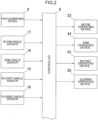
- the controller 8 includes a computer which performs: input and output of a signal; computation including determination and calculation; and storage of information. As shown in Fig. 2 , a signal from each of the photographing device 9, the boom angle sensor 17, the arm angle sensor 18, the bucket angle sensor 19, and the slewing angle sensor 16 is input to the controller 8. The controller 8 outputs a control signal to each of a boom operating device 23, an arm operating device 24, a bucket operating device 25, and a slewing operating device 26.
- the boom operating device 23 controls the boom cylinder 13.
- the boom operating device 23 is, for example, a hydraulic control device, and includes a direction control valve, a pressure control valve, and a flow rate control valve.
- the arm operating device 24 controls the arm cylinder 14.
- the arm operating device 24 is, for example, a hydraulic control device, and includes a direction control valve, a pressure control valve, and a flow rate control valve.
- the bucket operating device 25 controls the bucket cylinder 15.
- the bucket operating device 25 is, for example, a hydraulic control device, and includes a direction control valve, a pressure control valve, and a flow rate control valve.
- the slewing operating device 26 controls the slewing device 6.
- the slewing operating device 26 is, for example, a hydraulic control device, and includes a direction control valve, a pressure control valve, and a flow rate control valve.
- the controller 8 (start position determinator) is configured to determine an excavation start position of the bucket 12 to the soil and sand mound 100.
- the excavation start position represents a reference point where the bucket 12 starts an excavation operation for the soil and sand mound 100, and, as an example, where the bucket 12 comes into contact with soil and sand of the soil and sand mound 100 from a state where the bucket 12 is arranged at an excavation start position when the boom 10 is driven in a lowering direction and the arm 11 is driven in a pulling direction.
- the excavation position determination system includes the photographing device 9 and the controller 8.
- the controller 8 target specifying section
- Fig. 3A is a diagram explaining a process of determining an excavation start position of the bucket 12.
- Fig. 3A is illustration obtainable when the soil and sand mound 100 is seen from the hydraulic excavator 1.
- the controller 8 shifts the bucket 12 toward the soil and sand mound 100 in a slewing direction in the vicinity of ground G.
- the controller 8 causes the upper slewing body 3 to slew.
- the bucket 12 is positioned in the rear of the soil and sand mound 100 by the controller 8 when seen from the hydraulic excavator 1.
- the controller 8 can calculate a position and a posture of the bucket 12 from a signal from each of the angle sensors 16 to 19.
- the controller 8 stores information about dimensions of respective members, i.e., the upper slewing body 3, the boom 10, the arm 11, and the bucket 12, in advance.
- the controller 8 controls the position and the posture of the bucket 12.
- the controller 8 determines, on the basis of the detected data from the photographing device 9, a position of the bucket 12 where the bucket 12 is not wholly hidden by the soil and sand mound 100 but a part of the soil and sand mound 100 and a part of the bucket 12 overlap each other when the soil and sand mound 100 is seen from the hydraulic excavator 1 (machine body) as the excavation start position of the bucket 12 to the soil and sand mound 100.
- the excavation start position represents a position of the bucket 12 where one part of the bucket 12 is visible from the machine body and other part of the bucket 12 that is different from the one part is hidden by the soil and sand mound 100 when the bucket 12 is seen from the machine body.
- the controller 8 determines a position of the bucket 12 where a proportion of an area S of a certain part (the one part) of the bucket 12 that does not overlap the soil and sand mound 100 to a whole area of the bucket 12 is a predetermined value (proportion) or lower when the soil and sand mound 100 is seen from the hydraulic excavator 1 as the excavation start position.
- the controller 8 calculates the whole area of the bucket 12 from point group data (detected data) of the bucket 12 acquired by the photographing device 9 when the bucket 12 is not hidden by the soil and sand mound 100 (as the bucket 12 denoted by a double-dotted line in Fig. 3A ).
- the predetermined value (proportion) indicates, for example, 30%.
- the controller 8 can automatically and appropriately determine an excavation start position in accordance with the shape or contour of the soil and sand mound 100. In a subsequent excavation, the soil and sand mound 100 is efficiently excavated without being left. Moreover, when the bucket 12 is wholly hidden by the soil and sand mound 100, a soil amount in the bucket 12 is undetectable in the excavation.
- the soil amount in the bucket 12 in the excavation is detectable by the photographing device 9 at an excavation position determined by the controller 8, and therefore, an unnecessary excavation operation is preventable and the soil and sand is efficiently excavated through a scooping operation by the bucket 12 when a given amount of soil and sand or more is excavated.
- the controller 8 determines the excavation start position of the bucket 12 by employing the proportion of the area S of the certain part of the bucket 12 that does not overlap the soil and sand mound 100 to the whole area of the bucket 12, thereby reliably keeping the bucket 12 from being wholly hidden by the soil and sand mound 100 and preventing the bucket 12 and the soil and sand mound 100 from failing to overlap each other.
- the predetermined value (proportion) defined as, for example, 30 % may be directly input to the controller 8 or may be input to the controller 8 through the mobile terminal 22, by the operator. Specifically, the operator may be allowed to correct the excavation start position by changing the predetermined value (proportion) through the mobile terminal 22. The operator allowed to correct the excavation start position through the mobile terminal 22 can flexibly set the excavation start position from a place away from the hydraulic excavator 1.
- the controller 8 serves as a signal input section of the present invention as well.
- the signal input section inputs, to the drive section (each cylinder) of the hydraulic excavator 1, a drive instructive signal to start an excavation operation for the soil and sand mound 100 by the bucket 12 from an excavation start position determined by the controller 8 (start position determinator).
- the photographing device 9 and the controller 8 form an excavation control system according to the present invention.
- Fig. 3B is a diagram explaining another process, which is different from the process in Fig. 3A , of determining an excavation start position of the bucket 12.
- Fig. 3B is illustration obtainable when the soil and sand mound 100 is seen from the hydraulic excavator 1.
- the controller 8 shifts the bucket 12 toward the soil and sand mound 100 in a slewing direction in the vicinity of the ground G.
- the controller 8 causes the upper slewing body 3 to slew.
- the bucket 12 is positioned in the rear of the soil and sand mound 100 by the controller 8.
- the controller 8 determines a position of the bucket 12 where a distance Y1 (offset distance) between an end Pe of the soil and sand mound 100 that is closer to the bucket 12 in a direction of causing the bucket 12 to approach the soil and sand mound 100 and an end Pb1 of the bucket 12 in the opposite direction to the direction of causing the bucket 12 to approach the soil and sand mound 100 reaches a predetermined value (distance) or smaller when the soil and sand mound 100 is seen from the hydraulic excavator 1 as the excavation start position.
- a distance Y1 offset distance
- the end Pe is at a point on a lower corner which is closer to the bucket 12 among the point group data (detected data) of the soil and sand mound 100 acquired by the photographing device 9.
- the end Pb1 is at a point on a lower corner which is away from the soil and sand mound 100 among the point group data (detected data) of the bucket 12 acquired by the photographing device 9.
- the predetermined value (distance) indicates, for example, 200 mm.
- Determination of the excavation start position of the bucket 12 by employing the distance Y1 (offset distance) between the end Pe of the soil and sand mound 100 that is closer to the bucket 12 in the direction of causing the bucket 12 to approach the soil and sand mound 100 and the end Pb1 of the bucket 12 in the opposite direction to the direction of causing the bucket 12 to approach the soil and sand mound 100 leads to a success in reliably keeping the bucket 12 from being wholly hidden by the soil and sand mound 100 and preventing the bucket 12 and the soil and sand mound 100 from failing to overlap each other.
- the predetermined value (distance) defined as, for example, 200 mm may be directly input to the controller 8 or may be input to the controller 8 through the mobile terminal 22, by the operator.
- the excavation start position may be correctable in accordance with a change in the predetermined value (distance) through the mobile terminal 22.
- the operator can flexibly set an excavation start position from a place away from the hydraulic excavator 1.
- the controller 8 determines an excavation start position of the bucket 12 to the soil and sand mound 100 in a slewing direction of the upper slewing body 3 with respect to the lower traveling body 2.
- Fig. 4 is a diagram explaining a process of determining a first excavation start position and a second excavation start position in gradual deviation of the bucket 12 from each other in the slewing direction at each excavation when the soil and sand mound 100 is excavated.
- Fig. 5 is a plan view explaining a state of gradual deviation of excavation start positions from one another in a slewing direction.
- the upper illustration in Fig. 4 is equivalent to the illustration in Fig. 3B , but shows the first excavation start position of the bucket 12.
- the lower illustration in Fig. 4 shows the second excavation start position of the bucket 12.
- Fig. 5 the positions respectively denoted by the mark " ⁇ " and given the reference signs B1 to B4 represent first to fourth excavation start positions of the bucket 12. Double-dotted lined rectangle portions respectively denoted by the numerals (1) to (4) and adjacently overlapping each other in the slewing direction represent excavation ranges of the bucket 12 for first to fourth excavations.
- Fig. 5 further shows a three-dimensional rectangular coordinate system based on the hydraulic excavator 1. A direction of approaching the soil and sand mound 100 from the hydraulic excavator 1 is denoted by an X-axial direction (X-axis).
- a Y-axis is perpendicular to the X-axis on a horizontal plane, and a Z-axis is perpendicular to both the X-axis and the Y-axis.
- the Z-axis extends in a vertical direction.
- a way of determining the first excavation start position of the bucket 12 is the same as a way of determining the second excavation start position of the bucket 12.
- the controller 8 shifts the bucket 12 toward the soil and sand mound 100 in the slewing direction in the vicinity of the ground G.
- the controller 8 determines, on the basis of the detected data from the photographing device 9, a position of the bucket 12 where of the bucket 12 is not wholly hidden by the soil and sand mound 100 but a part of the soil and sand mound 100 and a part of the bucket 12 overlap each other as the first excavation start position of the bucket 12 to the soil and sand mound 100 (upper illustration in Fig. 4 ).
- the controller 8 determines, on the basis of the detected data from the photographing device 9, each of the second and subsequent excavation start position (lower illustration in Fig. 4 ) so that the bucket 12 is not wholly hidden by the soil and sand mound 100 but a part of the soil and sand mound 100 and a part of the bucket 12 overlap each other.
- the controller 8 determines a position of the bucket 12 where one part of the bucket 12 is visible from the machine body and other part of the bucket 12 is hidden by the soil and sand mound 100 as the excavation start position in each of the first and second excavations.
- the controller 8 deviates each of the second and subsequent excavation start positions from a preceding excavation start position in the slewing direction (Y-axial direction) of the bucket 12.
- the shape or contour of the soil and sand mound 100 changes every moment in accordance with an excavation situation thereof. This configuration enables automatic and appropriate determination of the excavation start position in accordance with the shape or contour of the soil and sand mound 100 in the second or subsequent excavation in addition to the first excavation.
- the controller 8 determines each of the first excavation start position, and second and subsequent excavation start positions of the bucket 12 by employing a distance Y1 (offset distance) between an end Pe of the soil and sand mound 100 that is closer to the bucket 12 in the direction of causing the bucket 12 to approach the soil and sand mound 100 and an end Pb1 of the bucket 12 in the opposite direction to the direction of causing the bucket 12 to approach the soil and sand mound 100 in the same manner as shown in Fig. 3B .
- a distance Y1 offset distance
- the controller 8 may determine each excavation start position of the bucket 12 by employing a proportion of an area S of a certain part of the bucket 12 that does not overlap the soil and sand mound 100 to the whole area of the bucket 12.
- the end Pb1 is at a point on a lower corner which is away from the soil and sand mound 100 among point group data (detected data) of the bucket 12 acquired by the photographing device 9.
- the end Pb1 may be undetectable due to the soil and sand accumulated on the ground G.
- the controller 8 can calculate a coordinate of the end Pb 1 from an end Pb4 located above the end Pb1 and on an upper corner of the bucket 12 by using the dimension of the bucket 12 stored in the controller 8.
- the controller 8 may deviate the second and subsequent excavation start positions from one another each at a predetermined angle in the slewing direction of the bucket 12 per excavation.
- This predetermined angle takes a fixed value determined and input to the controller 8 by the operator without consideration of the detected data from the photographing device 9. Even with the fixed value, the bucket 12 can be kept from being wholly hidden by the soil and sand mound 100. Consequently, the soil and sand mound 100 is efficiently excavatable in a subsequent excavation. Further, a computation load of the controller 8 is suppressible.
- the controller 8 controls the boom 10, the arm 11, and the bucket 12 to execute the first excavation after determining a first excavation start position B1 (see Fig. 5 ). After the first excavation and soil discharge is finished, the bucket 12 is shifted in the slewing direction for determination of a second excavation start position B2, and the second excavation is executed.
- the controller 8 gradually deviates each excavation start position in the slewing direction per excavation.
- Fig. 5 is a plan view explaining a state of gradual deviation of excavation start positions from one another in the slewing direction.
- the excavation direction is represented by the X-axial direction in Fig. 5 , but, more accurately, the excavation direction indicates a direction of approaching the proximal end of the boom 10 of the hydraulic excavator 1.
- Fig. 6 is a plan view explaining a state of gradual deviation of excavation start positions from one another in a slewing direction.
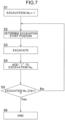
- Fig. 7 is a flowchart explaining a flow of executions of counting an excavation number, i.e., excavation No., and changing, in accordance with the excavation No, the excavation start position by the controller 8.
- a whole excavation range of the soil and sand mound 100 in the slewing direction is presumed as a range of -20° to 20° in a view from the hydraulic excavator 1.
- the controller 8 may deviate the second and subsequent excavation start positions in the slewing direction of the bucket 12 in accordance with the excavation number input by the controller 8.
- a specific excavation number for instance, "5" is input as the excavation number "N" to the controller 8 as to how many excavations are required to excavate a whole range (whole excavation range) of the soil and sand mound 100 in the slewing direction. That is to say, the whole range of the soil and sand mound 100 in the slewing direction is supposed to be excavatable at five excavations in total.
- the controller 8 shifts the bucket 12 toward the soil and sand mound 100 in the slewing direction.
- the controller 8 determines, on the basis of the detected data from the photographing device 9, a position of the bucket 12 where the bucket 12 is not wholly hidden by the soil and sand mound 100 but a part of the soil and sand mound 100 and a part of the bucket 12 overlap each other as the first excavation start position of the bucket 12 to the soil and sand mound 100 (step S2).
- the controller 8 controls the boom 10, the arm 11, and the bucket 12 to excavate the soil and sand mound 100 (step S3).
- step S4 adds "1" to the excavation No. (step S4), and returns to step S2 when the excavation No. does not exceed "5" (No in step S5). Contrarily, when the excavation No. exceeds "5", that is, indicates N + 1 or larger (Yes in step S5), the controller 8 decides an end of excavation (step S6), and thus the excavation is finished.
- the second and subsequent excavation start positions are determined, for example, in the manner described below.
- the operator may determine the excavation number under the condition that a part of an excavation range of the bucket in an n-th excavation and a part of an excavation range of the bucket in an (n+1)th excavation overlap each other, and the operator may input the determined excavation number to the controller 8.
- the controller 8 can receive an input of the excavation number to the soil and sand mound 100, and can set the predetermined angle in accordance with the input excavation number so that the second and subsequent excavation start positions shift in the slewing direction.
- the operator may input another excavation number to the controller 8 to change the excavation number, that is, to correct the excavation start position.
- the operator may input the excavation number from the mobile terminal 22 to the controller 8.
- the excavation start position may be correctable through the mobile terminal 22 in accordance with the changed excavation number.
- the mobile terminal 22 is operable to input, to the controller 8, a signal of correcting the excavation start position.
- the controller 8 enabling deviation of the excavation start positions in the slewing direction of the bucket 12 in accordance with the input excavation number allows the operator to input another excavation number to the controller 8 in accordance with the shape or contour of the soil and sand mound 100 to change the excavation number, and consequently permits the hydraulic excavator 1 to flexibly execute an excavation in accordance with the shape or contour of the soil and sand mound 100.
- Fig. 8A is a diagram explaining a process of determining an excavation start position in a modification in the present invention.
- Fig. 3A illustrates a state where the controller 8 shifts the bucket 12 toward the soil and sand mound 100 in the slewing direction in the vicinity of the ground G.
- a controller 8 lowers a bucket 12 from a position above a soil and sand mound 100 to a rear position of the soil and sand mound 100 to arrange the bucket 12 at an excavation start position.
- the controller 8 moves an arm 11 in a lowering direction.
- the controller 8 determines, on the basis of detected data from a photographing device 9, a position of the bucket 12 where a proportion of an area S of a specific part of the bucket 12 that does not overlap the soil and sand mound 100 to a whole area of the bucket 12 is a predetermined value (proportion) or lower when the soil and sand mound 100 is seen from the hydraulic excavator 1 as the excavation start position.
- the predetermined value (proportion) indicates, for example, 30%.
- the controller 8 deviates the second and subsequent excavation start positions downward from a preceding excavation start position.
- Fig. 8B is a diagram explaining another process, which is different from the process in Fig. 8A , of determining an excavation start position in another modification in the present invention.
- Fig. 3B illustrates a state where the controller 8 shifts the bucket 12 toward the soil and sand mound 100 in the slewing direction in the vicinity of the ground G.
- a controller 8 lowers a bucket 12 from a position above a soil and sand mound 100 to a rear position of the soil and sand mound 100 to arrange the bucket 12 at an excavation start position.
- the controller 8 moves an arm 11 in a lowering direction.
- the controller 8 determines, on the basis of detected data from a photographing device 9, a position of the bucket 12 where a distance Z1 (offset distance) between an end Pm of the soil and sand mound 100 that is closer to the bucket 12 in a direction of causing the bucket 12 to approach the soil and sand mound 100 and an end Pb3 of the bucket 12 in the opposite direction to the direction of causing the bucket 12 to approach the soil and sand mound 100 reaches a predetermined value (distance) or smaller when the soil and sand mound 100 (bucket 12) is seen from the hydraulic excavator 1 (machine body) as the excavation start position.
- a distance Z1 offset distance
- the predetermined value (distance) indicates, for example, 200 mm.
- the controller 8 deviates the second and subsequent excavation start positions downward from a preceding excavation start position.
- the controller 8 determines the excavation start position of the bucket 12 to the soil and sand mound 100 in a tilting direction of the attachment 4 with respect to the upper slewing body 3.
- the excavation target having the mountain shape may be a crushed stone mound, a scrap mound, or a rubber mound in place of the soil and sand mound 100.
- Fig. 3A and other drawings show that the bucket 12 is shifted toward the soil and sand mound 100 in the slewing direction in the vicinity of the ground G to determine an excavation start position of the bucket 12 to the soil and sand mound 100.
- the bucket 12 may be arranged at a position above the ground G without exceeding the height of the top of soil and sand mound 100, and the bucket 12 may be shifted from the position toward the soil and sand mound 100 in the slewing direction to determine the excavation start position of the bucket 12 to the soil and sand mound 100.
- the controller 8 mounted on the hydraulic excavator 1 does not necessarily store a computation system for determining an excavation start position of the bucket 12 to the soil and sand mound 100.
- another controller (not shown) which is different from the controller 8 but communicable with the controller 8, and further provided outside the hydraulic excavator 1 may store a computation system for determining an excavation start position of the bucket 12 to the soil and sand mound 100.
- the hydraulic excavator 1 (working machine) does not need to include all the components of each of the excavation position determination system and the excavation control system according to the present invention.
- a server provided in a remote management center located at a position away from a work site of the hydraulic excavator 1 may serve as the controller 8.
- the present invention provides an excavation position determination system for use in a working machine including a machine body and a bucket movable relative to the machine body for excavating an excavation target having a mountain shape.
- the excavation position determination system includes: a photographing device that photographs the excavation target and the bucket; and a start position determinator that determines an excavation start position of the bucket to the excavation target.
- the start position determinator determines, on the basis of detected data from the photographing device, a position of the bucket where a part of the bucket is visible from the machine body and the other part of the bucket is hidden by the excavation target when the bucket is seen from the machine body as the excavation start position.
- the start position determinator may determine a position of the bucket where a proportion of an area of the one part of the bucket visible from the machine body to a whole area of the bucket is a predetermined value or lower when the bucket is seen from the machine body as the excavation start position.
- the start position determinator may determine a position of the bucket where a distance between an end of the excavation target that is closer to the bucket in a direction of causing the bucket to approach the excavation target and an end of the bucket in the opposite direction to the direction of causing the bucket to approach the excavation target reaches a predetermined value or smaller when the bucket is seen from the machine body as the excavation start position.
- the start position determinator may determine a position of the bucket where the part of the bucket is visible from the machine body and the other part of the bucket is hidden by the excavation target as a first excavation start position, and determine a position of the bucket where one part of the bucket is visible from the machine body and the other part of the bucket is hidden by the excavation target as a second or subsequent excavation start positions.
- the start position determinator determines a position of the bucket where the part of the bucket is visible from the machine body and the other part of the bucket is hidden by the excavation target as a first excavation start position, and determines second and subsequent excavation start positions in deviation from one another each at a predetermined angle.
- the start position determinator is configured to receive an input of an excavation number to the excavation target and set the predetermined angle in accordance with the input excavation number so that the second and subsequent excavation start positions shift in a slewing direction.
- the configuration may further include an external terminal arrangeable at a position away from the working machine and communicable with the start position determinator.
- the external terminal may be operable to input, to the start position determinator, a signal of correcting the excavation start position.
- the present invention provides an excavation control system including: the excavation position determination system described above; and a signal input section that inputs a drive instructive signal to the working machine to start an excavation operation for the excavation target by the bucket from the excavation start position determined by the start position determinator of the excavation position determination system.
- the present invention provides a working machine including: a machine body; a bucket that is movable relative to the machine body; a drive section that drives the bucket; and the excavation control system described above.
- the signal input section inputs the drive instructive signal to the drive section to start the excavation operation for the excavation target by the bucket from the excavation start position determined by the start position determinator of the excavation position determination system.
- the machine body may include: a lower traveling body; an upper slewing body supported on the lower traveling body slewably about a slewing axis extending in an up-down direction; and an attachment including the bucket and tiltably supported on the upper slewing body.
- the start position determinator may determine the excavation start position of the bucket to the excavation target in a slewing direction of the upper slewing body with respect to the lower traveling body.
- the machine body may include: a lower traveling body; an upper slewing body supported on the lower traveling body slewably about a slewing axis extending in an up-down direction; and an attachment including the bucket and tiltably supported on the upper slewing body.
- the start position determinator may determine the excavation start position of the bucket to the excavation target in a tilting direction of the attachment with respect to the upper slewing body.
Landscapes
- Engineering & Computer Science (AREA)
- Mining & Mineral Resources (AREA)
- Civil Engineering (AREA)
- General Engineering & Computer Science (AREA)
- Structural Engineering (AREA)
- Mechanical Engineering (AREA)
- Operation Control Of Excavators (AREA)
- Component Parts Of Construction Machinery (AREA)
Claims (9)
- Système de détermination de la position d'excavation à utiliser dans une machine de travail comprenant un corps de machine et un godet (12) déplaçable par rapport au corps de machine pour excaver une cible d'excavation (100) ayant une forme de montagne, le système de détermination de la position d'excavation comprenant :un dispositif de photographie (9) qui photographie la cible d'excavation (100) et le godet (12) ; etun déterminateur de position de départ (8) qui détermine une position de départ de l'excavation du godet (12) par rapport à la cible d'excavation (100), dans lequelle déterminateur de position de départ (8) détermine, sur la base des données détectées du dispositif de photographie (9), une position du godet (12) dans laquelle une partie du godet (12) est visible du corps de machine et l'autre partie du godet (12) est cachée par la cible d'excavation (100) lorsque le godet (12) est vu du corps de machine en tant que position de départ de l'excavation, caractérisé en ce quelorsque la machine de travail exécute une pluralité de travaux d'excavation sur la cible d'excavation (100), le déterminateur de position de départ (8) détermine une position du godet (12) dans laquelle la partie du godet (12) est visible du corps de machine et l'autre partie du godet (12) est cachée par la cible d'excavation (100) en tant que première position de départ de l'excavation, et détermine des deuxième et suivantes positions de départ de l'excavation qui diffèrent l'une de l'autre chacune selon un angle prédéterminé,dans lequel le déterminateur de position de départ (8) est configuré pour recevoir une entrée d'un nombre d'excavation vers la cible d'excavation (100) et pour définir l'angle prédéterminé selon le nombre d'excavation entré de telle sorte que les deuxième et suivantes positions de départ de l'excavation soient décalées dans une direction de pivotement.
- Système de détermination de la position d'excavation selon la revendication 1, dans lequel le déterminateur de position de départ (8) détermine une position du godet (12) dans laquelle une proportion d'une zone (S) de la partie du godet (12) visible du corps de machine par rapport à une zone entière du godet (12) est une valeur prédéterminée ou inférieure lorsque le godet (12) est vu du corps de machine en tant que position de départ de l'excavation.
- Système de détermination de la position d'excavation selon la revendication 1, dans lequel le déterminateur de position de départ (8) détermine une position du godet (12) dans laquelle une distance (Y1) entre une extrémité (Pe) de la cible d'excavation (100) qui est plus proche du godet (12) dans une direction amenant le godet (12) à s'approcher de la cible d'excavation (100) et une extrémité (Pb1) du godet (12) dans la direction opposée à la direction amenant le godet (12) à s'approcher de la cible d'excavation (100) atteint une valeur prédéterminée ou inférieure lorsque le godet (12) est vu du corps de machine en tant que position de départ de l'excavation.
- Système de détermination de la position d'excavation selon l'une quelconque des revendications 1 à 3, dans lequel, lorsque la machine de travail exécute une pluralité de travaux d'excavation à la cible d'excavation (100), le déterminateur de position de départ (8) détermine une position du godet (12) dans laquelle la partie du godet (12) est visible du corps de machine et l'autre partie du godet (12) est cachée par la cible d'excavation (100) en tant que première position de départ de l'excavation, et détermine une position du godet (12) dans laquelle la partie du godet (12) est visible du corps de machine et l'autre partie du godet (12) est cachée par la cible d'excavation (100) en tant qu'une deuxième ou suivante position de départ de l'excavation.
- Système de détermination de la position d'excavation selon l'une quelconque des revendications 1 à 4, comprenant en outre un terminal externe pouvant être disposé à une position éloignée de la machine de travail et pouvant communiquer avec le déterminateur de position de départ (8), dans lequel
le terminal externe peut fonctionner pour entrer, dans le déterminateur de position de départ (8), un signal de correction de la position de départ de l'excavation. - Système de commande d'excavation comprenant :le système de détermination de la position d'excavation selon l'une quelconque des revendications 1 à 5 ; etune section d'entrée de signal qui entre un signal d'instruction d'entraînement à la machine de travail pour démarrer une opération d'excavation pour la cible d'excavation (100) par le godet (12) à partir de la position de départ de l'excavation déterminée par le déterminateur de position de départ (8) du système de détermination de la position d'excavation.
- Machine de travail comprenant :un corps de machine ;un godet (12) déplaçable par rapport au corps de machine ;une section d'entraînement qui entraîne le godet (12) ; etle système de commande d'excavation selon la revendication 6, dans laquellela section d'entrée de signal entre le signal d'instruction d'entraînement à la section d'entraînement pour démarrer l'opération d'excavation pour la cible d'excavation (100) par le godet (12) à partir de la position de départ de l'excavation déterminée par le déterminateur de position de départ (8) du système de détermination de la position d'excavation.
- Machine de travail selon la revendication 7, dans laquelle la machine de travail comprend :un corps de déplacement inférieur (2) ;un corps de pivotement supérieur (3) supporté sur le corps de déplacement inférieur (2) de manière pivotante autour d'un axe de pivotement s'étendant dans une direction haut au bas; etun accessoire (4) comprenant le godet (12) et supporté de manière inclinable sur le corps de pivotement supérieur (3), dans lequelle déterminateur de position de départ (8) détermine la position de départ de l'excavation du godet (12) par rapport à la cible d'excavation (100) dans une direction de pivotement du corps de pivotement supérieur (3) par rapport au corps de déplacement inférieur (2).
- Machine de travail selon la revendication 7, dans laquelle la machine de travail comprend :un corps de déplacement inférieur (2) ;un corps de pivotement supérieur (3) supporté sur le corps de déplacement inférieur (2) de manière pivotante autour d'un axe de pivotement s'étendant dans une direction haut au bas; etun accessoire (4) comprenant le godet (12) et supporté de manière inclinable sur le corps de pivotement supérieur (3), dans laquellele déterminateur de position de départ (8) détermine la position de départ de l'excavation du godet (12) par rapport à la cible d'excavation (100) dans une direction d'inclinaison de l'accessoire (4) par rapport au corps de pivotement supérieur (3).
Applications Claiming Priority (2)
| Application Number | Priority Date | Filing Date | Title |
|---|---|---|---|
| JP2020168015A JP7472751B2 (ja) | 2020-10-02 | 2020-10-02 | 掘削位置決定システム |
| PCT/JP2021/033480 WO2022070852A1 (fr) | 2020-10-02 | 2021-09-13 | Système de détermination de position de forage, système de commande de forage et engin de chantier |
Publications (3)
| Publication Number | Publication Date |
|---|---|
| EP4202128A1 EP4202128A1 (fr) | 2023-06-28 |
| EP4202128A4 EP4202128A4 (fr) | 2024-03-13 |
| EP4202128B1 true EP4202128B1 (fr) | 2025-01-08 |
Family
ID=80951369
Family Applications (1)
| Application Number | Title | Priority Date | Filing Date |
|---|---|---|---|
| EP21875154.3A Active EP4202128B1 (fr) | 2020-10-02 | 2021-09-13 | Système de détermination de position de forage, système de commande de forage et engin de chantier |
Country Status (5)
| Country | Link |
|---|---|
| US (1) | US12497751B2 (fr) |
| EP (1) | EP4202128B1 (fr) |
| JP (1) | JP7472751B2 (fr) |
| CN (1) | CN116234960B (fr) |
| WO (1) | WO2022070852A1 (fr) |
Families Citing this family (2)
| Publication number | Priority date | Publication date | Assignee | Title |
|---|---|---|---|---|
| KR20230163389A (ko) * | 2021-03-31 | 2023-11-30 | 스미토모 겐키 가부시키가이샤 | 작업기계, 작업기계용 하중계산시스템 |
| JP2022160276A (ja) * | 2021-04-06 | 2022-10-19 | コベルコ建機株式会社 | 掘削システム |
Family Cites Families (21)
| Publication number | Priority date | Publication date | Assignee | Title |
|---|---|---|---|---|
| JPS54123202A (en) | 1978-03-16 | 1979-09-25 | Komatsu Mfg Co Ltd | Transverse excavation controller by oil pressure backkhoe |
| JP2000291076A (ja) * | 1999-04-01 | 2000-10-17 | Tokai Rika Co Ltd | パワーショベル |
| KR101163289B1 (ko) * | 2009-10-26 | 2012-07-05 | 육상조 | 작업상태의 확인이 가능한 포크레인의 버켓 뷰어 시스템 |
| JP5202667B2 (ja) * | 2011-02-22 | 2013-06-05 | 株式会社小松製作所 | 油圧ショベルの位置誘導システム及びその制御方法 |
| JP5426743B1 (ja) * | 2012-10-05 | 2014-02-26 | 株式会社小松製作所 | 掘削機械の表示システム及び掘削機械 |
| US8914199B2 (en) * | 2012-10-05 | 2014-12-16 | Komatsu Ltd. | Excavating machine display system and excavating machine |
| PL225300B1 (pl) | 2015-01-22 | 2017-03-31 | Ireneusz Piskorz | Turbina wiatrowa z obrotowymi nawiewnicami |
| JP6522441B2 (ja) * | 2015-06-29 | 2019-05-29 | 日立建機株式会社 | 作業機械の作業支援システム |
| WO2017170900A1 (fr) | 2016-03-31 | 2017-10-05 | 住友建機株式会社 | Pelle |
| JP7571963B2 (ja) | 2016-09-30 | 2024-10-23 | 住友建機株式会社 | ショベル |
| JP6454383B2 (ja) | 2017-07-18 | 2019-01-16 | 株式会社小松製作所 | 建設機械の表示システムおよびその制御方法 |
| US10586349B2 (en) * | 2017-08-24 | 2020-03-10 | Trimble Inc. | Excavator bucket positioning via mobile device |
| JP6878226B2 (ja) | 2017-09-19 | 2021-05-26 | 日立建機株式会社 | 作業機械 |
| EP3763885B1 (fr) * | 2018-03-08 | 2026-05-06 | Sumitomo Heavy Industries, Ltd. | Machine de travail, dispositif de traitement d'informations, procédé de traitement d'informations, et programme |
| JP2019203285A (ja) | 2018-05-22 | 2019-11-28 | 株式会社神戸製鋼所 | 作業機械用画像生成装置及び作業機械用画像生成方法 |
| JP7274831B2 (ja) | 2018-07-31 | 2023-05-17 | 株式会社小松製作所 | 作業機械 |
| JP7188941B2 (ja) | 2018-08-31 | 2022-12-13 | 株式会社小松製作所 | 作業機械の制御装置および制御方法 |
| EP3868963B1 (fr) * | 2018-10-19 | 2025-11-26 | Sumitomo Construction Machinery Co., Ltd. | Dispositif d'affichage pour un excavateur, excavateur et appareil terminal comprenant un dispositif d'affichage |
| CN109816778B (zh) * | 2019-01-25 | 2023-04-07 | 北京百度网讯科技有限公司 | 物料堆三维重建方法、装置、电子设备和计算机可读介质 |
| US11062511B2 (en) * | 2019-05-02 | 2021-07-13 | Deere & Company | Controlling mobile construction equipment for subterranean mapping |
| DE102024201220A1 (de) | 2024-02-09 | 2025-08-14 | Robert Bosch Gesellschaft mit beschränkter Haftung | Vorrichtung und Verfahren zum Erzeugen eines ersten Agenten, insbesondere zu einer Interaktion zwischen dem ersten Agenten und einem zweiten Agenten, und Vorrichtung und Verfahren zum Trainieren wenigstens eines Modells zum Erzeugen des ersten Agenten |
-
2020
- 2020-10-02 JP JP2020168015A patent/JP7472751B2/ja active Active
-
2021
- 2021-09-13 EP EP21875154.3A patent/EP4202128B1/fr active Active
- 2021-09-13 US US18/246,266 patent/US12497751B2/en active Active
- 2021-09-13 WO PCT/JP2021/033480 patent/WO2022070852A1/fr not_active Ceased
- 2021-09-13 CN CN202180065310.XA patent/CN116234960B/zh active Active
Also Published As
| Publication number | Publication date |
|---|---|
| US12497751B2 (en) | 2025-12-16 |
| EP4202128A4 (fr) | 2024-03-13 |
| JP2022060036A (ja) | 2022-04-14 |
| EP4202128A1 (fr) | 2023-06-28 |
| JP7472751B2 (ja) | 2024-04-23 |
| CN116234960B (zh) | 2026-03-20 |
| US20230358015A1 (en) | 2023-11-09 |
| WO2022070852A1 (fr) | 2022-04-07 |
| CN116234960A (zh) | 2023-06-06 |
Similar Documents
| Publication | Publication Date | Title |
|---|---|---|
| EP3159455B1 (fr) | Pelle, et procédé de commande de celle-ci | |
| KR101759409B1 (ko) | 작업차량 및 작업차량의 제어 방법 | |
| CN114164888B (zh) | 液压挖掘机 | |
| JP6611205B2 (ja) | ショベル及びショベルの表示装置 | |
| CN113454294B (zh) | 作业机械的控制系统以及控制方法 | |
| CN107306500A (zh) | 作业机械的控制装置、作业机械以及作业机械的控制方法 | |
| US12497751B2 (en) | Drilling position determination system, drilling control system, and work machine | |
| KR102422582B1 (ko) | 유압 셔블 | |
| EP4187026A1 (fr) | Système de travail automatisé | |
| KR20230042730A (ko) | 작업 기계 | |
| US10900202B2 (en) | Systems and methods for generating operational machine heading | |
| EP4386146B1 (fr) | Système de génération de trajectoire et engin de chantier le comprenant | |
| EP4098804B1 (fr) | Excavatrice hydraulique | |
| JP2025123500A (ja) | 作業エリア設定システム | |
| EP4394131A1 (fr) | Engin de chantier | |
| EP3789542B1 (fr) | Machine de travail | |
| EP4455409A1 (fr) | Système de réglage de zone de travail | |
| WO2025206054A1 (fr) | Engin de chantier | |
| WO2025013421A1 (fr) | Système de travail | |
| WO2025057819A1 (fr) | Engin de chantier et dispositif de commande à distance | |
| WO2026053689A1 (fr) | Dispositif de commande | |
| WO2025154761A1 (fr) | Engin de chantier | |
| CN119585485A (zh) | 用于设定工程机械中的车体坐标系的系统以及方法 | |
| WO2025204383A1 (fr) | Système d'affichage d'un engin de chantier | |
| CN117980566A (zh) | 工程机械 |
Legal Events
| Date | Code | Title | Description |
|---|---|---|---|
| STAA | Information on the status of an ep patent application or granted ep patent |
Free format text: STATUS: THE INTERNATIONAL PUBLICATION HAS BEEN MADE |
|
| PUAI | Public reference made under article 153(3) epc to a published international application that has entered the european phase |
Free format text: ORIGINAL CODE: 0009012 |
|
| STAA | Information on the status of an ep patent application or granted ep patent |
Free format text: STATUS: REQUEST FOR EXAMINATION WAS MADE |
|
| 17P | Request for examination filed |
Effective date: 20230320 |
|
| AK | Designated contracting states |
Kind code of ref document: A1 Designated state(s): AL AT BE BG CH CY CZ DE DK EE ES FI FR GB GR HR HU IE IS IT LI LT LU LV MC MK MT NL NO PL PT RO RS SE SI SK SM TR |
|
| DAV | Request for validation of the european patent (deleted) | ||
| DAX | Request for extension of the european patent (deleted) | ||
| A4 | Supplementary search report drawn up and despatched |
Effective date: 20240214 |
|
| RIC1 | Information provided on ipc code assigned before grant |
Ipc: E02F 9/26 20060101ALI20240208BHEP Ipc: E02F 9/20 20060101ALI20240208BHEP Ipc: E02F 3/42 20060101AFI20240208BHEP |
|
| GRAP | Despatch of communication of intention to grant a patent |
Free format text: ORIGINAL CODE: EPIDOSNIGR1 |
|
| STAA | Information on the status of an ep patent application or granted ep patent |
Free format text: STATUS: GRANT OF PATENT IS INTENDED |
|
| INTG | Intention to grant announced |
Effective date: 20240912 |
|
| GRAS | Grant fee paid |
Free format text: ORIGINAL CODE: EPIDOSNIGR3 |
|
| GRAA | (expected) grant |
Free format text: ORIGINAL CODE: 0009210 |
|
| STAA | Information on the status of an ep patent application or granted ep patent |
Free format text: STATUS: THE PATENT HAS BEEN GRANTED |
|
| AK | Designated contracting states |
Kind code of ref document: B1 Designated state(s): AL AT BE BG CH CY CZ DE DK EE ES FI FR GB GR HR HU IE IS IT LI LT LU LV MC MK MT NL NO PL PT RO RS SE SI SK SM TR |
|
| REG | Reference to a national code |
Ref country code: GB Ref legal event code: FG4D |
|
| REG | Reference to a national code |
Ref country code: CH Ref legal event code: EP |
|
| REG | Reference to a national code |
Ref country code: DE Ref legal event code: R096 Ref document number: 602021024822 Country of ref document: DE |
|
| REG | Reference to a national code |
Ref country code: IE Ref legal event code: FG4D |
|
| REG | Reference to a national code |
Ref country code: LT Ref legal event code: MG9D |
|
| REG | Reference to a national code |
Ref country code: NL Ref legal event code: MP Effective date: 20250108 |
|
| REG | Reference to a national code |
Ref country code: AT Ref legal event code: MK05 Ref document number: 1758405 Country of ref document: AT Kind code of ref document: T Effective date: 20250108 |
|
| PG25 | Lapsed in a contracting state [announced via postgrant information from national office to epo] |
Ref country code: NL Free format text: LAPSE BECAUSE OF FAILURE TO SUBMIT A TRANSLATION OF THE DESCRIPTION OR TO PAY THE FEE WITHIN THE PRESCRIBED TIME-LIMIT Effective date: 20250108 |
|
| PG25 | Lapsed in a contracting state [announced via postgrant information from national office to epo] |
Ref country code: RS Free format text: LAPSE BECAUSE OF FAILURE TO SUBMIT A TRANSLATION OF THE DESCRIPTION OR TO PAY THE FEE WITHIN THE PRESCRIBED TIME-LIMIT Effective date: 20250408 |
|
| PG25 | Lapsed in a contracting state [announced via postgrant information from national office to epo] |
Ref country code: FI Free format text: LAPSE BECAUSE OF FAILURE TO SUBMIT A TRANSLATION OF THE DESCRIPTION OR TO PAY THE FEE WITHIN THE PRESCRIBED TIME-LIMIT Effective date: 20250108 |
|
| PG25 | Lapsed in a contracting state [announced via postgrant information from national office to epo] |
Ref country code: PL Free format text: LAPSE BECAUSE OF FAILURE TO SUBMIT A TRANSLATION OF THE DESCRIPTION OR TO PAY THE FEE WITHIN THE PRESCRIBED TIME-LIMIT Effective date: 20250108 |
|
| PG25 | Lapsed in a contracting state [announced via postgrant information from national office to epo] |
Ref country code: ES Free format text: LAPSE BECAUSE OF FAILURE TO SUBMIT A TRANSLATION OF THE DESCRIPTION OR TO PAY THE FEE WITHIN THE PRESCRIBED TIME-LIMIT Effective date: 20250108 |
|
| PG25 | Lapsed in a contracting state [announced via postgrant information from national office to epo] |
Ref country code: NO Free format text: LAPSE BECAUSE OF FAILURE TO SUBMIT A TRANSLATION OF THE DESCRIPTION OR TO PAY THE FEE WITHIN THE PRESCRIBED TIME-LIMIT Effective date: 20250408 Ref country code: IS Free format text: LAPSE BECAUSE OF FAILURE TO SUBMIT A TRANSLATION OF THE DESCRIPTION OR TO PAY THE FEE WITHIN THE PRESCRIBED TIME-LIMIT Effective date: 20250508 |
|
| PG25 | Lapsed in a contracting state [announced via postgrant information from national office to epo] |
Ref country code: HR Free format text: LAPSE BECAUSE OF FAILURE TO SUBMIT A TRANSLATION OF THE DESCRIPTION OR TO PAY THE FEE WITHIN THE PRESCRIBED TIME-LIMIT Effective date: 20250108 |
|
| PG25 | Lapsed in a contracting state [announced via postgrant information from national office to epo] |
Ref country code: PT Free format text: LAPSE BECAUSE OF FAILURE TO SUBMIT A TRANSLATION OF THE DESCRIPTION OR TO PAY THE FEE WITHIN THE PRESCRIBED TIME-LIMIT Effective date: 20250508 Ref country code: LV Free format text: LAPSE BECAUSE OF FAILURE TO SUBMIT A TRANSLATION OF THE DESCRIPTION OR TO PAY THE FEE WITHIN THE PRESCRIBED TIME-LIMIT Effective date: 20250108 |
|
| PG25 | Lapsed in a contracting state [announced via postgrant information from national office to epo] |
Ref country code: GR Free format text: LAPSE BECAUSE OF FAILURE TO SUBMIT A TRANSLATION OF THE DESCRIPTION OR TO PAY THE FEE WITHIN THE PRESCRIBED TIME-LIMIT Effective date: 20250409 Ref country code: BG Free format text: LAPSE BECAUSE OF FAILURE TO SUBMIT A TRANSLATION OF THE DESCRIPTION OR TO PAY THE FEE WITHIN THE PRESCRIBED TIME-LIMIT Effective date: 20250108 |
|
| PG25 | Lapsed in a contracting state [announced via postgrant information from national office to epo] |
Ref country code: AT Free format text: LAPSE BECAUSE OF FAILURE TO SUBMIT A TRANSLATION OF THE DESCRIPTION OR TO PAY THE FEE WITHIN THE PRESCRIBED TIME-LIMIT Effective date: 20250108 |
|
| PG25 | Lapsed in a contracting state [announced via postgrant information from national office to epo] |
Ref country code: SE Free format text: LAPSE BECAUSE OF FAILURE TO SUBMIT A TRANSLATION OF THE DESCRIPTION OR TO PAY THE FEE WITHIN THE PRESCRIBED TIME-LIMIT Effective date: 20250108 |
|
| PG25 | Lapsed in a contracting state [announced via postgrant information from national office to epo] |
Ref country code: SM Free format text: LAPSE BECAUSE OF FAILURE TO SUBMIT A TRANSLATION OF THE DESCRIPTION OR TO PAY THE FEE WITHIN THE PRESCRIBED TIME-LIMIT Effective date: 20250108 |
|
| REG | Reference to a national code |
Ref country code: DE Ref legal event code: R097 Ref document number: 602021024822 Country of ref document: DE |
|
| PG25 | Lapsed in a contracting state [announced via postgrant information from national office to epo] |
Ref country code: DK Free format text: LAPSE BECAUSE OF FAILURE TO SUBMIT A TRANSLATION OF THE DESCRIPTION OR TO PAY THE FEE WITHIN THE PRESCRIBED TIME-LIMIT Effective date: 20250108 |
|
| PGFP | Annual fee paid to national office [announced via postgrant information from national office to epo] |
Ref country code: DE Payment date: 20250730 Year of fee payment: 5 |
|
| PGFP | Annual fee paid to national office [announced via postgrant information from national office to epo] |
Ref country code: GB Payment date: 20250731 Year of fee payment: 5 |
|
| PGFP | Annual fee paid to national office [announced via postgrant information from national office to epo] |
Ref country code: FR Payment date: 20250808 Year of fee payment: 5 |
|
| PG25 | Lapsed in a contracting state [announced via postgrant information from national office to epo] |
Ref country code: CZ Free format text: LAPSE BECAUSE OF FAILURE TO SUBMIT A TRANSLATION OF THE DESCRIPTION OR TO PAY THE FEE WITHIN THE PRESCRIBED TIME-LIMIT Effective date: 20250108 Ref country code: EE Free format text: LAPSE BECAUSE OF FAILURE TO SUBMIT A TRANSLATION OF THE DESCRIPTION OR TO PAY THE FEE WITHIN THE PRESCRIBED TIME-LIMIT Effective date: 20250108 |
|
| PG25 | Lapsed in a contracting state [announced via postgrant information from national office to epo] |
Ref country code: RO Free format text: LAPSE BECAUSE OF FAILURE TO SUBMIT A TRANSLATION OF THE DESCRIPTION OR TO PAY THE FEE WITHIN THE PRESCRIBED TIME-LIMIT Effective date: 20250108 |
|
| PG25 | Lapsed in a contracting state [announced via postgrant information from national office to epo] |
Ref country code: SK Free format text: LAPSE BECAUSE OF FAILURE TO SUBMIT A TRANSLATION OF THE DESCRIPTION OR TO PAY THE FEE WITHIN THE PRESCRIBED TIME-LIMIT Effective date: 20250108 |
|
| PLBE | No opposition filed within time limit |
Free format text: ORIGINAL CODE: 0009261 |
|
| STAA | Information on the status of an ep patent application or granted ep patent |
Free format text: STATUS: NO OPPOSITION FILED WITHIN TIME LIMIT |
|
| REG | Reference to a national code |
Ref country code: CH Ref legal event code: L10 Free format text: ST27 STATUS EVENT CODE: U-0-0-L10-L00 (AS PROVIDED BY THE NATIONAL OFFICE) Effective date: 20251119 |
|
| 26N | No opposition filed |
Effective date: 20251009 |
|
| PG25 | Lapsed in a contracting state [announced via postgrant information from national office to epo] |
Ref country code: IT Free format text: LAPSE BECAUSE OF FAILURE TO SUBMIT A TRANSLATION OF THE DESCRIPTION OR TO PAY THE FEE WITHIN THE PRESCRIBED TIME-LIMIT Effective date: 20250108 |
|
| REG | Reference to a national code |
Ref country code: CH Ref legal event code: H13 Free format text: ST27 STATUS EVENT CODE: U-0-0-H10-H13 (AS PROVIDED BY THE NATIONAL OFFICE) Effective date: 20260504 |