EP4214262B1 - Polymères d'acide polylactique à résistance élevée à la fusion - Google Patents
Polymères d'acide polylactique à résistance élevée à la fusion Download PDFInfo
- Publication number
- EP4214262B1 EP4214262B1 EP21777802.6A EP21777802A EP4214262B1 EP 4214262 B1 EP4214262 B1 EP 4214262B1 EP 21777802 A EP21777802 A EP 21777802A EP 4214262 B1 EP4214262 B1 EP 4214262B1
- Authority
- EP
- European Patent Office
- Prior art keywords
- polymerisation
- lactide
- acid
- monomer
- hydroxy
- Prior art date
- Legal status (The legal status is an assumption and is not a legal conclusion. Google has not performed a legal analysis and makes no representation as to the accuracy of the status listed.)
- Active
Links
Images




Classifications
-
- C—CHEMISTRY; METALLURGY
- C08—ORGANIC MACROMOLECULAR COMPOUNDS; THEIR PREPARATION OR CHEMICAL WORKING-UP; COMPOSITIONS BASED THEREON
- C08G—MACROMOLECULAR COMPOUNDS OBTAINED OTHERWISE THAN BY REACTIONS ONLY INVOLVING UNSATURATED CARBON-TO-CARBON BONDS
- C08G63/00—Macromolecular compounds obtained by reactions forming a carboxylic ester link in the main chain of the macromolecule
- C08G63/02—Polyesters derived from hydroxycarboxylic acids or from polycarboxylic acids and polyhydroxy compounds
- C08G63/06—Polyesters derived from hydroxycarboxylic acids or from polycarboxylic acids and polyhydroxy compounds derived from hydroxycarboxylic acids
- C08G63/08—Lactones or lactides
-
- C—CHEMISTRY; METALLURGY
- C08—ORGANIC MACROMOLECULAR COMPOUNDS; THEIR PREPARATION OR CHEMICAL WORKING-UP; COMPOSITIONS BASED THEREON
- C08G—MACROMOLECULAR COMPOUNDS OBTAINED OTHERWISE THAN BY REACTIONS ONLY INVOLVING UNSATURATED CARBON-TO-CARBON BONDS
- C08G2230/00—Compositions for preparing biodegradable polymers
Definitions
- the invention concerns boosting polylactic acid (PLA) polymer melt strengths by random incorporation of small amounts of hydroxy-acid co-monomers with opposite alpha-carbon chirality, and the use of said polymers.
- PLA polylactic acid
- PLA lacks decent melt properties, i.e. it has low melt strength, melt viscosity and melt elasticity, resulting in processing limitations and challenges that must be tackled to create a commercially competitive biobased material, similar or superior to existing petroleum-derived plastics.
- the present invention demonstrates a significant increase in melt shear viscosity and elasticity as well as a rise in elongational viscosity and melt strength of PLA by random co-polymerisation of lactide with small amounts (0.4 - 10 mol%) of diethylglycolide of opposite chiral nature.
- Both monomers can be synthesized via a one-step zeolite catalysed process in high yields and enantiomeric purity. Both melt strength improvement and the efficient and enantiomerically pure monomer syntheses could result in a more cost-competitive and sustainable biomaterial while broadening its applicability.
- the present invention solves the problems of the related art, as unexpected improvements of melt viscosity and elasticity of PLA by co-polymerisation of the classic monomer with a small amount of co-monomer with reverse stereochemistry were discovered.
- Both enantiomerically pure monomers can be easily synthesized using a one-step zeolite-catalysed process.
- the poor melt strength of PLA limits its processability when strong extensional forces are applied on the polymer, e.g. when making bottles via blow moulding, or in film blowing, fibre spinning and foaming. A stronger melt can translate in less plastic usage per item, lowering its overall footprint.
- the invention is broadly drawn to random incorporation of small amounts of o-hydroxy-acid co-monomers with opposite o-carbon chirality to boost polylactic acid (PLA) polymer melt strengths, and the use of said polymers.
- PVA polylactic acid
- This effect was successfully reproducible when scaling-up the reaction.
- An easy way for incorporating the co-monomers relies on ring-opening polymerisation protocols of the cyclic dimers of said hydroxy-acids.
- Extensional viscosity measurements confirmed the presumption of the melt strength improving effect of copolymerising the right diethylglycolide.
- a large scale co-polymer of (L,L)-lactide with (D,D)-diethylglycolide (1.2 mol%) exhibited both a higher extensional viscosity and a higher extensional force in comparison with L-PLA and a commercial grade PLA (Ingeo 7001D) used for injection stretch blow moulding applications.
- the one-step conversion of (2-or) o-hydroxybutyric acid in the presence of zeolite H-BEA toward diethylglycolide resulted in high yields and enantiomeric purity.
- This enantiomerically pure cyclic ester gave access to a range of unexplored high-molecular weight, random co-polymers with lactide, exhibiting attractive new melt properties.
- Small amounts (0.4-10 mol%) of diethylglycolide of opposite chiral nature compared to lactide resulted in polymer materials with a significantly increased melt shear viscosity and melt elasticity compared to L-PLA.
- Another aspect of the invention is a method of improving effects in PLA in absence of chain extenders, blending, compounding or stereocomplexation.
- Still another aspect of the invention is a new pathway towards high melt strength materials via co-polymerisation.
- Biobased and biodegradable polymers are appealing alternatives for petroleum-based plastics, as the latter are associated with environmental pollution, triggering worldwide public concern.
- Polylactic acid an aliphatic polyester made up of lactic acid (LA) monomers
- LA lactic acid
- This carbohydrate-based thermoplastic is biodegradable under controlled conditions and exhibits superior mechanical and physical properties, on par with commodity plastics such as polystyrene and poly(ethylene terephthalate) [ Garlotta J. Polym. Environ. 9, 63-84 (2001 )].
- PLA high-molecular weight PLA is synthesized by ring-opening polymerisation (ROP) of the cyclic dilactone lactide (LD), which is made by a back-biting depolymerisation of polycondensed LA [ Rafael Auras et al. Poly(Lactic Acid): Synthesis, Structures, Properties, Processing, and Applications (John Wiley & Sons, Inc., 2010 )]. While dilactones and ROP are indispensable, making LD is a two-step time- and energy consuming process that requires additional purification, driving up the cost of production.
- ROP ring-opening polymerisation
- LD cyclic dilactone lactide
- PLA has a poor melt strength, melt viscosity and melt elasticity, all crucial properties for elongational flow dominated processes such as film blowing, blow moulding, fibre spinning, foaming, etc.
- chain extended polymer structures can exhibit a reduced degradability [ I ⁇ iguez-Franco et al. Polym. Test. 67, 190-196 (2018 ); Limsukon et al. Polym. Test. 80, 106108 (2019 )], whereas extending agents themselves are often not biodegradable or biocompatible and in some cases even toxic (diisocyanates).
- a second strategy consists of blending PLA with other polymers, as well as compounding it with different micro- or nanosized fillers (e.g. 5 wt%) to enhance its melt behaviour [ Nofar et al. Polym. Rev. 59, 465-509 (2019 )].
- different micro- or nanosized fillers e.g. 5 wt%
- homogeneous blends or equal particles dispersion are not readily to obtain.
- blending can result in recycling or (bio)degradation limitations.
- stereocomplex crystallites induced by mixing PLAs of opposite chiral nature (L-PLA with 5 wt% D-PLA), can act as crosslinking points, resulting in a melt behaviour similar to chain-extended PLA structures [ Yamane et al. J. Rheol. (N. Y. N. Y). 48, 599-609 (2004 )]. This would require large scale availability of pure D-LA, which is not trivial.
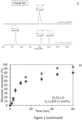
- Present invention concerns an unexpected and significant improvement of melt strength behaviour of PLA by ring-opening co-polymerisation of LD with (small amounts of) diethylglycolide (EG) of opposite chiral nature ( Fig. 1 A) .
- Racemic diethylglycolide (mixture of D,D + L,L) has been polymerised before, its traditional synthesis is homogeneously catalysed, inefficient and laborious, ending up with a mixture of diastereomers [ Yin & Baker Macromolecules 32, 7711-7718 (1999 ); Trimaille et al. J. Polym. Sci. Part A Polym. Chem. 42, 4379-4391 (2004 )].
- Enantiomerically pure homo- and co-polymers so far have only been made by polycondensation of ⁇ -HBA or a combination of ⁇ -HBA and LA, a method leading to low molecular weight compounds (e.g.
- FIG. 1 A shows the monomer synthesis and co-polymerisation
- Ring-opening polymerisation based on Kaihara et al. Nat. Protoc. 2, 2767-2771 (2007 ), was performed with a stannous octanoate Sn(Oct) 2 catalyst and 1-dodecanol initiator.
- This catalytic system ensures preservation of the stereochemistry of the monomers within the polymer chains, high molecular weight and low polydispersity.
- Diverse lactide-based polyesters were synthesized with different incorporations of EG, varying between 0.3 and 10 mol% (n/(m+n) in Figure 1 (A) ).
- the polymers vary in stereochemistry of the co-monomers (L-EG or D-EG with L-LD or D-LD).
- Chain structures of co-polymers are dependent on the relative polymerisation rates of the different monomers. If propagation rates are comparable, random chain structures are obtained, whereas a significant rate difference leads to block co-polymers.
- There is a decrease in polymerisation rate of alkyl-substituted lactides with increasing steric hindrance of the substituents Trimaille et al. J. Polym. Sci. Part A Polym. Chem. 42, 4379-4391 (2004 ); Saiyasombat et al. Polymer (Guildf). 39, 5581-5585 (1998 ); Vogel et al. Proceedings of the American Chemical Society, (2007), p. 2 ; Jing et al.
- Solvent-free ring-opening polymerisations is carried out in a dry, custom-made round-bottom flasks.
- a desired amount of monomer is added to the flask in an oxygen- and moisture free environment.
- the solvent is removed in vacuo and the flask is filled with argon and immersed in an oil bath at 170 °C for 70 minutes.
- the flask is cooled, and the polymer is dissolved in chloroform.
- the synthesized polymers are separated from the remaining monomers and oligomers via precipitation in methanol, filtered, and dried under reduced pressure.
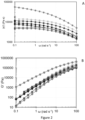
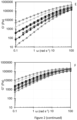
- Melt rheological properties of polymers govern their flow behaviour during processing towards various applications. Processing of PLA remains challenging due to its low melt strength and low melt viscosity and melt elasticity, limiting its applicability. Melt strength, can be indirectly determined by measuring the zero shear viscosity ( ⁇ 0 ) through strain controlled small amplitude oscillatory shear (SAOS) rheometry. Measurements were performed on the co-polymers described in Fout! Verwijzingsbron niet gevonden.
- SAOS strain controlled small amplitude oscillatory shear
- Co-polymers in which EG and LD had the same stereochemistry (P(L-LD-co-L-EG and P(D-LD-co-D-EG)) exhibited a limited increase in viscosity and elasticity, while a more significant increase was observed for co-polymers of L-LD and D-EG or D-LD and L-EG.
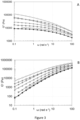
- extensional rheometry can be used as a direct measurement of melt strength.
- the bulk ROP reactions were scaled-up to 100 g.
- a pure P(L-LD) polymer and a co-polymer of L-LD with 1.2% of D-EG were synthesized and compared to the commercial grade PLA used for injection stretch blow moulding applications (e.g. bottles).
- P(L-LD-co-D-EG) exhibited an average force of about 24.4 N ( Fig. 4B ), which is about two times higher than the force of P(L-LD) (12.4 N).
- P(L-LD) and the commercial PLA showed comparable values.
- SAOS Small amplitude oscillatory shear
- strain sweep tests are performed by varying the strain amplitude between 0.1 and 10 % to determine the linear viscoelastic regime of the materials.
- Frequency sweep measurements are carried out at 185°C with dynamic frequencies ranging from 0.1 to 100 rad/s at a strain amplitude of 1-10 %.
- Consecutively rate sweep tests are performed applying shear rates between 0.01 and 1 s -1 . At each shear rate a waiting time of 30 s is installed to guarantee steady state, while a measuring time of 10 s is applied.
- Extensional flow properties of the polymers are determined on an AresMelts rheometer, using an Extensional Viscosity Fixture (EVF) set-up. Extensional viscosities are measured in strain-controlled stretch experiments with a Hencky strain of 3.4 at 185°C under a N 2 atmosphere.
- the polymer samples are compression molded into rectangular plates of 18.0 mm long, 10.0 mm ( ⁇ 0.10 mm) wide and 0.80 ( ⁇ 0.05 mm) thick. Prior to stretch measurements the plates are dried at 80°C overnight.
- the experimental protocol consists of three steps. During the first step a pre-stretch with a stretch rate of 0.0075 s -1 is performed on the polymers to compensate for thermal expansion during heating.
- pre-stretch Before pre-stretch a delay time of 50.0 s is applied to ensure the polymer samples are completely molten. The pre-stretch is followed by a relaxation step of 5.0 s to remove residual stress in the sample. Finally, the stretch measurement takes place at a constant Hencky strain rate (0.05, 0.1, 0.5, 1, 3.5 s -1 ).
- a Göttfert 2002 capillary rheometer is used in combination with a Haul-off apparatus.
- the polymer material is added to the barrel of the capillary rheometer at 185°C.
- the melt is pushed out of the barrel by a piston with a diameter of 12 mm and a die of 2 mm at a piston speed of 0.05 mm s-1 .
- the molten strands are attached to the Haul-off apparatus which spins the molten strands on a wheel, rotating at a pull-off speed of 100 mm s -1 .
- Table 1 Results of co-polymerisation of L(D)-LD with D-LD or L(D)-EG by ROP, weight-average molecular weight (M w ) (kg mol -1 ) and polydispersity (D) determined by GPC, T g and T m (°C) determined by DSC and zero shear viscosity ⁇ 0 (Pa s) and angular frequency at cross-over of G' and G" ⁇ c (rad s -1 ) determined by SAOS.
- M w weight-average molecular weight
- D polydispersity
Landscapes
- Chemical & Material Sciences (AREA)
- Health & Medical Sciences (AREA)
- Chemical Kinetics & Catalysis (AREA)
- Medicinal Chemistry (AREA)
- Polymers & Plastics (AREA)
- Organic Chemistry (AREA)
- Polyesters Or Polycarbonates (AREA)
Claims (15)
- Procédé permettant de produire un polymère à base d'acide lactique, comprenant l'étape de copolymérisation d'un lactide avec un dimère cyclique d'un autre α-hydroxy-acide en guise de comonomère d'une chiralité de carbone α opposée.
- Procédé selon la revendication 1, dans lequel la copolymérisation de lactide avec ledit dimère cyclique d'un autre α-hydroxy-acide est une copolymérisation aléatoire.
- Procédé selon la revendication 1, dans lequel la copolymérisation est une copolymérisation de (L,L)-lactide avec du (D,D)-diéthylglycolide ou une copolymérisation de (D,D)-lactide avec du (L,L)-diéthylglycolide.
- Procédé selon la revendication 3, dans lequel la copolymérisation est une copolymérisation en poly(acide lactique-co-α-hydroxybutyrique).
- Procédé selon l'une quelconque des revendications 1 à 4, dans lequel un lactide est copolymérisé avec 0,2 à 10 % molaires d'un dimère cyclique d'un autre α-hydroxy-acide en guise de comonomère de chiralité de carbone α opposée.
- Procédé selon l'une quelconque des revendications 1 à 5, dans lequel un lactide est copolymérisé avec 0,4 à 5 % molaires ou avec 0,7 à 2 % molaires d'un dimère cyclique d'un autre α-hydroxy-acide en guise de comonomère de chiralité de carbone α opposée.
- Copolymère pouvant être obtenu par un processus selon l'une quelconque des revendications 1 à 6.
- Copolymère selon la revendication 7, présentant une force d'extension qui est au moins 1,5 fois supérieure à celle d'un PLA pur obtenu par polymérisation de lactide.
- Copolymère selon la revendication 7 ou 8, présentant une viscosité sous cisaillement nul telle que mesurée à 185 °C, en appliquant une amplitude de déformation de 1 à 10 % et des fréquences dynamiques allant de 0,1 à 100 rad s-1 et calculée à l'aide d'un ajustement de modèle de Carreau-Yasuda) qui est au moins 1,2 fois supérieure à celle d'une copolymérisation de lactide avec un dimère cyclique d'un autre α-hydroxy-acide en guise de comonomère de la même chiralité de carbone α.
- Copolymère selon l'une quelconque des revendications 7 à 9, présentant une force d'extension d'au moins 17 N newtons (N), telle que mesurée par la force de la masse fondue à 185 °C, poussée à travers une filière avec un diamètre de 2 mm à une vitesse de piston de 0,05 mm s-1 et filée sur une roue en rotation à une vitesse de traction de 100 mm s-1 et une accélération linéaire de 0,12 mm s-1.
- Copolymère selon l'une quelconque des revendications 7 à 10, présentant une viscosité sous cisaillement nul d'au moins 15 kPa s, telle que mesurée à 185 °C, en appliquant une amplitude de déformation de 1 à 10 % et des fréquences dynamiques allant de 0,1 à 100 rad s-1 et calculée à l'aide d'un ajustement de modèle de Carreau-Yasuda.
- Copolymère selon l'une quelconque des revendications 7 à 11, présentant une force d'extension de 15 à 41 newtons (N), de préférence 23 à 25,5 N, telle que mesurée par la force de la masse fondue à 185 °C, poussée à travers une filière avec un diamètre de 2 mm à une vitesse de piston de 0,05 mm s-1 et filée sur une roue en rotation à une vitesse de traction de 100 mm s-1 et une accélération linéaire de 0,12 mm s-1.
- Copolymère selon l'une quelconque des revendications 7 à 11, présentant une viscosité sous cisaillement nul de 15 à 200 kPa s, telle que mesurée à 185 °C, en appliquant une amplitude de déformation de 1 à 10 % et des fréquences dynamiques allant de 0,1 à 100 rad s-1 et calculée à l'aide d'un ajustement de modèle de Carreau-Yasuda.
- Copolymère obtenu par une copolymérisation aléatoire de lactide avec un dimère cyclique d'un autre α-hydroxy-acide en guise de comonomère avec une chiralité de carbone α opposée, caractérisé en ce qu'il a une résistance en fusion d'au moins 15 et de préférence au moins 20 newtons (N) comprenant de 90 à 99,6 pour cent molaires d'acide lactique et comprenant de 10 à 0,4 pour cent molaires de comonomère hydroxy-acide ou caractérisé en ce qu'il a une résistance en fusion de 15 à 40 N, de préférence 20 à 35 N, plus préférablement 23 à 25,5 N comprenant de 90 à 99,6 pour cent molaires d'acide lactique et comprenant de 10 à 0,4 pour cent molaires de comonomère hydroxy-acide.
- Copolymère selon la revendication 14, dans lequel la résistance en fusion est mesurée par la force de la masse fondue à 185 °C, poussée à travers une filière avec un diamètre de 2 mm à une vitesse de piston de 0,05 mm s-1 et filée sur une roue en rotation à une vitesse de traction de 100 mm s-1 et une accélération linéaire de 0,12 mm s-1.
Applications Claiming Priority (2)
| Application Number | Priority Date | Filing Date | Title |
|---|---|---|---|
| EP20197312 | 2020-09-21 | ||
| PCT/EP2021/075980 WO2022058623A1 (fr) | 2020-09-21 | 2021-09-21 | Polymères d'acide polylactique à haute résistance à l'état fondu |
Publications (3)
| Publication Number | Publication Date |
|---|---|
| EP4214262A1 EP4214262A1 (fr) | 2023-07-26 |
| EP4214262B1 true EP4214262B1 (fr) | 2024-11-06 |
| EP4214262C0 EP4214262C0 (fr) | 2024-11-06 |
Family
ID=72613844
Family Applications (1)
| Application Number | Title | Priority Date | Filing Date |
|---|---|---|---|
| EP21777802.6A Active EP4214262B1 (fr) | 2020-09-21 | 2021-09-21 | Polymères d'acide polylactique à résistance élevée à la fusion |
Country Status (5)
| Country | Link |
|---|---|
| US (1) | US20240026070A1 (fr) |
| EP (1) | EP4214262B1 (fr) |
| CN (1) | CN116348523A (fr) |
| ES (1) | ES3000714T3 (fr) |
| WO (1) | WO2022058623A1 (fr) |
Family Cites Families (5)
| Publication number | Priority date | Publication date | Assignee | Title |
|---|---|---|---|---|
| GB1040168A (en) * | 1963-11-08 | 1966-08-24 | Du Pont | High molecular weight polylactides and a process for their preparation |
| CN1033517C (zh) * | 1988-08-08 | 1996-12-11 | 巴特尔纪念研究院 | 可生物降的组合物及其制备方法 |
| US5502158A (en) * | 1988-08-08 | 1996-03-26 | Ecopol, Llc | Degradable polymer composition |
| US6747121B2 (en) * | 2001-09-05 | 2004-06-08 | Synthes (Usa) | Poly(L-lactide-co-glycolide) copolymers, methods for making and using same, and devices containing same |
| ES2527180T3 (es) * | 2008-08-29 | 2015-01-21 | Uhde Inventa-Fischer Gmbh | Procedimiento para la preparación de una mezcla de derivados de lactidas |
-
2021
- 2021-09-21 ES ES21777802T patent/ES3000714T3/es active Active
- 2021-09-21 US US18/245,994 patent/US20240026070A1/en active Pending
- 2021-09-21 CN CN202180064149.4A patent/CN116348523A/zh active Pending
- 2021-09-21 WO PCT/EP2021/075980 patent/WO2022058623A1/fr not_active Ceased
- 2021-09-21 EP EP21777802.6A patent/EP4214262B1/fr active Active
Also Published As
| Publication number | Publication date |
|---|---|
| EP4214262A1 (fr) | 2023-07-26 |
| WO2022058623A1 (fr) | 2022-03-24 |
| ES3000714T3 (en) | 2025-03-03 |
| US20240026070A1 (en) | 2024-01-25 |
| CN116348523A (zh) | 2023-06-27 |
| EP4214262C0 (fr) | 2024-11-06 |
Similar Documents
| Publication | Publication Date | Title |
|---|---|---|
| Narmon et al. | Boosting PLA melt strength by controlling the chirality of co-monomer incorporation | |
| CN112689653B (zh) | 嵌段共聚物的制备方法 | |
| US9683075B2 (en) | Process for the continuous production of polyesters | |
| KR100880140B1 (ko) | 폴리히드록시카르복실산 및 이의 제조 방법 | |
| KR101484353B1 (ko) | 중합 반응기, 중합 장치, 생분해성 폴리에스테르의 제조방법 및 용도 | |
| EA012598B1 (ru) | Сверхразветвленные полимеры, содержащие их композиции, способ их получения и их применение | |
| CN106715524B (zh) | 丙交酯嵌段共聚物及其制备方法 | |
| JP4062622B2 (ja) | 単環式エステル及びカーボネートの共重合体並びにその製造方法 | |
| AU2020202896A1 (en) | Copolymer, method for producing same and resin composition | |
| EP4214262B1 (fr) | Polymères d'acide polylactique à résistance élevée à la fusion | |
| US5886093A (en) | Biodegradable polyester with improved molding characteristics and its production | |
| EP2135887B1 (fr) | Procédé de production de poudre stéréocomplexe d'acide polylactique | |
| CN115427478B (zh) | 聚乳酸立构复合物及其制备方法 | |
| CN105073025B (zh) | 由具有两个或更多个羧酸基团的单醇和二醇聚合引发剂制备的聚内酯聚合物 | |
| CN112469764A (zh) | 聚乙醇酸树脂及其制备方法 | |
| CN114479024A (zh) | 一种乳酸/戊酸共聚物、制备方法及其立构复合物 | |
| JPH0616792A (ja) | ε−カプロラクトンとグリコリドの共重合体の製造方法 | |
| CN107057048A (zh) | 一种高特性粘度聚对苯二甲酸丙二醇‑co‑聚邻苯二甲酸丙二醇共聚酯及其制备方法 | |
| JP2026505898A (ja) | ポリ(乳酸-3-ヒドロキシプロピオン酸)共重合体およびその製造方法 | |
| WO2025149608A1 (fr) | Copolymères comprenant des liaisons thioester | |
| CN117480208A (zh) | 结晶度优异的聚丙交酯树脂组合物及其制备方法 | |
| Abdouss et al. | Synthesis and characterization of novel biodegradable pentablock copolymers from L‐lactide, p‐dioxanone and poly (ethylene glycol) | |
| KR20220032499A (ko) | 폴리락테이트 입체이성질 복합체 및 이의 제조방법 | |
| PL226389B1 (pl) | Biodegradowalna kompozycja kopoliestrowa i sposób wytwarzania biodegradowalnej kompozycji kopoliestrowej | |
| PL210092B1 (pl) | Sposób otrzymywania plastyfikatorów dla polimerów kwasu mlekowego |
Legal Events
| Date | Code | Title | Description |
|---|---|---|---|
| STAA | Information on the status of an ep patent application or granted ep patent |
Free format text: STATUS: UNKNOWN |
|
| STAA | Information on the status of an ep patent application or granted ep patent |
Free format text: STATUS: THE INTERNATIONAL PUBLICATION HAS BEEN MADE |
|
| PUAI | Public reference made under article 153(3) epc to a published international application that has entered the european phase |
Free format text: ORIGINAL CODE: 0009012 |
|
| STAA | Information on the status of an ep patent application or granted ep patent |
Free format text: STATUS: REQUEST FOR EXAMINATION WAS MADE |
|
| 17P | Request for examination filed |
Effective date: 20230419 |
|
| AK | Designated contracting states |
Kind code of ref document: A1 Designated state(s): AL AT BE BG CH CY CZ DE DK EE ES FI FR GB GR HR HU IE IS IT LI LT LU LV MC MK MT NL NO PL PT RO RS SE SI SK SM TR |
|
| DAV | Request for validation of the european patent (deleted) | ||
| DAX | Request for extension of the european patent (deleted) | ||
| GRAP | Despatch of communication of intention to grant a patent |
Free format text: ORIGINAL CODE: EPIDOSNIGR1 |
|
| STAA | Information on the status of an ep patent application or granted ep patent |
Free format text: STATUS: GRANT OF PATENT IS INTENDED |
|
| INTG | Intention to grant announced |
Effective date: 20240418 |
|
| GRAS | Grant fee paid |
Free format text: ORIGINAL CODE: EPIDOSNIGR3 |
|
| GRAA | (expected) grant |
Free format text: ORIGINAL CODE: 0009210 |
|
| STAA | Information on the status of an ep patent application or granted ep patent |
Free format text: STATUS: THE PATENT HAS BEEN GRANTED |
|
| AK | Designated contracting states |
Kind code of ref document: B1 Designated state(s): AL AT BE BG CH CY CZ DE DK EE ES FI FR GB GR HR HU IE IS IT LI LT LU LV MC MK MT NL NO PL PT RO RS SE SI SK SM TR |
|
| REG | Reference to a national code |
Ref country code: GB Ref legal event code: FG4D |
|
| REG | Reference to a national code |
Ref country code: CH Ref legal event code: EP |
|
| REG | Reference to a national code |
Ref country code: DE Ref legal event code: R096 Ref document number: 602021021494 Country of ref document: DE |
|
| REG | Reference to a national code |
Ref country code: IE Ref legal event code: FG4D |
|
| U01 | Request for unitary effect filed |
Effective date: 20241205 |
|
| U07 | Unitary effect registered |
Designated state(s): AT BE BG DE DK EE FI FR IT LT LU LV MT NL PT RO SE SI Effective date: 20241213 |
|
| REG | Reference to a national code |
Ref country code: ES Ref legal event code: FG2A Ref document number: 3000714 Country of ref document: ES Kind code of ref document: T3 Effective date: 20250303 |
|
| PG25 | Lapsed in a contracting state [announced via postgrant information from national office to epo] |
Ref country code: HR Free format text: LAPSE BECAUSE OF FAILURE TO SUBMIT A TRANSLATION OF THE DESCRIPTION OR TO PAY THE FEE WITHIN THE PRESCRIBED TIME-LIMIT Effective date: 20241106 Ref country code: IS Free format text: LAPSE BECAUSE OF FAILURE TO SUBMIT A TRANSLATION OF THE DESCRIPTION OR TO PAY THE FEE WITHIN THE PRESCRIBED TIME-LIMIT Effective date: 20250306 |
|
| PG25 | Lapsed in a contracting state [announced via postgrant information from national office to epo] |
Ref country code: NO Free format text: LAPSE BECAUSE OF FAILURE TO SUBMIT A TRANSLATION OF THE DESCRIPTION OR TO PAY THE FEE WITHIN THE PRESCRIBED TIME-LIMIT Effective date: 20250206 |
|
| PG25 | Lapsed in a contracting state [announced via postgrant information from national office to epo] |
Ref country code: GR Free format text: LAPSE BECAUSE OF FAILURE TO SUBMIT A TRANSLATION OF THE DESCRIPTION OR TO PAY THE FEE WITHIN THE PRESCRIBED TIME-LIMIT Effective date: 20250207 |
|
| PG25 | Lapsed in a contracting state [announced via postgrant information from national office to epo] |
Ref country code: PL Free format text: LAPSE BECAUSE OF FAILURE TO SUBMIT A TRANSLATION OF THE DESCRIPTION OR TO PAY THE FEE WITHIN THE PRESCRIBED TIME-LIMIT Effective date: 20241106 |
|
| PG25 | Lapsed in a contracting state [announced via postgrant information from national office to epo] |
Ref country code: RS Free format text: LAPSE BECAUSE OF FAILURE TO SUBMIT A TRANSLATION OF THE DESCRIPTION OR TO PAY THE FEE WITHIN THE PRESCRIBED TIME-LIMIT Effective date: 20250206 |
|
| PG25 | Lapsed in a contracting state [announced via postgrant information from national office to epo] |
Ref country code: SM Free format text: LAPSE BECAUSE OF FAILURE TO SUBMIT A TRANSLATION OF THE DESCRIPTION OR TO PAY THE FEE WITHIN THE PRESCRIBED TIME-LIMIT Effective date: 20241106 |
|
| PG25 | Lapsed in a contracting state [announced via postgrant information from national office to epo] |
Ref country code: SK Free format text: LAPSE BECAUSE OF FAILURE TO SUBMIT A TRANSLATION OF THE DESCRIPTION OR TO PAY THE FEE WITHIN THE PRESCRIBED TIME-LIMIT Effective date: 20241106 |
|
| PG25 | Lapsed in a contracting state [announced via postgrant information from national office to epo] |
Ref country code: CZ Free format text: LAPSE BECAUSE OF FAILURE TO SUBMIT A TRANSLATION OF THE DESCRIPTION OR TO PAY THE FEE WITHIN THE PRESCRIBED TIME-LIMIT Effective date: 20241106 |
|
| PLBE | No opposition filed within time limit |
Free format text: ORIGINAL CODE: 0009261 |
|
| STAA | Information on the status of an ep patent application or granted ep patent |
Free format text: STATUS: NO OPPOSITION FILED WITHIN TIME LIMIT |
|
| 26N | No opposition filed |
Effective date: 20250807 |
|
| U20 | Renewal fee for the european patent with unitary effect paid |
Year of fee payment: 5 Effective date: 20250929 |
|
| PGFP | Annual fee paid to national office [announced via postgrant information from national office to epo] |
Ref country code: ES Payment date: 20251001 Year of fee payment: 5 |