EP4216004A2 - Dispositif de commande et procédé de commande d'une installation automatisée - Google Patents
Dispositif de commande et procédé de commande d'une installation automatisée Download PDFInfo
- Publication number
- EP4216004A2 EP4216004A2 EP23151846.5A EP23151846A EP4216004A2 EP 4216004 A2 EP4216004 A2 EP 4216004A2 EP 23151846 A EP23151846 A EP 23151846A EP 4216004 A2 EP4216004 A2 EP 4216004A2
- Authority
- EP
- European Patent Office
- Prior art keywords
- control module
- time
- process data
- instance
- point
- Prior art date
- Legal status (The legal status is an assumption and is not a legal conclusion. Google has not performed a legal analysis and makes no representation as to the accuracy of the status listed.)
- Granted
Links
Images



Classifications
-
- G—PHYSICS
- G05—CONTROLLING; REGULATING
- G05B—CONTROL OR REGULATING SYSTEMS IN GENERAL; FUNCTIONAL ELEMENTS OF SUCH SYSTEMS; MONITORING OR TESTING ARRANGEMENTS FOR SUCH SYSTEMS OR ELEMENTS
- G05B15/00—Systems controlled by a computer
- G05B15/02—Systems controlled by a computer electric
-
- G—PHYSICS
- G05—CONTROLLING; REGULATING
- G05B—CONTROL OR REGULATING SYSTEMS IN GENERAL; FUNCTIONAL ELEMENTS OF SUCH SYSTEMS; MONITORING OR TESTING ARRANGEMENTS FOR SUCH SYSTEMS OR ELEMENTS
- G05B19/00—Program-control systems
- G05B19/02—Program-control systems electric
- G05B19/04—Program control other than numerical control, i.e. in sequence controllers or logic controllers
- G05B19/042—Program control other than numerical control, i.e. in sequence controllers or logic controllers using digital processors
- G05B19/0428—Safety, monitoring
-
- G—PHYSICS
- G05—CONTROLLING; REGULATING
- G05B—CONTROL OR REGULATING SYSTEMS IN GENERAL; FUNCTIONAL ELEMENTS OF SUCH SYSTEMS; MONITORING OR TESTING ARRANGEMENTS FOR SUCH SYSTEMS OR ELEMENTS
- G05B19/00—Program-control systems
- G05B19/02—Program-control systems electric
- G05B19/04—Program control other than numerical control, i.e. in sequence controllers or logic controllers
- G05B19/042—Program control other than numerical control, i.e. in sequence controllers or logic controllers using digital processors
- G05B19/0423—Input/output
-
- G—PHYSICS
- G05—CONTROLLING; REGULATING
- G05B—CONTROL OR REGULATING SYSTEMS IN GENERAL; FUNCTIONAL ELEMENTS OF SUCH SYSTEMS; MONITORING OR TESTING ARRANGEMENTS FOR SUCH SYSTEMS OR ELEMENTS
- G05B9/00—Safety arrangements
- G05B9/02—Safety arrangements electric
-
- G—PHYSICS
- G05—CONTROLLING; REGULATING
- G05B—CONTROL OR REGULATING SYSTEMS IN GENERAL; FUNCTIONAL ELEMENTS OF SUCH SYSTEMS; MONITORING OR TESTING ARRANGEMENTS FOR SUCH SYSTEMS OR ELEMENTS
- G05B2219/00—Program-control systems
- G05B2219/20—Pc systems
- G05B2219/25—Pc structure of the system
- G05B2219/25257—Microcontroller
-
- Y—GENERAL TAGGING OF NEW TECHNOLOGICAL DEVELOPMENTS; GENERAL TAGGING OF CROSS-SECTIONAL TECHNOLOGIES SPANNING OVER SEVERAL SECTIONS OF THE IPC; TECHNICAL SUBJECTS COVERED BY FORMER USPC CROSS-REFERENCE ART COLLECTIONS [XRACs] AND DIGESTS
- Y02—TECHNOLOGIES OR APPLICATIONS FOR MITIGATION OR ADAPTATION AGAINST CLIMATE CHANGE
- Y02P—CLIMATE CHANGE MITIGATION TECHNOLOGIES IN THE PRODUCTION OR PROCESSING OF GOODS
- Y02P90/00—Enabling technologies with a potential contribution to greenhouse gas [GHG] emissions mitigation
- Y02P90/02—Total factory control, e.g. smart factories, flexible manufacturing systems [FMS] or integrated manufacturing systems [IMS]
Definitions
- the present invention relates to a control device and a corresponding method for controlling an automated system.
- Control devices are known in principle in the field of automation technology. Their task is to control and regulate technical systems.
- Technical systems can be machines or processes.
- a control device is referred to as modular when it is made up of individual components that each perform different tasks.
- the individual components are also referred to as control modules, which are combined to form a unit in a housing or housing frame.
- Such a unit regularly has at least one head module as the central processing unit and one or more modules for connection to the periphery of the technical system.
- the latter are referred to as input and output (I/O) modules.
- the input modules record states of the technical system by detecting signals from sensors or input devices that are present at the inputs of the modules.
- the central processing unit evaluates the recorded input signals and, depending on the input signals and the desired control or regulation task, generates output signals that are output via the output modules. Actuators are controlled via the output signals, which ultimately bring about the desired reaction of the technical system.
- Specialty controllers are safe controllers, also referred to as safety controllers or failsafe (FS) controllers. These perform the same functions as normal control devices, but differ in that they can also perform safety-related tasks and, in particular, bring about a safety-related response from the technical system. For this purpose, these controllers have additional hardware and software internally, which enable a safety-related function to be carried out.
- the safety-related functions ensure safe operation of the technical system in accordance with the relevant machine safety standards, in particular EN 61508, EN 62061 and/or ISO 13849-1.
- An essential quality criterion for a safe control device is its reaction time.
- the response time describes the time required from the detection of a safety-relevant event to the execution of a corresponding safety-related reaction.
- the reaction time describes, for example, the period of time between the actuation of an emergency stop button and the resulting shutdown of a dangerous drive. The shorter the reaction time, the higher the quality of a safe control device.
- the reaction time When calculating the reaction time, the most unfavorable temporal behavior is to be assumed in each case. Communication between the modules plays a key role here.
- the individual modules of the control device are linked to one another via a communication channel for communication with one another, with special measures having to be taken to provide secure communication (FS communication).
- FS communication secure communication
- the latter affect, among other things, the response time.
- the data to be transmitted is regularly transmitted redundantly during safe communication in order to increase the immunity of the FS communication to electromagnetic interference.
- this redundant transmission does not guarantee any temporal properties.
- the most unfavorable temporal behavior must always be assumed for the calculation of the reaction times of a safety function.
- the redundant transmission therefore leads to longer response times, since the time up to which the redundant second transmission has also taken place must also be taken into account.
- control modules can guarantee a predetermined minimum time interval between two events. It has been shown that an actual reaction time cannot be reduced by specifying these minimum intervals, but the assurance of these temporal properties has a positive influence on the calculation of the most unfavorable temporal behavior (worst case consideration).
- the said minimum time intervals are not specified, there is no functionally reliable guarantee that is shorter than the total round-trip time of the process data from the sender via the receiver back to the sender.
- certain time characteristics in the circulation of the process data are guaranteed, which are taken into account in the worst-case analysis and lead to a better assumption than the total orbital period.
- the communication between the control modules takes place by means of redundant transmission of the process data.
- a temporal property of the redundant transmission is also guaranteed by the respective modules. In this way, a minimum time interval between the creation and processing of the process data can be defined on the two different control modules.
- the first control module ensures a minimum runtime between the transmission of a first instance of the process data and the transmission of a second instance of the process data by monitoring the time interval using time monitoring and only sending the second instance of the process data if the minimum time interval has been observed.
- This enables the first control module, in interaction with a correspondingly designed second control module, to guarantee a minimum time interval (minimum duration ⁇ 1 or ⁇ 3) between the creation of the process data and the processing of the process data on different control modules. Functionally reliable synchronization of the different control modules is not required for this.
- the response can thus also be sent redundantly.
- the second control module has a further time monitoring device which can be configured independently of a time monitoring function of a first control module. Since the second control module only starts this time monitoring when it has received a first instance of the process data, the second control module is enabled, in conjunction with a correspondingly trained first control module, to guarantee a minimum time interval (minimum duration ⁇ 1 or ⁇ 3) between the creation of the process data and the processing of the process data on different control modules, without the different control modules being time-synchronized in a functionally reliable manner.
- the first control module can be designed analogously if it acts as a receiver of the process data.
- an entity number is introduced for the transmission of the redundant data packets.
- the instance number refers to the redundant instances or redundant packets of a specific process data object of the process data that is transmitted redundantly.
- the instance number serves to make them distinguishable and sortable.
- a control module can use the instance numbers to assess in a simple manner whether process data from a first instance or a subsequent instance has been received. It goes without saying that the invention is not limited to a first and second instance, but conveys three or more instances can be used in pairs or as a whole to ensure the minimum distances.
- the second control module can guarantee the second minimum duration ⁇ 2 in a simple manner. For this it is sufficient that the second control module monitors the time interval between two events that are within the sphere of influence of the second control module. A temporal monitoring of this period can thus be implemented particularly easily and independently of other modules.
- the refinement also contributes to the assurance of a defined time property being particularly easy to implement.
- the first control module can thus monitor a cycle time and trigger a corresponding safety-related reaction if the process data are not processed within a defined cycle time.
- the minimum durations ⁇ 1- ⁇ 3 are each shorter than the period duration of the respective processing cycles and can therefore be integrated into the processing cycles without any problems as fixed time properties.
- the first control module transmits the process data at least twice within a single local work cycle. In this way, a minimum distance can be easily implemented together with a receiver module.
- the second control module also transmits the reply at least twice within a single local working cycle. In this way, a minimum distance can also be easily implemented together with a first control module as a receiver module.
- the fail-safe implemented processing part can be, for example, an IEC61131 PLC resource of a head module of the control device and enable fail-safe execution of an application program generated by the user.
- the failsafe implemented processing part can ensure failsafe input and output of the process data within these modules.
- the first control module and the second control module are set up so that they have a fail-safe communication via a enable a non-failsafe communication channel (black channel principle).
- a non-failsafe communication channel black channel principle
- control modules can ensure fail-safe time monitoring, for example by the time monitoring being carried out redundantly by two separate processing units which mutually compare and monitor their results.
- the assured temporal properties can thus be provided in a simple manner.
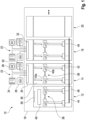
- FIG. 1 shows a schematic representation of a control device according to an embodiment of the present invention.
- the control device is denoted here by reference number 10 in its entirety.
- the control device 10 is a modular control device, which is composed of three individual modules in the exemplary embodiment shown here.
- a first control module 12 forms a central processing unit of the control device 10 (head module).
- a second control module 14 and a third control module 16 are input and output modules, via which the control device 10 is connected to a technical installation.
- the modules 12-16 are individual assemblies that are arranged together in a housing 18 or a housing frame. Typically, the modules are individual units that snap together to form the controller 10 . In this way, the control device 10 can be assembled individually and adapted to the respective control and regulation task.
- the expandability is indicated here by a further module slot 20 as a placeholder for further modules.
- the control device 10 is therefore not limited to the number of modules shown here, but can be expanded to include additional modules.
- a control device 10 of the type mentioned is usually housed in a control cabinet (not shown here) and the input and output modules 14, 16 are connected directly or indirectly (e.g. via a fieldbus) to the periphery 22 of the technical installation.
- the peripherals can have input devices, such as light barriers 24 or emergency stop buttons 26, as well as output devices that act as actuators.
- Actuators can be motors 28 or contactors 30, for example. It goes without saying that the invention is not limited to the peripheral elements shown.
- the second control module 14 and the third control module 16 each have connections to input devices and output devices.
- both control modules 14, 16 each have inputs and outputs 32 via which the modules are connected to the periphery 22. It goes without saying that in other versions a control module can also only have inputs or only outputs.
- the inputs and outputs 32 of the modules are preferably arranged in a separate module part (connection module part 34).
- the input and output signals present at the inputs and outputs 32 are processed in a logic module part 36 of the control module.
- the logic module part 36 has a fail-safe processing part 38 which is composed, for example, of two separate processing units 40a and 40b.
- the processing units 40a, 40b can be microcontrollers, ASICs or FPGAs, preferably of different types.
- the logic module part 36 has interfaces 42 to a communication bus 44.
- the interfaces 42 can be designed redundantly like the processing units 40a, 40b.
- the control modules 12-16 have a fail-safe structure in the sense of SIL2 or higher according to EN 61508 and/or PL d or higher according to ISO 13849-1.
- the control modules of the control device 10 can set up a communication channel among themselves via the communication bus 44 .
- the communication bus 44 can be formed by bus module parts 46 of the individual control modules 12-16.
- the lined-up bus module parts 46 can form a so-called modular backplane.
- the communication bus 44 can also be formed by a fixed rear wall of the housing 18 of the control device 10 .
- the first control module 12 which acts as a head module in the present exemplary embodiment, has a similar logic module part 36 as the input and output modules.
- the fail-safe processing part 38 is set up in the head module to process an application program. This is stored in a memory 48 of the logic module part 36, for example.
- the user program can be processed according to the input-processing-output (EVA) principle.
- EVA input-processing-output
- the processing part 38 In a first step, the processing part 38 generates a process image of the inputs (PAE) and then sequentially executes instructions from the user program depending on the PAE. Finally, the processing part 38 writes a process image of the outputs (PAA), on the basis of which the outputs are controlled.
- the inputs are read in and the outputs are set via the input and output modules.
- the fail-safe processing part 38 is set up to ensure fail-safe input and output.
- the communication between the modules is implemented by the communication bus 44.
- the first control module 12 is therefore not directly provided with inputs and outputs 32 to the periphery and can therefore do without its own connection module part 34.
- the first control module 12 can have an additional interface 50 via which a connection to other control devices or diagnostic devices can be established.
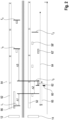
- FIG. 2 shows a schematic representation of the transmission of a process image of the inputs between a head module (first control module 12) and an input and output module (second control module 14) via the communication bus 44 2 shows in particular a worst-case analysis of fail-safe transmission of a PAE (FS-PAE).
- FS-PAE fail-safe transmission of a PAE
- the time t is plotted in the longitudinal direction.
- the first control module 12 (above) and the second control module 14 (below) work in fixed, local cycles 52 with defined cycle times.
- the cycle time is the time for processing a cycle including all communication tasks.
- “local” means that the cycles of the first control module 12 and of the second control module 14 do not necessarily have to be synchronized.
- the cycles do not have to be synchronized in a functionally safe manner.
- the cycles can be regularly synchronized, but this does not necessarily have to be done in a fail-safe manner in order to carry out the method according to the present disclosure.
- the claimed method provides that there is a time offset 54 between the local cycles 52 of the individual control modules 12 , 14 .
- the control module 12 creates a frame for process data and prepares it for transmission, as indicated here by the reference number 56 .
- the frame with the process data is then shifted into an output buffer of the communication channel provided by the communication bus 44 and thus transferred to its area of responsibility (time t 1 ).
- Transmission via the communication bus 44 to the second control module 14 then follows.
- Time t 2 marks the beginning of the processing of the process data by the second control module 14, ie the reading of the process data from the received frame and their evaluation.
- the first control module 12 and the second control module 14 are set up together to ensure a minimum duration ⁇ 1 between the two times t 1 and t 2 . This can be achieved, for example, by preparing and sending the process data from the control module 12 not only once within the local cycle, but twice. Such execution is discussed in detail with reference to the Figures 5-7 explained in more detail.
- the second control module 14 generates a response in relation to the received process data and places this at a time t 3 in an output buffer of the communication channel provided to the communication bus 44 .
- the creation of the response includes reading out the inputs of the second control module 14 and writing the corresponding states into the frame for sending.
- the response is processed by the latter at time t 4 .
- the first control module 12 and the second control module 14 also guarantee a minimum duration ⁇ 3 between the two times t 3 and t 4 for the response. This can be done in a similar way to sending the process data, in that the reply is also prepared and sent several times (at least twice) by the second control module 14 within the local cycle.
- the event 60 (represented here by the arrow) is considered.
- the event 60 can be, for example, the actuation of an emergency stop button, as a result of which the state of an input of the second control module 14 changes.
- the event 60 is temporally selected in such a way that processing (indicated here with the reference number 62) of the event can no longer be taken into account for the reply at the time t 3 , but only takes place completely in the subsequent cycle (reference number 62'). This assumption is permissible because it is fundamentally required that a signal must be present at the inputs for at least two local cycle times.
- the event 60 is only taken into account in the subsequent cycle and the corresponding status of the input is stored and sent in the response to the process data 58'. This response is then also transmitted to the first control module 12 and processed by it at time t' 4 .
- the duration from the occurrence of event 60 to (guaranteed) processing by first control module 12 is considered.
- the latter point in time is point in time t′ 4 in the present illustration.
- the entire cycle 64 from time t 1 to time t′ 4 is to be used for the worst-case analysis.
- the control modules 12, 14, as described above are set up jointly or individually to guarantee specific minimum intervals (minimum durations) between individual processes.
- the first control module 12 and the second control module 14 are set up in such a way that they can jointly guarantee a minimum duration ⁇ 1 between time t 1 and time t 2 and a minimum duration ⁇ 3 between time t 3 and time t 4 (or t' 3 and t' 4 ).
- the second control module 14 is set up here alone to ensure a minimum duration ⁇ 2 between the time t 2 and the time t 3 .
- the process data After the process data has been received 68 by the second control module 14, it begins processing the process data at the second point in time t 2 .
- the output at the outputs resulting from this is indicated with the reference number 70 .
- the desired state 72 arises, for example a stop of the machine a.
- the second control module 14 creates a corresponding reply and prepares it for transmission 74 .
- the response 76 After the response 76 has been received by the first control module 12, the response is evaluated at the fourth point in time t 4 .
- the second minimum duration ⁇ 2 between the second point in time t 2 and the third point in time t 3 corresponds to that previously referred to in FIG 2 indicated second minimum duration ⁇ 2.
- a third minimum duration ⁇ 3 can be guaranteed through the interaction of the first control module 12 and the second control module 14 .
- the third minimum duration ⁇ 3 relates to the time span between the third point in time t 3 and the fourth point in time t 4 .
- the minimum duration ⁇ 2 can be guaranteed by a single control module.
- the minimum duration ⁇ 1 and the minimum duration ⁇ 3, on the other hand, can only be achieved through the interaction of two modules are guaranteed. The latter can take advantage of a redundant (multiple) transmission of the process data to guarantee the minimum distances. The following is with reference to the 4 First, the minimum duration ⁇ 2 that can be guaranteed by a single control module is discussed.
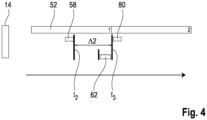
- FIG. 4 is an excerpt from the figures 2 or 3 , showing the second control module 14 only.
- the same reference numbers designate the same parts as with reference to FIG 2 and 3 .
- the excerpt shows two local cycles 52 of the second control module 14.
- the second control module 14 after it has received process data from another control module, processes these from time t 2 .
- the control module 14 starts a timer for a time monitoring.
- a period of time within which the control module 14 prevents a transmission of the process data (response) is defined by means of the time monitoring.
- the control module 14 is only able to create and send a response to the other control module after the specified period of time has expired.
- the time period in which the second control module 14 is prevented from sending the response corresponds to the second minimum duration ⁇ 2.
- the time monitoring can be designed as a timer with a fixed duration. Such a timer can be implemented in a simple manner by the processing part 38 present in the control module.
- the redundant design of the processing part 38 also enables the timer to be set up in a fail-safe manner.
- each processing unit 40 of the second control module can each execute a timer in order to ensure the minimum duration in a fail-safe manner.
- Timers are usually already integrated in common microcontrollers or can be easily simulated in software. No additional hardware is therefore required for the implementation of the time monitoring, so that it can also be retrofitted to existing control modules.
- One option is to send the process data multiple times within the cycle time, so that a first instance and at least a second instance of the process data are always sent in a single cycle.
- control modules can be set up, the redundant instances, i. H. to provide the redundant packets of a specific process data object (PDO) with consecutive instance numbers.
- PDO process data object
- the instance numbers are used to make the redundant instances distinguishable and can therefore be an addition to an already existing continuous numbering of the process data. It goes without saying that other measures can also be taken to achieve this distinguishability.
- FIG 5 shows the transmission of the redundant process data from a first control module 12 to a second control module 14 in a sequence diagram.
- the control module 12 contains a failsafe process image generator 82 and a send buffer 84.
- the control module 14 has a receive buffer 86 and a failsafe process image consumer 88.
- the process image generator 82 creates a process image for transmission, while the process image consumer 88 evaluates a received process image.
- the process image generator 82 and the process image consumer 88 are fail-safe devices.
- the send buffer 84 and the receive buffer 86 can be non-failsafe devices (also referred to as standard devices) of a communication bus.
- control module 12 analogous to the control module 14, can have a receiving buffer and a process image consumer.
- control module 14 can have a transmission buffer and a process image generator. In this way, circulating communication can be implemented between the two modules. For the sake of simplicity, these components are not shown here.
- figure 5 shows the redundant transmission of a first instance and a second instance of process data. More precisely, shows figure 5 the transmission of a first process data object of the first instance (FS-PDO instance 1) followed by a transmission of a second process data object of the second instance (FS-PDO instance 2).
- the first process data object and the second process data object have the same control-relevant content, but are made distinguishable, for example, by the instance numbering described above.
- the fail-safe process image generator 82 creates a process data object of the first instance and stores this in the send buffer in step S102 at a time t a .
- the process data object is then in the send buffer 84 (S103) and can be sent via the communication bus 44. From this point in time, the fail-safe process image generator 82 can no longer influence when and how the process data object is actually sent via the communication bus 44 . Accordingly, after the process data object of the first instance (FS-PDO instance 1) has been stored in the send buffer 84, the first control module 12 starts time monitoring in order to ensure a minimum interval between the creation of the second process data object (FS-PDO instance 2).
- the time monitoring can be implemented by a timer that is set to a defined period of time (timer runtime).
- the first control module 12 is not set up to create another process data object or to move one to the send buffer as long as the defined period of time has not yet expired.
- the process data object of the second instance is thus only placed in the transmit buffer 84 after the timer has expired, ie when the time has not been exceeded.
- the process data object of the second instance is preferably only created after the timer has expired (S106).
- the process data object of the second instance is thus placed in the send buffer 84 in step S108 while maintaining a minimum distance and is then ready for sending (S109).
- the first control module 12 thus guarantees that a minimum distance ⁇ a is maintained between the creation of the process data object of the first instance and the creation of the process data object of the second instance.
- the second control module 14 first receives the process data object of the first instance, which is stored in the receive buffer 86 and which is read out by the process image consumer 88 in step S110. The process data object is then evaluated in step S112.
- the second control module 14 then starts a time monitoring in order to ensure the minimum interval for processing and evaluating a process data object of the second instance (S114).
- the time monitoring can be set up analogously to the time monitoring of the first control module, with the sending of a process data object not being prevented during the timer running time, but rather its processing and evaluation. This can be done by setting up the second control module 14 to read a process data object of the second instance located in the receive buffer 86, but only to process and evaluate this object if no undertime has been determined and a minimum distance ⁇ b can thus be ensured.
- the process data object of the second instance is conditionally evaluated in step S116, specifically depending on whether the time monitoring has ended (S115).
- the process image generator 82 in the first control module 12 and the process image consumer 88 in the second control module 14 to jointly ensure that there is a minimum time interval between the creation (S100) and the processing (S116) of the process data.
- This minimum time interval corresponds to the minimum durations ⁇ 1 and ⁇ 3, as in connection with the 2 and 3 have been described.
- the minimum time interval between creation and processing can also be guaranteed in the event that the process data object of the first instance is lost.
- the second control module 14 thus receives the process data object of the first instance and carries out the steps S110 to S114, as already described in connection with the figure 5 have been described. Accordingly, the process image consumer 88 starts a time monitoring (S114) after evaluating the process data object of the first instance (S112), but then does not receive any further process data object (S122) after the specified period of time has expired. Thus, after the time monitoring has expired, the process image consumer 88 again evaluates the process data object of the first instance in order to complete the process data evaluation (S124). Since the renewed evaluation of the process data object of the first instance is also delayed by the minimum time interval ⁇ b, the minimum interval between the creation of the process data (S100) and the final evaluation (S124) of the process data is again guaranteed when considering the communication as a whole.
Landscapes
- Engineering & Computer Science (AREA)
- Physics & Mathematics (AREA)
- General Physics & Mathematics (AREA)
- Automation & Control Theory (AREA)
- General Engineering & Computer Science (AREA)
- Programmable Controllers (AREA)
- Safety Devices In Control Systems (AREA)
- Communication Control (AREA)
- Selective Calling Equipment (AREA)
Applications Claiming Priority (1)
| Application Number | Priority Date | Filing Date | Title |
|---|---|---|---|
| DE102022101436.3A DE102022101436A1 (de) | 2022-01-21 | 2022-01-21 | Steuervorrichtung und Verfahren zum Steuern einer automatisierten Anlage |
Publications (4)
| Publication Number | Publication Date |
|---|---|
| EP4216004A2 true EP4216004A2 (fr) | 2023-07-26 |
| EP4216004A3 EP4216004A3 (fr) | 2023-09-13 |
| EP4216004B1 EP4216004B1 (fr) | 2025-04-02 |
| EP4216004C0 EP4216004C0 (fr) | 2025-04-02 |
Family
ID=84982055
Family Applications (1)
| Application Number | Title | Priority Date | Filing Date |
|---|---|---|---|
| EP23151846.5A Active EP4216004B1 (fr) | 2022-01-21 | 2023-01-16 | Dispositif de commande et procédé de commande d'une installation automatisée |
Country Status (5)
| Country | Link |
|---|---|
| US (1) | US20230236558A1 (fr) |
| EP (1) | EP4216004B1 (fr) |
| JP (1) | JP7602563B2 (fr) |
| CN (1) | CN116482999A (fr) |
| DE (1) | DE102022101436A1 (fr) |
Family Cites Families (6)
| Publication number | Priority date | Publication date | Assignee | Title |
|---|---|---|---|---|
| DK1086408T3 (da) * | 1998-06-10 | 2003-05-26 | Siemens Ag | Styreindretning til en maskine, et system eller et apparat og en fremgangsmåde til overvågning af styreindretningen. |
| JP5655460B2 (ja) | 2010-09-22 | 2015-01-21 | 富士電機株式会社 | プログラマブルコントローラシステム |
| DE102017007815A1 (de) * | 2017-08-18 | 2019-02-21 | WAGO Verwaltungsgesellschaft mit beschränkter Haftung | Prozesssteuerung |
| US10345801B2 (en) * | 2017-08-21 | 2019-07-09 | Honeywell International Inc. | Ensuring a correct program sequence in a dual-processor architecture |
| CA3090841A1 (fr) * | 2018-02-23 | 2019-08-29 | Lutron Technology Company Llc | Procede de detection de collision |
| JP7423249B2 (ja) | 2019-10-24 | 2024-01-29 | 株式会社日立製作所 | 制御装置及び分散制御システム |
-
2022
- 2022-01-21 DE DE102022101436.3A patent/DE102022101436A1/de not_active Withdrawn
-
2023
- 2023-01-10 JP JP2023001654A patent/JP7602563B2/ja active Active
- 2023-01-16 EP EP23151846.5A patent/EP4216004B1/fr active Active
- 2023-01-20 CN CN202310050982.4A patent/CN116482999A/zh active Pending
- 2023-01-20 US US18/157,516 patent/US20230236558A1/en active Pending
Also Published As
| Publication number | Publication date |
|---|---|
| EP4216004B1 (fr) | 2025-04-02 |
| JP7602563B2 (ja) | 2024-12-18 |
| US20230236558A1 (en) | 2023-07-27 |
| DE102022101436A1 (de) | 2023-07-27 |
| EP4216004C0 (fr) | 2025-04-02 |
| EP4216004A3 (fr) | 2023-09-13 |
| CN116482999A (zh) | 2023-07-25 |
| JP2023107211A (ja) | 2023-08-02 |
Similar Documents
| Publication | Publication Date | Title |
|---|---|---|
| EP1221075B1 (fr) | Dispositif de commande de processus critiques de securite | |
| EP3220561B1 (fr) | Dispositif et procédé de commande d'une installation automatisée | |
| DE102008007672A1 (de) | Verfahren und Vorrichtung zum Übertragen von Daten in einem Netzwerk | |
| EP1188096A1 (fr) | Systeme de commande pour commander des processus critiques pour la securite | |
| EP1296207B1 (fr) | Appareil HMI et procédé de commande d'une installation technique, système d'automatisation avec cet appareil HMI et produit de programme informatique avec un programme pour la mise en oeuvre de ce procédé dans un appareil HMI ou dans un système d'automatisation | |
| DE19744071B4 (de) | Eine programmierbare Logiksteuervorrichtung verwendendes Steuerungssystem | |
| EP3100121B1 (fr) | Procédé et dispositif pour déconnecter en toute sécurité une charge électrique | |
| DE3104921A1 (de) | "verfahren zur signaluebertragung zwischen einer zentralstation und einer vielzahl von entfernt angeordneten stationen, sowie befehls- und ueberwachungsvorrichtung zur durchfuehrung des verfahrens" | |
| EP3098673A1 (fr) | Procede et dispositif de validation automatique de fonctions de securite sur un systeme de securite construit de façon modulaire | |
| EP4012517B1 (fr) | Environnement d'exécution permettant d'exécuter un programme de commande axé sur les événements | |
| EP3414632B1 (fr) | Procédé et dispositif pour contrôler un traitement et une transmission de données dans une chaîne de sécurité d'un système de sécurité | |
| EP3673621B1 (fr) | Procédé de transmission de données entre un dispositif de commande central et une pluralité d'appareils décentralisés et dispositifs correspondants | |
| EP1206868A2 (fr) | Procede de configuration d'un noeud sur et systeme de commande sur comportant un tel noeud | |
| EP2375636A1 (fr) | Dispositif et procédé de configuration d'un système de bus | |
| EP3470937B1 (fr) | Procédé et dispositifs de surveillance du temps réactionnel d'une fonction de sécurité fournie par un système de sécurité | |
| EP4216004B1 (fr) | Dispositif de commande et procédé de commande d'une installation automatisée | |
| EP2942686B1 (fr) | Système de commande et de transmission de données pour la transmission de données liées à la sécurité par l'intermédiaire d'un support de communication | |
| DE19940874B4 (de) | Verfahren zum Konfigurieren eines sicheren Busteilnehmers und sicheres Steuerungssystem mit einem solchen | |
| EP1672446B1 (fr) | Module d'entrée/sortie sécurisé pour un controleur | |
| EP3989018B1 (fr) | Dispositif de commande, module de protection pour un tel dispositif et procédé correspondant | |
| EP4068014A1 (fr) | Solution d'automatisation en nuage hautement disponible à temps de transmission optimisés | |
| DE102010038484A1 (de) | Verfahren und Vorrichtung zum Steuern einer Anlage | |
| EP1865393B1 (fr) | Procédé destiné à l'opération d'un système d'automatisation, participant à la communication et système d'automatisation | |
| WO2026068188A1 (fr) | Système et procédé de compensation de défaillances de composants | |
| EP2209258A1 (fr) | Procédé destiné au fonctionnement d'un réseau de communication et appareil de communication |
Legal Events
| Date | Code | Title | Description |
|---|---|---|---|
| PUAI | Public reference made under article 153(3) epc to a published international application that has entered the european phase |
Free format text: ORIGINAL CODE: 0009012 |
|
| STAA | Information on the status of an ep patent application or granted ep patent |
Free format text: STATUS: THE APPLICATION HAS BEEN PUBLISHED |
|
| AK | Designated contracting states |
Kind code of ref document: A2 Designated state(s): AL AT BE BG CH CY CZ DE DK EE ES FI FR GB GR HR HU IE IS IT LI LT LU LV MC ME MK MT NL NO PL PT RO RS SE SI SK SM TR |
|
| PUAL | Search report despatched |
Free format text: ORIGINAL CODE: 0009013 |
|
| AK | Designated contracting states |
Kind code of ref document: A3 Designated state(s): AL AT BE BG CH CY CZ DE DK EE ES FI FR GB GR HR HU IE IS IT LI LT LU LV MC ME MK MT NL NO PL PT RO RS SE SI SK SM TR |
|
| RIC1 | Information provided on ipc code assigned before grant |
Ipc: G05B 9/02 20060101ALI20230809BHEP Ipc: G05B 19/042 20060101AFI20230809BHEP |
|
| STAA | Information on the status of an ep patent application or granted ep patent |
Free format text: STATUS: REQUEST FOR EXAMINATION WAS MADE |
|
| 17P | Request for examination filed |
Effective date: 20240313 |
|
| RBV | Designated contracting states (corrected) |
Designated state(s): AL AT BE BG CH CY CZ DE DK EE ES FI FR GB GR HR HU IE IS IT LI LT LU LV MC ME MK MT NL NO PL PT RO RS SE SI SK SM TR |
|
| GRAP | Despatch of communication of intention to grant a patent |
Free format text: ORIGINAL CODE: EPIDOSNIGR1 |
|
| STAA | Information on the status of an ep patent application or granted ep patent |
Free format text: STATUS: GRANT OF PATENT IS INTENDED |
|
| INTG | Intention to grant announced |
Effective date: 20241115 |
|
| GRAS | Grant fee paid |
Free format text: ORIGINAL CODE: EPIDOSNIGR3 |
|
| GRAA | (expected) grant |
Free format text: ORIGINAL CODE: 0009210 |
|
| STAA | Information on the status of an ep patent application or granted ep patent |
Free format text: STATUS: THE PATENT HAS BEEN GRANTED |
|
| AK | Designated contracting states |
Kind code of ref document: B1 Designated state(s): AL AT BE BG CH CY CZ DE DK EE ES FI FR GB GR HR HU IE IS IT LI LT LU LV MC ME MK MT NL NO PL PT RO RS SE SI SK SM TR |
|
| REG | Reference to a national code |
Ref country code: GB Ref legal event code: FG4D Free format text: NOT ENGLISH |
|
| REG | Reference to a national code |
Ref country code: CH Ref legal event code: EP |
|
| REG | Reference to a national code |
Ref country code: IE Ref legal event code: FG4D Free format text: LANGUAGE OF EP DOCUMENT: GERMAN |
|
| REG | Reference to a national code |
Ref country code: DE Ref legal event code: R096 Ref document number: 502023000738 Country of ref document: DE |
|
| U01 | Request for unitary effect filed |
Effective date: 20250428 |
|
| U07 | Unitary effect registered |
Designated state(s): AT BE BG DE DK EE FI FR IT LT LU LV MT NL PT RO SE SI Effective date: 20250506 |
|
| PG25 | Lapsed in a contracting state [announced via postgrant information from national office to epo] |
Ref country code: ES Free format text: LAPSE BECAUSE OF FAILURE TO SUBMIT A TRANSLATION OF THE DESCRIPTION OR TO PAY THE FEE WITHIN THE PRESCRIBED TIME-LIMIT Effective date: 20250402 |
|
| PG25 | Lapsed in a contracting state [announced via postgrant information from national office to epo] |
Ref country code: NO Free format text: LAPSE BECAUSE OF FAILURE TO SUBMIT A TRANSLATION OF THE DESCRIPTION OR TO PAY THE FEE WITHIN THE PRESCRIBED TIME-LIMIT Effective date: 20250702 Ref country code: GR Free format text: LAPSE BECAUSE OF FAILURE TO SUBMIT A TRANSLATION OF THE DESCRIPTION OR TO PAY THE FEE WITHIN THE PRESCRIBED TIME-LIMIT Effective date: 20250703 |
|
| PG25 | Lapsed in a contracting state [announced via postgrant information from national office to epo] |
Ref country code: PL Free format text: LAPSE BECAUSE OF FAILURE TO SUBMIT A TRANSLATION OF THE DESCRIPTION OR TO PAY THE FEE WITHIN THE PRESCRIBED TIME-LIMIT Effective date: 20250402 |
|
| PG25 | Lapsed in a contracting state [announced via postgrant information from national office to epo] |
Ref country code: HR Free format text: LAPSE BECAUSE OF FAILURE TO SUBMIT A TRANSLATION OF THE DESCRIPTION OR TO PAY THE FEE WITHIN THE PRESCRIBED TIME-LIMIT Effective date: 20250402 |
|
| PG25 | Lapsed in a contracting state [announced via postgrant information from national office to epo] |
Ref country code: RS Free format text: LAPSE BECAUSE OF FAILURE TO SUBMIT A TRANSLATION OF THE DESCRIPTION OR TO PAY THE FEE WITHIN THE PRESCRIBED TIME-LIMIT Effective date: 20250702 |
|
| PG25 | Lapsed in a contracting state [announced via postgrant information from national office to epo] |
Ref country code: IS Free format text: LAPSE BECAUSE OF FAILURE TO SUBMIT A TRANSLATION OF THE DESCRIPTION OR TO PAY THE FEE WITHIN THE PRESCRIBED TIME-LIMIT Effective date: 20250802 |
|
| PG25 | Lapsed in a contracting state [announced via postgrant information from national office to epo] |
Ref country code: SM Free format text: LAPSE BECAUSE OF FAILURE TO SUBMIT A TRANSLATION OF THE DESCRIPTION OR TO PAY THE FEE WITHIN THE PRESCRIBED TIME-LIMIT Effective date: 20250402 |
|
| PG25 | Lapsed in a contracting state [announced via postgrant information from national office to epo] |
Ref country code: CZ Free format text: LAPSE BECAUSE OF FAILURE TO SUBMIT A TRANSLATION OF THE DESCRIPTION OR TO PAY THE FEE WITHIN THE PRESCRIBED TIME-LIMIT Effective date: 20250402 |
|
| PG25 | Lapsed in a contracting state [announced via postgrant information from national office to epo] |
Ref country code: SK Free format text: LAPSE BECAUSE OF FAILURE TO SUBMIT A TRANSLATION OF THE DESCRIPTION OR TO PAY THE FEE WITHIN THE PRESCRIBED TIME-LIMIT Effective date: 20250402 |
|
| REG | Reference to a national code |
Ref country code: CH Ref legal event code: U11 Free format text: ST27 STATUS EVENT CODE: U-0-0-U10-U11 (AS PROVIDED BY THE NATIONAL OFFICE) Effective date: 20260201 |
|
| PLBE | No opposition filed within time limit |
Free format text: ORIGINAL CODE: 0009261 |
|
| STAA | Information on the status of an ep patent application or granted ep patent |
Free format text: STATUS: NO OPPOSITION FILED WITHIN TIME LIMIT |
|
| REG | Reference to a national code |
Ref country code: CH Ref legal event code: L10 Free format text: ST27 STATUS EVENT CODE: U-0-0-L10-L00 (AS PROVIDED BY THE NATIONAL OFFICE) Effective date: 20260211 |
|
| U20 | Renewal fee for the european patent with unitary effect paid |
Year of fee payment: 4 Effective date: 20260127 |
|
| 26N | No opposition filed |
Effective date: 20260105 |
|
| PGFP | Annual fee paid to national office [announced via postgrant information from national office to epo] |
Ref country code: CH Payment date: 20260201 Year of fee payment: 4 |