EP4225733B1 - Composés pour dispositifs électroniques - Google Patents
Composés pour dispositifs électroniques Download PDFInfo
- Publication number
- EP4225733B1 EP4225733B1 EP21759101.5A EP21759101A EP4225733B1 EP 4225733 B1 EP4225733 B1 EP 4225733B1 EP 21759101 A EP21759101 A EP 21759101A EP 4225733 B1 EP4225733 B1 EP 4225733B1
- Authority
- EP
- European Patent Office
- Prior art keywords
- atoms
- aromatic ring
- ring systems
- groups
- radicals
- Prior art date
- Legal status (The legal status is an assumption and is not a legal conclusion. Google has not performed a legal analysis and makes no representation as to the accuracy of the status listed.)
- Active
Links
Classifications
-
- C—CHEMISTRY; METALLURGY
- C07—ORGANIC CHEMISTRY
- C07D—HETEROCYCLIC COMPOUNDS
- C07D251/00—Heterocyclic compounds containing 1,3,5-triazine rings
- C07D251/02—Heterocyclic compounds containing 1,3,5-triazine rings not condensed with other rings
- C07D251/12—Heterocyclic compounds containing 1,3,5-triazine rings not condensed with other rings having three double bonds between ring members or between ring members and non-ring members
- C07D251/14—Heterocyclic compounds containing 1,3,5-triazine rings not condensed with other rings having three double bonds between ring members or between ring members and non-ring members with hydrogen or carbon atoms directly attached to at least one ring carbon atom
- C07D251/24—Heterocyclic compounds containing 1,3,5-triazine rings not condensed with other rings having three double bonds between ring members or between ring members and non-ring members with hydrogen or carbon atoms directly attached to at least one ring carbon atom to three ring carbon atoms
-
- C—CHEMISTRY; METALLURGY
- C07—ORGANIC CHEMISTRY
- C07C—ACYCLIC OR CARBOCYCLIC COMPOUNDS
- C07C211/00—Compounds containing amino groups bound to a carbon skeleton
- C07C211/43—Compounds containing amino groups bound to a carbon skeleton having amino groups bound to carbon atoms of six-membered aromatic rings of the carbon skeleton
- C07C211/54—Compounds containing amino groups bound to a carbon skeleton having amino groups bound to carbon atoms of six-membered aromatic rings of the carbon skeleton having amino groups bound to two or three six-membered aromatic rings
-
- C—CHEMISTRY; METALLURGY
- C07—ORGANIC CHEMISTRY
- C07C—ACYCLIC OR CARBOCYCLIC COMPOUNDS
- C07C211/00—Compounds containing amino groups bound to a carbon skeleton
- C07C211/43—Compounds containing amino groups bound to a carbon skeleton having amino groups bound to carbon atoms of six-membered aromatic rings of the carbon skeleton
- C07C211/57—Compounds containing amino groups bound to a carbon skeleton having amino groups bound to carbon atoms of six-membered aromatic rings of the carbon skeleton having amino groups bound to carbon atoms of six-membered aromatic rings being part of condensed ring systems of the carbon skeleton
- C07C211/58—Naphthylamines; N-substituted derivatives thereof
-
- C—CHEMISTRY; METALLURGY
- C07—ORGANIC CHEMISTRY
- C07C—ACYCLIC OR CARBOCYCLIC COMPOUNDS
- C07C211/00—Compounds containing amino groups bound to a carbon skeleton
- C07C211/43—Compounds containing amino groups bound to a carbon skeleton having amino groups bound to carbon atoms of six-membered aromatic rings of the carbon skeleton
- C07C211/57—Compounds containing amino groups bound to a carbon skeleton having amino groups bound to carbon atoms of six-membered aromatic rings of the carbon skeleton having amino groups bound to carbon atoms of six-membered aromatic rings being part of condensed ring systems of the carbon skeleton
- C07C211/60—Compounds containing amino groups bound to a carbon skeleton having amino groups bound to carbon atoms of six-membered aromatic rings of the carbon skeleton having amino groups bound to carbon atoms of six-membered aromatic rings being part of condensed ring systems of the carbon skeleton containing a ring other than a six-membered aromatic ring forming part of at least one of the condensed ring systems
-
- C—CHEMISTRY; METALLURGY
- C07—ORGANIC CHEMISTRY
- C07C—ACYCLIC OR CARBOCYCLIC COMPOUNDS
- C07C211/00—Compounds containing amino groups bound to a carbon skeleton
- C07C211/43—Compounds containing amino groups bound to a carbon skeleton having amino groups bound to carbon atoms of six-membered aromatic rings of the carbon skeleton
- C07C211/57—Compounds containing amino groups bound to a carbon skeleton having amino groups bound to carbon atoms of six-membered aromatic rings of the carbon skeleton having amino groups bound to carbon atoms of six-membered aromatic rings being part of condensed ring systems of the carbon skeleton
- C07C211/61—Compounds containing amino groups bound to a carbon skeleton having amino groups bound to carbon atoms of six-membered aromatic rings of the carbon skeleton having amino groups bound to carbon atoms of six-membered aromatic rings being part of condensed ring systems of the carbon skeleton with at least one of the condensed ring systems formed by three or more rings
-
- C—CHEMISTRY; METALLURGY
- C07—ORGANIC CHEMISTRY
- C07D—HETEROCYCLIC COMPOUNDS
- C07D209/00—Heterocyclic compounds containing five-membered rings, condensed with other rings, with one nitrogen atom as the only ring hetero atom
- C07D209/56—Ring systems containing three or more rings
- C07D209/58—[b]- or [c]-condensed
- C07D209/70—[b]- or [c]-condensed containing carbocyclic rings other than six-membered
-
- C—CHEMISTRY; METALLURGY
- C07—ORGANIC CHEMISTRY
- C07D—HETEROCYCLIC COMPOUNDS
- C07D209/00—Heterocyclic compounds containing five-membered rings, condensed with other rings, with one nitrogen atom as the only ring hetero atom
- C07D209/56—Ring systems containing three or more rings
- C07D209/80—[b, c]- or [b, d]-condensed
- C07D209/82—Carbazoles; Hydrogenated carbazoles
- C07D209/86—Carbazoles; Hydrogenated carbazoles with only hydrogen atoms, hydrocarbon or substituted hydrocarbon radicals, directly attached to carbon atoms of the ring system
-
- C—CHEMISTRY; METALLURGY
- C07—ORGANIC CHEMISTRY
- C07D—HETEROCYCLIC COMPOUNDS
- C07D307/00—Heterocyclic compounds containing five-membered rings having one oxygen atom as the only ring hetero atom
- C07D307/77—Heterocyclic compounds containing five-membered rings having one oxygen atom as the only ring hetero atom ortho- or peri-condensed with carbocyclic rings or ring systems
- C07D307/91—Dibenzofurans; Hydrogenated dibenzofurans
-
- C—CHEMISTRY; METALLURGY
- C07—ORGANIC CHEMISTRY
- C07D—HETEROCYCLIC COMPOUNDS
- C07D405/00—Heterocyclic compounds containing both one or more hetero rings having oxygen atoms as the only ring hetero atoms, and one or more rings having nitrogen as the only ring hetero atom
- C07D405/02—Heterocyclic compounds containing both one or more hetero rings having oxygen atoms as the only ring hetero atoms, and one or more rings having nitrogen as the only ring hetero atom containing two hetero rings
- C07D405/12—Heterocyclic compounds containing both one or more hetero rings having oxygen atoms as the only ring hetero atoms, and one or more rings having nitrogen as the only ring hetero atom containing two hetero rings linked by a chain containing hetero atoms as chain links
-
- C—CHEMISTRY; METALLURGY
- C09—DYES; PAINTS; POLISHES; NATURAL RESINS; ADHESIVES; COMPOSITIONS NOT OTHERWISE PROVIDED FOR; APPLICATIONS OF MATERIALS NOT OTHERWISE PROVIDED FOR
- C09K—MATERIALS FOR MISCELLANEOUS APPLICATIONS, NOT PROVIDED FOR ELSEWHERE
- C09K11/00—Luminescent materials, e.g. electroluminescent or chemiluminescent
- C09K11/06—Luminescent materials, e.g. electroluminescent or chemiluminescent containing organic luminescent materials
-
- H—ELECTRICITY
- H10—SEMICONDUCTOR DEVICES; ELECTRIC SOLID-STATE DEVICES NOT OTHERWISE PROVIDED FOR
- H10K—ORGANIC ELECTRIC SOLID-STATE DEVICES
- H10K50/00—Organic light-emitting devices
- H10K50/10—OLEDs or polymer light-emitting diodes [PLED]
- H10K50/11—OLEDs or polymer light-emitting diodes [PLED] characterised by the electroluminescent [EL] layers
-
- H—ELECTRICITY
- H10—SEMICONDUCTOR DEVICES; ELECTRIC SOLID-STATE DEVICES NOT OTHERWISE PROVIDED FOR
- H10K—ORGANIC ELECTRIC SOLID-STATE DEVICES
- H10K50/00—Organic light-emitting devices
- H10K50/10—OLEDs or polymer light-emitting diodes [PLED]
- H10K50/14—Carrier transporting layers
- H10K50/15—Hole transporting layers
-
- H—ELECTRICITY
- H10—SEMICONDUCTOR DEVICES; ELECTRIC SOLID-STATE DEVICES NOT OTHERWISE PROVIDED FOR
- H10K—ORGANIC ELECTRIC SOLID-STATE DEVICES
- H10K85/00—Organic materials used in the body or electrodes of devices covered by this subclass
- H10K85/60—Organic compounds having low molecular weight
- H10K85/615—Polycyclic condensed aromatic hydrocarbons, e.g. anthracene
-
- H—ELECTRICITY
- H10—SEMICONDUCTOR DEVICES; ELECTRIC SOLID-STATE DEVICES NOT OTHERWISE PROVIDED FOR
- H10K—ORGANIC ELECTRIC SOLID-STATE DEVICES
- H10K85/00—Organic materials used in the body or electrodes of devices covered by this subclass
- H10K85/60—Organic compounds having low molecular weight
- H10K85/615—Polycyclic condensed aromatic hydrocarbons, e.g. anthracene
- H10K85/624—Polycyclic condensed aromatic hydrocarbons, e.g. anthracene containing six or more rings
-
- H—ELECTRICITY
- H10—SEMICONDUCTOR DEVICES; ELECTRIC SOLID-STATE DEVICES NOT OTHERWISE PROVIDED FOR
- H10K—ORGANIC ELECTRIC SOLID-STATE DEVICES
- H10K85/00—Organic materials used in the body or electrodes of devices covered by this subclass
- H10K85/60—Organic compounds having low molecular weight
- H10K85/631—Amine compounds having at least two aryl rest on at least one amine-nitrogen atom, e.g. triphenylamine
- H10K85/633—Amine compounds having at least two aryl rest on at least one amine-nitrogen atom, e.g. triphenylamine comprising polycyclic condensed aromatic hydrocarbons as substituents on the nitrogen atom
-
- H—ELECTRICITY
- H10—SEMICONDUCTOR DEVICES; ELECTRIC SOLID-STATE DEVICES NOT OTHERWISE PROVIDED FOR
- H10K—ORGANIC ELECTRIC SOLID-STATE DEVICES
- H10K85/00—Organic materials used in the body or electrodes of devices covered by this subclass
- H10K85/60—Organic compounds having low molecular weight
- H10K85/631—Amine compounds having at least two aryl rest on at least one amine-nitrogen atom, e.g. triphenylamine
- H10K85/636—Amine compounds having at least two aryl rest on at least one amine-nitrogen atom, e.g. triphenylamine comprising heteroaromatic hydrocarbons as substituents on the nitrogen atom
-
- H—ELECTRICITY
- H10—SEMICONDUCTOR DEVICES; ELECTRIC SOLID-STATE DEVICES NOT OTHERWISE PROVIDED FOR
- H10K—ORGANIC ELECTRIC SOLID-STATE DEVICES
- H10K85/00—Organic materials used in the body or electrodes of devices covered by this subclass
- H10K85/60—Organic compounds having low molecular weight
- H10K85/649—Aromatic compounds comprising a hetero atom
- H10K85/657—Polycyclic condensed heteroaromatic hydrocarbons
- H10K85/6572—Polycyclic condensed heteroaromatic hydrocarbons comprising only nitrogen in the heteroaromatic polycondensed ring system, e.g. phenanthroline or carbazole
-
- H—ELECTRICITY
- H10—SEMICONDUCTOR DEVICES; ELECTRIC SOLID-STATE DEVICES NOT OTHERWISE PROVIDED FOR
- H10K—ORGANIC ELECTRIC SOLID-STATE DEVICES
- H10K85/00—Organic materials used in the body or electrodes of devices covered by this subclass
- H10K85/60—Organic compounds having low molecular weight
- H10K85/649—Aromatic compounds comprising a hetero atom
- H10K85/657—Polycyclic condensed heteroaromatic hydrocarbons
- H10K85/6574—Polycyclic condensed heteroaromatic hydrocarbons comprising only oxygen in the heteroaromatic polycondensed ring system, e.g. cumarine dyes
-
- C—CHEMISTRY; METALLURGY
- C07—ORGANIC CHEMISTRY
- C07C—ACYCLIC OR CARBOCYCLIC COMPOUNDS
- C07C2601/00—Systems containing only non-condensed rings
- C07C2601/18—Systems containing only non-condensed rings with a ring being at least seven-membered
-
- C—CHEMISTRY; METALLURGY
- C07—ORGANIC CHEMISTRY
- C07C—ACYCLIC OR CARBOCYCLIC COMPOUNDS
- C07C2603/00—Systems containing at least three condensed rings
- C07C2603/02—Ortho- or ortho- and peri-condensed systems
- C07C2603/04—Ortho- or ortho- and peri-condensed systems containing three rings
- C07C2603/06—Ortho- or ortho- and peri-condensed systems containing three rings containing at least one ring with less than six ring members
- C07C2603/10—Ortho- or ortho- and peri-condensed systems containing three rings containing at least one ring with less than six ring members containing five-membered rings
- C07C2603/12—Ortho- or ortho- and peri-condensed systems containing three rings containing at least one ring with less than six ring members containing five-membered rings only one five-membered ring
- C07C2603/18—Fluorenes; Hydrogenated fluorenes
-
- C—CHEMISTRY; METALLURGY
- C07—ORGANIC CHEMISTRY
- C07C—ACYCLIC OR CARBOCYCLIC COMPOUNDS
- C07C2603/00—Systems containing at least three condensed rings
- C07C2603/93—Spiro compounds
- C07C2603/95—Spiro compounds containing "not free" spiro atoms
- C07C2603/96—Spiro compounds containing "not free" spiro atoms containing at least one ring with less than six members
- C07C2603/97—Spiro compounds containing "not free" spiro atoms containing at least one ring with less than six members containing five-membered rings
-
- H—ELECTRICITY
- H10—SEMICONDUCTOR DEVICES; ELECTRIC SOLID-STATE DEVICES NOT OTHERWISE PROVIDED FOR
- H10K—ORGANIC ELECTRIC SOLID-STATE DEVICES
- H10K50/00—Organic light-emitting devices
- H10K50/10—OLEDs or polymer light-emitting diodes [PLED]
- H10K50/18—Carrier blocking layers
- H10K50/181—Electron blocking layers
-
- Y—GENERAL TAGGING OF NEW TECHNOLOGICAL DEVELOPMENTS; GENERAL TAGGING OF CROSS-SECTIONAL TECHNOLOGIES SPANNING OVER SEVERAL SECTIONS OF THE IPC; TECHNICAL SUBJECTS COVERED BY FORMER USPC CROSS-REFERENCE ART COLLECTIONS [XRACs] AND DIGESTS
- Y02—TECHNOLOGIES OR APPLICATIONS FOR MITIGATION OR ADAPTATION AGAINST CLIMATE CHANGE
- Y02E—REDUCTION OF GREENHOUSE GAS [GHG] EMISSIONS, RELATED TO ENERGY GENERATION, TRANSMISSION OR DISTRIBUTION
- Y02E10/00—Energy generation through renewable energy sources
- Y02E10/50—Photovoltaic [PV] energy
- Y02E10/549—Organic PV cells
Definitions
- the present application relates to spirobifluorene amines which have certain aromatic or heteroaromatic ring systems on the amine nitrogen atom.
- the compounds are suitable for use in electronic devices.
- OLEDs organic electroluminescent devices
- OLEDs organic electroluminescent devices
- the term OLEDs refers to electronic devices which have one or more layers containing organic compounds and which emit light when an electrical voltage is applied.
- the structure and general operating principle of OLEDs are known to those skilled in the art.
- Emission layers and layers with hole-transporting functions have a major influence on the performance data of electronic devices.
- New compounds are still being sought for use in these layers, in particular hole-transporting compounds and compounds that can serve as hole-transporting matrix material, in particular for phosphorescent emitters, in an emitting layer.
- compounds are particularly sought that have a high glass transition temperature, high stability, and high conductivity for holes.
- a high stability of the compound is a Prerequisite for achieving a long service life of the electronic device.
- compounds are sought whose use in electronic devices leads to an improvement in the performance of the devices, in particular high efficiency, long service life and low operating voltage.
- triarylamine compounds such as spirobifluorenamines and fluorenamines are known in particular as hole transport materials and hole transporting matrix materials for electronic devices.
- Such compounds are, for example, in US2019/372025 A1
- spirobifluorene amines according to formula (I) below, which are characterized in that they have certain aromatic or heteroaromatic ring systems on the amine nitrogen atom, are outstandingly suitable for use in electronic devices. They are particularly suitable for use in OLEDs, again particularly for use therein as hole transport materials and for use as hole-transporting matrix materials, in particular for phosphorescent emitters.
- the compounds lead to a long service life, high efficiency and low operating voltage of the devices.
- the compounds found preferably have a high glass transition temperature, high stability and high conductivity for holes.
- An aryl group in the sense of this invention is understood to be either a single aromatic cycle, i.e. benzene, or a condensed aromatic polycycle, for example naphthalene, phenanthrene or anthracene.
- a condensed aromatic polycycle in the sense of the present application consists of two or more individual aromatic cycles condensed together. Condensation between cycles is understood to mean that the cycles share at least one edge with each other.
- An aryl group in the sense of this invention contains 6 to 40 aromatic ring atoms. Furthermore, an aryl group does not contain a heteroatom as an aromatic ring atom, but only carbon atoms.
- a heteroaryl group in the sense of this invention is understood to be either a single heteroaromatic cycle, for example pyridine, pyrimidine or thiophene, or a condensed heteroaromatic polycycle, for example quinoline or carbazole.
- a condensed heteroaromatic polycycle in the sense of the present application consists of two or more individual aromatic or heteroaromatic cycles condensed together, where at least one of the aromatic and heteroaromatic cycles is a heteroaromatic cycle. Condensation between cycles is understood to mean that the cycles share at least one edge with each other.
- a heteroaryl group in the sense of this invention contains 5 to 40 aromatic ring atoms, of which at least one is a heteroatom. The heteroatoms of the heteroaryl group are preferably selected from N, O and S.
- An aryl or heteroaryl group which can be substituted with the above-mentioned radicals, is understood to mean in particular groups which are derived from benzene, naphthalene, anthracene, phenanthrene, pyrene, dihydropyrene, chrysene, perylene, triphenylene, fluoranthene, benzanthracene, benzphenanthrene, tetracene, pentacene, benzopyrene, furan, benzofuran, isobenzofuran, dibenzofuran, thiophene, benzothiophene, isobenzothiophene, dibenzothiophene, pyrrole, indole, isoindole, carbazole, pyridine, quinoline, isoquinoline, acridine, phenanthridine, benzo-5,6-quinoline, benzo-6,7-quinoline, benzo-7,8-quinoline,
- An aromatic ring system in the sense of this invention is a system which does not necessarily only contain aryl groups, but which can additionally contain one or more non-aromatic rings which are condensed with at least one aryl group. These non-aromatic rings contain only carbon atoms as ring atoms. Examples of groups covered by this definition are tetrahydronaphthalene, fluorene and spirobifluorene. Furthermore, the term aromatic ring system includes systems which consist of two or more aromatic ring systems which are connected to one another via single bonds, for example biphenyl, terphenyl, 7-phenyl-2-fluorenyl, quaterphenyl and 3,5-diphenyl-1-phenyl. An aromatic ring system in the sense of this invention contains 6 to 40 C atoms and no heteroatoms in the ring system. The definition of "aromatic ring system" does not include heteroaryl groups.
- a heteroaromatic ring system corresponds to the above definition of an aromatic ring system, with the difference that it must contain at least one heteroatom as a ring atom.
- the heteroaromatic ring system does not have to contain exclusively aryl groups and heteroaryl groups, but it can additionally contain one or more non-aromatic rings that are condensed with at least one aryl or heteroaryl group.
- the non-aromatic rings can contain exclusively C atoms as ring atoms, or they can additionally contain one or more heteroatoms, where the heteroatoms are preferably selected from N, O and S.
- An example of such a heteroaromatic ring system is benzopyranyl.
- heteromatic ring system refers to systems consisting of two or more aromatic or heteroaromatic ring systems which are connected to one another via single bonds, such as, for example, 4,6-diphenyl-2-triazinyl.
- a heteroaromatic ring system in the sense of this invention contains 5 to 40 ring atoms which are selected from carbon and heteroatoms, where at least one of the ring atoms is a heteroatom.
- the heteroatoms of the heteroaromatic ring system are preferably selected from N, O and S.
- heteromatic ring system and "aromatic ring system” as defined in the present application differ from one another in that an aromatic ring system cannot have a heteroatom as a ring atom, while a heteroaromatic ring system must have at least one heteroatom as a ring atom.
- This heteroatom can be present as a ring atom of a non-aromatic heterocyclic ring or as a ring atom of an aromatic heterocyclic ring.
- any aryl group is included in the term “aromatic ring system” and any heteroaryl group is included in the term “heteroaromatic ring system”.
- An aromatic ring system with 6 to 40 aromatic ring atoms or a heteroaromatic ring system with 5 to 40 aromatic ring atoms is understood to mean, in particular, groups which are derived from the groups mentioned above under aryl groups and heteroaryl groups as well as from biphenyl, terphenyl, quaterphenyl, fluorene, spirobifluorene, dihydrophenanthrene, dihydropyrene, tetrahydropyrene, indenofluorene, truxene, isotruxene, spirotruxene, spiroisotruxene, indenocarbazole, or from combinations of these groups.
- a straight-chain alkyl group having 1 to 20 C atoms or a branched or cyclic alkyl group having 3 to 20 C atoms or an alkenyl or alkynyl group having 2 to 40 C atoms in which individual H atoms or CH 2 groups can also be substituted by the groups mentioned above in the definition of the radicals, preferably the radicals methyl, ethyl, n-propyl, i-propyl, n-butyl, i-butyl, s-butyl, t-butyl, 2-methylbutyl, n-pentyl, s-pentyl, cyclopentyl, neopentyl, n-hexyl, cyclohexyl, neo-hexyl, n-heptyl, cycloheptyl, n-octyl, cyclooctyl, 2-ethyl, n-propyl
- An alkoxy or thioalkyl group having 1 to 20 C atoms, in which individual H atoms or CH 2 groups can also be substituted by the groups mentioned above in the definition of the radicals, is preferably methoxy, trifluoromethoxy, ethoxy, n-propoxy, i-propoxy, n-butoxy, i-butoxy, s-butoxy, t-butoxy, n-pentoxy, s-pentoxy, 2-methylbutoxy, n-hexoxy, cyclohexyloxy, n-heptoxy, cycloheptyloxy, n-octyloxy, cyclooctyloxy, 2-ethylhexyloxy, pentafluoroethoxy, 2,2,2-trifluoroethoxy, methylthio, ethylthio, n-propylthio, i-propylthio, n-butylthio, i-butyl
- group A is equal to C.
- Z 1 and Z 2 are each C if the amino group shown with a variable bonding position is bonded thereto, and otherwise equal to CR 1 .
- Z 3 is CR 4 .
- Z is CR 1 .
- Z 4 is CR 6 .
- Z 1 and Z 2 are each C if the amino group shown with a variable bonding position is bonded thereto and otherwise equal to CR 1 , Z is equal to CR 1 , Z 3 is equal to CR 4 , and Z 4 is equal to CR 6 .
- R 1 is particularly preferably selected on each occurrence, identically or differently, from H, -[Ar L ] k -N(Ar 4 ) 2 , straight-chain alkyl groups having 1 to 20 C atoms, branched or cyclic alkyl groups having 3 to 20 C atoms, aromatic ring systems having 6 to 40 aromatic ring atoms, and heteroaromatic ring systems having 5 to 40 aromatic ring atoms; where the alkyl groups mentioned, the aromatic ring systems mentioned and the heteroaromatic ring systems mentioned are each substituted by radicals R 7 .
- R 1 is very particularly preferably H.
- R 1 in the compound of formula (I) are selected from the following groups: R-1 R-2 R-3 R-4 R-5 R-6 R-7 R-8 R-9 R-10 R-11 R-12 R-13 R-14 R-15 R-16 R-17 R-18 R-19 R-20 R-21 R-22 R-23 R-24 R-25 R-26 R-27 R-28 R-29 R-30 R-31 R-32 R-33 R-34 R-35 R-36 R-37 R-38 R-39 R-40 R-41 R-42 R-43 R-44 R-45 R-46 R-47 R-48 R-49 R-50 R-51 R-52 R-53 R-54 R-55 R-56 R-57 R-58 R-59 R-60 R-61 R-62 R-63 R-64 R-65 R-66 R-67 R-68 R-69 R-70 R-71 R-72 R-73 R-74 R-75 R-76 R-77 R-78 R-79 R-80 R-81 R-82 R-83 R-84 R-85 R-86 R-87 R-
- the compound contains at least one, preferably one group R 4 , which is selected from aromatic ring systems with 6 to 40 aromatic ring atoms, and heteroaromatic ring systems with 5 to 40 aromatic ring atoms, each of which is substituted by radicals R 7 .
- Particularly preferred are phenyl, biphenyl, terphenyl, naphthyl, phenanthrenyl, fluorenyl, carbazolyl, dibenzofuranyl, dibenzothiophenyl, each of which is substituted by radicals R 7 .
- Index k is preferably selected from 0, 1 and 2, particularly preferably selected from 0 and 1, most preferably index k is equal to 0.
- Ar L is preferably selected, identically or differently on each occurrence, from aromatic or heteroaromatic rings having 6 aromatic ring atoms and aromatic or heteroaromatic ring systems having 10 aromatic ring atoms, particularly preferably selected from phenyl, biphenyl, naphthyl and fluorenyl, each of which is substituted by radicals R 2 ; very particularly preferably selected from phenyl which is substituted by radicals R 2 .
- Ar L is preferably selected at each occurrence, identically or differently, from groups of the following formulas: Ar L -23 Ar L -24 Ar L -25 Ar L -26 Ar L -27 Ar L -28 Ar L -29 Ar L -30 Ar L -31 Ar L -32 Ar L -33 Ar L -34 Ar L -35 Ar L -36 Ar L -37 Ar L -38 Ar L -39 Ar L -40 Ar L -41 Ar L -42 Ar L -43 Ar L -44 Ar L -45 Ar L -46 Ar L -47 Ar L -48 Ar L -49 Ar L -50 Ar L -51 Ar L -52 Ar L -53 Ar L -54 Ar L -55 Ar L -56 Ar L -57 Ar L -58 Ar L -59 Ar L -60 Ar L -61 Ar L -62 Ar L -63 Ar L -64 Ar L -65 Ar L -66 Ar L -67 Ar L -68 Ar L -69 Ar
- index m is 0 or 1.
- index m is 2 or 3, particularly preferably 2.
- Ar 1 is selected on each occurrence, identically or differently, from aromatic or heteroaromatic ring systems having 6 aromatic ring atoms which are substituted by radicals R 3 , from aromatic or heteroaromatic ring systems having 10 aromatic ring atoms which are substituted by radicals R 3 , and from fluorenyl which is substituted by radicals R 3.
- Ar 1 is selected on each occurrence, identically or differently, from phenyl, naphthyl, fluorenyl, and biphenyl, each of which is substituted by radicals R 3.
- Ar 3 is phenyl which is substituted by radicals R 3 .
- the Unity is preferably a unit , so that the compounds of formula (I) correspond to a preferred formula (I-sub):
- the Unity is particularly preferably selected from units of a formula , so that the compounds of formula (I) correspond to a preferred formula (I-sub-1), (I-sub-2) or (I-sub-3): formula (I-sub-1) formula (I-sub-2) Formula (I-sub-3).
- Preferred Units are selected from the following: Naph-1 Naph-2 Naph-3 Naph-4 Naph-5 Naph-6 Naph-7 Naph-8 Naph-9 Naph-10 Naph-11 Naph-12 Naph-13 Naph-14 Naph-15 Naph-16 Naph-17 Naph-18 Naph-19 Naph-20 Naph-21 Naph-22 Naph-23 Naph-24 Naph-25 Naph-26 Naph-27 Naph-28 Naph-29 Naph-30 Naph-31 Naph-32 Naph-33 Naph-34 Naph-35 Naph-36 Naph-37 Naph-38 Naph-39 Naph-40 Naph-41 Naph-42 Naph-43 Naph-44 Naph-45 Naph-46 Naph-47 Naph-48 Naph-49 Naph-50 Naph-51 Naph-52 Naph-53 Naph-54 Na
- the groups Naph-1, Naph-12, Naph-18, Naph-23, Naph-25, Naph-26, Naph-27, Naph-41, Naph-52, Naph-56, Naph-82, Naph-87, Naph-108, Naph-109, Naph-116, Naph-122, Naph-194, Naph-195, Naph-197 are particularly preferred.
- Ar 2 is selected on each occurrence, identically or differently, from phenyl and naphthyl, each of which is substituted by radicals R 5 , very particularly preferably phenyl which is substituted by radicals R 5.
- Phenyl can be ortho-phenylene, meta-phenylene or para-phenylene, with para-phenylene being preferred.
- n 1 or 2.
- the unit -[Ar 2 ] n - is phenylene substituted by R 5 radicals or biphenylene substituted by R 5 radicals.
- Para-phenylene units are preferred over meta- or ortho-phenylene units.
- Ar 3 is selected from groups of the formulae (Ar 3 -2), (Ar 3 -3) and (Ar 3 -4), particularly preferably groups of the formulae (Ar 3 -2) and (Ar 3 -3).
- Z 4 is preferably CR 6 , or C, if the bond to the rest of the formula is via this Z 4 .
- Ar 3 are selected from the following groups: Ar 3 -1 Ar 3 -2 Ar 3 -3 Ar 3 -4 Ar 3 -5 Ar 3 -6 Ar 3 -7 Ar 3 -8 Ar 3 -9 Ar 3 -10 Ar 3 -11 Ar 3 -12 Ar 3 -13 Ar 3 -14 Ar 3 -15 Ar 3 -16 Ar 3 -17 Ar 3 -18 Ar 3 -19 Ar 3 -20 Ar 3 -21 Ar 3 -22 Ar 3 -23 Ar 3 -24 Ar 3 -25 Ar 3 -26 Ar 3 -27 Ar 3 -28 Ar 3 -29 Ar 3 -30 Ar 3 -31 Ar 3 -32 Ar 3 -33 Ar 3 -34 Ar 3 -35 Ar 3 -36 Ar 3 -37 Ar 3 -38 Ar 3 -39 Ar 3 -40 Ar 3 -41 Ar 3 -42 Ar 3 -43 Ar 3 -44 Ar 3 -45 Ar 3 -46 Ar 3 -47 Ar 3 -48 Ar 3 -49 Ar 3 -50 Ar 3 -51 Ar 3 -52 Ar 3 -53 Ar 3 -54
- the groups Ar 3 -1, Ar 3 -2, Ar 3 -3, Ar 3 -5, Ar 3 -50, Ar 3 -56, Ar 3 -78, Ar 3 -82, Ar 3 -111, Ar 3 -114, Ar 3 -140, Ar 3 -141, Ar 3 -257, Ar 3 -262, Ar 3 -263 are particularly preferred.
- Units -[Ar 2 ] n -Ar 3 are preferably selected from the following units
- Preferred embodiments of formula (I) are selected from the following formulas: (I-1) (I-2) (I-3) (I-4) (I-5) (I-6) (I-7) (I-8) (I-9) (I-10) where the variables occurring are defined as above, and where formulas (I-1) and (I-2) are preferred, particularly preferably formula (I-1).
- the preferred embodiments of the variable groups and indices, in particular the groups Z, Z 3 , Ar L , Ar 1 , Ar 2 , Ar 3 , k, m and n, preferably apply in the formulas.
- Z is particularly preferably CR 1 .
- the group -[Ar L ] k -N(Ar 4 ) 2 is defined as a group of the formula
- formula (I) are selected from the following formulas: (IA-1) (IA-2) (IA-3) (IA-4) (IA-5) (IA-6) (IA-7) (IA-8) (IA-9) (IB-1) (IB-2) (IB-3) (IB-4) (IB-5) (IB-6) (IB-7) (IB-8) (IB-9) (IC-1) (IC-2) (IC-3) (IC-4) (IC-5) (IC-6) (IC-7) (IC-8) (IC-9) (ID-1) (ID-2) (ID-3) (ID-4) (ID-5) (ID-6) (ID-7) (ID-8) (ID-9) (IE-1) (IE-2) (IE-3) (IF-1) (IF-2) (IF-3) (IF-4) (IF-5) (IF-6) (IG-1) (IG-2) (IG-3) (IG-4) (IG-5) (IF-6) (IG-1) (IG-2) (IG-3) (IG-4) (IG-5)
- the present application therefore relates to a process for preparing a compound of formula (I), characterized in that an amino group is introduced by means of an organometallic coupling reaction.
- the organometallic coupling reaction is preferably selected from a Suzuki coupling and a Buchwald coupling.
- the organometallic coupling reaction is also preferably carried out between a spirobifluorenyl derivative having a halogen substituent or a fluorenone derivative having a halogen substituent and the amino group.
- Suitable reactive leaving groups are, for example, bromine, iodine, chlorine, boronic acids, boronic acid esters, amines, alkenyl or alkynyl groups with a terminal C-C double bond or C-C triple bond, oxiranes, oxetanes, groups which undergo a cycloaddition, for example a 1,3-dipolar cycloaddition, such as dienes or azides, carboxylic acid derivatives, alcohols and silanes.
- the invention therefore further relates to oligomers, polymers or dendrimers containing one or more compounds according to formula (I), where the bond(s) to the polymer, oligomer or dendrimer can be located at any position substituted by R 1 , R 2 , R 3 , R 4 , R 5 or R 6 in formula (I).
- the compound is part of a side chain of the oligomer or polymer or part of the main chain.
- An oligomer in the sense of this invention is understood to mean a compound which is made up of at least three monomer units.
- a polymer in the sense of the invention is understood to mean a compound which is made up of at least ten monomer units.
- the polymers, oligomers or dendrimers according to the invention can be conjugated, partially conjugated or non-conjugated.
- the oligomers or polymers according to the invention can be linear, branched or dendritic.
- the units according to formula (I) can be directly linked to each other or they can be linked via a bivalent group, for example, via a substituted or unsubstituted alkylene group, via a heteroatom or via a bivalent aromatic or heteroaromatic group.
- branched and dendritic structures for example, three or more units according to formula (I) can be linked via a trivalent or higher-valent group, for example via a trivalent or higher-valent aromatic or heteroaromatic group, to form a branched or dendritic oligomer or polymer.
- the monomers according to the invention are homopolymerized or copolymerized with other monomers.
- Suitable and preferred comonomers are selected from fluorenes, spirobifluorenes, paraphenylenes, carbazoles, thiophenes, dihydrophenanthrenes, cis- and trans-indenofluorenes, ketones, phenanthrenes or several of these units.
- the polymers, oligomers and dendrimers usually contain further units, for example emitting (fluorescent or phosphorescent) units, such as vinyltriarylamines or phosphorescent metal complexes, and/or charge transport units, in particular those based on triarylamines.
- the polymers, oligomers and dendrimers according to the invention have advantageous properties, in particular long lifetimes, high efficiencies and good color coordinates.
- formulations of the compounds according to the invention are required. These formulations can be, for example, solutions, dispersions or emulsions. It may be preferable to use mixtures of two or more solvents for this purpose.
- Suitable and preferred solvents are, for example, toluene, anisole, o-, m- or p-xylene, methyl benzoate, mesitylene, tetralin, veratrole, THF, methyl-THF, THP, chlorobenzene, dioxane, phenoxytoluene, in particular 3-phenoxytoluene, (-)-fenchone, 1,2,3,5-tetramethylbenzene, 1,2,4,5-tetramethylbenzene, 1-methylnaphthalene, 2-methylbenzothiazole, 2-phenoxyethanol, 2-pyrrolidinone, 3-methylanisole, 4-methylanisole, 3,4-dimethylanisole, 3,5-dimethylanisole, acetophenone, alpha-terpineol, benzothiazole, butylbenzoate, cumene, cyclohexanol, cyclohexanone, cyclohexylbenzene, Decalin,
- the invention therefore further relates to a formulation, in particular a solution, dispersion or emulsion, containing at least one compound according to formula (I) or at least one polymer, oligomer or dendrimer containing at least one unit according to formula (I) and at least one solvent, preferably an organic solvent.
- a formulation in particular a solution, dispersion or emulsion, containing at least one compound according to formula (I) or at least one polymer, oligomer or dendrimer containing at least one unit according to formula (I) and at least one solvent, preferably an organic solvent.
- the compound according to formula (I) is suitable for use in an electronic device, in particular an organic electroluminescent device (OLED).
- OLED organic electroluminescent device
- the compound of formula (I) can be used in different functions and layers. Preference is given to use as a hole-transporting material in a hole-transporting layer and/or as a matrix material in an emitting layer, particularly preferably in combination with a phosphorescent emitter.
- the invention therefore further relates to the use of a compound according to formula (I) in an electronic device.
- the electronic device is preferably selected from the group consisting of organic integrated circuits (OICs), organic field-effect transistors (OFETs), organic thin-film transistors (OTFTs), organic light-emitting transistors (OLETs), organic solar cells (OSCs), organic optical detectors, organic photoreceptors, organic field quench devices (OFQDs), organic light-emitting electrochemical cells (OLECs), organic laser diodes (O-lasers) and particularly preferably organic electroluminescent devices (OLEDs).
- OICs organic integrated circuits
- OFETs organic field-effect transistors
- OTFTs organic thin-film transistors
- OLETs organic light-emitting transistors
- OSCs organic solar cells
- organic optical detectors organic photoreceptors
- organic photoreceptors organic photoreceptors
- OFQDs organic field quench devices
- OLEDs
- the invention further relates to an electronic device containing at least one compound according to formula (I).
- the electronic device is preferably selected from the abovementioned devices.
- an organic electroluminescent device comprising an anode, cathode and at least one emitting layer, characterized in that at least one organic layer is contained in the device which contains at least one compound according to formula (I).
- an organic electroluminescent device comprising an anode, cathode and at least one emitting layer, characterized in that at least one organic layer in the device, selected from hole-transporting and emitting layers, contains at least one compound according to formula (I).
- a hole-transporting layer is understood to mean all layers that are arranged between the anode and the emitting layer, preferably hole injection layer, hole transport layer, and electron blocking layer.
- a hole injection layer is understood to mean a layer that is directly adjacent to the anode.
- a hole transport layer is understood to mean a layer that is present between the anode and the emitting layer, but is not directly adjacent to the anode, and preferably not directly adjacent to the emitting layer either.
- An electron blocking layer is understood to mean a layer that is present between the anode and the emitting layer and is directly adjacent to the emitting layer.
- An electron blocking layer preferably has a high-energy LUMO and thus prevents electrons from escaping from the emitting layer.
- the electronic device can contain further layers. These are selected, for example, from one or more hole injection layers, hole transport layers, hole blocking layers, electron transport layers, electron injection layers, electron blocking layers, exciton blocking layers, interlayers, charge generation layers and/or organic or inorganic p/n junctions. It should be noted, however, that not all of these layers necessarily have to be present and the choice of layers always depends on the compounds used and in particular on whether the electroluminescent device is fluorescent or phosphorescent.
- the organic electroluminescent device according to the invention can contain several emitting layers. Particularly preferably, these emission layers have a total of several emission maxima between 380 nm and 750 nm, so that overall white emission results, i.e. different emitting compounds are used in the emitting layers, which can fluoresce or phosphoresce and which emit blue, green, yellow, orange or red light. Three-layer systems are particularly preferred, i.e. systems with three emitting layers, where one of the three layers shows blue emission, one of the three layers shows green emission and one of the three layers shows orange or red emission.
- the compounds according to the invention are preferably present in a hole-transporting layer or in the emitting layer. It should be noted that instead of several color-emitting emitter compounds, a single emitter compound which emits in a broad wavelength range can also be suitable for generating white light.
- the emitting layer may be a fluorescent emitting layer or it may be a phosphorescent emitting layer.
- the emitting layer is a blue fluorescent layer or a green phosphorescent layer.
- the device comprising the compound of formula (I) contains a phosphorescent emitting layer, it is preferred that this layer contains two or more, preferably exactly two, different matrix materials (mixed matrix system). Preferred embodiments of mixed matrix systems are described in more detail below.
- the compound according to formula (I) is used as a hole transport material in a hole transport layer, a hole injection layer or an electron blocking layer, the compound can be used as Pure material, ie in a proportion of 100%, can be used in the hole transport layer, or it can be used in combination with one or more other compounds.
- a hole-transporting layer comprising the compound of formula (I) additionally contains one or more further hole-transporting compounds.
- These further hole-transporting compounds are preferably selected from triarylamine compounds, particularly preferably from mono-triarylamine compounds. They are very particularly preferably selected from the preferred embodiments of hole-transport materials given further below.
- the compound of formula (I) and the one or more further hole-transporting compounds are preferably each present in a proportion of at least 10%, particularly preferably each present in a proportion of at least 20%.
- a hole-transporting layer comprising the compound of formula (I) additionally contains one or more p-dopants.
- the p-dopants used are preferably those organic electron acceptor compounds which can oxidize one or more of the other compounds in the mixture.
- Particularly preferred p-dopants are quinodimethane compounds, azaindenofluorenediones, azaphenalenes, azatriphenylenes, I 2 , metal halides, preferably transition metal halides, metal oxides, preferably metal oxides containing at least one transition metal or a metal of the 3rd main group, and transition metal complexes, preferably complexes of Cu, Co, Ni, Pd and Pt with ligands containing at least one oxygen atom as a bonding site.
- transition metal oxides as dopants preferably oxides of rhenium, Molybdenum and tungsten, particularly preferably Re 2 O 7 , MoO 3 , WO 3 and ReOs.
- Even more preferred are complexes of bismuth in the oxidation state (III), in particular bismuth(III) complexes with electron-poor ligands, in particular carboxylate ligands.
- the p-dopants are preferably distributed largely evenly in the p-doped layers. This can be achieved, for example, by co-evaporation of the p-dopant and the hole transport material matrix.
- the p-dopant is preferably present in a proportion of 1 to 10% in the p-doped layer.
- a hole injection layer is present in the device which corresponds to one of the following embodiments: a) it contains a triarylamine and a p-dopant; or b) it contains a single electron-poor material (electron acceptor).
- the triarylamine is a mono-triarylamine, in particular one of the preferred triarylamine derivatives mentioned below.
- the electron-poor material is a hexaazatriphenylene derivative, as in US 2007/0092755 described.
- the compound of formula (I) can be contained in a hole injection layer, in a hole transport layer, and/or in an electron blocking layer of the device. If the compound is present in a hole injection layer or in a hole transport layer, it is preferably p-doped, i.e. it is mixed with a p-dopant, as described above, in the layer.
- the compound of formula (I) is preferably contained in an electron blocking layer. In this case, it is preferably not p-doped. In this case, it is also preferably present as a single compound in the layer, without the addition of another compound.
- the compound of formula (I) is used in an emitting layer as a matrix material in combination with one or more emitting compounds, preferably phosphorescent emitting compounds.
- the phosphorescent emitting compounds are preferably selected from red phosphorescent and green phosphorescent compounds.
- the proportion of the matrix material in the emitting layer is in this case between 50.0 and 99.9 vol.%, preferably between 80.0 and 99.5 vol.% and particularly preferably between 85.0 and 97.0 vol.%.
- the proportion of the emitting compound is between 0.1 and 50.0 vol.%, preferably between 0.5 and 20.0 vol.% and particularly preferably between 3.0 and 15.0 vol.%.
- An emitting layer of an organic electroluminescent device can also contain systems comprising several matrix materials (mixed matrix systems) and/or several emitting compounds.
- the emitting compounds are generally those compounds whose proportion in the system is the smaller and the matrix materials are those compounds whose proportion in the system is the larger.
- the proportion of a single matrix material in the system must be smaller than the proportion of a single emitting compound.
- the compounds according to formula (I) are used as a component of mixed matrix systems, preferably for phosphorescent emitters.
- the mixed matrix systems preferably comprise two or three different matrix materials, particularly preferably two different matrix materials.
- one of the two materials is a material with hole-transporting properties and the other material is a material with electron-transporting properties. It is also preferred if one of the materials is selected from compounds with a large energy difference between HOMO and LUMO (wide bandgap materials).
- the compound of formula (I) preferably represents the matrix material with hole-transporting properties in a mixed matrix system.
- the compound of formula (I) is used as a matrix material for a phosphorescent emitter in the emitting layer of an OLED, a second matrix compound is present in the emitting layer which has electron-transporting properties.
- the two different matrix materials can be present in a ratio of 1:50 to 1:1, preferably 1:20 to 1:1, particularly preferably 1:10 to 1:1 and most preferably 1:4 to 1:1.
- the desired electron-transporting and hole-transporting properties of the mixed-matrix components can also be mainly or completely combined in a single mixed-matrix component, with the other mixed-matrix component(s) fulfilling other functions.
- phosphorescent emitters typically includes compounds in which light emission occurs through a spin-forbidden transition, for example a transition from an excited triplet state or a state with a higher spin quantum number, for example a quintet state.
- Particularly suitable phosphorescent emitters are compounds which, when suitably excited, emit light, preferably in the visible range, and which also contain at least one atom with an atomic number greater than 20, preferably greater than 38 and less than 84, particularly preferably greater than 56 and less than 80.
- compounds which contain copper, molybdenum, tungsten, rhenium, ruthenium, osmium, rhodium, iridium, palladium, platinum, silver, gold or europium are used as phosphorescent emitters, in particular compounds which contain iridium, platinum or copper.
- luminescent iridium, platinum or copper complexes are considered to be phosphorescent compounds.
- Preferred fluorescent emitting compounds are selected from the class of arylamines.
- An arylamine or an aromatic amine in the sense of this invention is understood to mean a compound which contains three substituted or unsubstituted aromatic or heteroaromatic ring systems directly bonded to the nitrogen.
- at least one of these aromatic or heteroaromatic ring systems is a condensed ring system, particularly preferably with at least 14 aromatic ring atoms.
- Preferred examples of these are aromatic anthraceneamines, aromatic anthracenediamines, aromatic pyreneamines, aromatic pyrenediamines, aromatic chrysenamines or aromatic chrysenediamines.
- An aromatic anthraceneamine is understood to mean a compound in which a diarylamino group is directly bonded to an anthracene group. preferably in the 9-position.
- An aromatic anthracene diamine is understood to mean a compound in which two diarylamino groups are bonded directly to an anthracene group, preferably in the 9,10-position.
- Aromatic pyrenamines, pyrenediamines, chrysenamines and chrysenediamines are defined analogously, with the diarylamino groups on the pyrene preferably being bonded in the 1-position or in the 1,6-position.
- emitting compounds are indenofluorenamines or diamines, benzoindenofluorenamines or diamines, and dibenzoindenofluorenamines or diamines, as well as indenofluorene derivatives with condensed aryl groups. Also preferred are pyrene-arylamines. Also preferred are benzoindenofluorene amines, benzofluorene amines, extended benzoindenofluorenes, phenoxazines and fluorene derivatives which are bonded to furan units or to thiophene units.
- Preferred matrix materials for fluorescent emitters are selected from the classes of oligoarylenes (e.g. 2,2',7,7'-tetraphenylspirobifluorene), in particular oligoarylenes containing condensed aromatic groups, oligoarylenevinylenes, polypodal metal complexes, hole-conducting compounds, electron-conducting compounds, in particular ketones, phosphine oxides, and sulfoxides; atropisomers, boronic acid derivatives or benzanthracenes.
- oligoarylenes e.g. 2,2',7,7'-tetraphenylspirobifluorene
- oligoarylenes containing condensed aromatic groups oligoarylenevinylenes, polypodal metal complexes, hole-conducting compounds, electron-conducting compounds, in particular ketones, phosphine oxides, and sulfoxides
- atropisomers boronic acid derivatives or benzan
- Particularly preferred matrix materials are selected from the classes of oligoarylenes containing naphthalene, anthracene, benzanthracene and/or pyrene or atropisomers of these compounds, oligoarylenevinylenes, ketones, phosphine oxides and sulfoxides.
- Very particularly preferred matrix materials are selected from the classes of oligoarylenes containing anthracene, benzanthracene, benzphenanthrene and/or pyrene or atropisomers of these compounds.
- An oligoarylene in the sense of this invention is understood to mean a compound in which at least three aryl or arylene groups are bonded to one another.
- Preferred matrix materials for phosphorescent emitters are aromatic ketones, aromatic phosphine oxides or aromatic sulfoxides or sulfones, triarylamines, carbazole derivatives, e.g.
- CBP N,N-biscarbazolylbiphenyl
- carbazole derivatives indolocarbazole derivatives, indenocarbazole derivatives, azacarbazole derivatives, bipolar matrix materials, silanes, azaboroles or boronic esters, triazine derivatives, zinc complexes, diazasilole or tetraazasilole derivatives, diazaphosphole derivatives, bridged carbazole derivatives, triphenylene derivatives, or lactams.
- Electron-transporting materials are Electron-transporting materials:
- Suitable electron-transporting materials are, for example, those in Y. Shirota et al., Chem. Rev. 2007, 107(4), 953-1010 disclosed compounds or other materials as used in these layers according to the prior art.
- All materials that are used according to the prior art as electron transport materials in the electron transport layer can be used as materials for the electron transport layer.
- Particularly suitable are aluminum complexes, for example Alq 3 , zirconium complexes, for example Zrq 4 , lithium complexes, for example Liq, benzimidazole derivatives, triazine derivatives, pyrimidine derivatives, pyridine derivatives, pyrazine derivatives, quinoxaline derivatives, quinoline derivatives, oxadiazole derivatives, aromatic ketones, lactams, boranes, diazaphosphole derivatives and phosphine oxide derivatives.
- indenofluorenamine derivatives amine derivatives, hexaazatriphenylene derivatives, amine derivatives with condensed aromatics, monobenzoindenofluorenamines, dibenzoindenofluorenamines, spirobifluorene amines, fluorene amines, spiro-dibenzopyran amines, dihydroacridine derivatives, spirodibenzofurans and spirodibenzothiophenes, phenanthrene diarylamines, spiro-tribenzotropolones, spirobifluorenes with meta-phenyldiamine groups, spiro-bisacridines, xanthene diarylamines, and 9,10-dihydroanthracene spiro compounds with diarylamino groups. Particularly preferred for this
- the layers with hole-transporting function include hole injection layers, hole transport layers, electron blocking layers and also emitting layers.
- the compounds are suitable as matrix materials, in particular as matrix materials with hole-transporting properties. This applies to OLEDs of any structure, not just to OLEDs according to the definitions of the present application.
- the following compounds are also particularly suitable for use in layers with hole-transporting function of any OLEDs, not only the OLEDs according to the definitions of the present application: HT-1 HT-2 WO 2013/182263 WO 2013/120577 HT-3 HT-4 WO 2013/120577 WO 2013/120577 HT-5 HT-6 WO 2012/034627 WO 2013/120577 HT-7 HT-8 WO 2012/034627 WO 2019/115577 HT-9 HT-10 WO 2019/115577 WO 2012/034627 HT-11 HT-12 WO 2019/115577 WO 2019/115577 HT-13 HT-14 WO 2019/115577 WO 2013/120577 HT-15 HT-16 WO 2012/034627 WO 2014/072017
- the compounds HT-1 to HT-16 are generally suitable for use in hole-transporting layers. Their use is not limited to specific OLEDs, such as the OLEDs described in the present application.
- the compounds HT-1 to HT-16 can be prepared according to the procedures disclosed in the published documents listed in the table above. The further teaching concerning the use and preparation of the compounds disclosed in the published documents listed in the table above is hereby explicitly included and is preferably to be combined with the above teaching concerning the use of the above compounds as hole-transporting materials.
- the compounds HT-1 to HT-16 exhibit excellent properties when used in OLEDs, in particular excellent lifetime and efficiency.
- Metals with a low work function, metal alloys or multilayer structures made of different metals are preferred as the cathode of the electronic device, such as alkaline earth metals, alkali metals, main group metals or lanthanides (e.g. Ca, Ba, Mg, Al, In, Mg, Yb, Sm, etc.). Alloys made of an alkali or alkaline earth metal and silver are also suitable, for example an alloy of magnesium and silver.
- other metals that have a relatively high work function can also be used in addition to the metals mentioned, such as Ag or Al, in which case As a rule, combinations of metals such as Ca/Ag, Mg/Ag or Ba/Ag are used.
- a thin intermediate layer of a material with a high dielectric constant between a metallic cathode and the organic semiconductor may also be preferable to introduce a thin intermediate layer of a material with a high dielectric constant between a metallic cathode and the organic semiconductor.
- suitable materials for this are alkali metal or alkaline earth metal fluorides, but also the corresponding oxides or carbonates (e.g. LiF, Li 2 O, BaF 2 , MgO, NaF, CsF, Cs 2 CO 3 , etc.).
- Lithium quinolinate (LiQ) can also be used for this purpose.
- the layer thickness is preferably between 0.5 and 5 nm.
- anode Materials with a high work function are preferred as anode.
- the anode preferably has a work function greater than 4.5 eV vs. vacuum.
- metals with a high redox potential are suitable for this, such as Ag, Pt or Au.
- metal/metal oxide electrodes e.g. Al/Ni/NiO x , Al/PtO x
- at least one of the electrodes must be transparent or partially transparent in order to enable either the irradiation of the organic material (organic solar cell) or the coupling out of light (OLED, O-LASER).
- Preferred anode materials here are conductive mixed metal oxides.
- ITO Indium tin oxide
- IZO indium zinc oxide
- conductive, doped organic materials in particular conductive doped polymers.
- the anode can also consist of several layers, for example an inner layer of ITO and an outer layer of a metal oxide, preferably tungsten oxide, molybdenum oxide or vanadium oxide.
- the electronic device is characterized in that one or more layers are coated using a sublimation process.
- the materials are vapor-deposited in vacuum sublimation systems at an initial pressure of less than 10 -5 mbar, preferably less than 10 -6 mbar. However, it is also possible for the initial pressure to be even lower, for example less than 10 -7 mbar.
- an electronic device characterized in that one or more layers with the OVPD (Organic Vapour Phase Deposition) process or with the help of carrier gas sublimation.
- the materials are applied at a pressure between 10 -5 mbar and 1 bar.
- OVJP Organic Vapour Jet Printing
- the materials are applied directly through a nozzle and thus structured (e.g. BMS Arnold et al., Appl. Phys. Lett. 2008, 92, 053301 ).
- an electronic device characterized in that one or more layers are produced from solution, such as by spin coating, or using any printing method, such as screen printing, flexographic printing, nozzle printing or offset printing, but particularly preferably LITI (light induced thermal imaging, thermal transfer printing) or ink-jet printing. Soluble compounds according to formula (I) are required for this. High solubility can be achieved by suitable substitution of the compounds.
- one or more layers are applied from solution and one or more layers are applied by a sublimation process.
- the device After the layers have been applied, the device is structured, contacted and finally sealed, depending on the application, to exclude damaging effects of water and air.
- the electronic devices comprising one or more compounds according to formula (I) can be used in displays, as light sources in lighting applications and as light sources in medical and/or cosmetic applications.
- the solid is quenched in 500 mL of toluene and then 720 mg (3.8 mmol) of p -toluenesulfonic acid are added. The mixture is heated under reflux for 6 hours, then allowed to cool to room temperature and water is added. The precipitated solid is filtered off and washed with heptane (40.10 g, 66% yield).
- Glass plates coated with structured ITO indium tin oxide with a thickness of 50 nm form the substrates on which the OLEDs are applied.
- the OLEDs basically have the following layer structure: substrate / hole injection layer (HIL) / hole transport layer (HTL) / electron blocking layer (EBL) / emission layer (EML) / optional hole blocking layer (HBL) / electron transport layer (ETL) / electron injection layer (EIL) and finally a cathode.
- the cathode is formed by a 100 nm thick aluminum layer.
- the exact structure of the OLEDs can be found in the following tables. The materials used to manufacture the OLEDs are shown in the following table. An anthracene derivative is used as material H, and as material SEB a spirobifluorene diamine. NDP-9 from Novaled-AG, Dresden, is used as p-dopant.
- the emission layer consists of at least one matrix material (host material) and an emitting dopant, which is mixed into the matrix material(s) in a certain volume proportion by co-evaporation.
- a specification such as H:SEB (95%:5%) means that the material H is present in a volume proportion of 95% and SEB in a volume proportion of 5% in the layer.
- the electron transport layer and the hole injection layer also consist of a mixture of two materials. The structures of the materials used in the OLEDs are shown in Table 3.
- the OLEDs are characterized as standard.
- the electroluminescence spectra, the external quantum efficiency (EQE, measured in %) as a function of the luminance, calculated from current-voltage-luminance characteristics assuming a Lambertian radiation characteristic, and the service life are determined.
- the specification EQE @ 10mA/cm 2 refers to the external quantum efficiency that is achieved at 10mA/cm 2 .
- the specification U @ 10 mA/cm 2 refers to the operating voltage at 10 mA/cm 2 .
- the service life LT is defined as the time after which the luminance drops from the starting luminance to a certain proportion when operated with a constant current density.
- a specification LT90 means that the specified service life corresponds to the time after which the luminance has dropped to 90% of its initial value.
- the specification @80 mA/cm 2 means that the service life in question is measured at 80 mA/cm 2 .
- OLEDs E1 and E2 serve as reference and contain compounds that are substituted with the amino group in positions 3 and 4 on the spiro, respectively.
- the OLEDs according to the invention show an improved lifetime compared to the OLEDs E-C1 and E-C2 with substitution position 3 or 4 of the amino group on spirobifluorene: LT90 @ 60 mA/cm 2 (h) E1 210 E2 240 E-C1 180 E-C2 180
- Good performance data are obtained with the compounds according to the invention, particularly with regard to efficiency (8.0 - 9.0 % EQE@10mA), at an operating voltage of 4.0 - 8.0 VU@10mA.
Landscapes
- Chemical & Material Sciences (AREA)
- Organic Chemistry (AREA)
- Physics & Mathematics (AREA)
- Engineering & Computer Science (AREA)
- Materials Engineering (AREA)
- Spectroscopy & Molecular Physics (AREA)
- Optics & Photonics (AREA)
- Heterocyclic Carbon Compounds Containing A Hetero Ring Having Nitrogen And Oxygen As The Only Ring Hetero Atoms (AREA)
- Electroluminescent Light Sources (AREA)
- Pharmaceuticals Containing Other Organic And Inorganic Compounds (AREA)
- Nitrogen Condensed Heterocyclic Rings (AREA)
Claims (19)
- Composé de formule (I)
 dans laquelle le groupement amino dessiné avec une position de liaison variable au spirobifluorène dans la formule (I) est lié à Z1 ou bien à Z2 ; etoù ce qui suit s'applique aux groupements et indices présents :A est égal à C ou Si ;ArL est choisi à chaque occurrence, de manière identique ou différente, parmi des noyaux aromatiques ayant de 6 à 40 atomes de cycle aromatique, qui sont dans chaque cas substitués par des radicaux R2, et des noyaux hétéroaromatiques ayant de 5 à 40 atomes de cycle aromatique, qui sont dans chaque cas substitués par des radicaux R2 ;Ar1 est choisi à chaque occurrence, de manière identique ou différente, parmi des noyaux aromatiques ayant de 6 à 24 atomes de cycle aromatique, qui sont substitués par des radicaux R3, et des noyaux hétéroaromatiques ayant de 5 à 24 atomes de cycle aromatique, qui sont substitués par des radicaux R3 ;Ar2 est choisi à chaque occurrence, de manière identique ou différente, parmi phényle, qui est substitué par des radicaux R5, naphtyle, qui est substitué par des radicaux R5, et des noyaux hétéroaromatiques ayant de 6 à 10 atomes de cycle aromatique, qui sont dans chaque cas substitués par des radicaux R5 ;Ar3 est choisi parmi les groupements de formules (Ar3-1) à (Ar3-7), qui sont liés au reste de la formule (I) via la liaison marquée par *


 où Z4 est choisi à chaque occurrence, de manière identique ou différente, parmi CR6 et N, et où dans les formules (Ar3-2) à (Ar3-7) le groupement Z4 qui est lié via une liaison librement dessinée est C ; où dans la formule (Ar3-3) X équivalent à C(R6)2 peut également être lié au reste de la formule (I), auquel cas un groupement R6 dans ce groupement X est remplacé par la liaison au reste de la formule (I) ;et où X est choisi parmi O, S, NR6 et C(R6)2 ; et où dans la formule (Ar3-3) un ou plusieurs motifs Z4=Z4 peuvent être remplacés par un motif choisi parmi les motifs
 où les atomes marqués par # dans chaque cas remplacent les atomes Z4 ; et où dans la formule (Ar3-3) un ou plusieurs motifs Z4-Z4 peuvent être remplacés par un motif choisi parmi les motifs
 où les atomes marqués par # dans chaque cas remplacent les atomes Z4 ;Z est choisi à chaque occurrence, de manière identique ou différente, parmi CR1 et N ;Z1 et Z2 sont dans chaque cas C si le groupement amino dessiné avec la position de liaison variable y est lié et sont sinon choisis parmi CR1 et N ;Z3 est choisi à chaque occurrence, de manière identique ou différente, parmi CR4 et N ;R1 est choisi à chaque occurrence, de manière identique ou différente, parmi H, D, F, Cl, Br, I, C(=O)R7, CN, Si(R7)3, N(R7)2, -(ArL)k-N(Ar4)2, P(=O)(R7)2, OR7, S(=O)R7, S(=O)2R7, des groupements alkyle ou alcoxy à chaîne linéaire ayant de 1 à 20 atomes de C, des groupements alkyle ou alcoxy ramifiés ou cycliques ayant de 3 à 20 atomes de C, des groupements alcényle ou alcynyle ayant de 2 à 20 atomes de C, des noyaux aromatiques ayant de 6 à 40 atomes de cycle aromatique, et des noyaux hétéroaromatiques ayant de 5 à 40 atomes de cycle aromatique ; où deux, ou plus, radicaux R1, R2, R3, R4, R5 ou R6 peuvent être liés les uns aux autres et peuvent former un cycle ; où lesdits groupements alkyle, alcoxy, alcényle et alcynyle et lesdits noyaux aromatiques et noyaux hétéroaromatiques sont dans chaque cas substitués par des radicaux R7 ; et où un ou plusieurs groupements CH2 dans lesdits groupements alkyle, alcoxy, alcényle et alcynyle peuvent être remplacés par -R7C=CR7-, -C=C-, Si(R7)2, C=O, C=NR7, -C(=O)O-, -C(=O)NR7-, NR7, P(=O)(R7), -O-, -S-, SO ou SO2 ;R2, R3, R4, R5 et R6 sont dans chaque cas choisis, à chaque occurrence de manière identique ou différente, parmi H, D, F, Cl, Br, I, C(=O)R7, CN, Si(R7)3, N(R7)2, P(=O)(R7)2, OR7, S(=O)R7, S(=O)2R7, des groupements alkyle ou alcoxy à chaîne linéaire ayant de 1 à 20 atomes de C, des groupements alkyle ou alcoxy ramifiés ou cycliques ayant de 3 à 20 atomes de C, des groupements alcényle ou alcynyle ayant de 2 à 20 atomes de C, des noyaux aromatiques ayant de 6 à 40 atomes de cycle aromatique, et des noyaux hétéroaromatiques ayant de 5 à 40 atomes de cycle aromatique ; où deux, ou plus, radicaux R2, R3, R4, R5 ou R6 peuvent être liés les uns aux autres et peuvent former un cycle ; où lesdits groupements alkyle, alcoxy, alcényle et alcynyle et lesdits noyaux aromatiques et noyaux hétéroaromatiques sont dans chaque cas substitués par des radicaux R7 ; et où un ou plusieurs groupements CH2 dans lesdits groupements alkyle, alcoxy, alcényle et alcynyle peuvent être remplacés par -R7C=CR7-, -C=C-, Si(R7)2, C=O, C=NR7, -C(=O)O-, -C(=O)NR7-, NR7, P(=O)(R7), -O-, -S-, SO ou SO2 ;Ar4 est choisi à chaque occurrence, de manière identique ou différente, parmi des noyaux aromatiques ayant de 6 à 40 atomes de cycle aromatique, qui sont substitués par un ou plusieurs radicaux R7, et des noyaux hétéroaromatiques ayant de 5 à 40 atomes de cycle aromatique, qui sont substitués par un ou plusieurs radicaux R7 ;R7 est choisi à chaque occurrence, de manière identique ou différente, parmi H, D, F, Cl, Br, I, C(=O)R8, CN, Si(R8)3, N(R8)2, P(=O)(R8)2, OR8, S(=O)R8, S(=O)2R8, des groupements alkyle ou alcoxy à chaîne linéaire ayant de 1 à 20 atomes de C, des groupements alkyle ou alcoxy ramifiés ou cycliques ayant de 3 à 20 atomes de C, des groupements alcényle ou alcynyle ayant de 2 à 20 atomes de C, des noyaux aromatiques ayant de 6 à 40 atomes de cycle aromatique, et des noyaux hétéroaromatiques ayant de 5 à 40 atomes de cycle aromatique ; où deux, ou plus, radicaux R1, R2, R3, R4, R5 ou R6 peuvent être liés les uns aux autres et peuvent former un cycle ; où lesdits groupements alkyle, alcoxy, alcényle et alcynyle et lesdits noyaux aromatiques et noyaux hétéroaromatiques sont dans chaque cas substitués par des radicaux R8 ; et où un ou plusieurs groupements CH2 dans lesdits groupements alkyle, alcoxy, alcényle et alcynyle peuvent être remplacés par -R8C=CR8-, -C=C-, Si(R8)2, C=O, C=NR8, -C(=O)O-, -C(=O)NR8-, NR8, P(=O)(R8), -O-, -S-, SO ou SO2 ;R8 est choisi à chaque occurrence, de manière identique ou différente, parmi H, D, F, Cl, Br, I, CN, des groupements alkyle ou alcoxy ayant de 1 à 20 atomes de C, des groupements alcényle ou alcynyle ayant de 2 à 20 atomes de C, des noyaux aromatiques ayant de 6 à 40 atomes de cycle aromatique et des noyaux hétéroaromatiques ayant de 5 à 40 atomes de cycle aromatique ; où deux, ou plus, radicaux R8 peuvent être liés les uns aux autres et peuvent former un cycle ; et où lesdits groupements alkyle, alcoxy, alcényle et alcynyle, noyaux aromatiques et noyaux hétéroaromatiques peuvent être substitués par un ou plusieurs radicaux choisis parmi F et CN;k est égal à 0, 1, 2, 3 ou 4 ;m est égal à 0, 1, 2, 3 ou 4 ;n est égal à 1, 2, 3 ou 4.
 - Composé selon la revendication 1, caractérisé en ce que Z1 et Z2 sont dans chaque cas C si le groupement amino dessiné avec la position de liaison variable y est lié, et sont sinon égaux à CR1, Z est égal à CR1, Z3 est égal à CR4 et Z4 est égal à CR6.
- Composé selon la revendication 1 ou 2, caractérisé en ce que R1 est choisi à chaque occurrence, de manière identique ou différente, parmi H, -[ArL]k-N(Ar4)2, des groupements alkyle à chaîne linéaire ayant de 1 à 20 atomes de C, des groupements alkyle ramifiés ou cycliques ayant de 3 à 20 atomes de C, des noyaux aromatiques ayant de 6 à 40 atomes de cycle aromatique, et des noyaux hétéroaromatiques ayant de 5 à 40 atomes de cycle aromatique ; où lesdits groupements alkyle, lesdits noyaux aromatiques et lesdits noyaux hétéroaromatiques sont dans chaque cas substitués par des radicaux R7.
- Composé selon l'une ou plusieurs parmi les revendications 1 à 3, caractérisé en ce que R2, R3, R4, R5 et R6 sont choisis à chaque occurrence, de manière identique ou différente, parmi H, D, F, CN, Si(R7)3, N(R7)2, des groupements alkyle ou alcoxy à chaîne linéaire ayant de 1 à 20 atomes de C, des groupements alkyle ou alcoxy ramifiés ou cycliques ayant de 3 à 20 atomes de C, des noyaux aromatiques ayant de 6 à 40 atomes de cycle aromatique et des noyaux hétéroaromatiques ayant de 5 à 40 atomes de cycle aromatique ; où lesdits groupements alkyle et alcoxy, lesdits noyaux aromatiques et lesdits noyaux hétéroaromatiques sont dans chaque cas substitués par des radicaux R7 ; et où un ou plusieurs groupements CH2 dans lesdits groupements alkyle ou alcoxy peuvent être remplacés par -C=C-, -R7C=CR7-, Si(R7)2, C=O, C=NR7, -NR7-, -O-, -S-, -C(=O)O- ou -C(=O)NR7-.
- Composé selon l'une ou plusieurs parmi les revendications 1 à 4, caractérisé en ce qu'il contient au moins un groupement R4 qui est choisi parmi des noyaux aromatiques ayant de 6 à 40 atomes de cycle aromatique et des noyaux hétéroaromatiques ayant de 5 à 40 atomes de cycle aromatique, qui sont dans chaque cas substitués par des radicaux R7.
- Composé selon l'une ou plusieurs parmi les revendications 1 à 5, caractérisé en ce que l'indice k est égal à 0.
- Composé selon l'une ou plusieurs parmi les revendications 1 à 6, caractérisé en ce que Ar1 est choisi à chaque occurrence, de manière identique ou différente, parmi phényle, naphtyle, fluorényle et biphényle, qui sont dans chaque cas substitués par des radicaux R3.
- Composé selon l'une ou plusieurs parmi les revendications 1 à 7, caractérisé en ce qu'il répond à une formule choisie parmi les formules suivantes :

formule (I-sub-1) 
formule (I-sub-2) 
formule (I-sub-3) - Composé selon l'une ou plusieurs parmi les revendications 1 à 8, caractérisé en ce qu'il répond à l'une des formules suivantes :

(I-1) 
(I-2) 
(I-3) 
(I-4) 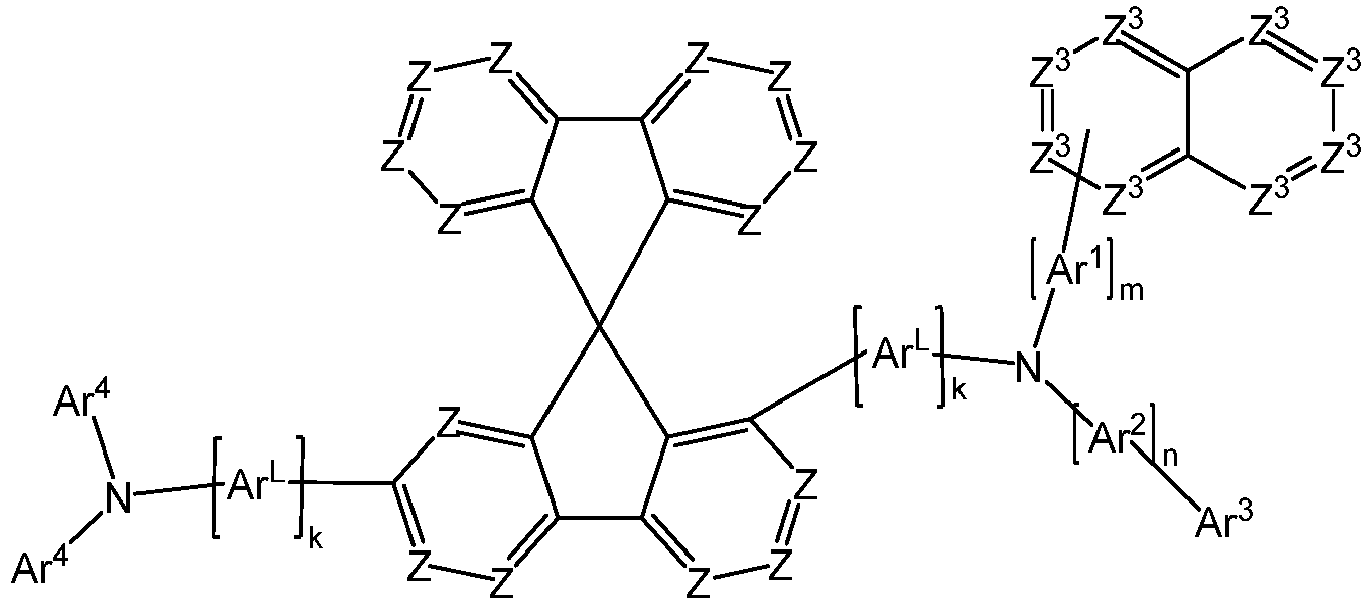
(I-5) 
(I-6) 
(I-7) 
(I-8) 
(I-9) 
(I-10) - Composé selon l'une ou plusieurs parmi les revendications 1 à 9, caractérisé en ce que Ar2 est choisi à chaque occurrence, de manière identique ou différente, parmi phényle et naphtyle, qui sont dans chaque cas substitués par des radicaux R5.
- Composé selon l'une ou plusieurs parmi les revendications 1 à 10, caractérisé en ce que l'indice n est égal à 1 ou 2.
- Composé selon l'une ou plusieurs parmi les revendications 1 à 11, caractérisé en ce que Ar3 est choisi parmi les groupements de formules (Ar3-2) et (Ar3-3) :

- Composé selon l'une ou plusieurs parmi les revendications 1 à 12, caractérisé en ce que A est égal à C.
- Procédé de préparation d'un composé selon l'une ou plusieurs parmi les revendications 1 à 13, caractérisé en ce qu'un groupement amino est introduit au moyen d'un réaction de couplage organométallique.
- Oligomère, polymère ou dendrimère contenant un ou plusieurs composés selon l'une ou plusieurs parmi les revendications 1 à 13, la ou les liaisons au polymère, à l'oligomère ou au dendrimère pouvant être situées au niveau de positions désirées quelconques qui sont substituées par R1, R2, R3, R4, R5 ou R6 dans la formule (I).
- Formulation comprenant au moins un composé selon l'une ou plusieurs parmi les revendications 1 à 13 ou au moins un polymère, oligomère ou dendrimère selon la revendication 15 et au moins un solvant.
- Dispositif électronique contenant au moins un composé selon l'une ou plusieurs parmi les revendications 1 à 13 ou au moins un polymère, oligomère ou dendrimère selon la revendication 15.
- Dispositif électronique selon la revendication 17, caractérisé en ce qu'il s'agit d'un dispositif électroluminescent organique et qu'il comprend une anode, une cathode et au moins une couche émettrice, et en ce que le composé est présent dans une couche de transport de trous ou dans une couche émettrice du dispositif.
- Utilisation d'un composé selon l'une ou plusieurs parmi les revendications 1 à 13 dans un dispositif électronique.
Applications Claiming Priority (3)
| Application Number | Priority Date | Filing Date | Title |
|---|---|---|---|
| EP20201069 | 2020-10-09 | ||
| EP21172857 | 2021-05-07 | ||
| PCT/EP2021/073110 WO2021214348A2 (fr) | 2020-10-09 | 2021-08-20 | Composés pour dispositifs électroniques |
Publications (2)
| Publication Number | Publication Date |
|---|---|
| EP4225733A2 EP4225733A2 (fr) | 2023-08-16 |
| EP4225733B1 true EP4225733B1 (fr) | 2024-11-27 |
Family
ID=77466005
Family Applications (1)
| Application Number | Title | Priority Date | Filing Date |
|---|---|---|---|
| EP21759101.5A Active EP4225733B1 (fr) | 2020-10-09 | 2021-08-20 | Composés pour dispositifs électroniques |
Country Status (6)
| Country | Link |
|---|---|
| US (1) | US20230373941A1 (fr) |
| EP (1) | EP4225733B1 (fr) |
| KR (1) | KR20230084529A (fr) |
| CN (1) | CN116406358A (fr) |
| TW (1) | TW202231621A (fr) |
| WO (1) | WO2021214348A2 (fr) |
Families Citing this family (2)
| Publication number | Priority date | Publication date | Assignee | Title |
|---|---|---|---|---|
| WO2022114118A1 (fr) * | 2020-11-27 | 2022-06-02 | 出光興産株式会社 | Composé, matériau d'élément électroluminescent organique, élément électroluminescent organique et dispositif électronique |
| KR20240051932A (ko) * | 2021-08-27 | 2024-04-22 | 이데미쓰 고산 가부시키가이샤 | 화합물, 유기 전기발광 소자용 재료, 유기 전기발광 소자, 및 전자 기기 |
Family Cites Families (5)
| Publication number | Priority date | Publication date | Assignee | Title |
|---|---|---|---|---|
| US20070092755A1 (en) | 2005-10-26 | 2007-04-26 | Eastman Kodak Company | Organic element for low voltage electroluminescent devices |
| KR101311840B1 (ko) * | 2011-11-09 | 2013-09-27 | (주)위델소재 | 신규한 3차 아릴 아민 및 이를 포함한 유기전계 발광소자 |
| KR102700186B1 (ko) * | 2016-12-27 | 2024-08-29 | 주식회사 동진쎄미켐 | 신규 화합물 및 이를 포함하는 유기 발광 소자 |
| CN117440703A (zh) * | 2017-03-01 | 2024-01-23 | 默克专利有限公司 | 有机电致发光器件 |
| WO2020109434A1 (fr) | 2018-11-30 | 2020-06-04 | Merck Patent Gmbh | Composés pour dispositifs électroniques |
-
2021
- 2021-08-20 WO PCT/EP2021/073110 patent/WO2021214348A2/fr not_active Ceased
- 2021-08-20 CN CN202180067885.5A patent/CN116406358A/zh active Pending
- 2021-08-20 EP EP21759101.5A patent/EP4225733B1/fr active Active
- 2021-08-20 KR KR1020237015076A patent/KR20230084529A/ko active Pending
- 2021-08-20 US US18/030,512 patent/US20230373941A1/en active Pending
- 2021-10-06 TW TW110137159A patent/TW202231621A/zh unknown
Non-Patent Citations (1)
| Title |
|---|
| XIAO HAIBO ET AL: "tert-Butylated spirobifluorene derivative incorporating triphenylamine groups: A deep-blue emitter with high thermal stability and good hole transport ability for organic light emitting diode applications", DYES AND PIGMENTS, vol. 121, 1 October 2015 (2015-10-01), GB, pages 7 - 12, XP055870013, ISSN: 0143-7208, DOI: 10.1016/j.dyepig.2015.03.027 * |
Also Published As
| Publication number | Publication date |
|---|---|
| TW202231621A (zh) | 2022-08-16 |
| WO2021214348A3 (fr) | 2022-03-03 |
| EP4225733A2 (fr) | 2023-08-16 |
| US20230373941A1 (en) | 2023-11-23 |
| CN116406358A (zh) | 2023-07-07 |
| WO2021214348A2 (fr) | 2021-10-28 |
| KR20230084529A (ko) | 2023-06-13 |
Similar Documents
| Publication | Publication Date | Title |
|---|---|---|
| EP3238286B1 (fr) | Matériaux pour dispositifs électroniques | |
| EP3411455B1 (fr) | Matériaux pour dispositifs électroniques | |
| WO2018069167A1 (fr) | Dispositif électronique | |
| EP3341349A1 (fr) | Dérivés de 6,9,15,18-tétrahydro-s-indacéno[1,2-b:5,6-b']difluorène et leur utilisation dans des dispositifs électroniques | |
| WO2015022051A1 (fr) | Matériaux destinés à des dispositifs électroniques | |
| EP4066289A1 (fr) | Composés pour dispositifs électroniques | |
| WO2014106522A1 (fr) | Matériaux pour dispositifs électroniques | |
| EP4483687A2 (fr) | Matériaux pour dispositifs électroniques | |
| EP2926385B1 (fr) | Dispositif électronique | |
| WO2019192954A1 (fr) | Matériaux pour dispositifs électroniques | |
| EP3589624A1 (fr) | Matières destinées à des dispositifs électroniques organiques | |
| WO2020127145A2 (fr) | Matériaux de dispositifs électroniques | |
| EP4240718A1 (fr) | Matériaux pour dispositifs électroniques | |
| EP4423065A1 (fr) | Composés pour dispositifs électroniques | |
| EP3679023A1 (fr) | Matériaux pour dispositifs électroniques | |
| WO2019101719A1 (fr) | Matériaux pour dispositifs électroniques | |
| EP4225733B1 (fr) | Composés pour dispositifs électroniques | |
| EP4263512A1 (fr) | Matériaux pour dispositifs électroniques | |
| WO2024013275A1 (fr) | Matériaux pour dispositifs électroniques | |
| EP4423064A1 (fr) | Composés pour dispositifs électroniques | |
| WO2016096069A1 (fr) | Composés pour dispositifs électroniques | |
| EP3394036B1 (fr) | Matériaux pour dispositifs électroniques | |
| EP4423073A2 (fr) | Composés pour dispositifs électroniques | |
| EP4423063A1 (fr) | Composés pour dispositifs électroniques | |
| WO2024126322A1 (fr) | Matériaux pour dispositifs électroniques |
Legal Events
| Date | Code | Title | Description |
|---|---|---|---|
| STAA | Information on the status of an ep patent application or granted ep patent |
Free format text: STATUS: UNKNOWN |
|
| STAA | Information on the status of an ep patent application or granted ep patent |
Free format text: STATUS: THE INTERNATIONAL PUBLICATION HAS BEEN MADE |
|
| PUAI | Public reference made under article 153(3) epc to a published international application that has entered the european phase |
Free format text: ORIGINAL CODE: 0009012 |
|
| STAA | Information on the status of an ep patent application or granted ep patent |
Free format text: STATUS: REQUEST FOR EXAMINATION WAS MADE |
|
| 17P | Request for examination filed |
Effective date: 20230405 |
|
| AK | Designated contracting states |
Kind code of ref document: A2 Designated state(s): AL AT BE BG CH CY CZ DE DK EE ES FI FR GB GR HR HU IE IS IT LI LT LU LV MC MK MT NL NO PL PT RO RS SE SI SK SM TR |
|
| DAV | Request for validation of the european patent (deleted) | ||
| DAX | Request for extension of the european patent (deleted) | ||
| RIC1 | Information provided on ipc code assigned before grant |
Ipc: H10K 85/60 20230101ALI20240507BHEP Ipc: C07C 211/61 20060101ALI20240507BHEP Ipc: C07C 211/58 20060101ALI20240507BHEP Ipc: C07C 211/54 20060101ALI20240507BHEP Ipc: C09K 11/06 20060101ALI20240507BHEP Ipc: C07D 405/12 20060101ALI20240507BHEP Ipc: C07D 307/91 20060101ALI20240507BHEP Ipc: C07D 251/24 20060101ALI20240507BHEP Ipc: C07D 209/86 20060101ALI20240507BHEP Ipc: C07D 201/00 20060101AFI20240507BHEP |
|
| GRAP | Despatch of communication of intention to grant a patent |
Free format text: ORIGINAL CODE: EPIDOSNIGR1 |
|
| STAA | Information on the status of an ep patent application or granted ep patent |
Free format text: STATUS: GRANT OF PATENT IS INTENDED |
|
| INTG | Intention to grant announced |
Effective date: 20240625 |
|
| GRAS | Grant fee paid |
Free format text: ORIGINAL CODE: EPIDOSNIGR3 |
|
| GRAA | (expected) grant |
Free format text: ORIGINAL CODE: 0009210 |
|
| STAA | Information on the status of an ep patent application or granted ep patent |
Free format text: STATUS: THE PATENT HAS BEEN GRANTED |
|
| AK | Designated contracting states |
Kind code of ref document: B1 Designated state(s): AL AT BE BG CH CY CZ DE DK EE ES FI FR GB GR HR HU IE IS IT LI LT LU LV MC MK MT NL NO PL PT RO RS SE SI SK SM TR |
|
| REG | Reference to a national code |
Ref country code: GB Ref legal event code: FG4D Free format text: NOT ENGLISH |
|
| REG | Reference to a national code |
Ref country code: CH Ref legal event code: EP |
|
| REG | Reference to a national code |
Ref country code: IE Ref legal event code: FG4D Free format text: LANGUAGE OF EP DOCUMENT: GERMAN |
|
| REG | Reference to a national code |
Ref country code: DE Ref legal event code: R096 Ref document number: 502021005949 Country of ref document: DE |
|
| P01 | Opt-out of the competence of the unified patent court (upc) registered |
Free format text: CASE NUMBER: APP_65433/2024 Effective date: 20241211 |
|
| REG | Reference to a national code |
Ref country code: LT Ref legal event code: MG9D |
|
| REG | Reference to a national code |
Ref country code: NL Ref legal event code: MP Effective date: 20241127 |
|
| PG25 | Lapsed in a contracting state [announced via postgrant information from national office to epo] |
Ref country code: IS Free format text: LAPSE BECAUSE OF FAILURE TO SUBMIT A TRANSLATION OF THE DESCRIPTION OR TO PAY THE FEE WITHIN THE PRESCRIBED TIME-LIMIT Effective date: 20250327 Ref country code: PT Free format text: LAPSE BECAUSE OF FAILURE TO SUBMIT A TRANSLATION OF THE DESCRIPTION OR TO PAY THE FEE WITHIN THE PRESCRIBED TIME-LIMIT Effective date: 20250327 Ref country code: HR Free format text: LAPSE BECAUSE OF FAILURE TO SUBMIT A TRANSLATION OF THE DESCRIPTION OR TO PAY THE FEE WITHIN THE PRESCRIBED TIME-LIMIT Effective date: 20241127 |
|
| PG25 | Lapsed in a contracting state [announced via postgrant information from national office to epo] |
Ref country code: FI Free format text: LAPSE BECAUSE OF FAILURE TO SUBMIT A TRANSLATION OF THE DESCRIPTION OR TO PAY THE FEE WITHIN THE PRESCRIBED TIME-LIMIT Effective date: 20241127 Ref country code: NL Free format text: LAPSE BECAUSE OF FAILURE TO SUBMIT A TRANSLATION OF THE DESCRIPTION OR TO PAY THE FEE WITHIN THE PRESCRIBED TIME-LIMIT Effective date: 20241127 |
|
| PG25 | Lapsed in a contracting state [announced via postgrant information from national office to epo] |
Ref country code: BG Free format text: LAPSE BECAUSE OF FAILURE TO SUBMIT A TRANSLATION OF THE DESCRIPTION OR TO PAY THE FEE WITHIN THE PRESCRIBED TIME-LIMIT Effective date: 20241127 |
|
| PG25 | Lapsed in a contracting state [announced via postgrant information from national office to epo] |
Ref country code: ES Free format text: LAPSE BECAUSE OF FAILURE TO SUBMIT A TRANSLATION OF THE DESCRIPTION OR TO PAY THE FEE WITHIN THE PRESCRIBED TIME-LIMIT Effective date: 20241127 |
|
| PG25 | Lapsed in a contracting state [announced via postgrant information from national office to epo] |
Ref country code: NO Free format text: LAPSE BECAUSE OF FAILURE TO SUBMIT A TRANSLATION OF THE DESCRIPTION OR TO PAY THE FEE WITHIN THE PRESCRIBED TIME-LIMIT Effective date: 20250227 |
|
| PG25 | Lapsed in a contracting state [announced via postgrant information from national office to epo] |
Ref country code: GR Free format text: LAPSE BECAUSE OF FAILURE TO SUBMIT A TRANSLATION OF THE DESCRIPTION OR TO PAY THE FEE WITHIN THE PRESCRIBED TIME-LIMIT Effective date: 20250228 Ref country code: LV Free format text: LAPSE BECAUSE OF FAILURE TO SUBMIT A TRANSLATION OF THE DESCRIPTION OR TO PAY THE FEE WITHIN THE PRESCRIBED TIME-LIMIT Effective date: 20241127 |
|
| PG25 | Lapsed in a contracting state [announced via postgrant information from national office to epo] |
Ref country code: PL Free format text: LAPSE BECAUSE OF FAILURE TO SUBMIT A TRANSLATION OF THE DESCRIPTION OR TO PAY THE FEE WITHIN THE PRESCRIBED TIME-LIMIT Effective date: 20241127 |
|
| PG25 | Lapsed in a contracting state [announced via postgrant information from national office to epo] |
Ref country code: RS Free format text: LAPSE BECAUSE OF FAILURE TO SUBMIT A TRANSLATION OF THE DESCRIPTION OR TO PAY THE FEE WITHIN THE PRESCRIBED TIME-LIMIT Effective date: 20250227 |
|
| PG25 | Lapsed in a contracting state [announced via postgrant information from national office to epo] |
Ref country code: SM Free format text: LAPSE BECAUSE OF FAILURE TO SUBMIT A TRANSLATION OF THE DESCRIPTION OR TO PAY THE FEE WITHIN THE PRESCRIBED TIME-LIMIT Effective date: 20241127 |
|
| PG25 | Lapsed in a contracting state [announced via postgrant information from national office to epo] |
Ref country code: DK Free format text: LAPSE BECAUSE OF FAILURE TO SUBMIT A TRANSLATION OF THE DESCRIPTION OR TO PAY THE FEE WITHIN THE PRESCRIBED TIME-LIMIT Effective date: 20241127 |
|
| PG25 | Lapsed in a contracting state [announced via postgrant information from national office to epo] |
Ref country code: EE Free format text: LAPSE BECAUSE OF FAILURE TO SUBMIT A TRANSLATION OF THE DESCRIPTION OR TO PAY THE FEE WITHIN THE PRESCRIBED TIME-LIMIT Effective date: 20241127 |
|
| PG25 | Lapsed in a contracting state [announced via postgrant information from national office to epo] |
Ref country code: RO Free format text: LAPSE BECAUSE OF FAILURE TO SUBMIT A TRANSLATION OF THE DESCRIPTION OR TO PAY THE FEE WITHIN THE PRESCRIBED TIME-LIMIT Effective date: 20241127 |
|
| PG25 | Lapsed in a contracting state [announced via postgrant information from national office to epo] |
Ref country code: SK Free format text: LAPSE BECAUSE OF FAILURE TO SUBMIT A TRANSLATION OF THE DESCRIPTION OR TO PAY THE FEE WITHIN THE PRESCRIBED TIME-LIMIT Effective date: 20241127 |
|
| PG25 | Lapsed in a contracting state [announced via postgrant information from national office to epo] |
Ref country code: CZ Free format text: LAPSE BECAUSE OF FAILURE TO SUBMIT A TRANSLATION OF THE DESCRIPTION OR TO PAY THE FEE WITHIN THE PRESCRIBED TIME-LIMIT Effective date: 20241127 |
|
| PG25 | Lapsed in a contracting state [announced via postgrant information from national office to epo] |
Ref country code: IT Free format text: LAPSE BECAUSE OF FAILURE TO SUBMIT A TRANSLATION OF THE DESCRIPTION OR TO PAY THE FEE WITHIN THE PRESCRIBED TIME-LIMIT Effective date: 20241127 |
|
| REG | Reference to a national code |
Ref country code: DE Ref legal event code: R097 Ref document number: 502021005949 Country of ref document: DE |
|
| PG25 | Lapsed in a contracting state [announced via postgrant information from national office to epo] |
Ref country code: SE Free format text: LAPSE BECAUSE OF FAILURE TO SUBMIT A TRANSLATION OF THE DESCRIPTION OR TO PAY THE FEE WITHIN THE PRESCRIBED TIME-LIMIT Effective date: 20241127 |
|
| PLBE | No opposition filed within time limit |
Free format text: ORIGINAL CODE: 0009261 |
|
| STAA | Information on the status of an ep patent application or granted ep patent |
Free format text: STATUS: NO OPPOSITION FILED WITHIN TIME LIMIT |
|
| REG | Reference to a national code |
Ref country code: CH Ref legal event code: L10 Free format text: ST27 STATUS EVENT CODE: U-0-0-L10-L00 (AS PROVIDED BY THE NATIONAL OFFICE) Effective date: 20251008 |
|
| PGFP | Annual fee paid to national office [announced via postgrant information from national office to epo] |
Ref country code: DE Payment date: 20250724 Year of fee payment: 5 |
|
| PGFP | Annual fee paid to national office [announced via postgrant information from national office to epo] |
Ref country code: AT Payment date: 20251020 Year of fee payment: 5 |
|
| 26N | No opposition filed |
Effective date: 20250828 |
|
| REG | Reference to a national code |
Ref country code: CH Ref legal event code: H13 Free format text: ST27 STATUS EVENT CODE: U-0-0-H10-H13 (AS PROVIDED BY THE NATIONAL OFFICE) Effective date: 20260324 |
|
| PG25 | Lapsed in a contracting state [announced via postgrant information from national office to epo] |
Ref country code: MC Free format text: LAPSE BECAUSE OF FAILURE TO SUBMIT A TRANSLATION OF THE DESCRIPTION OR TO PAY THE FEE WITHIN THE PRESCRIBED TIME-LIMIT Effective date: 20241127 |
|
| PG25 | Lapsed in a contracting state [announced via postgrant information from national office to epo] |
Ref country code: LU Free format text: LAPSE BECAUSE OF NON-PAYMENT OF DUE FEES Effective date: 20250820 |
|
| PG25 | Lapsed in a contracting state [announced via postgrant information from national office to epo] |
Ref country code: CH Free format text: LAPSE BECAUSE OF NON-PAYMENT OF DUE FEES Effective date: 20250831 |