EP4227882A1 - Reiseaufzeichnungsvorrichtung, reiseaufzeichnungssystem und reiseaufzeichnungsverfahren - Google Patents
Reiseaufzeichnungsvorrichtung, reiseaufzeichnungssystem und reiseaufzeichnungsverfahren Download PDFInfo
- Publication number
- EP4227882A1 EP4227882A1 EP20962377.6A EP20962377A EP4227882A1 EP 4227882 A1 EP4227882 A1 EP 4227882A1 EP 20962377 A EP20962377 A EP 20962377A EP 4227882 A1 EP4227882 A1 EP 4227882A1
- Authority
- EP
- European Patent Office
- Prior art keywords
- running
- time
- information
- runner
- environment
- Prior art date
- Legal status (The legal status is an assumption and is not a legal conclusion. Google has not performed a legal analysis and makes no representation as to the accuracy of the status listed.)
- Granted
Links
Images




Classifications
-
- G—PHYSICS
- G07—CHECKING-DEVICES
- G07C—TIME OR ATTENDANCE REGISTERS; REGISTERING OR INDICATING THE WORKING OF MACHINES; GENERATING RANDOM NUMBERS; VOTING OR LOTTERY APPARATUS; ARRANGEMENTS, SYSTEMS OR APPARATUS FOR CHECKING NOT PROVIDED FOR ELSEWHERE
- G07C1/00—Registering, indicating or recording the time of events or elapsed time, e.g. time-recorders for work people
- G07C1/22—Registering, indicating or recording the time of events or elapsed time, e.g. time-recorders for work people in connection with sports or games
- G07C1/24—Race time-recorders
-
- G—PHYSICS
- G06—COMPUTING OR CALCULATING; COUNTING
- G06Q—INFORMATION AND COMMUNICATION TECHNOLOGY [ICT] SPECIALLY ADAPTED FOR ADMINISTRATIVE, COMMERCIAL, FINANCIAL, MANAGERIAL OR SUPERVISORY PURPOSES; SYSTEMS OR METHODS SPECIALLY ADAPTED FOR ADMINISTRATIVE, COMMERCIAL, FINANCIAL, MANAGERIAL OR SUPERVISORY PURPOSES, NOT OTHERWISE PROVIDED FOR
- G06Q10/00—Administration; Management
- G06Q10/10—Office automation; Time management
-
- A—HUMAN NECESSITIES
- A63—SPORTS; GAMES; AMUSEMENTS
- A63B—APPARATUS FOR PHYSICAL TRAINING, GYMNASTICS, SWIMMING, CLIMBING, OR FENCING; BALL GAMES; TRAINING EQUIPMENT
- A63B24/00—Electric or electronic controls for exercising apparatus of preceding groups; Controlling or monitoring of exercises, sportive games, training or athletic performances
- A63B24/0021—Tracking a path or terminating locations
-
- A—HUMAN NECESSITIES
- A63—SPORTS; GAMES; AMUSEMENTS
- A63B—APPARATUS FOR PHYSICAL TRAINING, GYMNASTICS, SWIMMING, CLIMBING, OR FENCING; BALL GAMES; TRAINING EQUIPMENT
- A63B24/00—Electric or electronic controls for exercising apparatus of preceding groups; Controlling or monitoring of exercises, sportive games, training or athletic performances
- A63B24/0062—Monitoring athletic performances, e.g. for determining the work of a user on an exercise apparatus, the completed jogging or cycling distance
-
- G—PHYSICS
- G06—COMPUTING OR CALCULATING; COUNTING
- G06Q—INFORMATION AND COMMUNICATION TECHNOLOGY [ICT] SPECIALLY ADAPTED FOR ADMINISTRATIVE, COMMERCIAL, FINANCIAL, MANAGERIAL OR SUPERVISORY PURPOSES; SYSTEMS OR METHODS SPECIALLY ADAPTED FOR ADMINISTRATIVE, COMMERCIAL, FINANCIAL, MANAGERIAL OR SUPERVISORY PURPOSES, NOT OTHERWISE PROVIDED FOR
- G06Q50/00—Information and communication technology [ICT] specially adapted for implementation of business processes of specific business sectors, e.g. utilities or tourism
- G06Q50/10—Services
-
- A—HUMAN NECESSITIES
- A63—SPORTS; GAMES; AMUSEMENTS
- A63B—APPARATUS FOR PHYSICAL TRAINING, GYMNASTICS, SWIMMING, CLIMBING, OR FENCING; BALL GAMES; TRAINING EQUIPMENT
- A63B24/00—Electric or electronic controls for exercising apparatus of preceding groups; Controlling or monitoring of exercises, sportive games, training or athletic performances
- A63B24/0021—Tracking a path or terminating locations
- A63B2024/0025—Tracking the path or location of one or more users, e.g. players of a game
-
- A—HUMAN NECESSITIES
- A63—SPORTS; GAMES; AMUSEMENTS
- A63B—APPARATUS FOR PHYSICAL TRAINING, GYMNASTICS, SWIMMING, CLIMBING, OR FENCING; BALL GAMES; TRAINING EQUIPMENT
- A63B24/00—Electric or electronic controls for exercising apparatus of preceding groups; Controlling or monitoring of exercises, sportive games, training or athletic performances
- A63B24/0062—Monitoring athletic performances, e.g. for determining the work of a user on an exercise apparatus, the completed jogging or cycling distance
- A63B2024/0068—Comparison to target or threshold, previous performance or not real time comparison to other individuals
Definitions
- the present invention relates to a run recording device.
- the present invention relates to a device that records running states in a marathon race.
- Patent Literature 1 Japanese Unexamined Patent Application Publication No. 2008-299535
- the present invention has been made in view of such a situation, and a purpose thereof is to provide a system that enables holding of a fair marathon race with simultaneity maintained.
- a run recording device includes: a position acquirer that acquires position information of a first runner running with a certain time set to the starting point of a running time and also acquires position information of a second runner running with the same time as the certain time set to the starting point of a running time; an environment acquirer that acquires environment information indicating running environment of the first runner and also acquires environment information indicating running environment of the second runner; and an adjustment unit that makes adjustment, based on the environment information, to running information calculated with the position information such as to correct a difference in the running load due to running environment that may occur between the first runner and the second runner running in the same running time starting at the certain time.
- the run recording system includes: a run recording terminal including a position acquirer that acquires position information of a runner running with a certain time set to the starting point of a running time, and an environment acquirer that acquires environment information indicating running environment of the runner; and a run recording server including an adjustment unit that makes adjustment, based on the environment information, to running information calculated with the position information such as to correct a difference in the running load due to running environment that may occur between the runner and another runner running in the same running time starting at the certain time.
- the device includes: a position acquirer that acquires position information of a runner running with a certain time set to the starting point of a running time; an environment acquirer that acquires environment information indicating running environment of the runner; an adjustment unit that makes adjustment, based on the environment information, to running information calculated with the position information such as to correct a difference in the running load due to running environment that may occur between the runner and another runner running in the same running time starting at the certain time; and a comparison unit that acquires a result of comparison between running information after the adjustment and adjusted running information of another runner running in the same running time starting at the certain time.
- Still yet another aspect of the present invention relates to a run recording method.
- the method includes: acquiring position information of a first runner running with a certain time set to the starting point of a running time and also acquiring position information of a second runner running with the same time as the certain time set to the starting point of a running time; acquiring environment information indicating running environment of the first runner and also acquiring environment information indicating running environment of the second runner; and making adjustment, based on the environment information, to running information calculated with the position information such as to correct a difference in the running load due to running environment that may occur between the first runner and the second runner running in the same running time starting at the certain time.
- the present invention provides a system that enables holding of a fair marathon race with simultaneity maintained.
- a marathon race (hereinafter referred to as a "remote marathon race") is held in which the participants race for the time measured for the marathon distance, simultaneously at different locations such as remote locations.
- a running time is adjusted during the run based on environment information, which indicates the running environment of each participant, and the current rank obtained by comparison with other participants based on the adjusted running time and the running distance is output from moment to moment during the run.
- a gross time which is the time from when a gun sounds to signal the start of the race to when the runner reaches the finish line
- a net time which is the time from when the runner crosses the start line to when the runner reaches the finish line
- a gross time which is the time from the simultaneous start at the same date and time to when the runner reaches the distance of finish
- a net time which is the running time of each runner from the time of start of measurement to when the runner reaches the distance of finish
- the adjusted running time may be hereinafter referred to as a remote time.
- the adjusted running times are compared among the participants to determine the ranking, thereby absorbing differences in physical stress due to environments and providing the participants with fairer results.
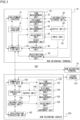
- FIG. 1 is a functional block diagram that shows a configuration of a run recording system 200.
- the run recording system 200 is constituted by multiple run recording terminals 10 and a run recording server 100 connected thereto.
- Each run recording terminal 10 may be, for example, a mobile terminal, such as a smartphone or smartwatch, carried by a participant of a remote marathon race.
- Each run recording terminal 10 includes an environment acquirer 12, a position acquirer 14, a state judgement unit 20, an information storage unit 30, a comparison unit 40, a registration processing unit 42, a communication unit 50, an output unit 60, and an input unit 62.
- FIG. 1 shows functional blocks realized by cooperation of such components. Therefore, it will be understood by those skilled in the art that these functional blocks may be implemented in a variety of forms by hardware only, software only, or a combination thereof.
- the input unit 62 accepts an instruction provided by a user's operation input. Based on an instruction from the user, the registration processing unit 42 processes the issuance of a user account with a user ID and a password for an unregistered user and also processes the registration for participation in a race. The registration processing unit 42 requests the issuance of the user account to the run recording server 100 via the communication unit 50 and registers the issued user ID and password in the information storage unit 30. Based on an instruction from the user, the registration processing unit 42 requests the registration for participation in a remote marathon race desired by the user to the run recording server 100 via the communication unit 50 and registers, in the information storage unit 30, a race ID indicating the remote marathon race in which participation has been registered.
- the position acquirer 14 acquires position information of the current location received from a satellite positioning system, such as the GPS (Global Positioning System), and transmits to the state judgement unit 20 the position information together with information indicating the acquisition date and time.
- the position information mainly includes date and time information in Coordinated Universal Time, latitude and longitude information, altitude information, moving speed information, and moving direction information, for example.
- the position acquirer 14 acquires the position information at intervals of several seconds; however, the position acquirer 14 may acquire the position information at regular time intervals or at indefinite intervals, such as each time a peculiar change in motion is detected by a motion sensor, which will be described later.
- the environment acquirer 12 acquires environment information of the current location and transmits the environment information to the state judgement unit 20.
- the environment information is information indicating, for example, the temperature, humidity, wind speed, wind direction, atmospheric pressure, altitude, and road surface condition (a paved road, an unpaved road, an athletic track, or a treadmill). The environment information will be detailed later.
- the state judgement unit 20 includes a time measurement unit 22, a distance measurement unit 24, a pace measurement unit 26, and an adjustment unit 28.
- the time measurement unit 22 measures a running time based on time information from a timer.
- the time measurement unit 22 acquires, from the run recording server 100, information on the start date and time, which indicates the simultaneous start time of a remote marathon race in which participation has been registered, to measure start delay time from the start date and time to the start of recording of the running time, and the time measurement unit 22 also measures the elapsed time from the time of start of recording. In the recorded running time, a portion from the simultaneous start time of the remote marathon race in which participation has been registered to the time limit of the race is considered valid.
- the recorded running time is defined as the net time, and the time obtained by adding the start delay time to the net time is defined as the gross time.
- the time measurement unit 22 measures a lap time, which is moving time for a predetermined distance.
- the predetermined distance for which the lap time is measured may be 1 kilometer or 1 mile, for example.
- the distance measurement unit 24 acquires information on the race distance (such as the total distance of 42.195 km or 26.2 miles as the marathon distance) from the run recording server 100 and calculates the running distance, which is the accumulated value of distance based on the position information from the time of start of recording, and the remaining distance.
- the distance measurement unit 24 measures the distance between multiple positioning points of which the position information has been acquired and calculates the cumulative running distance obtained by connecting the series of acquired distances.
- the distance measurement unit 24 may correct the distance using various methods, such as statistical analysis using standard deviation or the like to make a line connecting three or more positioning points smoother, analysis using acceleration information from a motion sensor, and removal of abnormal values.
- the distance measurement unit 24 can acquire the position of a point on the corrected trajectory and use the position as corrected position information.
- the distance measured by the distance measurement unit 24 is the length of the line connecting the corrected pieces of position information.
- the distance measurement unit 24 identifies two positioning points that sandwich a point among the points set every 10 m (hereinafter also referred to as "time measurement points"), and the time measurement unit 22 estimates the passing time at the time measurement point based on the running time and the distance between the two positioning points.
- a course with a distance X is divided into K sections of S 1 , S 2 , ..., S K at 1 km intervals.
- the pace measurement unit 26 calculates the running pace by dividing the distance between corrected multiple positioning points by time. Besides the moving pace between positioning points, the pace measurement unit 26 further calculates a pace within a predetermined distance.
- the pace within a predetermined distance may be, for example, an average pace within each of sections set at 1 km intervals, an average pace between the starting point of the current section and the current location, or an average pace from the time of start of recording to the current location.
- the information of the running time, the running distance, and the pace calculated by the time measurement unit 22, the distance measurement unit 24, and the pace measurement unit 26 is transmitted to the output unit 60. Also, one or both of the position information acquired from the position acquirer 14 and the position information corrected by the distance measurement unit 24 is recorded together with information on the acquisition date and time thereof in the information storage unit 30.
- the adjustment unit 28 Based on multiple types of environment information acquired by the environment acquirer 12, the adjustment unit 28 adjusts the running time measured by the time measurement unit 22.
- the time interval between two positioning points is usually a difference in positioning time, and the adjustment unit 28 adjusts the positioning time difference based on the multiple types of environment information.
- the adjustment unit 28 transmits, to the run recording server 100 via the communication unit 50, information necessary for the adjustment of the running time in the section where the user is currently running, together with an adjustment value determination request.
- the adjustment unit 28 receives the adjustment value calculated by the run recording server 100.
- the adjustment unit 28 adjusts the running time by adding the adjustment value thus received to the running time in the section where the user is currently running.
- the information transmitted by the adjustment unit 28 to the run recording server 100 may be, for example, information of the running time, running distance, and environment information.
- the adjustment value may be calculated by the adjustment unit 28 instead of the run recording server 100.
- the adjustment unit 28 acquires, from the run recording server 100, adjustment values A 1 , A 2 , ..., A K for running times T 1 , T 2 , ..., T K in the respective sections S 1 , S 2 , ... , S K .
- the entire distance X is 42.195 km
- each section from S 1 to S 42 is 1 km long, and only the section S 43 is 0.195 km long.
- the current remote time is a time obtained by adding an accumulated adjustment value, which is obtained by accumulating the adjustment values of the respective sections up to the present, to the running time from the simultaneous start time, which is the start date and time common to all the participants, to the current time.
- the adjustment value is calculated using a function f(e(t)) of a learned model with an environment value e(t) as a parameter.
- the function f(e(t)) may be generated as a learned model by means of regression analysis with the environment value e(t) as the explanatory variable and the adjustment value of the running time as the objective variable, based on past environment information and running data. Also, the environment information and running data accumulated in the run recording system 200 may be further reflected as a learning result in the function f(e(t)).
- the adjustment value may be a positive or negative number and is recorded, in the information storage unit 30, in association with information indicating a section to be adjusted.
- the adjustment value is calculated in units of time based on the participant's environment information and is adjusted so that participants of the same ability have the same time.
- the information storage unit 30 stores the position information acquired by the position acquirer 14 together with information on the acquisition date and time thereof and also stores the position information corrected by the distance measurement unit 24 together with information on the acquisition date and time thereof.
- the information storage unit 30 also stores information on the adjustment value acquired by the adjustment unit 28, in association with information indicating a section to be adjusted.
- the information storage unit 30 further stores information of the user ID, the password, and a race ID of the user, for example.
- the comparison unit 40 transmits, to the run recording server 100 via the communication unit 50, information necessary for determination of ranking together with a ranking determination request, each time the running distance in the section where the user is currently running increases by 10 m.
- the comparison unit 40 receives, as a comparison result, ranking information indicating the current rank determined by the run recording server 100.
- the information transmitted by the comparison unit 40 to the run recording server 100 may be, for example, the running distance and the remote time at the point or may be the position information, the information on the acquisition date and time, and the running time and the adjustment value in each distance section.
- the ranking information is a result of comparison with other participants whose running times start at the simultaneous start time, which is the start date and time common to all the participants registered for the race with the same race ID.
- the ranking information is a value indicating the current rank determined by comparing the running time (the remote time obtained by adding the accumulated value of the adjustment values to the gross time) with the running times of other participants at the same time measurement point or in the same distance section, or a value indicating percentage from the top within which the current rank is included, in the ranking among all the participants.
- the comparison unit 40 acquires, as the current rank, the rank at a point that the user has passed through most recently among the points set every 10 m or the points set every 1 km.
- the comparison unit 40 acquires the ranking information at a point that the user has passed through most recently among the time measurement points set every 10 m or the ranking information at the 12 km point and transmits the ranking information to the output unit 60. Also, at intervals even shorter than the above intervals, e.g., at predetermined time intervals such as every 1 second or at predetermined distance intervals such as every 1 m, the comparison unit 40 may transmit, to the run recording server 100, information of the current running distance, estimated passing time at the distance point, and the adjustment value together with the ranking determination request and may acquire the real-time order in the section where the user is currently running.
- a run recording terminal 10 may be configured to transmit, to the run recording server 100, the adjustment value determination request and the ranking determination request together as a single determination request to acquire the adjustment value and the ranking information.
- the run recording terminal 10 transmits to the run recording server 100 the running distance, running time, and environment information together with the determination request, the run recording server 100 determines the adjustment value of the running time and the ranking information and transmits the adjustment value or the remote time and the ranking information to the run recording terminal 10.
- the output unit 60 outputs running states based on the adjusted running time or the running distance.
- the output unit 60 outputs the running states, such as the gross time, the adjusted running time (remote time), the running distance, and the current rank, in the form of an audio reading of such information.
- the output unit 60 also displays the running states such as the gross time, remote time, running distance, and current rank on the screen of the user's mobile terminal.
- the run recording server 100 includes a state judgement unit 120, an information storage unit 130, a comparison unit 140, a registration processing unit 142, and a communication unit 150.
- the configuration of the run recording server 100 is also realized by configurations including a CPU/GPU, a RAM, a ROM, and a communication module in terms of hardware components
- FIG. 1 shows functional blocks realized by cooperation of such components. Therefore, it will be understood by those skilled in the art that these functional blocks may be implemented in a variety of forms by hardware only, software only, or a combination thereof.
- the communication unit 150 is connected to the communication unit 50 of each of multiple run recording terminals 10 via the Internet and receives information of each user, such as the user ID, password, race ID, position information, acquisition date and time, running distance, running time, environment information, adjustment value determination request, remote time, and ranking determination request.
- the registration processing unit 142 registers a user ID and a password in the information storage unit 130 in response to a request for issuance of a user account from a run recording terminal 10.
- the registration processing unit 142 also registers, in response to a request for participation in a remote marathon race from a run recording terminal 10, the user ID of the participant in association with the race ID of the race in which the participant is to participate, in the information storage unit 130.
- the information storage unit 130 further stores information of each user received from the corresponding run recording terminal 10, such as the position information, acquisition date and time, running distance, running time, environment information, remote time, and start delay time.
- the state judgement unit 120 includes a time measurement unit 122, a distance measurement unit 124, a pace measurement unit 126, and an adjustment unit 128, which correspond respectively to the time measurement unit 22, distance measurement unit 24, pace measurement unit 26, and adjustment unit 28 of a run recording terminal 10.
- the time measurement unit 122 acquires, from each of multiple run recording terminals 10, a running time of the runner as the user.
- the time measurement unit 122 may acquire the position information and information on the acquisition date and time thereof from a run recording terminal 10 to calculate, as the gross time, the difference between the simultaneous start time and the passing time in the section where the runner is currently running and may also calculate, as the net time, the difference between the acquisition date and time of the position information received first and the acquisition date and time of the latest position information.
- the distance measurement unit 124 acquires, from each of multiple run recording terminals 10, a running distance of the runner as the user. In a modification, the distance measurement unit 124 may acquire the position information and information on the acquisition date and time thereof from a run recording terminal 10 to calculate the accumulated value of distance from the position information received first to the latest position information, as the current running distance.
- the pace measurement unit 126 acquires, from each of multiple run recording terminals 10, a pace within a predetermined distance, such as an average pace within each of sections set at 10 minute intervals, an average pace from the starting point of the current section, or an average pace from the time of start of recording to the current time, of the runner as the user. In a modification, the pace measurement unit 126 may acquire the position information and information on the acquisition date and time thereof from a run recording terminal 10 to calculate the pace within a predetermined distance.
- the adjustment unit 128 receives, from each of multiple run recording terminals 10, the running time and the environment information of the runner as the user in the section where the runner is currently running, together with the adjustment value determination request. Based on the environment information, the adjustment unit 128 calculates the adjustment value of the running time and transmits, to the run recording terminal 10, the calculated adjustment value as a response to the adjustment value determination request. The adjustment unit 128 calculates the remote time by adding the accumulated adjustment value obtained by accumulating the adjustment values of the respective sections up to the present, to the running time from the simultaneous start time to the current time and stores, in the information storage unit 130, the remote time in association with the user ID and the running distance.
- the comparison unit 140 corresponds to the comparison unit 40 in a run recording terminal 10 and receives, from each of multiple run recording terminals 10, the running distance and the remote time at the point together with the ranking determination request. In response to the ranking determination request, the comparison unit 140 compares the received remote time at the point of the running distance with the remote times at the same point of other participants registered to participate in the race with the same race ID. In other words, the comparison unit 140 compares the remote times at the same point among the runners whose running times start at the simultaneous start time common to all the participants registered for the race with the same race ID. As a result of the comparison, the comparison unit 140 determines the user's rank and transmits the rank to the run recording terminal 10.
- the comparison unit 140 determines a runner's rank by comparison with remote times at the same distance point, among the records of valid remote times, i.e., remote times included in the range from the simultaneous start time to the time limit, of other participants registered to participate in the race with the same race ID, stored in the information storage unit 130.
- a participant who has finished running a 1 km section later will basically not be added at a rank higher than a participant who has finished running the 1 km section earlier.
- a participant who has finished running the section later may be added at a rank higher than a participant who has finished running the section earlier; accordingly, the ranking information transmitted from the comparison unit 140 to each run recording terminal 10 is merely provisional ranking, which may be changed later.
- an output unit 144 transmits information on each participant to a viewer terminal 152 via the communication unit 50 in response to a viewing request.
- the information on each participant includes information for identifying the participant and a list of the running distance, running time and remote time, adjustment value, and rank in each section of the participant, for example.
- the first embodiment describes an example in which the measurement of the running time and running distance and the correction of the position information are performed on the side of the state judgement unit 20 in a run recording terminal 10.
- part or all of the processes performed by the state judgement unit 20 may be performed on the side of the state judgement unit 120 in the run recording server 100, and the result may be sent back to the run recording terminal 10.
- the run recording terminal 10 transmits the position information and information on the acquisition date and time thereof to the run recording server 100 via the communication unit 50, and the state judgement unit 120 receives such information via the communication unit 150.
- the time measurement unit 122 and the distance measurement unit 124 then calculate the running time and the running distance and transmit the running time and running distance to the run recording terminal 10 via the communication unit 150.
- the adjustment value of the running time may be calculated on the run recording terminal 10 side, and the adjustment value or remote time information may be transmitted from the run recording terminal 10 to the run recording server 100.
- one of the multiple run recording terminals 10 may also be equipped with the configuration of the run recording server 100 as host functions, so that remote marathon races may be substantially realized only with the multiple run recording terminals 10.
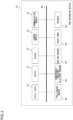
- FIG. 2 shows a hardware configuration of a run recording terminal 10.
- Each run recording terminal 10 includes a CPU/GPU 70, a RAM 72, a ROM 74, a camera module 76, a communication module 78, a positioning module 80, an atmospheric pressure altitude sensor 82, a motion sensor 84, a touch panel 86, and a speaker 88, which are connected to one another via a bus 90.
- Each run recording terminal 10 is implemented in the form of a mobile terminal, such as a smartphone.
- each run recording terminal 10 may be implemented in the form of a watch-type or glasses-type information terminal to be worn on the body, such as a smartwatch, a GPS watch, or smart glasses, or may be implemented in the form of a small information terminal to be built into a running shoe, such as a smart shoe.
- the running states such as the running time, running distance, adjustment value, and rank may be displayed on a screen visually recognized by the wearer, and, in addition, using an AR (augmented reality) or MR (mixed reality) imaging technique, the image of another runner ahead of the wearer may be projected in the field of view.
- the CPU/GPU 70 is a processor unit that executes a program to perform each function of the run recording terminal 10.
- the RAM 72 is a memory area used as a workspace for each program.
- the ROM 74 is a non-volatile memory in which each program and data are stored.
- the CPU/GPU 70, RAM 72, and ROM 74 may be configured in the form of a SoC (System on a Chip) in which they are all included.
- the camera module 76 is a camera that captures still images and moving images.
- the communication module 78 is a communication interface for cellular phone communication, wireless LAN, and short-range wireless communication, for example, and functionally corresponds mainly to the communication unit 50.
- the positioning module 80 is a module that acquires position information from a satellite positioning system, such as the GPS, and functionally corresponds mainly to the position acquirer 14.
- the atmospheric pressure altitude sensor 82 is a sensor that detects the atmospheric pressure at the current time and estimates the altitude based on the atmospheric pressure and functionally corresponds mainly to the environment acquirer 12.
- the motion sensor 84 includes an acceleration sensor, an angular velocity sensor, and a geomagnetic sensor for detecting the moving direction and the moving speed and functionally corresponds mainly to the environment acquirer 12.
- the touch panel 86 accepts user touch input and displays text and images on the screen, and the touch panel 86 functionally corresponds mainly to the output unit 60 and the input unit 62.
- the speaker 88 outputs sound and functionally corresponds mainly to the output unit 60.
- the environment acquirer 12 may acquire temperature information, humidity information, weather information, wind speed information, wind direction information, and the like from those sensors.
- the environment acquirer 12 may also acquire the temperature information, humidity information, weather information, wind speed information, wind direction information, and the like associated with the current position information from a certain server that publishes meteorological information, via the communication unit 50.
- the environment acquirer 12 also acquires atmospheric pressure information from the atmospheric pressure altitude sensor 82.
- the environment acquirer 12 may acquire altitude information from the atmospheric pressure altitude sensor 82 or may acquire altitude information based on the position information acquired from the positioning module 80 and map information acquired via the communication unit 50.
- the environment acquirer 12 also calculates the degree of increase or decrease of altitude based on the difference between the altitude information of the current location and the altitude information of the previous positioning point. Based on the altitude information and the distance information measured by the distance measurement unit 24 or based on information on the moving direction acquired by the motion sensor 84, the environment acquirer 12 also calculates the inclination angle of the road surface. Also, the environment acquirer 12 may judge whether the road surface condition is a paved road, an unpaved road, an athletic track, or a treadmill, based on the selection input by the user via the touch panel 86 before the start of recording or may judge the road surface condition of the current location based on the position information acquired from the positioning module 80 and the map information acquired via the communication unit 50.
- pause button may not be provided, and, if the measurement is stopped accidentally due to a malfunction or an operational error in the information terminal, processing for counting the participant as dropping out or processing for terminating the recording may be performed.
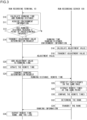
- FIG. 3 is a flowchart that shows a process of transmitting and receiving information performed between a run recording terminal 10 and the run recording server 100, adjusting the running time, and determining the ranking.
- the time measurement unit 22 and the distance measurement unit 24 calculate the running time and the running distance based on the position information and the acquisition time thereof (S10), the environment acquirer 12 acquires the environment information (S11), and the process of S10 and S11 is repeated until the running distance reaches one of points set at predetermined intervals, such as every 10 m (N at S12).
- the run recording terminal 10 transmits, to the run recording server 100, the running time, running distance, and environment information, as the adjustment value determination request (S14).
- the adjustment unit 128 calculates the adjustment value of the running time based on the received running time, running distance, and environment information (S16) and transmits, to the run recording terminal 10, the calculated adjustment value as a response to the adjustment value determination request (S18).
- the adjustment unit 28 adds the received adjustment value to the running time (S20) and updates the remote time (S22).
- the comparison unit 40 of the run recording terminal 10 transmits the running distance and the remote time as the ranking determination request to the run recording server 100 (S24); in the run recording server 100 that has received the ranking determination request, the comparison unit 140 identifies other participants registered for the race with the same race ID in the information storage unit 130 (S26). The comparison unit 140 extracts, from the data of the identified other participants, remote times at the same point as indicated in the ranking determination request (S28) and compares the remote time indicated in the ranking determination request and the remote times of other participants (S30) to determine the rank of the user, who is the sender of the ranking determination request (S32). The comparison unit 140 then transmits, to the run recording terminal 10, the ranking information as a response to the ranking determination request (S34). The run recording terminal 10 that has received the ranking information outputs the running distance, remote time, rank, and the like in the form of screen display or sound, for example (S36). The process flow described above is repeated until the termination of the recording.
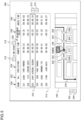
- FIG. 4 shows an example of screen display on a user's mobile terminal.
- a running time 160 shows the running time (gross time) as an actual measured value.
- a remote time 162 shows the running time after adjustment (remote time).
- An adjustment value 163 shows the accumulated value of the adjustment values to be added to the gross time.
- a running distance 164 shows the running distance.
- a situation image 166 shows an animation displaying the positional relationship between the user himself or herself and the preceding and following runners. In the situation image 166, a self icon 170 represents the user himself or herself and is always displayed in the center.
- a preceding runner icon 172 which indicates the position of the preceding runner
- a following runner icon 174 which indicates the position of the following runner
- a preceding distance 176 shows, with text, the distance difference from the preceding runner.
- a following distance 178 shows with text the distance difference from the following runner.
- the intervals from the preceding runner and the following runner may be shown as time differences.
- Rank display 168 shows, with text, the user's current rank and the percentage from the top within which the user is positioned.
- a stop button 180 is a button used to order the stop of recording.
- the rank displayed in the rank display 168 and the distance differences from the preceding runner and the following runner displayed with the icons are those in the section that the user has passed through most recently.
- the remote time at the current point which is obtained by adding, to the remote time up to the section that the user has passed through most recently, the running time from the passing through of the section to the current position and the adjustment value thereof, may be compared with the remote times of other participants at the same point among the distance points set every 10 m, and the rank obtained thereby may be displayed.
- FIG. 5 shows an example of screen display displaying the rank of each participant in a remote marathon race in the first embodiment.
- a screen 208 is a screen of the viewer terminal 152 prepared mainly for viewing by persons other than the participants and is displayed, for example, on a personal computer or tablet terminal using a web browser.
- the screen 208 includes a ranking table 210 and a map column 240.
- the ranking table 210 shows a list of participants in the remote marathon race in order of shortest remote time at a predetermined point.
- a first column 220 shows the rank of each participant, a second column 222 shows the number of each participant, and a third column 224 shows the name of each participant.
- a fourth column 226 shows the remote time of each participant
- a fifth column 228 shows the adjustment value of each participant
- a sixth column 230 shows the gross time of each participant.
- seven participants are displayed, from the "231st" to "236th" places in the ranking based on the remote time at the "12 km point".
- an upward scroll button 212 and a downward scroll button 214 are displayed; when a viewer presses the upward scroll button 212, the list is switched to a list of higher-ranked participants, and, when a viewer presses the downward scroll button 214, the list is switched to a list of lower-ranked participants.
- a left move button 216 and a right move button 218 are displayed; when a viewer presses the left move button 216, the list display is switched to that of the "11 km point" as the previous distance point, and, when a viewer presses the right move button 218, the list display is switched to that of the "13 km point” as the next distance point.
- the fairness of the ranking can be improved.
- the row of the selected participant is enclosed by a bold selection frame 232 and highlighted. Also, the current positions of the selected participant and the preceding and following participants are displayed in the map column 240.
- the map column 240 shows a map of a marathon course virtually set.
- an enlarge button 242 and a reduce button 244 are displayed.
- the map displayed in the map column 240 is enlarged, and, when the reduce button 244 is pressed, the map displayed in the map column 240 is reduced.
- a course line 246 indicates the marathon course set on the displayed map.
- a first participant mark 250 and a second participant mark 252 which respectively indicate the participants with the numbers "2389” and "212" whose latest ranks are higher, are displayed at the corresponding positions.
- a third participant mark 254 and a fourth participant mark 256 which respectively indicate the participants with the numbers "804" and "1082" whose latest ranks are lower, are displayed at the corresponding positions.
- the display position of each of the selected participant mark 248, the first participant mark 250, the second participant mark 252, the third participant mark 254, and the fourth participant mark 256 is determined based on the current estimated position according to the average pace up to that point based on the remote time of the corresponding participant and is updated over time, so that each mark is displayed to be moving, moment by moment, on the course line 246.
- the current estimated position of each mark may be, for example, the current estimated position of each participant after the "12 km point" based on the premise that the average pace based on the remote time of the participant from the start of measurement to the "12 km point" is maintained as is.
- it may be the current estimated position of each participant after the "12 km point” based on the premise that the latest average pace, such as the average pace within the 1 km section from the "11 km point” as the previous point to the "12 km point", of the participant is maintained as is.
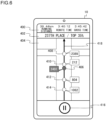
- FIG. 6 shows an example of screen display on a user's mobile terminal in a modification.
- the user's current location is displayed on a map that shows where the user is actually running, and virtual positions of the preceding runner and the following runner in the remote time ranking are also displayed on the map, thereby visually presenting to the user the intervals from the preceding runner and the following runner.
- a first column 400 shows the running distance, remote time, and gross time. The adjustment value may also be displayed.
- a second column 402 shows, with text, the user's current rank and the percentage from the top within which the user is positioned.
- a stop button 416 is a button used to order the stop of recording.
- a third column 404 shows a map showing the user's current location, and, on the map, a course line 418 indicating the course on which the user is currently running is displayed along the road on which the user is currently running. Also, the current locations of the user and the preceding and following runners are indicated by the respective marks on the course line 418. The map is displayed such that the running direction is always set upward on the screen, as in the so-called heading-up display.
- a self mark 406 is a mark indicating the user's current location.
- a first participant mark 408 and a second participant mark 410 are marks indicating the current locations of the preceding participants.
- a third participant mark 412 and a fourth participant mark 414 are marks indicating the current locations of the following participants.
- the course line 418 indicates the trajectory along which the user has run and also the direction in which the user will run from the present; however, the user's path is not actually determined, and when and where the user will turn is undetermined. Therefore, the course line 418 ahead of the user's current location merely indicates a tentative path before the user changes the path. For example, when the user turns a corner, the map is rotated such that the road ahead of the corner is directed upward on the screen, and the course line 418 is displayed such as to indicate a tentative path set upward again.
- the user and other runners are arranged two-dimensionally on the map to visually indicate their ranks and the intervals.
- a VR (virtual reality) space may be displayed on the screen of the user's mobile terminal, for example, and a three-dimensional image of the user and other runners running in the virtual space may be displayed, thereby visually expressing their ranks and the intervals.
- a map indicating the course of a specific marathon race that actually exists and the location thereof may be displayed for a remote marathon race, as if the user is virtually running on the marathon course.
- a map indicating the course of an imaginary marathon race and the location thereof may be displayed for a remote marathon race, as if the user is virtually running on the marathon course.
- the running distance, remote time, gross time, rank, and the like may be displayed on the screen of smart glasses.
- a mark or an image of a runner indicating a participant running ahead of the user in the running direction may be displayed using an AR (augmented reality) or MR (mixed reality) imaging technique, and the mark or image of the runner may be reduced and displayed on a scale according to the distance between the preceding participant and the user so that the user can grasp the distance from the preceding participant three-dimensionally.
- AR augmented reality
- MR mixed reality
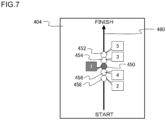
- FIG. 7 shows a modification of current position display.
- the entire course of a remote marathon race is represented by the length of the course line 460, and where the user is running is indicated by the displayed position of a self mark 450 on the course line 460.
- This display is suitable to display the entire course and all participants on a single axis, when the total distance of the remote marathon race course is relatively short, such as about 10 km, or when the number of participants is relatively small, such as 3 to 10, for example.
- a first participant mark 452 and a second participant mark 454 are marks indicating the current locations of the preceding participants.
- a third participant mark 456 and a fourth participant mark 458 are marks indicating the current locations of the following participants.
- the distance intervals between the user and other participants may not always be accurately grasped.
- this simpler diagram enables grasp of where the user is currently running on the course and of the order with the other participants, simultaneously.
- a distance and a time of a participant can be adjusted based on information such as the temperature at the time of start, and the altitude and atmospheric pressure at the starting point.
- the second embodiment differs in that the adjustment unit 28 adjusts the running distance, as opposed to the first embodiment in which the running time is adjusted.
- the adjustment unit 28 adjusts the running distance, as opposed to the first embodiment in which the running time is adjusted.
- the distance measurement unit 24 judges that, in a recorded running distance, a portion from the simultaneous start time of the remote marathon race in which participation has been registered to the time limit of the race is valid and defines the running distance of the valid portion as a gross distance.
- a predetermined time such as 10 seconds
- the time measurement unit 22 identifies two positioning points that sandwich a time point among the time points set every 10 seconds (hereinafter also referred to as "distance measurement points"), and the distance measurement unit 24 estimates the running distance at the distance measurement point based on the running distance and the time between the two positioning points.
- the running time is divided into n sections of S 1 , S 2 , ..., S n in total at 10 minute intervals.
- the adjustment unit 28 Based on multiple types of environment information acquired by the environment acquirer 12, the adjustment unit 28 adjusts the running distance measured by the distance measurement unit 24. As the distance interval between two distance measurement points, the adjustment unit 28 adjusts the running distance based on the multiple types of environment information.
- the adjustment unit 28 transmits, to the run recording server 100 via the communication unit 50, information necessary for the adjustment of the running distance in the section where the user is currently running, together with an adjustment value determination request. As a response thereto, the adjustment unit 28 receives the adjustment value calculated by the run recording server 100.
- the adjustment unit 28 adjusts the running distance by adding the adjustment value thus received to the running distance in the section where the user is currently running.
- the information transmitted by the adjustment unit 28 to the run recording server 100 may be, for example, information of the running time, running distance, and environment information.
- the adjustment value may be calculated by the adjustment unit 28 instead of the run recording server 100.
- the adjustment unit 28 acquires, from the run recording server 100, adjustment values A 1 , A 2 , ..., A n for running distances D 1 , D 2 , ..., D n in the respective sections S 1 , S 2 , ..., S n .
- the adjustment value A 6 is updated every 10 seconds.
- the current remote distance is a distance obtained by adding an accumulated adjustment value, which is obtained by accumulating the adjustment values of the respective sections up to the present, to the running distance from the simultaneous start time, which is the start date and time common to all the participants, to the current time.
- the adjustment value is calculated using a function f(e(t)) of a learned model with an environment value e(t) as a parameter.
- the function f(e(t)) may be generated as a learned model by means of regression analysis with the environment value e(t) as the explanatory variable and the adjustment value of the running distance as the objective variable, based on past environment information and running data. Also, the environment information and running data accumulated in the run recording system 200 may be further reflected as a learning result in the function f(e(t)).
- the adjustment value may be a positive or negative number and is recorded, in the information storage unit 30, in association with information indicating a section to be adjusted. The adjustment value is calculated in units of distance based on the participant's environment information and is adjusted so that participants of the same ability have the same distance.
- the distance measurement unit 124 calculates the adjusted running distance (remote distance) by adding the accumulated value of the adjustment values to the accumulated value of distance from the first position information to the latest position information.
- the comparison unit 40 transmits, to the run recording server 100 via the communication unit 50, information necessary for determination of ranking together with a ranking determination request, each time the running time in the section where the user is currently running advances by 10 seconds.
- the comparison unit 40 receives, as a comparison result, ranking information indicating the current rank determined by the run recording server 100.
- the information transmitted by the comparison unit 40 to the run recording server 100 may be, for example, the running time and the remote distance at the time point or may be the position information, the information on the acquisition date and time, and the running distance and the adjustment value in each time section.
- the ranking information is a result of comparison with other participants whose running times start at the simultaneous start time, which is the start date and time common to all the participants registered for the race with the same race ID. More specifically, the ranking information is a value indicating the current rank determined by comparing the running distance (the remote distance obtained by adding the accumulated value of the adjustment values to the gross distance) with the running distances of other participants at the same distance measurement point or in the same time section, or a value indicating percentage from the top within which the current rank is included, in the ranking among all the participants.
- the comparison unit 40 acquires, as the current rank, the rank at a time point that has passed most recently among the time points set every 10 seconds or the time points set every 10 minutes.
- the comparison unit 40 acquires the ranking information at a time point that has passed most recently among the distance measurement points set every 10 seconds or the ranking information at the time point when the running time is "0:50:00" and transmits the ranking information to the output unit 60. Also, at intervals even shorter than the above intervals, e.g., at predetermined time intervals such as every 1 second or at predetermined distance intervals such as every 1 m, the comparison unit 40 may transmit, to the run recording server 100, information of the current running time, estimated running distance at the time point, and the adjustment value together with the ranking determination request and may acquire the real-time order in the time section where the user is currently running.
- a run recording terminal 10 may be configured to transmit, to the run recording server 100, the adjustment value determination request and the ranking determination request together as a single determination request to acquire the adjustment value and the ranking information.
- the run recording terminal 10 transmits to the run recording server 100 the running distance, the running time, and the environment information together with the determination request, the run recording server 100 determines the adjustment value of the running distance and the ranking information and transmits the adjustment value or the remote distance and the ranking information to the run recording terminal 10.
- the output unit 60 outputs the running states, such as the gross time, the gross distance, the adjusted running distance (remote distance), and the current rank, in the form of an audio reading of such information.
- the output unit 60 also displays the running states such as the gross time, gross distance, remote distance, and current rank on the screen.
- the output unit 60 also displays the running states such as the gross time, gross distance, remote distance, and current rank on the screen of the user's mobile terminal.
- the time measurement unit 122, distance measurement unit 124, pace measurement unit 126, and adjustment unit 128 correspond respectively to the time measurement unit 22, distance measurement unit 24, pace measurement unit 26, and adjustment unit 28 of a run recording terminal 10.
- the adjustment unit 128 receives, from each of multiple run recording terminals 10, the running distance and the environment information of the runner as the user in the section where the runner is currently running, together with the adjustment value determination request. Based on the environment information, the adjustment unit 128 calculates the adjustment value of the running distance and transmits, to the run recording terminal 10, the calculated adjustment value as a response to the adjustment value determination request.
- the adjustment unit 128 calculates the remote distance by adding the accumulated adjustment value obtained by accumulating the adjustment values of the respective sections up to the present, to the running distance from the time of start of recording to the current time and stores, in the information storage unit 130, the remote distance in association with the user ID and the running time.
- the communication unit 150 is connected to the communication unit 50 of each of multiple run recording terminals 10 via the Internet and receives information of each user, such as the user ID, password, race ID, position information, acquisition date and time, running distance, running time, environment information, adjustment value determination request, remote distance, and ranking determination request.
- the information storage unit 130 further stores information of each user received from the corresponding run recording terminal 10, such as the position information, acquisition date and time, running distance, running time, environment information, remote distance, and start delay time.
- the adjustment unit 128 receives, from each of multiple run recording terminals 10, the running distance and the environment information of the runner as the user in the section where the runner is currently running, together with the adjustment value determination request. Based on the environment information, the adjustment unit 128 calculates the adjustment value of the running distance and transmits, to the run recording terminal 10, the calculated adjustment value as a response to the adjustment value determination request. The adjustment unit 128 calculates the remote distance by adding the accumulated adjustment value obtained by accumulating the adjustment values of the respective sections up to the present, to the running distance from the simultaneous start time to the current time and stores, in the information storage unit 130, the remote distance in association with the user ID and the running time.
- the comparison unit 140 corresponds to the comparison unit 40 in a run recording terminal 10 and receives, from each of multiple run recording terminals 10, the running time and the remote distance at the time point together with the ranking determination request. In response to the ranking determination request, the comparison unit 140 compares the received remote distance at the time point of the running time with the remote distances at the same time point of other participants registered to participate in the race with the same race ID. In other words, the comparison unit 140 compares the remote distances at the same time point among the runners whose running times start at the simultaneous start time common to all the participants registered for the race with the same race ID. As a result of the comparison, the comparison unit 140 determines the user's rank and transmits the rank to the run recording terminal 10.
- the comparison unit 140 determines a runner's rank by comparison with remote distances at the same time point, among the records of valid remote distances, i.e., remote distances run in the range from the simultaneous start time to the time limit, of other participants registered to participate in the race with the same race ID, stored in the information storage unit 130.
- the output unit 144 transmits information on each participant to the viewer terminal 152 via the communication unit 50 in response to a viewing request.
- the information on each participant includes information identifying the participant and a list of the running time, running distance and remote distance, adjustment value, and rank in each section of the participant, for example.
- the second embodiment describes an example in which the measurement of the running time and running distance and the correction of the position information are performed on the side of the state judgement unit 20 in a run recording terminal 10.
- part or all of the processes performed by the state judgement unit 20 may be performed on the side of the state judgement unit 120 in the run recording server 100, and the result may be sent back to the run recording terminal 10.
- the run recording terminal 10 transmits the position information and information on the acquisition date and time thereof to the run recording server 100 via the communication unit 50, and the state judgement unit 120 receives such information via the communication unit 150.
- the time measurement unit 122 and the distance measurement unit 124 then calculate the running time and the running distance and transmit the running time and running distance to the run recording terminal 10 via the communication unit 150.
- the adjustment value of the running distance may be calculated on the run recording terminal 10 side, and the adjustment value or remote distance information may be transmitted from the run recording terminal 10 to the run recording server 100.
- FIG. 8 is a flowchart that shows a process of transmitting and receiving information performed between a run recording terminal 10 and the run recording server 100, adjusting a running time, and determining ranking.
- the time measurement unit 22 and the distance measurement unit 24 calculate the running time and the running distance based on the position information and the acquisition time thereof (S40), the environment acquirer 12 acquires the environment information (S41), and the process of S40 and S41 is repeated until the running time passes one of time points set at predetermined intervals, such as every 10 seconds (N at S42).
- the run recording terminal 10 transmits, to the run recording server 100, the running time, running distance, and environment information, as the adjustment value determination request (S44).
- the adjustment unit 128 calculates the adjustment value of the running distance based on the received running time, running distance, and environment information (S46) and transmits, to the run recording terminal 10, the calculated adjustment value as a response to the adjustment value determination request (S48).
- the adjustment unit 28 adds the received adjustment value to the running distance (S50) and updates the remote distance (S52).
- the comparison unit 40 of the run recording terminal 10 transmits the running distance and the remote distance as the ranking determination request to the run recording server 100 (S54); in the run recording server 100 that has received the ranking determination request, the comparison unit 140 identifies other participants registered for the race with the same race ID in the information storage unit 130 (S56). The comparison unit 140 extracts, from the data of the identified other participants, remote distances at the same time point as indicated in the ranking determination request (S58) and compares the remote distance indicated in the ranking determination request and the remote distances of other participants (S60) to determine the rank of the user, who is the sender of the ranking determination request (S62). The comparison unit 140 then transmits, to the run recording terminal 10, the ranking information as a response to the ranking determination request (S64). The run recording terminal 10 that has received the ranking information outputs the running time, remote distance, rank, and the like in the form of screen display or sound, for example (S66). The process flow described above is repeated until the termination of the recording.
- FIG. 9 shows an example of screen display on a user's mobile terminal.
- a running distance 360 shows the running distance (gross distance) as an actual measured value.
- a remote distance 362 shows the running distance after adjustment (remote distance).
- An adjustment value 363 shows the accumulated value of the adjustment values to be added to the gross distance.
- a running time 364 shows the gross time.
- a situation image 366 shows an animation displaying the positional relationship between the user himself or herself and the preceding and following runners. In the situation image 366, a self icon 370 represents the user himself or herself and is always displayed in the center.
- a preceding runner icon 372 which indicates the position of the preceding runner
- a following runner icon 374 which indicates the position of the following runner
- a preceding distance 376 shows, with text, the distance difference from the preceding runner.
- a following distance 378 shows with text the distance difference from the following runner.
- the intervals from the preceding runner and the following runner may be shown as time differences.
- Rank display 368 shows, with text, the user's current rank and the percentage from the top within which the user is positioned.
- a stop button 380 is a button used to order the stop of recording.
- the rank displayed in the rank display 368 and the distance differences from the preceding runner and the following runner displayed with the icons are those in the time section that has elapsed most recently.
- the remote distance at the current time which is obtained by adding, to the remote distance up to the time section that has elapsed most recently, the running distance from the elapse of the time section to the current time and the adjustment value thereof, may be compared with the remote distances of other participants at the same time point among the time points set every 10 seconds, and the rank obtained thereby may be displayed.
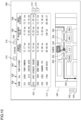
- FIG. 10 shows an example of screen display displaying the rank of each participant in a remote marathon race in the second embodiment.
- a screen 308 is a screen of the viewer terminal 152 prepared mainly for viewing by persons other than the participants and is displayed, for example, on a personal computer or tablet terminal using a web browser.
- the screen 308 includes a ranking table 310 and a map column 340.
- the ranking table 310 shows a list of participants in the remote marathon race in order of longest remote distance when a predetermined running time has elapsed or at a predetermined time.
- a first column 320 shows the rank of each participant, a second column 322 shows the number of each participant, and a third column 324 shows the name of each participant.
- a fourth column 326 shows the remote distance of each participant
- a fifth column 328 shows the adjustment value of each participant
- a sixth column 330 shows the gross distance of each participant.
- seven participants are displayed, from the "231st" to "236th" places in the ranking based on the remote distance when the running time is "0:50:00".
- an upward scroll button 312 and a downward scroll button 314 are displayed; when a viewer presses the upward scroll button 312, the list is switched to a list of higher-ranked participants, and, when a viewer presses the downward scroll button 314, the list is switched to a list of lower-ranked participants.
- a left move button 316 and a right move button 318 are displayed; when a viewer presses the left move button 316, the list display is switched to that at the previous running time (such as 10 minutes before), i.e., when the running time is "0:40:00", and, when a viewer presses the right move button 318, the list display is switched to that at the next running time (such as 10 minutes after), i.e., when the running time is "1:00:00".
- the fairness of the ranking can be improved.
- the row of the selected participant is enclosed by a bold selection frame 332 and highlighted. Also, the current positions of the selected participant and the preceding and following participants are displayed in the map column 340.
- the map column 340 shows a map of a marathon course virtually set.
- an enlarge button 342 and a reduce button 344 are displayed.
- the map displayed in the map column 340 is enlarged, and, when the reduce button 344 is pressed, the map displayed in the map column 340 is reduced.
- a course line 346 indicates the marathon course set on the displayed map.
- a selected participant mark 348 which indicates the participant with the number "2491" selectively displayed with the selection frame 332, is displayed at a predetermined position on the course line 346 such as to be positioned approximately near the center of the map column 340.
- a first participant mark 350 and a second participant mark 352 which respectively indicate the participants with the numbers "2389” and "212" whose latest ranks are higher, are displayed at the corresponding positions.
- the display position of each of the selected participant mark 348, the first participant mark 350, the second participant mark 352, the third participant mark 354, and the fourth participant mark 356 is determined based on the current estimated position according to the average pace up to that point based on the remote distance of the corresponding participant and is updated over time, so that each mark is displayed to be moving, moment by moment, on the course line 346.
- the current estimated position of each mark may be, for example, the current estimated position of each participant after "0:50:00" based on the premise that the average pace based on the elapsed time and the remote distance of the participant from the start of measurement to "0:50:00" is maintained as is.
- it may be the current estimated position of each participant after "0:50:00” based on the premise that the latest average pace, such as the average pace from "0:40:00” as the previous running time to "0:50:00", of the participant is maintained as is.
- FIG. 11 shows an example of screen display on a user's mobile terminal in a modification.
- the user's current location is displayed on a map that shows where the user is actually running, and virtual positions of the preceding runner and the following runner in the remote distance ranking are also displayed on the map, thereby visually presenting to the user the intervals from the preceding runner and the following runner.
- a first column 420 shows the gross time, remote distance, and gross distance. The adjustment value may also be displayed.
- a second column 422 shows, with text, the user's current rank and the percentage from the top within which the user is positioned.
- a stop button 436 is a button used to order the stop of recording.
- a third column 424 shows a map showing the user's current location, and, on the map, a course line 438 indicating the course on which the user is currently running is displayed along the road on which the user is currently running. Also, the current locations of the user and the preceding and following runners are indicated by the respective marks on the course line 438. The map is displayed such that the running direction is always set upward on the screen, as in the so-called heading-up display.
- a self mark 426 is a mark indicating the user's current location.
- a first participant mark 428 and a second participant mark 430 are marks indicating the current locations of the preceding participants.
- a third participant mark 432 and a fourth participant mark 434 are marks indicating the current locations of the following participants.
- the third embodiment differs in that the comparison unit 40 and the comparison unit 140 determine the ranking within a category classified by differences in the environment information, as opposed to the first and second embodiments in which the ranking among all participants is determined.
- description will be given mainly for the differences from the first and second embodiments, and the explanation of features in common will be omitted.
- the comparison unit 40 and the comparison unit 140 judge which of multiple categories the user falls into based on the environment information to relate the user to the category and compare the running distance with the running distances of other participants in the same category to determine the ranking.
- categories may be divided based on altitude information, atmospheric pressure information, temperature information, and the like.
- the "category A" has the highest degree of load and corresponds, for example, to the case where the altitude exceeds 1500 m, the case where the atmospheric pressure is 850 hPa or lower, and the case where the air temperature exceeds 25 degrees C.
- the “category B” has the next highest degree of load and corresponds, for example, to the case where the altitude is between 1000 and 1500 m, the case where the atmospheric pressure is between 850 and 900 hPa, and the case where the air temperature is between 15 and 25 degrees C.
- the “category C” has a relatively low degree of load and corresponds, for example, to the case where the altitude is lower than 1000 m, the case where the atmospheric pressure is 900 hPa or higher, and the case where the air temperature is lower than 15 degrees C.
- the running time or running distance need not be adjusted by the adjustment unit 28, and, even in that case, differences in the load due to differences in the environment information can be generally absorbed by the categories, so that the fairness can be ensured.
- the present invention relates to a run recording device.
- the present invention relates to a device that records running states in a marathon race.
Landscapes
- Business, Economics & Management (AREA)
- Engineering & Computer Science (AREA)
- General Health & Medical Sciences (AREA)
- Health & Medical Sciences (AREA)
- Physics & Mathematics (AREA)
- General Physics & Mathematics (AREA)
- Strategic Management (AREA)
- Human Resources & Organizations (AREA)
- Tourism & Hospitality (AREA)
- Physical Education & Sports Medicine (AREA)
- Economics (AREA)
- General Business, Economics & Management (AREA)
- Marketing (AREA)
- Theoretical Computer Science (AREA)
- Entrepreneurship & Innovation (AREA)
- Quality & Reliability (AREA)
- Operations Research (AREA)
- Data Mining & Analysis (AREA)
- Primary Health Care (AREA)
- Telephonic Communication Services (AREA)
- Management, Administration, Business Operations System, And Electronic Commerce (AREA)
Applications Claiming Priority (1)
| Application Number | Priority Date | Filing Date | Title |
|---|---|---|---|
| PCT/JP2020/042826 WO2022107213A1 (ja) | 2020-11-17 | 2020-11-17 | 走行記録装置、走行記録システム、および走行記録方法 |
Publications (3)
| Publication Number | Publication Date |
|---|---|
| EP4227882A1 true EP4227882A1 (de) | 2023-08-16 |
| EP4227882A4 EP4227882A4 (de) | 2023-11-01 |
| EP4227882B1 EP4227882B1 (de) | 2026-04-01 |
Family
ID=81708492
Family Applications (1)
| Application Number | Title | Priority Date | Filing Date |
|---|---|---|---|
| EP20962377.6A Active EP4227882B1 (de) | 2020-11-17 | 2020-11-17 | Reiseaufzeichnungsvorrichtung, reiseaufzeichnungssystem und reiseaufzeichnungsverfahren |
Country Status (5)
| Country | Link |
|---|---|
| US (1) | US12548378B2 (de) |
| EP (1) | EP4227882B1 (de) |
| JP (1) | JP7664946B2 (de) |
| CN (1) | CN116406464A (de) |
| WO (1) | WO2022107213A1 (de) |
Families Citing this family (4)
| Publication number | Priority date | Publication date | Assignee | Title |
|---|---|---|---|---|
| USD1083994S1 (en) * | 2023-12-15 | 2025-07-15 | Asics Corporation | Display screen or portion thereof with graphical user interface |
| USD1086178S1 (en) * | 2023-12-15 | 2025-07-29 | Asics Corporation | Display screen or portion thereof with graphical user interface |
| USD1088005S1 (en) * | 2023-12-15 | 2025-08-12 | Asics Corporation | Display screen or portion thereof with graphical user interface |
| USD1085132S1 (en) * | 2023-12-15 | 2025-07-22 | Asics Corporation | Display screen or portion thereof with graphical user interface |
Family Cites Families (27)
| Publication number | Priority date | Publication date | Assignee | Title |
|---|---|---|---|---|
| JP3153744B2 (ja) * | 1995-09-26 | 2001-04-09 | 日立テクノエンジニアリング株式会社 | 走者応答運動装置 |
| US6898550B1 (en) * | 1997-10-02 | 2005-05-24 | Fitsense Technology, Inc. | Monitoring activity of a user in locomotion on foot |
| US7771320B2 (en) * | 2006-09-07 | 2010-08-10 | Nike, Inc. | Athletic performance sensing and/or tracking systems and methods |
| JP2008299535A (ja) | 2007-05-30 | 2008-12-11 | Aruze Corp | 競技管理サーバ |
| GB2465162A (en) * | 2008-11-05 | 2010-05-12 | Christopher James Baldwin | Sporting event co-ordination and supervision system and method |
| JP5268708B2 (ja) * | 2009-02-27 | 2013-08-21 | 株式会社Kddi研究所 | 携帯端末装置、サーバ装置およびランキング通知システム |
| EP2866103B1 (de) * | 2009-04-26 | 2023-12-13 | NIKE Innovate C.V. | Sportuhr |
| US20160270717A1 (en) * | 2011-06-10 | 2016-09-22 | Aliphcom | Monitoring and feedback of physiological and physical characteristics using wearable devices |
| WO2013096889A1 (en) * | 2011-12-23 | 2013-06-27 | Icon Health & Fitness, Inc. | Competitive race system |
| JP5962902B2 (ja) * | 2012-04-10 | 2016-08-03 | セイコーエプソン株式会社 | 情報処理装置、運動支援情報提供システム及び運動支援情報提供方法 |
| US8864587B2 (en) * | 2012-10-03 | 2014-10-21 | Sony Corporation | User device position indication for security and distributed race challenges |
| US20140129008A1 (en) * | 2012-11-06 | 2014-05-08 | Aliphcom | General health and wellness management method and apparatus for a wellness application using data associated with a data-capable band |
| US20140125493A1 (en) * | 2012-11-08 | 2014-05-08 | Aliphcom | General health and wellness management method and apparatus for a wellness application using data associated with a data-capable band |
| US9087234B2 (en) * | 2013-03-15 | 2015-07-21 | Nike, Inc. | Monitoring fitness using a mobile device |
| US9304205B2 (en) * | 2013-10-31 | 2016-04-05 | Garmin Switzerland Gmbh | Distance calibration by event points |
| US9723381B2 (en) * | 2013-12-23 | 2017-08-01 | Nike, Inc. | Athletic monitoring system having automatic pausing of media content |
| US11340345B2 (en) * | 2015-07-17 | 2022-05-24 | Origin Wireless, Inc. | Method, apparatus, and system for wireless object tracking |
| TWI584853B (zh) * | 2014-10-17 | 2017-06-01 | 宏達國際電子股份有限公司 | 步伐速度建議方法、裝置及使用此方法的記錄媒體 |
| KR20170020085A (ko) * | 2015-08-13 | 2017-02-22 | 삼성전자주식회사 | 활동 정보 처리 방법 및 이를 지원하는 전자 장치 |
| US20170043213A1 (en) * | 2015-08-14 | 2017-02-16 | Martin Daumer | Method and System for Determining the Quality of Running |
| JP2018023681A (ja) * | 2016-08-12 | 2018-02-15 | セイコーエプソン株式会社 | 情報出力システム、情報出力方法、及び情報出力プログラム |
| JP2018023680A (ja) * | 2016-08-12 | 2018-02-15 | セイコーエプソン株式会社 | 情報出力システム、情報出力方法、及び情報出力プログラム |
| US11443246B2 (en) * | 2016-09-30 | 2022-09-13 | Mamadou Mande Gueye | Method and system for facilitating provisioning of social networking data to a mobile device |
| US20180216946A1 (en) * | 2016-09-30 | 2018-08-02 | Mamadou Mande Gueye | Method and system for facilitating provisioning of social activity data to a mobile device based on user preferences |
| CN108565002A (zh) * | 2018-04-27 | 2018-09-21 | 深圳市科迈爱康科技有限公司 | 虚拟跑步比赛的辅助方法、系统、设备及存储介质 |
| US20200074883A1 (en) * | 2018-09-05 | 2020-03-05 | Sergio Radovcic | Data aggregation, analysis, and results reporting network for fitness state management for users |
| US10943458B2 (en) * | 2019-02-21 | 2021-03-09 | Jung-Tang Huang | Marathon timing and real-time accident notification method and system thereof |
-
2020
- 2020-11-17 EP EP20962377.6A patent/EP4227882B1/de active Active
- 2020-11-17 JP JP2022563280A patent/JP7664946B2/ja active Active
- 2020-11-17 CN CN202080106405.7A patent/CN116406464A/zh active Pending
- 2020-11-17 US US18/252,947 patent/US12548378B2/en active Active
- 2020-11-17 WO PCT/JP2020/042826 patent/WO2022107213A1/ja not_active Ceased
Also Published As
| Publication number | Publication date |
|---|---|
| WO2022107213A1 (ja) | 2022-05-27 |
| US12548378B2 (en) | 2026-02-10 |
| CN116406464A (zh) | 2023-07-07 |
| JPWO2022107213A1 (de) | 2022-05-27 |
| EP4227882A4 (de) | 2023-11-01 |
| JP7664946B2 (ja) | 2025-04-18 |
| EP4227882B1 (de) | 2026-04-01 |
| US20240013580A1 (en) | 2024-01-11 |
Similar Documents
| Publication | Publication Date | Title |
|---|---|---|
| EP4227882B1 (de) | Reiseaufzeichnungsvorrichtung, reiseaufzeichnungssystem und reiseaufzeichnungsverfahren | |
| US11092459B2 (en) | GPS features and functionality in an athletic watch system | |
| US20210183511A1 (en) | Monitoring Fitness Using a Mobile Device | |
| JP7005482B2 (ja) | 多センサ事象相関システム | |
| CN110461425B (zh) | 智能自行车运动装置及其控制方法 | |
| US20170161962A1 (en) | Portable race device for displaying real-time race information | |
| JP2015058218A (ja) | バーチャル比較機能を備えた装置、システム、方法、プログラム | |
| JP4646937B2 (ja) | ナビゲーション装置、ナビゲーション方法およびプログラム | |
| JP7761829B2 (ja) | コンピュータプログラム、およびコンピュータ装置 | |
| US10331707B2 (en) | System and method for determining the occurrence of organized athletic events | |
| JP7174414B2 (ja) | 飛距離予測システム | |
| CN108114453A (zh) | 使用历史记录的运动方法与系统 | |
| KR100615985B1 (ko) | 개인별 운동기록 관리방법 | |
| CN113327660B (zh) | 运动数据的处理方法和装置 | |
| US20250303259A1 (en) | Information processing method and information processing device | |
| JP7651617B2 (ja) | 画像表示装置、画像表示システムおよび画像表示方法 | |
| CN118615686A (zh) | 运动监测方法、装置、电子设备及存储介质 |
Legal Events
| Date | Code | Title | Description |
|---|---|---|---|
| STAA | Information on the status of an ep patent application or granted ep patent |
Free format text: STATUS: THE INTERNATIONAL PUBLICATION HAS BEEN MADE |
|
| PUAI | Public reference made under article 153(3) epc to a published international application that has entered the european phase |
Free format text: ORIGINAL CODE: 0009012 |
|
| STAA | Information on the status of an ep patent application or granted ep patent |
Free format text: STATUS: REQUEST FOR EXAMINATION WAS MADE |
|
| 17P | Request for examination filed |
Effective date: 20230510 |
|
| AK | Designated contracting states |
Kind code of ref document: A1 Designated state(s): AL AT BE BG CH CY CZ DE DK EE ES FI FR GB GR HR HU IE IS IT LI LT LU LV MC MK MT NL NO PL PT RO RS SE SI SK SM TR |
|
| A4 | Supplementary search report drawn up and despatched |
Effective date: 20231005 |
|
| RIC1 | Information provided on ipc code assigned before grant |
Ipc: G06Q 50/10 20120101AFI20230928BHEP |
|
| DAV | Request for validation of the european patent (deleted) | ||
| DAX | Request for extension of the european patent (deleted) | ||
| GRAP | Despatch of communication of intention to grant a patent |
Free format text: ORIGINAL CODE: EPIDOSNIGR1 |
|
| STAA | Information on the status of an ep patent application or granted ep patent |
Free format text: STATUS: GRANT OF PATENT IS INTENDED |
|
| INTG | Intention to grant announced |
Effective date: 20251209 |
|
| GRAS | Grant fee paid |
Free format text: ORIGINAL CODE: EPIDOSNIGR3 |
|
| GRAA | (expected) grant |
Free format text: ORIGINAL CODE: 0009210 |
|
| STAA | Information on the status of an ep patent application or granted ep patent |
Free format text: STATUS: THE PATENT HAS BEEN GRANTED |
|
| AK | Designated contracting states |
Kind code of ref document: B1 Designated state(s): AL AT BE BG CH CY CZ DE DK EE ES FI FR GB GR HR HU IE IS IT LI LT LU LV MC MK MT NL NO PL PT RO RS SE SI SK SM TR |
|
| REG | Reference to a national code |
Ref country code: CH Ref legal event code: F10 Free format text: ST27 STATUS EVENT CODE: U-0-0-F10-F00 (AS PROVIDED BY THE NATIONAL OFFICE) Effective date: 20260401 Ref country code: GB Ref legal event code: FG4D |
|
| REG | Reference to a national code |
Ref country code: IE Ref legal event code: FG4D |
|
| REG | Reference to a national code |
Ref country code: DE Ref legal event code: R096 Ref document number: 602020069862 Country of ref document: DE |
|
| REG | Reference to a national code |
Ref country code: NL Ref legal event code: MP Effective date: 20260401 |