EP4228031A1 - Nickel-mangan-lithium-haltiges spinell-verbundoxid, herstellungsverfahren dafür sowie sekundärbatterie und elektrische vorrichtung damit - Google Patents
Nickel-mangan-lithium-haltiges spinell-verbundoxid, herstellungsverfahren dafür sowie sekundärbatterie und elektrische vorrichtung damit Download PDFInfo
- Publication number
- EP4228031A1 EP4228031A1 EP21960112.7A EP21960112A EP4228031A1 EP 4228031 A1 EP4228031 A1 EP 4228031A1 EP 21960112 A EP21960112 A EP 21960112A EP 4228031 A1 EP4228031 A1 EP 4228031A1
- Authority
- EP
- European Patent Office
- Prior art keywords
- lithium
- manganese
- spinel
- containing composite
- composite oxide
- Prior art date
- Legal status (The legal status is an assumption and is not a legal conclusion. Google has not performed a legal analysis and makes no representation as to the accuracy of the status listed.)
- Pending
Links
Images


Classifications
-
- C—CHEMISTRY; METALLURGY
- C01—INORGANIC CHEMISTRY
- C01G—COMPOUNDS CONTAINING METALS NOT COVERED BY SUBCLASSES C01D OR C01F
- C01G53/00—Compounds of nickel
- C01G53/40—Complex oxides containing nickel and at least one other metal element
- C01G53/42—Complex oxides containing nickel and at least one other metal element containing alkali metals, e.g. LiNiO2
- C01G53/44—Complex oxides containing nickel and at least one other metal element containing alkali metals, e.g. LiNiO2 containing manganese
- C01G53/52—Complex oxides containing nickel and at least one other metal element containing alkali metals, e.g. LiNiO2 containing manganese of the type (Mn2O4)2-, e.g. Li2(NixMn2-x)O4 or Li2(MyNixMn2-x-y)O4
-
- C—CHEMISTRY; METALLURGY
- C01—INORGANIC CHEMISTRY
- C01G—COMPOUNDS CONTAINING METALS NOT COVERED BY SUBCLASSES C01D OR C01F
- C01G53/00—Compounds of nickel
- C01G53/40—Complex oxides containing nickel and at least one other metal element
- C01G53/42—Complex oxides containing nickel and at least one other metal element containing alkali metals, e.g. LiNiO2
- C01G53/44—Complex oxides containing nickel and at least one other metal element containing alkali metals, e.g. LiNiO2 containing manganese
- C01G53/54—Complex oxides containing nickel and at least one other metal element containing alkali metals, e.g. LiNiO2 containing manganese of the type (Mn2O4)-, e.g. Li(NixMn2-x)O4 or Li(MyNixMn2-x-y)O4
-
- C—CHEMISTRY; METALLURGY
- C04—CEMENTS; CONCRETE; ARTIFICIAL STONE; CERAMICS; REFRACTORIES
- C04B—LIME, MAGNESIA; SLAG; CEMENTS; COMPOSITIONS THEREOF, e.g. MORTARS, CONCRETE OR LIKE BUILDING MATERIALS; ARTIFICIAL STONE; CERAMICS; REFRACTORIES; TREATMENT OF NATURAL STONE
- C04B35/00—Shaped ceramic products characterised by their composition; Ceramics compositions; Processing powders of inorganic compounds preparatory to the manufacturing of ceramic products
- C04B35/01—Shaped ceramic products characterised by their composition; Ceramics compositions; Processing powders of inorganic compounds preparatory to the manufacturing of ceramic products based on oxide ceramics
-
- H—ELECTRICITY
- H01—ELECTRIC ELEMENTS
- H01M—PROCESSES OR MEANS, e.g. BATTERIES, FOR THE DIRECT CONVERSION OF CHEMICAL ENERGY INTO ELECTRICAL ENERGY
- H01M10/00—Secondary cells; Manufacture thereof
- H01M10/05—Accumulators with non-aqueous electrolyte
- H01M10/052—Li-accumulators
-
- H—ELECTRICITY
- H01—ELECTRIC ELEMENTS
- H01M—PROCESSES OR MEANS, e.g. BATTERIES, FOR THE DIRECT CONVERSION OF CHEMICAL ENERGY INTO ELECTRICAL ENERGY
- H01M10/00—Secondary cells; Manufacture thereof
- H01M10/05—Accumulators with non-aqueous electrolyte
- H01M10/052—Li-accumulators
- H01M10/0525—Rocking-chair batteries, i.e. batteries with lithium insertion or intercalation in both electrodes; Lithium-ion batteries
-
- H—ELECTRICITY
- H01—ELECTRIC ELEMENTS
- H01M—PROCESSES OR MEANS, e.g. BATTERIES, FOR THE DIRECT CONVERSION OF CHEMICAL ENERGY INTO ELECTRICAL ENERGY
- H01M4/00—Electrodes
- H01M4/02—Electrodes composed of, or comprising, active material
- H01M4/13—Electrodes for accumulators with non-aqueous electrolyte, e.g. for lithium-accumulators; Processes of manufacture thereof
- H01M4/131—Electrodes based on mixed oxides or hydroxides, or on mixtures of oxides or hydroxides, e.g. LiCoOx
-
- H—ELECTRICITY
- H01—ELECTRIC ELEMENTS
- H01M—PROCESSES OR MEANS, e.g. BATTERIES, FOR THE DIRECT CONVERSION OF CHEMICAL ENERGY INTO ELECTRICAL ENERGY
- H01M4/00—Electrodes
- H01M4/02—Electrodes composed of, or comprising, active material
- H01M4/36—Selection of substances as active materials, active masses, active liquids
-
- H—ELECTRICITY
- H01—ELECTRIC ELEMENTS
- H01M—PROCESSES OR MEANS, e.g. BATTERIES, FOR THE DIRECT CONVERSION OF CHEMICAL ENERGY INTO ELECTRICAL ENERGY
- H01M4/00—Electrodes
- H01M4/02—Electrodes composed of, or comprising, active material
- H01M4/36—Selection of substances as active materials, active masses, active liquids
- H01M4/362—Composites
- H01M4/364—Composites as mixtures
-
- H—ELECTRICITY
- H01—ELECTRIC ELEMENTS
- H01M—PROCESSES OR MEANS, e.g. BATTERIES, FOR THE DIRECT CONVERSION OF CHEMICAL ENERGY INTO ELECTRICAL ENERGY
- H01M4/00—Electrodes
- H01M4/02—Electrodes composed of, or comprising, active material
- H01M4/36—Selection of substances as active materials, active masses, active liquids
- H01M4/362—Composites
- H01M4/366—Composites as layered products
-
- H—ELECTRICITY
- H01—ELECTRIC ELEMENTS
- H01M—PROCESSES OR MEANS, e.g. BATTERIES, FOR THE DIRECT CONVERSION OF CHEMICAL ENERGY INTO ELECTRICAL ENERGY
- H01M4/00—Electrodes
- H01M4/02—Electrodes composed of, or comprising, active material
- H01M4/36—Selection of substances as active materials, active masses, active liquids
- H01M4/48—Selection of substances as active materials, active masses, active liquids of inorganic oxides or hydroxides
- H01M4/485—Selection of substances as active materials, active masses, active liquids of inorganic oxides or hydroxides of mixed oxides or hydroxides for inserting or intercalating light metals, e.g. LiTi2O4 or LiTi2OxFy
-
- H—ELECTRICITY
- H01—ELECTRIC ELEMENTS
- H01M—PROCESSES OR MEANS, e.g. BATTERIES, FOR THE DIRECT CONVERSION OF CHEMICAL ENERGY INTO ELECTRICAL ENERGY
- H01M4/00—Electrodes
- H01M4/02—Electrodes composed of, or comprising, active material
- H01M4/36—Selection of substances as active materials, active masses, active liquids
- H01M4/48—Selection of substances as active materials, active masses, active liquids of inorganic oxides or hydroxides
- H01M4/50—Selection of substances as active materials, active masses, active liquids of inorganic oxides or hydroxides of manganese
- H01M4/505—Selection of substances as active materials, active masses, active liquids of inorganic oxides or hydroxides of manganese of mixed oxides or hydroxides containing manganese for inserting or intercalating light metals, e.g. LiMn2O4 or LiMn2OxFy
-
- H—ELECTRICITY
- H01—ELECTRIC ELEMENTS
- H01M—PROCESSES OR MEANS, e.g. BATTERIES, FOR THE DIRECT CONVERSION OF CHEMICAL ENERGY INTO ELECTRICAL ENERGY
- H01M4/00—Electrodes
- H01M4/02—Electrodes composed of, or comprising, active material
- H01M4/36—Selection of substances as active materials, active masses, active liquids
- H01M4/48—Selection of substances as active materials, active masses, active liquids of inorganic oxides or hydroxides
- H01M4/52—Selection of substances as active materials, active masses, active liquids of inorganic oxides or hydroxides of nickel, cobalt or iron
- H01M4/525—Selection of substances as active materials, active masses, active liquids of inorganic oxides or hydroxides of nickel, cobalt or iron of mixed oxides or hydroxides containing iron, cobalt or nickel for inserting or intercalating light metals, e.g. LiNiO2, LiCoO2 or LiCoOxFy
-
- C—CHEMISTRY; METALLURGY
- C01—INORGANIC CHEMISTRY
- C01P—INDEXING SCHEME RELATING TO STRUCTURAL AND PHYSICAL ASPECTS OF SOLID INORGANIC COMPOUNDS
- C01P2002/00—Crystal-structural characteristics
- C01P2002/30—Three-dimensional structures
- C01P2002/32—Three-dimensional structures spinel-type (AB2O4)
-
- C—CHEMISTRY; METALLURGY
- C01—INORGANIC CHEMISTRY
- C01P—INDEXING SCHEME RELATING TO STRUCTURAL AND PHYSICAL ASPECTS OF SOLID INORGANIC COMPOUNDS
- C01P2002/00—Crystal-structural characteristics
- C01P2002/50—Solid solutions
- C01P2002/52—Solid solutions containing elements as dopants
-
- C—CHEMISTRY; METALLURGY
- C01—INORGANIC CHEMISTRY
- C01P—INDEXING SCHEME RELATING TO STRUCTURAL AND PHYSICAL ASPECTS OF SOLID INORGANIC COMPOUNDS
- C01P2004/00—Particle morphology
- C01P2004/01—Particle morphology depicted by an image
-
- C—CHEMISTRY; METALLURGY
- C01—INORGANIC CHEMISTRY
- C01P—INDEXING SCHEME RELATING TO STRUCTURAL AND PHYSICAL ASPECTS OF SOLID INORGANIC COMPOUNDS
- C01P2004/00—Particle morphology
- C01P2004/60—Particles characterised by their size
- C01P2004/61—Micrometer sized, i.e. from 1-100 micrometer
-
- C—CHEMISTRY; METALLURGY
- C01—INORGANIC CHEMISTRY
- C01P—INDEXING SCHEME RELATING TO STRUCTURAL AND PHYSICAL ASPECTS OF SOLID INORGANIC COMPOUNDS
- C01P2004/00—Particle morphology
- C01P2004/80—Particles consisting of a mixture of two or more inorganic phases
-
- C—CHEMISTRY; METALLURGY
- C01—INORGANIC CHEMISTRY
- C01P—INDEXING SCHEME RELATING TO STRUCTURAL AND PHYSICAL ASPECTS OF SOLID INORGANIC COMPOUNDS
- C01P2004/00—Particle morphology
- C01P2004/80—Particles consisting of a mixture of two or more inorganic phases
- C01P2004/82—Particles consisting of a mixture of two or more inorganic phases two phases having the same anion, e.g. both oxidic phases
- C01P2004/84—Particles consisting of a mixture of two or more inorganic phases two phases having the same anion, e.g. both oxidic phases one phase coated with the other
-
- C—CHEMISTRY; METALLURGY
- C01—INORGANIC CHEMISTRY
- C01P—INDEXING SCHEME RELATING TO STRUCTURAL AND PHYSICAL ASPECTS OF SOLID INORGANIC COMPOUNDS
- C01P2006/00—Physical properties of inorganic compounds
- C01P2006/10—Solid density
-
- C—CHEMISTRY; METALLURGY
- C01—INORGANIC CHEMISTRY
- C01P—INDEXING SCHEME RELATING TO STRUCTURAL AND PHYSICAL ASPECTS OF SOLID INORGANIC COMPOUNDS
- C01P2006/00—Physical properties of inorganic compounds
- C01P2006/12—Surface area
-
- C—CHEMISTRY; METALLURGY
- C01—INORGANIC CHEMISTRY
- C01P—INDEXING SCHEME RELATING TO STRUCTURAL AND PHYSICAL ASPECTS OF SOLID INORGANIC COMPOUNDS
- C01P2006/00—Physical properties of inorganic compounds
- C01P2006/40—Electric properties
-
- H—ELECTRICITY
- H01—ELECTRIC ELEMENTS
- H01M—PROCESSES OR MEANS, e.g. BATTERIES, FOR THE DIRECT CONVERSION OF CHEMICAL ENERGY INTO ELECTRICAL ENERGY
- H01M4/00—Electrodes
- H01M4/02—Electrodes composed of, or comprising, active material
- H01M2004/021—Physical characteristics, e.g. porosity, surface area
-
- H—ELECTRICITY
- H01—ELECTRIC ELEMENTS
- H01M—PROCESSES OR MEANS, e.g. BATTERIES, FOR THE DIRECT CONVERSION OF CHEMICAL ENERGY INTO ELECTRICAL ENERGY
- H01M4/00—Electrodes
- H01M4/02—Electrodes composed of, or comprising, active material
- H01M2004/026—Electrodes composed of, or comprising, active material characterised by the polarity
- H01M2004/028—Positive electrodes
-
- Y—GENERAL TAGGING OF NEW TECHNOLOGICAL DEVELOPMENTS; GENERAL TAGGING OF CROSS-SECTIONAL TECHNOLOGIES SPANNING OVER SEVERAL SECTIONS OF THE IPC; TECHNICAL SUBJECTS COVERED BY FORMER USPC CROSS-REFERENCE ART COLLECTIONS [XRACs] AND DIGESTS
- Y02—TECHNOLOGIES OR APPLICATIONS FOR MITIGATION OR ADAPTATION AGAINST CLIMATE CHANGE
- Y02E—REDUCTION OF GREENHOUSE GAS [GHG] EMISSIONS, RELATED TO ENERGY GENERATION, TRANSMISSION OR DISTRIBUTION
- Y02E60/00—Enabling technologies; Technologies with a potential or indirect contribution to GHG emissions mitigation
- Y02E60/10—Energy storage using batteries
Definitions
- This application relates to the field of battery technologies, and in particular, to a spinel-type nickel-manganese-lithium-containing composite oxide, a preparation method thereof, a secondary battery and an electric apparatus containing the same.
- Lithium-ion secondary batteries have dominated the global secondary battery market due to their advantages such as high working voltage, high specific energy, no pollution, and long service life. Especially in recent years, the lithium-ion secondary batteries have been widely used in electric vehicles and other fields.
- a current lithium-ion secondary battery system for example, a lithium battery system with spinel-structured lithium nickel manganate as a positive electrode active material
- a working voltage of 4.5 V almost becomes an insurmountable bottleneck for current lithium-ion secondary batteries, and especially exacerbates electrical performance at high temperature.
- This application has been made in view of the foregoing issues.
- This application is intended to provide a spinel-type nickel-manganese-lithium-containing composite oxide with a stable structure and good kinetic performance, a preparation method thereof, and a secondary battery prepared by using the spinel-type nickel-manganese-lithium-containing composite oxide as a positive electrode material. Further, the application is further intended to provide an electric apparatus containing the secondary battery.
- a first aspect of this application provides a spinel-type nickel-manganese-lithium-containing composite oxide, including a body material and element P and one or more elements selected from elements Nb, W, and Sb doped in the body material, where the one or more elements selected from the elements Nb, W, and Sb are denoted as element G in this specification;
- the doping content k of the element P may be 1.36wt% ⁇ k ⁇ 2.95wt%.
- the doping content g of the element G may be 0.07wt% ⁇ g ⁇ 0.21wt%.
- a relationship between the doping content k of the element P and the doping content g of the element G may be 6 ⁇ k/g ⁇ 20.
- doping of the element P and/or the element G may be gradient doping, and the doping content of the element P and the doping content of the element G gradually decrease from a surface of the body material to its inside.
- the spinel-type nickel-manganese-lithium-containing composite oxide may be of quasi-monocrystalline morphology or monocrystalline morphology.
- a specific surface area of the spinel-type nickel-manganese-lithium-containing composite oxide is ⁇ 1 m 2 /g, and optionally 0.1 m 2 /g-0.8 m 2 /g.
- a true density of the spinel-type nickel-manganese-lithium-containing composite oxide is ⁇ 4.45 g/cm 3 , and optionally 4.5 g/cm 3 -4.7 g/cm 3 .
- a median particle size by volume D v 50 of the spinel-type nickel-manganese-lithium-containing composite oxide may be 2-15 ⁇ m, and optionally 6 ⁇ m-15 ⁇ m.
- At least part of surface of the spinel-type nickel-manganese-lithium-containing composite oxide further has a coating layer; optionally, the coating layer includes one or more of elements Al, Ti, B, Zr, and Si; optionally, based on the mass of the spinel-type nickel-manganese-lithium-containing composite oxide, the content of the one or more of the elements Al, Ti, B, Zr, and Si is 0.05wt%-2wt%; and optionally based on the mass of the spinel-type nickel-manganese-lithium-containing composite oxide, a coating amount of the coating layer is 0.1wt%-5wt%.
- the coating layer may be oxide or hydroxide that contains one or more elements selected from elements Al, Ti, B, Zr, and Si, composite oxide or hydroxide that contains Li, or the like.
- a proportion of a charge capacity at 3.5 V-4.4 V in the first cycle to a charge capacity at 3.5 V-4.95 V in the first cycle is ⁇ 3%.
- a second aspect of this application provides a preparation method of spinel-type nickel-manganese-lithium-containing composite oxide, which may include the following steps:
- raw materials of the body material in step S 1 may include a lithium source, a nickel source, and a manganese source; and optionally the raw materials of the body material may further include an additive that contains one or more of elements Ti, Zr, La, Co, Mg, Zn, Al, Mo, V, Cr, B, F, and Cl; where the lithium source may be selected from one or more of oxide, hydroxide, carbonate, and nitrate that contain lithium; the nickel source may be selected from one or more of oxide, hydroxide, carbonate, nitrate, and sulfate that contain nickel; the manganese source may be selected from one or more of oxide, hydroxide, carbonate, nitrate, and sulfate that contain manganese; and the additive may be selected from one or more of the following: oxide, hydroxide, ammonium salt, and nitrate that contain one or more of elements Ti, Zr, La, Co, Mg, Zn, Al, Mo, V, Cr, B, F, and Cl; where
- the P source is selected from one or more of oxide, hydroxide, ammonium salt, and nitrate that contain P
- the G source is selected from one or more of the following: oxide, hydroxide, ammonium salt, and nitrate that contain one or more elements selected from elements Nb, W, and Sb.
- treatment conditions of the high-temperature heat treatment in step S3 are: heating the raw material mixture to 910-1050°C at a temperature rise rate of 0.5-3°C/min in an air or oxygen atmosphere, and keeping the temperature for 5-30 hours.
- the preparation method further includes the following step: S4: performing ball milling on the resulting product of the high-temperature heat treatment in step S3.
- the preparation method further includes the following step: S5: performing annealing treatment on the resulting product of the high-temperature heat treatment in step S3 or performing annealing treatment on the product obtained through ball milling in step S4.
- conditions of the annealing treatment in step S5 are: heating the resulting product of the high-temperature heat treatment in step S3 or the product obtained through ball milling in step S4 to 600-700°C, and keeping the temperature for 5-50 hours.
- the preparation method of spinel-type nickel-manganese-lithium-containing composite oxide according to the second aspect of the present invention may further include a coating treatment step, and a coating material used in the coating treatment step may be selected from one or more of the following: aluminum oxide, titanium oxide, boron oxide, zirconium oxide, silicon dioxide, and lithium-containing composite oxide that contains one or more of aluminum, titanium, boron, zirconium, and silicon.
- a third aspect of this application provides a secondary battery, including the spinel-type nickel-manganese-lithium-containing composite oxide according to the first aspect of this application.
- a fourth aspect of this application provides an electric apparatus, including the secondary battery according to the third aspect of this application.
- the spinel-type nickel-manganese-lithium-containing composite oxide provided in this application that can be used as a positive electrode material of a secondary battery is a spinel-type nickel-manganese-lithium-containing composite oxide doped with both element P and element G, where the element P and the element G are added with specific amounts. This can stabilize a structure of the composite oxide and especially stabilize its surface structure.
- performance such as long-term stability of a battery system at high temperature and high voltage, especially storage performance at full charge at high temperature, can be greatly enhanced.
- the secondary battery in this application that contains the spinel-type nickel-manganese-lithium-containing composite oxide provided in this application has good long-term stability at high temperature and high voltage (especially high-temperature storage performance), thereby having longer service life.
- the electric apparatus of this application includes the secondary battery provided in this application, and therefore has at least the same advantages as the secondary battery.
- Ranges disclosed in this application are defined in the form of lower and upper limits, given ranges are defined by selecting lower and upper limits, and the selected lower and upper limits define boundaries of special ranges. Ranges defined in the method may or may not include end values, and any combination may be used, that is, any lower limit may be combined with any upper limit to form a range. For example, if ranges of 60 to 120 and 80 to 110 are provided for a specific parameter, it should be understood that ranges of 60 to 110 and 80 to 120 are also expectable. In addition, if minimum values of a range are set to 1 and 2, and maximum values of the range are set to 3, 4, and 5, the following ranges are all expectable: 1 to 3, 1 to 4, 1 to 5, 2 to 3, 2 to 4, and 2 to 5.
- a value range of "a to b" represents an abbreviated representation of any combination of real numbers between a and b, where both a and b are real numbers.
- a value range of "0 to 5" means that all real numbers from “0 to 5" are listed herein, and "0-5" is just an abbreviated representation of a combination of these values.
- a parameter is expressed as an integer greater than or equal to 2, this is equivalent to disclosure that the parameter is, for example, an integer: 2, 3, 4, 5, 6, 7, 8, 9, 10, 11, or 12.
- a method including steps (a) and (b) indicates that the method may include steps (a) and (b) performed in sequence, or may include steps (b) and (a) performed in sequence.
- the method may further include step (c) indicates that step (c) may be added to the method in any order.
- the method may include steps (a), (b), and (c), steps (a), (c), and (b), steps (c), (a), and (b), or the like.
- any one of the following conditions satisfies the condition "A or B”: A is true (or present) and B is false (or not present); A is false (or not present) and B is true (or present); or both A and B are true (or present).
- the secondary battery has become a preferred power supply of an electric apparatus due to its advantages such as high energy density, portability, zero memory effect, and environmental friendliness.
- LNMO lithium nickel manganate
- a large quantity of side reactions occur on a surface of the positive electrode material due to the high voltage and catalysis of transition metals Ni and Mn, resulting in oxygen loss, generation of H + , and dissolution of transition metal (mainly Mn) ions.
- H + is diffused to a negative electrode and then reduced to generate H 2
- Mn 2+ is diffused to the negative electrode to deposit.
- the secondary battery has good long-term stability at high temperature and high voltage, especially storage performance at full charge at high temperature.
- the secondary battery includes a positive electrode plate, a negative electrode plate, an electrolyte, and a separator.
- active ions are intercalated and deintercalated between the positive electrode plate and the negative electrode plate.
- the electrolyte conducts ions between the positive electrode plate and the negative electrode plate.
- the separator is disposed between the positive electrode plate and the negative electrode plate to mainly prevent a short circuit between positive and negative electrodes and to allow the ions to pass through.
- the positive electrode plate includes a positive electrode current collector and a positive electrode membrane that is disposed on at least one surface of the positive electrode current collector and that includes a positive electrode active material.
- the positive electrode current collector includes two back-to-back surfaces in a thickness direction of the positive electrode current collector, and a positive electrode membrane layer is disposed on either or both of the two back-to-back surfaces of the positive electrode current collector.
- a material with good conductivity and mechanical strength may be used as the positive electrode current collector.
- the positive electrode current collector may be an aluminum foil.
- the positive electrode active material on the positive electrode plate contains the spinel-type nickel-manganese-lithium-containing composite oxide provided in this application.
- the spinel-structured lithium nickel manganate composite oxide material has good structural stability, especially surface structural stability.
- battery system performance of the secondary battery at high temperature and high voltage can be greatly enhanced. For example, swelling is alleviated, and capacity loss is slowed down. This achieves long-term stability at high temperature and high voltage, especially storage performance at full charge at high temperature, thereby significantly prolonging service life of the secondary battery and improving safety performance thereof.
- the spinel-type nickel-manganese-lithium-containing composite oxide provided in this application includes a body material and element phosphorus (P) and element G that are doped in the body material.
- the body material is represented by a general formula Li xN i y Mn z M m O 4 Q q , where M may be selected from one or more of Ti, Zr, La, Co, Mg, Zn, Al, Mo, V, Cr, and B, Q may be selected from one or two of F and Cl, 0.95 ⁇ x ⁇ 1.1, 0.45 ⁇ y ⁇ 0.55, 1.4 ⁇ z ⁇ 1.55, 0 ⁇ m ⁇ 0.05, and 0 ⁇ q ⁇ 1.
- doping content of the element P is denoted as k, 0.48wt% ⁇ k ⁇ 3.05wt%
- doping content of the element G is denoted as g, 0.05wt% ⁇ g ⁇ 0.31wt%
- the spinel-type nickel-manganese-lithium-containing composite oxide satisfies 2 ⁇ k/g ⁇ 20.
- the inventors have found through a lot of research that when the spinel-structured lithium nickel manganate composite oxide is doped with both element phosphorus (P) and element G, and satisfies: based on mass of the spinel-type nickel-manganese-lithium-containing composite oxide, doping content k of the element P satisfies 0.48wt% ⁇ k ⁇ 3.05wt%, doping content g of the element G satisfies 0.05wt% ⁇ g ⁇ 0.31wt%, and 2 ⁇ k/g ⁇ 20, the spinel-structured lithium nickel manganate composite oxide material can have good structural stability, especially surface structural stability.
- P element phosphorus
- battery system performance of the secondary battery at high temperature and high voltage can be greatly enhanced. For example, swelling is alleviated, and capacity loss is slowed down. This achieves long-term stability at high temperature and high voltage, especially storage performance at full charge at high temperature, thereby significantly prolonging service life of the secondary battery and an electric apparatus containing the secondary battery and improving safety performance thereof.
- the doping content k of the element P may be 1.36wt% ⁇ k ⁇ 2.95wt%.
- the doping content g of the element G may be 0.07wt% ⁇ g ⁇ 0.21wt%.
- a relationship between the doping content k of the element P and the doping content g of the element G may be 6 ⁇ k/g ⁇ 20.
- doping of the element P and/or the element G may be gradient doping, and the doping content of the element P and the doping content of the element G gradually decrease from a surface of the body material to its inside.
- the manner of gradient doping of element P and element G is more conducive to surface stability of the spinel-type nickel-manganese-lithium-containing composite oxide material.
- the spinel-type nickel-manganese-lithium-containing composite oxide may be of quasi-monocrystalline morphology or monocrystalline morphology.
- a spinel-type nickel-manganese-lithium-containing composite oxide of polycrystalline morphology during coating of the spinel-type nickel-manganese-lithium-containing composite oxide of the monocrystalline morphology or quasi-monocrystalline morphology, it is easier to implement overall coating, and a possibility of crystal crushing during subsequent preparation of electrode plates and cycling of a battery is reduced, thereby further improving performance of the battery such as long-term stability and safety during cycling, storage, and the like.
- a specific surface area of the spinel-type nickel-manganese-lithium-containing composite oxide is ⁇ 1 m 2 /g, and optionally 0.1 m 2 /g-0.8 m 2 /g.
- a small specific surface area can reduce side reactions on a surface, and is more conducive to long-term cycling stability of a secondary battery prepared by using the spinel-type nickel-manganese-lithium-containing composite oxide as a positive electrode material.
- a true density of the spinel-type nickel-manganese-lithium-containing composite oxide is ⁇ 4.45 g/cm 3 , and optionally 4.5 g/cm 3 -4.7 g/cm 3 .
- Powder particles of the spinel-type nickel-manganese-lithium-containing composite oxide material are dense, which helps improve pressure resistance of the material and reduce a possibility of particle crushing in the electrode plates, thereby further improving overall stability of the battery system.
- a median particle size by volume D v 50 of the spinel-type nickel-manganese-lithium-containing composite oxide may be 2-15 ⁇ m, and optionally 3.9 ⁇ m-14.1 ⁇ m.
- At least part of surface of the spinel-type nickel-manganese-lithium-containing composite oxide further has a coating layer; optionally, the coating layer includes one or more of elements Al, Ti, B, Zr, and Si; and optionally based on the mass of the spinel-type nickel-manganese-lithium-containing composite oxide, content of the one or more of the elements Al, Ti, B, Zr, and Si is 0.05wt%-2wt%, and optionally 0.3wt%-lwt%, for example, 0.05wt%, O.lwt%, 0.2wt%, 0.5wt%, lwt%, 1.5wt%, or 2wt%.
- a coating amount of the coating layer is O.lwt%-Swt%, and optionally 0.6wt%-3wt%, for example, O.lwt%, 0.2wt%, 0.5wt%, lwt%, 1.5wt%, 2wt%, 3.5wt%, 4.5wt%, or Swt%.
- the coating layer may be oxide or hydroxide that contains one or more elements selected from elements Al, Ti, B, Zr, and Si, composite oxide or hydroxide that contains Li, or the like.
- the coating layer containing the one or more elements selected from the elements Al, Ti, B, Zr, and Si can further improve kinetic performance of the spinel-type nickel-manganese-lithium-containing composite oxide material, thereby improving rate performance of the battery.
- the coating layer can physically separate an electrolyte from the positive electrode material, and also be used as a consumable material (which consumes itself to maintain the body material), thereby further improving overall performance of the spinel-type nickel-manganese-lithium-containing composite oxide material.
- a proportion of a charge capacity at 3.5 V-4.4 V in the first cycle to a charge capacity at 3.5 V-4.95 V in the first cycle is ⁇ 3%.
- the inventors have found that a lower proportion of a charge capacity of the positive electrode active material at a 3.5 V-4.4 V plateau indicates higher content of P4 3 32 and lower content of Mn 3+ in the positive electrode active material, which is more conducive to long-term stability of the battery at high temperature and high voltage.
- the preparation method of spinel-type nickel-manganese-lithium-containing composite oxide provided in this application may include the following steps.
- S1 Provide a body material Li x Ni y Mn z M m O 4 Q q , where M is selected from one or more of Ti, Zr, La, Co, Mg, Zn, Al, Mo, V, Cr, and B, Q is selected from one or two ofF and Cl, 0.95 ⁇ x ⁇ 1.1, 0.45 ⁇ y ⁇ 0.55, 1.4 ⁇ z ⁇ 1.55, 0 ⁇ m ⁇ 0.05, and 0 ⁇ q ⁇ 1.
- step S2 Provide a P source and one or more sources selected from an Nb source, a W source, and an Sb source, where the one or more sources are denoted as a G source, and mix the sources with the body material in step S1 to obtain a raw material mixture.
- step S3 Perform high-temperature heat treatment on the raw material mixture obtained in step S2 to obtain the spinel-type nickel-manganese-lithium-containing composite oxide.
- doping content of the element P in the P source is denoted as k, 0.48wt% ⁇ k ⁇ 3.05wt%
- doping content of the element G in the G source is denoted as g, 0.05wt% ⁇ g ⁇ 0.31wt%
- the spinel-type nickel-manganese-lithium-containing composite oxide satisfies 2 ⁇ k/g ⁇ 20.
- raw materials of the body material in step S1 may include a lithium source, a nickel source, and a manganese source; and optionally the raw materials of the body material may further include an additive that contains one or more of elements Ti, Zr, La, Co, Mg, Zn, Al, Mo, V, Cr, B, F, and Cl.
- the lithium source may be selected from one or more of oxide, hydroxide, carbonate, and nitrate that contain lithium.
- the nickel source may be selected from one or more of oxide, hydroxide, carbonate, nitrate, and sulfate that contain nickel.
- the manganese source may be selected from one or more of oxide, hydroxide, carbonate, nitrate, and sulfate that contain manganese.
- the additive may be selected from one or more of the following: oxide, hydroxide, ammonium salt, and nitrate that contain one or more of elements Ti, Zr, La, Co, Mg, Zn, Al, Mo, V, Cr, B, F, and Cl.
- the P source in step S2 may be selected from one or more of oxide, hydroxide, ammonium salt, and nitrate that contain P.
- the G source in step S2 may be selected from one or more of the following: oxide, hydroxide, ammonium salt, and nitrate that contain one or more elements selected from elements Nb, W, and Sb.
- treatment conditions of the high-temperature heat treatment in step S3 may be: heating the raw material mixture to 910-1050°C at a temperature rise rate of 0.5-3°C/min in an air or oxygen atmosphere, and keeping the temperature for 5-30 hours.
- the preparation method further optionally includes one or more of the following steps S4 and S5.
- step S4 Perform ball milling on the resulting product of the high-temperature heat treatment in step S3.
- step S4 ball milling (for example, a ball mill is used for performing common ball milling for less than 6 h) is performed on the resulting product of the high-temperature heat treatment in step S3.
- This can break weak agglomeration during the high-temperature heat treatment in step S3 and improve dispersibility of crystals.
- This operation is different from a common crushing operation (for example, roll crushing and jet milling), a high-energy ball milling operation, or long-time grinding (with treatment time greater than 10 h).
- the crushing operation, high-energy ball milling operation, or long-time grinding can break hard agglomeration and improve mono-crystallinity (that is, there are fewer crystals in powder particles), but severely damages surfaces of the crystals and produces micro powder.
- step S5 Perform annealing treatment on the resulting product of the high-temperature heat treatment in step S3 or perform annealing treatment on the product obtained through ball milling in step S4.
- conditions of the annealing treatment in step S5 may be: heating the resulting product of the high-temperature heat treatment in step S3 or the product obtained through ball milling in step S4 to 600-700°C, and keeping the temperature for 5-50 hours.
- appropriate annealing treatment temperature and sufficient temperature hold time can facilitate transition of the material to ordered phase P4 3 32, reduce oxygen defects caused by the high-temperature heat treatment in step S3, and reduce content of bulk phase Mn 3+ .
- Mn can be less dissolved by performing step S5, thereby further significantly improving long-term stability of the obtained spinel-type nickel-manganese-lithium-containing composite oxide material at high temperature and high voltage.
- the preparation method of spinel-type nickel-manganese-lithium-containing composite oxide provided in the present invention may further include a coating treatment step, for example, performing coating treatment on the product obtained in any one of steps S3, S4, and S5 to obtain a spinel-type nickel-manganese-lithium-containing composite oxide with at least a part of a surface of a material being coated.
- Coating treatment temperature and temperature hold time may be not limited, provided that the objectives of the present invention can be achieved.
- the coating treatment temperature may be less than or equal to the annealing temperature in step S5, and the temperature hold time of the coating treatment may be 5-20 h.
- a coating material used in the coating treatment may be selected from one or more of the following: aluminum oxide, titanium oxide, boron oxide, zirconium oxide, silicon dioxide, and lithium-containing composite oxide that contains one or more of aluminum, titanium, boron, zirconium, and silicon.
- the coating material used for the coating can further improve kinetic performance of the obtained spinel-type nickel-manganese-lithium-containing composite oxide material, thereby improving rate performance.
- the coating material such as aluminum oxide and boron oxide can physically separate an electrolyte from a positive electrode material and also be used as a consumable (consume itself and trap F - to protect the body material), thereby further improving overall performance of the material.
- the secondary battery provided in the present invention may be a lithium-ion secondary battery.
- the positive electrode active material may further include other well-known positive electrode active materials used for a battery in the art.
- the other positive electrode active materials may further include at least one of the following materials: olivine-structured lithium-containing phosphate, lithium transition metal oxide, and respective modified compounds thereof.
- this application is not limited to these materials, and other conventional materials that can be used as the positive electrode active material of the battery may also be used.
- lithium transition metal oxide may include but is not limited to at least one of lithium cobalt oxide (for example, LiCoO 2 ), lithium nickel oxide (for example, LiNiO 2 ), lithium manganese oxide (for example, LiMnO 2 and LiMn 2 O 4 ), lithium nickel cobalt oxide, lithium manganese cobalt oxide, lithium nickel manganese oxide, lithium nickel cobalt manganese oxide (for example, LiNi 1/3 Co 1/3 Mn 1/3 O 2 (NCM333 for short), LiNi 0.5 Co 0.2 Mn 0.3 O 2 (NCM523 for short), LiNi 0.5 Co 0.25 Mn 0.25 O 2 (NCM211 for short), LiNi 0.6 Co 0.2 Mn 0.2 O 2 (NCM622 for short), and LiNi 0.8 Co 0.1 Mn 0.1 O 2 (NCM811 for short)), lithium nickel cobalt aluminum oxide (for example, LiNi 0.85 Co 0.15 Al 0.05 O 2 ), and modified compounds thereof.
- lithium cobalt oxide for example, LiCoO
- olivine-structured lithium-containing phosphate may include but is not limited to at least one of lithium iron phosphate (for example, LiFePO 4 (LFP for short)), a composite material of lithium iron phosphate and carbon, lithium manganese phosphate (for example, LiMnP04), a composite material of lithium manganese phosphate and carbon, lithium manganese iron phosphate, and a composite material of lithium manganese iron phosphate and carbon.
- lithium iron phosphate for example, LiFePO 4 (LFP for short
- LiMnP04 lithium manganese phosphate
- LiMnP04 lithium manganese phosphate and carbon
- lithium manganese iron phosphate for example, LiMnP04
- the positive electrode membrane further optionally includes a binder.
- the binder is not limited to any specific type, and may be selected by persons skilled in the art based on actual needs.
- the binder for the positive electrode membrane may include one or more of polyvinylidene fluoride (PVDF) and polytetrafluoroethylene (PTFE).
- the positive electrode membrane further optionally includes a conductive agent.
- the conductive agent is not limited to any specific type, and may be selected by persons skilled in the art based on actual needs.
- the conductive agent for the positive electrode membrane may include one or more of graphite, superconducting carbon, acetylene black, carbon black, Ketjen black, carbon dots, carbon nanotubes, graphene, and carbon nanofibers.
- steps of preparing the positive electrode plate by using the positive electrode active material may include: dispersing the positive electrode active material, the binder, and the optional conductive agent in a solvent which may be N-methylpyrrolidone, and uniformly stirring the mixture by using a vacuum stirrer to obtain a positive electrode slurry; and uniformly applying the positive electrode slurry onto a positive electrode current collector aluminum foil, drying the foil at room temperature, and then transferring the foil to an oven for drying, followed by cold pressing and slitting, to obtain the positive electrode plate.
- a solvent which may be N-methylpyrrolidone
- the negative electrode plate includes a negative electrode current collector and a negative electrode membrane disposed on at least one surface of the negative electrode current collector.
- the negative electrode current collector includes two back-to-back surfaces in a thickness direction of the negative electrode current collector, and a negative electrode membrane layer is disposed on either or both of the two back-to-back surfaces of the negative electrode current collector.
- a material with good conductivity and mechanical strength may be used as the negative electrode current collector, and the negative electrode current collector can conduct electricity and collect a current.
- the negative electrode current collector may be a copper foil.
- the negative electrode membrane includes a negative electrode active material
- steps of preparing the negative electrode plate by using the negative electrode active material may include: dispersing the negative electrode active material, a binder, and an optional thickener and conductive agent in a solvent which may be deionized water to form a uniform negative electrode slurry; and applying the negative electrode slurry onto the negative electrode current collector, followed by processes such as drying and cold pressing, to obtain the negative electrode plate.
- the negative electrode active material is not limited to a specific type in this application, and the negative electrode plate optionally includes a negative electrode active material that can be used for a negative electrode of a secondary battery.
- the negative electrode active material may be one or more of graphite material (for example, artificial graphite and natural graphite), mesocarbon microbeads (MCMB for short), hard carbon, soft carbon, silicon-based material, and tin-based material.
- the binder may be selected from one or more of polyacrylic acid (PAA), polyacrylic acid sodium (PAAS), polyacrylamide (PAM), polyvinyl alcohol (PVA), styrene butadiene rubber (SBR), sodium alginate (SA), polymethacrylic acid (PMAA), and carboxymethyl chitosan (CMCS).
- PAA polyacrylic acid
- PAAS polyacrylic acid sodium
- PAM polyacrylamide
- PVA polyvinyl alcohol
- SBR styrene butadiene rubber
- SA sodium alginate
- PMAA polymethacrylic acid
- CMCS carboxymethyl chitosan
- the thickener may be sodium carboxymethyl cellulose (CMC-Na).
- the conductive agent for the negative electrode plate may be selected from one or more of graphite, superconducting carbon, acetylene black, carbon black, Ketjen black, carbon dots, carbon nanotubes, graphene, and carbon nanofibers.
- the electrolyte conducts ions between the positive electrode plate and the negative electrode plate.
- the electrolyte is not limited to any specific type in this application, and may be selected based on a need.
- the electrolyte may be in a liquid state, a gel state, or an all-solid state.
- the electrolyte is a liquid electrolyte.
- the liquid electrolyte includes an electrolytic salt and a solvent.
- the electrolytic salt may be selected from one or more of LiPF 6 (lithium hexafluorophosphate), LiBF 4 (lithium tetrafluoroborate), LiClO 4 (lithium perchlorate), LiAsF 6 (lithium hexafluoroarsenate), LiFSI (lithium bis(fluorosulfonyl)imide), LiTFSI (lithium bistrifluoromethanesulfonimide), LiTFS (lithium trifluoromethanesulfonate), LiDFOB (lithium difluorooxalatoborate), LiBOB (lithium bisoxalatoborate), LiPO 2 F 2 (lithium difluorophosphate), LiDFOP (lithium bisoxalatodifluorophosphate), and LiTFOP (lithium tetrafluorooxalatophosphate).
- LiPF 6 lithium hexafluorophosphate
- LiBF 4 lithium tetrafluoroborate
- the solvent may be selected from one or more of ethylene carbonate (EC), propylene carbonate (PC), ethyl methyl carbonate (EMC), diethyl carbonate (DEC), dimethyl carbonate (DMC), dipropyl carbonate (DPC), methyl propyl carbonate (MPC), ethyl propyl carbonate (EPC), butylene carbonate (BC), fluoroethylene carbonate (FEC), methyl formate (MF), methyl acetate (MA), ethyl acetate (EA), propyl acetate (PA), methyl propionate (MP), ethyl propionate (EP), propyl propionate (PP), methyl butyrate (MB), ethyl butyrate (EB), 1,4-butyrolactone (GBL), sulfolane (SF), methyl sulfonyl methane (MSM), methyl ethyl sulfone (EMS), and diethyl
- the liquid electrolyte further optionally includes an additive.
- the additive may include a negative electrode film-forming additive, or may include a positive electrode film-forming additive, or may include an additive capable of improving some performance of the battery, for example, an additive for improving overcharge performance of the battery, an additive for improving high-temperature performance of the battery, or an additive for improving low-temperature performance of the battery.
- Secondary batteries using a liquid electrolyte and some secondary batteries using a solid electrolyte further include a separator.
- the separator is disposed between the positive electrode plate and the negative electrode plate for separation.
- the separator is not limited to any specific type in this application, and may be any well-known porous separator with good chemical stability and mechanical stability.
- a material of the separator may be selected from one or more of glass fiber, non-woven fabric, polyethylene, polypropylene, and polyvinylidene fluoride.
- the separator may be a single-layer thin film or a multi-layer composite thin film. When the separator is a multi-layer composite thin film, all layers may be made of the same or different materials.
- the secondary battery may include an outer package for packaging the positive electrode plate, the negative electrode plate, and the electrolyte.
- the positive electrode plate, the negative electrode plate, and the separator may be laminated or wound to form a cell of a laminated or wound structure, and the cell is packaged in the outer package; and the electrolyte may be the liquid electrolyte, and the liquid electrolyte infiltrates into the cell.
- the quantity may be adjusted based on a need.
- the outer package of the secondary battery may be a soft pack, for example, a soft pouch.
- a material of the soft pack may be plastic, for example, may include one or more of polypropylene PP, polybutylene terephthalate PBT, polybutylene succinate PBS, and the like.
- the outer package of the secondary battery may alternatively be a hard shell, for example, an aluminum shell.
- the positive electrode plate, the negative electrode plate, and the separator may be made into an electrode assembly through winding or lamination.
- the secondary battery is not limited to any specific shape in this application, and the secondary battery may be cylindrical, rectangular, or of any other shape.
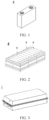
- FIG. 1 is a secondary battery 5 of a rectangular structure as an example.
- the secondary batteries provided in the present invention may be assembled into a battery module, and the battery module may include a plurality of secondary batteries. A specific quantity may be adjusted based on use and capacity of the battery module.
- FIG. 2 is a battery module 4 as an example.
- a plurality of secondary batteries 5 may be sequentially arranged in a length direction of the battery module 4.
- the secondary batteries may alternatively be arranged in any other manner.
- the plurality of secondary batteries 5 may be fastened through fasteners.
- the battery module 4 may further include a housing with an accommodating space, and the plurality of secondary batteries 5 are accommodated in the accommodating space.
- the battery module assembled by using the secondary batteries may be further assembled into a battery pack, and a quantity of the battery modules included in the battery pack may be adjusted based on use and capacity of the battery pack.
- FIG. 3 and FIG. 4 are a battery pack 1 as an example.
- the battery pack 1 may include a battery box and a plurality of battery modules 4 disposed in the battery box.
- the battery box includes an upper box body 2 and a lower box body 3.
- the upper box body 2 can cover the lower box body 3 to form an enclosed space for accommodating the battery modules 4.
- the plurality of battery modules 4 may be arranged in the battery box in any manner.
- the electric apparatus includes the secondary battery provided in this application, and the secondary battery supplies power to the electric apparatus.
- the electric apparatus may be but is not limited to a mobile device (for example, a mobile phone or a notebook computer), an electric vehicle (for example, a battery electric vehicle, a hybrid electric vehicle, a plug-in hybrid electric vehicle, an electric bicycle, an electric scooter, an electric golf vehicle, or an electric truck), an electric train, a ship, a satellite, and an energy storage system.
- the secondary battery, the battery module, or the battery pack may be selected for the electric apparatus based on requirements for using the electric apparatus.
- FIG. 5 is an electric apparatus as an example.
- the electric apparatus is a battery electric vehicle, a hybrid electric vehicle, a plug-in hybrid electric vehicle, or the like.
- a battery pack or a battery module may be used.
- the electric apparatus may be a mobile phone, a tablet computer, a notebook computer, or the like.
- the electric apparatus is usually required to be light and thin, and the secondary battery may be used as a power source.
- a median particle size by volume D v 50 which indicates a particle size of the material where the cumulative distribution by volume reaches 50%, of the spinel-type nickel-manganese-lithium-containing composite oxide material is measured by using Mastersizer 3000 laser particle size analyzer in accordance with GB/T 19077-2016 particle size analysis-laser diffraction methods.
- Morphology of powder of the spinel-type nickel-manganese-lithium-containing composite oxide material is observed by using a field emission scanning electron microscope (ZEISS Sigma 300) in accordance with JY/T010-1996.
- ZEISS Sigma 300 field emission scanning electron microscope
- a monocrystalline particle when one powder particle contains only one crystal or one crystal occupies more than half the volume of the powder particle, the powder particle is referred to as a monocrystalline particle; when one powder particle contains no more than 10 crystals with the same size, the powder particle is referred to as a quasi-monocrystalline particle; and when one powder particle contains more than 10 crystals, the powder particle is referred to as a polycrystalline particle.
- a compacted density of the powder of the spinel-type nickel-manganese-lithium-containing composite oxide material is measured in accordance with GB/T 24533-2009 compacted density test methods.
- a true density of the powder of the spinel-type nickel-manganese-lithium-containing composite oxide material is measured in accordance with GB/T 24586-2009 iron ores-determination of apparent density, true density and porosity.
- a specific surface area of the powder of the spinel-type nickel-manganese-lithium-containing composite oxide material is measured in accordance with GB/T 19587-2004 determination of the specific surface area of solids by gas adsorption using the BET method.
- a lithium source lithium carbonate
- a nickel manganese source nickel manganese hydroxide with a particle size D v 50 being 3.8 microns
- step S2 A P source (NH 4 H 2 PO 4 ) and a G source (WO 3 ) were weighed based on target doping content, and mixed with the body material in step S1 to obtain a raw material mixture.
- step S3 In an air or oxygen atmosphere, the raw material mixture obtained in step S2 was heated to 1000°C at a temperature rise rate of 1°C/min, with the temperature kept for 10 hours, and then cooled to room temperature with a furnace to obtain a spinel-type nickel-manganese-lithium-containing composite oxide.
- Table 1 shows the P source and the G source and the content of added elements P and G in step S2 of Example 1.
- Content of elements in the spinel-type nickel-manganese-lithium-containing composite oxide material prepared in Example 1 was tested, and the results are shown in Table 2. It can be learned that a chemical formula of the body material of the spinel-type nickel-manganese-lithium-containing composite oxide material prepared in Example 1 is Li 1.04 Ni 0.51 Mn 1.49 O 4 , and based on mass of the spinel-type nickel-manganese-lithium-containing composite oxide, doping content of the element P in the body material is 1.39%, and doping content of element G in the body material is 0.19%.
- Example 6 is a morphology image of the spinel-type nickel-manganese-lithium-containing composite oxide material prepared in Example 1, which is of quasi-monocrystalline morphology.
- the spinel-type nickel-manganese-lithium-containing composite oxide is used as a positive electrode active material
- battery performance of a secondary battery as a test object is shown in Table 3. Assembly methods and battery performance test methods of the secondary battery are described below.
- the spinel-type nickel-manganese-lithium-containing composite oxide material, conductive carbon black, and PVDF were mixed at a mass ratio of 96:2.5:1.5, an appropriate amount of N-methylpyrrolidone was added, and the mixture was stirred uniformly to obtain a positive electrode slurry.
- the positive electrode slurry was applied onto an aluminum foil, followed by drying, to obtain a positive electrode plate.
- a loading amount of the positive electrode active material on the positive electrode plate was 0.02 g/cm 2 .
- a negative electrode active material artificial graphite, conductive carbon black, and sodium carboxymethyl cellulose were mixed at a mass ratio of 96:1:3, an appropriate amount of deionized water was added, and the mixture was stirred uniformly to obtain a negative electrode slurry.
- the negative electrode slurry was applied onto a copper foil, followed by drying, to obtain a negative electrode plate.
- a loading amount of graphite on the negative electrode plate was 0.008 g/cm 2 .
- Ethylene carbonate (EC), ethyl methyl carbonate (EMC), and diethyl carbonate (DEC) were mixed at a volume ratio of 1:1:1, and then LiPF 6 was uniformly dissolved in such solution to obtain an electrolyte.
- a concentration of LiPF 6 was 1 mol/L.
- a polypropylene film was used as a separator.
- the positive electrode plate, the separator, and the negative electrode plate prepared above were stacked in sequence, so that the separator was sandwiched between the positive electrode plate and the negative electrode plate for separation. Then the resulting stack was wound, and packaged with an aluminum plastic bag. The electrolyte was injected and then packaged, followed by formation and grading, to obtain the secondary battery.
- the prepared secondary battery is used as a test object.
- the secondary battery was charged to 4.9 V at a constant current of 0.3C, then charged to 0.05C at a constant voltage of 4.9 V, left standing for 5 min, and then discharged to 3.5 V at a constant current of 0.33C.
- the discharge capacity was a discharge capacity of the secondary battery in the first cycle.
- the prepared secondary battery is used as a test object.
- the secondary battery was charged to 4.9 V at a constant current of 0.3C, and then charged to 0.05C at a constant voltage of 4.9 V.
- the secondary battery was placed at 45°C, a discharging process was performed every 5 d, and then the secondary battery was fully charged again and continued to be stored at 45°C.
- a discharge capacity value was extracted until the discharge capacity attenuated to 80% of the initial value, and the storage ended. Total duration of storage at 45°C after full charge is storage duration at full charge at high temperature.
- the prepared secondary battery is used as a test object.
- the secondary battery was charged to 4.9 V at a constant current of 0.3C, then charged to 0.05C at a constant voltage of 4.9 V, left standing for 5 min, and then discharged to 3.5 V at a constant current of 0.33C, which was one charge cycle process.
- a discharge capacity in the charge cycle process was a discharge capacity in the first cycle. After the full battery was subject to 200 charge cycles for the test according to the foregoing method, a remaining reversible discharge capacity was recorded.
- Examples 2 to 4 were the same as Example 1 except that doped G sources were different.
- Specific P sources and G sources and content of added elements P and G are shown in Table 1.
- Structural features and element content test results of obtained spinel-type nickel-manganese-lithium-containing composite oxide materials are shown in Table 2.
- battery performance of secondary batteries as test objects is shown in Table 3.
- Example 5 to 10 were the same as Example 1 except that doping content of the P sources and G sources was different.
- Specific P sources and G sources and content of added elements P and G are shown in Table 1.
- Structural features and element content test results of obtained spinel-type nickel-manganese-lithium-containing composite oxide materials are shown in Table 2.
- battery performance of secondary batteries as test objects is shown in Table 3.
- Comparative Examples 1 to 9 were the same as Example 1 except that no P source was added in Comparative Example 1.
- Comparative Examples 1 to 9 were the same as Example 1 except that no G source was added in Comparative Example 2.
- Comparative Examples 1 to 9 were the same as Example 1 except that no P source or G source was added in Comparative Example 3.
- Comparative Examples 1 to 9 were the same as Example 1 except that doping content of P sources and G sources in Comparative Examples 4 to 9 was different.
- Example 1 NH 4 H 2 PO 4 WO 3 1.40% W 0.20%
- Example 2 NH 4 H 2 PO 4 Nb 2 O 5 1.40% Nb 0.20%
- Example 3 NH 4 H 2 PO 4 SbO 2 1.40% Sb 0.20%
- Example 4 NH 4 H 2 PO 4 SbO 2 1.40% W 0.06% WO 3 Nb 0.07% Nb 2 O 5 Sb 0.07%
- Example 5 NH 4 H 2 PO 4 WO 3 0.50% W 0.20%
- Example 6 NH 4 H 2 PO 4 WO 3 1.00% W 0.20%
- Example 7 NH 4 H 2 PO 4 WO 3 3.00% W 0.20%
- Example 8 NH 4 H 2 PO 4 WO 3 1.40% W 0.07%
- Example 9 NH 4 H 2 PO 4 WO 3 1.40% W 0.10%
- Example 10 NH 4 H 2 PO 4 WO 3 0.50% W 0.05% Comparative Example 1 - WO 3 - W 0.20% Comparative Example 2
- Example 1 Li 1.04 Ni 0.51 Mn 1.49 O 4 1.39% w 0.19% 7.32
- Example 2 Li 1.05 Ni 0.51 Mn 1.49 O 4 1.37% Nb 0.21% 6.52
- Example 3 Li 1.03 Ni 0.51 Mn 1.49 O 4 1.41% Sb 0.19% 7.42
- Example 4 Li 1.04 Ni 0.51 Mn 1.49 O 4 1.38% w 0.06% 6.90 Nb 0.08% Sb 0.06%
- Example 5 Li 1.01 Ni 0.51 Mn 1.49 O 4 0.50% w 0.19% 2.63
- Example 6 Li 1.04 Ni 0.51 Mn 1.49 O 4 0.99% w 0.18% 5.50
- Example 7 Li 1.11 Ni 0.51 Mn 1.49 O 4 2.95% w 0.2
- both the P source and the G source were doped in preparation of the spinel-type nickel-manganese-lithium-containing composite oxides
- both the P source and the G source were also doped in Examples 1 to 10
- elements P and G doped in the prepared spinel-type nickel-manganese-lithium-containing composite oxide materials satisfied the following conditions: based on mass of the spinel-type nickel-manganese-lithium-containing composite oxide, doping content of the element P satisfies 0.48wt% ⁇ k ⁇ 3.05wt%, doping content of the element G (one or more elements selected from elements Nb, W, and Sb) satisfies 0.05wt% ⁇ g ⁇ 0.31wt%, and 2 ⁇ k/g ⁇ 20.
- the batteries can have good high-temperature storage performance (reflected by the storage days at full charge at 45°C) and high-temperature cycling performance (jointly reflected by the discharge capacity in the first cycle and the capacity after 200 cycles at 45°C).
- high-temperature storage performance reflected by the storage days at full charge at 45°C
- high-temperature cycling performance jointly reflected by the discharge capacity in the first cycle and the capacity after 200 cycles at 45°C.
- the secondary battery has better high-temperature storage performance and high-temperature cycling performance.
- Example 11 Based on Example 1, additional additives were added in step S1 in Examples 11 and 12.
- the additive added in Example 11 was Ti02, and the additive added in Example 12 was LiF.
- Structural features and element content test results of obtained spinel-type nickel-manganese-lithium-containing composite oxide materials in Examples 11 and 12 are shown in Table 4.
- Table 4 Structural features of spinel-type nickel-manganese-lithium-containing composite oxides prepared in Examples 11 and 12 and actual doping content of elements P and G No.
- Such additive may include a cation additive or an anion additive.
- the cation additive may be selected from one or more of Ti, Zr, La, Co, Mg, Zn, Al, Mo, V, Cr, and B, and the anion additive may be selected from one or two of F and Cl.
- step S2 The P source (NH 4 H 2 PO 4 ) and the G source (WO 3 ) were weighed based on target doping content, and mixed with the body material in step S1 to obtain a raw material mixture.
- step S3 In the air or oxygen atmosphere, the raw material mixture obtained in step S2 was heated to 1000°C at the temperature rise rate of 1°C/min, with the temperature kept for 10 hours, and then cooled to room temperature with the furnace to obtain a resulting product of the high-temperature heat treatment.
- step S4 The resulting product of the high-temperature heat treatment in step S3 was subject to ball milling for 5 h.
- step S5 In the air or oxygen atmosphere, the product obtained through ball milling in step S4 was heated to 650°C, with the temperature kept for 15 hours, and then cooled to room temperature with the furnace to obtain a spinel-type nickel-manganese-lithium-containing composite oxide.
- Examples 14 and 15 were the same as Example 13 except that doping content of the P sources and G sources was different.
- Structural features and element content test results of obtained spinel-type nickel-manganese-lithium-containing composite oxide materials are shown in Table 6.
- Table 6 When the prepared spinel-type nickel-manganese-lithium-containing composite oxides are used as positive electrode active materials, battery performance of a button half battery and a secondary battery as test objects is shown in Table 7. Assembly methods and performance test methods of the button half battery are as follows.
- Example 16 was the same as Example 13 except that doping content of the P source and G source was different and a product obtained through ball milling in step S4 was heated to 500°C in step S5.
- Structural features and element content test results of an obtained spinel-type nickel-manganese-lithium-containing composite oxide material are shown in Table 6.
- Table 7 Structural features and element content test results of an obtained spinel-type nickel-manganese-lithium-containing composite oxide material are shown in Table 6.
- Table 7 battery performance of a button half battery and a secondary battery as test objects is shown in Table 7. Assembly methods and performance test methods of the button half battery are as follows.
- the spinel-type nickel-manganese-lithium-containing composite oxide material, conductive carbon black, and PVDF were mixed at a mass ratio of 90:5:5, an appropriate amount of N-methylpyrrolidone was added, and the mixture was stirred uniformly to obtain a positive electrode slurry.
- the positive electrode slurry was applied onto an aluminum foil, followed by drying, to obtain a positive electrode plate.
- a loading amount of the positive electrode active material on the positive electrode plate was 0.015 g/cm 2 .
- the prepared positive electrode plate was cut into wafers with a diameter of 14 mm.
- Ethylene carbonate (EC), ethyl methyl carbonate (EMC), and diethyl carbonate (DEC) were mixed at a volume ratio of 1:1:1, and then LiPF 6 was uniformly dissolved in such solution to obtain an electrolyte.
- a concentration of LiPF 6 was 1 mol/L.
- a polypropylene film (for example, wafers with a thickness of 12 ⁇ m and a diameter of 16 mm) was used as a separator.
- a lithium metal sheet with a diameter of 15 mm was used as a counter electrode.
- the lithium metal sheet, the separator, and the positive electrode plate wafers were stacked in sequence, so that the separator was sandwiched between the lithium metal sheet and the positive electrode plate wafers for separation.
- the electrolyte was injected, and a CR2030 button battery was assembled and left standing for 24 h to obtain the button half battery.
- the prepared button half battery was charged to 4.95 V at a constant current rate of 0.1C, then charged to 0.05C at a constant voltage of 4.95 V, left standing for 5 min, and discharged to 3.5 V at a constant current rate of 0.1C.
- An average charge capacity (Q 1 ) at 4.4 V-3.5 V and an average charge capacity (Q 2 ) at 4.95 V-3.5 V are extracted from original charge data of the first charge to calculate Q1/Q2.
- Table 6 Structural features of spinel-type nickel-manganese-lithium-containing composite oxides prepared in Examples 13 to 16 and actual doping content of elements P and G No.
- Example 13 Li 1.06 Ni 0.51 Mn 1.49 O 4 2.01% w 0.20% 10.05
- Example 14 Li 1.05 Ni 0.51 Mn 1.49 O 4 1.42% w 0.29% 4.90
- Example 15 Li 1.10 Ni 0.51 Mn 1.49 O 4 3.02% w 0.31% 9.74
- Example 16 Li 1.06 Ni 0.51 Mn 1.49 O 4 2.03% w 0.21% 9.67
- the proportion of the charge capacity at 3.5 V-4.4 V in the first cycle to the charge capacity at 3.5 V-4.95 V in the first cycle is ⁇ 3%, indicating low content of Mn 3+ and high content of ordered phase P4 3 32 in the prepared spinel-type nickel-manganese-lithium-containing composite oxide material, which is conducive to long-term stability of the battery at high temperature and high voltage.
- the secondary battery is used as a test object, and the results indicate that the secondary battery has better high-temperature storage performance and high-temperature cycling performance.
- the product obtained through ball milling in step S4 was subject to annealing treatment at low annealing temperature in Example 16.
- the obtained spinel-type nickel-manganese-lithium-containing composite oxide can also ensure good high-temperature storage performance and high-temperature cycling performance of the secondary battery, but causes an increase in the proportion of the charge capacity at 3.5 V-4.4 V in the first cycle to the charge capacity at 3.5 V-4.95 V in the first cycle.
- Element content test results and physicochemical parameters of the obtained spinel-type nickel-manganese-lithium-containing composite oxide materials are shown in Table 9 and Table 10 respectively.
- Table 11 battery performance of secondary batteries as test objects is shown in Table 11.
- Table 8 Process parameters of high-temperature heat treatment and annealing treatment of spinel-type nickel-manganese-lithium-containing composite oxides prepared in Examples 17 to 27 No.
- Step S3 high-temperature heat treatment
- Step S5 annealing treatment Temperature rise rate (°C/min) Temperature (°C) Time (h) Temperature (°C) Time (h)
- Example 17 0.5 1000 10 650 15
- Example 18 3 1000 10 650 15
- Example 19 1 910 10 650 15
- Example 20 1 1050 10 650 15
- Example 21 1 1000 5 650 15
- Example 22 1 1000 30 650 15
- Example 23 1 1000 10 650 15
- Example 24 1 1000 10 600 15
- Example 25 1000 10 700 15
- Example 26 1 1000 10 650 5
- Example 27 1 1000 10 650 50
- Table 9 Structural features of spinel-type nickel-manganese-lithium-containing composite oxides prepared in Examples 17 to 27 and actual doping content of elements P and G No.
- Example 17 Li 1.06 Ni o.51 Mn 1.49 O 4 1.38% w 0.19% 7.26
- Example 18 Li 1.03 Ni 0.51 Mn 1.49 O 4 1.39% w 0.18% 7.72
- Example 19 Li 1.05 Ni 0.51 Mn 1.49 O 4 1.41% w 0.19% 7.42
- Example 20 Li 1.03 Ni 0.51 Mn 1.49 O 4 1.40% w 0.21% 6.67
- Example 21 Li 1.05 Ni 0.51 Mn 1.49 O 4 1.38% w 0.19% 7.67
- Example 22 Li 1.03 Ni 0.51 Mn 1.49 O 3.9 1.40% w 0.19% 7.37
- Example 23 Li 1.05 Ni 0.50 Mn 1.50 O 4 1.39% w 0.20% 6.95
- Example 24 Li 1.04 Ni 0.51 Mn 1.49 O 4 1.37% w 0.21% 6.52
- Example 25 Li 1.04 Ni 0.51 Mn 1.49 O 3.9 1.36% w 0.19% 7.16
- Example 26 Li 1.05
- FIG. 7 and FIG. 8 are respectively morphology images of the spinel-type nickel-manganese-lithium-containing composite oxide materials prepared in Examples 20 and 23.
- Example 20 Large single crystals of the power of the material with the particle size D v 50 being 14.1 ⁇ m were obtained in Example 20, and small single crystals of the power of the material with the particle size D v 50 being 5.9 ⁇ m were obtained in Example 23.
- the specific surface areas and true densities of these spinel-type nickel-manganese-lithium-containing composite oxide materials are tested, and the test results show that the specific surface area of the material is generally less than or equal to 1 m 2 /g, and the true density is generally larger than or equal to 4.45 g/cm 3 .
- a higher true density of a material indicates a higher limit value of a compacted density of an active membrane in an electrode plate, and a small specific surface area is more conducive to reducing side reactions on a surface.
- the secondary batteries can also have good high-temperature storage performance and high-temperature cycling performance shown in Table 11.
- Examples 29 to 33 were the same as Example 28 except that added coating materials and content thereof were different. Specifically, Al 2 O 3 was used as the coating material in Examples 29 to 33. Structural features and element content test results of obtained spinel-type nickel-manganese-lithium-containing composite oxide materials in the examples are shown in Table 12. When the prepared spinel-type nickel-manganese-lithium-containing composite oxides are used as positive electrode active materials, battery performance of secondary batteries as test objects is shown in Table 13. Table 13: Battery performance when spinel-type nickel-manganese-lithium-containing composite oxides prepared in Examples 28 to 33 are used as positive electrode active materials No.
- Discharge capacity of secondary battery in the first cycle (mAh/g) Storage days of secondary battery at full charge at 45°C (d) Capacity of secondary battery after 200 cycles at 45°C (mAh/g)
- Example 28 131.5 125 100.8
- Example 29 130.9 165 101.2
- Example 30 132.4 156 103.7
- Example 31 132.1 168 103.9
- Example 32 129.5 235 104.1
- Example 33 124.1 246 100.7
- the coating material can be used for coating the spinel-type nickel-manganese-lithium-containing composite oxide material, and the amount of the coating layer may be calculated based on the specific content of the selected coating element.
- the batteries can also have good high-temperature storage performance and high-temperature cycling performance.
- the coating material may be selected from one or more of the following: aluminum oxide, titanium oxide, boron oxide, zirconium oxide, silicon dioxide, and lithium-containing composite oxide that contains one or more of aluminum, titanium, boron, zirconium, and silicon.
- the coating material such as aluminum oxide and boron oxide can physically separate an electrolyte from a positive electrode material and also be used as a consumable (consume itself to protect the body material), thereby further improving overall performance of the spinel-type nickel-manganese-lithium-containing composite oxide material.
Landscapes
- Chemical & Material Sciences (AREA)
- Chemical Kinetics & Catalysis (AREA)
- General Chemical & Material Sciences (AREA)
- Electrochemistry (AREA)
- Inorganic Chemistry (AREA)
- Engineering & Computer Science (AREA)
- Organic Chemistry (AREA)
- Manufacturing & Machinery (AREA)
- Materials Engineering (AREA)
- Composite Materials (AREA)
- Ceramic Engineering (AREA)
- Structural Engineering (AREA)
- Battery Electrode And Active Subsutance (AREA)
- Inorganic Compounds Of Heavy Metals (AREA)
Applications Claiming Priority (1)
| Application Number | Priority Date | Filing Date | Title |
|---|---|---|---|
| PCT/CN2021/141143 WO2023115527A1 (zh) | 2021-12-24 | 2021-12-24 | 一种尖晶石型含镍锰锂复合氧化物、其制备方法及含有其的二次电池和用电装置 |
Publications (2)
| Publication Number | Publication Date |
|---|---|
| EP4228031A1 true EP4228031A1 (de) | 2023-08-16 |
| EP4228031A4 EP4228031A4 (de) | 2024-01-24 |
Family
ID=86901020
Family Applications (1)
| Application Number | Title | Priority Date | Filing Date |
|---|---|---|---|
| EP21960112.7A Pending EP4228031A4 (de) | 2021-12-24 | 2021-12-24 | Nickel-mangan-lithium-haltiges spinell-verbundoxid, herstellungsverfahren dafür sowie sekundärbatterie und elektrische vorrichtung damit |
Country Status (6)
| Country | Link |
|---|---|
| US (1) | US20230282821A1 (de) |
| EP (1) | EP4228031A4 (de) |
| JP (1) | JP7554421B2 (de) |
| KR (1) | KR102917857B1 (de) |
| CN (1) | CN116868371A (de) |
| WO (1) | WO2023115527A1 (de) |
Family Cites Families (13)
| Publication number | Priority date | Publication date | Assignee | Title |
|---|---|---|---|---|
| CN103531765B (zh) | 2005-05-17 | 2017-01-11 | 索尼株式会社 | 正极活性物质,正极活性物质的制造方法和电池 |
| US8496855B2 (en) * | 2009-07-27 | 2013-07-30 | Samsung Electronics Co., Ltd. | Cathode active material, cathode including cathode active material, and lithium battery including cathode |
| JP2011228292A (ja) * | 2010-04-01 | 2011-11-10 | Mitsubishi Chemicals Corp | リチウム二次電池用正極活物質材料及びその製造方法、並びにそれを用いたリチウム二次電池用正極及びリチウム二次電池 |
| CN102569807B (zh) | 2011-11-10 | 2014-11-26 | 中国科学院宁波材料技术与工程研究所 | 一种包覆改性的锰酸锂正极材料及其制备方法 |
| JP6359323B2 (ja) * | 2013-12-27 | 2018-07-18 | 住友化学株式会社 | リチウムイオン二次電池正極用の表面修飾リチウム含有複合酸化物 |
| KR20170073217A (ko) * | 2015-12-18 | 2017-06-28 | 삼성전자주식회사 | 복합 양극 활물질, 그 제조방법, 이를 포함하는 양극 및 리튬 전지 |
| EP3683873B1 (de) | 2017-11-06 | 2023-04-12 | LG Energy Solution, Ltd. | Lithiumsekundärbatterie |
| CN109817968B (zh) * | 2017-11-21 | 2021-06-25 | 宁德时代新能源科技股份有限公司 | 经表面包覆的镍锰酸锂颗粒及其制造方法 |
| CN111129481B (zh) | 2018-11-01 | 2021-10-29 | 天津国安盟固利新材料科技股份有限公司 | 锂离子电池用正极活性物质的制备方法 |
| CN110085858B (zh) * | 2019-05-20 | 2020-12-18 | 山东省科学院能源研究所 | 一种铌-磷共掺杂高镍三元正极材料及其制备方法和应用 |
| CN111453776B (zh) * | 2020-02-14 | 2021-04-30 | 北京大学 | 一种锂离子电池富锂锰基正极材料的磷、钨共掺杂改性制备方法 |
| CN113224288A (zh) | 2021-05-06 | 2021-08-06 | 安徽锂桥新材料有限公司 | 一种锰基锂电池正极材料及其制备方法 |
| CN113707875B (zh) | 2021-08-24 | 2023-03-07 | 蜂巢能源科技有限公司 | 一种尖晶石型镍锰酸锂、其制备方法和锂离子电池 |
-
2021
- 2021-12-24 CN CN202180094471.1A patent/CN116868371A/zh active Pending
- 2021-12-24 EP EP21960112.7A patent/EP4228031A4/de active Pending
- 2021-12-24 WO PCT/CN2021/141143 patent/WO2023115527A1/zh not_active Ceased
- 2021-12-24 JP JP2023520269A patent/JP7554421B2/ja active Active
- 2021-12-24 KR KR1020237011148A patent/KR102917857B1/ko active Active
-
2023
- 2023-05-11 US US18/315,511 patent/US20230282821A1/en active Pending
Also Published As
| Publication number | Publication date |
|---|---|
| CN116868371A (zh) | 2023-10-10 |
| JP2024503177A (ja) | 2024-01-25 |
| KR20230098564A (ko) | 2023-07-04 |
| JP7554421B2 (ja) | 2024-09-20 |
| US20230282821A1 (en) | 2023-09-07 |
| EP4228031A4 (de) | 2024-01-24 |
| WO2023115527A1 (zh) | 2023-06-29 |
| KR102917857B1 (ko) | 2026-01-27 |
Similar Documents
| Publication | Publication Date | Title |
|---|---|---|
| US11631852B2 (en) | Secondary battery, preparation method thereof, and battery module, battery pack, and apparatus associated therewith | |
| US20230119115A1 (en) | Positive-electrode active material and manufacturing method thereof, secondary battery, battery module, battery pack, and apparatus | |
| EP3955358B1 (de) | Sekundärbatterie und batteriemodul, batteriepack und vorrichtung damit | |
| US12230800B2 (en) | Secondary battery and apparatus containing the secondary battery | |
| US11437623B2 (en) | Secondary battery and apparatus contained the secondary battery | |
| WO2022041259A1 (zh) | 二次电池及其制备方法与包含二次电池的电池模块、电池包及装置 | |
| US12230810B2 (en) | Secondary battery and apparatus containing the same | |
| US12438149B2 (en) | Assembly, battery cell, battery, and electric apparatus containing same | |
| JP7833029B2 (ja) | 改質正極材料、その製造方法、正極シート、二次電池、電池モジュール、電池パック及び電力消費装置 | |
| WO2023015429A1 (zh) | 复合金属氧化物材料及其制备方法、正极极片、二次电池、电池模块、电池包和用电装置 | |
| EP4250401A1 (de) | Lithium-nickel-mangan-basiertes mischoxidmaterial, sekundärbatterie und elektrische vorrichtung | |
| EP4510230A1 (de) | Positivelektrodenaktivmaterial, herstellungsverfahren dafür, sekundärbatterie und elektrische vorrichtung | |
| CN115832187B (zh) | 电极及其制备方法、二次电池、电池模块、电池包和用电装置 | |
| US20250011172A1 (en) | Lithium nickel manganese-containing composite oxide, method for preparation thereof, positive electrode plate, secondary battery and electrical device | |
| US20240413308A1 (en) | Lithium-nickel-manganese-containing composite oxide, preparation method thereof, and positive electrode plate, secondary battery, and electric apparatus containing same | |
| EP4682979A1 (de) | Verfahren zur herstellung eines positivelektrodenmaterials, positivelektrodenmaterial, positivelektrodenfolie, batterie und elektrische vorrichtung | |
| CN117581397B (zh) | 镍锰酸锂正极活性材料及其制备方法、以及使用其的二次电池 | |
| EP4231390B1 (de) | Künstliches graphit und verfahren zu seiner herstellung, sekundärbatterie enhaltend das künstliche graphit, und elektrisches gerät | |
| US20230282821A1 (en) | Spinel-type nickel-manganese-lithium-containing composite oxide, preparation method thereof, and secondary battery and electric apparatus containing same | |
| JP7852030B2 (ja) | 正極活物質、二次電池、電池モジュール、電池パック及び電力消費装置 | |
| JP7579987B2 (ja) | 正極活物質、二次電池、電池モジュール、電池パックと電力消費装置 | |
| WO2025222681A1 (zh) | 一种锂离子电池和用电装置 | |
| KR20260048339A (ko) | 리튬 이차 전지용 양극 재료 및 그 제조 방법, 양극 시트, 이차 전지 및 그 사용 방법, 전기 장치 | |
| CN119944101A (zh) | 电池单体、电池、用电装置 |
Legal Events
| Date | Code | Title | Description |
|---|---|---|---|
| STAA | Information on the status of an ep patent application or granted ep patent |
Free format text: STATUS: UNKNOWN |
|
| STAA | Information on the status of an ep patent application or granted ep patent |
Free format text: STATUS: THE INTERNATIONAL PUBLICATION HAS BEEN MADE |
|
| PUAI | Public reference made under article 153(3) epc to a published international application that has entered the european phase |
Free format text: ORIGINAL CODE: 0009012 |
|
| STAA | Information on the status of an ep patent application or granted ep patent |
Free format text: STATUS: REQUEST FOR EXAMINATION WAS MADE |
|
| 17P | Request for examination filed |
Effective date: 20230428 |
|
| AK | Designated contracting states |
Kind code of ref document: A1 Designated state(s): AL AT BE BG CH CY CZ DE DK EE ES FI FR GB GR HR HU IE IS IT LI LT LU LV MC MK MT NL NO PL PT RO RS SE SI SK SM TR |
|
| REG | Reference to a national code |
Ref country code: DE Ref legal event code: R079 Free format text: PREVIOUS MAIN CLASS: H01M0004505000 Ipc: C01G0053000000 |
|
| A4 | Supplementary search report drawn up and despatched |
Effective date: 20240104 |
|
| RIC1 | Information provided on ipc code assigned before grant |
Ipc: H01M 4/505 20100101ALI20231221BHEP Ipc: C01G 53/00 20060101AFI20231221BHEP |
|
| RAP1 | Party data changed (applicant data changed or rights of an application transferred) |
Owner name: CONTEMPORARY AMPEREX TECHNOLOGY(HONG KONG) LIMITED |
|
| DAV | Request for validation of the european patent (deleted) | ||
| DAX | Request for extension of the european patent (deleted) | ||
| STAA | Information on the status of an ep patent application or granted ep patent |
Free format text: STATUS: EXAMINATION IS IN PROGRESS |
|
| 17Q | First examination report despatched |
Effective date: 20251024 |