EP4233365B1 - Systèmes, appareils et procédés d'optimisation de transfert entraîné par un service cognitif - Google Patents
Systèmes, appareils et procédés d'optimisation de transfert entraîné par un service cognitif Download PDFInfo
- Publication number
- EP4233365B1 EP4233365B1 EP21766177.6A EP21766177A EP4233365B1 EP 4233365 B1 EP4233365 B1 EP 4233365B1 EP 21766177 A EP21766177 A EP 21766177A EP 4233365 B1 EP4233365 B1 EP 4233365B1
- Authority
- EP
- European Patent Office
- Prior art keywords
- qoe
- handover
- user equipment
- related measurements
- logging
- Prior art date
- Legal status (The legal status is an assumption and is not a legal conclusion. Google has not performed a legal analysis and makes no representation as to the accuracy of the status listed.)
- Active
Links
Images





Classifications
-
- H—ELECTRICITY
- H04—ELECTRIC COMMUNICATION TECHNIQUE
- H04W—WIRELESS COMMUNICATION NETWORKS
- H04W36/00—Hand-off or reselection arrangements
- H04W36/0005—Control or signalling for completing the hand-off
- H04W36/0083—Determination of parameters used for hand-off, e.g. generation or modification of neighbour cell lists
- H04W36/00833—Handover statistics
-
- G—PHYSICS
- G06—COMPUTING OR CALCULATING; COUNTING
- G06N—COMPUTING ARRANGEMENTS BASED ON SPECIFIC COMPUTATIONAL MODELS
- G06N20/00—Machine learning
-
- H—ELECTRICITY
- H04—ELECTRIC COMMUNICATION TECHNIQUE
- H04L—TRANSMISSION OF DIGITAL INFORMATION, e.g. TELEGRAPHIC COMMUNICATION
- H04L41/00—Arrangements for maintenance, administration or management of data switching networks, e.g. of packet switching networks
- H04L41/50—Network service management, e.g. ensuring proper service fulfilment according to agreements
- H04L41/5061—Network service management, e.g. ensuring proper service fulfilment according to agreements characterised by the interaction between service providers and their network customers, e.g. customer relationship management
- H04L41/5067—Customer-centric QoS measurements
-
- H—ELECTRICITY
- H04—ELECTRIC COMMUNICATION TECHNIQUE
- H04W—WIRELESS COMMUNICATION NETWORKS
- H04W36/00—Hand-off or reselection arrangements
- H04W36/0005—Control or signalling for completing the hand-off
- H04W36/0083—Determination of parameters used for hand-off, e.g. generation or modification of neighbour cell lists
- H04W36/00837—Determination of triggering parameters for hand-off
- H04W36/008375—Determination of triggering parameters for hand-off based on historical data
-
- H—ELECTRICITY
- H04—ELECTRIC COMMUNICATION TECHNIQUE
- H04W—WIRELESS COMMUNICATION NETWORKS
- H04W24/00—Supervisory, monitoring or testing arrangements
- H04W24/08—Testing, supervising or monitoring using real traffic
Definitions
- Examples of mobile or wireless telecommunication systems may include the Universal Mobile Telecommunications System (UMTS) Terrestrial Radio Access Network (UTRAN), Long Term Evolution (LTE) Evolved UTRAN (E-UTRAN), LTE-Advanced (LTE-A), MulteFire, LTE-A Pro, and/or fifth generation (5G) radio access technology or new radio (NR) access technology.
- UMTS Universal Mobile Telecommunications System
- UTRAN Universal Mobile Telecommunications System
- LTE Long Term Evolution
- E-UTRAN Evolved UTRAN
- LTE-A LTE-Advanced
- MulteFire LTE-A Pro
- 5G wireless systems refer to the next generation (NG) of radio systems and network architecture.
- NG next generation
- a 5G system is mostly built on a 5G new radio (NR), but a 5G (or NG) network can also build on the E-UTRA radio.
- US2018/262924 discloses a network data analytics function, that can receive a request from a policy and control function for a policy input for a packet data unit (PDU) session associated with a network node, can transmit a request for measurement data to the network node, can receive a measurement data response and transmit a policy input to the PCF based on the measurement data response.
- PDU packet data unit
- WO2016/072893 discloses a method for managing a handover of a user equipment from a first to a second radio network node).
- the network node obtains a set of parameters, relating to radio measurements performed by the user equipment towards the second radio network node.
- the network node receives, from the second radio network node, a report including a quality of service value relating to quality of service for the user equipment.
- the network node trains a set of models for prediction of the quality of service for the user equipment by adapting each model of the set of models using the quality of service value of the report as a ground truth to be predicted given a respective subset of the set of parameters, which respective subset is taken as input to said each model.
- WO2020/175866 discloses a method of selectively deploying an application for facilitating quality-of-experience (QoE) in terms of streaming multimedia-content in a networking-environment comprising a user-equipment (UE) and a networking-node provided with a predictive-analysis module.
- the method comprises capturing parameters pertaining to UE from amongst at-least one of a version of the predictive-analysis module with respect to the UE, a current processor-occupancy within the UE, a power-level within the UE, network-conditions pertaining to the access-network etc. Thereafter, one or more of the captured-parameters and the observed network- conditions is analysed. Based on the analysis, inferring is drawn for selecting between the predictive-analysis model of the UE and of the networking-node for thereby enabling a customized- streaming of multimedia-content at the UE.
- QoE quality-of-experience
- Network automation is an important part of the efforts to improve network operability, for example, through automation-related standardization currently being done in 3 rd generation partnership project (3GPP).
- 3GPP 3 rd generation partnership project
- Extreme densification of the network, heterogeneity of access technologies, resource optimization functions on multiple network levels and the scarcity of physical and radio resources call for efficient network management methods that can better automate the complex interactions among network entities.
- CAN Cognitive autonomous networks
- OAM administration and management
- CANs are able to achieve a high degree of efficiency in network operations by utilizing the capabilities of machine learning (ML) and artificial intelligence (AI). This can be done due to the ability of ML and AI to learn the optimal behavior from the environment and previous experience in order to achieve a specific required output or maintain a minimum performance level.
- ML and/or AI to cognitive functions, CANs may take higher level goals, derive appropriate performance targets, learn from the environment through individual or shared experiences, learn to contextualize operating conditions, and learn optimal behavior appropriate to a specific environment and contexts.
- Certain example embodiments described herein are able to take advantage of the powerful capabilities of ML in order to personalize each HO to the mobility specifications of the UE, as well as the services running in real-time. Hence, example embodiments result in a seamless HO from the UE perspective due to the absence of degradations in quality of experience (QoE) while also avoiding traditional radio link failures (RLFs) and ping pong HOs.
- QoE quality of experience
- RLFs radio link failures
- ping pong HOs a seamless HO from the UE perspective due to the absence of degradations in quality of experience (QoE) while also avoiding traditional radio link failures (RLFs) and ping pong HOs.
- a CSDHO may be configured to evaluate the success of a HO in a comprehensive manner, while taking into consideration the radio characteristics such as RLF and ping pong HOs, as well as service dependent QoE.
- This QoE may be defined for specific services. For example, Voice over IP (VoIP) is heavily affected by latency, while data transfer is mostly affected by throughput. This allows certain embodiments to evaluate each HO individually depending on corresponding service attributes.
- VoIP Voice over IP
- a different ML-based QoE model can be trained for each service.
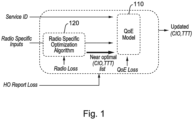
- Fig. 2 illustrates an example block diagram depicting the training of a QoE model 210 using PACHO 220 as a radio specific HO optimization algorithm.
- Fig. 2 illustrates the inputs and outputs of the QoE model 210 operating on the UE to optimize HO parameters.
- PACHO 220 may receive path, input signal sequences, and/or radio loss as input, and may output a near optimal list of CIO and/or TTT to the QoE model 210.
- the QoE model 210 may then output updated CIO and/or TTT.
- Fig. 3 and Fig. 4 illustrate examples of a CSDHO QoE model 310 and CSDHO QoE model 410, respectively, that may take advantage of PACHO as a radio specific optimization algorithm running on the UE.
- the UE may use performance evaluation functions to measure the loss and/or gain in QoE based on the service running on the UE and defined by a Service ID. For example, these functions can be used independent from the optimization model used and the parameters in those functions can be adjusted by the network.
- a HO performance report may be generated by the UE containing the QoE loss and/or gain associated with the HO settings produced by the QoE model. This data may be used for training the QoE model.
- the update and training of the radio specific HO optimization algorithm is independent, which supports the possibility to use CSDHO with any HO optimization algorithm (e.g., legacy or ML-based).
- the HO performance report may be encrypted and sent to the network while maintaining the anonymity of the user and privacy of location and service information.
- the active training of CSDHO may use handover performance reports from multiple UEs to update the QoE model (i.e., the ranking of different HO settings based on QoE measurements provided in the report).
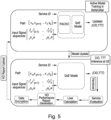
- Fig. 5 illustrates an example block diagram depicting an inference of HO settings using the QoE model at the UE and active model training and fine tuning of the PACHO and QoE model in the RAN/OAM, according to an example embodiment.
- the HO when a certain time period has elapsed after a HO is performed, the HO may be evaluated. This time period can be adjusted by the network dynamically to monitor ping-pong handovers and possible deterioration in QoE post-handover, for example.
- the UE may decide whether to send a corresponding report to the network or not.
- a sent report should improve the QoE model and prevent future UEs from experiencing a bad service scenario in the future. For example, in an embodiment, if the result of the evaluation is below a certain threshold, then the UE may send a HO performance report to the network.
- This threshold can be adjusted dynamically and may be small at the beginning of the active training in order to gather enough information about the performance of the model from many reports sent by multiple UEs. Later, the threshold can be increased to reduce the reports sent to the network and limit them to reports that are beneficial.
- the loss values may be separated such that the QoE related measurements may be reported in the HO performance report generated by the UE. This includes relevant information needed to update the QoE model, such as service ID and QoE measurements. Radio specific data, such as path/location sequence and RSRP values before and after the HO event, can be reported in a different report depending on the used HO optimization method.
- Fig. 5 illustrates how the active model training is achieved in the case of using PACHO as a radio specific HO optimization algorithm. Radio loss may be used to actively fine tune the trained PACHO model, while the QoE loss is used to update the QoE model and make sure that future UEs on the same path in the future are provided a better service through more optimized HO settings.
- Fig. 7 illustrates an example flow diagram of a signaling and SDCHO method, according to an example embodiment.
- Fig. 7 illustrates an example depicting signaling between a gNB/OAM and a UE, according to an example embodiment.
- the gNB/OAM transmits a message to the UE to start performing and/or logging QoE measurements, which may include conditions and parameters relating to the QoE measurements.
- the network e.g., gNB/OAM
- the UE may determine whether the conditions for starting the QoE measurements is true. If the conditions are not true, then the UE may do nothing. If, however, the conditions for starting the QoE measurements is determined to be true, then the UE may, at 2, calculate and log QoE related information. Then, the UE may determine whether conditions for stopping the QoE measurements is true and, if not, then the UE may continue to calculate and log QoE related information. If, however, the UE determines that the conditions for stopping the QoE measurements are true, then the UE may, at 3, stop calculating the QoE related information and generate HO performance reports based on the calculated QoE related information.
- the process may return to the beginning. If, however, it is determined that the reporting conditions are true, then the UE may transmit, at 5, a HO performance report to the gNB/OAM.
- the HO performance report may include the time-stamp, service ID and QoE measurement, as discussed above.
- the data for training the QoE model may include the hash of the radio specific data (e.g., path and signal sequences in the case of PACHO) and the corresponding QoE measurements.
- Table 2 illustrates an example structure of training data entries derived from the observation matrix in the example of Table 1. TABLE 2 Radio specific data QoE data Data A Data B ... Data N Service ID QoE measurement .. . . . . 1 4 .. . . . . 1 2 .. . . .. 1 2
- the training data may be compiled from the observation matrix and the input data can be used in training the radio specific HO optimization algorithm.
- the compilation may be done in the gNB in which case the UE signals the basic observation matrix to the network. This makes it possible to change the radio specific HO optimization algorithm and conserve the modularity of the CSDHO method. This also allows the gNB to combine data sent by multiple UEs simultaneously.
- the network or gNB signals the UE to receive the trained QoE model and then an initial download of the trained QoE model to the UE may be performed.
- the signaling is done first through the control channel and then model download may be done through traffic channels.
- the signaling and model download can be both done through traffic channels while indicating the nature of the model through header fields (e.g. update, new model).
- the HO performance evaluation, loss calculation, and/or HO performance report generation by the UE can be used even in the absence of a QoE model.
- data produced by these functions can be still sent to the network to provide training data for the QoE model before actual deployment.
- These functions may be configured by the network (e.g., by the gNB/OAM) to change parameters through the control channel. In some embodiments, the functions may also be shut down by the UE to conserve battery and a user may be able to opt-out on demand.
- Fig. 8A illustrates an example flow chart of a method for supporting cognitive service driven handover, according to an embodiment.
- the flow diagram of Fig. 8A is performed by a network node in a communications system, such as LTE or 5G NR.
- the network entity performing the method of Fig. 8A may include or be included in a base station, access node, node B, eNB, gNB, NG RAN node, or the like.
- the method of Fig. 8A may be performed by a gNB or OAM entity, such as the gNB/OAM depicted in the example diagram of Fig. 7 .
- the method includes at 800, signaling one or more UEs to start performing and logging quality of experience (QoE) related measurements.
- the signaling 800 may include signaling an indication of start conditions for the at least one user equipment to start the performing and logging of the quality of experience (QoE) related measurements, and/or signaling an indication of stop conditions for the at least one user equipment to stop the performing and logging of the quality of experience (QoE) related measurements.
- the signaling 800 may include configuring the one or more UEs to collect handover data for use to train a quality of experience (QoE) model.
- the signaling 800 may include signaling an indication of a duration for the logging of the quality of experience (QoE) related measurements.
- the duration may at least capture some period of time before and after a handover of the one or more UEs occurs.
- the method includes 810, signaling the one or more UEs to receive a trained quality of experience (QoE) model through at least one of a control channel or traffic channel.
- the signaling 810 includes transmitting or providing the trained QoE mode to the UE(s) via a control channel and/or traffic channel.
- the signaling 810 of the trained QoE model may be performed even in the absence of the signaling 800 to start performing or logging QoE related measurements.
- the signaling 810 of the trained QoE model to the UE(s) may be performed as a standalone method.
- the trained QoE model may be trained with historically collected data from one or more UEs, which may the same and/or different from the UE(s) to which the QoE model is provided.
- the method includes, at 820, transmitting a request for a report on handover performance to the one or more UEs.
- the method includes, at 830, receiving the handover performance report from the one or more UEs, which includes at least one service identifier of a service running on the one or more UEs and the quality of experience (QoE) related measurements.
- the handover performance measurement report may include a time-stamped observation matrix including the at least one service identifier of the service running on the one or more UEs and the quality of experience (QoE) related measurements.
- the receiving 830 of the handover performance report may include receiving the handover performance report through at least one of a control channel and/or traffic channel.
- the method may also include receiving radio specific handover data from the one or more UEs.
- the QoE model may be configured to be trained using at least a hash of the radio specific handover data and corresponding quality of experience (QoE) related measurements received from the one or more UEs.
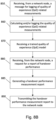
- Fig. 8B illustrates an example flow diagram of a method relating to supporting cognitive service driven handover, according to an embodiment. The method is performed at a UE.
- the method includes at 850, receiving, from a network node, a message for logging of quality of experience (QoE) related measurements at the user equipment.
- the receiving 850 of the message for logging of quality of experience (QoE) related measurements may include receiving an indication of one or more start conditions for the user equipment to start the performing and logging of the quality of experience (QoE) related measurements, and/or receiving an indication of one or more stop conditions for the user equipment to stop the performing and logging of the quality of experience (QoE) related measurements.
- the receiving 850 of the message for logging of quality of experience (QoE) related measurements may include receiving an indication of a duration for the logging of the quality of experience (QoE) related measurements, for example, where the duration may at least capture some period of time before and after a handover of the user equipment occurs.
- the method includes, at 870, receiving a trained quality of experience (QoE) model, from the network node, through at least one of a control channel and/or traffic channel and using the trained quality of experience (QoE) model to select or compute applicable handover settings, and applying the handover settings to determine and/or perform one or more handovers at the user equipment.
- QoE trained quality of experience
- the method may include using real-time global positioning system (GPS) and/or signal information to infer optimal handover settings, and performing, using the inferred parameters, the handover while logging radio and service measurements.
- the method may include transmitting radio specific handover data to the network node.
- GPS global positioning system
- Fig. 9A illustrates an example of an apparatus 10 according to an embodiment.
- the apparatus 10 is a network node.
- apparatus 10 may be a satellite, base station, a Node B, an evolved Node B (eNB), 5G Node B or access point, next generation Node B (NG-NB or gNB), transmission receive point (TRP), high altitude platform station (HAPS), integrated access and backhaul (IAB) node, and/or WLAN access point, associated with a radio access network, such as a LTE network, 5G or NR.
- apparatus 10 may be a gNB or OAM entity.
- apparatus 10 may be comprised of an edge cloud server as a distributed computing system where the server and the radio node may be stand-alone apparatuses communicating with each other via a radio path or via a wired connection, or where they may be located in a same entity communicating via a wired connection.
- apparatus 10 represents a gNB
- it may be configured in a central unit (CU) and distributed unit (DU) architecture that divides the gNB functionality.
- the CU may be a logical node that includes gNB functions such as transfer of user data, mobility control, radio access network sharing, positioning, and/or session management, etc.
- the CU may control the operation of DU(s) over a front-haul interface.
- the DU may be a logical node that includes a subset of the gNB functions, depending on the functional split option. It should be noted that one of ordinary skill in the art would understand that apparatus 10 may include components or features not shown in Fig. 9A .
- apparatus 10 may include two or more processors that may form a multiprocessor system (e.g., in this case processor 12 may represent a multiprocessor) that may support multiprocessing.
- processor 12 may represent a multiprocessor
- the multiprocessor system may be tightly coupled or loosely coupled (e.g., to form a computer cluster).
- Processor 12 may perform functions associated with the operation of apparatus 10, which may include, for example, precoding of antenna gain/phase parameters, encoding and decoding of individual bits forming a communication message, formatting of information, and overall control of the apparatus 10, including processes related to management of communication resources.
- Apparatus 10 further includes a memory 14 (internal or external), which may be coupled to processor 12, for storing information and instructions that may be executed by processor 12.
- memory 14 comprises computer program code that, when executed by processor 12, cause the apparatus to perform the method of any of figures 7-8 .
- 14 may be one or more memories and of any type suitable to the local application environment, and may be implemented using any suitable volatile or nonvolatile data storage technology such as a semiconductor-based memory device, a magnetic memory device and system, an optical memory device and system, fixed memory, and/or removable memory.
- memory 14 can be comprised of any combination of random access memory (RAM), read only memory (ROM), static storage such as a magnetic or optical disk, hard disk drive (HDD), or any other type of non-transitory machine or computer readable media, or other appropriate storing means.
- RAM random access memory
- ROM read only memory
- HDD hard disk drive
- the instructions stored in memory 14 may include program instructions or computer program code that, when executed by processor 12, enable the apparatus 10 to perform tasks as described herein.
- apparatus 10 may further include or be coupled to (internal or external) a drive or port that is configured to accept and read an external computer readable storage medium, such as an optical disc, USB drive, flash drive, or any other storage medium.
- an external computer readable storage medium such as an optical disc, USB drive, flash drive, or any other storage medium.
- the external computer readable storage medium may store a computer program or software for execution by processor 12 and/or apparatus 10.
- the radio interface may include components, such as filters, converters (e.g., digital-to-analog converters and the like), mappers, a Fast Fourier Transform (FFT) module, and/or the like, e.g., to generate symbols or signals for transmission via one or more downlinks and to receive symbols (e.g., via an uplink).
- components such as filters, converters (e.g., digital-to-analog converters and the like), mappers, a Fast Fourier Transform (FFT) module, and/or the like, e.g., to generate symbols or signals for transmission via one or more downlinks and to receive symbols (e.g., via an uplink).
- FFT Fast Fourier Transform
- circuitry may also cover an implementation of merely a hardware circuit or processor (or multiple processors), or portion of a hardware circuit or processor, and its accompanying software and/or firmware.
- circuitry may also cover, for example, a baseband integrated circuit in a server, cellular network node or device, or other computing or network device.
- apparatus 10 may be controlled by memory 14 and processor 12 to signal one or more UEs to start performing and logging quality of experience (QoE) related measurements.
- apparatus 10 may be controlled by memory 14 and processor 12 to signal, to the UE(s), an indication of start conditions for the UE(s) to start the performing and logging of the quality of experience (QoE) related measurements, and/or signaling an indication of stop conditions for the UE(s) to stop the performing and logging of the quality of experience (QoE) related measurements.
- apparatus 10 may be controlled by memory 14 and processor 12 to configure the one or more UEs to collect handover data for use to train a quality of experience (QoE) model.
- apparatus 10 may be controlled by memory 14 and processor 12 to signal an indication of a duration for the logging of the quality of experience (QoE) related measurements.
- the duration may at least capture some period of time before and after a handover of the one or more UEs occurs.
- apparatus 10 may be controlled by memory 14 and processor 12 to signal the one or more UEs to receive a trained quality of experience (QoE) model through at least one of a control channel or traffic channel.
- apparatus 10 may be controlled by memory 14 and processor 12 to transmit or provide the trained QoE mode to the UE(s) via a control channel and/or traffic channel.
- the trained QoE model may be provided to the UE(s) even in the absence of the signaling to start performing or logging QoE related measurements.
- apparatus 10 may be controlled by memory 14 and processor 12 to train the QoE model using historically collected data from one or more UEs, which may the same and/or different from the UE(s) to which the QoE model is provided.
- apparatus 10 may be controlled by memory 14 and processor 12 to transmit a request for a report on handover performance to the one or more UEs.
- apparatus 10 may be controlled by memory 14 and processor 12 to receive the handover performance report from the one or more UEs.
- the handover performance report may include at least one service identifier of a service running on the one or more UEs and the quality of experience (QoE) related measurements.
- the handover performance measurement report may include a time-stamped observation matrix including the at least one service identifier of the service running on the one or more UEs and the quality of experience (QoE) related measurements.
- Fig. 9B illustrates an example of an apparatus 20 according to another embodiment.
- Apparatus 20 is a user equipment, such as a UE, mobile equipment (ME), mobile station, mobile device, stationary device, IoT device, or other device.
- UE may alternatively be referred to as, for example, a mobile station, mobile equipment, mobile unit, mobile device, user device, subscriber station, wireless terminal, tablet, smart phone, IoT device, sensor or NB-IoT device, or the like.
- apparatus 20 may be implemented in, for instance, a wireless handheld device, a wireless plug-in accessory, or the like.
- apparatus 20 comprises a processor 22 (or processing means) for processing information and executing instructions or operations.
- processor 22 may be any type of general or specific purpose processor.
- processor 22 may include one or more of general-purpose computers, special purpose computers, microprocessors, digital signal processors (DSPs), field-programmable gate arrays (FPGAs), application-specific integrated circuits (ASICs), and processors based on a multi-core processor architecture, as examples. While a single processor 22 is shown in Fig. 9B , multiple processors may be utilized according to other embodiments.
- apparatus 20 may include two or more processors that may form a multiprocessor system (e.g., in this case processor 22 may represent a multiprocessor) that may support multiprocessing.
- processor 22 may represent a multiprocessor
- the multiprocessor system may be tightly coupled or loosely coupled (e.g., to form a computer cluster).
- Processor 22 may perform functions associated with the operation of apparatus 20 including, as some examples, precoding of antenna gain/phase parameters, encoding and decoding of individual bits forming a communication message, formatting of information, and overall control of the apparatus 20, including processes related to management of communication resources.
- Apparatus 20 further comprises a memory 24 (internal or external), which may be coupled to processor 22, for storing information and instructions that may be executed by processor 22.
- memory 24 comprises computer program code that, when executed by processor 22, cause the apparatus 20 to perform the method of any of figures 7-8 .
- Memory 24 may be one or more memories and of any type suitable to the local application environment, and may be implemented using any suitable volatile or nonvolatile data storage technology such as a semiconductor-based memory device, a magnetic memory device and system, an optical memory device and system, fixed memory, and/or removable memory.
- memory 24 can be comprised of any combination of random access memory (RAM), read only memory (ROM), static storage such as a magnetic or optical disk, hard disk drive (HDD), or any other type of non-transitory machine or computer readable media, or other storage means.
- RAM random access memory
- ROM read only memory
- HDD hard disk drive
- the instructions stored in memory 24 may include program instructions or computer program code that, when executed by processor 22, enable the apparatus 20 to perform tasks as described herein.
- apparatus 20 may further include or be coupled to (internal or external) a drive or port that is configured to accept and read an external computer readable storage medium, such as an optical disc, USB drive, flash drive, or any other storage medium.
- an external computer readable storage medium such as an optical disc, USB drive, flash drive, or any other storage medium.
- the external computer readable storage medium may store a computer program or software for execution by processor 22 and/or apparatus 20.
- apparatus 20 may also include or be coupled to one or more antennas 25 for receiving a downlink signal and for transmitting via an uplink from apparatus 20.
- Apparatus 20 may further include a transceiver 28 (or transceiving means) configured to transmit and receive information.
- the transceiver 28 may also include a radio interface (e.g., a modem) coupled to the antenna 25.
- the radio interface may correspond to a plurality of radio access technologies including one or more of GSM, LTE, LTE-A, 5G, NR, WLAN, NB-IoT, Bluetooth, BT-LE, NFC, RFID, UWB, and the like.
- the radio interface may include other components, such as filters, converters (for example, digital-to-analog converters and the like), symbol demappers, signal shaping components, an Inverse Fast Fourier Transform (IFFT) module, and the like, to process symbols, such as OFDMA symbols, carried by a downlink or an uplink.
- filters for example, digital-to-analog converters and the like
- symbol demappers for example, digital-to-analog converters and the like
- signal shaping components for example, an Inverse Fast Fourier Transform (IFFT) module, and the like
- IFFT Inverse Fast Fourier Transform
- transceiver 28 may be configured to modulate information on to a carrier waveform for transmission by the antenna(s) 25 and demodulate information received via the antenna(s) 25 for further processing by other elements of apparatus 20.
- transceiver 28 may be capable of transmitting and receiving signals or data directly.
- apparatus 20 may include an input and/or output device (I/O device) or input/output means.
- apparatus 20 may further include a user interface, such as a graphical user interface or touchscreen.
- memory 24 stores software modules that provide functionality when executed by processor 22.
- the modules may include, for example, an operating system that provides operating system functionality for apparatus 20.
- the memory may also store one or more functional modules, such as an application or program, to provide additional functionality for apparatus 20.
- the components of apparatus 20 may be implemented in hardware, or as any suitable combination of hardware and software.
- apparatus 20 may optionally be configured to communicate with apparatus 10 via a wireless or wired communications link 70 according to any radio access technology, such as NR.
- apparatus 20 may be a UE, mobile device, mobile station, ME, IoT device and/or NB-IoT device, for example.
- apparatus 20 may be controlled by memory 24 and processor 22 to perform the functions associated with example embodiments described herein.
- apparatus 20 may be configured to perform one or more of the processes or procedures depicted in any of the flow charts or signaling diagrams described herein, such as that illustrated in Fig. 7 or Figs. 8A-8B .
- apparatus 20 may be configured to perform or execute procedure(s) relating to supporting and/or performing cognitive service driven handover, for instance.
- apparatus 20 may be controlled by memory 24 and processor 22 to receive, from a network node, a message for logging of quality of experience (QoE) related measurements at apparatus 20.
- apparatus 20 may be controlled by memory 24 and processor 22 to receive an indication of one or more start conditions for the apparatus 20 to start the performing and logging of the quality of experience (QoE) related measurements, and/or to receive an indication of one or more stop conditions for the apparatus 20 to stop the performing and logging of the quality of experience (QoE) related measurements.
- QoE quality of experience
- apparatus 20 may be controlled by memory 24 and processor 22 to receive an indication of a duration for the logging of the quality of experience (QoE) related measurements, for example, where the duration may at least capture some period of time before and after a handover of the apparatus 20 occurs.
- QoE quality of experience
- apparatus 20 may be controlled by memory 24 and processor 22 to measure, calculate and/or log the quality of experience (QoE) related measurements.
- apparatus 20 may be controlled by memory 24 and processor 22 to start to calculate and log of the quality of experience (QoE) related measurements when the start conditions are met, and to stop calculating and logging of the quality of experience (QoE) related measurements when the stop conditions are met.
- apparatus 20 may be controlled by memory 24 and processor 22 to use performance evaluation functions to measure loss or gain in quality of experience (QoE) based on the service running on the apparatus 20 as defined by the service identifier.
- apparatus 20 may be controlled by memory 24 and processor 22 to receive a trained quality of experience (QoE) model, from the network node, through at least one of a control channel and/or traffic channel.
- apparatus 20 may be controlled by memory 24 and processor 22 to use the trained quality of experience (QoE) model to select or compute applicable handover settings, and to apply the handover settings to determine and/or perform one or more handovers at the apparatus 20.
- QoE trained quality of experience
- apparatus 20 may be controlled by memory 24 and processor 22 to receive, from the network node, a request for a report of handover performance.
- apparatus 20 may be controlled by memory 24 and processor 22 to generate a handover performance measurement report.
- the handover performance report may include at least one service identifier of a service running on the apparatus 20 and the quality of experience (QoE) related measurements.
- apparatus 20 may be controlled by memory 24 and processor 22 to generate a handover performance measurement report containing a loss or gain in quality of experience (QoE) associated with the handover settings.
- QoE quality of experience
- apparatus 20 may be controlled by memory 24 and processor 22 to transmit the handover performance measurement report to the network node, e.g., based on a result of an evaluation of the handover of the apparatus 20. It is noted that, according to some embodiments, not every generated handover performance measurement report need be transmitted to the network node.
- the handover performance report may be encrypted and configured to maintain anonymity of a user of the apparatus 20 and privacy of location and service information.
- the handover performance measurement report may include a time-stamped observation matrix comprising the at least one service identifier of the service running on the apparatus 20 and the quality of experience (QoE) related measurements.
- QoE quality of experience
- apparatus 20 may be controlled by memory 24 and processor 22 to use real-time global positioning system (GPS) and/or signal information to infer optimal handover settings, and to perform, using the inferred parameters, the handover while logging radio and service measurements.
- apparatus 20 may be further controlled by memory 24 and processor 22 to transmit radio specific handover data to the network node.
- GPS global positioning system
- an apparatus may include means for performing a method or any of the variants discussed herein, e.g., a method described with reference to Figs. 5 or 6 .
- Examples of the means may include one or more processors, memory, and/or computer program code for causing the performance of the operation.
- an apparatus may include or be associated with at least one software application, module, unit or entity configured as arithmetic operation(s), or as a program or portions of programs (including an added or updated software routine), which may be executed by at least one operation processor or controller.
- Programs also called program products or computer programs, including software routines, applets and macros, may be stored in any apparatus-readable data storage medium and may include program instructions to perform particular tasks.
Landscapes
- Engineering & Computer Science (AREA)
- Software Systems (AREA)
- Computer Networks & Wireless Communication (AREA)
- Signal Processing (AREA)
- Theoretical Computer Science (AREA)
- Computer Vision & Pattern Recognition (AREA)
- Evolutionary Computation (AREA)
- Medical Informatics (AREA)
- Data Mining & Analysis (AREA)
- Physics & Mathematics (AREA)
- Computing Systems (AREA)
- General Engineering & Computer Science (AREA)
- General Physics & Mathematics (AREA)
- Mathematical Physics (AREA)
- Artificial Intelligence (AREA)
- Business, Economics & Management (AREA)
- General Business, Economics & Management (AREA)
- Mobile Radio Communication Systems (AREA)
Claims (12)
- Procédé réalisé par un nœud de réseau (10), le procédé comprenant les étapes suivantes :commander (800) à au moins un équipement utilisateur de commencer à effectuer et à consigner des mesures liées à une qualité d'expérience, QoE ;transmettre (820) une demande de rapport sur une performance de transfert intercellulaire à l'au moins un équipement utilisateur ; etrecevoir (830) le rapport de performance de transfert intercellulaire de l'au moins un équipement utilisateur, dans lequel le rapport de performance de transfert intercellulaire comprend au moins un identifiant de service d'un service s'exécutant sur l'au moins un équipement utilisateur et les mesures liées à une qualité d'expérience, QoE ; dans lequel la commande de commencer à effectuer et à consigner des mesures liées à une QoE comprend la configuration de l'au moins un équipement utilisateur pour qu'il collecte des données de transfert intercellulaire à utiliser pour entraîner le modèle de qualité d'expérience, QoE, (110, 210, 310, 410) ; etcomprenant en outre la commande (810) à l'au moins un équipement utilisateur de recevoir un modèle QoE (110, 210, 310, 410) entraîné par au moins un parmi un canal de contrôle et un canal de trafic.
- Procédé selon la revendication 1, dans lequel la commande de commencer à effectuer et à consigner des mesures liées à une QoE comprend une commande indiquant : des conditions de début pour que l'au moins un équipement utilisateur commence à effectuer et à consigner les mesures liées à une qualité d'expérience, QoE, et/ou des conditions d'arrêt pour que l'au moins un équipement utilisateur arrête d'effectuer et de consigner les mesures liées à une QoE.
- Procédé selon l'une des revendications 1 et 2, dans lequel la commande de commencer à effectuer et à consigner des mesures liées à une QoE comprend une commande indiquant une durée de la journalisation des mesures liées à une QoE, dans lequel la durée capture au moins une certaine période de temps avant et après l'occurrence d'un transfert intercellulaire de l'au moins un équipement utilisateur.
- Procédé selon l'une des revendications 1 à 3, dans lequel le rapport de mesure de performance de transfert intercellulaire comprend une matrice d'observation horodatée comprenant l'au moins un identifiant de service du service s'exécutant sur l'au moins un équipement utilisateur et les mesures liées à une QoE.
- Procédé selon l'une des revendications 1 à 4, dans lequel la réception du rapport de performance de transfert intercellulaire comprend la réception du rapport de performance de transfert intercellulaire par au moins un parmi un canal de contrôle et un canal de trafic.
- Procédé selon l'une des revendications 1 à 5, comprenant en outre la réception de données de transfert intercellulaire radio spécifiques de l'au moins un équipement utilisateur.
- Procédé selon l'une des revendications 1 à 6, dans lequel le modèle QoE (110, 210, 310, 410) est configuré pour être entraîné à l'aide d'au moins un hachage des données de transfert intercellulaire radio spécifiques et de mesures liées à une QoE correspondantes reçues de l'au moins un équipement utilisateur.
- Procédé réalisé par un équipement utilisateur (20), comprenant les étapes suivantes :recevoir (850), d'un nœud de réseau, un message pour consigner des mesures liées à une qualité d'expérience, QoE, au niveau de l'équipement utilisateur ;calculer et consigner (860) des mesures liées à une QoE ;recevoir (880), du nœud de réseau, une demande de rapport sur la performance de transfert intercellulaire ; etgénérer (885) un rapport de mesure de performance de transfert intercellulaire, dans lequel le rapport de performance de transfert intercellulaire comprend au moins un identifiant de service d'un service s'exécutant sur l'équipement utilisateur et les mesures liées à une QoE ;recevoir (870) un modèle QoE (110, 210, 310, 410) entraîné par au moins un parmi un canal de contrôle et un canal de trafic ;utiliser le modèle QoE entraîné pour sélectionner ou calculer des paramétrages de transfert intercellulaire applicables ; etappliquer les paramétrages de transfert intercellulaire pour déterminer un ou plusieurs transferts intercellulaires au niveau de l'équipement utilisateur.
- Procédé selon la revendication 8, transmettant le rapport de mesure de performance de transfert intercellulaire au nœud de réseau sur la base d'un résultat d'une évaluation du transfert intercellulaire de l'équipement utilisateur.
- Procédé selon la revendication 9, dans lequel la génération comprend la génération d'un rapport de mesure de performance de transfert intercellulaire contenant une perte ou un gain de QoE associés aux paramétrages de transfert intercellulaire.
- Nœud de réseau (10), comprenant :au moins un processeur (12) ; etau moins une mémoire (14) comprenant un code de programme informatique,le code de programme informatique étant configuré, lorsqu'il est exécuté par l'au moins un processeur, pour amener le nœud de réseau à effectuer au moins un procédé selon l'une des revendications 1 à 7.
- Équipement utilisateur (20), comprenant :au moins un processeur (22) ; etau moins une mémoire (24) comprenant un code de programme informatique,le code de programme informatique étant configuré, lorsqu'il est exécuté par l'au moins un processeur, pour amener l'équipement utilisateur à effectuer au moins un procédé selon l'une des revendications 8 à 10.
Applications Claiming Priority (2)
| Application Number | Priority Date | Filing Date | Title |
|---|---|---|---|
| US202063094527P | 2020-10-21 | 2020-10-21 | |
| PCT/EP2021/073569 WO2022083923A1 (fr) | 2020-10-21 | 2021-08-26 | Systèmes, appareils et procédés d'optimisation de transfert entraîné par un service cognitif |
Publications (2)
| Publication Number | Publication Date |
|---|---|
| EP4233365A1 EP4233365A1 (fr) | 2023-08-30 |
| EP4233365B1 true EP4233365B1 (fr) | 2025-04-09 |
Family
ID=77655552
Family Applications (1)
| Application Number | Title | Priority Date | Filing Date |
|---|---|---|---|
| EP21766177.6A Active EP4233365B1 (fr) | 2020-10-21 | 2021-08-26 | Systèmes, appareils et procédés d'optimisation de transfert entraîné par un service cognitif |
Country Status (4)
| Country | Link |
|---|---|
| US (1) | US20230379774A1 (fr) |
| EP (1) | EP4233365B1 (fr) |
| ES (1) | ES3028667T3 (fr) |
| WO (1) | WO2022083923A1 (fr) |
Families Citing this family (2)
| Publication number | Priority date | Publication date | Assignee | Title |
|---|---|---|---|---|
| EP4478680A1 (fr) * | 2023-06-16 | 2024-12-18 | Nokia Technologies Oy | Appareil, procédés et programmes informatiques relatifs à la qualité d'expérience |
| JP2025074740A (ja) * | 2023-10-30 | 2025-05-14 | Kddi株式会社 | 移動通信ネットワークのネットワークノード、サーバ及びプログラム |
Citations (1)
| Publication number | Priority date | Publication date | Assignee | Title |
|---|---|---|---|---|
| WO2022034114A1 (fr) * | 2020-08-11 | 2022-02-17 | Nokia Technologies Oy | Optimisation de transfert cognitif sensible au trajet |
Family Cites Families (3)
| Publication number | Priority date | Publication date | Assignee | Title |
|---|---|---|---|---|
| WO2016072893A1 (fr) * | 2014-11-05 | 2016-05-12 | Telefonaktiebolaget L M Ericsson (Publ) | Entraînement de modèles de prédiction de qualité de service après transfert pour le déclenchement d'un transfert |
| US10986516B2 (en) * | 2017-03-10 | 2021-04-20 | Huawei Technologies Co., Ltd. | System and method of network policy optimization |
| CN113475089B (zh) * | 2019-02-25 | 2024-04-19 | 三星电子株式会社 | 用于面向用户的内容流的方法和系统 |
-
2021
- 2021-08-26 EP EP21766177.6A patent/EP4233365B1/fr active Active
- 2021-08-26 WO PCT/EP2021/073569 patent/WO2022083923A1/fr not_active Ceased
- 2021-08-26 US US18/248,149 patent/US20230379774A1/en active Pending
- 2021-08-26 ES ES21766177T patent/ES3028667T3/es active Active
Patent Citations (1)
| Publication number | Priority date | Publication date | Assignee | Title |
|---|---|---|---|---|
| WO2022034114A1 (fr) * | 2020-08-11 | 2022-02-17 | Nokia Technologies Oy | Optimisation de transfert cognitif sensible au trajet |
Also Published As
| Publication number | Publication date |
|---|---|
| EP4233365A1 (fr) | 2023-08-30 |
| WO2022083923A1 (fr) | 2022-04-28 |
| ES3028667T3 (en) | 2025-06-19 |
| US20230379774A1 (en) | 2023-11-23 |
Similar Documents
| Publication | Publication Date | Title |
|---|---|---|
| EP4147478B1 (fr) | Configuration de mesure pour la gestion de ressources radio utilisant un apprentissage automatique local | |
| US12556945B2 (en) | Methods and apparatuses for testing user equipment (UE) machine learning-assisted radio resource management (RRM) functionalities | |
| US12401400B2 (en) | Early channel state information acquisition for target cell in layer one / layer two inter-cell mobility | |
| KR20240009392A (ko) | Ml 모델 트레이닝 프로시저 | |
| EP4214954B1 (fr) | Procédés et appareils pour procédures de transfert | |
| US20240057139A1 (en) | Optimization of deterministic and non-deterministic traffic in radio-access network (ran) | |
| US20250374103A1 (en) | Communication method and apparatus | |
| WO2019242004A1 (fr) | Procédé, appareil et support lisible par ordinateur servant à l'optimisation de réseau | |
| US12150158B2 (en) | Handling of multiple minimization of drive test contexts in multiple radio resource controller states | |
| US20240172016A1 (en) | Prediction of cell traffic in a network | |
| US12185175B2 (en) | Service-centric mobility-based traffic steering | |
| US20260046694A1 (en) | Offloading plan enabled exchange between network nodes | |
| US20240259899A1 (en) | Unconfigured measurement gaps handling for frame based equipment (fbe) operation | |
| EP4233365B1 (fr) | Systèmes, appareils et procédés d'optimisation de transfert entraîné par un service cognitif | |
| CN117545019A (zh) | 用于负载均衡的方法及相关设备 | |
| US20260032555A1 (en) | Network aware optimal route selection for autonomous applications | |
| EP4078819B1 (fr) | Rétroaction de probabilité d'erreur d'unité de données de protocole (pdu) | |
| CN117479213A (zh) | 信息传输方法、装置及网络节点 | |
| CN106688269B (zh) | 用于确定无线设备是否是由于负载平衡原因而切换到目标小区的合适候选者的无线电网络节点和方法 | |
| US11812322B2 (en) | Channel state information reference signal configuration for inter-cell mobility | |
| US20260046856A1 (en) | Determining and adapting wireless network functionality using multiple configuration sets | |
| US20260046673A1 (en) | Determining and adapting wireless network functionality using multiple configuration sets | |
| US20240147417A1 (en) | Dynamic mechanism to improve subscriber level paging success rate in long term evolution and new radio networks | |
| US20250386238A1 (en) | Artificial intelligence-enabled routing and splitting of data traffic | |
| CN119729645A (zh) | 一种被用于无线通信的通信节点中的方法和装置 |
Legal Events
| Date | Code | Title | Description |
|---|---|---|---|
| STAA | Information on the status of an ep patent application or granted ep patent |
Free format text: STATUS: UNKNOWN |
|
| STAA | Information on the status of an ep patent application or granted ep patent |
Free format text: STATUS: THE INTERNATIONAL PUBLICATION HAS BEEN MADE |
|
| PUAI | Public reference made under article 153(3) epc to a published international application that has entered the european phase |
Free format text: ORIGINAL CODE: 0009012 |
|
| STAA | Information on the status of an ep patent application or granted ep patent |
Free format text: STATUS: REQUEST FOR EXAMINATION WAS MADE |
|
| 17P | Request for examination filed |
Effective date: 20230522 |
|
| AK | Designated contracting states |
Kind code of ref document: A1 Designated state(s): AL AT BE BG CH CY CZ DE DK EE ES FI FR GB GR HR HU IE IS IT LI LT LU LV MC MK MT NL NO PL PT RO RS SE SI SK SM TR |
|
| DAV | Request for validation of the european patent (deleted) | ||
| DAX | Request for extension of the european patent (deleted) | ||
| STAA | Information on the status of an ep patent application or granted ep patent |
Free format text: STATUS: EXAMINATION IS IN PROGRESS |
|
| 17Q | First examination report despatched |
Effective date: 20240430 |
|
| RIC1 | Information provided on ipc code assigned before grant |
Ipc: H04W 24/08 20090101ALN20240627BHEP Ipc: G06N 20/00 20190101ALN20240627BHEP Ipc: H04W 36/00 20090101AFI20240627BHEP |
|
| GRAP | Despatch of communication of intention to grant a patent |
Free format text: ORIGINAL CODE: EPIDOSNIGR1 |
|
| STAA | Information on the status of an ep patent application or granted ep patent |
Free format text: STATUS: GRANT OF PATENT IS INTENDED |
|
| RIC1 | Information provided on ipc code assigned before grant |
Ipc: H04W 24/08 20090101ALN20240705BHEP Ipc: G06N 20/00 20190101ALN20240705BHEP Ipc: H04W 36/00 20090101AFI20240705BHEP |
|
| INTG | Intention to grant announced |
Effective date: 20240808 |
|
| GRAJ | Information related to disapproval of communication of intention to grant by the applicant or resumption of examination proceedings by the epo deleted |
Free format text: ORIGINAL CODE: EPIDOSDIGR1 |
|
| STAA | Information on the status of an ep patent application or granted ep patent |
Free format text: STATUS: EXAMINATION IS IN PROGRESS |
|
| GRAP | Despatch of communication of intention to grant a patent |
Free format text: ORIGINAL CODE: EPIDOSNIGR1 |
|
| STAA | Information on the status of an ep patent application or granted ep patent |
Free format text: STATUS: GRANT OF PATENT IS INTENDED |
|
| INTC | Intention to grant announced (deleted) | ||
| RIC1 | Information provided on ipc code assigned before grant |
Ipc: H04W 24/08 20090101ALN20241023BHEP Ipc: G06N 20/00 20190101ALN20241023BHEP Ipc: H04W 36/00 20090101AFI20241023BHEP |
|
| INTG | Intention to grant announced |
Effective date: 20241104 |
|
| GRAS | Grant fee paid |
Free format text: ORIGINAL CODE: EPIDOSNIGR3 |
|
| GRAA | (expected) grant |
Free format text: ORIGINAL CODE: 0009210 |
|
| STAA | Information on the status of an ep patent application or granted ep patent |
Free format text: STATUS: THE PATENT HAS BEEN GRANTED |
|
| P01 | Opt-out of the competence of the unified patent court (upc) registered |
Free format text: CASE NUMBER: APP_8147/2025 Effective date: 20250218 |
|
| AK | Designated contracting states |
Kind code of ref document: B1 Designated state(s): AL AT BE BG CH CY CZ DE DK EE ES FI FR GB GR HR HU IE IS IT LI LT LU LV MC MK MT NL NO PL PT RO RS SE SI SK SM TR |
|
| REG | Reference to a national code |
Ref country code: GB Ref legal event code: FG4D |
|
| REG | Reference to a national code |
Ref country code: CH Ref legal event code: EP |
|
| REG | Reference to a national code |
Ref country code: DE Ref legal event code: R096 Ref document number: 602021028967 Country of ref document: DE |
|
| REG | Reference to a national code |
Ref country code: IE Ref legal event code: FG4D |
|
| REG | Reference to a national code |
Ref country code: ES Ref legal event code: FG2A Ref document number: 3028667 Country of ref document: ES Kind code of ref document: T3 Effective date: 20250619 |
|
| REG | Reference to a national code |
Ref country code: NL Ref legal event code: MP Effective date: 20250409 |
|
| PG25 | Lapsed in a contracting state [announced via postgrant information from national office to epo] |
Ref country code: NL Free format text: LAPSE BECAUSE OF FAILURE TO SUBMIT A TRANSLATION OF THE DESCRIPTION OR TO PAY THE FEE WITHIN THE PRESCRIBED TIME-LIMIT Effective date: 20250409 |
|
| REG | Reference to a national code |
Ref country code: AT Ref legal event code: MK05 Ref document number: 1784719 Country of ref document: AT Kind code of ref document: T Effective date: 20250409 |
|
| PG25 | Lapsed in a contracting state [announced via postgrant information from national office to epo] |
Ref country code: PT Free format text: LAPSE BECAUSE OF FAILURE TO SUBMIT A TRANSLATION OF THE DESCRIPTION OR TO PAY THE FEE WITHIN THE PRESCRIBED TIME-LIMIT Effective date: 20250811 Ref country code: FI Free format text: LAPSE BECAUSE OF FAILURE TO SUBMIT A TRANSLATION OF THE DESCRIPTION OR TO PAY THE FEE WITHIN THE PRESCRIBED TIME-LIMIT Effective date: 20250409 |
|
| PGFP | Annual fee paid to national office [announced via postgrant information from national office to epo] |
Ref country code: ES Payment date: 20250909 Year of fee payment: 5 |
|
| REG | Reference to a national code |
Ref country code: LT Ref legal event code: MG9D |
|
| PG25 | Lapsed in a contracting state [announced via postgrant information from national office to epo] |
Ref country code: NO Free format text: LAPSE BECAUSE OF FAILURE TO SUBMIT A TRANSLATION OF THE DESCRIPTION OR TO PAY THE FEE WITHIN THE PRESCRIBED TIME-LIMIT Effective date: 20250709 Ref country code: GR Free format text: LAPSE BECAUSE OF FAILURE TO SUBMIT A TRANSLATION OF THE DESCRIPTION OR TO PAY THE FEE WITHIN THE PRESCRIBED TIME-LIMIT Effective date: 20250710 |
|
| PG25 | Lapsed in a contracting state [announced via postgrant information from national office to epo] |
Ref country code: PL Free format text: LAPSE BECAUSE OF FAILURE TO SUBMIT A TRANSLATION OF THE DESCRIPTION OR TO PAY THE FEE WITHIN THE PRESCRIBED TIME-LIMIT Effective date: 20250409 |
|
| PGFP | Annual fee paid to national office [announced via postgrant information from national office to epo] |
Ref country code: IT Payment date: 20250722 Year of fee payment: 5 |
|
| PG25 | Lapsed in a contracting state [announced via postgrant information from national office to epo] |
Ref country code: BG Free format text: LAPSE BECAUSE OF FAILURE TO SUBMIT A TRANSLATION OF THE DESCRIPTION OR TO PAY THE FEE WITHIN THE PRESCRIBED TIME-LIMIT Effective date: 20250409 |
|
| PGFP | Annual fee paid to national office [announced via postgrant information from national office to epo] |
Ref country code: GB Payment date: 20250703 Year of fee payment: 5 |
|
| PG25 | Lapsed in a contracting state [announced via postgrant information from national office to epo] |
Ref country code: HR Free format text: LAPSE BECAUSE OF FAILURE TO SUBMIT A TRANSLATION OF THE DESCRIPTION OR TO PAY THE FEE WITHIN THE PRESCRIBED TIME-LIMIT Effective date: 20250409 |
|
| PG25 | Lapsed in a contracting state [announced via postgrant information from national office to epo] |
Ref country code: AT Free format text: LAPSE BECAUSE OF FAILURE TO SUBMIT A TRANSLATION OF THE DESCRIPTION OR TO PAY THE FEE WITHIN THE PRESCRIBED TIME-LIMIT Effective date: 20250409 |
|
| PG25 | Lapsed in a contracting state [announced via postgrant information from national office to epo] |
Ref country code: RS Free format text: LAPSE BECAUSE OF FAILURE TO SUBMIT A TRANSLATION OF THE DESCRIPTION OR TO PAY THE FEE WITHIN THE PRESCRIBED TIME-LIMIT Effective date: 20250709 |
|
| PG25 | Lapsed in a contracting state [announced via postgrant information from national office to epo] |
Ref country code: IS Free format text: LAPSE BECAUSE OF FAILURE TO SUBMIT A TRANSLATION OF THE DESCRIPTION OR TO PAY THE FEE WITHIN THE PRESCRIBED TIME-LIMIT Effective date: 20250809 |
|
| PG25 | Lapsed in a contracting state [announced via postgrant information from national office to epo] |
Ref country code: LV Free format text: LAPSE BECAUSE OF FAILURE TO SUBMIT A TRANSLATION OF THE DESCRIPTION OR TO PAY THE FEE WITHIN THE PRESCRIBED TIME-LIMIT Effective date: 20250409 |
|
| REG | Reference to a national code |
Ref country code: DE Ref legal event code: R097 Ref document number: 602021028967 Country of ref document: DE |
|
| PG25 | Lapsed in a contracting state [announced via postgrant information from national office to epo] |
Ref country code: SM Free format text: LAPSE BECAUSE OF FAILURE TO SUBMIT A TRANSLATION OF THE DESCRIPTION OR TO PAY THE FEE WITHIN THE PRESCRIBED TIME-LIMIT Effective date: 20250409 Ref country code: DK Free format text: LAPSE BECAUSE OF FAILURE TO SUBMIT A TRANSLATION OF THE DESCRIPTION OR TO PAY THE FEE WITHIN THE PRESCRIBED TIME-LIMIT Effective date: 20250409 |
|
| PG25 | Lapsed in a contracting state [announced via postgrant information from national office to epo] |
Ref country code: CZ Free format text: LAPSE BECAUSE OF FAILURE TO SUBMIT A TRANSLATION OF THE DESCRIPTION OR TO PAY THE FEE WITHIN THE PRESCRIBED TIME-LIMIT Effective date: 20250409 |
|
| PG25 | Lapsed in a contracting state [announced via postgrant information from national office to epo] |
Ref country code: EE Free format text: LAPSE BECAUSE OF FAILURE TO SUBMIT A TRANSLATION OF THE DESCRIPTION OR TO PAY THE FEE WITHIN THE PRESCRIBED TIME-LIMIT Effective date: 20250409 |
|
| PG25 | Lapsed in a contracting state [announced via postgrant information from national office to epo] |
Ref country code: SK Free format text: LAPSE BECAUSE OF FAILURE TO SUBMIT A TRANSLATION OF THE DESCRIPTION OR TO PAY THE FEE WITHIN THE PRESCRIBED TIME-LIMIT Effective date: 20250409 |
|
| PLBE | No opposition filed within time limit |
Free format text: ORIGINAL CODE: 0009261 |
|
| STAA | Information on the status of an ep patent application or granted ep patent |
Free format text: STATUS: NO OPPOSITION FILED WITHIN TIME LIMIT |
|
| REG | Reference to a national code |
Ref country code: CH Ref legal event code: L10 Free format text: ST27 STATUS EVENT CODE: U-0-0-L10-L00 (AS PROVIDED BY THE NATIONAL OFFICE) Effective date: 20260218 |
|
| REG | Reference to a national code |
Ref country code: DE Ref legal event code: R119 Ref document number: 602021028967 Country of ref document: DE |
|
| PG25 | Lapsed in a contracting state [announced via postgrant information from national office to epo] |
Ref country code: RO Free format text: LAPSE BECAUSE OF FAILURE TO SUBMIT A TRANSLATION OF THE DESCRIPTION OR TO PAY THE FEE WITHIN THE PRESCRIBED TIME-LIMIT Effective date: 20250409 |
|
| 26N | No opposition filed |
Effective date: 20260112 |
|
| REG | Reference to a national code |
Ref country code: CH Ref legal event code: H13 Free format text: ST27 STATUS EVENT CODE: U-0-0-H10-H13 (AS PROVIDED BY THE NATIONAL OFFICE) Effective date: 20260324 |
|
| PG25 | Lapsed in a contracting state [announced via postgrant information from national office to epo] |
Ref country code: MC Free format text: LAPSE BECAUSE OF FAILURE TO SUBMIT A TRANSLATION OF THE DESCRIPTION OR TO PAY THE FEE WITHIN THE PRESCRIBED TIME-LIMIT Effective date: 20250409 |
|
| PG25 | Lapsed in a contracting state [announced via postgrant information from national office to epo] |
Ref country code: LU Free format text: LAPSE BECAUSE OF NON-PAYMENT OF DUE FEES Effective date: 20250826 |
|
| PG25 | Lapsed in a contracting state [announced via postgrant information from national office to epo] |
Ref country code: CH Free format text: LAPSE BECAUSE OF NON-PAYMENT OF DUE FEES Effective date: 20250831 |