EP4234012A2 - Inhibiteurs de sglt2 pour le traitement des troubles métaboliques chez les animaux canins - Google Patents
Inhibiteurs de sglt2 pour le traitement des troubles métaboliques chez les animaux canins Download PDFInfo
- Publication number
- EP4234012A2 EP4234012A2 EP23171761.2A EP23171761A EP4234012A2 EP 4234012 A2 EP4234012 A2 EP 4234012A2 EP 23171761 A EP23171761 A EP 23171761A EP 4234012 A2 EP4234012 A2 EP 4234012A2
- Authority
- EP
- European Patent Office
- Prior art keywords
- pharmaceutically acceptable
- inhibitors
- formula
- sglt
- crystalline forms
- Prior art date
- Legal status (The legal status is an assumption and is not a legal conclusion. Google has not performed a legal analysis and makes no representation as to the accuracy of the status listed.)
- Pending
Links
Images
Classifications
-
- A—HUMAN NECESSITIES
- A61—MEDICAL OR VETERINARY SCIENCE; HYGIENE
- A61K—PREPARATIONS FOR MEDICAL, DENTAL OR TOILETRY PURPOSES
- A61K9/00—Medicinal preparations characterised by special physical form
- A61K9/02—Suppositories; Bougies; Bases therefor; Ovules
-
- A—HUMAN NECESSITIES
- A61—MEDICAL OR VETERINARY SCIENCE; HYGIENE
- A61K—PREPARATIONS FOR MEDICAL, DENTAL OR TOILETRY PURPOSES
- A61K38/00—Medicinal preparations containing peptides
- A61K38/16—Peptides having more than 20 amino acids; Gastrins; Somatostatins; Melanotropins; Derivatives thereof
- A61K38/17—Peptides having more than 20 amino acids; Gastrins; Somatostatins; Melanotropins; Derivatives thereof from animals; from humans
- A61K38/22—Hormones
- A61K38/28—Insulins
-
- A—HUMAN NECESSITIES
- A61—MEDICAL OR VETERINARY SCIENCE; HYGIENE
- A61K—PREPARATIONS FOR MEDICAL, DENTAL OR TOILETRY PURPOSES
- A61K31/00—Medicinal preparations containing organic active ingredients
- A61K31/33—Heterocyclic compounds
- A61K31/335—Heterocyclic compounds having oxygen as the only ring hetero atom, e.g. fungichromin
- A61K31/35—Heterocyclic compounds having oxygen as the only ring hetero atom, e.g. fungichromin having six-membered rings with one oxygen as the only ring hetero atom
- A61K31/351—Heterocyclic compounds having oxygen as the only ring hetero atom, e.g. fungichromin having six-membered rings with one oxygen as the only ring hetero atom not condensed with another ring
-
- A—HUMAN NECESSITIES
- A61—MEDICAL OR VETERINARY SCIENCE; HYGIENE
- A61K—PREPARATIONS FOR MEDICAL, DENTAL OR TOILETRY PURPOSES
- A61K31/00—Medicinal preparations containing organic active ingredients
- A61K31/70—Carbohydrates; Sugars; Derivatives thereof
- A61K31/7028—Compounds having saccharide radicals attached to non-saccharide compounds by glycosidic linkages
- A61K31/7034—Compounds having saccharide radicals attached to non-saccharide compounds by glycosidic linkages attached to a carbocyclic compound, e.g. phloridzin
-
- A—HUMAN NECESSITIES
- A61—MEDICAL OR VETERINARY SCIENCE; HYGIENE
- A61K—PREPARATIONS FOR MEDICAL, DENTAL OR TOILETRY PURPOSES
- A61K31/00—Medicinal preparations containing organic active ingredients
-
- A—HUMAN NECESSITIES
- A61—MEDICAL OR VETERINARY SCIENCE; HYGIENE
- A61K—PREPARATIONS FOR MEDICAL, DENTAL OR TOILETRY PURPOSES
- A61K31/00—Medicinal preparations containing organic active ingredients
- A61K31/33—Heterocyclic compounds
- A61K31/395—Heterocyclic compounds having nitrogen as a ring hetero atom, e.g. guanethidine or rifamycins
- A61K31/40—Heterocyclic compounds having nitrogen as a ring hetero atom, e.g. guanethidine or rifamycins having five-membered rings with one nitrogen as the only ring hetero atom, e.g. sulpiride, succinimide, tolmetin, buflomedil
- A61K31/401—Proline; Derivatives thereof, e.g. captopril
-
- A—HUMAN NECESSITIES
- A61—MEDICAL OR VETERINARY SCIENCE; HYGIENE
- A61K—PREPARATIONS FOR MEDICAL, DENTAL OR TOILETRY PURPOSES
- A61K31/00—Medicinal preparations containing organic active ingredients
- A61K31/70—Carbohydrates; Sugars; Derivatives thereof
- A61K31/7028—Compounds having saccharide radicals attached to non-saccharide compounds by glycosidic linkages
-
- A—HUMAN NECESSITIES
- A61—MEDICAL OR VETERINARY SCIENCE; HYGIENE
- A61K—PREPARATIONS FOR MEDICAL, DENTAL OR TOILETRY PURPOSES
- A61K31/00—Medicinal preparations containing organic active ingredients
- A61K31/70—Carbohydrates; Sugars; Derivatives thereof
- A61K31/7042—Compounds having saccharide radicals and heterocyclic rings
-
- A—HUMAN NECESSITIES
- A61—MEDICAL OR VETERINARY SCIENCE; HYGIENE
- A61K—PREPARATIONS FOR MEDICAL, DENTAL OR TOILETRY PURPOSES
- A61K31/00—Medicinal preparations containing organic active ingredients
- A61K31/70—Carbohydrates; Sugars; Derivatives thereof
- A61K31/7042—Compounds having saccharide radicals and heterocyclic rings
- A61K31/7048—Compounds having saccharide radicals and heterocyclic rings having oxygen as a ring hetero atom, e.g. leucoglucosan, hesperidin, erythromycin, nystatin, digitoxin or digoxin
-
- A—HUMAN NECESSITIES
- A61—MEDICAL OR VETERINARY SCIENCE; HYGIENE
- A61K—PREPARATIONS FOR MEDICAL, DENTAL OR TOILETRY PURPOSES
- A61K31/00—Medicinal preparations containing organic active ingredients
- A61K31/70—Carbohydrates; Sugars; Derivatives thereof
- A61K31/7042—Compounds having saccharide radicals and heterocyclic rings
- A61K31/7052—Compounds having saccharide radicals and heterocyclic rings having nitrogen as a ring hetero atom, e.g. nucleosides, nucleotides
- A61K31/7056—Compounds having saccharide radicals and heterocyclic rings having nitrogen as a ring hetero atom, e.g. nucleosides, nucleotides containing five-membered rings with nitrogen as a ring hetero atom
-
- A—HUMAN NECESSITIES
- A61—MEDICAL OR VETERINARY SCIENCE; HYGIENE
- A61K—PREPARATIONS FOR MEDICAL, DENTAL OR TOILETRY PURPOSES
- A61K45/00—Medicinal preparations containing active ingredients not provided for in groups A61K31/00 - A61K41/00
- A61K45/06—Mixtures of active ingredients without chemical characterisation, e.g. antiphlogistics and cardiaca
-
- A—HUMAN NECESSITIES
- A61—MEDICAL OR VETERINARY SCIENCE; HYGIENE
- A61K—PREPARATIONS FOR MEDICAL, DENTAL OR TOILETRY PURPOSES
- A61K47/00—Medicinal preparations characterised by the non-active ingredients used, e.g. carriers or inert additives; Targeting or modifying agents chemically bound to the active ingredient
- A61K47/06—Organic compounds, e.g. natural or synthetic hydrocarbons, polyolefins, mineral oil, petrolatum or ozokerite
- A61K47/22—Heterocyclic compounds, e.g. ascorbic acid, tocopherol or pyrrolidones
-
- A—HUMAN NECESSITIES
- A61—MEDICAL OR VETERINARY SCIENCE; HYGIENE
- A61K—PREPARATIONS FOR MEDICAL, DENTAL OR TOILETRY PURPOSES
- A61K9/00—Medicinal preparations characterised by special physical form
- A61K9/0012—Galenical forms characterised by the site of application
- A61K9/0053—Mouth and digestive tract, i.e. intraoral and peroral administration
-
- A—HUMAN NECESSITIES
- A61—MEDICAL OR VETERINARY SCIENCE; HYGIENE
- A61K—PREPARATIONS FOR MEDICAL, DENTAL OR TOILETRY PURPOSES
- A61K9/00—Medicinal preparations characterised by special physical form
- A61K9/08—Solutions
-
- A—HUMAN NECESSITIES
- A61—MEDICAL OR VETERINARY SCIENCE; HYGIENE
- A61K—PREPARATIONS FOR MEDICAL, DENTAL OR TOILETRY PURPOSES
- A61K9/00—Medicinal preparations characterised by special physical form
- A61K9/14—Particulate form, e.g. powders, Processes for size reducing of pure drugs or the resulting products, Pure drug nanoparticles
- A61K9/141—Intimate drug-carrier mixtures characterised by the carrier, e.g. ordered mixtures, adsorbates, solid solutions, eutectica, co-dried, co-solubilised, co-kneaded, co-milled, co-ground products, co-precipitates, co-evaporates, co-extrudates, co-melts; Drug nanoparticles with adsorbed surface modifiers
- A61K9/145—Intimate drug-carrier mixtures characterised by the carrier, e.g. ordered mixtures, adsorbates, solid solutions, eutectica, co-dried, co-solubilised, co-kneaded, co-milled, co-ground products, co-precipitates, co-evaporates, co-extrudates, co-melts; Drug nanoparticles with adsorbed surface modifiers with organic compounds
-
- A—HUMAN NECESSITIES
- A61—MEDICAL OR VETERINARY SCIENCE; HYGIENE
- A61K—PREPARATIONS FOR MEDICAL, DENTAL OR TOILETRY PURPOSES
- A61K9/00—Medicinal preparations characterised by special physical form
- A61K9/20—Pills, tablets, discs, rods
- A61K9/2004—Excipients; Inactive ingredients
- A61K9/2009—Inorganic compounds
-
- A—HUMAN NECESSITIES
- A61—MEDICAL OR VETERINARY SCIENCE; HYGIENE
- A61K—PREPARATIONS FOR MEDICAL, DENTAL OR TOILETRY PURPOSES
- A61K9/00—Medicinal preparations characterised by special physical form
- A61K9/20—Pills, tablets, discs, rods
- A61K9/2004—Excipients; Inactive ingredients
- A61K9/2013—Organic compounds, e.g. phospholipids, fats
-
- A—HUMAN NECESSITIES
- A61—MEDICAL OR VETERINARY SCIENCE; HYGIENE
- A61K—PREPARATIONS FOR MEDICAL, DENTAL OR TOILETRY PURPOSES
- A61K9/00—Medicinal preparations characterised by special physical form
- A61K9/20—Pills, tablets, discs, rods
- A61K9/2004—Excipients; Inactive ingredients
- A61K9/2013—Organic compounds, e.g. phospholipids, fats
- A61K9/2018—Sugars, or sugar alcohols, e.g. lactose, mannitol; Derivatives thereof, e.g. polysorbates
-
- A—HUMAN NECESSITIES
- A61—MEDICAL OR VETERINARY SCIENCE; HYGIENE
- A61K—PREPARATIONS FOR MEDICAL, DENTAL OR TOILETRY PURPOSES
- A61K9/00—Medicinal preparations characterised by special physical form
- A61K9/20—Pills, tablets, discs, rods
- A61K9/2004—Excipients; Inactive ingredients
- A61K9/2022—Organic macromolecular compounds
- A61K9/2027—Organic macromolecular compounds obtained by reactions only involving carbon-to-carbon unsaturated bonds, e.g. polyvinyl pyrrolidone, poly(meth)acrylates
-
- A—HUMAN NECESSITIES
- A61—MEDICAL OR VETERINARY SCIENCE; HYGIENE
- A61K—PREPARATIONS FOR MEDICAL, DENTAL OR TOILETRY PURPOSES
- A61K9/00—Medicinal preparations characterised by special physical form
- A61K9/20—Pills, tablets, discs, rods
- A61K9/2004—Excipients; Inactive ingredients
- A61K9/2022—Organic macromolecular compounds
- A61K9/205—Polysaccharides, e.g. alginate, gums; Cyclodextrin
- A61K9/2059—Starch, including chemically or physically modified derivatives; Amylose; Amylopectin; Dextrin
-
- A—HUMAN NECESSITIES
- A61—MEDICAL OR VETERINARY SCIENCE; HYGIENE
- A61K—PREPARATIONS FOR MEDICAL, DENTAL OR TOILETRY PURPOSES
- A61K9/00—Medicinal preparations characterised by special physical form
- A61K9/48—Preparations in capsules, e.g. of gelatin, of chocolate
- A61K9/4816—Wall or shell material
- A61K9/4825—Proteins, e.g. gelatin
-
- A—HUMAN NECESSITIES
- A61—MEDICAL OR VETERINARY SCIENCE; HYGIENE
- A61K—PREPARATIONS FOR MEDICAL, DENTAL OR TOILETRY PURPOSES
- A61K9/00—Medicinal preparations characterised by special physical form
- A61K9/48—Preparations in capsules, e.g. of gelatin, of chocolate
- A61K9/4841—Filling excipients; Inactive ingredients
- A61K9/4858—Organic compounds
-
- A—HUMAN NECESSITIES
- A61—MEDICAL OR VETERINARY SCIENCE; HYGIENE
- A61K—PREPARATIONS FOR MEDICAL, DENTAL OR TOILETRY PURPOSES
- A61K9/00—Medicinal preparations characterised by special physical form
- A61K9/48—Preparations in capsules, e.g. of gelatin, of chocolate
- A61K9/4841—Filling excipients; Inactive ingredients
- A61K9/4866—Organic macromolecular compounds
-
- A—HUMAN NECESSITIES
- A61—MEDICAL OR VETERINARY SCIENCE; HYGIENE
- A61P—SPECIFIC THERAPEUTIC ACTIVITY OF CHEMICAL COMPOUNDS OR MEDICINAL PREPARATIONS
- A61P1/00—Drugs for disorders of the alimentary tract or the digestive system
- A61P1/16—Drugs for disorders of the alimentary tract or the digestive system for liver or gallbladder disorders, e.g. hepatoprotective agents, cholagogues, litholytics
-
- A—HUMAN NECESSITIES
- A61—MEDICAL OR VETERINARY SCIENCE; HYGIENE
- A61P—SPECIFIC THERAPEUTIC ACTIVITY OF CHEMICAL COMPOUNDS OR MEDICINAL PREPARATIONS
- A61P1/00—Drugs for disorders of the alimentary tract or the digestive system
- A61P1/18—Drugs for disorders of the alimentary tract or the digestive system for pancreatic disorders, e.g. pancreatic enzymes
-
- A—HUMAN NECESSITIES
- A61—MEDICAL OR VETERINARY SCIENCE; HYGIENE
- A61P—SPECIFIC THERAPEUTIC ACTIVITY OF CHEMICAL COMPOUNDS OR MEDICINAL PREPARATIONS
- A61P13/00—Drugs for disorders of the urinary system
- A61P13/12—Drugs for disorders of the urinary system of the kidneys
-
- A—HUMAN NECESSITIES
- A61—MEDICAL OR VETERINARY SCIENCE; HYGIENE
- A61P—SPECIFIC THERAPEUTIC ACTIVITY OF CHEMICAL COMPOUNDS OR MEDICINAL PREPARATIONS
- A61P19/00—Drugs for skeletal disorders
-
- A—HUMAN NECESSITIES
- A61—MEDICAL OR VETERINARY SCIENCE; HYGIENE
- A61P—SPECIFIC THERAPEUTIC ACTIVITY OF CHEMICAL COMPOUNDS OR MEDICINAL PREPARATIONS
- A61P21/00—Drugs for disorders of the muscular or neuromuscular system
-
- A—HUMAN NECESSITIES
- A61—MEDICAL OR VETERINARY SCIENCE; HYGIENE
- A61P—SPECIFIC THERAPEUTIC ACTIVITY OF CHEMICAL COMPOUNDS OR MEDICINAL PREPARATIONS
- A61P27/00—Drugs for disorders of the senses
- A61P27/02—Ophthalmic agents
-
- A—HUMAN NECESSITIES
- A61—MEDICAL OR VETERINARY SCIENCE; HYGIENE
- A61P—SPECIFIC THERAPEUTIC ACTIVITY OF CHEMICAL COMPOUNDS OR MEDICINAL PREPARATIONS
- A61P27/00—Drugs for disorders of the senses
- A61P27/02—Ophthalmic agents
- A61P27/12—Ophthalmic agents for cataracts
-
- A—HUMAN NECESSITIES
- A61—MEDICAL OR VETERINARY SCIENCE; HYGIENE
- A61P—SPECIFIC THERAPEUTIC ACTIVITY OF CHEMICAL COMPOUNDS OR MEDICINAL PREPARATIONS
- A61P29/00—Non-central analgesic, antipyretic or antiinflammatory agents, e.g. antirheumatic agents; Non-steroidal antiinflammatory drugs [NSAID]
-
- A—HUMAN NECESSITIES
- A61—MEDICAL OR VETERINARY SCIENCE; HYGIENE
- A61P—SPECIFIC THERAPEUTIC ACTIVITY OF CHEMICAL COMPOUNDS OR MEDICINAL PREPARATIONS
- A61P3/00—Drugs for disorders of the metabolism
-
- A—HUMAN NECESSITIES
- A61—MEDICAL OR VETERINARY SCIENCE; HYGIENE
- A61P—SPECIFIC THERAPEUTIC ACTIVITY OF CHEMICAL COMPOUNDS OR MEDICINAL PREPARATIONS
- A61P3/00—Drugs for disorders of the metabolism
- A61P3/04—Anorexiants; Antiobesity agents
-
- A—HUMAN NECESSITIES
- A61—MEDICAL OR VETERINARY SCIENCE; HYGIENE
- A61P—SPECIFIC THERAPEUTIC ACTIVITY OF CHEMICAL COMPOUNDS OR MEDICINAL PREPARATIONS
- A61P3/00—Drugs for disorders of the metabolism
- A61P3/06—Antihyperlipidemics
-
- A—HUMAN NECESSITIES
- A61—MEDICAL OR VETERINARY SCIENCE; HYGIENE
- A61P—SPECIFIC THERAPEUTIC ACTIVITY OF CHEMICAL COMPOUNDS OR MEDICINAL PREPARATIONS
- A61P3/00—Drugs for disorders of the metabolism
- A61P3/08—Drugs for disorders of the metabolism for glucose homeostasis
- A61P3/10—Drugs for disorders of the metabolism for glucose homeostasis for hyperglycaemia, e.g. antidiabetics
-
- A—HUMAN NECESSITIES
- A61—MEDICAL OR VETERINARY SCIENCE; HYGIENE
- A61P—SPECIFIC THERAPEUTIC ACTIVITY OF CHEMICAL COMPOUNDS OR MEDICINAL PREPARATIONS
- A61P31/00—Antiinfectives, i.e. antibiotics, antiseptics, chemotherapeutics
- A61P31/12—Antivirals
-
- A—HUMAN NECESSITIES
- A61—MEDICAL OR VETERINARY SCIENCE; HYGIENE
- A61P—SPECIFIC THERAPEUTIC ACTIVITY OF CHEMICAL COMPOUNDS OR MEDICINAL PREPARATIONS
- A61P43/00—Drugs for specific purposes, not provided for in groups A61P1/00-A61P41/00
-
- A—HUMAN NECESSITIES
- A61—MEDICAL OR VETERINARY SCIENCE; HYGIENE
- A61P—SPECIFIC THERAPEUTIC ACTIVITY OF CHEMICAL COMPOUNDS OR MEDICINAL PREPARATIONS
- A61P5/00—Drugs for disorders of the endocrine system
- A61P5/48—Drugs for disorders of the endocrine system of the pancreatic hormones
- A61P5/50—Drugs for disorders of the endocrine system of the pancreatic hormones for increasing or potentiating the activity of insulin
-
- A—HUMAN NECESSITIES
- A61—MEDICAL OR VETERINARY SCIENCE; HYGIENE
- A61P—SPECIFIC THERAPEUTIC ACTIVITY OF CHEMICAL COMPOUNDS OR MEDICINAL PREPARATIONS
- A61P7/00—Drugs for disorders of the blood or the extracellular fluid
-
- A—HUMAN NECESSITIES
- A61—MEDICAL OR VETERINARY SCIENCE; HYGIENE
- A61P—SPECIFIC THERAPEUTIC ACTIVITY OF CHEMICAL COMPOUNDS OR MEDICINAL PREPARATIONS
- A61P9/00—Drugs for disorders of the cardiovascular system
- A61P9/10—Drugs for disorders of the cardiovascular system for treating ischaemic or atherosclerotic diseases, e.g. antianginal drugs, coronary vasodilators, drugs for myocardial infarction, retinopathy, cerebrovascula insufficiency, renal arteriosclerosis
-
- A—HUMAN NECESSITIES
- A61—MEDICAL OR VETERINARY SCIENCE; HYGIENE
- A61P—SPECIFIC THERAPEUTIC ACTIVITY OF CHEMICAL COMPOUNDS OR MEDICINAL PREPARATIONS
- A61P9/00—Drugs for disorders of the cardiovascular system
- A61P9/12—Antihypertensives
-
- C—CHEMISTRY; METALLURGY
- C07—ORGANIC CHEMISTRY
- C07D—HETEROCYCLIC COMPOUNDS
- C07D309/00—Heterocyclic compounds containing six-membered rings having one oxygen atom as the only ring hetero atom, not condensed with other rings
- C07D309/02—Heterocyclic compounds containing six-membered rings having one oxygen atom as the only ring hetero atom, not condensed with other rings having no double bonds between ring members or between ring members and non-ring members
- C07D309/08—Heterocyclic compounds containing six-membered rings having one oxygen atom as the only ring hetero atom, not condensed with other rings having no double bonds between ring members or between ring members and non-ring members with hetero atoms or with carbon atoms having three bonds to hetero atoms with at the most one bond to halogen, e.g. ester or nitrile radicals, directly attached to ring carbon atoms
- C07D309/10—Oxygen atoms
-
- C—CHEMISTRY; METALLURGY
- C07—ORGANIC CHEMISTRY
- C07D—HETEROCYCLIC COMPOUNDS
- C07D493/00—Heterocyclic compounds containing oxygen atoms as the only ring hetero atoms in the condensed system
- C07D493/02—Heterocyclic compounds containing oxygen atoms as the only ring hetero atoms in the condensed system in which the condensed system contains two hetero rings
- C07D493/08—Bridged systems
-
- A—HUMAN NECESSITIES
- A61—MEDICAL OR VETERINARY SCIENCE; HYGIENE
- A61K—PREPARATIONS FOR MEDICAL, DENTAL OR TOILETRY PURPOSES
- A61K2300/00—Mixtures or combinations of active ingredients, wherein at least one active ingredient is fully defined in groups A61K31/00 - A61K41/00
Definitions
- the present invention relates to veterinary medicine, in particular to the treatment and/or prevention of metabolic disorders in canine animals.
- Canine animals are affected by various metabolic disorders.
- a number of metabolic disorders are known in canine animals, including hyperglycaemia, insulin resistance, diabetes, hepatic lipidosis, obesity, hyperinsulinaemia, impaired glucose tolerance, ketosis (in particular ketoacidosis), dyslipidaemia, dysadipokinemia, subclinical inflammation or systemic inflammation, in particular low grade systemic inflammation, which also comprises adipose tissue, Syndrome X (metabolic syndrome) and/or inflammation of the pancreas.
- diabetes in particular pre-diabetes and insulin dependent diabetes mellitus, as well as hyperglycaemia, insulin resistance and obesity are gaining more and more importance. This can at least partially be ascribed to changing living and feeding behaviour and that companion animals are living longer due to improved preventive veterinary care during the last years.
- Diabetes mellitus is characterized by disturbances in carbohydrate, protein and triglyceride metabolism based on a relative or absolute lack of insulin.
- the current classification divides diabetes mellitus in humans into three classes:
- Canine diabetes is not easily classified, although there are clear similarities and differences between the human and canine diseases. There is no evidence of a canine equivalent to type 2 diabetes, despite obesity being as much a problem in pet dogs as it is in their owners.
- the disease can be broadly divided into insulin deficiency diabetes and insulin resistance diabetes ( Catchpole et al., Diabetologia 2005. 48: 1948-1956 ). Insulin deficiency is the most common type. In contrast to the human situation it is not commonly found in young dogs, but rather has possibly similarities to the latent/late autoimmune diabetes of the adult (LADA) form of type 1 diabetes in man, which is characterised by progressive beta cell destruction by autoimmune reactions.
- LADA latent/late autoimmune diabetes of the adult
- sulfonylurea/meglitinides or DPP IV inhibitors, respectively
- enhancing tissue sensitivity to insulin biguanides, thiazolidinediones
- slowing postprandial intestinal glucose absorption alpha-glucosidase inhibitors
- Some oral antihyperglycaemic drugs have been employed, but are either not effective in diabetic dogs e.g. sulfonylurea drugs or did show some effects on glycemic control, but are unfavorable due to high prevalence of adverse effects e.g. alpha-glucosidase inhibitors ( Nelson et al. J small Anim Pract 2000, 41, 486-490 ).
- SGLT2 in the kidney regulates glucose levels by mediating the reabsorption of glucose back into the plasma following filtration of the blood. SGLT2 inhibition thus induces glycosuria and may reduce blood glucose levels.
- compound 1-cyano-2-(4-cyclopropyl-benzyl)-4-(- ⁇ -glucopyranos-1-yl)-benzene is described as an SGLT2 inhibitor in WO 2007/128749 .
- a large variety of further SGLT2 inhibitors are also known.
- SGLT2 inhibition has not previously been contemplated for treatment of metabolic disorders in canine animals, such as dogs.
- medications for metabolic disorders are far less advanced than in humans.
- a treatment or prophylaxis is effective in humans, e.g., or other non-canine animals, it is not possible to conclude that the same approach will also be effective, safe and otherwise appropriate in a canine animal, such as a dog.
- Canine animals differ significantly from humans or, e.g., other carnivores as cats in respect of their metabolisms.
- Dogs display obesity and all characteristics of a metabolic syndrome similar to e.g. humans and also cats. In contrast to these species, in canine animals this syndrome does not progress to a type 2 diabetes. A pathophysiological hallmark of type 2 diabetes in humans as well as in felines - the pancreatic islet amyloid deposition is absent in dogs ( Verkest, Vet J, in press doi.org/10.1016/j.tvjl.2013.09.057 )
- Diabetic complication e.g. vision problems are commonly seen with diabetes mellitus in dogs, but are rarely found in feline animals. Though, retinopathy is frequently detected in human diabetics - in dogs it is rarely found, but vision problems arise from keratopathy and especially cataracts. These are encountered in up to 80 % of diabetic dogs ( Beam et al. Vet. Ophtalmol. 1999. 2, 169-172 )
- a treatment that would allow better compliance and therefore better glycaemic control than current insulin-based treatments would help to attenuate the progression of the disease and delay or prevent onset of complications in many animals.
- metabolic disorders such as obesity, insulin resistance, hyperglycaemia, hyperinsulinaemia, impaired glucose tolerance, hepatic lipidosis, dyslipidaemia, dysadipokinemia, subclinical inflammation or systemic inflammation, in particular low grade systemic inflammation, which also comprises adipose tissue, and associated disorders, such as Syndrome X (metabolic syndrome).
- these metabolic disorders can be associated to or induced by hypo- or hyperthyroidism, hypercortisolism (hyperadrenocorticism, cushing) and/or growth-hormone access (acromegaly).
- These metabolic disorders might become clinically manifest e.g. by hypertension, cardiomyopathy, renal dysfunction and/or musculoskeletal disorders in canine animals.
- the present inventors have surprisingly found that inhibition of SGLT2 is effective and safe in the treatment and/or prevention of metabolic disorders in canine animals.
- the present invention thus provides the use of one or more SGLT2 inhibitors or a pharmaceutically acceptable form thereof in the treatment and/or prevention of a metabolic disorder of a canine animal. Further, the present invention provides the use of one or more SGLT2 inhibitors or a pharmaceutically acceptable form thereof in the treatment and/or prevention of a metabolic disorder of a canine animal, wherein the one or more SGLT2 inhibitors is 1-cyano-2-(4-cyclopropyl-benzyl)-4-( ⁇ -D-glucopyranos-1-yl)-benzene (which is referred to in the following as compound A) or a pharmaceutically acceptable form thereof.
- Compound A has the following chemical formula:
- the pharmaceutically acceptable form of the one or more SGLT2 inhibitors may be a crystalline complex between the one or more SGLT2 inhibitors and one or more amino acids, such as proline.
- the one or more SGLT2 inhibitors preferably compound A, or pharmaceutically acceptable form thereof may be provided, e.g., for oral or parenteral administration, preferably for oral administration.
- the one or more SGLT2 inhibitors, preferably compound A, or a pharmaceutically acceptable form thereof may be administered in dosages of 0.1 to 3.0 mg/kg body weight per day, preferably from 0.2 to 2.0 mg/body weight per day, more preferably from 0.1 to 1 mg/body weight per day.
- the one or more SGLT2 inhibitors, preferably compound A, or pharmaceutically acceptable form thereof may be prepared for the administration of 0.1 to 3.0 mg/kg body weight per day, preferably from 0.2 to 2.0 mg/kg body weight per day, more preferably from 0.1 to 1 mg/kg body weight per day.
- the one or more SGLT2 inhibitors preferably compound A, or pharmaceutically acceptable form thereof is preferably administered only once per day.
- the present invention also provides a pharmaceutical composition
- a pharmaceutical composition comprising one or more SGLT2 inhibitors, preferably compound A, or a pharmaceutically acceptable form thereof, for use according to the invention as disclosed herein.
- the present inventors have surprisingly found that the use of one or more SGLT2 inhibitors, preferably compound A, according to the present invention advantageously leads to a reduction of hyperglycaemia and/or additionally to an improved e.g. 9 or 24 h glycaemic profile in a hyperglycaemic (e.g. diabetic) canine.
- a hyperglycaemic e.g. diabetic
- this can result in a reduction of insulin needed to treat diabetic canine animals.
- the invention shows major improvement and optimized treatment of hyperglycaemia and thus allows the possibility of preventing or delaying the progression or inducing a remission of hyperglycaemia associated complications, in particular diabetic cataract formation, in canine animals.
- a further advantage of the present invention is that the use of one or more SGLT2 inhibitors, preferably compound A, is effective against the metabolic disorders alone, i.e., if desired the use of one or more SGLT2 inhibitors, preferably compound A, in a canine animal provides a monotherapy, i.e. a stand-alone therapy; i.e., no other medication is administered to the canine animal for the treatment or prevention of the same metabolic disorder - with the only exemption of insulin dependent diabetes.
- the invention also allows for the possibility of combination therapy with insulin.
- Such a combination advantageously leads to a decrease in the dose and/or frequency at which the insulin is administered, compared to monotherapy of the canine animal with insulin.
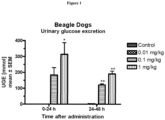
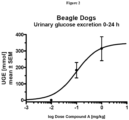
- one or more SGLT2 inhibitors preferably compound A, according to the present invention does not cause hypoglycaemia (Example 2).
- a further advantage in particular is that the use of one or more SGLT2 inhibitors, preferably compound A, according to the present invention leads to a reduction in insulin resistance in treated, insulin resistant canine animals. That is, equivalently, the use of one or more SGLT2 inhibitors, preferably compound A, according to the present invention advantageously leads to increased insulin sensitivity in treated, insulin resistant canine animals.
- use of one or more SGLT2 inhibitors, preferably compound A, according to the present invention provides improved treatment and/or prevention of metabolic diseases as disclosed herein, including diabetes, in canine animals.
- the effects of using one or more SGLT2 inhibitors, preferably compound A, according to the present invention may be relative to the same or a comparable canine animal prior to administration of one or more SGLT2 inhibitors, preferably compound A according to the present invention, and/or relative to a comparable canine animal that has not received said treatment (e.g. a placebo group).
- a comparison may be made after a certain treatment period, e.g., 1, 2, 3, 4, 5, 6 or 7 days; 10 days, 14 days; 1, 2, 3, 4, 5, 6, 7 or 8 weeks; 1, 2, 3 or 4 months.
- the treatment period is 4 weeks.
- the treatment period may be 6 or 8 weeks.
- the treatment period may be 8 weeks or more, e.g. 8-16 weeks, i.e. 8, 9, 10, 11, 12, 13, 14, 15 or 16 weeks.
- a further advantage of the present invention is that one or more SGLT2 inhibitors, preferably compound A, may effectively be administered to a canine animal orally. Moreover, the one or more SGLT2 inhibitors, preferably compound A, according to the present invention can be administered only once per day. These advantages allow for better compliance of the treated canine animal and the owner. This leads to better glycaemic control of disorders (e.g. diabetes) for which canine animals are currently treated with insulin. Generally, the use of one or more SGLT2 inhibitors, preferably compound A, according to the present invention thus helps to attenuate (i.e. delays or prevents) the progression of metabolic disorders and delays or prevents the onset of metabolic disorders (e.g. diabetes) and their complications in canine animals.
- the effects of using one or more SGLT2 inhibitors, preferably compound A, according to the present invention may be relative to the same or a comparable canine animal prior to administration of the one or more SGLT2 inhibitors, preferably compound A, according to the present invention, and/or relative to a comparable canine animal that has received e.g. standard insulin treatment (e.g. a control group) or has been untreated.
- a comparable canine animal that has received e.g. standard insulin treatment (e.g. a control group) or has been untreated.
- a further advantage of the present invention is that the one or more SGLT2 inhibitors, preferably compound A, may effectively be administered to a canine animal orally, e.g. in liquid form. Moreover, the one or more SGLT2 inhibitors, preferably compound A, according to the present invention can be administered only once per day.
- the present invention also provides pharmaceutical compositions comprising one or more SGLT2 inhibitors, preferably compound A, according to the invention for use in treating and/or preventing metabolic disorders in canine animals.
- the invention also provides methods of treating and/or preventing metabolic disorders in canine animals, comprising administering to a canine animal in need of such treatment and/or prevention an effective dose of one or more SGLT2 inhibitors, preferably compound A, as described herein.
- the use of one or more SGLT2 inhibitors, preferably compound A, according to the present invention may thus attenuate, delay or prevent the progression of a metabolic disorder, e.g. the metabolic disorders disclosed herein, or may delay the progression or prevent the onset of metabolic disorders and their complications in canine animals, e.g. hypertension, renal dysfunction and/or musculoskeletal disorders is prevented or progression is slowed or remission is achieved.
- a metabolic disorder e.g. the metabolic disorders disclosed herein
- canine animals e.g. hypertension, renal dysfunction and/or musculoskeletal disorders is prevented or progression is slowed or remission is achieved.
- Treatment effects disclosed herein may be observed with a statistical significance of p ⁇ 0.05, preferably ⁇ 0.01.
- the deviation may be, e.g., by 5% or more, particularly 10% or more, more particularly 15% or more, more particularly 20% or more, more particularly 30% or more, more particularly 40% or more, or more particularly 50% or more, with respect to the relevant reference value, unless otherwise stated.
- the deviation will be by at least 10%, i.e. 10% or more.
- the deviation may also be by 20%.
- the deviation may also be by 30%.
- the deviation may also be by 40%.
- the relevant reference value may be generated from a group of reference animals which are treated with placebo instead of the one or more SGLT2 inhibitors, preferably compound A, or are untreated.
- an excursion e.g. an insulin excursions or glucose excursion
- the magnitude of excursions, e.g. insulin excursions or glucose excursions may be expressed as area-under-curve (AUC) values.
- active substance encompass one or more SGLT2 inhibitors, preferably compound A, or any pharmaceutically acceptable form thereof (e.g. a prodrug or a crystalline form), for use according to the invention.
- clinical condition(s) refers to pathologic conditions) or pathophysiological or physiological changes that are recognizable, e.g. visible and/or measurable, such as blood parameters, and that are associated with and/or define a disorder and/or disease.
- ivGTT refers to an intravenous glucose tolerance test.
- 0.8 g dextrose per kg body mass may typically be employed.
- ivITT refers to an intravenous insulin tolerance test.
- 0.05 U insulin per kg body mass may typically be employed.
- SGLT2 inhibitors for use according to the invention include, but are not limited to, glucopyranosyl-substituted benzene derivatives, for example as described in WO 01/27128 , WO 03/099836 , WO 2005/092877 , WO 2006/034489 , WO 2006/064033 , WO 2006/117359 , WO 2006/117360 , WO 2007/025943 , WO 2007/028814 , WO 2007/031548 , WO 2007/093610 , WO 2007/128749 , WO 2008/049923 , WO 2008/055870 , WO 2008/055940 , WO 2009/022020 or WO 2009/022008 .
- the one or more SGLT2 inhibitors for use according to the invention may be selected from the group consisting of the following compounds or pharmaceutically acceptable forms thereof:
- dipagliflozin refers to dapagliflozin of the above structure as well as pharmaceutically acceptable forms thereof, including hydrates and solvates thereof, and crystalline forms thereof.
- the compound and methods of its synthesis are described in WO 03/099836 for example.
- Preferred hydrates, solvates and crystalline forms are described in the patent applications WO 2008/116179 and WO 2008/002824 for example.
- canagliflozin refers to canagliflozin of the above structure as well as pharmaceutically acceptable forms thereof, including hydrates and solvates thereof, and crystalline forms thereof.
- the compound and methods of its synthesis are described in WO 2005/012326 and WO 2009/035969 for example.
- Preferred hydrates, solvates and crystalline forms are described in the patent application WO 2008/069327 for example.
- epipagliflozin refers to empagliflozin of the above structure as well as pharmaceutically acceptable forms thereof, including hydrates and solvates thereof, and crystalline forms thereof.
- the compound and methods of its synthesis are described in WO 2005/092877 , WO 2006/120208 and WO 2011/039108 for example.
- a preferred crystalline form is described in the patent applications WO 2006/117359 and WO 2011/039107 for example.
- atigliflozin refers to atigliflozin of the above structure as well as pharmaceutically acceptable forms thereof, including hydrates and solvates thereof, and crystalline forms thereof.
- pharmaceutically acceptable forms thereof including hydrates and solvates thereof, and crystalline forms thereof.
- the compound and methods of its synthesis are described in WO 2004/007517 for example.
- ipragliflozin refers to ipragliflozin of the above structure as well as pharmaceutically acceptable forms thereof, including hydrates and solvates thereof, and crystalline forms thereof.
- the compound and methods of its synthesis are described in WO 2004/080990 , WO 2005/012326 and WO 2007/114475 for example.
- tofogliflozin refers to tofogliflozin of the above structure as well as pharmaceutically acceptable forms thereof, including hydrates and solvates thereof, and crystalline forms thereof.
- pharmaceutically acceptable forms thereof including hydrates and solvates thereof, and crystalline forms thereof.
- the compound and methods of its synthesis are described in WO 2007/140191 and WO 2008/013280 for example.
- luseogliflozin refers to luseogliflozin of the above structure as well as pharmaceutically acceptable forms thereof, including hydrates and solvates thereof, and crystalline forms thereof.
- ertugliflozin refers to ertugliflozin of the above structure as well as pharmaceutically acceptable forms thereof, including hydrates and solvates thereof, and crystalline forms thereof.
- the compound is described for example in WO 2010/023594 .
- remogliflozin refers to remogliflozin of the above structure as well as pharmaceutically acceptable forms thereof, including prodrugs of remogliflozin, in particular remogliflozin elaborate, including hydrates and solvates thereof, and crystalline forms thereof. Methods of its synthesis are described in the patent applications EP 1 213 296 and EP 1 354 888 for example.
- sergliflozin refers to sergliflozin of the above structure as well as pharmaceutically acceptable forms thereof, including prodrugs of sergliflozin, in particular sergliflozin elaborate, including hydrates and solvates thereof, and crystalline forms thereof. Methods for its manufacture are described in the patent applications EP 1 344 780 and EP 1 489 089 for example.
- Preferred SGLT2 inhibitors are glucopyranosyl-substituted benzene derivatives.
- one or more hydroxyl groups of the glucopyranosyl group in such one or more SGLT2 inhibitors may be acylated with groups selected from (C 1-18 -alkyl)carbonyl, (C 1-18 -alkyl)oxycarbonyl, phenylcarbonyl and phenyl-(C 1-3 -alkyl)-carbonyl.
- glucopyranosyl-substituted benzonitrile derivatives of formula (1) as disclosed herein above.
- such SGLT2 inhibitor is 1-cyano-2-(4-cyclopropyl-benzyl)-4-( ⁇ -D-glucopyranos-1-yl)-benzene as shown in formula (2) (also referred to herein as "compound A").
- one or more hydroxyl groups of the ⁇ -D-glucopyranosyl group of compound A may be acylated with groups selected from (C 1-18 -alkyl)carbonyl, (C 1-18 -alkyl)oxycarbonyl, phenylcarbonyl and phenyl-(C 1-3 -alkyl)-carbonyl.
- a SGLT2 inhibitor according to the present invention is a glucopyranosyl-substituted benzene derivative SGLT2 inhibitor, preferably a SGLT2 inhibitor of formula (1), more preferably of formula (18), or yet more preferably of formula (2) (i.e. compound A), in each case as defined herein above.
- the metabolic disorder may be diabetes, pre-diabetes, obesity and/or any disorder, disease, condition or symptom associated with one or more of those disorders.
- the metabolic disorder may be hyperglycaemia, impaired glucose tolerance, insulin resistance, insulin dependent diabetes and/or hepatic lipidosis.
- Further relevant metabolic disorders include hyperinsulinaemia, impaired glucose tolerance, ketosis (in particular ketoacidosis), hyperlipidaemia, dyslipidemia, elevated blood levels of fatty acids and/or of glycerol, Syndrome X (metabolic syndrome), and/or inflammation of the pancreas, low grade systemic inflammation, inflammation of adipose tissue.
- the metabolic disorder is diabetes.
- diabetes may be pre-diabetes, insulin dependent diabetes or insulin resistance diabetes.
- diabetes may be insulin dependent diabetes.
- the metabolic disorder is hyperglycaemia.
- hyperglycaemia may be associated with diabetes, e.g. with insulin dependent diabetes or insulin resistance diabetes.
- hyperglycaemia may be associated with obesity.
- the hyperglycaemia may be chronic.
- the metabolic disorder is insulin resistance.
- insulin resistance may be associated with diabetes, e.g. with insulin resistance diabetes.
- insulin resistance may be associated with obesity.
- the metabolic disorder is impaired glucose tolerance (IGT).
- ITT impaired glucose tolerance
- impaired glucose tolerance may be associated with diabetes, e.g. with insulin dependent diabetes or insulin resistance diabetes.
- impaired glucose tolerance may be associated with obesity.
- the metabolic disorder is hyperinsulinaemia.
- hyperinsulinaemia may be associated with diabetes, e.g. with insulin resistance diabetes.
- hyperinsulinaemia may be associated with obesity.
- the metabolic disorder is one or more of hyperglycaemia, insulin resistance, and hepatic lipidosis. In some embodiments, the metabolic disorder is selected from hyperglycaemia and insulin resistance.
- the metabolic disorder is one or more of hyperinsulinaemia, impaired glucose tolerance, hyperglycaemia and insulin resistance.
- the canine animal is obese.
- one or more metabolic disorders selected from hyperglycaemia, insulin resistance and hepatic lipidosis may be treated and/or prevented in an obese canine animal.
- hyperinsulinaemia and/or impaired glucose tolerance may be treated and/or prevented in an obese canine animal.
- one or more disorders selected from ketosis (in particular ketoacidosis), hyperlipidaemia, elevated blood levels of fatty acids and/or of glycerol, Syndrome X (metabolic syndrome), inflammation of the pancreas, inflammation of adipose tissue may be treated and/or prevented in an obese canine animal.
- the canine animal is not obese.
- the metabolic disorder may be associated and/or caused by e.g. hypo- or hyperthyroidism, hypercortisolism (hyperadrenocorticism, cushing) and/or growth-hormone access (acromegaly).
- one or more metabolic disorders selected from hyperglycaemia, insulin resistance and hepatic lipidosis may be treated and/or prevented in a non-obese canine animal.
- hyperinsulinaemia and/or impaired glucose tolerance may be treated and/or prevented in a non-obese canine animal.
- ketosis in particular ketoacidosis
- hyperlipidaemia elevated blood levels of fatty acids and/or of glycerol
- Syndrome X metabolic syndrome
- inflammation of the pancreas and/or inflammation of adipose tissue may be treated and/or prevented in a non-obese canine animal.
- the canine animal is suffering from diabetes, e.g. from insulin dependent diabetes or insulin resistance diabetes.
- diabetes e.g. from insulin dependent diabetes or insulin resistance diabetes.
- one or more metabolic disorders selected from the group of hyperglycaemia, impaired glucose tolerance and hepatic lipidosis may be treated and/or prevented in a canine animal that is suffering from diabetes, e.g. from insulin dependent diabetes or insulin resistance diabetes.
- hyperinsulinaemia and/or insulin resistance may be treated and/or prevented in a canine animal that is suffering from diabetes, e.g. from or insulin resistance diabetes.
- ketosis in particular ketoacidosis
- hyperlipidaemia elevated blood levels of fatty acids and/or of glycerol
- Syndrome X metabolic syndrome
- inflammation of the pancreas inflammation of adipose tissue
- diabetes e.g. from insulin dependent diabetes or insulin resistance diabetes.
- the canine animal is obese and not suffering from diabetes.
- the canine animal is not obese and suffering from diabetes.
- the present invention also provides the use of one or more SGLT2 inhibitors, preferably compound A, for treating and/or preventing hyperglycaemia associated complications. For example by improving the diurnal glycaemic control and thereby delay or prevent the development or the progression or induce the regression of cataract formation in a canine animal.
- Ketosis is a state of elevated levels of ketone bodies in the body.
- Ketoacidosis can be described as a type of metabolic acidosis which is caused by high concentrations of ketone bodies, formed by the breakdown of fatty acids and the deamination of amino acids.
- the two common ketones produced in humans are acetoacetic acid and ⁇ -hydroxybutyrate.
- acetoacetic acid, beta-hydroxybutyrate and pyruvic acid In dogs, predominantly three ketones are found: acetoacetic acid, beta-hydroxybutyrate and pyruvic acid.
- Ketoacidosis can be smelled on a subject's breath. This is due to acetone, a direct byproduct of the spontaneous decomposition of acetoacetic acid.
- Ketoacidosis is an extreme and uncontrolled form of ketosis. Ketosis is also a normal response to prolonged fasting. In ketoacidosis, the body fails to adequately regulate ketone production, esp. by producing Acetyl-CoA, causing such a severe accumulation of keto acids that the pH of the blood is substantially decreased, i.e. the excess ketone bodies may significantly acidify the blood. In extreme cases ketoacidosis can be fatal.
- Ketoacidosis may occur when the body is producing high levels of ketone bodies via the metabolism of fatty acids (ketosis) and insulin does not sufficiently slow this production (e.g. due to insulin resistance / reduced insulin sensitivity or lack of insulin).
- the presence of high blood sugar levels (hyperglycaemia) caused by the lack of insulin can lead to further acidity in the blood. In healthy individuals this normally does not occur because the pancreas produces insulin in response to rising ketone/blood sugar levels.
- Ketoacidosis is most common in untreated diabetes mellitus, when the liver breaks down fat and proteins in response to a perceived need for respiratory substrate.
- Pre-diabetes in canine animals is characterized by hyperinsulinemia, insulin resistance in target organs, impaired glucose tolerance incl. e.g. an altered insulin response to a glycaemic challenge, e.g. also e.g. induced by stress.
- Pre-diabetes is also often associated with obesity.
- Pre-diabetes may also be associated with intermittent hyperglycaemia.
- Insulin resistance diabetes in canine animals is characterized by both increased insulin production and insulin resistance in target organs and as a consequence hyperglycaemia. It is frequently detected in intact female diabetic canines and mainly attributed to progesterone acting as an endogenous insulin antagonist. Therefore, it is mostly either associated with the menstrual cycle, i.e. the dioestrus or to pregnancy - gestational. Genetic factors, glucosteroids, lack of exercise, and obesity are possible further reasons for insulin resistance.
- Clinical signs of diabetes mellitus observed with canine animals include polydipsia, polyuria, weight loss, and/or polyphagia. In contrast, in other species such as cats anorexia is more often described than polyphagia. Further particularly relevant clinical signs of diabetes mellitus in canine animals within the context of the present invention are hyperglycaemia and glycosuria.
- Hyperglycaemia in a canine animal e.g. a dog
- Plasma glucose values above normal values 3.5 - 7 mmol/l or 60 - 120 mg/dl
- Glycosuria in a canine animal e.g. a dog
- the renal threshold is reached with blood glucose concentrations of approximately 8 - 11 mmol/l or 150 to 200 mg/dl.
- diabetes mellitus in canine animals may alternatively be based on three criteria, e.g., as follows:
- further examinations can include haematology, blood chemistry, x-ray and/or abdominal ultrasound.
- the use of the one or more SGLT2 inhibitors, preferably compound A, according to the invention allows normal or near-normal blood glucose concentrations to be maintained and/or established.
- blood glucose concentrations may also be maintained, e.g., between 5.5 and 16.6 mmol/l or 100 to 300 mg/dl. For canine animals this will often be satisfactory.
- Hyperglycaemia induces cataracts are generally acute in onset, rapidly progressive, and bilaterally symmetrical.
- the clouding of the lens inside the eye leads to a decrease or ultimately loss of vision.
- Insulin resistance can be described as the condition in which normal amounts of insulin are inadequate to produce a normal insulin response from fat, muscle and liver cells.
- Insulin resistance in fat cells reduces the effects of insulin and results in elevated hydrolysis of stored triglycerides in the absence of measures which either increase insulin sensitivity or which provide additional insulin. Increased mobilization of stored lipids in these cells elevates free fatty acids in the blood plasma.
- Insulin resistance in muscle cells reduces glucose uptake (and so local storage of glucose as glycogen), whereas insulin resistance in liver cells results in impaired glycogen synthesis and a failure to suppress glucose production. Elevated blood fatty acid levels, reduced muscle glucose uptake, and increased liver glucose production, may all contribute to elevated blood glucose levels (hyperglycaemia). In obese dogs insulin resistance, i.e. a 5-fold lower insulin sensitivity than in lean dogs is detected.
- Insulin resistance may be present in association with obesity, visceral adiposity, hypertension and dyslipidaemia involving elevated triglycerides, small dense low-density lipoprotein (sdLDL) particles, and decreased HDL cholesterol levels.
- sdLDL small dense low-density lipoprotein
- a great deal of evidence in humans suggests two strong links with insulin resistance.
- visceral adiposity a great deal of evidence in humans suggests two strong links with insulin resistance.
- visceral adipose cells produce significant amounts of proinflammatory cytokines such as tumour necrosis factor-alpha (TNF-alpha), and Interleukins-1 and -6, etc.
- Hyperinsulinaemia can be described as a condition in which there are excess levels, i.e. more than about 35 pmol/L under basal or about 200 pmol/L during e.g. a glycaemic challenge (e.g. ivGTT or stress) of insulin circulating in the blood. As mentioned, it is commonly present in cases of, and may be a consequence of, insulin resistance in canine animals.
- a glycaemic challenge e.g. ivGTT or stress
- Impaired glucose tolerance can be described as condition in which the response to a after a glycaemic challenge e.g. after a meal or after a loading test (glucose tolerance test) or after stress induced elevation of blood glucose concentration, the glycaemic peak of the glucose excursion is higher and/or the duration of the glucose excursion is prolonged.
- Dyslipidaemia or hyperlipidaemia is the presence of raised or abnormal levels of lipids and/or lipoproteins in the blood. Lipid and lipoprotein abnormalities are regarded as a highly modifiable risk factor for cardiovascular disease due to the influence of cholesterol.
- Glycerol is a precursor for the synthesis of triacylglycerols (triglycerids) and of phospholipids in the liver and adipose tissue. When the body uses stored fat as a source of energy, glycerol and fatty acids are released into the bloodstream after hydrolysis of the triglycerides. The glycerol component can be converted to glucose by the liver and provides energy for cellular metabolism.
- Normal levels of free fatty acids in the blood of companion (such as canine) animals are triglyceride concentrations of 50 to 150 mg/dl. Normal levels of blood cholesterol are, e.g., 130 to 300 mg/dl for the dog.
- Dysadipokinemia can be described as a condition in which the circulating plasma levels of biologically active substances produced in adipose tissue that act in an autocrinelparacrine or endocrine fashion is deviated, e.g. an elevation of leptin and/or a reduction of adiponectin.
- Subclinical inflammation or systemic inflammation in particular low grade systemic inflammation is characterized by increased expression and secretion of pro-inflammatory cytokines such as tumour necrosis factor-alpha and/or lower expression and secretion of anti-inflammatory cytokines e.g. interleukin-10 and/or their respective receptors.
- pro-inflammatory cytokines such as tumour necrosis factor-alpha
- anti-inflammatory cytokines e.g. interleukin-10 and/or their respective receptors.
- Obesity can be described as a medical condition in which excess body fat has accumulated to the extent that it may have an adverse effect on health, leading to reduced life expectancy.
- a body condition score (BCS) of larger than 7 (out of 9) is encountered.
- Metabolic disorders to be treated and/or prevented according to the invention include Syndrome X (metabolic syndrome).
- Syndrome X metabolic syndrome
- This disorder can be described as a combination of medical disorders that increase the risk of developing manifest clinical consequences - e.g. hypertension, cardiomyopathy, renal dysfunction and/or musculooskeletal disorders in canine animals.
- Metabolic syndrome is also known as metabolic Syndrome X (metabolic syndrome), Syndrome X (metabolic syndrome), insulin resistance syndrome, Reaven's syndrome, and CHAOS (as an abbreviation for Coronary artery disease, Hypertension, Atherosclerosis, Obesity, and Stroke).
- TNF-alpha has been shown not only to cause the production of inflammatory cytokines, but possibly to trigger cell signalling by interaction with a TNF-alpha receptor that may lead to insulin resistance.
- the present invention also provides for prevention of clinically relevant consequences of the metabolic disorder e.g. hypertension, cardiomyopathy, renal dysfunction and/or musculoskeletal disorders in canine animals.
- Metabolic disorders to be treated and/or prevented according to the invention include inflammation of the pancreas (pancreatitis). This disorder may occur as either an acute form or a chronic form. Chronic pancreatitis may occur with or without steatorrhea and/or diabetes mellitus.
- Pancreatitis may be caused by hypertriglyceridemia (in particular when triglyceride values exceed 1500 mg/dl (16 mmol/l), hypercalcemia, viral infection, trauma, vasculitis (i.e. inflammation of the small blood vessels within the pancreas), and autoimmune pancreatitis.
- Metabolic disorders esp. dyslipidaemia and elevated serum levels of triglycerides are risk factors for the development of pancreatitis, and may thus be treated according to the present invention in association with pancreatitis. Accordingly, the present invention also provides for prevention of pancreatitis.
- Metabolic disorders to be treated and/or prevented according to the invention include an inflammation of adipose tissue (panniculitis), which is a group of disorders characterised by inflammation of subcutaneous adipose tissue.
- panniculitis adipose tissue
- Panniculitis may occur in any fatty tissue (cutaneous and/or visceral). It may be diagnosed on the basis of a deep skin biopsy, and can be further classified by histological characteristics based on the location of the inflammatory cells (within fatty lobules or in the septa which separate them) and on the presence or absence of vasculitis. Panniculitis can also be classified based on the presence or absence of systemic symptoms.
- Metabolic diseases esp. pancreatitis
- panniculitis are risk factors for the development of panniculitis, and may thus be treated according to the present invention in association with panniculitis. Accordingly, the present invention also provides for prevention of panniculitis.
- a canine animal may be a member of the Canidae family (i.e. a canid). It may thus belong either to the subfamily Canini (related to wolves) or Vulpini (related to foxes).
- the term canine animal encompasses the term dog, e.g., a domestic dog.
- the term domestic dog encompasses the terms Canis lupus familiaris and Canis lupus dingo.
- references to SGLT2 inhibitors and/or their use according to the invention encompass pharmaceutically acceptable forms of the SGLT2 inhibitors, unless otherwise stated.
- any pharmaceutically acceptable form of the SGLT2 inhibitor e.g. of formula (1), preferably formula (18), more preferably formula (2), may be used.
- a crystalline form may be used.
- Prodrug forms are also encompassed by the present invention.
- Prodrug forms may include, e.g., esters and/or hydrates.
- the term prodrug is also meant to include any covalently bonded carrier which releases the active compound of the invention in vivo when the prodrug is administered to a mammalian subject.
- Prodrugs of a compound of the invention may be prepared by modifying functional groups present in the compound of the invention in such a way that the modifications are cleaved, either in routine manipulation or in vivo, to the parent compound of the invention.
- Crystalline forms for use according to the invention include a complex of an SGLT2 inhibitor with one or more amino acids (see e.g. WO 2014/016381 ).
- An amino acid for such use may be a natural amino acid.
- the amino acid may be a proteogenic amino acid (including L-hydroxyproline), or a non-proteogenic amino acid.
- the amino acid may be a D- or an L-amino acid.
- the amino acid is proline (L-proline and/or D-proline, preferably L-proline).
- a crystalline complex of 1-cyano-2-(4-cyclopropyl-benzyl)-4-( ⁇ -D-glucopyranos-1-yl)-benzene (formula (2); compound A) with proline (e.g. L-proline) is preferred.
- proline e.g. L-proline
- a crystalline complex between one or more natural amino acids and an SGLT2 inhibitor e.g., a crystalline complex between one or more natural amino acids and a glucopyranosyl-substituted benzene derivative SGLT2 inhibitor, preferably a SGLT2 inhibitor of formula (1), more preferably of formula (18) or yet more preferably of formula (2) (compound A).
- a crystalline complex between one or more natural amino acids and 1-cyano-2-(4-cyclopropyl-benzyl)-4-( ⁇ -D-glucopyranos-1-yl)-benzene compound A.
- crystalline complexes as defined hereinbefore or hereinafter for preparing a pharmaceutical composition which is suitable for the treatment or prevention of diseases or conditions which can be influenced by inhibiting sodium-dependent glucose co-transporter SGLT, preferably SGLT2.
- sodium-dependent glucose co-transporter SGLT preferably SGLT2.
- one or more crystalline complexes as defined hereinbefore or hereinafter for preparing a pharmaceutical composition for inhibiting the sodium-dependent glucose co-transporter SGLT2.
- a crystalline complex between one or more natural amino acids (e.g. proline, preferably L-proline) and an SGLT2 inhibitor is a preferred pharmaceutically acceptable form of a SGLT2 inhibitor for use according to the present invention.
- a crystalline complex between one or more natural amino acids (e.g. proline, preferably L-proline) and a glucopyranosyl-substituted benzene derivative SGLT2 inhibitor, preferably a SGLT2 inhibitor of formula (1), more preferably of formula (18) or yet more preferably of formula (2) (compound A) is a preferred pharmaceutically acceptable form of a SGLT2 inhibitor for use according to the present invention.
- a crystalline complex between one or more natural amino acids e.g.
- proline preferably L-proline
- 1-cyano-2-(4-cyclopropyl-benzyl)-4-( ⁇ -D-glucopyranos-1-yl)-benzene is particularly preferred as a pharmaceutically acceptable form of a SGLT2 inhibitor for use according to the present invention.
- Also disclosed herein is a method for making one or more crystalline complexes as defined hereinbefore and hereinafter, said method comprising the following steps:
- a certain pharmaceutical activity is of course the basic prerequisite to be fulfilled by a pharmaceutically active agent before same is approved as a medicament on the market.
- a pharmaceutically active agent has to comply with. These requirements are based on various parameters which are connected with the nature of the active substance itself. Without being restrictive, examples of these parameters are the stability of the active agent under various environmental conditions, its stability during production of the pharmaceutical formulation and the stability of the active agent in the final medicament compositions.
- the pharmaceutically active substance used for preparing the pharmaceutical compositions should be as pure as possible and its stability in long-term storage must be guaranteed under various environmental conditions. This is essential to prevent the use of pharmaceutical compositions which contain, in addition to the actual active substance, breakdown products thereof, for example. In such cases the content of active substance in the medicament might be less than that specified.
- Uniform distribution of the medicament in the formulation is a critical factor, particularly when the medicament has to be given in low doses.
- the particle size of the active substance can be reduced to a suitable level, e.g. by grinding. Since breakdown of the pharmaceutically active substance as a side effect of the grinding (or micronising) has to be avoided as far as possible, in spite of the hard conditions required during the process, it is essential that the active substance should be highly stable throughout the grinding process. Only if the active substance is sufficiently stable during the grinding process it is possible to produce a homogeneous pharmaceutical formulation which always contains the specified amount of active substance in a reproducible manner.
- Another problem which may arise in the grinding process for preparing the desired pharmaceutical formulation is the input of energy caused by this process and the stress on the surface of the crystals. This may in certain circumstances lead to polymorphous changes, to amorphization or to a change in the crystal lattice. Since the pharmaceutical quality of a pharmaceutical formulation requires that the active substance should always have the same crystalline morphology, the stability and properties of the crystalline active substance are subject to stringent requirements from this point of view as well.
- the stability of a pharmaceutically active substance is also important in pharmaceutical compositions for determining the shelf life of the particular medicament; the shelf life is the length of time during which the medicament can be administered without any risk. High stability of a medicament in the abovementioned pharmaceutical compositions under various storage conditions is therefore an additional advantage for both the patient and the manufacturer.
- compositions with a tendency to absorb moisture have to be protected from moisture during storage, e.g. by the addition of suitable drying agents or by storing the drug in an environment where it is protected from moisture.
- a pharmaceutically active substance should be at best slightly hygroscopic.
- a crystalline complex between a natural amino acid and an SGLT2 inhibitor (e.g. a glucopyranosyl-substituted benzene derivative or a SGLT2 inhibitor of formula (1), or formula (18) or, particularly, of formula (2), i.e. compound A) fulfills important requirements mentioned hereinbefore.
- an SGLT2 inhibitor e.g. a glucopyranosyl-substituted benzene derivative or a SGLT2 inhibitor of formula (1), or formula (18) or, particularly, of formula (2), i.e. compound A
- the natural amino acid is present in either its (D) or (L) enantiomeric form, most preferably as the (L) enantiomer.
- crystalline complexes according to this invention are preferred which are formed between the SGLT2 inhibitor (e.g. of formula (1), preferably formula (18) or, particularly, of formula (2), i.e. compound A) and one natural amino acid, most preferably between the compound A and the (L) enantiomer of a natural amino acid.
- the SGLT2 inhibitor e.g. of formula (1), preferably formula (18) or, particularly, of formula (2), i.e. compound A
- one natural amino acid most preferably between the compound A and the (L) enantiomer of a natural amino acid.
- Preferred amino acids according to this invention are selected from the group consisting of phenylalanine and proline, in particular (L)-proline and (L)-phenylalanine.
- the crystalline complex is characterized in that the natural amino acid is proline, in particular (L)-proline.
- the molar ratio of the SGLT2 inhibitor e.g. of formula (1), preferably formula (18) or, particularly, of formula (2), i.e. compound A
- the natural amino acid is in the range from about 2 : 1 to about 1 : 3; more preferably from about 1.5 : 1 to about 1 : 1.5, even more preferably from about 1.2 : 1 to about 1 : 1.2, most preferably about 1 : 1.
- complex (1 : 1) or "1 : 1 complex”.
- a preferred crystalline complex according to this invention is a complex (1 : 1) between said SGLT2 inhibitor (e.g. of formula (1), preferably formula (18) or, particularly, of formula (2), i.e. compound A) and proline; in particular of said SGLT2 inhibitor and L-proline.
- said SGLT2 inhibitor e.g. of formula (1), preferably formula (18) or, particularly, of formula (2), i.e. compound A
- proline in particular of said SGLT2 inhibitor and L-proline.
- the crystalline complex in the particular the 1 : 1 complex of said SGLT2 inhibitor with L-proline, is a hydrate.
- the molar ratio of the crystalline complex and water is in the range from about 1 : 0 to 1 : 3; more preferably from about 1 : 0 to 1 : 2, even more preferably from about 1 : 0.5 to 1 : 1.5, most preferably about 1 : 0.8 to 1 : 1.2, in particular about 1:1.
- the crystalline complex of said SGLT2 inhibitor with proline in particular with L-proline and water, may be identified and distinguished from other crystalline forms by means of their characteristic X-ray powder diffraction (XRPD) patterns.
- XRPD characteristic X-ray powder diffraction
- a crystalline complex of compound A with L-proline is preferably characterised by an X-ray powder diffraction pattern that comprises peaks at 20.28, 21.14 and 21.64 degrees 2 ⁇ ( ⁇ 0.1 degrees 2 ⁇ ), wherein said X-ray powder diffraction pattern is made using CuK ⁇ 1 radiation.
- said X-ray powder diffraction pattern comprises peaks at 4.99, 20.28, 21.14, 21.64 and 23.23 degrees 2 ⁇ ( ⁇ 0.1 degrees 2 ⁇ ), wherein said X-ray powder diffraction pattern is made using CuK ⁇ 1 radiation.
- said X-ray powder diffraction pattern comprises peaks at 4.99, 17.61, 17.77, 20.28, 21.14, 21.64, 23.23 and 27.66 degrees 2 ⁇ ( ⁇ 0.1 degrees 2 ⁇ ), wherein said X-ray powder diffraction pattern is made using CuK ⁇ 1 radiation.
- said X-ray powder diffraction pattern comprises peaks at 4.99, 15.12, 17.61, 17.77, 18.17, 20.28, 21.14, 21.64, 23.23 and 27.66 degrees 2 ⁇ ( ⁇ 0.1 degrees 2 ⁇ ), wherein said X-ray powder diffraction pattern is made using CuK ⁇ 1 radiation.
- the crystalline complex of compound A and L-proline is characterised by an X-ray powder diffraction pattern, made using CuK ⁇ 1 radiation, which comprises peaks at degrees 2 ⁇ ( ⁇ 0.1 degrees 2 ⁇ ) as contained in Table 1.
- Table 1 X-ray powder diffraction pattern of the crystalline complex of compound A and L-proline (only peaks up to 30° in 2 ⁇ are listed): 2 ⁇ [°] d-value [ ⁇ ] Intensity I/I 0 [%] 4.99 17.68 39 7.01 12.61 6 8.25 10.70 11 9.95 8.88 12 13.15 6.73 30 13.33 6.64 10 14.08 6.28 4 15.12 5.85 32 16.40 5.40 12 16.49 5.37 13 17.11 5.18 6 17.61 5.03 32 17.77 4.99 35 18.17 4.88 32 18.32 4.84 28 18.72 4.74 8 19.16 4.63 30 19.96 4.45 26 20.28 4.37 56 20.60 4.31 7 21.14 4.20 84 21.64 4.10 100 22.33 3.98 15 23.23 3.83 41
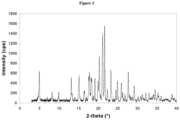
- said crystalline complex is characterised by an X-ray powder diffraction pattern, made using CuK ⁇ 1 radiation, which comprises peaks at degrees 2 ⁇ ( ⁇ 0.1 degrees 2 ⁇ as shown in Figure 3 .
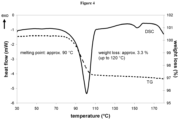
- said crystalline complex of the compound A with L-proline is characterized by a melting point of above 89°C, in particular in a range from about 89°C to about 115°C, more preferably in a range from about 89°C to about 110°C (determined via DSC; evaluated as onset-temperature; heating rate 10 K/min). It can be observed that this crystalline complex melts under dehydration.
- the obtained DSC curve is shown in Figure 4 .
- Said crystalline complex of the compound A with L-proline shows a weight loss by thermal gravimetry (TG).
- the observed weight loss indicates that the crystalline form contains water which may be bound by adsorption and/or may be part of the crystalline lattice, i.e. the crystalline form may be present as a crystalline hydrate.
- the content of water in the crystalline form lies in the range from 0 to about 10 weight-%, in particular 0 to about 5 weight-%, even more preferably from about 1.5 to about 5 weight-%.
- the dotted line in Figure 2 depicts a weight loss of between 2.8 and 3.8 % of water. From the observed weight loss a stoichiometry close to a monohydrate can be estimated.
- Said crystalline complex has advantageous physicochemical properties which are beneficial in the preparation of a pharmaceutical composition.
- the crystalline complex has a high physical and chemical stability under various environmental conditions and during the production of a medicament.
- the crystals can be obtained in a shape and particle size which are particular suitable in a production method for solid pharmaceutical formulations.
- the crystals show a high mechanical stability that allows grinding of the crystals.
- the crystalline complex does not show a high tendency to absorb moisture and is chemically stable, i.e. the crystalline complex allows the production of a solid pharmaceutical formulation with a long shelf life.
- the crystalline complex has a favorably high solubility over a wide pH-range which is advantageous in solid pharmaceutical formulations for oral administration.
- OED location-sensitive detector
- Cu-anode Cu-anode as X-ray source
- Table 1 the values "2 ⁇ [°]” denote the angle of diffraction in degrees and the values "d [ ⁇ ]” denote the specified distances in ⁇ between the lattice planes.
- the intensity shown in Figure 3 is given in units of cps (counts per second).
- the above described 2 ⁇ values should be considered accurate to ⁇ 0.1 degrees 2 ⁇ , in particular ⁇ 0.05 degrees 2 ⁇ . That is to say, when assessing whether a given sample of crystals of the compound A is the crystalline form in accordance with the above described 2 ⁇ values, a 2 ⁇ value which is experimentally observed for the sample should be considered identical with a characteristic value described above if it falls within ⁇ 0.1 degrees 2 ⁇ of the characteristic value, in particular if it falls within ⁇ 0.05 degrees 2 ⁇ of the characteristic value.
- the melting point is determined by DSC (Differential Scanning Calorimetry) using a DSC 821 (Mettler Toledo).
- the weight loss is determined by thermal gravimetry (TG) using a TGA 851 (Mettler Toledo).
- Also disclosed herein is a method for making a crystalline complex as defined hereinbefore and hereinafter, said method comprising the following steps:
- a solution of the SGLT2 inhibitor e.g. compound A or another SGLT2 inhibitor described herein
- the one or more natural amino acids in a solvent or a mixture of solvents is prepared.
- the solution is saturated or at least nearly saturated or even supersaturated with respect to the crystalline complex.
- the SGLT2 inhibitor may be dissolved in a solution comprising the one or more natural amino acids or the one or more natural amino acids may be dissolved in a solution comprising the SGLT2 inhibitor.
- the SGLT2 inhibitor is dissolved in a solvent or mixture of solvents to yield a first solution and the one or more natural amino acids are dissolved in a solvent or mixture of solvents to yield a second solution. Thereafter said first solution and said second solution are combined to form the solution according to step (a).
- the molar ratio of the natural amino acid and the SGLT2 inhibitor (e.g. compound A or any other SGLT2 inhibitor described herein) in the solution corresponds to the molar ratio of the natural amino acid and the SGLT2 inhibitor in the crystalline complex to be obtained. Therefore a preferred molar ratio is in the range from about 1 : 2 to 3 : 1; most preferably about 1:1.
- Suitable solvents are preferably selected from the group consisting of C 1-4 -alkanols, water, ethylacetate, acetonitrile, acetone, diethylether, tetrahydrofuran, and mixture of two or more of these solvents.
- More preferred solvents are selected from the group consisting of methanol, ethanol, isopropanol, water and mixture of two or more of these solvents, in particular mixtures of one or more of said organic solvents with water.
- Particularly preferred solvents are selected from the group consisting of ethanol, isopropanol, water and mixtures of ethanol and/or isopropanol with water.
- a preferred volume ratio of water : the alkanol is in the range from about 99 : 1 to 1 : 99; more preferably from about 50 : 1 to 1 : 80; even more preferably from about 10 : 1 to 1 : 60.
- the step (a) is carried out at about room temperature (about 20°C) or at an elevated temperature up to about the boiling point of the solvent or mixture of solvents used.
- the starting material of the SGLT2 inhibitor e.g. compound A or any other SGLT2 inhibitor described herein
- the starting material of the SGLT2 inhibitor e.g. compound A or any other SGLT2 inhibitor described herein
- the one or more natural amino acids and/or of the solvent and mixtures of solvents contain an amount of H 2 O which is at least the quantity required to form a hydrate of the SGLT2 inhibitor; in particular at least 1 mol, preferably at least 1.5 mol of water per mol of SGLT2 inhibitor. Even more preferably the amount of water is at least 2 mol of water per mol of SGLT2 inhibitor.
- the SGLT2 inhibitor e.g.
- compound A) as starting material or the one or more natural amino acids or said solvent or mixture of solvents, or said compounds and/or solvents in combination contain an amount of H 2 O as specified above.
- the starting material of the SGLT2 inhibitor e.g. compound A
- the natural amino acid in step (a) does contain sufficient water as specified above, a water content of the solvent(s) is not mandatory.
- step (a) and/or in step (b) one or more antisolvents may be added, preferably during step (a) or at the beginning of step (b).
- Water is an example of a suitable antisolvent.
- the amount of antisolvent is preferably chosen to obtain a supersaturated or saturated solution with respect to the crystalline complex.
- step (b) the solution is stored for a time sufficient to obtain a precipitate, i.e. the crystalline complex.
- the temperature of the solution in step (b) is about the same as in or lower than in step (a).
- the temperature of the solution is preferably lowered, preferably to a temperature in the range of 20°C to 0°C or even lower.
- the step (b) can be carried out with or without stirring.
- the size, shape and quality of the obtained crystals can be controlled.
- the crystallization may be induced by methods as known in the art, for example by mechanical means such as scratching or rubbing the contact surface of the reaction vessel for example with a glass rod.
- the (nearly) saturated or supersaturated solution may be inoculated with seed crystals.
- step (c) the solvent(s) can be removed from the precipitate by known methods as for example filtration, suction filtration, decantation or centrifugation.
- step (d) an excess of the solvent(s) is removed from the precipitate by methods known to the one skilled in the art as for example by reducing the partial pressure of the solvent(s), preferably in vacuum, and/or by heating above ca. 20°C, preferably in a temperature range below 100°C, even more preferably below 85°C.
- Compound A may be synthesized by methods as specifically and/or generally described or cited in international application WO 2007/128749 which in its entirety is incorporated herein by reference, and/or in the Examples disclosed herein below. Biological properties of the compound A may also be investigated as is described in WO 2007/128749 .
- a crystalline complex as described herein is preferably employed as drug active substance in substantially pure form, that is to say, essentially free of other crystalline forms of the SGLT2 inhibitor (e.g. compound A). Nevertheless, the invention also embraces a crystalline complex in admixture with another crystalline form or forms. Should the drug active substance be a mixture of crystalline forms, it is preferred that the substance comprises at least 50%-weight, even more preferably at least 90%-weight, most preferably at least 95%-weight of the crystalline complex as described herein.
- a crystalline complex according to the invention is suitable for the use in the treatment and/or preventive treatment of conditions or diseases which may be affected by the inhibition of SGLT activity, particularly SGLT-2 activity, in particular the metabolic disorders as described herein.
- the crystalline complex according to the invention is also suitable for the preparation of pharmaceutical compositions for the treatment and/or preventive treatment of conditions or diseases which may be affected by the inhibition of SGLT activity, particularly SGLT-2 activity, in particular metabolic disorders as described herein.
- a crystalline complex as described herein (in particular of compound A with a natural amino acid, e.g. proline, particularly L-proline) is also suitable for the use in the treatment of canines.
- the one or more SGLTS inhibitors, preferably compound A, for use according to the invention may be prepared as pharmaceutical compositions. It may be prepared as solid or as liquid formulations. In either case, it is preferably prepared for oral administration, preferably in liquid form for oral administration.
- the one or more SGLTS inhibitors, preferably compound A may, however, also be prepared, e.g., for parenteral administration.
- Solid formulations include tablets, granular forms, and other solid forms such as suppositories. Among solid formulations, tablets and granular forms are preferred.
- compositions within the meaning of the present invention may comprise one or more SGLT2 inhibitors, preferably compound A, according to the present invention and one or more excipients. Any excipient that allows for, or supports, the intended medical effect may be used. Such excipients are available to the skilled person.
- Useful excipients are for example antiadherents (used to reduce the adhesion between the powder (granules) and the punch faces and thus prevent sticking to tablet punches), binders (solution binders or dry binders that hold the ingredients together), coatings (to protect tablet ingredients from deterioration by moisture in the air and make large or unpleasant-tasting tablets easier to swallow), disintegrants (to allow the tablet to break upon dilution), fillers, diluents, flavours, colours, glidants (flow regulators - to promote powder flow by reducing interparticle friction and cohesion), lubricants (to prevent ingredients from clumping together and from sticking to the tablet punches or capsule filling machine), preservatives, sorbents, sweeteners etc.
- antiadherents used to reduce the adhesion between the powder (granules) and the punch faces and thus prevent sticking to tablet punches
- binders solution binders or dry binders that hold the ingredients together
- Formulations according to the invention may comprise carriers and/or disintegrants selected from the group of sugars and sugar alcohols, e.g. mannitol, lactose, starch, cellulose, microcrystalline cellulose and cellulose derivatives, e. g. methylcellulose, and the like.
- sugars and sugar alcohols e.g. mannitol, lactose, starch, cellulose, microcrystalline cellulose and cellulose derivatives, e. g. methylcellulose, and the like.
- formulations suitable for canine animals are known to the person skilled in the art, and for solid formulations comprise, e.g., direct compression, dry granulation and wet granulation.
- direct compression the active ingredient and all other excipients are placed together in a compression apparatus that is directly applied to press tablets out of this material.
- the resulting tablets can optionally be coated afterwards in order to protect them physically and/or chemically, e.g. by a material known from the state of the art.
- a unit for administration e.g. a single liquid dose or a unit of a solid formulation, e.g. a tablet, may comprise 0.01 mg to 10 mg, or e.g. 0.3 mg to 1 mg, 1 mg to 3 mg, 3 mg to 10 mg; or 5 to 2500 mg, or e.g. 5 to 2000 mg, 5 mg to 1500 mg, 10 mg to 1500 mg, 10 mg to 1000 mg, or 10-500 mg of an SGLT2 inhibitor for use according to the invention.
- the content of the SGLT2 inhibitor in a solid formulation, or any formulation as disclosed herein for administration to a canine animal may be increased or decreased as appropriate in proportion to the body weight of the canine animal to be treated.
- a pharmaceutical composition for use according to the invention is designed for oral or parenteral administration, preferably for oral administration.
- Especially the oral administration is ameliorated by excipients which modify the smell and/or haptic properties of the pharmaceutical composition for the intended patient, e.g. as described.
- excipients confer properties, e.g. palatability and/or chewability that render the formulation suitable for administration to a canine animal.
- liquid formulations may be, e.g., solutions, syrups or suspensions. They may be administered directly to the canine animal or may be mixed with the food and/or drink (e.g. drinking water, or the like) of the canine animal.
- a liquid formulation similar to a formulation in granular form, is that such a dosage form allows precise dosing.
- the SGLT2 inhibitor may be dosed precisely in proportion to the body weight of a canine animal.
- Typical compositions of liquid formulations are known to the person skilled in the art.
- Preferred units dosing units include mg/kg, i.e. mg SGLT2 inhibitor per body weight of the canine animal.
- An SGLT2 inhibitor of the invention may, e.g., be administered in doses of 0.01-5.0 mg/kg body weight per day, e.g. 0.01-4.0 mg/kg body weight per day, e.g. 0.01-3.0 mg/kg body weight per day, e.g. 0.01-2.0 mg/kg body weight per day, e.g. 0.01-1.5 mg/kg body weight per day, e.g., 0.01-1.0 mg/kg body weight per day, e.g.
- 0.01-0.75 mg/kg body weight per day e.g. 0.01-0.5 mg/kg body weight per day, e.g. 0.01-0.4 mg/kg body weight per day, e.g. 0.01-0.3 mg/kg body weight per day; or 0.1 to 3.0 mg/kg body weight per day, preferably from 0.2 to 2.0 mg/kg body weight per day, more preferably from 0.1 to 1 mg/kg body weight per day.
- the dose is 0.02-0.5 mg/kg body weight per day, more preferably 0.03-0.4 mg/kg body weight per day, e.g. 0.03-0.3 mg/kg body weight per day.
- a practitioner skilled in the art is able to prepare an SGLT2 inhibitor of the invention for administration according to a desired dose.
- an SGLT2 inhibitor is administered no more than three times per day, more preferably no more than twice per day, most preferably only once per day.
- the frequency of administration can be adapted to the typical feeding rate of the canine animal.
- an SGLT2 inhibitor may be administered such that an appropriate blood plasma concentration of the SGLT2 inhibitors is achieved (e.g. a maximal blood plasma concentration, or blood plasma concentration after a given time, e.g. 4, 8, 12 or 24 hours after oral administration, preferably about 8 hours after oral administration).
- an appropriate blood plasma concentration of the SGLT2 inhibitors e.g. a maximal blood plasma concentration, or blood plasma concentration after a given time, e.g. 4, 8, 12 or 24 hours after oral administration, preferably about 8 hours after oral administration.
- the blood plasma concentration e.g. maximal blood plasma concentration or blood plasma concentration after said given time after oral administration
- the blood plasma concentration may be within the range 2 to 4000 nM, e.g. 20 to 3000 nM, or e.g. 40 to 2000 nM.
- SGLT2 inhibitor following administration and the time required for an SGLT2 inhibitor to reach the bloodstream, such levels are maintained in the blood over a time interval of at least 12 hours, more preferably at least 18 hours, most preferably at least 24 h.
- an SGLT2 inhibitor is administered orally, in liquid or solid form.
- the SGLT2 inhibitor may be administered directly to the animals mouth (e.g. using a syringe, preferably a bodyweight-graduated syringe) or together with the animal's food or drink (e.g. with its drinking water or the like), in each case preferably in liquid form.
- the SGLT2 inhibitor may, however, also be administered, e.g., parenterally, or by any other route of administration, e.g., rectally.
- the SGLT2 inhibitor may be used alone or in combination with another drug.
- the one or more SGLT2 inhibitors preferably compound A, is used in combination with one or more further oral antihyperglycaemic drugs.
- the SGLT2 inhibitor and any further drug may be administered simultaneously, sequentially (in any order), and/or according to a chronologically staggered dosage regime.
- the SGLT2 inhibitor and any further drug are preferably administered within a period of at least 2 weeks, 1 month, 2 months, 4 months, 6 months or longer, e.g. 12 months or more.
- the one or more SGLTS inhibitors is used with co-administration with insulin, preferably a simultaneous, a sequential and/or a chronologically staggered co-administration with insulin.
- co-administration can also be in the form of a fixed-dose combination (FDC), e.g. a formulation including the one or more SGLT2 inhibitors, preferably compound A, and insulin combined in a single dosage form, which is manufactured and distributed in certain respective fixed doses.
- FDC fixed-dose combination
- the SGLT2 inhibitor (whether used alone or in combination with another drug) is not used in combination with 1-[(3-cyano-pyridin-2-yl)methyl]-3-methyl-7-(2-butyn-1-yl)-8-[3-(R)-amino-piperidin-1-yl]-xanthine or a pharmaceutically acceptable salt thereof, i.e. the canine animal is not treated with said compound.
- the SGLT2 inhibitor is not used in combination with a DPP-IV inhibitor, i.e., the canine animal is not treated with a DPP-IV inhibitor.
- the SGLT2 inhibitor is used as a monotherapy, i.e. stand-alone therapy, i.e. no other medication is administered to the canine animal for the treatment or prevention of the same metabolic disorder, i.e. the metabolic disorder for which the SGLT2 inhibitor is administered.
- no other medication is administered to the canine animal for the treatment or prevention of the same metabolic disorder within a period of at least 2, 3, or 4 weeks before and after administration of the SGLT2 inhibitor.
- Compound A was administered to overnight fasted dogs.
- PK measurements were taken until day 3 after a single administration of compound A or its vehicle.
- Table 2 Pharmacokinetic data, single dose (i.v. 1 mg/kg, oral 1 and 10 mg/kg) Parameter i.v. 1 mg/kg p.o. 1 mg/kg p.o.
- Compound A was moistened with a small volume of a 1% (w/v) aqueous Polysorbat 80 (Tween80, Polyoxyethylene Sorbitan Monooleate, ICN Biomedicals) solution and then dissolved by slowly adding a large volume of a 0.5% (w/v) aqueous hydroxyethylcellulose (Natrosol 250 HX, Boehringer Ingelheim) solution and stirring at room temperature for about 15 minutes. The final concentration of Polysorbat 80 was 0.015%. Compound A was applied in a volume of 2 mL/kg. b.w..
- the animals were kept individually in metabolic cages and received food 2 h after administration. They had free access to water during the experiment. Urine was collected in the time intervals 0-8 h, 8-24 h, 24-32 h, and 32-48 h after administration. A catheter (Eickemeyer) was inserted into the bladder to completely collect the 24 h urine. This urine was combined with the urine that had been excreted in the 8-24 h period. A volume of 5 mL of a 10% solution of sodium azide in saline had been added to each urine collection tube before sampling. Volume of urine was determined and samples were frozen for subsequent determination of glucose concentration.
- Insulin with the Compound A according to the invention or a combination of active substances according to the invention in addition to producing an acute improvement in the glucose metabolic situation, prevents deterioration in the metabolic situation in the long term and reduces the insulin dose needed to treat the diabetic canine. This can be observed if dogs are treated for a shorter or longer period, e.g. 2-4 weeks or 3 months to 1 year, with the pharmaceutical composition according to the invention and are compared to the metabolic situation prior to treatment or with dogs that have been treated with e.g. insulin alone. There is evidence of therapeutic success if daily mean blood glucose and fructosamine level are reduced as compared to pre-treatment level.
- Insulin resistance diabetes is a frequently found form of diabetes in intact female canine animals.
- Therapy with Compound A may be provided with the objective of preventing the transition to manifest diabetes.
- the success of the treatment is examined by determining the fasting glucose values and/or the glucose values after a meal or after a loading test (intravenous glucose tolerance test or food tolerance test after a defined meal) during the study throughout the different phases of the menstrual cycle and/or after the end of the period of therapy for the study and comparing them with the values before the start of the study and/or with those of a placebo group.
- the fructosamine value can be determined before and after therapy and compared with the initial value and/or compared with dogs that have been treated with other medications or placebo.
- a significant drop in the fasting or non-fasting glucose and/or fructosamine levels demonstrates the efficacy of the treatment of insulin resistance - diabetes and preventing manifest diabetes in female dogs with a history of dioestrus/gestational diabetes.
- the improvement of glycaemic control can furthermore be determined establishing diurnal blood glucose curves, e.g. a 9 or 24 hour blood glucose curve starting prior to medication and repeated measurements post dosing.
- the effect of compound A on hyperglycaemia can be shown in dogs subject to a continuous glucose infusion (hyperglycaemic clamp).
- the normalization of the hyperglycaemia can be evaluated as compared to no treatment and/or to a combined treatment with insulin and/or a treatment with insulin alone.
- the treatment of hyperglycaemic or insulin dependent or insulin resistance diabetic dogs with Compound A according to the invention or a combination of active substances according to the invention prevents or reduces hyperglycaemia associated complications, e.g. cataract formation.
- Evidence of the therapeutic success is compared with dogs that have been treated with other antidiabetic medicaments or with placebo.
- the success of the treatment is determined e.g. by ophthalmological eye examination of the development or the progression or the regression of cataract formation. And/or the time to development of a cataract and/or progression of the cataract maturation may be determined and be compared to dogs who have been treated with other antidiabetic medicaments or with placebo.
- glucose and blood lipids e.g. NEFA
- insulin values after a meal or after a loading test glucose tolerance test or insulin tolerance test
- glucose tolerance test or insulin tolerance test insulin tolerance test
- the efficacy of SGLT2 inhibition in accordance with the invention in the treatment of pre-diabetes characterised by pathological fasting glucose and/or impaired glucose tolerance and/or insulin resistance can be tested using clinical studies. In studies over a shorter or longer period (e.g. 2-4 weeks or 1-2 years) the success of the treatment is examined by determining the fasting glucose values and/or the glucose values after a meal or after a loading test (intravenous glucose tolerance test or food tolerance test after a defined meal or insulin tolerance test) after the end of the period of therapy for the study and comparing them with the values before the start of the study and/or with those of a placebo group.
- a loading test intravenous glucose tolerance test or food tolerance test after a defined meal or insulin tolerance test
- the fructosamine value can be determined before and after therapy and compared with the initial value and/or the placebo value.
- a significant drop in the fasting or non-fasting glucose and/or fructosamine levels demonstrates the efficacy of the treatment of pre-diabetes
- Treating dogs with metabolic disorders such as obesity, dyslipidaemia, dysadipokinemia, hepatic lipidosis, subclinical inflammation or systemic inflammation, in particular low grade systemic inflammation, which also comprises adipose tissue, and associated disorders, such as Syndrome X (metabolic syndrome), and/or insulin resistance, hyperglycaemia, hyperinsulinaemia, impaired glucose tolerance is also in pursuit of the goal of preventing the transition or slowing the progression to e.g. clinically manifest consequences of the metabolic disorders - e.g. hypertension, cardiomyopathy, renal dysfunction and/or musculoskeletal disorders in canine animals.
- metabolic disorders such as obesity, dyslipidaemia, dysadipokinemia, hepatic lipidosis, subclinical inflammation or systemic inflammation, in particular low grade systemic inflammation, which also comprises adipose tissue, and associated disorders, such as Syndrome X (metabolic syndrome), and/or insulin resistance, hyperglycaemia, hyperinsulinaemia, impaired glucose tolerance is also in pursuit of
- the efficacy of a treatment can be investigated in a comparative clinical study in which dogs are treated over a lengthy period (e.g. 3-12 months) with either Compound A or a combination of active substances or with placebo or with a non-drug therapy (e.g. diet) or other medicaments.
- a parameter Prior, during and at the end of the therapy the parameter can be determined: body weight (scale) and body composition e.g. with dual-energy x-ray absorptiometry.
- plasma or serum lipid e.g. Triglycerides, Cholesterol, NEFA
- adipokine e.g. adiponectin, leptin
- inflammatory markers e.g.
- c-reactive protein monocyte chemoattractant protein-1
- Insulin and glucose level can be determined basal as well as e.g. after a loading test.
- Renal parameter can be determined in blood and urinary samples (e.g. urea, creatinine, urinary albumin). Additionally, the blood pressure and/or also evidences of cardiomyopathy can be investigated with echocardiographic doppler ultrasound measurements.
- An improvement in musculoskeletal disorders e.g. osteoarthritis
- Oxalyl chloride (13.0 mL) is added to an ice-cold solution of 2-bromo-5-iodo-benzoic acid (49.5 g) in CH 2 Cl 2 (200 mL). DMF (0.2 mL) is added and the solution is stirred at room temperature for 6 h. Then, the solution is concentrated under reduced pressure and the residue is dissolved in THF (100 mL). The resulting solution is cooled in an ice-bath and LiBH 4 (3.4 g) is added in portions. The cooling bath is removed and the mixture is stirred at room temperature for 1 h. The reaction mixture is diluted with THF and treated with 0.1 M hydrochloric acid.
- the resulting mixture is stirred for 0.5 h, the organic solvent is removed and the residue is extracted with ethyl acetate. The combined organic layers are dried over sodium sulfate and the solvent is removed.
- the residue is taken up in dichloromethane (50 mL) and pyridine (9.4 mL), acetic anhydride (9.3 mL) and 4-dimethylaminopyridine (0.5 g) are added in succession to the solution.
- the solution is stirred for 1.5 h at ambient temperature and then diluted with dichloromethane. This solution is washed twice with 1 M hydrochloric acid and dried over sodium sulfate. After the solvent is removed, the residue is recrystallized from ethanol to furnish the product as a colourless solid.
- the compound described above is synthesized starting from 1-bromo-4-(2,3,4,6-tetra-O-acetyl-D-glucopyranos-1-yl)-2-(phenoxymethyl)-benzene using copper(I) cyanide (2 equivalents) in NMP at 210 °C.
- aqueous phase is extracted with ethyl acetate and the combined organic phases are dried (sodium sulfate). The solvent is evaporated and the residue is washed with a mixture of ether and cyclohexane to give the product as a colourless solid.
- the combined extracts are dried over sodium sulfate and the solvent is removed under reduced pressure.
- the residue is dissolved in methanol (20 mL) and treated with 4 M aqueous potassium hydroxide solution (4 mL). The resulting solution is stirred at ambient temperature for 1 h and then neutralized with 1 M hydrochloric acid.
- the methanol is evaporated, and the residue is diluted with brine and extracted with ethyl acetate.
- the organic extracts collected are dried over sodium sulfate, and the solvent is removed.
- the residue is chromatographed on silica gel (dichloromethane/methanol 1:0 -> 8:1).
- Residual solvent is removed by storing the crystals at slightly elevated temperature (30 to 50 °C) under vacuum for about 4 h to yield 1.27 g of the crystalline 1:1 complex of L-proline and 1-cyano-2-(4-cyclopropyl-benzyl)-4-( ⁇ -D-glucopyranos-1-yl)-benzene.
- the X-ray powder diffraction patterns coincide.
- the melting points are determined via DSC and evaluated as onset-temperature. Examples of melting points are approximately 89°C, 90°C, 92°C, 101°C and 110°C.
- the X-ray powder diffraction pattern as contained in Table 1 and as depicted in Figure 11 and the DSC and TG diagram in Figure 12 correspond to a batch with a melting point of approximately 90°C.
- active substance denotes an SGLT2 inhibitor or pharmaceutically acceptable form thereof, e.g. a prodrug or a crystalline form, for use according to the invention.
- active substance may also include the additional active substance.
- 1 tablet contains: active substance 100.0 mg lactose 80.0 mg corn starch 34.0 mg polyvinylpyrrolidone 4.0 mg magnesium stearate 2.0 mg 220.0 mg
- the active substance, lactose and starch are mixed together and uniformly moistened with an aqueous solution of the polyvinylpyrrolidone. After the moist composition has been screened (2.0 mm mesh size) and dried in a rack-type drier at 50°C it is screened again (1.5 mm mesh size) and the lubricant is added. The finished mixture is compressed to form tablets.
- 1 tablet contains: active substance 150.0 mg powdered lactose 89.0 mg corn starch 40.0 mg colloidal silica 10.0 mg polyvinylpyrrolidone 10.0 mg magnesium stearate 1.0 mg 300.0 mg
- the active substance mixed with lactose, corn starch and silica is moistened with a 20% aqueous polyvinylpyrrolidone solution and passed through a screen with a mesh size of 1.5 mm.
- the granules, dried at 45°C, are passed through the same screen again and mixed with the specified amount of magnesium stearate. Tablets are pressed from the mixture.
- 1 capsule contains: active substance 150.0 mg corn starch (dried) approx. 180.0 mg lactose (powdered) approx. 87.0 mg magnesium stearate 3.0 mg approx. 420.0 mg
- the active substance is mixed with the excipients, passed through a screen with a mesh size of 0.75 mm and homogeneously mixed using a suitable apparatus.
- the finished mixture is packed into size 1 hard gelatine capsules.
- Capsule shell size 1 hard gelatine capsule.
- 1 suppository contains: active substance 150.0 mg polyethyleneglycol 1500 550.0 mg polyethyleneglycol 6000 460.0 mg polyoxyethylene sorbitan monostearate 840.0 mg 2,000.0 mg
- the active substance is homogeneously distributed therein and the melt is poured into chilled moulds.
- the active substance is dissolved in the necessary amount of 0.01 N HCl, made isotonic with common salt, filtered sterile and transferred into 2 ml ampoules.
- the active substance is dissolved in the necessary amount of 0.01 N HCl, made isotonic with common salt, filtered sterile and transferred into 10 ml ampoules.
Landscapes
- Health & Medical Sciences (AREA)
- Life Sciences & Earth Sciences (AREA)
- Chemical & Material Sciences (AREA)
- Public Health (AREA)
- Veterinary Medicine (AREA)
- Animal Behavior & Ethology (AREA)
- General Health & Medical Sciences (AREA)
- Medicinal Chemistry (AREA)
- Pharmacology & Pharmacy (AREA)
- Epidemiology (AREA)
- Organic Chemistry (AREA)
- Engineering & Computer Science (AREA)
- Bioinformatics & Cheminformatics (AREA)
- Chemical Kinetics & Catalysis (AREA)
- General Chemical & Material Sciences (AREA)
- Nuclear Medicine, Radiotherapy & Molecular Imaging (AREA)
- Diabetes (AREA)
- Molecular Biology (AREA)
- Hematology (AREA)
- Obesity (AREA)
- Endocrinology (AREA)
- Biophysics (AREA)
- Gastroenterology & Hepatology (AREA)
- Ophthalmology & Optometry (AREA)
- Zoology (AREA)
- Immunology (AREA)
- Proteomics, Peptides & Aminoacids (AREA)
- Heart & Thoracic Surgery (AREA)
- Cardiology (AREA)
- Pain & Pain Management (AREA)
- Rheumatology (AREA)
- Emergency Medicine (AREA)
- Urology & Nephrology (AREA)
- Physical Education & Sports Medicine (AREA)
- Inorganic Chemistry (AREA)
- Physiology (AREA)
- Nutrition Science (AREA)
- Child & Adolescent Psychology (AREA)
- Orthopedic Medicine & Surgery (AREA)
- Neurology (AREA)
Applications Claiming Priority (6)
| Application Number | Priority Date | Filing Date | Title |
|---|---|---|---|
| EP14155327 | 2014-01-23 | ||
| EP14152327 | 2014-01-23 | ||
| EP14186477 | 2014-09-25 | ||
| EP18208143.0A EP3485890B1 (fr) | 2014-01-23 | 2015-01-20 | Inhibiteurs de sglt2 pour le traitement des troubles métaboliques chez les animaux canins |
| PCT/EP2015/050940 WO2015110402A1 (fr) | 2014-01-23 | 2015-01-20 | Traitement de troubles métaboliques chez des animaux canins |
| EP15701502.5A EP3096765B1 (fr) | 2014-01-23 | 2015-01-20 | Traitement des troubles métaboliques chez les animaux canins |
Related Parent Applications (2)
| Application Number | Title | Priority Date | Filing Date |
|---|---|---|---|
| EP15701502.5A Division EP3096765B1 (fr) | 2014-01-23 | 2015-01-20 | Traitement des troubles métaboliques chez les animaux canins |
| EP18208143.0A Division EP3485890B1 (fr) | 2014-01-23 | 2015-01-20 | Inhibiteurs de sglt2 pour le traitement des troubles métaboliques chez les animaux canins |
Publications (2)
| Publication Number | Publication Date |
|---|---|
| EP4234012A2 true EP4234012A2 (fr) | 2023-08-30 |
| EP4234012A3 EP4234012A3 (fr) | 2023-09-20 |
Family
ID=52432796
Family Applications (3)
| Application Number | Title | Priority Date | Filing Date |
|---|---|---|---|
| EP23171761.2A Pending EP4234012A3 (fr) | 2014-01-23 | 2015-01-20 | Inhibiteurs de sglt2 pour le traitement des troubles métaboliques chez les animaux canins |
| EP15701502.5A Active EP3096765B1 (fr) | 2014-01-23 | 2015-01-20 | Traitement des troubles métaboliques chez les animaux canins |
| EP18208143.0A Revoked EP3485890B1 (fr) | 2014-01-23 | 2015-01-20 | Inhibiteurs de sglt2 pour le traitement des troubles métaboliques chez les animaux canins |
Family Applications After (2)
| Application Number | Title | Priority Date | Filing Date |
|---|---|---|---|
| EP15701502.5A Active EP3096765B1 (fr) | 2014-01-23 | 2015-01-20 | Traitement des troubles métaboliques chez les animaux canins |
| EP18208143.0A Revoked EP3485890B1 (fr) | 2014-01-23 | 2015-01-20 | Inhibiteurs de sglt2 pour le traitement des troubles métaboliques chez les animaux canins |
Country Status (19)
| Country | Link |
|---|---|
| US (3) | US10603300B2 (fr) |
| EP (3) | EP4234012A3 (fr) |
| JP (3) | JP6239775B2 (fr) |
| KR (3) | KR102414283B1 (fr) |
| CN (3) | CN115282284A (fr) |
| AU (2) | AU2015208291B2 (fr) |
| CA (2) | CA3181411C (fr) |
| CY (1) | CY1126101T1 (fr) |
| DK (2) | DK3485890T3 (fr) |
| EA (2) | EA032558B1 (fr) |
| ES (2) | ES2951127T3 (fr) |
| FI (1) | FI3485890T3 (fr) |
| HU (1) | HUE062714T2 (fr) |
| LT (1) | LT3485890T (fr) |
| MX (2) | MX373034B (fr) |
| PL (2) | PL3485890T3 (fr) |
| RS (1) | RS64355B1 (fr) |
| SI (1) | SI3485890T1 (fr) |
| WO (1) | WO2015110402A1 (fr) |
Families Citing this family (19)
| Publication number | Priority date | Publication date | Assignee | Title |
|---|---|---|---|---|
| EP4245765A3 (fr) * | 2013-04-04 | 2024-03-20 | Boehringer Ingelheim Vetmedica GmbH | Traitement de troubles metaboliques chez des animaux equins |
| ES2969764T3 (es) | 2013-12-17 | 2024-05-22 | Boehringer Ingelheim Vetmedica Gmbh | Un inhibidor de SGLT-2 para usar en el tratamiento de un trastorno metabólico en animales felinos |
| CN115282284A (zh) | 2014-01-23 | 2022-11-04 | 勃林格殷格翰动物保健有限公司 | 犬科动物中代谢紊乱的治疗 |
| ES2811261T3 (es) | 2014-04-01 | 2021-03-11 | Boehringer Ingelheim Vetmedica Gmbh | Tratamiento de trastornos metabólicos en animales equinos |
| HUE068152T2 (hu) | 2014-09-25 | 2024-12-28 | Boehringer Ingelheim Vetmedica Gmbh | SGLT2-gátlók és dopamin agonisták kombinációs kezelése anyagcserezavarok megelõzésére lófélékben |
| MX389367B (es) * | 2015-08-27 | 2025-03-20 | Boehringer Ingelheim Vetmedica Gmbh | Composiciones farmaceuticas liquidas que comprenden inhibidores de sglt-2. |
| KR20180078762A (ko) * | 2016-12-30 | 2018-07-10 | 한미약품 주식회사 | 다파글리플로진 l-프롤린을 포함하는 당뇨병 질환의 예방 또는 치료용 약제학적 조성물 |
| CN110141566B (zh) * | 2018-02-11 | 2022-04-19 | 清华大学深圳研究生院 | Sglt2抑制剂在调控炎症中的应用 |
| KR102167792B1 (ko) * | 2019-10-01 | 2020-10-19 | 대한민국 | 개의 고칼슘혈증 조기 예측 또는 진단용 조성물 |
| CN114727624A (zh) | 2019-11-28 | 2022-07-08 | 勃林格殷格翰动物保健有限公司 | Sglt-2抑制剂在非人哺乳动物的停奶中的用途 |
| CN115212197A (zh) * | 2021-04-16 | 2022-10-21 | 山东威智百科药业有限公司 | 一种包含恩格列净的药物制剂及其制备方法 |
| BR112023024125A2 (pt) * | 2021-05-21 | 2024-01-30 | Daewoong Pharmaceutical Co Ltd | Uso de uma composição farmacêutica |
| EP4376819A1 (fr) * | 2021-07-28 | 2024-06-05 | Boehringer Ingelheim Vetmedica GmbH | Utilisation d'inhibiteurs de sglt-2 pour la prévention et/ou le traitement de l'hypertension chez des mammifères non humains |
| KR20230112426A (ko) * | 2022-01-20 | 2023-07-27 | 주식회사 대웅제약 | 이나보글리플로진을 포함하는 개과 동물의 비만 예방 또는 치료용 약학 조성물 |
| EP4531810A1 (fr) | 2022-05-25 | 2025-04-09 | Boehringer Ingelheim Vetmedica GmbH | Compositions pharmaceutiques aqueuses comprenant des inhibiteurs de sglt-2 |
| KR20240045138A (ko) * | 2022-09-29 | 2024-04-05 | 주식회사 대웅제약 | 이나보글리플로진을 포함하는 심혈관 노화 질환 예방 또는 치료용 약학 조성물 |
| EP4642454A1 (fr) * | 2022-12-30 | 2025-11-05 | Shenzhen Hightide Biopharmaceutical Ltd. | Combinaisons et compositions pharmaceutiques, et leurs procédés d'utilisation |
| US20240307628A1 (en) | 2023-03-06 | 2024-09-19 | Boehringer Ingelheim Vetmedica Gmbh | Systems and methods for delivery of liquid pharmaceutical compositions in particular comprising one or more sglt-2 inhibitor(s) |
| KR20260019532A (ko) | 2023-05-24 | 2026-02-10 | 베링거잉겔하임베트메디카게엠베하 | 하나 이상의 sglt-2 억제제와 텔미사르탄을 포함하는 비인간 포유류의 신장 질환 및/또는 고혈압의 병용 치료 및/또는 예방 |
Citations (39)
| Publication number | Priority date | Publication date | Assignee | Title |
|---|---|---|---|---|
| WO2001027128A1 (fr) | 1999-10-12 | 2001-04-19 | Bristol-Myers Squibb Company | Inhibiteurs de sglt2 a base de glucoside c-aryle |
| EP1213296A1 (fr) | 1999-08-31 | 2002-06-12 | Kissei Pharmaceutical Co., Ltd. | Derives de glucopyranosyloxypyrazole, compositions medicinales renfermant lesdits derives et produits intermediaires obtenus au cours de leur production |
| EP1344780A1 (fr) | 2000-11-30 | 2003-09-17 | Kissei Pharmaceutical Co., Ltd. | Derives de glucopyranosyloxybenzylbenzene, compositions medicinales contenant ces derives et produits intermediaires obtenus lors de l'elaboration de ces compositions |
| EP1354888A1 (fr) | 2000-12-28 | 2003-10-22 | Kissei Pharmaceutical Co., Ltd. | Derives de glucopyranosiloxypyrazole et leur utilisation dans des medicaments |
| WO2003099836A1 (fr) | 2002-05-20 | 2003-12-04 | Bristol-Myers Squibb Company | C-aryl glucosides en tant qu'inhibiteurs de sglt-2 et methode correspondante |
| WO2004007517A1 (fr) | 2002-07-11 | 2004-01-22 | Aventis Pharma Deutschland Gmbh | Nouveaux derives de thiophene-glycoside, procede permettant de les produire, medicaments contenant lesdits composes et leur utilisation |
| WO2004080990A1 (fr) | 2003-03-14 | 2004-09-23 | Astellas Pharma Inc. | Derives de c-glycoside et sels correspondants |
| EP1489089A1 (fr) | 2002-03-22 | 2004-12-22 | Kissei Pharmaceutical Co., Ltd. | Cristaux de derive de glucopyranosyloxybenzylbenzene |
| WO2005012326A1 (fr) | 2003-08-01 | 2005-02-10 | Tanabe Seiyaku Co., Ltd. | Nouveaux composes possedant une activite inhibitrice dirigee contre le transporteur dependant du sodium |
| WO2005092877A1 (fr) | 2004-03-16 | 2005-10-06 | Boehringer Ingelheim International Gmbh | Derives du benzol substitues par un glucopyranosyle,, medicaments renfermant ces composes, leur utilisation et leur procede de production |
| WO2006034489A2 (fr) | 2004-09-23 | 2006-03-30 | Bristol-Myers Squibb Company | Inhibiteurs de c-aryl glucoside sglt2 et methode |
| WO2006064033A2 (fr) | 2004-12-16 | 2006-06-22 | Boehringer Ingelheim International Gmbh | Derives de benzene substitues par glucopyranosyle, medicaments contenant ces composes, leur utilisation et leur procede de fabrication |
| WO2006117359A1 (fr) | 2005-05-03 | 2006-11-09 | Boehringer Ingelheim International Gmbh | FORME CRISTALLINE DE 1-CHLORO-4-(ß-D-GLUCOPYRANOS-1-YL)-2-[4-((S)-TETRAHYDROFURAN-3-YLOXY)-BENZYL]-BENZENE, SON PROCEDE DE PREPARATION ET SON UTILISATION DANS LA PREPARATION DE MEDICAMENTS |
| WO2006117360A1 (fr) | 2005-05-03 | 2006-11-09 | Boehringer Ingelheim International Gmbh | FORMES CRISTALLINES DE 1-CHLORO-4-(ß-D-GLUCOPYRANOS-1-YL)-2-[4-((R)-TETRAHYDROFURAN-3-YLOXY)-BENZYL]-BENZENE, SON PROCEDE DE PREPARATION ET SON UTILISATION DANS LA PREPARATION DE MEDICAMENTS |
| WO2006120208A1 (fr) | 2005-05-10 | 2006-11-16 | Boehringer Ingelheim International Gmbh | Procedes de preparation de derives de benzylbenzene a substitution glucopyranosyl et intermediaires obtenus selon ces procedes |
| WO2007025943A2 (fr) | 2005-08-30 | 2007-03-08 | Boehringer Ingelheim International Gmbh | Derives benzyl-benzene substitues par glucopyranosyle, medicaments contenant ces composes, leur utilisation et leur procede de preparation |
| WO2007028814A1 (fr) | 2005-09-08 | 2007-03-15 | Boehringer Ingelheim International Gmbh | FORMES CRISTALLINES DU 1-CHLORO-4-(ß-D-GLUCOPYRANOS-1-YL)-2-(4-ÉTHYNYLBENZYL)BENZÈNE, MÉTHODES DE SYNTHÈSE ET EMPLOI DANS L’ÉLABORATION DE MÉDICAMENTS |
| WO2007031548A2 (fr) | 2005-09-15 | 2007-03-22 | Boehringer Ingelheim International Gmbh | Procedes de preparation de derives de (ethynyl-benzyl)-benzene substitues par glucopyranosyl et de leurs intermediaires |
| WO2007093610A1 (fr) | 2006-02-15 | 2007-08-23 | Boehringer Ingelheim International Gmbh | Dérivés de benzonitrile substitués par glucopyranosyle, compositions pharmaceutiques contenant de tels composés, leurs applications et un procédé pour leur fabrication |
| WO2007114475A1 (fr) | 2006-04-05 | 2007-10-11 | Astellas Pharma Inc. | Cocristal du derive de c-glycoside et de l-proline |
| WO2007128749A1 (fr) | 2006-05-03 | 2007-11-15 | Boehringer Ingelheim International Gmbh | Derives benzonitrile substitues par le glucopyranosyle, compositions pharmaceutiques les contenant et utilisation et preparation de tels composes |
| WO2007140191A2 (fr) | 2006-05-23 | 2007-12-06 | Theracos, Inc. | Inhibiteurs de transport de glucose et procédés d'utilisation |
| WO2008002824A1 (fr) | 2006-06-28 | 2008-01-03 | Bristol-Myers Squibb Company | Solvates cristallins et complexes de dérivés de (is)-1,5-anhydro-l-c-{3-[(phényl)méthyl]phényl}-d-glucitol avec des acides aminés en tant qu'inhibiteurs de sglt2 pour le traitement du diabète |
| WO2008013280A1 (fr) | 2006-07-27 | 2008-01-31 | Chugai Seiyaku Kabushiki Kaisha | Dérivé de spirocétal substitué et utilisation de celui-ci comme médicament dans le traitement du diabète |
| WO2008042688A2 (fr) | 2006-09-29 | 2008-04-10 | Lexicon Pharmaceuticals, Inc. | Inhibiteurs de co-transporteur 2 de sodium glucose et procédés d'utilisation de ceux-ci |
| WO2008049923A1 (fr) | 2006-10-27 | 2008-05-02 | Boehringer Ingelheim International Gmbh | Forme cristalline du 4-(β-d-glucopyranos-1-yl)-1-méthyl-2-[4-((s)-tétrahydrofuran-3-yloxy)benzyl]benzène, procédé pour la préparation de celle-ci et utilisation de celle-ci pour préparer des médicaments |
| WO2008055870A1 (fr) | 2006-11-06 | 2008-05-15 | Boehringer Ingelheim International Gmbh | Dérivés de benzyl-benzonitrile substitués par glucopyranosyle, médicaments contenant de tels composés, leur utilisation et procédé pour leur fabrication |
| WO2008055940A2 (fr) | 2006-11-09 | 2008-05-15 | Boehringer Ingelheim International Gmbh | Traitement combinatoire avec inhibiteurs de sglt-2 et leurs compositions pharmaceutiques |
| WO2008069327A1 (fr) | 2006-12-04 | 2008-06-12 | Mitsubishi Tanabe Pharma Corporation | FORME CRISTALLINE DE 1- (β-D-GLUCOPYRANOSYL) -4 -MÉTHYLE- 3- [5- (4 -FLUOROPHÉNYL) -2-THIÉNYLMÉTHYLE] BENZÈNE HÉMIHYDRATE |
| WO2008116179A1 (fr) | 2007-03-22 | 2008-09-25 | Bristol-Myers Squibb | Préparations pharmaceutiques contenant de l'hydrate de propylèneglycol de dapagliflozine |
| WO2009014970A1 (fr) | 2007-07-26 | 2009-01-29 | Lexicon Pharmaceuticals, Inc. | Procédés et composés utiles pour la préparation d'inhibiteurs de co-transporteur 2 de sodium-glucose |
| WO2009022020A1 (fr) | 2007-08-16 | 2009-02-19 | Valeo Systemes Thermiques | Evaporateur à nappes multiples, en particulier pour un circuit de climatisation de véhicule automobile |
| WO2009022008A1 (fr) | 2007-08-16 | 2009-02-19 | Boehringer Ingelheim International Gmbh | Composition pharmaceutique comprenant un dérivé de pyrazole-o-glucoside |
| WO2009035969A1 (fr) | 2007-09-10 | 2009-03-19 | Janssen Pharmaceutica N.V. | Procédé pour la préparation de composés utiles en tant qu'inhibiteurs de sglt |
| WO2010023594A1 (fr) | 2008-08-28 | 2010-03-04 | Pfizer Inc. | Dérivés de dioxa-bicyclo[3.2.1.]octane-2,3,4-triol |
| WO2011039108A2 (fr) | 2009-09-30 | 2011-04-07 | Boehringer Ingelheim International Gmbh | Procédés de préparation de dérivés de benzyl-benzène substitués par un glucopyranosyle |
| WO2011039107A1 (fr) | 2009-09-30 | 2011-04-07 | Boehringer Ingelheim International Gmbh | Procédé de préparation d'une forme cristalline de 1-chloro-4-(β-d-glucopyranos-1-yl)-2-[4-((s)-tétrahydrofuran-3-yloxy)-benzyl]-benzène |
| WO2011117295A1 (fr) | 2010-03-25 | 2011-09-29 | Boehringer Ingelheim Vetmedica Gmbh | 1-[(3-cyano-pyridin-2-yl)méthyl]-3-méthyl-7-(2-butyn-1-yl)-8-[3-(r)-amino-pipéridin-1-yl]-xanthine pour le traitement d'un trouble métabolique d'un animal non humain principalement carnivore |
| WO2014016381A1 (fr) | 2012-07-26 | 2014-01-30 | Boehringer Ingelheim Vetmedica Gmbh | Complexe cristallin de 1-cyano-2-(4-cyclopropylbenzyl)-4-(β-d-glucopyranos-1-yl)benzène, procédés pour sa préparation et son utilisation pour la préparation de médicaments |
Family Cites Families (49)
| Publication number | Priority date | Publication date | Assignee | Title |
|---|---|---|---|---|
| US6683056B2 (en) | 2000-03-30 | 2004-01-27 | Bristol-Myers Squibb Company | O-aryl glucoside SGLT2 inhibitors and method |
| ES2258141T3 (es) | 2001-04-11 | 2006-08-16 | Bristol-Myers Squibb Company | Complejos de aminoacidos de glucosidos c-arilo para el tratamiento de la diabetes y procedimiento. |
| AU2003299966A1 (en) * | 2003-01-03 | 2004-08-10 | Bristol-Myers Squibb Company | Methods of producing c-aryl glucoside sglt2 inhibitors |
| DE10312809A1 (de) | 2003-03-21 | 2004-09-30 | Boehringer Ingelheim Pharma Gmbh & Co. Kg | Pramipexol zur Reduzierung übermäßiger Nahrungsaufnahme bei Kindern |
| US7375090B2 (en) * | 2003-08-26 | 2008-05-20 | Boehringer Ingelheim International Gmbh | Glucopyranosyloxy-pyrazoles, pharmaceutical compositions containing these compounds, the use thereof and processed for the preparation thereof |
| US7371732B2 (en) * | 2003-12-22 | 2008-05-13 | Boehringer Ingelheim International Gmbh | Glucopyranosyloxy-substituted aromatic compounds, medicaments containing such compounds, their use and process for their manufacture |
| US7393836B2 (en) * | 2004-07-06 | 2008-07-01 | Boehringer Ingelheim International Gmbh | D-xylopyranosyl-substituted phenyl derivatives, medicaments containing such compounds, their use and process for their manufacture |
| EP1773800A1 (fr) * | 2004-07-27 | 2007-04-18 | Boehringer Ingelheim International GmbH | Cyclenes substitues par d-glucopyranosyle-phenyle, medicaments contenant lesdits composes, leur utilisation et procede de production correspondant |
| DE102004048388A1 (de) * | 2004-10-01 | 2006-04-06 | Boehringer Ingelheim Pharma Gmbh & Co. Kg | D-Pyranosyl-substituierte Phenyle, diese Verbindungen enthaltende Arzneimittel, deren Verwendung und Verfahren zu ihrer Herstellung |
| WO2006089872A1 (fr) * | 2005-02-23 | 2006-08-31 | Boehringer Ingelheim International Gmbh | Derives d'(hetero)arylethynyl-benzyd-benzene a substitution glucopyranosyle et leur utilisation en tant que cotransporteur 2 de glucose dependant de sodium (sglt2) |
| ATE453656T1 (de) * | 2005-04-15 | 2010-01-15 | Boehringer Ingelheim Int | Glucopyranosyl-substituierte (heteroaryloxy- benzyl)-benzen-derivate als sglt-inhibitoren |
| ES2346347T3 (es) * | 2005-07-27 | 2010-10-14 | Boehringer Ingelheim International Gmbh | Derivados de ((hetero)cicloalquiletinil-bencil)-benceno y su uso como inhibidores del cotransportador de glucosa dependiente de sodio (sglt). |
| WO2007077457A2 (fr) | 2006-01-06 | 2007-07-12 | The Royal Veterinary College | Traitement de la fourbure chez le cheval |
| UY30082A1 (es) * | 2006-01-11 | 2007-08-31 | Boehringer Ingelheim Int | Forma cristalina de 1-(1-metiletil)-4`-((2-fluoro-4-metoxifenil)metil)-5`- metil-1h-pirazol-3`-o-b-d-glucopiranosido, un metodo para su preparacion y el uso de la misma para preparar medicamentos |
| GB0608647D0 (en) | 2006-05-02 | 2006-06-14 | Haritou Susan J A | Methods of diagnosis and treatment |
| US7771695B2 (en) * | 2006-07-21 | 2010-08-10 | International Business Machines Corporation | Complexes of carbon nanotubes and fullerenes with molecular-clips and use thereof |
| TW200817424A (en) | 2006-08-04 | 2008-04-16 | Daiichi Sankyo Co Ltd | Benzylphenyl glucopyranoside derivatives |
| CA2656847A1 (fr) * | 2006-08-15 | 2008-02-21 | Boehringer Ingelheim International Gmbh | Derives de cyclopropyl-benzene a substitution glucopyranosyle, compositions pharmaceutiques contenant de tels composes, leur utilisation en tant qu'inhibiteurs de sglt et leur procede de fabrication |
| US7858587B2 (en) * | 2006-09-21 | 2010-12-28 | Boehringer Ingelheim International Gmbh | Glucopyranosyl-substituted difluorobenzyl-benzene derivates, medicaments containing such compounds, their use and process for their manufacture |
| US7798264B2 (en) * | 2006-11-02 | 2010-09-21 | Hutcheson Timothy L | Reconfigurable balancing robot and method for dynamically transitioning between statically stable mode and dynamically balanced mode |
| JP2010519273A (ja) * | 2007-02-21 | 2010-06-03 | ベーリンガー インゲルハイム インターナショナル ゲゼルシャフト ミット ベシュレンクテル ハフツング | 四置換グルコピラノシル化ベンゼン誘導体、このような化合物を含む薬物、それらの使用及びそれらの製造方法 |
| TW200904454A (en) | 2007-03-22 | 2009-02-01 | Bristol Myers Squibb Co | Methods for treating obesity employing an SGLT2 inhibitor and compositions thereof |
| PE20090938A1 (es) * | 2007-08-16 | 2009-08-08 | Boehringer Ingelheim Int | Composicion farmaceutica que comprende un derivado de benceno sustituido con glucopiranosilo |
| WO2009124755A1 (fr) | 2008-04-08 | 2009-10-15 | European Molecular Biology Laboratory (Embl) | Composés à nouvelles utilisations médicales et procédés d'identification de ces composés |
| BRPI0913129A2 (pt) | 2008-05-22 | 2016-01-05 | Bristol Myers Squibb Co | método para tratamento de hiperuricemia empregando um inibidor de sglt2 e composição contendo o mesmo |
| PT2324002T (pt) * | 2008-08-22 | 2016-11-09 | Theracos Sub Llc | Processos para a preparação de inibidores de sglt2 |
| WO2010048358A2 (fr) | 2008-10-22 | 2010-04-29 | Auspex Pharmaceutical, Inc. | Inhibiteurs à base d'éthoxyphénylméthyle de sglt2 |
| US20100167989A1 (en) | 2008-10-23 | 2010-07-01 | Auspex Pharmaceuticals, Inc. | Isopropoxyphenylmethyl inhibitors of sglt2 |
| MY161472A (en) * | 2009-02-13 | 2017-04-14 | Boehringer Ingelheim Int | Sglt-2 inhibitor for treating type 1 diabetes mellitus, type 2 diabetes mellitus, impaired glucose tolerance or hyperglycemia |
| PL2395983T3 (pl) * | 2009-02-13 | 2020-09-07 | Boehringer Ingelheim International Gmbh | Kompozycja farmaceutyczna zawierająca inhibitor sglt2, inhibitor dpp-iv i ewentualnie dalszy środek przeciwcukrzycowy oraz jej zastosowania |
| BRPI0904365A2 (pt) | 2009-11-05 | 2011-11-16 | Ouro Fino Participacoes E Empreendimentos S A | associações farmacêuticas, composições farmacêuticas, medicamento e método para o tratamento de animais |
| WO2011153712A1 (fr) | 2010-06-12 | 2011-12-15 | Theracos, Inc. | Forme cristalline d'inhibiteur de sglt2 de type benzyl-benzène |
| US9616097B2 (en) | 2010-09-15 | 2017-04-11 | Synergy Pharmaceuticals, Inc. | Formulations of guanylate cyclase C agonists and methods of use |
| US20120283169A1 (en) * | 2010-11-08 | 2012-11-08 | Boehringer Ingelheim International Gmbh | Pharmaceutical composition, methods for treating and uses thereof |
| US8614195B2 (en) | 2011-04-14 | 2013-12-24 | Novartis Ag | Glycoside derivatives and uses thereof |
| EA201301354A1 (ru) * | 2011-06-03 | 2014-05-30 | Бёрингер Ингельхайм Интернациональ Гмбх | Ингибиторы sglt-2, предназначенные для лечения метаболических нарушений у пациентов, леченных нейролептиками |
| US20130035298A1 (en) * | 2011-07-08 | 2013-02-07 | Boehringer Ingelheim International Gmbh | Pharmaceutical composition, methods for treating and uses thereof |
| WO2013040164A1 (fr) | 2011-09-13 | 2013-03-21 | Biomed Valley Discoveries, Inc. | Compositions et méthodes pour le traitement des troubles métaboliques |
| US9192617B2 (en) * | 2012-03-20 | 2015-11-24 | Boehringer Ingelheim International Gmbh | Pharmaceutical composition, methods for treating and uses thereof |
| EP2727587A1 (fr) | 2012-10-30 | 2014-05-07 | Pharnext | Compositions, traitements et utilisations pour le traitement du diabète et troubles connexes par le contrôle du taux de glycémie |
| EP4245765A3 (fr) * | 2013-04-04 | 2024-03-20 | Boehringer Ingelheim Vetmedica GmbH | Traitement de troubles metaboliques chez des animaux equins |
| HRP20190101T1 (hr) * | 2013-04-05 | 2019-03-08 | Boehringer Ingelheim International Gmbh | Terapeutske uporabe empagliflozina |
| ES2969764T3 (es) * | 2013-12-17 | 2024-05-22 | Boehringer Ingelheim Vetmedica Gmbh | Un inhibidor de SGLT-2 para usar en el tratamiento de un trastorno metabólico en animales felinos |
| CN115282284A (zh) * | 2014-01-23 | 2022-11-04 | 勃林格殷格翰动物保健有限公司 | 犬科动物中代谢紊乱的治疗 |
| ES2811261T3 (es) * | 2014-04-01 | 2021-03-11 | Boehringer Ingelheim Vetmedica Gmbh | Tratamiento de trastornos metabólicos en animales equinos |
| HUE068152T2 (hu) * | 2014-09-25 | 2024-12-28 | Boehringer Ingelheim Vetmedica Gmbh | SGLT2-gátlók és dopamin agonisták kombinációs kezelése anyagcserezavarok megelõzésére lófélékben |
| MX389367B (es) | 2015-08-27 | 2025-03-20 | Boehringer Ingelheim Vetmedica Gmbh | Composiciones farmaceuticas liquidas que comprenden inhibidores de sglt-2. |
| CN111826352A (zh) * | 2019-04-22 | 2020-10-27 | 苏州方德门达新药开发有限公司 | 通用型car-t细胞、其制备及应用 |
| EP4531810A1 (fr) * | 2022-05-25 | 2025-04-09 | Boehringer Ingelheim Vetmedica GmbH | Compositions pharmaceutiques aqueuses comprenant des inhibiteurs de sglt-2 |
-
2015
- 2015-01-20 CN CN202210965261.1A patent/CN115282284A/zh active Pending
- 2015-01-20 PL PL18208143.0T patent/PL3485890T3/pl unknown
- 2015-01-20 EA EA201600535A patent/EA032558B1/ru not_active IP Right Cessation
- 2015-01-20 FI FIEP18208143.0T patent/FI3485890T3/fi active
- 2015-01-20 WO PCT/EP2015/050940 patent/WO2015110402A1/fr not_active Ceased
- 2015-01-20 EP EP23171761.2A patent/EP4234012A3/fr active Pending
- 2015-01-20 DK DK18208143.0T patent/DK3485890T3/da active
- 2015-01-20 EP EP15701502.5A patent/EP3096765B1/fr active Active
- 2015-01-20 DK DK15701502.5T patent/DK3096765T3/en active
- 2015-01-20 RS RS20230551A patent/RS64355B1/sr unknown
- 2015-01-20 ES ES18208143T patent/ES2951127T3/es active Active
- 2015-01-20 CA CA3181411A patent/CA3181411C/fr active Active
- 2015-01-20 SI SI201531955T patent/SI3485890T1/sl unknown
- 2015-01-20 CN CN201580005117.1A patent/CN105960242A/zh active Pending
- 2015-01-20 PL PL15701502T patent/PL3096765T3/pl unknown
- 2015-01-20 CA CA2932674A patent/CA2932674C/fr active Active
- 2015-01-20 AU AU2015208291A patent/AU2015208291B2/en active Active
- 2015-01-20 KR KR1020167022868A patent/KR102414283B1/ko active Active
- 2015-01-20 EA EA201891406A patent/EA201891406A1/ru unknown
- 2015-01-20 EP EP18208143.0A patent/EP3485890B1/fr not_active Revoked
- 2015-01-20 CN CN202210965596.3A patent/CN115671290A/zh active Pending
- 2015-01-20 MX MX2016009421A patent/MX373034B/es active IP Right Grant
- 2015-01-20 KR KR1020227021377A patent/KR20220097538A/ko not_active Ceased
- 2015-01-20 KR KR1020237026312A patent/KR20230122169A/ko active Pending
- 2015-01-20 HU HUE18208143A patent/HUE062714T2/hu unknown
- 2015-01-20 ES ES15701502T patent/ES2712860T3/es active Active
- 2015-01-20 LT LTEP18208143.0T patent/LT3485890T/lt unknown
- 2015-01-20 US US15/113,127 patent/US10603300B2/en active Active
- 2015-01-20 JP JP2016547852A patent/JP6239775B2/ja active Active
-
2016
- 2016-07-20 MX MX2020003920A patent/MX2020003920A/es unknown
-
2017
- 2017-11-01 JP JP2017211499A patent/JP2018021079A/ja active Pending
-
2019
- 2019-11-01 JP JP2019199528A patent/JP7022106B2/ja active Active
-
2020
- 2020-02-14 US US16/790,810 patent/US11433045B2/en active Active
- 2020-02-18 AU AU2020201168A patent/AU2020201168B2/en active Active
-
2022
- 2022-07-26 US US17/873,638 patent/US20220378737A1/en active Pending
-
2023
- 2023-07-21 CY CY20231100353T patent/CY1126101T1/el unknown
Patent Citations (39)
| Publication number | Priority date | Publication date | Assignee | Title |
|---|---|---|---|---|
| EP1213296A1 (fr) | 1999-08-31 | 2002-06-12 | Kissei Pharmaceutical Co., Ltd. | Derives de glucopyranosyloxypyrazole, compositions medicinales renfermant lesdits derives et produits intermediaires obtenus au cours de leur production |
| WO2001027128A1 (fr) | 1999-10-12 | 2001-04-19 | Bristol-Myers Squibb Company | Inhibiteurs de sglt2 a base de glucoside c-aryle |
| EP1344780A1 (fr) | 2000-11-30 | 2003-09-17 | Kissei Pharmaceutical Co., Ltd. | Derives de glucopyranosyloxybenzylbenzene, compositions medicinales contenant ces derives et produits intermediaires obtenus lors de l'elaboration de ces compositions |
| EP1354888A1 (fr) | 2000-12-28 | 2003-10-22 | Kissei Pharmaceutical Co., Ltd. | Derives de glucopyranosiloxypyrazole et leur utilisation dans des medicaments |
| EP1489089A1 (fr) | 2002-03-22 | 2004-12-22 | Kissei Pharmaceutical Co., Ltd. | Cristaux de derive de glucopyranosyloxybenzylbenzene |
| WO2003099836A1 (fr) | 2002-05-20 | 2003-12-04 | Bristol-Myers Squibb Company | C-aryl glucosides en tant qu'inhibiteurs de sglt-2 et methode correspondante |
| WO2004007517A1 (fr) | 2002-07-11 | 2004-01-22 | Aventis Pharma Deutschland Gmbh | Nouveaux derives de thiophene-glycoside, procede permettant de les produire, medicaments contenant lesdits composes et leur utilisation |
| WO2004080990A1 (fr) | 2003-03-14 | 2004-09-23 | Astellas Pharma Inc. | Derives de c-glycoside et sels correspondants |
| WO2005012326A1 (fr) | 2003-08-01 | 2005-02-10 | Tanabe Seiyaku Co., Ltd. | Nouveaux composes possedant une activite inhibitrice dirigee contre le transporteur dependant du sodium |
| WO2005092877A1 (fr) | 2004-03-16 | 2005-10-06 | Boehringer Ingelheim International Gmbh | Derives du benzol substitues par un glucopyranosyle,, medicaments renfermant ces composes, leur utilisation et leur procede de production |
| WO2006034489A2 (fr) | 2004-09-23 | 2006-03-30 | Bristol-Myers Squibb Company | Inhibiteurs de c-aryl glucoside sglt2 et methode |
| WO2006064033A2 (fr) | 2004-12-16 | 2006-06-22 | Boehringer Ingelheim International Gmbh | Derives de benzene substitues par glucopyranosyle, medicaments contenant ces composes, leur utilisation et leur procede de fabrication |
| WO2006117359A1 (fr) | 2005-05-03 | 2006-11-09 | Boehringer Ingelheim International Gmbh | FORME CRISTALLINE DE 1-CHLORO-4-(ß-D-GLUCOPYRANOS-1-YL)-2-[4-((S)-TETRAHYDROFURAN-3-YLOXY)-BENZYL]-BENZENE, SON PROCEDE DE PREPARATION ET SON UTILISATION DANS LA PREPARATION DE MEDICAMENTS |
| WO2006117360A1 (fr) | 2005-05-03 | 2006-11-09 | Boehringer Ingelheim International Gmbh | FORMES CRISTALLINES DE 1-CHLORO-4-(ß-D-GLUCOPYRANOS-1-YL)-2-[4-((R)-TETRAHYDROFURAN-3-YLOXY)-BENZYL]-BENZENE, SON PROCEDE DE PREPARATION ET SON UTILISATION DANS LA PREPARATION DE MEDICAMENTS |
| WO2006120208A1 (fr) | 2005-05-10 | 2006-11-16 | Boehringer Ingelheim International Gmbh | Procedes de preparation de derives de benzylbenzene a substitution glucopyranosyl et intermediaires obtenus selon ces procedes |
| WO2007025943A2 (fr) | 2005-08-30 | 2007-03-08 | Boehringer Ingelheim International Gmbh | Derives benzyl-benzene substitues par glucopyranosyle, medicaments contenant ces composes, leur utilisation et leur procede de preparation |
| WO2007028814A1 (fr) | 2005-09-08 | 2007-03-15 | Boehringer Ingelheim International Gmbh | FORMES CRISTALLINES DU 1-CHLORO-4-(ß-D-GLUCOPYRANOS-1-YL)-2-(4-ÉTHYNYLBENZYL)BENZÈNE, MÉTHODES DE SYNTHÈSE ET EMPLOI DANS L’ÉLABORATION DE MÉDICAMENTS |
| WO2007031548A2 (fr) | 2005-09-15 | 2007-03-22 | Boehringer Ingelheim International Gmbh | Procedes de preparation de derives de (ethynyl-benzyl)-benzene substitues par glucopyranosyl et de leurs intermediaires |
| WO2007093610A1 (fr) | 2006-02-15 | 2007-08-23 | Boehringer Ingelheim International Gmbh | Dérivés de benzonitrile substitués par glucopyranosyle, compositions pharmaceutiques contenant de tels composés, leurs applications et un procédé pour leur fabrication |
| WO2007114475A1 (fr) | 2006-04-05 | 2007-10-11 | Astellas Pharma Inc. | Cocristal du derive de c-glycoside et de l-proline |
| WO2007128749A1 (fr) | 2006-05-03 | 2007-11-15 | Boehringer Ingelheim International Gmbh | Derives benzonitrile substitues par le glucopyranosyle, compositions pharmaceutiques les contenant et utilisation et preparation de tels composes |
| WO2007140191A2 (fr) | 2006-05-23 | 2007-12-06 | Theracos, Inc. | Inhibiteurs de transport de glucose et procédés d'utilisation |
| WO2008002824A1 (fr) | 2006-06-28 | 2008-01-03 | Bristol-Myers Squibb Company | Solvates cristallins et complexes de dérivés de (is)-1,5-anhydro-l-c-{3-[(phényl)méthyl]phényl}-d-glucitol avec des acides aminés en tant qu'inhibiteurs de sglt2 pour le traitement du diabète |
| WO2008013280A1 (fr) | 2006-07-27 | 2008-01-31 | Chugai Seiyaku Kabushiki Kaisha | Dérivé de spirocétal substitué et utilisation de celui-ci comme médicament dans le traitement du diabète |
| WO2008042688A2 (fr) | 2006-09-29 | 2008-04-10 | Lexicon Pharmaceuticals, Inc. | Inhibiteurs de co-transporteur 2 de sodium glucose et procédés d'utilisation de ceux-ci |
| WO2008049923A1 (fr) | 2006-10-27 | 2008-05-02 | Boehringer Ingelheim International Gmbh | Forme cristalline du 4-(β-d-glucopyranos-1-yl)-1-méthyl-2-[4-((s)-tétrahydrofuran-3-yloxy)benzyl]benzène, procédé pour la préparation de celle-ci et utilisation de celle-ci pour préparer des médicaments |
| WO2008055870A1 (fr) | 2006-11-06 | 2008-05-15 | Boehringer Ingelheim International Gmbh | Dérivés de benzyl-benzonitrile substitués par glucopyranosyle, médicaments contenant de tels composés, leur utilisation et procédé pour leur fabrication |
| WO2008055940A2 (fr) | 2006-11-09 | 2008-05-15 | Boehringer Ingelheim International Gmbh | Traitement combinatoire avec inhibiteurs de sglt-2 et leurs compositions pharmaceutiques |
| WO2008069327A1 (fr) | 2006-12-04 | 2008-06-12 | Mitsubishi Tanabe Pharma Corporation | FORME CRISTALLINE DE 1- (β-D-GLUCOPYRANOSYL) -4 -MÉTHYLE- 3- [5- (4 -FLUOROPHÉNYL) -2-THIÉNYLMÉTHYLE] BENZÈNE HÉMIHYDRATE |
| WO2008116179A1 (fr) | 2007-03-22 | 2008-09-25 | Bristol-Myers Squibb | Préparations pharmaceutiques contenant de l'hydrate de propylèneglycol de dapagliflozine |
| WO2009014970A1 (fr) | 2007-07-26 | 2009-01-29 | Lexicon Pharmaceuticals, Inc. | Procédés et composés utiles pour la préparation d'inhibiteurs de co-transporteur 2 de sodium-glucose |
| WO2009022020A1 (fr) | 2007-08-16 | 2009-02-19 | Valeo Systemes Thermiques | Evaporateur à nappes multiples, en particulier pour un circuit de climatisation de véhicule automobile |
| WO2009022008A1 (fr) | 2007-08-16 | 2009-02-19 | Boehringer Ingelheim International Gmbh | Composition pharmaceutique comprenant un dérivé de pyrazole-o-glucoside |
| WO2009035969A1 (fr) | 2007-09-10 | 2009-03-19 | Janssen Pharmaceutica N.V. | Procédé pour la préparation de composés utiles en tant qu'inhibiteurs de sglt |
| WO2010023594A1 (fr) | 2008-08-28 | 2010-03-04 | Pfizer Inc. | Dérivés de dioxa-bicyclo[3.2.1.]octane-2,3,4-triol |
| WO2011039108A2 (fr) | 2009-09-30 | 2011-04-07 | Boehringer Ingelheim International Gmbh | Procédés de préparation de dérivés de benzyl-benzène substitués par un glucopyranosyle |
| WO2011039107A1 (fr) | 2009-09-30 | 2011-04-07 | Boehringer Ingelheim International Gmbh | Procédé de préparation d'une forme cristalline de 1-chloro-4-(β-d-glucopyranos-1-yl)-2-[4-((s)-tétrahydrofuran-3-yloxy)-benzyl]-benzène |
| WO2011117295A1 (fr) | 2010-03-25 | 2011-09-29 | Boehringer Ingelheim Vetmedica Gmbh | 1-[(3-cyano-pyridin-2-yl)méthyl]-3-méthyl-7-(2-butyn-1-yl)-8-[3-(r)-amino-pipéridin-1-yl]-xanthine pour le traitement d'un trouble métabolique d'un animal non humain principalement carnivore |
| WO2014016381A1 (fr) | 2012-07-26 | 2014-01-30 | Boehringer Ingelheim Vetmedica Gmbh | Complexe cristallin de 1-cyano-2-(4-cyclopropylbenzyl)-4-(β-d-glucopyranos-1-yl)benzène, procédés pour sa préparation et son utilisation pour la préparation de médicaments |
Non-Patent Citations (6)
| Title |
|---|
| BEAM ET AL., VET. OPHTALMOL, vol. 2, 1999, pages 169 - 172 |
| BEAM ET AL., VET. OPHTALMOL., vol. 2, 1999, pages 169 - 172 |
| CATCHPOLE ET AL., DIABETOLOGIA, vol. 48, 2005, pages 1948 - 1956 |
| NELSON ET AL., J SMALL ANIM PRACT, vol. 41, 2000, pages 486 - 490 |
| VERKEST, VET J |
| WANG ET AL., J DIABET. COMPL. |
Also Published As
Similar Documents
| Publication | Publication Date | Title |
|---|---|---|
| AU2020201168B2 (en) | Treatment of metabolic disorders in canine animals | |
| AU2023237139B2 (en) | Treatment of metabolic disorders in feline animals |
Legal Events
| Date | Code | Title | Description |
|---|---|---|---|
| PUAI | Public reference made under article 153(3) epc to a published international application that has entered the european phase |
Free format text: ORIGINAL CODE: 0009012 |
|
| STAA | Information on the status of an ep patent application or granted ep patent |
Free format text: STATUS: THE APPLICATION HAS BEEN PUBLISHED |
|
| PUAL | Search report despatched |
Free format text: ORIGINAL CODE: 0009013 |
|
| AC | Divisional application: reference to earlier application |
Ref document number: 3096765 Country of ref document: EP Kind code of ref document: P Ref document number: 3485890 Country of ref document: EP Kind code of ref document: P |
|
| AK | Designated contracting states |
Kind code of ref document: A2 Designated state(s): AL AT BE BG CH CY CZ DE DK EE ES FI FR GB GR HR HU IE IS IT LI LT LU LV MC MK MT NL NO PL PT RO RS SE SI SK SM TR |
|
| AK | Designated contracting states |
Kind code of ref document: A3 Designated state(s): AL AT BE BG CH CY CZ DE DK EE ES FI FR GB GR HR HU IE IS IT LI LT LU LV MC MK MT NL NO PL PT RO RS SE SI SK SM TR |
|
| STAA | Information on the status of an ep patent application or granted ep patent |
Free format text: STATUS: REQUEST FOR EXAMINATION WAS MADE |
|
| 17P | Request for examination filed |
Effective date: 20240229 |
|
| RBV | Designated contracting states (corrected) |
Designated state(s): AL AT BE BG CH CY CZ DE DK EE ES FI FR GB GR HR HU IE IS IT LI LT LU LV MC MK MT NL NO PL PT RO RS SE SI SK SM TR |
|
| STAA | Information on the status of an ep patent application or granted ep patent |
Free format text: STATUS: EXAMINATION IS IN PROGRESS |
|
| 17Q | First examination report despatched |
Effective date: 20251029 |