EP4234593A1 - Styrolblockcopolymere und verfahren zur herstellung davon - Google Patents
Styrolblockcopolymere und verfahren zur herstellung davon Download PDFInfo
- Publication number
- EP4234593A1 EP4234593A1 EP23157960.8A EP23157960A EP4234593A1 EP 4234593 A1 EP4234593 A1 EP 4234593A1 EP 23157960 A EP23157960 A EP 23157960A EP 4234593 A1 EP4234593 A1 EP 4234593A1
- Authority
- EP
- European Patent Office
- Prior art keywords
- block copolymer
- styrenic block
- hydrogenated styrenic
- butadiene
- monomer
- Prior art date
- Legal status (The legal status is an assumption and is not a legal conclusion. Google has not performed a legal analysis and makes no representation as to the accuracy of the status listed.)
- Granted
Links
Images
Classifications
-
- C—CHEMISTRY; METALLURGY
- C08—ORGANIC MACROMOLECULAR COMPOUNDS; THEIR PREPARATION OR CHEMICAL WORKING-UP; COMPOSITIONS BASED THEREON
- C08F—MACROMOLECULAR COMPOUNDS OBTAINED BY REACTIONS ONLY INVOLVING CARBON-TO-CARBON UNSATURATED BONDS
- C08F297/00—Macromolecular compounds obtained by successively polymerising different monomer systems using a catalyst of the ionic or coordination type without deactivating the intermediate polymer
- C08F297/02—Macromolecular compounds obtained by successively polymerising different monomer systems using a catalyst of the ionic or coordination type without deactivating the intermediate polymer using a catalyst of the anionic type
- C08F297/04—Macromolecular compounds obtained by successively polymerising different monomer systems using a catalyst of the ionic or coordination type without deactivating the intermediate polymer using a catalyst of the anionic type polymerising vinyl aromatic monomers and conjugated dienes
- C08F297/044—Macromolecular compounds obtained by successively polymerising different monomer systems using a catalyst of the ionic or coordination type without deactivating the intermediate polymer using a catalyst of the anionic type polymerising vinyl aromatic monomers and conjugated dienes using a coupling agent
-
- C—CHEMISTRY; METALLURGY
- C08—ORGANIC MACROMOLECULAR COMPOUNDS; THEIR PREPARATION OR CHEMICAL WORKING-UP; COMPOSITIONS BASED THEREON
- C08L—COMPOSITIONS OF MACROMOLECULAR COMPOUNDS
- C08L53/00—Compositions of block copolymers containing at least one sequence of a polymer obtained by reactions only involving carbon-to-carbon unsaturated bonds; Compositions of derivatives of such polymers
- C08L53/02—Compositions of block copolymers containing at least one sequence of a polymer obtained by reactions only involving carbon-to-carbon unsaturated bonds; Compositions of derivatives of such polymers of vinyl-aromatic monomers and conjugated dienes
- C08L53/025—Compositions of block copolymers containing at least one sequence of a polymer obtained by reactions only involving carbon-to-carbon unsaturated bonds; Compositions of derivatives of such polymers of vinyl-aromatic monomers and conjugated dienes modified
-
- C—CHEMISTRY; METALLURGY
- C08—ORGANIC MACROMOLECULAR COMPOUNDS; THEIR PREPARATION OR CHEMICAL WORKING-UP; COMPOSITIONS BASED THEREON
- C08F—MACROMOLECULAR COMPOUNDS OBTAINED BY REACTIONS ONLY INVOLVING CARBON-TO-CARBON UNSATURATED BONDS
- C08F12/00—Homopolymers and copolymers of compounds having one or more unsaturated aliphatic radicals, each having only one carbon-to-carbon double bond, and at least one being terminated by an aromatic carbocyclic ring
- C08F12/02—Monomers containing only one unsaturated aliphatic radical
- C08F12/04—Monomers containing only one unsaturated aliphatic radical containing one ring
- C08F12/06—Hydrocarbons
- C08F12/08—Styrene
-
- C—CHEMISTRY; METALLURGY
- C08—ORGANIC MACROMOLECULAR COMPOUNDS; THEIR PREPARATION OR CHEMICAL WORKING-UP; COMPOSITIONS BASED THEREON
- C08F—MACROMOLECULAR COMPOUNDS OBTAINED BY REACTIONS ONLY INVOLVING CARBON-TO-CARBON UNSATURATED BONDS
- C08F36/00—Homopolymers and copolymers of compounds having one or more unsaturated aliphatic radicals, at least one having two or more carbon-to-carbon double bonds
- C08F36/02—Homopolymers and copolymers of compounds having one or more unsaturated aliphatic radicals, at least one having two or more carbon-to-carbon double bonds the radical having only two carbon-to-carbon double bonds
- C08F36/04—Homopolymers and copolymers of compounds having one or more unsaturated aliphatic radicals, at least one having two or more carbon-to-carbon double bonds the radical having only two carbon-to-carbon double bonds conjugated
- C08F36/06—Butadiene
-
- C—CHEMISTRY; METALLURGY
- C08—ORGANIC MACROMOLECULAR COMPOUNDS; THEIR PREPARATION OR CHEMICAL WORKING-UP; COMPOSITIONS BASED THEREON
- C08F—MACROMOLECULAR COMPOUNDS OBTAINED BY REACTIONS ONLY INVOLVING CARBON-TO-CARBON UNSATURATED BONDS
- C08F8/00—Chemical modification by after-treatment
- C08F8/04—Reduction, e.g. hydrogenation
-
- C—CHEMISTRY; METALLURGY
- C08—ORGANIC MACROMOLECULAR COMPOUNDS; THEIR PREPARATION OR CHEMICAL WORKING-UP; COMPOSITIONS BASED THEREON
- C08J—WORKING-UP; GENERAL PROCESSES OF COMPOUNDING; AFTER-TREATMENT NOT COVERED BY SUBCLASSES C08B, C08C, C08F, C08G or C08H
- C08J5/00—Manufacture of articles or shaped materials containing macromolecular substances
- C08J5/18—Manufacture of films or sheets
-
- C—CHEMISTRY; METALLURGY
- C09—DYES; PAINTS; POLISHES; NATURAL RESINS; ADHESIVES; COMPOSITIONS NOT OTHERWISE PROVIDED FOR; APPLICATIONS OF MATERIALS NOT OTHERWISE PROVIDED FOR
- C09J—ADHESIVES; NON-MECHANICAL ASPECTS OF ADHESIVE PROCESSES IN GENERAL; ADHESIVE PROCESSES NOT PROVIDED FOR ELSEWHERE; USE OF MATERIALS AS ADHESIVES
- C09J153/00—Adhesives based on block copolymers containing at least one sequence of a polymer obtained by reactions only involving carbon-to-carbon unsaturated bonds; Adhesives based on derivatives of such polymers
- C09J153/02—Vinyl aromatic monomers and conjugated dienes
- C09J153/025—Vinyl aromatic monomers and conjugated dienes modified
-
- C—CHEMISTRY; METALLURGY
- C09—DYES; PAINTS; POLISHES; NATURAL RESINS; ADHESIVES; COMPOSITIONS NOT OTHERWISE PROVIDED FOR; APPLICATIONS OF MATERIALS NOT OTHERWISE PROVIDED FOR
- C09J—ADHESIVES; NON-MECHANICAL ASPECTS OF ADHESIVE PROCESSES IN GENERAL; ADHESIVE PROCESSES NOT PROVIDED FOR ELSEWHERE; USE OF MATERIALS AS ADHESIVES
- C09J7/00—Adhesives in the form of films or foils
- C09J7/30—Adhesives in the form of films or foils characterised by the adhesive composition
- C09J7/38—Pressure-sensitive adhesives [PSA]
- C09J7/381—Pressure-sensitive adhesives [PSA] based on macromolecular compounds obtained by reactions involving only carbon-to-carbon unsaturated bonds
- C09J7/387—Block-copolymers
-
- C—CHEMISTRY; METALLURGY
- C08—ORGANIC MACROMOLECULAR COMPOUNDS; THEIR PREPARATION OR CHEMICAL WORKING-UP; COMPOSITIONS BASED THEREON
- C08J—WORKING-UP; GENERAL PROCESSES OF COMPOUNDING; AFTER-TREATMENT NOT COVERED BY SUBCLASSES C08B, C08C, C08F, C08G or C08H
- C08J2353/00—Characterised by the use of block copolymers containing at least one sequence of a polymer obtained by reactions only involving carbon-to-carbon unsaturated bonds; Derivatives of such polymers
- C08J2353/02—Characterised by the use of block copolymers containing at least one sequence of a polymer obtained by reactions only involving carbon-to-carbon unsaturated bonds; Derivatives of such polymers of vinyl aromatic monomers and conjugated dienes
-
- C—CHEMISTRY; METALLURGY
- C08—ORGANIC MACROMOLECULAR COMPOUNDS; THEIR PREPARATION OR CHEMICAL WORKING-UP; COMPOSITIONS BASED THEREON
- C08L—COMPOSITIONS OF MACROMOLECULAR COMPOUNDS
- C08L2203/00—Applications
- C08L2203/16—Applications used for films
-
- C—CHEMISTRY; METALLURGY
- C08—ORGANIC MACROMOLECULAR COMPOUNDS; THEIR PREPARATION OR CHEMICAL WORKING-UP; COMPOSITIONS BASED THEREON
- C08L—COMPOSITIONS OF MACROMOLECULAR COMPOUNDS
- C08L2207/00—Properties characterising the ingredient of the composition
- C08L2207/04—Thermoplastic elastomer
-
- C—CHEMISTRY; METALLURGY
- C08—ORGANIC MACROMOLECULAR COMPOUNDS; THEIR PREPARATION OR CHEMICAL WORKING-UP; COMPOSITIONS BASED THEREON
- C08L—COMPOSITIONS OF MACROMOLECULAR COMPOUNDS
- C08L95/00—Compositions of bituminous materials, e.g. asphalt, tar, pitch
-
- C—CHEMISTRY; METALLURGY
- C09—DYES; PAINTS; POLISHES; NATURAL RESINS; ADHESIVES; COMPOSITIONS NOT OTHERWISE PROVIDED FOR; APPLICATIONS OF MATERIALS NOT OTHERWISE PROVIDED FOR
- C09J—ADHESIVES; NON-MECHANICAL ASPECTS OF ADHESIVE PROCESSES IN GENERAL; ADHESIVE PROCESSES NOT PROVIDED FOR ELSEWHERE; USE OF MATERIALS AS ADHESIVES
- C09J2453/00—Presence of block copolymer
-
- Y—GENERAL TAGGING OF NEW TECHNOLOGICAL DEVELOPMENTS; GENERAL TAGGING OF CROSS-SECTIONAL TECHNOLOGIES SPANNING OVER SEVERAL SECTIONS OF THE IPC; TECHNICAL SUBJECTS COVERED BY FORMER USPC CROSS-REFERENCE ART COLLECTIONS [XRACs] AND DIGESTS
- Y02—TECHNOLOGIES OR APPLICATIONS FOR MITIGATION OR ADAPTATION AGAINST CLIMATE CHANGE
- Y02T—CLIMATE CHANGE MITIGATION TECHNOLOGIES RELATED TO TRANSPORTATION
- Y02T10/00—Road transport of goods or passengers
- Y02T10/80—Technologies aiming to reduce greenhouse gasses emissions common to all road transportation technologies
- Y02T10/86—Optimisation of rolling resistance, e.g. weight reduction
Definitions
- the present disclosure relates to hydrogenated styrenic block copolymers (HSBCs), methods of preparation, and applications thereof.
- HSBCs hydrogenated styrenic block copolymers
- Styrenic block copolymers containing vinyl aromatic compounds and conjugated dienes, are well known in the art and exhibits elasticity comparable to that of natural and / or synthetic rubber. Moreover, the processability of SBCs at high temperatures can be compared with a thermoplastic resin.
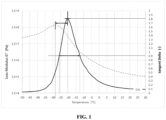
- Tan delta ( ⁇ ) peak is the ratio of the loss to the storage modulus, characterizing the efficiency of the material to dissipate energy when deformed.
- surface protection films for use in protecting surfaces, e.g., polymers, metals, glass, woods, furniture, fixtures, electrical appliances, etc., from scratches, dirt, and smudges.
- SBCs for use in such applications need to have a balance of mechanical properties in terms of strength, suitable modulus or hardness, weatherability, heat resistance, and the like.
- the disclosure relates to a hydrogenated styrenic block copolymer (HSBC) comprising, consisting essentially of, or consists of at least one polymer block A, at least polymer block B, and at least one copolymer block C.
- HSBC hydrogenated styrenic block copolymer
- each polymer block A is derived from a vinyl aromatic monomer
- each polymer block B is derived from a conjugated diene monomer selected from the group consisting of isoprene, 1,3-butadiene, 2,3-dimethyl-1,3-butadiene, 1-phenyl-1,3-butadiene, 1,3-pentadiene, 1,3-hexadiene, 3-butyl-1,3-octadiene, farnesene, myrcene, piperylene, cyclohexadiene, and mixtures thereof
- each copolymer block C is derived from at least one vinyl aromatic monomer and 1,3-butadiene monomer.
- the HSBC has a hydrogenation level in the polymerized conjugated diene monomer in the polymer block B of greater than 90%, a hydrogenation level in the polymerized 1,3-butadiene monomer in the polymer block C of greater than 90%, a total vinyl aromatic content of 15 to 60 wt.%, an aromatic blockiness index (ABI) of 20 to 80%, and a rubbery aliphatic methyl index (RAMI) of 10 to 35.
- ABSI aromatic blockiness index
- RAMI rubbery aliphatic methyl index
- the HSBC is characterized as having, a tan ⁇ peak height of 0.7 to 2, a tan ⁇ peak temperature of - 40 to 25°C, a temperature width value (in °C) at half the tan ⁇ peak height of 17 to 40, and a temperature difference value (in °C) between the tan ⁇ peak temperature and a maximum loss modulus peak temperature of 14 to 21, all measurements by Dynamic Mechanical Analysis (DMA) (10 rad/sec.).
- DMA Dynamic Mechanical Analysis
- the polymer block B contains polymerized 1,3-butadiene monomer.
- the polymerized 1,3-butadiene monomer in the polymer blocks B and C, together, is at least 50 wt.%, based on total weight of the polymer blocks B and C.
- the polymer block B contains polymerized 1,3-butadiene monomer.
- a multiplication product value (in °C) of the value of the tan ⁇ peak height and the temperature width value (in °C) at half the tan ⁇ peak height is greater than 25°C.
- FIG. 1 is an illustration of the DMA (Dynamic Mechanical Analysis) of the nomogram with the tangent Delta (tan ⁇ ) and the loss modulus (G") of a hydrogenated styrenic block copolymers.
- DMA Dynamic Mechanical Analysis
- At least one of [a group such as A, B, and C]" or "any of [a group such as A, B, and C]” means a single member from the group, more than one member from the group, or a combination of members from the group.
- at least one of A, B, and C includes, for example, A only, B only, or C only, as well as A and B, A and C, B and C; or A, B, and C, or any other all combinations of A, B, and C.
- a list of embodiments presented as "A, B, or C" is to be interpreted as including the embodiments, A only, B only, C only, "A or B,” “A or C,” “B or C,” or "A, B, or C”.
- At least one X and Y means there is at least one of X and there is one of Y, such as "X, X, and Y,” or "X, X, X, and Y,” or "X and Y" only.
- Copolymer refers to a polymer derived from more than one species of monomer.
- Block copolymer refers to a copolymer that comprises more than one species of monomer, wherein the monomers are present in blocks. Each block is constituted of a set of monomer units different from the set of monomer of the connected surrounding blocks in the same block copolymer. Each block can be constituted of a homopolymer or a random copolymer.
- Polystyrene content or PSC of a block copolymer refers to the weight % of vinyl aromatic, e.g., styrene in the block copolymer, calculated by dividing the sum of molecular weights of all vinyl aromatic units by the total molecular weight of the block copolymer.
- PSC can be determined using any suitable methodology such as proton nuclear magnetic resonance (NMR).
- M w refers to the polystyrene equivalent molecular weight in kg/mol of a polymer block or a block copolymer. M w can be measured with the gel permeation chromatography (GPC) using polystyrene calibration standards, such as is done according to ASTM 5296-19.
- the GPC detector can be an ultraviolet or refractive index detector or a combination thereof.
- the chromatograph is calibrated using commercially available polystyrene molecular weight standards.
- M w of polymers measured using GPC are polystyrene equivalent molecular weights or apparent molecular weights, measured at the peak of the GPC trace, and commonly referred to as polystyrene equivalent "peak molecular weight,” designated as M p .
- Individual GPC block M w can be calculated by the difference of M p measured before and after the considered block polymerization. For example, M w of block B is the M p of species A-B minus the M p of block A.
- Tan ⁇ is also referred to as damping factor, dissipation factor or loss factor, commonly used as a measure of the damping in a viscoelastic system. Tan ⁇ can be measured by DMA.
- ABI “Aromatic Blockiness Index” or ABI in the (co)polymer refers to the percentage of aromatic units with two adjacent aromatic units in the overall amount of aromatic units present in the polymer.
- Random Aliphatic Methyl Index refers to the percentage of the aliphatic protons (H) present in methyl groups of the conjugated diene derived units with respect to the total aliphatic protons present inside the rubbery units. The total aliphatic protons and the methyl proton content is corrected to remove the contribution of the aliphatic protons from the aromatic units.
- RAMI 100 ⁇ Integral ⁇ 2 ⁇ Correction ⁇ 2 / Integral ⁇ 1 ⁇ Correction ⁇ 1
- Integral-1 is determined by integrating the H-1 NMR spectrum from 2.99 ppm to 0.6 ppm
- Integral-2 is determined by integrating the H-1 NMR spectrum from, the signal minimum region between 1.0 ppm and 0.8 ppm, to 0.6 ppm.
- the correction is a function of the vinyl aromatic units present in the HSBC and Integral-3.
- the disclosure relates to a hydrogenated styrenic block copolymer (HSBC) with improved mechanical properties, characterized as having a broad tan delta ( ⁇ ) peak and broad adhesion temperature range, for use in applications including adhesives, protective films, over molding thermoplastic compounds, etc.
- HSBC hydrogenated styrenic block copolymer
- the HSBC is formed by hydrogenating a SBC precursor, which is any of linear, branched, or radial block copolymer having at least one end polymer block A, at least one interior polymer block B and / or polymer block C.
- the SBC precursor has a general configuration of A-B-C, A-B-C-A, A-B-C-A', A-B-C-B, A-B-C-A-B, A-B-C-B-A, B-A-B-C-B-A, B-A-B-C-B-A-B, C-B-A-B-C, (A-B-C) n X, (A-B-C-A) n X, (B-A-B-C) n X, (A-B-C-B-A) n X, (C-B-A-B-C) n X, or mixtures thereof; where n is an integer from 2 to 30, and X is a residue of a coupling agent.
- Polymer blocks A and A' are same or different and based on a vinyl aromatic monomer.
- Polymer block B is derived from a conjugated diene monomer.
- Copolymer block C is derived from at least one vinyl aromatic monomer and 1,3-butadiene monomer.
- the vinyl aromatic monomer is selected from the group consisting of styrene, para-methylstyrene, para-ethylstyrene, para-n-propylstyrene, para-iso-propylstyrene, para-n-butylstyrene, para-sec-butylstyrene, para-iso-butylstyrene, para-t-butylstyrene, isomers of para-decylstyrene, isomers of para-dodecylstyrene, ortho-substituted styrene, meta-substituted styrene, alpha-methylstyrene, 1,1-diphenylethylene, and mixtures thereof.
- the conjugated diene monomer is selected from the group consisting of isoprene, 1,3-butadiene, 2,3-dimethyl-1,3-butadiene, 1-phenyl-1,3-butadiene, 1,3-pentadiene, 1,3-hexadiene, 3-butyl-1,3-octadiene, farnesene, myrcene, piperylene, cyclohexadiene, and mixtures thereof.
- the polymer block B comprises polymerized 1,3-butadiene monomer in an amount of up to 100, 70 - 100, or 75 - 98, or 80 - 95, or > 70, or > 75, or 80 wt.%, based on total weight of the polymerized conjugated diene monomer in the polymer block B.
- the polymer block B comprises polymerized conjugated diene monomer other than 1,3-butadiene, from 0 - 30, or 2 - 25, or 5 - 20 wt.%, based on total weight of the polymerized monomer in the block B.
- the polymer block B is a homopolymer block of 1,3-butadiene monomer.
- total polymerized 1,3-butadiene monomer present in polymer blocks B and C, together is > 50, or > 55, or > 60, or > 65, or > 70, or > 75 wt.%, based on total weight of polymer blocks B and C.
- the copolymer block C comprises polymerized 1,3-butadiene monomer from 30 - 85, or 30 - 80, or 35 - 75, or 40 - 70, or 45 - 65, or 50 - 80, or ⁇ 75 wt.%, based on total weight of the copolymer block C.
- the copolymer block C comprises the polymerized vinyl aromatic monomer from 15 - 70, or 20 - 60, or 25 - 50 wt.%, based on total weight of the copolymer block C.
- Blocks B and C can have incorporation of 1,3-butadiene monomer by either 1,2 addition and / or 1,4 addition.
- blocks B and C contain, together, 40 - 80, or 45 - 80, or 65 - 80, or 70 - 80 wt.% of 1,3-butadiene monomer incorporated by 1,2 addition, based on total weight of polymerized 1,3-butadiene monomer in blocks B and C.
- the SBC precursor is hydrogenated to obtain the HSBC, meaning the polymerized vinyl aromatic monomers in polymer blocks A and C are left essentially non-hydrogenated, polymerized conjugated diene units in the polymer block B and polymerized 1,3-butadiene units in the block C are mostly hydrogenated.
- the polymerized conjugated diene monomer in the polymer block B and polymerized 1,3-butadiene monomer in the copolymer block C are independently hydrogenated to a level of > 70, or > 80, or > 85, or > 90, or > 95, or > 98, or > 99, or > 99.9 %, based on weight of the polymerized conjugated diene monomer in the polymer block B and the polymerized 1,3-butadiene monomer in the copolymer block C.
- the polymerized vinyl aromatic monomer in blocks A and C are independently hydrogenated to a level of ⁇ 30, or ⁇ 25, or ⁇ 20, or ⁇ 15, or ⁇ 10, or ⁇ 5, or ⁇ 2 %, based on weight of the polymerized vinyl aromatic monomer in blocks A and C.
- the polymer block A has a M p of 2 - 50, or 3 - 45, or 5 - 40, or 10 - 35, or 15 - 30, or > 3, or ⁇ 35 kg/mol.
- the polymer block B has a M p of 10 - 300, or 15 - 150, or 20 - 100, or 25 - 80, or 30 - 60, or > 15, or ⁇ 90 kg/mol.
- the copolymer block C has a M p of 5 - 300, or 10 - 200, or 15 - 150, or 20 - 120, or 25 - 100, or 30 - 90, or > 15, or ⁇ 160 kg/mol.
- the HSBC has a total vinyl aromatic content (PSC) of 15 - 60, 20 - 55, or 25 - 50, or 30 - 45 wt.%, based on total weight of the HSBC.
- PSC total vinyl aromatic content
- the HSBC has a RAMI of 10 - 35, or 12 - 32, or 15 - 30, or 17 - 30, or > 20, or > 25.
- the HSBC has an ABI of 20 - 80%, or 25 - 75%, or 30 - 70%, or 35 - 65%, or 40 - 60%, or > 30%, or > 40%, or ⁇ 75%.
- the HSBC further comprises at least one functional group selected from the group consisting of OH, halogen, acid anhydride, amino, epoxy, phosphino, SO 3 Y, CO 2 Z, wherein Y is a metal cation, H, alkoxy, or aryloxy.
- the SBC precursor can be prepared by known process in the art and disclosed in U.S. Patent No. 7449518 .
- the SBC precursor is prepared by an anionic polymerization using a sequential (or successive) polymerization of monomers in solution in the presence of an initiator followed by terminating of polymerized block copolymer chains.
- the polymerization of monomers can be performed by stepwise addition of the monomer to the solution containing the initiator followed by coupling of the resulting sequential block copolymer chains with a coupling agent (if present) and followed by a hydrogenation step for making the HSBC.
- the initiator is generally an organometallic compound, such as organolithium compounds, example, ethyl-, propyl-, isopropyl-, n-butyl-, sec-butyl-, tert-butyl-, phenyl-, hexylbiphenyl-, hexamethylenedi-, butadieneyl-, isopreneyl-, 1,1-diphenylhexyllithium, or polystyryllithium.
- organolithium compounds example, ethyl-, propyl-, isopropyl-, n-butyl-, sec-butyl-, tert-butyl-, phenyl-, hexylbiphenyl-, hexamethylenedi-, butadieneyl-, isopreneyl-, 1,1-diphenylhexyllithium, or polystyryllithium.
- the amount of initiator needed is
- a solvent for polymerization can include aliphatic, cycloaliphatic, or aromatic hydrocarbons having 4 - 12 carbon atoms, e.g., pentane, hexane, heptane, cyclopentane, cyclohexane, methylcyclohexane, decalin, isooctane, benzene, alkylbenzenes, such as toluene, xylene or ethylbenzene, and mixtures thereof.
- process conditions for the sequential polymerization step are similar to those in anionic polymerizations, at a temperature of -30 to 150°C, or 10 - 100°C, or 30 - 90°C.
- the polymerization is carried out in an inert atmosphere, e.g., nitrogen, or under pressure at 0.5 - 65 bars, for ⁇ 12 hrs., or 5 min. - 5 hrs., depending on temperature, concentration of monomer components, molecular weight of the block copolymer, etc.
- the coupling agent examples include bi- or polyfunctional compounds, for example divinylbenzene, halides of aliphatic or araliphatic hydrocarbons, such as 1,2-dibromoethane, bis(chloromethyl)benzene, or silicon tetrachloride, dialkyl- or diarylsilicon dichloride, alkyl- or arylsilicon trichloride, tin tetrachloride, alkylsilicon methoxides, alkyl silicon ethoxides, polyfunctional aldehydes, such as terephthalic dialdehyde, ketones, esters, anhydrides or epoxides.
- the coupling agent is selected from methyltrimethoxysilane (MTMS), methyltriethoxysilane (MTES), tetramethoxysilane (TMOS), dimethyladipate, and mixtures thereof.
- MTMS methyltrimethoxysilane
- MTES methyl
- a suitable amount of the coupling agent can be employed to obtain desired coupling efficiency, e.g., > 50%, or > 60%, or > 70%, or > 80%, or > 90%.
- the SBC precursor is hydrogenated using a hydrogenation process as disclosed in U.S. Patent Nos. 3670054 and 3700633 . Any hydrogenation process that is selective for the double bonds in polymerized conjugated diene monomer, leaving the aromatic unsaturation in the polymerized vinyl aromatic monomer substantially intact, can be used.
- the hydrogenation process employs a catalyst or catalyst precursor comprising a metal, e.g., nickel, cobalt, or titanium and a suitable reducing agent, e.g., an aluminum alkyl.
- a catalyst or catalyst precursor comprising a metal, e.g., nickel, cobalt, or titanium and a suitable reducing agent, e.g., an aluminum alkyl.
- a sufficient amount of catalyst is used depending on reaction temperature, desired molecular weight of the polymer, etc.
- the hydrogenation is controlled at a temperature of 25 - 175°C, or 35 - 150°C, or 50 - 100°C, and for a time ranging from 5 min. - 8 hrs., or 30 min. - 4 hrs. After the hydrogenation is completed, the catalyst and the catalyst residue will be separated from the block copolymer.
- compositions Based on HSBC Compositions Based on HSBC
- the HSBC can be used in a thermoplastic elastomer composition (TPE) as the primary component, or blended with a polyolefin in a compound, or blended with a rubber in a rubber composition.
- TPE thermoplastic elastomer composition
- thermoplastic elastomer composition (TPE) is prepared containing a HSBC, optional tackifying resin, optional (other) polymers, optional additives.
- the HSBC can be added in an amount of 50 - 99, or 60 - 90, or 70 - 95 wt.%, based on the TPE composition total weight.
- polymers examples include polylactic acids, polystyrenes, polyethylene glycols, poly(vinyl alcohol), polyurethanes, poly(acrylic acids), poly(acrylamides), polyolefins, polyesters, polyethylene terephthalates, polybutylene terephthalates, poly(butyl succinates), polycarbonates, polyetherimides, polyphenyloxides, poly(methyl methacrylates), poly(n-vinyl-pyrrolidone), polyethylenimenes, poly(dimethyl acrylamide), polyether ketone ketone (PEKK), polytetrafluoroethylene (PTFE), polyamides (PA), polyimides (PI), polyacrylates, poly(dimethylsiloxane), copolymers of foregoing polymers, and mixtures thereof.
- tackifying resins include one or more natural or modified rosins or rosin esters containing those made using polyols, polyterpene resins, phenolic-modified terpene resins, aromatic resins, aliphatic petroleum resins such as those made using C5 or C9 hydrocarbon streams obtained from petroleum cracking / refining, hydrogenated forms thereof, or mixtures thereof.
- the tackifying resin is used in amounts of 1 - 50, or 10 - 40, or 5 - 30 wt.%, based on the TPE composition total weight.
- the HSBC is blended with polyolefin selected from the group consisting of polyethylene (PE), polypropylene (PP), polybutylene (PB), polyisobutylene, ethylene propylene rubber, polyvinylchloride (PVC), polydiene, such as polybutadiene (e.g., poly-1,3-butadiene or poly-1,2-butadiene), polyisoprene, polydicyclopentadiene (PDCPD), polymers of ethylidene norbornene or vinyl norbornene, EPDM rubber, low density polyethylene (LDPE), linear low density polyethylene (LLDPE), very low density polyethylene (VLDPE), high density polyethylene (HDPE), medium density polyethylene (MDPE), high molecular weight polyethylene (HMWPE), and ultra-high molecular weight polyethylene (UHMWPE), polyolefin elastomer (POE), and mixtures thereof.
- PE polyethylene
- PP polypropylene
- PB poly
- the HSBC is blended with one or more rubbers, selected from a natural rubber, a synthetic rubber, and mixtures thereof.
- rubbers include natural rubber (NR), ethylene-propylene-diene rubber (EPDM), ethylene / alpha-olefin rubbers (EPR), ethylene-vinyl acetate (EVA), styrene / butadiene rubber (SBR), acrylonitrile / butadiene rubber (NBR), polychloroprene rubbers, polybutadiene rubbers (BR), synthetic polyisoprene rubber (IR), isobutylene-isoprene rubber (IIR), and mixtures thereof.
- NR natural rubber
- EPDM ethylene-propylene-diene rubber
- EPR ethylene / alpha-olefin rubbers
- EVA ethylene-vinyl acetate
- SBR styrene / butadiene rubber
- NBR acrylonitrile / butadiene rubber
- a rubber composition is prepared comprising 50 - 99 wt.% of the HSBC, 1 - 50 wt.% of the rubber, and 0 -15 wt.% of additives, based on total weight of the rubber composition.
- optional additive is selected from the group consisting of activators, curing agents, neutralizing agents, thickeners, coalescing agents, slip agents, release agents, antimicrobial agents, surfactants, antioxidants, antiozonants, color change pH indicators, plasticizers, tackifiers, film forming additives, dyes, pigments, cross-linking agents, UV absorbers, UV stabilizers, catalysts, fillers, redox couples, fibers, flame retardants, viscosity modifiers, wetting agents, deaerators, toughening agents, adhesion promoters, colorants, heat stabilizers, lubricants, flow modifiers, drip retardants, antistatic agents, processing aids, stress-relief additives, accelerator, water resistant agents, waterproofing agents, hydrophilicity-imparting agents, electrical conductivity-imparting agents, thermal conductivity-imparting agents, electromagnetic wave shielding property-imparting agents, fluorescent agents, sliding property-imparting agents, foaming agents, and mixtures thereof.
- plasticizers examples include paraffinic oil, naphthenic oil, natural oil, hydrotreated naphthenic oil, low molecular weight polyolefin, low molecular weight liquid rubber, and mixtures thereof.
- Fillers can be selected from inorganic silicates such as andalusite, sillimanite, kyanite, mullite, pyrophyllite, allophane, mineral calcium silicate, silica, quartz powder, metal sulfates such as barium sulfate, metal oxides such as zinc oxide, titanium dioxide, zeolites, leucite, potash feldspar, biotite, gypsum, anhydrite or heavy spar, and calcium minerals such as talc or chalk (CaCO3), metal hydroxides, mica, magnesium hydroxide, aluminum hydroxide, and mixtures thereof.
- inorganic silicates such as andalusite, sillimanite, kyanite, mullite, pyrophyllite, allophane, mineral calcium silicate, silica, quartz powder, metal sulfates such as barium sulfate, metal oxides such as zinc oxide, titanium dioxide, zeolites, leucite, potash feldspar
- the additive used is from 0 - 15, or 5 - 15, or 1 - 10, or 0.5 - 5 wt.%, based on total weight of the composition containing the HSBC.
- compositions based on HSBCs can be prepared by mixing components described above using a suitable processing device, such as Henschel mixer, V blender, ribbon blender, single or twin screw extruder, kneader and the like. Thereafter, the compositions can be pelletized for further processing or for end-use applications.
- the compositions containing the HSBC are processed directly into end-use applications using conventional plastics processing equipment, e.g., extrusion, molding including compression molding, injection molding, gas-assisted injection molding, hollow molding, sheet forming, rotational molding, laminating, calendering, vacuum forming, thermoforming, or hot forming.
- the HSBC provides improved mechanical and thermal properties which make them suitable for use in high performance applications.
- the HSBC can be processed with or without a curing agent.
- the HSBC shows improved adhesion and high damping performance at a broad temperature range while maintaining good balance of mechanical properties.
- the HSBC when used as an adhesive layer allows easy peel-off with adhesive failure property, when the adhesive layer is peeled from the surface.
- the HSBC is particularly suitable for use a component of protective film, providing easy peelability from the protected surfaces even after long storage time (e.g., 1 day, 1 week, 1 month, 3 months, or more) or during transport and under various environmental conditions.
- the HSBC has a tensile strength of 10 - 60, or 15 - 55, or 18 - 50, or 20 - 45, or 22 - 40, or 25 - 38, > 15, or > 20 MPa, measured according to ASTM D412.
- the HSBC has a tan ⁇ peak temperature of -40 to 25°C, or - 35 to 20°C, or -30 to 15°C, or -25 to -10°C, or -5 to 25°C, measured by DMA (10 rad/sec.).
- the HSBC has a value of a tan ⁇ peak height of 0.7 - 2, or 0.9 - 1.95, or 1 - 1.9, or 1.05 - 1.85, or 1.1 - 1.8, or 1.15 - 1.75, or 1.2 - 1.7, or > 0.9, or > 1, or > 1.1, or > 1.2.
- the HSBC has a 'full width half maximum' (FWHM), or a temperature width value (in °C) at half the tan ⁇ peak height of 15 - 40, or 18 - 35, or 17 - 32, or 22 - 40, or 20 - 30, or > 22, or > 24.
- FWHM 'full width half maximum'
- a temperature width value in °C
- the HSBC has a maximum loss modulus peak temperature of -55°C to -25°C, or -43°C to -30°C, or -45°C to -35°C, or -40°C to -30°C.
- the maximum loss modulus G" obtained as a function of temperature, attains a peak value ("loss modulus G" peak temperature) at a sweep frequency of 10 rad/s.
- the HSBC has a temperature difference value (in °C) between the tan ⁇ peak temperature and a maximum loss modulus peak temperature of 14 - 21, or 13.5 - 20.5, or 13 - 20, or 12.5 - 19.5, or 12 -19, or 11.5 - 18.5.
- the HSBC has a multiplication product value (in °C) of the value of tan ⁇ peak height and the temperature width value (°C) at half the tan ⁇ peak height of > 25, or > 27, or > 28, or > 30, or > 32, or > 35, or > 38, or > 40 or 25 - 50, or 22 -45, or 24-42.
- the HSBC has a melt flow rate (MFR) of 1 - 200, or 2 - 100, or 5 - 80, or 10 - 60, or 15 - 50, or 20 - 40, or 10 - 20 dg/min, measured according to D1238 under 2.16 kg load and at 230°C.
- MFR melt flow rate
- HSBCs can be used in applications, e.g., vibration damping, adhesives, labels, sealants, seals, acoustics, communications, coatings, e.g., wall coating or metal coatings, shoe parts, wire and cables.
- Adhesives can be pressure-sensitive and holt-melt adhesives.
- HSBCs are used for producing molded articles, e.g., automotive parts (automotive interior materials and automotive exterior materials), various containers such as food packaging containers, consumer electrical appliances, medical device parts, industrial parts, toys, and tackiness films, for example, surface protection films for protecting surfaces, such as glass, wood, metal, polymer, ceramic, and the like, for use in wide application areas including electronics, household items, furniture, displays, touch screens, and the like.
- automotive parts automotive interior materials and automotive exterior materials
- various containers such as food packaging containers, consumer electrical appliances, medical device parts, industrial parts, toys, and tackiness films, for example, surface protection films for protecting surfaces, such as glass, wood, metal, polymer, ceramic, and the like, for use in wide application areas including electronics, household items, furniture, displays, touch screens, and the like.
- a protection film (or an adhesive film) comprises the HSBC, having a thickness of 1 - 200 ⁇ m, or 5 - 100 ⁇ m, or 10 - 50 ⁇ m, or 5 - 30 ⁇ m and thickness of the substrate film can be from 10 ⁇ m - 5 mm, or 50 ⁇ m - 2 mm, or 100 ⁇ m - 1 mm, or 30 ⁇ m - 200 ⁇ m.
- the protection film can be prepared by known methods, e.g., casting, extruding, cast film extrusion, blown film extrusion, and the like, and can have a substrate film, e.g., polyethylene, polypropylene, polyesters, polyamides, polyimides, polyphenylene oxides, etc.
- a substrate film e.g., polyethylene, polypropylene, polyesters, polyamides, polyimides, polyphenylene oxides, etc.
- the HSBC can be used for vibration or sound damping applications, e.g., energy absorption, for both outdoor and indoor applications, at broad service temperature ranges, e.g., -50°C to 100°C, or -30°C to +80°C, or -10°C to 50°C, or 0°C to 100°C.
- an asphalt composition comprising 0.5 - 50 parts by weight of the HSBC, based on 100 parts by weight of an asphalt (or bitumen).
- the asphalt composition can be used in a roof shingle.
- Polymer molecular weights were determined by gel permeation chromatography (GPC) using polystyrene calibration standards according to ASTM 5296.
- T g Glass transition temperature of all polymer samples were measured by DMA according to ASTM 4065. Temperature sweep experiments were conducted from -80 to 200°C with a heating ramp of 2°C/min and at 10 rad/s in the shear mode unless specified otherwise, where storage moduli (G'), loss moduli (G") and loss factors (tan ⁇ ) were obtained as a function of temperature. The tan ⁇ peak temperature here is considered to be the T g of the rubber phase. DMA data at 10 rad/s or at 1Hz are not differing a lot but provided ranges are specified on 10 rad/s in shear mode measurements.
- the damping performance as a function of the breadth of the temperature range was measured using DMA.
- the temperature difference value in °C
- peak tanDelta peak value
- loss modulus G peak temperature
- tan ⁇ peak width was assessed by its total width at half its maximum height.
- Sample specimens of the HSBC were prepared using two different methods. In the first method, samples were prepared by pressing under high pressure at 180°C into 2mm (thickness) plates. In the second method, film samples were cast from a solution of 10 wt.% polymer dissolved in toluene at room temperature. The resulting cast films were subsequently dried in a vacuum oven at 40°C.
- the components used in examples include:
- LDPE Low density polyethylene
- Random copolymer of propylene-ethylene block (RcPP) copolymer is used as core layer and backing layer.
- Cyclohexane (593 kg) was added to a stainless steel reactor. To this, 2.7 kg of sec-BuLi catalyst was added followed by 40.5 kg first styrene monomer addition over 7 min. After 43 min. and after reaching peak reaction temperature to 45°C, a sample was taken to confirm the formation of the first styrene polymer block. Into the reaction mixture, 0.82 kg of 1,2-diethoxypropane was added followed by 193.5 kg first 1,3-butadiene addition over a period of 68 min. The reaction was maintained between 46 - 51°C for 40 minutes. Formation of butadiene polymer block was confirmed by analyzing the sample at this stage of the reaction.
- Tables 2 and 3 compare structure and properties of HSBCs prepared in Examples 1-4 with HSBC-C1 and HSBC-C2:
- Protective films containing the HSBC were prepared, and peel adhesion (PA) properties were evaluated.
- Protective film (or adhesive film / layer) samples were prepared using a three layers coextrusion process.
- the top layer was the HSBC or the composition containing the HSBC, while the two other layers were polyolefinic backing layers of polypropylene and / or polyethylene.
- the melt temperatures were adapted in the range of 190 - 250°C to reach a smooth extrusion with about 10 ⁇ m adhesive layer and 2 layers of about 20 ⁇ m each of polyolefin as backing layers.
- the extruded film was allowed to cool down before to be wrap onto itself with the adhesive layer oriented to the center to form a roll of protective film. Film thicknesses of different protective films are provided in table 4.
- Peel adhesion (PA) 180° was measured on stainless steel or PMMA plates according to FTM1 (peel adhesion (180°) test equipment). FTM1 test method was used to quantify performance of adhesion or peelability of self-adhesive pressure sensitive materials. Peel adhesion is defined as the force required to remove pressure sensitive coated material, which has been applied to a standard test plate under specified conditions from the plate at a specified angle and speed. Adhesion was measured 20 minutes and 24 hours after application, the latter being considered as the ultimate adhesion.
- PA tests were conducted after 20 minutes at room temperature contact time between the protective film and the substrate, and after various ageing steps. Plates protected by the protective film were submitted to one of the following two ageing before to be cooled down to room temperature to perform their PA testing. The first ageing procedure maintained the protected plates at 75°C for 7 days before cooling, while the second ageing procedure maintained the protected plates at 80°C for 2 hours before cooling to room temperature and PA testing.
- the thickness of each adhesive HSBC layer was about 6 - 11 ⁇ m.
- LDPE backing layers were used for supporting adhesive HSBC layers, having total thickness of the backing layer and the adhesive HSBC layer was about 40 - 50 ⁇ m.
- Table 4 compares test results, including PA of protective films prepared from the HSBC of examples 1-4, and HSBC-C1 and HSBC-C2.
- Protective film samples were prepared as described in above procedures but for the adhesive layer, extruder was fed with a dry mixture of the HSBC (example 3) with various amount of random copolymer PP (94% propylene and 6% ethylene) characterized by a MFR of 5 g/10 min.
- the backing layer was the pure random copolymer PP.
- PA 180° was measured on Light Guide Plates protected by the protective films, which were submitted to one of the following two ageing before to be cooled down to room temperature to perform their PA testing. The first ageing procedure maintained the protected plates at 80°C for 2 hrs. under 5 kg pressure before cooling while the second ageing procedure maintained the protected plates at 110°C for 2 hrs. under 5 kg pressure before cooling to room temperature and PA testing. For transparency tests, 2 mm plaques of the HSBC / PP blend were prepared.
- Table 5 shows transparency and PA values measured on protective film using the HSBC / random copolymer PP mixture as an adhesive layer.
- Table 5 Example-6 (0%PP) Example-7 (10%PP) Example-8 (20%PP) Example-9 (30%PP) Total transmittance (%) 85.1 79.1 76 74.2 Haze (%) 6.27 15.6 23 30.5 Clarity (% 93.4 90.8 88.7 87.2 Hardness, Shore A, 10s 44.3 58.7 69.2 82.6
Landscapes
- Chemical & Material Sciences (AREA)
- Chemical Kinetics & Catalysis (AREA)
- Organic Chemistry (AREA)
- Health & Medical Sciences (AREA)
- Medicinal Chemistry (AREA)
- Polymers & Plastics (AREA)
- General Chemical & Material Sciences (AREA)
- Engineering & Computer Science (AREA)
- Manufacturing & Machinery (AREA)
- Inorganic Chemistry (AREA)
- Materials Engineering (AREA)
- Compositions Of Macromolecular Compounds (AREA)
- Adhesive Tapes (AREA)
- Adhesives Or Adhesive Processes (AREA)
- Addition Polymer Or Copolymer, Post-Treatments, Or Chemical Modifications (AREA)
- Graft Or Block Polymers (AREA)
Applications Claiming Priority (1)
| Application Number | Priority Date | Filing Date | Title |
|---|---|---|---|
| US202263268390P | 2022-02-23 | 2022-02-23 |
Publications (3)
| Publication Number | Publication Date |
|---|---|
| EP4234593A1 true EP4234593A1 (de) | 2023-08-30 |
| EP4234593C0 EP4234593C0 (de) | 2024-10-09 |
| EP4234593B1 EP4234593B1 (de) | 2024-10-09 |
Family
ID=85415227
Family Applications (1)
| Application Number | Title | Priority Date | Filing Date |
|---|---|---|---|
| EP23157960.8A Active EP4234593B1 (de) | 2022-02-23 | 2023-02-22 | Styrolblockcopolymere und verfahren zur herstellung davon |
Country Status (5)
| Country | Link |
|---|---|
| US (1) | US12559619B2 (de) |
| EP (1) | EP4234593B1 (de) |
| JP (1) | JP2023122642A (de) |
| CN (1) | CN116640275A (de) |
| TW (1) | TW202337989A (de) |
Families Citing this family (1)
| Publication number | Priority date | Publication date | Assignee | Title |
|---|---|---|---|---|
| TWI889593B (zh) * | 2023-11-15 | 2025-07-01 | 日商旭化成股份有限公司 | 嵌段共聚物組合物、及黏著性膜 |
Citations (8)
| Publication number | Priority date | Publication date | Assignee | Title |
|---|---|---|---|---|
| US3670054A (en) | 1969-10-29 | 1972-06-13 | Shell Oil Co | Block copolymers having reduced solvent sensitivity |
| US3700633A (en) | 1971-05-05 | 1972-10-24 | Shell Oil Co | Selectively hydrogenated block copolymers |
| US20070225429A1 (en) * | 2006-03-24 | 2007-09-27 | Wright Kathryn J | Novel block copolymer compositons |
| US7449518B2 (en) | 2006-03-24 | 2008-11-11 | Kraton Polymers U.S. Llc | High temperature block copolymers and process for making same |
| JP2012236901A (ja) * | 2011-05-11 | 2012-12-06 | Asahi Kasei Chemicals Corp | 粘着剤用ブロック共重合体、粘着剤組成物及び表面保護フィルム |
| US20160230000A1 (en) * | 2015-02-11 | 2016-08-11 | Polyone Corporation | Damping thermoplastic elastomers |
| US20200190375A1 (en) * | 2018-12-14 | 2020-06-18 | Kraton Polymers Llc | Novel Block Copolymers and Uses Thereof |
| US20220049083A1 (en) * | 2020-08-14 | 2022-02-17 | Kraton Polymers Llc | Novel Block Copolymers and Uses Thereof |
Family Cites Families (2)
| Publication number | Priority date | Publication date | Assignee | Title |
|---|---|---|---|---|
| WO2001055276A1 (en) * | 2000-01-31 | 2001-08-02 | H.B. Fuller Licensing & Financing, Inc. | Radiation curable adhesive compositions comprising block copolymers having vinyl functionalized polydiene blocks |
| EP4063416A1 (de) * | 2021-03-22 | 2022-09-28 | Kraton Polymers Research B.V. | Silan-funktionalisiertes styrol-blockcopolymer |
-
2023
- 2023-02-22 EP EP23157960.8A patent/EP4234593B1/de active Active
- 2023-02-22 US US18/172,375 patent/US12559619B2/en active Active
- 2023-02-22 JP JP2023026038A patent/JP2023122642A/ja active Pending
- 2023-02-23 CN CN202310159453.8A patent/CN116640275A/zh active Pending
- 2023-02-23 TW TW112106675A patent/TW202337989A/zh unknown
Patent Citations (8)
| Publication number | Priority date | Publication date | Assignee | Title |
|---|---|---|---|---|
| US3670054A (en) | 1969-10-29 | 1972-06-13 | Shell Oil Co | Block copolymers having reduced solvent sensitivity |
| US3700633A (en) | 1971-05-05 | 1972-10-24 | Shell Oil Co | Selectively hydrogenated block copolymers |
| US20070225429A1 (en) * | 2006-03-24 | 2007-09-27 | Wright Kathryn J | Novel block copolymer compositons |
| US7449518B2 (en) | 2006-03-24 | 2008-11-11 | Kraton Polymers U.S. Llc | High temperature block copolymers and process for making same |
| JP2012236901A (ja) * | 2011-05-11 | 2012-12-06 | Asahi Kasei Chemicals Corp | 粘着剤用ブロック共重合体、粘着剤組成物及び表面保護フィルム |
| US20160230000A1 (en) * | 2015-02-11 | 2016-08-11 | Polyone Corporation | Damping thermoplastic elastomers |
| US20200190375A1 (en) * | 2018-12-14 | 2020-06-18 | Kraton Polymers Llc | Novel Block Copolymers and Uses Thereof |
| US20220049083A1 (en) * | 2020-08-14 | 2022-02-17 | Kraton Polymers Llc | Novel Block Copolymers and Uses Thereof |
Also Published As
| Publication number | Publication date |
|---|---|
| US20230265278A1 (en) | 2023-08-24 |
| CN116640275A (zh) | 2023-08-25 |
| TW202337989A (zh) | 2023-10-01 |
| US12559619B2 (en) | 2026-02-24 |
| EP4234593C0 (de) | 2024-10-09 |
| JP2023122642A (ja) | 2023-09-04 |
| EP4234593B1 (de) | 2024-10-09 |
Similar Documents
| Publication | Publication Date | Title |
|---|---|---|
| JP6716612B2 (ja) | 水添共重合体、組成物及び成形体 | |
| DK2313267T3 (en) | APPLICATION OF SILANE MODIFIED POLYOLEFINES AS BINDING AGENTS FOR THE PREPARATION OF FLAT LAMINATES | |
| CN103797067B (zh) | 交联组合物、交联组合物的制造方法和成型体 | |
| JP5468258B2 (ja) | ホットメルトシーラントおよび発泡体代替ガスケット材料 | |
| JP5405452B2 (ja) | 樹脂組成物及びそれを用いたシート | |
| EP3666807B1 (de) | Blockcopolymere und verwendungen davon | |
| JPWO2003035705A1 (ja) | 水添共重合体 | |
| EP2599833A1 (de) | Thermoplastische polymerzusammensetzung und formartikel | |
| CN114075317A (zh) | 新型嵌段共聚物及其用途 | |
| EP4234593B1 (de) | Styrolblockcopolymere und verfahren zur herstellung davon | |
| WO2015072466A1 (ja) | 熱可塑性エラストマー樹脂組成物 | |
| TWI641636B (zh) | 用作等向性薄膜、擠壓及模塑製品的聚合物組成及其混合物 | |
| KR102543409B1 (ko) | 수소 첨가 공중합체 조성물, 점접착재 조성물 및 점접착 필름 | |
| TWI748463B (zh) | 氫化共聚物、黏著膜、樹脂組合物以及成形體 | |
| JP2002146130A (ja) | 表面保護フィルム・シート | |
| WO2002038654A1 (en) | Surface-protecting film/sheet and decorative film/sheet, and decorative material | |
| JP2006194318A (ja) | ポリプロピレン樹脂組成物製パイプ | |
| JPH0532836A (ja) | シート、フイルム用重合体組成物 | |
| EP4269522A1 (de) | Laminat mit einer haftschicht aus einer acrylhaftmittelzusammensetzung | |
| KR20250134176A (ko) | 열 안정성이 향상된 감압 접착제 조성물 및 이의 사용 | |
| CN120659854A (zh) | 具有改善的阻燃性能的可喷涂压敏粘合剂组合物 |
Legal Events
| Date | Code | Title | Description |
|---|---|---|---|
| PUAI | Public reference made under article 153(3) epc to a published international application that has entered the european phase |
Free format text: ORIGINAL CODE: 0009012 |
|
| STAA | Information on the status of an ep patent application or granted ep patent |
Free format text: STATUS: THE APPLICATION HAS BEEN PUBLISHED |
|
| AK | Designated contracting states |
Kind code of ref document: A1 Designated state(s): AL AT BE BG CH CY CZ DE DK EE ES FI FR GB GR HR HU IE IS IT LI LT LU LV MC ME MK MT NL NO PL PT RO RS SE SI SK SM TR |
|
| STAA | Information on the status of an ep patent application or granted ep patent |
Free format text: STATUS: REQUEST FOR EXAMINATION WAS MADE |
|
| 17P | Request for examination filed |
Effective date: 20240128 |
|
| RBV | Designated contracting states (corrected) |
Designated state(s): AL AT BE BG CH CY CZ DE DK EE ES FI FR GB GR HR HU IE IS IT LI LT LU LV MC ME MK MT NL NO PL PT RO RS SE SI SK SM TR |
|
| GRAP | Despatch of communication of intention to grant a patent |
Free format text: ORIGINAL CODE: EPIDOSNIGR1 |
|
| STAA | Information on the status of an ep patent application or granted ep patent |
Free format text: STATUS: GRANT OF PATENT IS INTENDED |
|
| INTG | Intention to grant announced |
Effective date: 20240506 |
|
| GRAS | Grant fee paid |
Free format text: ORIGINAL CODE: EPIDOSNIGR3 |
|
| GRAA | (expected) grant |
Free format text: ORIGINAL CODE: 0009210 |
|
| STAA | Information on the status of an ep patent application or granted ep patent |
Free format text: STATUS: THE PATENT HAS BEEN GRANTED |
|
| AK | Designated contracting states |
Kind code of ref document: B1 Designated state(s): AL AT BE BG CH CY CZ DE DK EE ES FI FR GB GR HR HU IE IS IT LI LT LU LV MC ME MK MT NL NO PL PT RO RS SE SI SK SM TR |
|
| REG | Reference to a national code |
Ref country code: CH Ref legal event code: EP |
|
| REG | Reference to a national code |
Ref country code: DE Ref legal event code: R096 Ref document number: 602023000667 Country of ref document: DE |
|
| REG | Reference to a national code |
Ref country code: IE Ref legal event code: FG4D |
|
| U01 | Request for unitary effect filed |
Effective date: 20241024 |
|
| U07 | Unitary effect registered |
Designated state(s): AT BE BG DE DK EE FI FR IT LT LU LV MT NL PT RO SE SI Effective date: 20241107 |
|
| U20 | Renewal fee for the european patent with unitary effect paid |
Year of fee payment: 3 Effective date: 20250221 |
|
| PG25 | Lapsed in a contracting state [announced via postgrant information from national office to epo] |
Ref country code: IS Free format text: LAPSE BECAUSE OF FAILURE TO SUBMIT A TRANSLATION OF THE DESCRIPTION OR TO PAY THE FEE WITHIN THE PRESCRIBED TIME-LIMIT Effective date: 20250209 Ref country code: HR Free format text: LAPSE BECAUSE OF FAILURE TO SUBMIT A TRANSLATION OF THE DESCRIPTION OR TO PAY THE FEE WITHIN THE PRESCRIBED TIME-LIMIT Effective date: 20241009 |
|
| PG25 | Lapsed in a contracting state [announced via postgrant information from national office to epo] |
Ref country code: ES Free format text: LAPSE BECAUSE OF FAILURE TO SUBMIT A TRANSLATION OF THE DESCRIPTION OR TO PAY THE FEE WITHIN THE PRESCRIBED TIME-LIMIT Effective date: 20241009 |
|
| PG25 | Lapsed in a contracting state [announced via postgrant information from national office to epo] |
Ref country code: NO Free format text: LAPSE BECAUSE OF FAILURE TO SUBMIT A TRANSLATION OF THE DESCRIPTION OR TO PAY THE FEE WITHIN THE PRESCRIBED TIME-LIMIT Effective date: 20250109 |
|
| PG25 | Lapsed in a contracting state [announced via postgrant information from national office to epo] |
Ref country code: GR Free format text: LAPSE BECAUSE OF FAILURE TO SUBMIT A TRANSLATION OF THE DESCRIPTION OR TO PAY THE FEE WITHIN THE PRESCRIBED TIME-LIMIT Effective date: 20250110 |
|
| PG25 | Lapsed in a contracting state [announced via postgrant information from national office to epo] |
Ref country code: PL Free format text: LAPSE BECAUSE OF FAILURE TO SUBMIT A TRANSLATION OF THE DESCRIPTION OR TO PAY THE FEE WITHIN THE PRESCRIBED TIME-LIMIT Effective date: 20241009 |
|
| PG25 | Lapsed in a contracting state [announced via postgrant information from national office to epo] |
Ref country code: RS Free format text: LAPSE BECAUSE OF FAILURE TO SUBMIT A TRANSLATION OF THE DESCRIPTION OR TO PAY THE FEE WITHIN THE PRESCRIBED TIME-LIMIT Effective date: 20250109 |
|
| PG25 | Lapsed in a contracting state [announced via postgrant information from national office to epo] |
Ref country code: SM Free format text: LAPSE BECAUSE OF FAILURE TO SUBMIT A TRANSLATION OF THE DESCRIPTION OR TO PAY THE FEE WITHIN THE PRESCRIBED TIME-LIMIT Effective date: 20241009 |
|
| PG25 | Lapsed in a contracting state [announced via postgrant information from national office to epo] |
Ref country code: SK Free format text: LAPSE BECAUSE OF FAILURE TO SUBMIT A TRANSLATION OF THE DESCRIPTION OR TO PAY THE FEE WITHIN THE PRESCRIBED TIME-LIMIT Effective date: 20241009 |
|
| PG25 | Lapsed in a contracting state [announced via postgrant information from national office to epo] |
Ref country code: CZ Free format text: LAPSE BECAUSE OF FAILURE TO SUBMIT A TRANSLATION OF THE DESCRIPTION OR TO PAY THE FEE WITHIN THE PRESCRIBED TIME-LIMIT Effective date: 20241009 |
|
| PLBE | No opposition filed within time limit |
Free format text: ORIGINAL CODE: 0009261 |
|
| STAA | Information on the status of an ep patent application or granted ep patent |
Free format text: STATUS: NO OPPOSITION FILED WITHIN TIME LIMIT |
|
| PG25 | Lapsed in a contracting state [announced via postgrant information from national office to epo] |
Ref country code: MC Free format text: LAPSE BECAUSE OF FAILURE TO SUBMIT A TRANSLATION OF THE DESCRIPTION OR TO PAY THE FEE WITHIN THE PRESCRIBED TIME-LIMIT Effective date: 20241009 |
|
| 26N | No opposition filed |
Effective date: 20250710 |
|
| PG25 | Lapsed in a contracting state [announced via postgrant information from national office to epo] |
Ref country code: IE Free format text: LAPSE BECAUSE OF NON-PAYMENT OF DUE FEES Effective date: 20250222 |
|
| U20 | Renewal fee for the european patent with unitary effect paid |
Year of fee payment: 4 Effective date: 20260225 |