EP4236013A1 - Batteriesteuerungssystem und -verfahren - Google Patents
Batteriesteuerungssystem und -verfahren Download PDFInfo
- Publication number
- EP4236013A1 EP4236013A1 EP22876638.2A EP22876638A EP4236013A1 EP 4236013 A1 EP4236013 A1 EP 4236013A1 EP 22876638 A EP22876638 A EP 22876638A EP 4236013 A1 EP4236013 A1 EP 4236013A1
- Authority
- EP
- European Patent Office
- Prior art keywords
- battery
- module group
- battery module
- switch
- threshold value
- Prior art date
- Legal status (The legal status is an assumption and is not a legal conclusion. Google has not performed a legal analysis and makes no representation as to the accuracy of the status listed.)
- Pending
Links
Images



Classifications
-
- G—PHYSICS
- G01—MEASURING; TESTING
- G01R—MEASURING ELECTRIC VARIABLES; MEASURING MAGNETIC VARIABLES
- G01R19/00—Arrangements for measuring currents or voltages or for indicating presence or sign thereof
- G01R19/165—Indicating that current or voltage is either above or below a predetermined value or within or outside a predetermined range of values
- G01R19/16533—Indicating that current or voltage is either above or below a predetermined value or within or outside a predetermined range of values characterised by the application
- G01R19/16538—Indicating that current or voltage is either above or below a predetermined value or within or outside a predetermined range of values characterised by the application in AC or DC supplies
- G01R19/16542—Indicating that current or voltage is either above or below a predetermined value or within or outside a predetermined range of values characterised by the application in AC or DC supplies for batteries
-
- H—ELECTRICITY
- H02—GENERATION; CONVERSION OR DISTRIBUTION OF ELECTRIC POWER
- H02J—ELECTRIC POWER NETWORKS; CIRCUIT ARRANGEMENTS OR SYSTEMS FOR SUPPLYING OR DISTRIBUTING ELECTRIC POWER; SYSTEMS FOR STORING ELECTRIC ENERGY
- H02J7/00—Circuit arrangements for charging or discharging batteries or for supplying loads from batteries
- H02J7/50—Circuit arrangements for charging or discharging batteries or for supplying loads from batteries acting upon multiple batteries simultaneously or sequentially
-
- B—PERFORMING OPERATIONS; TRANSPORTING
- B60—VEHICLES IN GENERAL
- B60L—PROPULSION OF ELECTRICALLY-PROPELLED VEHICLES; SUPPLYING ELECTRIC POWER FOR AUXILIARY EQUIPMENT OF ELECTRICALLY-PROPELLED VEHICLES; ELECTRODYNAMIC BRAKE SYSTEMS FOR VEHICLES IN GENERAL; MAGNETIC SUSPENSION OR LEVITATION FOR VEHICLES; MONITORING OPERATING VARIABLES OF ELECTRICALLY-PROPELLED VEHICLES; ELECTRIC SAFETY DEVICES FOR ELECTRICALLY-PROPELLED VEHICLES
- B60L58/00—Methods or circuit arrangements for monitoring or controlling batteries or fuel cells, specially adapted for electric vehicles
- B60L58/10—Methods or circuit arrangements for monitoring or controlling batteries or fuel cells, specially adapted for electric vehicles for monitoring or controlling batteries
- B60L58/18—Methods or circuit arrangements for monitoring or controlling batteries or fuel cells, specially adapted for electric vehicles for monitoring or controlling batteries of two or more battery modules
- B60L58/19—Switching between serial connection and parallel connection of battery modules
-
- G—PHYSICS
- G01—MEASURING; TESTING
- G01R—MEASURING ELECTRIC VARIABLES; MEASURING MAGNETIC VARIABLES
- G01R31/00—Arrangements for testing electric properties; Arrangements for locating electric faults; Arrangements for electrical testing characterised by what is being tested not provided for elsewhere
- G01R31/36—Arrangements for testing, measuring or monitoring the electrical condition of accumulators or electric batteries, e.g. capacity or state of charge [SoC]
- G01R31/382—Arrangements for monitoring battery or accumulator variables, e.g. SoC
- G01R31/3835—Arrangements for monitoring battery or accumulator variables, e.g. SoC involving only voltage measurements
-
- H—ELECTRICITY
- H01—ELECTRIC ELEMENTS
- H01M—PROCESSES OR MEANS, e.g. BATTERIES, FOR THE DIRECT CONVERSION OF CHEMICAL ENERGY INTO ELECTRICAL ENERGY
- H01M10/00—Secondary cells; Manufacture thereof
- H01M10/42—Methods or arrangements for servicing or maintenance of secondary cells or secondary half-cells
- H01M10/4207—Methods or arrangements for servicing or maintenance of secondary cells or secondary half-cells for several batteries or cells simultaneously or sequentially
-
- H—ELECTRICITY
- H01—ELECTRIC ELEMENTS
- H01M—PROCESSES OR MEANS, e.g. BATTERIES, FOR THE DIRECT CONVERSION OF CHEMICAL ENERGY INTO ELECTRICAL ENERGY
- H01M10/00—Secondary cells; Manufacture thereof
- H01M10/42—Methods or arrangements for servicing or maintenance of secondary cells or secondary half-cells
- H01M10/425—Structural combination with electronic components, e.g. electronic circuits integrated to the outside of the casing
-
- H—ELECTRICITY
- H01—ELECTRIC ELEMENTS
- H01M—PROCESSES OR MEANS, e.g. BATTERIES, FOR THE DIRECT CONVERSION OF CHEMICAL ENERGY INTO ELECTRICAL ENERGY
- H01M50/00—Constructional details or processes of manufacture of the non-active parts of electrochemical cells other than fuel cells, e.g. hybrid cells
- H01M50/50—Current conducting connections for cells or batteries
- H01M50/502—Interconnectors for connecting terminals of adjacent batteries; Interconnectors for connecting cells outside a battery casing
- H01M50/509—Interconnectors for connecting terminals of adjacent batteries; Interconnectors for connecting cells outside a battery casing characterised by the type of connection, e.g. mixed connections
- H01M50/51—Connection only in series
-
- H—ELECTRICITY
- H01—ELECTRIC ELEMENTS
- H01M—PROCESSES OR MEANS, e.g. BATTERIES, FOR THE DIRECT CONVERSION OF CHEMICAL ENERGY INTO ELECTRICAL ENERGY
- H01M50/00—Constructional details or processes of manufacture of the non-active parts of electrochemical cells other than fuel cells, e.g. hybrid cells
- H01M50/50—Current conducting connections for cells or batteries
- H01M50/502—Interconnectors for connecting terminals of adjacent batteries; Interconnectors for connecting cells outside a battery casing
- H01M50/509—Interconnectors for connecting terminals of adjacent batteries; Interconnectors for connecting cells outside a battery casing characterised by the type of connection, e.g. mixed connections
- H01M50/512—Connection only in parallel
-
- H—ELECTRICITY
- H02—GENERATION; CONVERSION OR DISTRIBUTION OF ELECTRIC POWER
- H02J—ELECTRIC POWER NETWORKS; CIRCUIT ARRANGEMENTS OR SYSTEMS FOR SUPPLYING OR DISTRIBUTING ELECTRIC POWER; SYSTEMS FOR STORING ELECTRIC ENERGY
- H02J7/00—Circuit arrangements for charging or discharging batteries or for supplying loads from batteries
- H02J7/50—Circuit arrangements for charging or discharging batteries or for supplying loads from batteries acting upon multiple batteries simultaneously or sequentially
- H02J7/575—Parallel/serial switching of connection of batteries to charge or load circuit
-
- H—ELECTRICITY
- H02—GENERATION; CONVERSION OR DISTRIBUTION OF ELECTRIC POWER
- H02J—ELECTRIC POWER NETWORKS; CIRCUIT ARRANGEMENTS OR SYSTEMS FOR SUPPLYING OR DISTRIBUTING ELECTRIC POWER; SYSTEMS FOR STORING ELECTRIC ENERGY
- H02J7/00—Circuit arrangements for charging or discharging batteries or for supplying loads from batteries
- H02J7/60—Circuit arrangements for charging or discharging batteries or for supplying loads from batteries including safety or protection arrangements
- H02J7/64—Circuit arrangements for charging or discharging batteries or for supplying loads from batteries including safety or protection arrangements against overvoltage
-
- H—ELECTRICITY
- H02—GENERATION; CONVERSION OR DISTRIBUTION OF ELECTRIC POWER
- H02J—ELECTRIC POWER NETWORKS; CIRCUIT ARRANGEMENTS OR SYSTEMS FOR SUPPLYING OR DISTRIBUTING ELECTRIC POWER; SYSTEMS FOR STORING ELECTRIC ENERGY
- H02J7/00—Circuit arrangements for charging or discharging batteries or for supplying loads from batteries
- H02J7/80—Circuit arrangements for charging or discharging batteries or for supplying loads from batteries including monitoring or indicating arrangements
-
- H—ELECTRICITY
- H01—ELECTRIC ELEMENTS
- H01M—PROCESSES OR MEANS, e.g. BATTERIES, FOR THE DIRECT CONVERSION OF CHEMICAL ENERGY INTO ELECTRICAL ENERGY
- H01M10/00—Secondary cells; Manufacture thereof
- H01M10/42—Methods or arrangements for servicing or maintenance of secondary cells or secondary half-cells
- H01M10/425—Structural combination with electronic components, e.g. electronic circuits integrated to the outside of the casing
- H01M2010/4271—Battery management systems including electronic circuits, e.g. control of current or voltage to keep battery in healthy state, cell balancing
-
- H—ELECTRICITY
- H02—GENERATION; CONVERSION OR DISTRIBUTION OF ELECTRIC POWER
- H02J—ELECTRIC POWER NETWORKS; CIRCUIT ARRANGEMENTS OR SYSTEMS FOR SUPPLYING OR DISTRIBUTING ELECTRIC POWER; SYSTEMS FOR STORING ELECTRIC ENERGY
- H02J2105/00—Networks for supplying or distributing electric power characterised by their spatial reach or by the load
- H02J2105/30—Networks for supplying or distributing electric power characterised by their spatial reach or by the load the load networks being external to vehicles, i.e. exchanging power with vehicles
- H02J2105/33—Networks for supplying or distributing electric power characterised by their spatial reach or by the load the load networks being external to vehicles, i.e. exchanging power with vehicles exchanging power with road vehicles
- H02J2105/37—Networks for supplying or distributing electric power characterised by their spatial reach or by the load the load networks being external to vehicles, i.e. exchanging power with vehicles exchanging power with road vehicles exchanging power with electric vehicles [EV] or with hybrid electric vehicles [HEV]
-
- Y—GENERAL TAGGING OF NEW TECHNOLOGICAL DEVELOPMENTS; GENERAL TAGGING OF CROSS-SECTIONAL TECHNOLOGIES SPANNING OVER SEVERAL SECTIONS OF THE IPC; TECHNICAL SUBJECTS COVERED BY FORMER USPC CROSS-REFERENCE ART COLLECTIONS [XRACs] AND DIGESTS
- Y02—TECHNOLOGIES OR APPLICATIONS FOR MITIGATION OR ADAPTATION AGAINST CLIMATE CHANGE
- Y02E—REDUCTION OF GREENHOUSE GAS [GHG] EMISSIONS, RELATED TO ENERGY GENERATION, TRANSMISSION OR DISTRIBUTION
- Y02E60/00—Enabling technologies; Technologies with a potential or indirect contribution to GHG emissions mitigation
- Y02E60/10—Energy storage using batteries
Definitions
- Embodiments disclosed herein relate to a battery control system and method.
- the secondary batteries which are chargeable/dischargeable batteries, may include all of conventional nickel (Ni)/cadmium (Cd) batteries, Ni/metal hydride (MH) batteries, etc., and recent lithium-ion batteries.
- a lithium-ion battery has a much higher energy density than those of the conventional Ni/Cd batteries, Ni/MH batteries, etc.
- the lithium-ion battery may be manufactured to be small and lightweight, such that the lithium-ion battery has been used as a power source of mobile devices.
- the lithium-ion battery is attracting attention as a next-generation energy storage medium as a usage range thereof is expanded to a power source of electric vehicles.
- a secondary battery is generally used as a battery pack including a battery module where a plurality of battery cells are connected to one another in series and/or in parallel. Battery packs may be managed and controlled by a battery management system in terms of their states and operations.
- a plurality of battery modules (or battery cells) included in a battery pack are configured in either series or parallel.
- a parallel configuration is available for a long time due to a large battery capacity, but has a low power, whereas a serial configuration has a shorter duration, in spite of a higher power, than the parallel configuration.
- a battery control system disclosed herein includes a first battery module group, a second battery module group, a first switch configured to connect an end of the second battery module group to a first contactor or open the end of the second battery module group, a second switch configured to connect an end of the first battery module group to the end of the second battery module group or a second contactor, and a battery management system (BMS) connected to the first switch and the second switch, in which the BMS is configured to detect an event for battery structure conversion, control the first switch and the second switch to connect the first battery module group and the second battery module group in series or in parallel, based on the detected event, and adjust a threshold value for battery diagnosis based on whether the first battery module group and the second battery module group are connected in series or in parallel.
- BMS battery management system
- An operating method of a battery control system disclosed herein includes detecting an event for battery structure conversion, controlling a first switch and a second switch to connect a first battery module group and a second battery module group in series or in parallel, based on the detected event, and adjusting a threshold value for battery diagnosis based on whether the first battery module group and the second battery module group are connected in series or in parallel, in which the first switch is configured to connect an end of the second battery module group to a first contactor or open the end of the second battery module group, and the second switch is configured to connect an end of the first battery module group to the end of the second battery module group or a second contactor.
- a battery control system may maximize advantages of parallel and serial structures of a battery pack by freely using the parallel and serial structures according to a situation.
- the battery control system may stably perform battery diagnosis in case of change of parallel and serial structures of the battery pack.
- first, second, or the like may modify various components regardless of importance, and do not limit the components.
- a first component may be named as a second component without departing from the right scope of an embodiment disclosed herein, and similarly, the second component may be named as the first component.
- FIG. 1 is a block diagram of a general battery pack including a battery management apparatus according to various embodiments.
- FIG. 1 schematically shows a battery control system 1 including a battery pack 10 and a higher-level controller 20 included in a higher-level system according to an embodiment disclosed herein.
- the battery pack 10 may include a plurality of battery modules 12, a sensor 14, a switching unit 16, and a battery management system (BMS) 100.
- the battery pack 10 may include the battery module 12, the sensor 14, the switching unit 16, and the BMS 100 provided in plural.
- the plurality of battery modules 12 may include at least one chargeable/dischargeable battery cells. In this case, the plurality of battery modules 12 may be connected in series or in parallel.
- the sensor 14 may detect current flowing in the battery pack 10. In this case, a detected signal may be transmitted to the BMS 100.
- the switching unit 16 may be connected in series to a (+) terminal side or a (-) terminal side of the battery module 12 to control the charging/discharging current flow of the battery module 12.
- the switching unit 16 may use at least one relay, a magnetic contactor, etc., according to the specifications of the battery pack 10.
- the BMS 100 may monitor the voltage, current, temperature, etc., of the battery pack 10 to perform control and management to prevent overcharging and overdischarging, etc., and may include, for example, a rack BMS (RBMS).
- RBMS rack BMS
- the BMS 100 which is an interface for receiving measurement values of the above-described various parameter values, may include a plurality of terminals and a circuit, etc., connected thereto to process input values.
- the BMS 100 may control on/off of the switching unit 16, e.g., a relay, a contactor, etc., and may be connected to the battery module 12 to monitor the state of each battery module 12.
- the higher-level controller 20 may transmit a control signal for controlling the battery module 12 to the BMS 100.
- the BMS 100 may be controlled in terms of an operation thereof based on a signal applied from the higher-level controller 20.
- the battery module 12 may be a component included in an energy storage system (ESS).
- the higher-level controller 20 may be a controller (a bank BMS (BBMS)) of a battery bank including the plurality of packs 10 or an ESS controller for controlling the entire ESS including a plurality of banks.
- BBMS bank BMS
- the battery pack 10 is not limited to such a purpose.
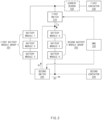
- FIGS. 2 to 4 are block diagrams showing a configuration of a battery control system according to various embodiments.
- a battery control system 1 (or the battery pack 10) may include a plurality of battery modules (battery modules 1 to 6), a first switch 210 and a second switch 220 configured to convert a battery structure in connection with some of the plurality of battery modules, a first contactor 230 and a second contactor 240 connected to the plurality of battery modules, and the BMS 100 connected to each component.
- the battery control system 1 may further include a current sensor 250 between the first contactor 230 and the plurality of battery modules to measure a current.
- the plurality of battery modules may be classified into two or more groups.
- the plurality of battery modules may be classified into a first battery module group 201 including the battery modules 1 to 3 and a second battery module group 202 including the battery modules 4 to 6, but the number of battery modules included in each battery module group and the number of battery module groups are not limited to an example shown in FIG. 2 .
- the following description presumes an embodiment where each battery module includes the same number of battery cells having the same performance, but the performance and number of cells are not necessarily identical.
- the first contactor 230 and the second contactor 240 may be a positive contactor and a negative contactor, respectively.
- a device e.g., a vehicle, construction machinery, etc.
- the first contactor 230 and the second contactor 240 may be turned on/off, together.
- the first contactor 230 may be connected to the first battery module group 201 (e.g., the battery module 1)
- the second contactor 240 may be connected to the second battery module group 202 (e.g., the battery module 6).
- a first end of the first switch 210 may be connected to the first contactor 230, and a second end of the first switch 210 may be connected to the second battery module group 202 (e.g., the battery module 4) (e.g., a path A).
- the second end of the first switch 210 may enter an open state with the second battery module group 202 under control of the BMS 100.
- a first end of the second switch 220 may be connected to the first battery module group 201 (e.g., the battery module 3), and a second end thereof may be connected to the second battery module group 202 (e.g., the battery module 4) (e.g., a path B1) or the second contactor 240 (e.g., a path B2) under control of the BMS 100.
- the first battery module group 201 e.g., the battery module 3
- the second battery module group 202 e.g., the battery module 4
- the second contactor 240 e.g., a path B2
- the BMS 100 may be connected to each component of the battery control system 1 to perform an overall operation of the battery control system 1. While FIGS. 2 to 4 show a structure where the BMS 100 is connected by the switches 210 and 220, the BMS 100 may be further connected to a measurement apparatus (e.g., the current sensor 250) or a plurality of battery modules.
- a measurement apparatus e.g., the current sensor 250
- the BMS 100 may control the first switch 210 and the second switch 220 to connect the first battery module group 201 and the second battery module group 202 in series or in parallel.
- the BMS 100 may control the first switch 210 to be in an open state with the second battery module group 202 and the second switch 220 to be connected to the second battery module group 202.
- the BMS 100 may control the first switch 210 to be connected to the second battery module group 202 and the second switch 220 to be connected to the second contactor 240.
- the BMS 100 may determine a battery structure to be a serial structure or a parallel structure based on detection of an event for battery structure conversion. For example, the BMS 100 may determine a battery structure to be the parallel structure to increase a battery duration when a battery capacity is less than a designated threshold capacity. In another example, the BMS 100 may determine the battery structure based on a location of the battery control system 1 (or a location of a vehicle). For example, when the vehicle is located in a downtown area, the BMS 100 may determine the battery structure to be the parallel structure to maintain battery performance. On the other hand, the BMS 100 may determine the battery structure to be the serial structure when the battery capacity is greater than or equal to the threshold capacity or the vehicle is not located in the downtown area (e.g., is located on a highway).
- the BMS 100 may adjust a threshold value for battery diagnosis based on the battery structure. For example, assuming that a voltage of each battery module is n (herein, n is an integer), when the battery structure is serial as shown in FIG. 3 , a maximum total voltage V total of a battery pack is equal to a sum, 6n, of a maximum total voltage V1 of the first battery module group 201 and a maximum total voltage V2 of the second battery module group 202, such that the BMS 100 may determine a threshold value for diagnosing an over-voltage to be a value equal to or greater than 6n. As shown in FIG. 4 , when the battery structure is parallel as shown in FIG.
- a maximum total voltage V total of a battery pack is equal to 3n that is the maximum total voltage V1 of the first battery module group 201 (or the maximum total voltage V2 of the second battery module group 202), such that the BMS 100 may determine the threshold value for diagnosing an over-voltage to be a value equal to or greater than 3n.
- the BMS 100 may determine a battery state to be fault and stop a battery operation (or a vehicle operation) or output a notification.
- the BMS 100 may change a threshold value for battery cell diagnosis according to a battery structure based on the same principle as battery diagnosis in the unit of a battery pack.
- the BMS 100 may change the threshold value by applying the same principle to pack under or over-current.
- FIG. 5 is an operating flowchart for controlling a battery structure and a threshold according to various embodiments. Operations shown in the operating flowchart may be implemented by the battery control system 1 or a component thereof (e.g., the BMS 100).
- the battery control system 1 may detect an event for battery structure conversion. According to an embodiment, the battery control system 1 may determine whether the structure of the battery pack 10 is serial or parallel.
- the battery control system 1 may control the first switch 210 and the second switch 220 to connect the first battery module group 201 and the second battery module group 202 in series or in parallel, based on the detected event.
- the battery control system 1 may adjust a threshold value for battery diagnosis based on the serial or parallel structure of the battery.
- FIG. 6 is an operating flowchart for controlling a battery structure and a threshold according to various embodiments.
- the battery control system 1 may identify at least one of a battery capacity or a location of the battery control system 1.
- the battery control system 1 may determine whether to connect battery module groups (the first battery module group and the second battery module group) in series or in parallel based on the identified value.
- the battery control system 1 may control the first switch 210 such that an end of the second battery module group 202 is in an open state with the first contactor340, in operation 630, and control the second switch 220 such that an end of the first battery module group 201 is connected to the end of the second battery module group 202, in operation 640.
- the battery control system 1 may determine the threshold value for battery diagnosis as a first threshold value.
- the battery control system 1 may control the first switch 210 such that the end of the second battery module group 202 is connected to the first contactor 340, in operation 660, and control the second switch 220 such that the end of the first battery module group 201 is connected to the second contactor 340, in operation 670.
- the battery control system 1 may determine the threshold value for battery diagnosis as a second threshold value.
- the second threshold value may be determined according to a ratio of the first battery module group 201 to the second battery module group 202.
- the battery control system 1 may determine the second threshold value to be a half of the first threshold value (or the half + a wherein a is a margin value).
- FIG. 7 is a block diagram showing a computing system that performs a battery management method according to various embodiments.
- a computing system 30 may include a microcontroller unit (MCU) 32, a memory 34, an input/output interface (I/F) 36, and a communication I/F 38.
- MCU microcontroller unit
- I/F input/output interface
- the MCU 32 may be a processor that executes various programs (e.g., a feature calculation program, a class classification and lifespan estimation program, etc.) stored in the memory 34, processes various data including voltage, current, etc., of a battery cell through these programs, and executes the above-described functions of the battery management apparatus shown in FIG. 2 .
- programs e.g., a feature calculation program, a class classification and lifespan estimation program, etc.
- the memory 34 may store various programs regarding feature calculation, class classification, and lifespan estimation of the battery cell. Moreover, the memory 34 may store various data such as a voltage, a current, feature data, etc., of each battery cell.
- the memory 34 may be provided in plural, depending on a need.
- the memory 34 may be volatile memory or non-volatile memory.
- RAM random access memory
- DRAM dynamic RAM
- SRAM static RAM
- ROM read only memory
- PROM programmable ROM
- EAROM electrically alterable ROM
- EPROM erasable PROM
- EEPROM electrically erasable PROM
- flash memory etc.
- the above-listed examples of the memory 34 are merely examples and are not limited thereto.
- the input/output interface (I/F) 36 may provide an interface for transmitting and receiving data by connecting an input device (not shown) such as a keyboard, a mouse, a touch panel, etc., and an output device such as a display (not shown), etc., to the MCU 32.
- an input device such as a keyboard, a mouse, a touch panel, etc.
- an output device such as a display (not shown), etc.
- the communication I/F 340 which is a component capable of transmitting and receiving various data to and from a server, may be various devices capable of supporting wired or wireless communication. For example, a program for feature calculation, class classification, and lifespan estimation for a battery cell or various data, etc., may be transmitted and received to and from a separately provided external server through the communication I/F 38.
- a computer program according to an embodiment disclosed herein may be recorded in the memory 34 and processed by the MCU 32, thus being implemented as a module that performs functions shown in FIG. 1 or 2 .
Landscapes
- Engineering & Computer Science (AREA)
- Power Engineering (AREA)
- General Chemical & Material Sciences (AREA)
- Chemical & Material Sciences (AREA)
- Chemical Kinetics & Catalysis (AREA)
- Electrochemistry (AREA)
- Manufacturing & Machinery (AREA)
- Physics & Mathematics (AREA)
- General Physics & Mathematics (AREA)
- Microelectronics & Electronic Packaging (AREA)
- Life Sciences & Earth Sciences (AREA)
- Sustainable Development (AREA)
- Sustainable Energy (AREA)
- Transportation (AREA)
- Mechanical Engineering (AREA)
- Charge And Discharge Circuits For Batteries Or The Like (AREA)
- Secondary Cells (AREA)
- Battery Mounting, Suspending (AREA)
Applications Claiming Priority (2)
| Application Number | Priority Date | Filing Date | Title |
|---|---|---|---|
| KR1020210129267A KR20230046146A (ko) | 2021-09-29 | 2021-09-29 | 배터리 제어 시스템 및 방법 |
| PCT/KR2022/010039 WO2023054863A1 (ko) | 2021-09-29 | 2022-07-11 | 배터리 제어 시스템 및 방법 |
Publications (2)
| Publication Number | Publication Date |
|---|---|
| EP4236013A1 true EP4236013A1 (de) | 2023-08-30 |
| EP4236013A4 EP4236013A4 (de) | 2024-06-05 |
Family
ID=85783063
Family Applications (1)
| Application Number | Title | Priority Date | Filing Date |
|---|---|---|---|
| EP22876638.2A Pending EP4236013A4 (de) | 2021-09-29 | 2022-07-11 | Batteriesteuerungssystem und -verfahren |
Country Status (6)
| Country | Link |
|---|---|
| US (1) | US20240047976A1 (de) |
| EP (1) | EP4236013A4 (de) |
| JP (1) | JP7601528B2 (de) |
| KR (1) | KR20230046146A (de) |
| CN (1) | CN116648627A (de) |
| WO (1) | WO2023054863A1 (de) |
Families Citing this family (1)
| Publication number | Priority date | Publication date | Assignee | Title |
|---|---|---|---|---|
| WO2026071942A1 (en) * | 2024-09-25 | 2026-04-02 | Epiroc Rock Drills Aktiebolag | Energy source system for mining and/or construction machines |
Family Cites Families (15)
| Publication number | Priority date | Publication date | Assignee | Title |
|---|---|---|---|---|
| JPH04251528A (ja) * | 1990-12-28 | 1992-09-07 | Fujitsu Ltd | バッテリー充電回路 |
| JP2001119813A (ja) | 1999-10-19 | 2001-04-27 | Shigeo Tanahashi | 電気自動車および充電装置 |
| JP5691981B2 (ja) | 2011-10-04 | 2015-04-01 | トヨタ自動車株式会社 | 直並列電池システムの充電制御装置 |
| DE102011054790A1 (de) * | 2011-10-25 | 2013-04-25 | Albright Deutschland GmbH | Batterie mit mehreren Akkumulator-Zellen und Verfahren zum Betreiben einer solchen |
| JP2014176168A (ja) | 2013-03-07 | 2014-09-22 | Honda Motor Co Ltd | 電源制御装置及び出力制限方法 |
| RS58351B1 (sr) | 2013-03-15 | 2019-03-29 | Shire Viropharma Inc | C1-inh kompozicije i postupci za prevenciju i lečenje poremećaja koji su povezani sa deficijencijom inhibitora c1 esteraze |
| DE102016008263A1 (de) | 2016-07-08 | 2017-02-16 | Daimler Ag | Batterieanordnung für ein Kraftfahrzeug |
| JP6877912B2 (ja) * | 2016-08-05 | 2021-05-26 | 株式会社デンソーテン | 組電池監視システム |
| KR20190027450A (ko) * | 2017-09-07 | 2019-03-15 | 르노삼성자동차 주식회사 | 전기 자동차 트랙션 배터리의 두 가지 모드의 직렬/병렬 스위칭 구조 |
| JP7006263B2 (ja) | 2017-12-27 | 2022-01-24 | トヨタ自動車株式会社 | 充電装置 |
| JP6992540B2 (ja) | 2018-01-23 | 2022-01-13 | トヨタ自動車株式会社 | 電池システム |
| JP7079129B2 (ja) * | 2018-03-28 | 2022-06-01 | 日立Astemo株式会社 | 車両用バッテリ装置 |
| US20210242692A1 (en) | 2018-05-09 | 2021-08-05 | Byton Limied | Flexibly configurable traction battery |
| JP7337567B2 (ja) | 2019-07-02 | 2023-09-04 | 矢崎総業株式会社 | 電源装置 |
| KR102174288B1 (ko) * | 2019-09-17 | 2020-11-05 | (주)엠피에스코리아 | 배터리 교체주기가 표시되는 리튬 전지팩 구조 |
-
2021
- 2021-09-29 KR KR1020210129267A patent/KR20230046146A/ko active Pending
-
2022
- 2022-07-11 WO PCT/KR2022/010039 patent/WO2023054863A1/ko not_active Ceased
- 2022-07-11 CN CN202280007939.3A patent/CN116648627A/zh active Pending
- 2022-07-11 EP EP22876638.2A patent/EP4236013A4/de active Pending
- 2022-07-11 JP JP2023534984A patent/JP7601528B2/ja active Active
- 2022-07-11 US US18/266,738 patent/US20240047976A1/en active Pending
Also Published As
| Publication number | Publication date |
|---|---|
| JP7601528B2 (ja) | 2024-12-17 |
| CN116648627A (zh) | 2023-08-25 |
| US20240047976A1 (en) | 2024-02-08 |
| KR20230046146A (ko) | 2023-04-05 |
| JP2023553109A (ja) | 2023-12-20 |
| WO2023054863A1 (ko) | 2023-04-06 |
| EP4236013A4 (de) | 2024-06-05 |
Similar Documents
| Publication | Publication Date | Title |
|---|---|---|
| US12130338B2 (en) | Battery abnormality diagnosis apparatus and method | |
| US12449485B2 (en) | Battery management apparatus and method | |
| EP4155744B1 (de) | Batterieanomaliediagnoseapparat und verfahren | |
| CN114097159B (zh) | 并联电池继电器诊断装置和方法 | |
| US20260110739A1 (en) | Battery State Management Apparatus and Operating Method Thereof | |
| EP4290730A1 (de) | Batterieverwaltungsvorrichtung und -verfahren | |
| EP4236013A1 (de) | Batteriesteuerungssystem und -verfahren | |
| US20230344248A1 (en) | Battery management apparatus and operating method thereof | |
| EP4567447A1 (de) | Batterieverwaltungsvorrichtung und betriebsverfahren dafür | |
| US20240421610A1 (en) | Battery Control System and Method for Managing Battery State | |
| EP4692824A1 (de) | Batterieverwaltungsvorrichtung und betriebsverfahren dafür | |
| EP4365613B1 (de) | Batteriepack und betriebsverfahren dafür | |
| EP4325232A1 (de) | Batterieverwaltungsvorrichtung und betriebsverfahren dafür | |
| US20230163621A1 (en) | Battery management apparatus and method, and battery management system | |
| EP4307516A1 (de) | Batterieverwaltungsvorrichtung und -verfahren | |
| EP4614167A1 (de) | Batterieverwaltungsvorrichtung und betriebsverfahren dafür | |
| KR102953708B1 (ko) | 배터리 관리 장치 및 그것의 동작 방법 | |
| EP4600678A1 (de) | Batterieverwaltungsvorrichtung und betriebsverfahren dafür | |
| EP4206708A1 (de) | Batterieverwaltungsvorrichtung und -verfahren | |
| KR20230055200A (ko) | 복수의 배터리 팩을 포함하는 배터리 제어 시스템 및 그에 관한 방법 | |
| KR20250010934A (ko) | 배터리 진단 장치 및 그것의 동작 방법 |
Legal Events
| Date | Code | Title | Description |
|---|---|---|---|
| STAA | Information on the status of an ep patent application or granted ep patent |
Free format text: STATUS: THE INTERNATIONAL PUBLICATION HAS BEEN MADE |
|
| PUAI | Public reference made under article 153(3) epc to a published international application that has entered the european phase |
Free format text: ORIGINAL CODE: 0009012 |
|
| STAA | Information on the status of an ep patent application or granted ep patent |
Free format text: STATUS: REQUEST FOR EXAMINATION WAS MADE |
|
| 17P | Request for examination filed |
Effective date: 20230525 |
|
| AK | Designated contracting states |
Kind code of ref document: A1 Designated state(s): AL AT BE BG CH CY CZ DE DK EE ES FI FR GB GR HR HU IE IS IT LI LT LU LV MC MK MT NL NO PL PT RO RS SE SI SK SM TR |
|
| A4 | Supplementary search report drawn up and despatched |
Effective date: 20240508 |
|
| RIC1 | Information provided on ipc code assigned before grant |
Ipc: B60L 58/19 20190101ALN20240502BHEP Ipc: G01R 31/3835 20190101ALI20240502BHEP Ipc: H01M 10/42 20060101ALI20240502BHEP Ipc: G01R 19/165 20060101ALI20240502BHEP Ipc: H02J 7/00 20060101AFI20240502BHEP |
|
| DAV | Request for validation of the european patent (deleted) | ||
| DAX | Request for extension of the european patent (deleted) | ||
| STAA | Information on the status of an ep patent application or granted ep patent |
Free format text: STATUS: EXAMINATION IS IN PROGRESS |
|
| 17Q | First examination report despatched |
Effective date: 20250203 |