EP4242193A2 - Verfahren zur herstellung von komponenten aus keramischem faserverbundwerkstoff - Google Patents
Verfahren zur herstellung von komponenten aus keramischem faserverbundwerkstoff Download PDFInfo
- Publication number
- EP4242193A2 EP4242193A2 EP23185025.6A EP23185025A EP4242193A2 EP 4242193 A2 EP4242193 A2 EP 4242193A2 EP 23185025 A EP23185025 A EP 23185025A EP 4242193 A2 EP4242193 A2 EP 4242193A2
- Authority
- EP
- European Patent Office
- Prior art keywords
- precursor
- silicon
- reactor
- stoichiometric
- carbon
- Prior art date
- Legal status (The legal status is an assumption and is not a legal conclusion. Google has not performed a legal analysis and makes no representation as to the accuracy of the status listed.)
- Pending
Links
Images


Classifications
-
- C—CHEMISTRY; METALLURGY
- C04—CEMENTS; CONCRETE; ARTIFICIAL STONE; CERAMICS; REFRACTORIES
- C04B—LIME, MAGNESIA; SLAG; CEMENTS; COMPOSITIONS THEREOF, e.g. MORTARS, CONCRETE OR LIKE BUILDING MATERIALS; ARTIFICIAL STONE; CERAMICS; REFRACTORIES; TREATMENT OF NATURAL STONE
- C04B35/00—Shaped ceramic products characterised by their composition; Ceramics compositions; Processing powders of inorganic compounds preparatory to the manufacturing of ceramic products
- C04B35/71—Ceramic products containing macroscopic reinforcing agents
- C04B35/78—Ceramic products containing macroscopic reinforcing agents containing non-metallic materials
- C04B35/80—Fibres, filaments, whiskers, platelets, or the like
-
- C—CHEMISTRY; METALLURGY
- C04—CEMENTS; CONCRETE; ARTIFICIAL STONE; CERAMICS; REFRACTORIES
- C04B—LIME, MAGNESIA; SLAG; CEMENTS; COMPOSITIONS THEREOF, e.g. MORTARS, CONCRETE OR LIKE BUILDING MATERIALS; ARTIFICIAL STONE; CERAMICS; REFRACTORIES; TREATMENT OF NATURAL STONE
- C04B35/00—Shaped ceramic products characterised by their composition; Ceramics compositions; Processing powders of inorganic compounds preparatory to the manufacturing of ceramic products
- C04B35/515—Shaped ceramic products characterised by their composition; Ceramics compositions; Processing powders of inorganic compounds preparatory to the manufacturing of ceramic products based on non-oxide ceramics
-
- C—CHEMISTRY; METALLURGY
- C04—CEMENTS; CONCRETE; ARTIFICIAL STONE; CERAMICS; REFRACTORIES
- C04B—LIME, MAGNESIA; SLAG; CEMENTS; COMPOSITIONS THEREOF, e.g. MORTARS, CONCRETE OR LIKE BUILDING MATERIALS; ARTIFICIAL STONE; CERAMICS; REFRACTORIES; TREATMENT OF NATURAL STONE
- C04B35/00—Shaped ceramic products characterised by their composition; Ceramics compositions; Processing powders of inorganic compounds preparatory to the manufacturing of ceramic products
- C04B35/515—Shaped ceramic products characterised by their composition; Ceramics compositions; Processing powders of inorganic compounds preparatory to the manufacturing of ceramic products based on non-oxide ceramics
- C04B35/56—Shaped ceramic products characterised by their composition; Ceramics compositions; Processing powders of inorganic compounds preparatory to the manufacturing of ceramic products based on non-oxide ceramics based on carbides or oxycarbides
- C04B35/565—Shaped ceramic products characterised by their composition; Ceramics compositions; Processing powders of inorganic compounds preparatory to the manufacturing of ceramic products based on non-oxide ceramics based on carbides or oxycarbides based on silicon carbide
-
- C—CHEMISTRY; METALLURGY
- C04—CEMENTS; CONCRETE; ARTIFICIAL STONE; CERAMICS; REFRACTORIES
- C04B—LIME, MAGNESIA; SLAG; CEMENTS; COMPOSITIONS THEREOF, e.g. MORTARS, CONCRETE OR LIKE BUILDING MATERIALS; ARTIFICIAL STONE; CERAMICS; REFRACTORIES; TREATMENT OF NATURAL STONE
- C04B35/00—Shaped ceramic products characterised by their composition; Ceramics compositions; Processing powders of inorganic compounds preparatory to the manufacturing of ceramic products
- C04B35/622—Forming processes; Processing powders of inorganic compounds preparatory to the manufacturing of ceramic products
- C04B35/626—Preparing or treating the powders individually or as batches ; preparing or treating macroscopic reinforcing agents for ceramic products, e.g. fibres; mechanical aspects section B
- C04B35/628—Coating the powders or the macroscopic reinforcing agents
- C04B35/62844—Coating fibres
- C04B35/62857—Coating fibres with non-oxide ceramics
- C04B35/62865—Nitrides
- C04B35/62868—Boron nitride
-
- C—CHEMISTRY; METALLURGY
- C23—COATING METALLIC MATERIAL; COATING MATERIAL WITH METALLIC MATERIAL; CHEMICAL SURFACE TREATMENT; DIFFUSION TREATMENT OF METALLIC MATERIAL; COATING BY VACUUM EVAPORATION, BY SPUTTERING, BY ION IMPLANTATION OR BY CHEMICAL VAPOUR DEPOSITION, IN GENERAL; INHIBITING CORROSION OF METALLIC MATERIAL OR INCRUSTATION IN GENERAL
- C23C—COATING METALLIC MATERIAL; COATING MATERIAL WITH METALLIC MATERIAL; SURFACE TREATMENT OF METALLIC MATERIAL BY DIFFUSION INTO THE SURFACE, BY CHEMICAL CONVERSION OR SUBSTITUTION; COATING BY VACUUM EVAPORATION, BY SPUTTERING, BY ION IMPLANTATION OR BY CHEMICAL VAPOUR DEPOSITION, IN GENERAL
- C23C16/00—Chemical coating by decomposition of gaseous compounds, without leaving reaction products of surface material in the coating, i.e. chemical vapour deposition [CVD] processes
- C23C16/04—Coating on selected surface areas, e.g. using masks
- C23C16/045—Coating cavities or hollow spaces, e.g. interior of tubes; Infiltration of porous substrates
-
- C—CHEMISTRY; METALLURGY
- C23—COATING METALLIC MATERIAL; COATING MATERIAL WITH METALLIC MATERIAL; CHEMICAL SURFACE TREATMENT; DIFFUSION TREATMENT OF METALLIC MATERIAL; COATING BY VACUUM EVAPORATION, BY SPUTTERING, BY ION IMPLANTATION OR BY CHEMICAL VAPOUR DEPOSITION, IN GENERAL; INHIBITING CORROSION OF METALLIC MATERIAL OR INCRUSTATION IN GENERAL
- C23C—COATING METALLIC MATERIAL; COATING MATERIAL WITH METALLIC MATERIAL; SURFACE TREATMENT OF METALLIC MATERIAL BY DIFFUSION INTO THE SURFACE, BY CHEMICAL CONVERSION OR SUBSTITUTION; COATING BY VACUUM EVAPORATION, BY SPUTTERING, BY ION IMPLANTATION OR BY CHEMICAL VAPOUR DEPOSITION, IN GENERAL
- C23C16/00—Chemical coating by decomposition of gaseous compounds, without leaving reaction products of surface material in the coating, i.e. chemical vapour deposition [CVD] processes
- C23C16/44—Chemical coating by decomposition of gaseous compounds, without leaving reaction products of surface material in the coating, i.e. chemical vapour deposition [CVD] processes characterised by the method of coating
- C23C16/455—Chemical coating by decomposition of gaseous compounds, without leaving reaction products of surface material in the coating, i.e. chemical vapour deposition [CVD] processes characterised by the method of coating characterised by the method used for introducing gases into reaction chamber or for modifying gas flows in reaction chamber
- C23C16/45523—Pulsed gas flow or change of composition over time
- C23C16/45525—Atomic layer deposition [ALD]
- C23C16/45544—Atomic layer deposition [ALD] characterized by the apparatus
-
- H—ELECTRICITY
- H10—SEMICONDUCTOR DEVICES; ELECTRIC SOLID-STATE DEVICES NOT OTHERWISE PROVIDED FOR
- H10P—GENERIC PROCESSES OR APPARATUS FOR THE MANUFACTURE OR TREATMENT OF DEVICES COVERED BY CLASS H10
- H10P14/00—Formation of materials, e.g. in the shape of layers or pillars
- H10P14/20—Formation of materials, e.g. in the shape of layers or pillars of semiconductor materials
- H10P14/34—Deposited materials, e.g. layers
- H10P14/3402—Deposited materials, e.g. layers characterised by the chemical composition
- H10P14/3404—Deposited materials, e.g. layers characterised by the chemical composition being Group IVA materials
- H10P14/3408—Silicon carbide
-
- C—CHEMISTRY; METALLURGY
- C01—INORGANIC CHEMISTRY
- C01B—NON-METALLIC ELEMENTS; COMPOUNDS THEREOF; METALLOIDS OR COMPOUNDS THEREOF NOT COVERED BY SUBCLASS C01C
- C01B32/00—Carbon; Compounds thereof
- C01B32/90—Carbides
- C01B32/914—Carbides of single elements
- C01B32/956—Silicon carbide
-
- C—CHEMISTRY; METALLURGY
- C04—CEMENTS; CONCRETE; ARTIFICIAL STONE; CERAMICS; REFRACTORIES
- C04B—LIME, MAGNESIA; SLAG; CEMENTS; COMPOSITIONS THEREOF, e.g. MORTARS, CONCRETE OR LIKE BUILDING MATERIALS; ARTIFICIAL STONE; CERAMICS; REFRACTORIES; TREATMENT OF NATURAL STONE
- C04B2235/00—Aspects relating to ceramic starting mixtures or sintered ceramic products
- C04B2235/02—Composition of constituents of the starting material or of secondary phases of the final product
- C04B2235/50—Constituents or additives of the starting mixture chosen for their shape or used because of their shape or their physical appearance
- C04B2235/52—Constituents or additives characterised by their shapes
- C04B2235/5208—Fibers
- C04B2235/5216—Inorganic
- C04B2235/524—Non-oxidic, e.g. borides, carbides, silicides or nitrides
- C04B2235/5244—Silicon carbide
-
- C—CHEMISTRY; METALLURGY
- C04—CEMENTS; CONCRETE; ARTIFICIAL STONE; CERAMICS; REFRACTORIES
- C04B—LIME, MAGNESIA; SLAG; CEMENTS; COMPOSITIONS THEREOF, e.g. MORTARS, CONCRETE OR LIKE BUILDING MATERIALS; ARTIFICIAL STONE; CERAMICS; REFRACTORIES; TREATMENT OF NATURAL STONE
- C04B2235/00—Aspects relating to ceramic starting mixtures or sintered ceramic products
- C04B2235/02—Composition of constituents of the starting material or of secondary phases of the final product
- C04B2235/50—Constituents or additives of the starting mixture chosen for their shape or used because of their shape or their physical appearance
- C04B2235/52—Constituents or additives characterised by their shapes
- C04B2235/5208—Fibers
- C04B2235/5268—Orientation of the fibers
-
- C—CHEMISTRY; METALLURGY
- C04—CEMENTS; CONCRETE; ARTIFICIAL STONE; CERAMICS; REFRACTORIES
- C04B—LIME, MAGNESIA; SLAG; CEMENTS; COMPOSITIONS THEREOF, e.g. MORTARS, CONCRETE OR LIKE BUILDING MATERIALS; ARTIFICIAL STONE; CERAMICS; REFRACTORIES; TREATMENT OF NATURAL STONE
- C04B2235/00—Aspects relating to ceramic starting mixtures or sintered ceramic products
- C04B2235/60—Aspects relating to the preparation, properties or mechanical treatment of green bodies or pre-forms
- C04B2235/614—Gas infiltration of green bodies or pre-forms
-
- C—CHEMISTRY; METALLURGY
- C04—CEMENTS; CONCRETE; ARTIFICIAL STONE; CERAMICS; REFRACTORIES
- C04B—LIME, MAGNESIA; SLAG; CEMENTS; COMPOSITIONS THEREOF, e.g. MORTARS, CONCRETE OR LIKE BUILDING MATERIALS; ARTIFICIAL STONE; CERAMICS; REFRACTORIES; TREATMENT OF NATURAL STONE
- C04B2235/00—Aspects relating to ceramic starting mixtures or sintered ceramic products
- C04B2235/65—Aspects relating to heat treatments of ceramic bodies such as green ceramics or pre-sintered ceramics, e.g. burning, sintering or melting processes
- C04B2235/658—Atmosphere during thermal treatment
- C04B2235/6581—Total pressure below 1 atmosphere, e.g. vacuum
Definitions
- This disclosure relates to a method of fabricating components, and in particular, ceramic matrix composite (CMC) components.
- CMC ceramic matrix composite
- CMC components typically comprise ceramic reinforcements, such as fibers, in a ceramic matrix phase.
- CMC components can withstand high temperatures and oxidative environments due to their material properties, high strength and creep resistance, high thermal conductivity, and relatively low weight.
- An example CMC component comprises silicon carbide reinforcement embedded in a silicon carbide matrix material.
- a preform comprising reinforcements is infiltrated with a matrix material.
- the composition of the matrix material affects the properties of the CMC component.
- the composition of the matrix material can be influenced by the method of depositing the matrix material onto the preform.
- a method for fabricating a component according to an example of the present invention includes the steps of depositing a stoichiometric precursor layer onto a preform, and densifying the preform by depositing a matrix material onto the stoichiometric precursor layer.
- the preform comprises silicon carbide fibers.
- the stoichiometric precursor layer is silicon carbide, and the ratio of silicon to carbon in the stoichiometric precursor layer is approximately one.
- the matrix material is silicon carbide and has a ratio of silicon atoms to carbon atoms, and the ratio is approximately one.
- the step of depositing the stoichiometric precursor layer onto the preform is accomplished by an atomic layer deposition process.
- the step of densifying the preform is accomplished by a chemical vapor infiltration process.
- the matrix material comprises one or more constituents
- the method further comprises the steps of determining the ratio of the one or more constituents to one another, and comparing the ratio to the stoichiometric ratio of the matrix material.
- the depositing step and the densifying step are performed in the same reactor.
- Another method of fabricating a component according to an example of the present invention includes the steps of arranging one or more preforms in a reactor, providing a silicon-containing precursor to the reactor such that the silicon-containing precursor adsorbs onto the one or more preforms, providing a carbon-containing precursor to the reactor such that the carbon-containing precursor reacts with the silicon-containing precursor to form a stoichiometric precursor layer, wherein the ratio of silicon atoms to carbon atoms in the stoichiometric precursor layer is approximately one, and providing at least one silicon carbide precursor to the reactor to densify the one or more preforms by depositing a silicon carbide matrix onto the stoichiometric precursor layer.
- the silicon carbide matrix has a ratio of silicon atoms to carbon atoms, and the ratio is approximately one.
- the silicon-containing precursor includes one of Cl 2 SiH 2 , SiH 4 , ClSiH 3 , and Si 2 H 6 and the carbon-containing precursor includes one of CH 4 (methane), C 2 H 6 (ethane), C 3 H 8 (propane), C 2 H 2 (acetylene), and C 2 H 4 (ethylene).
- the at least one silicon carbide precursor includes a first precursor and a second precursor, and the first precursor is methyltrichlorosilane (MTS) and the second precursor is hydrogen (H 2 ).
- MTS methyltrichlorosilane
- H 2 hydrogen
- the method further comprises the step of vacuuming the reactor after the step of providing the silicon-containing precursor to the reactor to remove excess silicon-containing precursor from the reactor.
- the method further comprises the step of vacuuming the reactor after the step of providing the carbon-containing precursor to the reactor to remove excess carbon -containing precursor from the reactor.
- the reactor includes an exhaust valve
- the exhaust valve is closed during the step of providing the silicon-containing precursor to the reactor and the step of providing the carbon-containing precursor to the reactor, and the exhaust valve is open during the step of providing at least one silicon-carbide precursor to the reactor.
- the one or more preforms comprise silicon carbide fibers.
- the silicon carbide fibers are coated with a boron nitride interfacial coating.
- the silicon carbon fibers have a unidirectional orientation with respect to one another.
- a ceramic matrix composite component according to an example of the present invention is formed by a process comprising the steps of depositing a stoichiometric precursor layer onto a preform and densifying the preform by depositing a matrix material onto the stoichiometric precursor layer.
- FIGs 1A-1B schematically illustrate a ceramic matrix composite (CMC) component 20 for hot sections of gas turbine engines, which operate at temperatures greater than 2000°F (1093.33 °C).
- the component 20 is a blade or vane for a turbine.
- component 20 can be another part of a gas turbine engine, such as a combustor panel, a blade outer air seal, or another type of component.
- CMC component 20 includes ceramic reinforcements 22, such as fibers, embedded in a ceramic matrix material 24.
- the fibers 22 are arranged unidirectional with respect to one another. However, in other examples, the fibers 22 can have other orientations, or have random orientations.
- fibers 22 are silicon carbide fibers and matrix 24 is silicon carbide as well.
- fibers 22 include a coating, such as a boron nitride interfacial coating.
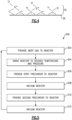
- FIG. 2 shows a method 100 of fabricating the CMC component 20.
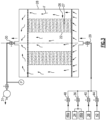
- step 102 one or more preforms 26 are arranged in a reactor 28, as shown in Figure 3 .
- the reactor 28 generally includes an inlet valve 29 to control inlets to the reactor 28 and an exhaust valve 30 to control exhaust from the reactor 28.
- a vacuum pump 31 controls the pressure in the reactor 28.
- the preforms 26 comprise fibers 22 and are generally porous.
- multiple preforms 26 are loaded to the reactor 28 and are stacked, with spacers 27 separating each preform 26 from adjacent preforms 26.
- preforms 26 can be arranged within reactor 28 in another way.
- only a single preform 26 is loaded to the reactor 28.
- a single preform 26 will be referred to in the foregoing description.
- a stoichiometric precursor layer 32 is infiltrated into the preform 26, as shown in Figure 4 .
- a stoichiometric material such as the stoichiometric precursor material, has a ratio of atomic constituents that is approximately the same as the ratio of constituents expressed in its chemical formula.
- SiC silicon carbide
- SiC has a ratio of silicon atoms to carbon atoms that is equal to approximately one.
- Silicon carbide with a ratio of silicon atoms to carbon atoms that is substantially equal to one exhibits improved temperature and oxidation resistance, as well as high thermal conductivity and high strength and creep resistance as compared to silicon carbide with a ratio of silicon atoms to carbon atoms that is substantially less than or greater than one. This is partially due to improved material uniformity. Additionally, if silicon carbide has a ratio of silicon atoms to carbon atoms greater than one, the silicon carbide has excess silicon and exhibits lowered melting temperature and lowered oxidation resistance.
- the silicon carbide has a ratio of silicon atoms to carbon atoms less than one, the silicon carbide has excess carbon and exhibits decreased temperature and oxidation resistance.
- the stoichiometric precursor layer 32 is silicon carbide, it should be understood that in other examples, the stoichiometric precursor layer 32 is another stoichiometric material.
- the stoichiometric precursor layer 32 is deposited into the one or more preforms 26 by an atomic layer deposition (ALD) process.
- ALD atomic layer deposition
- ALE atomic layer epitaxy
- An ALE process 200 is shown in Figure 5 .
- a gas 34 that is inert is provided to the reactor 28 by opening valve 36.
- the reactor 28 is then brought to a desired temperature T1 and a desired pressure P1.
- the desired temperature T1 and pressure P1 depend on selected and used precursors and the desired stoichiometric precursor layer 32. In one example, where the desired stoichiometric precursor layer 32 is silicon carbide, the desired temperature T1 is about 1832°F (1000°C) and the desired pressure P1 is about 0.3 torr (40 Pa).
- a first precursor 38 is provided to the reactor 28 by opening valve 40.
- valve 36 is closed to stop the flow of gas 34 into the reactor 28 and exhaust valve 30 is closed to keep the first precursor 38 in the reactor 28.
- step 206 is performed in approximately ten seconds or less.
- the first precursor infiltrates into and adsorbs on the surfaces of the preform 26.
- the first precursor is a silicon-containing precursor and the second precursor is a carbon-containing precursor.
- Example silicon-containing precursors are Cl 2 SiH 2 , SiH 4 , ClSiH 3 , and Si 2 H 6 .
- Example carbon-containing precursors are CH 4 (methane), C 2 H 6 (ethane), C 3 H 8 (propane), C 2 H 2 (acetylene), and C 2 H 4 (ethylene). However, if another stoichiometric precursor layer 32 is being formed, other precursors containing the elements of the desired stoichiometric precursor layer 32 would be used.
- valve 40 is closed to stop the flow of the first precursor 38 into the reactor 28.
- step 208 the reactor 28 is vacuumed by vacuum pump 31 by opening exhaust valve 30 to remove excess first precursor 38 from the reactor 28.
- step 208 is performed for approximately between 10 and 60 seconds.
- a second precursor 42 is provided to the reactor 28 by opening valve 44. At the same time, exhaust valve 30 is closed to keep the second precursor 42 in the reactor 28.
- the precursors 38, 42 form the stoichiometric precursor layer 32 (i.e., a layer 32 with a ratio of silicon atoms to carbon atoms of approximately one).
- the second precursor 42 is a carbon-containing precursor and infiltrates the preform 26 to form the silicon carbide, such that the ratio of silicon atoms to carbon atoms on the preform 26 is approximately one.
- step 210 is performed in approximately ten seconds or less.
- valve 44 is closed to stop the flow of the second precursor 42 into the reactor 28.
- silicon and carbon from the precursors 38, 42 form a silicon carbide stoichiometric precursor layer, as shown in Figure 4 .
- the first precursor 38 is the silicon-containing precursor and the second precursor 42 is the carbon-containing precursor.
- step 212 the reactor 28 is vacuumed by pump 31 by opening exhaust valve 30 to remove the second precursor 42 from the reactor 28.
- step 212 is performed for approximately between 10 and 60 seconds.
- Steps 206-212 can optionally be repeated one or more times to build up the stoichiometric precursor layer 32.
- the component 20 is densified by depositing matrix material 24 onto the stoichiometric precursor layer 32.
- the matrix material 24 is the same material as the stoichiometric precursor layer 32.
- the stoichiometric precursor layer 32 favors improved yield and deposition of a generally stoichiometric matrix material 24 in step 106. This is because reactions occurring at the surface of the preform 26 tend to mimic the existing surface chemistry of the stoichiometric precursor layer 32 to mitigate the stacking faults. Therefore, the matrix material 24 is generally stoichiometric and exhibits improved properties as described above.
- steps 104-106 are repeated one or more times. For instance, after partially densifying the preform 26 in step 106, the ratio of the constituents of the matrix material 24 is determined via x-ray or another type of spectroscopy in optional step 108. Then, the ratio of constituents is compared to the stoichiometric ratio in step 110. If the ratio differs from the stoichiometric ratio, another stoichiometric precursor layer 32 is infiltrated into the preform 26 as in step 104. The preform 26 is then densified again as in step 106. The further densification results in a generally stoichiometric matrix material 24 as described above.
- the densifying in step 106 is performed by a chemical vapor infiltration process 300, as shown schematically in Figure 6 .
- the reactor 28 is brought to a desired temperature T2 and pressure P2.
- T2 a temperature of approximately 1922°F (1050 °C) and a pressure P2 10 torr (1333.22 Pa).
- the temperature T2 in process 300 is greater than the temperature T1 in process 200
- the pressure P2 in process 300 is greater than the pressure P1 in process 200.
- step 304 one or more matrix material precursors 46a, 46b are provided to the reactor 28. Exhaust valve 30 remains open to allow for continuous flow of matrix material precursors 46a, 48b through the reactor 28, as shown by arrows F.
- example precursors 46a, 46b are methyltrichlorosilane (MTS) and hydrogen (H 2 ).
- MTS breaks down into gaseous CH 3 and SiCl 3 free radicals 50, as shown in Figure 7 , which adsorb onto the stoichiometric precursor layer 32 to react for the formation of silicon carbide deposit, in generally stoichiometric amounts to create a generally stoichiometric silicon carbide matrix material 24.
- Step 304 is performed until a desired density of the component 20 is achieved.
- MTS is provided to the reactor 28 by opening valve 48 and hydrogen is provided to the reactor 28 by valve 36, the same valve that controls flow of inert gas 34 to the reactor 28.
- a separate valve is used for hydrogen or another matrix material precursor.
- step 306 the reactor 28 is purged by closing valve 48 to stop the flow of matrix material precursor 46a into the reactor 28 and providing inert gas 34 to the reactor 28 via valve 36. In step 306, the reactor 28 is also cooled.
- steps 104 and 106 are described above as being performed in the same furnace, in another example, steps 104 and 106 can be performed in separate furnaces.
Landscapes
- Chemical & Material Sciences (AREA)
- Engineering & Computer Science (AREA)
- Ceramic Engineering (AREA)
- Organic Chemistry (AREA)
- Materials Engineering (AREA)
- Manufacturing & Machinery (AREA)
- Structural Engineering (AREA)
- Chemical Kinetics & Catalysis (AREA)
- General Chemical & Material Sciences (AREA)
- Mechanical Engineering (AREA)
- Metallurgy (AREA)
- Inorganic Chemistry (AREA)
- Ceramic Products (AREA)
- Chemical Vapour Deposition (AREA)
Applications Claiming Priority (2)
| Application Number | Priority Date | Filing Date | Title |
|---|---|---|---|
| US15/687,625 US10801108B2 (en) | 2017-08-28 | 2017-08-28 | Method for fabricating ceramic matrix composite components |
| EP18191322.9A EP3450416B1 (de) | 2017-08-28 | 2018-08-28 | Verfahren zur herstellung von komponenten aus keramischem faserverbundwerkstoff |
Related Parent Applications (2)
| Application Number | Title | Priority Date | Filing Date |
|---|---|---|---|
| EP18191322.9A Division EP3450416B1 (de) | 2017-08-28 | 2018-08-28 | Verfahren zur herstellung von komponenten aus keramischem faserverbundwerkstoff |
| EP18191322.9A Division-Into EP3450416B1 (de) | 2017-08-28 | 2018-08-28 | Verfahren zur herstellung von komponenten aus keramischem faserverbundwerkstoff |
Publications (2)
| Publication Number | Publication Date |
|---|---|
| EP4242193A2 true EP4242193A2 (de) | 2023-09-13 |
| EP4242193A3 EP4242193A3 (de) | 2023-11-29 |
Family
ID=63442545
Family Applications (2)
| Application Number | Title | Priority Date | Filing Date |
|---|---|---|---|
| EP23185025.6A Pending EP4242193A3 (de) | 2017-08-28 | 2018-08-28 | Verfahren zur herstellung von komponenten aus keramischem faserverbundwerkstoff |
| EP18191322.9A Active EP3450416B1 (de) | 2017-08-28 | 2018-08-28 | Verfahren zur herstellung von komponenten aus keramischem faserverbundwerkstoff |
Family Applications After (1)
| Application Number | Title | Priority Date | Filing Date |
|---|---|---|---|
| EP18191322.9A Active EP3450416B1 (de) | 2017-08-28 | 2018-08-28 | Verfahren zur herstellung von komponenten aus keramischem faserverbundwerkstoff |
Country Status (2)
| Country | Link |
|---|---|
| US (3) | US10801108B2 (de) |
| EP (2) | EP4242193A3 (de) |
Families Citing this family (3)
| Publication number | Priority date | Publication date | Assignee | Title |
|---|---|---|---|---|
| US10801108B2 (en) * | 2017-08-28 | 2020-10-13 | Raytheon Technologies Corporation | Method for fabricating ceramic matrix composite components |
| US12269779B2 (en) | 2019-01-04 | 2025-04-08 | Rtx Corporation | Method for producing a ceramic matrix composite component |
| US12583798B2 (en) * | 2023-02-13 | 2026-03-24 | Rtx Corporation | Atomic layer deposition method enhancing the nucleation and crystallinity of a boron nitride interface coating on a silicon carbide fiber |
Family Cites Families (30)
| Publication number | Priority date | Publication date | Assignee | Title |
|---|---|---|---|---|
| JP3182212B2 (ja) * | 1991-05-21 | 2001-07-03 | アブコウ・コーポレイション | 高密度化多孔質ビレットを製造する方法及び多孔質予備成形体の高密度化方法 |
| US5354527A (en) * | 1992-02-21 | 1994-10-11 | The Carborundum Company | Process for making silicon carbide ceramic fibers |
| US6743393B1 (en) | 1998-06-17 | 2004-06-01 | Coi Ceramics, Inc. | Method for producing ceramic matrix composites |
| US7297368B2 (en) * | 2003-04-15 | 2007-11-20 | Ultramet | Method of making carbon fiber-carbon matrix reinforced ceramic composites |
| US20050276961A1 (en) * | 2003-08-04 | 2005-12-15 | Sherwood Walter J | Materials and methods for making ceramic matrix composites |
| US20060035024A1 (en) * | 2004-08-11 | 2006-02-16 | General Electric Company | Processing of Sic/Sic ceramic matrix composites by use of colloidal carbon black |
| US20060163773A1 (en) * | 2005-01-24 | 2006-07-27 | General Electric Company | Method for performing silicon melt infiltration of ceramic matrix composites |
| US7549840B2 (en) * | 2005-06-17 | 2009-06-23 | General Electric Company | Through thickness reinforcement of SiC/SiC CMC's through in-situ matrix plugs manufactured using fugitive fibers |
| FI122323B (fi) * | 2006-06-22 | 2011-11-30 | Beneq Oy | Menetelmä kuituaihion valmistamiseksi |
| US7888248B2 (en) | 2007-07-13 | 2011-02-15 | Northrop Grumman Systems Corporation | Method of producing large area SiC substrates |
| US20100151676A1 (en) * | 2008-12-16 | 2010-06-17 | Applied Materials, Inc. | Densification process for titanium nitride layer for submicron applications |
| US20100284810A1 (en) * | 2009-05-07 | 2010-11-11 | General Electric Company | Process for inhibiting delamination in a bend of a continuous fiber-reinforced composite article |
| US20110071014A1 (en) * | 2009-09-24 | 2011-03-24 | United Technologies Corporation | Hybred polymer cvi composites |
| FR2950622B1 (fr) * | 2009-09-28 | 2011-10-21 | Snecma Propulsion Solide | Piece en materiau composite a matrice ceramique et procede pour sa fabrication. |
| FR2957093B1 (fr) * | 2010-03-02 | 2012-03-23 | Snecma | Preforme fibreuse pour un secteur d'anneau de turbine et son procede de fabrication. |
| CN102534491B (zh) * | 2011-10-19 | 2014-08-27 | 深圳市三海光电技术有限公司 | 高转化效率铜铟镓硒薄膜太阳能电池吸收层的制备设备及制备方法 |
| US20130167374A1 (en) | 2011-12-29 | 2013-07-04 | General Electric Company | Process of producing ceramic matrix composites and ceramic matrix composites formed thereby |
| US9050769B2 (en) * | 2012-04-13 | 2015-06-09 | General Electric Company | Pre-form ceramic matrix composite cavity and method of forming and method of forming a ceramic matrix composite component |
| US9676674B2 (en) * | 2013-03-14 | 2017-06-13 | Rolls-Royce Corporation | Environmental barrier fiber coating |
| EP2970020B1 (de) * | 2013-03-15 | 2020-11-11 | Rolls-Royce Corporation | Keramikmatrixverbundwerkstoffe und verfahren zur herstellung von keramikmatrixverbundwerkstoffen |
| US9726025B2 (en) * | 2013-03-15 | 2017-08-08 | Rolls-Royce Corporation | Ceramic matrix composite |
| US9650303B2 (en) * | 2013-03-15 | 2017-05-16 | Rolls-Royce Corporation | Silicon carbide ceramic matrix composites |
| US10618848B2 (en) * | 2013-09-20 | 2020-04-14 | General Electric Company | Ceramic matrix composites made by chemical vapor infiltration and methods of manufacture thereof |
| EP2933353B1 (de) | 2014-04-17 | 2017-12-20 | Safran Ceramics | Verfahren zur Herstellung von faserverstärkten Verbundstoffen |
| US10233126B2 (en) * | 2015-08-12 | 2019-03-19 | Rolls-Royce Corporation | Forming a ceramic matrix composite having a silicide layer |
| US10465533B2 (en) * | 2015-10-08 | 2019-11-05 | General Electric Company | Ceramic matrix composite component and process of producing a ceramic matrix composite component |
| RU2720579C1 (ru) * | 2016-08-08 | 2020-05-12 | Дженерал Атомикс | Разработанные sic-sic композит и монолитные слоистые sic структуры |
| CN107011620A (zh) * | 2017-05-17 | 2017-08-04 | 郴州金通信息科技有限公司 | 一种掺石墨烯纳米片3d打印用改性abs材料及其制备方法 |
| US10801108B2 (en) * | 2017-08-28 | 2020-10-13 | Raytheon Technologies Corporation | Method for fabricating ceramic matrix composite components |
| US10829419B2 (en) * | 2017-11-27 | 2020-11-10 | United Technologies Corporation | Method of densifying a ceramic matrix composite using a filled tackifier |
-
2017
- 2017-08-28 US US15/687,625 patent/US10801108B2/en active Active
-
2018
- 2018-08-28 EP EP23185025.6A patent/EP4242193A3/de active Pending
- 2018-08-28 EP EP18191322.9A patent/EP3450416B1/de active Active
-
2020
- 2020-09-18 US US17/025,544 patent/US11597686B2/en active Active
-
2023
- 2023-03-06 US US18/117,825 patent/US20230219858A1/en active Pending
Also Published As
| Publication number | Publication date |
|---|---|
| US20210002766A1 (en) | 2021-01-07 |
| US11597686B2 (en) | 2023-03-07 |
| US10801108B2 (en) | 2020-10-13 |
| US20230219858A1 (en) | 2023-07-13 |
| US20190062913A1 (en) | 2019-02-28 |
| EP3450416A1 (de) | 2019-03-06 |
| EP3450416B1 (de) | 2023-08-23 |
| EP4242193A3 (de) | 2023-11-29 |
Similar Documents
| Publication | Publication Date | Title |
|---|---|---|
| US20230219858A1 (en) | Method for fabricating ceramic matrix composite components | |
| EP3061740B1 (de) | Keramische matrizenverbundstrukturen mit kontrollierten mikrostrukturen, die durch chemische dampfphaseninfitration (cvi) hergestellt sind | |
| US9493873B2 (en) | Method for preparing a coating for protecting a part against oxidation | |
| US10906842B2 (en) | Method of processing a ceramic matrix composite (CMC) component | |
| US12325670B2 (en) | Doped silicon carbide ceramic matrix composite | |
| US20030215625A1 (en) | Coatings and method for protecting carbon-containing components from oxidation | |
| US20110071014A1 (en) | Hybred polymer cvi composites | |
| US11046620B2 (en) | Method of processing a ceramic matrix composite (CMC) component | |
| US20160251272A1 (en) | Laminate structure fabricated using chemical vapor infiltration (cvi) | |
| US20200024197A1 (en) | Method of forming in-situ boron nitride for ceramic matrix composite environmental protection | |
| EP3650424A1 (de) | Beschleunigte cvi-verdichtung von cmc durch infiltration | |
| EP3957619A1 (de) | Verfahren zur herstellung eines keramikmatrixverbundes mit chemischer beständigkeit | |
| JP7752004B2 (ja) | 水分及び環境への抵抗性を呈するセラミックマトリックス複合材料を作製する方法 | |
| US10752556B2 (en) | Method of processing a ceramic matrix composite (CMC) component | |
| US10233126B2 (en) | Forming a ceramic matrix composite having a silicide layer | |
| US11198934B2 (en) | Method of chemical vapor infiltration or deposition | |
| EP3677563B1 (de) | Verfahren zur herstellung eines keramischen matrixverbundbauteils | |
| EP2933353B1 (de) | Verfahren zur Herstellung von faserverstärkten Verbundstoffen | |
| US11655194B2 (en) | Ceramic composites with an intermediate layer having a carbon sink material for high temperature applications | |
| CN105503270A (zh) | 一种SiC涂层的制备方法 | |
| US20240279128A1 (en) | Methods for Joining Composite Components to Form a Unitary Composite Component | |
| JPH09201896A (ja) | 耐熱・耐酸化性炭素材料 | |
| JP2025080034A (ja) | Bn被覆セラミックス繊維、それを備えたセラミックス基複合材料、ならびにbn被覆セラミックス繊維の製造方法 |
Legal Events
| Date | Code | Title | Description |
|---|---|---|---|
| PUAI | Public reference made under article 153(3) epc to a published international application that has entered the european phase |
Free format text: ORIGINAL CODE: 0009012 |
|
| STAA | Information on the status of an ep patent application or granted ep patent |
Free format text: STATUS: THE APPLICATION HAS BEEN PUBLISHED |
|
| AC | Divisional application: reference to earlier application |
Ref document number: 3450416 Country of ref document: EP Kind code of ref document: P |
|
| AK | Designated contracting states |
Kind code of ref document: A2 Designated state(s): AL AT BE BG CH CY CZ DE DK EE ES FI FR GB GR HR HU IE IS IT LI LT LU LV MC MK MT NL NO PL PT RO RS SE SI SK SM TR |
|
| REG | Reference to a national code |
Ref country code: DE Ref legal event code: R079 Free format text: PREVIOUS MAIN CLASS: C04B0035800000 Ipc: C04B0035565000 |
|
| PUAL | Search report despatched |
Free format text: ORIGINAL CODE: 0009013 |
|
| RAP3 | Party data changed (applicant data changed or rights of an application transferred) |
Owner name: RTX CORPORATION |
|
| AK | Designated contracting states |
Kind code of ref document: A3 Designated state(s): AL AT BE BG CH CY CZ DE DK EE ES FI FR GB GR HR HU IE IS IT LI LT LU LV MC MK MT NL NO PL PT RO RS SE SI SK SM TR |
|
| RIC1 | Information provided on ipc code assigned before grant |
Ipc: C04B 35/80 20060101ALI20231020BHEP Ipc: C04B 35/628 20060101ALI20231020BHEP Ipc: C04B 35/565 20060101AFI20231020BHEP |
|
| STAA | Information on the status of an ep patent application or granted ep patent |
Free format text: STATUS: REQUEST FOR EXAMINATION WAS MADE |
|
| 17P | Request for examination filed |
Effective date: 20240524 |
|
| RBV | Designated contracting states (corrected) |
Designated state(s): AL AT BE BG CH CY CZ DE DK EE ES FI FR GB GR HR HU IE IS IT LI LT LU LV MC MK MT NL NO PL PT RO RS SE SI SK SM TR |