EP4246149B1 - Compteur d'électricité doté d'une commande électronique et d'une alimentation électrique - Google Patents
Compteur d'électricité doté d'une commande électronique et d'une alimentation électrique Download PDFInfo
- Publication number
- EP4246149B1 EP4246149B1 EP22163046.0A EP22163046A EP4246149B1 EP 4246149 B1 EP4246149 B1 EP 4246149B1 EP 22163046 A EP22163046 A EP 22163046A EP 4246149 B1 EP4246149 B1 EP 4246149B1
- Authority
- EP
- European Patent Office
- Prior art keywords
- electricity meter
- power supply
- circuit arrangement
- meter according
- connection
- Prior art date
- Legal status (The legal status is an assumption and is not a legal conclusion. Google has not performed a legal analysis and makes no representation as to the accuracy of the status listed.)
- Active
Links
Images
Classifications
-
- G—PHYSICS
- G01—MEASURING; TESTING
- G01R—MEASURING ELECTRIC VARIABLES; MEASURING MAGNETIC VARIABLES
- G01R22/00—Arrangements for measuring time integral of electric power or current, e.g. electricity meters
- G01R22/06—Arrangements for measuring time integral of electric power or current, e.g. electricity meters by electronic methods
- G01R22/061—Details of electronic electricity meters
- G01R22/066—Arrangements for avoiding or indicating fraudulent use
Definitions
- the invention relates to an electricity meter with an electronic control and a power supply.
- the electricity meter has an electronic control system, a power supply unit and a circuit arrangement which is controlled by the electronic control system in such a way that the power supply unit is temporarily supplied with metered electricity and temporarily with unmetered electricity.
- the electronic control unit controls the circuit arrangement. It can comprise a measuring device and/or an evaluation device and/or a display and/or a communication device. It is responsible for all or part of the electricity meter's internal consumption.
- the aforementioned elements of the electronic control unit are implemented, in particular, on a printed circuit board and are implemented entirely or partially in an integrated design, in particular in the form of a measuring chip and, if necessary, further integrated circuits with the necessary external circuitry.
- the electronic control unit can be connected to one or more measuring taps for each phase and can measure the voltage and current of the phase and determine consumption values from the measured current and voltage values.
- the elements of the electronic control unit in particular a measuring device and a control device, can be distributed between the neutral conductor side and the outer conductor (phase) side.
- a special feature of the invention is the circuit arrangement, which is controlled by the electronic controller in such a way that the power supply is temporarily supplied with metered current and temporarily with unmetered current.
- the circuit arrangement has two states. In a first switching state, the power supply is supplied with metered current. In a second switching state, the power supply is supplied with unmetered current.
- the electronic controller controls the circuit arrangement.
- the electronic controller is designed to switch the circuit arrangement from the first switching state to the second switching state and vice versa. This occurs sufficiently quickly to ensure a continuous supply to the power supply.
- the circuit arrangement can, in principle, be designed in any electronically controllable form, for example in the form of a relay.
- the circuit arrangement preferably has an electronic switch, in particular a transistor, which can be switched between the two switching states.
- the power supply unit is supplied with metered or unmetered power. Recording power consumption is possible in both cases.
- the important difference for the invention is that the consumption data recorded by the electricity meter differs depending on the switching state of the circuit arrangement by the internal consumption or a portion of the internal consumption, because this is counted in the first switching state and not counted in the second switching state. However, this only applies if the electricity meter records consumption correctly. If there is tampering, in particular if a line monitored by the electricity meter has been bridged, the electricity meter can neither properly record the consumption of the consumers connected to the supply network nor its own consumption or any portion of its own consumption.
- the electricity meter's own consumption, or the portion thereof provided by the power supply, is also design-dependent and known. Unlike with an additional/external consumer, it is therefore generally not necessary to provide the electricity meter with information about the expected additional consumption to detect tampering. Because the electricity meter's electronic control system controls the circuitry, the respective switching state is also immediately available for evaluation.
- the power supply is intended to supply the electronic control system.
- the electricity meter can have exactly one (possibly multi-phase) power supply, which is responsible for supplying all elements of the electronic control system and/or which provides the entire internal consumption of the electricity meter.
- the power supply is intended to supply power to an additional device.
- the additional device can be, for example, a smart meter gateway or another electronic device that exchanges data with the electricity meter via an interface.
- the additional device can be integrated into the electricity meter.
- the additional device can be arranged in a separate housing and connected to the electricity meter, for example, via a plug connection.
- the electricity meter has a first connection for connection to a phase of a supply network, a second connection for connection to a household network, and a shunt connected between the two connections.
- the circuit arrangement for supplying the power supply with metered electricity establishes a connection between the power supply and the second connection in a first switching state.
- the fact that a connection is established between the power supply and the second connection means that energy can be supplied to a component of the power supply via this connection.
- the connection established between the power supply and the second connection in the first switching state does not exist in a second switching state of the circuit arrangement. In the second switching state, the power supply can in particular be connected to the first connection, although this connection does not necessarily have to be broken in the first switching state. However, in the first switching state, no or no significant energy is supplied via the connection between the first connection and the power supply.
- the power supply is a capacitor power supply.
- the power supply can have any design, e.g., it can be a switched-mode power supply or have a transformer.
- a capacitor power supply has a particularly simple construction and, due to the possibility of charging the power supply's capacitor via different current paths, can be combined with a particularly simple circuit arrangement.
- the capacitor power supply can have a capacitor whose reactance is used as a series resistor. In this case, or in conjunction with another power supply type, the power supply can have a smoothing capacitor and/or a voltage stabilization circuit.
- the capacitor power supply comprises at least one Zener diode and one capacitor connected in series, wherein the circuit arrangement, in the first switching state, connects a node between the capacitor and the at least one Zener diode to the second terminal.
- the terminal of the capacitor not connected to the node can be connected directly or indirectly (e.g., via a measuring and control device connected to the neutral conductor) to a neutral conductor.
- the terminal of the at least one Zener diode not connected to the node can be connected to the first terminal.
- the capacitor is charged with a counted current in the first switching state via the connection established by the circuit arrangement.
- the capacitor is charged with an uncounted current via the at least one (forward-biased) Zener diode during a positive half-cycle.
- the circuit arrangement is designed such that a voltage drop that occurs in the first switching state when current flows through the established connection is smaller than a voltage drop across the at least one Zener diode when the at least one Zener diode is operated in the forward direction. This ensures that the power supply capacitor, which is directly or indirectly connected to the neutral conductor, is supplied almost entirely with counted current during the positive half-wave when the circuit arrangement is in the first switching state. This is achieved with a correspondingly low voltage drop across the circuit arrangement when using a single Zener diode.
- several, in particular two or three, Zener diodes can be connected in series, whereby the voltage drop across the Zener diodes is correspondingly increased, e.g., to double or triple. This allows a larger voltage drop across the circuit arrangement to be accepted and, if necessary, the circuit arrangement can be implemented at lower cost.
- the circuit arrangement establishes the connection via a transistor and a Schottky diode.
- Schottky diodes have a particularly low voltage drop, so that the voltage drop across the combination of transistor and Schottky diode can be kept small, in particular smaller than the voltage drop across the at least one Zener diode.
- the transistor can, in particular, be a small-signal transistor.
- the transistor is a field-effect transistor. This variant is characterized by a low voltage drop across the switched-on transistor and by its particularly simple, virtually power-free control.
- the electronic control system is designed to control the circuit arrangement at intervals and/or in a predetermined time pattern. Multiple/regular changes between the two switching states simplify the evaluation of the recorded consumption.
- the intervals in which the power supply is supplied with metered electricity can be kept very short.
- the circuit arrangement can be controlled in such a way that in 24 hours the supply is only provided with metered electricity for several short intervals of, for example, 10 s, e.g. once every 15 minutes. The self-consumption thus assigned to the household is then irrelevant for billing and is significantly smaller than the permissible measurement errors.
- the software can also calculate the temporarily assigned known self-consumption out of the measurement result so that no measurement error can occur in the first place.
- the circuit arrangement has a control input that is connected to an output of the electronic control, in particular on the outer conductor side (phase).
- the electronic control can, in particular, have a programmable output so that the desired switching of the circuit arrangement can be controlled via software.
- the electronic control unit has a measuring chip with an interrupt connection connected to the control input.
- the software controlling the electricity meter and/or the measuring chip can then be programmed to output a voltage required to control the circuit arrangement at the interrupt connection. For example, an error can be triggered deliberately, and the resulting error message can, for example, lead to a high signal at the interrupt connection.
- the interrupt functionality of a measuring chip that does not have a programmable output can be used for controlling the circuit arrangement.
- the electricity meter has an evaluation device configured to determine a difference between a first consumption in a first period in which the power supply was supplied with unmetered electricity and a second consumption in a second period in which the power supply was supplied with metered electricity, and to compare this difference with an expected internal consumption of the electricity meter. If the comparison reveals a deviation, this may indicate tampering, in particular a current bridge.
- the electricity meter has a communication device configured to send a tamper warning if the evaluation device detects a deviation when comparing the determined difference with the expected self-consumption. In this way, a meter operator, in particular, can be automatically alerted to a possible tampering.
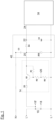
- the electricity meter from Fig. 1 has an electronic control unit 38, a power supply unit 40 for supplying the electronic control unit 38, and a circuit arrangement 14.
- the electricity meter is an alternating current meter for recording the consumption of only one phase.
- a first terminal L is connected to a phase of a supply network, a second terminal L' to the corresponding phase of a household network.
- Another terminal N of the electricity meter is connected directly or indirectly to a neutral conductor.
- a shunt 16 is connected between the first terminal L and the second terminal L'.
- a measuring tap 18, 18' is formed at each end of the shunt 16 and connected to a corresponding input of the electricity meter, which is not shown in the figure.
- the node 22 between the cathode of the diode D4 and the smoothing capacitor C2 forms an output of the capacitor power supply, which is connected to a supply terminal 24 of the electronic control 38.
- the circuit arrangement 14 comprises a diode D3 and a transistor Q1, via which, in a first switching state in which the transistor Q1 is switched on, a connection exists between the second terminal L' and the node 20 of the power supply 40. In a second switching state, the transistor Q1 is blocked and the connection does not exist.
- the circuit arrangement also has a control input 26 and three resistors R1, R2 and R3. The control input 26 is connected to the electronic controller 38 in a manner not shown, so that the circuit arrangement 14 can be specifically switched into the first switching state and into the second switching state by the electronic controller 38.
- Diode D3 is a Schottky diode.
- Transistor Q1 is a bipolar transistor, but a field-effect transistor can also be used instead.
- the circuit arrangement 14 operates as follows: If a voltage lower than the voltage at node 20 is present at control input 26, transistor Q1 is off and circuit 14 is in the second switching state. During a positive half-wave at the first terminal L, the potential there is higher than the neutral conductor potential at the other terminal N. Capacitor C3 is charged via Zener diode ZD2.
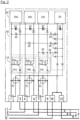
- the electricity meter from Fig. 2 is a three-phase meter with three first terminals 1, 4, and 7, each connected to a phase L1, L2, and L3 of a supply network, respectively, and three second terminals 3, 6, and 9, each connected to the corresponding phase of a household network.
- Another terminal 10 of the electricity meter is connected to the neutral conductor N of the supply network, and yet another terminal 12 is connected to the neutral conductor of the household network.
- a schematically illustrated measuring device 32 is connected between the first terminals 1, 4, and 7 and the second terminals 3, 6, and 9.
- the electronic control 38 is shown in more detail in this embodiment than in the embodiment of the Fig. 1 . It comprises three electronic measuring devices 28a, 28b, 28c, each assigned to a phase, which are arranged on the outer conductor side (phase), and an electronic control device 30 which is arranged on the neutral conductor side.
- the power supply 40 comprises three subunits, each consisting of a capacitor 34 and a Zener diode 36. These subunits are each assigned to one of the three phases L1, L2, and L3.
- the power supply 40 also includes the remaining diodes arranged within the box designated by reference numeral 40 and the four smoothing capacitors 42.
- the circuit arrangement 14 comprises three circuit arrangements 14a, 14b, 14c, each of which is assigned to a phase and each has a control input 26.
- the function and structure of the circuit arrangements 14a, 14b and 14c correspond to the circuit arrangement 14 from the embodiment of the Fig. 1 .
- the control device 30 can perform this control.
- a potential-bridging signal generator such as an optocoupler, can be used to bridge the potential difference between the neutral conductor side and the outer conductor side.
- the measuring devices 28a, 28b, and 28c can control the control inputs 26a, 26b, and 26c belonging to the circuit arrangement 14a, 14b, and 14c of the respective phase, respectively, whereby a potential-bridging signal generator can be omitted.
- the control can be effected directly via a control output or an interrupt connection of the respective measuring device 28a, 28b, and 28c.
Landscapes
- Engineering & Computer Science (AREA)
- Power Engineering (AREA)
- Physics & Mathematics (AREA)
- General Physics & Mathematics (AREA)
- Remote Monitoring And Control Of Power-Distribution Networks (AREA)
- Rectifiers (AREA)
Claims (14)
- Compteur d'électricité doté d'une commande électronique (38) et d'une alimentation électrique (40), caractérisé par un circuit (14), lequel est actionné de telle façon par la commande électronique (38), que l'alimentation électrique (40) est approvisionnée par moments en courant compté et par moments en courant non compté.
- Compteur d'électricité selon la revendication 1, caractérisé en ce que l'alimentation électrique (40) est prévue pour l'approvisionnement de la commande électronique (38).
- Compteur d'électricité selon la revendication 1 ou 2, caractérisé en ce que l'alimentation électrique (40) est prévue pour l'approvisionnement d'un appareil auxiliaire.
- Compteur d'électricité selon l'une des revendications 1 à 3, caractérisé en ce que le compteur d'électricité présente une première borne (L) pour la connexion à une phase d'un réseau de distribution, une deuxième borne (L') pour la connexion à un réseau domestique et un shunt (16) placé entre les deux bornes, dans lequel le circuit (14) établit une liaison entre l'alimentation électrique (40) et la deuxième borne (L') pour l'approvisionnement de l'alimentation électrique (40) en courant compté dans un premier état de commutation.
- Compteur d'électricité selon l'une des revendications 1 à 4, caractérisé en ce que l'alimentation électrique (40) est une alimentation électrique à condensateur.
- Compteur d'électricité selon la revendication 5, caractérisé en ce que l'alimentation électrique à condensateur présente un condensateur (C3) et au moins une diode Zener (ZD2), lesquels sont montés en série, dans lequel le circuit (14) relie un nœud (20) entre le condensateur (C3) et l'au moins une diode Zener (ZD2) à la deuxième borne (L') dans le premier état de commutation.
- Compteur d'électricité selon la revendication 6, caractérisé en ce que le circuit (14) est configuré de telle façon qu'une chute de tension survenant dans le premier état de commutation lors d'un passage de courant par la liaison établie est inférieure à une chute de tension au niveau de l'au moins une diode Zener (ZD2) lors d'un fonctionnement dans le sens passant.
- Compteur d'électricité selon l'une des revendications 1 à 7, caractérisé en ce que le circuit (14) établit la liaison par le biais d'un transistor (Q1) et d'une diode Schottky (D3).
- Compteur d'électricité selon la revendication 8, caractérisé en ce que le transistor (Q1) est un transistor à effet de champ.
- Compteur d'électricité selon l'une des revendications 1 à 9, caractérisé en ce que la commande électronique (38) est conçue pour actionner le circuit (14) par intervalles et/ou selon un schéma temporel prédéfini.
- Compteur d'électricité selon l'une des revendications 1 à 10, caractérisé en ce que le circuit (14) présente une entrée de commande (26), laquelle est reliée à une sortie de la commande électronique (38).
- Compteur d'électricité selon la revendication 11, caractérisé en ce que la commande électronique (38) présente une puce de mesure dotée d'une borne à interruption, laquelle est reliée à l'entrée de commande (26).
- Compteur d'électricité selon l'une des revendications 1 à 12, caractérisé en ce que le compteur d'électricité présente un dispositif d'évaluation, lequel est conçu pour déterminer une différence entre une première consommation sur une première durée pendant laquelle l'alimentation électrique (40) a été approvisionnée en courant non compté, et une deuxième consommation sur une deuxième durée pendant laquelle l'alimentation électrique (40) a été approvisionnée en courant compté, et pour comparer celle-ci avec une consommation propre attendue du compteur d'électricité.
- Compteur d'électricité selon l'une des revendications 1 à 13, caractérisé en ce que le compteur d'électricité présente un dispositif de communication, lequel est conçu pour envoyer une alerte de manipulation lorsque le dispositif d'évaluation constate un écart lors de la comparaison de la différence déterminée avec la consommation propre attendue.
Priority Applications (1)
| Application Number | Priority Date | Filing Date | Title |
|---|---|---|---|
| EP22163046.0A EP4246149B1 (fr) | 2022-03-18 | 2022-03-18 | Compteur d'électricité doté d'une commande électronique et d'une alimentation électrique |
Applications Claiming Priority (1)
| Application Number | Priority Date | Filing Date | Title |
|---|---|---|---|
| EP22163046.0A EP4246149B1 (fr) | 2022-03-18 | 2022-03-18 | Compteur d'électricité doté d'une commande électronique et d'une alimentation électrique |
Publications (3)
| Publication Number | Publication Date |
|---|---|
| EP4246149A1 EP4246149A1 (fr) | 2023-09-20 |
| EP4246149C0 EP4246149C0 (fr) | 2025-07-02 |
| EP4246149B1 true EP4246149B1 (fr) | 2025-07-02 |
Family
ID=80819843
Family Applications (1)
| Application Number | Title | Priority Date | Filing Date |
|---|---|---|---|
| EP22163046.0A Active EP4246149B1 (fr) | 2022-03-18 | 2022-03-18 | Compteur d'électricité doté d'une commande électronique et d'une alimentation électrique |
Country Status (1)
| Country | Link |
|---|---|
| EP (1) | EP4246149B1 (fr) |
Family Cites Families (4)
| Publication number | Priority date | Publication date | Assignee | Title |
|---|---|---|---|---|
| EP2209013B1 (fr) | 2009-01-17 | 2016-11-09 | EMH metering GmbH & Co. KG | Compteur multiphasique électronique |
| EP2804006B1 (fr) | 2013-05-15 | 2018-11-07 | Itron Zaehler & Systemtechnik GmbH | Dispositif destiné à être utilisé avec un compteur d'électricité |
| DE102014018809A1 (de) | 2014-12-19 | 2016-06-23 | Emh Metering Gmbh & Co. Kg | Übertragung über ein Stromnetz mit modulierbarem Verbraucher und Elektrizitätszähler |
| DE102020122869A1 (de) * | 2020-09-01 | 2022-03-03 | Emh Metering Gmbh & Co. Kg | Elektrizitätszähler mit einem Sicherungshalter |
-
2022
- 2022-03-18 EP EP22163046.0A patent/EP4246149B1/fr active Active
Also Published As
| Publication number | Publication date |
|---|---|
| EP4246149C0 (fr) | 2025-07-02 |
| EP4246149A1 (fr) | 2023-09-20 |
Similar Documents
| Publication | Publication Date | Title |
|---|---|---|
| DE69719207T2 (de) | Steuerschaltung für hilfsstromversorgung | |
| EP0432386A1 (fr) | Dispositif pour déterminer les valeurs des variables électriques, que peuvent être dérivés d'au moins deux signaux d'entrée du dispositif | |
| DE19814366A1 (de) | Verfahren zur Steuerung wenigstens eines mit einer Steuerungseinrichtung verbundenen elektrischen Verbrauchers und entsprechende Schaltungsanordnung | |
| DE2756289C2 (fr) | ||
| WO2020120307A1 (fr) | Circuit pour la détection d'erreurs dans un système haute tension non mis à la terre | |
| WO1998043334A1 (fr) | Fusible electronique | |
| EP4246149B1 (fr) | Compteur d'électricité doté d'une commande électronique et d'une alimentation électrique | |
| DE4142760C1 (en) | Monitor for current circuit of appliance, e.g. separate lamps of motor vehicle - uses differential amplifier as comparator with inputs across fuse and output supplying warning appts. if heat exceeds threshold value | |
| EP3929595A1 (fr) | Borne de mesure d'énergie ou circuit de mesure d'une borne de mesure d'énergie | |
| DE60014357T2 (de) | Anlaufschaltung für Schaltnetzteile | |
| EP2770641B1 (fr) | Dispositif d'exploitation de signaux d'entrée électriques | |
| DE3738493C2 (de) | Fehlerortungseinrichtung | |
| DE19532677B4 (de) | Überwachungsschaltung für wenigstens eine Versorgungsspannung | |
| EP0203419B1 (fr) | Alimentation de puissance à découpage sur le circuit primaire | |
| DE4020294A1 (de) | Elektrischer schalter der mit zeitverzoegerung mehrere outputs schaltet | |
| DE19548724A1 (de) | Verfahren zum Schutz eines Schaltreglers sowie Anordnung und Anwendung | |
| EP4277066B1 (fr) | Dispositif de commutation de sécurité, en particulier pour la mise sous tension contrôlée d'un consommateur électrique et/ou électronique | |
| DE4101209A1 (de) | Sicherheitsschaltgeraet | |
| DE69734768T2 (de) | Schaltungsanordnung zur Spannungsüberwachung | |
| DE102009023560A1 (de) | Spannungsversorgungsschaltung, Verfahren zu deren Betrieb und Verwendung einer solchen Spannungsversorgungsschaltung | |
| EP0404143A1 (fr) | Circuit pour surveiller des charges à courant alternatif dans des installations de chemin de fer | |
| EP0855035B2 (fr) | Procede permettant de faire fonctionner un circuit d'entree et circuit d'entree correspondant | |
| DE2625288A1 (de) | Anordnung zur regelung einer wechselspannung | |
| DE2642464A1 (de) | Schaltungsanordnung zur ausfallsicheren stromversorgung | |
| EP3800773A1 (fr) | Convertisseur à oscillateur bloqué à détermination de la tension primaire dans le circuit secondaire |
Legal Events
| Date | Code | Title | Description |
|---|---|---|---|
| PUAI | Public reference made under article 153(3) epc to a published international application that has entered the european phase |
Free format text: ORIGINAL CODE: 0009012 |
|
| STAA | Information on the status of an ep patent application or granted ep patent |
Free format text: STATUS: THE APPLICATION HAS BEEN PUBLISHED |
|
| AK | Designated contracting states |
Kind code of ref document: A1 Designated state(s): AL AT BE BG CH CY CZ DE DK EE ES FI FR GB GR HR HU IE IS IT LI LT LU LV MC MK MT NL NO PL PT RO RS SE SI SK SM TR |
|
| STAA | Information on the status of an ep patent application or granted ep patent |
Free format text: STATUS: REQUEST FOR EXAMINATION WAS MADE |
|
| 17P | Request for examination filed |
Effective date: 20230927 |
|
| RBV | Designated contracting states (corrected) |
Designated state(s): AL AT BE BG CH CY CZ DE DK EE ES FI FR GB GR HR HU IE IS IT LI LT LU LV MC MK MT NL NO PL PT RO RS SE SI SK SM TR |
|
| GRAP | Despatch of communication of intention to grant a patent |
Free format text: ORIGINAL CODE: EPIDOSNIGR1 |
|
| STAA | Information on the status of an ep patent application or granted ep patent |
Free format text: STATUS: GRANT OF PATENT IS INTENDED |
|
| INTG | Intention to grant announced |
Effective date: 20250415 |
|
| RIC1 | Information provided on ipc code assigned before grant |
Ipc: G01R 22/06 20060101AFI20250404BHEP |
|
| GRAS | Grant fee paid |
Free format text: ORIGINAL CODE: EPIDOSNIGR3 |
|
| GRAA | (expected) grant |
Free format text: ORIGINAL CODE: 0009210 |
|
| STAA | Information on the status of an ep patent application or granted ep patent |
Free format text: STATUS: THE PATENT HAS BEEN GRANTED |
|
| AK | Designated contracting states |
Kind code of ref document: B1 Designated state(s): AL AT BE BG CH CY CZ DE DK EE ES FI FR GB GR HR HU IE IS IT LI LT LU LV MC MK MT NL NO PL PT RO RS SE SI SK SM TR |
|
| REG | Reference to a national code |
Ref country code: GB Ref legal event code: FG4D Free format text: NOT ENGLISH |
|
| REG | Reference to a national code |
Ref country code: CH Ref legal event code: EP |
|
| REG | Reference to a national code |
Ref country code: IE Ref legal event code: FG4D Free format text: LANGUAGE OF EP DOCUMENT: GERMAN |
|
| U01 | Request for unitary effect filed |
Effective date: 20250702 |
|
| U07 | Unitary effect registered |
Designated state(s): AT BE BG DE DK EE FI FR IT LT LU LV MT NL PT RO SE SI Effective date: 20250708 |
|
| PG25 | Lapsed in a contracting state [announced via postgrant information from national office to epo] |
Ref country code: IS Free format text: LAPSE BECAUSE OF FAILURE TO SUBMIT A TRANSLATION OF THE DESCRIPTION OR TO PAY THE FEE WITHIN THE PRESCRIBED TIME-LIMIT Effective date: 20251102 |
|
| PG25 | Lapsed in a contracting state [announced via postgrant information from national office to epo] |
Ref country code: NO Free format text: LAPSE BECAUSE OF FAILURE TO SUBMIT A TRANSLATION OF THE DESCRIPTION OR TO PAY THE FEE WITHIN THE PRESCRIBED TIME-LIMIT Effective date: 20251002 |
|
| PG25 | Lapsed in a contracting state [announced via postgrant information from national office to epo] |
Ref country code: HR Free format text: LAPSE BECAUSE OF FAILURE TO SUBMIT A TRANSLATION OF THE DESCRIPTION OR TO PAY THE FEE WITHIN THE PRESCRIBED TIME-LIMIT Effective date: 20250702 |
|
| PG25 | Lapsed in a contracting state [announced via postgrant information from national office to epo] |
Ref country code: GR Free format text: LAPSE BECAUSE OF FAILURE TO SUBMIT A TRANSLATION OF THE DESCRIPTION OR TO PAY THE FEE WITHIN THE PRESCRIBED TIME-LIMIT Effective date: 20251003 |
|
| PG25 | Lapsed in a contracting state [announced via postgrant information from national office to epo] |
Ref country code: CZ Free format text: LAPSE BECAUSE OF FAILURE TO SUBMIT A TRANSLATION OF THE DESCRIPTION OR TO PAY THE FEE WITHIN THE PRESCRIBED TIME-LIMIT Effective date: 20250702 |
|
| PG25 | Lapsed in a contracting state [announced via postgrant information from national office to epo] |
Ref country code: PL Free format text: LAPSE BECAUSE OF FAILURE TO SUBMIT A TRANSLATION OF THE DESCRIPTION OR TO PAY THE FEE WITHIN THE PRESCRIBED TIME-LIMIT Effective date: 20250702 |
|
| PG25 | Lapsed in a contracting state [announced via postgrant information from national office to epo] |
Ref country code: RS Free format text: LAPSE BECAUSE OF FAILURE TO SUBMIT A TRANSLATION OF THE DESCRIPTION OR TO PAY THE FEE WITHIN THE PRESCRIBED TIME-LIMIT Effective date: 20251002 |
|
| PG25 | Lapsed in a contracting state [announced via postgrant information from national office to epo] |
Ref country code: ES Free format text: LAPSE BECAUSE OF FAILURE TO SUBMIT A TRANSLATION OF THE DESCRIPTION OR TO PAY THE FEE WITHIN THE PRESCRIBED TIME-LIMIT Effective date: 20250702 |
|
| PG25 | Lapsed in a contracting state [announced via postgrant information from national office to epo] |
Ref country code: SM Free format text: LAPSE BECAUSE OF FAILURE TO SUBMIT A TRANSLATION OF THE DESCRIPTION OR TO PAY THE FEE WITHIN THE PRESCRIBED TIME-LIMIT Effective date: 20250702 |
|
| U20 | Renewal fee for the european patent with unitary effect paid |
Year of fee payment: 5 Effective date: 20260303 |
|
| PG25 | Lapsed in a contracting state [announced via postgrant information from national office to epo] |
Ref country code: SK Free format text: LAPSE BECAUSE OF FAILURE TO SUBMIT A TRANSLATION OF THE DESCRIPTION OR TO PAY THE FEE WITHIN THE PRESCRIBED TIME-LIMIT Effective date: 20250702 |