EP4249157A1 - Lichtbogenschweissvorrichtung für sekundärbatterie und schweissverfahren damit - Google Patents
Lichtbogenschweissvorrichtung für sekundärbatterie und schweissverfahren damit Download PDFInfo
- Publication number
- EP4249157A1 EP4249157A1 EP22756487.9A EP22756487A EP4249157A1 EP 4249157 A1 EP4249157 A1 EP 4249157A1 EP 22756487 A EP22756487 A EP 22756487A EP 4249157 A1 EP4249157 A1 EP 4249157A1
- Authority
- EP
- European Patent Office
- Prior art keywords
- fixing portion
- welding
- facing surface
- arc
- electrode
- Prior art date
- Legal status (The legal status is an assumption and is not a legal conclusion. Google has not performed a legal analysis and makes no representation as to the accuracy of the status listed.)
- Pending
Links
Images

Classifications
-
- B—PERFORMING OPERATIONS; TRANSPORTING
- B23—MACHINE TOOLS; METAL-WORKING NOT OTHERWISE PROVIDED FOR
- B23K—SOLDERING OR UNSOLDERING; WELDING; CLADDING OR PLATING BY SOLDERING OR WELDING; CUTTING BY APPLYING HEAT LOCALLY, e.g. FLAME CUTTING; WORKING BY LASER BEAM
- B23K9/00—Arc welding or cutting
- B23K9/16—Arc welding or cutting making use of shielding gas
- B23K9/167—Arc welding or cutting making use of shielding gas and of a non-consumable electrode
- B23K9/1675—Arc welding or cutting making use of shielding gas and of a non-consumable electrode making use of several electrodes
-
- B—PERFORMING OPERATIONS; TRANSPORTING
- B23—MACHINE TOOLS; METAL-WORKING NOT OTHERWISE PROVIDED FOR
- B23K—SOLDERING OR UNSOLDERING; WELDING; CLADDING OR PLATING BY SOLDERING OR WELDING; CUTTING BY APPLYING HEAT LOCALLY, e.g. FLAME CUTTING; WORKING BY LASER BEAM
- B23K9/00—Arc welding or cutting
- B23K9/10—Other electric circuits therefor; Protective circuits; Remote controls
- B23K9/1006—Power supply
-
- B—PERFORMING OPERATIONS; TRANSPORTING
- B23—MACHINE TOOLS; METAL-WORKING NOT OTHERWISE PROVIDED FOR
- B23K—SOLDERING OR UNSOLDERING; WELDING; CLADDING OR PLATING BY SOLDERING OR WELDING; CUTTING BY APPLYING HEAT LOCALLY, e.g. FLAME CUTTING; WORKING BY LASER BEAM
- B23K9/00—Arc welding or cutting
- B23K9/0026—Arc welding or cutting specially adapted for particular articles or work
- B23K9/0035—Arc welding or cutting specially adapted for particular articles or work of thin articles
-
- B—PERFORMING OPERATIONS; TRANSPORTING
- B23—MACHINE TOOLS; METAL-WORKING NOT OTHERWISE PROVIDED FOR
- B23K—SOLDERING OR UNSOLDERING; WELDING; CLADDING OR PLATING BY SOLDERING OR WELDING; CUTTING BY APPLYING HEAT LOCALLY, e.g. FLAME CUTTING; WORKING BY LASER BEAM
- B23K9/00—Arc welding or cutting
- B23K9/02—Seam welding; Backing means; Inserts
- B23K9/035—Seam welding; Backing means; Inserts with backing means disposed under the seam
-
- B—PERFORMING OPERATIONS; TRANSPORTING
- B23—MACHINE TOOLS; METAL-WORKING NOT OTHERWISE PROVIDED FOR
- B23K—SOLDERING OR UNSOLDERING; WELDING; CLADDING OR PLATING BY SOLDERING OR WELDING; CUTTING BY APPLYING HEAT LOCALLY, e.g. FLAME CUTTING; WORKING BY LASER BEAM
- B23K9/00—Arc welding or cutting
- B23K9/09—Arrangements or circuits for arc welding with pulsed current or voltage
-
- B—PERFORMING OPERATIONS; TRANSPORTING
- B23—MACHINE TOOLS; METAL-WORKING NOT OTHERWISE PROVIDED FOR
- B23K—SOLDERING OR UNSOLDERING; WELDING; CLADDING OR PLATING BY SOLDERING OR WELDING; CUTTING BY APPLYING HEAT LOCALLY, e.g. FLAME CUTTING; WORKING BY LASER BEAM
- B23K9/00—Arc welding or cutting
- B23K9/16—Arc welding or cutting making use of shielding gas
-
- H—ELECTRICITY
- H01—ELECTRIC ELEMENTS
- H01M—PROCESSES OR MEANS, e.g. BATTERIES, FOR THE DIRECT CONVERSION OF CHEMICAL ENERGY INTO ELECTRICAL ENERGY
- H01M50/00—Constructional details or processes of manufacture of the non-active parts of electrochemical cells other than fuel cells, e.g. hybrid cells
- H01M50/50—Current conducting connections for cells or batteries
- H01M50/531—Electrode connections inside a battery casing
- H01M50/536—Electrode connections inside a battery casing characterised by the method of fixing the leads to the electrodes, e.g. by welding
-
- B—PERFORMING OPERATIONS; TRANSPORTING
- B23—MACHINE TOOLS; METAL-WORKING NOT OTHERWISE PROVIDED FOR
- B23K—SOLDERING OR UNSOLDERING; WELDING; CLADDING OR PLATING BY SOLDERING OR WELDING; CUTTING BY APPLYING HEAT LOCALLY, e.g. FLAME CUTTING; WORKING BY LASER BEAM
- B23K2101/00—Articles made by soldering, welding or cutting
- B23K2101/18—Sheet panels
-
- B—PERFORMING OPERATIONS; TRANSPORTING
- B23—MACHINE TOOLS; METAL-WORKING NOT OTHERWISE PROVIDED FOR
- B23K—SOLDERING OR UNSOLDERING; WELDING; CLADDING OR PLATING BY SOLDERING OR WELDING; CUTTING BY APPLYING HEAT LOCALLY, e.g. FLAME CUTTING; WORKING BY LASER BEAM
- B23K2101/00—Articles made by soldering, welding or cutting
- B23K2101/36—Electric or electronic devices
-
- B—PERFORMING OPERATIONS; TRANSPORTING
- B23—MACHINE TOOLS; METAL-WORKING NOT OTHERWISE PROVIDED FOR
- B23K—SOLDERING OR UNSOLDERING; WELDING; CLADDING OR PLATING BY SOLDERING OR WELDING; CUTTING BY APPLYING HEAT LOCALLY, e.g. FLAME CUTTING; WORKING BY LASER BEAM
- B23K2101/00—Articles made by soldering, welding or cutting
- B23K2101/36—Electric or electronic devices
- B23K2101/38—Conductors
-
- Y—GENERAL TAGGING OF NEW TECHNOLOGICAL DEVELOPMENTS; GENERAL TAGGING OF CROSS-SECTIONAL TECHNOLOGIES SPANNING OVER SEVERAL SECTIONS OF THE IPC; TECHNICAL SUBJECTS COVERED BY FORMER USPC CROSS-REFERENCE ART COLLECTIONS [XRACs] AND DIGESTS
- Y02—TECHNOLOGIES OR APPLICATIONS FOR MITIGATION OR ADAPTATION AGAINST CLIMATE CHANGE
- Y02E—REDUCTION OF GREENHOUSE GAS [GHG] EMISSIONS, RELATED TO ENERGY GENERATION, TRANSMISSION OR DISTRIBUTION
- Y02E60/00—Enabling technologies; Technologies with a potential or indirect contribution to GHG emissions mitigation
- Y02E60/10—Energy storage using batteries
-
- Y—GENERAL TAGGING OF NEW TECHNOLOGICAL DEVELOPMENTS; GENERAL TAGGING OF CROSS-SECTIONAL TECHNOLOGIES SPANNING OVER SEVERAL SECTIONS OF THE IPC; TECHNICAL SUBJECTS COVERED BY FORMER USPC CROSS-REFERENCE ART COLLECTIONS [XRACs] AND DIGESTS
- Y02—TECHNOLOGIES OR APPLICATIONS FOR MITIGATION OR ADAPTATION AGAINST CLIMATE CHANGE
- Y02P—CLIMATE CHANGE MITIGATION TECHNOLOGIES IN THE PRODUCTION OR PROCESSING OF GOODS
- Y02P70/00—Climate change mitigation technologies in the production process for final industrial or consumer products
- Y02P70/50—Manufacturing or production processes characterised by the final manufactured product
Definitions
- the present disclosure relates to an arc welding device for a secondary battery and a welding method using the same, and more particularly, to a welding device and method for applying arc welding in the case of welding an electrode tab and an electrode lead of a secondary battery.
- lithium secondary batteries such as lithium ion batteries and lithium ion polymer batteries, which have advantages such as high energy density, discharge voltage, and output stability.
- Secondary batteries may also be classified according to the structure of an electrode assembly in which a positive electrode, a negative electrode, and a separator interposed between the positive and negative electrodes are stacked.
- a jelly roll-type electrode assembly having a structure in which long sheet-shaped positive and negative electrodes are wound with a separator interposed therebetween
- a stack-type electrode assembly in which a plurality of positive and negative electrodes cut into units having a predetermined size are sequentially stacked with a separator interposed therebetween, and the like may be listed.
- a stack/folding-type electrode assembly having a structure in which unit cells with positive and negative electrodes of a predetermined unit stacked with a separator interposed therebetween are located on a separation film and sequentially wound, as a mixed type of the jelly roll type and the stack type, has been developed.
- secondary batteries may be classified into a cylindrical secondary battery in which an electrode assembly is built in a cylindrical case, a prismatic secondary battery in which an electrode assembly is built in a prismatic case, and a pouch-type secondary battery in which an electrode assembly is built in a pouch-type case of a laminate sheet.
- an electrode assembly in which a positive electrode, a negative electrode, and a separator disposed therebetween are stacked is accommodated in a pouch-type case.
- the plurality of electrode tabs connected to the respective electrodes are connected to an electrode lead by welding and electrically connected to an external component through an electrode lead exposed to the outside.
- a welding method specifically, an ultrasonic welding method and a laser welding method are generally used.
- fine metal foreign matter may occur due to friction with an oxide film during a welding process, and when the corresponding foreign matter is attached to a secondary battery, a short circuit defect may occur.
- laser welding which is widely used recently to avoid the disadvantages of ultrasonic welding, there is a problem of short-circuit failure due to spatter occurring during welding, and frequent replacement of jig or nozzle is required as these spatters are accumulated.
- An object of an exemplary embodiment of the present invention is to provide an arc welding device for a secondary battery and a welding method using the same, which may increase welding reliability, while reducing welding cost, without the occurrence of spatter in the case of welding an electrode tab and an electrode lead of a secondary battery.
- An arc welding device for a secondary battery includes an upper fixing portion in which a plurality of welding electrode units connected to one pole of a welding power are disposed and a lower fixing portion disposed to face the upper fixing portion with an object to be welded therebetween and connected to the other pole of the welding power, wherein the upper fixing portion includes a first facing surface facing the object to be welded and formed to be concave toward the object to be welded, the lower fixing portion includes a second facing surface facing the first facing face and formed to be convex to correspond to the concave shape of the first facing surface.
- An arc may be generated between the plurality of welding electrode units and the lower fixing portion by the supply of the welding power.
- the first facing surface may include a plurality of arc holes corresponding to the plurality of welding electrode units.
- the arc welding device may further include a first nozzle portion supplying an inert gas to an inside of the upper fixing portion.
- a plurality of gas supply holes may be formed in the second facing surface of the lower fixing portion, and the arc welding device may further include a second nozzle portion supplying an inert gas to an inside of the lower fixing portion.
- the object to be welded may be an electrode tab and an electrode lead of the secondary battery.
- the upper fixing portion may include one or more materials selected from copper, a copper-based alloy, ceramic, and quartz.
- the plurality of welding electrode units may include a plurality of tungsten electrodes.
- a welding method as a welding method using the aforementioned arc welding device for a secondary battery, includes: preparing an electrode assembly including a plurality of electrode tabs protruding to the outside, disposing the electrode tab and the electrode lead between the upper fixing portion and the lower fixing portion, adhering the first facing surface and the second facing surface to each other with the electrode tab and the electrode lead interposed therebetween, and generating an arc between the welding electrode unit and the lower fixing portion to perform gas tungsten arc welding (GTAW).
- GTAW gas tungsten arc welding
- a range of a base current supplied to the plurality of welding electrode units may be 2 A to 4 A, and a range of a peak current may be 4 A to 10 A.
- the GTAW may be performed as pulse welding having a frequency of 2000 Hz or higher.
- the arc welding device for a secondary battery and the welding method using the same which may increase welding reliability, while reducing welding costs, without causing spatter, when welding an electrode tab and an electrode lead of a secondary battery.
- the size and thickness of each component shown in the drawings may be arbitrarily shown for convenience of explanation, and therefore, the present technology is not necessarily limited to the shown exemplary embodiments in the drawings.
- the thickness of various layers, regions, etc. may be exaggerated for clarity.
- the thickness of partial layers and regions may be exaggerated for convenience of explanation.
- in plan view it means that a target element is viewed from above, and when it is referred to "in crosssectional view”, it means that a target element taken vertically is viewed from the side.
- FIGS. 1A , 1B , and 2 a welding device for a secondary battery and a welding method using the same according to an exemplary embodiment of the present invention will be described with reference to FIGS. 1A , 1B , and 2 .
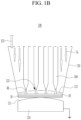
- FIGS. 1A and 1B are diagrams illustrating a schematic configuration of an arc welding device for a secondary battery according to an exemplary embodiment of the present invention.
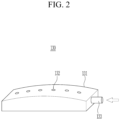
- FIG. 2 is an enlarged view showing a configuration of a lower fixing portion in FIGS. 1A and 1B .
- an arc welding device 100 for a secondary battery is a welding device 100 for bonding a plurality of electrode tabs 10 and an electrode lead 20 connected to an electrode of an electrode assembly and includes an upper fixing portion 120 and a lower fixing portion 130 disposed with the electrode tab 10 and the electrode lead 20 interposed therebetween.
- the arc welding device 100 for a secondary battery is a device for arc welding, not a configuration for ultrasonic welding or laser welding used for bonding the electrode tab 10 and the electrode lead 20 in the related art.
- arc welding also called gas tungsten arc welding
- inert gas such as Ar or He is used as a protective gas
- the arc welding is also called tungsten inert gas welding.
- the arc welding device 100 for a secondary battery allows this arc welding method to be applied to a welding method for bonding the electrode tab 10 and the electrode lead 20 to prevent an occurrence of spatter and foreign matter and damage to a battery.
- the upper fixing portion 120 includes a plurality of welding electrode units 200 connected to one pole of a welding power (not shown) therein.
- the welding electrode unit 200 may be a tungsten electrode, and may be disposed inside the upper fixing portion 120 such that an end thereof communicates with the outside through an arc hole 122 formed in the first facing surface 121 of the upper fixing portion 120. Power may be supplied through the welding electrode unit 200 to generate an arc AR.
- the tungsten electrode constituting the welding electrode unit 200 may include zirconia-based or lanthanide-based tungsten, but is not particularly limited.
- a first facing surface 121 formed to be concave toward an object to be welded, that is, the electrode lead 20 and the electrode tab 10, may be formed below the upper fixing portion 120.
- the first facing surface 121 may be in close contact with a second facing surface 131 of the lower fixing portion 130, which will be described later, to reliably fix the electrode lead 20 and the electrode tab 10, which are to be welded, during welding and minimize a gap therebetween.
- the upper fixing portion 120 may be formed in a chamber shape in which the welding electrode unit 200 is disposed, and the upper fixing portion 120 may further include a first nozzle portion 123 for supplying an inert gas IG at an upper portion thereof.
- the inert gas IG is supplied through the first nozzle portion 123 and passes through the inside of the upper fixing portion 120 to act as a shielding gas during welding through the arc hole 122 described above.
- the shielding gas a single or mixed gas selected from Ar, He, N 2 , etc. may be used, but is not particularly limited.
- As the inert gas IG is supplied to a welding portion during welding through the upper fixing portion 120, contact of the welding portion with oxygen may be blocked. In an exemplary embodiment of the present invention, such a structure may be simply provided through the upper fixing portion 120.
- the upper fixing portion 120 may include one or more materials selected from copper, a copper-based alloy, ceramic, and quartz. Accordingly, even if heat generated by the arc increases during arc welding, cooling may be performed quickly to enable repeated work, and since the material has heat resistance, it may be appropriately applied to arc welding.
- the lower fixing portion 130 connected to the other pole of the welding power with the object to be welded interposed therebetween is disposed below the upper fixing portion 120.
- the lower fixing portion 130 includes a second facing surface 131 facing the first facing surface 121 and formed to be convex to correspond to the concave shape of the first facing surface 121.
- An arrangement direction of the electrode tab 10 and the electrode lead 20 is not particularly limited. That is, as shown in FIG. 1A , the electrode tab 10 and the electrode lead 20 may be arranged such that convex shapes thereof correspond to each other in a length direction, or, as shown in FIG.
- the electrode tab 10 and the electrode lead 20 may be arranged in a width direction.
- additional shaping may be performed to have an appropriate shape by a subsequent pressing process, etc., and thus, such bending may not affect weld quality or performance of a final product.
- the electrode tab 10 and the electrode lead 20 to be welded may be disposed on the second facing surface 131, the first facing surface 121 of the upper fixing portion 120 may be brought into close contact with the second facing surface 131 to perform arc welding, and accordingly, a gap between the electrode tab 10 and the electrode lead 20 may be minimized and the electrode tab 10 and the electrode lead 20 may be stably supported during welding, whereby arc welding may be easily applied to the electrode tab 10 and the electrode lead 20 as well.
- a plurality of gas supply holes 132 may be further formed on the second facing surface 131.
- a second nozzle portion 133 communicating with the inside of the lower fixing portion 130 may be further provided to supply inert gas therethrough.
- the inert gas may be supplied through the gas supply hole 132 to further improve adhesion between the objects to be welded and block contact thereof with oxygen during welding.
- the lower fixing portion 130 may include copper or a copper-based alloy having good thermal conductivity. Thereby, rapid cooling may be achieved, but the present technology is not limited thereto.
- the welding device 100 for a secondary battery when used, arc welding that does not cause spatter may be applied in the bonding of the electrode tab 10 and the electrode lead 20 of the secondary battery, and as a result, the welding device may be simplified without adding an additional device (such as a suction device) for removing spatter, and a secondary battery may be manufactured without causing short circuit defects due to spatter.
- a suction device such as a suction device
- the welding electrode unit is included in the upper fixing portion, the upper fixing portion may serve as a fixing jig by itself together with the lower fixing portion, and the inert gas IG may also be easily supplied through the upper fixing portion, and therefore, costs for configuring the corresponding facility may be low to reduce overall equipment investment costs and suppress the occurrence of defects, thereby significantly improving the process efficiency.
- a plurality of electrode tabs connected to the respective electrodes and protruding outward and the electrode leads are aligned and disposed on the upper fixing portion 120 and the lower fixing portion 130. Thereafter, the first facing surface 121 of the upper fixing portion 120 and the second facing surface 131 of the lower fixing portion 130 are brought into close contact with each other with the electrode tab 10 and the electrode lead 20 interposed therebetween.
- the first facing surface 121 has a concave shape and the second facing surface 131 has a convex shape to correspond thereto, adhesion between the electrode lead 20 and the electrode tab 10 disposed therebetween may be improved and the electrode lead 20 and the electrode tab 10 may be fixed more stably.
- arc AR between the welding electrode unit 200 and the lower fixing portion 130
- welding i.e., gas tungsten arc welding (GTAW)
- GTAW gas tungsten arc welding
- the supplied power may have a base current in a range of 2 A to 4 A, and a peak current may be in a range of 4 A to 10 A. If the current value is smaller than this range, welding may not be sufficiently performed, and if the current value is larger, damage to the electrode lead 20 and the electrode tab 10 may occur. In particular, in the exemplary embodiment of the present invention, by supplying a relatively small base current and at the same time supplying a larger peak current, sufficient welding may be performed, without damage to the electrode lead 20 and the electrode tab 10.
- GTAW may be performed as pulse welding having a frequency of 2000 Hz or higher. Accordingly, welding may be performed without damage to the electrode lead 20 and the electrode tab 10.
- arc welding may be applied to a welding process for bonding the electrode tab 10 and the electrode lead 20 during the manufacture of a secondary battery, so that welding with high reliability may be performed even with simple facility, without causing spatter, thereby reducing a defect rate during manufacturing and reduce the process cost.
Landscapes
- Engineering & Computer Science (AREA)
- Physics & Mathematics (AREA)
- Plasma & Fusion (AREA)
- Mechanical Engineering (AREA)
- Chemical & Material Sciences (AREA)
- Chemical Kinetics & Catalysis (AREA)
- Electrochemistry (AREA)
- General Chemical & Material Sciences (AREA)
- Connection Of Batteries Or Terminals (AREA)
Applications Claiming Priority (2)
| Application Number | Priority Date | Filing Date | Title |
|---|---|---|---|
| KR1020210022437A KR102955395B1 (ko) | 2021-02-19 | 2021-02-19 | 이차전지용 아크 용접 장치 및 이를 이용한 용접 방법 |
| PCT/KR2022/002288 WO2022177289A1 (ko) | 2021-02-19 | 2022-02-16 | 이차전지용 아크 용접 장치 및 이를 이용한 용접 방법 |
Publications (2)
| Publication Number | Publication Date |
|---|---|
| EP4249157A1 true EP4249157A1 (de) | 2023-09-27 |
| EP4249157A4 EP4249157A4 (de) | 2024-05-22 |
Family
ID=82930946
Family Applications (1)
| Application Number | Title | Priority Date | Filing Date |
|---|---|---|---|
| EP22756487.9A Pending EP4249157A4 (de) | 2021-02-19 | 2022-02-16 | Lichtbogenschweissvorrichtung für sekundärbatterie und schweissverfahren damit |
Country Status (5)
| Country | Link |
|---|---|
| US (1) | US20240139850A1 (de) |
| EP (1) | EP4249157A4 (de) |
| KR (1) | KR102955395B1 (de) |
| CN (1) | CN116745057A (de) |
| WO (1) | WO2022177289A1 (de) |
Family Cites Families (16)
| Publication number | Priority date | Publication date | Assignee | Title |
|---|---|---|---|---|
| GB743806A (en) * | 1953-07-09 | 1956-01-25 | Prec Equipment Inc | Improvements in or relating to arc welding |
| BE754268R (fr) * | 1969-08-27 | 1970-12-31 | Kabel Metallwerke Ghh | Dispositif pour le soudage de minces toles, en particulier pourle soudage d'un feuillard metallique faconne en un |
| CA1106453A (en) * | 1977-12-21 | 1981-08-04 | Alcan Research And Development Limited | Reduction of arc blow in multi-electrode welding |
| JPH0688132B2 (ja) * | 1989-06-06 | 1994-11-09 | スカイアルミニウム株式会社 | 薄板の重ね合わせ溶接方法 |
| CN1039207C (zh) * | 1994-12-09 | 1998-07-22 | Lg产业株式会社 | 钨极惰性气体保护焊机的反极性直流电源 |
| JP3939473B2 (ja) * | 1999-10-08 | 2007-07-04 | バブコック日立株式会社 | ホットワイヤ溶接装置 |
| JP2007061830A (ja) * | 2005-08-29 | 2007-03-15 | Toyota Auto Body Co Ltd | 溶接装置 |
| MY164289A (en) * | 2005-11-09 | 2017-12-15 | Daihatsu Motor Co Ltd | Spot welding method, method for judging shape of nugget, spot welding machine, and spot welding electrode |
| JP2008200750A (ja) * | 2007-01-26 | 2008-09-04 | Kobe Steel Ltd | 片面アークスポット溶接方法 |
| KR20110055255A (ko) * | 2009-11-19 | 2011-05-25 | 에스비리모티브 주식회사 | 버스 바와 이를 구비한 전지 모듈 |
| JP2013099793A (ja) * | 2011-01-26 | 2013-05-23 | Denso Corp | 溶接方法 |
| KR20130042954A (ko) * | 2011-10-19 | 2013-04-29 | 주식회사 엘지화학 | 안전성이 향상된 이차전지 및 그 제조 방법 |
| JP6101513B2 (ja) * | 2012-12-27 | 2017-03-22 | 株式会社アマダミヤチ | 金属箔の重ね接合方法及び接合構造体 |
| KR102101429B1 (ko) * | 2016-05-18 | 2020-04-16 | 주식회사 엘지화학 | 리드 용접 장치, 이러한 리드 용접 장치를 통해 제조되는 배터리 모듈 및 이러한 배터리 모듈을 포함하는 배터리 팩 |
| CN106141387A (zh) * | 2016-08-24 | 2016-11-23 | 江苏阿斯美特精工科技有限公司 | 同轴空心钨极热丝tig焊枪、焊接装置及焊接方法 |
| KR102178729B1 (ko) * | 2017-12-26 | 2020-11-13 | 주식회사 포스코 | 강재 용접방법 |
-
2021
- 2021-02-19 KR KR1020210022437A patent/KR102955395B1/ko active Active
-
2022
- 2022-02-16 EP EP22756487.9A patent/EP4249157A4/de active Pending
- 2022-02-16 US US18/272,139 patent/US20240139850A1/en active Pending
- 2022-02-16 WO PCT/KR2022/002288 patent/WO2022177289A1/ko not_active Ceased
- 2022-02-16 CN CN202280008488.5A patent/CN116745057A/zh active Pending
Also Published As
| Publication number | Publication date |
|---|---|
| EP4249157A4 (de) | 2024-05-22 |
| KR20220118699A (ko) | 2022-08-26 |
| US20240139850A1 (en) | 2024-05-02 |
| WO2022177289A1 (ko) | 2022-08-25 |
| KR102955395B1 (ko) | 2026-04-20 |
| CN116745057A (zh) | 2023-09-12 |
Similar Documents
| Publication | Publication Date | Title |
|---|---|---|
| CN102522519B (zh) | 制造在连接部分具有相同尺寸电极头的电极组件的方法 | |
| CN101325248B (zh) | 锂离子二次电池 | |
| KR102366429B1 (ko) | 전극탭의 용접 특성을 개선한 전극 및 이를 포함하는 이차전지 | |
| KR101161965B1 (ko) | 이차전지용 집전단자판, 이차전지 및 이차전지의 제조방법 | |
| CN101908652B (zh) | 密闭型电池及密闭型电池的制造方法 | |
| KR102851254B1 (ko) | 전극 탭 용접 방법 및 전극 조립체를 포함하는 이차전지 | |
| JP4588331B2 (ja) | 角形電池とその製造方法 | |
| US20180131030A1 (en) | Electric power storage device and method of manufacturing the same | |
| JP5044108B2 (ja) | 電池間接続装置 | |
| JP6698869B2 (ja) | 電極端子接続プレートを備えている電池パック | |
| CN102124592A (zh) | 二次电池的制造方法及二次电池 | |
| WO2007004335A1 (ja) | 電池間接続装置 | |
| KR102309416B1 (ko) | 박판을 이용한 리드 단선을 개선하는 파우치형 이차전지 및 그 제조방법 | |
| CN110948111A (zh) | 一种软包锂离子电池的极耳复合焊接方法 | |
| KR101222284B1 (ko) | 전지 및 그 제조방법 | |
| CN113285109B (zh) | 袋状电池单元及其制造方法 | |
| US20230261336A1 (en) | Welding Method and Electrode Assembly Manufactured by the Same | |
| US8574756B1 (en) | Prismatic secondary battery | |
| KR102829145B1 (ko) | 원통형 이차전지의 제조방법 | |
| KR20130129837A (ko) | 레이저 조사에 의한 전극단자의 표면처리 방법 | |
| US20240139850A1 (en) | Arc Welding Device for Secondary Battery, and Welding Method Using the Same | |
| KR101124964B1 (ko) | 이차전지의 양극리드 또는 음극리드를 외부 부재와 연결하는 방법 | |
| KR101678810B1 (ko) | 용접봉 정렬용 홀을 포함하고 있는 지그를 구비한 용접 장치 | |
| EP2239802B1 (de) | Batterie und Hestellungsverfahren | |
| JP2008091036A (ja) | 組電池 |
Legal Events
| Date | Code | Title | Description |
|---|---|---|---|
| STAA | Information on the status of an ep patent application or granted ep patent |
Free format text: STATUS: THE INTERNATIONAL PUBLICATION HAS BEEN MADE |
|
| PUAI | Public reference made under article 153(3) epc to a published international application that has entered the european phase |
Free format text: ORIGINAL CODE: 0009012 |
|
| STAA | Information on the status of an ep patent application or granted ep patent |
Free format text: STATUS: REQUEST FOR EXAMINATION WAS MADE |
|
| 17P | Request for examination filed |
Effective date: 20230620 |
|
| AK | Designated contracting states |
Kind code of ref document: A1 Designated state(s): AL AT BE BG CH CY CZ DE DK EE ES FI FR GB GR HR HU IE IS IT LI LT LU LV MC MK MT NL NO PL PT RO RS SE SI SK SM TR |
|
| A4 | Supplementary search report drawn up and despatched |
Effective date: 20240422 |
|
| RIC1 | Information provided on ipc code assigned before grant |
Ipc: B23K 101/38 20060101ALI20240416BHEP Ipc: B23K 9/167 20060101ALI20240416BHEP Ipc: B23K 9/035 20060101ALI20240416BHEP Ipc: B23K 9/00 20060101ALI20240416BHEP Ipc: B23K 101/18 20060101ALI20240416BHEP Ipc: B23K 101/36 20060101ALI20240416BHEP Ipc: B23K 9/09 20060101ALI20240416BHEP Ipc: B23K 9/16 20060101ALI20240416BHEP Ipc: B23K 9/10 20060101AFI20240416BHEP |
|
| DAV | Request for validation of the european patent (deleted) | ||
| DAX | Request for extension of the european patent (deleted) |