EP4249561B1 - Polycarbonatzusammensetzung - Google Patents
Polycarbonatzusammensetzung Download PDFInfo
- Publication number
- EP4249561B1 EP4249561B1 EP22167695.0A EP22167695A EP4249561B1 EP 4249561 B1 EP4249561 B1 EP 4249561B1 EP 22167695 A EP22167695 A EP 22167695A EP 4249561 B1 EP4249561 B1 EP 4249561B1
- Authority
- EP
- European Patent Office
- Prior art keywords
- formula
- alkyl
- units
- composition according
- copolycarbonate
- Prior art date
- Legal status (The legal status is an assumption and is not a legal conclusion. Google has not performed a legal analysis and makes no representation as to the accuracy of the status listed.)
- Active
Links
Classifications
-
- C—CHEMISTRY; METALLURGY
- C08—ORGANIC MACROMOLECULAR COMPOUNDS; THEIR PREPARATION OR CHEMICAL WORKING-UP; COMPOSITIONS BASED THEREON
- C08L—COMPOSITIONS OF MACROMOLECULAR COMPOUNDS
- C08L69/00—Compositions of polycarbonates; Compositions of derivatives of polycarbonates
Definitions
- the present invention relates to a polycarbonate (PC) composition.
- the present invention relates to a polycarbonate composition with high level of comparative tracking index, good flame retardancy, high heat resistance, and good impact resistance, and a shaped article made from the same.
- Polycarbonate is widely used for a variety of applications, such as automotive, electric and electronic fields due to excellent optical, mechanical and heat resistant properties as well as excellent thermal processing ability thereof.
- Copolycarbonates as special types of polycarbonates, are widely used in electrical and electronic sectors, as housing material of lights, and in applications where particular thermal and mechanical properties are required, for example blow dryers, applications in the automotive sector, plastic covers, diffuser screens or waveguide elements and lamp covers or lamp bezels.
- a high level of flame retardancy e.g., V0 rating at 1.5mm as determined according to UL94-2015
- the comparative tracking index for standard polycarbonate resin is only around 250 V or even below.
- US4900784A discloses a polymer mixture which consists of a polybutylene terephthalate, a brominated polystyrene, an aromatic polycarbonate and an agent to improve the impact strength, which shows a combination of good flame-retardancy and a high level of comparative tracking index.
- CN 111 117 192 A discloses a polycarbonate/polyester alloy with high level of comparative tracking index, said alloy comprising 50 to 90 parts of polycarbonate resin, 10 to 25 parts of polyester resin, 1 to 6 parts of compatibilizer, 5 to 20 parts of flame retardant, 0.2 to 1 part of antioxidant, and 0.3 to 0.6 parts of lubricant.
- One objective of the present application is thus to provide a polycarbonate composition which has a good combination of comparative tracking index, flame retardancy, heat resistance, and impact resistance.
- Another object of the present application is to provide an article which has a good combination of comparative tracking index, high heat resistance, good impact resistance and flame retardancy.
- the present invention provides a polycarbonate composition comprising the following components, relative to the total weight of the composition:
- C 1/C/W C 1/CO/M ⁇ M w1 C 1/CO/M ⁇ M w1 ′ + C 2/CO/M ⁇ M w2 ⁇ C co/c/w
- Comparative tracking index means a numerical value of the maximum voltage at which five test specimens in test period withstand 50 drops of specified electrolyte liquid without tracking failure and without a persistent flame occurring, as determined according to IEC60112:2011.
- the composition according to the present invention has a comparative tracking index up to 600V as determined according to IEC60112:2011, a flame-retardancy level of V0 as determined according to UL94-2015, good heat resistance with a Vicat temperature not lower than 100 °C as determined according to ISO 306: 2013, and an impact strength more than 10 kJ/m 2 as determined according to ISO 180/A:2000.
- the present invention provides a shaped article made from a polycarbonate composition according to the first aspect of the present invention.
- the present invention provides a process for preparing the shaped article mentioned above, comprising injection moulding, extrusion moulding, blow moulding or thermoforming the polycarbonate composition according to the first aspect of the present invention.
- the polycarbonate composition according to the present invention comprises a copolycarbonate.
- the copolycarbonate refers to the polycarbonate comprising
- the units of formula (1) can be derived from a diphenol of formula (1'): wherein
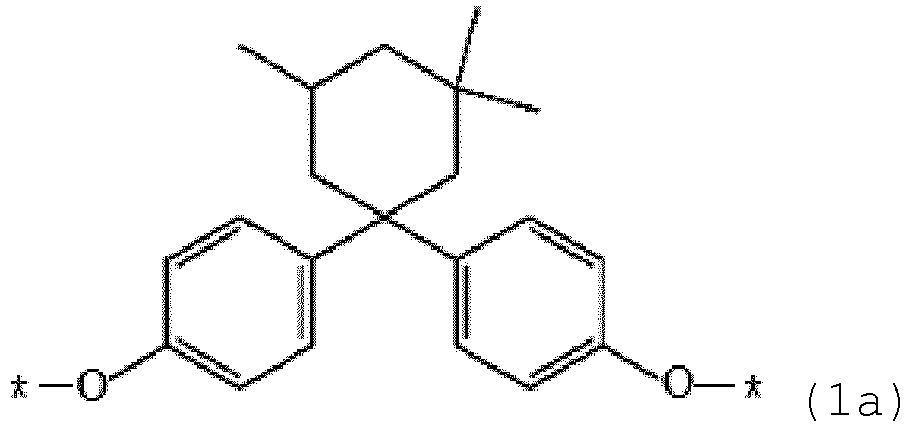
- the unit of formula (1) has the following formula (1a), wherein * indicates the position where formula (1a) is connected to the polymer chain, i.e., the unit of formula (1) is derived from bis(4-hydroxyphenyl)-3,3,5-trimethylcyclohexane (BPTMC) having the formula (1'a):
- BPTMC bis(4-hydroxyphenyl)-3,3,5-trimethylcyclohexane
- the units of formula (2) can be derived from a diphenol of formula (2'): wherein
- the unit of formula (2) has the following formula (2a), wherein * indicates the position where formula (2a) is connected to the polymer chain, i.e., the unit of formula (2) is derived from bisphenol A, i.e. the diphenol of formula (2'a).
- the copolycarbonate comprises units derived from bis(4-hydroxyphenyl)-3,3,5-trimethylcyclohexane (BPTMC) and bisphenol A.
- BPTMC bis(4-hydroxyphenyl)-3,3,5-trimethylcyclohexane
- the units of formula (1) in the copolycarbonate are derived from a diphenol of formula (1') and the units of formula (2) in the copolycarbonate are derived from a diphenol of formula (2').
- the units of formula (1) in the copolycarbonate are derived from bis(4-hydroxyphenyl)-3,3,5-trimethylcyclohexane (BPTMC) and the units of formula (2) in the copolycarbonate are derived from bisphenol A.
- BPTMC bis(4-hydroxyphenyl)-3,3,5-trimethylcyclohexane
- diphenols of formula (1') and formula (2') are known and can be prepared by processes known from literatures (for example H. J. Buysch et al., Ullmann's Encyclopedia of Industrial Chemistry, VCH, New York 1991, 5th Ed., Vol. 19, p. 348 ).
- the mole content of the units of the formula (1) in the copolycarbonate is 20-80 mol %
- the mole content of the units of the formula (2) in the copolycarbonate is 80 - 20 mol %, based on the total mole number of units of formula (1) and formula (2).
- the mole content of the units of the formula (1) in the copolycarbonate is 30-75 mol %
- the mole content of the units of the formula (2) in the copolycarbonate is 70 - 25 mol %, based on the total mole number of units of formula (1) and formula (2).
- copolycarbonate used in the composition according to the present invention is commercially available or can be produced by a process known in the art.
- the copolycarbonate used in the composition according to the present invention can be produced by an interfacial process.
- the diphenols of the formula (1') and (2') and optional branching agents are dissolved in aqueous alkaline solution and reacted with a carbonate source, such as phosgene, optionally dissolved in a solvent, in a two-phase mixture comprising an aqueous alkaline solution, an organic solvent and a catalyst, preferably an amine compound.
- a carbonate source such as phosgene
- a solvent preferably an amine compound.
- the reaction procedure can also be conducted in a multistep process.
- the concentration of the diphenols in the aqueous alkaline solution is from 2 wt. % to 25 wt. %, preferably from 2 wt. % to 20 wt. %, more preferably from 2 wt. % to 18 wt. % and even more preferably from 3 wt. % to 15 wt. %.
- the aqueous alkaline solution consists of water in which hydroxides of alkali metals or alkaline earth metals are dissolved. Sodium and potassium hydroxides are preferred.
- the concentration of the amine compound is from 0.1 mol % to 10 mol %, preferably 0.2 mol % to 8 mol %, particularly preferably 0.3 mol % to 6 mol % and more particularly preferably 0.4 mol % to 5 mol %, relative to the mole amount of diphenol used.
- the carbonate source is phosgene, diphosgene or triphosgene, preferably phosgene. Where phosgene is used, a solvent may optionally be dispensed with and the phosgene may be passed directly into the reaction mixture.
- Tertiary amines such as triethylamine or N-alkylpiperidines, may be used as a catalyst.
- Suitable catalysts are trialkylamines and 4-(dimethylamino)pyridine.
- Triethylamine, tripropylamine, triisopropylamine, tributylamine, trisobutylamine, N-methylpiperidine, N-ethylpiperidine and N-propylpiperidine are particularly suitable.
- Halogenated hydrocarbons such as methylene chloride, chlorobenzene, dichlorobenzene, trichlorobenzene or mixtures thereof, or aromatic hydrocarbons, such as, toluene or xylenes, are suitable as an organic solvent.
- the reaction temperature may be from - 5 °C. to 100 °C, preferably from 0 °C to 80 °C, particularly preferably from 10 °C to 70 °C. and very particularly preferably from 10 °C. to 60 °C.
- melt transesterification process is described, for example, in Encyclopedia of Polymer Science, Vol. 10 (1969 ), Chemistry and Physics of Polycarbonates, Polymer Reviews, H. Schnell, Vol. 9, John Wiley and Sons, Inc. (1964 ), and DE-C 1031 512 .
- the aromatic dihydroxy compounds already described in the case of the phase boundary process are transesterified with carbonic acid diesters with the aid of suitable catalysts and optionally further additives in the melt.
- the reaction of the aromatic dihydroxy compound and of the carbonic acid diester to give the copolycarbonate can be carried out batchwise or preferably continuously, for example in stirred vessels, thin-film evaporators, falling-film evaporators, stirred vessel cascades, extruders, kneaders, simple disc reactors and high-viscosity disc reactors.
- the copolycarbonate is selected from block copolycarbonates and random copolycarbonates. More preferably, the copolycarbonate is selected from random copolycarbonates.
- the copolycarbonate has a weight average molecular weight (Mw) ranging from 16000 g/mol to 40000 g/mol, preferably from 17000 g/mol to 32000 g/mol, as determined by Gel Permeation Chromatography (GPC) in methylene chloride at 25°C using a polycarbonate standard with an UV-IR detector.
- Mw weight average molecular weight
- the copolycarbonate is present in an amount ranging from 10 wt. % to 60 wt. %, more preferably from 12 wt. % to 45 wt. %, even more preferably from 15 wt. % to 45 wt. %, relative to the total weight of the composition according to the present invention.
- the polycarbonate composition according to the present invention comprises a homopolycarbonate comprising units of formula (2).
- the homopolycarbonate refers to the polycarbonate comprising units of formula (2) as defined above.
- the unit of formula (2) is derived from a diphenol of formula (2'): wherein
- the unit of formula (2) is derived from the diphenol of formula (2'a), i.e. bisphenol A.
- the homopolycarbonate used in the composition according to the present invention is commercially available or can be produced by a process known in the art.
- the homopolycarbonate can be produced by referring to the preparation process described with respect to component A.
- the homopolycarbonate has a weight average molecular weight (Mw) ranging from 20,000 g/mol to 32,000 g/mol, preferably from 20,000 g/mol to 30,000 g/mol, as determined by Gel Permeation Chromatography (GPC) in methylene chloride at 25°C using a polycarbonate standard with an UV-IR detector.
- Mw weight average molecular weight
- Makrolon ® FS2000 As commercial products of homopolycarbonates suitable for use in the composition according to the present invention, mention can be made of Makrolon ® FS2000, Makrolon ® 2400, Makrolon ® 2600, and Makrolon ® 2800 sold by the company Covestro Polymer (China).
- the homopolycarbonate is present in the polycarbonate composition according to the present invention in an amount ranging from 25 wt. % to 75wt. %, preferably from 26 wt. % to 65 wt. %, more preferably from 26 wt. % to 60 wt. %, relative to the total weight of the composition.
- the polycarbonate composition according to the present invention comprises a phosphorous flame retardant.
- the phosphorus flame retardant suitable for use in the composition according to the present invention are selected from monomeric and oligomeric phosphoric and phosphonic acid esters, and mixtures thereof.
- Preferred monomeric and oligomeric phosphoric and phosphonic acid esters are phosphorus compounds of formula (3). wherein
- R 1 , R 2 , R 3 and R 4 independently of one another, each denotes C1-C4 alkyl, phenyl, naphthyl, or phenyl C1-C4 alkyl, wherein the aromatic groups R 1 , R 2 , R 3 and R 4 can themselves be substituted with halogen and/or alkyl groups, preferably chlorine, bromine and/or C1-C4 alkyl.
- Particularly preferred aryl residues are cresyl, phenyl, xylenyl, propylphenyl or butylphenyl and the corresponding brominated and chlorinated derivatives thereof.
- X in formula (3) denotes a mononuclear or polynuclear aromatic residue with 6 to 30 carbon atoms.
- X is derived from resorcinol, hydroquinone, bisphenol A or diphenylphenol. Particularly preferably, X is derived from bisphenol A.
- n is equal to 1.
- q denotes a number from 0 to 20, particularly from 0 to 10, and in the case that a mixture of phosphorus compounds of the general formula (3) are used, a average value from 0.8 to 5.0, preferably 1.0 to 3.0, more preferably 1.05 to 2.00, and particularly preferably from 1.08 to 1.60.
- Phosphorus compounds of formula (3) are in particular tributyl phosphate, triphenyl phosphate, tricresyl phosphate, diphenyl cresyl phosphate, diphenyl octyl phosphate, diphe-nyl-2-ethylcresyl phosphate, tri(isopropylphenyl)phosphate, resorcinol bridged oligophosphate and bisphenol A bridged oligophosphate.
- the use of oligomeric phosphoric acid esters of formula (3) derived from bisphenol A is particularly preferred.
- phosphorus compounds of formula (3) is bisphenol A based oligophosphate according to formula (4), i.e., bisphenol-A bis(diphenyl phosphate):
- the phosphorus compounds of formula (3) are known (cf. e.g. EP-A 0 363 608 , EP-A 0 640 655 ) or can be produced by known methods in an analogous manner (e.g. Ullmanns Enzyklopadie der ischen Chemie, vol. 18, pp. 301 ff. 1979 ; Houben-Weyl, Methoden der organischen Chemie, vol. 12/1, p. 43 ; Beilstein vol. 6, p. 177 ).
- the phosphorus flame-retardant is present in the composition according to the present invention in an amount ranging from 7 wt. % to 13 wt. %, more preferably 8 wt. % to 11 wt. %, relative to the total weight of the composition.
- the polycarbonate composition of the present invention comprise an impact modifier.
- Impact modifiers commonly used in polycarbonate composition can be used in the polycarbonate composition according to the present invention.
- the impact modifier is selected from rubber-modified vinyl (co)polymers comprising,
- the wt. % is calculated based on the weight of the rubber-modified vinyl (co)polymer.
- the glass transition temperature was determined by means of dynamic differential calorimetry (DSC) in accordance with the standard DIN EN 61006 at a heating rate of 10 K/min with definition of the T g as the midpoint temperature (tangent method).
- the at least one vinyl monomer D1 are preferably mixtures of
- the wt. % is calculated based on the weight of the vinyl monomer D1.
- Preferred monomer D1.1 is chosen from styrene, ⁇ -methylstyrene and methyl methacrylate.
- Preferred monomer D1.2 is chosen from acrylonitrile, maleic anhydride and methyl methacrylate. More preferably, monomer D1.1 is styrene and monomer D1.2 is selected from acrylonitrile and methyl methacrylate.
- graft base D2 examples of the graft base D2
- diene rubbers and acrylate, and ethylene/vinyl acetate rubbers.
- Preferred graft base D2 is chosen from diene rubbers, for example based on butadiene and isoprene, or mixtures of diene rubbers or copolymers of diene rubbers or mixtures thereof with further copolymerizable monomers (e.g. according to D1.1 and D1.2), with the provison that the glass transition temperature of component D2 is below ⁇ 10 °C, preferably ⁇ 0 °C, particularly preferably ⁇ -20 °C.
- Particularly preferred graft base D2 is selected from pure polybutadiene rubber or acrylate composite rubbers.
- Particularly preferred rubber-modified vinyl (co)polymers are for example, ABS (Acrylonitrile-Butadiene-Styrene), MBS (Methyl methacrylate-Butadiene-Styrene).
- the rubber-modified vinyl (co)polymers can be prepared by free radical polymerization, e.g. by emulsion, suspension, solution or bulk polymerization, preferably by emulsion or bulk polymerization, in particular by emulsion polymerization.
- the impact modifier is present in the polycarbonate composition according to the present invention in amount ranging from 4 wt. % to 9 wt. %, relative to the total weight of the polycarbonate composition.
- the polycarbonate composition of the present invention comprise a polyester, selected from poly(1,4-butylene terephthalate), poly(1,4-cyclohexylenedimethylene 1,4-cyclohexanedicarboxylate), poly(2,2,4,4-tetramethyl-1,3-cyclobutylene terephthalate) copolyester, and a combination thereof.
- Poly(1,4-butylene terephthalate), also called as (PBT), is obtained by polycondensing terephthalic acid with a glycol component containing an alkylene glycol having 4 carbon atoms (1,4-butanediol).
- the intrinsic viscosity of the polybutylene terephthalate resin is not particularly limited.
- the intrinsic viscosity (IV) of the polybutylene terephthalate resin is from 0.60 dL/g to 1.2 dL/g, preferably from 0.65 dL/g to 0.9 dL/g.
- the intrinsic viscosity (IV) of the polybutylene terephthalate resin can be measured, for example, in o-chlorophenol at a temperature of 35 °C.
- a polybutylene terephthalate resin having an intrinsic viscosity of 0.9 dL/g can be prepared by blending a polybutylene terephthalate resin having an intrinsic viscosity of 1.0 dL/g and a polybutylene terephthalate resin having an intrinsic viscosity of 0.7 dL/g.
- PCCD employed can be a standard PCCD available from Eastman Chemical. It has a molecular weight of 41,000 to 60,000 g/mol as determined by GPC with CHCl 3 as solvent at 23 °C.
- PCCD has an inherent viscosity of from 0.8 dL/g to 1.1 dL/g, preferably of 0.82 dL/g to 1.0 dL/g, as measured in 60/40 (wt/wt) phenol/tetrachloroethane at a concentration of 0.5g/100ml at 25 °C.
- Poly(2,2,4,4-tetramethyl-1,3-cyclobutylene terephthalate) copolyester is an amorphous copolyester comprising 1,4-cyclohexanedimethylene terephthalate repeating units having the structure and 2,2,4,4-tetramethyl-1,3-cyclobutylene terephthalate repeating units having the structure wherein * indicates the position where the unit is connected to the polymer chain.
- Poly(2,2,4,4-tetramethyl-1,3-cyclobutylene terephthalate) copolyester can be obtained by polymerization of 2,2,4,4-tetramethyl-1,3-cyclobutanediol (TMCBD), terephthalic acid (or dimethyl terephthalate) and 1,4-cyclohexanediol.
- TMCBD 2,2,4,4-tetramethyl-1,3-cyclobutanediol
- terephthalic acid or dimethyl terephthalate
- 1,4-cyclohexanediol 1,4-cyclohexanediol
- the monomer TMCBD has cis and trans isomers.
- the C4 ring of the cis-TMCBD is non-planar and the crystals have a dihedral angle of 17.5°, while the trans -TMCBD has a dihedral angle of 0° and has a symmetrical structure; the C4 ring is very stable.
- the copolyester comprises 10 wt.-% to 90 wt.% of the cyclohexanedimethylene terephthalate repeating units and 10 wt.-% to 90 wt.-% of the 2,2,4,4-tetramethylcyclobutylene terephthalate repeating units, based on the weight of the copolyester.
- the copolyester has a melt volume rate (MVR) of 5 to 30 g/mol, preferably of 8 to 25 g/mol, and more preferably of 10 to 20 g/mol, as measured in accordance with ISO 1133-1: 2011 at 260°C under a loading of 5kg.
- MVR melt volume rate
- the polyester is present in the polycarbonate composition according to the present invention in an amount ranging from 2 wt.% to 14 wt.%, preferably from 2 wt.% to 13 wt.%, relative to the total weight of the polycarbonate composition.
- the polycarbonate compositions according to the present invention can optionally comprise one or more additives conventionally used in polycarbonate compositions.
- additives are, for example, fillers, carbon black, UV stabilizers, IR stabilizers, heat stabilizers, antistatic agents, pigments, colorants, lubricants, demoulding agents (such as pentaerythrityl tetrastearate), antioxidants, flow improvers agents, anti-dripping agents (such as poly(tetrafluoroethylene)), etc.
- the total amount of the additives preferably is up to 4 wt. %, preferably up 1.8 wt. %, relative to the total weight of the polycarbonate composition according to the present invention.
- the polycarbonate composition according to the present invention comprises the following components, relative to the total weight of the composition:
- the polycarbonate composition according to the present invention can be in the form of, for example, pellets.
- the polycarbonate composition according to the present invention demonstrates a good processing behaviour and can be prepared by a variety of methods involving intimate admixing of the materials desired in the composition.
- the materials desired in the composition are first blended in a high speed mixer.
- Low shear processes including but not limited to hand mixing, can also accomplish this blending.
- the blend is then fed into the throat of a twin-screw extruder via a hopper.
- at least one of the components can be incorporated into the composition by feeding it directly into the extruder at the throat and/or downstream through a side stuffer.
- Additives can also be compounded into a masterbatch with a desired polymeric resin and fed into the extruder.
- the extruder is generally operated at a temperature higher than that necessary to cause the composition to flow.
- the extrudate is immediately quenched in a water bath and pelletized.
- the pellets can be one-fourth inch long or less as described. Such pellets can be used for subsequent molding, shaping or forming.
- melt blending methods are preferred due to the availability of melt blending equipment in commercial polymer processing facilities.
- Illustrative examples of equipment used in such melt processing methods include corotating and counter-rotating extruders, single screw extruders, co-kneaders, and various other types of extrusion equipment.
- the temperature of the melt in the processing is preferably minimized in order to avoid excessive degradation of the polymers. It is often desirable to maintain the melt temperature between 230 °C and 350 °C in the molten resin composition, although higher temperatures can be used provided that the residence time of the resin in the processing equipment is kept short.
- the melting composition exits from a processing equipment such as an extruder through small exit holes in a die.
- the resulting strands of the molten resin are cooled by passing the strands through a water bath.
- the cooled strands can be chopped into small pellets for packaging and further handling.
- polycarbonate compositions according to the present invention can be used, for example for the production of various types of shaped articles.
- the present invention also provides a shaped article made from a polycarbonate composition according to the first aspect of the present invention.
- shaped articles mention can be made of, for example, films; profiles; housing parts, e.g. for domestic appliances or for office machines such as monitors, flat screens, notebooks, printers and copiers; sheets; tubes; electrical conduits; windows, doors and other profiles for the building sector (interior and exterior applications); electrical and electronic parts such as keypads, screen display covers, switches, plugs and sockets; lenses, and body parts or interior trim for commercial vehicles.
- housing parts e.g. for domestic appliances or for office machines such as monitors, flat screens, notebooks, printers and copiers
- sheets tubes
- electrical conduits windows, doors and other profiles for the building sector (interior and exterior applications)
- electrical and electronic parts such as keypads, screen display covers, switches, plugs and sockets; lenses, and body parts or interior trim for commercial vehicles.
- polycarbonate compositions according to the present invention can be processed into shaped articles by a variety of means such as injection moulding, extrusion moulding, blow moulding or thermoforming to form shaped articles.
- the present invention provides a process for preparing the shaped article made from a composition according to the first aspect of the present invention, comprising injection moulding, extrusion moulding, blow moulding or thermoforming the polycarbonate composition according to the present invention.
- CoPC-1 commercially available from the company Covestro Polymer (China), a copolycarbonate based on 70 mol % of 3,3,5-trimethyl-1,1-bis(4-hydroxyphenyl)cyclohexane (bisphenol TMC) units and 30 mol % of bisphenol A units, based on the total amount of bisphenol units, with a MVR of 7 cm 3 /10 min, as measured at 330 °C, 1.2 kg according to ISO 1133: (2011), and a weight average molecular weight of about 30000 g/mol, as determined by means of Gel Permeation Chromatography (GPC) in methylene chloride at 25 °C using a polycarbonate standard.
- GPC Gel Permeation Chromatography
- CoPC-2 commercially available from the company Covestro Polymer (China), a copolycarbonate based on 44 mol % of 3,3,5-trimethyl-1,1-bis(4-hydroxyphenyl)cyclohexane (bisphenol TMC) units and 56 mol % of bisphenol A units, based on the total amount of bisphenol units, with a MVR of 16 cm 3 /10 min, as measured at 330 °C, 1.2 kg according to ISO 1133: 2011, and a weight average molecular weight of about 27000 g/mol, as determined by means of Gel Permeation Chromatography (GPC) in methylene chloride at 25 °C using a polycarbonate standard.
- GPC Gel Permeation Chromatography
- PC-1 commercially available from the company Covestro Polymer (China), a linear polycarbonate based on bisphenol A have a weight average molecular weight of 26000 g/mol, as determined by means of Gel Permeation Chromatography (GPC) in methylene chloride at 25 °C using a polycarbonate standard.
- GPC Gel Permeation Chromatography
- PC-2 commercially available from the company Covestro Polymer (China), a linear polycarbonate based on bisphenol A having a weight average molecular weight (Mw) of 28000 g/mol, as determined by means of Gel Permeation Chromatography (GPC) in methylene chloride at 25 °C using a polycarbonate standard.
- Mw weight average molecular weight
- PC-3 commercially available from the company Covestro Polymer (China), a linear polycarbonate based on bisphenol A having a weight average molecular weight (Mw) of 20000 g/mol, as determined by means of Gel Permeation Chromatography (GPC) in methylene chloride at 25 °C using a polycarbonate standard.
- Mw weight average molecular weight
- BDP bisphenol-A bis(diphenyl phosphate), available from the company Zhejiang Wansheng Science China.
- ABS available under the trade name P60 from INEOS Styrolution GmbH, a core-shell impact modifier prepared by emulsion polymerization of 58 wt. %, based on the ABS polymer, of a mixture of 24 wt. % of acrylonitrile and 76 wt. % of styrene in the presence of 42 wt. %, based on the ABS polymer, of a linear polybutadiene rubber.
- MBS available under the trade name Kane Ace M732 from Japan Kaneka Chemical Co. Ltd, methyl methacrylate-butadiene-styrene with a core/shell structure.
- PET polyethylene terephthalate, having an intrinsic viscosity of 0.652-0.676 dl/g, available as RT6020 from Invista CO.
- PBT polybutylene terephthalate, having an intrinsic viscosity of 1.2 dl/g, available as 1100-211 S from ChangChun Plastic.
- PCCD a copolymer of 1,4-cyclohexanedimethanol (CHDM) and 1,4-dimethylcyclohexane dicarboxylate (DMCD), PCCD has an inherent viscosity of 0.92 dL/g, as measured in 60/40 (wt/wt) phenol/tetrachloroethane at a concentration of 0.5g/100ml at 25 °C. available as NEOSTAR COPOLYESTER 24303 from Eastman Chemical Company.
- CHDM 1,4-cyclohexanedimethanol
- DMCD 1,4-dimethylcyclohexane dicarboxylate
- Tritan poly(2,2,4,4-tetramethyl-1,3-cyclobutylene terephthalate) copolyester, a copolymer of dimethyl terephthalate (DMT), 1,4-cyclohexanedimethanol (CHDM), and 2,2,4,4-tetramethyl-1,3-cyclobutanediol (TMCBD), with a melt volume flow rate of about 14.5 cm 3 /10 min in accordance with ISO 1133-1: 2011 at 260 °C and 5 kg load, available as TRITAN TM Copolyester TX1001 from Eastman Chemical Company.
- DMT dimethyl terephthalate
- CHDM 1,4-cyclohexanedimethanol
- TMCBD 2,2,4,4-tetramethyl-1,3-cyclobutanediol
- ADS5000 masterbatch of poly(tetrafluoroethylene) sold under the trade name ADS5000 from the company Chemical Innovation Co., Ltd. Thailand.
- FACI L348 Pentaerythritol tetrastearate powder, a mold release agent.
- Irganox ® B900 a mixture of 80% Irgafos ® 168 and 20% Irganox ® 1076 sold from the company BASF, wherein Irgafos ® 168 is (tris (2,4-di-tert-butylphenyl)phosphite), Irganox ® 1076 is (2,6-di-tert-butyl-4-(octadecanoxy-carbonylethyl)-phenol.
- Phosphorous acid H 3 PO 3 , available from the company Sigma-Aldrich Chemie GmbH.
- the comparative tracking index (CTI) was determined according to IEC60112-2020-solution A.
- T Vicat The Vicat softening temperature
- melt volume flow rate was determined according to ISO 1133: 2011 at 260°C and a loading of 5 kg with a Zwick 4106 instrument from Roell.
- Izod notched impact strength was measured on specimens with dimensions of 80 mm ⁇ 10 mm ⁇ 3 mm according to ISO180/A:2000 (23°C, 4 mm, 5.5J).
- the flame retardancy was evaluated on 127 mm ⁇ 12.7 mm ⁇ 1.5 mm bars according to UL94-2015 after the bars were conditioned at 23 °C for 48 hours.
- the materials listed in Table 1 were compounded on a twin-screw extruder (ZSK-26) (from Coperion, Werner and Pfleiderer) at a speed of rotation of 225 rpm, a throughput of 20 kg/h, and a machine temperature of 300°C-330 °C and granulated.
- ZSK-26 twin-screw extruder
- the granules were processed into corresponding testing specimens on an injection moulding machine (from Arburg) with a melting temperature of 300-330 °C and a mold temperature of 60-80 °C.
- the molar content of BPTMC unit is 70 mol% and the molar content of BPA unit is 30 mol% in CoPC-1
- the molecular weight of BPTMC unit is 308 g/mol
- CoPC-1 is present in an amount of 20 wt.
- Composition of comparative example 1 not comprising a copolycarbonate and a polyester as defined in claim 1 does not have a high comparative tracking index.
- composition of comparative examples 2 and 3 not comprising a polyester as defined in claim 1 does not have a high comparative tracking index.
- composition of comparative examples 4 and 5 not comprising a copolycarbonate as defined in claim 1 does not have a high impact strength.
- composition of comparative examples 6-9 not comprising a copolycarbonate as defined in claim 1 does not have a high Vicat softening temperature.
- composition of comparative example 9 does not have a high comparative tracking index.
- Composition of comparative example 10 not comprising a copolycarbonate as defined in claim 1 does not have a high comparative tracking index.
- composition of comparative examples 11-14 comprising PET rather than a polyester as defined in claim 1 does not have a high impact strength.
- Composition of invention examples 1-3 according to the present invention have a good combination of comparative tracking index, Vicat softening temperature, Izod notched impact strength, and flame-retardancy.
- Composition of invention examples 4-14 according to the present invention have a good combination of comparative tracking index, Vicat softening temperature, Izod notched impact strength, and flame-retardancy.
- compositions of invention examples 15-20 according to the present invention have a good combination of comparative tracking index, Vicat softening temperature, Izod notched impact strength, and flame-retardancy.
- Composition of comparative example 15 comprising more than 14 wt.% of BDP(bisphenol-A bis(diphenyl phosphate)) copolycarbonate does not have a high Vicat softening temperature.
- Composition of comparative example 16 comprising lower than 4 wt.% of ABS does not have a high impact strength.
- Composition of comparative example 17 comprising more than 9 wt.% of ABS does not pass the flame retardancy test.
- Table 4 IE15 IE16 IE17 IE18 CE15 CE16 IE19 IE20 CE17 PC-1(M.2600) 53.48 41.48 26.48 52.13 45.13 54.13 48.13 54.13 46.13 CoPC-1 18.00 30.00 45.00 21.85 21.85 21.85 21.85 21.85 PBT 10.00 10.00 10.00 10.00 10.00 10.00 10.00 10.00 10.00 10.00 10.00 10.00 10.00 10.00 10.00 10.00 10.00 10.00 10.00 10.00 10.00 10.00 10.00 10.00 10.00 10.00 10.00 BDP 10.50 10.50 8 15.00 10.50 10.50 7 10.50 ABS 6.5 6.5 6.5 6.5 2 8 5.5 10 ADS5000 1 1 1 1 1 1 1 1 1 1 1 1 FACI L348 (PETS) 0.4 0.4 0.4 0.4 0.4 0.4 0.4 0.4 0.4 0.4 0.4 0.4 0.4 0.4
Landscapes
- Chemical & Material Sciences (AREA)
- Health & Medical Sciences (AREA)
- Chemical Kinetics & Catalysis (AREA)
- Medicinal Chemistry (AREA)
- Polymers & Plastics (AREA)
- Organic Chemistry (AREA)
- Compositions Of Macromolecular Compounds (AREA)
Claims (15)
- Polycarbonatzusammensetzung, umfassend die folgenden Komponenten, bezogen auf das Gesamtgewicht der Zusammensetzung:A) 10 - 60 Gew.-% eines Copolycarbonats, umfassendi) Einheiten der Formel (1)
 * die Position anzeigt, an der Formel (1) an die Polymerkette gebunden ist,R1 jeweils unabhängig für Wasserstoff oder C1-C4-Alkyl steht,R2 jeweils unabhängig für C1-C4-Alkyl steht,n für 0, 1, 2 oder 3 steht, undii) Einheiten der Formel (2):
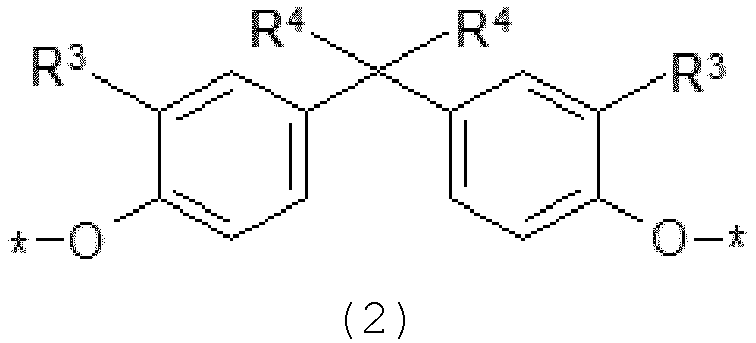 * die Position anzeigt, an der Formel (2) an die Polymerkette gebunden ist,R3 jeweils unabhängig für Wasserstoff, lineares oder verzweigtes C1-C10-Alkyl steht undR4 jeweils unabhängig für lineares oder verzweigtes C1-C10-Alkyl steht,B) 25 - 75 Gew.-% eines Homopolycarbonats, umfassend Einheiten der Formel (2) gemäß obiger Definition,C) 7 - 13 Gew.-% eines phosphorhaltigen Flammschutzmittels,D) 4 - 9 Gew.-% eines Schlagzähmodifikators undE) 2- 14 Gew.-% eines Polyesters, der aus Poly(1,4-butylenterephthalat), Poly(1,4-cyclohexylendimethylen-1,4-cyclohexandicarboxylat), Poly(2,2,4,4-tetramethyl-1,3-cyclobutylenterephthalat)-Copolyester und einer Kombination davon ausgewählt ist,wobei der Gewichtsgehalt der Einheit der Formel (1) in der Polycarbonatzusammensetzung 8-31 Gew.-% beträgt.
 - Zusammensetzung nach Anspruch 1, wobei sich die Einheiten der Formel (1) in dem Copolycarbonat von einem Diphenol der Formel (1') ableiten und sich die Einheiten der Formel (2) in dem Copolycarbonate von einem Diphenol der Formel (2') ableiten:
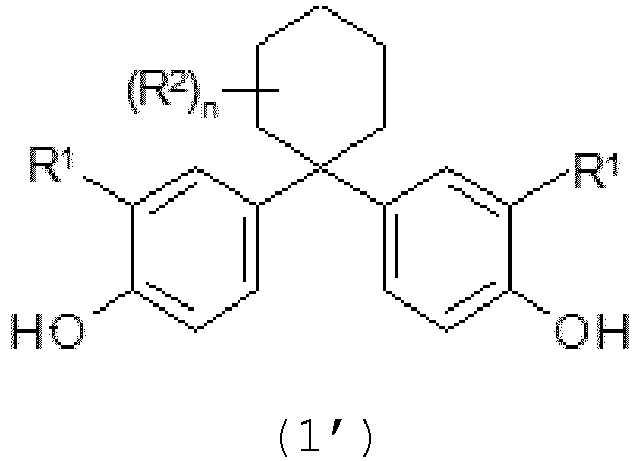 R1 jeweils unabhängig für Wasserstoff oder C1-C4-Alkyl steht,R2 jeweils unabhängig für C1-C4-Alkyl steht,n für 0, 1, 2 oder 3 steht;
 wobeiR3 jeweils unabhängig für H, lineares oder verzweigtes C1-C10-Alkyl steht,R4 jeweils unabhängig für lineares oder verzweigtes C1-C10-Alkyl steht.
 - Zusammensetzung nach Anspruch 2, wobei sich die Einheiten der Formel (1) in dem Copolycarbonat von Bis(4-hydroxyphenyl)-3,3,5-trimethylcyclohexan (BPTMC) ableiten und sich die Einheiten der Formel (2) in dem Copolycarbonat von Bisphenol A ableiten.
- Zusammensetzung nach einem der Ansprüche 1 bis 3, wobei der molare Gehalt der Einheiten der Formel (1) in dem Copolycarbonat 20-80 Mol-%, vorzugsweise 30-75 Mol-%, beträgt und der molare Gehalt der Einheiten der Formel (2) in dem Copolycarbonat 80-20 Mol-%, vorzugsweise 70-25 Mol-% beträgt, bezogen auf die gesamte Molzahl von Einheiten der Formel (1) und Formel (2).
- Zusammensetzung nach einem der Ansprüche 1 bis 4, wobei das Copolycarbonat aus Blockcopolycarbonaten und statistischen Copolycarbonaten ausgewählt ist.
- Zusammensetzung nach einem der Ansprüche 1 bis 5, wobei das Copolycarbonat ein gewichtsmittleres Molekulargewicht (Mw) im Bereich von 16.000 g/mol bis 40.000 g/mol, vorzugsweise von 17.000 g/mol bis 32.000 g/mol, gemäß Bestimmung durch Gelpermeationschromatographie (GPC) in Methylenchlorid bei 25 °C unter Verwendung eines Polycarbonat-Standards, aufweist.
- Zusammensetzung nach einem der Ansprüche 1 bis 6, wobei die Einheit der Formel (2) in dem Homopolycarbonat von einem Diphenol der Formel (2') abgeleitet ist:
 R3 jeweils unabhängig für H, lineares oder verzweigtes C1-C4-Alkyl steht undR4 jeweils unabhängig für lineares oder verzweigtes C1-C4-Alkyl steht.
 - Zusammensetzung nach einem der Ansprüche 1 bis 7, wobei die Einheit der Formel (2) von Bisphenol A abgeleitet ist.
- Zusammensetzung nach einem der Ansprüche 1 bis 8, wobei das phosphorhaltige Flammschutzmittel ausgewählt ist aus Phosphorverbindungen der Formel (3)
 R1, R2, R3 und R4 unabhängig voneinander jeweils gegebenenfalls halogeniertes C1- bis C8-Alkyl, C5- bis C6-Cycloalkyl, C6- bis C20-Aryl oder C7- bis C12-Aralkyl, jeweils gegebenenfalls durch Alkyl, vorzugsweise C1- bis C4-Alkyl und/oder Halogen, vorzugsweise Chlor, Brom, substituiert, bedeuten,n unabhängig voneinander 0 oder 1 bedeutet,q eine Zahl im Bereich von 0 bis 30 bedeutet undX einen ein- oder mehrkernigen aromatischen Rest mit 6 bis 30 Kohlenstoffatomen oder einen linearen oder verzweigten aliphatischen Rest mit 2 bis 30 Kohlenstoffatomen, der OH-substituiert sein kann und bis zu acht Etherverbindungen enthalten kann, bedeutet,das phosphorhaltige Flammschutzmittel vorzugsweise Bisphenol-A-bis(diphenylphosphat) ist.
 - Zusammensetzung nach einem der Ansprüche 1 bis 9, wobei der Schlagzähmodifikator ausgewählt ist aus kautschukmodifiziertem Vinyl(co)polymer, umfassendD1) 5 bis 95 Gew.-%, vorzugsweise 8 bis 90 Gew.-%, insbesondere 20 bis 85 Gew.-%, mindestens eines Vinylmonomers aufD2) 95 bis 5 Gew.-%, vorzugsweise 92 bis 10 Gew.-%, insbesondere 80 bis 15 Gew.-%, einer oder mehrerer Pfropfgrundlagen mit Glasübergangstemperaturen von < 10 °C, vorzugsweise < 0 °C, besonders bevorzugt < -20 °C, wobei der Gew.-%-Anteil auf der Basis des Gewichts des kautschukmodifizierten Vinyl(co)polymers berechnet wird.
- Zusammensetzung nach Anspruch 10, wobei
es sich bei dem mindestens einen Vinylmonomer D1 um eine Mischung vonD1.1) 50 bis 99 Gew.-%, vorzugsweise 65 bis 85 Gew.-%, insbesondere 75 bis 80 Gew.-%, Vinylaromaten und/oder kernsubstituierten Vinylaromaten und/oder Methacrylsäure-(C1-C8)-alkylestern undD1.2) 1 bis 50 Gew.-%, vorzugsweise 15 bis 35 Gew.-%, insbesondere 20 bis 25 Gew.-%, Vinylcyaniden und/oder (Meth)acrylsäure-(C1-C8)-alkylestern,wobei der Gew.-%-Anteil auf der Basis des Gewichts des Vinylmonomers D1 berechnet wird;
und/oderdie Pfropfgrundlage D2 aus Dienkautschuken und Acrylat- und Ethylen/Vinylacetat-Kautschuken ausgewählt ist. - Zusammensetzung nach Anspruch 11, wobei Monomer D1.1 Styrol ist, Monomer D1.2 aus Acrylnitril und Methylmethacrylat ausgewählt ist und die Pfropfgrundlage D2 aus reinem Polybutadien-Kautschuk oder Acrylatkautschuken ausgewählt ist.
- Zusammensetzung nach einem der Ansprüche 1 bis 9, wobei der Schlagzähmodifikator aus ABS, Methylmethacrylat-Butadien-Styrol (MBS) und einer Kombination davon ausgewählt ist.
- Zusammensetzung nach Anspruch 1, umfassend die folgenden Komponenten, bezogen auf das Gesamtgewicht der Zusammensetzung:A) 15 - 45 Gew.-% eines Copolycarbonats, umfassendi) Einheiten der Formel (1a)
 ii) Einheiten der Formel (2a)
 B) 26 - 60 Gew.-% eines Homopolycarbonats, umfassend Einheiten der Formel (2a) gemäß obiger Definition,C) 8 - 11 Gew.-% Bisphenol-A-bis(diphenylphosphat),D) 4 - 9 Gew.-% eines Schlagzähmodifikators, der aus Acrylnitril-Butadien-Styrol oder Methylmethacrylat-Butadien-Styrol ausgewählt ist, undE) 2 - 13 Gew.-% eines Polyesters, der aus Poly(1,4-butylenterephthalat), Poly(1,4-cyclohexylendimethylen-1,4-cyclohexandicarboxylat), Poly(2,2,4,4-tetramethyl-1,3-cyclobutylenterephthalat)-Copolyester und einer Kombination davon ausgewählt ist,wobei der Gewichtsgehalt der Einheit der Formel (1a) in der Polycarbonatzusammensetzung 8 Gew.-% bis 31 Gew.-% beträgt.
 - Formkörper, hergestellt aus der Zusammensetzung nach einem der Ansprüche 1 bis 14.
Priority Applications (5)
| Application Number | Priority Date | Filing Date | Title |
|---|---|---|---|
| US18/849,989 US20250257208A1 (en) | 2022-03-25 | 2023-03-17 | Polycarbonate Composition |
| KR1020247031157A KR20240162502A (ko) | 2022-03-25 | 2023-03-17 | 폴리카르보네이트 조성물 |
| CN202380030097.8A CN118922497A (zh) | 2022-03-25 | 2023-03-17 | 聚碳酸酯组合物 |
| PCT/EP2023/056843 WO2023180190A1 (en) | 2022-03-25 | 2023-03-17 | Polycarbonate composition |
| JP2024554705A JP2025509533A (ja) | 2022-03-25 | 2023-03-17 | ポリカーボネート組成物 |
Applications Claiming Priority (1)
| Application Number | Priority Date | Filing Date | Title |
|---|---|---|---|
| CN2022082957 | 2022-03-25 |
Publications (2)
| Publication Number | Publication Date |
|---|---|
| EP4249561A1 EP4249561A1 (de) | 2023-09-27 |
| EP4249561B1 true EP4249561B1 (de) | 2024-12-18 |
Family
ID=87760158
Family Applications (1)
| Application Number | Title | Priority Date | Filing Date |
|---|---|---|---|
| EP22167695.0A Active EP4249561B1 (de) | 2022-03-25 | 2022-04-11 | Polycarbonatzusammensetzung |
Country Status (1)
| Country | Link |
|---|---|
| EP (1) | EP4249561B1 (de) |
Family Cites Families (8)
| Publication number | Priority date | Publication date | Assignee | Title |
|---|---|---|---|---|
| DE1031512B (de) | 1955-12-21 | 1958-06-04 | Bayer Ag | Verfahren zur Herstellung von hochmolekularen faser- und filmbildenden Polycarbonaten |
| NL8703130A (nl) | 1987-12-24 | 1989-07-17 | Gen Electric | Polymeermengsel met een polybutyleentereftalaat en een gebormineerd polystyreen, daaruit gevormde voorwerpen. |
| NL8802346A (nl) | 1988-09-22 | 1990-04-17 | Gen Electric | Polymeermengsel met aromatisch polycarbonaat, styreen bevattend copolymeer en/of entpolymeer en een vlamvertragend middel, daaruit gevormde voorwerpen. |
| DE4328656A1 (de) | 1993-08-26 | 1995-03-02 | Bayer Ag | Flammwidrige, spannungsrißbeständige Polycarbonat-ABS-Formmassen |
| MY119540A (en) | 1998-04-24 | 2005-06-30 | Ciba Spacialty Chemicals Holding Inc | Increasing the molecular weight of polyesters |
| US7700696B2 (en) * | 2006-06-28 | 2010-04-20 | Sabic Innovative Plastics Ip B.V. | Polycarbonate composition having improved scratch resistance, and articles formed therefrom |
| US20150232661A1 (en) * | 2014-02-20 | 2015-08-20 | Sabic Innovative Plastics Ip B.V. | Thermoplastic composition and article |
| CN111117192A (zh) * | 2019-12-28 | 2020-05-08 | 会通新材料股份有限公司 | 一种高cti值、高灼热丝、低热球压痕的聚碳酸酯/聚酯合金及其制备方法 |
-
2022
- 2022-04-11 EP EP22167695.0A patent/EP4249561B1/de active Active
Also Published As
| Publication number | Publication date |
|---|---|
| EP4249561A1 (de) | 2023-09-27 |
Similar Documents
| Publication | Publication Date | Title |
|---|---|---|
| KR20160114084A (ko) | 폴리머 인 난연제를 갖는 무할로겐 난연성 폴리카보네이트/열가소성 폴리에스테르 성형 조성물 | |
| EP4330331B1 (de) | Polycarbonatzusammensetzung mit hohem vergleichendem verfolgungsindex | |
| US20250257208A1 (en) | Polycarbonate Composition | |
| EP3732247B1 (de) | Polycarbonatzusammensetzung und daraus hergestellter formkörper | |
| EP4249561B1 (de) | Polycarbonatzusammensetzung | |
| EP4092081A1 (de) | Flammhemmende polycarbonatzusammensetzung mit hoher kriechstromfestigkeit | |
| CN101981105B (zh) | 抗冲击改性聚对苯二甲酸亚烷基二醇酯/聚碳酸酯组合物 | |
| EP4330332B1 (de) | Flammhemmende polycarbonatzusammensetzung mit hoher kriechstromfestigkeit | |
| JP7288751B2 (ja) | 熱可塑性樹脂組成物及び成形体 | |
| JP7288752B2 (ja) | 熱可塑性樹脂組成物及び成形体 | |
| JP2009235361A (ja) | 難燃性ポリアリレート樹脂組成物 | |
| JP2020176158A (ja) | 熱可塑性樹脂組成物及び成形体 | |
| EP4347687B1 (de) | Thermoplastische polycarbonatzusammensetzung | |
| JP2018145439A (ja) | ポリカーボネート−ポリオルガノシロキサン共重合体を含むポリカーボネート系樹脂組成物及びその成形品 | |
| US20210253850A1 (en) | Thermoplastic compositions having good mechanical properties | |
| KR102725450B1 (ko) | 우수한 안정성을 갖는 열가소성 조성물 | |
| EP4092082A1 (de) | Polycarbonatzusammensetzung mit hohem vergleichendem verfolgungsindex | |
| JP5144426B2 (ja) | 難燃性樹脂組成物、及びその製造方法 | |
| KR20250129660A (ko) | 폴리카르보네이트 조성물 | |
| JP6314601B2 (ja) | 芳香族ポリカーボネート樹脂組成物 | |
| KR101466275B1 (ko) | 열가소성 수지 조성물 | |
| CN1902280A (zh) | 聚碳酸酯聚酯模塑组合物 | |
| CN1894340A (zh) | 聚碳酸酯聚酯模塑组合物 |
Legal Events
| Date | Code | Title | Description |
|---|---|---|---|
| PUAI | Public reference made under article 153(3) epc to a published international application that has entered the european phase |
Free format text: ORIGINAL CODE: 0009012 |
|
| STAA | Information on the status of an ep patent application or granted ep patent |
Free format text: STATUS: THE APPLICATION HAS BEEN PUBLISHED |
|
| AK | Designated contracting states |
Kind code of ref document: A1 Designated state(s): AL AT BE BG CH CY CZ DE DK EE ES FI FR GB GR HR HU IE IS IT LI LT LU LV MC MK MT NL NO PL PT RO RS SE SI SK SM TR |
|
| STAA | Information on the status of an ep patent application or granted ep patent |
Free format text: STATUS: REQUEST FOR EXAMINATION WAS MADE |
|
| 17P | Request for examination filed |
Effective date: 20240327 |
|
| RBV | Designated contracting states (corrected) |
Designated state(s): AL AT BE BG CH CY CZ DE DK EE ES FI FR GB GR HR HU IE IS IT LI LT LU LV MC MK MT NL NO PL PT RO RS SE SI SK SM TR |
|
| GRAP | Despatch of communication of intention to grant a patent |
Free format text: ORIGINAL CODE: EPIDOSNIGR1 |
|
| STAA | Information on the status of an ep patent application or granted ep patent |
Free format text: STATUS: GRANT OF PATENT IS INTENDED |
|
| INTG | Intention to grant announced |
Effective date: 20240905 |
|
| GRAS | Grant fee paid |
Free format text: ORIGINAL CODE: EPIDOSNIGR3 |
|
| GRAA | (expected) grant |
Free format text: ORIGINAL CODE: 0009210 |
|
| STAA | Information on the status of an ep patent application or granted ep patent |
Free format text: STATUS: THE PATENT HAS BEEN GRANTED |
|
| AK | Designated contracting states |
Kind code of ref document: B1 Designated state(s): AL AT BE BG CH CY CZ DE DK EE ES FI FR GB GR HR HU IE IS IT LI LT LU LV MC MK MT NL NO PL PT RO RS SE SI SK SM TR |
|
| REG | Reference to a national code |
Ref country code: CH Ref legal event code: EP |
|
| REG | Reference to a national code |
Ref country code: DE Ref legal event code: R096 Ref document number: 602022008728 Country of ref document: DE |
|
| REG | Reference to a national code |
Ref country code: IE Ref legal event code: FG4D |
|
| REG | Reference to a national code |
Ref country code: LT Ref legal event code: MG9D |
|
| PG25 | Lapsed in a contracting state [announced via postgrant information from national office to epo] |
Ref country code: HR Free format text: LAPSE BECAUSE OF FAILURE TO SUBMIT A TRANSLATION OF THE DESCRIPTION OR TO PAY THE FEE WITHIN THE PRESCRIBED TIME-LIMIT Effective date: 20241218 |
|
| PG25 | Lapsed in a contracting state [announced via postgrant information from national office to epo] |
Ref country code: FI Free format text: LAPSE BECAUSE OF FAILURE TO SUBMIT A TRANSLATION OF THE DESCRIPTION OR TO PAY THE FEE WITHIN THE PRESCRIBED TIME-LIMIT Effective date: 20241218 |
|
| PG25 | Lapsed in a contracting state [announced via postgrant information from national office to epo] |
Ref country code: BG Free format text: LAPSE BECAUSE OF FAILURE TO SUBMIT A TRANSLATION OF THE DESCRIPTION OR TO PAY THE FEE WITHIN THE PRESCRIBED TIME-LIMIT Effective date: 20241218 |
|
| PG25 | Lapsed in a contracting state [announced via postgrant information from national office to epo] |
Ref country code: NO Free format text: LAPSE BECAUSE OF FAILURE TO SUBMIT A TRANSLATION OF THE DESCRIPTION OR TO PAY THE FEE WITHIN THE PRESCRIBED TIME-LIMIT Effective date: 20250318 |
|
| REG | Reference to a national code |
Ref country code: NL Ref legal event code: MP Effective date: 20241218 |
|
| PG25 | Lapsed in a contracting state [announced via postgrant information from national office to epo] |
Ref country code: LV Free format text: LAPSE BECAUSE OF FAILURE TO SUBMIT A TRANSLATION OF THE DESCRIPTION OR TO PAY THE FEE WITHIN THE PRESCRIBED TIME-LIMIT Effective date: 20241218 Ref country code: GR Free format text: LAPSE BECAUSE OF FAILURE TO SUBMIT A TRANSLATION OF THE DESCRIPTION OR TO PAY THE FEE WITHIN THE PRESCRIBED TIME-LIMIT Effective date: 20250319 |
|
| PG25 | Lapsed in a contracting state [announced via postgrant information from national office to epo] |
Ref country code: RS Free format text: LAPSE BECAUSE OF FAILURE TO SUBMIT A TRANSLATION OF THE DESCRIPTION OR TO PAY THE FEE WITHIN THE PRESCRIBED TIME-LIMIT Effective date: 20250318 |
|
| PG25 | Lapsed in a contracting state [announced via postgrant information from national office to epo] |
Ref country code: NL Free format text: LAPSE BECAUSE OF FAILURE TO SUBMIT A TRANSLATION OF THE DESCRIPTION OR TO PAY THE FEE WITHIN THE PRESCRIBED TIME-LIMIT Effective date: 20241218 |
|
| REG | Reference to a national code |
Ref country code: AT Ref legal event code: MK05 Ref document number: 1752240 Country of ref document: AT Kind code of ref document: T Effective date: 20241218 |
|
| PG25 | Lapsed in a contracting state [announced via postgrant information from national office to epo] |
Ref country code: SM Free format text: LAPSE BECAUSE OF FAILURE TO SUBMIT A TRANSLATION OF THE DESCRIPTION OR TO PAY THE FEE WITHIN THE PRESCRIBED TIME-LIMIT Effective date: 20241218 |
|
| PG25 | Lapsed in a contracting state [announced via postgrant information from national office to epo] |
Ref country code: PL Free format text: LAPSE BECAUSE OF FAILURE TO SUBMIT A TRANSLATION OF THE DESCRIPTION OR TO PAY THE FEE WITHIN THE PRESCRIBED TIME-LIMIT Effective date: 20241218 |
|
| PGFP | Annual fee paid to national office [announced via postgrant information from national office to epo] |
Ref country code: DE Payment date: 20250319 Year of fee payment: 4 |
|
| PG25 | Lapsed in a contracting state [announced via postgrant information from national office to epo] |
Ref country code: ES Free format text: LAPSE BECAUSE OF FAILURE TO SUBMIT A TRANSLATION OF THE DESCRIPTION OR TO PAY THE FEE WITHIN THE PRESCRIBED TIME-LIMIT Effective date: 20241218 |
|
| PG25 | Lapsed in a contracting state [announced via postgrant information from national office to epo] |
Ref country code: IS Free format text: LAPSE BECAUSE OF FAILURE TO SUBMIT A TRANSLATION OF THE DESCRIPTION OR TO PAY THE FEE WITHIN THE PRESCRIBED TIME-LIMIT Effective date: 20250418 |
|
| PGFP | Annual fee paid to national office [announced via postgrant information from national office to epo] |
Ref country code: IT Payment date: 20250430 Year of fee payment: 4 |
|
| PG25 | Lapsed in a contracting state [announced via postgrant information from national office to epo] |
Ref country code: PT Free format text: LAPSE BECAUSE OF FAILURE TO SUBMIT A TRANSLATION OF THE DESCRIPTION OR TO PAY THE FEE WITHIN THE PRESCRIBED TIME-LIMIT Effective date: 20250421 |
|
| PG25 | Lapsed in a contracting state [announced via postgrant information from national office to epo] |
Ref country code: EE Free format text: LAPSE BECAUSE OF FAILURE TO SUBMIT A TRANSLATION OF THE DESCRIPTION OR TO PAY THE FEE WITHIN THE PRESCRIBED TIME-LIMIT Effective date: 20241218 |
|
| PG25 | Lapsed in a contracting state [announced via postgrant information from national office to epo] |
Ref country code: AT Free format text: LAPSE BECAUSE OF FAILURE TO SUBMIT A TRANSLATION OF THE DESCRIPTION OR TO PAY THE FEE WITHIN THE PRESCRIBED TIME-LIMIT Effective date: 20241218 Ref country code: RO Free format text: LAPSE BECAUSE OF FAILURE TO SUBMIT A TRANSLATION OF THE DESCRIPTION OR TO PAY THE FEE WITHIN THE PRESCRIBED TIME-LIMIT Effective date: 20241218 |
|
| PG25 | Lapsed in a contracting state [announced via postgrant information from national office to epo] |
Ref country code: SK Free format text: LAPSE BECAUSE OF FAILURE TO SUBMIT A TRANSLATION OF THE DESCRIPTION OR TO PAY THE FEE WITHIN THE PRESCRIBED TIME-LIMIT Effective date: 20241218 |
|
| PG25 | Lapsed in a contracting state [announced via postgrant information from national office to epo] |
Ref country code: CZ Free format text: LAPSE BECAUSE OF FAILURE TO SUBMIT A TRANSLATION OF THE DESCRIPTION OR TO PAY THE FEE WITHIN THE PRESCRIBED TIME-LIMIT Effective date: 20241218 |
|
| PG25 | Lapsed in a contracting state [announced via postgrant information from national office to epo] |
Ref country code: SE Free format text: LAPSE BECAUSE OF FAILURE TO SUBMIT A TRANSLATION OF THE DESCRIPTION OR TO PAY THE FEE WITHIN THE PRESCRIBED TIME-LIMIT Effective date: 20241218 |
|
| REG | Reference to a national code |
Ref country code: DE Ref legal event code: R097 Ref document number: 602022008728 Country of ref document: DE |
|
| PG25 | Lapsed in a contracting state [announced via postgrant information from national office to epo] |
Ref country code: DK Free format text: LAPSE BECAUSE OF FAILURE TO SUBMIT A TRANSLATION OF THE DESCRIPTION OR TO PAY THE FEE WITHIN THE PRESCRIBED TIME-LIMIT Effective date: 20241218 |
|
| PLBE | No opposition filed within time limit |
Free format text: ORIGINAL CODE: 0009261 |
|
| STAA | Information on the status of an ep patent application or granted ep patent |
Free format text: STATUS: NO OPPOSITION FILED WITHIN TIME LIMIT |
|
| REG | Reference to a national code |
Ref country code: CH Ref legal event code: L10 Free format text: ST27 STATUS EVENT CODE: U-0-0-L10-L00 (AS PROVIDED BY THE NATIONAL OFFICE) Effective date: 20251029 |
|
| REG | Reference to a national code |
Ref country code: CH Ref legal event code: H13 Free format text: ST27 STATUS EVENT CODE: U-0-0-H10-H13 (AS PROVIDED BY THE NATIONAL OFFICE) Effective date: 20251125 |
|
| 26N | No opposition filed |
Effective date: 20250919 |
|
| PG25 | Lapsed in a contracting state [announced via postgrant information from national office to epo] |
Ref country code: LU Free format text: LAPSE BECAUSE OF NON-PAYMENT OF DUE FEES Effective date: 20250411 |
|
| PG25 | Lapsed in a contracting state [announced via postgrant information from national office to epo] |
Ref country code: MC Free format text: LAPSE BECAUSE OF FAILURE TO SUBMIT A TRANSLATION OF THE DESCRIPTION OR TO PAY THE FEE WITHIN THE PRESCRIBED TIME-LIMIT Effective date: 20241218 |
|
| REG | Reference to a national code |
Ref country code: BE Ref legal event code: MM Effective date: 20250430 |
|
| PG25 | Lapsed in a contracting state [announced via postgrant information from national office to epo] |
Ref country code: FR Free format text: LAPSE BECAUSE OF NON-PAYMENT OF DUE FEES Effective date: 20250430 |
|
| PG25 | Lapsed in a contracting state [announced via postgrant information from national office to epo] |
Ref country code: BE Free format text: LAPSE BECAUSE OF NON-PAYMENT OF DUE FEES Effective date: 20250430 |
|
| PG25 | Lapsed in a contracting state [announced via postgrant information from national office to epo] |
Ref country code: CH Free format text: LAPSE BECAUSE OF NON-PAYMENT OF DUE FEES Effective date: 20250430 |
|
| PGFP | Annual fee paid to national office [announced via postgrant information from national office to epo] |
Ref country code: GB Payment date: 20260325 Year of fee payment: 5 |
|
| PG25 | Lapsed in a contracting state [announced via postgrant information from national office to epo] |
Ref country code: IE Free format text: LAPSE BECAUSE OF NON-PAYMENT OF DUE FEES Effective date: 20250411 |