EP4253204B1 - Véhicule plafonnier de type chenille conçu pour se déplacer le long d'une structure; procédé permettant de fournir un mouvement de déplacement de type chenille le long de la structure; et utilisation d'au moins une unité d'entrainement de type chenille pour fournir une cinématique de déplacement/accouplement pour le mouvement de déplacement - Google Patents
Véhicule plafonnier de type chenille conçu pour se déplacer le long d'une structure; procédé permettant de fournir un mouvement de déplacement de type chenille le long de la structure; et utilisation d'au moins une unité d'entrainement de type chenille pour fournir une cinématique de déplacement/accouplement pour le mouvement de déplacement Download PDFInfo
- Publication number
- EP4253204B1 EP4253204B1 EP22165205.0A EP22165205A EP4253204B1 EP 4253204 B1 EP4253204 B1 EP 4253204B1 EP 22165205 A EP22165205 A EP 22165205A EP 4253204 B1 EP4253204 B1 EP 4253204B1
- Authority
- EP
- European Patent Office
- Prior art keywords
- ceiling
- circumferential
- vehicle
- track
- suspension elements
- Prior art date
- Legal status (The legal status is an assumption and is not a legal conclusion. Google has not performed a legal analysis and makes no representation as to the accuracy of the status listed.)
- Active
Links
Images









Classifications
-
- B—PERFORMING OPERATIONS; TRANSPORTING
- B62—LAND VEHICLES FOR TRAVELLING OTHERWISE THAN ON RAILS
- B62D—MOTOR VEHICLES; TRAILERS
- B62D55/00—Endless track vehicles
- B62D55/06—Endless track vehicles with tracks without ground wheels
- B62D55/075—Tracked vehicles for ascending or descending stairs, steep slopes or vertical surfaces
Definitions
- the present invention refers to crawler type ceiling vehicles configured for traveling in a suspended manner, e.g. headlong at a ceiling structure. Further, the present invention refers to a method for suspending (especially hanging) and optionally also actively driving such a crawler type vehicle. In particular, the present invention refers to devices and methods according to features of the enclosed independent claims.
- the skilled person may differentiate between those vehicles which are provided for moving on the underground and those vehicles which are provided for moving along a ceiling structure, especially since the latter have to be suspended in secure manner also, in order to avoid going down. Therefore, there might be different approaches as to the kinematics ensuring interaction/engagement at the structure's interface.
- the object also includes providing for a coupling mechanism allowing for reliably coupling the ceiling vehicle with a support structure of arbitrary orientation in space for transferring a predefined driving motion, preferably a driving motion in at least two spatial dimensions/directions (2D), in very reliable manner to the support structure.
- the present invention concerns kinematics of suspension elements being de-/coupled by a driving motion along circumferential tracks.
- the present invention may also provide for a vehicle and driving mechanism which respectively allows for very reliable and accurate traveling/driving motion and positioning of the vehicle with respect to the structure in context with logistic tasks, especially also with respect to a cargo or load functionality, in particular in an arrangement at a ceiling or in an overhead arrangement (upside down).
- the present invention also provides for a coupling mechanism allowing for reliably coupling the vehicle with a support structure for transferring a predefined driving motion, preferably a driving motion in at least two spatial dimensions/directions (2D), in very reliable manner to the support structure, in order to allow for reliable positioning of the vehicle and of a load or cargo carried by at least one hoist of the vehicle.
- a predefined driving motion preferably a driving motion in at least two spatial dimensions/directions (2D)
- 2D spatial dimensions/directions
- a crawler type vehicle especially ceiling vehicle
- the vehicle exhibits: a plurality of suspension elements configured for suspending the vehicle and configured for coupling the vehicle to the structure, and at least one drive unit (especially a crawler track-like drive unit) configured for circumferential driving/guiding motion (resp.
- the suspension elements are attached to the first circumferential track at predefined first longitudinal positions corresponding to a predefined raster (especially a/the raster defined by the structure), wherein the vehicle is configured for moving along the structure by decoupling a subset of the plurality of suspension elements from resp. coupling them into the structure when the suspension elements are guided along (the) two circumferential tracks by the circumferential motion (driving/guiding motion).
- a predefined path of motion defined by e.g. a rail (or the like) of the structure.
- structure when it is referred to "structure” or “ceiling structure”, likewise, a structure which may also extend on the ground or along a wall or on an inclined plane (or the like) can be designated.
- the present invention can preferably be applied for ceiling vehicles being arranged at resp. traveling along a ceiling structure, and in addition, the present invention also allows for any motion along any structure with alternative orientation and/or arrangement.
- a “structure” or “ceiling structure” includes reference to any other “structure” exhibiting the features allowing for coupling with/to the inventive vehicle and de-/coupling kinematics.
- the disclosure when it is referred to "vehicle” or “ceiling vehicle”, the disclosure also generally refers to crawler type vehicles and its relative spatial arrangement or traveling motion (e.g. also on the ground or on an inclined plane or at the wall).
- traveling motion e.g. also on the ground or on an inclined plane or at the wall.
- circumferential track the disclosure also generally refers to closed loop guidings and lines and predefined contours along which the suspension elements are guided and/or driven.
- profiles when it is referred to "profiles” or “T-profiles”, the disclosure also generally refers to different kinds of profiles like e.g. I-profiles or L-profiles which may provide for advantageous/favourable arrangements in individual applications.
- the suspension elements are coupled with the ceiling structure based on form fit (form closure, positive locking), especially exclusively form fit (no force-fit coupling).
- form fit can advantageously be provided by wheels or any other bearing points at a free end of the respective suspension element for being in contact with T-profiles or other kinds of profile rails of the ceiling structure (e.g. C-profiles or L-profiles or I-profiles).
- form fit provides for a preferred/superior manner of coupling in many circumstances, especially in comparison with magnet coupling or the like.
- the skilled person can decide which kind of profile (e.g. T-profile) is most appropriate.
- the drive unit's traveling motion (as to its spatial direction resp. locomotion) can be individual.
- the skilled person may implement the present invention for different kinds of spatial traveling motions, especially without any limitation, i.e., in 2D or even 3D degrees of freedom.
- each track exhibits at least three different guide/rail sections, namely: a first (linear) section in which each suspension element is engaged with the profile, wherein the suspension element performs a linear motion; and at least one second (curved) section in which each suspension element performs a decoupling motion (wherein each track may exhibit two second sections being arranged oppositely); and a third (linear) section in which the suspension elements are returned to couple again with the profile (for continuous, circumferential motion and engagement process).
- first and second tracks may define the trajectory of the respective free ends of the suspension elements (especially exhibiting at least one roller being attached to the respective suspension element) by any appropriate means (e.g. by a gliding/rolling contour, a chain drive, a timing belt, or any likewise mechanism or mechanical feature) which is configured for predefining a specific contour and for guiding the free ends resp. the rollers to follow that contour of the tracks.
- any appropriate means e.g. by a gliding/rolling contour, a chain drive, a timing belt, or any likewise mechanism or mechanical feature
- the present invention concerns an application at a ceiling in context with hoist functionality, wherein suspension can specifically be provided in view of 2D traveling motion also along the ceiling structure.
- the above mentioned object can also be solved by a crawler type ceiling vehicle, especially with ceiling hoist, configured for traveling in a suspended manner especially headlong at a ceiling structure, wherein the ceiling vehicle exhibits:
- a crawler type vehicle configured for traveling along a structure having a predefined raster, wherein the vehicle exhibits: a plurality of suspension elements configured for coupling the vehicle to the structure, and at least one drive unit (especially crawler track-like) configured for (crawler-type) circumferential driving/guiding motion and accommodating a first circumferential track and a second circumferential track having a different circumferential shape/contour than the first circumferential track at least in curved sections of the track(s), wherein the suspension elements are attached to the first circumferential track at predefined first longitudinal positions corresponding to the raster of the structure, wherein the suspension elements are aligned/oriented by the second circumferential track at predefined second longitudinal positions corresponding to the raster of the structure and respectively differing from the corresponding first longitudinal positions, wherein the vehicle is configured for moving along the structure in at least one spatial direction by decoupling a subset of the plurality of suspension elements from resp. coupling them into the structure when
- the above mentioned object can also be solved by a crawler type ceiling vehicle configured for traveling in at least two spatial directions in a suspended manner headlong at a ceiling structure defining a first of said spatial directions, the traveling motion having at least two degrees of freedom, wherein the ceiling vehicle exhibits: a plurality of suspension elements configured for suspending the ceiling vehicle and configured for coupling the ceiling vehicle to the ceiling structure such that the suspension elements can be moved (e.g.
- At least one drive unit (especially crawler track-like) accommodating a first circumferential track and a second circumferential track and configured for circumferential driving/guiding motion
- the suspension elements are attached to the first circumferential track at predefined first longitudinal positions corresponding to a raster defined by the ceiling structure in a second of said spatial directions, wherein the suspension elements engage the second circumferential track at predefined second longitudinal positions, wherein the first and second tracks have a different shape/contour, wherein the first and second tracks are (fixedly) arranged with respect to each other in such a manner that the suspension elements are decoupled from resp. coupled into the ceiling structure by a/the (crawler track-like) circumferential motion provided by the first and second drive units or tracks.
- a crawler type vehicle configured for traveling/driving along a structure having a predefined raster, wherein the vehicle exhibits: a plurality of suspension elements configured for coupling the vehicle to the structure, and de-/coupling kinematics comprising a first circumferential track and a second circumferential track having a different circumferential shape/contour than the first circumferential track at least in curved sections of the track(s), wherein the suspension elements are attached to the first circumferential track at predefined first longitudinal positions corresponding to the raster of the structure, wherein the suspension elements are guided in/by the second circumferential track at respective second longitudinal positions being longitudinally offset with respect to the respective first longitudinal position, and at least one drive unit (especially crawler track-like) configured for (crawler-type) circumferential driving/guiding motion and accommodating the first and second circumferential tracks, wherein the de-/coupling kinematics provide for both a first (vertical) motion orthogonal to
- the present invention concerns a logistic system and logistic applications and hoist functionality especially not only in context with 2D but also in context with 3D traveling motion either of drive units or of a load carried by at least one drive unit or hoist.
- hoist arrangement configured for three-dimensional (3D-) movement at/along a structure having a predefined raster, wherein the hoist arrangement exhibits at least one hoist unit and a crawler type vehicle configured for traveling along the structure, especially in a suspended manner especially headlong at the structure, wherein the crawler type vehicle exhibits:
- the present invention also allows for overcoming limitations of standard overhead cranes such as gantry cranes where only one hoist can operate in the defined work-space.
- the vehicle is configured for moving along the ceiling structure in at least one spatial direction by decoupling a subset of the plurality of suspension elements from resp. coupling them into the structure, especially when said subset of suspension elements are guided along a curved section of the circumferential tracks.
- spatial direction designates a direction in space
- spatial direction may comprise a motion along a space axis in both directions along the space axis.
- in at least one spatial direction designates a one-dimensional motion (which is optionally bidirectional, i.e., back and forth) having one degree of freedom (especially linear motion).
- two-dimensional motion refers to a motion having two degrees of freedom (especially linear motion in a first spatial direction and in a second spatial direction, the second spatial direction e.g. being orthogonal to the first spatial direction, optionally also in bidirectional manner).
- the term "drive unit” especially may designate the whole assembly of drive components and kinematic components required for realizing the desired traveling motion. But, the drive unit does not necessarily include any active motor or drive. Also, the drive unit may further comprise a case or chassis accommodating structural parts and elements for arrangement of any parts of the drive section. Further, the drive unit may also comprise structural parts or supports or beams for mounting and support of any hoist component or passenger/cargo transport components.
- the shape or dimension of the at least one drive unit can be defined individually according to specific applications.
- the cross-section geometry of the at least one drive unit is in the shape of a racecourse (parallel longitudinal sections and opposite semicircle sections). But, alternatively, the cross-section geometry can also be circular or elliptical for example.
- the vehicle may (optionally) comprise different kinds of power units, drives, motors and actuators, not only for the drive units, but also for further functions as e.g. winch or hoist functions.
- the vehicle can be provided as a passive vehicle without any motor for driving the vehicle (then, the vehicle can be positioned e.g. via external forces which apply on a hoist mechanism or the like) or as an active vehicle exhibiting at least one motor interacting with the driving mechanism resp. with the suspension elements.
- the vehicle exhibits at least one power unit or motor for each resp. for the at least one drive unit, e.g. an electric motor which is coupled to an axis of rotation of a gear unit interacting with the respective circumferential track.
- the vehicle may optionally exhibit at least one motor interacting with a/the wheels of the suspension elements, in order to allow for motorized motion in a further spatial direction; thus, the wheels can be driven by any drive to actively drive along the profile rails.
- the vehicle resp. the at least one drive unit may comprise an energy storage unit, especially a rechargeable battery pack, providing energy to the at least one drive/motor, irrespective of any external energy supply (power to motors for driving the vehicle resp. the tracks resp. the guiding motion along the tracks).
- the vehicle may also exhibit at least one hoist (hoist unit) and a traction mechanism configured for lifting loads.
- the hoist unit can be fixed to and supported by the at least one drive unit.
- Each power unit, drive, motor and/or actuator of the vehicle can be coupled to a control unit of the vehicle.
- the control unit may control the type/kind of motion, and the control unit may also control e.g. a lifting action of a hoist unit e.g. in context with cargo tasks or logistic tasks in general.
- the vehicle may exhibit two or three drive units which can be arranged in predefined lateral distance to each other (e.g. defined/connected via cross-beams or the like), and in case the vehicle should be driven in active manner (which configuration is optional), each drive unit may exhibit at least one drive/motor for (actively) driving the suspension elements along the circumferential tracks, and these drives/motors can be controlled depending on each other, e.g. via the speed of rotation.
- a traveling direction can be controlled also, especially in combination with actively driven wheels of the suspension elements being driven along the profile rails of the ceiling structure (which active drive aspect is optional, too).
- the term “drive unit” especially refers to a unit accommodating kinematics allowing for traveling motion of the vehicle.
- the term “drive unit” not necessarily implies presence of active motors; rather, the traveling motion may also be induced by external forces; thus, the term “drive unit” not necessarily implies the unit to be driven in active manner.
- driving motion (which designates circumferential motion along the first and second circumferential tracks) is different from the term “traveling motion” which designates a motion of the vehicle itself.
- the kinematics according to the present invention allow for equipping the vehicle with at least one drive unit; i.e., there is no need of providing more than one drive unit; preferably, two or even three drive units (especially in view of improved form-fit) allow for even more reliable suspension.
- the ceiling vehicle exhibits a first drive unit accommodating the first and second circumferential tracks, and the ceiling vehicle exhibits a second drive unit also accommodating a further first and second circumferential tracks.
- the drive units of the vehicle can be scaled up in number; e.g., the vehicle exhibits tree drive units each being based on the same kinematic concept, but at least one of these drive units providing for mirror-inverted type/manner of de-/coupling kinematics.
- the ceiling vehicle is configured for moving along the structure by decoupling a subset of the plurality of suspension elements from resp. coupling them into the ceiling structure when the suspension elements are guided along a curved section of at least one of the circumferential tracks by the circumferential driving motion.
- the at least one drive unit of the crawler type vehicle is configured for enabling a closed loop trajectory of the suspension elements, especially by the respective drive unit(s) along the circumferential track(s). This configuration is also favourable in view of scaling.
- the first and second circumferential tracks provide for decoupling kinematics based on different circumferential shapes/contours at least in curved sections of the track(s), wherein the suspension elements are guided in/by the second circumferential track at respective second longitudinal positions being longitudinally offset with respect to the respective first longitudinal positions, wherein the de-/coupling kinematics provide for both a first (vertical) motion and a second motion pivoting each suspension element when it is guided along a/the (momentary) curved section of the circumferential tracks by the circumferential driving motion.
- the de-/coupling kinematics provide for an S-shaped path of motion of a bearing point at a free end of the respective suspension element, at least in a section along the path of motion.
- other forms of motion of the suspension element resp. clamping arm can be designed, e.g. different paths of motion with a shape like the number 7 or 3 or like the letter/character Z, at least in a section of the path of motion, providing for individual potential optimizations.
- the de-/coupling kinematics comprise both vertical motion kinematics and non-circular pivot motion kinematics for/of a/the bearing point at a free end of the respective suspension element.
- the first and second circumferential tracks are shaped in such a manner that the suspension elements are decoupled from/into the ceiling structure only when passing a curved section of the tracks. This also allows for providing, along a rectilinear section of the tracks, a section in which suspension of the vehicle can be secured by a scalable number of suspension elements.
- the momentary relative first longitudinal position of the respective suspension element at the first track defines a/the instantaneous centre of rotation of that suspension element
- the corresponding relative second longitudinal position at the second track defines the amount of momentary rotation of that suspension element
- the tracks are shaped in such a manner that both the momentary vertical coordinate as well as the momentary coordinate of the second spatial direction of the respective suspension element is defined and adjusted by the contour of the tracks.
- the tracks have a shape/contour deviating from the standard racecourse shape of a crawler track at least in a curved section of the tracks (redirection section), wherein the first track's shape preferably deviates at least in vertical direction, wherein the second track's shape preferably deviates both in vertical direction and in said second direction.
- the radius of curvature of the first track is constant, at least approximately.
- the radius of curvature of the second track is bigger than the radius of curvature of the first track, and in at least one further longitudinal position along the track(s), the radius of curvature of the second track is smaller than the radius of curvature of the first track, wherein the radius of curvature of the tracks preferably differs/changes in steady/continuous manner as a function of the momentary longitudinal position along the track(s).
- the curvature section of the circumferential tracks may comprise a plurality of different radii od curvatures resp. of different sections of individual curvature; various types of curvatures allow for a de-/coupling motion of the suspension element; the present embodiment is therefore to be understood as an example.
- the first track e.g. defined by a chain
- the second track has a single radius on the one side and as series of multiple radii on the other side.
- a specific succession of radii and the amount of deviation may also be defined depending on the type and size of the structure and the suspension elements and/or rolls/wheels/pulleys.
- the contour of the first track provides for a/the first (especially vertical) motion of a/the contacting/bearing point of the respective suspension element
- the contour and changing distance of the second track with respect to the first track provides for a/the pivoting motion of the contacting/bearing point of the respective suspension element when it is guided along a/the (momentary) curved section of the circumferential tracks (or vice versa: the second tack may provide for first motion at a contacting point of the suspension element and the first track may provide for a pivoting motion).
- both the first and second track may provide for a vertical motion; in particular, after lifting the respective suspension element (out of the structure), preferably, the second track may controls a/the pivoting motion.
- first track may guide second pulleys and the second track may guiding first pulleys.
- present numbering of kinematic components is to be understood being an example only.
- the suspension elements are fixedly attached/coupled by means of a first pulley to/with the first circumferential track (or vice versa: first pulley with second track and second pulley with first track), wherein the suspension elements are guided within the second circumferential track by means of a second pulley respectively, wherein the first and second pulley preferably are arranged at a lever arm of the respective suspension element, wherein the respective suspension element preferably has an L-shape resp. the shape of an L-profile.
- This also favours relative arrangement of two pulley (with respect to each other in a predefined distance) which are guided by/in the circumferential tracks.
- each suspension element exhibits a first pulley and a second pulley arranged in longitudinal distance with respect to the first pulley at a lever arm of the suspension element, wherein the (respective) suspension element is coupled to the first and second tracks via the first and second pulleys.
- This arrangement also allows for high accuracy of the predefined path and amount of the predefined motion of a free end (or of a/the wheel) of the respective suspension element.
- each suspension element exhibits a lever arm accommodating/supporting a/the pulley guided by the second track, wherein the pulley is arranged at a free end of the lever arm, and wherein in a linear section of the track, the lever arm is pointing in the driving/traveling direction (second spatial direction), at least roughly.
- This also allows for effecting a great effective length of the lever arm section between the first and second pulley, thereby ensuring considerable pivot motions for de-/coupling kinematics.
- the shape/contour of the tracks provides for both lifting and lowering of the suspension elements as a function of the longitudinal position along the tracks, especially first lifting and then lowering in context with decoupling, and vice versa in context with coupling.
- the relative radial distance of the tracks is constant along a linear section of the tracks, and the relative radial distance of the tracks differs/changes along a curved section of the tracks as a function of the momentary longitudinal position along the track(s), especially in steady/continuous manner.
- the ceiling vehicle exhibits at least one further/third drive unit (especially crawler track-like) accommodating a third circumferential track and configured for synchronous circumferential driving motion.
- the third drive unit is configured similar to the first or second track, and/or the third drive unit provides for similar functionality same as the first track or the second track.
- the ceiling vehicle exhibits a further/third drive unit accommodating a third/further circumferential track, wherein a plurality of further suspension elements configured for suspending the ceiling vehicle and configured for coupling the ceiling vehicle to the ceiling structure are attached to the third/further circumferential track in predefined third/further longitudinal positions corresponding to a/the raster defined by the ceiling structure.
- suspension elements and the further suspension elements are securing/blocking the ceiling vehicle at the ceiling structure with respect to the driving direction (second spatial direction) and opposite thereto, especially such that slipping off the ceiling structure is prevented.
- the first circumferential track exhibits a chain (resp. belt or similar kind of traction means) or is provided/defined by a chain forming a closed loop of interrelated chain elements.
- This configuration also allows for adjusting the shape/contour of the track by means of a chain tensioning device or other kinds of deviating point/pulley.
- the first circumferential track can be defined by a chain connecting the suspension elements.
- chain may also refer to a belt or cable or any other circumferential driving element that allows to follow/constrain to the circumferential track(s). The skilled person may decide which configuration of the chain is most appropriate in/for an individual application.
- the ceiling vehicle exhibits a plurality of counter bearings, especially configured and arranged for frontally interacting with the (ceiling) structure, wherein the plurality of counter bearings are preferably coupled to/with the first circumferential track, especially coupled to chain elements of the first circumferential track.
- This configuration also allows for securing the vehicle's positions with respect to a further spatial direction, especially orthogonally to the structure resp. orthogonally to the rails (normal force being exerted on the structure in case the vehicle is arranged in a headlong manner upside down or at an inclined plane).
- the plurality of counter bearings may/can provide for a counter force drive module (counter force unit) which allows/facilitates even more secure positioning and suspension of the vehicle, e.g.
- the free ends of the counter bearings can be configured in dependence on the type/shape of the (ceiling) structure; e.g., the free ends of the counter bearings exhibit at least one wheel or pulley.
- the ceiling vehicle exhibits a further drive unit (especially crawler track-like) accommodating further first and second circumferential tracks and being configured for synchronous circumferential motion of further suspension elements. This facilitates scaling up and favours configurations for vehicles having high stability and security requirements.
- a further drive unit especially crawler track-like
- the ceiling vehicle exhibits a further drive unit accommodating further (first and second) circumferential tracks, wherein a plurality of further suspension elements are attached to the further circumferential tracks in predefined longitudinal positions corresponding to a/the predefined raster and are configured for suspending the ceiling vehicle and for coupling the ceiling vehicle to the ceiling structure, especially such that the ceiling vehicle is secured with respect to opposite directions at the ceiling structure.
- a further drive unit accommodating further (first and second) circumferential tracks, wherein a plurality of further suspension elements are attached to the further circumferential tracks in predefined longitudinal positions corresponding to a/the predefined raster and are configured for suspending the ceiling vehicle and for coupling the ceiling vehicle to the ceiling structure, especially such that the ceiling vehicle is secured with respect to opposite directions at the ceiling structure.
- the suspension elements (of a/the first drive unit) and the further suspension elements (of a/the further drive unit) are securing/blocking the ceiling vehicle at the ceiling structure both with respect to the driving/traveling direction (second spatial direction) and opposite thereto, especially such that slipping off the ceiling structure is prevented.
- the vehicle may also comprise at least three drive units.
- the suspension elements are connected to each other by means of longitudinal connecting elements, especially by longitudinal connecting elements being connected at the axis of a/the first pulley of the respective suspension element, thereby forming a closed loop of interrelated suspension elements distanced to each other in the predefined raster.
- Each longitudinal connecting element preferably exhibits the shape of a rod or stick or small lever arm.
- the plurality of longitudinal connecting elements may provide for a closed loop of interrelated elements which form a kind of chain or the like which is guided/driven along the circumferential track(s).
- the ceiling vehicle exhibits a further (second) drive unit which exhibits the same configuration as a/the first drive unit but with mirror-inverted arrangement of the further suspension elements and further circumferential tracks, wherein the further suspension elements are guided/driven in a direction opposite to the guiding direction of the suspension elements of the first drive unit, especially such that both the respective suspension elements and the further suspension elements are simultaneously de-/coupling to/from the ceiling structure.
- This configuration advantageously fits with a ceiling structure being made of or being provided by T-profiles or T-shaped support elements (especially T-shaped ceiling beams).
- the ceiling vehicle exhibits at least one ceiling hoist, or the ceiling vehicle exhibits at least two or three ceiling hoists.
- the at least one drive unit is configured for lifting the respective suspension element out of the ceiling structure in an unloaded state, especially such that the at least one crawler type drive unit provides for both de-/coupling kinematics for a subset of momentarily unloaded suspension elements and suspension of the vehicle by a subset of momentarily loaded suspension elements at the same time.
- This kind of decoupling kinematics also provides for a quite energy-efficient and force-efficient manner of driving/traveling/advancing. Also, minimising forces and momentum in context with decoupling process also favours potentially very fast crawling motion(s) even in case the vehicle exhibits considerable weight or has to lift considerable loads.
- the at least one drive unit has a substantially plane configuration, in a lateral view (side-face).
- the drive units (especially two or three drive units) are arranged in parallel to each other. This also favours implementation of tow or even three drive units in a quite narrow/slim arrangement, respectively.
- the circumferential tracks are respectively guided/driven in a plane, extending in two-dimensional manner. This may also favour implementation of a linear traveling motion which can be combined with a further motion along the ceiling structure, especially orthogonally to the direction of the traveling motion.
- the vehicle is configured for traveling in at least two spatial directions, namely a first spatial direction being predefined by the ceiling structure and a second spatial direction being defined by the driving/guiding motion along the circumferential tracks, wherein the second spatial direction is orthogonal to the first spatial direction.
- a first spatial direction being predefined by the ceiling structure
- a second spatial direction being defined by the driving/guiding motion along the circumferential tracks
- the second spatial direction is orthogonal to the first spatial direction.
- the respective suspension element exhibits at least one wheel which is arranged and configured for being guided along the ceiling structure, especially on a wheel tread of a respective/corresponding T-profile of the ceiling structure.
- This kind of coupling/suspension at/on the ceiling structure also facilitates two-dimensional traveling motion.
- the respective drive unit is coupled by means of at least three suspension elements. This also provides for distributing any forces and momentum via a plurality of suspension elements, thereby ensuring a good security and stability level also.
- the respective suspension element has an L-shape (resp. the shape of an L-profile) which provides for two arms defining the relative arrangement of a/the wheel and first and second pulleys (engaging the first and second circumferential tracks) of the respective suspension element.
- L-shape resp. the shape of an L-profile
- the suspension elements can easily be designed individually depending on specific applications and specific ceiling structures, by adapting the design of the lever arms.
- a crawler type vehicle arrangement comprising at least one vehicle (especially ceiling vehicle) as described above and a/the structure (especially ceiling structure) exhibiting a plurality of profiles (especially T-profiles) defining a/the raster of the structure, wherein the raster of the relative arrangement of the suspension elements corresponds to the structure's raster, wherein a subset of the suspension elements (namely those momentarily engaging the profiles) are arranged/configured for being guided (especially rolled) along the profiles in a (first) spatial direction being defined by the structure, the vehicle's traveling motion thereby having at least two degrees of freedom.
- the ceiling structure exhibits a plurality of profiles (especially T-profiles) defining a/the raster of the ceiling structure, wherein the ceiling vehicle exhibits a plurality of further suspension elements (of a second type) suspending the ceiling vehicle together with the suspension elements (of a/the first type), wherein the suspension elements and the further suspension elements secure/block the ceiling vehicle at the ceiling structure with respect to the driving/traveling direction (second spatial direction).
- This may further increase security and stability level.
- the at least one drive unit preferably exhibits a/one first circumferential track (which can be provided/defined by, e.g., a chain) and two second circumferential tracks, wherein one of the second circumferential tracks is arranged such that its shape/contour is arranged in asymmetrical manner with respect to the shape/contour of the other/corresponding second circumferential track.
- a/one first circumferential track which can be provided/defined by, e.g., a chain
- two second circumferential tracks wherein one of the second circumferential tracks is arranged such that its shape/contour is arranged in asymmetrical manner with respect to the shape/contour of the other/corresponding second circumferential track.
- the T-profiles (or any other suitable kind of profile rails) respectively exhibit at least one power rail, wherein the ceiling vehicle is configured for (actively) driving the at least one drive unit by means of energy supplied via the power rails, especially via current collectors provided within the suspension elements.
- the at least one drive unit may provide for energy (e.g. electric energy) on its own, e.g. by means of an on board battery.
- the ceiling structure is modular and extendable especially based on tiles which are equipped with profiles of the structure, especially T-profiles.
- the crawler type ceiling vehicle arrangement extends on at least two different levels of altitude and exhibits at least one elevator interconnecting said levels of altitude, wherein the elevator exhibits an elevator ceiling structure geometrically corresponding to/with the ceiling structure arranged at the at least two different levels of altitude (especially at to different ceilings of rooms being arranged on different floors of a building).
- the above mentioned object is also solved by a method of hanging/suspending a crawler type ceiling vehicle at/from a ceiling structure for traveling in a suspended manner headlong the ceiling structure (especially also actively driving the crawler type ceiling vehicle), especially a crawler type ceiling vehicle as described above, wherein the ceiling vehicle is suspended by means of a plurality of suspension elements coupling the ceiling vehicle to the ceiling structure, wherein a circumferential guiding/driving motion is provided by at least one drive unit accommodating first and second circumferential tracks having a different circumferential shape/contour, wherein the suspension elements are attached to the first circumferential track at predefined first longitudinal positions corresponding to a raster defined by the ceiling structure, wherein the ceiling vehicle is suspended such that it can move along the ceiling structure by decoupling a subset of the plurality of suspension elements from resp.
- the above mentioned object can also be solved by a method of providing a two-dimensional crawler-like traveling motion or two-dimensional positioning by means of a crawler type ceiling vehicle being suspended headlong at a ceiling structure defining a first spatial direction, especially by means of a crawler type ceiling vehicle as described above, wherein a plurality of suspension elements suspending the ceiling vehicle are momentarily coupled with the ceiling structure such that the suspension elements can be moved (e.g.
- a circumferential guiding/driving motion is provided by at least one drive unit (especially crawler track-like) accommodating a first circumferential track and a second circumferential track, wherein the suspension elements are attached to the first circumferential track at predefined first longitudinal positions corresponding to a raster defined by the ceiling structure in a second of said spatial directions, wherein the suspension elements engage the second circumferential track at predefined second longitudinal positions, wherein the first and second tracks have a different shape/contour, wherein the suspension elements are decoupled from resp.
- at least one drive unit especially crawler track-like
- the first and second tracks remain in (fixed) relative arrangement with respect to each other, especially in parallel arrangement.
- the above mentioned object can also be solved by a method of providing a crawler-like traveling motion or positioning by means of a crawler type vehicle being coupled to a structure having a predefined raster, especially by means of a crawler type vehicle as described above, wherein a plurality of suspension elements of the vehicle are momentarily coupled to the structure, wherein a circumferential guiding/driving motion is provided by at least one drive unit (especially crawler track-like) accommodating a first circumferential track and a second circumferential track having a different circumferential shape/contour than the first circumferential track at least in curved sections of the track(s), wherein the suspension elements are attached to the first circumferential track at predefined first longitudinal positions corresponding to the raster of the structure, wherein the suspension elements are aligned/oriented by the second circumferential track at predefined second longitudinal positions corresponding to the raster of the structure and respectively differing from the corresponding first longitudinal positions, wherein the traveling motion or positioning of the vehicle is provided moving the vehicle along the
- the above mentioned object can also be solved by a method of providing a crawler-like traveling motion or positioning by means of a crawler type vehicle being coupled to a structure having a predefined raster, especially by means of a crawler type vehicle as described above, wherein a plurality of suspension elements of the vehicle are momentarily coupled to the structure, wherein de-/coupling kinematics comprising a first circumferential track and a second circumferential track having a different circumferential shape/contour than the first circumferential track at least in curved sections of the track(s) provide for respectively de-/coupling a subset of the suspension elements to/from the structure when guiding/driving the suspension elements along a curved section of the circumferential tracks, especially by means of at least one drive unit (especially crawler track-like) accommodating the first and second circumferential tracks, wherein the suspension elements are attached to the first circumferential track at predefined first longitudinal positions corresponding to the raster of the structure, wherein the suspension elements are guided in/
- the circumferential motion is transmitted/transferred by the suspension elements momentarily engaging the ceiling structure.
- This also allows for distributing any forces and momentum via all suspension elements momentarily engaging the ceiling structure.
- Scaling can easily be done via the length of the vehicle. It should be noted that actio can be provided by the (respective) drive unit(s), and only reactio is provided by the ceiling structure. There is no need of any active component or drive acting within the ceiling structure.
- the guiding/driving motion is provided by first and second drive units, wherein the first drive unit provides for a circumferential motion of a first subset of the suspension elements on a first closed loop trajectory (especially in a first direction) and the second drive unit provides for a circumferential motion of a second subset of the suspension elements on a second closed loop trajectory (especially in a second direction which moving direction is optionally the same or different from the first closed loop trajectory, especially opposite to the first closed loop trajectory).
- This arrangement also favours a secure manner of coupling, wherein the vehicle can be secured in different spatial directions.
- At least one load/cargo is carried by at least one hoist accommodated on the vehicle.
- the above mentioned object is also solved by use of at least one crawler type drive unit accommodating first and second circumferential tracks having different circumferential shapes/contours, for hanging/suspending and optionally also actively driving a crawler type ceiling vehicle to travel in a suspended manner especially headlong at a ceiling structure, especially for hanging/suspending and optionally also actively driving a crawler type ceiling vehicle as described above, especially in a method as described above, wherein the ceiling vehicle is suspended by means of a plurality of suspension elements coupling the ceiling vehicle to the ceiling structure, wherein the suspension elements are attached to the first circumferential track at predefined first longitudinal positions corresponding to a raster defined by the ceiling structure, wherein a/the circumferential guiding/driving motion is provided by the at least one drive unit such that the vehicle moves along the ceiling structure by decoupling a subset of the plurality of suspension elements from resp.
- the at least one crawler type drive unit provides for both de-/coupling kinematics and suspension of the vehicle at the same time (simultaneously).
- battery technology e.g. embedded in the vehicle to supply energy to the vehicle, e.g. for powering an on board controller, hoist(s) and motor(s) for locomotion
- At least one drive unit (especially crawler track-like) accommodating a first and a second circumferential track for providing an at least one-dimensional crawler-like traveling motion along a structure having a predefined raster, especially along/at a ceiling structure, wherein the first and second tracks are fixedly arranged with respect to each other in a crawler type vehicle being suspended by means of a plurality of suspension elements, especially headlong at the (ceiling) structure, wherein the suspension elements are guided by the circumferential tracks when providing a circumferential guiding/driving motion (especially a synchronous motion for both tracks of the drive unit) to the tracks by the at least one drive unit, wherein the circumferential tracks have a different shape/contour which differ with respect to each other at least in curved sections of the tracks in such a manner that a subset of the suspension elements are decoupled from resp.
- At least one drive unit accommodating a first and a second circumferential track for providing an at least one-dimensional crawler-like traveling motion along a structure having a predefined raster, especially along/at a ceiling structure, wherein the first and second tracks are fixedly arranged with respect to each other in crawler type vehicle being suspended by means of a plurality of suspension elements configured for coupling the vehicle to the structure, especially headlong at the (ceiling) structure, wherein the suspension elements are guided by the circumferential tracks when providing a crawler-type circumferential guiding/driving motion to/by the tracks, wherein the suspension elements are attached to the first circumferential track at predefined first longitudinal positions corresponding to the raster of the structure, wherein the suspension elements are aligned/oriented by the second circumferential track at predefined second longitudinal positions corresponding to the raster of the structure and respectively differing from the corresponding first longitudinal positions, wherein the circumferential tracks have a different shape/contour which differs with respect to
- the respective drive unit accommodating the tracks may also provide for (passive) decoupling kinematics for the suspension elements; i.e., actively driving the vehicle is one of several options of implementing the present invention.
- the present invention provides for a ceiling vehicle 10 having at least one drive unit 11 (especially crawler track-like), especially a first drive unit 11a and a further (second) drive unit 11b and optionally also a further (third) drive unit 11c.
- the vehicle 10 is configured for traveling along a ceiling structure 1 exhibiting a predefined raster 1a which is, e.g., defined by T-profiles resp. T-rails 1.1 or any such profile rails.
- the profiles 1.1 exhibit at least one wheel tread 1.2, and optionally, a power rail 1.3 providing for energy supply can be arranged at the profiles also.
- the vehicle 10 is coupled to the structure 1 and suspended via a plurality of suspension elements 13 (e.g. each including at least one chain element).
- a crawler type ceiling vehicle arrangement 100 is composed of at least one ceiling vehicle 10 and at least one ceiling structure 1.
- the at least one drive unit 11 provides for a drive mechanism 11.1 (with or without motor(s) or actuator(s)) which allows for circumferential motion of the suspension elements 13 along circumferential tracks 12, namely simultaneously along a first and a second circumferential track 12a, 12b, which tracks exhibit individual shapes/contours XZa, XZb.
- the tracks only extend two-dimensionally (2D), i.e. in a plane, and the shape is different at least in curved sections of the tracks.
- Each track 12a, 12b exhibits a parallel/linear section 12p (resp. two parallel sections) and a redirection/curved section 12r (resp. two curved sections).
- a lateral area resp. surface shell 11.2 of the at least one drive unit is preferably flat, plane, even, respectively on each lateral side. Such a configuration is also favourable in view of interconnection of several drive units.
- the vehicle 10 exhibits at least one further (second) drive unit 11b exhibiting first and second circumferential tracks 12a, 12b and accommodating a plurality of further suspension elements 13b which are arranged mirror-inverted, with respect to the suspension elements 13 of the first drive unit 11a.
- the first and second drive units 11a, 11b provide for a traveling motion (e.g. by a synchronous guiding/driving motion of/to the suspension elements), and these drive units 11a, 11b can be interconnected, e.g. via cross-beams or the like.
- the first and second drive units 11a, 11b may provide for different driving motions, e.g. in order to force a non-linear, but curved/curvilinear traveling motion.
- the desired/required traveling motion can be controlled via a control unit 30 which can be coupled to at least one motor or actuator 17 (which is optional).
- the vehicle can be provided as a kind of passive vehicle which traveling motion is induced by external forces; in such a configuration, the inventive kinematics provide for hanging/suspending the vehicle, but not for actively driving the vehicle for any traveling motion.
- the drive section may also comprise at least one gear unit 18 configured for interacting with the track(s) and at least one energy storage unit 19.
- a sensor arrangement 40 e.g. comprising position sensors and velocity sensors and/or weight sensors and/or gyroscopes, may provide sensor data to the control unit.
- Each suspension element 13 exhibits a first pulley 13.1 and a second pulley 13.2, and optionally, a wheel 13.3 is provided at the free end of the suspension element 13 (bearing point P13).
- the first and second pulleys are arranged on a lever arm 13.5 in distance from/to each other (y-offset, longitudinal extension y13 of lever arm); the bearing point P13 resp. the wheel 13.3 is arranged at a protruding section resp. suspension arm 13.6 (z-offset).
- a current collector resp. power-slider 13.4 conductive slider for energy transfer
- the plurality of suspension elements 13 of a/the respective drive unit 11 can be interconnected via longitudinal connecting elements 15 which can ensure a closed loop 15a of interrelated suspension elements.
- the suspension elements 13 are coupled to the respective circumferential tracks.
- the suspension elements preferably exhibit a wheel 13.3 performing a rolling motion on the profile, allowing for motion which is orthogonal to the motion predefined and evoked by the tracks, wherein the wheel is positioned orthogonally with respect to the first and second pulleys.
- the wheel can be motorised e.g. by means of further actuators or motors.
- the first pulley 13.1 is engaged with the first or second circumferential track, thereby following that track; also, the second pulley 13.2 is engaged with the first or second circumferential track, thereby following that track (which is different from the track engaged by the first pulley, i.e. vice versa).
- Lever arm 13.5 is preferably L-shaped, especially provided as integral element in one piece (massive, solid).
- the structure 1 and its raster 1a is defined by profiles 1.1 being arranged in parallel and with similar distance (pitch) to adjacent profiles.
- Each profile is preferably configured to support geometries/surface(s) which are adequate for interaction with the wheel(s) of the suspension elements (e.g. T-profile, C-profile, L-profile, I-profile), and a series of such profiles preferably provides for a planar surface at least in sections.
- the (respective) drive unit provides for de-/coupling kinematics 20 which ensure both vertical motion kinematics 20a and non-circular pivot motion kinematics 20b.
- de-/coupling of each suspension element can be effected via circumferential motion along the tracks without the need of any axial telescopic motion within each suspension element.
- the suspension element can be designed as purely mechanic unit.
- the vehicle 10 may exhibit at least one hoist unit 50 providing for a traction mechanism 51 (especially with rope winch) and having at least one transmission means 53 (especially a rope).
- the first pulley 13.1 of each suspension element 13 rotates about a first pulley axis X13.1 and defines a first guiding point G13.1 (coupling the first track and the respective suspension element), and vice versa, the corresponding point of the corresponding circumferential track defines that first guiding point G13.1 for each suspension element.
- the second pulley 13.2 of each suspension element 13 rotates about a second pulley axis X13.2 (which is preferably aligned in parallel) and defines a second guiding point G13.2 (coupling the second track and the respective suspension element).
- an instantaneous centre of rotation Cr of each suspension element is defined by the axis X13.1 of the first pulley 13.1 being coupled to the first track 12a, wherein coupling/attachment/fixation can be ensured e.g. at the axial section between a/the suspension arm 13.6 and the first pulley 13.1 (cf. Fig. 3B ).
- the two tracks 12a, 12b are arranged with respect to another in such a manner that the contacting/bearing point/area P13 of the respective suspension element 13 can be hooked or hitched on the ceiling structure.
- each suspension element 13 rotates about a wheel axis Y13.3 which is preferably aligned orthogonally to the first and second pulley axis X13.1, X13.2. Since each suspension element 13 is coupled to the tracks 12a, 12b in predefined positions, namely in a predefined first longitudinal position y12a via the first pulley 13.1 and in a predefined second longitudinal position y12b via the second pulley 13.2, when driving the tracks resp. when guiding the suspension elements along the tracks, the bearing point P13 at the free end of the suspension element 13 is guided according to the relative position/contour and distance of the tracks.
- (x) designates a/the first spatial direction (especially cross direction, especially direction of longitudinal extension of T-profiles), and (y) designates a/the second spatial direction (especially longitudinal direction or momentary driving direction of the drive units), and (z) designates a/the third spatial direction (especially vertical direction).
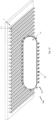
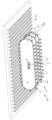
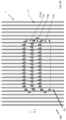
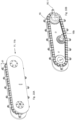
- Fig. 1A shows a ceiling vehicle 10 exhibiting a drive unit 11 and suspension elements 13, wherein a subset of the suspension elements 13 is momentarily coupled to a/the ceiling structure 1, namely to T-profiles.
- the suspension elements 13 are guided (and optionally also actively driven) along two circumferential tracks (not shown, cf. Fig. 1C ), and decoupling is carried out in curved sections of the tracks.
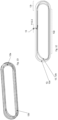
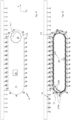
- Fig. 1B, 1C , 1D, 1E show separate components of the respective drive unit 11, 11a, 11b, 11c.
- At least one drive 17 (which is optional, i.e., which can be provided if active driving motion to the suspension elements is desired) provides for circumferential motion of the tracks 12a, 12b, especially by means of at least one gear unit 18 engaging the tracks.
- the de-/coupling kinematics are provided within the curved sections 12r of the first and second circumferential tracks 12a, 12b.
- the suspension elements 13 remain in predefined relative positions at/with respect to the ceiling structure. In that section, the axis Y13.3 of the wheel 13.3 of the respective suspension element 13 is aligned parallel to the parallel section(s) 12p of the tracks.
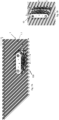
- Fig. 1F, 1G illustrate the curved sections 12r in more detail; it can be seen that both the radius of curvature and the distance of the tracks with respect to each other deviates/changes in value and direction, thereby effecting a pivot motion of the suspension arm 13.6 (protruding section) and the wheel 13.3 resp. bearing point P13 of the respective suspension element 13 (especially pivoting within the plane yz as shown in Fig. 1F and pivoting about an x-axis and around the instantaneous centre of rotation Cr).
- both vertical motion kinematics 20a and non-circular pivot motion kinematics 20b can be provided by means of rigid/stiff components being guided/driven along two circumferential tracks with different shape/contour.
- Fig. 1H, 1J, 1K, 1L, 1M, 1N, 1O show some more details of the de-/coupling kinematics 20.
- the first track 12a has a curvature bent up (upwards), thereby effecting a slight lifting of the wheel 13.3 from the wheel tread 1.2, namely when the first pulley 13.1 is passing that section.
- the shape/contour XZb of the second circumferential track 12b runs (is arranged) within the shape/contour XZa of the first circumferential track 12a.
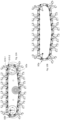
- Fig. 2A, 2B, 2C show a plurality of suspension elements 13 being interconnected via longitudinal connecting elements 15 which thereby ensure a closed loop 15a of interrelated suspension elements.
- the suspension elements 13 are coupled to the respective circumferential tracks 12a, 12b via the first and second pulleys 13.1, 13.2.
- the first and second pulleys 13.1, 13.2 are arranged on opposite lateral sides of the respective suspension element 13.
- the closed loop 15a of interrelated suspension elements is arranged between the first and second tracks 12a, 12b which extend on both lateral sides of the closed loop 15a.
- the tracks 12a, 12b can be made of any kind of rail guide system components, in particular including at least one chain, belt, cable or the like traction or transmission means.
- the tracks 12a, 12b may comprise different guide/rail sections coupled together, each exhibiting a different radius of curvature or being linear.
- the tracks 12a, 12b can be formed/made by on single continuous/coherent rail.
- Fig. 3A, 3B, 3C show some more details of the suspension elements 13 and the connecting elements 15.
- the connecting elements 15 are coupled to the lever arm 13.5 at the axis X13.1 if the first pulley 13.1, thereby facilitating pivot motion about that axis (resp. around the respective instantaneous centre of rotation Cr).
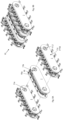
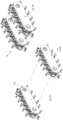
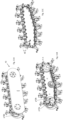
- Fig. 4A , 4B, 4C, 4D , 4E, 4F , 4G show an embodiment of a vehicle 10 exhibiting three drive units 11a, 11b, 11c which can be interrelated/connected e.g. via cross-beams or the like.
- the suspension elements 13b of the second drive unit 11b are arranged in mirror-inverted manner, but the suspension elements 13 of the third drive unit 11c are arranged in the same manner as the suspension elements 13 of the first drive unit 11a.
- the suspension elements 13b of the second drive unit 11b are arranged in mirror-inverted manner, but the suspension elements 13 of the third drive unit 11c are arranged in the same manner as the suspension elements 13 of the first drive unit 11a.
- the vehicle 10 may only comprise two drive units 11a, 11b.
- Fig. 5A, 5B, 5C, 5D show different kinds of traveling motions which can be effected by means of the vehicle 10 described herein.
- the present invention allows for two-dimensional traveling motion both in a first spatial direction (x) corresponding to the longitudinal direction/extension of the T-profiles 1.1 (dashed line arrow), and in a second spatial direction (y) corresponding to the driving direction resp. to the direction/extension of the tracks (dotted line arrow).
- T-profiles shown in the figures may also be provided as other kinds of profile rails; i.e., the inventive mechanism/kinematics is/are not limited to use of T-profiles only; rather, the skilled person is aware of the fact that also other profiles offering adequate suspension for the suspension elements and optionally also a guiding track to the wheels can be used.
- first drive unit comprising a chain drive
- first circumferential track comprises a chain (with a closed loop of interrelated chain elements arranging the corresponding suspension elements and optionally also arranging counter bearing elements), and the longitudinal connecting elements of that first drive unit are provided in the form of chain elements.
- Figure 6A shows a vehicle exhibiting means for avoiding any relative motion of the vehicle with respect to the structure (full suspension especially also in view of any relative motion orthogonally/normally with respect to the structure), and Figure 6B shows a configuration which at least ensures secure the suspension in view of vertical forces of inertia and lateral forces (suspension devoid of counter bearings).
- Figures 7A, 7B , 7C, 7D illustrate a ceiling vehicle arrangement 100 comprising a ceiling vehicle 10 exhibiting three drive units 11a, 11b, 11c.
- the present invention allows for two-dimensional traveling motion both in a first spatial direction corresponding to the longitudinal direction/extension of the T-profiles 1.1 (dashed line arrow), and in a second spatial direction corresponding to the driving direction resp. to the direction/extension of the tracks (dotted line arrow).
- the first and/or second spatial direction may also comprise a vertical (z-)component, as illustrated in Fig. 7C, 7D (inclined plane / level).
- coordinates x, y shown in the figures in context with inclined planes refer to the longitudinal extension (x) of the (ceiling) structure.
- Figures 8A, 8B show some more details of a ceiling vehicle 10 exhibiting three drive units 11a, 11b, 11c drive units arranged laterally with respect to each other, wherein the drive unit 11b arranged there between (in the middle) does not exhibit any suspension elements but counter bearings 16, and Figures 9A, 9B show some more details of a ceiling vehicle 10 exhibiting two drive units 11a, 11c (each without counter bearing).
- the second drive unit 11b provides for counter bearings 16 which are coupled to the chain 15a, i.e., the first circumferential track provides for positioning and motion of the counter bearings 16.
- theses counter bearings 16 are intended for interfering with the structure only at a face side, and therefore, no de-/coupling kinematics are provided in context with these counter bearings 16. Therefore, there is no need for provision of any further second circumferential track at/for the second drive unit 11b arranged in the middle.
- the second drive unit 11b arranged in the middle and accommodating (only) the counter bearings only exhibits a/the first circumferential track.
- FIGS. 10A, 10B show some details of a drive unit 11, 11b only accommodating counter bearings but no suspension elements.
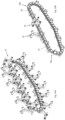
- FIG. 11A, 11B, 11C and Figures 12A, 12B and Figure 13 and Figures 14A , 14B show some kinematic aspects of drive units accommodating/arranging/guiding both suspension elements 13 and further suspension elements 13b.
- Fig. 13 also illustrates that one (each) drive unit 11 may comprise the first circumferential track (here: provided/defined by the chain 15a) and two second circumferential tracks 12b, wherein these two second circumferential tracks 12b are arranged asymmetrically, i.e., the shape/contour XZb is asymmetrical.
- Such an arrangement also allows for providing de-/coupling kinematics for both a plurality of suspension elements 13 and a plurality of further suspension elements 13b, especially in such a manner that both types of suspension elements 13, 13b may interact and engage in the same (but asymmetrical) manner with the structure 1, especially at the same profile rail at opposite lateral sides, respectively.
- Such an arrangement may also ensure a high security and stability level already by means of one single drive unit 11.
- scaling (two, three or even more) of the drive units is realizable in even more flexible manner, and individual arrangements can be optimized for each application.
- the first circumferential track resp. a/the chain may/can provide for guiding and driving both the suspension elements 13 and the further suspension elements 13b; both types of suspension elements 13, 13b can be coupled, e.g., via a protruding axial section (guiding bolt or shaft) 13.7 to the chain structure (cf. Fig. 16B ) which protrudes vis-à-vis of the first pulley 13.1, especially along its axis X13.1.
- the suspension elements 13 and the further suspension elements 13b are arranged with longitudinal offset (y) and mirror-inverted on both sides of the chain 15a.
- the longitudinal distance (y) of the respective suspension element 13 and the respective further suspension element 13b of a respective pair of suspension elements 13, 13b corresponds to the extension in cross direction (y) of each element/profile of the (ceiling) structure.
- Figure 15 also shows a guiding plank or rail 14 allowing for guiding the first circumferential track resp. the chain more precisely.
- Figures 16A, 16B show a further embodiment of suspension elements 13, wherein in comparison with the suspension elements described above in context with Fig. 3 , these suspension elements exhibit two wheels or pulleys 13.3 arranged and configured for interacting with the structure 1, and these suspension elements may also exhibit a further pulley which is suspended around an axis extending in the z-direction (as shown in Fig. 16B ). That optional further pulley may ensure further/improved support and guiding with respect to the structure.
- a contact point distance ⁇ d provided by different protruding distances d1, d2 of the suspension element's contact point P13 and of the counter bearing's contact point (free end, especially wheel/pulley) is illustrated by referring to the relative arrangement at the (ceiling) structure, respectively.
Landscapes
- Engineering & Computer Science (AREA)
- Chemical & Material Sciences (AREA)
- Combustion & Propulsion (AREA)
- Transportation (AREA)
- Mechanical Engineering (AREA)
- Carriers, Traveling Bodies, And Overhead Traveling Cranes (AREA)
Claims (15)
- Véhicule de plafond de type chenille (10) configuré pour se déplacer de manière suspendue, en particulier tête baissée, sur une structure de plafond (1), dans lequel le véhicule de plafond (10) présente les caractéristiques suivantes :- une pluralité d'éléments de suspension (13, 13b) configurés pour suspendre le véhicule de plafond (10) et configurés pour coupler le véhicule de plafond (10) à la structure de plafond (1),- au moins une unité d'entraînement (11, 11a, 11b, 11c) configurée pour un mouvement circonférentiel et accueillant une première piste circonférentielle (12a) et une deuxième piste circonférentielle (12b) ayant une forme/contour circonférentiel différent de la première piste circonférentielle, dans laquelle les éléments de suspension (13, 13b) sont fixés à la première voie circonférentielle (12a) à des premières positions longitudinales prédéfinies correspondant à une trame prédéfinie, le véhicule de plafond (10) étant configuré pour se déplacer le long de la structure de plafond (1) en découplant un sous-ensemble de la pluralité d'éléments de suspension (13, 13b), resp. en les couplant à la structure de plafond (1). en les accouplant à la structure du plafond (1) lorsque les éléments de suspension (13, 13b) sont guidés le long des deux pistes circonférentielles (12, 12a, 12b) par le mouvement circonférentiel.
- Véhicule de plafond de type chenille (10) selon la revendication 1, dans lequel le véhicule de plafond (10) est configuré pour se déplacer le long de la structure de plafond (1) en découplant un sous-ensemble de la pluralité d'éléments de suspension (13, 13b) de resp. en les couplant à la structure de plafond (1) lorsque les éléments de suspension (13, 13b) sont guidés le long d'une section courbe d'au moins une des pistes circonférentielles (12, 12a, 12b) par le mouvement d'entraînement circonférentiel.
- (10) selon l'une quelconque des revendications précédentes, dans lequel les première et deuxième voies circonférentielles (12, 12a, 12b) permettent une cinématique de désaccouplement basée sur des formes/contours circonférentiels différents, au moins dans les sections incurvées de la ou des voies, dans lequel les éléments de suspension (13, 13b) sont guidés dans/par la deuxième voie circonférentielle (12b) à des deuxièmes positions longitudinales respectives décalées longitudinalement par rapport aux premières positions longitudinales respectives, où la cinématique de découplage prévoit à la fois un premier mouvement et un deuxième mouvement faisant pivoter chaque élément de suspension lorsqu'il est guidé le long d'une section incurvée des voies circonférentielles (12, 12a, 12b) par le mouvement d'entraînement circonférentiel ; et/ou dans laquelle la cinématique de désaccouplement prévoit une trajectoire de mouvement en forme de S d'un point d'appui à une extrémité libre de l'élément de suspension respectif, au moins dans une section le long de la trajectoire de mouvement ; et/ou dans laquelle la cinématique de désaccouplement comprend à la fois une cinématique de mouvement vertical et une cinématique de mouvement de pivot non circulaire pour un point d'appui à une extrémité libre de l'élément de suspension respectif ; et/ou dans laquelle les première et deuxième voies circonférentielles (12, 12a, 12b) sont façonnées de telle sorte que les éléments de suspension (13, 13b) ne sont désaccouplés de/à l'intérieur de la structure du plafond (1) que lorsqu'ils passent une section incurvée d'au moins une des voies.
- (10) selon l'une quelconque des revendications précédentes, dans lequel la première position longitudinale relative momentanée de l'élément de suspension respectif au niveau de la première voie définit le centre de rotation instantané de cet élément de suspension, et la deuxième position longitudinale relative correspondante au niveau de la deuxième voie définit la quantité de rotation momentanée de cet élément de suspension ; et/ou dans laquelle les pistes sont façonnées de telle sorte que la coordonnée verticale momentanée ainsi que la coordonnée momentanée de la seconde direction spatiale de l'élément de suspension respectif sont définies et ajustées par le contour des pistes ; et/ou dans laquelle les pistes ont une forme/contour qui s'écarte de la forme standard d'un hippodrome d'une piste à chenilles au moins dans une section courbe des pistes, la forme de la première piste s'écartant de préférence au moins dans la direction verticale, la forme de la seconde piste s'écartant de préférence à la fois dans la direction verticale et dans ladite seconde direction ; et/ou dans laquelle le rayon de courbure de la première voie est constant, au moins approximativement ; et/ou dans lequel, dans au moins une position longitudinale le long de la (des) piste(s), le rayon de courbure de la seconde piste est plus grand que le rayon de courbure de la première piste, et dans au moins une autre position longitudinale le long de la (des) piste(s), le rayon de courbure de la seconde piste est plus petit que le rayon de courbure de la première piste, dans lequel le rayon de courbure des pistes diffère/change de préférence de manière régulière/continue en fonction de la position longitudinale momentanée le long de la (des) piste(s) ; et/ou dans lequel le contour de la première voie assure un premier mouvement du point de contact/de roulement de l'élément de suspension respectif, et le contour et la distance changeante de la deuxième voie par rapport à la première voie assurent un mouvement de pivotement du point de contact/de roulement de l'élément de suspension respectif lorsqu'il est guidé le long d'une section courbe des voies circonférentielles (12, 12a, 12b).
- Véhicule de plafond de type chenille (10) selon l'une quelconque des revendications précédentes, dans lequel la forme/contour des chenilles permet à la fois le levage et l'abaissement des éléments de suspension (13, 13b) en fonction de la position longitudinale le long des chenilles, en particulier d'abord le levage et ensuite l'abaissement dans le contexte du découplage, et vice versa dans le contexte du couplage ; et/ou dans lequel la distance radiale relative des voies est constante le long d'une section linéaire des voies, et la distance radiale relative des voies diffère/change le long d'une section courbe des voies en fonction de la position longitudinale momentanée le long de la (des) voie(s), en particulier de manière régulière/continue.
- (10) selon l'une des revendications précédentes, dans lequel le véhicule plafonnier (10) présente une autre unité d'entraînement (11c) accueillant une autre voie circonférentielle et configurée pour un mouvement d'entraînement circonférentiel synchrone ; et/ou dans lequel le véhicule de plafond (10) présente une autre unité d'entraînement (11c) accueillant une autre voie circonférentielle, dans lequel plusieurs autres éléments de suspension (13b) configurés pour suspendre le véhicule de plafond (10) et configurés pour coupler le véhicule de plafond (10) à la structure de plafond (1) sont fixés à l'autre voie circonférentielle dans d'autres positions longitudinales prédéfinies correspondant à une trame définie par la structure de plafond (1) ; et/ou dans lequel les éléments de suspension (13) et les autres éléments de suspension (13b) fixent/bloquent le véhicule de plafond (10) à la structure de plafond (1) par rapport à la direction de conduite et à l'opposé de celle-ci.
- Véhicule de plafond de type chenille (10) selon l'une quelconque des revendications précédentes, dans lequel le véhicule plafonnier (10) comporte au moins une unité de levage (50), ou le véhicule plafonnier (10) comporte au moins deux ou trois unités de levage.
- Agencement de véhicule de plafond de type chenille (100) comprenant au moins un Véhicule de plafond de type chenille (10) selon l'une quelconque des revendications précédentes et a/la structure de plafond (1) présentant une pluralité de profils définissant une trame de la structure de plafond (1), dans lequel les éléments de suspension (13, 13b) sont configurés pour être guidés le long des profils dans ladite première direction spatiale, le mouvement de déplacement du véhicule de plafond ayant au moins deux degrés de liberté ; et/ou dans lequel la structure de plafond (1) présente une pluralité de profils définissant la trame de la structure de plafond (1), dans lequel le véhicule de plafond (10) présente une pluralité d'autres éléments de suspension (13b) suspendant le véhicule de plafond (10) avec les éléments de suspension (13), dans lequel les éléments de suspension (13) et les autres éléments de suspension (13b) fixent/bloquent le véhicule de plafond (10) à la structure de plafond (1) par rapport à la direction d'entraînement.
- Agencement de véhicule de plafond de type chenille (100) selon la revendication précédente, dans lequel les profilés présentent respectivement au moins un rail d'alimentation, le véhicule plafonnier (10) étant configuré pour entraîner au moins une unité motrice (11, 11a, 11b, 11c) au moyen de l'énergie fournie par les rails d'alimentation, en particulier par les collecteurs de courant prévus dans les éléments de suspension (13, 13b).
- l' agencement de véhicules de plafond de type chenille (100) selon la revendication 8 ou 9, dans lequel la structure de plafond (1) est modulaire et extensible, en particulier sur la base des dalles qui sont équipées de profils de la structure de plafond (1).
- l ' agencement de véhicule de plafond de type chenille (100) selon l'une des revendications 8 à 10, dans lequel l'agencement de véhicules plafonniers de type chenille s'étend sur au moins deux niveaux d'altitude différents et présente au moins un ascenseur reliant lesdits niveaux d'altitude, dans lequel l'ascenseur présente une structure de plafond d'ascenseur (1) correspondant géométriquement à/avec la structure de plafond (1) disposée sur les au moins deux niveaux d'altitude différents.
- Méthode d'accrochage/suspension d'un véhicule de plafond de type chenille (10) à/depuis une structure de plafond (1) pour se déplacer de manière suspendue le long de la structure de plafond (1), en particulier un véhicule plafonnier à chenilles (10) selon l'une des revendications 1 à 7, dans lequel le véhicule plafonnier (10) est suspendu au moyen d'une pluralité d'éléments de suspension (13, 13b) reliant le véhicule plafonnier (10) à la structure de plafond (1), dans lequel un mouvement de guidage/entraînement circonférentiel est fourni par au moins une unité d'entraînement (11, 11a, 11b, 11c) comprenant une première et une deuxième voies circonférentielles (12a, 12b) ayant une forme/contour circonférentiel différent, dans laquelle les éléments de suspension (13, 13b) sont fixés à la première voie circonférentielle à des premières positions longitudinales prédéfinies correspondant à une trame définie par la structure de plafond (1), dans laquelle le véhicule de plafond (10) est suspendu de manière à pouvoir se déplacer le long de la structure de plafond (1) en découplant un sous-ensemble de la pluralité d'éléments de suspension (13, 13b) de respectivement, les coupler à la structure de plafond (1). en les accouplant à la structure du plafond (1) lorsque les éléments de suspension (13, 13b) sont guidés le long des pistes circonférentielles par le mouvement circonférentiel.
- Méthode selon la revendication précédente, dans laquelle le mouvement circonférentiel est transmis/transféré par les éléments de suspension (13, 13b) qui s'engagent momentanément dans la structure du plafond (1) ; et/ou dans lequel le mouvement circonférentiel est assuré par les première et deuxième unités d'entraînement (11a, 11b), la première unité d'entraînement (11a) assurant le mouvement circonférentiel d'un premier sous-ensemble d'éléments de suspension (13, 13b) sur une première trajectoire en boucle fermée et la deuxième unité d'entraînement (11b) assurant le mouvement circonférentiel d'un deuxième sous-ensemble d'éléments de suspension (13, 13b) sur une deuxième trajectoire en boucle fermée ; et/ou dans lequel au moins une charge/cargaison est transportée par au moins un palan installé sur le véhicule.
- Programme d'ordinateur comprenant des instructions qui, lorsque le programme est exécuté par un ordinateur, amènent l'ordinateur à exécuter les étapes du procédé selon au moins l'une des revendications de procédé 12 ou 13 dans le cadre de la fourniture et du contrôle du mouvement de guidage/entraînement circonférentiel, notamment en contrôlant au moins une unité d'entraînement (11, 11a, 11b, 11c).
- Utilisation d'au moins une unité d'entraînement de type chenille (11, 11a, 11b, 11c) accueillant une première et une deuxième chenilles circonférentielles (12a, 12b) ayant des formes/contours circonférentiels différents, pour suspendre/suspendre et éventuellement aussi conduire activement un véhicule de plafond de type chenille (10) afin de se déplacer de manière suspendue, en particulier tête baissée, vers une structure de plafond (1), en particulier pour suspendre/suspendre un véhicule de plafond de type chenille (10) selon l'une des revendications 1 à 7, en particulier dans un procédé selon l'une des revendications 12 à 13, dans lequel le véhicule de plafond (10) est suspendu au moyen d'une pluralité d'éléments de suspension (13, 13b) reliant le véhicule de plafond (10) à la structure de plafond (1), dans lequel les éléments de suspension (13, 13b) sont fixés au premier rail circonférentiel à des premières positions longitudinales prédéfinies correspondant à une trame définie par la structure de plafond (1), dans lequel un mouvement de guidage/conduite circonférentiel est fourni par au moins une unité d'entraînement (11, 11a, 11b, 11c) de sorte que le véhicule se déplace le long de la structure du plafond (1) en découplant un sous-ensemble de la pluralité d'éléments de suspension (13, 13b) de resp. en les accouplant à la structure du plafond (1) lorsque les éléments de suspension (13, 13b) sont guidés/entraînés le long des pistes circonférentielles.
Priority Applications (29)
| Application Number | Priority Date | Filing Date | Title |
|---|---|---|---|
| PL22165205.0T PL4253204T3 (pl) | 2022-03-29 | 2022-03-29 | Pojazd sufitowy typu gąsienicowego przystosowany do poruszania się wzdłuż konstrukcji, sposób zapewniania przejazdowego ruchu gąsienicowego wzdłuż konstrukcji oraz zastosowanie co najmniej jednej jednostki napędowej typu gąsienicowego w celu zapewnienia kinematyki odłączania/sprzęgania dla ruchu przejazdowego |
| EP22165205.0A EP4253204B1 (fr) | 2022-03-29 | 2022-03-29 | Véhicule plafonnier de type chenille conçu pour se déplacer le long d'une structure; procédé permettant de fournir un mouvement de déplacement de type chenille le long de la structure; et utilisation d'au moins une unité d'entrainement de type chenille pour fournir une cinématique de déplacement/accouplement pour le mouvement de déplacement |
| ES22165205T ES3014133T3 (en) | 2022-03-29 | 2022-03-29 | Crawler type ceiling vehicle configured for traveling along a structure, method of providing a crawler-like traveling motion along the structure, and use of at least one crawler type drive unit for providing de-/coupling kinematics for the traveling motion |
| ES22193445T ES3028813T3 (en) | 2022-03-29 | 2022-09-01 | Crawler type vehicle configured for traveling along a structure, method of hanging/suspending the vehicle for carrying out crawler-like traveling motion along the structure, and use of at least one crawler type drive unit for active traveling motion |
| PL22193445.8T PL4253202T3 (pl) | 2022-03-29 | 2022-09-01 | Pojazd gąsienicowy przystosowany do poruszania się wzdłuż konstrukcji, sposób podwieszania/zawieszania pojazdu w celu wykonywania ruchu gąsienicowego wzdłuż konstrukcji oraz zastosowanie co najmniej jednej jednostki napędowej typu gąsienicowego do aktywnego ruchu |
| EP22193445.8A EP4253202B1 (fr) | 2022-03-29 | 2022-09-01 | Véhicule de type chenille configuré pour se déplacer le long d'une structure, procédé d'accrochage/suspension du véhicule pour effectuer un mouvement de déplacement de type chenille le long de la structure, et utilisation d'au moins une unité d'entraînement de type chenille pour un mouvement de déplacement actif |
| PCT/EP2023/058057 WO2023186936A1 (fr) | 2022-03-29 | 2023-03-28 | Agencement de suspension de plafond présentant au moins une unité de plafond de type à chenilles ainsi que procédé de suspension de l'unité de plafond au niveau d'une structure de plafond |
| US18/853,019 US20250242875A1 (en) | 2022-03-29 | 2023-03-28 | Crawler type vehicle configured for traveling along a structure, method of hanging/suspending the vehicle for carrying out a crawler-like traveling motion along the structure, and use of at least one crawler type drive unit for active traveling motion |
| JP2024558106A JP2025512900A (ja) | 2022-03-29 | 2023-03-28 | 構造に沿って移動するように構成されるクローラータイプビークル、構造に沿ってクローラーのような移動運動を実行するためにビークルを懸架/懸垂保持する方法、および能動的移動運動のための少なくとも1つのクローラータイプドライブユニットの使用 |
| KR1020247035556A KR20240168394A (ko) | 2022-03-29 | 2023-03-28 | 구조물을 따라 주행하도록 구성된 크롤러형 차량, 구조물을 따라 크롤러형 주행 운동을 수행하기 위해 차량을 매달거나 현가하는 방법, 및 능동 주행 운동을 위한 적어도 하나의 크롤러형 구동 유닛의 사용 방법 |
| JP2024557917A JP2025511124A (ja) | 2022-03-29 | 2023-03-28 | 構造に沿って移動するように構成されるクローラータイプ天井ビークル、構造に沿ってクローラーのような移動運動を提供する方法、および移動運動のために分離/結合キネマティックスを提供するための少なくとも1つのクローラータイプドライブユニットの使用 |
| JP2024558107A JP2025512901A (ja) | 2022-03-29 | 2023-03-28 | 構造に沿って移動するために構成されるクローラータイプビークル、構造に沿ってクローラー様移動運動を実行するためにビークルを懸架/懸垂保持する方法、および能動的移動運動のための少なくとも1つのクローラータイプドライブユニットの使用法 |
| US18/853,085 US20250222995A1 (en) | 2022-03-29 | 2023-03-28 | Crawler type ceiling vehicle configured for traveling along a structure, method of providing a crawler-like traveling motion along the structure, and use of at least one crawler type drive unit for providing de-/coupling kinematics for the traveling motion |
| KR1020247035559A KR20240168395A (ko) | 2022-03-29 | 2023-03-28 | 구조물을 따라 주행하도록 구성된 크롤러형 천장 차량, 구조물을 따라 크롤러형 주행 운동을 제공하는 방법, 및 주행 운동을 위해 분리 결합 운동학을 제공하기 위한 적어도 하나의 크롤러형 구동 유닛의 사용 방법 |
| PCT/EP2023/058054 WO2023186933A1 (fr) | 2022-03-29 | 2023-03-28 | Véhicule de plafond de type chenille configuré pour se déplacer le long d'une structure, procédé de fourniture d'un mouvement de déplacement de type chenille le long de la structure et utilisation d'au moins une unité d'entraînement de type chenille pour fournir une cinématique de découplage pour le mouvement de déplacement |
| PCT/EP2023/058059 WO2023186937A1 (fr) | 2022-03-29 | 2023-03-28 | Véhicule de type à chenilles configuré pour se déplacer le long d'une structure, procédé de suspension du véhicule pour réaliser un mouvement de déplacement de type à chenilles le long de la structure, et utilisation d'au moins une unité d'entraînement de type à chenilles pour un mouvement de déplacement actif |
| AU2023244472A AU2023244472A1 (en) | 2022-03-29 | 2023-03-28 | Ceiling suspension arrangement exhibiting at least one crawler type ceiling unit as well as method of suspending the ceiling unit at a ceiling structure |
| PCT/EP2023/058060 WO2023186938A1 (fr) | 2022-03-29 | 2023-03-28 | Véhicule de type à chenilles configuré pour se déplacer le long d'une structure, procédé d'accrochage / de suspension du véhicule pour effectuer un mouvement de déplacement de type à chenilles le long de la structure, et utilisation d'au moins une unité d'entraînement de type à chenilles pour un mouvement de déplacement actif |
| CN202380032021.9A CN119053507A (zh) | 2022-03-29 | 2023-03-28 | 具有至少一个履带式吊顶单元的吊顶悬挂装置以及将吊顶单元悬挂在吊顶结构处的方法 |
| CA3245485A CA3245485A1 (fr) | 2022-03-29 | 2023-03-28 | Véhicule de type à chenilles configuré pour se déplacer le long d'une structure, procédé d'accrochage / de suspension du véhicule pour effectuer un mouvement de déplacement de type à chenilles le long de la structure, et utilisation d'au moins une unité d'entraînement de type à chenilles pour un mouvement de déplacement actif |
| KR1020247035767A KR20240167887A (ko) | 2022-03-29 | 2023-03-28 | 적어도 하나의 크롤러형 천장 유닛을 구비한 천장 서스펜션 장치 및 천장 구조물에 천장 유닛을 현수하는 방법 |
| CA3245481A CA3245481A1 (fr) | 2022-03-29 | 2023-03-28 | Agencement de suspension de plafond présentant au moins une unité de plafond de type à chenilles ainsi que procédé de suspension de l'unité de plafond au niveau d'une structure de plafond |
| JP2024558108A JP2025511228A (ja) | 2022-03-29 | 2023-03-28 | 少なくとも1つのクローラータイプ天井ユニットを示す天井懸垂保持配置構成ならびに天井構造において天井ユニットを懸垂保持する方法 |
| CA3245475A CA3245475A1 (fr) | 2022-03-29 | 2023-03-28 | Véhicule de plafond de type chenille configuré pour se déplacer le long d'une structure, procédé de fourniture d'un mouvement de déplacement de type chenille le long de la structure et utilisation d'au moins une unité d'entraînement de type chenille pour fournir une cinématique de découplage pour le mouvement de déplacement |
| KR1020247035770A KR20240168405A (ko) | 2022-03-29 | 2023-03-28 | 구조물을 따라 이동하도록 구성된 크롤러형 차량, 구조물을 따라 크롤러와 같은 이동 동작을 수행하기 위해 차량을 현수하는 방법, 및 능동 이동 동작을 위한 적어도 하나의 크롤러형 구동 유닛의 사용방법 |
| US18/853,060 US20250236348A1 (en) | 2022-03-29 | 2023-03-28 | Ceiling suspension arrangement exhibiting at least one crawler type ceiling unit as well as method of suspending the ceiling unit at a ceiling structure |
| CA3245453A CA3245453A1 (fr) | 2022-03-29 | 2023-03-28 | Véhicule de type à chenilles configuré pour se déplacer le long d'une structure, procédé de suspension du véhicule pour réaliser un mouvement de déplacement de type à chenilles le long de la structure, et utilisation d'au moins une unité d'entraînement de type à chenilles pour un mouvement de déplacement actif |
| US18/852,871 US20250229853A1 (en) | 2022-03-29 | 2023-03-28 | Crawler type vehicle configured for traveling along a structure, method of hanging/suspending the vehicle for carrying out crawler-like traveling motion along the structure, and use of at least one crawler type drive unit for active traveling motion |
| MX2024011816A MX2024011816A (es) | 2022-03-29 | 2024-09-26 | Disposicion de suspension de techo que presenta al menos una unidad de techo de tipo oruga, asi como metodo de suspension de la unidad de techo en una estructura de techo |
Applications Claiming Priority (1)
| Application Number | Priority Date | Filing Date | Title |
|---|---|---|---|
| EP22165205.0A EP4253204B1 (fr) | 2022-03-29 | 2022-03-29 | Véhicule plafonnier de type chenille conçu pour se déplacer le long d'une structure; procédé permettant de fournir un mouvement de déplacement de type chenille le long de la structure; et utilisation d'au moins une unité d'entrainement de type chenille pour fournir une cinématique de déplacement/accouplement pour le mouvement de déplacement |
Publications (3)
| Publication Number | Publication Date |
|---|---|
| EP4253204A1 EP4253204A1 (fr) | 2023-10-04 |
| EP4253204B1 true EP4253204B1 (fr) | 2024-11-27 |
| EP4253204C0 EP4253204C0 (fr) | 2024-11-27 |
Family
ID=80999827
Family Applications (1)
| Application Number | Title | Priority Date | Filing Date |
|---|---|---|---|
| EP22165205.0A Active EP4253204B1 (fr) | 2022-03-29 | 2022-03-29 | Véhicule plafonnier de type chenille conçu pour se déplacer le long d'une structure; procédé permettant de fournir un mouvement de déplacement de type chenille le long de la structure; et utilisation d'au moins une unité d'entrainement de type chenille pour fournir une cinématique de déplacement/accouplement pour le mouvement de déplacement |
Country Status (3)
| Country | Link |
|---|---|
| EP (1) | EP4253204B1 (fr) |
| ES (1) | ES3014133T3 (fr) |
| PL (1) | PL4253204T3 (fr) |
Family Cites Families (4)
| Publication number | Priority date | Publication date | Assignee | Title |
|---|---|---|---|---|
| JPS59227570A (ja) * | 1983-06-06 | 1984-12-20 | M T Hikawa:Kk | 吸盤付無限軌道帯 |
| US10220896B2 (en) * | 2016-08-22 | 2019-03-05 | Eliot Kazakov | Multi-terrain wall climbing vehicle |
| CN110228541B (zh) * | 2019-05-08 | 2021-01-15 | 西安理工大学 | 一种爪刺对抓式履带爬壁机器人 |
| DE202020100256U1 (de) * | 2020-01-17 | 2020-05-20 | MagneCat UG (haftungsbeschränkt) | Linearmotorisch angetriebenes Raupenfahrzeug |
-
2022
- 2022-03-29 EP EP22165205.0A patent/EP4253204B1/fr active Active
- 2022-03-29 PL PL22165205.0T patent/PL4253204T3/pl unknown
- 2022-03-29 ES ES22165205T patent/ES3014133T3/es active Active
Also Published As
| Publication number | Publication date |
|---|---|
| ES3014133T3 (en) | 2025-04-16 |
| EP4253204C0 (fr) | 2024-11-27 |
| EP4253204A1 (fr) | 2023-10-04 |
| PL4253204T3 (pl) | 2025-04-28 |
Similar Documents
| Publication | Publication Date | Title |
|---|---|---|
| KR20140057209A (ko) | 트랙없는 다크 라이드 탑승장치, 시스템 및 방법 | |
| US20250222995A1 (en) | Crawler type ceiling vehicle configured for traveling along a structure, method of providing a crawler-like traveling motion along the structure, and use of at least one crawler type drive unit for providing de-/coupling kinematics for the traveling motion | |
| EP4253204B1 (fr) | Véhicule plafonnier de type chenille conçu pour se déplacer le long d'une structure; procédé permettant de fournir un mouvement de déplacement de type chenille le long de la structure; et utilisation d'au moins une unité d'entrainement de type chenille pour fournir une cinématique de déplacement/accouplement pour le mouvement de déplacement | |
| EP4253203B1 (fr) | Véhicule de type de chenilles concu pour se déplacer le long d'une structure; procédé de suspension du véhicule permettant de mettre en oéuvre un mouvement de déplacement de véhicule de type é chenilles le long de la structure et utilisation d'au moins une unité d'entrainement de type de chenilles pour mouvement de déplacement actif | |
| EP4253202B1 (fr) | Véhicule de type chenille configuré pour se déplacer le long d'une structure, procédé d'accrochage/suspension du véhicule pour effectuer un mouvement de déplacement de type chenille le long de la structure, et utilisation d'au moins une unité d'entraînement de type chenille pour un mouvement de déplacement actif | |
| CN118973897A (zh) | 构造为用于沿结构行进的履带式天花板车辆、提供沿结构的履带式行进运动的方法、以及用于提供用于行进运动的分离/联接运动学结构的至少一个履带式驱动单元的用途 | |
| EP4530166A1 (fr) | Agencement de suspension de plafond avec véhicules à chenilles et structure modulaire et procédé de construction de la structure | |
| EP4273030B1 (fr) | Agencement de suspension de plafond présentant au moins une unité de plafond de type chenille ainsi que procédé de suspension de l'unité de plafond à une structure de plafond | |
| EP4530165A1 (fr) | Véhicule à chenilles suspendu dans une structure et électriquement relié à celle-ci | |
| JP2025511124A5 (fr) | ||
| EP4530242A1 (fr) | Système d'ascenseur pour déplacer des personnes entre des étages, procédé d'utilisation d'un système d'ascenseur et procédé mis en uvre par ordinateur pour le planning d'itinéraire pour un système d'ascenseur | |
| CN215210255U (zh) | 一种运输车 | |
| CN121986048A (en) | Crawler-type carrier suspended in and electrically connected to structure | |
| WO2025068476A1 (fr) | Agencement de suspension à véhicules à déplacement omnidirectionnel et procédé utilisant des véhicules à déplacement omnidirectionnel |
Legal Events
| Date | Code | Title | Description |
|---|---|---|---|
| PUAI | Public reference made under article 153(3) epc to a published international application that has entered the european phase |
Free format text: ORIGINAL CODE: 0009012 |
|
| STAA | Information on the status of an ep patent application or granted ep patent |
Free format text: STATUS: THE APPLICATION HAS BEEN PUBLISHED |
|
| AK | Designated contracting states |
Kind code of ref document: A1 Designated state(s): AL AT BE BG CH CY CZ DE DK EE ES FI FR GB GR HR HU IE IS IT LI LT LU LV MC MK MT NL NO PL PT RO RS SE SI SK SM TR |
|
| STAA | Information on the status of an ep patent application or granted ep patent |
Free format text: STATUS: REQUEST FOR EXAMINATION WAS MADE |
|
| 17P | Request for examination filed |
Effective date: 20240328 |
|
| RBV | Designated contracting states (corrected) |
Designated state(s): AL AT BE BG CH CY CZ DE DK EE ES FI FR GB GR HR HU IE IS IT LI LT LU LV MC MK MT NL NO PL PT RO RS SE SI SK SM TR |
|
| GRAP | Despatch of communication of intention to grant a patent |
Free format text: ORIGINAL CODE: EPIDOSNIGR1 |
|
| STAA | Information on the status of an ep patent application or granted ep patent |
Free format text: STATUS: GRANT OF PATENT IS INTENDED |
|
| RIC1 | Information provided on ipc code assigned before grant |
Ipc: B62D 55/075 20060101AFI20240610BHEP |
|
| INTG | Intention to grant announced |
Effective date: 20240624 |
|
| RAP1 | Party data changed (applicant data changed or rights of an application transferred) |
Owner name: CEILIX AG |
|
| GRAS | Grant fee paid |
Free format text: ORIGINAL CODE: EPIDOSNIGR3 |
|
| GRAA | (expected) grant |
Free format text: ORIGINAL CODE: 0009210 |
|
| STAA | Information on the status of an ep patent application or granted ep patent |
Free format text: STATUS: THE PATENT HAS BEEN GRANTED |
|
| AK | Designated contracting states |
Kind code of ref document: B1 Designated state(s): AL AT BE BG CH CY CZ DE DK EE ES FI FR GB GR HR HU IE IS IT LI LT LU LV MC MK MT NL NO PL PT RO RS SE SI SK SM TR |
|
| REG | Reference to a national code |
Ref country code: GB Ref legal event code: FG4D |
|
| REG | Reference to a national code |
Ref country code: CH Ref legal event code: EP |
|
| REG | Reference to a national code |
Ref country code: DE Ref legal event code: R096 Ref document number: 602022008059 Country of ref document: DE |
|
| REG | Reference to a national code |
Ref country code: IE Ref legal event code: FG4D |
|
| U01 | Request for unitary effect filed |
Effective date: 20241220 |
|
| U07 | Unitary effect registered |
Designated state(s): AT BE BG DE DK EE FI FR IT LT LU LV MT NL PT RO SE SI Effective date: 20250113 |
|
| PG25 | Lapsed in a contracting state [announced via postgrant information from national office to epo] |
Ref country code: HR Free format text: LAPSE BECAUSE OF FAILURE TO SUBMIT A TRANSLATION OF THE DESCRIPTION OR TO PAY THE FEE WITHIN THE PRESCRIBED TIME-LIMIT Effective date: 20241127 Ref country code: IS Free format text: LAPSE BECAUSE OF FAILURE TO SUBMIT A TRANSLATION OF THE DESCRIPTION OR TO PAY THE FEE WITHIN THE PRESCRIBED TIME-LIMIT Effective date: 20250327 |
|
| REG | Reference to a national code |
Ref country code: ES Ref legal event code: FG2A Ref document number: 3014133 Country of ref document: ES Kind code of ref document: T3 Effective date: 20250416 |
|
| PG25 | Lapsed in a contracting state [announced via postgrant information from national office to epo] |
Ref country code: GR Free format text: LAPSE BECAUSE OF FAILURE TO SUBMIT A TRANSLATION OF THE DESCRIPTION OR TO PAY THE FEE WITHIN THE PRESCRIBED TIME-LIMIT Effective date: 20250228 |
|
| PG25 | Lapsed in a contracting state [announced via postgrant information from national office to epo] |
Ref country code: RS Free format text: LAPSE BECAUSE OF FAILURE TO SUBMIT A TRANSLATION OF THE DESCRIPTION OR TO PAY THE FEE WITHIN THE PRESCRIBED TIME-LIMIT Effective date: 20250227 |
|
| U20 | Renewal fee for the european patent with unitary effect paid |
Year of fee payment: 4 Effective date: 20250325 |
|
| PG25 | Lapsed in a contracting state [announced via postgrant information from national office to epo] |
Ref country code: SM Free format text: LAPSE BECAUSE OF FAILURE TO SUBMIT A TRANSLATION OF THE DESCRIPTION OR TO PAY THE FEE WITHIN THE PRESCRIBED TIME-LIMIT Effective date: 20241127 |
|
| PGFP | Annual fee paid to national office [announced via postgrant information from national office to epo] |
Ref country code: ES Payment date: 20250429 Year of fee payment: 4 |
|
| PGFP | Annual fee paid to national office [announced via postgrant information from national office to epo] |
Ref country code: CH Payment date: 20250401 Year of fee payment: 4 |
|
| PG25 | Lapsed in a contracting state [announced via postgrant information from national office to epo] |
Ref country code: SK Free format text: LAPSE BECAUSE OF FAILURE TO SUBMIT A TRANSLATION OF THE DESCRIPTION OR TO PAY THE FEE WITHIN THE PRESCRIBED TIME-LIMIT Effective date: 20241127 |
|
| PLBE | No opposition filed within time limit |
Free format text: ORIGINAL CODE: 0009261 |
|
| STAA | Information on the status of an ep patent application or granted ep patent |
Free format text: STATUS: NO OPPOSITION FILED WITHIN TIME LIMIT |
|
| REG | Reference to a national code |
Ref country code: CH Ref legal event code: L10 Free format text: ST27 STATUS EVENT CODE: U-0-0-L10-L00 (AS PROVIDED BY THE NATIONAL OFFICE) Effective date: 20251008 |
|
| PG25 | Lapsed in a contracting state [announced via postgrant information from national office to epo] |
Ref country code: MC Free format text: LAPSE BECAUSE OF FAILURE TO SUBMIT A TRANSLATION OF THE DESCRIPTION OR TO PAY THE FEE WITHIN THE PRESCRIBED TIME-LIMIT Effective date: 20241127 |
|
| 26N | No opposition filed |
Effective date: 20250828 |
|
| PG25 | Lapsed in a contracting state [announced via postgrant information from national office to epo] |
Ref country code: IE Free format text: LAPSE BECAUSE OF NON-PAYMENT OF DUE FEES Effective date: 20250329 |
|
| REG | Reference to a national code |
Ref country code: CH Ref legal event code: U11 Free format text: ST27 STATUS EVENT CODE: U-0-0-U10-U11 (AS PROVIDED BY THE NATIONAL OFFICE) Effective date: 20260401 |
|
| PGFP | Annual fee paid to national office [announced via postgrant information from national office to epo] |
Ref country code: GB Payment date: 20260324 Year of fee payment: 5 |
|
| PGFP | Annual fee paid to national office [announced via postgrant information from national office to epo] |
Ref country code: NO Payment date: 20260323 Year of fee payment: 5 |
|
| PGFP | Annual fee paid to national office [announced via postgrant information from national office to epo] |
Ref country code: TR Payment date: 20260325 Year of fee payment: 5 |
|
| PGFP | Annual fee paid to national office [announced via postgrant information from national office to epo] |
Ref country code: CZ Payment date: 20260324 Year of fee payment: 5 |
|
| PGFP | Annual fee paid to national office [announced via postgrant information from national office to epo] |
Ref country code: PL Payment date: 20260310 Year of fee payment: 5 |
|
| U20 | Renewal fee for the european patent with unitary effect paid |
Year of fee payment: 5 Effective date: 20260326 |