EP4258355A1 - Halbleitermodul und verfahren zu seiner herstellung - Google Patents
Halbleitermodul und verfahren zu seiner herstellung Download PDFInfo
- Publication number
- EP4258355A1 EP4258355A1 EP21900291.2A EP21900291A EP4258355A1 EP 4258355 A1 EP4258355 A1 EP 4258355A1 EP 21900291 A EP21900291 A EP 21900291A EP 4258355 A1 EP4258355 A1 EP 4258355A1
- Authority
- EP
- European Patent Office
- Prior art keywords
- semiconductor
- semiconductor module
- module according
- frame
- pixel region
- Prior art date
- Legal status (The legal status is an assumption and is not a legal conclusion. Google has not performed a legal analysis and makes no representation as to the accuracy of the status listed.)
- Withdrawn
Links
Images













Classifications
-
- H—ELECTRICITY
- H10—SEMICONDUCTOR DEVICES; ELECTRIC SOLID-STATE DEVICES NOT OTHERWISE PROVIDED FOR
- H10F—INORGANIC SEMICONDUCTOR DEVICES SENSITIVE TO INFRARED RADIATION, LIGHT, ELECTROMAGNETIC RADIATION OF SHORTER WAVELENGTH OR CORPUSCULAR RADIATION
- H10F39/00—Integrated devices, or assemblies of multiple devices, comprising at least one element covered by group H10F30/00, e.g. radiation detectors comprising photodiode arrays
- H10F39/80—Constructional details of image sensors
- H10F39/805—Coatings
- H10F39/8057—Optical shielding
-
- H—ELECTRICITY
- H04—ELECTRIC COMMUNICATION TECHNIQUE
- H04N—PICTORIAL COMMUNICATION, e.g. TELEVISION
- H04N25/00—Circuitry of solid-state image sensors [SSIS]; Control thereof
- H04N25/60—Noise processing, e.g. detecting, correcting, reducing or removing noise
- H04N25/62—Detection or reduction of noise due to excess charges produced by the exposure, e.g. smear, blooming, ghost image, crosstalk or leakage between pixels
-
- H—ELECTRICITY
- H10—SEMICONDUCTOR DEVICES; ELECTRIC SOLID-STATE DEVICES NOT OTHERWISE PROVIDED FOR
- H10F—INORGANIC SEMICONDUCTOR DEVICES SENSITIVE TO INFRARED RADIATION, LIGHT, ELECTROMAGNETIC RADIATION OF SHORTER WAVELENGTH OR CORPUSCULAR RADIATION
- H10F39/00—Integrated devices, or assemblies of multiple devices, comprising at least one element covered by group H10F30/00, e.g. radiation detectors comprising photodiode arrays
- H10F39/011—Manufacture or treatment of image sensors covered by group H10F39/12
- H10F39/026—Wafer-level processing
-
- H—ELECTRICITY
- H10—SEMICONDUCTOR DEVICES; ELECTRIC SOLID-STATE DEVICES NOT OTHERWISE PROVIDED FOR
- H10F—INORGANIC SEMICONDUCTOR DEVICES SENSITIVE TO INFRARED RADIATION, LIGHT, ELECTROMAGNETIC RADIATION OF SHORTER WAVELENGTH OR CORPUSCULAR RADIATION
- H10F39/00—Integrated devices, or assemblies of multiple devices, comprising at least one element covered by group H10F30/00, e.g. radiation detectors comprising photodiode arrays
- H10F39/80—Constructional details of image sensors
- H10F39/802—Geometry or disposition of elements in pixels, e.g. address-lines or gate electrodes
-
- H—ELECTRICITY
- H10—SEMICONDUCTOR DEVICES; ELECTRIC SOLID-STATE DEVICES NOT OTHERWISE PROVIDED FOR
- H10F—INORGANIC SEMICONDUCTOR DEVICES SENSITIVE TO INFRARED RADIATION, LIGHT, ELECTROMAGNETIC RADIATION OF SHORTER WAVELENGTH OR CORPUSCULAR RADIATION
- H10F39/00—Integrated devices, or assemblies of multiple devices, comprising at least one element covered by group H10F30/00, e.g. radiation detectors comprising photodiode arrays
- H10F39/80—Constructional details of image sensors
- H10F39/804—Containers or encapsulations
-
- H—ELECTRICITY
- H10—SEMICONDUCTOR DEVICES; ELECTRIC SOLID-STATE DEVICES NOT OTHERWISE PROVIDED FOR
- H10F—INORGANIC SEMICONDUCTOR DEVICES SENSITIVE TO INFRARED RADIATION, LIGHT, ELECTROMAGNETIC RADIATION OF SHORTER WAVELENGTH OR CORPUSCULAR RADIATION
- H10F39/00—Integrated devices, or assemblies of multiple devices, comprising at least one element covered by group H10F30/00, e.g. radiation detectors comprising photodiode arrays
- H10F39/80—Constructional details of image sensors
- H10F39/809—Constructional details of image sensors of hybrid image sensors
-
- H—ELECTRICITY
- H10—SEMICONDUCTOR DEVICES; ELECTRIC SOLID-STATE DEVICES NOT OTHERWISE PROVIDED FOR
- H10F—INORGANIC SEMICONDUCTOR DEVICES SENSITIVE TO INFRARED RADIATION, LIGHT, ELECTROMAGNETIC RADIATION OF SHORTER WAVELENGTH OR CORPUSCULAR RADIATION
- H10F39/00—Integrated devices, or assemblies of multiple devices, comprising at least one element covered by group H10F30/00, e.g. radiation detectors comprising photodiode arrays
- H10F39/80—Constructional details of image sensors
- H10F39/811—Interconnections
Definitions
- the present technology relates to a semiconductor module. Specifically, the present invention relates to a semiconductor module including an imaging element and a method for manufacturing the same.
- a technique of shielding light in portions other than a pixel region in order to prevent occurrence of flare and ghost due to reflection of unnecessary light rays, there is known a technique of shielding light in portions other than a pixel region.
- a package has been proposed in which a protective substrate is provided via a spacer material on a substrate on which a sensor is formed (see, for example, Patent Document 1).
- Patent Document 1 Japanese Patent Application Laid-Open No. 2018-050054
- a sensor window opening is provided in the protective substrate so as to shield light on other portions.
- a functional component such as a logic chip is arranged around a pixel region, in which light rays are reflected from the functional component, and flare or ghost may occur.
- the present technology has been made in view of such a situation, and an object thereof is to prevent unnecessary light ray reflection in a semiconductor module employing a chip-on-chip structure or a chip-on-wafer structure.
- a first aspect thereof is a semiconductor module including a substrate, a first semiconductor element arranged on the substrate and including a wiring electrically connected to the substrate and a pixel region of an imaging element on an upper surface opposite to a surface facing the substrate, a second semiconductor element arranged at a position different from the pixel region on the upper surface of the first semiconductor element, and a cover part that covers the first and second semiconductor elements from the upper surface with respect to at least a part of a region excluding the pixel region, and a method for manufacturing the same.
- the cover part may be a frame having an opening corresponding to the pixel region and is attached to the substrate so as to cover the first and second semiconductor elements from the upper surface.
- the frame may be formed by resin or metal.
- the frame may have a hollow structure with respect to a region including the second semiconductor element and the wiring.
- a filling portion filled in a sealed manner in a region including the second semiconductor element and the wiring may be further included. At that time, the filling portion may be formed by resin.
- the frame may be in contact with the upper surface of the second semiconductor element.
- the frame may be in contact with the upper surface of the second semiconductor element.
- the frame may be embossed on an inner wall facing the pixel region.
- the frame may have a tapered structure in which an inner wall facing the pixel region is inclined toward the pixel region.
- a sealing glass bonded to an upper surface of the frame via a sealing material may be further included.
- the frame may include a recess in a region in contact with the sealing glass in an inner wall facing the pixel region.
- the cover part may be a sealing resin that seals a portion other than an opening corresponding to the pixel region.
- a sealing glass bonded to an upper surface of the sealing resin via a sealing material may be further included.
- a transparent resin may be further included in the opening.
- the cover part may be a molding resin that covers a back surface and a side surface of the second semiconductor element.
- the molding resin contains a filler.
- the second semiconductor element may be bonded to the first semiconductor element via an underfill, and a fillet of the underfill may be located outside the molding resin.
- each of the first and second semiconductor elements may be a semiconductor chip, and may form a chip-on-chip structure.
- the first semiconductor element may be a semiconductor wafer
- the second semiconductor element may be a semiconductor chip
- the first and second semiconductor elements may form a chip-on-wafer structure.
- Fig. 1 is a view illustrating an example of a relationship between an image sensor chip 100 and logic chips 200 according to an embodiment of the present technology.
- the image sensor chip 100 is a semiconductor element including an imaging element.
- the image sensor chip 100 includes a pixel region 110 of the imaging element on an upper surface, and photoelectrically converts incident light and generates a pixel signal on the basis of a signal charge generated according to the amount of received light. Note that the image sensor chip 100 is an example of a first semiconductor element described in the claims.
- the logic chips 200 are arranged on an electrode 120 provided at a peripheral position different from the pixel region 110 on the upper surface of the image sensor chip 100.
- the logic chips 200 are semiconductor elements that perform signal processing such as correlated double sampling (CDS), signal amplification, and analog-to-digital (A/D) conversion on a pixel signal. Note that the logic chips 200 are an example of a second semiconductor element described in the claims.
- the image sensor chip 100 and the logic chips 200 have a chip-on-chip (CoC) structure. That is, a structure in which the logic chips 200 are stacked on the upper surface of the image sensor chip 100 is provided. Note that, although the chip-on-chip structure is assumed in the following description, a chip-on-wafer (CoW) structure may be included. That is, instead of the image sensor chip 100, a silicon wafer including an imaging element may be provided, and the logic chips 200 may be formed thereon.
- CoC chip-on-chip
- a silicon wafer including an imaging element may be provided, and the logic chips 200 may be formed thereon.
- the image sensor chip 100 includes input-output pads 130 in a periphery. As described later, when the image sensor chip 100 is arranged on the circuit board, conduction wires (gold wires) are bonded from the input-output pads 130 to the circuit board.
- Fig. 2 is a view illustrating an example of a top view of the semiconductor module according to the embodiment of the present technology.
- the image sensor chip 100 and the logic chips 200 of the above-described chip-on-chip structure are arranged on a substrate, and a frame 400 is provided on an upper surface thereof.
- the frame 400 has a shape that covers the logic chips 200 in order to prevent flare and ghost due to reflected light from the logic chips 200.
- the frame 400 includes an opening corresponding to the pixel region 110, and allows incident light to be incident on the pixel region 110.
- the frame 400 may include fastening holes 490 for fixing the semiconductor module with screws.
- the frame 400 is an example of a cover part described in the claims.
- a sealing glass 500 is provided on an upper surface of the frame 400, and is sealed by the sealing glass 500 in order to protect the imaging element from an external environment such as water, humidity, and external force.
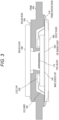
- Fig. 3 is a view illustrating an example of a cross-sectional structure of the semiconductor module according to the first embodiment of the present technology.
- the semiconductor module includes a flat circuit board 600.
- the material of the circuit board 600 may be a ceramic substrate, an organic substrate, or a flexible substrate. Note that the circuit board 600 is an example of a substrate described in the claims.
- the image sensor chip 100 is bonded onto the circuit board 600 via a die bonding agent 650.
- the logic chips 200 are stacked on the upper surface of the image sensor chip 100 to form the chip-on-chip structure. Note that, here, the logic chips 200 which are active components have been described as an example of a component to be stacked on the image sensor chip 100, but passive components may be stacked.
- the frame 400 On the upper surfaces of the image sensor chip 100 and the logic chips 200, the frame 400 covering them is formed.
- the frame 400 includes an opening on the upper surface of the pixel region 110, and allows incident light to be incident on the pixel region 110 while preventing the reflected light from the logic chips 200.
- a low-reflection black resin or the like for the frame 400.
- another resin such as an epoxy resin may be used as the material of the frame 400.
- metal such as stainless steel (SUS) or copper (Cu) may be used as the material of the frame 400.
- the sealing glass 500 is bonded to the upper surface of the frame 400 via a sealing resin 550.
- the sealing glass 500 may include resin.
- the input-output pads 130 of the image sensor chip 100 and electrodes of the circuit board 600 are electrically connected by gold wires 190.
- the frame 400 and the circuit board 600 are bonded by a frame adhesive resin 410.
- the frame 400 has a hollow structure and is not in contact with the logic chips 200 and the gold wires 190. Then, a region including the logic chips 200 and the gold wires 190 is an air blank region that is not sealed and filled.
- Fig. 4 is a view illustrating an example of a resin reservoir 401 of the frame 400 according to the first embodiment of the present technology.
- the sealing resin 550 is used between the upper surface of the frame 400 and the sealing glass 500. At this time, there is a possibility that a part of the sealing resin 550 protrudes to the opening side of the pixel region 110 and reflects the light ray incident on the opening. Thus, it is desirable to form the resin reservoir 401. That is, a recessed portion (recess) is provided as the resin reservoir 401 in the inner wall distal end portion of the frame 400. Thus, it is possible to prevent the sealing resin 550 from protruding from the inner wall of the frame 400, and it is possible to prevent reflection of a light ray caused by the light ray hitting the sealing resin 550.
- Fig. 5 is a view illustrating an example of embossing 402 of the inner wall of the frame 400 according to the first embodiment of the present technology.
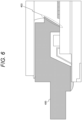
- Fig. 6 is a view illustrating an example of the tapered structure 403 of the inner wall of the frame 400 according to the first embodiment of the present technology.
- the light reflected on the inner wall of the frame 400 may be incident on the pixel region 110 to cause flare and ghost.
- incident light can be made incident on the pixel region 110 while preventing the reflected light from the logic chips 200.
- Fig. 7 is a view illustrating an example of a cross-sectional structure of a semiconductor module according to a second embodiment of the present technology.
- the region including the logic chips 200 is an air blank region, but in the second embodiment, a structure is provided in which the region is filled with the frame adhesive resin 410 and sealed. That is, by filling and sealing the region including the logic chips 200 and the gold wires 190 with the frame adhesive resin 410, heat dissipation is promoted and adhesive strength is improved.
- Figs. 8 and 9 are views illustrating an example of a method for manufacturing a semiconductor module according to the second embodiment of the present technology.
- the die bonding agent 650 is applied to a package of the circuit board 600 of ceramic or the like. Then, as illustrated in b in the same drawing, the image sensor chip 100 and the logic chips 200 of the chip-on-chip structure are mounted, and the die bonding agent 650 is cured. Then, as illustrated in c in the same drawing, the input-output pads 130 of the image sensor chip 100 and the electrodes of the circuit board 600 are electrically connected by the gold wires 190.
- the frame adhesive resin 410 is applied.
- the separately manufactured frame 400 is mounted on the circuit board 600 and cured. Note that, at that time, it may be mounted after the frame adhesive resin 410 is applied on the frame 400 side.
- the sealing resin 550 is applied to the upper surface of the frame 400. Then, as illustrated in g in the same drawing, the sealing resin 550 is cured after the sealing glass 500 is mounted thereon. Thus, the semiconductor module according to the second embodiment is manufactured.
- incident light can be made incident on the pixel region 110 while preventing the reflected light from the logic chips 200.
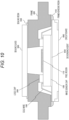
- Fig. 10 is a view illustrating an example of a cross-sectional structure of a semiconductor module according to a third embodiment of the present technology.
- the first embodiment described above has a structure in which the frame 400 is not in contact with the logic chips 200, but the third embodiment has a structure in which the frame 400 is in contact with the upper surface of the logic chips 200. That is, by blocking the upper surfaces of the logic chips 200 with the frame 400, the reflected light from the logic chips 200 is prevented so that light rays do not hit thereon.
- the frame 400 is in contact with the upper surfaces of the logic chips 200, but the region including the gold wires 190 outside the logic chips 200 has a hollow structure and is an air blank region that is not filled in a sealed manner.
- the structure of the frame 400 according to the third embodiment is advantageous in that it is easy to manufacture and is less likely to be damaged since it does not have a protruding portion as in the above-described first embodiment. Therefore, for example, in a case where the thicknesses of the logic chips 200 are thin and side surfaces have a small influence, the structure of the frame 400 of the third embodiment is advantageous. Furthermore, in general, the logic chips 200 tend to have a larger amount of heat generation than the image sensor chip 100, and thus it is advantageous to bring the frame 400 and the logic chips 200 into contact with each other as in the structure of the third embodiment because the number of heat generation paths increases.
- the frame 400 contacts and blocks the upper surfaces of the logic chips 200, so that the incident light can be made incident on the pixel region 110 while preventing the reflected light from the logic chips 200.
- Fig. 11 is a view illustrating an example of a cross-sectional structure of a semiconductor module according to a fourth embodiment of the present technology.
- the region including the gold wires 190 is an air blank region, but in the fourth embodiment, a structure is provided in which the region is filled and sealed with the frame adhesive resin 410. That is, by filling and sealing the region including the gold wires 190 with the frame adhesive resin 410, the heat dissipation is further promoted and the adhesion strength is improved. It is similar to the third embodiment described above except that the frame adhesive resin 410 is filled in a sealed manner, and thus detailed description thereof will be omitted.
- Fig. 12 is a view illustrating an example of a cross-sectional structure of a semiconductor module according to a fifth embodiment of the present technology.
- the above-described embodiment has a structure in which the frame 400 manufactured separately is used, but the fifth embodiment has a structure in which the region including the logic chips 200 and the gold wires 190 is covered with a sealing resin 450 without using the frame 400.
- a sealing resin 450 is an example of a cover part described in the claims.
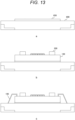
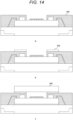
- Figs. 13 and 14 are views illustrating an example of a method for manufacturing the semiconductor module according to the fifth embodiment of the present technology.
- the die bonding agent 650 is applied to the package of the circuit board 600 of ceramic or the like. Then, as illustrated in b in the same drawing, the image sensor chip 100 and the logic chips 200 of the chip-on-chip structure are mounted, and the die bonding agent 650 is cured. Then, as illustrated in c in the same drawing, the input-output pads 130 of the image sensor chip 100 and the electrodes of the circuit board 600 are electrically connected by the gold wires 190.
- the logic chips 200 and the gold wires 190 are collectively covered with the sealing resin 450.
- the sealing resin 450 is formed by a procedure in which the periphery is fitted into a mold and the material of the sealing resin 450 is poured into the mold.
- the sealing resin 550 is applied to the upper surface of the sealing resin 450. Then, after the sealing glass 500 is mounted thereon, the sealing resin 550 is cured. Thus, the semiconductor module according to the fifth embodiment is manufactured.
- incident light can be made incident on the pixel region 110 while preventing the reflected light from the logic chips 200.
- Fig. 15 is a view illustrating an example of a cross-sectional structure of a semiconductor module according to a sixth embodiment of the present technology.
- the above-described fifth embodiment has a structure in which the sealing glass 500 is mounted on the upper surface of the sealing resin 450, but the sixth embodiment has a structure in which a transparent resin 590 is filled in the pixel region 110 instead of the sealing glass 500. That is, by not using the sealing glass 500, the height of the entire semiconductor module is reduced.
- Fig. 16 is a view illustrating an example of a method for manufacturing the semiconductor module according to the sixth embodiment of the present technology.
- the semiconductor module according to the sixth embodiment is manufactured by applying and curing the transparent resin 590 on the surface of the pixel in the pixel region 110.
- the sixth embodiment of the present technology by covering the region including the logic chips 200 with the sealing resin 450 and filling the pixel region 110 with the transparent resin 590, it is possible to reduce the height of the entire semiconductor module while preventing reflected light of the logic chips 200.
- Fig. 17 is a view illustrating an example of a cross-sectional structure of a semiconductor module according to a seventh embodiment of the present technology.
- the logic chips 200 are covered with the frame 400 and the sealing resin 450, but the seventh embodiment has a structure in which back surfaces and side surfaces of the logic chips 200 are covered with a molding resin 470.
- a molding resin 470 is an example of a cover part described in the claims.
- the image sensor chip 100 and the logic chips 200 of the chip-on-chip structure are mounted on the circuit board 600 via the die bonding agent 650.
- the circuit board 600 for example, a ceramic package is assumed.
- the sealing glass 500 is bonded to the upper surface of the circuit board 600 via the sealing resin 550.
- the sealing glass 500 does not need an anti-reflection coating (AR coating) or a light shielding film, and may be a normal sealing glass.
- Fig. 18 is a view illustrating an example of a process of manufacturing the semiconductor module according to the seventh embodiment of the present technology.
- logic chips 820 formed on a wafer 810 are cut out by dicing after microbumps are formed on the bonding surface.
- the cut individual logic chips 200 are arranged on the temporary arrangement sheet 830 as illustrated in b in the same drawing.
- the molding resin 470 is formed on the back surfaces and the side surfaces of the logic chips 200.
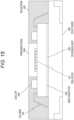
- Fig. 19 is a view illustrating an appearance example of the logic chips 820 after microbumps 209 are formed according to the seventh embodiment of the present technology.
- the microbumps 209 are formed on the logic chips 820 in a state of a wafer 800.
- the microbumps 209 are for connection with the image sensor chip 100.
- a material of the microbumps 209 for example, a solder material such as tin (Sn), silver (Ag), or copper (Cu) is suitable.
- a method for forming the microbumps 209 for example, a method such as electroplating, printing, or vapor deposition can be applied.
- Fig. 20 is a view illustrating an example of how the logic chips 200 are singulated according to the seventh embodiment of the present technology.
- the logic chips 820 formed on the wafer 800 are singulated into individual logic chips 200 by dicing.
- a normal dicing blade 801 for silicon can be used.
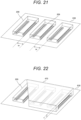
- Fig. 21 is a view illustrating an example of a state of arrangement of the logic chips 200 on the temporary arrangement sheet 830 according to the seventh embodiment of the present technology.
- the logic chips 200 are arranged on the temporary arrangement sheet 830 with formation surfaces for the microbumps 209 facing downward.
- the temporary arrangement sheet 830 for example, a dicing sheet or the like can be used.
- the thickness of the bonding surface (for example, about 10 ⁇ m) is required so that the surfaces of the logic chips 200 including the microbumps 209 are completely hidden at the time of bonding.
- a thickness of the molding resin 470 of a side wall can be adjusted by the interval W of the logic chips 200 at the time of this arrangement. That is, assuming that cutting is performed at the center of the interval W between the logic chips 200 by dicing in a subsequent process, the thickness of the molding resin 470 on the side surfaces of the logic chips 200 is "W/2".
- Fig. 22 is a view illustrating an example of a state of forming the molding resin 470 according to the seventh embodiment of the present technology.
- the molding resin 470 is formed on the back surfaces and the side surfaces of the logic chips 200.
- a material of the molding resin 470 a material used in a fan-out chip size package (CSP) or the like is suitably used. Basically, it is an epoxy resin and contains a filler. When the filler is contained in the resin, minute irregularities are formed on the resin surface, so that what is called a "satin state" is obtained. It can be expected that the irregularities attenuate light applied to the surface of the molding resin 470. Thus, a further preventive effect against flare and ghost can be obtained.
- the particle size of the filler that provides such an effect is assumed to be, for example, about 5 to 50 ⁇ m.
- a phenolic novolak resin a biphenol type epoxy resin (BP-E.R.), an O-cresol novolak epoxy resin (OCN-E.R.), a trisphenol methane type epoxy resin (TPM-E.R.), a dicyclopentadiene type epoxy resin (DCPD-E.R.), and the like are assumed.
- the content ratio of the filler is desirably determined in consideration of the influence on fluidity.
- a mold is used to form the molding resin 470, and a mold thickness T of the back surfaces of the logic chips 200 is determined by a cavity thickness of the mold. Furthermore, as the molding method, a compression molding method in which voids and the like are less likely to occur and resin fluidity is good is suitable.
- the thickness of the molding resin 470 can be adjusted by "W/2" and "T".
- an optimum thickness varies depending on the transmittance of the resin, and thus the thickness is set according to physical properties of the resin so as to be a suitable thickness.
- Fig. 23 is a view illustrating an example of how the logic chips 200 covered with the molding resin 470 are singulated according to the seventh embodiment of the present technology.
- the logic chips 200 covered with the molding resin 470 are diced by dicing.
- a dicing blade 802 for resin used for dividing a BGA package or the like can be used.
- the singulated logic chips 200 are peeled off from the temporary arrangement sheet 830. At this time, in a case where the adhesive remains on the formation surfaces for the microbumps 209, a cleaning step using a solvent that does not affect the molding resin 470 may be added.
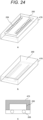
- Fig. 24 is a view illustrating an appearance example of the logic chips 200 covered with the molding resin 470 according to the seventh embodiment of the present technology.
- the logic chip 200 divided after the formation of the molding resin 470 is illustrated in the drawing.
- a is a view as viewed from the surface on which the microbumps 209 are formed.
- b is a view as viewed from the back surface of the logic chip 200.
- c in the same drawing is a cross-sectional view of the logic chip 200.
- the logic chips 200 thus formed are arranged on the image sensor chip 100 as follows.
- Fig. 25 is a view illustrating an arrangement example of the logic chips 200 on the image sensor chip 100 according to the seventh embodiment of the present technology.
- the logic chips 200 covered with the molding resin 470 are mounted at positions different from the pixel region on the image sensor chip 100 by a collet 850.
- an underfill resin 870 is discharged from a dispenser nozzle 860 and applied. Thereafter, by curing the applied underfill resin 870, an underfill resin 880 is formed below the logic chips 200 as illustrated in c in the same drawing. At this time, the fillet of the underfill resin 880 is formed outside the molding resin 470.
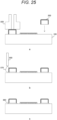
- Fig. 26 is a view illustrating an example of a method for manufacturing the semiconductor module according to the seventh embodiment of the present technology.
- the image sensor chip 100 and the logic chips 200 of the chip-on-chip structure manufactured as described above are mounted on the circuit board 600.
- the die bonding agent 650 is applied to the mounting position.
- the image sensor chip 100 and the logic chips 200 of the chip-on-chip structure are mounted, and the die bonding agent 650 is cured.
- the input-output pads of the image sensor chip 100 and the electrodes of the circuit board 600 are electrically connected by the gold wires 190.
- the sealing resin 550 is applied to the upper surface of the circuit board 600. Then, after the sealing glass 500 is mounted thereon, the sealing resin 550 is cured. Thus, the semiconductor module according to the seventh embodiment is manufactured.
- incident light can be made incident on the pixel region 110 while preventing the reflected light from the logic chips 200.
- Fig. 27 is a view illustrating an example of a cross-sectional structure of a semiconductor module according to an eighth embodiment of the present technology.
- the above-described seventh embodiment has a structure in which the sealing glass 500 is mounted on the upper surface of the circuit board 600, but the eighth embodiment has a structure in which the frame 400 is used as a package.
- the present embodiment is similar to the above-described seventh embodiment except that the frame 400 is used, and thus detailed description related to the structure is omitted.
- the image sensor chip 100 and the logic chips 200 of the chip-on-chip structure are used.
- the method for manufacturing the image sensor chip 100 and the logic chips 200 is similar to that of the above-described seventh embodiment, and thus detailed description thereof will be omitted.
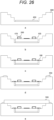
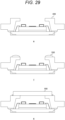
- Figs. 28 and 29 are views illustrating an example of the method for manufacturing the semiconductor module according to the eighth embodiment of the present technology.
- the image sensor chip 100 and the logic chips 200 of the chip-on-chip structure manufactured as described above are mounted on the circuit board 600.
- the die bonding agent 650 is applied to the mounting position.
- the image sensor chip 100 and the logic chips 200 of the chip-on-chip structure are mounted, and the die bonding agent 650 is cured.
- the input-output pads of the image sensor chip 100 and the electrodes of the circuit board 600 are electrically connected by the gold wires 190.
- the frame adhesive resin 410 is applied.
- the separately manufactured frame 400 is mounted on the circuit board 600 and cured. Note that, at that time, it may be mounted after the frame adhesive resin 410 is applied on the frame 400 side.
- the sealing resin 550 is applied to the upper surface of the frame 400. Then, as illustrated in g in the same drawing, the sealing resin 550 is cured after the sealing glass 500 is mounted thereon. Thus, the semiconductor module according to the eighth embodiment is manufactured.
- incident light can be made incident on the pixel region 110 while preventing the reflected light from the logic chips 200.
Landscapes
- Engineering & Computer Science (AREA)
- Multimedia (AREA)
- Signal Processing (AREA)
- Solid State Image Pick-Up Elements (AREA)
- Structures Or Materials For Encapsulating Or Coating Semiconductor Devices Or Solid State Devices (AREA)
Applications Claiming Priority (2)
| Application Number | Priority Date | Filing Date | Title |
|---|---|---|---|
| JP2020200816 | 2020-12-03 | ||
| PCT/JP2021/037355 WO2022118535A1 (ja) | 2020-12-03 | 2021-10-08 | 半導体モジュールおよびその製造方法 |
Publications (2)
| Publication Number | Publication Date |
|---|---|
| EP4258355A1 true EP4258355A1 (de) | 2023-10-11 |
| EP4258355A4 EP4258355A4 (de) | 2024-10-09 |
Family
ID=81852724
Family Applications (1)
| Application Number | Title | Priority Date | Filing Date |
|---|---|---|---|
| EP21900291.2A Withdrawn EP4258355A4 (de) | 2020-12-03 | 2021-10-08 | Halbleitermodul und verfahren zu seiner herstellung |
Country Status (3)
| Country | Link |
|---|---|
| US (1) | US20240006439A1 (de) |
| EP (1) | EP4258355A4 (de) |
| WO (1) | WO2022118535A1 (de) |
Families Citing this family (3)
| Publication number | Priority date | Publication date | Assignee | Title |
|---|---|---|---|---|
| WO2024122177A1 (ja) * | 2022-12-05 | 2024-06-13 | ソニーセミコンダクタソリューションズ株式会社 | 半導体パッケージ、および、半導体パッケージの製造方法 |
| WO2025243813A1 (ja) * | 2024-05-21 | 2025-11-27 | ソニーセミコンダクタソリューションズ株式会社 | パッケージ、リードフレームおよびパッケージの製造方法 |
| CN120897540A (zh) * | 2025-07-29 | 2025-11-04 | 业泓科技(成都)有限公司 | 具抗眩光特性的球栅阵列封装影像传感器模块 |
Family Cites Families (20)
| Publication number | Priority date | Publication date | Assignee | Title |
|---|---|---|---|---|
| JPH05102449A (ja) * | 1991-10-07 | 1993-04-23 | Sony Corp | 固体撮像装置およびその製造方法 |
| JP3168859B2 (ja) * | 1995-03-06 | 2001-05-21 | 日本ケミコン株式会社 | Ccdモジュールの樹脂封止方法 |
| IL133453A0 (en) * | 1999-12-10 | 2001-04-30 | Shellcase Ltd | Methods for producing packaged integrated circuit devices and packaged integrated circuit devices produced thereby |
| JP4170950B2 (ja) * | 2003-10-10 | 2008-10-22 | 松下電器産業株式会社 | 光学デバイスおよびその製造方法 |
| JP2008245244A (ja) * | 2007-02-26 | 2008-10-09 | Sony Corp | 撮像素子パッケージ、撮像素子モジュールおよびレンズ鏡筒並びに撮像装置 |
| JP4443600B2 (ja) * | 2007-12-03 | 2010-03-31 | シャープ株式会社 | 固体撮像装置の製造方法 |
| JP2010238995A (ja) * | 2009-03-31 | 2010-10-21 | Sanyo Electric Co Ltd | 半導体モジュールおよびこれを搭載したカメラモジュール |
| JP2011101228A (ja) * | 2009-11-06 | 2011-05-19 | Toshiba Corp | セラミックパッケージおよびカメラモジュール |
| JP2012064837A (ja) * | 2010-09-17 | 2012-03-29 | Panasonic Corp | 半導体モジュール |
| JP2012124305A (ja) * | 2010-12-08 | 2012-06-28 | Panasonic Corp | 半導体モジュール |
| US8796800B2 (en) * | 2011-11-21 | 2014-08-05 | Optiz, Inc. | Interposer package for CMOS image sensor and method of making same |
| KR20130114352A (ko) * | 2012-04-09 | 2013-10-18 | 삼성전자주식회사 | 반도체 패키지 및 그 제조 방법 |
| US8890274B2 (en) * | 2012-07-11 | 2014-11-18 | Taiwan Semiconductor Manufacturing Company, Ltd. | Interconnect structure for CIS flip-chip bonding and methods for forming the same |
| US9142695B2 (en) | 2013-06-03 | 2015-09-22 | Optiz, Inc. | Sensor package with exposed sensor array and method of making same |
| KR102384157B1 (ko) * | 2015-03-04 | 2022-04-08 | 삼성전자주식회사 | 반도체 패키지 및 그 제조 방법 |
| US10546888B2 (en) * | 2015-10-09 | 2020-01-28 | Sony Corporation | Solid-state imaging device package and manufacturing method, and electronic apparatus |
| US9996725B2 (en) * | 2016-11-03 | 2018-06-12 | Optiz, Inc. | Under screen sensor assembly |
| JP2019160847A (ja) * | 2018-03-07 | 2019-09-19 | ソニーセミコンダクタソリューションズ株式会社 | 固体撮像装置および固体撮像素子 |
| US10998361B2 (en) * | 2018-09-22 | 2021-05-04 | Omnivision Technologies, Inc. | Image-sensor package and associated method |
| JP2023141960A (ja) * | 2022-03-24 | 2023-10-05 | キヤノン株式会社 | 半導体装置、表示装置、光電変換装置、電子機器、照明装置、移動体 |
-
2021
- 2021-10-08 WO PCT/JP2021/037355 patent/WO2022118535A1/ja not_active Ceased
- 2021-10-08 US US18/254,848 patent/US20240006439A1/en active Pending
- 2021-10-08 EP EP21900291.2A patent/EP4258355A4/de not_active Withdrawn
Also Published As
| Publication number | Publication date |
|---|---|
| WO2022118535A1 (ja) | 2022-06-09 |
| EP4258355A4 (de) | 2024-10-09 |
| US20240006439A1 (en) | 2024-01-04 |
Similar Documents
| Publication | Publication Date | Title |
|---|---|---|
| CN111354652B (zh) | 高可靠性图像传感器晶圆级扇出封装结构及方法 | |
| JP5255246B2 (ja) | チップスケールパッケージ、cmosイメージスケールパッケージおよびcmosイメージスケールパッケージの製造方法 | |
| US8420430B2 (en) | Fabrication method of package structure having MEMS element | |
| US7655501B2 (en) | Wafer level package with good CTE performance | |
| US20240006439A1 (en) | Semiconductor module and method for manufacturing the same | |
| TWI700805B (zh) | 具有電磁干擾遮蔽的半導體裝置 | |
| KR100773843B1 (ko) | 반도체 장치 및 그 제조 방법 | |
| US20080191333A1 (en) | Image sensor package with die receiving opening and method of the same | |
| US20090008729A1 (en) | Image sensor package utilizing a removable protection film and method of making the same | |
| US20110180891A1 (en) | Conductor package structure and method of the same | |
| JP2008258582A (ja) | ダイ受入れキャビティを備えたウェハレベル・イメージセンサパッケージおよびその方法 | |
| CN105702696A (zh) | 影像传感芯片的封装结构及其制作方法 | |
| TW200835318A (en) | Image sensor module and the method of the same | |
| US10541262B2 (en) | Image sensing chip packaging structure and packaging method | |
| KR20050045509A (ko) | 초박형 반도체 패키지 및 그 제조방법 | |
| US20220093664A1 (en) | Reliable semiconductor packages | |
| US9653500B2 (en) | Optical cover plate with improved solder mask dam on glass for image sensor package and fabrication method thereof | |
| CN112768416A (zh) | 一种高频多芯片模组的扇出型封装及其制备方法 | |
| KR101631406B1 (ko) | 반도체 패키지 및 그 제조 방법 | |
| JP2003309228A (ja) | 半導体装置及びその製造方法 | |
| CN111341796A (zh) | 一种图像传感器的扇出型封装方法 | |
| US20070054484A1 (en) | Method for fabricating semiconductor packages | |
| US20110059579A1 (en) | Method of forming tape ball grid array package | |
| TWI594409B (zh) | 影像傳感晶片封裝結構及封裝方法 | |
| US20110031594A1 (en) | Conductor package structure and method of the same |
Legal Events
| Date | Code | Title | Description |
|---|---|---|---|
| STAA | Information on the status of an ep patent application or granted ep patent |
Free format text: STATUS: THE INTERNATIONAL PUBLICATION HAS BEEN MADE |
|
| PUAI | Public reference made under article 153(3) epc to a published international application that has entered the european phase |
Free format text: ORIGINAL CODE: 0009012 |
|
| STAA | Information on the status of an ep patent application or granted ep patent |
Free format text: STATUS: REQUEST FOR EXAMINATION WAS MADE |
|
| 17P | Request for examination filed |
Effective date: 20230626 |
|
| AK | Designated contracting states |
Kind code of ref document: A1 Designated state(s): AL AT BE BG CH CY CZ DE DK EE ES FI FR GB GR HR HU IE IS IT LI LT LU LV MC MK MT NL NO PL PT RO RS SE SI SK SM TR |
|
| DAV | Request for validation of the european patent (deleted) | ||
| DAX | Request for extension of the european patent (deleted) | ||
| A4 | Supplementary search report drawn up and despatched |
Effective date: 20240906 |
|
| RIC1 | Information provided on ipc code assigned before grant |
Ipc: H04N 25/62 20230101ALI20240902BHEP Ipc: H01L 23/31 20060101ALI20240902BHEP Ipc: H01L 23/29 20060101ALI20240902BHEP Ipc: H01L 23/02 20060101ALI20240902BHEP Ipc: H01L 27/146 20060101AFI20240902BHEP |
|
| STAA | Information on the status of an ep patent application or granted ep patent |
Free format text: STATUS: THE APPLICATION HAS BEEN WITHDRAWN |
|
| 18W | Application withdrawn |
Effective date: 20250929 |