EP4261021A1 - Verstärkungsmaterial für verbundlaminat - Google Patents
Verstärkungsmaterial für verbundlaminat Download PDFInfo
- Publication number
- EP4261021A1 EP4261021A1 EP23166214.9A EP23166214A EP4261021A1 EP 4261021 A1 EP4261021 A1 EP 4261021A1 EP 23166214 A EP23166214 A EP 23166214A EP 4261021 A1 EP4261021 A1 EP 4261021A1
- Authority
- EP
- European Patent Office
- Prior art keywords
- fabric
- prepreg
- fabric prepreg
- layer
- sheets
- Prior art date
- Legal status (The legal status is an assumption and is not a legal conclusion. Google has not performed a legal analysis and makes no representation as to the accuracy of the status listed.)
- Granted
Links
Images







Classifications
-
- B—PERFORMING OPERATIONS; TRANSPORTING
- B29—WORKING OF PLASTICS; WORKING OF SUBSTANCES IN A PLASTIC STATE IN GENERAL
- B29C—SHAPING OR JOINING OF PLASTICS; SHAPING OF MATERIAL IN A PLASTIC STATE, NOT OTHERWISE PROVIDED FOR; AFTER-TREATMENT OF THE SHAPED PRODUCTS, e.g. REPAIRING
- B29C70/00—Shaping composites, i.e. plastics material comprising reinforcements, fillers or preformed parts, e.g. inserts
- B29C70/04—Shaping composites, i.e. plastics material comprising reinforcements, fillers or preformed parts, e.g. inserts comprising reinforcements only, e.g. self-reinforcing plastics
- B29C70/06—Fibrous reinforcements only
- B29C70/10—Fibrous reinforcements only characterised by the structure of fibrous reinforcements, e.g. hollow fibres
- B29C70/16—Fibrous reinforcements only characterised by the structure of fibrous reinforcements, e.g. hollow fibres using fibres of substantial or continuous length
- B29C70/22—Fibrous reinforcements only characterised by the structure of fibrous reinforcements, e.g. hollow fibres using fibres of substantial or continuous length oriented in at least two directions forming a two-dimensional [2D] structure
-
- C—CHEMISTRY; METALLURGY
- C08—ORGANIC MACROMOLECULAR COMPOUNDS; THEIR PREPARATION OR CHEMICAL WORKING-UP; COMPOSITIONS BASED THEREON
- C08J—WORKING-UP; GENERAL PROCESSES OF COMPOUNDING; AFTER-TREATMENT NOT COVERED BY SUBCLASSES C08B, C08C, C08F, C08G or C08H
- C08J5/00—Manufacture of articles or shaped materials containing macromolecular substances
- C08J5/24—Impregnating materials with prepolymers which can be polymerised in situ, e.g. manufacture of prepregs
-
- B—PERFORMING OPERATIONS; TRANSPORTING
- B29—WORKING OF PLASTICS; WORKING OF SUBSTANCES IN A PLASTIC STATE IN GENERAL
- B29B—PREPARATION OR PRETREATMENT OF THE MATERIAL TO BE SHAPED; MAKING GRANULES OR PREFORMS; RECOVERY OF PLASTICS OR OTHER CONSTITUENTS OF WASTE MATERIAL CONTAINING PLASTICS
- B29B11/00—Making preforms
- B29B11/14—Making preforms characterised by structure or composition
- B29B11/16—Making preforms characterised by structure or composition comprising fillers or reinforcement
-
- B—PERFORMING OPERATIONS; TRANSPORTING
- B29—WORKING OF PLASTICS; WORKING OF SUBSTANCES IN A PLASTIC STATE IN GENERAL
- B29C—SHAPING OR JOINING OF PLASTICS; SHAPING OF MATERIAL IN A PLASTIC STATE, NOT OTHERWISE PROVIDED FOR; AFTER-TREATMENT OF THE SHAPED PRODUCTS, e.g. REPAIRING
- B29C70/00—Shaping composites, i.e. plastics material comprising reinforcements, fillers or preformed parts, e.g. inserts
- B29C70/04—Shaping composites, i.e. plastics material comprising reinforcements, fillers or preformed parts, e.g. inserts comprising reinforcements only, e.g. self-reinforcing plastics
- B29C70/06—Fibrous reinforcements only
- B29C70/10—Fibrous reinforcements only characterised by the structure of fibrous reinforcements, e.g. hollow fibres
- B29C70/16—Fibrous reinforcements only characterised by the structure of fibrous reinforcements, e.g. hollow fibres using fibres of substantial or continuous length
- B29C70/22—Fibrous reinforcements only characterised by the structure of fibrous reinforcements, e.g. hollow fibres using fibres of substantial or continuous length oriented in at least two directions forming a two-dimensional [2D] structure
- B29C70/222—Fibrous reinforcements only characterised by the structure of fibrous reinforcements, e.g. hollow fibres using fibres of substantial or continuous length oriented in at least two directions forming a two-dimensional [2D] structure the structure being shaped to form a three dimensional configuration
-
- B—PERFORMING OPERATIONS; TRANSPORTING
- B29—WORKING OF PLASTICS; WORKING OF SUBSTANCES IN A PLASTIC STATE IN GENERAL
- B29C—SHAPING OR JOINING OF PLASTICS; SHAPING OF MATERIAL IN A PLASTIC STATE, NOT OTHERWISE PROVIDED FOR; AFTER-TREATMENT OF THE SHAPED PRODUCTS, e.g. REPAIRING
- B29C70/00—Shaping composites, i.e. plastics material comprising reinforcements, fillers or preformed parts, e.g. inserts
- B29C70/04—Shaping composites, i.e. plastics material comprising reinforcements, fillers or preformed parts, e.g. inserts comprising reinforcements only, e.g. self-reinforcing plastics
- B29C70/06—Fibrous reinforcements only
- B29C70/10—Fibrous reinforcements only characterised by the structure of fibrous reinforcements, e.g. hollow fibres
- B29C70/16—Fibrous reinforcements only characterised by the structure of fibrous reinforcements, e.g. hollow fibres using fibres of substantial or continuous length
- B29C70/22—Fibrous reinforcements only characterised by the structure of fibrous reinforcements, e.g. hollow fibres using fibres of substantial or continuous length oriented in at least two directions forming a two-dimensional [2D] structure
- B29C70/226—Fibrous reinforcements only characterised by the structure of fibrous reinforcements, e.g. hollow fibres using fibres of substantial or continuous length oriented in at least two directions forming a two-dimensional [2D] structure the structure comprising mainly parallel filaments interconnected by a small number of cross threads
-
- B—PERFORMING OPERATIONS; TRANSPORTING
- B29—WORKING OF PLASTICS; WORKING OF SUBSTANCES IN A PLASTIC STATE IN GENERAL
- B29C—SHAPING OR JOINING OF PLASTICS; SHAPING OF MATERIAL IN A PLASTIC STATE, NOT OTHERWISE PROVIDED FOR; AFTER-TREATMENT OF THE SHAPED PRODUCTS, e.g. REPAIRING
- B29C70/00—Shaping composites, i.e. plastics material comprising reinforcements, fillers or preformed parts, e.g. inserts
- B29C70/04—Shaping composites, i.e. plastics material comprising reinforcements, fillers or preformed parts, e.g. inserts comprising reinforcements only, e.g. self-reinforcing plastics
- B29C70/28—Shaping operations therefor
- B29C70/30—Shaping by lay-up, i.e. applying fibres, tape or broadsheet on a mould, former or core; Shaping by spray-up, i.e. spraying of fibres on a mould, former or core
-
- B—PERFORMING OPERATIONS; TRANSPORTING
- B32—LAYERED PRODUCTS
- B32B—LAYERED PRODUCTS, i.e. PRODUCTS BUILT-UP OF STRATA OF FLAT OR NON-FLAT, e.g. CELLULAR OR HONEYCOMB, FORM
- B32B1/00—Layered products having a non-planar shape
- B32B1/08—Tubular products
-
- B—PERFORMING OPERATIONS; TRANSPORTING
- B32—LAYERED PRODUCTS
- B32B—LAYERED PRODUCTS, i.e. PRODUCTS BUILT-UP OF STRATA OF FLAT OR NON-FLAT, e.g. CELLULAR OR HONEYCOMB, FORM
- B32B5/00—Layered products characterised by the non- homogeneity or physical structure, i.e. comprising a fibrous, filamentary, particulate or foam layer; Layered products characterised by having a layer differing constitutionally or physically in different parts
- B32B5/02—Layered products characterised by the non- homogeneity or physical structure, i.e. comprising a fibrous, filamentary, particulate or foam layer; Layered products characterised by having a layer differing constitutionally or physically in different parts characterised by structural features of a fibrous or filamentary layer
- B32B5/024—Woven fabric
-
- B—PERFORMING OPERATIONS; TRANSPORTING
- B32—LAYERED PRODUCTS
- B32B—LAYERED PRODUCTS, i.e. PRODUCTS BUILT-UP OF STRATA OF FLAT OR NON-FLAT, e.g. CELLULAR OR HONEYCOMB, FORM
- B32B5/00—Layered products characterised by the non- homogeneity or physical structure, i.e. comprising a fibrous, filamentary, particulate or foam layer; Layered products characterised by having a layer differing constitutionally or physically in different parts
- B32B5/02—Layered products characterised by the non- homogeneity or physical structure, i.e. comprising a fibrous, filamentary, particulate or foam layer; Layered products characterised by having a layer differing constitutionally or physically in different parts characterised by structural features of a fibrous or filamentary layer
- B32B5/12—Layered products characterised by the non- homogeneity or physical structure, i.e. comprising a fibrous, filamentary, particulate or foam layer; Layered products characterised by having a layer differing constitutionally or physically in different parts characterised by structural features of a fibrous or filamentary layer characterised by the relative arrangement of fibres or filaments of different layers, e.g. the fibres or filaments being parallel or perpendicular to each other
-
- B—PERFORMING OPERATIONS; TRANSPORTING
- B32—LAYERED PRODUCTS
- B32B—LAYERED PRODUCTS, i.e. PRODUCTS BUILT-UP OF STRATA OF FLAT OR NON-FLAT, e.g. CELLULAR OR HONEYCOMB, FORM
- B32B5/00—Layered products characterised by the non- homogeneity or physical structure, i.e. comprising a fibrous, filamentary, particulate or foam layer; Layered products characterised by having a layer differing constitutionally or physically in different parts
- B32B5/22—Layered products characterised by the non- homogeneity or physical structure, i.e. comprising a fibrous, filamentary, particulate or foam layer; Layered products characterised by having a layer differing constitutionally or physically in different parts characterised by the presence of two or more layers which are next to each other and are fibrous, filamentary, formed of particles or foamed
- B32B5/24—Layered products characterised by the non- homogeneity or physical structure, i.e. comprising a fibrous, filamentary, particulate or foam layer; Layered products characterised by having a layer differing constitutionally or physically in different parts characterised by the presence of two or more layers which are next to each other and are fibrous, filamentary, formed of particles or foamed one layer being a fibrous or filamentary layer
- B32B5/26—Layered products characterised by the non- homogeneity or physical structure, i.e. comprising a fibrous, filamentary, particulate or foam layer; Layered products characterised by having a layer differing constitutionally or physically in different parts characterised by the presence of two or more layers which are next to each other and are fibrous, filamentary, formed of particles or foamed one layer being a fibrous or filamentary layer another layer next to it also being fibrous or filamentary
- B32B5/262—Layered products characterised by the non- homogeneity or physical structure, i.e. comprising a fibrous, filamentary, particulate or foam layer; Layered products characterised by having a layer differing constitutionally or physically in different parts characterised by the presence of two or more layers which are next to each other and are fibrous, filamentary, formed of particles or foamed one layer being a fibrous or filamentary layer another layer next to it also being fibrous or filamentary characterised by one fibrous or filamentary layer being a woven fabric layer
- B32B5/263—Layered products characterised by the non- homogeneity or physical structure, i.e. comprising a fibrous, filamentary, particulate or foam layer; Layered products characterised by having a layer differing constitutionally or physically in different parts characterised by the presence of two or more layers which are next to each other and are fibrous, filamentary, formed of particles or foamed one layer being a fibrous or filamentary layer another layer next to it also being fibrous or filamentary characterised by one fibrous or filamentary layer being a woven fabric layer next to one or more woven fabric layers
-
- B—PERFORMING OPERATIONS; TRANSPORTING
- B32—LAYERED PRODUCTS
- B32B—LAYERED PRODUCTS, i.e. PRODUCTS BUILT-UP OF STRATA OF FLAT OR NON-FLAT, e.g. CELLULAR OR HONEYCOMB, FORM
- B32B7/00—Layered products characterised by the relation between layers; Layered products characterised by the relative orientation of features between layers, or by the relative values of a measurable parameter between layers, i.e. products comprising layers having different physical, chemical or physicochemical properties; Layered products characterised by the interconnection of layers
- B32B7/04—Interconnection of layers
- B32B7/12—Interconnection of layers using interposed adhesives or interposed materials with bonding properties
-
- D—TEXTILES; PAPER
- D06—TREATMENT OF TEXTILES OR THE LIKE; LAUNDERING; FLEXIBLE MATERIALS NOT OTHERWISE PROVIDED FOR
- D06M—TREATMENT, NOT PROVIDED FOR ELSEWHERE IN CLASS D06, OF FIBRES, THREADS, YARNS, FABRICS, FEATHERS OR FIBROUS GOODS MADE FROM SUCH MATERIALS
- D06M17/00—Producing multi-layer textile fabrics
- D06M17/04—Producing multi-layer textile fabrics by applying synthetic resins as adhesives
-
- D—TEXTILES; PAPER
- D06—TREATMENT OF TEXTILES OR THE LIKE; LAUNDERING; FLEXIBLE MATERIALS NOT OTHERWISE PROVIDED FOR
- D06N—WALL, FLOOR, OR LIKE COVERING MATERIALS, e.g. LINOLEUM, OILCLOTH, ARTIFICIAL LEATHER, ROOFING FELT, CONSISTING OF A FIBROUS WEB COATED WITH A LAYER OF MACROMOLECULAR MATERIAL; FLEXIBLE SHEET MATERIAL NOT OTHERWISE PROVIDED FOR
- D06N3/00—Artificial leather, oilcloth or other material obtained by covering fibrous webs with macromolecular material, e.g. resins, rubber or derivatives thereof
- D06N3/0002—Artificial leather, oilcloth or other material obtained by covering fibrous webs with macromolecular material, e.g. resins, rubber or derivatives thereof characterised by the substrate
- D06N3/0006—Artificial leather, oilcloth or other material obtained by covering fibrous webs with macromolecular material, e.g. resins, rubber or derivatives thereof characterised by the substrate using woven fabrics
-
- B—PERFORMING OPERATIONS; TRANSPORTING
- B29—WORKING OF PLASTICS; WORKING OF SUBSTANCES IN A PLASTIC STATE IN GENERAL
- B29C—SHAPING OR JOINING OF PLASTICS; SHAPING OF MATERIAL IN A PLASTIC STATE, NOT OTHERWISE PROVIDED FOR; AFTER-TREATMENT OF THE SHAPED PRODUCTS, e.g. REPAIRING
- B29C70/00—Shaping composites, i.e. plastics material comprising reinforcements, fillers or preformed parts, e.g. inserts
- B29C70/04—Shaping composites, i.e. plastics material comprising reinforcements, fillers or preformed parts, e.g. inserts comprising reinforcements only, e.g. self-reinforcing plastics
- B29C70/28—Shaping operations therefor
- B29C70/40—Shaping or impregnating by compression not applied
-
- B—PERFORMING OPERATIONS; TRANSPORTING
- B29—WORKING OF PLASTICS; WORKING OF SUBSTANCES IN A PLASTIC STATE IN GENERAL
- B29C—SHAPING OR JOINING OF PLASTICS; SHAPING OF MATERIAL IN A PLASTIC STATE, NOT OTHERWISE PROVIDED FOR; AFTER-TREATMENT OF THE SHAPED PRODUCTS, e.g. REPAIRING
- B29C70/00—Shaping composites, i.e. plastics material comprising reinforcements, fillers or preformed parts, e.g. inserts
- B29C70/04—Shaping composites, i.e. plastics material comprising reinforcements, fillers or preformed parts, e.g. inserts comprising reinforcements only, e.g. self-reinforcing plastics
- B29C70/28—Shaping operations therefor
- B29C70/40—Shaping or impregnating by compression not applied
- B29C70/42—Shaping or impregnating by compression not applied for producing articles of definite length, i.e. discrete articles
- B29C70/44—Shaping or impregnating by compression not applied for producing articles of definite length, i.e. discrete articles using isostatic pressure, e.g. pressure difference-moulding, vacuum bag-moulding, autoclave-moulding or expanding rubber-moulding
-
- B—PERFORMING OPERATIONS; TRANSPORTING
- B29—WORKING OF PLASTICS; WORKING OF SUBSTANCES IN A PLASTIC STATE IN GENERAL
- B29K—INDEXING SCHEME ASSOCIATED WITH SUBCLASSES B29B, B29C OR B29D, RELATING TO MOULDING MATERIALS OR TO MATERIALS FOR MOULDS, REINFORCEMENTS, FILLERS OR PREFORMED PARTS, e.g. INSERTS
- B29K2063/00—Use of EP, i.e. epoxy resins or derivatives thereof, as moulding material
-
- B—PERFORMING OPERATIONS; TRANSPORTING
- B29—WORKING OF PLASTICS; WORKING OF SUBSTANCES IN A PLASTIC STATE IN GENERAL
- B29K—INDEXING SCHEME ASSOCIATED WITH SUBCLASSES B29B, B29C OR B29D, RELATING TO MOULDING MATERIALS OR TO MATERIALS FOR MOULDS, REINFORCEMENTS, FILLERS OR PREFORMED PARTS, e.g. INSERTS
- B29K2307/00—Use of elements other than metals as reinforcement
- B29K2307/04—Carbon
-
- B—PERFORMING OPERATIONS; TRANSPORTING
- B32—LAYERED PRODUCTS
- B32B—LAYERED PRODUCTS, i.e. PRODUCTS BUILT-UP OF STRATA OF FLAT OR NON-FLAT, e.g. CELLULAR OR HONEYCOMB, FORM
- B32B2250/00—Layers arrangement
- B32B2250/05—5 or more layers
-
- B—PERFORMING OPERATIONS; TRANSPORTING
- B32—LAYERED PRODUCTS
- B32B—LAYERED PRODUCTS, i.e. PRODUCTS BUILT-UP OF STRATA OF FLAT OR NON-FLAT, e.g. CELLULAR OR HONEYCOMB, FORM
- B32B2250/00—Layers arrangement
- B32B2250/20—All layers being fibrous or filamentary
-
- B—PERFORMING OPERATIONS; TRANSPORTING
- B32—LAYERED PRODUCTS
- B32B—LAYERED PRODUCTS, i.e. PRODUCTS BUILT-UP OF STRATA OF FLAT OR NON-FLAT, e.g. CELLULAR OR HONEYCOMB, FORM
- B32B2260/00—Layered product comprising an impregnated, embedded, or bonded layer wherein the layer comprises an impregnation, embedding, or binder material
- B32B2260/02—Composition of the impregnated, bonded or embedded layer
- B32B2260/021—Fibrous or filamentary layer
- B32B2260/023—Two or more layers
-
- B—PERFORMING OPERATIONS; TRANSPORTING
- B32—LAYERED PRODUCTS
- B32B—LAYERED PRODUCTS, i.e. PRODUCTS BUILT-UP OF STRATA OF FLAT OR NON-FLAT, e.g. CELLULAR OR HONEYCOMB, FORM
- B32B2260/00—Layered product comprising an impregnated, embedded, or bonded layer wherein the layer comprises an impregnation, embedding, or binder material
- B32B2260/04—Impregnation, embedding, or binder material
- B32B2260/046—Synthetic resin
-
- B—PERFORMING OPERATIONS; TRANSPORTING
- B32—LAYERED PRODUCTS
- B32B—LAYERED PRODUCTS, i.e. PRODUCTS BUILT-UP OF STRATA OF FLAT OR NON-FLAT, e.g. CELLULAR OR HONEYCOMB, FORM
- B32B2262/00—Composition or structural features of fibres which form a fibrous or filamentary layer or are present as additives
- B32B2262/10—Inorganic fibres
- B32B2262/106—Carbon fibres, e.g. graphite fibres
-
- B—PERFORMING OPERATIONS; TRANSPORTING
- B32—LAYERED PRODUCTS
- B32B—LAYERED PRODUCTS, i.e. PRODUCTS BUILT-UP OF STRATA OF FLAT OR NON-FLAT, e.g. CELLULAR OR HONEYCOMB, FORM
- B32B2262/00—Composition or structural features of fibres which form a fibrous or filamentary layer or are present as additives
- B32B2262/14—Mixture of at least two fibres made of different materials
- B32B2262/148—Woven fabric
-
- B—PERFORMING OPERATIONS; TRANSPORTING
- B32—LAYERED PRODUCTS
- B32B—LAYERED PRODUCTS, i.e. PRODUCTS BUILT-UP OF STRATA OF FLAT OR NON-FLAT, e.g. CELLULAR OR HONEYCOMB, FORM
- B32B2262/00—Composition or structural features of fibres which form a fibrous or filamentary layer or are present as additives
- B32B2262/16—Structural features of fibres, filaments or yarns e.g. wrapped, coiled, crimped or covered
-
- B—PERFORMING OPERATIONS; TRANSPORTING
- B32—LAYERED PRODUCTS
- B32B—LAYERED PRODUCTS, i.e. PRODUCTS BUILT-UP OF STRATA OF FLAT OR NON-FLAT, e.g. CELLULAR OR HONEYCOMB, FORM
- B32B2307/00—Properties of the layers or laminate
- B32B2307/70—Other properties
- B32B2307/718—Weight, e.g. weight per square meter
-
- B—PERFORMING OPERATIONS; TRANSPORTING
- B32—LAYERED PRODUCTS
- B32B—LAYERED PRODUCTS, i.e. PRODUCTS BUILT-UP OF STRATA OF FLAT OR NON-FLAT, e.g. CELLULAR OR HONEYCOMB, FORM
- B32B2307/00—Properties of the layers or laminate
- B32B2307/70—Other properties
- B32B2307/732—Dimensional properties
- B32B2307/737—Dimensions, e.g. volume or area
- B32B2307/7375—Linear, e.g. length, distance or width
-
- B—PERFORMING OPERATIONS; TRANSPORTING
- B32—LAYERED PRODUCTS
- B32B—LAYERED PRODUCTS, i.e. PRODUCTS BUILT-UP OF STRATA OF FLAT OR NON-FLAT, e.g. CELLULAR OR HONEYCOMB, FORM
- B32B2597/00—Tubular articles, e.g. hoses, pipes
-
- B—PERFORMING OPERATIONS; TRANSPORTING
- B32—LAYERED PRODUCTS
- B32B—LAYERED PRODUCTS, i.e. PRODUCTS BUILT-UP OF STRATA OF FLAT OR NON-FLAT, e.g. CELLULAR OR HONEYCOMB, FORM
- B32B27/00—Layered products comprising a layer of synthetic resin
- B32B27/38—Layered products comprising a layer of synthetic resin comprising epoxy resins
-
- D—TEXTILES; PAPER
- D06—TREATMENT OF TEXTILES OR THE LIKE; LAUNDERING; FLEXIBLE MATERIALS NOT OTHERWISE PROVIDED FOR
- D06M—TREATMENT, NOT PROVIDED FOR ELSEWHERE IN CLASS D06, OF FIBRES, THREADS, YARNS, FABRICS, FEATHERS OR FIBROUS GOODS MADE FROM SUCH MATERIALS
- D06M15/00—Treating fibres, threads, yarns, fabrics, or fibrous goods made from such materials, with macromolecular compounds; Such treatment combined with mechanical treatment
- D06M15/19—Treating fibres, threads, yarns, fabrics, or fibrous goods made from such materials, with macromolecular compounds; Such treatment combined with mechanical treatment with synthetic macromolecular compounds
- D06M15/37—Macromolecular compounds obtained otherwise than by reactions only involving carbon-to-carbon unsaturated bonds
- D06M15/55—Epoxy resins
-
- D—TEXTILES; PAPER
- D06—TREATMENT OF TEXTILES OR THE LIKE; LAUNDERING; FLEXIBLE MATERIALS NOT OTHERWISE PROVIDED FOR
- D06M—TREATMENT, NOT PROVIDED FOR ELSEWHERE IN CLASS D06, OF FIBRES, THREADS, YARNS, FABRICS, FEATHERS OR FIBROUS GOODS MADE FROM SUCH MATERIALS
- D06M2101/00—Chemical constitution of the fibres, threads, yarns, fabrics or fibrous goods made from such materials, to be treated
- D06M2101/40—Fibres of carbon
-
- D—TEXTILES; PAPER
- D06—TREATMENT OF TEXTILES OR THE LIKE; LAUNDERING; FLEXIBLE MATERIALS NOT OTHERWISE PROVIDED FOR
- D06N—WALL, FLOOR, OR LIKE COVERING MATERIALS, e.g. LINOLEUM, OILCLOTH, ARTIFICIAL LEATHER, ROOFING FELT, CONSISTING OF A FIBROUS WEB COATED WITH A LAYER OF MACROMOLECULAR MATERIAL; FLEXIBLE SHEET MATERIAL NOT OTHERWISE PROVIDED FOR
- D06N2201/00—Chemical constitution of the fibres, threads or yarns
- D06N2201/08—Inorganic fibres
- D06N2201/087—Carbon fibres
Definitions
- the present invention relates to a woven multi-layer fabric prepreg for use in constructing a composite laminate, a method of manufacturing a woven multi-layer fabric prepreg, and a method of manufacturing a composite laminate.
- a reinforcement material is typically a mix of fibres and a polymer matrix.
- Common fibres are carbon fibre, glass fibre, or natural fibres such as flax and hemp.
- the polymer matrix is often a resin, such as epoxy, phenolic, bismaleimide, or cyanate ester.
- the reinforcement fibres are commonly either laid uni-directionally or woven, depending upon the desired result. A component that requires strength in all directions is often made using woven reinforcement material.
- One method of creating a composite laminate is by layering sheets of reinforcement material over a pattern or in a mould before curing.
- the polymer matrix may be added separately, but for the best results the reinforcement material is pre-impregnated with the polymer matrix. Sheets of pre-impregnated material are referred to as prepregs.
- Creating a composite laminate is time-consuming, as each layer of prepreg must be cut to size and shape before being laid on, ensuring intimate contact with the surface of the pattern or mould.
- Using a thicker prepreg requires fewer layers to be used, which therefore speeds the process up.
- using a thicker fabric does not necessarily reduce the time to create a composite laminate.
- thicker fabrics can be difficult to work with for complex forms, as they are stiffer and have less drape.
- a method of manufacturing a woven multi-layer fabric prepreg for use in constructing a composite laminate comprising the steps of: providing two sheets of woven fabric using tows of fibres in a satin weave, such that said tows create long floats on each side of each sheet, each sheet being elongate and having a longitudinal direction; impregnating each sheet of fabric with a polymer matrix; placing the sheets together face-to-face or back-to-back with the long floats parallel, such that the tows pack together and enclosed free space between the sheets is minimised, and so that the longitudinal directions are aligned; and adhering said sheets together to form the woven multi-layer fabric prepreg.
- the multi-layer fabric prepreg can be constructed in a quicker and more cost-effective manner. This is compared to if square sheets of fabric are used, with one sheet being rotated to provide the parallel long float formation.
- a fabric prepreg formed in such a manner is balanced, which allows for it to be used in a straightforward manner.
- the face of the sheet may be referred to as the warp side, and the back of the sheet may be referred to as the weft side.
- the face or warp side has long floats aligned with the longitudinal direction, and the back or weft side has long floats aligned in an orthogonal direction. It will be appreciated the term of "face-to-face” and “back-to-back” may equate to “warp-side-to-warp-side” and "weft-side-to-weft-side” respectively.
- the method may further comprise cutting the woven multi-layer fabric prepreg into pieces.
- the woven multi-layer fabric prepreg may be elongate and said cutting may occur in a direction transverse to a longitudinal direction of the woven multi-layer fabric prepreg.
- the resulting multi-layer fabric prepreg is also long, and therefore the multi-layer fabric prepreg may be cut into pieces or strips to allow easier use thereof.
- the prepreg is preferably cut automatically and continuously on a conveyorised computer numerical control (CNC) machine. Before cutting, it will be appreciated that the fabric prepreg may be wound onto a roll, so as to allow for more convenient transportation.
- CNC computer numerical control
- At least one of the two sheets of fabric may be provided on a roll. Both sheets are preferably provided on separate rolls. This allows for more convenient storage and use of the elongate sheets.
- At least one of the two sheets of fabric may be greater than 100 m long. Such a length is convenient for processing.
- the sheets of fabric may be between 100 m and 200 m long.
- a face of one of said sheets may be impregnated with the polymer matrix and a back of one of said sheets may be impregnated with the polymer matrix.
- a warp-side of one sheet may be impregnated and a weft-side of one sheet may be impregnated. Since the sheets are then positioned "face-to-face”, “back-to-back”, “warp-side-to-warp-side”, or "weft-side-to-weft-side", polymer matrix is positioned in between the two sheets.
- each sheet may have a fabric weight of between 60 gsm (grams per square meter, or g/m 2 ) and 1500 gsm so that the woven multi-layer fabric prepreg has a fabric weight of between 120 gsm and 3000 gsm.
- the prepreg may be suitable for use in the formation of tools or components.
- the fabric weight of the sheet and of the prepreg may be defined as the weight of the fabric per unit of area and excluding the weight of the polymer matrix. A narrower fabric weight range of the sheet of between 150 gsm and 1000 gsm may also be considered.
- each sheet may have a fabric weight of over 500 gsm so that the woven multi-layer fabric prepreg has a fabric weight of over 1000 gsm.
- Fabric of a fabric weight over 1000 gsm is difficult to impregnate fully, and so such fabric is particularly suited to a multi-layer formation to provide good polymer impregnation.
- each sheet may have a fabric weight of between 500 gsm and 525 gsm so that the woven multi-layer fabric prepreg has a fabric weight of between 1000 and 1050 gsm. As such, it is possible to provide a woven multi-layer fabric prepreg having a fabric weight of around 1032 gsm.
- the satin weave may be a four, five, or eight harness satin weave.
- a method of manufacturing a composite laminate comprising the steps of: obtaining a pattern or a mould; obtaining a first woven multi-layer fabric prepreg manufactured using the method according to a first aspect of the invention; creating a laminate by placing a plurality of layers of said first fabric prepreg onto said pattern or into said mould; and curing said laminate using heat.
- the method further comprises the step of: obtaining a second woven fabric prepreg, said second fabric prepreg having a lower fabric weight than said first fabric prepreg; and wherein said step of creating a laminate further comprises the step of placing a layer of said second fabric prepreg before said layers of said first fabric prepreg.
- a single debulking may occur after placement of the second fabric prepreg and one layer of the first fabric prepreg. Less debulking allows for manufacture in a quicker and more cost-effective manner.
- the method may further comprise the step of obtaining a further said second woven fabric prepreg and said step of creating a laminate further comprises the step of placing a layer of said second fabric after said layers of said first fabric prepreg.
- said layers of said first fabric prepreg are placed such that the tows of adjacent layers are neither parallel nor orthogonal to each other
- a woven fabric for constructing a composite laminate comprising two sheets of fabric woven from tows of fibres, impregnated with a polymer matrix and adhered together; wherein: each sheet is woven in a satin weave such that said tows create long floats on at least one side of the sheet; and said sheets are positioned face-to-face or back-to-back with the long floats parallel, such that the tows pack or nest together and the space between the sheets is minimised.
- said sheets may be adhered together by said polymer matrix.
- said satin weave may be a four-harness, five-harness, or eight harness satin weave.
- each sheet may have an area density of between 60 g/m 2 and 1500 g/m 2 .
- said polymer matrix may be epoxy resin.
- said fibres may be one of the following: a. carbon fibres; b. glass fibres; or c. natural fibres.
- a method of manufacturing a woven fabric for constructing a composite laminate comprising the steps of: weaving two sheets of fabric using tows of fibres in a satin weave, such that said tows create long floats on at least one side of each sheet; impregnating each sheet of fabric with a polymer matrix; placing the sheets together face-to-face or back-to-back with the long floats parallel, such that the tows pack together and the space or enclosed free space between the sheets is minimised; and adhering said sheets together.
- said step of adhering said sheets together may comprise the step of heating the polymer matrix in both sheets and then allowing it to cool.
- said sheets may be woven using a five-harness satin weave.
- each sheet may have an area density of between 60 g/m 2 and 1500 g/m 2 .
- said polymer matrix may be an epoxy resin.
- said fibres may be one of the following: a. carbon fibres; b. glass fibres; or c. natural fibres.
- a method of manufacturing a composite laminate comprising the steps of: obtaining a pattern or a mould; obtaining a first woven fabric manufactured using the method according to the fourth aspect of the invention; creating a laminate by placing a plurality of layers of said first fabric onto said pattern or into said mould; and curing said laminate using heat.
- said layers of said first fabric may be placed such that the tows of adjacent layers are neither parallel nor orthogonal to each other.
- the method of manufacturing a composite laminate may further comprise the step of: obtaining a second woven fabric, said second fabric having a lower area density than said first fabric; and wherein said step of creating a laminate further comprises the step of placing a layer of said second fabric before said layers of said first fabric.
- said second fabric may be woven in a twill weave.
- said second fabric may be a spread tow fabric.
- said second fabric may have an area density of less than 195 g/m 2 or less than 210 g/m 2 .
- said second fabric may have an additional coating of said polymer matrix on one side.
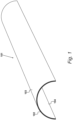
- Figure 1 illustrates a composite carbon-fibre component, made using a laminating process.
- Component 101 has a hemicylindrical shape, and is designed to be fixed to a similar component to create a cylindrical duct or pipe. It is approximately 10 cm wide and the wall thickness is around 2 mm.
- Component 101 comprises several layers 102 of reinforcement material, shown diagrammatically at the edge. These have been layered on in the form of prepregs, as will be further described with reference to Figure 5 .
- Component 101 has an outer surface 103, whose shape is defined by the mould in which the component was made, and an inner surface 104, whose shape is defined by the number of layers in the laminate and the way in which they were laid on. For example, a component with a thicker wall can be made by adding more layers.
- Figure 2 details steps that are taken in the manufacturing process to create component 101.
- a solid pattern is created, usually by machining a suitable material. For example, for a carbon-fibre component, epoxy tooling board is frequently used.
- a tooling component or mould is created from the pattern, and at step 203 the final component 101 is created using this mould.
- the tooling component and the final component are made in the same way, by creating a composite laminate of prepregs.
- the difference between the two types of component is in the number of layers used and the weight of the prepregs.
- Prepregs can be manufactured in varying weights, and may be suitable for making either tooling or final components.
- the specific prepregs forming part of the invention will be described with reference to Figures 6 to 10 .
- Figure 3 illustrates pattern 301 that is used in the construction of component 101. It is a solid pattern machined from epoxy tooling board, and its top surface 302 has the shape required by the top surface 103 of component 101.
- FIG 4 illustrates pattern 301 with mould 401 constructed on top of it.
- Mould 401 is a composite carbon-fibre tooling component constructed by placing a number of layers, including layers 402 and 403 (shown diagrammatically), of prepreg onto pattern 301.
- mould 401 has an inner surface 404 and an outer surface 405.
- Inner surface 404 is the negative shape of top surface 302 of pattern 301, and therefore of the outer surface 103 of component 101.
- the composite laminate is constructed as follows. First a layer of thin surface ply prepreg is laid on, which in this embodiment has a weight of 185 g/m 2 . This creates the smooth inner surface 404. The surface ply fabric 402 used for this layer will be described further with reference to Figure 10 .
- each bulk ply layer has a weight of 1020 g/m 2 .
- the bulk ply fabric 403 used for these layers will be described further with reference to Figures 6 to 9 .
- a final layer of surface ply is then added.
- a single debulking operation is carried out after the first layer of bulk ply, as will be described further with reference to Figure 5 .
- mould 401 is cured under heat and pressure.
- a preferred method of curing is to place mould 401 and pattern 301 in a vacuum bag, pulling the vacuum from the bag, and then placing it into an autoclave. Before the vacuum bag is placed in the autoclave, a vacuum drop test may be conducted to ensure the vacuum integrity.
- the autoclave applies a vacuum to the vacuum bag, pressurises the vessel to typically 6 bar [600 kPa], and heats the air around it.
- a typical curing process for a tooling prepreg would be 8-12 hours at around 45 °C. At this temperature, any difference between the expansion coefficients of the carbon in mould 401 and the tooling board from which pattern 301 is made is negligible.
- Mould 401 is then removed from pattern 301 and is placed in an oven for post-curing. In this process the temperature is ramped up gradually over around twenty hours from about 50 °C to 195 °C. This causes full cross-linking of the resin while gradually increasing the glass transition temperature, but not exceeding it which would cause the resin to become rubbery. Mould 401 is then ready to be used to make component 101 and hundreds of identical components.
- the wall of mould 401 is typically around 6 mm thick. This thickness generally provides enough strength and solidity to be used as a tooling component. However, depending upon requirements, a tooling component could be thinner or thicker.
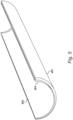
- Figure 5 illustrates a first layer and second layer of a composite laminate being laid inside mould 401, in order to construct component 101.
- Component 101 comprises a plurality of layers 102 of prepreg. Generally these layers are thinner and not as many of them are required as for mould 401. The number of layers will depend on the strength, thickness, and weight requirements of the final component.
- a first layer of visible grade prepreg 501 forms outer surface 103 of component 101.
- Two further layers of 400 g/m 2 will be added to finish the laminate.
- the 400 g/m 2 prepreg 502 is formed in the same way as bulk ply fabric 403, which will be described with reference to Figures 6 to 9 .
- layers 501 and 502 are not exactly the same size as mould 401 and overlap it at the edge.
- the final component 101 will be machined to remove these inaccuracies.
- a similar process may be required for mould 401 , although in that case the edge inaccuracies may be acceptable.
- component 101 and mould 401 are placed in a vacuum bag inside an autoclave.
- the autoclave applies pressure and heat, and component 101 is cured by ramping up to a temperature of around 120 °C to 130 °C over one hour. It is possible to cure at this higher temperature because mould 401 and component 101 are made of the same materials and therefore have the same expansion coefficients.
- the component may then be post-cured in an oven ramped up to around 190 °C over a period of time.
- a component that will be subjected to high temperature such as in a racing car, may need to be post-cured.
- a component that will not be subjected to heat or does not need to be quite so strong may not require post-curing.
- voids may be formed within the resin in the finished product, which reduce the component's strength.
- surface pinholing or inclusions, which occur when air migrates outwards during curing from free space within the laminate stack.
- FIG 6 shows a plan view of part of a sheet of fabric 600 used to create bulk ply prepreg 403.
- a cross-section across line A-A will be illustrated in Figure 7 .
- Bulk ply 403 is a woven multi-layer fabric pre-impregnated with a polymer matrix.
- the fabric is woven from carbon-fibre tows, but it could also be made from tows of any other suitable fibre, such as glass-fibre or natural fibres such as flax or hemp.
- the polymer matrix is epoxy resin, but it could be any other suitable resin or other matrix.
- the fabric is woven by passing wefts, such as wefts 601 , 602 and 603 , over and under a number of warps, such as warps 611 , 612 and 613.
- the wefts are usually formed from a single tow being passed in one direction and then the other.
- Each weft and warp is, in this example, a 12K carbon-fibre tow that is a bundle of around 12,000 carbon-fibre filaments.
- Figure 6 illustrates a part only of the fabric; the entire fabric sheet 600 is much larger.
- the fabric is a satin weave, meaning that each weft goes under a number of warps and then over a single warp. In this example it is five-harness satin weave, which goes under four warps, but other variations of satin weave could be used. Wherever the weft goes under the warps, long parallel floats are created, such as floats 621 and 622.
- Typical methods of pre-impregnating sheets of fibres include the hot melt method and the solution dip method.
- a resin film is cast onto a carrier, typically a coated industrial paper.
- the fabric and film are passed through heated rollers which heat the resin, transfer the resin to the fabric, and force partial impregnation of the resin into the fibre web, from the paper upwards.
- This method can leave a lot of dry fibre in the fabric, depending on how thick it is.
- the pressure of the rollers consolidates the resin in the fabric and also spreads and flattens the tows, which improves fibre packing and reduces the amount of enclosed free space for air.
- the area density (also referred to as the weight) of fabric sheet 600 is 510 g/m 2 .
- This sheet could be used as a prepreg. Satin weave fabrics, however, are difficult to work with because while they are very drapeable, they do not have good stability. When working around an edge or a corner, the fabric will tend to thin and even split due to the long floats, which create large areas of unidirectional filaments.
- a similar sheet of woven fabric is used to create prepreg 502, which is used in component 101.
- a thinner tow is used for the warps and wefts, leading to an area density of 200 g/m 2 .
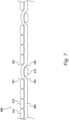
- Figure 7 shows a cross-section of part of fabric 600 along the line A-A shown in Figure 6 .
- Weft 603 passes under four warps, including warps 611 and 612 , before passing over a single warp 613. This is repeated across the whole fabric. If a cross-section were shown in the orthogonal direction it would have the same layout but upside-down, with a warp passing over four wefts and over one. Therefore, the fabric has long parallel floats on both sides, with those on one side being orthogonal to those on the other side.
- warp 611 forms float 621
- warp 612 forms float 622.
- crimping occurs where the weft passes over or under the warps, which leaves free space in the fabric. There is some free space between the adjacent tows, but crimping creates even more. For example, there is free space at 701 , 702, 703 and 704 where weft 603 passes over warp 613.
- Typical prepregs use a twill weave, which provides a compromise between drape and strength, in which each weft goes under two warps and over two warps (as will be shown in Figure 10 ). This results in a large amount of crimping, and therefore a large amount of free space.
- the crimping increases with the weight of the fibre tow, so a thicker fabric has relatively more free space. Some free space is enclosed within a single layer of fabric, and some enclosed free space is created between layers of prepregs when creating a laminate.
- Each warp and weft is a bundle of carbon-fibre filaments.
- the tows are supplied for weaving in a flattened circle shape known as a ribbon, as can be seen in Figure 7 .
- the pre-impregnation process flattens the tows further which improves fibre packing.
- the long parallel floats of a satin weave make it easier for this flattening to occur, thereby further reducing the free space in the fabric.
- Figure 8 details steps in the process of creating the fabric prepreg 403 used for the bulk ply layers of mould 401 (such as layer 403 ) and the fabric 502 used for the prepreg layers of component 101.
- two sheets of satin weave fabric such as sheet 600 are woven. These are substantially identical, woven using the same weight of tow of the same fibre, and in the same satin weave which in this example is five-harness.
- the sheets are elongate, thereby having a longitudinal direction and/or extent.
- the sheets are provided wound as rolls, and each sheet may have a length of between 100 m to 200 m. However, it will be appreciated that other lengths may be considered such as between 50 m and 500 m.
- the sheets may then be unrolled from their rolled state. Whilst being unrolled, the sheets are processed as per the below, with their longitudinal directions or extents aligned or substantially aligned. That is to say that, as the sheets are being unrolled, the unrolled portion of the sheets are aligned and run alongside each other and can be processed as per the below to allow continuous formation of the fabric prepreg 403.
- the sheets are pre-impregnated with resin.
- the warp side of one sheet i.e. the side on which the long floats of the warps are visible, is pre-impregnated at step 802. This can be done by the hot melt system, placing the warp side onto the resin paper. Under the heat and pressure of the rollers, the resin will be well consolidated into the warp side but there will be dry fibre left on the weft side.
- the weft side of the other sheet is pre-impregnated.
- the two sheets are placed together with the weft sides facing, so that the long floats nest together. Because the sheets were pre-impregnated on different sides, the dry side of one sheet faces the resin side of the other sheet.
- the two fabrics are then subjected to a secondary process of consolidation under heat and pressure at step 805.
- This process packs the fibres of the two sheets together, consolidates the resin throughout the remaining dry fibre, and adheres the two sheets together to create a single multi-layer fabric having an area density of 1020 g/m 2 .
- This secondary consolidation process could be carried out by the same machine that pre-impregnates the sheets, or by a different machine.
- the resulting fabric prepreg is also elongate.
- the fabric prepreg may then be cut into pieces, such as square sheets, via cutting transversely to a longitudinal direction. This may be done automatically and continuously on a conveyorised computer numerical control (CNC) machine.
- CNC computer numerical control
- a woven fabric prepreg for constructing a composite laminate comprising two sheets of fabric woven from tows of fibres, impregnated with a polymer matrix and adhered together.
- the sheets are woven in a satin weave such that the tows create long floats on at least one side.
- the sheets are positioned face-to-face with the long floats parallel, such that the tows pack together and the space between the sheets is minimised.
- the two sheets could be placed with the warp sides facing instead of the weft sides.
- the sheets are square, one sheet could be rotated by 90° and the sheets placed warp side to weft side so that the direction of the long floats is matched. In this case, it would be preferable to pre-impregnate the same side of each sheet.
- either sheet could be pre-impregnated on the other side from that stated here, so that the sheets are placed with dry sides together or resin sides together.
- Figure 9 shows a diagrammatic cross section through bulk ply layer 403. It comprises two substantially identical woven sheets, sheet 600 and sheet 900 , which have been consolidated to create a multi-layer fabric as described with reference to Figure 8 .
- Wefts, such as wefts 601 and 602 , of sheet 600 are placed parallel to the warps, such as warps 901 and 902 , of sheet 900. It is not necessary for them to be in the exact configuration shown in this Figure, only for the long floats to be parallel, i.e. running in the same direction.
- Resin 903 is consolidated throughout the two sheets, leaving only a few small pockets of air such as at 904 and 905.
- the secondary process of consolidation not only consolidates the resin throughout both sheets 600 and 900 and adheres them together to create a single multi-layer fabric 403 , it also improves fibre packing to reduce enclosed free space.
- the long floats nest together under pressure, with the filaments of the tows spreading into the free space of the opposing sheet.
- Figure 9 is a diagram of the fabric rather than an illustration; the actual fabric will have even less enclosed free space than that shown here.
- fabric 403 Because fabric 403 is almost fully consolidated and has little enclosed free space, it requires less debulking than known prepregs. It is generally understood in the industry that debulking should take place after every addition of layers totalling an area density of around 1000 g/m 2 . However, fabric 403 , despite having an area density of 1020 g/m 2 , requires less debulking. For example, debulking may only be required every three layers or more. This considerably speeds up the process of creating a laminate. Further, since each debulking procedure requires single-use items such as a vacuum bag and breather fabric or similar, using fabric 403 results in less waste.
- Fabric 403 because it has a satin weave, is far more drapeable than known fabrics of the same weight. However, unlike known satin-weave fabrics, it has good stability and is easy to use. Further, the large areas of unidirectional fibres created by nesting the floats of the two sheets together result in a very strong laminate.
- the same process described herein can be used to make a multi-layer satin-weave fabric of any area density.
- the 400 g/m 2 prepreg 502 is created in the same way.
- a fabric according to the invention could be manufactured using any weight of tow, any suitable fibre, and any suitable polymer matrix.
- a reasonable range for the area density of each sheet is between 60 g/m 2 and 1500 g/m 2 , resulting in a possible range for the multi-layer bulk ply of between 120 g/m 2 and 3000 g/m 2 .
- the two sheets are adhered together by the polymer matrix, but in other embodiments an additional adhesive could be used, dependent on the method used to consolidate the sheets together.
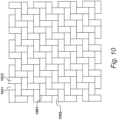
- Part of surface ply prepreg 402 is shown in plan view in Figure 10 .
- This fabric is a twill weave, in which wefts such as weft 1001 and 1002 go over two warps and under two warps, such as warps 1011 and 1012.
- wefts such as weft 1001 and 1002 go over two warps and under two warps, such as warps 1011 and 1012.
- the enclosed free space in the fabric must be minimised. This is done by reducing the space between the tows and reducing the crimp.
- the 3K tows i.e. tows having 3000 filaments
- the fabric has an area density of 185 g/m 2 , which is lighter than any previous surface ply.
- Surface ply prepreg generally has an additional coating of resin on one side. This side is placed downwards on the pattern, and the additional resin creates a smoother inner surface of the mould.
- the surface ply used in a laminate would be made from the same fibre and polymer matrix as the bulk ply.
- any suitable fibre or matrix can be used.
- Figure 11 details step 202 at which a tooling component such as mould 401 is constructed using fabrics 402 and 403.
- a layer of surface ply 402 is placed onto pattern 301 and at step 1102 a first layer of bulk ply 403 is added having the same orientation. This means that the warp and weft of one fabric are parallel/orthogonal to the warp and weft of the other fabric.
- the laminate stack is debulked. It has been found that no further debulking subsequent to this step is required during addition of subsequent layers.
- step 1104 four further layers of bulk ply 403 are added, with alternating orientations, so that the warp and weft of each fabric is at around 45° to the warp and weft of the previous fabric.
- step 1105 a final layer of surface ply 402 is added, having the same orientation as the first layer of surface ply. Constructing the laminate stack with these orientations ensures that the laminate is balanced, which improves strength.
- the laminate is a 1:5:1 laminate, since there is a first surface layer 402, five bulk layers 403, and a second surface layer 402.
- the laminate stack is then cured in an autoclave at step 1106 , before being post-cured in an oven at step 1107.
- a known tooling component may comprise one layer of thin surface ply having a weight of between 193 g/m 2 and 205 g/m 2 , eight layers of thicker bulk ply having a weight of between 625 g/m 2 and 680 g/m 2 , followed by a final layer of surface ply. It will need debulking after the first layer of surface ply and after every two layers of bulk ply, i.e., four times. However, for mould 401 constructed using the fabrics 402 and 403 described herein, only one debulking procedure is required.
- the time taken to construct mould 401 is half the time taken to construct a known tooling component.
- Figure 12 details step 203 at which a plurality of components such as component 101 is constructed using mould 401.
- a visual grade prepreg may be layered in the mould, depending on the finish required on the component.
- the required number of layers of component prepreg 502 are added.
- the component is cured in an autoclave and at step 1204 it is post-cured in an oven.
- it is trimmed to its final shape, such as by machining. Step 203 is repeated until the required number of components have been made, or until mould 401 cannot be used any more.
- a final component such as component 101 usually has fewer layers in its laminate than a tooling component, but still requires debulking when using known prepregs.
Landscapes
- Engineering & Computer Science (AREA)
- Textile Engineering (AREA)
- Chemical & Material Sciences (AREA)
- Mechanical Engineering (AREA)
- Composite Materials (AREA)
- Materials Engineering (AREA)
- Manufacturing & Machinery (AREA)
- Health & Medical Sciences (AREA)
- Chemical Kinetics & Catalysis (AREA)
- Medicinal Chemistry (AREA)
- Polymers & Plastics (AREA)
- Organic Chemistry (AREA)
- Reinforced Plastic Materials (AREA)
- Laminated Bodies (AREA)
Priority Applications (1)
| Application Number | Priority Date | Filing Date | Title |
|---|---|---|---|
| EP25152954.1A EP4520521A3 (de) | 2022-04-11 | 2023-03-31 | Verstärkungsmaterial für verbundlaminat |
Applications Claiming Priority (2)
| Application Number | Priority Date | Filing Date | Title |
|---|---|---|---|
| GBGB2205270.8A GB202205270D0 (en) | 2022-04-11 | 2022-04-11 | Reinforcement material for composite laminate |
| GB2217233.2A GB2614600B (en) | 2022-04-11 | 2022-11-17 | Reinforcement material for composite laminate |
Related Child Applications (2)
| Application Number | Title | Priority Date | Filing Date |
|---|---|---|---|
| EP25152954.1A Division EP4520521A3 (de) | 2022-04-11 | 2023-03-31 | Verstärkungsmaterial für verbundlaminat |
| EP25152954.1A Division-Into EP4520521A3 (de) | 2022-04-11 | 2023-03-31 | Verstärkungsmaterial für verbundlaminat |
Publications (3)
| Publication Number | Publication Date |
|---|---|
| EP4261021A1 true EP4261021A1 (de) | 2023-10-18 |
| EP4261021B1 EP4261021B1 (de) | 2025-02-26 |
| EP4261021C0 EP4261021C0 (de) | 2025-02-26 |
Family
ID=85800318
Family Applications (2)
| Application Number | Title | Priority Date | Filing Date |
|---|---|---|---|
| EP25152954.1A Pending EP4520521A3 (de) | 2022-04-11 | 2023-03-31 | Verstärkungsmaterial für verbundlaminat |
| EP23166214.9A Active EP4261021B1 (de) | 2022-04-11 | 2023-03-31 | Verstärkungsmaterial für verbundlaminat |
Family Applications Before (1)
| Application Number | Title | Priority Date | Filing Date |
|---|---|---|---|
| EP25152954.1A Pending EP4520521A3 (de) | 2022-04-11 | 2023-03-31 | Verstärkungsmaterial für verbundlaminat |
Country Status (5)
| Country | Link |
|---|---|
| US (1) | US20230323054A1 (de) |
| EP (2) | EP4520521A3 (de) |
| ES (1) | ES3030323T3 (de) |
| GB (1) | GB2622323B (de) |
| PL (1) | PL4261021T3 (de) |
Families Citing this family (1)
| Publication number | Priority date | Publication date | Assignee | Title |
|---|---|---|---|---|
| US12528258B2 (en) * | 2023-05-26 | 2026-01-20 | Rtx Corporation | Manufacturing fiber-reinforced composite body with multiple laminated layers |
Citations (3)
| Publication number | Priority date | Publication date | Assignee | Title |
|---|---|---|---|---|
| EP0595384A1 (de) * | 1992-10-26 | 1994-05-04 | General Motors Corporation | Zusammengesetztes Blattventil aus Polymer |
| JP2001055642A (ja) * | 1999-08-12 | 2001-02-27 | Nitto Boseki Co Ltd | 樹脂補強用クロス及びそれを用いた積層板 |
| CN114179462A (zh) * | 2022-02-16 | 2022-03-15 | 北京玻钢院复合材料有限公司 | 一种自粘型复合材料蜂窝板及制备方法 |
Family Cites Families (1)
| Publication number | Priority date | Publication date | Assignee | Title |
|---|---|---|---|---|
| CN210458024U (zh) * | 2019-06-26 | 2020-05-05 | 湖北航宇新型材料股份有限公司 | 一种环氧阻燃预浸料布 |
-
2022
- 2022-11-17 GB GB2317149.9A patent/GB2622323B/en active Active
-
2023
- 2023-03-31 PL PL23166214.9T patent/PL4261021T3/pl unknown
- 2023-03-31 EP EP25152954.1A patent/EP4520521A3/de active Pending
- 2023-03-31 ES ES23166214T patent/ES3030323T3/es active Active
- 2023-03-31 EP EP23166214.9A patent/EP4261021B1/de active Active
- 2023-04-10 US US18/298,107 patent/US20230323054A1/en active Pending
Patent Citations (3)
| Publication number | Priority date | Publication date | Assignee | Title |
|---|---|---|---|---|
| EP0595384A1 (de) * | 1992-10-26 | 1994-05-04 | General Motors Corporation | Zusammengesetztes Blattventil aus Polymer |
| JP2001055642A (ja) * | 1999-08-12 | 2001-02-27 | Nitto Boseki Co Ltd | 樹脂補強用クロス及びそれを用いた積層板 |
| CN114179462A (zh) * | 2022-02-16 | 2022-03-15 | 北京玻钢院复合材料有限公司 | 一种自粘型复合材料蜂窝板及制备方法 |
Also Published As
| Publication number | Publication date |
|---|---|
| US20230323054A1 (en) | 2023-10-12 |
| EP4520521A3 (de) | 2025-06-04 |
| GB2622323A (en) | 2024-03-13 |
| ES3030323T3 (en) | 2025-06-27 |
| EP4261021B1 (de) | 2025-02-26 |
| EP4520521A2 (de) | 2025-03-12 |
| GB202317149D0 (en) | 2023-12-20 |
| PL4261021T3 (pl) | 2025-06-23 |
| EP4261021C0 (de) | 2025-02-26 |
| GB2622323B (en) | 2025-02-12 |
Similar Documents
| Publication | Publication Date | Title |
|---|---|---|
| US10821680B2 (en) | Curable prepregs with surface openings | |
| EP1899146B1 (de) | Verfahren zur Herstellung gekrümmter Verbundstofftragelemente | |
| KR101886877B1 (ko) | 직조 모재, 복합물 및 그 제조방법 | |
| US8142583B2 (en) | Method for production of several fibre composite components | |
| EP1338406A2 (de) | Formmassen und Verfahren zu deren Herstellung | |
| US20140227474A1 (en) | Multi-layer fabric, use thereof and method for producing composites | |
| EP1547756A1 (de) | Verfahren zur Herstellung von Flugzeugsteilen | |
| US20140342630A1 (en) | Woven fabric preforms and process for making the same | |
| WO2015047480A2 (en) | Composite flange with three-dimensional weave architecture | |
| US20030104156A1 (en) | Composite material | |
| US20030124287A1 (en) | Integrally reinforced composite sandwich joint and process for making the same | |
| EP4261021B1 (de) | Verstärkungsmaterial für verbundlaminat | |
| CN114055882A (zh) | 用于制造夹层面板的方法、夹层面板和制造工具 | |
| US20240131807A1 (en) | Method for manufacturing a composite part and preform for manufacturing same | |
| Hasanzadeh et al. | Advanced fibrous composites for aircraft application | |
| GB2614600A (en) | Reinforcement material for composite laminate | |
| WO2022091121A1 (en) | Method of producing flexible seals and flexible seals produced therefrom | |
| US20240391183A1 (en) | Manufacturing fiber-reinforced composite body with multiple laminated layers | |
| US11433625B2 (en) | Composite with infusion film systems and methods | |
| King | A production engineers view of advanced composite materials: Part 2 The manufacture of advanced composites, components and structures | |
| GB2640453A (en) | Basalt fabric material | |
| Venkataraman et al. | Review on hybrid yarns, textile structures and techniques | |
| Venkataraman et al. | Review on Hybrid Yarn, Structure and Techniques | |
| HK1115098B (en) | Method of manufacturing curved composite structural elements |
Legal Events
| Date | Code | Title | Description |
|---|---|---|---|
| PUAI | Public reference made under article 153(3) epc to a published international application that has entered the european phase |
Free format text: ORIGINAL CODE: 0009012 |
|
| STAA | Information on the status of an ep patent application or granted ep patent |
Free format text: STATUS: THE APPLICATION HAS BEEN PUBLISHED |
|
| AK | Designated contracting states |
Kind code of ref document: A1 Designated state(s): AL AT BE BG CH CY CZ DE DK EE ES FI FR GB GR HR HU IE IS IT LI LT LU LV MC ME MK MT NL NO PL PT RO RS SE SI SK SM TR |
|
| STAA | Information on the status of an ep patent application or granted ep patent |
Free format text: STATUS: REQUEST FOR EXAMINATION WAS MADE |
|
| 17P | Request for examination filed |
Effective date: 20240418 |
|
| RBV | Designated contracting states (corrected) |
Designated state(s): AL AT BE BG CH CY CZ DE DK EE ES FI FR GB GR HR HU IE IS IT LI LT LU LV MC ME MK MT NL NO PL PT RO RS SE SI SK SM TR |
|
| GRAP | Despatch of communication of intention to grant a patent |
Free format text: ORIGINAL CODE: EPIDOSNIGR1 |
|
| STAA | Information on the status of an ep patent application or granted ep patent |
Free format text: STATUS: GRANT OF PATENT IS INTENDED |
|
| RIC1 | Information provided on ipc code assigned before grant |
Ipc: B32B 7/12 20060101ALI20240904BHEP Ipc: B32B 5/26 20060101ALI20240904BHEP Ipc: B32B 5/02 20060101ALI20240904BHEP Ipc: B32B 1/08 20060101ALI20240904BHEP Ipc: B29B 11/16 20060101ALI20240904BHEP Ipc: B29C 70/30 20060101ALI20240904BHEP Ipc: B29C 70/22 20060101AFI20240904BHEP |
|
| INTG | Intention to grant announced |
Effective date: 20240917 |
|
| GRAS | Grant fee paid |
Free format text: ORIGINAL CODE: EPIDOSNIGR3 |
|
| GRAA | (expected) grant |
Free format text: ORIGINAL CODE: 0009210 |
|
| STAA | Information on the status of an ep patent application or granted ep patent |
Free format text: STATUS: THE PATENT HAS BEEN GRANTED |
|
| AK | Designated contracting states |
Kind code of ref document: B1 Designated state(s): AL AT BE BG CH CY CZ DE DK EE ES FI FR GB GR HR HU IE IS IT LI LT LU LV MC ME MK MT NL NO PL PT RO RS SE SI SK SM TR |
|
| REG | Reference to a national code |
Ref country code: GB Ref legal event code: FG4D |
|
| REG | Reference to a national code |
Ref country code: CH Ref legal event code: EP |
|
| REG | Reference to a national code |
Ref country code: DE Ref legal event code: R096 Ref document number: 602023002154 Country of ref document: DE |
|
| REG | Reference to a national code |
Ref country code: IE Ref legal event code: FG4D |
|
| U01 | Request for unitary effect filed |
Effective date: 20250324 |
|
| U07 | Unitary effect registered |
Designated state(s): AT BE BG DE DK EE FI FR IT LT LU LV MT NL PT RO SE SI Effective date: 20250328 |
|
| U20 | Renewal fee for the european patent with unitary effect paid |
Year of fee payment: 3 Effective date: 20250513 |
|
| REG | Reference to a national code |
Ref country code: ES Ref legal event code: FG2A Ref document number: 3030323 Country of ref document: ES Kind code of ref document: T3 Effective date: 20250627 |
|
| PG25 | Lapsed in a contracting state [announced via postgrant information from national office to epo] |
Ref country code: RS Free format text: LAPSE BECAUSE OF FAILURE TO SUBMIT A TRANSLATION OF THE DESCRIPTION OR TO PAY THE FEE WITHIN THE PRESCRIBED TIME-LIMIT Effective date: 20250526 |
|
| PGFP | Annual fee paid to national office [announced via postgrant information from national office to epo] |
Ref country code: ES Payment date: 20250529 Year of fee payment: 3 |
|
| PG25 | Lapsed in a contracting state [announced via postgrant information from national office to epo] |
Ref country code: NO Free format text: LAPSE BECAUSE OF FAILURE TO SUBMIT A TRANSLATION OF THE DESCRIPTION OR TO PAY THE FEE WITHIN THE PRESCRIBED TIME-LIMIT Effective date: 20250526 Ref country code: IS Free format text: LAPSE BECAUSE OF FAILURE TO SUBMIT A TRANSLATION OF THE DESCRIPTION OR TO PAY THE FEE WITHIN THE PRESCRIBED TIME-LIMIT Effective date: 20250626 |
|
| PG25 | Lapsed in a contracting state [announced via postgrant information from national office to epo] |
Ref country code: HR Free format text: LAPSE BECAUSE OF FAILURE TO SUBMIT A TRANSLATION OF THE DESCRIPTION OR TO PAY THE FEE WITHIN THE PRESCRIBED TIME-LIMIT Effective date: 20250226 |
|
| PG25 | Lapsed in a contracting state [announced via postgrant information from national office to epo] |
Ref country code: GR Free format text: LAPSE BECAUSE OF FAILURE TO SUBMIT A TRANSLATION OF THE DESCRIPTION OR TO PAY THE FEE WITHIN THE PRESCRIBED TIME-LIMIT Effective date: 20250527 |
|
| PG25 | Lapsed in a contracting state [announced via postgrant information from national office to epo] |
Ref country code: SM Free format text: LAPSE BECAUSE OF FAILURE TO SUBMIT A TRANSLATION OF THE DESCRIPTION OR TO PAY THE FEE WITHIN THE PRESCRIBED TIME-LIMIT Effective date: 20250226 |
|
| PG25 | Lapsed in a contracting state [announced via postgrant information from national office to epo] |
Ref country code: CZ Free format text: LAPSE BECAUSE OF FAILURE TO SUBMIT A TRANSLATION OF THE DESCRIPTION OR TO PAY THE FEE WITHIN THE PRESCRIBED TIME-LIMIT Effective date: 20250226 |
|
| PG25 | Lapsed in a contracting state [announced via postgrant information from national office to epo] |
Ref country code: SK Free format text: LAPSE BECAUSE OF FAILURE TO SUBMIT A TRANSLATION OF THE DESCRIPTION OR TO PAY THE FEE WITHIN THE PRESCRIBED TIME-LIMIT Effective date: 20250226 |
|
| PG25 | Lapsed in a contracting state [announced via postgrant information from national office to epo] |
Ref country code: MC Free format text: LAPSE BECAUSE OF FAILURE TO SUBMIT A TRANSLATION OF THE DESCRIPTION OR TO PAY THE FEE WITHIN THE PRESCRIBED TIME-LIMIT Effective date: 20250226 |
|
| PLBE | No opposition filed within time limit |
Free format text: ORIGINAL CODE: 0009261 |
|
| STAA | Information on the status of an ep patent application or granted ep patent |
Free format text: STATUS: NO OPPOSITION FILED WITHIN TIME LIMIT |
|
| REG | Reference to a national code |
Ref country code: CH Ref legal event code: L10 Free format text: ST27 STATUS EVENT CODE: U-0-0-L10-L00 (AS PROVIDED BY THE NATIONAL OFFICE) Effective date: 20260107 |
|
| 26N | No opposition filed |
Effective date: 20251127 |
|
| REG | Reference to a national code |
Ref country code: CH Ref legal event code: U11 Free format text: ST27 STATUS EVENT CODE: U-0-0-U10-U11 (AS PROVIDED BY THE NATIONAL OFFICE) Effective date: 20260401 |
|
| U20 | Renewal fee for the european patent with unitary effect paid |
Year of fee payment: 4 Effective date: 20260305 |
|
| PGFP | Annual fee paid to national office [announced via postgrant information from national office to epo] |
Ref country code: IE Payment date: 20260304 Year of fee payment: 4 |
|
| PGFP | Annual fee paid to national office [announced via postgrant information from national office to epo] |
Ref country code: PL Payment date: 20260305 Year of fee payment: 4 |