EP4265183A1 - Automatisiertes system zur kontrolle des blutzuckerspiegels eines patienten - Google Patents
Automatisiertes system zur kontrolle des blutzuckerspiegels eines patienten Download PDFInfo
- Publication number
- EP4265183A1 EP4265183A1 EP23196894.2A EP23196894A EP4265183A1 EP 4265183 A1 EP4265183 A1 EP 4265183A1 EP 23196894 A EP23196894 A EP 23196894A EP 4265183 A1 EP4265183 A1 EP 4265183A1
- Authority
- EP
- European Patent Office
- Prior art keywords
- blood sugar
- patient
- model
- state variables
- physiological model
- Prior art date
- Legal status (The legal status is an assumption and is not a legal conclusion. Google has not performed a legal analysis and makes no representation as to the accuracy of the status listed.)
- Granted
Links
Images

Classifications
-
- A—HUMAN NECESSITIES
- A61—MEDICAL OR VETERINARY SCIENCE; HYGIENE
- A61B—DIAGNOSIS; SURGERY; IDENTIFICATION
- A61B5/00—Measuring for diagnostic purposes; Identification of persons
- A61B5/48—Other medical applications
- A61B5/4836—Diagnosis combined with treatment in closed-loop systems or methods
- A61B5/4839—Diagnosis combined with treatment in closed-loop systems or methods combined with drug delivery
-
- A—HUMAN NECESSITIES
- A61—MEDICAL OR VETERINARY SCIENCE; HYGIENE
- A61M—DEVICES FOR INTRODUCING MEDIA INTO, OR ONTO, THE BODY; DEVICES FOR TRANSDUCING BODY MEDIA OR FOR TAKING MEDIA FROM THE BODY; DEVICES FOR PRODUCING OR ENDING SLEEP OR STUPOR
- A61M5/00—Devices for bringing media into the body in a subcutaneous, intra-vascular or intramuscular way; Accessories therefor, e.g. filling or cleaning devices, arm-rests
- A61M5/14—Infusion devices, e.g. infusing by gravity; Blood infusion; Accessories therefor
- A61M5/168—Means for controlling media flow to the body or for metering media to the body, e.g. drip meters, counters ; Monitoring media flow to the body
- A61M5/172—Means for controlling media flow to the body or for metering media to the body, e.g. drip meters, counters ; Monitoring media flow to the body electrical or electronic
- A61M5/1723—Means for controlling media flow to the body or for metering media to the body, e.g. drip meters, counters ; Monitoring media flow to the body electrical or electronic using feedback of body parameters, e.g. blood-sugar, pressure
-
- A—HUMAN NECESSITIES
- A61—MEDICAL OR VETERINARY SCIENCE; HYGIENE
- A61B—DIAGNOSIS; SURGERY; IDENTIFICATION
- A61B5/00—Measuring for diagnostic purposes; Identification of persons
- A61B5/145—Measuring characteristics of blood in vivo, e.g. gas concentration or pH-value ; Measuring characteristics of body fluids or tissues, e.g. interstitial fluid or cerebral tissue
- A61B5/14532—Measuring characteristics of blood in vivo, e.g. gas concentration or pH-value ; Measuring characteristics of body fluids or tissues, e.g. interstitial fluid or cerebral tissue for measuring glucose, e.g. by tissue impedance measurement
-
- A—HUMAN NECESSITIES
- A61—MEDICAL OR VETERINARY SCIENCE; HYGIENE
- A61B—DIAGNOSIS; SURGERY; IDENTIFICATION
- A61B5/00—Measuring for diagnostic purposes; Identification of persons
- A61B5/145—Measuring characteristics of blood in vivo, e.g. gas concentration or pH-value ; Measuring characteristics of body fluids or tissues, e.g. interstitial fluid or cerebral tissue
- A61B5/1495—Calibrating or testing of in-vivo probes
-
- A—HUMAN NECESSITIES
- A61—MEDICAL OR VETERINARY SCIENCE; HYGIENE
- A61M—DEVICES FOR INTRODUCING MEDIA INTO, OR ONTO, THE BODY; DEVICES FOR TRANSDUCING BODY MEDIA OR FOR TAKING MEDIA FROM THE BODY; DEVICES FOR PRODUCING OR ENDING SLEEP OR STUPOR
- A61M5/00—Devices for bringing media into the body in a subcutaneous, intra-vascular or intramuscular way; Accessories therefor, e.g. filling or cleaning devices, arm-rests
- A61M5/14—Infusion devices, e.g. infusing by gravity; Blood infusion; Accessories therefor
- A61M5/142—Pressure infusion, e.g. using pumps
-
- A—HUMAN NECESSITIES
- A61—MEDICAL OR VETERINARY SCIENCE; HYGIENE
- A61M—DEVICES FOR INTRODUCING MEDIA INTO, OR ONTO, THE BODY; DEVICES FOR TRANSDUCING BODY MEDIA OR FOR TAKING MEDIA FROM THE BODY; DEVICES FOR PRODUCING OR ENDING SLEEP OR STUPOR
- A61M5/00—Devices for bringing media into the body in a subcutaneous, intra-vascular or intramuscular way; Accessories therefor, e.g. filling or cleaning devices, arm-rests
- A61M5/14—Infusion devices, e.g. infusing by gravity; Blood infusion; Accessories therefor
- A61M5/142—Pressure infusion, e.g. using pumps
- A61M5/14244—Pressure infusion, e.g. using pumps adapted to be carried by the patient, e.g. portable on the body
- A61M5/14276—Pressure infusion, e.g. using pumps adapted to be carried by the patient, e.g. portable on the body specially adapted for implantation
-
- G—PHYSICS
- G16—INFORMATION AND COMMUNICATION TECHNOLOGY [ICT] SPECIALLY ADAPTED FOR SPECIFIC APPLICATION FIELDS
- G16H—HEALTHCARE INFORMATICS, i.e. INFORMATION AND COMMUNICATION TECHNOLOGY [ICT] SPECIALLY ADAPTED FOR THE HANDLING OR PROCESSING OF MEDICAL OR HEALTHCARE DATA
- G16H20/00—ICT specially adapted for therapies or health-improving plans, e.g. for handling prescriptions, for steering therapy or for monitoring patient compliance
- G16H20/10—ICT specially adapted for therapies or health-improving plans, e.g. for handling prescriptions, for steering therapy or for monitoring patient compliance relating to drugs or medications, e.g. for ensuring correct administration to patients
- G16H20/17—ICT specially adapted for therapies or health-improving plans, e.g. for handling prescriptions, for steering therapy or for monitoring patient compliance relating to drugs or medications, e.g. for ensuring correct administration to patients delivered via infusion or injection
-
- G—PHYSICS
- G16—INFORMATION AND COMMUNICATION TECHNOLOGY [ICT] SPECIALLY ADAPTED FOR SPECIFIC APPLICATION FIELDS
- G16H—HEALTHCARE INFORMATICS, i.e. INFORMATION AND COMMUNICATION TECHNOLOGY [ICT] SPECIALLY ADAPTED FOR THE HANDLING OR PROCESSING OF MEDICAL OR HEALTHCARE DATA
- G16H40/00—ICT specially adapted for the management or administration of healthcare resources or facilities; ICT specially adapted for the management or operation of medical equipment or devices
- G16H40/60—ICT specially adapted for the management or administration of healthcare resources or facilities; ICT specially adapted for the management or operation of medical equipment or devices for the operation of medical equipment or devices
- G16H40/63—ICT specially adapted for the management or administration of healthcare resources or facilities; ICT specially adapted for the management or operation of medical equipment or devices for the operation of medical equipment or devices for local operation
-
- G—PHYSICS
- G16—INFORMATION AND COMMUNICATION TECHNOLOGY [ICT] SPECIALLY ADAPTED FOR SPECIFIC APPLICATION FIELDS
- G16H—HEALTHCARE INFORMATICS, i.e. INFORMATION AND COMMUNICATION TECHNOLOGY [ICT] SPECIALLY ADAPTED FOR THE HANDLING OR PROCESSING OF MEDICAL OR HEALTHCARE DATA
- G16H50/00—ICT specially adapted for medical diagnosis, medical simulation or medical data mining; ICT specially adapted for detecting, monitoring or modelling epidemics or pandemics
- G16H50/20—ICT specially adapted for medical diagnosis, medical simulation or medical data mining; ICT specially adapted for detecting, monitoring or modelling epidemics or pandemics for computer-aided diagnosis, e.g. based on medical expert systems
-
- A—HUMAN NECESSITIES
- A61—MEDICAL OR VETERINARY SCIENCE; HYGIENE
- A61B—DIAGNOSIS; SURGERY; IDENTIFICATION
- A61B2560/00—Constructional details of operational features of apparatus; Accessories for medical measuring apparatus
- A61B2560/02—Operational features
- A61B2560/0223—Operational features of calibration, e.g. protocols for calibrating sensors
-
- A—HUMAN NECESSITIES
- A61—MEDICAL OR VETERINARY SCIENCE; HYGIENE
- A61B—DIAGNOSIS; SURGERY; IDENTIFICATION
- A61B5/00—Measuring for diagnostic purposes; Identification of persons
- A61B5/145—Measuring characteristics of blood in vivo, e.g. gas concentration or pH-value ; Measuring characteristics of body fluids or tissues, e.g. interstitial fluid or cerebral tissue
- A61B5/14503—Measuring characteristics of blood in vivo, e.g. gas concentration or pH-value ; Measuring characteristics of body fluids or tissues, e.g. interstitial fluid or cerebral tissue invasive, e.g. introduced into the body by a catheter or needle or using implanted sensors
-
- A—HUMAN NECESSITIES
- A61—MEDICAL OR VETERINARY SCIENCE; HYGIENE
- A61M—DEVICES FOR INTRODUCING MEDIA INTO, OR ONTO, THE BODY; DEVICES FOR TRANSDUCING BODY MEDIA OR FOR TAKING MEDIA FROM THE BODY; DEVICES FOR PRODUCING OR ENDING SLEEP OR STUPOR
- A61M5/00—Devices for bringing media into the body in a subcutaneous, intra-vascular or intramuscular way; Accessories therefor, e.g. filling or cleaning devices, arm-rests
- A61M5/14—Infusion devices, e.g. infusing by gravity; Blood infusion; Accessories therefor
- A61M5/142—Pressure infusion, e.g. using pumps
- A61M2005/14208—Pressure infusion, e.g. using pumps with a programmable infusion control system, characterised by the infusion program
-
- A—HUMAN NECESSITIES
- A61—MEDICAL OR VETERINARY SCIENCE; HYGIENE
- A61M—DEVICES FOR INTRODUCING MEDIA INTO, OR ONTO, THE BODY; DEVICES FOR TRANSDUCING BODY MEDIA OR FOR TAKING MEDIA FROM THE BODY; DEVICES FOR PRODUCING OR ENDING SLEEP OR STUPOR
- A61M5/00—Devices for bringing media into the body in a subcutaneous, intra-vascular or intramuscular way; Accessories therefor, e.g. filling or cleaning devices, arm-rests
- A61M5/14—Infusion devices, e.g. infusing by gravity; Blood infusion; Accessories therefor
- A61M5/168—Means for controlling media flow to the body or for metering media to the body, e.g. drip meters, counters ; Monitoring media flow to the body
- A61M5/172—Means for controlling media flow to the body or for metering media to the body, e.g. drip meters, counters ; Monitoring media flow to the body electrical or electronic
- A61M5/1723—Means for controlling media flow to the body or for metering media to the body, e.g. drip meters, counters ; Monitoring media flow to the body electrical or electronic using feedback of body parameters, e.g. blood-sugar, pressure
- A61M2005/1726—Means for controlling media flow to the body or for metering media to the body, e.g. drip meters, counters ; Monitoring media flow to the body electrical or electronic using feedback of body parameters, e.g. blood-sugar, pressure the body parameters being measured at, or proximate to, the infusion site
-
- A—HUMAN NECESSITIES
- A61—MEDICAL OR VETERINARY SCIENCE; HYGIENE
- A61M—DEVICES FOR INTRODUCING MEDIA INTO, OR ONTO, THE BODY; DEVICES FOR TRANSDUCING BODY MEDIA OR FOR TAKING MEDIA FROM THE BODY; DEVICES FOR PRODUCING OR ENDING SLEEP OR STUPOR
- A61M2205/00—General characteristics of the apparatus
- A61M2205/50—General characteristics of the apparatus with microprocessors or computers
- A61M2205/52—General characteristics of the apparatus with microprocessors or computers with memories providing a history of measured variating parameters of apparatus or patient
-
- A—HUMAN NECESSITIES
- A61—MEDICAL OR VETERINARY SCIENCE; HYGIENE
- A61M—DEVICES FOR INTRODUCING MEDIA INTO, OR ONTO, THE BODY; DEVICES FOR TRANSDUCING BODY MEDIA OR FOR TAKING MEDIA FROM THE BODY; DEVICES FOR PRODUCING OR ENDING SLEEP OR STUPOR
- A61M2230/00—Measuring parameters of the user
- A61M2230/005—Parameter used as control input for the apparatus
-
- A—HUMAN NECESSITIES
- A61—MEDICAL OR VETERINARY SCIENCE; HYGIENE
- A61M—DEVICES FOR INTRODUCING MEDIA INTO, OR ONTO, THE BODY; DEVICES FOR TRANSDUCING BODY MEDIA OR FOR TAKING MEDIA FROM THE BODY; DEVICES FOR PRODUCING OR ENDING SLEEP OR STUPOR
- A61M2230/00—Measuring parameters of the user
- A61M2230/20—Blood composition characteristics
- A61M2230/201—Glucose concentration
Definitions
- the present application concerns the field of automated blood sugar regulation systems, also called artificial pancreas.
- An artificial pancreas is a system that automatically regulates the insulin intake of a diabetic patient based on their blood sugar history, their meal intake history, and their insulin injection history.
- MPC type regulation systems from the English “Model-based Predictive Control”
- predictive control systems in which the regulation of the dose of insulin administered takes into account a prediction of the future evolution of the patient's blood sugar, made from a physiological model describing the assimilation of insulin by the patient's body and its impact on the patient's blood sugar.
- the quantity is representative of the area between a first curve g representative of the temporal evolution of the blood sugar estimated from the model over the observation period, and a second curve g representative of the evolution time of the blood glucose measured by the sensor over the observation period.
- the calibration method further comprises a step of estimating parameters of the system of differential equations by minimization of said quantity.
- the initial values of the state variables are determined analytically by assuming that all the derivatives of the system of differential equations are zero.
- the processing and control unit takes into account the history of insulin injected into the patient by the injection device and the history of glucose ingested by the patient.
- the physiological model is the Hovorka model.
- the method further comprises a step of estimating parameters of the system of differential equations by minimization of said quantity.
- the digital indicator comprises an indicator m representative of the area between a first curve g representative of the temporal evolution of the blood sugar estimated from the model over the observation period, and a second curve g representative of the temporal evolution of the blood glucose measured by the sensor over the observation period.
- the digital indicator comprises an indicator m 1 representative of the difference between the glycemia estimated from the model and the glycemia measured by the sensor at a given time.
- the digital indicator comprises an indicator m 2 representative of the difference between the derivative of the blood sugar estimated from the model and the derivative of the blood sugar measured by the sensor at a given time.
- the physiological model comprises a system of differential equations describing the evolution of a plurality of state variables as a function of time
- step a) of automatic calibration of the model comprises a step of estimation of parameters of the system of differential equations by minimization of a quantity representative of the error, during a past observation period, between the blood sugar estimated from the physiological model and the blood sugar measured by the sensor.
- step a) of automatic calibration of the model further comprises a step of determining initial values of the state variables.
- FIG. 1 schematically represents, in block form, an example of an embodiment of an automated system for regulating a patient's blood sugar.
- the system of figure 1 comprises a sensor 101 (CG) adapted to measure the patient's blood sugar.
- the sensor 101 can be permanently positioned on or in the patient's body, for example at the height of his abdomen.
- the sensor 101 is for example a CGM type sensor (from the English "Continuous Glucose Monitoring" - continuous blood glucose monitoring), that is to say a sensor adapted to measure continuously (for example at least once per minute) the patient's blood sugar.
- the sensor 101 is for example a subcutaneous blood glucose sensor.
- the system of figure 1 further comprises an insulin injection device 103 (PMP), for example a subcutaneous injection device.
- the device 103 is for example an automatic injection device of the insulin pump type, comprising an insulin reservoir connected to an injection needle implanted under the skin of the patient, the pump being able to be electrically controlled to automatically inject doses of insulin determined at specific times.
- the injection device 103 can be permanently positioned in or on the patient's body, for example at the level of his abdomen.
- the processing and control unit 105 is adapted to determine the doses of insulin to be injected into the patient by taking into account in particular the blood sugar history measured by the sensor 101, the history of insulin injected by the device 103 , and the history of glucose ingestion by the patient.
- the processing and control unit 105 comprises a digital calculation circuit (not detailed), comprising for example a microprocessor.
- the processing and control unit 105 is for example a mobile device worn by the patient throughout the day and/or night, for example a smartphone type device configured to implement a regulation method of the type described below.
- the MPC physiological model is a compartmental model comprising, in addition to the input variables i(t) and cho(t) and the output variable G(t), a plurality of state variables corresponding to physiological variables of the patient, evolving over time.
- the temporal evolution of the state variables is governed by a system of differential equations comprising a plurality of parameters represented on the figure 2 by a vector [PARAM] applied to an input p1 of the MPC block.
- the response of the physiological model is further conditioned by the initial states or initial values assigned to the state variables, represented on the figure 2 by a vector [INIT] applied to an input p2 of the MPC block.
- FIG. 3 is a diagram representing in more detail a (non-limiting) example of the MPC physiological model used in the system of figure 1 to predict the future evolution of the patient's blood sugar levels.
- This example model known as the Hovorka model, is described in more detail in the article titled " Nonlinear model predictive control of glucose concentration in subjects with type 1 diabetes" by Roman Hovorka et al. (Physiol Meas. 2004;25:905-920 ), and in the article entitled “ Partitioning glucose distribution/transport, disposal, and endogenous production during IVGTT", by Roman Hovorka et al. (Am J Physiol Endocrinol Metab 282: E992-E1007, 2002 ).
- the physiological model of Figure 3 comprises a first two-compartmental sub-model 301 describing the effect of dietary glucose intake on the rate of appearance of glucose in the blood plasma.
- the sub-model 301 takes as input the quantity of glucose ingested cho(t), for example in mmol/min, and provides at its output a rate U G of absorption of glucose into the blood plasma, for example in mmol/min .
- the submodel 301 includes two state variables D 1 and D 2 corresponding respectively to masses of glucose, for example in mmol, in first and second compartments.
- the model of the Figure 3 further comprises a third sub-model 305 describing the regulation of glucose by the patient's body.
- Submodel 305 takes as input the rates absorption U G of glucose and U I of insulin, and provides at its output the blood sugar G(t), that is to say the concentration of glucose in the blood plasma, for example in mmol/l.
- the submodel 305 includes six state variables Q 1 , Q 2 , x 3 , x 1 , x 2 , I.
- the variables Q1 and Q2 correspond respectively to masses of glucose, for example in mmol, in first and second compartments.
- the variables x 1 , x 2 , x 3 are unitless variables representing each of the actions of insulin on glucose kinetics.
- the variable I corresponds to insulinemia, that is to say the concentration of insulin in the blood plasma, for example in mU/l.
- V G , F 01 , k 12 , F R , EGP 0 , k b1 , k a1 , k b2 , k a2 , k b3 , k a3 , k a , V I , k e and t max are parameters.
- V G corresponds to the volume of distribution of glucose, for example in liters
- F 01 corresponds to a transfer rate of non-insulin-dependent glucose, for example in mmol/min
- k 12 corresponds to a transfer rate constant between the two compartments of submodel 305, for example in min -1
- k a1 , k a2 , k a3 correspond to insulin deactivation rate constants, for example in min -1
- F R corresponds to urinary excretion of glucose , for example in mmol/min
- EGP 0 corresponds to endogenous production of glucose, for example in min -1
- k b1 , k b2 and k b3 correspond to insulin activation rate constants
- k a corresponds to an absorption rate constant for insulin injected subcutaneously
- V I corresponds to the volume of distribution of insulin, for example in liters
- k e corresponds to a rate of elimination of insulin from
- the vector [INIT] comprises ten values corresponding to the initial values (at a time t 0 of start of a phase of simulation of the patient's behavior from the model) assigned to the ten state variables D 1 , D 2 , S 1 , S 2 , Q 1 , Q 2 , x 1 , x 2 , x 1 and I of the model.
- parameters of the vector [PARAM] some can be considered constant for a given patient. He these are for example the parameters k 12 , k a1 , k a2 , k a3 , k a , k e , V I , V G and t max .
- Other parameters hereinafter called time-dependent parameters, are however likely to change over time, for example the parameters k b1 , k b2 , k b3 , EGP 0 , F 01 and F R. Due to this variability of certain system parameters, it is in practice necessary to regularly re-calibrate or re-calibrate the model in use, for example every 1 to 20 minutes, to ensure that the predictions of the model remains relevant.
- This updating of the model also called personalization of the model, must be able to be carried out automatically by the system of the figure 1 , that is to say without it being necessary to physically measure the time-dependent parameters of the system on the patient and then transmit them to the processing and control unit 105.
- This method includes a step 401 of re-calibration or updating of the model, which can for example be repeated at regular intervals, for example every 1 to 20 minutes.
- the processing and control unit 105 implements a method of re-estimating the time-dependent parameters of the model taking into account the insulin data actually injected by the device 103 and the actual blood sugar data. measured by the sensor 101 during a past observation period, for example a period of 1 to 10 hours preceding the calibration step.
- the processing and control unit 105 simulates the behavior of the patient over the past observation period from the physiological model (taking into account possible glucose ingestions and injections of insulin during this period), and compares the blood sugar curve estimated by the model to the actual blood sugar curve measured by the sensor during this same period.
- the processing and control unit 105 searches, for the time-dependent parameters of the model, a set of values leading to minimizing a quantity representative of the error between the blood sugar curve estimated by the model and the actual blood sugar curve during the observation period.
- t is the discretized time variable
- t 0 corresponds to the start time of the past observation phase
- t 0 + ⁇ T corresponds to the end time of the past observation phase (corresponding for example to l 'start time of the model calibration step)
- g is the temporal evolution curve of the actual blood sugar measured by the sensor 101 during the period [t0, t 0 + ⁇ T]
- g is the curve of blood glucose estimated from the model during the period [t 0 , t 0 + ⁇ T].
- the optimal parameter search algorithm used during this step is not detailed in the present application, the embodiments described being compatible with the usual algorithms used in various fields
- the process of Figure 4 further comprises, after step 401, a step 403 of prediction, by the processing and control unit 105, of the temporal evolution of the patient's blood sugar over a period to come, from the physiological model updated. day in step 401 and taking into account the history of insulin injected into the patient and the history of glucose ingested by the patient.
- the process of figure 4 further comprises, after step 403, a step 405 of determination, by the processing and control unit 105, taking into account the future blood sugar curve predicted in step 403, doses of insulin to be injected into the patient for a future period.
- the processing and control unit 105 can program the injection device 103 to administer the determined doses during the period to come.
- the steps 403 of predicting the blood sugar level and 405 and determining the future doses of insulin to be administered can for example be repeated at each update of the physiological model (that is to say after each iteration of step 401 ), with each new ingestion of glucose reported by the patient, and/or with each new administration of a dose of insulin by the injection device 103.
- a problem which arises in the operation described above is that, when updating the physiological model in step 401, the processing and control unit 105 must define a vector [INIT] of initial states (states at t 0 ) of the state variables of the model, to be able to simulate the patient's behavior from the model.
- initial states are necessary not only to be able to predict the future evolution of the patient's blood sugar (step 403), but also during the step of updating the model itself (step 401), to be able to simulate the evolution of the patient's blood sugar during the past observation period, so that the simulated blood sugar can be compared to the measured blood sugar.
- a first possibility consists of making the hypothesis that, in the period preceding the observation period [t0, t 0 + ⁇ T] on which the calibration of the model is based , the patient was in a stationary state, with a constant flow of injected insulin, and zero food glucose intake. Under this assumption, all derivatives of the system of differential equations can be considered zero at the initial time t 0 . The values at t 0 of the system state variables can then be calculated analytically.
- the model output (estimated blood sugar) is not constrained. In particular, the estimated blood sugar at time t 0 may be different from the actual blood sugar measured at time t 0 . In this case, the algorithm implemented in step 401 of searching for the time-dependent parameters of the model by minimizing the error between the simulated blood sugar and the measured blood sugar may have difficulty converging.
- a second possibility consists of making the same hypotheses as previously, but by constraining the variable Q 1 (t 0 ) so that the blood sugar estimated at time t 0 is equal to the real blood sugar measured by the sensor. This makes it possible to improve the relevance of the initialization at time t 0 .
- the derivative of the estimated blood sugar and the derivative of the actual blood sugar may diverge.
- the algorithm for finding the time-dependent parameters of the system may again have difficulty converging.
- step 401 it is planned, during the calibration or updating phase of the model (step 401), to consider the initial states [INIT] of the model as random variables. , and to carry out, as is done to estimate the time-dependent parameters of the model, a search for an optimal set of initial state values by minimization of a quantity representative of the error between the estimated blood sugar curve from the model and the actual blood glucose curve during the observation period on which the calibration is based.
- the optimal values of the time-dependent parameters and the initial states of the state variables can be determined simultaneously, during the same step optimization of the model by minimizing the error between the estimated blood sugar and the actual blood sugar over the past observation period.
- the cumulative number of time-dependent parameters and variables d are relatively large, which can lead to numerical instability during the search for optimal values phase. In other words, certain values may be difficult or even impossible to estimate in a single search, the number of unknowns being too large.
- the problem can be decomposed into two sub-problems, corresponding respectively to the estimation of the time-dependent parameters of the model and to the estimation of the initial states of the model, as will now be described in relation to the figure 5 .
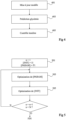
- FIG 5 is a diagram illustrating an example of an embodiment of an automated process for calibrating or updating the system of the figure 1 , corresponding to an example of implementation of step 401 of the figure 4 .
- This method includes a step 501 during which the parameter vector [PARAM] (reduced here to only the time-dependent parameters of the model) is initialized to a first set of values P1.
- the set P1 corresponds for example to the values taken by the parameters [PARAM] before the start of the model updating phase.
- the set of values P1 is a predetermined reference set corresponding for example to the average values taken by the parameters [PARAM] over a reference period.
- the initial state vector [INIT] of the state variables is further initialized to a first set of value I1.
- the set of values I1 is for example determined analytically as described above, assuming a stationary state of the patient in the period preceding the calibration phase, and making the blood sugar estimated at time t 0 and the actual blood sugar measured at this same time coincide .
- the processing and control unit 105 searches, by fixing the set of initial states [INIT] to its current state, a set of values of the time-dependent parameters of the model leading to minimizing a quantity representative of the error between the blood sugar curve estimated from the model and the actual blood sugar curve during the observation period, for example the indicator m defined above.
- the vector [PARAM] is updated with the new estimated values.
- the processing and control unit 105 searches, by fixing the set of parameters [PARAM] to its current state, a set of initial state values of the variables of state leading to minimizing a quantity representative of the error between the blood sugar curve estimated from the model and the actual blood sugar curve during the observation period, for example the indicator m defined above, or any other representative indicator of the error between the two curves, for example an indicator based on the L1 norm.
- the vector [INIT] is updated with the new estimated values.
- steps 503 and 505 are repeated a predetermined number N of times, where N is an integer greater than 1.
- the values of the time-dependent parameters and the initial states of the updated model then correspond to the values of the vectors [ PARAM] and [INIT] at the end of the Nth iteration of steps 503 and 505.
- the number of iterations of steps 503 and 505 may not be predetermined, and may be adjusted taking into account the evolution of the error indicator m between the blood glucose estimated from the model and the actual blood sugar over the observation period.
- An advantage of the mode of operation described above, in which the initial values of the state variables of the physiological model are determined by minimization of a quantity representative of the error between the measured blood glucose data and the estimated blood glucose for a period past observation, is that it makes it possible to improve the quality of the prediction of the patient's future blood sugar levels, and thus to control insulin intake with greater relevance.
- An object of another embodiment is to make it possible to limit the risks for the patient linked to a possible failure of the physiological model used to predict the patient's future blood sugar.
- control and processing device 105 of the regulation system is adapted, after each update or re-calibration of the physiological model (step 401), to estimate the quality of the physiological model updated using one or more digital quality indicators, and, if the quality of the model is judged to be unsatisfactory, to stop using the model to regulate the patient's blood sugar.
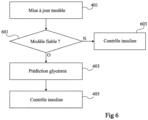
- FIG. 6 is a diagram illustrating an example of an embodiment of an automated blood sugar regulation method implemented by the system of the figure 1 .
- This process comprises the same steps 401, 403 and 405 as in the example of the Figure 4 .
- the process of Figure 6 further comprises, after each step 401 of updating the physiological model used by the regulation system and before the implementation of the following steps 403 of predicting the patient's future blood sugar levels from the model and 405 of control of insulin delivery based on the blood sugar prediction, a step 601 for checking the quality of the updated model.
- the processing and control unit 105 determines one or more digital indicators of the quality of the model updated in step 401. For example, the processing and control unit calculates a digital quality indicator representative of the area between the blood sugar curve estimated from the model and the actual blood sugar curve measured by the sensor 101 during a past observation period. This indicator corresponds for example to the quantity m defined above.
- the quality of the model can be considered satisfactory by the processing and control unit 105 when the values m, m 1 and m 2 are less than predefined thresholds. More generally, any other quality criterion or any other combination of quality criteria can be used in step 601 to determine whether the physiological model re-calibrated in step 401 can be considered reliable.
- steps 403 and 405 can be implemented in a manner similar to what was described previously, that is to say that the unit of treatment and control 105 continues to be based on the predictions made by the physiological model to regulate the administration of insulin to the patient.
- step 601 (N) If the physiological model is judged insufficiently reliable in step 601 (N), the processing and control unit 105 stops using this model to regulate the administration of insulin to the patient, and implements a method substitution regulation during a step 603.
- the processing and control unit 105 uses a simplified physiological model, for example a compartmental model comprising a number of state variables and a reduced number of parameters compared to the initial model, to predict the evolution of the patient's blood sugar and regulate the insulin injection accordingly.
- a simplified physiological model for example a compartmental model comprising a number of state variables and a reduced number of parameters compared to the initial model
- the processing and control unit 105 stops implementing predictive control, that is to say it stops using a physiological model to predict the future blood sugar levels of the patient and regulate the insulin injection accordingly.
- the processing and control unit 105 controls, for example, the insulin injection device 103 to administer pre-programmed doses of insulin, corresponding for example to a reference basal rate prescribed to the patient.
- Such a substitution method can for example be used for a predetermined period of time. At the end of this period, steps 401 of calibrating the main physiological model and 601 of estimating the quality of the main physiological model can be repeated, in order, if the quality of the main physiological model is deemed satisfactory, to reactivate the use of this model to regulate the administration of insulin to the patient.
Landscapes
- Health & Medical Sciences (AREA)
- Life Sciences & Earth Sciences (AREA)
- Engineering & Computer Science (AREA)
- Public Health (AREA)
- General Health & Medical Sciences (AREA)
- Biomedical Technology (AREA)
- Veterinary Medicine (AREA)
- Animal Behavior & Ethology (AREA)
- Heart & Thoracic Surgery (AREA)
- Medical Informatics (AREA)
- Physics & Mathematics (AREA)
- Pathology (AREA)
- Biophysics (AREA)
- Molecular Biology (AREA)
- Surgery (AREA)
- Vascular Medicine (AREA)
- Anesthesiology (AREA)
- Hematology (AREA)
- Chemical & Material Sciences (AREA)
- Bioinformatics & Cheminformatics (AREA)
- Medicinal Chemistry (AREA)
- Optics & Photonics (AREA)
- Primary Health Care (AREA)
- Epidemiology (AREA)
- Diabetes (AREA)
- Pharmacology & Pharmacy (AREA)
- Emergency Medicine (AREA)
- Databases & Information Systems (AREA)
- Data Mining & Analysis (AREA)
- General Business, Economics & Management (AREA)
- Business, Economics & Management (AREA)
- Measurement Of The Respiration, Hearing Ability, Form, And Blood Characteristics Of Living Organisms (AREA)
- Infusion, Injection, And Reservoir Apparatuses (AREA)
- External Artificial Organs (AREA)
- Measuring And Recording Apparatus For Diagnosis (AREA)
Applications Claiming Priority (3)
| Application Number | Priority Date | Filing Date | Title |
|---|---|---|---|
| FR1658881A FR3056094B1 (fr) | 2016-09-21 | 2016-09-21 | Systeme automatise de regulation de la glycemie d'un patient |
| EP17783918.0A EP3515307B1 (de) | 2016-09-21 | 2017-09-19 | Automatisiertes system zur kontrolle des blutzuckerspiegels eines patienten |
| PCT/FR2017/052511 WO2018055283A1 (fr) | 2016-09-21 | 2017-09-19 | Système automatise de régulation de la glycémie d'un patient |
Related Parent Applications (1)
| Application Number | Title | Priority Date | Filing Date |
|---|---|---|---|
| EP17783918.0A Division EP3515307B1 (de) | 2016-09-21 | 2017-09-19 | Automatisiertes system zur kontrolle des blutzuckerspiegels eines patienten |
Publications (3)
| Publication Number | Publication Date |
|---|---|
| EP4265183A1 true EP4265183A1 (de) | 2023-10-25 |
| EP4265183C0 EP4265183C0 (de) | 2024-05-15 |
| EP4265183B1 EP4265183B1 (de) | 2024-05-15 |
Family
ID=57590621
Family Applications (2)
| Application Number | Title | Priority Date | Filing Date |
|---|---|---|---|
| EP17783918.0A Active EP3515307B1 (de) | 2016-09-21 | 2017-09-19 | Automatisiertes system zur kontrolle des blutzuckerspiegels eines patienten |
| EP23196894.2A Active EP4265183B1 (de) | 2016-09-21 | 2017-09-19 | Automatisiertes system zur regulierung des blutzuckers eines patienten |
Family Applications Before (1)
| Application Number | Title | Priority Date | Filing Date |
|---|---|---|---|
| EP17783918.0A Active EP3515307B1 (de) | 2016-09-21 | 2017-09-19 | Automatisiertes system zur kontrolle des blutzuckerspiegels eines patienten |
Country Status (8)
| Country | Link |
|---|---|
| US (1) | US11298460B2 (de) |
| EP (2) | EP3515307B1 (de) |
| JP (1) | JP7042808B2 (de) |
| KR (1) | KR102398748B1 (de) |
| BR (1) | BR112019005520A2 (de) |
| ES (2) | ES2961496T3 (de) |
| FR (1) | FR3056094B1 (de) |
| WO (1) | WO2018055283A1 (de) |
Families Citing this family (10)
| Publication number | Priority date | Publication date | Assignee | Title |
|---|---|---|---|---|
| ATE480278T1 (de) | 2005-09-12 | 2010-09-15 | Unomedical As | Einfürungssystem für ein infusionsset mit einem ersten und zweiten federeinheit |
| US10194938B2 (en) | 2011-03-14 | 2019-02-05 | UnoMedical, AS | Inserter system with transport protection |
| EP2583715A1 (de) | 2011-10-19 | 2013-04-24 | Unomedical A/S | Infusionsschlauchsystem und Herstellungsverfahren |
| WO2017125817A1 (en) | 2016-01-19 | 2017-07-27 | Unomedical A/S | Cannula and infusion devices |
| FR3056094B1 (fr) * | 2016-09-21 | 2018-10-12 | Commissariat A L'energie Atomique Et Aux Energies Alternatives | Systeme automatise de regulation de la glycemie d'un patient |
| FR3083076B1 (fr) * | 2018-06-29 | 2023-04-07 | Commissariat Energie Atomique | Systeme automatise de controle de la glycemie d'un patient |
| FR3090315B1 (fr) | 2018-12-21 | 2022-12-09 | Commissariat Energie Atomique | Système automatisé de régulation de la glycémie d'un patient |
| CA3141608A1 (en) | 2019-05-20 | 2020-11-26 | Unomedical A/S | Rotatable infusion device and methods thereof |
| FR3099043B1 (fr) | 2019-07-25 | 2023-11-03 | Commissariat Energie Atomique | Système automatisé de régulation de glycémie |
| FR3103372B1 (fr) | 2019-11-27 | 2024-11-01 | Commissariat Energie Atomique | Système de régulation automatisée de glycémie |
Citations (2)
| Publication number | Priority date | Publication date | Assignee | Title |
|---|---|---|---|---|
| GB2436873A (en) | 2006-04-07 | 2007-10-10 | Univ Cambridge Tech | Blood glucose monitoring systems |
| EP3515307B1 (de) * | 2016-09-21 | 2023-09-13 | Commissariat à l'énergie atomique et aux énergies alternatives | Automatisiertes system zur kontrolle des blutzuckerspiegels eines patienten |
Family Cites Families (3)
| Publication number | Priority date | Publication date | Assignee | Title |
|---|---|---|---|---|
| FI118509B (fi) | 1996-02-12 | 2007-12-14 | Nokia Oyj | Menetelmä ja laitteisto potilaan veren glukoosipitoisuuden ennustamiseksi |
| CN104769595B (zh) | 2012-08-30 | 2017-12-08 | 美敦力迷你迈德公司 | 用于闭环胰岛素输注系统的防护技术 |
| US9526834B2 (en) * | 2012-08-30 | 2016-12-27 | Medtronic Minimed, Inc. | Safeguarding measures for a closed-loop insulin infusion system |
-
2016
- 2016-09-21 FR FR1658881A patent/FR3056094B1/fr not_active Expired - Fee Related
-
2017
- 2017-09-19 ES ES17783918T patent/ES2961496T3/es active Active
- 2017-09-19 US US16/334,825 patent/US11298460B2/en active Active
- 2017-09-19 WO PCT/FR2017/052511 patent/WO2018055283A1/fr not_active Ceased
- 2017-09-19 BR BR112019005520A patent/BR112019005520A2/pt not_active Application Discontinuation
- 2017-09-19 JP JP2019515487A patent/JP7042808B2/ja active Active
- 2017-09-19 EP EP17783918.0A patent/EP3515307B1/de active Active
- 2017-09-19 KR KR1020197010866A patent/KR102398748B1/ko active Active
- 2017-09-19 ES ES23196894T patent/ES2983738T3/es active Active
- 2017-09-19 EP EP23196894.2A patent/EP4265183B1/de active Active
Patent Citations (2)
| Publication number | Priority date | Publication date | Assignee | Title |
|---|---|---|---|---|
| GB2436873A (en) | 2006-04-07 | 2007-10-10 | Univ Cambridge Tech | Blood glucose monitoring systems |
| EP3515307B1 (de) * | 2016-09-21 | 2023-09-13 | Commissariat à l'énergie atomique et aux énergies alternatives | Automatisiertes system zur kontrolle des blutzuckerspiegels eines patienten |
Non-Patent Citations (5)
| Title |
|---|
| CHIARA DALLA MAN ET AL.: "A System Model of Oral Glucose Absorption: Validation on Gold Standard Data", IEEE TRANSACTIONS ON BIOMEDICAL ENGINEERING, vol. 53, no. 12, December 2006 (2006-12-01), XP011150965, DOI: 10.1109/TBME.2006.883792 |
| ROMAN HOVORKA ET AL., AM J PHYSIOL ENDOCRINOL METAB, vol. 282, 2002, pages E992 - E1007 |
| ROMAN HOVORKA ET AL., PHYSIOL MEAS., vol. 25, 2004, pages 905 - 920 |
| ROMAN HOVORKA ET AL., PHYSIOLOGICAL MEASUREMENT, vol. 25, no. 4, August 2004 (2004-08-01), pages 905 - 920, ISSN: 0967-3334 |
| ROMAN HOVORKA ET AL: "Nonlinear model predictive control of glucose concentration in subjects with type 1 diabetes; Controlling glucose", PHYSIOLOGICAL MEASUREMENT, INSTITUTE OF PHYSICS PUBLISHING, BRISTOL, GB, vol. 25, no. 4, 1 August 2004 (2004-08-01), pages 905 - 920, XP020074167, ISSN: 0967-3334, DOI: 10.1088/0967-3334/25/4/010 * |
Also Published As
| Publication number | Publication date |
|---|---|
| EP4265183C0 (de) | 2024-05-15 |
| EP3515307A1 (de) | 2019-07-31 |
| ES2983738T3 (es) | 2024-10-24 |
| FR3056094B1 (fr) | 2018-10-12 |
| KR102398748B1 (ko) | 2022-05-16 |
| EP4265183B1 (de) | 2024-05-15 |
| US11298460B2 (en) | 2022-04-12 |
| KR20190050834A (ko) | 2019-05-13 |
| EP3515307C0 (de) | 2023-09-13 |
| ES2961496T3 (es) | 2024-03-12 |
| EP3515307B1 (de) | 2023-09-13 |
| US20190298918A1 (en) | 2019-10-03 |
| JP2019534066A (ja) | 2019-11-28 |
| FR3056094A1 (fr) | 2018-03-23 |
| WO2018055283A1 (fr) | 2018-03-29 |
| CA3037655A1 (fr) | 2018-03-29 |
| BR112019005520A2 (pt) | 2019-06-18 |
| JP7042808B2 (ja) | 2022-03-28 |
Similar Documents
| Publication | Publication Date | Title |
|---|---|---|
| EP4265183B1 (de) | Automatisiertes system zur regulierung des blutzuckers eines patienten | |
| WO2018055284A1 (fr) | Système automatise de régulation de la glycémie d'un patient | |
| EP3768166B1 (de) | System zur vorhersage des blutzuckerspiegels eines patienten | |
| EP3655968A1 (de) | Automatisiertes system zur regulierung des blutzuckerspiegels eines patienten | |
| EP3813663B1 (de) | Automatisches system zur kontrolle des blutzuckers eines patienten | |
| US11887715B2 (en) | Dynamic equivalent on board estimator | |
| EP3899968A1 (de) | Automatisiertes system zur regulierung des blutzuckerspiegels eines patienten | |
| EP3796838B1 (de) | Automatisiertes system zur überwachung des blutzuckers eines patienten | |
| EP3797426B1 (de) | Automatisiertes system zur überwachung des blutzuckers eines patienten | |
| CA3037655C (fr) | Systeme automatise de regulation de la glycemie d'un patient | |
| FR3142279A1 (fr) | Dispositif et procédé de détermination d'une valeur de recommandation d'un paramètre de régulation d'un dispositif d'infusion de fluide. |
Legal Events
| Date | Code | Title | Description |
|---|---|---|---|
| PUAI | Public reference made under article 153(3) epc to a published international application that has entered the european phase |
Free format text: ORIGINAL CODE: 0009012 |
|
| STAA | Information on the status of an ep patent application or granted ep patent |
Free format text: STATUS: REQUEST FOR EXAMINATION WAS MADE |
|
| 17P | Request for examination filed |
Effective date: 20230912 |
|
| AC | Divisional application: reference to earlier application |
Ref document number: 3515307 Country of ref document: EP Kind code of ref document: P |
|
| AK | Designated contracting states |
Kind code of ref document: A1 Designated state(s): AL AT BE BG CH CY CZ DE DK EE ES FI FR GB GR HR HU IE IS IT LI LT LU LV MC MK MT NL NO PL PT RO RS SE SI SK SM TR |
|
| STAA | Information on the status of an ep patent application or granted ep patent |
Free format text: STATUS: EXAMINATION IS IN PROGRESS |
|
| 17Q | First examination report despatched |
Effective date: 20240104 |
|
| GRAP | Despatch of communication of intention to grant a patent |
Free format text: ORIGINAL CODE: EPIDOSNIGR1 |
|
| STAA | Information on the status of an ep patent application or granted ep patent |
Free format text: STATUS: GRANT OF PATENT IS INTENDED |
|
| INTG | Intention to grant announced |
Effective date: 20240223 |
|
| GRAS | Grant fee paid |
Free format text: ORIGINAL CODE: EPIDOSNIGR3 |
|
| GRAA | (expected) grant |
Free format text: ORIGINAL CODE: 0009210 |
|
| STAA | Information on the status of an ep patent application or granted ep patent |
Free format text: STATUS: THE PATENT HAS BEEN GRANTED |
|
| AC | Divisional application: reference to earlier application |
Ref document number: 3515307 Country of ref document: EP Kind code of ref document: P |
|
| AK | Designated contracting states |
Kind code of ref document: B1 Designated state(s): AL AT BE BG CH CY CZ DE DK EE ES FI FR GB GR HR HU IE IS IT LI LT LU LV MC MK MT NL NO PL PT RO RS SE SI SK SM TR |
|
| REG | Reference to a national code |
Ref country code: CH Ref legal event code: EP |
|
| REG | Reference to a national code |
Ref country code: IE Ref legal event code: FG4D Free format text: LANGUAGE OF EP DOCUMENT: FRENCH |
|
| REG | Reference to a national code |
Ref country code: DE Ref legal event code: R096 Ref document number: 602017082049 Country of ref document: DE |
|
| U01 | Request for unitary effect filed |
Effective date: 20240521 |
|
| U07 | Unitary effect registered |
Designated state(s): AT BE BG DE DK EE FI FR IT LT LU LV MT NL PT SE SI Effective date: 20240605 |
|
| PG25 | Lapsed in a contracting state [announced via postgrant information from national office to epo] |
Ref country code: IS Free format text: LAPSE BECAUSE OF FAILURE TO SUBMIT A TRANSLATION OF THE DESCRIPTION OR TO PAY THE FEE WITHIN THE PRESCRIBED TIME-LIMIT Effective date: 20240915 |
|
| PG25 | Lapsed in a contracting state [announced via postgrant information from national office to epo] |
Ref country code: HR Free format text: LAPSE BECAUSE OF FAILURE TO SUBMIT A TRANSLATION OF THE DESCRIPTION OR TO PAY THE FEE WITHIN THE PRESCRIBED TIME-LIMIT Effective date: 20240515 |
|
| PG25 | Lapsed in a contracting state [announced via postgrant information from national office to epo] |
Ref country code: GR Free format text: LAPSE BECAUSE OF FAILURE TO SUBMIT A TRANSLATION OF THE DESCRIPTION OR TO PAY THE FEE WITHIN THE PRESCRIBED TIME-LIMIT Effective date: 20240816 |
|
| REG | Reference to a national code |
Ref country code: ES Ref legal event code: FG2A Ref document number: 2983738 Country of ref document: ES Kind code of ref document: T3 Effective date: 20241024 |
|
| PG25 | Lapsed in a contracting state [announced via postgrant information from national office to epo] |
Ref country code: PL Free format text: LAPSE BECAUSE OF FAILURE TO SUBMIT A TRANSLATION OF THE DESCRIPTION OR TO PAY THE FEE WITHIN THE PRESCRIBED TIME-LIMIT Effective date: 20240515 |
|
| RAP4 | Party data changed (patent owner data changed or rights of a patent transferred) |
Owner name: COMMISSARIAT A L'ENERGIE ATOMIQUE ET AUX ENERGIESALTERNATIVES |
|
| U1H | Name or address of the proprietor changed after the registration of the unitary effect |
Owner name: COMMISSARIAT A L'ENERGIE ATOMIQUE ET AUX ENERGIESALTERNATIVES; FR |
|
| U20 | Renewal fee for the european patent with unitary effect paid |
Year of fee payment: 8 Effective date: 20240925 |
|
| PG25 | Lapsed in a contracting state [announced via postgrant information from national office to epo] |
Ref country code: PL Free format text: LAPSE BECAUSE OF FAILURE TO SUBMIT A TRANSLATION OF THE DESCRIPTION OR TO PAY THE FEE WITHIN THE PRESCRIBED TIME-LIMIT Effective date: 20240515 Ref country code: NO Free format text: LAPSE BECAUSE OF FAILURE TO SUBMIT A TRANSLATION OF THE DESCRIPTION OR TO PAY THE FEE WITHIN THE PRESCRIBED TIME-LIMIT Effective date: 20240815 Ref country code: IS Free format text: LAPSE BECAUSE OF FAILURE TO SUBMIT A TRANSLATION OF THE DESCRIPTION OR TO PAY THE FEE WITHIN THE PRESCRIBED TIME-LIMIT Effective date: 20240915 Ref country code: HR Free format text: LAPSE BECAUSE OF FAILURE TO SUBMIT A TRANSLATION OF THE DESCRIPTION OR TO PAY THE FEE WITHIN THE PRESCRIBED TIME-LIMIT Effective date: 20240515 Ref country code: GR Free format text: LAPSE BECAUSE OF FAILURE TO SUBMIT A TRANSLATION OF THE DESCRIPTION OR TO PAY THE FEE WITHIN THE PRESCRIBED TIME-LIMIT Effective date: 20240816 Ref country code: RS Free format text: LAPSE BECAUSE OF FAILURE TO SUBMIT A TRANSLATION OF THE DESCRIPTION OR TO PAY THE FEE WITHIN THE PRESCRIBED TIME-LIMIT Effective date: 20240815 |
|
| PG25 | Lapsed in a contracting state [announced via postgrant information from national office to epo] |
Ref country code: CZ Free format text: LAPSE BECAUSE OF FAILURE TO SUBMIT A TRANSLATION OF THE DESCRIPTION OR TO PAY THE FEE WITHIN THE PRESCRIBED TIME-LIMIT Effective date: 20240515 |
|
| PG25 | Lapsed in a contracting state [announced via postgrant information from national office to epo] |
Ref country code: SK Free format text: LAPSE BECAUSE OF FAILURE TO SUBMIT A TRANSLATION OF THE DESCRIPTION OR TO PAY THE FEE WITHIN THE PRESCRIBED TIME-LIMIT Effective date: 20240515 Ref country code: RO Free format text: LAPSE BECAUSE OF FAILURE TO SUBMIT A TRANSLATION OF THE DESCRIPTION OR TO PAY THE FEE WITHIN THE PRESCRIBED TIME-LIMIT Effective date: 20240515 |
|
| PG25 | Lapsed in a contracting state [announced via postgrant information from national office to epo] |
Ref country code: SM Free format text: LAPSE BECAUSE OF FAILURE TO SUBMIT A TRANSLATION OF THE DESCRIPTION OR TO PAY THE FEE WITHIN THE PRESCRIBED TIME-LIMIT Effective date: 20240515 |
|
| PG25 | Lapsed in a contracting state [announced via postgrant information from national office to epo] |
Ref country code: SM Free format text: LAPSE BECAUSE OF FAILURE TO SUBMIT A TRANSLATION OF THE DESCRIPTION OR TO PAY THE FEE WITHIN THE PRESCRIBED TIME-LIMIT Effective date: 20240515 Ref country code: SK Free format text: LAPSE BECAUSE OF FAILURE TO SUBMIT A TRANSLATION OF THE DESCRIPTION OR TO PAY THE FEE WITHIN THE PRESCRIBED TIME-LIMIT Effective date: 20240515 Ref country code: RO Free format text: LAPSE BECAUSE OF FAILURE TO SUBMIT A TRANSLATION OF THE DESCRIPTION OR TO PAY THE FEE WITHIN THE PRESCRIBED TIME-LIMIT Effective date: 20240515 Ref country code: CZ Free format text: LAPSE BECAUSE OF FAILURE TO SUBMIT A TRANSLATION OF THE DESCRIPTION OR TO PAY THE FEE WITHIN THE PRESCRIBED TIME-LIMIT Effective date: 20240515 |
|
| REG | Reference to a national code |
Ref country code: DE Ref legal event code: R097 Ref document number: 602017082049 Country of ref document: DE |
|
| PLBE | No opposition filed within time limit |
Free format text: ORIGINAL CODE: 0009261 |
|
| STAA | Information on the status of an ep patent application or granted ep patent |
Free format text: STATUS: NO OPPOSITION FILED WITHIN TIME LIMIT |
|
| 26N | No opposition filed |
Effective date: 20250218 |
|
| PG25 | Lapsed in a contracting state [announced via postgrant information from national office to epo] |
Ref country code: MC Free format text: LAPSE BECAUSE OF FAILURE TO SUBMIT A TRANSLATION OF THE DESCRIPTION OR TO PAY THE FEE WITHIN THE PRESCRIBED TIME-LIMIT Effective date: 20240515 |
|
| PG25 | Lapsed in a contracting state [announced via postgrant information from national office to epo] |
Ref country code: IE Free format text: LAPSE BECAUSE OF NON-PAYMENT OF DUE FEES Effective date: 20240919 |
|
| REG | Reference to a national code |
Ref country code: CH Ref legal event code: U11 Free format text: ST27 STATUS EVENT CODE: U-0-0-U10-U11 (AS PROVIDED BY THE NATIONAL OFFICE) Effective date: 20251001 |
|
| PGFP | Annual fee paid to national office [announced via postgrant information from national office to epo] |
Ref country code: GB Payment date: 20250923 Year of fee payment: 9 |
|
| U20 | Renewal fee for the european patent with unitary effect paid |
Year of fee payment: 9 Effective date: 20250923 |
|
| PGFP | Annual fee paid to national office [announced via postgrant information from national office to epo] |
Ref country code: CH Payment date: 20251001 Year of fee payment: 9 |
|
| PG25 | Lapsed in a contracting state [announced via postgrant information from national office to epo] |
Ref country code: CY Free format text: LAPSE BECAUSE OF FAILURE TO SUBMIT A TRANSLATION OF THE DESCRIPTION OR TO PAY THE FEE WITHIN THE PRESCRIBED TIME-LIMIT; INVALID AB INITIO Effective date: 20170919 |
|
| PGFP | Annual fee paid to national office [announced via postgrant information from national office to epo] |
Ref country code: ES Payment date: 20251020 Year of fee payment: 9 |
|
| PG25 | Lapsed in a contracting state [announced via postgrant information from national office to epo] |
Ref country code: HU Free format text: LAPSE BECAUSE OF FAILURE TO SUBMIT A TRANSLATION OF THE DESCRIPTION OR TO PAY THE FEE WITHIN THE PRESCRIBED TIME-LIMIT; INVALID AB INITIO Effective date: 20170919 |