EP4265634A2 - Amplificateur pour lymphocytes t ou lymphocytes b ayant une fonction de mémoire, inhibiteur de récurrence de tumeur maligne, et inducteur pour induire une fonction de mémoire dans des lymphocytes t ou des lymphocytes b - Google Patents
Amplificateur pour lymphocytes t ou lymphocytes b ayant une fonction de mémoire, inhibiteur de récurrence de tumeur maligne, et inducteur pour induire une fonction de mémoire dans des lymphocytes t ou des lymphocytes b Download PDFInfo
- Publication number
- EP4265634A2 EP4265634A2 EP23187186.4A EP23187186A EP4265634A2 EP 4265634 A2 EP4265634 A2 EP 4265634A2 EP 23187186 A EP23187186 A EP 23187186A EP 4265634 A2 EP4265634 A2 EP 4265634A2
- Authority
- EP
- European Patent Office
- Prior art keywords
- cells
- nucleic acid
- ccl19
- acid encoding
- malignant tumor
- Prior art date
- Legal status (The legal status is an assumption and is not a legal conclusion. Google has not performed a legal analysis and makes no representation as to the accuracy of the status listed.)
- Pending
Links
Images














Classifications
-
- C—CHEMISTRY; METALLURGY
- C12—BIOCHEMISTRY; BEER; SPIRITS; WINE; VINEGAR; MICROBIOLOGY; ENZYMOLOGY; MUTATION OR GENETIC ENGINEERING
- C12N—MICROORGANISMS OR ENZYMES; COMPOSITIONS THEREOF; PROPAGATING, PRESERVING, OR MAINTAINING MICROORGANISMS; MUTATION OR GENETIC ENGINEERING; CULTURE MEDIA
- C12N15/00—Mutation or genetic engineering; DNA or RNA concerning genetic engineering, vectors, e.g. plasmids, or their isolation, preparation or purification; Use of hosts therefor
- C12N15/09—Recombinant DNA-technology
- C12N15/63—Introduction of foreign genetic material using vectors; Vectors; Use of hosts therefor; Regulation of expression
- C12N15/79—Vectors or expression systems specially adapted for eukaryotic hosts
- C12N15/85—Vectors or expression systems specially adapted for eukaryotic hosts for animal cells
- C12N15/86—Viral vectors
-
- A—HUMAN NECESSITIES
- A61—MEDICAL OR VETERINARY SCIENCE; HYGIENE
- A61K—PREPARATIONS FOR MEDICAL, DENTAL OR TOILETRY PURPOSES
- A61K39/00—Medicinal preparations containing antigens or antibodies
- A61K39/0005—Vertebrate antigens
- A61K39/0011—Cancer antigens
-
- A—HUMAN NECESSITIES
- A61—MEDICAL OR VETERINARY SCIENCE; HYGIENE
- A61K—PREPARATIONS FOR MEDICAL, DENTAL OR TOILETRY PURPOSES
- A61K31/00—Medicinal preparations containing organic active ingredients
- A61K31/66—Phosphorus compounds
- A61K31/675—Phosphorus compounds having nitrogen as a ring hetero atom, e.g. pyridoxal phosphate
-
- A—HUMAN NECESSITIES
- A61—MEDICAL OR VETERINARY SCIENCE; HYGIENE
- A61K—PREPARATIONS FOR MEDICAL, DENTAL OR TOILETRY PURPOSES
- A61K31/00—Medicinal preparations containing organic active ingredients
- A61K31/70—Carbohydrates; Sugars; Derivatives thereof
- A61K31/7042—Compounds having saccharide radicals and heterocyclic rings
- A61K31/7052—Compounds having saccharide radicals and heterocyclic rings having nitrogen as a ring hetero atom, e.g. nucleosides, nucleotides
- A61K31/706—Compounds having saccharide radicals and heterocyclic rings having nitrogen as a ring hetero atom, e.g. nucleosides, nucleotides containing six-membered rings with nitrogen as a ring hetero atom
- A61K31/7064—Compounds having saccharide radicals and heterocyclic rings having nitrogen as a ring hetero atom, e.g. nucleosides, nucleotides containing six-membered rings with nitrogen as a ring hetero atom containing condensed or non-condensed pyrimidines
- A61K31/7076—Compounds having saccharide radicals and heterocyclic rings having nitrogen as a ring hetero atom, e.g. nucleosides, nucleotides containing six-membered rings with nitrogen as a ring hetero atom containing condensed or non-condensed pyrimidines containing purines, e.g. adenosine, adenylic acid
-
- A—HUMAN NECESSITIES
- A61—MEDICAL OR VETERINARY SCIENCE; HYGIENE
- A61K—PREPARATIONS FOR MEDICAL, DENTAL OR TOILETRY PURPOSES
- A61K35/00—Medicinal preparations containing materials or reaction products thereof with undetermined constitution
- A61K35/12—Materials from mammals; Compositions comprising non-specified tissues or cells; Compositions comprising non-embryonic stem cells; Genetically modified cells
- A61K35/14—Blood; Artificial blood
- A61K35/17—Lymphocytes; B-cells; T-cells; Natural killer cells; Interferon-activated or cytokine-activated lymphocytes
-
- A—HUMAN NECESSITIES
- A61—MEDICAL OR VETERINARY SCIENCE; HYGIENE
- A61K—PREPARATIONS FOR MEDICAL, DENTAL OR TOILETRY PURPOSES
- A61K35/00—Medicinal preparations containing materials or reaction products thereof with undetermined constitution
- A61K35/12—Materials from mammals; Compositions comprising non-specified tissues or cells; Compositions comprising non-embryonic stem cells; Genetically modified cells
- A61K35/28—Bone marrow; Haematopoietic stem cells; Mesenchymal stem cells of any origin, e.g. adipose-derived stem cells
-
- A—HUMAN NECESSITIES
- A61—MEDICAL OR VETERINARY SCIENCE; HYGIENE
- A61K—PREPARATIONS FOR MEDICAL, DENTAL OR TOILETRY PURPOSES
- A61K35/00—Medicinal preparations containing materials or reaction products thereof with undetermined constitution
- A61K35/56—Materials from animals other than mammals
- A61K35/60—Fish, e.g. seahorses; Fish eggs
-
- A—HUMAN NECESSITIES
- A61—MEDICAL OR VETERINARY SCIENCE; HYGIENE
- A61K—PREPARATIONS FOR MEDICAL, DENTAL OR TOILETRY PURPOSES
- A61K35/00—Medicinal preparations containing materials or reaction products thereof with undetermined constitution
- A61K35/66—Microorganisms or materials therefrom
- A61K35/74—Bacteria
-
- A—HUMAN NECESSITIES
- A61—MEDICAL OR VETERINARY SCIENCE; HYGIENE
- A61K—PREPARATIONS FOR MEDICAL, DENTAL OR TOILETRY PURPOSES
- A61K35/00—Medicinal preparations containing materials or reaction products thereof with undetermined constitution
- A61K35/66—Microorganisms or materials therefrom
- A61K35/76—Viruses; Subviral particles; Bacteriophages
-
- A—HUMAN NECESSITIES
- A61—MEDICAL OR VETERINARY SCIENCE; HYGIENE
- A61K—PREPARATIONS FOR MEDICAL, DENTAL OR TOILETRY PURPOSES
- A61K35/00—Medicinal preparations containing materials or reaction products thereof with undetermined constitution
- A61K35/66—Microorganisms or materials therefrom
- A61K35/76—Viruses; Subviral particles; Bacteriophages
- A61K35/768—Oncolytic viruses not provided for in groups A61K35/761 - A61K35/766
-
- A—HUMAN NECESSITIES
- A61—MEDICAL OR VETERINARY SCIENCE; HYGIENE
- A61K—PREPARATIONS FOR MEDICAL, DENTAL OR TOILETRY PURPOSES
- A61K38/00—Medicinal preparations containing peptides
- A61K38/16—Peptides having more than 20 amino acids; Gastrins; Somatostatins; Melanotropins; Derivatives thereof
- A61K38/17—Peptides having more than 20 amino acids; Gastrins; Somatostatins; Melanotropins; Derivatives thereof from animals; from humans
- A61K38/19—Cytokines; Lymphokines; Interferons
-
- A—HUMAN NECESSITIES
- A61—MEDICAL OR VETERINARY SCIENCE; HYGIENE
- A61K—PREPARATIONS FOR MEDICAL, DENTAL OR TOILETRY PURPOSES
- A61K38/00—Medicinal preparations containing peptides
- A61K38/16—Peptides having more than 20 amino acids; Gastrins; Somatostatins; Melanotropins; Derivatives thereof
- A61K38/17—Peptides having more than 20 amino acids; Gastrins; Somatostatins; Melanotropins; Derivatives thereof from animals; from humans
- A61K38/19—Cytokines; Lymphokines; Interferons
- A61K38/195—Chemokines, e.g. RANTES
-
- A—HUMAN NECESSITIES
- A61—MEDICAL OR VETERINARY SCIENCE; HYGIENE
- A61K—PREPARATIONS FOR MEDICAL, DENTAL OR TOILETRY PURPOSES
- A61K38/00—Medicinal preparations containing peptides
- A61K38/16—Peptides having more than 20 amino acids; Gastrins; Somatostatins; Melanotropins; Derivatives thereof
- A61K38/17—Peptides having more than 20 amino acids; Gastrins; Somatostatins; Melanotropins; Derivatives thereof from animals; from humans
- A61K38/19—Cytokines; Lymphokines; Interferons
- A61K38/20—Interleukins [IL]
-
- A—HUMAN NECESSITIES
- A61—MEDICAL OR VETERINARY SCIENCE; HYGIENE
- A61K—PREPARATIONS FOR MEDICAL, DENTAL OR TOILETRY PURPOSES
- A61K38/00—Medicinal preparations containing peptides
- A61K38/16—Peptides having more than 20 amino acids; Gastrins; Somatostatins; Melanotropins; Derivatives thereof
- A61K38/17—Peptides having more than 20 amino acids; Gastrins; Somatostatins; Melanotropins; Derivatives thereof from animals; from humans
- A61K38/19—Cytokines; Lymphokines; Interferons
- A61K38/20—Interleukins [IL]
- A61K38/2046—IL-7
-
- A—HUMAN NECESSITIES
- A61—MEDICAL OR VETERINARY SCIENCE; HYGIENE
- A61K—PREPARATIONS FOR MEDICAL, DENTAL OR TOILETRY PURPOSES
- A61K40/00—Cellular immunotherapy
- A61K40/10—Cellular immunotherapy characterised by the cell type used
- A61K40/11—T-cells, e.g. tumour infiltrating lymphocytes [TIL] or regulatory T [Treg] cells; Lymphokine-activated killer [LAK] cells
-
- A—HUMAN NECESSITIES
- A61—MEDICAL OR VETERINARY SCIENCE; HYGIENE
- A61K—PREPARATIONS FOR MEDICAL, DENTAL OR TOILETRY PURPOSES
- A61K40/00—Cellular immunotherapy
- A61K40/30—Cellular immunotherapy characterised by the recombinant expression of specific molecules in the cells of the immune system
- A61K40/31—Chimeric antigen receptors [CAR]
-
- A—HUMAN NECESSITIES
- A61—MEDICAL OR VETERINARY SCIENCE; HYGIENE
- A61K—PREPARATIONS FOR MEDICAL, DENTAL OR TOILETRY PURPOSES
- A61K40/00—Cellular immunotherapy
- A61K40/30—Cellular immunotherapy characterised by the recombinant expression of specific molecules in the cells of the immune system
- A61K40/32—T-cell receptors [TCR]
-
- A—HUMAN NECESSITIES
- A61—MEDICAL OR VETERINARY SCIENCE; HYGIENE
- A61K—PREPARATIONS FOR MEDICAL, DENTAL OR TOILETRY PURPOSES
- A61K40/00—Cellular immunotherapy
- A61K40/40—Cellular immunotherapy characterised by antigens that are targeted or presented by cells of the immune system
- A61K40/41—Vertebrate antigens
- A61K40/42—Cancer antigens
- A61K40/4202—Receptors, cell surface antigens or cell surface determinants
- A61K40/4214—Receptors for cytokines
- A61K40/4219—Receptors for chemokines
-
- A—HUMAN NECESSITIES
- A61—MEDICAL OR VETERINARY SCIENCE; HYGIENE
- A61K—PREPARATIONS FOR MEDICAL, DENTAL OR TOILETRY PURPOSES
- A61K40/00—Cellular immunotherapy
- A61K40/40—Cellular immunotherapy characterised by antigens that are targeted or presented by cells of the immune system
- A61K40/41—Vertebrate antigens
- A61K40/42—Cancer antigens
- A61K40/4202—Receptors, cell surface antigens or cell surface determinants
- A61K40/4221—CD20
-
- A—HUMAN NECESSITIES
- A61—MEDICAL OR VETERINARY SCIENCE; HYGIENE
- A61K—PREPARATIONS FOR MEDICAL, DENTAL OR TOILETRY PURPOSES
- A61K40/00—Cellular immunotherapy
- A61K40/40—Cellular immunotherapy characterised by antigens that are targeted or presented by cells of the immune system
- A61K40/41—Vertebrate antigens
- A61K40/42—Cancer antigens
- A61K40/4231—Cytokines
- A61K40/4234—Interleukins [IL]
-
- A—HUMAN NECESSITIES
- A61—MEDICAL OR VETERINARY SCIENCE; HYGIENE
- A61K—PREPARATIONS FOR MEDICAL, DENTAL OR TOILETRY PURPOSES
- A61K40/00—Cellular immunotherapy
- A61K40/40—Cellular immunotherapy characterised by antigens that are targeted or presented by cells of the immune system
- A61K40/41—Vertebrate antigens
- A61K40/42—Cancer antigens
- A61K40/4254—Adhesion molecules, e.g. NRCAM, EpCAM or cadherins
- A61K40/4255—Mesothelin [MSLN]
-
- A—HUMAN NECESSITIES
- A61—MEDICAL OR VETERINARY SCIENCE; HYGIENE
- A61K—PREPARATIONS FOR MEDICAL, DENTAL OR TOILETRY PURPOSES
- A61K40/00—Cellular immunotherapy
- A61K40/40—Cellular immunotherapy characterised by antigens that are targeted or presented by cells of the immune system
- A61K40/41—Vertebrate antigens
- A61K40/42—Cancer antigens
- A61K40/428—Undefined tumor antigens, e.g. tumor lysate or antigens targeted by cells isolated from tumor
-
- A—HUMAN NECESSITIES
- A61—MEDICAL OR VETERINARY SCIENCE; HYGIENE
- A61K—PREPARATIONS FOR MEDICAL, DENTAL OR TOILETRY PURPOSES
- A61K48/00—Medicinal preparations containing genetic material which is inserted into cells of the living body to treat genetic diseases; Gene therapy
-
- A—HUMAN NECESSITIES
- A61—MEDICAL OR VETERINARY SCIENCE; HYGIENE
- A61K—PREPARATIONS FOR MEDICAL, DENTAL OR TOILETRY PURPOSES
- A61K48/00—Medicinal preparations containing genetic material which is inserted into cells of the living body to treat genetic diseases; Gene therapy
- A61K48/0008—Medicinal preparations containing genetic material which is inserted into cells of the living body to treat genetic diseases; Gene therapy characterised by an aspect of the 'non-active' part of the composition delivered, e.g. wherein such 'non-active' part is not delivered simultaneously with the 'active' part of the composition
-
- A—HUMAN NECESSITIES
- A61—MEDICAL OR VETERINARY SCIENCE; HYGIENE
- A61K—PREPARATIONS FOR MEDICAL, DENTAL OR TOILETRY PURPOSES
- A61K9/00—Medicinal preparations characterised by special physical form
- A61K9/10—Dispersions; Emulsions
- A61K9/127—Synthetic bilayered vehicles, e.g. liposomes or liposomes with cholesterol as the only non-phosphatidyl surfactant
-
- A—HUMAN NECESSITIES
- A61—MEDICAL OR VETERINARY SCIENCE; HYGIENE
- A61K—PREPARATIONS FOR MEDICAL, DENTAL OR TOILETRY PURPOSES
- A61K9/00—Medicinal preparations characterised by special physical form
- A61K9/48—Preparations in capsules, e.g. of gelatin, of chocolate
- A61K9/50—Microcapsules having a gas, liquid or semi-solid filling; Solid microparticles or pellets surrounded by a distinct coating layer, e.g. coated microspheres, coated drug crystals
- A61K9/51—Nanocapsules; Nanoparticles
-
- A—HUMAN NECESSITIES
- A61—MEDICAL OR VETERINARY SCIENCE; HYGIENE
- A61P—SPECIFIC THERAPEUTIC ACTIVITY OF CHEMICAL COMPOUNDS OR MEDICINAL PREPARATIONS
- A61P35/00—Antineoplastic agents
-
- C—CHEMISTRY; METALLURGY
- C07—ORGANIC CHEMISTRY
- C07K—PEPTIDES
- C07K14/00—Peptides having more than 20 amino acids; Gastrins; Somatostatins; Melanotropins; Derivatives thereof
- C07K14/435—Peptides having more than 20 amino acids; Gastrins; Somatostatins; Melanotropins; Derivatives thereof from animals; from humans
- C07K14/52—Cytokines; Lymphokines; Interferons
- C07K14/521—Chemokines
-
- C—CHEMISTRY; METALLURGY
- C07—ORGANIC CHEMISTRY
- C07K—PEPTIDES
- C07K14/00—Peptides having more than 20 amino acids; Gastrins; Somatostatins; Melanotropins; Derivatives thereof
- C07K14/435—Peptides having more than 20 amino acids; Gastrins; Somatostatins; Melanotropins; Derivatives thereof from animals; from humans
- C07K14/52—Cytokines; Lymphokines; Interferons
- C07K14/54—Interleukins [IL]
- C07K14/5418—IL-7
-
- C—CHEMISTRY; METALLURGY
- C07—ORGANIC CHEMISTRY
- C07K—PEPTIDES
- C07K14/00—Peptides having more than 20 amino acids; Gastrins; Somatostatins; Melanotropins; Derivatives thereof
- C07K14/435—Peptides having more than 20 amino acids; Gastrins; Somatostatins; Melanotropins; Derivatives thereof from animals; from humans
- C07K14/705—Receptors; Cell surface antigens; Cell surface determinants
- C07K14/70503—Immunoglobulin superfamily
- C07K14/7051—T-cell receptor (TcR)-CD3 complex
-
- C—CHEMISTRY; METALLURGY
- C12—BIOCHEMISTRY; BEER; SPIRITS; WINE; VINEGAR; MICROBIOLOGY; ENZYMOLOGY; MUTATION OR GENETIC ENGINEERING
- C12N—MICROORGANISMS OR ENZYMES; COMPOSITIONS THEREOF; PROPAGATING, PRESERVING, OR MAINTAINING MICROORGANISMS; MUTATION OR GENETIC ENGINEERING; CULTURE MEDIA
- C12N7/00—Viruses; Bacteriophages; Compositions thereof; Preparation or purification thereof
-
- A—HUMAN NECESSITIES
- A61—MEDICAL OR VETERINARY SCIENCE; HYGIENE
- A61K—PREPARATIONS FOR MEDICAL, DENTAL OR TOILETRY PURPOSES
- A61K39/00—Medicinal preparations containing antigens or antibodies
- A61K2039/51—Medicinal preparations containing antigens or antibodies comprising whole cells, viruses or DNA/RNA
- A61K2039/515—Animal cells
- A61K2039/5156—Animal cells expressing foreign proteins
-
- A—HUMAN NECESSITIES
- A61—MEDICAL OR VETERINARY SCIENCE; HYGIENE
- A61K—PREPARATIONS FOR MEDICAL, DENTAL OR TOILETRY PURPOSES
- A61K39/00—Medicinal preparations containing antigens or antibodies
- A61K2039/51—Medicinal preparations containing antigens or antibodies comprising whole cells, viruses or DNA/RNA
- A61K2039/515—Animal cells
- A61K2039/5158—Antigen-pulsed cells, e.g. T-cells
-
- A—HUMAN NECESSITIES
- A61—MEDICAL OR VETERINARY SCIENCE; HYGIENE
- A61K—PREPARATIONS FOR MEDICAL, DENTAL OR TOILETRY PURPOSES
- A61K2239/00—Indexing codes associated with cellular immunotherapy of group A61K40/00
- A61K2239/31—Indexing codes associated with cellular immunotherapy of group A61K40/00 characterized by the route of administration
-
- A—HUMAN NECESSITIES
- A61—MEDICAL OR VETERINARY SCIENCE; HYGIENE
- A61K—PREPARATIONS FOR MEDICAL, DENTAL OR TOILETRY PURPOSES
- A61K2239/00—Indexing codes associated with cellular immunotherapy of group A61K40/00
- A61K2239/38—Indexing codes associated with cellular immunotherapy of group A61K40/00 characterised by the dose, timing or administration schedule
-
- A—HUMAN NECESSITIES
- A61—MEDICAL OR VETERINARY SCIENCE; HYGIENE
- A61K—PREPARATIONS FOR MEDICAL, DENTAL OR TOILETRY PURPOSES
- A61K2300/00—Mixtures or combinations of active ingredients, wherein at least one active ingredient is fully defined in groups A61K31/00 - A61K41/00
-
- C—CHEMISTRY; METALLURGY
- C07—ORGANIC CHEMISTRY
- C07K—PEPTIDES
- C07K2319/00—Fusion polypeptide
- C07K2319/01—Fusion polypeptide containing a localisation/targetting motif
- C07K2319/03—Fusion polypeptide containing a localisation/targetting motif containing a transmembrane segment
-
- C—CHEMISTRY; METALLURGY
- C12—BIOCHEMISTRY; BEER; SPIRITS; WINE; VINEGAR; MICROBIOLOGY; ENZYMOLOGY; MUTATION OR GENETIC ENGINEERING
- C12N—MICROORGANISMS OR ENZYMES; COMPOSITIONS THEREOF; PROPAGATING, PRESERVING, OR MAINTAINING MICROORGANISMS; MUTATION OR GENETIC ENGINEERING; CULTURE MEDIA
- C12N2710/00—MICROORGANISMS OR ENZYMES; COMPOSITIONS THEREOF; PROPAGATING, PRESERVING, OR MAINTAINING MICROORGANISMS; MUTATION OR GENETIC ENGINEERING; CULTURE MEDIA dsDNA viruses
- C12N2710/00011—Details
- C12N2710/24011—Poxviridae
- C12N2710/24111—Orthopoxvirus, e.g. vaccinia virus, variola
- C12N2710/24121—Viruses as such, e.g. new isolates, mutants or their genomic sequences
-
- C—CHEMISTRY; METALLURGY
- C12—BIOCHEMISTRY; BEER; SPIRITS; WINE; VINEGAR; MICROBIOLOGY; ENZYMOLOGY; MUTATION OR GENETIC ENGINEERING
- C12N—MICROORGANISMS OR ENZYMES; COMPOSITIONS THEREOF; PROPAGATING, PRESERVING, OR MAINTAINING MICROORGANISMS; MUTATION OR GENETIC ENGINEERING; CULTURE MEDIA
- C12N2710/00—MICROORGANISMS OR ENZYMES; COMPOSITIONS THEREOF; PROPAGATING, PRESERVING, OR MAINTAINING MICROORGANISMS; MUTATION OR GENETIC ENGINEERING; CULTURE MEDIA dsDNA viruses
- C12N2710/00011—Details
- C12N2710/24011—Poxviridae
- C12N2710/24111—Orthopoxvirus, e.g. vaccinia virus, variola
- C12N2710/24141—Use of virus, viral particle or viral elements as a vector
- C12N2710/24143—Use of virus, viral particle or viral elements as a vector viral genome or elements thereof as genetic vector
-
- Y—GENERAL TAGGING OF NEW TECHNOLOGICAL DEVELOPMENTS; GENERAL TAGGING OF CROSS-SECTIONAL TECHNOLOGIES SPANNING OVER SEVERAL SECTIONS OF THE IPC; TECHNICAL SUBJECTS COVERED BY FORMER USPC CROSS-REFERENCE ART COLLECTIONS [XRACs] AND DIGESTS
- Y02—TECHNOLOGIES OR APPLICATIONS FOR MITIGATION OR ADAPTATION AGAINST CLIMATE CHANGE
- Y02A—TECHNOLOGIES FOR ADAPTATION TO CLIMATE CHANGE
- Y02A50/00—TECHNOLOGIES FOR ADAPTATION TO CLIMATE CHANGE in human health protection, e.g. against extreme weather
- Y02A50/30—Against vector-borne diseases, e.g. mosquito-borne, fly-borne, tick-borne or waterborne diseases whose impact is exacerbated by climate change
Definitions
- the present invention relates to an enhancer for T-cells or B-cells having a memory function in an administration subject, a malignant tumor recurrence inhibitor, and an inducer for inducing a memory function in T-cells or B-cells in an administration subject, comprising a nucleic acid delivery vehicle, a nucleic acid encoding interleukin-7 (IL-7), and a nucleic acid encoding chemokine (C-C motif) ligand 19 (CCL19).
- IL-7 interleukin-7
- C-C motif chemokine
- This immune cell therapy is a therapy which involves collecting immune cells from a patient, treating the immune cells so as to enhance their immune function, amplifying the cells, and transferring the cells to the patient again.
- a method which involves collecting T-cells from a patient, introducing a nucleic acid encoding CAR to the T-cells, amplifying the T-cells, and transferring the T-cells to the patient again (see non-patent document 1).
- This therapy is currently under clinical trial worldwide and has produced results that indicate efficacy for hematopoietic malignant tumor such as leukemia or lymphoma.
- interleukin-7 is a cytokine essential for the survival of T-cells and is known to be produced by non-hematopoietic cells such as stromal cells of the bone marrow, the thymus gland, and lymphoid organs or tissues.
- T-cells expressing a chimeric cytokine receptor of IL-7 and IL-7R alpha fused with each other are disclosed as T-cells exploiting the function of this IL-7.
- the chimeric cytokine receptor in these T-cells is expressed as one fusion protein in a manner limited to the membrane surface of the T-cells harboring the chimeric cytokine receptor, and merely transduces cytokine signals of IL-7R or the like to the self- cells in a ligand-independent manner.
- the chimeric cytokine receptor has failed to enhance the function of T-cells that do not harbor the receptor.
- CCL19, CCL21, or IL-7 are cells of the reticuloendothelial system, not T-cells, residing in secondary lymphoid tissues.
- the present inventors have proposed immune cell therapy of markedly suppressing solid cancer by coexpressing IL-7 and CCL19 (see patent documents 2 and 3).
- This method can enhance the activation of endogenous immune cells or their ability to accumulate to tumor cells in a host (recipient).
- immune cell therapy using CAR-expressing T-cells, TCR-expressing T-cells, or the like, coexpressing IL-7 and CCL19 has been developed, and the development of techniques of markedly improving the ability of immune cells to proliferate, the ability to survive, or the ability of host's immune cells to accumulate, and being adaptable to solid cancer on which conventional immune cell therapy has been found to have no sufficient therapeutic effect, are underway.
- malignant tumor often recurs. It is not clear whether or not the immune cell therapy continues to reject malignant tumor over a long period of time even if the malignant tumor can be temporarily treated. Furthermore, preventive measures against recurrence have not been discussed.
- an object of the present invention is to provide an enhancer for endogenous T-cells or B-cells having a memory function, a malignant tumor recurrence inhibitor, and an inducer for inducing a memory function in endogenous T-cells or B-cells in order to continue to reject malignant tumor over a long period of time.
- the present inventors have studied the further possibilities of the previously developed T-cells expressing CAR, IL-7 and CCL19 and consequently found that: the administration of the T-cells to a subject induces a memory function not only in the administered T-cells but in endogenous T-cells in the subject (host) and increases the absolute number of cells having a memory function; and in a recurrence model experiment of malignant tumor, this administration suppresses malignant tumor formation in cells having no antigen that is recognized by CAR.
- the present inventors have further found that use of TCR instead of CAR or use of a virus instead of T-cells also produces similar effects. On the basis of these findings, the present invention has been completed.
- the present invention is as follows.
- Use of the enhancer for T-cells or B-cells having a memory function according to the present invention enables enhancement in T-cells or B-cells having a memory function in an administration subject. Furthermore, use of the malignant tumor recurrence inhibitor of the present invention enables inhibition of recurrence of malignant tumor after treatment. Use of the inducer for inducing a memory function in T-cells or B-cells according to the present invention enables induction of a memory function in T-cells or B-cells in an administration subject.
- the "enhancer for T-cells or B-cells having a memory function” is not particularly limited as long as the enhancer comprises a nucleic acid delivery vehicle, a nucleic acid encoding IL-7, and a nucleic acid encoding CCL19. This enhancer enables enhancement in T-cells or B-cells having a memory function.
- the "inducer for inducing a memory function in T-cells or B-cells” is not particularly limited as long as the inducer comprises a nucleic acid delivery vehicle, a nucleic acid encoding IL-7, and a nucleic acid encoding CCL19.
- This inducer enables induction of a memory function in T-cells or B-cells.
- the "enhancer for T-cells or B-cells having a memory function” and the “inducer for inducing a memory function in T-cells or B-cells” are also collectively referred to as the "present enhancer or inducer”.
- the "malignant tumor recurrence inhibitor” is not particularly limited as long as the malignant tumor recurrence inhibitor comprises a nucleic acid delivery vehicle, a nucleic acid encoding IL-7, and a nucleic acid encoding CCL19. This malignant tumor recurrence inhibitor enables inhibition of malignant tumor recurrence.
- the "malignant tumor recurrence inhibitor” is also referred to as the "present malignant tumor recurrence inhibitor”.
- nucleic acid encoding IL-7 and the nucleic acid encoding CCL19 can include a human-derived nucleic acid. Each of these nucleic acids can be appropriately selected according to the type of cells for introduction. Sequence information on each of the nucleic acids can be appropriately retrieved from a document known in the art or a database such as NCBI (https://www.ncbi.nlm.nih.gov/guide/). Examples of the nucleic acid encoding IL-7 can include the nucleotide sequence of a nucleic acid encoding the amino acid sequence set forth in SEQ ID NO: 1.
- nucleotide sequence of a nucleic acid encoding an amino acid sequence having 80% or higher, preferably 85% or higher, more preferably 90% or higher, further preferably 95% or higher, most preferably 98% or higher sequence identity to the amino acid sequence set forth in SEQ ID NO: 1 may be used as long as the resulting IL-7 has the action of increasing a cell proliferation rate or a cell survival rate.
- nucleic acid encoding CCL19 can include the nucleotide sequence of a nucleic acid encoding the amino acid sequence set forth in SEQ ID NO: 2.
- nucleotide sequence of a nucleic acid encoding an amino acid sequence having 80% or higher, preferably 85% or higher, more preferably 90% or higher, further preferably 95% or higher, most preferably 98% or higher sequence identity to the amino acid sequence set forth in SEQ ID NO: 2 may be used as long as the resulting CCL19 has the action of migrating cells.
- the action of increasing a cell proliferation rate or a cell survival rate by IL-7 and the action of migrating cells by CCL19 can be confirmed by methods described in patent document 2.
- the term "identity” means the degree of polypeptide or polynucleotide sequence similarity (which is determined by the matching of a query sequence with another sequence, preferably, of the same type (nucleic acid or protein sequence)).
- Preferred examples of the computer program method for calculating and determining the "identity” can include GCG BLAST (basic local alignment search tool) ( Altschul et al., J. Mol. Biol. 1990, 215: 403-410 ; Altschul et al., Nucleic Acids Res. 1997, 25: 3389-3402 ; and Devereux et al., Nucleic Acid Res.
- the nucleic acid encoding IL-7 and/or the nucleic acid encoding CCL19 may be incorporated in a vector containing a control sequence such as a promoter or a terminator, and a selective marker sequence such as a drug resistance gene or a reporter gene.
- the vector may further contain a nucleic acid encoding suicide gene, or a nucleic acid encoding 2A peptide or IRES.
- the vector, the nucleic acid encoding suicide gene, and the nucleic acid encoding 2A peptide or IRES can be obtained or prepared with reference to patent documents 2 and 3.
- Examples of the promoter can include cytomegalovirus (CMV) IE (immediate early) gene promoter, SV40 early promoter, retrovirus promoter, metallothionein promoter, heat shock promoter, SR ⁇ promoter, NFAT promoter, and HIF promoter.
- Examples of the vector can include a retrovirus vector such as pMSGV vector ( Tamada k et al., Clin Cancer Res 18: 6436-6445 (2002 )) and pMSCV vector (manufactured by Takara Bio Inc.), and a vector derived from any of these vectors.
- a nucleic acid encoding an additional immune function control factor such as IL-15, CCL21, IL-2, IL-4, IL-12, IL-13, IL-17, IL-18, IP-10, CCL4, Flt3L, interferon- ⁇ , MIP-1 ⁇ , GM-CSF, M-CSF, TGF- ⁇ , TNF- ⁇ , a checkpoint inhibitory antibody, or a fragment thereof may be contained together with the nucleic acid encoding IL-7 and the nucleic acid encoding CCL19.
- an additional immune function control factor such as IL-15, CCL21, IL-2, IL-4, IL-12, IL-13, IL-17, IL-18, IP-10, CCL4, Flt3L, interferon- ⁇ , MIP-1 ⁇ , GM-CSF, M-CSF, TGF- ⁇ , TNF- ⁇ , a checkpoint inhibitory antibody, or a fragment thereof
- the present enhancer or inducer or the present malignant tumor recurrence inhibitor even free from the nucleic acid encoding the additional immune function control factor, can sufficiently exert an effect as the present enhancer or inducer or the present malignant tumor recurrence inhibitor as long as the present enhancer or inducer or the present malignant tumor recurrence inhibitor contains at least the nucleic acid encoding IL-7 and the nucleic acid encoding CCL19 as nucleic acids encoding immune function control factors.
- the "memory function” means a function of more rapidly and strongly activating T-cells or B-cells that have previously experienced stimulation with a tumor antigen and come into contact with malignant tumor cells again, as compared with naive T-cells or naive B-cells without previous stimulation with the tumor antigen, and thereby allowing the T-cells or the B-cells to exert high immune function against the malignant tumor cells.
- Examples of the T-cells or B-cells having a memory function can include central memory T-cells and memory B-cells.
- T-cells or B-cells having a memory function can be confirmed by comprehensively evaluating positivity/negativity (+/-) to or expression intensity of each of CD44, CD62L, and CD127 (IL-7R).
- the CD molecule to be measured can be appropriately selected according to a subject such as a human or a mouse.
- the positivity and the negativity are also described as "+” and "-", respectively.
- the "enhancement in T-cells or B-cells having a memory function” means increase in the ratio of the T-cells or B-cells having a memory function, increase in the absolute number of the T-cells or B-cells having a memory function, or enhancement in the memory function per cell of the T-cells or B-cells having a memory function, in a cell population including the T-cells or B-cells having a memory function.
- the "induction of a memory function in T-cells or B-cells” means induction of naive T-cells or naive B-cells so as to have a memory function by acquiring immune memory in response to stimulation with a tumor antigen, induction of T-cells or B-cells already having a memory function so as to have a higher memory function, and increase in the number of T-cells or B-cells already having a memory function in vivo, in a cell population including the naive T-cells or the naive B-cells. Specific examples thereof can include induction of naive T-cells into central memory T-cells.
- Preferred examples of the administration subject can include a mammal and mammalian cells.
- the mammals more preferred examples thereof can include a human, a mouse, a dog, a rat, a guinea pig, a rabbit, a bird, a sheep, a pig, a cattle, a horse, a cat, a monkey, and a chimpanzee, particularly preferably a human.
- the "nucleic acid delivery vehicle” can be at least one member selected from an immune cell, a virus, an anaerobe, a liposome, a mesenchymal stem cell (MSC), and a nanoparticle, two or more of which may be mixed and used.
- an immune cell a virus, an anaerobe, a liposome, a mesenchymal stem cell (MSC), and a nanoparticle, two or more of which may be mixed and used.
- the immune cell is not particularly limited as long as the cell is involved in immune response and can express IL-7 and CCL19 by the introduction of the nucleic acid encoding IL-7 and the nucleic acid encoding CCL19.
- An immune cell separated (collected) from a living body is preferred.
- Examples thereof can include a separated form of a lymphoid lineage cell such as a T-cell, a natural killer cell (NK cell), and a B-cell, an antigen-presenting cell such as a monocyte, a macrophage, and a dendritic cell, or a granulocyte such as a neutrophil, an eosinophil, a basophil, and a mast cell, and can preferably include a T-cell separated from a mammal such as a human, a dog, a cat, a pig, or a mouse, preferably a T-cell separated from a human.
- a lymphoid lineage cell such as a T-cell, a natural killer cell (NK cell), and a B-cell
- an antigen-presenting cell such as a monocyte, a macrophage, and a dendritic cell
- a granulocyte such as a neutrophil, an eosinophil, a basophil, and a mast cell
- the separated T-cells may additionally include cells other than T-cells and can include the T-cells at a proportion of 50% or more, preferably 60% or more, more preferably 70% or more, further preferably 80% or more, most preferably 90% or more.
- the T-cells can be obtained by separating a cell population including the immune cell from a body fluid such as blood or bone marrow fluid, a tissue such as a spleen tissue, a thymic tissue, or a lymph node, or immune cells infiltrating a cancer tissue such as primary tumor, metastatic tumor, or cancerous ascites.
- the cell population thus separated may be further subjected to isolation or purification, if necessary, by a standard method to obtain the T-cells.
- T-cells prepared from ES cells or iPS cells may be utilized. Examples of such a T-cell can include an alpha-beta T-cell, a gamma-delta T-cell, a CD8 + T-cell, a CD4 + T-cell, a tumor-infiltrating T-cell, a memory T-cell, a naive T-cell, and a NK T-cell.
- the origin of the immune cell and the administration subject may be the same or different and is preferably the same.
- an autologous cell collected from a patient as the administration subject, or an allogeneic cell collected from another person may be used as the immune cell.
- the donor and the recipient may be the same or different and is preferably the same.
- the virus is not particularly limited as long as the virus can enclose the nucleic acid encoding IL-7 and the nucleic acid encoding CCL19 and is capable of infecting malignant tumor cells.
- An oncolytic virus is preferred.
- the oncolytic virus means a virus that rarely proliferates upon infection in normal cells, but proliferates upon infection in malignant tumor cells, and has the ability to kill the malignant tumor cells (cytotoxicity against malignant tumor cells).
- the oncolytic virus is reviewed in, for example, Molecular Therapy, Vol. 18, No. 2, February 2010, p. 233-234 .
- This oncolytic virus is not particularly limited as long as the oncolytic virus has the ability to kill malignant tumor cells by infecting the malignant tumor cells.
- Examples thereof can include oncolytic vaccinia virus, oncolytic adenovirus, oncolytic herpes simplex virus, oncolytic reovirus, oncolytic measles virus, oncolytic Newcastle disease virus, oncolytic cowpox virus, oncolytic mumps virus, and oncolytic coxsackievirus.
- Examples of the oncolytic vaccinia virus that may be used include, but are not limited to, a virus described in Kim MK et al., Science Translational Medicine. 2013 May 15; 5 (185): 185ra63 , Heo J, et al., Nature Medicine, 2013 (3): 329-36. doi: 10.1038/nm.3089. Epub 2013 Feb 10 ., and International Publication No.
- WO 2012/094386 examples include, but are not limited to, a virus described in Tedcastle A et al., Mol Ther. 2016; 24: 796-804 , Marino N, Illingworth S, Kodialbail P, Patel A, Calderon H, Lear R, Fisher KD, Champion BR, Brown ACN.
- oncolytic herpes simplex virus examples include, but are not limited to, a virus described in Mazzacurati et al., Mol Ther, 2015 Jan; 23 (1): 99-107 , Hirooka Y, et al., BMC Cancer 2018, 18, 596 , Nakatake R, et al., Cancer Sci. 2018 Mar, 109 (3); 600-610 , and Andtbacka RHI, et al., J Clin Oncol. 2015; 33: 2780-2788 .
- Examples of the oncolytic reovirus that may be used include, but are not limited to, a virus described in Mahalingam, et al., Cancers 2018, 10, 160 .
- Examples of the oncolytic Newcastle disease virus that may be used include, but are not limited to, a virus described in Journal of Virology. 2016 Jun; 90 (11): 5343-5352 .
- Examples of the oncolytic vesicular stomatitis virus that may be used include, but are not limited to, a virus described in Muik A. et al., Cancer Res; 74 (13); 3567-78 .
- Some oncolytic viruses have a protein expression function added by genetic modification and may be allowed to express IL-7 and CCL19 described above instead of or in addition to such a protein.
- the anaerobe is not particularly limited as long as the anaerobe can express IL-7 and CCL19 by introducing the nucleic acid encoding IL-7 and the nucleic acid encoding CCL19 into its cell.
- An anaerobic gram-positive bacterium having the ability to accumulate to malignant tumor cells is preferred. Examples thereof can include a bacterium of the genus Bifidobacterium such as bifidus, a bacterium of the genus Lactobacillus, and a bacterium of the genus Listeria.
- the anaerobe is known to accumulate easily to malignant tumor cells because the anaerobe grows easily in an environment containing less oxygen.
- the liposome is not particularly limited as long as the liposome can deliver the nucleic acid encoding IL-7 and the nucleic acid encoding CCL19 to tumor cells and is a lipid nanocapsule constituted by a phospholipid bilayer.
- the liposome can be obtained by use of a commercially available product or by synthesis according to a routine method.
- the MSC is not particularly limited as long as the MSC can express IL-7 and CCL19 by introducing the nucleic acid encoding IL-7 and the nucleic acid encoding CCL19 into the cell, and has the ability to accumulate to malignant tumor cells.
- the nanoparticle is not particularly limited as long as the nanoparticle has the ability to be able to deliver the nucleic acid encoding IL-7 and the nucleic acid encoding CCL19 to tumor cells, and is in a particle form of nanometer order, preferably 5 to 800 nm in diameter.
- Examples thereof can include a metal nanoparticle such as a gold nanoparticle, and a silica nanoparticle.
- the nanoparticle can be obtained by use of a commercially available product or by synthesis according to a routine method.
- nucleic acid delivery vehicle has the ability to accumulate to malignant tumor cells
- the nucleic acid delivery vehicle has the ability to accumulate specifically to malignant tumor cells.
- Specific examples of such ability can include a) the ability of the nucleic acid delivery vehicle to accumulate to malignant tumor cells by the action of a substance that recognizes a cell surface molecule of the malignant tumor cells, the substance being carried by the nucleic acid delivery vehicle, and b) the ability of the nucleic acid delivery vehicle to accumulate to malignant tumor cells by an EPR (enhanced permeability and retention) effect which exploits a vent of several hundreds of nm that is opened in the vascular wall of a tumor tissue and is wider by single digit or more than that of the vascular vessel of a normal tissue.
- EPR enhanced permeability and retention
- Examples of the substance that recognizes a cell surface molecule of malignant tumor cells, carried by the nucleic acid delivery vehicle can include a chimeric antigen receptor (CAR) and a T-cell receptor (TCR).
- a receptor described in patent documents 2 and 3 can be used as the CAR or the TCR.
- examples of the nucleic acid delivery vehicle having the ability to accumulate to malignant tumor cells can include a CAR-expressing immune cell and a TCR-expressing immune cell.
- the chimeric antigen receptor (CAR) is an artificial chimeric protein in which single chain Fv (scFv) that recognizes a cell surface antigen of cancer cells is fused with a signal transduction region that induces the activation of T-cells.
- the "ability to proliferate specifically in malignant tumor cells” means the ability to rarely proliferate in infected normal cells, but proliferate in infected malignant tumor cells. Examples thereof can include the ability of an oncolytic virus to proliferate specifically in malignant tumor cells.
- examples of the nucleic acid delivery vehicle having the ability to proliferate specifically in malignant tumor cells can include an oncolytic virus.
- the "cytotoxicity against malignant tumor cells” means the ability to lyse or kill malignant tumor cells by damaging the malignant tumor cells. Malignant tumor cells are lysed or killed so that a malignant tumor antigen in the malignant tumor cells is released to the surroundings of the lysed or killed cells.
- the "cell surface molecule that recognizes a malignant tumor antigen” can be any cell surface molecule that recognizes a malignant tumor antigen on the cell surface of malignant tumor. Examples thereof can include a chimeric antigen receptor (CAR) and a T-cell receptor (TCR). A receptor described in patent documents 2 and 3 can be used as the CAR or the TCR.
- examples of the immune cell having the cell surface molecule that recognizes a malignant tumor antigen can include a CAR-expressing immune cell and a TCR-expressing immune cell.
- the malignant tumor antigen means a substance, such as a protein or a glycolipid, which is expressed more highly in malignant tumor cells than in normal cells or specifically expressed in malignant tumor cells.
- a malignant tumor antigen can include an epitope peptide of a tumor-associated antigen, a cancer-testis antigen, an angiogenesis-associated antigen, or an antigen newly generated in malignant tumor by gene mutation (neoantigen) and can specifically include a protein such as WT1, MART-1, NY-ESO-1, MAGE-A1, MAGE-A3, MAGE-A4, Glypican-3, KIF20A, Survivin, AFP-1, gp100, MUC1, PAP-10, PAP-5, TRP2-1, SART-1, VEGFR1, VEGFR2, NEIL3, MPHOSPH1, DEPDC1, FOXM1, CDH3, TTK, TOMM34, URLC10, KOC1, UBE2T, TOPK, ECT2, MESOTHELIN, NKG2D,
- the phrase "comprising a nucleic acid delivery vehicle, a nucleic acid encoding IL-7, and a nucleic acid encoding CCL19" also includes an aspect in which the nucleic acid encoding IL-7 and the nucleic acid encoding CCL19 are contained in the nucleic acid delivery vehicle.
- the nucleic acid delivery vehicle is, for example, an immune cell
- the nucleic acid encoding IL-7 and the nucleic acid encoding CCL19 can be contained in the immune cell.
- the immune cell may contain the nucleic acid encoding IL-7 and the nucleic acid encoding CCL19 in a state integrated into the genome or in a state not integrated into the genome (e.g., in an episomal state).
- the present enhancer or inducer or the present malignant tumor recurrence inhibitor can be prepared by introducing the nucleic acid encoding IL-7 and the nucleic acid encoding CCL19 to the immune cell, i.e., introducing a foreign nucleic acid encoding IL-7 and nucleic acid encoding CCL19 (preferably a foreign nucleic acid encoding IL-7 and nucleic acid encoding CCL19 operably linked to downstream of a promoter) to the immune cell.
- the introduction method can be any method for introducing DNA to an immune cell.
- Examples thereof can include a method such as an electroporation method ( Cytotechnology, 3, 133 (1990 )), a calcium phosphate method ( Japanese unexamined Patent Application Publication No. 2-227075 ), a lipofection method ( Proc. Natl. Acad. Sci. U.S.A., 84, 7413 (1987 )), and a viral infection method.
- a method such as an electroporation method ( Cytotechnology, 3, 133 (1990 )), a calcium phosphate method ( Japanese unexamined Patent Application Publication No. 2-227075 ), a lipofection method ( Proc. Natl. Acad. Sci. U.S.A., 84, 7413 (1987 )), and a viral infection method.
- Examples of the viral infection method can include a method which involves transfecting packaging cells such as GP2-293 cells (manufactured by Takara Bio Inc.), Plat-GP cells (manufactured by Cosmo Bio Co., Ltd.), PG13 cells (ATCC CRL-10686), or PA317 cells (ATCC CRL-9078) with a vector comprising a nucleic acid to be introduced and a packaging plasmid to prepare a recombinant virus, and infecting T-cells with the recombinant virus (patent document 2).
- packaging cells such as GP2-293 cells (manufactured by Takara Bio Inc.), Plat-GP cells (manufactured by Cosmo Bio Co., Ltd.), PG13 cells (ATCC CRL-10686), or PA317 cells (ATCC CRL-9078)
- packaging cells such as GP2-293 cells (manufactured by Takara Bio Inc.), Plat-GP cells (manufactured by Cosmo Bio Co., Ltd
- a "virus that has the nucleic acid encoding IL-7 and the nucleic acid encoding CCL19 and expresses IL-7 and CCL19" can be prepared by introducing the nucleic acid encoding IL-7 and the nucleic acid encoding CCL19 to the virus, i.e., introducing a foreign nucleic acid encoding IL-7 and nucleic acid encoding CCL19 (preferably a foreign nucleic acid encoding IL-7 and nucleic acid encoding CCL19 operably linked to downstream of a promoter) to the virus.
- the virus thus prepared can be used as the present enhancer or inducer or the present malignant tumor recurrence inhibitor.
- a "anaerobe, liposome, or mesenchymal stem cell (MSC) that has the nucleic acid encoding IL-7 and the nucleic acid encoding CCL19 and expresses IL-7 and CCL19" can be prepared by introducing the nucleic acid encoding IL-7 and the nucleic acid encoding CCL19 to the anaerobe, the liposome, or the mesenchymal stem cell (MSC), i.e., introducing a foreign nucleic acid encoding IL-7 and nucleic acid encoding CCL19 (preferably a foreign nucleic acid encoding IL-7 and nucleic acid encoding CCL19 operably linked to downstream of a promoter) to the anaerobe, the liposome, or the mesenchymal stem cell (MSC).
- a foreign nucleic acid encoding IL-7 and nucleic acid encoding CCL19 preferably a foreign nucleic acid encoding IL-7 and nucleic
- the anaerobe, the liposome, or the mesenchymal stem cell (MSC) thus prepared can be used as the present enhancer or inducer or the present malignant tumor recurrence inhibitor.
- the “mesenchymal stem cell (MSC) that has the nucleic acid encoding IL-7 and the nucleic acid encoding CCL19 and expresses IL-7 and CCL19” may be used as a malignant tumor proliferation inhibitor.
- Another method for introducing the nucleic acid encoding IL-7 and the nucleic acid encoding CCL19 to the immune cell may be a method which involves integrating the nucleic acid encoding IL-7 and the nucleic acid encoding CCL19 into the genome of the immune cell by use of a gene editing technique known in the art such that these nucleic acids are expressible under the control of a suitable promoter.
- a gene editing technique known in the art can include a technique using an endonuclease such as zinc finger nuclease, TALEN (transcription activator-like effector nuclease), or CRISPR (clustered regularly interspaced short palindromic repeat)-Cas system.
- this immune cell can be prepared by any of the following methods:
- this immune cell can be prepared by any of the following methods:
- an immune cell expressing TCR specific for the desired tumor antigen is prepared in advance, and the immune cell expressing TCR, IL-7, and CCL19 may be prepared by any of the following methods using the TCR-expressing immune cell:
- an "immune cell expressing CAR, TCR, IL-7, and CCL19" may be prepared as the present enhancer or inducer or the present malignant tumor recurrence inhibitor.
- Specific examples of the method therefor can include a preparation method of further allowing all or any of the vectors described in the "case of preparing an immune cell expressing CAR, IL-7, and CCL19" to contain the nucleic acid encoding TCR such that TCR is also expressed, a preparation method of further allowing all or any of the vectors described in the "case of preparing an immune cell expressing TCR, IL-7, and CCL19" to contain the nucleic acid encoding CAR such that CAR is also expressed, and a preparation method of introducing the vectors described in the "case of preparing an immune cell expressing CAR, IL-7, and CCL19" to the "TCR-expressing immune cell”.
- an "immune cell expressing a plurality of, preferably two types of CARs that recognize different malignant tumor antigens” may be prepared.
- Specific examples of the method therefor can include a preparation method of allowing the vectors described in the "case of preparing an immune cell expressing CAR, IL-7, and CCL19" to contain nucleic acids encoding a plurality of, preferably two types of CARs that recognize different malignant tumor antigens such that the plurality of, preferably the two types of CARs are expressed.
- a malignant tumor antigen X-recognizing CAR-IL-7 expression vector containing the nucleic acid encoding CAR that recognizes malignant tumor antigen X and the nucleic acid encoding IL-7, and a malignant tumor antigen Y-recognizing CAR-CCL19 expression vector containing the nucleic acid encoding CAR that recognizes malignant tumor antigen Y and the nucleic acid encoding CCL19 are prepared and introduced to the immune cell.
- the resulting immune cell can have higher tumor specificity because IL-7 and CCL19 are secreted to the surroundings of cells having the malignant tumor antigens X and Y.
- the nucleic acid delivery vehicle is an immune cell, a virus, an anaerobe, or a mesenchymal stem cell
- a culture product that is obtained by culturing the immune cell, the virus, the anaerobe, or the mesenchymal stem cell and contains the immune cells may be used.
- the "malignant tumor recurrence" for the malignant tumor recurrence inhibitor means the occurrence of malignant tumor again after malignant tumor treatment by general chemotherapy, radiotherapy, or surgical therapy, etc.
- the malignant tumor recurrence is preferably recurrence ascribable to malignant tumor cells having resistance to the ability of the nucleic acid delivery vehicle to accumulate to malignant tumor cells, or the ability of the nucleic acid delivery vehicle to proliferate specifically in malignant tumor cells.
- examples of the "recurrence ascribable to malignant tumor cells having resistance to the ability to accumulate to malignant tumor cells” can include the case in which the nucleic acid delivery vehicle is an immune cell having a cell surface molecule that recognizes a malignant tumor antigen, and the malignant tumor recurrence is malignant tumor recurrence ascribable to malignant tumor cells having no malignant tumor antigen that is specifically recognized by the cell surface molecule, or having lost the malignant tumor antigen that is specifically recognized by the cell surface molecule.
- Examples of the "recurrence ascribable to malignant tumor cells having resistance to the ability of the nucleic acid delivery vehicle to proliferate specifically in malignant tumor cells” can include tumor recurrence ascribable to malignant tumor cells having no sensitivity to infection with an oncolytic virus for malignant tumor, or having lost the sensitivity to infection with an oncolytic virus for malignant tumor.
- the "recurrence ascribable to malignant tumor cells having resistance to the ability to accumulate to malignant tumor cells” can be confirmed, for example, by examining a malignant tumor antigen in malignant tumor cells of a tissue that has undergone recurrence.
- the malignant tumor recurrence inhibitor can be used for administration to a subject having malignant tumor treated by immunotherapy.
- the malignant tumor recurrence inhibitor may be used for administration to a subject having malignant tumor treated by immunotherapy, day 100 or later after the treatment by immunotherapy for the purpose of inhibiting recurrence for a long period.
- the present enhancer or inducer or the present malignant tumor recurrence inhibitor may contain a pharmaceutically acceptable additive.
- the present enhancer or inducer or the present malignant tumor recurrence inhibitor may further contain an instruction for its use.
- the present enhancer or inducer or the present malignant tumor recurrence inhibitor may be prepared into a pharmaceutical composition by containing a pharmaceutically acceptable additive.
- the "pharmaceutical composition containing the present enhancer and a pharmaceutically acceptable additive” the "pharmaceutical composition containing the present inducer and a pharmaceutically acceptable additive”
- the "pharmaceutical composition containing the present malignant tumor recurrence inhibitor and a pharmaceutically acceptable additive" are also collectively referred to as the "present pharmaceutical composition".
- Examples of the additive can include saline, buffered saline, a culture medium for cell culture, dextrose, injectable water, glycerol, ethanol and a combination thereof, a stabilizer, a solubilizer, a surfactant, a buffer, an antiseptic, a tonicity agent, a filler, and a lubricant.
- the present enhancer or inducer, the present malignant tumor recurrence inhibitor, or the present pharmaceutical composition can be administered to a subject in need of treatment of malignant tumor or inhibition of its recurrence by use of a method known to those skilled in the art.
- the administration method can include intravenous, intratumoral, intradermal, subcutaneous, intramuscular, intraperitoneal, intraarterial, intramedullary, intracardiac, intraarticular, intrasynovial, intracranial, intraspinal, and subarachnoidal (spinal fluid) injection.
- Examples of the method for administering the present enhancer or inducer, the present malignant tumor recurrence inhibitor, or the present pharmaceutical composition can include administration independently performed four times, three times, twice or once a day, every 2 days, every 3 days, every 4 days, every 5 days, every 6 days, once a week, every 8 days, every 9 days, every 10 days, twice a week, once a month or twice a month.
- the dose of the present enhancer or inducer, the present malignant tumor recurrence inhibitor, or the present pharmaceutical composition can be appropriately determined according to the age, sex, health, and body weight, etc. of a subject.
- the nucleic acid delivery vehicle is, for example, an immune cell
- examples thereof can include 1 ⁇ 10 3 to 1 ⁇ 10 9 cells, preferably 1 ⁇ 10 4 to 1 ⁇ 10 8 cells, more preferably 1 ⁇ 10 5 to 1 ⁇ 10 -7 cells, per kg of body weight to a human adult.
- examples thereof can include approximately 10 2 to 10 10 plaque-forming units (PFU), preferably 10 5 to 10 6 plaque-forming units (PFU), per dosage to a human adult.
- the malignant tumor may be malignant solid tumor or malignant blood tumor.
- a cancer such as glioma, melanoma, malignant mesothelioma, adenocarcinoma, squamous cell carcinoma, adenosquamous carcinoma, anaplastic cancer, large-cell cancer, small-cell cancer, skin cancer, thyroid gland cancer, breast cancer, prostate cancer, urinary bladder cancer, vaginal cancer, head and neck cancer, neck cancer, uterine cancer, liver cancer, kidney cancer, pancreatic cancer, spleen cancer, lung cancer, trachea cancer, bronchial cancer, large intestine cancer, colon cancer, small intestine cancer, stomach cancer, esophageal cancer, biliary tract cancer, gallbladder cancer, testis cancer, ovary cancer, and brain tumor, a cancer of a bone tissue, a cartilage tissue, an adipose tissue, a muscle tissue, a vascular tissue, or a hem
- the present enhancer or inducer, the present malignant tumor recurrence inhibitor, or the present pharmaceutical composition can be used in combination with an additional antitumor agent. Also, a method using the present enhancer or inducer, the present malignant tumor recurrence inhibitor, or the present pharmaceutical composition may be combined with a cancer treatment method using radiation.
- the additional antitumor agent can include an alkylating drug such as cyclophosphamide, bendamustine, ifosfamide, and dacarbazine, an antimetabolic drug such as pentostatin, fludarabine, cladribine, methotrexate, 5-fluorouracil, 6-mercaptopurine, and enocitabine, a molecular targeting drug such as rituximab, cetuximab, and trastuzumab, a kinase inhibitor such as imatinib, gefitinib, erlotinib, afatinib, dasatinib, sunitinib, and trametinib, a proteasome inhibitor such as bortezomib, a calcineurin inhibitory drug such as cyclosporin and tacrolimus, an anticancer antibiotic such as idarubicin and doxorubicin-mitomycin C, a vegetable alky
- Examples of the method using the present enhancer or inducer, the present malignant tumor recurrence inhibitor, or the present pharmaceutical composition in combination with the additional antitumor agent can include a method using the additional antitumor agent and then using the present enhancer or inducer, the present malignant tumor recurrence inhibitor, or the present pharmaceutical composition, a method concurrently using the present enhancer or inducer, the present malignant tumor recurrence inhibitor, or the present pharmaceutical composition and the additional antitumor agent, and a method using the present enhancer or inducer, the present malignant tumor recurrence inhibitor, or the present pharmaceutical composition and then using the additional antitumor agent.
- the present malignant tumor recurrence inhibitor or the present pharmaceutical composition and the additional antitumor agent in combination, a therapeutic effect on a cancer is further improved while their respective adverse reactions can be reduced by decreasing their respective frequencies of administration or doses.
- T-cells expressing anti-human CD20 CAR, mouse IL-7, and mouse CCL19 (anti-human CD20 CAR-IL-7/CCL19-expressing T-cells; also referred to as “7 ⁇ 19" in the following Examples or drawings)" and the "anti-human CD20 CAR-expressing T-cells; also referred to "Conv.” in the following Examples or drawings)" used in Examples mentioned later were prepared in accordance with the methods described in patent document 3 and the article of Tamada et al. (Nature Biotechnology doi: 10.1038/nbt.4086 ). Hereinafter, the preparation method will be briefly described.
- T-cells expressing anti-human CD20 CAR, mouse IL-7, and mouse CCL19 are T-cells having anti-human CD20 CAR as the cell surface molecule that recognizes a malignant tumor cell antigen, and comprises the nucleic acid encoding IL-7 and the nucleic acid encoding CCL19.
- an anti-human CD20 CAR-IL-7-CCL19 expression pMSGV vector containing the nucleic acid encoding anti-human CD20 CAR, the nucleic acid encoding mouse IL-7, and the nucleic acid encoding mouse CCL19 was prepared in advance.
- the vector was introduced using retrovirus to mouse T-cells separated from the spleens and lymph nodes of CD90.1-positive (CD90.1 + ) and CD90.2-negative (CD90.2 - ) congenic mice (manufactured by The Jackson Laboratory) using Pan T Cell Isolation Kit II (manufactured by Miltenyi Biotec) to prepare the anti-human CD20 CAR-IL-7/CCL19-expressing T-cells.
- the T-cells expressing anti-human CD20 CAR were prepared by preparing an anti-human 20 CAR expression pMSGV vector in advance, and introducing the vector to the separated mouse T-cells using retrovirus.
- mice T-cells without gene introduction are also referred to as "non-transduced" in the following Examples or drawings.
- a pMSGV vector was used as the retrovirus vector for introducing the nucleic acid encoding anti-human CD20 CAR, the nucleic acid encoding IL-7, and the nucleic acid encoding CCL19 to the mouse T-cells separated as described above.
- some mouse T-cells contain the retrovirus vector in their cytoplasms, whereas the nucleic acid encoding anti-human CD20 CAR, the nucleic acid encoding IL-7, and the nucleic acid encoding CCL19 are integrated into the genomes of most of mouse T-cells.
- the mouse T-cells express anti-human CD20 CAR, IL-7, and CCL19 from a foreign recombinant construct when the nucleic acid encoding anti-human CD20 CAR, the nucleic acid encoding IL-7, and the nucleic acid encoding CCL19 are integrated in their genomes.
- the culture of the T-cells employed RPMI-1640 culture medium supplemented with 10% fetal calf serum (FCS), 100 U/mL penicillin, 100 ug/mL streptomycin, 50 ⁇ M 2-mercaptoethanol, 25 mM HEPES, and 2 mM L-glutamine.
- FCS fetal calf serum
- a biotin-labeled anti-CD90.1 antibody (clone OX-7 manufactured by BioLegend, Inc.; binding to the donor T-cells) and an anti-CD3 antibody (clone 17A2; manufactured by Tonbo Biosciences Inc.; binding to both the donor T-cells and the recipient endogenous T-cells) were used in combination in primary staining, and Alexa Fluor 488-conjugated streptavidin (manufactured by Thermo Fisher Scientific, Inc.; green) and Alexa Fluor 647-conjugated anti-rat IgG2b (manufactured by Abcam PLC; red) were used in secondary staining.
- the nuclei were stained with DAPI (manufactured by Thermo Fisher Scientific Inc.; blue). Observation under a microscope was performed at ⁇ 400. The results are shown in Figure 1(a) .
- the secondary staining indicates cells bound with the biotin-labeled anti-CD90.1 antibody by green color, and cells bound with the anti-CD3 antibody by red color. Therefore, the anti-human CD20 CAR-IL-7/CCL19-expressing T-cells as the donor T-cells were yellow (green color + red color; CD90.1 + + CD3 + ), and the recipient endogenous T-cells were red (CD90.1- + CD3 + ).
- the cells are indicated by grayscale.
- Figure 1(b) shows results of quantifying each positive region labeled in Figure 1(a) using Hybrid Cell Count program (manufactured by Keyence Corp.).
- the filled column depicts the area of the recipient (host) endogenous T-cells (red in the right image of Figure 1(a) ), and the open column depicts the area of the administered donor T-cells (yellow in the right image of Figure 1(a)).
- Figures 1(a) and 1(b) demonstrated that the administration of the anti-human CD20 CAR-IL-7/CCL19-expressing T-cells enhances the local accumulation of not only the administered T-cells but the recipient (host) endogenous T-cells to tumor, in other words, enhances the local accumulation of even the endogenous T-cells to tumor by locally secreting IL-7 and CCL19 to the tumor.
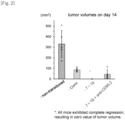
- anti-CD90.2 An anti-CD90.2 antibody (anti-CD90.2; prepared using a hybridoma purchased from ATCC by the present inventors), an antibody against CD90.2 (Thy1.2) expressed in the endogenous T-cells, was intraperitoneally administered twice a week from day 1. The first two doses were set to 1 mg/mouse, and the subsequent doses were set to 0.5 mg/mouse.
- the administration of the anti-human CD20 CAR-IL-7/CCL19-expressing T-cells suppressed the proliferation of malignant tumor, and the tumor disappeared because of a very high antitumor effect.
- the administration of the anti-CD90.2 antibody reduced the antitumor effect by approximately 50%.
- the anti-human CD20 CAR-IL-7/CCL19-expressing T-cells were evaluated for acquirement of a memory function by donor CAR-T-cells and endogenous T-cells and increase in the number of cells having a memory function, using memory cell markers CD44 and CD62L.
- the donor T-cells were identified as CD90.1-positive cells (CD90.1 + ), and the recipient T-cells were identified as CD90.2-positive cells (CD90.2 + ).
- the expression of the memory T-cell markers (CD44 and CD62L) and CAR in CD4-positive and CD8-positive T-cells was detected by flow cytometry.
- the numerical values of dot plots or histograms represent the proportion of cells in each gate. The results are shown in Figure 3 .
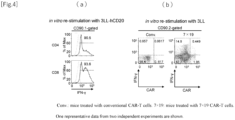
- the spleen cells collected on day 28 were stimulated by coculture with 3LL-hCD20 or the parent line 3LL expressing no hCD20, treated with mitomycin C (manufactured by Kyowa Kirin Co., Ltd.) at 37°C for 90 minutes.
- the production of IFN- ⁇ was examined by intracellular cytokine staining.
- the results are shown in Figure 4 .
- the numerical values in the histograms of Figure 4(a) represent the ratio of IFN- ⁇ -positive cells to CD90.1-positive donor T-cells.
- Figure 4(b) shows results of detecting IFN- ⁇ -positive cells in CD90.2-positive and endogenous CD8-positive T-cells by flow cytometry.
- the numerical values of the dot plots represent the proportions of cells in 4 quadrants.
- the CD90.2-gated cells included central memory T-cells (memory T-cell marker CD44-positive and CD62L-positive cells) at 5.5% of CD4-positive cells and 24.8% of CD8-positive cells.
- the CD90.2-gated cells included central memory T-cells at 6.76% of CD4-positive cells and 49.2% of CD8-positive cells.
- the ratio of central memory T-cells was increased in both the cases.
- the anti-human CD20 CAR-IL-7/CCL19-expressing T-cells can be used as an inducer for T-cells having a memory function in an administration subject, or an enhancer for T-cells having a memory function in an administration subject.
- the CD90.1-gated cells included central memory T-cells at 75.8% of CD4-positive cells and 90.7% of CD8-positive cells, confirming that the donor T-cells themselves were induced into the central memory T-cells.
- the CD90.1-gated cells were 0%, and the CD90.1-positive cells were not detected (n.d.) because Conv. expressed neither IL-7 nor CCL19 and exhibited a low survival rate of CAR-expressing T-cells.
- the donor cells included 90.5% CD4-positive cells and 93.6% CD8-positive cells producing IFN- ⁇ by stimulation with 3LL. Also, among the recipient endogenous T-cells (expressing no CAR-T), while 0.957% of CD4-positive cells produced IFN- ⁇ by the Conv. treatment, 14.9% of CD4 positive cells produced IFN- ⁇ by the 7 ⁇ 19 treatment. These results demonstrated that by the secretion of IL-7 and CCL19 using the anti-human CD20 CAR-IL-7/CCL19-expressing T-cells, both the donor T-cells and the recipient cells produce IFN- ⁇ by stimulation and acquire a memory function.
- TCR T-cell receptor
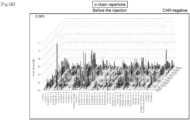
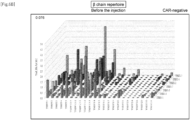
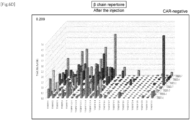
- spleen cells were collected from mice completely cured by the treatment of the tumor as described above (tumor-rejected mice), and cultured with P815-hCD20 or the parent line P815 expressing no hCD20 (hCD20-negative: hCD20 - ) for 4 days for the proliferation of CAR-positive T-cells or CAR-negative T-cells sorted using a cell sorter (SH800; manufactured by Sony Corp.). Then, for TCR repertoire analysis, CD8-positive and CAR-positive (CD8 + CAR + ) or CD8-positive and CAR-negative (CD8 + CAR - ) population was sorted using a flow cytometer.
- FIG. 5A to 5D show the results about the ⁇ chain
- Figures 6A to 6D show the results about the ⁇ chain
- Figures 5A , 5B , 6A , and 6B show the results obtained before administration of cells of each line
- Figures 5C , 5D , 6C , and 6D show the results obtained after administration of cells of each line.
- the upper left numerical values in the diagrams represent diversity indexes calculated by the Pielou's index of evenness (a higher number indicates a less diversity) and mean that a lower numerical value indicates a higher diversity.
- the T-cell receptor is an antigen receptor molecule expressed on the cell membranes of T-cells.
- the T-cell receptor exists as a heterodimer consisting of an ⁇ chain and a ⁇ chain or a ⁇ chain and a ⁇ chain, and is known to activate T-cells by recognizing an antigen molecule bound with major histocompatibility complex (MHC).
- MHC major histocompatibility complex
- the diversity indexes value was increased for both the ⁇ chain and the ⁇ chains by the administration of the anti-human CD20 CAR-IL-7/CCL19-expressing T-cells.
- the diversity of TCR was reduced not only in the administered anti-human CD20 CAR-IL-7/CCL19-expressing T-cells but in the recipient endogenous T-cells, demonstrating that T-cells presumably having a memory function against tumor antigen by locally secreting IL-7 and CCL19 to tumor while destroying the tumor cells are selectively increased in number.
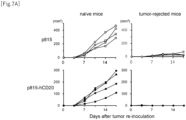
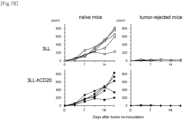
- CPA anticancer agent cyclophosphamide
- the abscissa of Figure 7A depicts the number of days from the day on which P815-hCD20 or P815 was initially administered (day 0) for the naive mice, and the number of days from the day on which P815-hCD20 was inoculated again on day 140 after the initial inoculation of P815-hCD20 (day 0) for the tumor-rejected mice.
- the abscissa of Figure 7B depicts the number of days from the day on which 3LL-hCD20 or 3LL was initially administered (day 0) for the naive mice, and the number of days from the day on which 3LL-hCD20 was inoculated again (day 0) for the tumor-rejected mice.
- the ordinates of Figures 7A and 7B depict tumor volumes (mm 3 ).
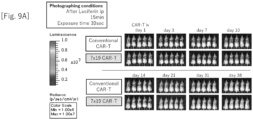
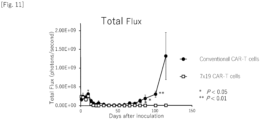
- tumor was formed by administering a human malignant pleural mesothelioma cell line to mice, and then, the presence or absence of tumor recurrence for 143 days was examined by the presence or absence of administration of the anti-human mesothelin CAR-IL-7/CCL19-expressing T-cells.
- Figure 8 shows a specific experimental protocol. Methods for preparing "ACC-MESO1-GFP-Luc", “anti-mesothelin CAR-expressing T-cells”, “anti-mesothelin CAR-IL-7/CCL19-expressing T-cells" shown in Figure 8 , and a method for activating T-cells are as follows.
- GFP-Luc green fluorescence protein-luciferase
- ACC-MESO1 was seeded at 1 ⁇ 10 3 cells/well to a 96-well plate.
- the culture medium used was RPMI1640 (manufactured by Gibco) supplemented with 10% FBS.
- RediFect Red-FLuc-GFP manufactured by PerkinElmer, Inc.
- lentivirus particles for luminescent cell preparation was added thereto at MOI 100 to start transduction.
- hexadimethrine bromide manufactured by Sigma-Aldrich Co. LLC was added to this culture medium such that the final concentration was 4 pg/mL.
- the anti-human mesothelin CAR-IL-7-CCL19-expressing T-cells, and the anti-human mesothelin CAR-expressing T-cells were prepared on the basis of the methods described in Japanese Patent Application No. 2017-247109 and International Publication No. WO 2016/056228 .
- a third-generation CAR construct (SEQ ID NO: 6) was prepared which had anti-human mesothelin single chain Fv consisting of the amino acid sequence of a heavy chain variable region set forth in SEQ ID NO: 3, the amino acid sequence of a linker set forth in SEQ ID NO: 4, and the amino acid sequence of a light chain variable region set forth in SEQ ID NO: 5, a human CD8 transmembrane region, and a human CD28-4-1BB-CD3 ⁇ intracellular signal motif in this order.
- a gene of a construct having human IL-7 set forth in SEQ ID NO: 1, subsequent picornavirus-derived 2A peptide (F2A) set forth in SEQ ID NO: 7, human CCL19 set forth in SEQ ID NO: 2, and herpes virus-derived thymidine kinase gene(HSV-tk) in this order at the C terminus of the construct was prepared and inserted to pMSGV1 retroviral expression vector ( Tamada k et al., Clin Cancer Res 18: 6436-6445 (2002 )) to prepare pMSGV1 retroviral expression vector for the expression of human IL-7/CCL19 and HSV-tk.
- the obtained pMSGV1 retroviral expression vector was introduced to mouse T-cells using retrovirus to prepare the anti-human mesothelin CAR-IL-7-CCL19-expressing T-cells.
- pMSGV1 retroviral expression vector for the expression of the third-generation CAR construct having anti-human mesothelin single chain Fv, a human CD8 transmembrane region, and a human CD28-4-1BB-CD3 ⁇ intracellular signal motif in this order was introduced instead of the pMSGV1 retroviral expression vector for the expression of human IL-7/CCL19 and HSV-tk to mouse T-cells using retrovirus to prepare the anti-human mesothelin CAR-expressing T-cells (conventional anti-human mesothelin CAR-expressing T-cells).
- the signal peptide used was a signal peptide set forth in SEQ ID NO: 8.
- the culture solution used contained OpTmizer CTS (manufactured by Gibco) supplemented with 2 mM L-glutamine (manufactured by Gibco), 1% penicillin-streptomycin (manufactured by Wako Pure Chemical Industries, Ltd.) and 2.5 ug/mL fungizone (manufactured by Bristol-Myers Squibb Company). After culture for 3 days, T-cells on day 3 were confirmed under a microscope to be activated and morphologically changed.
- OpTmizer CTS manufactured by Gibco
- 2 mM L-glutamine manufactured by Gibco
- penicillin-streptomycin manufactured by Wako Pure Chemical Industries, Ltd.
- 2.5 ug/mL fungizone manufactured by Bristol-Myers Squibb Company
- the ACC-MESO1-GFP-Luc was intrathoracically administered at 2 ⁇ 10 6 cells/mouse to 8-week-old female NSG immunodeficient mice.
- intrathoracic tumor engraftment was confirmed using an in vivo imaging system (IVIS).
- IVIS in vivo imaging system
- PBMC peripheral blood mononuclear cells
- mice given the anti-human mesothelin CAR-IL-7-CCL19-expressing T-cells are indicated by "7 ⁇ 19 CAR-T”
- the mice given the conventional anti-mesothelin CAR-expressing T-cells are indicated by "Conventional CAR-T”.
- NSG immunodeficient mice defective in endogenous T-cells were used as recipients. Therefore, the influence of recipient endogenous T-cells was eliminated, and the effect of the administered anti-human mesothelin CAR-IL-7-CCL19-expressing T-cells themselves was evaluated.
- tumor fluorescence intensity was rarely observed in both 7 ⁇ 19 CAR-T and Conventional CAR-T on or around day 21. Then, no tumor fluorescence was observed in 7 ⁇ 19 CAR-T up to day 143, confirming that recurrence was completely inhibited. On the other hand, tumor fluorescence became observable in Conventional CAR-T on or around day 45, and tumor fluorescence intensity was elevated on day 115, with one dead on day 129 and the remaining four also dead on day 143.
- T-cells having CAR as the cell surface molecule that recognizes a malignant tumor antigen.
- the memory potential of recipient endogenous T-cells was examined using T-cells having a T-cell receptor (TCR) instead of CAR as the cell surface molecule that recognizes a malignant tumor antigen.
- TCR T-cell receptor
- T-cells expressing TCR specific for the tumor antigen P1A of P815, mouse IL-7, mouse CCL19, and GFP were prepared in accordance with the method described in patent document 3. The preparation method will be briefly described below.
- IL-7-F2A-CCL19 DNA fragment encoding mouse IL-7 (without a stop codon), subsequent picornavirus-derived 2A peptide (F2A), and mouse CCL19 was artificially synthesized (Life Technologies Corp.).
- the IL-7-F2A-CCL19 DNA fragment thus synthesized was inserted to the multicloning site of pMSGV retroviral expression vector (patent document 3) having a F2A-eGFP sequence by restriction enzyme (NCOI and ECORI) treatment and ligation to obtain pMSGV vector comprising an IL-7-F2A-CCL19-F2A-eGFP DNA fragment (SEQ ID NO: 9) (IL-7 ⁇ CCL19-eGFP expression vector).
- nucleotides 1 to 462 correspond to a nucleic acid encoding IL-7 (nucleotides 1 to 75 correspond to a nucleic acid encoding a signal sequence of IL-7), nucleotides 463 to 537 correspond to a nucleic acid encoding F2A, nucleotides 538 to 861 correspond to a nucleic acid encoding CCL19 (nucleotides 538 to 612 correspond to a nucleic acid encoding a signal sequence of CCL19), nucleotides 868 to 942 correspond to a nucleic acid encoding F2A, nucleotides 946 to 1662 correspond to a nucleic acid encoding eGFP, and nucleotides 1663 to 1665 correspond to a stop codon.
- Spleen cells were collected from transgenic mice expressing TCR specific for H-2L d -restricted tumor antigen P1A of P815 ( Sarma, S., Y. Guo, Y. Guilloux, C. Lee, X.-F. Bai, Y. Liu. 1999. J. Exp. Med. 189:811 .) obtained from Y. Liu. Spleen cell-derived mouse T-cells expressing TCR specific for the tumor antigen P1A of P815 (P1A-specific TCR-T-cells) were obtained therefrom.
- retrovirus harboring the IL-7 ⁇ CCL19-eGFP expression vector or the eGFP control vector was prepared, and cells obtained by activating the spleen cells (3 ⁇ 10 6 cells/well) including the P1A-specific TCR-T-cells with P1A peptide for 48 hours were transduced with the retrovirus to obtain P1A-specific TCR/IL-7/CCL19/eGFP-expressing T-cells (7 ⁇ 19 P1A-CTL) or P1A-specific TCR/eGFP-expressing T-cells (conv. P1A-CTL).
- the transduction with each expression vector was confirmed by flow cytometry analysis of detecting eGFP as a surrogate marker.
- the eGFP expression level of the obtained T-cells of each line was 70 to 80% in all the experiments.
- Figures 12(a) and 12(b) show results of analyzing the ratio of CD8 + GFP + cells to spleen cells and the absolute number of CD8 + GFP + cells in mice treated with the P1A-specific TCR/IL-7/CCL19/eGFP-expressing T-cells or the P1A-specific TCR/eGFP-expressing T-cells by flow cytometry.
- the treatment with the P1A-specific TCR/IL-7/CCL19/eGFP-expressing T-cells was confirmed to increase the ratio of CD8 + GFP + cells to spleen cells and the absolute number of CD8 + GFP + cells.
- Figures 13(a) and 13(b) show results of analyzing the expression of CD44 in CD8 + spleen cells of naive BDA/2 mice and CD8 + GFP - or CD8 + GFP + spleen cells of mice treated with the P1A-specific TCR/IL-7/CCL19/eGFP-expressing T-cells by flow cytometry.
- Figure 13(a) shows the representative number of CD44 + cells.
- Figure 13(b) shows the proportion of CD44 + cells.
- the P1A-specific TCR/IL-7/CCL19/eGFP-expressing T-cells were confirmed to have the action of imparting memory potential to recipient intrinsic T-cells, i.e., the action of inducing a memory function in recipient intrinsic T-cells and enhancing the memory function in the recipient intrinsic T-cells.
- T-cells were magnetically isolated from spleen cells and cocultured for approximately 5 days with mucosal mast cells (MMC) treated with P815.
- Figure 14 shows results of detecting the concentration of IFN- ⁇ in a supernatant of the culture medium by ELISA (enzyme-linked immunosorbent assay). As shown in Figure 14 , the P1A-specific TCR/IL-7/CCL19/eGFP-expressing T-cells were confirmed to be rich in the production of IFN- ⁇ .
- the P1A-specific TCR/IL-7/CCL19/eGFP-expressing T-cells were confirmed to improve the antitumor activity of the recipient endogenous T-cells. This suggested that the P1A-specific TCR/IL-7/CCL19/eGFP-expressing T-cells induce a recurrence inhibitory effect in recipients.
- Examples described above employed an immune cell as the nucleic acid delivery vehicle. Enhancement in T-cells or B-cells having a memory function or inhibition of malignant tumor recurrence in an administration subject must be achieved without the use of the immune cell as long as IL-7 and CCL19 are locally secreted to tumor. Accordingly, analysis was conducted using a virus instead of the immune cell as the nucleic acid delivery vehicle.
- a genetically recombinant vaccinia virus expressing mouse IL-7 and mouse CCL19 was prepared by the following method in accordance with the method described in patent document 3 and International Publication No. WO 2011/125469 .
- a blue fluorescent protein (BFP) gene region was amplified with DNA of pTagBFP-N vector (FP172, Evrogen) as a template using two primers (5'-ATG GCC GGA CCG GCC ACC GGT CGC CAC CAT GAG CGA G-3': SEQ ID NO: 10) and (5'-TCG AAT TCG CTA GCG GCC GCT TAA TTA AGC TTG TGC CCC AG-3': SEQ ID NO: 11).
- telomere sequence was cloned into the corresponding restriction site of pTK-SP-LG vector (International Publication No. WO 2011/125469 ) to construct pTK-SP-BFP in which the BFP gene was linked under synthetic vaccinia virus promoter ( Hammond JM. et al., Journal of Virological Methods. 1997; 66 (1): 135-138 ).
- pAmCyan1-N1 vector (manufactured by Takara Bio Inc.) was cleaved with restriction enzymes AgeI and NotI, and the resulting fluorescence protein AmCyan1 fragment was cloned into a site, treated with the same restriction enzymes thereas, of pTK-SP-BFP to construct pTK-SP-AmCyan1.
- pMSGV plasmid comprising a DNA fragment encoding mouse IL-7, subsequent picornavirus-derived 2A peptide (F2A), mouse CCL19, F2A, and eGFP (patent document 3) was cleaved with restriction enzyme BamHI, treated for blunt end, and then cleaved with NcoI.
- mouse IL-7-F2A-mouse CCL19-F2A-eGFP fragment was cloned into a site obtained by the cleavage of pTK-SP-AmCyan1 with NheI and treatment for blunt end, followed by cleavage with NcoI to construct transfer vector plasmid pTK-SP-mouse IL-7-F2A-mouse CCL19-F2A-eGFP.
- a firefly luciferase gene region was amplified with DNA of pGL4.20 (manufactured by Promega Corp.) as a template using two primers (5'-GCT CCG GAC GCC ACC ATG GAA GAT GCC AAA AAC-3' (SEQ ID NO: 12) and 5'-GCG AAT TCC ACG GCG ATC TTG CCG CCC TTC T-3' (SEQ ID NO: 13)).
- the PCR product was cleaved with restriction enzymes BspEI and EcoRI, and the obtained Luc fragment, and a fragment comprising a portion of eGFP, obtained by the cleavage of pTK-SP-mouse IL-7-F2A-mouse CCL19-F2A-eGFP with restriction enzymes EcoRI and BsrGI were simultaneously cloned into a site of pTK-SP-mouse IL-7-F2A-mouse CCL19-F2A-eGFP cleaved with restriction enzymes BspEI and BsrGI to construct transfer vector plasmid pTK-SP-Luc-F2A-eGFP.
- transfer vector plasmid DNA pTK-SP-mouse IL-7-F2A-mouse CCL19-F2A-eGFP or pTK-SP-Luc-F2A-eGFP
- FuGENE HD manufactured by Promega Corp.
- the cells were cultured at 37°C for 2 to 5 days. The cells were recovered, frozen and thawed, then sonicated, appropriately diluted and inoculated into almost confluent BSC1 cells.
- Eagle MEM culture medium containing 0.8% methylcellulose and 5% FBS was added thereto, and the cells were cultured at 37°C for 2 to 5 days. The culture medium was removed, and BFP-expressing plaques were scraped off with a pipette tip and suspended in Opti-MEM culture medium (manufactured by Invitrogen Corp.). This operation was further repeated three or more times using BSC1 cells to purify the plaques. The suspension of the plaques collected after the plaque purification was sonicated.
- genomic DNA was extracted from a 200 ⁇ L aliquot thereof using High Pure Viral Nucleic Acid Kit (manufactured by F. Hoffmann-La Roche, Ltd.) according to the manual and subjected to screening by PCR.
- PCR was performed using two primers (5'-ATT TCT CCG TGA TAG GTA TCG ATG-3' (SEQ ID NO: 14) and 5'-AAC GGT TTA CGT TGA AAT GTC C-3'SEQ ID NO: 15), and clones with a predetermined size of a PCR product detected were directly sequenced to confirm the nucleotide sequence of the PCR product.
- a virus clone having no problem in the nucleotide sequence was selected and amplified in A549 cells, followed by virus titer measurement in RK13 cells.
- the obtained virus was subjected as genetically recombinant vaccinia virus LC16mO TK-SP-mouse IL-7-F2A-mouse CCL19-F2A-eGFP (TK-ICE; Figure 15(a) ) or LC16mO TK-SP-Luc-F2A-eGFP (TK-LE; Figure 15(b) ) to the following experiment.
- the supernatant recovered from the cells of each line 24, 48, or 72 hours later were diluted 100-fold, and the amounts of IL-7 and CCL19 secreted in 0.5 mL of the supernatant were measured using DuoSet ELISA Mouse IL-7 (DY407 manufactured by R&D Systems, Inc.), DuoSet ELISA Mouse CCL-19 (DY440 manufactured by R&D Systems, Inc.), and DuoSet Ancillary Reagent Kit 2 (DY008 manufactured by R&D Systems, Inc.).
- the measurement results are shown in Figure 17 .
- eGFP fluorescence emission from the A549 cells and the CT26 cells 24, 48, or 72 hours after the infection was at the same level between TK-ICE and TK-LE.
- the eGFP fluorescence emission was detected in almost all the A549 cells 48 hours after the infection.
- the eGFP fluorescence emission was increased in the CT26 cells with a lapse of time.
- IL-7 and CCL19 were detected from 24 hours after the infection in the A549 cells and CT26 cells infected with TK-ICE.
- the amounts of IL-7 and CCL19 in the A549 cells reached almost a plateau 48 hours after the infection.
- the amounts of IL-7 and CCL19 in the CT26 cells were elevated with a lapse of time.
- the amounts of IL-7 and CCL19 were equal to or lower than the detection limits in the cells infected with TK-LE. From these results, TK-ICE was confirmed to secrete IL-7 and CCL19 while destroying tumor cells.
- Example 8 the genetically recombinant vaccinia virus TK-ICE prepared as described above was confirmed to secrete IL-7 and CCL19 while destroying cancer cells by infecting the tumor cells. Accordingly, the genetically recombinant vaccinia virus TK-ICE was examined for its antitumor effect.
- mouse large intestine cancer CT26 cells (5 ⁇ 10 5 cells) were subcutaneously transplanted to right and left abdominal parts of each of BALB/c mice and allowed to grow. Subsequently, each genetically recombinant vaccinia virus (3 to 5 ⁇ 10 7 plaque-forming units (PFU)) was intratumorally administered a total of three times (days 0, 2, and 4) to a larger one selected from tumors formed in the right and left abdominal parts. Then, the antitumor effect of the virus was studied by tumor diameter measurement in the right and left abdominal parts. The tumor on the administration side before the first dosage was 43 to 102 mm 3 , and the tumor on the non-administration side before the first dosage was 24 to 82 mm 3 . The results are shown in Figure 19 .
- the genetically recombinant vaccinia virus administered to tumor on one side of the abdominal parts was confirmed to be not migrated to tumor on the other side, by a method for noninvasively detecting a virus by administering a substrate (luciferin) for a luminescent enzyme (luciferase) expressed in tumor cells infected with TK-LE, and confirming the presence or absence of luminescence (not shown).
- a substrate luciferin
- luciferase luminescent enzyme
Landscapes
- Health & Medical Sciences (AREA)
- Life Sciences & Earth Sciences (AREA)
- General Health & Medical Sciences (AREA)
- Chemical & Material Sciences (AREA)
- Animal Behavior & Ethology (AREA)
- Public Health (AREA)
- Veterinary Medicine (AREA)
- Epidemiology (AREA)
- Medicinal Chemistry (AREA)
- Pharmacology & Pharmacy (AREA)
- Engineering & Computer Science (AREA)
- Organic Chemistry (AREA)
- Zoology (AREA)
- Immunology (AREA)
- Genetics & Genomics (AREA)
- Bioinformatics & Cheminformatics (AREA)
- Gastroenterology & Hepatology (AREA)
- Proteomics, Peptides & Aminoacids (AREA)
- Molecular Biology (AREA)
- Virology (AREA)
- Biotechnology (AREA)
- Biochemistry (AREA)
- Microbiology (AREA)
- Biomedical Technology (AREA)
- Biophysics (AREA)
- Cell Biology (AREA)
- Toxicology (AREA)
- Mycology (AREA)
- Chemical Kinetics & Catalysis (AREA)
- Nuclear Medicine, Radiotherapy & Molecular Imaging (AREA)
- General Chemical & Material Sciences (AREA)
- Wood Science & Technology (AREA)
- Oncology (AREA)
- General Engineering & Computer Science (AREA)
- Physics & Mathematics (AREA)
- Developmental Biology & Embryology (AREA)
- Hematology (AREA)
- Optics & Photonics (AREA)
- Nanotechnology (AREA)
- Dispersion Chemistry (AREA)
Applications Claiming Priority (3)
| Application Number | Priority Date | Filing Date | Title |
|---|---|---|---|
| JP2017196718 | 2017-10-10 | ||
| EP18866437.9A EP3695846B1 (fr) | 2017-10-10 | 2018-10-09 | Amplificateur pour lymphocytes t ou lymphocytes b ayant une fonction de mémoire, inhibiteur de récurrence de tumeur maligne, et inducteur pour induire une fonction de mémoire dans des lymphocytes t ou des lymphocytes b |
| PCT/JP2018/037608 WO2019073973A1 (fr) | 2017-10-10 | 2018-10-09 | Amplificateur pour lymphocytes t ou lymphocytes b ayant une fonction de mémoire, inhibiteur de récurrence de tumeur maligne, et inducteur pour induire une fonction de mémoire dans des lymphocytes t ou des lymphocytes b |
Related Parent Applications (2)
| Application Number | Title | Priority Date | Filing Date |
|---|---|---|---|
| EP18866437.9A Division EP3695846B1 (fr) | 2017-10-10 | 2018-10-09 | Amplificateur pour lymphocytes t ou lymphocytes b ayant une fonction de mémoire, inhibiteur de récurrence de tumeur maligne, et inducteur pour induire une fonction de mémoire dans des lymphocytes t ou des lymphocytes b |
| EP18866437.9A Division-Into EP3695846B1 (fr) | 2017-10-10 | 2018-10-09 | Amplificateur pour lymphocytes t ou lymphocytes b ayant une fonction de mémoire, inhibiteur de récurrence de tumeur maligne, et inducteur pour induire une fonction de mémoire dans des lymphocytes t ou des lymphocytes b |
Publications (2)
| Publication Number | Publication Date |
|---|---|
| EP4265634A2 true EP4265634A2 (fr) | 2023-10-25 |
| EP4265634A3 EP4265634A3 (fr) | 2024-01-24 |
Family
ID=66100816
Family Applications (2)
| Application Number | Title | Priority Date | Filing Date |
|---|---|---|---|
| EP23187186.4A Pending EP4265634A3 (fr) | 2017-10-10 | 2018-10-09 | Amplificateur pour lymphocytes t ou lymphocytes b ayant une fonction de mémoire, inhibiteur de récurrence de tumeur maligne, et inducteur pour induire une fonction de mémoire dans des lymphocytes t ou des lymphocytes b |
| EP18866437.9A Active EP3695846B1 (fr) | 2017-10-10 | 2018-10-09 | Amplificateur pour lymphocytes t ou lymphocytes b ayant une fonction de mémoire, inhibiteur de récurrence de tumeur maligne, et inducteur pour induire une fonction de mémoire dans des lymphocytes t ou des lymphocytes b |
Family Applications After (1)
| Application Number | Title | Priority Date | Filing Date |
|---|---|---|---|
| EP18866437.9A Active EP3695846B1 (fr) | 2017-10-10 | 2018-10-09 | Amplificateur pour lymphocytes t ou lymphocytes b ayant une fonction de mémoire, inhibiteur de récurrence de tumeur maligne, et inducteur pour induire une fonction de mémoire dans des lymphocytes t ou des lymphocytes b |
Country Status (18)
| Country | Link |
|---|---|
| US (2) | US11617765B2 (fr) |
| EP (2) | EP4265634A3 (fr) |
| JP (3) | JP7232447B2 (fr) |
| KR (2) | KR102790597B1 (fr) |
| CN (1) | CN111163758A (fr) |
| AU (2) | AU2018349889B2 (fr) |
| BR (1) | BR112020006746A2 (fr) |
| CA (1) | CA3075886A1 (fr) |
| CL (1) | CL2020000950A1 (fr) |
| ES (1) | ES2970282T3 (fr) |
| IL (2) | IL305898B2 (fr) |
| MX (1) | MX2020003737A (fr) |
| MY (1) | MY202579A (fr) |
| PH (1) | PH12020550241A1 (fr) |
| SG (1) | SG11202003252TA (fr) |
| TW (1) | TWI838348B (fr) |
| WO (1) | WO2019073973A1 (fr) |
| ZA (1) | ZA202000986B (fr) |
Families Citing this family (12)
| Publication number | Priority date | Publication date | Assignee | Title |
|---|---|---|---|---|
| WO2019124468A1 (fr) * | 2017-12-24 | 2019-06-27 | ノイルイミューン・バイオテック株式会社 | Cellule immunocompétente exprimant une molécule de surface cellulaire reconnaissant spécifiquement la mésothéline humaine, il-7 et ccl19 |
| JP7436056B2 (ja) * | 2019-10-28 | 2024-02-21 | ノイルイミューン・バイオテック株式会社 | がんを治療するための医薬、組み合わせ医薬、医薬組成物、免疫応答性細胞、核酸送達媒体、及び製品 |
| JPWO2021193081A1 (fr) * | 2020-03-23 | 2021-09-30 | ||
| CN111849910B (zh) * | 2020-05-27 | 2021-06-15 | 南京北恒生物科技有限公司 | 工程化免疫细胞及其用途 |
| JP7758370B2 (ja) * | 2020-07-16 | 2025-10-22 | チャンジェン セラピューティクス (シャンハイ) カンパニー リミテッド | 間葉系幹細胞によるケモカインおよびサイトカイン送達を標的とする免疫療法 |
| KR102770127B1 (ko) * | 2020-10-28 | 2025-02-21 | 주식회사 티에스디라이프사이언스 | 이종 면역세포에 대한 화학주성을 유도하는 형질전환된 면역세포 |
| CN114717203B (zh) * | 2020-12-22 | 2023-06-27 | 广东东阳光药业有限公司 | 一种hIL7/hCCL19双基因重组溶瘤病毒及其制备方法和用途 |
| AU2022318416A1 (en) * | 2021-07-29 | 2024-01-25 | Takeda Pharmaceutical Company Limited | Engineered immune cell that specifically targets mesothelin and uses thereof |
| CN113832115A (zh) * | 2021-08-25 | 2021-12-24 | 居颂光 | 融合基因ril-7联合ccl19重组溶瘤牛痘病毒及其在制备抗肿瘤药物中的应用 |
| GB202205572D0 (en) * | 2022-04-14 | 2022-06-01 | Adaptimmune Ltd | Engineered T cells |
| DE102022132082B4 (de) * | 2022-12-02 | 2024-08-08 | Horia Hulubei National Institute for R & D in Physics and Nuclear Engineering (IFIN-HH) | Verfahren zur Herstellung von genetisch transfizierten und mit Nanopartikeln und/oder einem zytotoxischen Stoff beladenen immunokompetenten Zellen sowie immunokompetente Zellen und medizinische Zusammensetzung. |
| CN120916775A (zh) * | 2023-03-01 | 2025-11-07 | 百奥科莫株式会社 | 抗癌剂、癌症治疗用药物组合物、试剂盒以及活化剂 |
Citations (8)
| Publication number | Priority date | Publication date | Assignee | Title |
|---|---|---|---|---|
| JPH02227075A (ja) | 1988-09-29 | 1990-09-10 | Kyowa Hakko Kogyo Co Ltd | 新規ポリペプチド |
| JP3867968B2 (ja) | 2002-07-08 | 2007-01-17 | 関西ティー・エル・オー株式会社 | 腫瘍細胞において選択的に増殖する腫瘍融解ウイルス |
| WO2011125469A1 (fr) | 2010-04-09 | 2011-10-13 | 国立大学法人東京大学 | Virus de vaccine recombinant régulé par micro-arn et utilisation de celui-ci |
| WO2012094386A1 (fr) | 2011-01-04 | 2012-07-12 | Jennerex Inc. | Génération d'anticorps contre des antigènes tumoraux et génération de cytotoxicité dépendante du complément spécifique d'une tumeur par l'administration du virus oncolytique de la vaccine |
| WO2013123061A1 (fr) | 2012-02-13 | 2013-08-22 | Seattle Children's Hospital D/B/A Seattle Children's Research Institute | Récepteurs d'antigène chimères bispécifiques et utilisations thérapeutiques de ceux-ci |
| JP5574284B2 (ja) | 2004-05-25 | 2014-08-20 | 小財 健一郎 | サービビン(Survivin)プロモーターを含む増殖型アデノウイルスベクターを有効成分とする癌治療薬 |
| WO2016056228A1 (fr) | 2014-10-09 | 2016-04-14 | 国立大学法人山口大学 | Vecteur d'expression de récepteur d'antigène chimérique, et cellule t d'expression de récepteur d'antigène chimérique |
| WO2017159736A1 (fr) | 2016-03-17 | 2017-09-21 | 国立大学法人山口大学 | Cellule immunocompétente et vecteur d'expression exprimant des facteurs de régulation de la fonction immunitaire |
Family Cites Families (2)
| Publication number | Priority date | Publication date | Assignee | Title |
|---|---|---|---|---|
| JP5716759B2 (ja) | 2013-01-09 | 2015-05-13 | コニカミノルタ株式会社 | 有機エレクトロルミネッセンス素子の製造方法 |
| JP5701442B1 (ja) | 2014-09-05 | 2015-04-15 | 関西ペイント株式会社 | カチオン電着塗料組成物 |
-
2018
- 2018-10-09 KR KR1020207009950A patent/KR102790597B1/ko active Active
- 2018-10-09 CN CN201880062891.XA patent/CN111163758A/zh active Pending
- 2018-10-09 IL IL305898A patent/IL305898B2/en unknown
- 2018-10-09 BR BR112020006746-6A patent/BR112020006746A2/pt unknown
- 2018-10-09 EP EP23187186.4A patent/EP4265634A3/fr active Pending
- 2018-10-09 JP JP2019548200A patent/JP7232447B2/ja active Active
- 2018-10-09 US US16/754,645 patent/US11617765B2/en active Active
- 2018-10-09 ES ES18866437T patent/ES2970282T3/es active Active
- 2018-10-09 KR KR1020257010303A patent/KR20250048397A/ko active Pending
- 2018-10-09 CA CA3075886A patent/CA3075886A1/fr active Pending
- 2018-10-09 AU AU2018349889A patent/AU2018349889B2/en active Active
- 2018-10-09 SG SG11202003252TA patent/SG11202003252TA/en unknown
- 2018-10-09 IL IL273689A patent/IL273689B2/en unknown
- 2018-10-09 EP EP18866437.9A patent/EP3695846B1/fr active Active
- 2018-10-09 MX MX2020003737A patent/MX2020003737A/es unknown
- 2018-10-09 MY MYPI2020001652A patent/MY202579A/en unknown
- 2018-10-09 WO PCT/JP2018/037608 patent/WO2019073973A1/fr not_active Ceased
- 2018-10-11 TW TW107135776A patent/TWI838348B/zh active
-
2020
- 2020-02-17 ZA ZA2020/00986A patent/ZA202000986B/en unknown
- 2020-04-08 CL CL2020000950A patent/CL2020000950A1/es unknown
- 2020-04-08 PH PH12020550241A patent/PH12020550241A1/en unknown
-
2023
- 2023-02-09 JP JP2023018050A patent/JP7595888B2/ja active Active
- 2023-02-09 US US18/166,672 patent/US20240269174A1/en not_active Abandoned
-
2024
- 2024-02-28 AU AU2024201332A patent/AU2024201332B2/en active Active
- 2024-11-19 JP JP2024201873A patent/JP2025019112A/ja not_active Withdrawn
Patent Citations (8)
| Publication number | Priority date | Publication date | Assignee | Title |
|---|---|---|---|---|
| JPH02227075A (ja) | 1988-09-29 | 1990-09-10 | Kyowa Hakko Kogyo Co Ltd | 新規ポリペプチド |
| JP3867968B2 (ja) | 2002-07-08 | 2007-01-17 | 関西ティー・エル・オー株式会社 | 腫瘍細胞において選択的に増殖する腫瘍融解ウイルス |
| JP5574284B2 (ja) | 2004-05-25 | 2014-08-20 | 小財 健一郎 | サービビン(Survivin)プロモーターを含む増殖型アデノウイルスベクターを有効成分とする癌治療薬 |
| WO2011125469A1 (fr) | 2010-04-09 | 2011-10-13 | 国立大学法人東京大学 | Virus de vaccine recombinant régulé par micro-arn et utilisation de celui-ci |
| WO2012094386A1 (fr) | 2011-01-04 | 2012-07-12 | Jennerex Inc. | Génération d'anticorps contre des antigènes tumoraux et génération de cytotoxicité dépendante du complément spécifique d'une tumeur par l'administration du virus oncolytique de la vaccine |
| WO2013123061A1 (fr) | 2012-02-13 | 2013-08-22 | Seattle Children's Hospital D/B/A Seattle Children's Research Institute | Récepteurs d'antigène chimères bispécifiques et utilisations thérapeutiques de ceux-ci |
| WO2016056228A1 (fr) | 2014-10-09 | 2016-04-14 | 国立大学法人山口大学 | Vecteur d'expression de récepteur d'antigène chimérique, et cellule t d'expression de récepteur d'antigène chimérique |
| WO2017159736A1 (fr) | 2016-03-17 | 2017-09-21 | 国立大学法人山口大学 | Cellule immunocompétente et vecteur d'expression exprimant des facteurs de régulation de la fonction immunitaire |
Non-Patent Citations (29)
| Title |
|---|
| ALTSCHUL ET AL., J. MOL. BIOL., vol. 215, 1990, pages 403 - 410 |
| ALTSCHUL ET AL., NUCLEIC ACIDS RES., vol. 25, 1997, pages 3389 - 3402 |
| ANDTBACKA RHI ET AL., J CLIN ONCOL, vol. 33, 2015, pages 2780 - 2788 |
| DEVEREUX ET AL., NUCLEIC ACID RES., vol. 12, 1984, pages 387 |
| FREEDMAN JD ET AL., EMBO MOL MED, vol. 9, 2017, pages 1067 - 1087 |
| HAMMOND JM ET AL., JOURNAL OF VIROLOGICAL METHODS, vol. 66, no. 1, 1997, pages 135 - 138 |
| HEO J ET AL., NATURE MEDICINE, no. 3, 2013, pages 329 - 36 |
| HIROOKA Y ET AL., BMC CANCER, vol. 18, 2018, pages 596 |
| JAMES M. ET AL., THE JOURNAL OF ONCOLOGY, vol. 188, no. 6, 2012, pages 2391 - 7 |
| JOURNAL OF VIROLOGY, vol. 90, no. 11, June 2016 (2016-06-01), pages 5343 - 5352 |
| KIM MK ET AL., SCIENCE TRANSLATIONAL MEDICINE, vol. 5, no. 185, 15 May 2013 (2013-05-15), pages 18563 |
| LANG FF ET AL., JOURNAL OF CLINICAL ONCOLOGY, 2018 |
| MAHALINGAM ET AL., CANCERS, vol. 10, 2018, pages 160 |
| MARINO NILLINGWORTH SKODIALBAIL PPATEL ACALDERON HLEAR RFISHER KDCHAMPION BRBROWN ACN, PLOS ONE, vol. 12, no. 5, 2017, pages e0177810 |
| MAZZACURATI ET AL., MOL THER, vol. 23, no. 1, January 2015 (2015-01-01), pages 99 - 107 |
| MOLECULAR THERAPY, vol. 18, 2 February 2010 (2010-02-02), pages 233 - 234 |
| MUIK A ET AL., CANCER RES, vol. 74, no. 13, pages 3567 - 78 |
| NAKATAKE R ET AL., CANCER SCI., vol. 9, no. 3, 10 March 2018 (2018-03-10), pages 600 - 610 |
| NEEDLEMANWUNSCH, J. MOL. BIOL., vol. 48, 1970, pages 443 - 453 |
| PEARSONLIPMAN, PROC. NATL. ACAD. SCI. USA, vol. 85, 1988, pages 2444 - 2448 |
| PROC. NATL. ACAD. SCI. U.S.A., vol. 84, 1987, pages 7413 |
| SARMA, S.Y. GUOY. GUILLOUXC. LEEX.-F. BAIY. LIU, J. EXP. MED., vol. 189, 1999, pages 811 |
| SATO-HASHIMOTO M ET AL., J. IMMUNOL., vol. 187, no. 1, 2011, pages 291 - 7 |
| SIEGERT S. ET AL., FRONT. IMMUNOL, vol. 3, 2012, pages 285 |
| TAMADA ET AL., NATURE BIOTECHNOLOGY |
| TAMADA K ET AL., CLIN CANCER RES, vol. 18, 2002, pages 6436 - 6445 |
| TEDCASTLE A ET AL., MOL THER, vol. 24, 2016, pages 796 - 804 |
| WIBURLIPMAN, SIAM J. APPL. MATH., vol. 44, 1984, pages 557 - 567 |
| YOZO NAKAZAWA, THE SHINSHU MEDICAL JOURNAL, vol. 61, no. 4, 2013, pages 197 - 203 |
Also Published As
Similar Documents
| Publication | Publication Date | Title |
|---|---|---|
| US20240269174A1 (en) | Enhancer for t-cells or b-cells having memory function, malignant tumor recurrence inhibitor, and inducer for inducing memory function in t-cells or b-cells | |
| RU2688185C2 (ru) | Способ и композиции для клеточной иммунотерапии | |
| US20240139248A1 (en) | Immunocompetent cell that expresses a cell surface molecule specifically recognizing human mesothelin, il-7 and ccl19 | |
| JP6971986B2 (ja) | 免疫療法の抗腫瘍活性を高めるための間葉系幹細胞 | |
| EP3597742A1 (fr) | Vecteur d'expression de récepteur d'antigène chimérique et cellules t d'expression de récepteur d'antigène chimérique | |
| JP2020527036A (ja) | 癌免疫療法用mr1制限t細胞受容体 | |
| WO2020112815A1 (fr) | Thérapie à base de lymphocyte t-tcr anti-lmp2 pour le traitement de cancers associés à ebv | |
| JP2022500038A (ja) | 癌免疫療法用mr1制限t細胞受容体 | |
| Hatami et al. | Interleukin-12 encoded by the oncolytic virus VSV-GP enhances therapeutic antitumor efficacy by inducing CD8+ T-cell responses with a long-lived effector cell phenotype | |
| HK40095464A (en) | Enhancer for t-cells or b-cells having memory function, malignant tumor recurrence inhibitor, and inducer for inducing memory function in t-cells or b-cells | |
| RU2802824C2 (ru) | Энхансер t-клеток или b-клеток, имеющих функцию памяти, ингибитор рецидива злокачественной опухоли и индуктор для индуцирования функции памяти в t-клетках или b-клетках | |
| HK40025476A (en) | Enhancer for t-cells or b-cells having memory function, malignant tumor recurrence inhibitor, and inducer for inducing memory function in t-cells or b-cells | |
| HK40025476B (en) | Enhancer for t-cells or b-cells having memory function, malignant tumor recurrence inhibitor, and inducer for inducing memory function in t-cells or b-cells | |
| US20260053856A1 (en) | Immunocompetent cell and expression vector expressing regulatory factors of immune function / a cell surface molecule specifically recognizing human mesothelin, il-7 and ccl19 | |
| US20240002465A1 (en) | Mr1 restricted t cell receptors for cancer immunotherapy |
Legal Events
| Date | Code | Title | Description |
|---|---|---|---|
| PUAI | Public reference made under article 153(3) epc to a published international application that has entered the european phase |
Free format text: ORIGINAL CODE: 0009012 |
|
| STAA | Information on the status of an ep patent application or granted ep patent |
Free format text: STATUS: THE APPLICATION HAS BEEN PUBLISHED |
|
| AC | Divisional application: reference to earlier application |
Ref document number: 3695846 Country of ref document: EP Kind code of ref document: P |
|
| AK | Designated contracting states |
Kind code of ref document: A2 Designated state(s): AL AT BE BG CH CY CZ DE DK EE ES FI FR GB GR HR HU IE IS IT LI LT LU LV MC MK MT NL NO PL PT RO RS SE SI SK SM TR |
|
| REG | Reference to a national code |
Ref country code: DE Ref legal event code: R079 Free format text: PREVIOUS MAIN CLASS: C07K0014725000 Ipc: A61K0035600000 |
|
| PUAL | Search report despatched |
Free format text: ORIGINAL CODE: 0009013 |
|
| AK | Designated contracting states |
Kind code of ref document: A3 Designated state(s): AL AT BE BG CH CY CZ DE DK EE ES FI FR GB GR HR HU IE IS IT LI LT LU LV MC MK MT NL NO PL PT RO RS SE SI SK SM TR |
|
| RIC1 | Information provided on ipc code assigned before grant |
Ipc: A61K 39/00 20060101ALI20231215BHEP Ipc: A61K 38/20 20060101ALI20231215BHEP Ipc: A61K 38/19 20060101ALI20231215BHEP Ipc: C12N 15/24 20060101ALI20231215BHEP Ipc: C12N 5/0783 20100101ALI20231215BHEP Ipc: C12N 5/0781 20100101ALI20231215BHEP Ipc: A61P 35/00 20060101ALI20231215BHEP Ipc: A61K 48/00 20060101ALI20231215BHEP Ipc: A61K 35/76 20150101ALI20231215BHEP Ipc: A61K 35/74 20150101ALI20231215BHEP Ipc: A61K 35/28 20150101ALI20231215BHEP Ipc: A61K 35/17 20150101ALI20231215BHEP Ipc: A61K 9/51 20060101ALI20231215BHEP Ipc: A61K 9/127 20060101ALI20231215BHEP Ipc: A61K 35/768 20150101ALI20231215BHEP Ipc: A61K 35/60 20060101AFI20231215BHEP |
|
| REG | Reference to a national code |
Ref country code: HK Ref legal event code: DE Ref document number: 40095464 Country of ref document: HK |
|
| STAA | Information on the status of an ep patent application or granted ep patent |
Free format text: STATUS: REQUEST FOR EXAMINATION WAS MADE |
|
| 17P | Request for examination filed |
Effective date: 20240621 |
|
| RBV | Designated contracting states (corrected) |
Designated state(s): AL AT BE BG CH CY CZ DE DK EE ES FI FR GB GR HR HU IE IS IT LI LT LU LV MC MK MT NL NO PL PT RO RS SE SI SK SM TR |
|
| STAA | Information on the status of an ep patent application or granted ep patent |
Free format text: STATUS: EXAMINATION IS IN PROGRESS |
|
| 17Q | First examination report despatched |
Effective date: 20241217 |
|
| GRAP | Despatch of communication of intention to grant a patent |
Free format text: ORIGINAL CODE: EPIDOSNIGR1 |
|
| STAA | Information on the status of an ep patent application or granted ep patent |
Free format text: STATUS: GRANT OF PATENT IS INTENDED |
|
| RIC1 | Information provided on ipc code assigned before grant |
Ipc: A61K 35/60 20060101AFI20260220BHEP Ipc: A61K 39/00 20060101ALI20260220BHEP Ipc: A61K 38/20 20060101ALI20260220BHEP Ipc: A61K 38/19 20060101ALI20260220BHEP Ipc: A61P 35/00 20060101ALI20260220BHEP Ipc: A61K 48/00 20060101ALI20260220BHEP Ipc: A61K 35/76 20150101ALI20260220BHEP Ipc: A61K 35/74 20150101ALI20260220BHEP Ipc: A61K 35/28 20150101ALI20260220BHEP Ipc: A61K 35/17 20150101ALI20260220BHEP Ipc: A61K 9/51 20060101ALI20260220BHEP Ipc: A61K 9/127 20060101ALI20260220BHEP Ipc: A61K 35/768 20150101ALI20260220BHEP Ipc: C07K 14/725 20060101ALI20260220BHEP Ipc: A61K 40/11 20250101ALI20260220BHEP Ipc: A61K 40/31 20250101ALI20260220BHEP Ipc: A61K 40/32 20250101ALI20260220BHEP Ipc: A61K 40/42 20250101ALI20260220BHEP |
|
| INTG | Intention to grant announced |
Effective date: 20260312 |