EP4269358A1 - Lithiummanganat vom spinelltyp, verfahren zu seiner herstellung und seine verwendung - Google Patents
Lithiummanganat vom spinelltyp, verfahren zu seiner herstellung und seine verwendung Download PDFInfo
- Publication number
- EP4269358A1 EP4269358A1 EP21910800.8A EP21910800A EP4269358A1 EP 4269358 A1 EP4269358 A1 EP 4269358A1 EP 21910800 A EP21910800 A EP 21910800A EP 4269358 A1 EP4269358 A1 EP 4269358A1
- Authority
- EP
- European Patent Office
- Prior art keywords
- spinel
- manganese oxide
- type lithium
- lithium manganese
- less
- Prior art date
- Legal status (The legal status is an assumption and is not a legal conclusion. Google has not performed a legal analysis and makes no representation as to the accuracy of the status listed.)
- Pending
Links
Images
Classifications
-
- C—CHEMISTRY; METALLURGY
- C01—INORGANIC CHEMISTRY
- C01G—COMPOUNDS CONTAINING METALS NOT COVERED BY SUBCLASSES C01D OR C01F
- C01G45/00—Compounds of manganese
- C01G45/20—Compounds containing manganese, with or without oxygen or hydrogen, and containing one or more other elements
- C01G45/22—Compounds containing manganese, with or without oxygen or hydrogen, and containing two or more other elements
-
- H—ELECTRICITY
- H01—ELECTRIC ELEMENTS
- H01M—PROCESSES OR MEANS, e.g. BATTERIES, FOR THE DIRECT CONVERSION OF CHEMICAL ENERGY INTO ELECTRICAL ENERGY
- H01M4/00—Electrodes
- H01M4/02—Electrodes composed of, or comprising, active material
- H01M4/36—Selection of substances as active materials, active masses, active liquids
- H01M4/48—Selection of substances as active materials, active masses, active liquids of inorganic oxides or hydroxides
- H01M4/50—Selection of substances as active materials, active masses, active liquids of inorganic oxides or hydroxides of manganese
- H01M4/505—Selection of substances as active materials, active masses, active liquids of inorganic oxides or hydroxides of manganese of mixed oxides or hydroxides containing manganese for inserting or intercalating light metals, e.g. LiMn2O4 or LiMn2OxFy
-
- C—CHEMISTRY; METALLURGY
- C01—INORGANIC CHEMISTRY
- C01B—NON-METALLIC ELEMENTS; COMPOUNDS THEREOF; METALLOIDS OR COMPOUNDS THEREOF NOT COVERED BY SUBCLASS C01C
- C01B25/00—Phosphorus; Compounds thereof
- C01B25/16—Oxyacids of phosphorus; Salts thereof
- C01B25/26—Phosphates
- C01B25/30—Alkali metal phosphates
-
- C—CHEMISTRY; METALLURGY
- C01—INORGANIC CHEMISTRY
- C01B—NON-METALLIC ELEMENTS; COMPOUNDS THEREOF; METALLOIDS OR COMPOUNDS THEREOF NOT COVERED BY SUBCLASS C01C
- C01B25/00—Phosphorus; Compounds thereof
- C01B25/16—Oxyacids of phosphorus; Salts thereof
- C01B25/26—Phosphates
- C01B25/45—Phosphates containing plural metal, or metal and ammonium
-
- C—CHEMISTRY; METALLURGY
- C01—INORGANIC CHEMISTRY
- C01G—COMPOUNDS CONTAINING METALS NOT COVERED BY SUBCLASSES C01D OR C01F
- C01G45/00—Compounds of manganese
- C01G45/12—Complex oxides containing manganese and at least one other metal element
- C01G45/1207—Permanganates ([MnO4)-] or manganates ([MnO4)2-]
- C01G45/1214—Permanganates ([MnO4)-] or manganates ([MnO4)2-] containing alkali metals
-
- C—CHEMISTRY; METALLURGY
- C01—INORGANIC CHEMISTRY
- C01G—COMPOUNDS CONTAINING METALS NOT COVERED BY SUBCLASSES C01D OR C01F
- C01G45/00—Compounds of manganese
- C01G45/12—Complex oxides containing manganese and at least one other metal element
- C01G45/1221—Manganates or manganites with trivalent manganese, tetravalent manganese or mixtures thereof
-
- C—CHEMISTRY; METALLURGY
- C01—INORGANIC CHEMISTRY
- C01G—COMPOUNDS CONTAINING METALS NOT COVERED BY SUBCLASSES C01D OR C01F
- C01G45/00—Compounds of manganese
- C01G45/12—Complex oxides containing manganese and at least one other metal element
- C01G45/1221—Manganates or manganites with trivalent manganese, tetravalent manganese or mixtures thereof
- C01G45/1242—Manganates or manganites with trivalent manganese, tetravalent manganese or mixtures thereof of the type (Mn2O4)-, e.g. LiMn2O4 or Li(MxMn2-x)O4
-
- H—ELECTRICITY
- H01—ELECTRIC ELEMENTS
- H01M—PROCESSES OR MEANS, e.g. BATTERIES, FOR THE DIRECT CONVERSION OF CHEMICAL ENERGY INTO ELECTRICAL ENERGY
- H01M10/00—Secondary cells; Manufacture thereof
- H01M10/05—Accumulators with non-aqueous electrolyte
- H01M10/052—Li-accumulators
-
- H—ELECTRICITY
- H01—ELECTRIC ELEMENTS
- H01M—PROCESSES OR MEANS, e.g. BATTERIES, FOR THE DIRECT CONVERSION OF CHEMICAL ENERGY INTO ELECTRICAL ENERGY
- H01M4/00—Electrodes
- H01M4/02—Electrodes composed of, or comprising, active material
- H01M4/04—Processes of manufacture in general
- H01M4/0471—Processes of manufacture in general involving thermal treatment, e.g. firing, sintering, backing particulate active material, thermal decomposition, pyrolysis
-
- H—ELECTRICITY
- H01—ELECTRIC ELEMENTS
- H01M—PROCESSES OR MEANS, e.g. BATTERIES, FOR THE DIRECT CONVERSION OF CHEMICAL ENERGY INTO ELECTRICAL ENERGY
- H01M4/00—Electrodes
- H01M4/02—Electrodes composed of, or comprising, active material
- H01M4/13—Electrodes for accumulators with non-aqueous electrolyte, e.g. for lithium-accumulators; Processes of manufacture thereof
- H01M4/131—Electrodes based on mixed oxides or hydroxides, or on mixtures of oxides or hydroxides, e.g. LiCoOx
-
- H—ELECTRICITY
- H01—ELECTRIC ELEMENTS
- H01M—PROCESSES OR MEANS, e.g. BATTERIES, FOR THE DIRECT CONVERSION OF CHEMICAL ENERGY INTO ELECTRICAL ENERGY
- H01M4/00—Electrodes
- H01M4/02—Electrodes composed of, or comprising, active material
- H01M4/36—Selection of substances as active materials, active masses, active liquids
- H01M4/362—Composites
- H01M4/364—Composites as mixtures
-
- H—ELECTRICITY
- H01—ELECTRIC ELEMENTS
- H01M—PROCESSES OR MEANS, e.g. BATTERIES, FOR THE DIRECT CONVERSION OF CHEMICAL ENERGY INTO ELECTRICAL ENERGY
- H01M4/00—Electrodes
- H01M4/02—Electrodes composed of, or comprising, active material
- H01M4/36—Selection of substances as active materials, active masses, active liquids
- H01M4/58—Selection of substances as active materials, active masses, active liquids of inorganic compounds other than oxides or hydroxides, e.g. sulfides, selenides, tellurides, halogenides or LiCoFy; of polyanionic structures, e.g. phosphates, silicates or borates
- H01M4/5825—Oxygenated metallic salts or polyanionic structures, e.g. borates, phosphates, silicates, olivines
-
- C—CHEMISTRY; METALLURGY
- C01—INORGANIC CHEMISTRY
- C01P—INDEXING SCHEME RELATING TO STRUCTURAL AND PHYSICAL ASPECTS OF SOLID INORGANIC COMPOUNDS
- C01P2002/00—Crystal-structural characteristics
- C01P2002/30—Three-dimensional structures
- C01P2002/32—Three-dimensional structures spinel-type (AB2O4)
-
- C—CHEMISTRY; METALLURGY
- C01—INORGANIC CHEMISTRY
- C01P—INDEXING SCHEME RELATING TO STRUCTURAL AND PHYSICAL ASPECTS OF SOLID INORGANIC COMPOUNDS
- C01P2004/00—Particle morphology
- C01P2004/51—Particles with a specific particle size distribution
-
- C—CHEMISTRY; METALLURGY
- C01—INORGANIC CHEMISTRY
- C01P—INDEXING SCHEME RELATING TO STRUCTURAL AND PHYSICAL ASPECTS OF SOLID INORGANIC COMPOUNDS
- C01P2004/00—Particle morphology
- C01P2004/60—Particles characterised by their size
- C01P2004/61—Micrometer sized, i.e. from 1-100 micrometer
-
- C—CHEMISTRY; METALLURGY
- C01—INORGANIC CHEMISTRY
- C01P—INDEXING SCHEME RELATING TO STRUCTURAL AND PHYSICAL ASPECTS OF SOLID INORGANIC COMPOUNDS
- C01P2006/00—Physical properties of inorganic compounds
- C01P2006/12—Surface area
-
- C—CHEMISTRY; METALLURGY
- C01—INORGANIC CHEMISTRY
- C01P—INDEXING SCHEME RELATING TO STRUCTURAL AND PHYSICAL ASPECTS OF SOLID INORGANIC COMPOUNDS
- C01P2006/00—Physical properties of inorganic compounds
- C01P2006/14—Pore volume
-
- C—CHEMISTRY; METALLURGY
- C01—INORGANIC CHEMISTRY
- C01P—INDEXING SCHEME RELATING TO STRUCTURAL AND PHYSICAL ASPECTS OF SOLID INORGANIC COMPOUNDS
- C01P2006/00—Physical properties of inorganic compounds
- C01P2006/16—Pore diameter
-
- C—CHEMISTRY; METALLURGY
- C01—INORGANIC CHEMISTRY
- C01P—INDEXING SCHEME RELATING TO STRUCTURAL AND PHYSICAL ASPECTS OF SOLID INORGANIC COMPOUNDS
- C01P2006/00—Physical properties of inorganic compounds
- C01P2006/16—Pore diameter
- C01P2006/17—Pore diameter distribution
-
- C—CHEMISTRY; METALLURGY
- C01—INORGANIC CHEMISTRY
- C01P—INDEXING SCHEME RELATING TO STRUCTURAL AND PHYSICAL ASPECTS OF SOLID INORGANIC COMPOUNDS
- C01P2006/00—Physical properties of inorganic compounds
- C01P2006/40—Electric properties
-
- C—CHEMISTRY; METALLURGY
- C01—INORGANIC CHEMISTRY
- C01P—INDEXING SCHEME RELATING TO STRUCTURAL AND PHYSICAL ASPECTS OF SOLID INORGANIC COMPOUNDS
- C01P2006/00—Physical properties of inorganic compounds
- C01P2006/80—Compositional purity
-
- H—ELECTRICITY
- H01—ELECTRIC ELEMENTS
- H01M—PROCESSES OR MEANS, e.g. BATTERIES, FOR THE DIRECT CONVERSION OF CHEMICAL ENERGY INTO ELECTRICAL ENERGY
- H01M4/00—Electrodes
- H01M4/02—Electrodes composed of, or comprising, active material
- H01M2004/026—Electrodes composed of, or comprising, active material characterised by the polarity
- H01M2004/028—Positive electrodes
-
- Y—GENERAL TAGGING OF NEW TECHNOLOGICAL DEVELOPMENTS; GENERAL TAGGING OF CROSS-SECTIONAL TECHNOLOGIES SPANNING OVER SEVERAL SECTIONS OF THE IPC; TECHNICAL SUBJECTS COVERED BY FORMER USPC CROSS-REFERENCE ART COLLECTIONS [XRACs] AND DIGESTS
- Y02—TECHNOLOGIES OR APPLICATIONS FOR MITIGATION OR ADAPTATION AGAINST CLIMATE CHANGE
- Y02E—REDUCTION OF GREENHOUSE GAS [GHG] EMISSIONS, RELATED TO ENERGY GENERATION, TRANSMISSION OR DISTRIBUTION
- Y02E60/00—Enabling technologies; Technologies with a potential or indirect contribution to GHG emissions mitigation
- Y02E60/10—Energy storage using batteries
Definitions
- the present invention relates to a spinel-type lithium manganese oxide, a method for producing the spinel-type lithium manganese oxide and applications of the spinel-type lithium manganese oxide and specifically to a spinel-type lithium manganese oxide that includes a phosphate, a method for producing such a spinel-type lithium manganese oxide and a lithium secondary battery that includes an electrode including the spinel-type lithium manganese oxide.
- Lithium secondary batteries have been widely used as rechargeable batteries for mobile terminals since they have higher energy densities than other rechargeable batteries. There have been studies for further performance enhancement, such as application to large batteries required to have a large capacity and a high power, such as stationary or vehicle-mounted batteries.
- Cobalt-based materials (LiCoO 2 ) have been primarily used as positive electrode materials for lithium secondary batteries that are consumer small batteries included in mobile phones or the like, and nickel-based materials (LiNi 0.8 Co 0.15 Al 0.05 O 2 ) or nickel-cobalt-manganese ternary materials (e.g., LiNi 0.5 Co 0.2 Mn 0.3 O 2 ) have been primarily used as positive electrode materials for lithium secondary batteries that are stationary or vehicle-mounted batteries.
- nickel-based materials LiNi 0.8 Co 0.15 Al 0.05 O 2
- nickel-cobalt-manganese ternary materials e.g., LiNi 0.5 Co 0.2 Mn 0.3 O 2
- cobalt raw materials and nickel raw materials are expensive since they are not abundant resources. Furthermore, it is not possible to achieve high power.
- a spinel-type lithium manganese oxide which is one of the types of manganese-based material, is one of the materials suitable for applications that require large batteries, since the raw material thereof, that is, manganese, is an abundant resource, inexpensive and excellent in terms of safety.
- a spinel-type lithium manganese oxide is disadvantageous in terms of stability at high temperatures, that is, charge-discharge cyclic performance at high temperatures, which are particularly charge-discharge cyclic performance using carbon as negative electrode and storage characteristics. Solutions for the above issues have been anticipated. For example, in PTLs 1 and 2, where a spinel-type lithium manganese oxide that includes a phosphate is proposed, there is room for improvement in terms of charge-discharge cyclic stability at high temperatures, which are particularly cyclic stability using carbon electrode as negative electrode.
- An object of the present invention is to provide a spinel-type lithium manganese oxide that is excellent in terms of charge-discharge cyclic performance at high temperatures and, in particular, cyclic stability using a carbon as negative electrode and that has low resistance and high power and a lithium secondary battery that includes a positive electrode including the spinel-type lithium manganese oxide.
- the inventors of the present invention conducted extensive studies of the spinel-type lithium manganese oxide and consequently found that the present invention, the summary of which is as describe below, may achieve the above-described object.
- the present invention includes [1] to [12] below.
- the spinel-type lithium manganese oxide according to the present invention is used as a positive electrode material for lithium secondary batteries, it becomes possible to provide a lithium secondary battery that is excellent in terms of charge-discharge cyclic performance at high temperatures and, in particular, charge-discharge cyclic performance using carbon as negative electrode and that has low resistance and high power, compared with the related art.
- the spinel-type lithium manganese oxide according to the present invention includes a phosphate.
- the phosphate include, but are not limited to, lithium phosphates, such as Li 3 PO 4 and LiPOs; sodium phosphates, such as Na 3 PO 4 , NaH 2 PO 4 and Na 2 HPO 4 ; and potassium phosphates, such as K 3 PO 4 , KH 2 PO 4 and K 2 HPO 4 .
- the phosphate is preferably Li 3 PO 4 or LiPOs and is more preferably Li 3 PO 4 .
- the phosphate is included in the spinel-type lithium manganese oxide, excellent charge-discharge cyclic performance can be achieved at high temperatures when the spinel-type lithium manganese oxide is used as a positive electrode active material for lithium secondary batteries.
- the properties of the phosphate is not limited. Examples of the phosphate include, but are not limited to, a crystalline phosphate, a crystalline porous phosphate, a crystalline dense phosphate, an amorphous phosphate, an amorphous porous phosphate and an amorphous dense phosphate.
- the spinel-type lithium manganese oxide according to the present invention is represented by chemical formula Li 1+X Mn 2-X-Y M Y O 4 (where 0.02 ⁇ X ⁇ 0.20, 0.05 ⁇ Y ⁇ 0.30, and M represents Al or Mg). If the value X is less than 0.02, the capacity is likely to reduce when charge and discharge are performed at high temperatures. If the value X exceeds 0.20, a sufficiently high charge-discharge capacity cannot be achieved. If the value Y is less than 0.05, the capacity is likely to reduce when charge and discharge are performed at high temperatures. If the value Y exceeds 0.30, a sufficiently high charge-discharge capacity cannot be achieved.
- the values X and Y of the spinel-type lithium manganese oxide can be determined by composition analysis. Examples of the method for composition analysis include inductively coupled plasma atomic emission spectroscopy and atomic absorption spectrometry.
- the volume of pores having a size of 0.6 ⁇ m or less is 0.003 cm 3 /g or more and 0.2 cm 3 /g or less.
- the volume of pores having a size of 0.6 ⁇ m or less is 0.003 cm 3 /g or more and 0.2 cm 3 /g or less
- the electrolyte solution is included inside the secondary particles of the spinel-type lithium manganese oxide and the area of contact between the particles of the spinel-type lithium manganese oxide and the electrolyte solution is increased. This reduces resistance and enhance high-rate performance.
- the volume of pores having a size of 0.6 ⁇ m or less be less than 0.003 cm 3 /g because, in such a case, the electrolyte solution cannot be included inside the secondary particles of the spinel-type lithium manganese oxide to a sufficient degree and the area of contact between the particles of the spinel-type lithium manganese oxide and the electrolyte solution is reduced. This increases resistance and, as a results, high-rate performance are likely to become degraded. It is not preferable that the volume of pores having a size of 0.6 ⁇ m or less be more than 0.2 cm 3 /g because, in such a case, the density of the positive electrode is likely to be reduced.
- the volume of pores having a size of 0.6 ⁇ m or less is preferably 0.004 cm 3 /g or more and 0.15 cm 3 /g or less and is more preferably 0.015 cm 3 /g or more and 0.1 cm 3 /g or less.
- the volume of pores of the spinel-type lithium manganese oxide can be measured by mercury intrusion porosimetry.
- the relative standard deviation of the sizes of secondary particles of the spinel-type lithium manganese oxide according to the present invention is 25% or more and 45% or less.
- the secondary particles have a sharp grain size distribution and, as a result, in the case where the spinel-type lithium manganese oxide is used as a material for the positive electrode of a lithium-ion secondary battery, the degree of uniformity at which the spinel-type lithium manganese oxide, a conductive agent and a binder are mixed with one another is increased. This enhances charge-discharge cycle performance and reduces resistance.
- the relative standard deviation of the secondary particle sizes is preferably 25% or more and 40% or less and is more preferably 27% or more and 35% or less.
- the phosphorus/manganese molar ratio is preferably 0.0015 or more and 0.1 or less and is more preferably 0.002 or more and 0.05 or less in order to further increase the rate at which, when the spinel-type lithium manganese oxide is used as a positive electrode active material of a lithium secondary battery, the reaction in which hydrogen fluoride included in the electrolyte solution of the lithium secondary battery in a trace amount is captured by the phosphate occurs, consequently further reduce the elution of manganese which occurs due to a reaction between the hydrogen fluoride and the spinel-type lithium manganese oxide, and further limit the capacity reduction caused as a result of charge and discharge being performed at high temperatures.
- the BET specific surface area of the spinel-type lithium manganese oxide according to the present invention is preferably 0.8 m 2 /g or more and 5.0 m 2 /g or less and is more preferably 1.0 m 2 /g or more and 4.0 m 2 /g or less in order to achieve excellent charge-discharge cycle performance at high temperatures when the spinel-type lithium manganese oxide is used as a positive electrode active material of a lithium secondary battery and to reduce resistance and achieve further excellent high-rate performance.
- the average size of secondary particles of the spinel-type lithium manganese oxide according to the present invention is preferably 4 ⁇ m or more and 20 ⁇ m or less and is more preferably 5 ⁇ m or more and 10 ⁇ m or less in order to reduce the lithium diffusion length inside the particles of the spinel-type lithium manganese oxide, thereby make it possible to achieve further excellent high-rate performance, and further enhance the packing density of the positive electrode mixture when the spinel-type lithium manganese oxide is used as a positive electrode active material of a lithium secondary battery.
- the content of SO 4 in the spinel-type lithium manganese oxide according to the present invention is preferably 0.8 wt% or less and is more preferably 0.5 wt% or less in order to further increase the charge-discharge capacity of a lithium secondary battery that includes the spinel-type lithium manganese oxide according to the present invention as a positive electrode active material and achieve further excellent charge-discharge cyclic performance at high temperatures.
- the content of Na in the spinel-type lithium manganese oxide according to the present invention is preferably 3,000 wtppm or less, is more preferably 1,500 wtppm or less, and is further preferably 1,000 wtppm or less in order to further increase the charge-discharge capacity of a lithium secondary battery that includes the spinel-type lithium manganese oxide according to the present invention as a positive electrode active material, enhance crystallinity, and achieve further excellent charge-discharge cyclic performance at high temperatures.
- a method for producing the spinel-type lithium manganese oxide according to the present invention is descried below.
- the spinel-type lithium manganese oxide according to the present invention can be produced by adding a manganese compound, a lithium compound, a compound including the element M according to Claim 1, a phosphoric acid compound and a boron compound to a solution to prepare a slurry including a mixture of the above compounds dispersed therein, the mixture having an average particle size of 1 ⁇ m or less, granulating the slurry by spray drying, calcining the resulting granules at a temperature of 700°C or more and 960°C or less in air or an oxygen-rich atmosphere (including a pure oxygen atmosphere), and subsequently performing disintegration. If the average particle size of the mixture is more than 1 pm, the volume of pores having a size of 0.6 ⁇ m or less is likely to be less than 0.003 cm 3 .
- any of the manganese compound, the lithium compound, the compound including the element M according to Claim 1, the phosphoric acid compound and the boron compound may be a water-soluble substance.
- the manganese compound is not limited.
- Examples of the manganese compound include, but are not limited to, electrolytic manganese dioxide, Mn 3 O 4 and Mn 2 O 3 .
- the lithium compound is not limited.
- Examples of the lithium compound include, but are not limited to, lithium carbonate, lithium hydroxide, lithium nitrate, lithium chloride, lithium iodide and lithium oxalate.
- the phosphoric acid compound is not limited.
- the phosphoric acid compound include, but are not limited to, lithium phosphates, such as Li 3 PO 4 and LiPOs, sodium phosphates, such as Na 3 PO 4 , NaH 2 PO 4 and Na 2 HPO 4 , potassium phosphates, such as K 3 PO 4 , KH 2 PO 4 and K 2 HPO 4 , magnesium phosphates, such as Mg 3 (PO 4 ) 2 , MgHPO 4 and Mg(H 2 PO 4 ) 2 , phosphoric acids of ammonium, such as NH 4 H 2 PO 4 and (NH 4 ) 2 HPO 4 , and hydrogen phosphates, such as H 3 PO 4 .
- lithium phosphates such as Li 3 PO 4 and LiPOs
- sodium phosphates such as Na 3 PO 4 , NaH 2 PO 4 and Na 2 HPO 4
- potassium phosphates such as K 3 PO 4 , KH 2 PO 4 and K 2 HPO 4
- the compound including the element M (Al or Mg) according to Claim 1 is not limited.
- examples of such a compound include, but are not limited to, Al(OH) 3 , AlOOH, Al 2 O 3 , Mg(OH) 2 and MgO.
- the boron compound is not limited.
- the average particle size of the mixture is 1 ⁇ m or less and is preferably 0.3 ⁇ m or more and 0.7 ⁇ m or less.
- the above average particle size can be achieved by adding the above compounds to a solution and subsequently performing crush mixing. Examples of a crush mixer include a wet medium stirring mill, a ball mill and a vibration mill.
- the manganese compound, the lithium compound, the compound including the element M according to Claim 1, the phosphoric acid compound and the boron compound may be partially or entirely dissolved in water.
- Examples of the solution to which the above compounds are added include pure water and water.
- the slurry prepared by wet crush mixing is granulated by spray drying.
- a common spray dryer capable of spraying the slurry with a rotary disc or a fluid nozzle and drying the droplets with hot air can be used.
- the calcining performed in the production of the spinel-type lithium manganese oxide according to the present invention is performed at a temperature of 700°C or more and 960°C or less in air or an oxygen-rich atmosphere (including a pure oxygen atmosphere), that is, an oxygen atmosphere having an oxygen content of 18 to 100 vol%. If the above calcining temperature is less than 700°C, the volume of pores of the spinel-type lithium manganese oxide which have a size of 0.6 ⁇ m or less is increased to an excessive degree and, consequently, density is likely to be reduced when the spinel-type lithium manganese oxide is used as a material for a positive electrode.
- the calcining temperature is higher than 960°C, the amount of oxygen deficiency in the spinel-type lithium manganese oxide is increased and, as a result, the charge-discharge cycle performance of a lithium secondary battery that includes the spinel-type lithium manganese oxide as a positive electrode active material is likely to become degraded.
- the calcining is preferably performed at a temperature of 750°C or more and 850°C or less.
- the spinel-type lithium manganese oxide according to the present invention In order to enhance charge-discharge cycle performance and reduce resistance, it is preferable to wash the spinel-type lithium manganese oxide according to the present invention with water to reduce the content of the boron compound. It is preferable to reduce the content of the boron compound to 100 wtppm or less by water-washing.
- the spinel-type lithium manganese oxide it is preferable to disintegrate the spinel-type lithium manganese oxide in order to achieve the intended particle size because the secondary particles are likely to consolidate with one another during calcining.
- the disintegration is preferably performed using a shearing force in order to further limit generation of fine powder particles.
- the size of openings of the sieve is preferably 200 ⁇ m or less and is more preferably 150 ⁇ m or less.
- the spinel-type lithium manganese oxide including the phosphate according to the present invention as a material constituting a positive electrode for lithium secondary batteries enables the production of a lithium secondary battery that has excellent charge-discharge cycle performance at high temperatures and that has low resistance and high power, which has been impossible in the related art.
- the components of the lithium secondary battery which are other than the positive electrode are not limited.
- the negative electrode is composed of a material capable of occluding and releasing Li, such as a carbon-based material, a tin oxide-based material, Li 4 Ti 5 O 12 , SiO, or a material capable of alloying with Li.
- Examples of the material capable of alloying with Li include a silicon-based material and an aluminum-based material.
- Examples of the electrolyte include an organic electrolyte solution that includes an organic solvent and a Li salt and appropriate additives that are dissolved in the organic solvent, a solid electrolyte conductive to Li ions, and a combination thereof.
- composition of each of the spinel-type lithium manganese oxides prepared in Examples and Comparative Examples and the contents of SO 4 , Na and boron in the spinel-type lithium manganese oxide were determined by dissolving the spinel-type lithium manganese oxide in an aqueous hydrochloric acid-hydrogen peroxide mixture solution and analyzing the solution using an inductively coupled plasma atomic emission spectrometer (product name: ICP-AES, produced by PerkinElmer Japan Co., Ltd.).
- the volume of the pores of each of the spinel-type lithium manganese oxides prepared in Examples and Comparative Examples was measured with an automatic mercury porosimeter pore distribution analyzer (product name: AutoPore V 9600, produced by MICROMERITICS).
- the mercury intrusion pressure was set to 0.48 to 33,000 psia.
- the BET specific surface area of the treated sample was measured by a single-point method with a BET measurement apparatus (product name: MICROMERITICS DeSorbIII, produced by Shimadzu Corporation) using a nitrogen 30%-helium 70% mixed gas as an adsorption gas.
- the average size (D 50 ) of secondary particles of the lithium manganese oxide and the standard deviation of the particle sizes were determined using a particle size distribution analyzer (product name: MT3000II series, produced by MicrotracBEL).
- a CR2032-type coin cell was prepared using a Li foil punched to a diameter of 16 mm as a negative electrode, an electrolyte solution including a mixed solvent containing ethylene carbonate and dimethyl carbonate (1:2 by volume) and 1 mol/dm 3 of LiPF 6 dissolved in the mixed solvent and a separator (product name: Celgard, produced by Polypore International, Inc.).
- the above battery was subjected to one cycle of charge and discharge within the cell voltage range of 4.3 to 3.0 V at a current of 0.1 mA and 24°C.
- the discharge capacity was considered as initial capacity.
- a positive electrode similar to that prepared in the measurement of initial capacity was used.
- a CR2032-type coin cell was prepared using the positive electrode, the negative electrode, 0.2 mL of an electrolyte solution including a mixed solvent containing ethylene carbonate and dimethyl carbonate (1:2 by volume) and 1 mol/dm 3 of LiPF 6 dissolved in the mixed solvent and a separator (product name: Celgard, produced by Polypore International, Inc.).
- the above battery was subjected to one cycle of constant-current constant-voltage charge and constant-current discharge within the cell voltage range of 4.25 to 3.0 V at a current of 0.1 mA and 24°C.
- the battery was subsequently subjected to one cycle of constant-current constant-voltage charge and constant-current discharge within the cell voltage range of 4.25 to 3.0 V at a current of 0.2 mA and 24°C.
- the discharge capacity was considered as cell capacity.
- the battery was then subjected to 50 cycles of constant-current constant-voltage charge and constant-current discharge at 45°C within the cell voltage range of 4.25 to 3.0 V at a current density corresponding to one-hour discharge rate relative to the battery capacity.
- a charge-discharge cycle retention using carbon as negative electrode was determined from the ratio between the discharge capacities measured in the 50th and 1st cycles. Note that the constant-voltage charge was terminated when the charge current was attenuated to 1/10 of the current applied during the constant-current charge.
- the resulting slurry was subjected to a spray dryer (produced by Ohkawara Kakohki Co., Ltd.) in order to remove water by evaporation.
- a spray dryer produced by Ohkawara Kakohki Co., Ltd.
- the inlet temperature of hot air was set to 250°C.
- the resulting material was disintegrated with a high power compact crusher (product name: Rotary Crusher, produced by Osaka Chemical Co., Ltd.) and subsequently passed through a sieve having an opening of 150 ⁇ m.
- a high power compact crusher product name: Rotary Crusher, produced by Osaka Chemical Co., Ltd.
- phosphate-containing spinel-type lithium manganese oxide was prepared.
- the composition of the phosphate-containing spinel-type lithium manganese oxide was Li 1.10 Mn 1.80 Al 0.10 O 4 .
- the results of the XRD measurement confirmed that the phosphate-containing spinel-type lithium manganese oxide had a mixed phase including JCPDS No. 35-782 (LiMn 2 O 4 ) and JCPDS No. 25-1030 (Li 3 PO 4 ).
- Table 1 lists the results of measurement of the phosphorus/manganese molar ratio, the volume of pores having a size of 0.6 ⁇ m or less, the BET specific surface area, the average size of secondary particles of lithium manganese oxide, the relative standard deviation of the sizes of secondary particle of the lithium manganese oxide, and the contents of SO 4 , Na and B (hereinafter, referred to as "measurement results").
- Table 2 lists the battery performance.
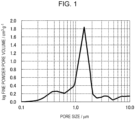
- Fig. 1 illustrates the distribution of pores of the phosphate-containing spinel-type lithium manganese oxide.
- a phosphate-containing spinel-type lithium manganese oxide was prepared as in Example 1, except that the amount of the boric acid used was changed to 0.6 g and the calcining temperature was changed to 900°C.
- the composition of the phosphate-containing spinel-type lithium manganese oxide was Li 1.09 Mn 1.81 Al 0.10 O 4 .
- the results of the XRD measurement confirmed that the phosphate-containing spinel-type lithium manganese oxide had a mixed phase including JCPDS No. 35-782 (LiMn 2 O 4 ) and JCPDS No. 25-1030 (Li 3 PO 4 ).
- Table 1 lists the measurement results.
- Table 2 lists the battery performance.
- a phosphate-containing spinel-type lithium manganese oxide was prepared as in Example 1, except that the calcining temperature was changed to 800°C.
- the composition of the phosphate-containing spinel-type lithium manganese oxide was Li 1.10 Mn 1.80 Al 0.10 O 4 .
- the results of the XRD measurement confirmed that the phosphate-containing spinel-type lithium manganese oxide had a mixed phase including JCPDS No. 35-782 (LiMn 2 O 4 ) and JCPDS No. 25-1030 (Li 3 PO 4 ).
- Table 1 lists the measurement results.
- Table 2 lists the battery performance.
- a phosphate-containing spinel-type lithium manganese oxide was prepared as in Example 1, except that the calcining temperature was changed to 900°C.
- the composition of the phosphate-containing spinel-type lithium manganese oxide was Li 1.11 Mn 1.79 Al 0.10 O 4 .
- the results of the XRD measurement confirmed that the phosphate-containing spinel-type lithium manganese oxide had a mixed phase including JCPDS No. 35-782 (LiMn 2 O 4 ) and JCPDS No. 25-1030 (Li 3 PO 4 ).
- Table 1 lists the measurement results.
- Table 2 lists the battery performance.
- a phosphate-containing spinel-type lithium manganese oxide was prepared as in Example 1, except that the amount of the trilithium phosphate used was changed to 31 g, the amount of the boric acid used was changed to 1 g, and the calcining temperature was changed to 810°C.
- the composition of the phosphate-containing spinel-type lithium manganese oxide was Li 1.09 Mn 1.31 Al 0.10 O 4 .
- the results of the XRD measurement confirmed that the phosphate-containing spinel-type lithium manganese oxide had a mixed phase including JCPDS No. 35-782 (LiMn 2 O 4 ) and JCPDS No. 25-1030 (Li 3 PO 4 ).
- Table 1 lists the measurement results.
- Table 2 lists the battery performance.
- a phosphate-containing spinel-type lithium manganese oxide was prepared as in Example 5, except that the amount of the trilithium phosphate used was changed to 46 g.
- the composition of the phosphate-containing spinel-type lithium manganese oxide was Li 1.09 Mn 1.81 Al 0.10 O 4 .
- the results of the XRD measurement confirmed that the phosphate-containing spinel-type lithium manganese oxide had a mixed phase including JCPDS No. 35-782 (LiMn 2 O 4 ) and JCPDS No. 25-1030 (Li 3 PO 4 ).
- Table 1 lists the measurement results.
- Table 2 lists the battery performance.
- the resulting slurry was subjected to a spray dryer (produced by Ohkawara Kakohki Co., Ltd.) in order to remove water by evaporation.
- a spray dryer produced by Ohkawara Kakohki Co., Ltd.
- the inlet temperature of hot air was set to 250°C.
- the resulting material was disintegrated with a high-power compact crusher (product name: Rotary Crusher, produced by Osaka Chemical Co., Ltd.) and subsequently passed through a sieve having an opening of 150 ⁇ m.
- a high-power compact crusher product name: Rotary Crusher, produced by Osaka Chemical Co., Ltd.
- phosphate-containing spinel-type lithium manganese oxide was prepared.
- the composition of the phosphate-containing spinel-type lithium manganese oxide was Li 1.07 Mn 1.83 Mg 0.10 O 4 .
- the results of the XRD measurement confirmed that the phosphate-containing spinel-type lithium manganese oxide had a mixed phase including JCPDS No. 35-782 (LiMn 2 O 4 ) and JCPDS No. 25-1030 (Li 3 PO 4 ).
- Table 1 lists the measurement results.
- Table 2 lists the battery performance.
- a phosphate-containing spinel-type lithium manganese oxide was prepared as in Example 7, except that the amount of the trilithium phosphate used was changed to 63 g and the calcining temperature was changed to 800°C.
- the composition of the phosphate-containing spinel-type lithium manganese oxide was Li 1.07 Mn 1.83 Mg 0.10 O 4 .
- the results of the XRD measurement confirmed that the phosphate-containing spinel-type lithium manganese oxide had a mixed phase including JCPDS No. 35-782 (LiMn 2 O 4 ) and JCPDS No. 25-1030 (Li 3 PO 4 ).
- Table 1 lists the measurement results.
- Table 2 lists the battery performance.
- a phosphate-containing spinel-type lithium manganese oxide was prepared as in Example 7, except that the amount of the trilithium phosphate used was changed to 31 g and the calcining temperature was changed to 800°C.
- the composition of the phosphate-containing spinel-type lithium manganese oxide was Li 1.06 Mn 1.34 Mg 0.10 O 4 .
- the results of the XRD measurement confirmed that the phosphate-containing spinel-type lithium manganese oxide had a mixed phase including JCPDS No. 35-782 (LiMn 2 O 4 ) and JCPDS No. 25-1030 (Li 3 PO 4 ).
- Table 1 lists the measurement results.
- Table 2 lists the battery performance.
- a phosphate-containing spinel-type lithium manganese oxide was prepared as in Example 7, except that the amount of the trilithium phosphate used was changed to 62 g and the calcining temperature was changed to 850°C.
- the composition of the phosphate-containing spinel-type lithium manganese oxide was Li 1.07 Mn 1.80 Mg 0.10 O 4 .
- the results of the XRD measurement confirmed that the phosphate-containing spinel-type lithium manganese oxide had a mixed phase including JCPDS No. 35-782 (LiMn 2 O 4 ) and JCPDS No. 25-1030 (Li 3 PO 4 ).
- Table 1 lists the measurement results.
- Table 2 lists the battery performance.
- a phosphate-containing spinel-type lithium manganese oxide was prepared as in Example 7, except that the amount of the trilithium phosphate used was changed to 62 g, the amount of the boric acid used was changed to 2.8 g, and the calcining temperature was changed to 850°C.
- the composition of the phosphate-containing spinel-type lithium manganese oxide was Li 1.06 Mn 1.84 Mg 0.10 O 4 .
- the results of the XRD measurement confirmed that the phosphate-containing spinel-type lithium manganese oxide had a mixed phase including JCPDS No. 35-782 (LiMn 2 O 4 ) and JCPDS No. 25-1030 (Li 3 PO 4 ).
- Table 1 lists the measurement results.
- Table 2 lists the battery performance.
- a spinel-type lithium manganese oxide was prepared as in Example 3, except that trilithium phosphate was not used.
- the composition of the spinel-type lithium manganese oxide was Li 1.10 Mn 1.80 Al 0.10 O 4 .
- the results of the XRD measurement confirmed that the spinel-type lithium manganese oxide had a single phase of JCPDS No. 35-782 (LiMn 2 O 4 ).
- Table 1 lists the measurement results.
- Table 2 lists the battery performance.
- the calcined material was disintegrated with a high-power compact crusher (product name: Rotary Crusher, produced by Osaka Chemical Co., Ltd.) and subsequently passed through a sieve having an opening of 32 ⁇ m.
- a high-power compact crusher product name: Rotary Crusher, produced by Osaka Chemical Co., Ltd.
- phosphate-containing spinel-type lithium manganese oxide was prepared.
- the composition of the phosphate-containing spinel-type lithium manganese oxide was Li 1.12 Mn 1.82 Mg 0.06 O 4 .
- the results of the XRD measurement confirmed that the phosphate-containing spinel-type lithium manganese oxide had a mixed phase including JCPDS No. 35-782 (LiMn 2 O 4 ) and JCPDS No. 25-1030 (Li 3 PO 4 ).
- Table 1 lists the measurement results.
- Table 2 lists the battery performance.
- the phosphate-containing spinel-type lithium manganese oxide according to the present invention has pores having a pore volume and has a secondary particle size
- the phosphate-containing spinel-type lithium manganese oxide can be used as a positive electrode active material for lithium secondary batteries that have excellent charge-discharge cyclic performance and, in particular, excellent charge-discharge cyclic performance using carbon as negative electrode at high temperatures and that have high power.
Landscapes
- Chemical & Material Sciences (AREA)
- Organic Chemistry (AREA)
- Inorganic Chemistry (AREA)
- Chemical Kinetics & Catalysis (AREA)
- Electrochemistry (AREA)
- General Chemical & Material Sciences (AREA)
- Engineering & Computer Science (AREA)
- Manufacturing & Machinery (AREA)
- Composite Materials (AREA)
- Crystallography & Structural Chemistry (AREA)
- Materials Engineering (AREA)
- Battery Electrode And Active Subsutance (AREA)
- Inorganic Compounds Of Heavy Metals (AREA)
- Secondary Cells (AREA)
Applications Claiming Priority (2)
| Application Number | Priority Date | Filing Date | Title |
|---|---|---|---|
| JP2020216330 | 2020-12-25 | ||
| PCT/JP2021/047382 WO2022138660A1 (ja) | 2020-12-25 | 2021-12-21 | スピネル型マンガン酸リチウム及びその製造法並びにその用途 |
Publications (2)
| Publication Number | Publication Date |
|---|---|
| EP4269358A1 true EP4269358A1 (de) | 2023-11-01 |
| EP4269358A4 EP4269358A4 (de) | 2025-01-01 |
Family
ID=82159787
Family Applications (1)
| Application Number | Title | Priority Date | Filing Date |
|---|---|---|---|
| EP21910800.8A Pending EP4269358A4 (de) | 2020-12-25 | 2021-12-21 | Lithiummanganat vom spinelltyp, verfahren zu seiner herstellung und seine verwendung |
Country Status (6)
| Country | Link |
|---|---|
| US (1) | US20240304802A1 (de) |
| EP (1) | EP4269358A4 (de) |
| JP (1) | JP7775696B2 (de) |
| KR (1) | KR20230123964A (de) |
| CN (1) | CN116670074A (de) |
| WO (1) | WO2022138660A1 (de) |
Family Cites Families (11)
| Publication number | Priority date | Publication date | Assignee | Title |
|---|---|---|---|---|
| US6267943B1 (en) * | 1998-10-15 | 2001-07-31 | Fmc Corporation | Lithium manganese oxide spinel compound and method of preparing same |
| JP4254267B2 (ja) * | 2002-02-21 | 2009-04-15 | 東ソー株式会社 | リチウムマンガン複合酸化物顆粒二次粒子及びその製造方法並びにその用途 |
| CN100344543C (zh) * | 2002-02-21 | 2007-10-24 | 东曹株式会社 | 锂-锰复合氧化物的粒状二级颗粒、其制备方法和其用途 |
| JP2008181850A (ja) * | 2006-10-19 | 2008-08-07 | Sanyo Electric Co Ltd | 非水電解質二次電池 |
| EP2214232B1 (de) * | 2007-10-23 | 2012-02-08 | Mitsui Mining & Smelting Co., Ltd | Lithium-übergangsmetalloxid des spinelltyps |
| EP2226293B1 (de) * | 2007-12-28 | 2018-08-08 | Toda Kogyo Corp. | Lithium-manganat für eine sekundärbatterie mit wasserfreiem elektrolyt, herstellungsverfahren dafür und sekundärbatterie mit wasserfreiem elektrolyt |
| KR101687040B1 (ko) * | 2009-01-20 | 2016-12-15 | 도다 고교 가부시끼가이샤 | 비수전해액 이차 전지용 정극 활성 물질 및 그의 제조 방법, 비수전해액 이차 전지 |
| WO2012047316A1 (en) * | 2010-05-21 | 2012-04-12 | Ada Technologies, Inc. | High performance carbon nano-tube composites for electrochemical energy storage devices |
| US10770759B2 (en) * | 2015-07-17 | 2020-09-08 | Toyota Jidosha Kabushiki Kaisha | Method of manufacturing lithium ion secondary battery |
| JP2017031006A (ja) | 2015-08-03 | 2017-02-09 | 新日本電工株式会社 | リチウムマンガン複合酸化物粉末およびその製造方法 |
| JP2018095529A (ja) * | 2016-12-15 | 2018-06-21 | 新日本電工株式会社 | リチウムマンガン複合酸化物粉末およびその製造方法ならびに非水電解質二次電池用正極 |
-
2021
- 2021-12-21 US US18/259,076 patent/US20240304802A1/en active Pending
- 2021-12-21 WO PCT/JP2021/047382 patent/WO2022138660A1/ja not_active Ceased
- 2021-12-21 KR KR1020237020867A patent/KR20230123964A/ko active Pending
- 2021-12-21 JP JP2021207346A patent/JP7775696B2/ja active Active
- 2021-12-21 EP EP21910800.8A patent/EP4269358A4/de active Pending
- 2021-12-21 CN CN202180087273.2A patent/CN116670074A/zh active Pending
Also Published As
| Publication number | Publication date |
|---|---|
| JP2022103107A (ja) | 2022-07-07 |
| WO2022138660A1 (ja) | 2022-06-30 |
| KR20230123964A (ko) | 2023-08-24 |
| EP4269358A4 (de) | 2025-01-01 |
| US20240304802A1 (en) | 2024-09-12 |
| CN116670074A (zh) | 2023-08-29 |
| JP7775696B2 (ja) | 2025-11-26 |
Similar Documents
| Publication | Publication Date | Title |
|---|---|---|
| EP2128915B1 (de) | Li-ni-komplexoxid-teilchenpulver für eine sekundärbatterie mit wasserfreiem elektrolyt, herstellungsverfahren dafür und sekundärbatterie mit wasserfreiem elektrolyt | |
| KR101369658B1 (ko) | 비수전해질 이차 전지용 Li-Ni 복합 산화물 입자 분말 및 그의 제조 방법, 및 비수전해질 이차 전지 | |
| US8999573B2 (en) | Positive electrode active material for non-aqueous electrolyte secondary battery and production method for same, precursor for positive electrode active material, and non-aqueous electrolyte secondary battery using positive electrode active material | |
| EP2936592B1 (de) | Lmfp-kathodenmaterialien mit verbesserten elektrochemischen eigenschaften | |
| JP6260535B2 (ja) | 炭素複合化リン酸マンガン鉄リチウム粒子粉末の製造方法、及び該粒子粉末を用いた非水電解質二次電池の製造方法 | |
| CN104703921B (zh) | Li‑Ni复合氧化物颗粒粉末和非水电解质二次电池 | |
| EP3514867B1 (de) | Aktivmaterial für eine positivelektrode für wasserfreien elektrolyt einer sekundärbatterie, verfahren zur herstellung davon und sekundärbatterie mit wasserfreiem elektrolyt mit dem aktivmaterial für besagte positivelektrode | |
| WO2016208413A1 (ja) | 遷移金属含有複合水酸化物とその製造方法、非水電解質二次電池用正極活物質とその製造方法、および非水電解質二次電池 | |
| KR20170009914A (ko) | 축전 디바이스의 전극용 타이타늄산 리튬 분말, 활물질 재료, 및 그것을 이용한 축전 디바이스 | |
| KR20160048184A (ko) | 타이타늄산리튬 분말, 활물질 재료, 및 그것을 이용한 축전 디바이스 | |
| JP7272134B2 (ja) | リチウムイオン二次電池用正極活物質およびその製造方法、並びに、リチウムイオン二次電池 | |
| CN102544465A (zh) | 掺杂磷的尖晶石结构锂钛氧化物材料及其制备方法 | |
| US20130043426A1 (en) | Synthesis strategy toward microspheric carbon coated off-stoichiometric lithium-iron-phosphorus compound materials | |
| EP3929158A1 (de) | Positivelektrodenaktivmaterial für lithium-ionen-sekundärbatterie, verfahren zur herstellung davon und lithium-ionen-sekundärbatterie | |
| US20140356714A1 (en) | Process for preparing a core-shell structured lithiated manganese oxide | |
| JP7484283B2 (ja) | リチウムイオン二次電池用正極活物質およびその製造方法、並びに、リチウムイオン二次電池 | |
| EP4269359A1 (de) | Lithiummangan vom spinelltyp, verfahren zur herstellung davon und verwendung davon | |
| JP6329034B2 (ja) | チタン酸リチウムの製造方法およびそれを用いたリチウムイオン二次電池の製造方法 | |
| JP7272140B2 (ja) | リチウムイオン二次電池用正極活物質およびその製造方法、並びに、リチウムイオン二次電池 | |
| EP3929157A1 (de) | Positivelektrodenaktivmaterial für eine lithium-ionen-sekundärbatterie, verfahren zur herstellung des positivelektrodenaktivmaterials für eine lithium-ionen-sekundärbatterie und lithium-ionen-sekundärbatterie | |
| EP4269358A1 (de) | Lithiummanganat vom spinelltyp, verfahren zu seiner herstellung und seine verwendung | |
| JP2023024368A (ja) | スピネル型マンガン酸リチウム及びその製造方法並びにその用途 |
Legal Events
| Date | Code | Title | Description |
|---|---|---|---|
| STAA | Information on the status of an ep patent application or granted ep patent |
Free format text: STATUS: THE INTERNATIONAL PUBLICATION HAS BEEN MADE |
|
| PUAI | Public reference made under article 153(3) epc to a published international application that has entered the european phase |
Free format text: ORIGINAL CODE: 0009012 |
|
| STAA | Information on the status of an ep patent application or granted ep patent |
Free format text: STATUS: REQUEST FOR EXAMINATION WAS MADE |
|
| 17P | Request for examination filed |
Effective date: 20230623 |
|
| AK | Designated contracting states |
Kind code of ref document: A1 Designated state(s): AL AT BE BG CH CY CZ DE DK EE ES FI FR GB GR HR HU IE IS IT LI LT LU LV MC MK MT NL NO PL PT RO RS SE SI SK SM TR |
|
| DAV | Request for validation of the european patent (deleted) | ||
| DAX | Request for extension of the european patent (deleted) | ||
| REG | Reference to a national code |
Ref country code: DE Ref legal event code: R079 Free format text: PREVIOUS MAIN CLASS: C01G0045000000 Ipc: H01M0004360000 |
|
| A4 | Supplementary search report drawn up and despatched |
Effective date: 20241129 |
|
| RIC1 | Information provided on ipc code assigned before grant |
Ipc: H01M 4/02 20060101ALI20241125BHEP Ipc: H01M 10/052 20100101ALI20241125BHEP Ipc: H01M 4/131 20100101ALI20241125BHEP Ipc: H01M 4/04 20060101ALI20241125BHEP Ipc: C01G 45/12 20060101ALI20241125BHEP Ipc: C01B 25/30 20060101ALI20241125BHEP Ipc: H01M 4/505 20100101ALI20241125BHEP Ipc: H01M 4/36 20060101AFI20241125BHEP |