EP4273143B1 - Dérivé d'un composé de 2,5-dicétopipérazine, son procédé de préparation, composition pharmaceutique de celui-ci et son utilisation - Google Patents
Dérivé d'un composé de 2,5-dicétopipérazine, son procédé de préparation, composition pharmaceutique de celui-ci et son utilisation Download PDFInfo
- Publication number
- EP4273143B1 EP4273143B1 EP21914730.3A EP21914730A EP4273143B1 EP 4273143 B1 EP4273143 B1 EP 4273143B1 EP 21914730 A EP21914730 A EP 21914730A EP 4273143 B1 EP4273143 B1 EP 4273143B1
- Authority
- EP
- European Patent Office
- Prior art keywords
- alkyl
- mmol
- halogen
- pln
- methylene
- Prior art date
- Legal status (The legal status is an assumption and is not a legal conclusion. Google has not performed a legal analysis and makes no representation as to the accuracy of the status listed.)
- Active
Links
Images

Classifications
-
- A—HUMAN NECESSITIES
- A61—MEDICAL OR VETERINARY SCIENCE; HYGIENE
- A61P—SPECIFIC THERAPEUTIC ACTIVITY OF CHEMICAL COMPOUNDS OR MEDICINAL PREPARATIONS
- A61P35/00—Antineoplastic agents
-
- C—CHEMISTRY; METALLURGY
- C07—ORGANIC CHEMISTRY
- C07C—ACYCLIC OR CARBOCYCLIC COMPOUNDS
- C07C303/00—Preparation of esters or amides of sulfuric acids; Preparation of sulfonic acids or of their esters, halides, anhydrides or amides
- C07C303/32—Preparation of esters or amides of sulfuric acids; Preparation of sulfonic acids or of their esters, halides, anhydrides or amides of salts of sulfonic acids
-
- C—CHEMISTRY; METALLURGY
- C07—ORGANIC CHEMISTRY
- C07C—ACYCLIC OR CARBOCYCLIC COMPOUNDS
- C07C309/00—Sulfonic acids; Halides, esters, or anhydrides thereof
- C07C309/01—Sulfonic acids
- C07C309/02—Sulfonic acids having sulfo groups bound to acyclic carbon atoms
- C07C309/03—Sulfonic acids having sulfo groups bound to acyclic carbon atoms of an acyclic saturated carbon skeleton
- C07C309/04—Sulfonic acids having sulfo groups bound to acyclic carbon atoms of an acyclic saturated carbon skeleton containing only one sulfo group
-
- C—CHEMISTRY; METALLURGY
- C07—ORGANIC CHEMISTRY
- C07D—HETEROCYCLIC COMPOUNDS
- C07D401/00—Heterocyclic compounds containing two or more hetero rings, having nitrogen atoms as the only ring hetero atoms, at least one ring being a six-membered ring with only one nitrogen atom
- C07D401/14—Heterocyclic compounds containing two or more hetero rings, having nitrogen atoms as the only ring hetero atoms, at least one ring being a six-membered ring with only one nitrogen atom containing three or more hetero rings
-
- C—CHEMISTRY; METALLURGY
- C07—ORGANIC CHEMISTRY
- C07D—HETEROCYCLIC COMPOUNDS
- C07D403/00—Heterocyclic compounds containing two or more hetero rings, having nitrogen atoms as the only ring hetero atoms, not provided for by group C07D401/00
- C07D403/02—Heterocyclic compounds containing two or more hetero rings, having nitrogen atoms as the only ring hetero atoms, not provided for by group C07D401/00 containing two hetero rings
- C07D403/06—Heterocyclic compounds containing two or more hetero rings, having nitrogen atoms as the only ring hetero atoms, not provided for by group C07D401/00 containing two hetero rings linked by a carbon chain containing only aliphatic carbon atoms
-
- C—CHEMISTRY; METALLURGY
- C07—ORGANIC CHEMISTRY
- C07D—HETEROCYCLIC COMPOUNDS
- C07D413/00—Heterocyclic compounds containing two or more hetero rings, at least one ring having nitrogen and oxygen atoms as the only ring hetero atoms
- C07D413/14—Heterocyclic compounds containing two or more hetero rings, at least one ring having nitrogen and oxygen atoms as the only ring hetero atoms containing three or more hetero rings
-
- C—CHEMISTRY; METALLURGY
- C07—ORGANIC CHEMISTRY
- C07F—ACYCLIC, CARBOCYCLIC OR HETEROCYCLIC COMPOUNDS CONTAINING ELEMENTS OTHER THAN CARBON, HYDROGEN, HALOGEN, OXYGEN, NITROGEN, SULFUR, SELENIUM OR TELLURIUM
- C07F5/00—Compounds containing elements of Groups 3 or 13 of the Periodic Table
- C07F5/02—Boron compounds
- C07F5/025—Boronic and borinic acid compounds
Definitions
- the present disclosure belongs to the technical field of medicinal chemistry, and specifically relates to a derivative of a 2,5-diketopiperazine compound, a preparation method therefor, a pharmaceutical composition thereof, and a use thereof.
- Plinabulin belongs to derivatives of 2,5-diketopiperazine compound, which is a derivative obtained by structural modification of a metabolite (low molecular cyclic dipeptide Phenylahistin) produced by marine fungus Aspergillus sp., and is a tubulin binding agent. Plinabulin can selectively act near the colchicine-binding site in endothelial tubulin, inhibit tubulin polymerization, and block microtubule assembly, thereby destroying the endothelial cytoskeleton and inhibiting tumor blood flow. At the same time, Plinabulin also inhibits the migration of endothelial cells and makes the tumor vasculature dysfunctional.
- a metabolite low molecular cyclic dipeptide Phenylahistin
- Plinabulin acts on cells to arrest cells in early mitosis and induce cell death.
- Prior art WO2012035436
- plinabulin prodrug analogs and their use for treating various disease conditions including cancer.
- Plinabulin is a differentiation immune and stem cell regulator, as well as a guanine nucleotide exchange factor (GEF-H1) activator, which can target and change the tumor microenvironment and destroy tumor vasculature through multiple mechanisms of action; Plinabulin acts as a potent antigen-presenting cell (APC) inducer (by activating dendritic cell maturation), and its long-lasting anticancer effect is associated with T cell activation ( Cell Reports 2019, 28:13, 3367-3386 ).
- APC antigen-presenting cell
- the candidate drug is currently being developed by BeyondSpring Pharmaceuticals and has completed clinical phase III trials in China, the United States and other countries. On the one hand, it is used in combination with docetaxel for the treatment of non-small cell lung cancer, and on the other hand, it is used for the prevention of chemotherapy-induced neutropenia (CIN) in non-myeloid malignancies.
- CIN chemotherapy-induced neutropenia
- Plinabulin has a chemical structural formula as follows:
- Plinabulin has a molecular formula of C 19 H 20 N 4 O 2 , a molecular weight of 336.39, and a CAS number of 714272-27-2 . It has good stability, but poor water solubility, making it difficult to formulate into a drug.
- the technical problem to be solved by the present disclosure is the defect of poor water solubility of Plinabulin, which is unfavorable for drug formation, and the present disclosure provides a derivative of a 2,5-diketopiperazine compound, a preparation method therefor, a pharmaceutical composition thereof, and a use thereof.
- the compounds of the present disclosure have novel structures, good activity, and water solubility.
- the present disclosure solves the above technical problem through the following solutions.
- the present disclosure provides a compound of formula (I), a stereoisomer thereof, a tautomer thereof, a pharmaceutically acceptable salt thereof, or a solvate of any one of the foregoing (referring to the foregoing compound of formula (I), the stereoisomer thereof, the tautomer thereof, or the pharmaceutically acceptable salt thereof):
- R 1 when R 1 is halogen, the halogen is fluorine, chlorine, bromine, or iodine, such as fluorine.
- R 1 is C 1 -C 8 alkyl
- the C 1 -C 8 alkyl is C 1 -C 4 alkyl, such as methyl.
- R 1 is C 1 -C 8 alkyl substituted by one or more than one halogen
- the C 1 -C 8 alkyl substituted by one or more than one halogen is C 1 -C 4 alkyl substituted by one or more than one halogen, such as trifluoromethyl.
- R 1 is C 1 -C 8 alkoxy
- the C 1 -C 8 alkoxy is C 1 -C 4 alkoxy, such as methoxy.
- R 1 is C 1 -C 8 alkoxy substituted by one or more than one halogen
- the C 1 -C 8 alkoxy substituted by one or more than one halogen is C 1 -C 4 alkoxy substituted by one or more than one halogen, such as trifluoromethoxy.
- R 1 when R 1 is benzoyl substituted by one or more than one halogen, the halogen is fluorine, chlorine, bromine, or iodine, such as fluorine.
- the benzoyl substituted by one or more than one halogen is fluorine, chlorine, bromine, or iodine, such as fluorine.
- the benzoyl substituted by one or more than one halogen is fluorine, chlorine, bromine, or iodine, such as fluorine.
- the benzoyl substituted by one or more than one halogen is
- R 1 when R 1 is phenoxy substituted by one or more than one halogen, the halogen is fluorine, chlorine, bromine, or iodine, such as fluorine.
- the phenoxy substituted by one or more than one halogen is fluorine, chlorine, bromine, or iodine, such as fluorine.
- the phenoxy substituted by one or more than one halogen is fluorine, chlorine, bromine, or iodine, such as fluorine.
- the phenoxy substituted by one or more than one halogen is fluorine, chlorine, bromine, or iodine, such as fluorine.
- R 1a , R 1b , and R 1c are independently halogen
- the halogen is fluorine, chlorine, bromine, or iodine, such as fluorine.
- R 1a , R 1b , and R 1c are independently C 1 -C 8 alkyl
- the C 1 -C 8 alkyl is C 1 -C 4 alkyl, such as methyl.
- the C 6 -C 10 aryl is phenyl
- R 1 , R 1a together with the carbon atoms to which they are attached form the 3- to 10-membered heteroaryl with 1-5 heteroatoms selected from one or more than one of N, O, and S
- the 3- to 10-membered heteroaryl with 1-5 heteroatoms selected from one or more than one of N, O, and S is 4- to 8-membered heteroaryl with 1-2 heteroatoms selected from one or more than one of N, O, and S; such as pyridyl; and further such as with an a-terminal attached to the carbon atom to which R 1 is attached and a b-terminal attached to the carbon atom to which R 1a is attached.
- the C 1 -C 8 alkyl is C 1 -C 4 alkyl, such as methyl, ethyl, isopropyl, or tert-butyl.
- R 2 is C 3 -C 10 cycloalkyl
- the C 3 -C 10 cycloalkyl is C 3 -C 6 cycloalkyl, such as cyclopropyl.
- the C 1 -C 8 alkylene is C 3 -C 8 alkylene, such as and further such as
- R 3 , R 4 , R 6 , and R 7 are independently C 1 -C 8 alkyl
- the C 1 -C 8 alkyl is C 1 -C 4 alkyl, such as methyl or ethyl, and further such as methyl.
- R 3 , R 4 , R 6 , and R 7 are independently C 1 -C 8 alkyl substituted by one or more than one R 3-1 , the C 1 -C 8 alkyl is C 1 -C 4 alkyl, such as methyl.
- R 3-1-1 is C 1 -C 8 alkyl
- the C 1 -C 8 alkyl is C 1 -C 4 alkyl, such as methyl, ethyl, n-propyl, or n-butyl.
- R 3-1-1 is C 1 -C 8 alkyl substituted by one or more than one R 3-1-2
- the C 1 -C 8 alkyl is C 1 -C 4 alkyl, such as methyl.
- R 3-1-2 is independently C 6 -C 10 aryl
- the C 6 -C 10 aryl is phenyl
- the C 1 -C 8 alkyl is C 1 -C 4 alkyl, such as methyl, ethyl, n-propyl, isopropyl, n-butyl, or 2-methylpropyl, and further such as methyl.
- R 5 is C 6 -C 10 aryl substituted by one or more than one R 5-1
- the C 6 -C 10 aryl is phenyl or naphthyl, such as phenyl.
- R 5-1 when R 5-1 is halogen, the halogen is fluorine, chlorine, bromine, or iodine, such as fluorine.
- R 5-3 is C 1 -C 8 alkoxy
- the C 1 -C 8 alkoxy is C 1 -C 4 alkoxy, such as tert-butoxy.
- R 5-3 is C 1 -C 8 alkyl
- the C 1 -C 8 alkyl is methyl, ethyl, n-propyl, isopropyl, tert-butyl, or -CH(C 2 H 5 )CH 2 CH 3 .
- the C 1 -C 8 alkyl is C 1 -C 4 alkyl.
- R 5-3 is C 3 -C 10 cycloalkyl
- the C 3 -C 10 cycloalkyl is cyclopropyl, cyclobutyl, cyclopentyl, cyclohexyl, or adamantyl.
- the C 3 -C 10 cycloalkyl is C 3 -C 6 cycloalkyl.
- R 5-3 is C 2 -C 8 alkenyl
- the C 2 -C 8 alkenyl is C 2 -C 4 alkenyl, such as and further such as
- R 5-3 is C 6 -C 10 aryl
- the C 6 -C 10 aryl is phenyl or naphthyl, such as phenyl.
- R 5-3-1 and R 5-3-2 are independently C 1 -C 8 alkyl
- the C 1 -C 8 alkyl is C 1 -C 4 alkyl, such as isopropyl or tert-butyl.
- R 5-3-1 and R 5-3-2 are independently C 3 -C 10 cycloalkyl
- the C 3 -C 10 cycloalkyl is C 3 -C 6 cycloalkyl, such as cyclopentyl or cyclohexyl.
- R 5-4 is C 1 -C 8 alkyl
- the C 1 -C 8 alkyl is C 1 -C 4 alkyl, such as methyl.
- R 5-4 is C 6 -C 10 aryl
- the C 6 -C 10 aryl is phenyl or naphthyl, such as phenyl.
- R 1 is hydrogen, halogen, C 1 -C 8 alkyl, C 1 -C 8 alkoxy, C 1 -C 8 alkoxy substituted by one or more than one halogen, benzoyl, benzoyl substituted by one or more than one halogen, phenoxy, or phenoxy substituted by one or more than one halogen.
- R 1b is hydrogen or halogen; such as hydrogen or fluorine.
- R 1c is hydrogen or halogen, such as hydrogen or fluorine.
- R 2 is C 1 -C 8 alkyl.
- L is C 1 -C 8 alkylene.
- R 3 , R 4 , R 6 , and R 7 are independently hydrogen or C 1 -C 8 alkyl.
- R 5-3 is hydrogen, C 1 -C 4 alkyl, C 3 -C 6 cycloalkyl, C 2 -C 8 alkenyl, benzyloxy substituted by one or more than one R 5-2 , C 6 -C 10 aryl, or NR 5-3-1 R 5-3-2 .
- R 2 is isopropyl or cyclopropyl.
- L is
- the compound of formula (I) is any one of the following compounds: or
- the compound of formula (I) is any one of the following compounds: a compound with a retention time of 6.29 min under the following conditions, which is one stereoisomer of chromatographic column: Acclaim 120, C18, 5 ⁇ m, 4.6 * 150 mm, mobile phase: mobile phase A: MeOH, mobile phase B: 0.1% formic acid aqueous solution; flow rate: 1 mL/min, the mobile phase is washed according to the following gradient elution procedure: Time (min) Mobile phase A (%, V/V) Mobile phase B (%, V/V) 0 40 60 0 ⁇ 6 40 ⁇ 100 60 ⁇ 0 6-10 100-40 0 ⁇ 60 a compound with a retention time of 6.48 min under the following conditions, which is one stereoisomer of chromatographic column: Acclaim 120, C18, 5 ⁇ m, 4.6 * 150 mm, mobile phase: mobile phase A: MeOH, mobile phase B: 0.1% formic acid aqueous solution; flow rate: 1 mL/min, the mobile phase is
- test conditions for the above retention time are not limited to the compound, and as long as the retention time obtained by using the above test conditions is the same as that described above or within the error range, and the compound is one stereoisomer of the compounds defined by the above retention times, the compound falls within the scope of protection of the present disclosure.
- the pharmaceutically acceptable salt of the compound of formula (I) may be a salt prepared from the compound of formula (I) and a pharmaceutically acceptable acid, and the pharmaceutically acceptable acid may be a conventional acid in the art, such as an inorganic acid or an organic acid.
- the inorganic acid is preferably hydrochloric acid
- the organic acid is preferably methanesulfonic acid.
- the pharmaceutically acceptable acid is hydrochloric acid or methanesulfonic acid.
- the pharmaceutically acceptable salt of the compound of formula (I) is a salt formed by the compound of formula (I) and the pharmaceutically acceptable acid in a molar ratio of 1:2.
- the pharmaceutically acceptable salt of the compound of formula (I) is any one of the following compounds: or
- the present disclosure also provides a preparation method for the compound of formula (I), which comprises the following steps: carrying out a condensation reaction as shown below between a compound of formula (II) and a compound of formula (III) to obtain the compound of formula (I); wherein *, L, Z, R 1 , R 1a , R 1b , R 1c , R 2 , R 3 , R 4 , R 6 , and R 7 are as defined in any one of the preceding items.
- the present disclosure also provides a compound of formula (II): wherein *, R 2 , R 3 , R 4 , R 6 , R 7 , L, and Z are as defined in any one of the preceding items.
- the compound of formula (II) is any one of the following compounds: or
- the substitution reaction is carried out in an aprotic solvent
- the aprotic solvent may be conventional in the art.
- the aprotic solvent is one or more than one of acetonitrile, N,N-dimethylformamide, N,N-dimethylacetamide, dimethylsulfoxide, hexamethylphosphoric triamide, benzene, toluene, nitrobenzene, xylene, and carbon tetrachloride; for example, N,N-dimethylformamide.
- the substitution reaction is carried out in the presence of a base, and the base may be a base commonly used in the art for such reactions.
- the base is one or more than one of sodium hydride, potassium hydroxide, potassium carbonate, cesium carbonate, and sodium bicarbonate, such as cesium carbonate.
- the substitution reaction is carried out in the presence of a catalyst
- the catalyst may be a catalyst commonly used in the art for such reactions.
- the catalyst is one or more than one of iodine, potassium iodide, and sodium iodide, such as potassium iodide.
- the present disclosure also provides a pharmaceutical composition, which comprises the above compound of formula (I), the stereoisomer thereof, the tautomer thereof, the pharmaceutically acceptable salt thereof, or the solvate of any one of the foregoing, and a pharmaceutical excipient.
- the pharmaceutical excipient does not comprise a cosolvent.
- the present disclosure also provides the above compound of formula (I), the stereoisomer thereof, the tautomer thereof, the pharmaceutically acceptable salt thereof, or the solvate of any one of the foregoing, or the above pharmaceutical composition for use in preventing and/or treating cancer.
- the cancer is preferably one or more than one of lung cancer, pancreatic cancer, colon cancer, and liver cancer.
- the compound, the stereoisomer thereof, the tautomer thereof, the pharmaceutically acceptable salt thereof or the solvate of any one of the foregoing, or the pharmaceutical composition of the present disclosure may be administered locally or systemically, for example, for enteral administration, such as rectal or oral administration, or for parenteral administration to mammals (especially humans).
- enteral administration such as rectal or oral administration
- parenteral administration to mammals (especially humans).
- rectal administration include a suppository, which may contain, for example, a suitable non-irritating excipient, such as cocoa butter, synthetic glycerides, or polyethylene glycol, which is a solid at room temperature, but melts and/or dissolves in the rectal cavity to release drugs.
- the compounds of the present disclosure may also be administered parenterally, for example, by inhalation, injection, or infusion, such as by intravenous, intraarterial, intraosseous, intramuscular, intracerebral, extraventricular, intrasynovial, intrasternal, intrathecal, intralesional, intralesional, intracranial, intratumoral, intradermal and subcutaneous injection, or infusion.
- the therapeutically effective amount of the active ingredient is as defined in the context and depends on the species, weight, age, individual condition, individual pharmacokinetic parameters, diseases to be treated, and administration mode of the mammal.
- enteral administration such as oral administration
- the compounds of the present disclosure can be formulated in a wide variety of dosage forms.
- the effective amount of the compound, the stereoisomer thereof, the tautomer thereof, the pharmaceutically acceptable salt thereof or the solvate of any one of the foregoing, or the pharmaceutical composition of the present disclosure can be easily determined by routine experiments, and the most effective and convenient route of administration and the most appropriate preparation can also be determined by routine experiments.
- the pharmaceutical excipients can be those widely used in the field of pharmaceutical production. Excipients are primarily used to provide a safe, stable, and functional pharmaceutical composition, and may also provide methods to enable the active ingredient to dissolve at a desired rate after the subject has received administration or to facilitate effective absorption of the active ingredient after the subject has received administration of the composition.
- the pharmaceutical excipients can be inert fillers or provide some functions, such as stabilizing the overall pH of the composition or preventing degradation of the active ingredients of the composition.
- the pharmaceutical excipients may include one or more than one of the following excipient: binder, suspending agent, emulsifying agent, diluent, filler, granulating agent, adhesive agent, disintegrating agent, lubricant, anti-adhesive agent, glidant, wetting agent, gelling agent, absorption retardant, dissolution inhibitor, enhancer, adsorbent, buffer, chelating agent, preservative, coloring agent, flavoring agent, and sweetener.
- Substances that may be used as pharmaceutically acceptable excipients include, but are not limited to, ion exchangers, aluminum stearate, lecithin, serum proteins such as human serum albumin, buffer substances such as phosphate, glycine, sorbic acid, potassium sorbate, a mixture of partial glycerides of saturated vegetable fatty acids, water, salts, or electrolytes such as protamine sulfate, disodium hydrogen phosphate, potassium hydrogen phosphate, sodium chloride, zinc salts, colloidal silicon, magnesium trisilicate, polyvinylpyrrolidone, polyacrylates, waxes, polyethylene-polyoxypropylene-block polymers, lanolin, sugars such as lactose, glucose, and sucrose; starches such as corn starch and potato starch; cellulose and its derivatives such as sodium carboxymethyl cellulose, ethyl cellulose, and cellulose acetate; gum powder; malt; gelatin; talc; excipients such as
- composition of the present disclosure can be prepared according to the disclosure using any method known to those skilled in the art. For example, conventional mixing, dissolving, granulating, emulsifying, levigating, encapsulating, embedding, or lyophilizing processes.
- Pharmaceutical dosage forms of the compound of the present disclosure may be provided as immediate release, controlled release, sustained release, or targeted drug release systems.
- Common dosage forms include, for example, solutions and suspensions, (micro)emulsions, ointments, gels and patches, liposomes, tablets, sugar-coated pills, soft-shell or hard-shell capsules, suppositories, ovules, implants, amorphous or crystalline powder, aerosols, and lyophilized preparations.
- special devices such as a syringe and needle, inhaler, pump, injection pen, applicator, or special flask, may be required to administer or give the drug.
- Pharmaceutical dosage forms often consist of a drug, an excipient, and a container/sealing system.
- One or more than one excipient also known as inactive ingredients
- excipients in this art including those listed in various pharmacopoeias. (See U.S.
- USP Japanese Pharmacopoeia
- JP Japanese Pharmacopoeia
- EP European Pharmacopoeia
- BP British pharmacopoeia
- CEDR Center for Drug Evaluation and Research
- compositions of the present disclosure may be manufactured by any of the methods well known in the art, for example, by conventional mixing, sieving, dissolving, melting, granulating, making sugar-coated pills, tabletting, suspending, extruding, spray-drying, grinding, emulsification, (nano/micro) encapsulation, inclusion, or lyophilization processes.
- the composition of the present disclosure may include one or more than one physiologically acceptable inactive ingredient that facilitates processing of the active molecule into a preparation for pharmaceutical use.
- composition and dosage forms may comprise one or more than one compound of the present disclosure, one or more than one pharmaceutically acceptable salt thereof, or one or more than one solvate of any one of the foregoing as active components.
- Pharmaceutically acceptable carriers may be a solid or liquid. Preparations in solid form include powders, tablets, pills, lozenges, capsules, cachets, suppositories, and dispersible granules.
- a solid carrier may also be one or more than one substance which acts as diluents, flavoring agents, solubilizers, lubricants, suspending agents, binders, preservatives, tablet disintegrating agents, or encapsulating materials.
- the carrier is usually a finely divided solid, which is a mixture with the finely divided active component.
- the active component is usually mixed with a carrier with the necessary binding capacity in an appropriate proportion and compacted to the desired shape and size.
- Suitable carriers include, but are not limited to, magnesium carbonate, magnesium stearate, talc, sugar, lactose, pectin, dextrin, starch, gelatin, methyl cellulose, sodium carboxymethyl cellulose, low melting point wax, cocoa butter, etc.
- the preparation of the active compound may comprise an encapsulating material as a carrier, providing a capsule in which the active component, with or without carriers, is surrounded by carriers bound to the active component.
- liquid form preparations including emulsions, syrups, elixirs, aqueous solutions, aqueous suspensions, or solid form preparations which are intended to be converted, shortly before use, to liquid form preparations.
- Emulsions may be prepared in a solution, for example, in a propylene glycol aqueous solution or may contain an emulsifying agent, such as lecithin, sorbitan monooleate, or acacia.
- Aqueous solutions may be prepared by dissolving the active component in water and adding suitable coloring agents, flavors, stabilizers, and thickeners.
- Aqueous suspensions may be prepared by dispersing the finely divided active ingredient in water with binders, such as natural or synthetic gums, resins, methyl cellulose, carboxymethyl cellulose, and other commonly used suspending agents.
- binders such as natural or synthetic gums, resins, methyl cellulose, carboxymethyl cellulose, and other commonly used suspending agents.
- Preparations in solid form include solutions, suspensions, and emulsions, which may contain, in addition to the active ingredient, coloring agents, flavors, stabilizers, buffers, artificial and natural sweeteners, dispersants, thickeners, solubilizers, etc.
- the pharmaceutical composition of the present disclosure may be in the form of sterile injectable or infusible preparations, for example, as sterile aqueous or oleaginous suspensions.
- the suspension may be formulated according to techniques known in the art using a suitable dispersing or wetting agent (such as Tween 80) and a suspending agent.
- the sterile injectable or infusible preparation may also be a sterile injectable or infusible solution or suspension in a non-toxic parenterally acceptable diluent or solvent.
- acceptable vehicles and solvents that can be used in the pharmaceutical composition of the present disclosure include, but are not limited to, mannitol, water, and isotonic sodium chloride solution.
- sterile non-volatile oils are commonly used as solvents or suspension media. Any mild non-volatile oil can be used for this purpose, including synthetic monoglycerides or diglycerides. Fatty acids such as oleic acid and its glyceride derivatives can be used to prepare injections, as well as natural pharmaceutically acceptable oils, such as olive oil or castor oil, especially in their polyethoxylated form. These oil solutions or suspensions may also contain a long-chain alcohol diluent or dispersant. Solutions for parenteral use may also include suitable stabilizers and, if necessary, buffers.
- Suitable stabilizers include antioxidants such as sodium bisulphate, sodium sulphite or ascorbic acid, citric acid and a salt thereof and EDTA sodium salt, alone or in combination.
- antioxidants such as sodium bisulphate, sodium sulphite or ascorbic acid, citric acid and a salt thereof and EDTA sodium salt, alone or in combination.
- Parenteral solutions can also contain preservatives, such as benzalkonium chloride, p-hydroxybenzoic acid, or propylparaben and chlorobutanol.
- a therapeutically effective amount can be estimated initially using various methods well known in the art.
- the initial amount for animal studies can be based on the effective concentration established in the cell culture assay. Dose ranges suitable for human subjects can be determined, for example, using data obtained from animal studies and cell culture assays.
- the compounds of the present disclosure can be prepared as medicaments for oral administration.
- An effective or therapeutically effective amount or dose of a medicament refers to the amount of the medicament or compound that results in amelioration of symptoms or prolongation of survival in a subject.
- Toxicity and therapeutic efficacy of the molecules can be determined in cell culture or experimental animals by standard pharmaceutical procedures, for example, by measuring the LD 50 (the dose lethal to 50% of the population) and the ED 50 (the dose therapeutically effective in 50% of the population).
- the dose ratio of toxic effect to therapeutic effect is therapeutic index, which can be expressed as LD 50 /ED 50 . Agents exhibiting high therapeutic index are preferred.
- an effective amount or therapeutically effective amount is an amount of a compound or pharmaceutical composition that will trigger a biological or medical response in a tissue, system, animal, or human being sought by a researcher, veterinarian, physician, or other clinician.
- the dose is preferably within the range of circulating concentration including minimal toxicity or no toxicity of ED 50 .
- the dose may vary within this range, depending on the dosage form used and/or the route of administration used.
- the proper preparation, route of administration, dose, and interval of administration should be selected according to methods known in the art, taking into account the particularities of individual conditions.
- the dose and interval may be individually adjusted to provide plasma levels of the active moiety sufficient to obtain the desired effect; i.e., a minimal effective concentration (MEC).
- MEC minimal effective concentration
- the MEC varies for each compound, but may be estimated, for example, from in vitro data and animal experiments.
- the dose necessary to obtain MEC will depend on individual characteristics and route of administration. In the case of topical administration or selective uptake, the effective local concentration of the drug may be independent of the plasma concentration.
- the amount of medicament or composition administered will depend on various factors, including the sex, age and weight of the individual being treated, the severity of the condition, the mode of administration, and the judgment of the prescribing physician.
- the term "more than one" refers to 2, 3, 4, or 5, preferably 2 or 3.
- pharmaceutically acceptable refers to salts, solvents, excipients and the like that are generally non-toxic, safe, and suitable for patient use.
- solvate refers to a substance formed by combining the compound of the present disclosure or a pharmaceutically acceptable salt thereof with a stoichiometric or non-stoichiometric amount of solvent.
- Solvent molecules in the solvate can exist in an ordered or non-ordered arrangements.
- the solvent includes, but is not limited to, water, methanol, ethanol, etc.
- compound may exist in the form of a single tautomer or a mixture thereof if tautomers exist, preferably in the form of relatively stable tautomers.
- halogen refers to fluorine, chlorine, bromine, or iodine.
- alkyl refers to a saturated linear or branched alkyl with a specified number of carbon atoms.
- alkyl include methyl, ethyl, n-propyl, isopropyl, n-butyl, tert-butyl, isobutyl, sec-butyl, n-pentyl, n-hexyl, n-heptyl, n-octyl, and similar alkyl.
- alkylene refers to a subunit formed by formally eliminating two monovalent or one divalent atoms or groups from saturated linear or branched alkane with a specified number of carbon atoms.
- the two valences can be on the same carbon atom or on different carbon atoms (for example, two valences are on the carbon atoms at both ends).
- methylene may be (-CH 2 -), and ethylene may be -CH 2 CH 2 -, or -CH(CH 3 )-.
- heteroalkylene refers to a subunit formed by formally eliminating two monovalent or one divalent atoms or groups from saturated linear or branched heteroalkane.
- the two valences can be on the same atom or on different atoms (for example, two valences are on the atoms at both ends).
- ethylene containing an oxygen atom can be - CH 2 OCH 2 - or -CHO(CH 3 )-, etc.
- alkoxy refers to the group -O-R X , wherein R X is the alkyl as defined above.
- alkenyl refers to a linear or branched alkene with a specific number of carbon atoms containing one or more than one carbon-carbon double bonds and without a carbon-carbon triple bond, and the one or more than one carbon-carbon double bond may be internal or terminal.
- alkene include vinyl, allyl, methylvinyl, propenyl, butenyl, pentenyl, 1,1-dimethyl-2-propenyl, hexenyl, etc.
- aryl refers to C 6 -C 10 aryl, such as phenyl or naphthyl.
- heteroaryl refers to an aromatic group containing a heteroatom, preferably aromatic 3- to 6-membered monocyclic rings or 9- to 10-membered bicyclic rings containing 1, 2, or 3 heteroatoms independently selected from nitrogen, oxygen, and sulfur, and in the case of bicyclic rings, at least one ring is aromatic, such as furyl, pyridyl, pyridazinyl, pyrimidyl, pyrazinyl, thienyl, isoxazolyl, oxazolyl, diazolyl, imidazolyl, pyrrolyl, pyrazolyl, triazolyl, tetrazolyl, thiazolyl, isothiazolyl, thiadiazolyl, benzimidazolyl, indolyl, indazolyl, benzothiazolyl, benzisothiazolyl, benzazolyl, benzisoxazolyl, quinolinyl, isoquino
- cycloalkyl refers to monovalent saturated cyclic alkyl, preferably monovalent saturated cyclic alkyl having 3 to 6 carbon atoms, such as cyclopropyl, cyclobutyl, cyclopentyl, or cyclohexyl.
- heterocycloalkyl refers to a saturated cyclic group having a heteroatom, preferably a 3- to 10-membered saturated monocyclic ring containing 1, 2 or 3 cyclic heteroatoms independently selected from N, O, and S.
- heterocycloalkyl examples include: tetrahydrofuranyl, tetrahydropyranyl, tetrahydrothienyl, tetrahydropyridyl, tetrahydropyrrolyl, azetidinyl, thiazolidinyl, azolidinyl, piperidinyl, morpholinyl, thiomorpholinyl, piperazinyl, azepanyl, diazepanyl, oxazepanyl, etc.
- Preferred heterocyclyl is morpholin-4-yl, piperidin-1-yl, pyrrolidin-1-yl, thiomorpholin-4-yl, and 1,1-dioxo-thiomorpholin-4-yl.
- treatment refers to a therapeutic therapy.
- the treatment refers to: (1) alleviation of one or more than one biological manifestation of a disorder or disease, (2) interfering with (a) one or more than one point in the biological cascade leading to or causing a disease or (b) one or more than one biological manifestation of the disease, (3) improvement of one or more than one symptom, effect, or side effect associated with the disease, or one or more than one symptom, effect, or side effect associated with the disease or treatment thereof, or (4) slowdown of the progression of a disease or one or more than one biological manifestation of the disease.
- prevention refers to a reduced risk of acquiring or developing a disease or disorder.
- patient refers to any animal, preferably a mammal, and most preferably a human, to whom the compound or composition will be or has been administered according to examples of the present disclosure.
- mammal includes any mammal. Examples of the mammal include, but are not limited to, cow, horse, sheep, pig, cat, dog, mouse, rat, rabbit, guinea pig, monkey, human, etc., and most preferably a human.
- the reagents and raw materials used in the present disclosure are commercially available.
- the compounds involved in the present disclosure are brand new compounds obtained by the inventors of the present disclosure through structure and synthetic route design and chemical synthesis, which have not been reported in the literature. Compared with the control Plinabulin, some compounds have anti-tumor activities equivalent to or even better than that Plinabulin; some compounds have good water solubility when formed into salts, and can be administered by intravenous injection after dissolving with the commonly used clinical saline/5% glucose aqueous solution. Especially when Z in the compound of formula (I) is oxygen, the compounds of the present disclosure have an improved water solubility compared with Plinabulin, which have a good development prospect.
- Methanol (3 mL) was added thereto, ultrasonically dispersed, and the mixture was left overnight at -20°C. The mixture was filtered and dried to obtain 120 mg of the target product with a yield of 29.7%.
- the reaction was monitored by LC-MS. After the reaction was completed, the reaction mixture was dropped into cold water (40 mL) at 4°C, and filtered under reduced pressure. The filter cake was washed with cold water, dried under reduced pressure, dissolved in methanol and dichloromethane (1:3), filtered, concentrated under reduced pressure, ultrasonically slurried with methanol, left to stand overnight at -30°C, and filtered under reduced pressure. The filter cake was washed with cold methanol, dried under vacuum at 50°C to obtain 110.0 mg of the target product with a yield of 45.09%.
- the reaction was monitored by LC-MS. After the reaction was completed, the reaction mixture was dropped into cold water (80 mL) at 4°C, and filtered under reduced pressure. The filter cake was washed with cold water, dried under reduced pressure, dissolved in methanol and dichloromethane (1:3), filtered, concentrated under reduced pressure, dried, chromatographed, concentrated under reduced pressure, dried, ultrasonically slurried with methanol, left to stand in a refrigerator at -30°C, and filtered under reduced pressure. The filter cake was washed with cold methanol, dried under vacuum at 50°C to obtain 159.1 mg of the target product with a yield of 22.56%.
- the reaction was monitored by LC-MS. After the reaction was completed, the reaction mixture was dropped into cold water (80 mL) at 4°C, and filtered under reduced pressure. The filter cake was washed with cold water, dried under reduced pressure, dissolved in methanol and dichloromethane (1:3), filtered, concentrated under reduced pressure, dried, chromatographed, concentrated under reduced pressure, dried, ultrasonically slurried with methanol, left to stand in a refrigerator at -30°C, and filtered under reduced pressure. The filter cake was washed with cold methanol, dried under vacuum at 50°C to obtain 301.7 mg of the target product with a yield of 35.66%.
- the reaction mixture was dropped into cold water (80 mL) at 4°C, and filtered under reduced pressure.
- the filter cake was washed with cold water, dried under reduced pressure, dissolved in methanol and dichloromethane (1:3), filtered, concentrated under reduced pressure, dried, chromatographed, concentrated under reduced pressure, dried, ultrasonically slurried with methanol, left to stand in a refrigerator at -30°C, and filtered under reduced pressure.
- the filter cake was washed with cold methanol, dried under vacuum at 50°C to obtain 217.6 mg of the target product with a yield of 32.05%.
- the aqueous phase was extracted with DCM (100 mL * 2), and the organic phases were combined, concentrated under reduced pressure, dried, chromatographed, concentrated under reduced pressure, dried, ultrasonically slurried with methanol, left to stand in a refrigerator at -30°C, and filtered under reduced pressure.
- the filter cake was washed with cold methanol, dried under vacuum at 50°C to obtain 25.4 mg of the target product with a yield of 5.00%.
- the mixture was degassed, placed in an oil bath at 70°C under nitrogen atmosphere, stirred and reacted for 24 hours. After the reaction was completed, the temperature was naturally cooled to room temperature, then 3-p-fluorobenzoylbenzaldehyde (133.13 mg, 0.58 mmol) in DMF (2 mL) was added thereto, and the mixture was heated to 45°C in an oil bath, stirred and reacted for 24 hours. The reaction was monitored by LC-MS. After the reaction was completed, the reaction mixture was dropped into cold water (80 mL) at 4°C, and filtered under reduced pressure.
- the filter cake was washed with cold water, dried under reduced pressure, dissolved in methanol and dichloromethane (1:3), filtered, dried, chromatographed, concentrated under reduced pressure, dried, ultrasonically slurried with methanol, left to stand in a refrigerator at -30°C, and filtered under reduced pressure.
- the filter cake was washed with cold methanol, dried under vacuum at 50°C to obtain 56.8 mg of the target product with a yield of 13.03%.
- the mixture was transferred to a 100 mL single-necked flask, rinsed with ethanol, concentrated under reduced pressure obtain an orange oil.
- the mixture was degassed, placed in an oil bath at 45°C under nitrogen atmosphere, stirred and reacted for 20 hours.
- the reaction was monitored by LC-MS.
- the filter cake was washed with cold methanol, detected by LC-MS, with a purity of 95% or more, and dried under vacuum at 50°C to obtain 326.5 mg of the target product with a yield of 56.04%.
- the mixture was neutralized with saturated sodium carbonate aqueous solution, and the pH of the mixture was neutral, and the mixture was concentrated under reduced pressure to be an oil.
- the oil was dissolved with 1 mL of methanol, dropped into EA (40 mL), and a solid was precipitated.
- the mixture was placed in a cold trap at -15°C, stirred for 2 hours, filtered under reduced pressure, and the filter cake was washed with cold EA, dried under vacuum at 50°C to obtain 199 mg of the target product with a yield of 93.56%.
- Example 17 (3Z,6Z)-3-(3-(4-Fluorophenoxy)phenyl)methylene-6-((5-isopropyl-1-(3-N-tert-butoxycarbonylpiperazinyl)propylimidazol-4-yl)methylene)piperazine-2,5-dione (PLN-2-17)
- the mixture was degassed, placed in an oil bath at 45°C under nitrogen atmosphere, stirred and reacted for 20 hours.
- the mixture was neutralized with saturated sodium carbonate aqueous solution, and the pH of the mixture was neutral, and the mixture was concentrated under reduced pressure to be an oil.
- the oil was dissolved with 1 mL of methanol, dropped into EA (20 mL), and a solid was precipitated.
- the mixture was neutralized with saturated sodium carbonate aqueous solution, and the pH of the mixture was neutral, and the mixture was concentrated under reduced pressure to be an oil.
- the oil was dissolved with methanol, dropped into EA (40 mL), and a solid was precipitated.
- the mixture was placed in a cold trap at -15°C, stirred for 2 hours, filtered under reduced pressure, and the filter cake was washed with cold EA, dried under vacuum at 50°C to obtain 112.7 mg of the target product with a yield of 95.24%.
- the reaction was monitored by LC-MS. After the reaction was completed, the reaction mixture was dropped into cold water (40 mL) at 4°C, and filtered under reduced pressure. The filter cake was washed with cold water, dried under reduced pressure, dissolved in methanol and dichloromethane (1:3), filtered, concentrated under reduced pressure, ultrasonically slurried with methanol, left to stand overnight at -30°C, and filtered under reduced pressure. The filter cake was washed with cold methanol, dried under vacuum at 50°C to obtain 48.6 mg of the target product with a yield of 16.83%.
- the reaction mixture was dropped into cold water at 4°C, and a solid was precipitated.
- the mixture was filtered under reduced pressure, and the filter cake was washed with water, and the mixture was dried under vacuum at 50°C, chromatographed, and concentrated under reduced pressure to obtain 50.2 mg of the target product with a yield of 54.22%.
- Example 27 Preparation of (3Z,6Z)-3-(3-(p-fluorobenzoyl)phenyl)methylene-6-((5-isopropyl-1-(3-N-(4-(4,4,5,5-tetramethyl-1,3,2-dioxaborolan-2-yl))benzylpiperazinyl)propylimidazol-4-yl)methylene)piperazine-2,5-dione (PLN-2-27)
- Example 28 Preparation of (3Z,6Z)-3-(3-(p-fluorobenzoyl)phenyl)methylene-6-((5-isopropyl-1-(3-N-p-(4,4,5,5-tetramethyl-1,3,2-dioxaborolan-2-yl)benzyloxycarbonylpiperazinyl)propylimidazol-4-yl)methylene)piperazine-2,5-dione (PLN-2-28)
- the reaction was monitored by LC-MS. After the reaction was completed, the mixture was quenched with methanol, concentrated under reduced pressure, dried, chromatographed, concentrated under reduced pressure, dried, ultrasonically slurried with EA, left to stand in a refrigerator at -30°C, filtered under reduced pressure. The filter cake was washed with cold EA and dried under vacuum at 50°C to obtain 49.4 mg of the target product with a yield of 48.89%.
- Example 36 Preparation of (3Z,6Z)-3-(3-(p-fluorobenzoyl)phenyl)methylene-6-((5-isopropyl-1-(3-N-cyclobutanoylpiperazinyl)propylimidazol-4-yl)methylene)piperazine-2,5-dione (PLN-2-36)
- Example 40 Preparation of (3Z,6Z)-3-(3-(p-fluorobenzoyl)phenyl)methylene-6-((5-isopropyl-1-(3-N-(3,3-dimethyl)acryloylpiperazinyl)propylimidazol-4-yl)methylene)piperazine-2,5-dione (PLN-2-40)
- Example 45 (3Z,6Z)-3-(3-(p-Fluorobenzoyl)phenyl)methylene-6-((5-isopropyl-1-(3-N-tert-butylaminocarbonylpiperazinyl)propylimidazol-4-yl)methylene)piperazine-2,5-dione (PLN-2-45)
- Example 48 Synthesis of (3Z,6Z)-3-(3-(2,5-difluorophenyl)methylene-6-((5-isopropyl-1-(3-N-tert-butoxycarbonylpiperazinyl)propylimidazol-4-yl)methylene)piperazine-2,5-dione (PLN-2-48)
- the mixture was degassed, placed in an oil bath at 45°C under nitrogen atmosphere, stirred and reacted for 19 hours.
- the reaction was monitored by LC-MS.
- the reaction mixture was dropped into cold water (60 mL) at 4°C, and filtered under reduced pressure.
- the filter cake was washed with cold water, dried under reduced pressure, dissolved in methanol and dichloromethane (1:3), filtered, concentrated under reduced pressure, ultrasonically slurried with methanol, left to stand overnight at -30°C, filtered under reduced pressure.
- the filter cake was washed with cold methanol, dried under vacuum at 50°C to obtain 367.2 mg of the target product with a yield of 72.31%.
- Example 50 (3Z,6Z)-3-(2,3-Dimethylphenyl)methylene-6-((5-isopropyl-1-(3-morpholinyl)propylimidazol-4-yl)methylene)piperazine-2,5-dione (PLN-2-50)
- Example 51 (3Z,6Z)-3-(3-Methylphenyl)methylene-6-((5-isopropyl-1-(3-morpholinyl)propylimidazol-4-yl)methylene)piperazine-2,5-dione (PLN-2-51)
- Example 52 (3Z,6Z)-3-(3-Methoxyphenyl)methylene-6-((5-isopropyl-1-(3-morpholinyl)propylimidazol-4-yl)methylene)piperazine-2,5-dione (PLN-2-52)
- Example 53 (3Z,6Z)-3-(3-Trifluoromethoxyphenyl)methylene-6-((5-isopropyl-1-(3-morpholinyl)propylimidazol-4-yl)methylene)piperazine-2,5-dione (PLN-2-53)
- Example 54 (3Z,6Z)-3-(1-Naphthalenyl)methylene-6-((5-isopropyl-1-(3-morpholinyl)propylimidazol-4-yl)methylene)piperazine-2,5-dione (PLN-2-54)
- Example 56 (3Z,6Z)-3-(3-Fluorophenyl)methylene-6-(5-isopropyl-1-(3-((R)-2-methylmorpholinyl)propylimidazol-4-yl)methylene)piperazine-2,5-dione (PLN-2-56)
- Example 58 (3Z,6Z)-3-(3-Fluorophenyl)methylene-6-(5-isopropyl-1-(3-(2-(ethoxymethyl)morpholinyl)propylimidazol-4-yl)methylene)piperazine-2,5-dione (PLN- 2-58)
- Example 60 (3Z,6Z)-3-(3-Fluorophenyl)methylene-6-(5-isopropyl-1-(3-(2-(benzyloxymethyl)morpholinyl)propylimidazol-4-yl)methylene)piperazine-2,5-dione (PLN-2-60)
- Example 61 (3Z,6Z)-3-(3-Fluorophenyl)methylene-6-(5-isopropyl-1-(3-(4-(acryloyl)piperazinyl)propylimidazol-4-yl)methylene)piperazine-2,5-dione (PLN-2-61)
- Example 62 (3Z,6Z)-3-(3,5-Difluorophenyl)methylene-6-((5-isopropyl-1-(3-morpholinyl)propylimidazol-4-yl)methylene)piperazine-2,5-dione (PLN-2-62)
- Example 63 (3Z,6Z)-3-(3,4-Difluorophenyl)methylene-6-((5-isopropyl-1-(3-morpholinyl)propylimidazol-4-yl)methylene)piperazine-2,5-dione (PLN-2-63)
- Example 64 (3Z,6Z)-3-(3-Fluorophenyl)methylene-6-(5-isopropyl-1-(3-(4-(acetyl)piperazinyl)propylimidazol-4-yl)methylene)piperazine-2,5-dione (PLN-2-64)
- Example 65 (3Z,6Z)-3-(3-Fluorophenyl)methylene-6-(5-isopropyl-1-(3-(4-(propionyl)piperazinyl)propylimidazol-4-yl)methylene)piperazine-2,5-dione (PLN-2-65)
- Example 66 (3Z,6Z)-3-(3-Fluorophenyl)methylene-6-(5-isopropyl-1-(3-(4-(n-butyryl)piperazinyl)propylimidazol-4-yl)methylene)piperazine-2,5-dione (PLN-2-66)
- Example 1 (3Z,6Z)-3-(3-(p-Fluorobenzoyl)phenyl)methylene-6-((5-isopropyl-1-(3-morpholinyl)propylimidazol-4-yl)methylene)piperazine-2,5-dione, hydrochloride (PLN-2-1-1)
- the reaction mixture was concentrated, and a small amount of MeOH was added thereto to just dissolve the product, and the mixture was added dropwise to 12 mL of EA to precipitate a solid, stirred for 10 min, and then filtered. The filter cake was dried to obtain 128.8 mg of a light yellow solid with a yield of 95%.
- Example 2 (3Z,6Z)-3-(3-(p-Fluorophenoxy)phenyl)methylene-6-((5-isopropyl-1-(3-morpholinyl)propylimidazol-4-yl)methylene)piperazine-2,5-dione, hydrochloride (PLN-2-2-1)
- Example 3 (3Z,6Z)-3-(3-(p-Fluorobenzoyl)phenyl)methylene-6-((5-cyclopropyl-1-(3-morpholinyl)propylimidazol-4-yl)methylene)piperazine-2,5-dione, hydrochloride (PLN-2-3-1)
- the reaction mixture was concentrated, a small amount of MeOH was added thereto to just dissolve the product, and the mixture was added dropwise to 35 mL of EA to precipitate a solid, stirred for 10 min, and then filtered. The filter cake was dried to obtain 401.0 mg of a light yellow solid with a yield of 99%.
- Example 4 (3Z,6Z)-3-(3-(p-Fluorophenoxy)phenyl)methylene-6-((5-cyclopropyl-1-(3-morpholinyl)propylimidazol-4-yl)methylene)piperazine-2,5-dione, hydrochloride (PLN-2-4-1)
- the reaction mixture was concentrated, and a small amount of MeOH was added thereto to just dissolve the product, and the mixture was added dropwise to 5 mL of EA to precipitate a solid, stirred for 10 min, and then filtered. The filter cake was dried to obtain 55.2 mg of a light yellow solid with a yield of 95%.
- Example 6 (3Z,6Z)-3-(2,5-Difluorophenyl)methylene-6-((5-isopropyl-1-(3-morpholinyl)propylimidazol-4-yl)methylene)piperazine-2,5-dione, hydrochloride (PLN- 2-7-1)
- the reaction mixture was concentrated, and a small amount of MeOH was added thereto to just dissolve the product, and the mixture was added dropwise to 9 mL of EA to precipitate a solid, stirred for 10 min, and then filtered. The filter cake was dried to obtain 218.0 mg of a light yellow solid with a yield of 95%.
- Example 7 (3Z,6Z)-3-(3-Fluorophenyl)methylene-6-((5-isopropyl-1-(3-morpholinyl)propylimidazol-4-yl)methylene)piperazine-2,5-dione, hydrochloride (PLN-2-9-1)
- Example 8 (3Z,6Z)-3-(3-Fluorophenyl)methylene-6-((5-cyclopropyl-1-(3-morpholinyl)propylimidazol-4-yl)methylene)piperazine-2,5-dione, hydrochloride (PLN-2-10-1)
- the reaction mixture was concentrated, and a small amount of MeOH was added thereto to just dissolve the product, and the mixture was added dropwise to 9 mL of EA to precipitate a solid, stirred for 10 min, and then filtered. The filter cake was dried to obtain 106.0 mg of a light yellow solid with a yield of 92%.
- Example 10 (3Z,6Z)-3-(3-Fluorophenyl)methylene-6-(5-isopropyl-1-(3-5)-(-2-methylmorpholinyl)propylimidazol-4-yl)methylene)piperazine-2,5-dione, hydrochloride (PLN-2-57-1)
- the reaction mixture was concentrated, and a small amount of MeOH was added thereto to just dissolve the product, and the mixture was added dropwise to 9 mL of EA to precipitate a solid, stirred for 10 min, and then filtered. The filter cake was dried to obtain 107.0 mg of a light yellow solid with a yield of 93%.
- Example 11 (3Z,6Z)-3-(3,5-Difluorophenyl)methylene-6-((5-isopropyl-1-(3-morpholinyl)propylimidazol-4-yl)methylene)piperazine-2,5-dione, hydrochloride (PLN-2-62-1)
- the reaction mixture was concentrated, and a small amount of MeOH was added thereto to just dissolve the product, and the mixture was added dropwise to 9 mL of EA to precipitate a solid, stirred for 10 min, and then filtered. The filter cake was dried to obtain 85.4 mg of a light yellow solid with a yield of 93%.
- Example 12 (3Z,6Z)-3-(3,4-Difluorophenyl)methylene-6-((5-isopropyl-1-(3-morpholinyl)propylimidazol-4-yl)methylene)piperazine-2,5-dione, hydrochloride (PLN-2-63-1)
- the reaction mixture was concentrated, and a small amount of MeOH was added thereto to just dissolve the product, and the mixture was added dropwise to 9 mL of EA to precipitate a solid, stirred for 10 min, and then filtered. The filter cake was dried to obtain 87.3 mg of a light yellow solid with a yield of 95%.
- phenolphthalein indicator solution 1 g of phenolphthalein and 100 mL of ethanol.
- Sodium hydroxide titration solution (0.1 mol/L): 5.6 mL of clear saturated sodium hydroxide solution was taken, added with freshly boiled cold water to make 1000 mL, and shaken evenly.
- Sodium hydroxide titration solution (0.1 mol/L): About 0.6 g of standard potassium hydrogen phthalate dried at 105°C to constant weight was taken, weighed accurately, added with 50 mL of freshly boiled cold water, and shaken to be dissolved as much as possible; 2 drops of phenolphthalein indicator solution was added thereto, and titrated with this solution; when approaching the end point, potassium hydrogen phthalate should be completely dissolved, and titrated until the solution was pink. Every 1 mL of sodium hydroxide titration solution (0.1 mol/L) was equivalent to 20.42 mg of potassium hydrogen phthalate.
- m is the weighed amount of standard potassium hydrogen phthalate (mg);
- test drug (about 10 mg) was precisely weighed, added with 50 mL of freshly boiled cold water, shaken to be dissolved; 2 drops of phenolphthalein indicator solution was added thereto, and titrated with the calibrated sodium hydroxide solution, reached the end point until the solution was pink. The volume V consumption of sodium hydroxide solution was recorded.
- the salt-forming ratio is: n (sodium hydroxide )/n (test drug)
- the salt-forming ratio of Plinabulin morpholine derivatives and hydrochloric acid in the present disclosure is 1:2, that is, one molecule of the derivative is combined with two molecules of hydrochloric acid.
- Example 1 (3Z,6Z)-3-(3-(p-Fluorobenzoyl)phenyl)methylene-6-((5-isopropyl-1-(3-morpholinyl)propylimidazol-4-yl)methylene)piperazine-2,5-dione, mesylate (PLN-2-1-2)
- reaction mixture was concentrated, and a small amount of MeOH was added thereto to just dissolve the product, and the mixture was added dropwise to 15 mL of EA to precipitate a solid, stirred for 10 min, then filtered, dried, and the filter cake was taken to obtain 268.0 mg of a light yellow solid with a yield of 95%.
- Example 3 (3Z,6Z)-3-(3-Fluorophenyl)methylene-6-((5-cyclopropyl-1-(3-morpholinyl)propylimidazol-4-yl)methylene)piperazine-2,5-dione, mesylate (PLN-2-10-2)
- reaction mixture was concentrated, and a small amount of MeOH was added thereto to just dissolve the product, and the mixture was added dropwise to 12 mL of EA to precipitate a solid, stirred for 10 min, then filtered, dried, and the filter cake was taken to obtain 161.0 mg of a light yellow solid with a yield of 95%.
- reaction mixture was concentrated, and a small amount of MeOH was added thereto to just dissolve the product, and the mixture was added dropwise to 12 mL of EA to precipitate a solid, stirred for 10 min, then filtered, dried, and the filter cake was taken to obtain 138.0 mg of a light yellow solid with a yield of 90%.
- reaction mixture was concentrated, and a small amount of MeOH was added thereto to just dissolve the product, and the mixture was added dropwise to 15 mL of EA to precipitate a solid, stirred for 10 min, then filtered, dried, and the filter cake was taken to obtain 225.1 mg of a light yellow solid with a yield of 95%.
- phenolphthalein indicator solution 1 g of phenolphthalein and 100 mL of ethanol.
- Sodium hydroxide titration solution (0.1 mol/L): 5.6 mL of clear saturated sodium hydroxide solution was taken, added with freshly boiled cold water to make 1000 mL, and shaken evenly.
- Sodium hydroxide titration solution (0.1 mol/L): About 0.6 g of standard potassium hydrogen phthalate dried at 105°C to constant weight was taken, weighed accurately, added with 50 mL of freshly boiled cold water, and shaken to be dissolved as much as possible; 2 drops of phenolphthalein indicator solution were added thereto, and titrated with this solution; when approaching the end point, potassium hydrogen phthalate should be completely dissolved, and titrated until the solution was pink. Every 1 mL of sodium hydroxide titration solution (0.1 mol/L) was equivalent to 20.42 mg of potassium hydrogen phthalate.
- m is the weighed amount of standard potassium hydrogen phthalate (mg);
- test drug (about 15 mg) was precisely weighed, added with 50 mL of freshly boiled cold water, shaken to be dissolved; 2 drops of phenolphthalein indicator solution were added thereto, and titrated with the calibrated sodium hydroxide solution, reached the end point until the solution was pink. The volume V consumption of sodium hydroxide solution was recorded.
- the salt-forming ratio is: n (sodium hydroxide) /n (test drug)
- the salt-forming ratio of Plinabulin morpholine derivatives and methanesulfonic acid in the present disclosure is 1:2, that is, one molecule of the derivative is combined with two molecules of methanesulfonic acid.
- Method 1 A 1.5 mL brown EP tube was taken, about 1 mg of compound was weighed respectively, and 1 mL of ultrapure water was added thereto. The mixture was vortexed, and sonicated until the compound was no longer dissolved (the solution was turbid or had suspended particles). The mixture was put into an incubation shaker, maintained at a temperature of (37 ⁇ 1°C), shaken at 100 r/min for 24 hours, so as to achieve full dissolution equilibrium. After 24 hours, the supernatant was quickly filtered through a 0.45 ⁇ m microporous membrane, and the initial filtrate was discarded. 200 ⁇ L of the renewed filtrate was taken and diluted with 200 ⁇ L of methanol. The assay was repeated at least three times. According to the chromatographic conditions, the sample was injected by LC-MS, and the peak area was measured and the equilibrium solubility of each 2,5-diketopiperazine derivative in pure water was calculated.
- Method 2 A 0.5 mL brown EP tube was taken, about 2 mg of hydrochloride of derivatives of 2,5-diketopiperazine compounds was weighed respectively, and 0.2 mL of ultrapure water was added thereto. The mixture was vortexed, put into an incubation shaker, maintained at a temperature of (37 ⁇ 1°C), shaken at 100 r/min for 24 hours, so as to achieve full dissolution equilibrium. The dissolution of the mixture was observed.
- Tumor cells (NCI-H460, BxPC-3, HT-29, HCC-LM3) in the logarithmic growth phase were digested, centrifuged, and the supernatants were removed. Cells were resuspended by adding fresh culture medium, and counted using a cell counting plate. 100 ⁇ L of culture medium (containing cells) was added to a 96-well plate according to the standard of 2000 to 6000 cells per well and incubated in an incubator (37°C, 5% CO 2 ) for 24 hours. After the cells were completely adhered to the wall, the test sample and Plinabulin were diluted to different concentrations using fresh culture medium, and 4 wells were set for each concentration.
- NCI-H460 is a human non-small cell lung cancer cell line
- BxPC-3 is a human pancreatic cancer cell line
- HT-29 is a human colon cancer cell line
- HCC-LM3 is a human liver cancer cell line.
- Plinabulin was used as a positive control.
- the control group was DMSO without adding samples.
Landscapes
- Chemical & Material Sciences (AREA)
- Organic Chemistry (AREA)
- Health & Medical Sciences (AREA)
- General Chemical & Material Sciences (AREA)
- Medicinal Chemistry (AREA)
- Nuclear Medicine, Radiotherapy & Molecular Imaging (AREA)
- Chemical Kinetics & Catalysis (AREA)
- Pharmacology & Pharmacy (AREA)
- Life Sciences & Earth Sciences (AREA)
- Animal Behavior & Ethology (AREA)
- General Health & Medical Sciences (AREA)
- Public Health (AREA)
- Veterinary Medicine (AREA)
- Pharmaceuticals Containing Other Organic And Inorganic Compounds (AREA)
Claims (12)
- Composé de formule (I), stéréoisomère de celui-ci, tautomère de celui-ci, sel acceptable pharmaceutiquement de celui-ci ou solvate de l'un quelconque de ce qui précède :
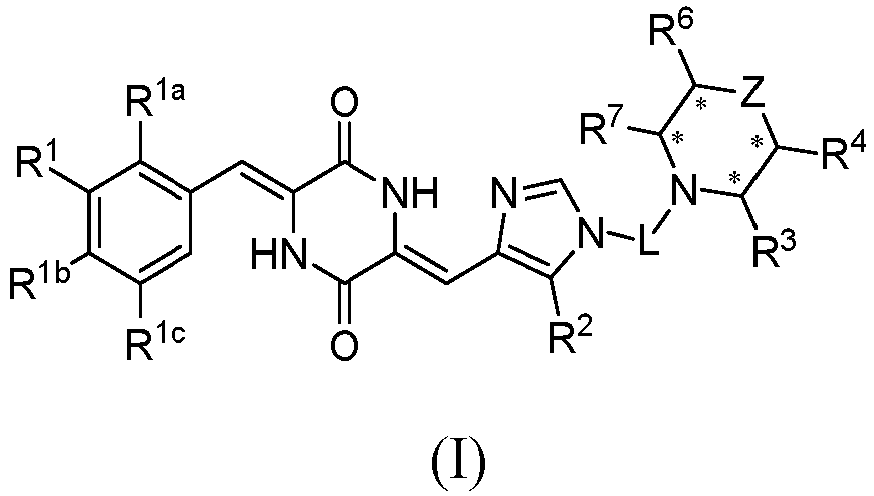 un atome de carbone avec « * » est un atome de carbone ou un atome de carbone chiral, et lorsque l'atome de carbone avec « * » est l'atome de carbone chiral, il se trouve dans une configuration S et/ou une configuration R ;R1 est un hydrogène, un deutérium, un halogène, un alkyle en C1-C8, un alkyle en C1-C8 substitué par un ou plusieurs halogènes, un alcoxy en C1-C8, un alcoxy en C1-C8 substitué par un ou plusieurs halogènes, un benzoyle, un benzoyle substitué par un ou plusieurs halogènes, un phénoxy ou un phénoxy substitué par un ou plusieurs halogènes ;R1a, R1b et R1c sont indépendamment un hydrogène, un deutérium, un halogène ou un alkyle en C1-C8 ;ou, R1, R1a conjointement avec les atomes de carbone auxquels ils sont liés, forment un aryle en C6-C10 ou un hétéroaryle à 3 à 10 chaînons avec 1 à 5 hétéroatomes choisis parmi un ou plusieurs parmi N, O et S ;ou, R1, R1b conjointement avec les atomes de carbone auxquels ils sont liés, forment un aryle en C6-C10 ou un hétéroaryle à 3 à 10 chaînons avec 1 à 5 hétéroatomes choisis parmi un ou plusieurs parmi N, O et S ;ou, R1b, R1c conjointement avec les atomes de carbone auxquels ils sont liés forment un aryle en C6-C10 ou un hétéroaryle à 3 à 10 chaînons avec 1 à 5 hétéroatomes choisis parmi un ou plusieurs parmi N, O et S ;R2 est un alkyle en C1-C8 ou un cycloalkyle en C3-C10 ;L est un hétéroalkylène en C1-C8 avec 1 à 4 hétéroatomes choisis parmi un ou plusieurs parmi N, O, S et Se ou un alkylène en C1-C8 ;R3, R4, R6 et R7 sont indépendamment un hydrogène, un deutérium, un alkyle en C1-C8, un alkyle en C1-C8 substitué par un ou plusieurs R3-1, un alcoxy en C1-C8, un cycloalkyle en C3-C10, un aryle en C6-C10, ou un hétérocycloalkyle à 3 à 10 chaînons avec 1 à 5 hétéroatomes choisis parmi un ou plusieurs parmi N, O et S ;R3-1 est indépendamment O-R3-1-1, R3-1-1 est un alkyle en C1-C8 ou un alkyle en C1-C8 substitué par un ou plusieurs R3-1-2 ;R3-1-2 est indépendamment un aryle en C6-C10 ;Z est O ou N(R5) ;R5 est un hydrogène, un deutérium, un alkyle en C1-C8, un aryle en C6-C10 substitué par un ou plusieurs R5-1, un benzyle, un benzyle substitué par un ou plusieurs R5-2, -C(=O)-R5-3, ou - S(=O)2-R5-4 ;R5-1 est indépendamment un halogène ;R5-2 est indépendamment
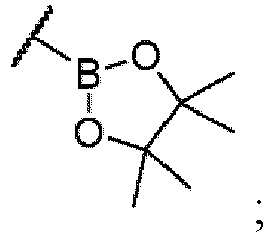 R5-3 est un hydrogène, un alcoxy en C1-C8, un benzyloxy, un benzyloxy substitué par un ou plusieurs R5-2, un alkyle en C1-C8, un cycloalkyle en C3-C10, un alcényle en C2-C8, un aryle en C6-C10 ou NR5-3-1R5-3-2 ; R5-3-1 et R5-3-2 sont indépendamment un hydrogène, un alkyle en C1-C8 ou un cycloalkyle en C3-C10 ;R5-4 est un alkyle en C1-C8 ou un aryle en C6-C10.
 - Composé de formule (I) selon la revendication 1, stéréoisomère de celui-ci, tautomère de celui-ci, sel acceptable pharmaceutiquement de celui-ci ou solvate de l'un quelconque de ce qui précède, dans lequel lorsque R1 est un halogène, l'halogène est le fluor, le chlore, le brome ou l'iode ;ou, lorsque R1 est un alkyle en C1-C8, l'alkyle en C1-C8 est un alkyle en C1-C4 ;ou, lorsque R1 est un alkyle en C1-C8 substitué par un ou plusieurs halogènes, l'alkyle en C1-C8 substitué par un ou plusieurs halogènes est un alkyle en C1-C4 substitué par un ou plusieurs halogènes ;ou, lorsque R1 est un alcoxy en C1-C8, l'alcoxy en C1-C8 est un alcoxy en C1-C4 ;ou, lorsque R1 est un alcoxy en C1-C8 substitué par un ou plusieurs halogènes, l'alcoxy en C1-C8 substitué par un ou plusieurs halogènes est un alcoxy en C1-C4 substitué par un ou plusieurs halogènes ;ou, lorsque R1 est un benzoyle substitué par un ou plusieurs halogènes, l'halogène est le fluor, le chlore, le brome ou l'iode ;ou, lorsque R1 est un phénoxy substitué par un ou plusieurs halogènes, l'halogène est le fluor, le chlore, le brome ou l'iode ;ou, lorsque R1a, R1b et R1c sont indépendamment un halogène, l'halogène est le fluor, le chlore, le brome ou l'iode ;ou, lorsque R1a, R1b et R1c sont indépendamment un alkyle en C1-C8, l'alkyle en C1-C8 est un alkyle en C1-C4 ;ou, lorsque R1, R1a conjointement avec les atomes de carbone auxquels ils sont liés forment l'aryle en C6-C10, l'aryle en C6-C10 est un phényle ;ou, lorsque R1, R1a conjointement avec les atomes de carbone auxquels ils sont liés forment l'hétéroaryle à 3 à 10 chaînons avec 1 à 5 hétéroatomes choisis parmi un ou plusieurs parmi N, O et S, l'hétéroaryle à 3 à 10 chaînons avec 1 à 5 hétéroatomes choisis parmi un ou plusieurs parmi N, O et S est un hétéroaryle à 4 à 8 chaînons avec 1 à 2 hétéroatomes choisis parmi un ou plusieurs parmi N, O et S ;ou, lorsque R2 est un alkyle en C1-C8, l'alkyle en C1-C8 est un alkyle en C1-C4 ;ou, lorsque R2 est un cycloalkyle en C3-C10, le cycloalkyle en C3-C10 est un cycloalkyle en C3-C6 ;ou, lorsque L est un alkylène en C1-C8, l'alkylène en C1-C8 est un alkylène en C3-C8 ;ou, lorsque R3, R4, R6 et R7 sont indépendamment un alkyle en C1-C8, l'alkyle en C1-C8 est un alkyle en C1-C4 ;ou, lorsque R3, R4, R6 et R7 sont indépendamment un alkyle en C1-C8 substitué par un ou plusieurs R3-1, l'alkyle en C1-C8 est un alkyle en C1-C4 ;ou, lorsque R3-1-1 est un alkyle en C1-C8, l'alkyle en C1-C8 est un alkyle en C1-C4 ;ou, lorsque R3-1-1 est un alkyle en C1-C8 substitué par un ou plusieurs R3-1-2, l'alkyle en C1-C8 est un alkyle en C1-C4 ;ou, lorsque R3-1-2 est indépendamment un aryle en C6-C10, l'aryle en C6-C10 est un phényle ;ou, lorsque R5 est un alkyle en C1-C8, l'alkyle en C1-C8 est un alkyle en C1-C4 ;ou, lorsque R5 est un aryle en C6-C10 substitué par un ou plusieurs R5-1, l'aryle en C6-C10 est un phényle ou un naphtyle ;ou, lorsque R5-1 est un halogène, l'halogène est le fluor, le chlore, le brome ou l'iode ;ou, lorsque R5-3 est un alcoxy en C1-C8, l'alcoxy en C1-C8 est un alcoxy en C1-C4 ;ou, lorsque R5-3 est un alkyle en C1-C8, l'alkyle en C1-C8 est un méthyle, un éthyle, un n-propyle, un isopropyle, un tert-butyle ou -CH(C2H5)CH2CH3 ;ou, lorsque R5-3 est un cycloalkyle en C3-C10, le cycloalkyle en C3-C10 est un cyclopropyle, un cyclobutyle, un cyclopentyle, un cyclohexyle ou un adamantyle ;ou, lorsque R5-3 est un alcényle en C2-C8, l'alcényle en C2-C8 est un alcényle en C2-C4 ;ou, lorsque R5-3 est un aryle en C6-C10, l'aryle en C6-C10 est un phényle ou un naphtyle ;ou, lorsque R5-3-1 et R5-3-2 sont indépendamment un alkyle en C1-C8, l'alkyle en C1-C8 est un alkyle en C1-C4 ;ou, lorsque R5-3-1 et R5-3-2 sont indépendamment un cycloalkyle en C3-C10, le cycloalkyle en C3-C10 est un cycloalkyle en C3-C6 ;ou, lorsque R5-4 est un alkyle en C1-C8, l'alkyle en C1-C8 est un alkyle en C1-C4 ;ou, lorsque R5-4 est un aryle en C6-C10, l'aryle en C6-C10 est un phényle ou un naphtyle.
- Composé de formule (I) selon la revendication 1, stéréoisomère de celui-ci, tautomère de celui-ci, sel acceptable pharmaceutiquement de celui-ci ou solvate de l'un quelconque de ce qui précède, dans lequel lorsque R1 est un halogène, l'halogène est le fluor ;ou, lorsque R1 est un alkyle en C1-C8, l'alkyle en C1-C8 est un méthyle ;ou, lorsque R1 est un alkyle en C1-C8 substitué par un ou plusieurs halogènes, l'alkyle en C1-C8 substitué par un ou plusieurs halogènes est un trifluorométhyle ;ou, lorsque R1 est un alcoxy en C1-C8, l'alcoxy en C1-C8 est un méthoxy ;ou, lorsque R1 est un alcoxy en C1-C8 substitué par un ou plusieurs halogènes, l'alcoxy en C1-C8 substitué par un ou plusieurs halogènes est un trifluorométhoxy ;ou, lorsque R1 est un benzoyle substitué par un ou plusieurs halogènes, l'halogène est le fluor ; de préférence, le benzoyle substitué par un ou plusieurs halogènes est
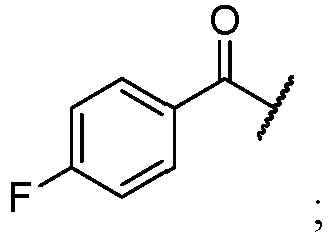 ou, lorsque R1 est un phénoxy substitué par un ou plusieurs halogènes, l'halogène est le fluor ; de préférence, le phénoxy substitué par un ou plusieurs halogènes est
 ou, lorsque R1a, R1b et R1c sont indépendamment un halogène, l'halogène est le fluor ;ou, lorsque R1a, R1b et R1c sont indépendamment un alkyle en C1-C8, l'alkyle en C1-C8 est un méthyle ;ou, lorsque R1, R1a conjointement avec les atomes de carbone auxquels ils sont liés forment l'hétéroaryle à 3 à 10 chaînons avec 1 à 5 hétéroatomes choisis parmi un ou plusieurs parmi N, O et S, l'hétéroaryle à 3 à 10 chaînons avec 1 à 5 hétéroatomes choisis parmi un ou plusieurs parmi N, O et S est un pyridyle ; de préférence, l'hétéroaryle à 3 à 10 chaînons avec 1 à 5 hétéroatomes choisis parmi un ou plusieurs parmi N, O et S est
 ou, lorsque R2 est un alkyle en C1-C8, l'alkyle en C1-C8 est un méthyle, un éthyle, un isopropyle ou un tert-butyle ;ou, lorsque R2 est un cycloalkyle en C3-C10, le cycloalkyle en C3-C10 est un cyclopropyle ;ou, lorsque L est un alkylène en C1-C8, l'alkylène en C1-C8 est

 ou, lorsque R3, R4, R6 et R7 sont indépendamment un alkyle en C1-C8, l'alkyle en C1-C8 est un méthyle ou un éthyle, par exemple un méthyle ;ou, lorsque R3, R4, R6 et R7 sont indépendamment un alkyle en C1-C8 substitué par un ou plusieurs R3-1, l'alkyle en C1-C8 est un méthyle ;ou, lorsque R3-1-1 est un alkyle en C1-C8, l'alkyle en C1-C8 est un méthyle, un éthyle, un n-propyle ou un n-butyle ;ou, lorsque R3-1-1 est un alkyle en C1-C8 substitué par un ou plusieurs R3-1-2, l'alkyle en C1-C8 est un méthyle ;ou, lorsque R5 est alkyle en C1-C8, l'alkyle en C1-C8 est un méthyle, un éthyle, un n-propyle, un isopropyle, un n-butyle ou 2-méthylpropyle, par exemple un méthyle ;ou, lorsque R5 est un aryle en C6-C10 substitué par un ou plusieurs R5-1, l'aryle en C6-C10 est un phényle ;ou, lorsque R5-1 est un halogène, l'halogène est le fluor ;ou, lorsque R5-3 est un alcoxy en C1-C8, l'alcoxy en C1-C8 est un tert-butoxy ;ou, lorsque R5-3 est un alkyle en C1-C8, l'alkyle en C1-C8 est un alkyle en C1-C4 ;ou, lorsque R5-3 est un cycloalkyle en C3-C10, le cycloalkyle en C3-C10 est un cycloalkyle en C3-C6 ;ou, lorsque R5-3 est un alcényle en C2-C8, l'alcényle en C2-C8 est

 ou, lorsque R5-3 est un aryle en C6-C10, l'aryle en C6-C10 est un phényle ;ou, lorsque R5-3-1 et R5-3-2 sont indépendamment un alkyle en C1-C8, l'alkyle en C1-C8 est un isopropyle ou un tert-butyle ;ou, lorsque R5-3-1 et R5-3-2 sont indépendamment un cycloalkyle en C3-C10, le cycloalkyle en C3-C10 est un cyclopentyle ou un cyclohexyle ;ou, lorsque R5-4 est un alkyle en C1-C8, l'alkyle en C1-C8 est un méthyle ;ou, lorsque R5-4 est un aryle en C6-C10, l'aryle en C6-C10 est un phényle.
 - Composé de formule (I) selon la revendication 1, stéréoisomère de celui-ci, tautomère de celui-ci, sel acceptable pharmaceutiquement de celui-ci ou solvate de l'un quelconque de ce qui précède, dans lequel lorsque R1 est un hydrogène, un halogène, un alkyle en C1-C8, un alcoxy en C1-C8, un alcoxy en C1-C8 substitué par un ou plusieurs halogènes, un benzoyle, un benzoyle substitué par un ou plusieurs halogènes, un phénoxy ou un phénoxy substitué par un ou plusieurs halogènes ;ou, R1b est un hydrogène ou un halogène ; par exemple un hydrogène ou un fluor ;ou, R1c est un hydrogène ou un halogène, par exemple un hydrogène ou un fluor ;ou, R2 est un alkyle en C1-C8 ;ou, L est un alkylène en C1-C8 ;ou, R3, R4, R6 et R7 sont indépendamment un hydrogène ou un alkyle en C1-C8 ;ou, R5 est un benzyle, -C(=O)-R5-3 ou -S(=O)2-R5-4 ;ou, R5-3 est un hydrogène, un alkyle en C1-C4, un cycloalkyle en C3-C6, un alcényle en C2-C8, un benzyloxy substitué par un ou plusieurs groupes R5-2, un aryle en C6-C10 ou NR5-3-1R5-3-2 ;ou, le sel acceptable pharmaceutiquement du composé de formule (I) est un sel préparé à partir du composé de formule (I) et d'un acide acceptable pharmaceutiquement, l'acide acceptable pharmaceutiquement est un acide inorganique ou un acide organique, l'acide inorganique est de préférence l'acide chlorhydrique, et l'acide organique est de préférence l'acide méthanesulfonique.
- Composé de formule (I) selon la revendication 1, stéréoisomère de celui-ci, tautomère de celui-ci, sel acceptable pharmaceutiquement de celui-ci ou solvate de l'un quelconque de ce qui précède, dans lequel


 ou, R2 est un isopropyle ou un cyclopropyle ;ou, L est

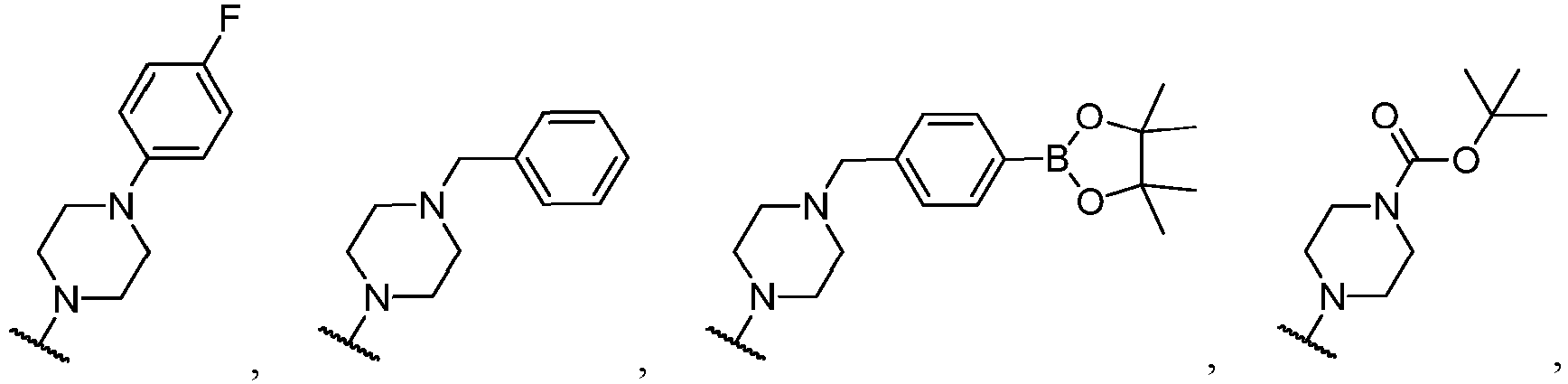




 ou, le sel acceptable pharmaceutiquement du composé de formule (I) est un sel préparé à partir du composé de formule (I) et d'un acide acceptable pharmaceutiquement, l'acide acceptable pharmaceutiquement est l'acide chlorhydrique ou l'acide méthanesulfonique ;ou, le sel acceptable pharmaceutiquement du composé de formule (I) est un sel formé par le composé de formule (I) et l'acide acceptable pharmaceutiquement dans un rapport molaire de 1:2.
 - Composé de formule (I) selon la revendication 1, stéréoisomère de celui-ci, tautomère de celui-ci, sel acceptable pharmaceutiquement de celui-ci, ou solvate de l'un quelconque de ce qui précède, dans lequel le composé de formule (I) est l'un quelconque des composés suivants :


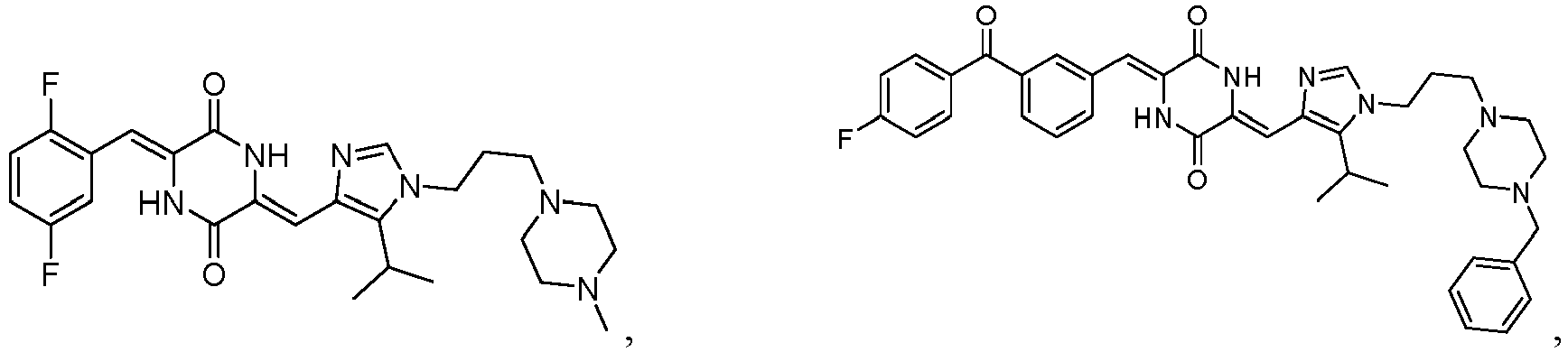


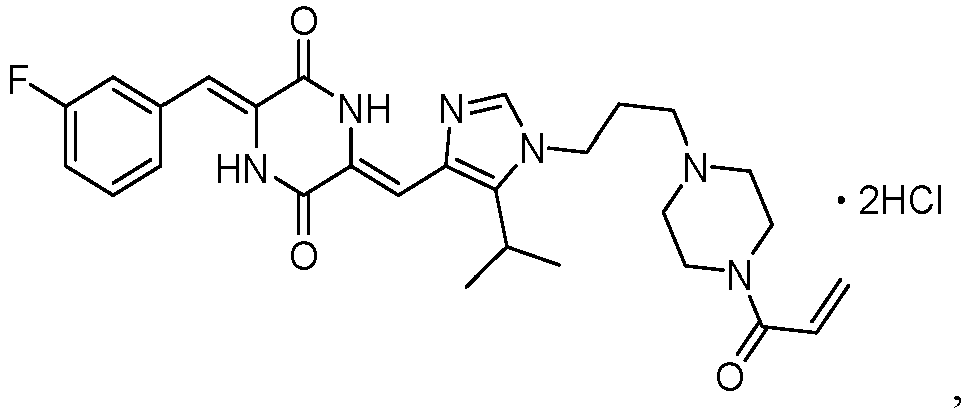


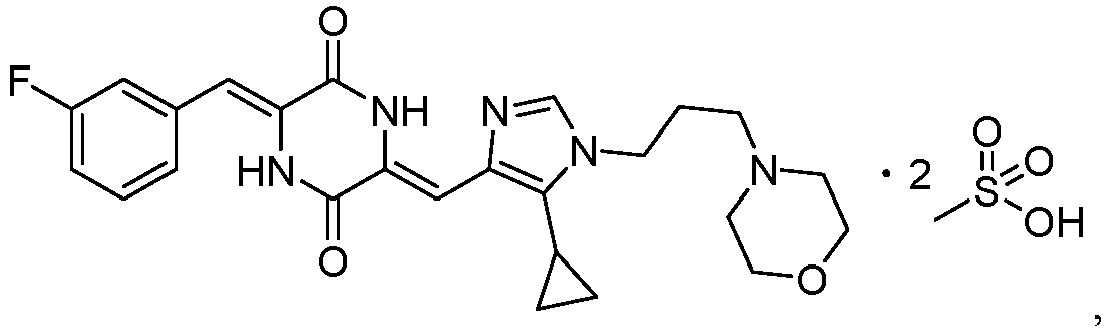


- Composé de formule (I) selon la revendication 1, stéréoisomère de celui-ci, tautomère de celui-ci, sel acceptable pharmaceutiquement de celui-ci ou solvate de l'un quelconque de ce qui précède, dans lequel le composé de formule (I) est l'un quelconque des composés suivants :un composé dont le temps de rétention est de 6,29 min dans les conditions suivantes, qui est un stéréoisomère de

Temps (min) Phase mobile A (%, V/V) Phase mobile B (%, V/V) 0 40 60 0→6 40→100 60→0 6→10 100→40 0→60 un composé dont le temps de rétention est de 6,48 min dans les conditions suivantes, qui est un stéréoisomère de
Temps (min) Phase mobile A (%, V/V) Phase mobile B (%, V/V) 0 40 60 0→6 40→100 60→0 6→10 100→40 0→60 - Procédé de préparation d'un composé de formule (I), qui comprend les étapes suivantes : la réalisation d'une réaction de condensation comme indiqué ci-dessous entre un composé de formule (II) et un composé de formule (III) pour obtenir le composé de formule (I) ;

- Composé de formule (II)

- Composé de formule (II) selon la revendication 9, ledit composé de formule (II) étant l'un quelconque des composés suivants :


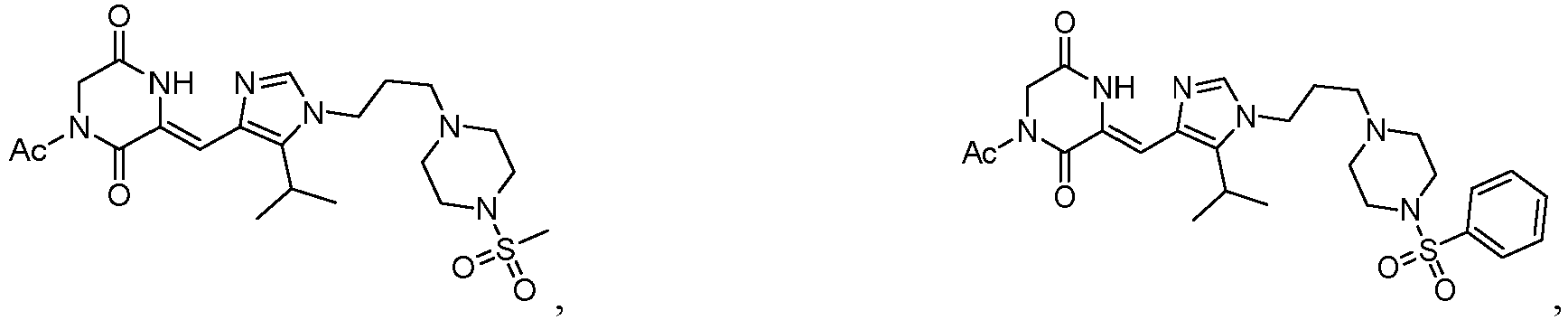
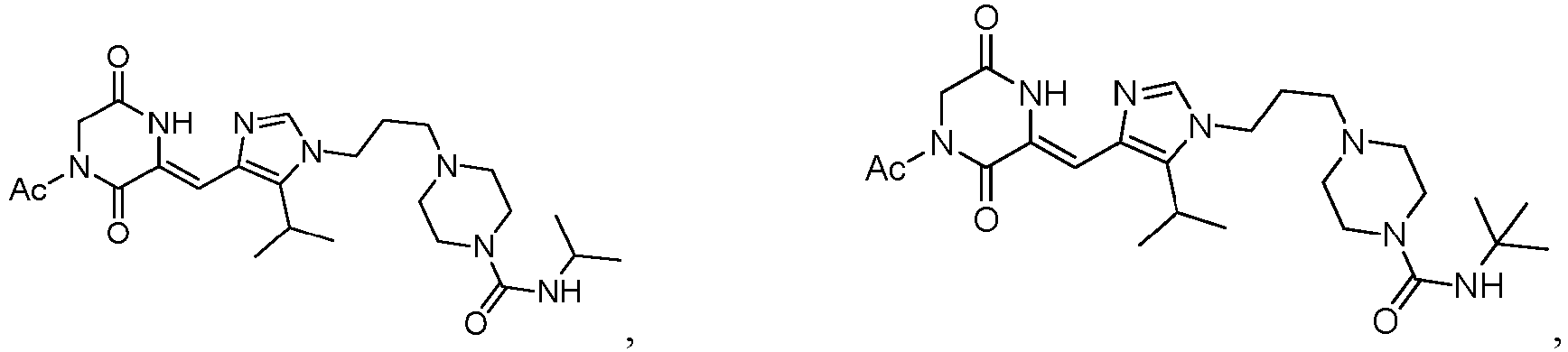


- Composition pharmaceutique, comprenant le composé de formule (I) selon au moins l'une des revendications 1 à 7, stéréoisomère de celui-ci, tautomère de celui-ci, sel acceptable pharmaceutiquement de celui-ci ou solvate de l'un quelconque de ce qui précède, et un excipient pharmaceutique ; de préférence, l'excipient pharmaceutique ne comprend pas de co-solvant.
- Composé de formule (I) selon au moins l'une des revendications 1 à 7, stéréoisomère de celui-ci, tautomère de celui-ci, sel acceptable pharmaceutiquement de celui-ci ou solvate de l'un quelconque de ce qui précède, ou composition pharmaceutique selon la revendication 11 destiné(e) à être utilisé(e) dans la prévention et/ou le traitement du cancer ; le cancer est de préférence un ou plusieurs parmi le cancer du poumon, le cancer du pancréas, le cancer du côlon et le cancer du foie.
Applications Claiming Priority (2)
| Application Number | Priority Date | Filing Date | Title |
|---|---|---|---|
| CN202011624889 | 2020-12-31 | ||
| PCT/CN2021/143913 WO2022144002A1 (fr) | 2020-12-31 | 2021-12-31 | Dérivé d'un composé de 2,5-dicétopipérazine, son procédé de préparation, composition pharmaceutique de celui-ci et son utilisation |
Publications (3)
| Publication Number | Publication Date |
|---|---|
| EP4273143A1 EP4273143A1 (fr) | 2023-11-08 |
| EP4273143A4 EP4273143A4 (fr) | 2024-05-08 |
| EP4273143B1 true EP4273143B1 (fr) | 2025-05-21 |
Family
ID=82137503
Family Applications (1)
| Application Number | Title | Priority Date | Filing Date |
|---|---|---|---|
| EP21914730.3A Active EP4273143B1 (fr) | 2020-12-31 | 2021-12-31 | Dérivé d'un composé de 2,5-dicétopipérazine, son procédé de préparation, composition pharmaceutique de celui-ci et son utilisation |
Country Status (4)
| Country | Link |
|---|---|
| US (1) | US20240140941A1 (fr) |
| EP (1) | EP4273143B1 (fr) |
| CN (1) | CN114685456B (fr) |
| WO (1) | WO2022144002A1 (fr) |
Families Citing this family (3)
| Publication number | Priority date | Publication date | Assignee | Title |
|---|---|---|---|---|
| CN117285512B (zh) * | 2022-06-16 | 2026-04-10 | 大连万众益生大健康有限公司 | 2,5-二酮哌嗪-咪唑类化合物、其制备方法及其应用 |
| CN117466871A (zh) * | 2022-07-29 | 2024-01-30 | 青岛海合生物科技有限公司 | 一种2,5-二酮哌嗪类化合物及其应用 |
| CN119371407A (zh) * | 2024-06-27 | 2025-01-28 | 青岛海合生物科技有限公司 | 一种具有抗肿瘤功效的2,5-二酮哌嗪类化合物及其在制备治疗和/或预防中性粒细胞减少症的药物中的应用 |
Family Cites Families (5)
| Publication number | Priority date | Publication date | Assignee | Title |
|---|---|---|---|---|
| WO2012035436A1 (fr) * | 2010-09-15 | 2012-03-22 | Tokyo University Of Pharmacy And Life Sciences | Analogues de promédicaments à base de plinabuline et utilisations thérapeutiques associées |
| CN106279039B (zh) * | 2015-06-02 | 2019-01-11 | 青岛海洋生物医药研究院股份有限公司 | 氘代脱氢苯基阿夕斯丁类化合物及其制备方法和在制备抗肿瘤的药物中的应用 |
| CN107286137A (zh) * | 2016-04-12 | 2017-10-24 | 青岛海洋生物医药研究院股份有限公司 | 氘代脱氢3-苯甲酰苯基阿夕斯丁类化合物及其制备方法和在制备抗肿瘤的药物中的应用 |
| CN110240592A (zh) * | 2018-03-08 | 2019-09-17 | 青岛海洋生物医药研究院股份有限公司 | (z)-3-(3-甲酰基苯亚甲基)哌嗪二酮类化合物及其在制备抗肿瘤药物中的应用 |
| CN110835335B (zh) * | 2018-08-17 | 2022-04-15 | 深圳华大海洋科技有限公司 | 2,5-二酮哌嗪类化合物及其在制备抗癌药物中的应用 |
-
2021
- 2021-12-31 WO PCT/CN2021/143913 patent/WO2022144002A1/fr not_active Ceased
- 2021-12-31 EP EP21914730.3A patent/EP4273143B1/fr active Active
- 2021-12-31 US US18/269,731 patent/US20240140941A1/en active Pending
- 2021-12-31 CN CN202111665255.6A patent/CN114685456B/zh active Active
Also Published As
| Publication number | Publication date |
|---|---|
| EP4273143A1 (fr) | 2023-11-08 |
| US20240140941A1 (en) | 2024-05-02 |
| CN114685456A (zh) | 2022-07-01 |
| WO2022144002A1 (fr) | 2022-07-07 |
| CN114685456B (zh) | 2023-10-10 |
| EP4273143A4 (fr) | 2024-05-08 |
Similar Documents
| Publication | Publication Date | Title |
|---|---|---|
| EP4112606A1 (fr) | Composé aromatique et son utilisation dans la préparation de médicaments antinéoplasiques | |
| CN113717157B (zh) | 用作cdk7激酶抑制剂的化合物及其应用 | |
| EP3712150B1 (fr) | Composé macrocyclique servant d'inhibiteur de wee1 et ses applications | |
| CA3170068A1 (fr) | Compose de quinazoline contenant un cycle spiro | |
| CN117285590A (zh) | 一种化合物、其制备方法、包括其的组合物及其应用 | |
| EP4273143A1 (fr) | Dérivé d'un composé de 2,5-dicétopipérazine, son procédé de préparation, composition pharmaceutique de celui-ci et son utilisation | |
| KR101738866B1 (ko) | 안드로겐 수용체 길항제, 항암제로서 사이클릭 n,n'-다이아릴티오우레아 및 n,n'-다이아릴우레아, 이의 제조방법 및 이의 용도 | |
| CN106536491B (zh) | 作为盐皮质激素受体调节剂的苯并噁嗪酮酰胺 | |
| WO2021213317A1 (fr) | Inhibiteur de hpk1, son procédé de préparation et son utilisation | |
| EP4155304B9 (fr) | Composé utilisé comme inhibiteur de kinase ret et son application | |
| CN100596299C (zh) | 一类脱氢水飞蓟宾双酯类衍生物及其制备方法和用途 | |
| AU2219599A (en) | Platelet adp receptor inhibitors | |
| JPH037257A (ja) | ピリジン誘導体及びそれを有効成分とする向精神剤 | |
| CN106317057B (zh) | 具有咪唑并吡嗪类衍生物,其制备及其在医药上的应用 | |
| CN115974855A (zh) | Ezh2和hdac双靶点抑制剂、其药物组合物及其制备方法和用途 | |
| WO2024235218A1 (fr) | Inhibiteur sélectif de hdac1/2 et son utilisation | |
| US5238947A (en) | Synthetic piperidinediones with cytostatic activity | |
| TW201922690A (zh) | 環-amp反應元素結合蛋白的抑制劑 | |
| CA2557942C (fr) | Derives de carbamate de 2h- ou 3h-benzo[e]indazol-1-yle, leur preparation et leur application en therapeutique | |
| CN104119295B (zh) | 吩噻嗪类一氧化氮供体、其制备方法和用途 | |
| CN118772107B (zh) | Hdac抑制剂及其用途 | |
| CN114702444B (zh) | 一种具有抗多发性骨髓瘤作用的aha1抑制剂及其制备方法和应用 | |
| TW202340167A (zh) | 含硫異吲哚啉類衍生物的晶型 | |
| KR101048748B1 (ko) | 신규 갈바닉산 유도체 또는 이의 약학적으로 허용가능한 염, 이의 제조방법 및 이를 유효성분으로 함유하는 다약제내성 억제용 약학적 조성물 | |
| KR100673974B1 (ko) | 2,2-디메틸-3-알킬에테르-4-알콕시-6-알킬 아미노벤조피란 유도체를 유효성분으로 함유하는 pge2 활성에 관련된 염증질환 치료제 |
Legal Events
| Date | Code | Title | Description |
|---|---|---|---|
| STAA | Information on the status of an ep patent application or granted ep patent |
Free format text: STATUS: THE INTERNATIONAL PUBLICATION HAS BEEN MADE |
|
| PUAI | Public reference made under article 153(3) epc to a published international application that has entered the european phase |
Free format text: ORIGINAL CODE: 0009012 |
|
| STAA | Information on the status of an ep patent application or granted ep patent |
Free format text: STATUS: REQUEST FOR EXAMINATION WAS MADE |
|
| 17P | Request for examination filed |
Effective date: 20230731 |
|
| AK | Designated contracting states |
Kind code of ref document: A1 Designated state(s): AL AT BE BG CH CY CZ DE DK EE ES FI FR GB GR HR HU IE IS IT LI LT LU LV MC MK MT NL NO PL PT RO RS SE SI SK SM TR |
|
| DAV | Request for validation of the european patent (deleted) | ||
| DAX | Request for extension of the european patent (deleted) | ||
| A4 | Supplementary search report drawn up and despatched |
Effective date: 20240409 |
|
| RIC1 | Information provided on ipc code assigned before grant |
Ipc: A61P 35/00 20060101ALI20240403BHEP Ipc: A61K 31/5377 20060101ALI20240403BHEP Ipc: A61K 31/496 20060101ALI20240403BHEP Ipc: C07D 405/14 20060101ALI20240403BHEP Ipc: C07D 417/14 20060101ALI20240403BHEP Ipc: C07D 409/14 20060101ALI20240403BHEP Ipc: C07D 401/06 20060101ALI20240403BHEP Ipc: C07D 403/06 20060101ALI20240403BHEP Ipc: C07D 403/14 20060101AFI20240403BHEP |
|
| GRAP | Despatch of communication of intention to grant a patent |
Free format text: ORIGINAL CODE: EPIDOSNIGR1 |
|
| STAA | Information on the status of an ep patent application or granted ep patent |
Free format text: STATUS: GRANT OF PATENT IS INTENDED |
|
| INTG | Intention to grant announced |
Effective date: 20241212 |
|
| GRAS | Grant fee paid |
Free format text: ORIGINAL CODE: EPIDOSNIGR3 |
|
| GRAA | (expected) grant |
Free format text: ORIGINAL CODE: 0009210 |
|
| STAA | Information on the status of an ep patent application or granted ep patent |
Free format text: STATUS: THE PATENT HAS BEEN GRANTED |
|
| AK | Designated contracting states |
Kind code of ref document: B1 Designated state(s): AL AT BE BG CH CY CZ DE DK EE ES FI FR GB GR HR HU IE IS IT LI LT LU LV MC MK MT NL NO PL PT RO RS SE SI SK SM TR |
|
| REG | Reference to a national code |
Ref country code: GB Ref legal event code: FG4D |
|
| REG | Reference to a national code |
Ref country code: CH Ref legal event code: EP |
|
| REG | Reference to a national code |
Ref country code: DE Ref legal event code: R096 Ref document number: 602021031300 Country of ref document: DE |
|
| REG | Reference to a national code |
Ref country code: IE Ref legal event code: FG4D |
|
| REG | Reference to a national code |
Ref country code: NL Ref legal event code: MP Effective date: 20250521 |
|
| P01 | Opt-out of the competence of the unified patent court (upc) registered |
Free format text: CASE NUMBER: UPC_APP_4214_4273143/2025 Effective date: 20250825 |
|
| PG25 | Lapsed in a contracting state [announced via postgrant information from national office to epo] |
Ref country code: PT Free format text: LAPSE BECAUSE OF FAILURE TO SUBMIT A TRANSLATION OF THE DESCRIPTION OR TO PAY THE FEE WITHIN THE PRESCRIBED TIME-LIMIT Effective date: 20250922 Ref country code: ES Free format text: LAPSE BECAUSE OF FAILURE TO SUBMIT A TRANSLATION OF THE DESCRIPTION OR TO PAY THE FEE WITHIN THE PRESCRIBED TIME-LIMIT Effective date: 20250521 Ref country code: FI Free format text: LAPSE BECAUSE OF FAILURE TO SUBMIT A TRANSLATION OF THE DESCRIPTION OR TO PAY THE FEE WITHIN THE PRESCRIBED TIME-LIMIT Effective date: 20250521 |
|
| REG | Reference to a national code |
Ref country code: LT Ref legal event code: MG9D |
|
| PG25 | Lapsed in a contracting state [announced via postgrant information from national office to epo] |
Ref country code: GR Free format text: LAPSE BECAUSE OF FAILURE TO SUBMIT A TRANSLATION OF THE DESCRIPTION OR TO PAY THE FEE WITHIN THE PRESCRIBED TIME-LIMIT Effective date: 20250822 Ref country code: NO Free format text: LAPSE BECAUSE OF FAILURE TO SUBMIT A TRANSLATION OF THE DESCRIPTION OR TO PAY THE FEE WITHIN THE PRESCRIBED TIME-LIMIT Effective date: 20250821 |
|
| PG25 | Lapsed in a contracting state [announced via postgrant information from national office to epo] |
Ref country code: NL Free format text: LAPSE BECAUSE OF FAILURE TO SUBMIT A TRANSLATION OF THE DESCRIPTION OR TO PAY THE FEE WITHIN THE PRESCRIBED TIME-LIMIT Effective date: 20250521 Ref country code: PL Free format text: LAPSE BECAUSE OF FAILURE TO SUBMIT A TRANSLATION OF THE DESCRIPTION OR TO PAY THE FEE WITHIN THE PRESCRIBED TIME-LIMIT Effective date: 20250521 |
|
| PG25 | Lapsed in a contracting state [announced via postgrant information from national office to epo] |
Ref country code: BG Free format text: LAPSE BECAUSE OF FAILURE TO SUBMIT A TRANSLATION OF THE DESCRIPTION OR TO PAY THE FEE WITHIN THE PRESCRIBED TIME-LIMIT Effective date: 20250521 |
|
| PG25 | Lapsed in a contracting state [announced via postgrant information from national office to epo] |
Ref country code: HR Free format text: LAPSE BECAUSE OF FAILURE TO SUBMIT A TRANSLATION OF THE DESCRIPTION OR TO PAY THE FEE WITHIN THE PRESCRIBED TIME-LIMIT Effective date: 20250521 |
|
| PG25 | Lapsed in a contracting state [announced via postgrant information from national office to epo] |
Ref country code: RS Free format text: LAPSE BECAUSE OF FAILURE TO SUBMIT A TRANSLATION OF THE DESCRIPTION OR TO PAY THE FEE WITHIN THE PRESCRIBED TIME-LIMIT Effective date: 20250821 |
|
| PG25 | Lapsed in a contracting state [announced via postgrant information from national office to epo] |
Ref country code: IS Free format text: LAPSE BECAUSE OF FAILURE TO SUBMIT A TRANSLATION OF THE DESCRIPTION OR TO PAY THE FEE WITHIN THE PRESCRIBED TIME-LIMIT Effective date: 20250921 |
|
| REG | Reference to a national code |
Ref country code: AT Ref legal event code: MK05 Ref document number: 1796685 Country of ref document: AT Kind code of ref document: T Effective date: 20250521 |
|
| REG | Reference to a national code |
Ref country code: CH Ref legal event code: U11 Free format text: ST27 STATUS EVENT CODE: U-0-0-U10-U11 (AS PROVIDED BY THE NATIONAL OFFICE) Effective date: 20260101 |
|
| PGFP | Annual fee paid to national office [announced via postgrant information from national office to epo] |
Ref country code: GB Payment date: 20251229 Year of fee payment: 5 |
|
| PG25 | Lapsed in a contracting state [announced via postgrant information from national office to epo] |
Ref country code: AT Free format text: LAPSE BECAUSE OF FAILURE TO SUBMIT A TRANSLATION OF THE DESCRIPTION OR TO PAY THE FEE WITHIN THE PRESCRIBED TIME-LIMIT Effective date: 20250521 Ref country code: DK Free format text: LAPSE BECAUSE OF FAILURE TO SUBMIT A TRANSLATION OF THE DESCRIPTION OR TO PAY THE FEE WITHIN THE PRESCRIBED TIME-LIMIT Effective date: 20250521 Ref country code: SM Free format text: LAPSE BECAUSE OF FAILURE TO SUBMIT A TRANSLATION OF THE DESCRIPTION OR TO PAY THE FEE WITHIN THE PRESCRIBED TIME-LIMIT Effective date: 20250521 |
|
| PGFP | Annual fee paid to national office [announced via postgrant information from national office to epo] |
Ref country code: FR Payment date: 20251222 Year of fee payment: 5 |
|
| PG25 | Lapsed in a contracting state [announced via postgrant information from national office to epo] |
Ref country code: CZ Free format text: LAPSE BECAUSE OF FAILURE TO SUBMIT A TRANSLATION OF THE DESCRIPTION OR TO PAY THE FEE WITHIN THE PRESCRIBED TIME-LIMIT Effective date: 20250521 |
|
| PG25 | Lapsed in a contracting state [announced via postgrant information from national office to epo] |
Ref country code: EE Free format text: LAPSE BECAUSE OF FAILURE TO SUBMIT A TRANSLATION OF THE DESCRIPTION OR TO PAY THE FEE WITHIN THE PRESCRIBED TIME-LIMIT Effective date: 20250521 |
|
| PG25 | Lapsed in a contracting state [announced via postgrant information from national office to epo] |
Ref country code: SK Free format text: LAPSE BECAUSE OF FAILURE TO SUBMIT A TRANSLATION OF THE DESCRIPTION OR TO PAY THE FEE WITHIN THE PRESCRIBED TIME-LIMIT Effective date: 20250521 |
|
| PG25 | Lapsed in a contracting state [announced via postgrant information from national office to epo] |
Ref country code: IT Free format text: LAPSE BECAUSE OF FAILURE TO SUBMIT A TRANSLATION OF THE DESCRIPTION OR TO PAY THE FEE WITHIN THE PRESCRIBED TIME-LIMIT Effective date: 20250521 |
|
| REG | Reference to a national code |
Ref country code: DE Ref legal event code: R097 Ref document number: 602021031300 Country of ref document: DE |
|
| PG25 | Lapsed in a contracting state [announced via postgrant information from national office to epo] |
Ref country code: RO Free format text: LAPSE BECAUSE OF FAILURE TO SUBMIT A TRANSLATION OF THE DESCRIPTION OR TO PAY THE FEE WITHIN THE PRESCRIBED TIME-LIMIT Effective date: 20250521 |
|
| PLBE | No opposition filed within time limit |
Free format text: ORIGINAL CODE: 0009261 |
|
| STAA | Information on the status of an ep patent application or granted ep patent |
Free format text: STATUS: NO OPPOSITION FILED WITHIN TIME LIMIT |
|
| REG | Reference to a national code |
Ref country code: CH Ref legal event code: L10 Free format text: ST27 STATUS EVENT CODE: U-0-0-L10-L00 (AS PROVIDED BY THE NATIONAL OFFICE) Effective date: 20260402 |
|
| PGFP | Annual fee paid to national office [announced via postgrant information from national office to epo] |
Ref country code: DE Payment date: 20251222 Year of fee payment: 5 |
|
| PGFP | Annual fee paid to national office [announced via postgrant information from national office to epo] |
Ref country code: CH Payment date: 20260101 Year of fee payment: 5 |
|
| 26N | No opposition filed |
Effective date: 20260224 |