EP4273360B1 - Charnière pivotante et vantail de porte pivotant - Google Patents
Charnière pivotante et vantail de porte pivotant Download PDFInfo
- Publication number
- EP4273360B1 EP4273360B1 EP22171124.5A EP22171124A EP4273360B1 EP 4273360 B1 EP4273360 B1 EP 4273360B1 EP 22171124 A EP22171124 A EP 22171124A EP 4273360 B1 EP4273360 B1 EP 4273360B1
- Authority
- EP
- European Patent Office
- Prior art keywords
- door leaf
- cam
- pivot hinge
- pivot
- slidable
- Prior art date
- Legal status (The legal status is an assumption and is not a legal conclusion. Google has not performed a legal analysis and makes no representation as to the accuracy of the status listed.)
- Active
Links
Images


Classifications
-
- E—FIXED CONSTRUCTIONS
- E05—LOCKS; KEYS; WINDOW OR DOOR FITTINGS; SAFES
- E05D—HINGES OR SUSPENSION DEVICES FOR DOORS, WINDOWS OR WINGS
- E05D11/00—Additional features or accessories of hinges
- E05D11/10—Devices for preventing movement between relatively-movable hinge parts
- E05D11/1028—Devices for preventing movement between relatively-movable hinge parts for maintaining the hinge in two or more positions, e.g. intermediate or fully open
- E05D11/105—Devices for preventing movement between relatively-movable hinge parts for maintaining the hinge in two or more positions, e.g. intermediate or fully open the maintaining means acting perpendicularly to the pivot axis
- E05D11/1064—Devices for preventing movement between relatively-movable hinge parts for maintaining the hinge in two or more positions, e.g. intermediate or fully open the maintaining means acting perpendicularly to the pivot axis with a coil spring perpendicular to the pivot axis
-
- E—FIXED CONSTRUCTIONS
- E05—LOCKS; KEYS; WINDOW OR DOOR FITTINGS; SAFES
- E05D—HINGES OR SUSPENSION DEVICES FOR DOORS, WINDOWS OR WINGS
- E05D15/00—Suspension arrangements for wings
- E05D15/48—Suspension arrangements for wings allowing alternative movements
- E05D15/54—Suspension arrangements for wings allowing alternative movements for opening both inwards and outwards
-
- E—FIXED CONSTRUCTIONS
- E05—LOCKS; KEYS; WINDOW OR DOOR FITTINGS; SAFES
- E05D—HINGES OR SUSPENSION DEVICES FOR DOORS, WINDOWS OR WINGS
- E05D7/00—Hinges or pivots of special construction
- E05D7/08—Hinges or pivots of special construction for use in suspensions comprising two spigots placed at opposite edges of the wing, especially at the top and the bottom, e.g. trunnions
- E05D7/081—Hinges or pivots of special construction for use in suspensions comprising two spigots placed at opposite edges of the wing, especially at the top and the bottom, e.g. trunnions the pivot axis of the wing being situated near one edge of the wing, especially at the top and bottom, e.g. trunnions
-
- E—FIXED CONSTRUCTIONS
- E05—LOCKS; KEYS; WINDOW OR DOOR FITTINGS; SAFES
- E05D—HINGES OR SUSPENSION DEVICES FOR DOORS, WINDOWS OR WINGS
- E05D11/00—Additional features or accessories of hinges
- E05D11/10—Devices for preventing movement between relatively-movable hinge parts
- E05D11/1028—Devices for preventing movement between relatively-movable hinge parts for maintaining the hinge in two or more positions, e.g. intermediate or fully open
- E05D2011/1035—Devices for preventing movement between relatively-movable hinge parts for maintaining the hinge in two or more positions, e.g. intermediate or fully open with circumferential and evenly distributed detents around the pivot-axis
-
- E—FIXED CONSTRUCTIONS
- E05—LOCKS; KEYS; WINDOW OR DOOR FITTINGS; SAFES
- E05F—DEVICES FOR MOVING WINGS INTO OPEN OR CLOSED POSITION; CHECKS FOR WINGS; WING FITTINGS NOT OTHERWISE PROVIDED FOR, CONCERNED WITH THE FUNCTIONING OF THE WING
- E05F1/00—Closers or openers for wings, not otherwise provided for in this subclass
- E05F1/08—Closers or openers for wings, not otherwise provided for in this subclass spring-actuated, e.g. for horizontally sliding wings
- E05F1/10—Closers or openers for wings, not otherwise provided for in this subclass spring-actuated, e.g. for horizontally sliding wings for swinging wings, e.g. counterbalance
- E05F1/12—Mechanisms in the shape of hinges or pivots, operated by springs
- E05F1/1246—Mechanisms in the shape of hinges or pivots, operated by springs with a coil spring perpendicular to the pivot axis
- E05F1/1253—Mechanisms in the shape of hinges or pivots, operated by springs with a coil spring perpendicular to the pivot axis with a compression spring
-
- E—FIXED CONSTRUCTIONS
- E05—LOCKS; KEYS; WINDOW OR DOOR FITTINGS; SAFES
- E05Y—INDEXING SCHEME ASSOCIATED WITH SUBCLASSES E05D AND E05F, RELATING TO CONSTRUCTION ELEMENTS, ELECTRIC CONTROL, POWER SUPPLY, POWER SIGNAL OR TRANSMISSION, USER INTERFACES, MOUNTING OR COUPLING, DETAILS, ACCESSORIES, AUXILIARY OPERATIONS NOT OTHERWISE PROVIDED FOR, APPLICATION THEREOF
- E05Y2201/00—Constructional elements; Accessories therefor
- E05Y2201/10—Covers; Housings
-
- E—FIXED CONSTRUCTIONS
- E05—LOCKS; KEYS; WINDOW OR DOOR FITTINGS; SAFES
- E05Y—INDEXING SCHEME ASSOCIATED WITH SUBCLASSES E05D AND E05F, RELATING TO CONSTRUCTION ELEMENTS, ELECTRIC CONTROL, POWER SUPPLY, POWER SIGNAL OR TRANSMISSION, USER INTERFACES, MOUNTING OR COUPLING, DETAILS, ACCESSORIES, AUXILIARY OPERATIONS NOT OTHERWISE PROVIDED FOR, APPLICATION THEREOF
- E05Y2201/00—Constructional elements; Accessories therefor
- E05Y2201/60—Suspension or transmission members; Accessories therefor
- E05Y2201/622—Suspension or transmission members elements
- E05Y2201/638—Cams; Ramps
-
- E—FIXED CONSTRUCTIONS
- E05—LOCKS; KEYS; WINDOW OR DOOR FITTINGS; SAFES
- E05Y—INDEXING SCHEME ASSOCIATED WITH SUBCLASSES E05D AND E05F, RELATING TO CONSTRUCTION ELEMENTS, ELECTRIC CONTROL, POWER SUPPLY, POWER SIGNAL OR TRANSMISSION, USER INTERFACES, MOUNTING OR COUPLING, DETAILS, ACCESSORIES, AUXILIARY OPERATIONS NOT OTHERWISE PROVIDED FOR, APPLICATION THEREOF
- E05Y2600/00—Mounting or coupling arrangements for elements provided for in this subclass
- E05Y2600/40—Mounting location; Visibility of the elements
- E05Y2600/46—Mounting location; Visibility of the elements in or on the wing
-
- E—FIXED CONSTRUCTIONS
- E05—LOCKS; KEYS; WINDOW OR DOOR FITTINGS; SAFES
- E05Y—INDEXING SCHEME ASSOCIATED WITH SUBCLASSES E05D AND E05F, RELATING TO CONSTRUCTION ELEMENTS, ELECTRIC CONTROL, POWER SUPPLY, POWER SIGNAL OR TRANSMISSION, USER INTERFACES, MOUNTING OR COUPLING, DETAILS, ACCESSORIES, AUXILIARY OPERATIONS NOT OTHERWISE PROVIDED FOR, APPLICATION THEREOF
- E05Y2800/00—Details, accessories and auxiliary operations not otherwise provided for
- E05Y2800/20—Combinations of elements
- E05Y2800/21—Combinations of elements of identical elements, e.g. of identical compression springs
-
- E—FIXED CONSTRUCTIONS
- E05—LOCKS; KEYS; WINDOW OR DOOR FITTINGS; SAFES
- E05Y—INDEXING SCHEME ASSOCIATED WITH SUBCLASSES E05D AND E05F, RELATING TO CONSTRUCTION ELEMENTS, ELECTRIC CONTROL, POWER SUPPLY, POWER SIGNAL OR TRANSMISSION, USER INTERFACES, MOUNTING OR COUPLING, DETAILS, ACCESSORIES, AUXILIARY OPERATIONS NOT OTHERWISE PROVIDED FOR, APPLICATION THEREOF
- E05Y2800/00—Details, accessories and auxiliary operations not otherwise provided for
- E05Y2800/26—Form or shape
-
- E—FIXED CONSTRUCTIONS
- E05—LOCKS; KEYS; WINDOW OR DOOR FITTINGS; SAFES
- E05Y—INDEXING SCHEME ASSOCIATED WITH SUBCLASSES E05D AND E05F, RELATING TO CONSTRUCTION ELEMENTS, ELECTRIC CONTROL, POWER SUPPLY, POWER SIGNAL OR TRANSMISSION, USER INTERFACES, MOUNTING OR COUPLING, DETAILS, ACCESSORIES, AUXILIARY OPERATIONS NOT OTHERWISE PROVIDED FOR, APPLICATION THEREOF
- E05Y2900/00—Application of doors, windows, wings or fittings thereof
- E05Y2900/10—Application of doors, windows, wings or fittings thereof for buildings or parts thereof
- E05Y2900/13—Type of wing
- E05Y2900/132—Doors
Definitions
- the invention relates to the field of pivot hinges having a pivot pin member for pivotally connecting a pivotal door leaf with a structural element, e.g. a floor or a ceiling of a building or a door frame mounted in or on a floor or ceiling of a building, the door leaf having an upper edge, lower edge, an inner side edge and an outer side edge, and the pivot pin member defining a vertical pivot axis for the door leaf, wherein the pivot pin member has a cam, the pivot hinge comprising a first cam follower on a first side of the pivot pin member and a second cam follower on a second side of the pivot pin member opposite the first side.
- the pivot hinge comprising a spring arrangement adapted to urge a cam follower against the cam.
- the cam of the pivot pin member tends to have a shape that is such that in rotating the pivot door - and hence the cam followers - relative to the pivot pin member, the diameter of the cam as seen between the first and second cam followers varies. This means that for one or both of the cam followers their radial position relative to the cam varies in said rotation.
- pivot hinges are known from e.g. DE20152006151 .
- the pivot hinge disclosed in this document has dedicated springs for each of the radially movable cam followers disclosed therein, so as to urge each of the cam followers against the cam. This is disadvantageous as it leads to a pivot hinge having a large footprint.
- Document DE 10 2010 022047 discloses a door closing device having the features of the preamble of claim 1.
- a further advantage is that due to the rigid connection between the first and second end parts, the force acting on the second end part equals the force acting on the first end part. This leads to a balanced pivot hinge.
- the spring arrangement is, or may be, arranged under pretension, e.g. an adjustable pretension.
- the pivotal door leaf may be a large and heavy door, e.g. a glass door.
- the pivotal door leaf may have an outer profile.
- the casing may be integrated in, or be part of, said outer profile.
- the cam has recesses configured to receive both of the cam followers to form holding positions for the door leaf, in opened and closed positions of the door leaf. That is, in rotating the door leaf around the pivot pin member, the cam followers are urged into the recesses by the spring arrangement as they follow and rotate along the contour of the cam. This leads to a holding moment to retain the door leaf in said position. Seen between the first and second cam followers, the recesses essentially lead to the cam locally having a reduced diameter, i.e. an inner diameter that is smaller than an outer diameter of the cam.
- a pair of recesses is provided such that both cam followers are simultaneously retained in such a recess.
- Multiple pairs of recesses are provided at right angles from each other.
- the pivot hinge further comprises a slidable guide member that is movably mounted within the slidable reciprocating member, the slidable guide member being coupled with the second cam follower, and the spring arrangement being arranged between the slidable guide member and the second end part.
- the slidable guide member transfers the spring force to the second cam follower.
- the slidable guide member aids in the radial movement of the second cam follower relative to the pin member as the spring arrangement urges the second cam follower against the cam.
- the slidable guide member aids in the radial movement of the second cam follower relative to the second end part when it compresses the spring arrangement.
- the slidable guide member may further advantageously add stability to the spring arrangement and/or the compressing thereof by the second cam follower and/or the radial movement of the second cam follower due to the spring force.
- the slidable guide member may e.g. be made of a metal material such as steel, or a plastic material, for example polyoxymethylene (POM).
- a plastic material is advantageous for reducing friction in a sliding movement.
- the slidable guide member is elongate and has a bore in which the spring arrangement is received. This is for example advantageous for protecting the spring arrangement and/or providing further stability and stiffness to the spring arrangement so as to prevent undesired deformation thereof, e.g. out of plane deformation relative to the plane in which the spring arrangement is compressed/elongated.
- the slidable reciprocating member has sliding faces that are in sliding engagement with the casing.
- This sliding engagement may be a direct engagement between the slidable reciprocating member and the casing, or an intermediate guiding surface may be provided therebetween.
- the sliding faces may e.g. be provided in a lower part and/or an upper part of the slidable reciprocating member and be in sliding engagement with a lower and/or upper part of the casing.
- the sliding faces may be provided, e.g. additionally, on the first end part and/or second end part.
- the slidable reciprocating member may e.g. be made of a metal material such as steel, or a plastic material, for example POM. A plastic material is advantageous for reducing friction in a sliding movement.
- the sliding faces of the slidable reciprocating member and/or the part that the respective sliding faces are in sliding engagement with may be provided with friction reducing measures.
- These measures may e.g. relate to surface treatment of surfaces of the casing and/or the slidable reciprocating member, for example with a friction reducing coating.
- the surfaces that are in sliding engagement may be treated with material hardening and/or impregnation , e.g. with a co-polymer.
- the casing is provided with inner ribs to slidably support the slidable reciprocating member.
- the spring arrangement comprises a coil spring, for example two concentric coil springs or two parallel coil springs.
- Parallel coil springs may be arranged side-by-side.
- the spring or springs e.g. coil spring or coil springs, are chosen so as to fit the spring requirements, e.g. the stiffness, for the pivotal door leaf. Arranging multiple coil springs concentrically allows for using an appropriate combination of standard springs so as to meet said requirements without the need for designing a dedicated spring for the situation at hand.
- the slidable reciprocating member has one or more tension rods for connecting the first end part and the second end part. The first end part and second end part may e.g.
- the sliding faces of the slidable guide member and/or the part that the respective sliding faces are in sliding engagement with may be provided with friction reducing measures.
- These measures may e.g. relate to surface treatment of surfaces of the casing and/or the slidable guide member, for example with a friction reducing coating.
- the surfaces that are in sliding engagement may be treated with material hardening and/or impregnation, e.g. with a co-polymer.
- the cam may have sliding faces that are in sliding engagement with the casing. These sliding faces and/or the part of the casing that the respective sliding faces are in sliding engagement with may be provided with friction reducing measures as discussed previously, e.g. for the slidable guide member or the slidable reciprocating member.
- the invention further relates to a pivotal door leaf provided with a pivot hinge as discussed herein.
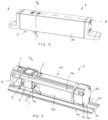
- the pivot hinge 1 further comprises a slidable reciprocating member 20 being arranged within the casing 2 and being movably mounted therein.
- the slidable reciprocating member 20 has a first end part 21 and a second end part 22 that are rigidly connected to one another.
- the slidable reciprocating member has a predetermined, fixed length L.
- the first end part 21 is coupled with the first cam follower 5, and the spring arrangement 30 is arranged between the second cam follower 6 and the second end part 22, such that the spring arrangement 30 urges both cam followers 5, 6 against the cam 4 .
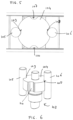
- Fig. 4A is shown an outward radial state of the cam followers 5, 6, that is the cam followers 5, 6 are urged outward by an outer local diameter of the cam 4 and the spring arrangement 30 is compressed by the second cam follower 6. Due to the rigid connection between the first end part 21 and the second end part 22, the outward radial movement of the first cam follower 5 leads to a sliding movement of the slidable reciprocating member 20, whilst the spring force of spring arrangement 30 is transferred from the second end part 22 to the first cam follower 5 so as to urge it against the cam 4.
- Fig. 4B is shown an inward radial state of the cam followers 5, 6, in which the spring arrangement 30 urges the followers 5, 6 against the cam at an inner local diameter which is smaller than the outer local diameter of the position of the cam 4 of Fig. 4A .
- the slidable reciprocating member 20 has one or more tension rods 23, 24 for connecting the first end part 21 and the second end part 22
- the slidable reciprocating member 20 has sliding faces 70 that are in sliding engagement with the casing 2.
- the casing 2 is provided with inner ribs 50 to slidably support the slidable reciprocating member 20.
- These inner ribs 50 may be provided on a lower part 2a of the casing 2 (e.g. shown in Fig. 2 and Fig. 7 ) and/or on an upper part 2a of the casing 2 (e.g. shown in Fig. 7 ).
- the slidable guide member 40 may have sliding faces that may be in sliding engagement with the tension rods 23, 24, 25 (a potential fourth tension rod to form a symmetric arrangement is not shown in the figures).
- the slidable guide member 40 has sliding faces 41 that are in sliding engagement with the casing 2, shown here for lower part 2a thereof.
- the sliding faces 41 of the slidable guide member 40 are aligned with the sliding faces 50 of the slidable reciprocating member 20 such that these faces are supported by the same inner ribs of the casing.
- the slidable guide member 40 is elongate and has a bore in which the spring arrangement 30 is received.
- the spring arrangement 30 here comprises a coil spring, for example two concentric coil springs.
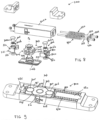
- Fig. 7 is schematically shown an exploded view of pivot hinge 1.
- Figs. 8-9 is shown another embodiment of a pivot hinge 300 according to the invention.
- the pivot hinge 300 has a pivot pin member 303 for pivotally connecting a pivotal door leaf with a structural element, the door leaf having an upper edge, lower edge, an inner side edge and an outer side edge, and the pivot pin member 303 defining a vertical pivot axis P A for the door leaf.
- the pivot hinge 300 comprises a casing 302 configured to be mounted to either the door leaf or the structural element, for example to the lower edge of the door leaf, the pivot pin member 303 being configured to be fixed to the other of the door leaf or the structural element.
- the casing comprises an upper part 302a and a lower part 302b.
- the spring arrangements 330, 430 are arranged side-by-side within the casing 302.
- the pivot hinge 300 further comprises a slidable reciprocating member being arranged within the casing 302 and being movably mounted therein.
- the slidable reciprocating member has a first end part 321 and a second end part 322 that are rigidly connected to one another.
- the slidable reciprocating member further has a third end part 422 that is rigidly connected to the first end part 321. As such the slidable reciprocating member has a predetermined, fixed length.
- the first end part 321 is coupled with the first cam follower 305
- the spring arrangement 330 is arranged between the second cam follower 306 and the second end part 322
- the spring arrangement 430 is arranged between the second cam follower 306 and the third end part 422, such that the spring arrangement 330 and/or spring arrangement 430 urge both cam followers 305, 306 against the cam 304 .
- the slidable reciprocating member has tension rod 324 for connecting the first end part 321 and the second end part 322, and the slidable reciprocating member has tension rod 323 for connecting the first end part 321 and the further end part 422
- the slidable reciprocating member has sliding faces, e.g. 370, that are in sliding engagement with the casing 302.
- the surfaces being in sliding engagement may be treated with a surface treatment, for example a friction reducing coating.
- the casing 302 may be provided with inner ribs 350 to slidably support the slidable reciprocating member. These inner ribs 350 may be provided on a lower part 302a of the casing 302 (e.g. shown in Fig. 8 ) and/or on an upper part 302a of the casing 2.
- the lower part 302a of the casing is provided with a recess, here demarcated between the ribs 350, so as to facilitate the sliding movement of the slidable reciprocating member.
- the slidable reciprocating member may be in sliding engagement with - i.e. direct contact with - the ribs 350 and/or the recess, or the slidable reciprocating member may slide in such a manner that there is no direct contact between the slidable reciprocating member and the ribs 350 and/or the recess.
- the pivot hinge 300 further comprises a slidable guide member 340 that is movably mounted within the slidable reciprocating member, the slidable guide member 340 being coupled with the second cam follower 306, and the spring arrangements 330, 340 being arranged between the slidable guide member 340 and the respective end parts 322, 422.
- first cam follower 305 is retained on the first end part 321, and the second cam follower 306 is retained on the slidable guide member 340.
- the slidable guide member 340 is elongate and has two bores in which the tension rods 323, 324 are received.
- Tension rods 323, 324 are received in a recess 304c between upper part 304a and lower part 304b of the cam 304.
- Block 385 is arranged at an end of the casing 302 on the same side of the pivot pin member 303 as first end part 321.
- Block 380 is arranged at the opposite end of the casing 302.
Landscapes
- Engineering & Computer Science (AREA)
- Mechanical Engineering (AREA)
- Closing And Opening Devices For Wings, And Checks For Wings (AREA)
Claims (12)
- Charnière à pivot (1 ; 300) comportant un élément formant pivot (3 ; 303) pour le raccordement à pivotement d'un vantail de porte pivotant à un élément structurel, le vantail de porte comportant un bord supérieur, un bord inférieur, un bord latéral intérieur et un bord latéral extérieur, et l'élément formant pivot définissant un axe de pivotement vertical pour le vantail de porte,l'élément formant pivot comportant une came, la charnière à pivot comprenant un premier suiveur de came sur un premier côté de l'élément formant pivot et un second suiveur de came sur un second côté de l'élément formant pivot opposé au premier côté, les suiveurs de came (5, 6 ; 305 ; 306) étant tous deux déplaçables dans une direction radiale relativement à la came,la charnière à pivot comprenant en outre :- un boîtier (2 ; 302) conçu pour être installé soit sur le vantail de porte, soit sur l'élément structurel, par exemple sur le bord inférieur du vantail de porte, l'élément formant pivot étant conçu pour être fixé à l'autre du vantail de porte et de l'élément structurel,- un dispositif de ressort (30 ; 430) propre à solliciter un suiveur de came contre la came,- un élément à mouvement alternatif coulissant disposé à l'intérieur du boîtier et étant installé de manière mobile dans celui-ci, l'élément à mouvement alternatif coulissant comportant une première partie d'extrémité (21 ; 321) et une seconde partie d'extrémité (22 ; 322) qui sont raccordées l'une à l'autre de manière rigide, la première partie d'extrémité étant accouplée avec le premier suiveur de came et le dispositif de ressort étant disposé entre le second suiveur de came et la seconde partie d'extrémité, de telle sorte que le dispositif de ressort sollicite les deux suiveurs de came contre la came,caractérisée en ce que la came comporte des paires de renfoncements (8, 9 ; 107, 108, 109, 110) disposés à angle droit l'un par rapport à l'autre, chaque paire de renfoncements étant conçue pour recevoir les deux suiveurs de came (5, 6 ; 305 ; 306) pour former des positions de retenue pour le vantail de porte dans des positions ouverte et fermée du vantail de porte, et le boîtier étant pourvu de nervures intérieures (50) destinées à supporter à coulissement l'élément à mouvement alternatif coulissant, lesdites nervures intérieures (50) étant formées sur une partie inférieure (2b ; 302b) du boîtier et/ou sur une partie supérieure (2a ; 302a) du boîtier.
- Charnière à pivot selon la revendication 1, la charnière à pivot comprenant, en outre, un élément de guidage coulissant (40 ; 340) qui est installé de manière mobile à l'intérieur de l'élément à mouvement alternatif coulissant, l'élément de guidage coulissant étant accouplé avec le second suiveur de came, et le dispositif de ressort étant disposé entre l'élément de guidage coulissant et la seconde partie d'extrémité.
- Charnière à pivot selon la revendication 2, l'élément de guidage coulissant (40 ; 340) étant allongé et comportant un orifice dans lequel le dispositif de ressort est reçu.
- Charnière à pivot selon la revendication 2 ou 3, l'élément à mouvement alternatif coulissant comportant des faces de coulissement (71) qui interagissent de manière coulissante avec le boîtier.
- Charnière à pivot selon l'une quelconque des revendications précédentes, le dispositif de ressort comprenant un ressort hélicoïdal, par exemple deux ressorts hélicoïdaux concentriques ou deux ressorts hélicoïdaux parallèles.
- Charnière à pivot selon l'une quelconque des revendications précédentes, l'élément à mouvement alternatif coulissant comportant une ou plusieurs tiges de tension (23, 24 ; 323, 324) destinées à raccorder la première partie d'extrémité et la seconde partie d'extrémité.
- Charnière à pivot selon la revendication 6, l'élément de guidage coulissant comportant des faces de coulissement (41) qui coopèrent de manière coulissante avec le boîtier et/ou comportant des faces de coulissement qui coopèrent de manière coulissante avec les tiges de tension.
- Charnière à pivot selon l'une quelconque des revendications précédentes, les suiveurs de came étant des galets de came.
- Vantail de porte pivotant pourvu d'une charnière à pivot selon l'une quelconque ou plusieurs des revendications précédentes.
- Vantail de porte pivotant selon la revendication 9, la charnière à pivot étant installée sur le bord inférieur du vantail de porte, par ex. dans une région d'angle entre le bord latéral intérieur et le bord inférieur du vantail de porte pivotant.
- Vantail de porte pivotant selon la revendication 10, la charnière à pivot étant installée de telle sorte que la charnière s'étende le long du bord inférieur du vantail de porte pivotant et que le premier suiveur de came soit situé à proximité du bord latéral intérieur du vantail de porte.
- Élément structurel et vantail de porte pivotant raccordé à l'élément structurel par le biais d'une charnière à pivot selon l'une quelconque ou plusieurs des revendications précédentes, le boîtier étant installé soit sur le vantail de porte, soit sur l'élément structurel, par exemple au niveau du bord inférieur du vantail de porte ou encastré dans un sol sous le bord inférieur du vantail de porte.
Priority Applications (7)
| Application Number | Priority Date | Filing Date | Title |
|---|---|---|---|
| PL22171124.5T PL4273360T3 (pl) | 2022-05-02 | 2022-05-02 | Zawias obrotowy i obrotowe skrzydło drzwiowe |
| ES22171124T ES3039264T3 (en) | 2022-05-02 | 2022-05-02 | Pivot hinge and pivotal door leaf |
| EP22171124.5A EP4273360B1 (fr) | 2022-05-02 | 2022-05-02 | Charnière pivotante et vantail de porte pivotant |
| PCT/EP2023/060109 WO2023213541A1 (fr) | 2022-05-02 | 2023-04-19 | Charnière à pivot et battant de porte pivotant |
| US18/856,893 US20250263961A1 (en) | 2022-05-02 | 2023-04-19 | A pivot hinge and pivotal door leaf |
| CN202380036886.2A CN119110869A (zh) | 2022-05-02 | 2023-04-19 | 枢轴铰链和枢转门扇 |
| AU2023264193A AU2023264193A1 (en) | 2022-05-02 | 2023-04-19 | A pivot hinge and pivotal door leaf. |
Applications Claiming Priority (1)
| Application Number | Priority Date | Filing Date | Title |
|---|---|---|---|
| EP22171124.5A EP4273360B1 (fr) | 2022-05-02 | 2022-05-02 | Charnière pivotante et vantail de porte pivotant |
Publications (3)
| Publication Number | Publication Date |
|---|---|
| EP4273360A1 EP4273360A1 (fr) | 2023-11-08 |
| EP4273360C0 EP4273360C0 (fr) | 2025-07-02 |
| EP4273360B1 true EP4273360B1 (fr) | 2025-07-02 |
Family
ID=81579503
Family Applications (1)
| Application Number | Title | Priority Date | Filing Date |
|---|---|---|---|
| EP22171124.5A Active EP4273360B1 (fr) | 2022-05-02 | 2022-05-02 | Charnière pivotante et vantail de porte pivotant |
Country Status (7)
| Country | Link |
|---|---|
| US (1) | US20250263961A1 (fr) |
| EP (1) | EP4273360B1 (fr) |
| CN (1) | CN119110869A (fr) |
| AU (1) | AU2023264193A1 (fr) |
| ES (1) | ES3039264T3 (fr) |
| PL (1) | PL4273360T3 (fr) |
| WO (1) | WO2023213541A1 (fr) |
Families Citing this family (1)
| Publication number | Priority date | Publication date | Assignee | Title |
|---|---|---|---|---|
| JP2024516036A (ja) * | 2021-05-06 | 2024-04-11 | コルコム グループ エス.アール.エル. | ドア、リーフなどの制御された回転移動のためのシステム |
Citations (2)
| Publication number | Priority date | Publication date | Assignee | Title |
|---|---|---|---|---|
| US8789240B2 (en) * | 2010-10-14 | 2014-07-29 | Estem B.V. | Hinge for a panel door, in particular for a cooling cupboard |
| EP3138985A1 (fr) * | 2015-09-02 | 2017-03-08 | Gretsch-Unitas GmbH Baubeschläge | Dispositif de fermeture d'un battant de porte |
Family Cites Families (11)
| Publication number | Priority date | Publication date | Assignee | Title |
|---|---|---|---|---|
| US3174177A (en) * | 1961-11-06 | 1965-03-23 | Erling P Bugge | Door closer |
| GB1174327A (en) | 1966-09-24 | 1969-12-17 | Zd Y Umelecke Kovovyroby Narod | Improvements in or relating to Door Closers. |
| DE3345004A1 (de) * | 1983-12-13 | 1985-06-13 | Dorma-Baubeschlag Gmbh & Co Kg, 5828 Ennepetal | Obentuerschliesser |
| DE4041824C1 (fr) * | 1990-12-24 | 1992-06-11 | Dorma Gmbh + Co. Kg, 5828 Ennepetal, De | |
| US5901412A (en) * | 1996-01-30 | 1999-05-11 | Dorma Gmbh + Co. Kg | Top-mounted door closer |
| KR200324642Y1 (ko) * | 2003-06-03 | 2003-08-25 | 박형태 | 플로어 힌지 |
| DE102010022051B4 (de) * | 2009-12-01 | 2026-05-13 | Dormakaba Deutschland Gmbh | Türschließer mit Magnetwegeventil |
| US20110197391A1 (en) * | 2010-02-12 | 2011-08-18 | Rick Yu | Automatic door closer structure |
| DE102015206151A1 (de) | 2015-04-07 | 2016-10-13 | Ford Global Technologies, Llc | Vorrichtung zur Energierückgewinnung an einem Verbrennungsmotor mit Abgasturbolader als Wärmequelle für einen Dampfkraftmaschinenkreislauf und Verfahren zum Betrieb der Vorrichtung |
| ES2865059T3 (es) * | 2019-01-16 | 2021-10-14 | Dormakaba Deutschland Gmbh | Accionador de puerta |
| CN221546714U (zh) * | 2023-12-11 | 2024-08-16 | 东莞力督门控设备有限公司 | 窄边框门用360度旋转凸轮液压闭门器 |
-
2022
- 2022-05-02 PL PL22171124.5T patent/PL4273360T3/pl unknown
- 2022-05-02 ES ES22171124T patent/ES3039264T3/es active Active
- 2022-05-02 EP EP22171124.5A patent/EP4273360B1/fr active Active
-
2023
- 2023-04-19 US US18/856,893 patent/US20250263961A1/en active Pending
- 2023-04-19 AU AU2023264193A patent/AU2023264193A1/en active Pending
- 2023-04-19 CN CN202380036886.2A patent/CN119110869A/zh active Pending
- 2023-04-19 WO PCT/EP2023/060109 patent/WO2023213541A1/fr not_active Ceased
Patent Citations (2)
| Publication number | Priority date | Publication date | Assignee | Title |
|---|---|---|---|---|
| US8789240B2 (en) * | 2010-10-14 | 2014-07-29 | Estem B.V. | Hinge for a panel door, in particular for a cooling cupboard |
| EP3138985A1 (fr) * | 2015-09-02 | 2017-03-08 | Gretsch-Unitas GmbH Baubeschläge | Dispositif de fermeture d'un battant de porte |
Also Published As
| Publication number | Publication date |
|---|---|
| US20250263961A1 (en) | 2025-08-21 |
| EP4273360C0 (fr) | 2025-07-02 |
| AU2023264193A1 (en) | 2024-10-24 |
| CN119110869A (zh) | 2024-12-10 |
| WO2023213541A1 (fr) | 2023-11-09 |
| EP4273360A1 (fr) | 2023-11-08 |
| ES3039264T3 (en) | 2025-10-20 |
| PL4273360T3 (pl) | 2025-11-12 |
Similar Documents
| Publication | Publication Date | Title |
|---|---|---|
| EP3259425B1 (fr) | Système de levage pour battants de porte de meuble | |
| JP6815018B2 (ja) | 摺動ドアのためのガイドデバイス | |
| EP3289157B9 (fr) | Charnière ralentie pour meuble | |
| CN108699872B (zh) | 用于家具的门扇的具有弹性打开部件的铰链 | |
| US11603693B2 (en) | Furniture hinge for upward-opening cabinet doors | |
| EP2315896B1 (fr) | Structure de porte avec charnieres a pivot a fermeture automatique integrees dans un panneau de porte | |
| US9422757B2 (en) | Hinge for the controlled rotatable movement of a door, in particular a glass door | |
| US20170370139A1 (en) | Compact hinge apparatus and method of use | |
| CN102292511A (zh) | 门用铰链装置 | |
| EP4273360A1 (fr) | Charnière pivotante et vantail de porte pivotant | |
| EP3662125A1 (fr) | Charnière dotée de dispositif d'ouverture pour meubles | |
| US20200115943A1 (en) | Hinge for the Rotatable Movement of a Door, a Shutter or the Like | |
| EP0794307A1 (fr) | Une charnière pour portes et fenêtres métalliques | |
| EP2872717B1 (fr) | Charnière pour le mouvement rotatif d'une porte en particulier porte renforcee | |
| US6000796A (en) | Slidably resilient hinge for eyeglass frames | |
| RU2019137202A (ru) | Механизм для перемещения мебельной дверцы | |
| JP7698588B2 (ja) | 固定支持構造体に閉鎖要素を固定するためのシステム | |
| EP3409868B1 (fr) | Charnière démontable | |
| KR100403161B1 (ko) | 힌지 | |
| EP3473791A1 (fr) | Charnière démontable avec deux coulisseaux | |
| WO2018002805A2 (fr) | Charnière pour le mouvement rotatif d'une porte ou d'un élément de fermeture similaire | |
| KR200483996Y1 (ko) | 가구 힌지용 어댑터 |
Legal Events
| Date | Code | Title | Description |
|---|---|---|---|
| PUAI | Public reference made under article 153(3) epc to a published international application that has entered the european phase |
Free format text: ORIGINAL CODE: 0009012 |
|
| STAA | Information on the status of an ep patent application or granted ep patent |
Free format text: STATUS: THE APPLICATION HAS BEEN PUBLISHED |
|
| AK | Designated contracting states |
Kind code of ref document: A1 Designated state(s): AL AT BE BG CH CY CZ DE DK EE ES FI FR GB GR HR HU IE IS IT LI LT LU LV MC MK MT NL NO PL PT RO RS SE SI SK SM TR |
|
| STAA | Information on the status of an ep patent application or granted ep patent |
Free format text: STATUS: REQUEST FOR EXAMINATION WAS MADE |
|
| 17P | Request for examination filed |
Effective date: 20240503 |
|
| RBV | Designated contracting states (corrected) |
Designated state(s): AL AT BE BG CH CY CZ DE DK EE ES FI FR GB GR HR HU IE IS IT LI LT LU LV MC MK MT NL NO PL PT RO RS SE SI SK SM TR |
|
| RIC1 | Information provided on ipc code assigned before grant |
Ipc: E05F 1/12 20060101ALN20241126BHEP Ipc: E05D 15/54 20060101ALI20241126BHEP Ipc: E05D 11/10 20060101ALI20241126BHEP Ipc: E05D 7/081 20060101AFI20241126BHEP |
|
| GRAP | Despatch of communication of intention to grant a patent |
Free format text: ORIGINAL CODE: EPIDOSNIGR1 |
|
| STAA | Information on the status of an ep patent application or granted ep patent |
Free format text: STATUS: GRANT OF PATENT IS INTENDED |
|
| RIC1 | Information provided on ipc code assigned before grant |
Ipc: E05F 1/12 20060101ALN20241219BHEP Ipc: E05D 15/54 20060101ALI20241219BHEP Ipc: E05D 11/10 20060101ALI20241219BHEP Ipc: E05D 7/081 20060101AFI20241219BHEP |
|
| INTG | Intention to grant announced |
Effective date: 20250108 |
|
| GRAS | Grant fee paid |
Free format text: ORIGINAL CODE: EPIDOSNIGR3 |
|
| GRAA | (expected) grant |
Free format text: ORIGINAL CODE: 0009210 |
|
| STAA | Information on the status of an ep patent application or granted ep patent |
Free format text: STATUS: THE PATENT HAS BEEN GRANTED |
|
| AK | Designated contracting states |
Kind code of ref document: B1 Designated state(s): AL AT BE BG CH CY CZ DE DK EE ES FI FR GB GR HR HU IE IS IT LI LT LU LV MC MK MT NL NO PL PT RO RS SE SI SK SM TR |
|
| REG | Reference to a national code |
Ref country code: GB Ref legal event code: FG4D |
|
| REG | Reference to a national code |
Ref country code: CH Ref legal event code: EP |
|
| REG | Reference to a national code |
Ref country code: DE Ref legal event code: R096 Ref document number: 602022016693 Country of ref document: DE |
|
| REG | Reference to a national code |
Ref country code: IE Ref legal event code: FG4D |
|
| U01 | Request for unitary effect filed |
Effective date: 20250704 |
|
| U07 | Unitary effect registered |
Designated state(s): AT BE BG DE DK EE FI FR IT LT LU LV MT NL PT RO SE SI Effective date: 20250711 |
|
| REG | Reference to a national code |
Ref country code: ES Ref legal event code: FG2A Ref document number: 3039264 Country of ref document: ES Kind code of ref document: T3 Effective date: 20251020 |
|
| REG | Reference to a national code |
Ref country code: GR Ref legal event code: EP Ref document number: 20250401976 Country of ref document: GR Effective date: 20251112 |
|
| PG25 | Lapsed in a contracting state [announced via postgrant information from national office to epo] |
Ref country code: IS Free format text: LAPSE BECAUSE OF FAILURE TO SUBMIT A TRANSLATION OF THE DESCRIPTION OR TO PAY THE FEE WITHIN THE PRESCRIBED TIME-LIMIT Effective date: 20251102 |
|
| PG25 | Lapsed in a contracting state [announced via postgrant information from national office to epo] |
Ref country code: NO Free format text: LAPSE BECAUSE OF FAILURE TO SUBMIT A TRANSLATION OF THE DESCRIPTION OR TO PAY THE FEE WITHIN THE PRESCRIBED TIME-LIMIT Effective date: 20251002 |
|
| PG25 | Lapsed in a contracting state [announced via postgrant information from national office to epo] |
Ref country code: HR Free format text: LAPSE BECAUSE OF FAILURE TO SUBMIT A TRANSLATION OF THE DESCRIPTION OR TO PAY THE FEE WITHIN THE PRESCRIBED TIME-LIMIT Effective date: 20250702 |
|
| PG25 | Lapsed in a contracting state [announced via postgrant information from national office to epo] |
Ref country code: CZ Free format text: LAPSE BECAUSE OF FAILURE TO SUBMIT A TRANSLATION OF THE DESCRIPTION OR TO PAY THE FEE WITHIN THE PRESCRIBED TIME-LIMIT Effective date: 20250702 |
|
| PG25 | Lapsed in a contracting state [announced via postgrant information from national office to epo] |
Ref country code: RS Free format text: LAPSE BECAUSE OF FAILURE TO SUBMIT A TRANSLATION OF THE DESCRIPTION OR TO PAY THE FEE WITHIN THE PRESCRIBED TIME-LIMIT Effective date: 20251002 |
|
| PG25 | Lapsed in a contracting state [announced via postgrant information from national office to epo] |
Ref country code: SM Free format text: LAPSE BECAUSE OF FAILURE TO SUBMIT A TRANSLATION OF THE DESCRIPTION OR TO PAY THE FEE WITHIN THE PRESCRIBED TIME-LIMIT Effective date: 20250702 |
|
| PG25 | Lapsed in a contracting state [announced via postgrant information from national office to epo] |
Ref country code: SK Free format text: LAPSE BECAUSE OF FAILURE TO SUBMIT A TRANSLATION OF THE DESCRIPTION OR TO PAY THE FEE WITHIN THE PRESCRIBED TIME-LIMIT Effective date: 20250702 |
|
| PLBE | No opposition filed within time limit |
Free format text: ORIGINAL CODE: 0009261 |
|
| STAA | Information on the status of an ep patent application or granted ep patent |
Free format text: STATUS: NO OPPOSITION FILED WITHIN TIME LIMIT |