EP4285871A2 - Prothèse pouvant être actionnée par une force extérieure - Google Patents
Prothèse pouvant être actionnée par une force extérieure Download PDFInfo
- Publication number
- EP4285871A2 EP4285871A2 EP23205304.1A EP23205304A EP4285871A2 EP 4285871 A2 EP4285871 A2 EP 4285871A2 EP 23205304 A EP23205304 A EP 23205304A EP 4285871 A2 EP4285871 A2 EP 4285871A2
- Authority
- EP
- European Patent Office
- Prior art keywords
- prosthesis
- control device
- operated
- microcontroller
- gripping process
- Prior art date
- Legal status (The legal status is an assumption and is not a legal conclusion. Google has not performed a legal analysis and makes no representation as to the accuracy of the status listed.)
- Granted
Links
Images

Classifications
-
- A—HUMAN NECESSITIES
- A61—MEDICAL OR VETERINARY SCIENCE; HYGIENE
- A61F—FILTERS IMPLANTABLE INTO BLOOD VESSELS; PROSTHESES; DEVICES PROVIDING PATENCY TO, OR PREVENTING COLLAPSING OF, TUBULAR STRUCTURES OF THE BODY, e.g. STENTS; ORTHOPAEDIC, NURSING OR CONTRACEPTIVE DEVICES; FOMENTATION; TREATMENT OR PROTECTION OF EYES OR EARS; BANDAGES, DRESSINGS OR ABSORBENT PADS; FIRST-AID KITS
- A61F2/00—Filters implantable into blood vessels; Prostheses, i.e. artificial substitutes or replacements for parts of the body; Appliances for connecting them with the body; Devices providing patency to, or preventing collapsing of, tubular structures of the body, e.g. stents
- A61F2/50—Prostheses not implantable in the body
- A61F2/68—Operating or control means
- A61F2/70—Operating or control means electrical
-
- A—HUMAN NECESSITIES
- A61—MEDICAL OR VETERINARY SCIENCE; HYGIENE
- A61F—FILTERS IMPLANTABLE INTO BLOOD VESSELS; PROSTHESES; DEVICES PROVIDING PATENCY TO, OR PREVENTING COLLAPSING OF, TUBULAR STRUCTURES OF THE BODY, e.g. STENTS; ORTHOPAEDIC, NURSING OR CONTRACEPTIVE DEVICES; FOMENTATION; TREATMENT OR PROTECTION OF EYES OR EARS; BANDAGES, DRESSINGS OR ABSORBENT PADS; FIRST-AID KITS
- A61F2/00—Filters implantable into blood vessels; Prostheses, i.e. artificial substitutes or replacements for parts of the body; Appliances for connecting them with the body; Devices providing patency to, or preventing collapsing of, tubular structures of the body, e.g. stents
- A61F2/50—Prostheses not implantable in the body
- A61F2/54—Artificial arms or hands or parts thereof
- A61F2/58—Elbows; Wrists ; Other joints; Hands
- A61F2/583—Hands; Wrist joints
-
- A—HUMAN NECESSITIES
- A61—MEDICAL OR VETERINARY SCIENCE; HYGIENE
- A61F—FILTERS IMPLANTABLE INTO BLOOD VESSELS; PROSTHESES; DEVICES PROVIDING PATENCY TO, OR PREVENTING COLLAPSING OF, TUBULAR STRUCTURES OF THE BODY, e.g. STENTS; ORTHOPAEDIC, NURSING OR CONTRACEPTIVE DEVICES; FOMENTATION; TREATMENT OR PROTECTION OF EYES OR EARS; BANDAGES, DRESSINGS OR ABSORBENT PADS; FIRST-AID KITS
- A61F2/00—Filters implantable into blood vessels; Prostheses, i.e. artificial substitutes or replacements for parts of the body; Appliances for connecting them with the body; Devices providing patency to, or preventing collapsing of, tubular structures of the body, e.g. stents
- A61F2/50—Prostheses not implantable in the body
- A61F2/54—Artificial arms or hands or parts thereof
- A61F2/58—Elbows; Wrists ; Other joints; Hands
- A61F2/583—Hands; Wrist joints
- A61F2/586—Fingers
-
- A—HUMAN NECESSITIES
- A61—MEDICAL OR VETERINARY SCIENCE; HYGIENE
- A61F—FILTERS IMPLANTABLE INTO BLOOD VESSELS; PROSTHESES; DEVICES PROVIDING PATENCY TO, OR PREVENTING COLLAPSING OF, TUBULAR STRUCTURES OF THE BODY, e.g. STENTS; ORTHOPAEDIC, NURSING OR CONTRACEPTIVE DEVICES; FOMENTATION; TREATMENT OR PROTECTION OF EYES OR EARS; BANDAGES, DRESSINGS OR ABSORBENT PADS; FIRST-AID KITS
- A61F2/00—Filters implantable into blood vessels; Prostheses, i.e. artificial substitutes or replacements for parts of the body; Appliances for connecting them with the body; Devices providing patency to, or preventing collapsing of, tubular structures of the body, e.g. stents
- A61F2/50—Prostheses not implantable in the body
- A61F2/68—Operating or control means
- A61F2/70—Operating or control means electrical
- A61F2/72—Bioelectric control, e.g. myoelectric
-
- A—HUMAN NECESSITIES
- A61—MEDICAL OR VETERINARY SCIENCE; HYGIENE
- A61F—FILTERS IMPLANTABLE INTO BLOOD VESSELS; PROSTHESES; DEVICES PROVIDING PATENCY TO, OR PREVENTING COLLAPSING OF, TUBULAR STRUCTURES OF THE BODY, e.g. STENTS; ORTHOPAEDIC, NURSING OR CONTRACEPTIVE DEVICES; FOMENTATION; TREATMENT OR PROTECTION OF EYES OR EARS; BANDAGES, DRESSINGS OR ABSORBENT PADS; FIRST-AID KITS
- A61F2/00—Filters implantable into blood vessels; Prostheses, i.e. artificial substitutes or replacements for parts of the body; Appliances for connecting them with the body; Devices providing patency to, or preventing collapsing of, tubular structures of the body, e.g. stents
- A61F2/50—Prostheses not implantable in the body
- A61F2/78—Means for protecting prostheses or for attaching them to the body, e.g. bandages, harnesses, straps, or stockings for the limb stump
- A61F2/80—Sockets, e.g. of suction type
-
- A—HUMAN NECESSITIES
- A61—MEDICAL OR VETERINARY SCIENCE; HYGIENE
- A61F—FILTERS IMPLANTABLE INTO BLOOD VESSELS; PROSTHESES; DEVICES PROVIDING PATENCY TO, OR PREVENTING COLLAPSING OF, TUBULAR STRUCTURES OF THE BODY, e.g. STENTS; ORTHOPAEDIC, NURSING OR CONTRACEPTIVE DEVICES; FOMENTATION; TREATMENT OR PROTECTION OF EYES OR EARS; BANDAGES, DRESSINGS OR ABSORBENT PADS; FIRST-AID KITS
- A61F2/00—Filters implantable into blood vessels; Prostheses, i.e. artificial substitutes or replacements for parts of the body; Appliances for connecting them with the body; Devices providing patency to, or preventing collapsing of, tubular structures of the body, e.g. stents
- A61F2/50—Prostheses not implantable in the body
- A61F2/68—Operating or control means
- A61F2002/6881—Operating or control means optical
-
- A—HUMAN NECESSITIES
- A61—MEDICAL OR VETERINARY SCIENCE; HYGIENE
- A61F—FILTERS IMPLANTABLE INTO BLOOD VESSELS; PROSTHESES; DEVICES PROVIDING PATENCY TO, OR PREVENTING COLLAPSING OF, TUBULAR STRUCTURES OF THE BODY, e.g. STENTS; ORTHOPAEDIC, NURSING OR CONTRACEPTIVE DEVICES; FOMENTATION; TREATMENT OR PROTECTION OF EYES OR EARS; BANDAGES, DRESSINGS OR ABSORBENT PADS; FIRST-AID KITS
- A61F2/00—Filters implantable into blood vessels; Prostheses, i.e. artificial substitutes or replacements for parts of the body; Appliances for connecting them with the body; Devices providing patency to, or preventing collapsing of, tubular structures of the body, e.g. stents
- A61F2/50—Prostheses not implantable in the body
- A61F2/68—Operating or control means
- A61F2002/689—Alarm means, e.g. acoustic
-
- A—HUMAN NECESSITIES
- A61—MEDICAL OR VETERINARY SCIENCE; HYGIENE
- A61F—FILTERS IMPLANTABLE INTO BLOOD VESSELS; PROSTHESES; DEVICES PROVIDING PATENCY TO, OR PREVENTING COLLAPSING OF, TUBULAR STRUCTURES OF THE BODY, e.g. STENTS; ORTHOPAEDIC, NURSING OR CONTRACEPTIVE DEVICES; FOMENTATION; TREATMENT OR PROTECTION OF EYES OR EARS; BANDAGES, DRESSINGS OR ABSORBENT PADS; FIRST-AID KITS
- A61F2/00—Filters implantable into blood vessels; Prostheses, i.e. artificial substitutes or replacements for parts of the body; Appliances for connecting them with the body; Devices providing patency to, or preventing collapsing of, tubular structures of the body, e.g. stents
- A61F2/50—Prostheses not implantable in the body
- A61F2/68—Operating or control means
- A61F2/70—Operating or control means electrical
- A61F2002/704—Operating or control means electrical computer-controlled, e.g. robotic control
-
- A—HUMAN NECESSITIES
- A61—MEDICAL OR VETERINARY SCIENCE; HYGIENE
- A61F—FILTERS IMPLANTABLE INTO BLOOD VESSELS; PROSTHESES; DEVICES PROVIDING PATENCY TO, OR PREVENTING COLLAPSING OF, TUBULAR STRUCTURES OF THE BODY, e.g. STENTS; ORTHOPAEDIC, NURSING OR CONTRACEPTIVE DEVICES; FOMENTATION; TREATMENT OR PROTECTION OF EYES OR EARS; BANDAGES, DRESSINGS OR ABSORBENT PADS; FIRST-AID KITS
- A61F2/00—Filters implantable into blood vessels; Prostheses, i.e. artificial substitutes or replacements for parts of the body; Appliances for connecting them with the body; Devices providing patency to, or preventing collapsing of, tubular structures of the body, e.g. stents
- A61F2/50—Prostheses not implantable in the body
- A61F2/68—Operating or control means
- A61F2/70—Operating or control means electrical
- A61F2002/705—Electromagnetic data transfer
-
- A—HUMAN NECESSITIES
- A61—MEDICAL OR VETERINARY SCIENCE; HYGIENE
- A61F—FILTERS IMPLANTABLE INTO BLOOD VESSELS; PROSTHESES; DEVICES PROVIDING PATENCY TO, OR PREVENTING COLLAPSING OF, TUBULAR STRUCTURES OF THE BODY, e.g. STENTS; ORTHOPAEDIC, NURSING OR CONTRACEPTIVE DEVICES; FOMENTATION; TREATMENT OR PROTECTION OF EYES OR EARS; BANDAGES, DRESSINGS OR ABSORBENT PADS; FIRST-AID KITS
- A61F2/00—Filters implantable into blood vessels; Prostheses, i.e. artificial substitutes or replacements for parts of the body; Appliances for connecting them with the body; Devices providing patency to, or preventing collapsing of, tubular structures of the body, e.g. stents
- A61F2/50—Prostheses not implantable in the body
- A61F2/76—Means for assembling, fitting or testing prostheses, e.g. for measuring or balancing, e.g. alignment means
- A61F2002/7615—Measuring means
- A61F2002/7635—Measuring means for measuring force, pressure or mechanical tension
-
- A—HUMAN NECESSITIES
- A61—MEDICAL OR VETERINARY SCIENCE; HYGIENE
- A61F—FILTERS IMPLANTABLE INTO BLOOD VESSELS; PROSTHESES; DEVICES PROVIDING PATENCY TO, OR PREVENTING COLLAPSING OF, TUBULAR STRUCTURES OF THE BODY, e.g. STENTS; ORTHOPAEDIC, NURSING OR CONTRACEPTIVE DEVICES; FOMENTATION; TREATMENT OR PROTECTION OF EYES OR EARS; BANDAGES, DRESSINGS OR ABSORBENT PADS; FIRST-AID KITS
- A61F2/00—Filters implantable into blood vessels; Prostheses, i.e. artificial substitutes or replacements for parts of the body; Appliances for connecting them with the body; Devices providing patency to, or preventing collapsing of, tubular structures of the body, e.g. stents
- A61F2/50—Prostheses not implantable in the body
- A61F2/76—Means for assembling, fitting or testing prostheses, e.g. for measuring or balancing, e.g. alignment means
- A61F2002/7615—Measuring means
- A61F2002/769—Displaying measured values
-
- B—PERFORMING OPERATIONS; TRANSPORTING
- B25—HAND TOOLS; PORTABLE POWER-DRIVEN TOOLS; MANIPULATORS
- B25J—MANIPULATORS; CHAMBERS PROVIDED WITH MANIPULATION DEVICES
- B25J13/00—Controls for manipulators
Definitions
- the present invention describes a prosthesis that can be actuated by external force, comprising a prosthesis shaft and an exoprosthesis with at least one prosthesis motor that can be actuated by means of a prosthesis control device and a joint, the prosthesis control device comprising a housing, a microcontroller arranged therein and display means, so that a gripping process is carried out by the prosthesis motor that can be controlled by the prosthesis control device can be replicated and parameters of the gripping process can be displayed by the display means, with the recording and evaluation of electromyography signals being dispensed with.
- prostheses are in demand, comprising a prosthetic shaft with an exoprosthesis in the form of a hand or foot prosthesis, which are operated by external power.
- a prosthesis control device is connected to the exoprosthesis, by means of which at least one prosthesis motor is controlled so that at least one joint on the exoprosthesis can be moved.
- the movement of at least one finger joint is simulated, making a gripping movement possible.
- EMG electromyography
- the at least one prosthesis motor of the exoprosthesis is controlled by means of surface electrodes on the skin in the area of the limb stump of a prosthesis wearer.
- the muscle signals that can be picked up along the prosthesis shaft are recorded by the prosthesis control device using sensors and converted into movements of the exoprosthesis.
- WO2013038187 describes a method for controlling an EMG prosthesis, which allows the prosthesis wearer to train prosthesis movements even if the prosthesis is not ready for use.
- the exoprosthesis can either be moved or movements can be simulated in a computer, with the prosthesis wearer being able to train real movements using the latter.
- the prosthesis wearer can start predefined programs, for example for different gripping processes, using the correct muscle signals via computer and thus execute them through the exoprosthesis.
- gripping programs can run with computer support. However, this is associated with correspondingly increased technical effort.
- a prosthesis wearer can only have the stored programs carried out by the prosthesis, controlled by their EMG signals, which is not very flexible.
- the sensors, actuators and electronics for controlling the prostheses described are cost-intensive and very complex.
- the present invention has the task of creating a simple and cost-effective prosthesis that can be operated by external power, which can be operated without extensive training and requires few components.
- This prosthesis enables reproducible, non-destructive and safe gripping controlled by external force Objects of different hardness can be achieved, without the evaluation of electromyography signals and grip force sensors.
- the prosthesis control device of the prosthesis can be manipulated from the outside by a prosthesis wearer before and during the gripping movement, the grip force and the grip duration being easily and reliably adjusted by the prosthesis wearer and also being adjustable in real time by the prosthesis wearer during the gripping movement .
- the set grip strength and grip duration are transmitted to the prosthesis wearer optically, tactilely and/or acoustically.
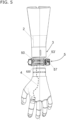
- an external force-controlled prosthesis 1 comprising a prosthesis shaft 2, a coupling 3, an exoprosthesis 4 and a prosthesis control device 5 is shown and explained using the example of a hand prosthesis.
- the prosthesis shaft 2 is placed over an extremity stump 0 in the form of a forearm stump 0, indicated by dashed lines, and is releasably fastened.
- the hand prosthesis 4 is connected to the prosthesis shaft 2 by means of the coupling 3.
- a prosthesis motor is not shown here, but is designed in such a way that it can be controlled by the prosthesis control device 5, thereby forming a gripping process.
- the prosthesis control device 5 has a housing 50.
- the housing 50 is attached to a bracelet 51, which is placed around the prosthesis shaft 2, so that the prosthesis control device 5 is in the form of a wristwatch ( Fig. 1a ) or a sports armband ( Fig. 1b ) can be trained.
- the prosthesis control device 5 is attached to the outer surface of the prosthesis shaft 2 and is therefore spaced from the skin of the prosthesis wearer. This is easily possible since no myoelectric signals are recorded by the prosthesis control device 5.
- the prosthesis control device 5 and the housing 50 have input means 52 and display means 53.
- the input means 52 can also consist of virtual input buttons arranged on a user interface 520.
- the user interface 520 of the prosthesis control device 5 is from an outer surface Exoprosthesis 4, the prosthesis shaft 2 or the coupling 3 are arranged to project away and are therefore easily accessible.
- All input means 52 can be operated mechanically by a prosthesis wearer manually, i.e. with a finger. The operation is preferably carried out with at least one finger of the intact hand, but could also be operated using an aid held in the intact hand.
- a screen is designed as a display means 53 with a display area, while the input means 52 are buttons next to the screen 53.
- the prosthesis control device 5 enables the current grip force and the grip duration to be displayed on the screen 53, so that a prosthesis wearer can easily read the parameters with which the next gripping movement will take place.
- the display means 53 can be used to visually track how the gripping movement will or is taking place.
- the prosthesis control device 5 on the prosthesis shaft 2, as in Figure 1b shown, has a housing 50 with a bracelet 51 in the form of a sports bracelet or fitness bracelet.
- the prosthesis wearer can enter parameters into the prosthesis control device 5 via buttons 52, which can also be designed as capacitive or resistive switches 52 or pressure elements.
- Selection keys 521 are provided as input means 52, with which a mode or a parameter to be set can be set.
- size selection buttons 522 are provided.
- the display means 53 used here can be LEDs. The number of illuminated LEDs or the color of the illuminated LEDs can visually display the set parameters, such as grip strength or grip duration.
- the prosthesis control device 5 is integrated into the exoprosthesis 4, so that a prosthesis wearer can set the parameters and read the values directly on the hand prosthesis 4.
- the housing 50 is correspondingly integrated into the exoprosthesis 4 or a part of the hand prosthesis 4 forms the housing 50 of the prosthesis control device 5.
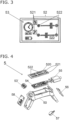
- the display means 53 can also be designed as a touch-sensitive screen, as in Figure 3 shown.
- An operating software (firmware) or application (app) is preferably operated on the prosthesis control device 5, which controls and displays the display means 53 and the input means 52.
- a user interface 520 is provided on the touch-sensitive screen as an input means 52.
- the user interface 520 here includes input means 52 in the form of virtual selection buttons 521 and virtual size selection buttons 522 in the form of sliders.
- the prosthesis control device 5 preferably comprises a single-board computer, for example an iOS board or a Raspberry Pi
- the prosthesis control device 5 can, in addition to controlling the exoprosthesis, also be used to operate other apps, as is known from smartphones and smartwatches. This means that, in addition to controlling the power-operated prosthesis, a prosthesis wearer can run apps for music or video playback, gaming applications, messaging or even making phone calls. Natural is a multi-process operation important, with the prosthesis control always taking priority over the other functions.
- a prosthesis control device 5 is shown in detail Figure 4 shown.
- a microcontroller 54 is stored in the housing 50 as the heart of the prosthesis control device 5, connected to a power supply 55.
- the power supply 55 is in the form of a rechargeable battery or one or more button batteries.
- a user interface 520 represents the input means 52 and LEDs 53' represent the display means 53. After parameters have been entered via the microcontroller 54, the currently set parameters are displayed optically by means of the LEDs 53'.
- a haptic motor driver 56 and a vibration motor 57 is also connected to the microcontroller 54 . Triggered by the microcontroller 54, the vibration motor 57 carries out vibrations that the prosthesis wearer can feel when the prosthesis control device 5 is arranged on the prosthesis shaft 2 or directly on the hand prosthesis 4.
- the haptic motor driver 56 in conjunction with the vibration motor 57 enables the prosthesis wearer to detect the grip contact of the hand prosthesis 4 through vibrations.
- the aim is to communicate the set parameters to the prosthesis wearer in a tactile manner, whereby a vibration can occur as soon as the grip movement has taken place with the set grip force or when an object has been gripped.
- the user interface 520 is designed here as a touch-sensitive PCB component (printed circuit board), with input taking place on touch-sensitive surfaces (touch pads). Selected parameters can be increased or decreased on the size selection buttons 522, shown as arrow-shaped areas. The parameters to be set can be varied using selection buttons 521. The one on the Values entered on the user interface 520 are forwarded to the microcontroller for further processing.
- an acceleration sensor 58 can be integrated into the prosthesis control device 5, which is also connected to the microcontroller 54.
- the acceleration sensor 58 can be used to register the movements and accelerations of the prosthesis control device 5 carried on the prosthesis shaft 2 and/or the exoprosthesis 4.
- the prosthesis control device 5 controls a gripping process using a microcontroller 54 on which operating software runs. Parameters are transmitted from the user interface 520 to the microcontroller 54 by input means 52, processed by the microcontroller 54 and displayed with the display means 53. Controlled by the microcontroller 54, the prosthesis motor movement is controlled as set. Even during the gripping process, the parameters can be readjusted in real time by the prosthesis wearer using input means 52.
- the power supply 55 is arranged in the prosthesis shaft 2, on the exoprosthesis 4, but could also be stored elsewhere on the body of the prosthesis wearer, for example in a trouser pocket.
- the prosthesis control device 5 can be arranged to at least partially cover the coupling 3 between the prosthesis shaft 2 and the exoprosthesis 4.
- What is sketched here is a connection from the prosthesis control device 5 to at least one finger joint of the hand prosthesis 4, which can be moved by the prosthesis control device 5.
- a prosthetic motor that can carry out the handle movement is indicated by dashed lines.
- the connection between prosthesis control device 5 and Hand prosthesis 4 or the at least one prosthesis motor can be done via a cable or wirelessly, for example via Bluetooth.
- the at least one prosthesis motor is controlled by the prosthesis control device 5 after entering the parameters, in particular the grip duration and the grip force.
- the at least one prosthesis motor is operated in a controlled manner by the microcontroller 54, and the parameters can also be changed in real time during the gripping process.
- the described prosthesis control device 5 is used to control and display the grip force or the grip duration of hand prostheses 4 operated by external power.
- the prosthesis wearer will manually set the grip force to be achieved and possibly a grip duration using the at least one prosthesis motor on the user interface 520.
- This setting is done with a finger of the intact hand, with the parameters being selected using selection buttons 521 and the size being defined using size selection buttons 522.
- the display means 53 indicate to the prosthesis wearer whether the desired settings have been made.
- the settings are passed from the input means 52 to the microcontroller 54, which subsequently controls the output means 53 and the movement of the hand prosthesis 4.
- the desired movement begins, which can be triggered, for example, by a defined position of the hand prosthesis 4 relative to the prosthesis shaft 2.
- the prosthesis wearer tracks the movement themselves, but also receives tactile feedback, for example about the beginning and end of the gripping movement using vibrations.
- the display means 53 also visually display the movement parameters and/or the course of the movement.
- the control of the at least one prosthesis motor based on the previously entered parameters is triggered and controlled by the microcontroller 54.
- the prosthesis wearer realizes that the gripping movement does not correspond to his wishes, he has the option of changing the parameters in real time via the user interface 520 while the hand prosthesis 4 is moving.
- the prosthesis wearer can also change the parameters manually.
- Adapted target values for example the grip force, are transmitted to the microcontroller 54.
- the microcontroller 54 controls the at least one prosthesis motor in a modified form. For example, an infinite period of time or a specific time voltage less than infinity can be considered as the grip duration. Due to the possibility of subsequently changing the parameters, the gripping movement can be ended at any time, with the prosthesis motor releasing the grip and opening the joint.
- the prosthesis wearer can freely specify the grip strength of the hand prosthesis 4 at any time via an externally portable module.
- start parameters can be specified by the prosthesis wearer before triggering. If it is recognized during the gripping movement that the grip force is too high because the objects to be gripped are softer than expected, the grip force can easily be readjusted. In this way, destruction of the grasped object can be ruled out.
- the tactile feedback using the vibration motor 57 can, for example, indicate when the object to be gripped is touched, gripped and released again. This means that the gripping process can be approximated to natural gripping.
- the parameters or feedback signals set on the prosthesis control device 5 during movement can also be transmitted in the form of acoustic feedback instead of optical and haptic signals. Accordingly, at least one loudspeaker and an acoustic module must be connected to the microcontroller 54, from which acoustic feedback signals can be transmitted to the prosthesis wearer.
- the software operated on the microcontroller 54 can, for example, acoustically report the set grip force or the successful completion of a gripping movement.
- the prosthesis control device 5 can be designed in several parts, with the input means 52 and the display means 53 not being arranged at the location of the housing 50, but rather being spatially separated from one another.
- the input means 52 can be designed in the form of the acoustic module connected to the microcontroller 54, with voice commands received by the acoustic module being used to input the desired grip force and/or grip duration on the microcontroller 54 of the prosthesis control device 5.
- the prosthesis wearer speaks directly into the prosthesis control device 5 or the acoustic module before carrying out a gripping process and reports the gripping force and/or gripping duration.
- the understood voice command is then displayed by the display means 53 and the handle can be carried out. This would result in a correspondingly voice-controlled prosthesis 1.
- the prosthesis control device 5 or the housing 50 is worn as part of the prosthesis 1 on the limb stump 0, the prosthesis control device can also be worn on the healthy or intact hand. The operation then takes place, for example, with a prosthetic finger if the input means 52 are designed in the form of manually operated buttons.
Landscapes
- Health & Medical Sciences (AREA)
- Transplantation (AREA)
- Orthopedic Medicine & Surgery (AREA)
- Heart & Thoracic Surgery (AREA)
- Engineering & Computer Science (AREA)
- Biomedical Technology (AREA)
- Oral & Maxillofacial Surgery (AREA)
- Vascular Medicine (AREA)
- Life Sciences & Earth Sciences (AREA)
- Animal Behavior & Ethology (AREA)
- General Health & Medical Sciences (AREA)
- Public Health (AREA)
- Veterinary Medicine (AREA)
- Cardiology (AREA)
- Prostheses (AREA)
Applications Claiming Priority (3)
| Application Number | Priority Date | Filing Date | Title |
|---|---|---|---|
| CH01252/16A CH712952A1 (de) | 2016-09-26 | 2016-09-26 | Fremdkraftbetätigbare Prothese. |
| PCT/EP2017/073730 WO2018054945A1 (fr) | 2016-09-26 | 2017-09-20 | Prothèse pouvant être actionnée par une force extérieure |
| EP17781019.9A EP3515371B1 (fr) | 2016-09-26 | 2017-09-20 | Prothèse pouvant être actionnée par une force extérieure |
Related Parent Applications (1)
| Application Number | Title | Priority Date | Filing Date |
|---|---|---|---|
| EP17781019.9A Division EP3515371B1 (fr) | 2016-09-26 | 2017-09-20 | Prothèse pouvant être actionnée par une force extérieure |
Publications (3)
| Publication Number | Publication Date |
|---|---|
| EP4285871A2 true EP4285871A2 (fr) | 2023-12-06 |
| EP4285871A3 EP4285871A3 (fr) | 2024-02-21 |
| EP4285871B1 EP4285871B1 (fr) | 2026-04-01 |
Family
ID=57582999
Family Applications (2)
| Application Number | Title | Priority Date | Filing Date |
|---|---|---|---|
| EP17781019.9A Active EP3515371B1 (fr) | 2016-09-26 | 2017-09-20 | Prothèse pouvant être actionnée par une force extérieure |
| EP23205304.1A Active EP4285871B1 (fr) | 2016-09-26 | 2017-09-20 | Prothèse pouvant être actionnée par une force extérieure |
Family Applications Before (1)
| Application Number | Title | Priority Date | Filing Date |
|---|---|---|---|
| EP17781019.9A Active EP3515371B1 (fr) | 2016-09-26 | 2017-09-20 | Prothèse pouvant être actionnée par une force extérieure |
Country Status (4)
| Country | Link |
|---|---|
| US (1) | US11065133B2 (fr) |
| EP (2) | EP3515371B1 (fr) |
| CH (1) | CH712952A1 (fr) |
| WO (1) | WO2018054945A1 (fr) |
Families Citing this family (15)
| Publication number | Priority date | Publication date | Assignee | Title |
|---|---|---|---|---|
| GB201114264D0 (en) | 2011-08-18 | 2011-10-05 | Touch Emas Ltd | Improvements in or relating to prosthetics and orthotics |
| GB201302025D0 (en) | 2013-02-05 | 2013-03-20 | Touch Emas Ltd | Improvements in or relating to prosthetics |
| WO2015120083A1 (fr) | 2014-02-04 | 2015-08-13 | Rehabilitation Institute Of Chicago | Composants modulaires et légers de prothèse myoélectrique et procédés correspondants |
| GB201403265D0 (en) | 2014-02-25 | 2014-04-09 | Touch Emas Ltd | Prosthetic digit for use with touchscreen devices |
| GB201408253D0 (en) | 2014-05-09 | 2014-06-25 | Touch Emas Ltd | Systems and methods for controlling a prosthetic hand |
| US11185426B2 (en) | 2016-09-02 | 2021-11-30 | Touch Bionics Limited | Systems and methods for prosthetic wrist rotation |
| US10973660B2 (en) | 2017-12-15 | 2021-04-13 | Touch Bionics Limited | Powered prosthetic thumb |
| US11547581B2 (en) | 2018-12-20 | 2023-01-10 | Touch Bionics Limited | Energy conservation of a motor-driven digit |
| EP4403142B1 (fr) | 2019-04-10 | 2025-06-25 | Touch Bionics Limited | Doigt prothétique à liaisons articulées |
| WO2021053557A1 (fr) | 2019-09-18 | 2021-03-25 | Touch Bionics Limited | Doigts prothétiques et actionneurs |
| US11931270B2 (en) | 2019-11-15 | 2024-03-19 | Touch Bionics Limited | Prosthetic digit actuator |
| US12115087B2 (en) | 2020-11-03 | 2024-10-15 | Touch Bionics Limited | Sensor for prosthetic control |
| WO2023278459A1 (fr) * | 2021-06-28 | 2023-01-05 | Alt-Bionics, Inc. | Système de main prothétique modulaire |
| DE102022103275B3 (de) | 2022-02-11 | 2023-03-23 | Deutsches Zentrum für Luft- und Raumfahrt e.V. | Verfahren zum Steuern eines Roboters |
| WO2025068828A1 (fr) * | 2023-09-25 | 2025-04-03 | Università Di Pisa | Dispositif de rétroaction prothétique amélioré |
Citations (1)
| Publication number | Priority date | Publication date | Assignee | Title |
|---|---|---|---|---|
| WO2013038187A1 (fr) | 2011-09-16 | 2013-03-21 | Touch Emas Limited | Procédé et appareil de commande d'un dispositif prothétique |
Family Cites Families (10)
| Publication number | Priority date | Publication date | Assignee | Title |
|---|---|---|---|---|
| US5413611A (en) * | 1992-07-21 | 1995-05-09 | Mcp Services, Inc. | Computerized electronic prosthesis apparatus and method |
| SE512643C2 (sv) * | 1997-04-29 | 2000-04-17 | Handevelop Ab | Anordning för artificiell känsel medelst registrering av beröringsljud |
| US8449624B2 (en) * | 2007-02-06 | 2013-05-28 | Deka Products Limited Partnership | Arm prosthetic device |
| DE102007035965B4 (de) * | 2007-07-30 | 2016-08-11 | Otto Bock Healthcare Products Gmbh | Prothetische Greifeinheit |
| EP2467102B1 (fr) * | 2009-08-20 | 2017-03-01 | Vanderbilt University | Dispositifs mécaniques articulés |
| CN101849865A (zh) * | 2010-06-08 | 2010-10-06 | 上海科生假肢有限公司 | 假肢状态智能监控显示装置 |
| US20140277588A1 (en) * | 2013-03-15 | 2014-09-18 | Eli Robert Patt | System and method for providing a prosthetic device with non-tactile sensory feedback |
| US9815206B2 (en) * | 2014-09-25 | 2017-11-14 | The Johns Hopkins University | Surgical system user interface using cooperatively-controlled robot |
| CA2934405A1 (fr) * | 2015-06-26 | 2016-12-26 | Nikolai Dechev | Prothese de membre superieur a mouvement entraine par le corps, personnalisee, fabriquee par impression 3d |
| US10369024B2 (en) * | 2016-09-02 | 2019-08-06 | Touch Bionics Limited | Systems and methods for prosthetic wrist rotation |
-
2016
- 2016-09-26 CH CH01252/16A patent/CH712952A1/de not_active Application Discontinuation
-
2017
- 2017-09-20 WO PCT/EP2017/073730 patent/WO2018054945A1/fr not_active Ceased
- 2017-09-20 EP EP17781019.9A patent/EP3515371B1/fr active Active
- 2017-09-20 US US16/336,156 patent/US11065133B2/en active Active
- 2017-09-20 EP EP23205304.1A patent/EP4285871B1/fr active Active
Patent Citations (1)
| Publication number | Priority date | Publication date | Assignee | Title |
|---|---|---|---|---|
| WO2013038187A1 (fr) | 2011-09-16 | 2013-03-21 | Touch Emas Limited | Procédé et appareil de commande d'un dispositif prothétique |
Also Published As
| Publication number | Publication date |
|---|---|
| EP3515371B1 (fr) | 2023-10-25 |
| CH712952A1 (de) | 2018-03-29 |
| US20190240047A1 (en) | 2019-08-08 |
| EP4285871A3 (fr) | 2024-02-21 |
| US11065133B2 (en) | 2021-07-20 |
| EP3515371A1 (fr) | 2019-07-31 |
| EP4285871B1 (fr) | 2026-04-01 |
| WO2018054945A1 (fr) | 2018-03-29 |
Similar Documents
| Publication | Publication Date | Title |
|---|---|---|
| EP3515371B1 (fr) | Prothèse pouvant être actionnée par une force extérieure | |
| CN108351701B (zh) | 辅助技术控制系统及相关方法 | |
| DE102015012959B4 (de) | Robotersystem und Verfahren zur Steuerung eines Robotersystems | |
| DE102014106960A1 (de) | Verfahren zur Darstellung einer virtuellen Interaktion auf zumindest einem Bildschirm und Eingabevorrichtung, System und Verfahren für eine virtuelle Anwendung mittels einer Recheneinheit | |
| DE112014005880B4 (de) | Eine Armbanduhr und ein Verfahren zum Ausführen ihrer Anwendungsprogramme | |
| Wheeler | Device control using gestures sensed from EMG | |
| DE112004001937T5 (de) | Haptisches Eingabegerät zur Erzeugung von Steuerungsinformation | |
| WO2024235375A1 (fr) | Commande d'un véhicule automobile | |
| DE102020116536A1 (de) | Protheseneinrichtung mit einer Prothesenhand und Verfahren zum Betreiben einer Protheseneinrichtung | |
| EP2977855A1 (fr) | Clavier virtuel et procédé de saisie pour un clavier virtuel | |
| DE29705610U1 (de) | Vorrichtung zur Bedienung elektronisch steuerbarer Geräte | |
| Pamungkas | Enhancing human computer interaction with electrotactile feedback | |
| Solís-Peña et al. | Device to guide hand rehabilitation routines based on pressure signals | |
| WO2021028274A1 (fr) | Système utilisateur et procédé pour faire fonctionner un système utilisateur | |
| DE102021116915A1 (de) | Medizinische Fernsteuerung, Steuersystem und Steuerverfahren | |
| DE102016121687A1 (de) | Intraoralscanner und Verfahren zur digitalen Zahnabformung im zahnmedizinischen Bereich | |
| EP3108332A1 (fr) | Interface utilisateur et procédé de commutation d'un premier mode de commande d'une interface utilisateur en un mode gestuel en 3d | |
| DE102023126314B4 (de) | Eingabevorrichtung, Messsystem, computergestütztes Auswertungsverfahren sowie Computerprogramm | |
| WO2015091275A1 (fr) | Système comprenant un appareil d'électrostimulation et un appareil de communication mobile | |
| EP3966665A1 (fr) | Procédé pour faire fonctionner un système de commande utilisateur et système de commande utilisateur | |
| DE202015104049U1 (de) | Trainingssystem für ein Tasteninstrument | |
| DE102010048504B3 (de) | Gebetshilfevorrichtung | |
| WO2019110575A1 (fr) | Appareil mobile | |
| Tang et al. | An oral tactile interface for two-way communication | |
| Gálvez-García et al. | Influence of prior use of the same or different effectors in a reaching action |
Legal Events
| Date | Code | Title | Description |
|---|---|---|---|
| PUAI | Public reference made under article 153(3) epc to a published international application that has entered the european phase |
Free format text: ORIGINAL CODE: 0009012 |
|
| STAA | Information on the status of an ep patent application or granted ep patent |
Free format text: STATUS: THE APPLICATION HAS BEEN PUBLISHED |
|
| AC | Divisional application: reference to earlier application |
Ref document number: 3515371 Country of ref document: EP Kind code of ref document: P |
|
| AK | Designated contracting states |
Kind code of ref document: A2 Designated state(s): AL AT BE BG CH CY CZ DE DK EE ES FI FR GB GR HR HU IE IS IT LI LT LU LV MC MK MT NL NO PL PT RO RS SE SI SK SM TR |
|
| REG | Reference to a national code |
Ref country code: DE Ref legal event code: R079 Free format text: PREVIOUS MAIN CLASS: A61F0002800000 Ipc: A61F0002580000 Ref country code: DE Ref legal event code: R079 Ref document number: 502017017290 Country of ref document: DE Free format text: PREVIOUS MAIN CLASS: A61F0002800000 Ipc: A61F0002580000 |
|
| PUAL | Search report despatched |
Free format text: ORIGINAL CODE: 0009013 |
|
| AK | Designated contracting states |
Kind code of ref document: A3 Designated state(s): AL AT BE BG CH CY CZ DE DK EE ES FI FR GB GR HR HU IE IS IT LI LT LU LV MC MK MT NL NO PL PT RO RS SE SI SK SM TR |
|
| RIC1 | Information provided on ipc code assigned before grant |
Ipc: A61F 2/80 20060101ALN20240116BHEP Ipc: A61F 2/76 20060101ALI20240116BHEP Ipc: A61F 2/70 20060101ALI20240116BHEP Ipc: A61F 2/68 20060101ALI20240116BHEP Ipc: A61F 2/58 20060101AFI20240116BHEP |
|
| STAA | Information on the status of an ep patent application or granted ep patent |
Free format text: STATUS: REQUEST FOR EXAMINATION WAS MADE |
|
| 17P | Request for examination filed |
Effective date: 20240806 |
|
| RBV | Designated contracting states (corrected) |
Designated state(s): AL AT BE BG CH CY CZ DE DK EE ES FI FR GB GR HR HU IE IS IT LI LT LU LV MC MK MT NL NO PL PT RO RS SE SI SK SM TR |
|
| RIC1 | Information provided on ipc code assigned before grant |
Ipc: A61F 2/58 20060101AFI20250918BHEP Ipc: A61F 2/68 20060101ALI20250918BHEP Ipc: A61F 2/70 20060101ALI20250918BHEP Ipc: A61F 2/76 20060101ALI20250918BHEP Ipc: A61F 2/80 20060101ALN20250918BHEP |
|
| GRAP | Despatch of communication of intention to grant a patent |
Free format text: ORIGINAL CODE: EPIDOSNIGR1 |
|
| STAA | Information on the status of an ep patent application or granted ep patent |
Free format text: STATUS: GRANT OF PATENT IS INTENDED |
|
| RIC1 | Information provided on ipc code assigned before grant |
Ipc: A61F 2/58 20060101AFI20251017BHEP Ipc: A61F 2/68 20060101ALI20251017BHEP Ipc: A61F 2/70 20060101ALI20251017BHEP Ipc: A61F 2/76 20060101ALI20251017BHEP Ipc: A61F 2/80 20060101ALN20251017BHEP |
|
| INTG | Intention to grant announced |
Effective date: 20251029 |
|
| GRAS | Grant fee paid |
Free format text: ORIGINAL CODE: EPIDOSNIGR3 |
|
| GRAA | (expected) grant |
Free format text: ORIGINAL CODE: 0009210 |
|
| STAA | Information on the status of an ep patent application or granted ep patent |
Free format text: STATUS: THE PATENT HAS BEEN GRANTED |
|
| AC | Divisional application: reference to earlier application |
Ref document number: 3515371 Country of ref document: EP Kind code of ref document: P |
|
| AK | Designated contracting states |
Kind code of ref document: B1 Designated state(s): AL AT BE BG CH CY CZ DE DK EE ES FI FR GB GR HR HU IE IS IT LI LT LU LV MC MK MT NL NO PL PT RO RS SE SI SK SM TR |
|
| REG | Reference to a national code |
Ref country code: CH Ref legal event code: F10 Free format text: ST27 STATUS EVENT CODE: U-0-0-F10-F00 (AS PROVIDED BY THE NATIONAL OFFICE) Effective date: 20260401 Ref country code: GB Ref legal event code: FG4D Free format text: NOT ENGLISH |
|
| REG | Reference to a national code |
Ref country code: IE Ref legal event code: FG4D Free format text: LANGUAGE OF EP DOCUMENT: GERMAN |
|
| REG | Reference to a national code |
Ref country code: DE Ref legal event code: R096 Ref document number: 502017017290 Country of ref document: DE |