EP4302902A1 - Nanoparticules d'argent fonctionnalisées en surface supportées par du carbone - Google Patents
Nanoparticules d'argent fonctionnalisées en surface supportées par du carbone Download PDFInfo
- Publication number
- EP4302902A1 EP4302902A1 EP23179708.5A EP23179708A EP4302902A1 EP 4302902 A1 EP4302902 A1 EP 4302902A1 EP 23179708 A EP23179708 A EP 23179708A EP 4302902 A1 EP4302902 A1 EP 4302902A1
- Authority
- EP
- European Patent Office
- Prior art keywords
- silver nanoparticles
- surface functionalized
- situ
- carbon
- composition
- Prior art date
- Legal status (The legal status is an assumption and is not a legal conclusion. Google has not performed a legal analysis and makes no representation as to the accuracy of the status listed.)
- Pending
Links
Images



Classifications
-
- C—CHEMISTRY; METALLURGY
- C09—DYES; PAINTS; POLISHES; NATURAL RESINS; ADHESIVES; COMPOSITIONS NOT OTHERWISE PROVIDED FOR; APPLICATIONS OF MATERIALS NOT OTHERWISE PROVIDED FOR
- C09D—COATING COMPOSITIONS, e.g. PAINTS, VARNISHES OR LACQUERS; FILLING PASTES; CHEMICAL PAINT OR INK REMOVERS; INKS; CORRECTING FLUIDS; WOODSTAINS; PASTES OR SOLIDS FOR COLOURING OR PRINTING; USE OF MATERIALS THEREFOR
- C09D11/00—Inks
- C09D11/02—Printing inks
- C09D11/03—Printing inks characterised by features other than the chemical nature of the binder
- C09D11/037—Printing inks characterised by features other than the chemical nature of the binder characterised by the pigment
-
- B—PERFORMING OPERATIONS; TRANSPORTING
- B01—PHYSICAL OR CHEMICAL PROCESSES OR APPARATUS IN GENERAL
- B01J—CHEMICAL OR PHYSICAL PROCESSES, e.g. CATALYSIS OR COLLOID CHEMISTRY; THEIR RELEVANT APPARATUS
- B01J23/00—Catalysts comprising metals or metal oxides or hydroxides, not provided for in group B01J21/00
- B01J23/38—Catalysts comprising metals or metal oxides or hydroxides, not provided for in group B01J21/00 of noble metals
- B01J23/48—Silver or gold
- B01J23/50—Silver
-
- B—PERFORMING OPERATIONS; TRANSPORTING
- B01—PHYSICAL OR CHEMICAL PROCESSES OR APPARATUS IN GENERAL
- B01J—CHEMICAL OR PHYSICAL PROCESSES, e.g. CATALYSIS OR COLLOID CHEMISTRY; THEIR RELEVANT APPARATUS
- B01J35/00—Catalysts, in general, characterised by their form or physical properties
- B01J35/30—Catalysts, in general, characterised by their form or physical properties characterised by their physical properties
- B01J35/391—Physical properties of the active metal ingredient
- B01J35/393—Metal or metal oxide crystallite size
-
- B—PERFORMING OPERATIONS; TRANSPORTING
- B01—PHYSICAL OR CHEMICAL PROCESSES OR APPARATUS IN GENERAL
- B01J—CHEMICAL OR PHYSICAL PROCESSES, e.g. CATALYSIS OR COLLOID CHEMISTRY; THEIR RELEVANT APPARATUS
- B01J35/00—Catalysts, in general, characterised by their form or physical properties
- B01J35/40—Catalysts, in general, characterised by their form or physical properties characterised by dimensions, e.g. grain size
- B01J35/45—Nanoparticles
-
- B—PERFORMING OPERATIONS; TRANSPORTING
- B01—PHYSICAL OR CHEMICAL PROCESSES OR APPARATUS IN GENERAL
- B01J—CHEMICAL OR PHYSICAL PROCESSES, e.g. CATALYSIS OR COLLOID CHEMISTRY; THEIR RELEVANT APPARATUS
- B01J37/00—Processes, in general, for preparing catalysts; Processes, in general, for activation of catalysts
- B01J37/16—Reducing
-
- C—CHEMISTRY; METALLURGY
- C09—DYES; PAINTS; POLISHES; NATURAL RESINS; ADHESIVES; COMPOSITIONS NOT OTHERWISE PROVIDED FOR; APPLICATIONS OF MATERIALS NOT OTHERWISE PROVIDED FOR
- C09C—TREATMENT OF INORGANIC MATERIALS, OTHER THAN FIBROUS FILLERS, TO ENHANCE THEIR PIGMENTING OR FILLING PROPERTIES ; PREPARATION OF CARBON BLACK ; PREPARATION OF INORGANIC MATERIALS WHICH ARE NO SINGLE CHEMICAL COMPOUNDS AND WHICH ARE MAINLY USED AS PIGMENTS OR FILLERS
- C09C3/00—Treatment in general of inorganic materials, other than fibrous fillers, to enhance their pigmenting or filling properties
- C09C3/08—Treatment with low-molecular-weight non-polymer organic compounds
-
- C—CHEMISTRY; METALLURGY
- C22—METALLURGY; FERROUS OR NON-FERROUS ALLOYS; TREATMENT OF ALLOYS OR NON-FERROUS METALS
- C22C—ALLOYS
- C22C1/00—Making non-ferrous alloys
- C22C1/04—Making non-ferrous alloys by powder metallurgy
- C22C1/0466—Alloys based on noble metals
-
- C—CHEMISTRY; METALLURGY
- C25—ELECTROLYTIC OR ELECTROPHORETIC PROCESSES; APPARATUS THEREFOR
- C25B—ELECTROLYTIC OR ELECTROPHORETIC PROCESSES FOR THE PRODUCTION OF COMPOUNDS OR NON-METALS; APPARATUS THEREFOR
- C25B1/00—Electrolytic production of inorganic compounds or non-metals
- C25B1/01—Products
- C25B1/23—Carbon monoxide or syngas
-
- C—CHEMISTRY; METALLURGY
- C25—ELECTROLYTIC OR ELECTROPHORETIC PROCESSES; APPARATUS THEREFOR
- C25B—ELECTROLYTIC OR ELECTROPHORETIC PROCESSES FOR THE PRODUCTION OF COMPOUNDS OR NON-METALS; APPARATUS THEREFOR
- C25B11/00—Electrodes; Manufacture thereof not otherwise provided for
- C25B11/02—Electrodes; Manufacture thereof not otherwise provided for characterised by shape or form
- C25B11/03—Electrodes; Manufacture thereof not otherwise provided for characterised by shape or form perforated or foraminous
- C25B11/031—Porous electrodes
- C25B11/032—Gas diffusion electrodes
-
- C—CHEMISTRY; METALLURGY
- C25—ELECTROLYTIC OR ELECTROPHORETIC PROCESSES; APPARATUS THEREFOR
- C25B—ELECTROLYTIC OR ELECTROPHORETIC PROCESSES FOR THE PRODUCTION OF COMPOUNDS OR NON-METALS; APPARATUS THEREFOR
- C25B11/00—Electrodes; Manufacture thereof not otherwise provided for
- C25B11/04—Electrodes; Manufacture thereof not otherwise provided for characterised by the material
- C25B11/051—Electrodes formed of electrocatalysts on a substrate or carrier
- C25B11/054—Electrodes comprising electrocatalysts supported on a carrier
-
- C—CHEMISTRY; METALLURGY
- C25—ELECTROLYTIC OR ELECTROPHORETIC PROCESSES; APPARATUS THEREFOR
- C25B—ELECTROLYTIC OR ELECTROPHORETIC PROCESSES FOR THE PRODUCTION OF COMPOUNDS OR NON-METALS; APPARATUS THEREFOR
- C25B11/00—Electrodes; Manufacture thereof not otherwise provided for
- C25B11/04—Electrodes; Manufacture thereof not otherwise provided for characterised by the material
- C25B11/051—Electrodes formed of electrocatalysts on a substrate or carrier
- C25B11/055—Electrodes formed of electrocatalysts on a substrate or carrier characterised by the substrate or carrier material
- C25B11/057—Electrodes formed of electrocatalysts on a substrate or carrier characterised by the substrate or carrier material consisting of a single element or compound
- C25B11/065—Carbon
-
- C—CHEMISTRY; METALLURGY
- C25—ELECTROLYTIC OR ELECTROPHORETIC PROCESSES; APPARATUS THEREFOR
- C25B—ELECTROLYTIC OR ELECTROPHORETIC PROCESSES FOR THE PRODUCTION OF COMPOUNDS OR NON-METALS; APPARATUS THEREFOR
- C25B11/00—Electrodes; Manufacture thereof not otherwise provided for
- C25B11/04—Electrodes; Manufacture thereof not otherwise provided for characterised by the material
- C25B11/051—Electrodes formed of electrocatalysts on a substrate or carrier
- C25B11/073—Electrodes formed of electrocatalysts on a substrate or carrier characterised by the electrocatalyst material
- C25B11/075—Electrodes formed of electrocatalysts on a substrate or carrier characterised by the electrocatalyst material consisting of a single catalytic element or catalytic compound
- C25B11/081—Electrodes formed of electrocatalysts on a substrate or carrier characterised by the electrocatalyst material consisting of a single catalytic element or catalytic compound the element being a noble metal
-
- B—PERFORMING OPERATIONS; TRANSPORTING
- B01—PHYSICAL OR CHEMICAL PROCESSES OR APPARATUS IN GENERAL
- B01J—CHEMICAL OR PHYSICAL PROCESSES, e.g. CATALYSIS OR COLLOID CHEMISTRY; THEIR RELEVANT APPARATUS
- B01J21/00—Catalysts comprising the elements, oxides, or hydroxides of magnesium, boron, aluminium, carbon, silicon, titanium, zirconium, or hafnium
- B01J21/18—Carbon
-
- B—PERFORMING OPERATIONS; TRANSPORTING
- B01—PHYSICAL OR CHEMICAL PROCESSES OR APPARATUS IN GENERAL
- B01J—CHEMICAL OR PHYSICAL PROCESSES, e.g. CATALYSIS OR COLLOID CHEMISTRY; THEIR RELEVANT APPARATUS
- B01J2235/00—Indexing scheme associated with group B01J35/00, related to the analysis techniques used to determine the catalysts form or properties
- B01J2235/30—Scanning electron microscopy; Transmission electron microscopy
-
- B—PERFORMING OPERATIONS; TRANSPORTING
- B22—CASTING; POWDER METALLURGY
- B22F—WORKING METALLIC POWDER; MANUFACTURE OF ARTICLES FROM METALLIC POWDER; MAKING METALLIC POWDER; APPARATUS OR DEVICES SPECIALLY ADAPTED FOR METALLIC POWDER
- B22F1/00—Metallic powder; Treatment of metallic powder, e.g. to facilitate working or to improve properties
- B22F1/05—Metallic powder characterised by the size or surface area of the particles
- B22F1/054—Nanosized particles
-
- B—PERFORMING OPERATIONS; TRANSPORTING
- B22—CASTING; POWDER METALLURGY
- B22F—WORKING METALLIC POWDER; MANUFACTURE OF ARTICLES FROM METALLIC POWDER; MAKING METALLIC POWDER; APPARATUS OR DEVICES SPECIALLY ADAPTED FOR METALLIC POWDER
- B22F1/00—Metallic powder; Treatment of metallic powder, e.g. to facilitate working or to improve properties
- B22F1/10—Metallic powder containing lubricating or binding agents; Metallic powder containing organic material
- B22F1/102—Metallic powder coated with organic material
-
- B—PERFORMING OPERATIONS; TRANSPORTING
- B22—CASTING; POWDER METALLURGY
- B22F—WORKING METALLIC POWDER; MANUFACTURE OF ARTICLES FROM METALLIC POWDER; MAKING METALLIC POWDER; APPARATUS OR DEVICES SPECIALLY ADAPTED FOR METALLIC POWDER
- B22F1/00—Metallic powder; Treatment of metallic powder, e.g. to facilitate working or to improve properties
- B22F1/14—Treatment of metallic powder
-
- B—PERFORMING OPERATIONS; TRANSPORTING
- B22—CASTING; POWDER METALLURGY
- B22F—WORKING METALLIC POWDER; MANUFACTURE OF ARTICLES FROM METALLIC POWDER; MAKING METALLIC POWDER; APPARATUS OR DEVICES SPECIALLY ADAPTED FOR METALLIC POWDER
- B22F9/00—Making metallic powder or suspensions thereof
- B22F9/16—Making metallic powder or suspensions thereof using chemical processes
- B22F9/18—Making metallic powder or suspensions thereof using chemical processes with reduction of metal compounds
- B22F9/24—Making metallic powder or suspensions thereof using chemical processes with reduction of metal compounds starting from liquid metal compounds, e.g. solutions
-
- B—PERFORMING OPERATIONS; TRANSPORTING
- B82—NANOTECHNOLOGY
- B82Y—SPECIFIC USES OR APPLICATIONS OF NANOSTRUCTURES; MEASUREMENT OR ANALYSIS OF NANOSTRUCTURES; MANUFACTURE OR TREATMENT OF NANOSTRUCTURES
- B82Y30/00—Nanotechnology for materials or surface science, e.g. nanocomposites
-
- B—PERFORMING OPERATIONS; TRANSPORTING
- B82—NANOTECHNOLOGY
- B82Y—SPECIFIC USES OR APPLICATIONS OF NANOSTRUCTURES; MEASUREMENT OR ANALYSIS OF NANOSTRUCTURES; MANUFACTURE OR TREATMENT OF NANOSTRUCTURES
- B82Y40/00—Manufacture or treatment of nanostructures
Definitions
- the present disclosure relates generally to carbon supported surface functionalized silver nanoparticles and methods for preparing the same.
- Silver nanoparticles have interesting physiochemical and antimicrobial properties that make them suitable for a wide variety of applications.
- the applications include, but are not limited to: catalysts, chemical sensors, biomedicines, medical devices, functional textiles, cosmetics, food packaging, food supplements, odor-resistant items, electronics, household appliances, dental amalgam, water disinfectants, paints/inks, and the like.
- compositions and methods for preparing the composition are provided.
- One disclosed feature of the embodiments is a composition comprising carbon supported surface functionalized silver nanoparticles.
- Another disclosed feature of the embodiments is an in-situ method to prepare carbon supported silver nanoparticles.
- the method comprises preparing a liquid-containing composition comprising a plurality of silver nanoparticles and adding a carbon structure with the liquid-containing composition to form the carbon supported silver nanoparticles in-situ.
- Another disclosure feature of the embodiments is an in-situ method to prepare carbon supported silver nanoparticles.
- the method comprises mixing a composition comprising a carbon structure, a plurality of silver nanoparticles, and a liquid to grow silver nanoparticles on the carbon structure in-situ.
- the present disclosure broadly discloses example carbon supported surface functionalized silver nanoparticles and a method for fabricating the same via in-situ methods.
- silver nanoparticles have interesting physiochemical and antimicrobial properties that make them suitable for a wide variety of applications.
- One example is for the field of CO 2 capture and utilization (CCU) using electro-catalytic conversion of CO 2 into value-added chemicals and synthetic fuels.
- the key to the electrochemical conversion process is the electro-catalysts with high efficiency and selectivity, as well as long-term stability.
- Recent years have witnessed significant advances in the development of electro-catalysts that can selectively reduce CO 2 to CO, including Au, Ag, Zn, Pd, and Ga, etc.
- silver shows the highest potential for large-scale applications, owning to its moderate cost and high catalytic selectivity for CO production.
- challenges remain in developing materials with enhanced catalytic selectivity at reduced overpotentials, in a simple, scalable, and cost-efficient way.
- the present disclosure uses carbon supported surface functionalized silver nanoparticles as the electro-catalysts in the gas diffusion electrode for electro-catalytic conversion of CO 2 .
- the carbon supported surface functionalized silver nanoparticles can be formed ex-situ or via novel in-situ methods described herein.
- Nanostructured silver catalysts have shown improved performance compared to their bulk counterparts, as they offer mass-transport advantages and more highly active sites on the edges and corners of the nanomaterials. By tuning nanomaterial composition, size, morphology, porosity, and surface modification, nanostructured catalyst behaviors can be adjusted for specific applications.
- a typical MEA comprises two gas diffusion layers (GDLs) and an ion exchange membrane with catalyst particles dispersed at the interface, and production of the MEA is similar to the various roll-to-roll production methods utilized in printing.
- GDLs gas diffusion layers
- ion exchange membrane with catalyst particles dispersed at the interface
- the present disclosure provides carbon supported surface functionalized silver nanoparticles that can be used to prepare MEAs.
- the carbon supported surface functionalized silver nanoparticles can be prepared using ex-situ methods or novel in-situ methods described herein.
- the term "ex-situ” may refer to forming the surface functionalized silver nanoparticles separate from the carbon support and depositing the surface functionalized silver nanoparticles onto a surface of the carbon support or structure.
- the silver nanoparticles may be surface functionalized in isolation away from the carbon structure before being added onto the surface of the carbon structure.
- the fully synthesized silver nanoparticles are removed from the liquid-containing composition that the surface functionalized silver nanoparticles were formed in and then added to the carbon structure.
- the term “in-situ” refers to the presence of the carbon structure (that is, carbon support) in the same liquid-containing composition that the silver nanoparticles are synthesized/prepared in.
- carbon support may be added to the liquid-containing composition containing the silver nanoparticles during the process of surface functionalization of the silver nanoparticles or immediately after the surface functionalization process of the silver nanoparticles.
- citrate stabilized silver nanoparticles are prepared by reducing AgNOs with NaBH 4 in an aqueous solution in the presence of the NGO and sodium citrate.
- an aqueous solution of glycerol and sodium hydroxide are added to the suspension of NGO containing AgNOs.
- a suspension of NGO and AgNOs is made, and the carbon supported silver nanoparticles are formed by reduction by slowly adding ascorbic acid to the mixture under constant stirring.
- the mean particle sizes were 7 nanometers (nm), 38 nm, and 211 nm, respectively.
- the particle size distribution was also found to be relatively wide (e.g., a large distribution of various different sizes of particles).
- large particles up to 300 nm can also be found as aggregation occurs in the three methods described above.
- Another previous method is the ex-situ or impregnation method.
- the carbon support is in contact with a solution containing the salt of a metal catalyst. Impregnation occurs by capillary action. Drawing the salt solution into the porous structure of the support and subsequent evaporation of the solution results in precipitation of metal salt in the pores of the support.
- dispersion and distribution of the active phase are largely determined by the impregnation step.
- a limitation of the impregnation technique is that the surface area of metal particles (m2 /g) decreases as the metal loading increases. This occurs when the metal salt concentrates in a fixed number of pores; as the salt concentration increases, a larger mass of salt is precipitated in each pore (pore-concentration mechanism) and as a result larger metal particles are obtained when the metal salt is reduced.
- SEM images show that the impregnation method results in platelets as opposed to true nanoparticles or sphere shaped particles.
- the platelets are formed in non-uniform sizes as large as 2 microns.
- the platelets are unevenly distributed across the surface of the carbon substrate.
- the in-situ synthesized carbon supported surface functionalized silver nanoparticles of the present disclosure can be prepared more efficiently than is possible using existing methods to prepare carbon supported amine functionalized silver nanoparticles, and with greater electro-catalytic performance.
- the greater electro-catalytic performance can be attributed to more uniform particle size distribution and uniform distribution of the particles on the surface of the microporous carbon support structures.
- the particle size of the amine functionalized silver nanoparticles can be controlled.
- the average diameter of the amine functionalized silver nanoparticles grown using the in-situ methods of the present disclosure can be between approximately 6 nanometers (nm) and approximately 8 nm and can have a range from between approximately 2 nm to approximately 18 nm.
- the aggregation of the silver nanoparticles that can lead to larger particle sizes may be prevented.
- the in-situ synthesized carbon supported surface functionalized silver nanoparticles of the present disclosure can be prepared via two different in-situ methods.
- the two in-situ methods are an in-situ deposition method and an in-situ growth method.
- the present disclosure provides a composition of a carbon supported surface functionalized silver nanoparticle.
- the carbon supported surface functionalized silver nanoparticle can be formed by depositing surface functionalized silver nanoparticles onto a surface of the carbon via an ex-situ method or a novel in-situ method described herein.
- Silver nanoparticles can be surface functionalized by mixing silver acetate with organic moieties or nitrogen containing moieties.
- organic moieties or nitrogen containing moieties For example, a compound having small organic molecules or nitrogen molecules can attach to the surface of the silver particles.
- the organic molecules may include compounds amino acids, or organic acids (e.g., mercaptoacetic acid, malic acid, oleic acid, and the like).
- the nitrogen containing moiety may include an amine, an amide, an imide, or a nitrogen containing aromatic compound.
- the amine may be a primary amine, a secondary amine, or a tertiary amine.
- primary amines may include hexylamine, heptylamine, octylamine, nonylamine, decylamine, undecylamine, dodecylamine, and the like.
- secondary amines may include piperidine, pyrrolidine, dipropylamine, dibutylamine, dipentylamine, dihexylamine, diheptylamine, dioctylamine, dinonylamine, didecylamine, diisopropylamine, and the like.
- tertiary amines may include diisopropylethylamine, triethylamine, diethylmethylamine, tripropylamine, tributylamine, tripentylamine, trihexylamine, triheptylamine, trioctylamine, trinonylamine, tridecylamine triundecylamine, tridodecylamine, and the like.
- Example amides may include propanoamide, butanoamide, pentanoamide, hexanoamide, benzamide, N-methylbutanamide, N-ethylbutanamide, glutamine, asparagine, and the like.
- Example imides may include succinimide, maleimide, glutarimide, phthalimide, and the like.
- Example nitrogen containing aromatic compounds may include pyridine, 4-methylpyridine, 4-ethylpyridine, 4-propylpyridine, pyrrole, imidazole, 4-methylimidazole, and the like.
- functionalizing the silver nanoparticles may refer to changing nanomaterial properties to add certain functionality through assembling different nitrogen containing materials via covalent or noncovalent bonds, such as hydrogen bonds, electrostatic force, van der Waals force, and the like.
- the carbon supported surface functionalized silver nanoparticles may be prepared with dodecylamine.
- the silver nanoparticles can be functionalized to bond with a carbon substrate by attaching dodecylamine to the silver nanoparticles through noncovalent bonds.
- the nitrogen molecule can be coordinated to the silver molecules to form the noncovalent bonds.
- the carbon support can be treated with acid before depositing the surface functionalized silver nanoparticles.
- the carbon supported surface functionalized silver nanoparticles prepared ex-situ without acid treatment may have a range of particle diameters of from about 7 nm to about 36 nm. In one example, the average diameter was 25.87 nm with a standard deviation of 12.51.
- the carbon supported surface functionalized silver nanoparticles prepared ex-situ with acid treatment may have a range of particle diameters of from about 8 nm to about 69 nm. In one example, the average diameter was 36.10 nm with a standard deviation of 15.56.
- the carbon supported surface functionalized silver nanoparticles prepared in-situ may have a range of particle diameters of from about 2 nm to about 18 nm with an average diameter of from about 6 nm to about 8 nm.
- average particle size may refer to the volume-based median particle diameter (e.g., the particle diameter below which 50% by volume of the particle population is found). Particle diameters and particle size distributions may be determined by laser diffraction in accordance with ISO 13320:2009. In one embodiment, imaged software was used to analyze the silver particle size. The diameters of the particles were measured using a straight line length measurement tool on the pixels of the image. The scale bar was measured in pixels and used to convert the diameter values to nanometers. Fifteen random particles were measured for each TEM image and the averaged values were reported with standard deviation.
- FIG. 1 illustrates an example flowchart of a method 100 for preparing in-situ synthesized carbon supported surface functionalized silver nanoparticles using the in-situ deposition method.
- the method 100 beings at block 102.
- the method 100 prepares a liquid-containing composition of a plurality of silver nanoparticles.
- the silver nanoparticles may be surface functionalized.
- silver nanoparticles, a moiety with a nitrogen molecule, and a solvent may be mixed together to prepare the liquid-containing composition of the surface functionalized silver nanoparticles.
- the silver nanoparticles may be provided using silver acetate.
- the nitrogen containing moiety may include an amine, an amide, an imide, or a nitrogen containing aromatic compound, all of which are described in detail above.
- dodecylamine was used as the nitrogen containing moiety.
- the liquid/solvent may a polar liquid/solvent.
- polar liquids/solvents may include one or more of isopropanol, ethanol, water, and the like.
- the liquid-containing composition of the silver nanoparticles, the nitrogen containing moiety, and the solvent may be mixed with stirring for a desired amount of time at a desired temperature range to help control a size of the surface functionalized silver nanoparticles that are formed.
- a reducing agent may be added to the mixture to help precipitate the surface functionalized silver nanoparticles out of solution.
- a ratio of the silver nanoparticles, the amine ligand of the nitrogen containing moiety, and the selected reducing agent may affect a particle size of the surface functionalized silver nanoparticles that are formed.
- the strength of the reducing agent may have the largest effect on the particle size.
- a stronger reducing agent may produce a smaller particle size and a weaker reducing agent may produce a larger particle size.
- stronger reducing agents may include sodium borohydride (NaBH 4 ), lithium aluminum hydride, (LiAlH 4 ), sodium aluminum hydride (NaAlH 2 ), phenylhydrazine, tosylhydrazide, hydrazine, and the like.
- weaker reducing agents may include ascorbic acid (CeHsOs), formic acid (HCOOH), oxalic acid (C 2 H 2 O 4 ), dimethylformamide (DMF), ammonium formate, methanol, formamide, and the like.
- the reducing agent may be added in an amount of 1 equivalent and may be added up to amounts as high as 10 equivalents.
- the method 100 adds a carbon structure with the liquid-containing composition to form the carbon supported silver nanoparticles in-situ.
- the carbon structure may be a porous or non-porous carbon structure.
- the carbon structure may be a microporous carbon structure.
- Examples of the microporous carbon structure may include carbon black, carbon nanotubes, graphene, and the like.
- the microporous carbon structure may be mixed with a solvent and then added to the liquid-containing composition.
- the solvent may be isopropanol, ethanol, water, and the like.
- “Carbon supported” may be understood to mean that the surface functionalized silver nanoparticles are on the surface of the carbon structure.
- the carbon structure may be larger than the surface functionalized silver nanoparticles.
- the carbon structure can be 50-100 nanometers (nm) in diameter versus the surface functionalized silver nanoparticles that can be 5-20 nm in diameter.
- the smaller silver nanoparticles can be formed on the surface of the carbon structure
- the in-situ synthesized carbon supported surface functionalized silver nanoparticles that are formed may then be filtered out of the liquid-containing composition, rinsed, and dried.
- the in-situ synthesized carbon supported surface functionalized silver nanoparticles may then be used for various applications, such as preparation into an ink form to be printed onto substrates to form gas diffusion electrodes for CO 2 conversion systems.
- an ionomer may be added to the in-situ synthesized carbon supported surface functionalized silver nanoparticles to prepare stable inks.
- ionomers that can be used include an alkaline based ionomers mixed with a polar solvent (e.g., Sustainion XA-9), polystyrene, sulfonate, nafion, and the like.
- a polar solvent e.g., Sustainion XA-9
- polystyrene sulfonate
- nafion nafion
- Example 1 provides an example of the preparation of the in-situ synthesized carbon supported surface functionalized silver nanoparticles via the in-situ deposition method.
- Silver acetate powder (35 g, 0.2097 mol) was slowly added to the mixture, keeping the reaction temperature between 35-37 °C. Stirring slowly ramped to 500 RPM over silver acetate addition. Once the entirely of silver acetate was added, the reaction was brought to 40 °C and stirred for 1 hour.
- Vulcan XC72 carbon black dispersed in 200 mL of decalin was added slowly to the reaction mixture.
- the mixture was stirred at 40 °C for 2 hours.
- the in-situ deposition method was shown to grow surface functionalized silver nanoparticles with a relatively small average diameter.
- the average diameter of the surface functionalized silver nanoparticles that were synthesized with the in-situ deposition method were found to be approximately 7-8 nanometers (nm). In an example, the average diameter was approximately 7.22 nm with a standard deviation of 3.69.
- the surface functionalized silver nanoparticles were found to have a range of diameters from approximately 2 to 18 nm.
- Examples 2 and 3 provide examples of how the in-situ synthesized carbon supported surface functionalized silver nanoparticles are prepared into stable inks.
- Example 2 provides an example of an ink prepared with an ionomer and
- Example 3 provides an example of an ink prepared without the ionomer.
- the cathode catalyst ink was prepared by mixing 225 mg of the in-situ synthesized carbon supported surface functionalized silver nanoparticles prepared in Example 1 (40wt%) with 27.1 ml of Toluene, 1.94g of 2.5wt% Sustainion XA-9/ Toluene dispersion (e.g., the ionomer), then ultra-sonicating for 60 min.
- the cathode catalyst ink was prepared by mixing 225 mg of the in-situ synthesized carbon supported surface functionalized silver nanoparticles prepared in Example 1 (40wt%) with 30 ml of Toluene, then ultra-sonicating for 60 min. The mass ratio of Ag loading was 0.34%.
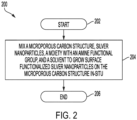
- FIG. 2 illustrates an example flowchart of a method 200 for preparing in-situ synthesized carbon supported surface functionalized silver nanoparticles using the in-situ growth method.
- the method 200 beings at block 202.
- the method 200 mixes a composition comprising a carbon structure, a plurality of silver nanoparticles, and a liquid to grow silver nanoparticles on the carbon structure in-situ.
- the composition may further include a nitrogen containing moiety to surface functionalize the silver nanoparticles in the liquid-containing composition.
- the functionalized silver nanoparticles may be precipitated out of liquid-containing composition directly onto the surface of the microporous carbon structure that is also present in the liquid containing composition.
- the carbon structure may be a porous or non-porous carbon structure.
- the carbon structure may be a microporous carbon structure. Examples of the microporous carbon structure may include carbon black, carbon nanotubes, graphene, and the like.
- the nitrogen containing moiety may include an amine, an amide, an imide, or a nitrogen containing aromatic compound, all of which are described above in the present disclosure.
- dodecylamine was used as the nitrogen containing moiety.
- the liquid may be a solvent.
- the solvent may be any type of polar solvent.
- Examples of liquids/polar solvents may include one or more of isopropanol, butanol, water, and the like.
- the mixture of the silver nanoparticles, the nitrogen containing moiety, and the solvent may be mixed with stirring for a desired amount of time at a desired temperature range to help control a size of the surface functionalized silver nanoparticles that are formed.
- a reducing agent may be added to the mixture to help precipitate the surface functionalized silver nanoparticles out of the liquid-containing composition.
- a ratio of the silver nanoparticles, the amine ligand of a moiety with an amine functional group, and the selected reducing agent may affect a particle size of the surface functionalized silver nanoparticles that are formed.
- the strength of the reducing agent may have the largest effect on the particle size.
- a stronger reducing agent may produce a smaller particle size and a weaker reducing agent may produce a larger particle size.
- stronger reducing agents may include sodium borohydride (NaBH 4 ), lithium aluminum hydride, (LiAlH 4 ), sodium aluminum hydride (NaAlH 2 ), phenylhydrazine, tosylhydrazide, hydrazine, and the like.
- weaker reducing agents may include ascorbic acid (CeHsOs), formic acid (HCOOH), oxalic acid (C 2 H 2 O 4 ), dimethylformamide (DMF), ammonium formate, methanol, formamide, and the like.
- the reducing agent may be added in an amount of 1 equivalent and may be added up to amounts as high as 10 equivalents.
- the in-situ synthesized carbon supported surface functionalized silver nanoparticles that are formed may then be filtered out of solution, rinsed, and dried.
- the in-situ synthesized carbon supported surface functionalized silver nanoparticles may then be used for various applications, such as preparation into an ink form to be printed onto substrates to form gas diffusion electrodes for CO 2 conversion systems.
- an ionomer may be added to the in-situ synthesized carbon supported surface functionalized silver nanoparticles to prepare stable inks.
- ionomers that can be sued include an alkaline based ionomers mixed with a polar solvent (e.g., Sustainion XA-9), polystyrene, sulfonate, nafion, and the like.
- a polar solvent e.g., Sustainion XA-9
- polystyrene sulfonate
- nafion nafion
- Example 4 provides an example of the preparation of the in-situ synthesized carbon supported surface functionalized silver nanoparticles via the in-situ growth method.
- Phenylhydrazine (11.3 g, 0.1048 mol) was then added with stirring and temperature stabilized at 35°C.
- Silver acetate powder 35 g, 0.2097 mol was slowly added to the mixture, keeping the reaction temperature between 35-37 °C. Stirring slowly ramped to 500 RPM over silver acetate addition. Once the entirely of silver acetate was added, the reaction was brought to 40 °C and stirred for 1 hour.
- the in-situ growth method was shown to grow surface functionalized silver nanoparticles with a relatively small average diameter.
- the average diameter of the surface functionalized silver nanoparticles that were synthesized with the in-situ growth method were found to be approximately 6-7 nanometers (nm). In an example, the average diameter was approximately 6.29 nm with a standard deviation of 4.16.
- the surface functionalized silver nanoparticles were found to have a range of diameters from approximately 2 to 15 nm.
- Examples 5 and 6 provide examples of how the in-situ synthesized carbon supported surface functionalized silver nanoparticles are prepared into stable inks.
- Example 5 provides an example of an ink prepared with an ionomer and
- Example 6 provides an example of an ink prepared without the ionomer.
- the cathode catalyst ink was prepared by mixing 225 mg of the in-situ synthesized carbon supported surface functionalized silver nanoparticles prepared in Example 2 (40wt%) with 27.1 ml of Toluene, 1.94g of 2.5wt% Sustainion XA-9/ Toluene dispersion (e.g., the ionomer), then ultra-sonicating for 60 min.
- the cathode catalyst ink was prepared by mixing 225 mg of the in-situ synthesized carbon supported surface functionalized silver nanoparticles prepared in Example 2 (40wt%) with 30 ml of Toluene, then ultra-sonicating for 60 min. The mass ratio of Ag loading was 0.34%.
- FIGs. 3 and 4 provide transmission electron microscopy (TEM) images of the in-situ synthesized carbon supported surface functionalized silver nanoparticles prepared via the in-situ deposition and in-situ growth methods.
- FIG. 3 illustrates TEM images 302 and 304 that show different magnifications of the in-situ synthesized carbon supported surface functionalized silver nanoparticles prepared via the in-situ deposition method.
- FIG. 4 illustrates TEM images 402 and 404 that show different magnifications of the in-situ synthesized carbon supported surface functionalized silver nanoparticles prepared via the in-situ growth method.
- the methods described herein to prepare the in-situ synthesized carbon supported surface functionalized silver nanoparticles create very uniform, discrete particles that are evenly distributed across the surface of the carbon support.
- the in-situ synthesized carbon supported surface functionalized silver nanoparticles may have a different physical appearance than ex-situ synthesized carbon supported surface functionalized silver nanoparticles.
- the average diameter of the surface functionalized silver nanoparticles formed using the in-situ methods described herein may range between approximately 6 nanometers (nm) and approximately 8 nm.
- the in-situ deposition method may form surface functionalized silver nanoparticles with an average diameter of approximately 7.22 nm
- the in-situ growth method may form surface functionalized silver nanoparticles with an average diameter of approximately 6.29 nm.
- the average particle size (or diameter) of the surface functionalized silver nanoparticles may be approximately 7 nm in the in-situ deposition method.
- the term "average particle size” as used herein may refer to the volume-based median particle diameter (e.g., the particle diameter below which 50% by volume of the particle population is found). Particle diameters and particle size distributions may be determined by laser diffraction in accordance with ISO 13320:2009.
- even particle size distribution may be understood to mean that greater than 90% of the surface functionalized silver nanoparticles have a particle diameter or size of from about 2 nm to about 18 nm. Said another way, the particle size distribution graph for the in-situ deposition method may be very narrow, with a peak formed between approximately 2-18 nm. In other words, there is minimal agglomeration of the surface functionalized silver nanoparticles. Rather, the surface functionalized silver nanoparticles are formed on the carbon support with a very consistent particle diameter size distribution.
- the terms “evenly distributed across the surface” and “uniform distribution” may be understood to mean having an approximately equal number (e.g., within +/- 5%) of surface functionalized silver nanoparticles per microporous carbon structure.
- the terms “evenly distributed across the surface” and “uniform distribution” may also be defined based on a distance between adjacent surface functionalized silver nanoparticles on the surface of the microporous carbon structure. For example, the distance between adjacent surface functionalized silver nanoparticles may be approximately the same (e.g., within +/- 5%) across a surface of the microporous carbon structure to have a "uniform distribution.”
- the in-situ deposition method can provide over 90% coverage of the surface area of the microporous carbon structure.
- the particle size of the silver nanoparticles can be well controlled. Since the carbon source is added to the reaction mixture immediately after the surface functionalized silver nanoparticle formation, there is no time for particles to aggregate. Without the immediate addition of the carbon source, the particles may be isolated in solid form, which can add to risk of destabilization and/or aggregation. In one embodiment, “immediately” may be defined as within 1 hour of when the silver moiety is added to the solvent or any time before isolation of the silver nanoparticles occurs.
- FIG. 5 illustrates an image 502 and an image 504 that were captured one month apart.
- the SEM images 502 and 504 show an unchanged morphology over time of the in-situ synthesized carbon supported surface functionalized silver nanoparticles prepared via an in-situ deposition method. In other words, the SEM images showed that the particles did not aggregate over time.
- the particle size of the surface functionalized silver nanoparticles in the in-situ growth method may range between approximately 2-15 nanometers (nm).
- the average particle size (or diameter) of the surface functionalized silver nanoparticles may be approximately 6 nm in the in-situ growth method.
- the term "average particle size" (or “average diameter") as used herein may refer to the volume-based median particle diameter (e.g., the particle diameter below which 50% by volume of the particle population is found). Particle diameters and particle size distributions may be determined by laser diffraction in accordance with ISO 13320:2009.
- the term "even particle size distribution” may be understood to mean that greater than 90% of the surface functionalized silver nanoparticles have a particle diameter or size of from about 2 nm to about 15 nm. Said another way, the particle size distribution graph for the in-situ growth method may be very narrow, with a peak formed between approximately 2-15 nm.
- the terms “evenly distributed across the surface” and “uniform distribution” may be understood to mean having an approximately equal number (e.g., within +/- 5%) of surface functionalized silver nanoparticles per microporous carbon structure.
- the terms “evenly distributed across the surface” and “uniform distribution” may also be defined based on a distance between adjacent surface functionalized silver nanoparticles on the surface of the microporous carbon structure. For example, the distance between adjacent surface functionalized silver nanoparticles may be approximately the same (e.g., within +/- 5%) across a surface of the microporous carbon structure to have a "uniform distribution.”
- the in-situ deposition method can provide over 90% coverage of the surface area of the microporous carbon structure.
- the particle size of the silver nanoparticles can be well controlled.
- the resultant silver nanoparticles can be grown directly onto the support structure. Due to the particles being supported, the particle size can be controlled by tuning the ratios of silver, stabilizer, and reducing agent.
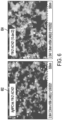
- FIG. 6 illustrates an image 602 and an image 604 that were captured one month apart.
- the SEM images 602 and 604 show an unchanged morphology over time of the in-situ synthesized carbon supported surface functionalized silver nanoparticles prepared via an in-situ growth method. In other words, the SEM images showed that the particles did not aggregate over time.
- the present disclosure provides carbon supported surface functionalized silver nanoparticles.
- the present disclosure also provides an in-situ method, in addition to the ex-situ method, to synthesize carbon supported surface functionalized silver nanoparticles that provide as good, or better, electro catalytic performance.
- the in-situ synthesized carbons supported surface functionalized silver nanoparticles can be prepared using an in-situ deposition method or an in-situ growth method that forms the in-situ synthesized carbons supported surface functionalized silver nanoparticles with uniform particle size distributions, very high coverage of the surface of the microporous carbon structure, and even coverage of the surface of the microporous carbon structure with the surface functionalized silver nanoparticles.
- the in-situ synthesized carbons supported surface functionalized silver nanoparticles can be prepared into printable inks that can be used for a variety of different applications, such as catalysts, chemical sensors, biomedicines, medical devices, functional textiles, cosmetics, food packaging, food supplements, odor-resistant items, electronics, household appliances, dental amalgam, water disinfectants, paints/inks, and the like.
Landscapes
- Chemical & Material Sciences (AREA)
- Organic Chemistry (AREA)
- Engineering & Computer Science (AREA)
- Materials Engineering (AREA)
- Chemical Kinetics & Catalysis (AREA)
- Metallurgy (AREA)
- Electrochemistry (AREA)
- General Chemical & Material Sciences (AREA)
- Inorganic Chemistry (AREA)
- Life Sciences & Earth Sciences (AREA)
- Wood Science & Technology (AREA)
- Mechanical Engineering (AREA)
- Nanotechnology (AREA)
- Catalysts (AREA)
- Carbon And Carbon Compounds (AREA)
Applications Claiming Priority (1)
| Application Number | Priority Date | Filing Date | Title |
|---|---|---|---|
| US17/810,979 US12410328B2 (en) | 2022-07-06 | 2022-07-06 | Carbon supported surface functionalized silver nanoparticles |
Publications (1)
| Publication Number | Publication Date |
|---|---|
| EP4302902A1 true EP4302902A1 (fr) | 2024-01-10 |
Family
ID=86862109
Family Applications (1)
| Application Number | Title | Priority Date | Filing Date |
|---|---|---|---|
| EP23179708.5A Pending EP4302902A1 (fr) | 2022-07-06 | 2023-06-16 | Nanoparticules d'argent fonctionnalisées en surface supportées par du carbone |
Country Status (3)
| Country | Link |
|---|---|
| US (1) | US12410328B2 (fr) |
| EP (1) | EP4302902A1 (fr) |
| JP (1) | JP2024008867A (fr) |
Families Citing this family (1)
| Publication number | Priority date | Publication date | Assignee | Title |
|---|---|---|---|---|
| US12570862B2 (en) * | 2022-07-06 | 2026-03-10 | Genesee Valley Innovations, LLC | Carbon supported surface functionalized silver nanoparticles for ink/electrodes/MEA |
Citations (3)
| Publication number | Priority date | Publication date | Assignee | Title |
|---|---|---|---|---|
| KR20120047455A (ko) * | 2010-11-04 | 2012-05-14 | 부산대학교 산학협력단 | 폴리올을 이용한 무극성 탄소나노소재 및 그 제조방법 |
| US20150231698A1 (en) * | 2012-08-02 | 2015-08-20 | National University Corporation Yamagata University | Process for producing coated silver fine particles and coated silver fine particles produced by said production process |
| US10818405B2 (en) * | 2015-07-09 | 2020-10-27 | Furukawa Electric Co., Ltd. | Metal fine particle-containing composition |
Family Cites Families (20)
| Publication number | Priority date | Publication date | Assignee | Title |
|---|---|---|---|---|
| US7538062B1 (en) * | 2005-09-12 | 2009-05-26 | University Of Dayton | Substrate-enhanced electroless deposition (SEED) of metal nanoparticles on carbon nanotubes |
| US8900704B1 (en) * | 2008-08-05 | 2014-12-02 | Lockheed Martin Corporation | Nanostructured metal-diamond composite thermal interface material (TIM) with improved thermal conductivity |
| US8591624B2 (en) * | 2010-02-25 | 2013-11-26 | National Tsing Hua University | Methods for preparing hydrophobic metal nanoparticles and precursors used therein |
| US8765025B2 (en) * | 2010-06-09 | 2014-07-01 | Xerox Corporation | Silver nanoparticle composition comprising solvents with specific hansen solubility parameters |
| JP6037494B2 (ja) * | 2012-01-11 | 2016-12-07 | 国立大学法人山形大学 | 銀ナノ粒子の製造方法及び銀ナノ粒子、並びに銀塗料組成物 |
| US20130202909A1 (en) * | 2012-02-06 | 2013-08-08 | Lg Chem, Ltd. | Method of producing metal nanoparticles |
| EP3061547B1 (fr) * | 2013-10-24 | 2019-12-04 | Daicel Corporation | Procédé pour produire un liquide de dispersion contenant des nanoparticules d'argent et liquide de dispersion contenant des nanoparticules d'argent |
| JP5738464B1 (ja) * | 2013-12-10 | 2015-06-24 | Dowaエレクトロニクス株式会社 | 銀微粒子分散液 |
| CN106660129B (zh) * | 2014-06-11 | 2019-08-13 | 阪东化学株式会社 | 银微粒子分散体、银微粒子及其制造方法及接合用组合物 |
| EP3195928B1 (fr) * | 2014-08-28 | 2020-02-12 | National Institute of Advanced Industrial Science and Technology | Procédé de production de dispersion |
| JP6666846B2 (ja) * | 2014-10-02 | 2020-03-18 | 株式会社ダイセル | 銀粒子塗料組成物 |
| US10125418B2 (en) * | 2015-01-30 | 2018-11-13 | King Fahd University Of Petroleum And Minerals | Method for the preparation of Ag/C nanocomposite films by laser-induced carbonization of alkane |
| WO2016132649A1 (fr) * | 2015-02-19 | 2016-08-25 | 株式会社ダイセル | Composition de revêtement à base de particules d'argent |
| US10807048B2 (en) * | 2015-07-17 | 2020-10-20 | King Abdullah University Of Science And Technology | Compositions of graphene materials with metal nanostructures and microstructures and methods of making and using including pressure sensors |
| JP2019513078A (ja) * | 2016-03-09 | 2019-05-23 | ビーエーエスエフ コーポレーション | コア/シェル炭化水素トラップ触媒および製作方法 |
| WO2020014565A1 (fr) * | 2018-07-13 | 2020-01-16 | Chiu Pei Chun | Procédés de production de matériaux carbonés modifiés à l'argent |
| US11227702B2 (en) * | 2019-04-04 | 2022-01-18 | Dowa Electronics Materials Co., Ltd. | Fine silver particle dispersion |
| US12325903B2 (en) * | 2019-07-29 | 2025-06-10 | Kyoto University | Alloy nanoparticle, aggregate of alloy nanoparticles, catalyst, and method for producing alloy nanoparticles |
| WO2021229435A1 (fr) * | 2020-05-12 | 2021-11-18 | Xtpl S.A. | Composition de nanoparticules métalliques et procédé de distribution de composition de nanoparticules métalliques |
| US20230304175A1 (en) * | 2022-03-28 | 2023-09-28 | The Research Foundation For The State University Of New York | Catalyst for an electrochemical cell, and methods of making and using the catalyst |
-
2022
- 2022-07-06 US US17/810,979 patent/US12410328B2/en active Active
-
2023
- 2023-06-16 EP EP23179708.5A patent/EP4302902A1/fr active Pending
- 2023-06-28 JP JP2023106089A patent/JP2024008867A/ja active Pending
Patent Citations (3)
| Publication number | Priority date | Publication date | Assignee | Title |
|---|---|---|---|---|
| KR20120047455A (ko) * | 2010-11-04 | 2012-05-14 | 부산대학교 산학협력단 | 폴리올을 이용한 무극성 탄소나노소재 및 그 제조방법 |
| US20150231698A1 (en) * | 2012-08-02 | 2015-08-20 | National University Corporation Yamagata University | Process for producing coated silver fine particles and coated silver fine particles produced by said production process |
| US10818405B2 (en) * | 2015-07-09 | 2020-10-27 | Furukawa Electric Co., Ltd. | Metal fine particle-containing composition |
Non-Patent Citations (5)
| Title |
|---|
| ANIL K KARUMURI ET AL: "Silver nanoparticles supported on carbon nanotube carpets: influence of surface functionalization", NANOTECHNOLOGY, INSTITUTE OF PHYSICS PUBLISHING, BRISTOL, GB, vol. 27, no. 14, 26 February 2016 (2016-02-26), pages 145603, XP020301685, ISSN: 0957-4484, [retrieved on 20160226], DOI: 10.1088/0957-4484/27/14/145603 * |
| LIU ANMIN ET AL: "A facile approach for the fabrication of loading-controlled Ag/C foam catalyst", IONICS, KIEL, DE, vol. 25, no. 1, 18 October 2018 (2018-10-18), pages 361 - 365, XP036670779, ISSN: 0947-7047, [retrieved on 20181018], DOI: 10.1007/S11581-018-2769-Y * |
| STOSEVSKI IVAN ET AL: "Radiolitically synthesized nano Ag/C catalysts for oxygen reduction and borohydride oxidation reactions in alkaline media, for potential applications in fuel cells", ENERGY, ELSEVIER, AMSTERDAM, NL, vol. 101, 27 February 2016 (2016-02-27), pages 79 - 90, XP029508884, ISSN: 0360-5442, DOI: 10.1016/J.ENERGY.2016.02.003 * |
| TINKER HENRY R ET AL: "Synthetic tethered silver nanoparticles on reduced graphene oxide for alkaline oxygen reduction catalysis", JOURNAL OF MATERIAL SCIENCE, vol. 56, no. 11, 18 January 2021 (2021-01-18), pages 6966 - 6976, XP037352701, ISSN: 0022-2461, DOI: 10.1007/S10853-020-05711-2 * |
| TRUONG VAN MEN ET AL: "Comparison of Carbon Supports in Anion Exchange Membrane Fuel Cells", MATERIALS, vol. 13, no. 23, 26 November 2020 (2020-11-26), pages 5370, XP093097513, DOI: 10.3390/ma13235370 * |
Also Published As
| Publication number | Publication date |
|---|---|
| US12410328B2 (en) | 2025-09-09 |
| JP2024008867A (ja) | 2024-01-19 |
| US20240010855A1 (en) | 2024-01-11 |
Similar Documents
| Publication | Publication Date | Title |
|---|---|---|
| Guo et al. | Electrochemical synthesis of Pd nanoparticles on functional MWNT surfaces | |
| Guo et al. | Highly dispersed Ag nanoparticles on functional MWNT surfaces for methanol oxidation in alkaline solution | |
| KR101807919B1 (ko) | 담체-나노입자 복합체, 이의 제조방법, 및 이를 포함하는 촉매 | |
| Guo et al. | High dispersion and electrocatalytic properties of platinum on functional multi‐walled carbon nanotubes | |
| EP0165177A1 (fr) | Nouveaux microagrégats de métaux non nobles, procédé pour leur préparation et application à la catalyse de la photoréduction de l'eau | |
| WO2010082443A1 (fr) | Poudre de noir de platine, colloïde de noir de platine, procédé de production de poudre de noir de platine, et procédé pour la production de colloïde de noir de platine | |
| Afzali et al. | Design of PdxIr/g-C3N4 modified FTO to facilitate electricity generation and hydrogen evolution in alkaline media | |
| EP4302902A1 (fr) | Nanoparticules d'argent fonctionnalisées en surface supportées par du carbone | |
| Nayak et al. | Green synthesis of a novel porous gold-curcumin nanocomposite for super-efficient alcohol oxidation | |
| CN109277103A (zh) | 一种高活性铂基双金属析氢催化剂及其制备方法 | |
| JP2001224968A (ja) | 担持金属触媒の調製方法及び固体高分子型燃料電池の製造方法 | |
| Zhang et al. | Preparation of freestanding palladium nanosheets modified with gold nanoparticles at edges | |
| EP4303343A2 (fr) | Nanoparticules d'argent fonctionnalisées en surface supportées par du carbone pour encre/électrodes/mea | |
| EP4303342A2 (fr) | Nanoparticules d'argent fonctionnalisées à surface d'azote supportées sur du carbone pour électrodes de diffusion de gaz | |
| KR101000475B1 (ko) | 무전해 도금에 의한 전이금속/탄소나노튜브 나노복합체의제조방법 | |
| Zoladek et al. | Fabrication of polyoxometallate-modified gold nanoparticles and their utilization as supports for dispersed platinum in electrocatalysis | |
| EP4343034A2 (fr) | Nanoparticules d'argent fonctionnalisées par un carboxyle supporté sur du carbone pour électrodes de diffusion de gaz | |
| US20220298657A1 (en) | Stable hydrogen evolution electrocatalyst based on 3d metal nanostructures on a ti substrate | |
| RU2446009C1 (ru) | Способ приготовления платино-рутениевых электрокатализаторов | |
| Liu et al. | Tuning ion complexing to rapidly prepare hollow Ag–Pt nanowires with high activity toward the methanol oxidization reaction | |
| JP2005193182A (ja) | 触媒およびその製造方法 | |
| Su et al. | Pt monolayer deposition onto carbon nanotube mattes with high electrochemical activity | |
| JP4919699B2 (ja) | 金属微粒子−炭素複合体の製造方法 | |
| EP2468398A1 (fr) | Procédé de synthèse électrochimique de peroxyde d'hydrogène et utilisation associée d'un catalyseur | |
| CN115992359B (zh) | 一种氮掺杂碳纳米管包裹超细金属纳米粒子的材料及其制备方法和应用 |
Legal Events
| Date | Code | Title | Description |
|---|---|---|---|
| PUAI | Public reference made under article 153(3) epc to a published international application that has entered the european phase |
Free format text: ORIGINAL CODE: 0009012 |
|
| STAA | Information on the status of an ep patent application or granted ep patent |
Free format text: STATUS: THE APPLICATION HAS BEEN PUBLISHED |
|
| AK | Designated contracting states |
Kind code of ref document: A1 Designated state(s): AL AT BE BG CH CY CZ DE DK EE ES FI FR GB GR HR HU IE IS IT LI LT LU LV MC ME MK MT NL NO PL PT RO RS SE SI SK SM TR |
|
| STAA | Information on the status of an ep patent application or granted ep patent |
Free format text: STATUS: REQUEST FOR EXAMINATION WAS MADE |
|
| 17P | Request for examination filed |
Effective date: 20240710 |
|
| RBV | Designated contracting states (corrected) |
Designated state(s): AL AT BE BG CH CY CZ DE DK EE ES FI FR GB GR HR HU IE IS IT LI LT LU LV MC ME MK MT NL NO PL PT RO RS SE SI SK SM TR |