EP4303342A2 - Nanoparticules d'argent fonctionnalisées à surface d'azote supportées sur du carbone pour électrodes de diffusion de gaz - Google Patents
Nanoparticules d'argent fonctionnalisées à surface d'azote supportées sur du carbone pour électrodes de diffusion de gaz Download PDFInfo
- Publication number
- EP4303342A2 EP4303342A2 EP23179706.9A EP23179706A EP4303342A2 EP 4303342 A2 EP4303342 A2 EP 4303342A2 EP 23179706 A EP23179706 A EP 23179706A EP 4303342 A2 EP4303342 A2 EP 4303342A2
- Authority
- EP
- European Patent Office
- Prior art keywords
- silver nanoparticles
- surface functionalized
- carbon
- functionalized silver
- electrode
- Prior art date
- Legal status (The legal status is an assumption and is not a legal conclusion. Google has not performed a legal analysis and makes no representation as to the accuracy of the status listed.)
- Pending
Links
Images





Classifications
-
- C—CHEMISTRY; METALLURGY
- C25—ELECTROLYTIC OR ELECTROPHORETIC PROCESSES; APPARATUS THEREFOR
- C25B—ELECTROLYTIC OR ELECTROPHORETIC PROCESSES FOR THE PRODUCTION OF COMPOUNDS OR NON-METALS; APPARATUS THEREFOR
- C25B1/00—Electrolytic production of inorganic compounds or non-metals
- C25B1/01—Products
- C25B1/23—Carbon monoxide or syngas
-
- B—PERFORMING OPERATIONS; TRANSPORTING
- B01—PHYSICAL OR CHEMICAL PROCESSES OR APPARATUS IN GENERAL
- B01J—CHEMICAL OR PHYSICAL PROCESSES, e.g. CATALYSIS OR COLLOID CHEMISTRY; THEIR RELEVANT APPARATUS
- B01J21/00—Catalysts comprising the elements, oxides, or hydroxides of magnesium, boron, aluminium, carbon, silicon, titanium, zirconium, or hafnium
- B01J21/18—Carbon
-
- B—PERFORMING OPERATIONS; TRANSPORTING
- B01—PHYSICAL OR CHEMICAL PROCESSES OR APPARATUS IN GENERAL
- B01J—CHEMICAL OR PHYSICAL PROCESSES, e.g. CATALYSIS OR COLLOID CHEMISTRY; THEIR RELEVANT APPARATUS
- B01J23/00—Catalysts comprising metals or metal oxides or hydroxides, not provided for in group B01J21/00
- B01J23/38—Catalysts comprising metals or metal oxides or hydroxides, not provided for in group B01J21/00 of noble metals
- B01J23/48—Silver or gold
- B01J23/50—Silver
-
- B—PERFORMING OPERATIONS; TRANSPORTING
- B01—PHYSICAL OR CHEMICAL PROCESSES OR APPARATUS IN GENERAL
- B01J—CHEMICAL OR PHYSICAL PROCESSES, e.g. CATALYSIS OR COLLOID CHEMISTRY; THEIR RELEVANT APPARATUS
- B01J35/00—Catalysts, in general, characterised by their form or physical properties
- B01J35/40—Catalysts, in general, characterised by their form or physical properties characterised by dimensions, e.g. grain size
- B01J35/45—Nanoparticles
-
- B—PERFORMING OPERATIONS; TRANSPORTING
- B01—PHYSICAL OR CHEMICAL PROCESSES OR APPARATUS IN GENERAL
- B01J—CHEMICAL OR PHYSICAL PROCESSES, e.g. CATALYSIS OR COLLOID CHEMISTRY; THEIR RELEVANT APPARATUS
- B01J37/00—Processes, in general, for preparing catalysts; Processes, in general, for activation of catalysts
- B01J37/0009—Use of binding agents; Moulding; Pressing; Powdering; Granulating; Addition of materials ameliorating the mechanical properties of the product catalyst
- B01J37/0027—Powdering
- B01J37/0045—Drying a slurry, e.g. spray drying
-
- B—PERFORMING OPERATIONS; TRANSPORTING
- B01—PHYSICAL OR CHEMICAL PROCESSES OR APPARATUS IN GENERAL
- B01J—CHEMICAL OR PHYSICAL PROCESSES, e.g. CATALYSIS OR COLLOID CHEMISTRY; THEIR RELEVANT APPARATUS
- B01J37/00—Processes, in general, for preparing catalysts; Processes, in general, for activation of catalysts
- B01J37/02—Impregnation, coating or precipitation
- B01J37/03—Precipitation; Co-precipitation
- B01J37/031—Precipitation
-
- B—PERFORMING OPERATIONS; TRANSPORTING
- B22—CASTING; POWDER METALLURGY
- B22F—WORKING METALLIC POWDER; MANUFACTURE OF ARTICLES FROM METALLIC POWDER; MAKING METALLIC POWDER; APPARATUS OR DEVICES SPECIALLY ADAPTED FOR METALLIC POWDER
- B22F1/00—Metallic powder; Treatment of metallic powder, e.g. to facilitate working or to improve properties
- B22F1/05—Metallic powder characterised by the size or surface area of the particles
- B22F1/054—Nanosized particles
-
- B—PERFORMING OPERATIONS; TRANSPORTING
- B22—CASTING; POWDER METALLURGY
- B22F—WORKING METALLIC POWDER; MANUFACTURE OF ARTICLES FROM METALLIC POWDER; MAKING METALLIC POWDER; APPARATUS OR DEVICES SPECIALLY ADAPTED FOR METALLIC POWDER
- B22F1/00—Metallic powder; Treatment of metallic powder, e.g. to facilitate working or to improve properties
- B22F1/10—Metallic powder containing lubricating or binding agents; Metallic powder containing organic material
- B22F1/102—Metallic powder coated with organic material
-
- C—CHEMISTRY; METALLURGY
- C09—DYES; PAINTS; POLISHES; NATURAL RESINS; ADHESIVES; COMPOSITIONS NOT OTHERWISE PROVIDED FOR; APPLICATIONS OF MATERIALS NOT OTHERWISE PROVIDED FOR
- C09D—COATING COMPOSITIONS, e.g. PAINTS, VARNISHES OR LACQUERS; FILLING PASTES; CHEMICAL PAINT OR INK REMOVERS; INKS; CORRECTING FLUIDS; WOODSTAINS; PASTES OR SOLIDS FOR COLOURING OR PRINTING; USE OF MATERIALS THEREFOR
- C09D11/00—Inks
- C09D11/02—Printing inks
- C09D11/03—Printing inks characterised by features other than the chemical nature of the binder
- C09D11/033—Printing inks characterised by features other than the chemical nature of the binder characterised by the solvent
-
- C—CHEMISTRY; METALLURGY
- C09—DYES; PAINTS; POLISHES; NATURAL RESINS; ADHESIVES; COMPOSITIONS NOT OTHERWISE PROVIDED FOR; APPLICATIONS OF MATERIALS NOT OTHERWISE PROVIDED FOR
- C09D—COATING COMPOSITIONS, e.g. PAINTS, VARNISHES OR LACQUERS; FILLING PASTES; CHEMICAL PAINT OR INK REMOVERS; INKS; CORRECTING FLUIDS; WOODSTAINS; PASTES OR SOLIDS FOR COLOURING OR PRINTING; USE OF MATERIALS THEREFOR
- C09D11/00—Inks
- C09D11/02—Printing inks
- C09D11/03—Printing inks characterised by features other than the chemical nature of the binder
- C09D11/037—Printing inks characterised by features other than the chemical nature of the binder characterised by the pigment
-
- C—CHEMISTRY; METALLURGY
- C09—DYES; PAINTS; POLISHES; NATURAL RESINS; ADHESIVES; COMPOSITIONS NOT OTHERWISE PROVIDED FOR; APPLICATIONS OF MATERIALS NOT OTHERWISE PROVIDED FOR
- C09D—COATING COMPOSITIONS, e.g. PAINTS, VARNISHES OR LACQUERS; FILLING PASTES; CHEMICAL PAINT OR INK REMOVERS; INKS; CORRECTING FLUIDS; WOODSTAINS; PASTES OR SOLIDS FOR COLOURING OR PRINTING; USE OF MATERIALS THEREFOR
- C09D5/00—Coating compositions, e.g. paints, varnishes or lacquers, characterised by their physical nature or the effects produced; Filling pastes
- C09D5/24—Electrically-conducting paints
-
- C—CHEMISTRY; METALLURGY
- C22—METALLURGY; FERROUS OR NON-FERROUS ALLOYS; TREATMENT OF ALLOYS OR NON-FERROUS METALS
- C22C—ALLOYS
- C22C1/00—Making non-ferrous alloys
- C22C1/04—Making non-ferrous alloys by powder metallurgy
- C22C1/0466—Alloys based on noble metals
-
- C—CHEMISTRY; METALLURGY
- C25—ELECTROLYTIC OR ELECTROPHORETIC PROCESSES; APPARATUS THEREFOR
- C25B—ELECTROLYTIC OR ELECTROPHORETIC PROCESSES FOR THE PRODUCTION OF COMPOUNDS OR NON-METALS; APPARATUS THEREFOR
- C25B11/00—Electrodes; Manufacture thereof not otherwise provided for
- C25B11/02—Electrodes; Manufacture thereof not otherwise provided for characterised by shape or form
- C25B11/03—Electrodes; Manufacture thereof not otherwise provided for characterised by shape or form perforated or foraminous
- C25B11/031—Porous electrodes
- C25B11/032—Gas diffusion electrodes
-
- C—CHEMISTRY; METALLURGY
- C25—ELECTROLYTIC OR ELECTROPHORETIC PROCESSES; APPARATUS THEREFOR
- C25B—ELECTROLYTIC OR ELECTROPHORETIC PROCESSES FOR THE PRODUCTION OF COMPOUNDS OR NON-METALS; APPARATUS THEREFOR
- C25B11/00—Electrodes; Manufacture thereof not otherwise provided for
- C25B11/04—Electrodes; Manufacture thereof not otherwise provided for characterised by the material
- C25B11/051—Electrodes formed of electrocatalysts on a substrate or carrier
- C25B11/054—Electrodes comprising electrocatalysts supported on a carrier
-
- C—CHEMISTRY; METALLURGY
- C25—ELECTROLYTIC OR ELECTROPHORETIC PROCESSES; APPARATUS THEREFOR
- C25B—ELECTROLYTIC OR ELECTROPHORETIC PROCESSES FOR THE PRODUCTION OF COMPOUNDS OR NON-METALS; APPARATUS THEREFOR
- C25B11/00—Electrodes; Manufacture thereof not otherwise provided for
- C25B11/04—Electrodes; Manufacture thereof not otherwise provided for characterised by the material
- C25B11/051—Electrodes formed of electrocatalysts on a substrate or carrier
- C25B11/073—Electrodes formed of electrocatalysts on a substrate or carrier characterised by the electrocatalyst material
- C25B11/075—Electrodes formed of electrocatalysts on a substrate or carrier characterised by the electrocatalyst material consisting of a single catalytic element or catalytic compound
- C25B11/081—Electrodes formed of electrocatalysts on a substrate or carrier characterised by the electrocatalyst material consisting of a single catalytic element or catalytic compound the element being a noble metal
-
- C—CHEMISTRY; METALLURGY
- C25—ELECTROLYTIC OR ELECTROPHORETIC PROCESSES; APPARATUS THEREFOR
- C25B—ELECTROLYTIC OR ELECTROPHORETIC PROCESSES FOR THE PRODUCTION OF COMPOUNDS OR NON-METALS; APPARATUS THEREFOR
- C25B11/00—Electrodes; Manufacture thereof not otherwise provided for
- C25B11/04—Electrodes; Manufacture thereof not otherwise provided for characterised by the material
- C25B11/051—Electrodes formed of electrocatalysts on a substrate or carrier
- C25B11/073—Electrodes formed of electrocatalysts on a substrate or carrier characterised by the electrocatalyst material
- C25B11/091—Electrodes formed of electrocatalysts on a substrate or carrier characterised by the electrocatalyst material consisting of at least one catalytic element and at least one catalytic compound; consisting of two or more catalytic elements or catalytic compounds
- C25B11/095—Electrodes formed of electrocatalysts on a substrate or carrier characterised by the electrocatalyst material consisting of at least one catalytic element and at least one catalytic compound; consisting of two or more catalytic elements or catalytic compounds at least one of the compounds being organic
-
- C—CHEMISTRY; METALLURGY
- C25—ELECTROLYTIC OR ELECTROPHORETIC PROCESSES; APPARATUS THEREFOR
- C25B—ELECTROLYTIC OR ELECTROPHORETIC PROCESSES FOR THE PRODUCTION OF COMPOUNDS OR NON-METALS; APPARATUS THEREFOR
- C25B13/00—Diaphragms; Spacing elements
-
- C—CHEMISTRY; METALLURGY
- C25—ELECTROLYTIC OR ELECTROPHORETIC PROCESSES; APPARATUS THEREFOR
- C25B—ELECTROLYTIC OR ELECTROPHORETIC PROCESSES FOR THE PRODUCTION OF COMPOUNDS OR NON-METALS; APPARATUS THEREFOR
- C25B9/00—Cells or assemblies of cells; Constructional parts of cells; Assemblies of constructional parts, e.g. electrode-diaphragm assemblies; Process-related cell features
- C25B9/17—Cells comprising dimensionally-stable non-movable electrodes; Assemblies of constructional parts thereof
- C25B9/19—Cells comprising dimensionally-stable non-movable electrodes; Assemblies of constructional parts thereof with diaphragms
-
- B—PERFORMING OPERATIONS; TRANSPORTING
- B22—CASTING; POWDER METALLURGY
- B22F—WORKING METALLIC POWDER; MANUFACTURE OF ARTICLES FROM METALLIC POWDER; MAKING METALLIC POWDER; APPARATUS OR DEVICES SPECIALLY ADAPTED FOR METALLIC POWDER
- B22F9/00—Making metallic powder or suspensions thereof
- B22F9/16—Making metallic powder or suspensions thereof using chemical processes
- B22F9/18—Making metallic powder or suspensions thereof using chemical processes with reduction of metal compounds
- B22F9/24—Making metallic powder or suspensions thereof using chemical processes with reduction of metal compounds starting from liquid metal compounds, e.g. solutions
-
- B—PERFORMING OPERATIONS; TRANSPORTING
- B82—NANOTECHNOLOGY
- B82Y—SPECIFIC USES OR APPLICATIONS OF NANOSTRUCTURES; MEASUREMENT OR ANALYSIS OF NANOSTRUCTURES; MANUFACTURE OR TREATMENT OF NANOSTRUCTURES
- B82Y30/00—Nanotechnology for materials or surface science, e.g. nanocomposites
-
- B—PERFORMING OPERATIONS; TRANSPORTING
- B82—NANOTECHNOLOGY
- B82Y—SPECIFIC USES OR APPLICATIONS OF NANOSTRUCTURES; MEASUREMENT OR ANALYSIS OF NANOSTRUCTURES; MANUFACTURE OR TREATMENT OF NANOSTRUCTURES
- B82Y40/00—Manufacture or treatment of nanostructures
-
- Y—GENERAL TAGGING OF NEW TECHNOLOGICAL DEVELOPMENTS; GENERAL TAGGING OF CROSS-SECTIONAL TECHNOLOGIES SPANNING OVER SEVERAL SECTIONS OF THE IPC; TECHNICAL SUBJECTS COVERED BY FORMER USPC CROSS-REFERENCE ART COLLECTIONS [XRACs] AND DIGESTS
- Y02—TECHNOLOGIES OR APPLICATIONS FOR MITIGATION OR ADAPTATION AGAINST CLIMATE CHANGE
- Y02E—REDUCTION OF GREENHOUSE GAS [GHG] EMISSIONS, RELATED TO ENERGY GENERATION, TRANSMISSION OR DISTRIBUTION
- Y02E60/00—Enabling technologies; Technologies with a potential or indirect contribution to GHG emissions mitigation
- Y02E60/30—Hydrogen technology
- Y02E60/50—Fuel cells
Definitions
- the present disclosure relates generally to membrane electrode assemblies and relates more particularly to gas diffusion electrodes with carbon surface functionalized silver nanoparticles used in various conversion systems.
- GSGs greenhouse gases
- CCU CO 2 capture and utilization
- CO 2 can be electrochemically converted into various products such as carbon monoxide (CO), methane (CH 4 ), ethylene (C 2 H 4 ), formic acid (HCOOH), methanol (CHsOH) and ethanol (C 2 H 5 OH), etc.
- CO carbon monoxide
- CH 4 methane
- C 2 H 4 ethylene
- HCOOH formic acid
- CHsOH methanol
- C 2 H 5 OH ethanol
- compositions comprising a carbon supported nitrogen surface functionalized silver nanoparticle.
- Another disclosed feature of the embodiments is a method comprising preparing an ink comprising carbon supported silver nanoparticles and depositing the ink on an electrically conductive surface.
- the electrode comprises an electrically conductive surface and carbon supported surface functionalized silver nanoparticles on the electrically conductive surface.
- the present disclosure broadly discloses an example gas diffusion electrode with microporous carbon structures impregnated via an ex-situ process with organo-functionalized silver nanoparticles and a method for fabricating the same.
- an example gas diffusion electrode with microporous carbon structures impregnated via an ex-situ process with organo-functionalized silver nanoparticles and a method for fabricating the same.
- the key to the electrochemical conversion process is the electro-catalysts with high efficiency and selectivity, as well as long-term stability.
- Recent years have witnessed significant advances in the development of electro-catalysts that can selectively reduce CO 2 to CO, including Au, Ag, Zn, Pd, and Ga, etc.
- silver shows the highest potential for large-scale applications, owning to its moderate cost and high catalytic selectivity for CO production.
- challenges remain in developing materials with enhanced catalytic selectivity at reduced overpotentials, in a simple, scalable, and cost-efficient way.
- the present disclosure uses carbon supported nitrogen surface functionalized silver nanoparticles that are formed by depositing nitrogen surface functionalized silver nanoparticles formed ex-situ onto a surface of a carbon support or structure.
- the silver nanoparticles may be surface functionalized in isolation away from the carbon structure before being added onto the surface of the carbon structure.
- the fully synthesized silver nanoparticles are removed from the liquid-containing composition that the surface functionalized silver nanoparticles were formed in and then added to the carbon structure.
- the carbon structure may be microporous or non-porous.
- the microporous carbon structure may be impregnated with surface functionalized silver nanoparticles that are formed ex-situ as the electro-catalysts in the gas diffusion electrode for electro-catalytic conversion of CO 2 .
- the carbon supported surface functionalized silver nanoparticles may be formed ex-situ via an impregnation method.
- Carbon supported may be defined as the surface functionalized silver nanoparticles being on the surface of the carbon structure.
- the carbon structure may be larger than the surface functionalized silver nanoparticles.
- the carbon structure can be from about 50 nanometers (nm) to about 100 nm in diameter) versus the surface functionalized silver nanoparticles that can be from about 5 nm to about 20 nm in diameter.
- the smaller silver nanoparticles can be formed onto the surface of the carbon structure.
- Nanostructured silver catalysts have shown improved performance compared to their bulk counterparts, as they offer mass-transport advantages and more highly active sites on the edges and corners of the nanomaterials. By tuning nanomaterial composition, size, morphology, porosity, and surface modification, nanostructured catalyst behaviors can be adjusted for specific applications.
- a typical MEA comprises two gas diffusion layers (GDLs) and an ion exchange membrane with catalyst particles dispersed at the interface, and its production is similar to the various roll-to-roll production methods utilized in printing.
- GDLs gas diffusion layers
- ion exchange membrane with catalyst particles dispersed at the interface
- the present disclosure provides novel carbon supported nitrogen surface functionalized silver nanoparticles and a scalable approach to prepare MEAs for electrochemical reduction using the carbon supported nitrogen surface functionalized silver nanoparticles as electro-catalysts that are efficient and selective.
- the carbon structure can be non-porous, microporous carbon structures provide improved performance for MEAs.
- Microporous carbon structures impregnated with surface functionalized silver nanoparticles are synthesized and formulated into catalyst inks which are deposited on GDLs via continuous print/coating methods.
- the surface functionalized silver nanoparticle carbon particles may reduce the silver loading by up to 20 times compared to the amount of silver loading for unsupported silver nanoparticles.
- the fabrication of MEAs with high Faradic efficiency and selectivity for CO are demonstrated under relatively low overpotentials.
- FIG. 1 illustrates an example membrane electrode assembly 100 that includes a gas diffusion electrode 104 of the present disclosure.
- the membrane electrode assembly 100 may be part of a flow cell electro-catalytic converter that is used to convert a compound into different desirable compounds.
- the gas diffusion electrode 104 of the present disclosure may provide a scalable electrode that is highly efficient at lower cell potentials (e.g., uses less power to perform the conversion).
- One example conversion that can be performed by the membrane electrode assembly 100 is the conversion of carbon dioxide (CO 2 ) into carbon monoxide (CO) and hydrogen gas (H 2 ).
- CO 2 carbon dioxide
- H 2 hydrogen gas
- the gas diffusion electrode 104 may be used for electro-catalytic conversion of other types of compounds within the context of flow cell electro-catalytic converters.
- the membrane electrode assembly 100 includes a cathode 102 having the gas diffusion electrode 104, an anion exchange membrane 106, and an anode 108 with an iridium-oxide electrode 110.
- an inlet 112 may feed CO 2 through the cathode 104 and an outlet 114 may carry the CO and H 2 away from the cathode 104.
- An inlet 116 may feed water through the anode 110 and an outlet may carry water and oxygen away from the anode 108.
- a reference voltage 114 may be applied to assist in the conversion of the CO 2 into CO and H 2 .
- a cell potential may be applied to the membrane electrode assembly 100 via the reference voltage to perform the electro-catalytic conversion.
- the gas diffusion electrode 104 may be fabricated with microporous carbon structures impregnated with surface functionalized silver nanoparticles, as described herein. Details of the methods to fabricate the gas diffusion electrode 104 are discussed in further details below.
- the gas diffusion electrode 104 may be fabricated by coating a carbon substrate with a catalyst ink formulated with surface functionalized silver nanoparticle carbon particles and then drying the catalyst ink.
- the gas diffusion electrode 104 of the present disclosure may have a Faradic efficiency that is greater than 60% with a selectivity that is greater than 98% at overpotentials or a cell potential less than 3.50 V.
- the gas diffusion electrode 104 may have a single pass conversion rate of CO 2 to CO of greater than 25% at a cell potential less than 3.50V.
- the gas diffusion electrode 104 may have a current density of greater than 75 milliamps per square centimeter (mA/cm 2 ) at a cell potential between 3.00 V to 3.50 V.
- the gas diffusion electrode 104 may have an energetic efficiency of greater than 25% at a cell potential of 3.00 V.
- the ion exchange member 106 may be a Dioxide Materials Sustainion X37-50-RT activated with potassium hydroxide (KOH) and rinsed with deionized water.
- the anode 110 may be an iridium oxide (IrO 2 ) coated carbon substrate with the catalyst facing up or towards the ion exchange member 106.
- the anolyte may be potassium bicarbonate (KHCOs).
- KHCOs potassium bicarbonate
- the catholyte flow chamber may capture the CO and H 2 converted from the CO 2 provided by the carbon dioxide flow chamber 102.
- the membrane electrode assembly may be used in a flow cell electro-catalytic converter system. Although various examples are were provided for the anolyte, the anode 110, and the ion exchange membrane 106, it should be noted that other materials may be deployed.
- FIG. 2 illustrates a block diagram of an example printer 200 that can be used to spray carbon supported surface functionalized silver nanoparticles 208 that are prepared for fabrication of the gas diffusion electrode 104.
- the carbon supported surface functionalized silver nanoparticles 208 may be prepared by mixing silver acetate with nitrogen containing moieties.
- a compound having nitrogen molecules can attach to the surface of the silver particles.
- the nitrogen containing moiety may include an amine, an amide, an imide, or a nitrogen containing aromatic compound.
- the amine may be a primary amine, a secondary amine, or a tertiary amine.
- primary amines may include hexylamine, heptylamine, octylamine, nonylamine, decylamine, undecylamine, dodecylamine, and the like.
- secondary amines may include piperidine, pyrrolidine, dipropylamine, dibutylamine, dipentylamine, dihexylamine, diheptylamine, dioctylamine, dinonylamine, didecylamine, diisopropylamine, and the like.
- tertiary amines may include diisopropylethylamine, triethylamine, diethylmethylamine, tripropylamine, tributylamine, tripentylamine, trihexylamine, triheptylamine, trioctylamine, trinonylamine, tridecylamine triundecylamine, tridodecylamine, and the like.
- Example amides may include propanoamide, butanoamide, pentanoamide, hexanoamide, benzamide, N-methylbutanamide, N-ethylbutanamide, glutamine, asparagine, and the like.
- Example imides may include succinimide, maleimide, glutarimide, phthalimide, and the like.
- Example nitrogen containing aromatic compounds may include pyridine, 4-methylpyridine, 4-ethylpyridine, 4-propylpyridine, pyrrole, imidazole, 4-methylimidazole, and the like.
- functionalizing the silver nanoparticles may refer to changing nanomaterial properties to add certain functionality through assembling different nitrogen containing materials via covalent or noncovalent bonds, such as hydrogen bonds, electrostatic force, van der Waals force, and the like.
- the carbon supported surface functionalized silver nanoparticles 208 may be prepared with dodecylamine.
- the silver nanoparticles can be functionalized to bond with a carbon substrate by attaching dodecylamine to the silver nanoparticles through noncovalent bonds.
- the nitrogen molecule can be coordinated to the silver molecules to form the noncovalent bonds.
- Example 1 below describes an example of the carbon supported surface functionalized silver nanoparticles 208 with dodecylamine.
- Silver acetate powder (50 g, 0.2996 mol) was slowly added to the mixture, keeping the reaction temperature between 35-37 °C. Stirring slowly ramped to 500 RPM over silver acetate addition. Once the entirety of silver acetate was added, the reaction was brought to 40 °C and stirred for 1 hour.
- the AgNP wetcake was placed in a vacuum oven at room temperature with vacuum set to -30 inches of mercury (In Hg). Material was removed when all the methanol was removed to give 29 g of bluish-grey AgNP powder. Particle size by Electrophoretic Light Scattering (ELS) was measured to be higher, Zave: 48.3 nanometers (nm), Zave (primary distribution): 12.2 nm, D(1,0): 9.1 nm.
- ELS Electrophoretic Light Scattering
- the carbon supported surface functionalized silver nanoparticles were then used to impregnate microporous carbon structures as described by Example 2 below.
- the surface functionalized silver nanoparticles were used to impregnate microporous carbon structures that are acid treated.
- An example of the acid treating the microporous carbon structures is described in Example 3 below.
- the carbon supported surface functionalized silver nanoparticles 208 may then be prepared into an ink form that can be dispensed by a printhead 202 with a spray nozzle 204 that is under the control of a central processing unit (CPU) 206 (also referred to as a processor or controller).
- the in-situ synthesized carbon supported surface functionalized silver nanoparticles 208 may be mixed with a polar or non-polar solvent to prepare the ink.
- the polar solvent may include ethanol, isopropanol, butanol, water, and the like.
- the non-polar solvent may include toluene, decalin, benzene, hexane, and the like.
- the solvent can be water and isopropyl alcohol, with a ratio from 90:10 to 10:90.
- the solvent may be pure isopropyl alcohol.
- the solid concentration of the surface functionalized silver nanoparticles 208 may range from 0.1 wt% to 5 wt%.
- the printhead 202 may move along an x-y coordinate system 214 to distribute the carbon supported surface functionalized silver nanoparticles 208 across the surface of the substrate 210.
- Example 4 describes an example of how the carbon supported surface functionalized silver nanoparticles 208 (with or without acid treatment) are prepared into an ink form.
- the cathode catalyst ink was prepared by mixing 150 mg of the above 40wt% AgNP-DDA/C powder with 18.07ml of toluene, 1.29g of 2.5wt% Sustainion XA-9/ toluene dispersion. The ink was ultra-sonicated for 60 min for complete mixing.
- the carbon supported surface functionalized silver nanoparticles 208 in an ink form may then be printed onto a substrate 210.
- the substrate 210 may be a carbon substrate.
- the carbon supported surface functionalized silver nanoparticles 208 may be printed by spraying the substrate 210 with the carbon supported surface functionalized silver nanoparticles 208 in an ink form.
- the carbon supported surface functionalized silver nanoparticles 208 in an ink form were spray coated with an ultrasonic spray coater with nitrogen flow gas at 34 kilopascals (kPa) at 0.17 cubic meters (m 3 ) delivery per hour at a stand-off distance of 30 millimeters (mm) from a sonic head gas diffusion layer substrate.
- Sonication power was at 1.5 watts (W) and a conical vortex delivery pattern with 0.3 milliliters per minute (mL/min) ink delivery via a syringe pump.
- Printing was done via an X-Y ballscrew-stage with fixed Ultrasonic (e.g., Sonotek-Vortex) print head was 60 mm x 60 mm zone consisting of a serpentine path of 12 lines with a 5 mm spacing gap between them at a linear speed of 25 mm per second (mm/sec).
- the ink was stirred using a string bar in the syringe.
- the carbon supported surface functionalized silver nanoparticles 208 may be dried at room temperature for 24 hours.
- FIGs. 5-10 illustrate image comparisons of the different fabricated electrodes with and the comparative performance of each electrode compared to gas diffusion electrodes fabricated with surface functionalized silver nanoparticles without using the carbon impregnation described above.
- FIG. 5 illustrates scanning electron microscope (SEM) and transmission electron microscopy (TEM) images of different types of electrodes.
- SEM image 502 illustrates a gas diffusion electrode with microporous carbon structures that are not acid treated and impregnated with surface functionalized silver nanoparticles.
- SEM image 504 illustrates a gas diffusion electrode with microporous carbon structures that are treated with acid and impregnated with surface functionalized silver nanoparticles.
- the SEM images 502 and 504 appear to show a uniform distribution of the surface functionalized silver nanoparticles on the microporous carbon support structures.
- the surface functionalized silver nanoparticles appear to aggregate more microporous carbon support structures that receive the acid treatment (e.g., the SEM image 504) compared to the microporous carbon support structures that do not receive the acid treatment (e.g., the SEM image 502). These observations are further confirmed by TEM image 506 of the microporous carbon structures that are not acid treated and impregnated with surface functionalized silver nanoparticles and TEM image 508 of the microporous carbon structures that are treated with acid and impregnated with surface functionalized silver nanoparticles.
- FIG. 6 illustrates a graph 600 of the Faradic efficiency versus cell potential for the two example electrodes described above compared to an electrode without the microporous carbon support structure.
- the silver loading of the electrode without the microporous carbon support structure is much higher (e.g., approximately 1.6 mg/cm 2 ) compared to the two electrodes with the microporous carbon support structure (e.g., less than 0.1 mg/cm 2 or approximately 0.08 mg/cm 2 ).
- the Faradic efficiency is a measure of the specific electron efficiency participating in the desired electrochemical reaction.
- the Faradic selectivity towards carbon monoxide for the electrodes with the microporous carbon structure (treated and untreated) were found to be similar, but slightly below, the electrode without the microporous carbon structure through testing in a voltage region between 2.8 V to 3.8 V.
- the electrode with the acid treated microporous carbon structure showed a similar trend line as the electrode without the microporous carbon structure through the voltage region between 2.8 V to 3.8 V. However, all electrodes showed a Faradic efficiency greater than 60%.
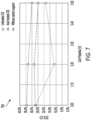
- FIG. 7 illustrates a graph 700 of the energetic efficiency versus cell potential for the four example electrodes described above at different sintered conditions.
- the energetic efficiency is a measure of the true energy efficiency of the electrochemical conversion process. This is done by the multiplication of the Faradaic efficiency with cell overpotential, which yields the actual energy input.
- the graph 700 illustrates that the energetic efficiency of the electrodes with the microporous carbon structure (treated and untreated) were found to be similar, but slightly below, the electrode without the microporous carbon structure through testing in a voltage region between 2.8 V to 3.8 V.
- the electrode with the acid treated microporous carbon structure showed a similar trend line as the electrode without the microporous carbon structure through the voltage region between 2.8 V to 3.8 V. All the electrodes showed an energetic efficiency of greater than 25% at the cell potential of 2.8 V.
- FIG. 8 illustrates a graph 800 of the current density in mA/cm 2 versus cell potential for the four example electrodes described above at different sintered conditions.
- the current density is a measure of the amount of charge able to be applied to the cell and is directly related to the maximum throughput or conversion rate. This makes the current density a critical factor when considering the scale-up economics of CO 2 electrolysis.
- the graph 800 illustrated that at 3.00 V the electrode without the microporous carbon structure had the highest current density, followed by the electrode with the acid treated microporous carbon structure, and then the electrode with the untreated microporous carbon structure.
- Graph 800 illustrates that the current density improves as the voltage increases for the electrode with the acid treated microporous carbon structure.
- the electrode with the untreated microporous carbon structure did not exhibit as good a performance as the electrode with the acid treated microporous carbon structure. All electrodes showed a current density of greater than 60 mA/cm 2 at a cell potential of 2.80 V.
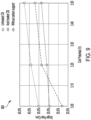
- FIG. 9 illustrates a graph 900 of the single pass conversion rate versus cell potential for the four example electrodes described above at different sintered conditions.
- the single pass conversion rate is a performance metric often related to scale-up economics of conversion systems. In this instance the outlet CO flow rate is measured and used to calculate the molar conversion percentage of the input CO 2 .
- the graph 900 illustrates that the electrode with the untreated microporous carbon structure had the highest single pass conversion rate, followed by the electrode without any microporous carbon structure, and then followed by the electrode with the acid treated microporous carbon structure.
- Graph 900 illustrates that the single pass conversion rate increases for all electrodes as the voltage is increased. All electrodes showed a single pass conversion rate of greater than 20% at cell potentials between 2.8 V to 3.8 V.
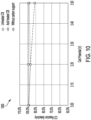
- FIG. 10 illustrates a graph 1000 of the CO reaction selectivity versus cell potential for the four example electrodes described above at different sintered conditions.
- the CO reaction selectivity is quantified by the molar ratio of CO to H 2 produced during cell operation.
- the CO selectivity is generally very high at lower potential ⁇ 2.8 V, reaching over 98% for all four devices.
- With the increase in applied voltage there is a declining trend in selectivity for all electrodes, but all electrodes showed a very high and consistent CO reaction selectivity at lower voltages (e.g., 3.0 V and 3.2 V).
- the electrodes with the microporous carbon structure can provide comparable target catalytic performance to the electrode without the impregnated microporous carbon structure.
- electrodes with the carbon supported surface functionalized silver nanoparticles of the present disclosure can provide the same target catalytic performance level compared to another electrode having surface functionalized silver nanoparticles that are not carbon supported.
- the silver loading of the electrode is two times or more lower compared to another electrode having surface functionalized silver nanoparticles that are not carbons supported.
- the acid pre-treatment further improves the Faradic efficiency, energetic efficiency, and current density, making the catalyst system highly attractive for CO 2 reduction applications.
- the more desirable catalytic behavior can be explained by the enhanced interaction between the silver and carbon support.
- strong acids such as HNOs
- HNOs have been reported to activate carbon surfaces, and possibly forming -COOH groups on the carbon surface.
- Other methods may also be used to activate the carbon surfaces to increase interaction between the silver and the carbon support.
- other treatments can include plasma treatment, bases, or other types of chemical treatments.
- Silver nanoparticles have strong interactions with the carboxylic acid and carbonyl groups present on the activated carbon surfaces, leading to better electron transfer properties and, thus, better catalytic performance.
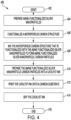
- FIGs. 3 and 4 illustrate flowcharts of example methods 300 and 400, respectively, for fabricating a gas diffusion electrode of the present disclosure.
- one or more blocks of the methods 300 and 400 may be performed by various tools or machines under the control of a central controller or processor (e.g., the printer 200) or in combination with manually performed steps to prepare the various compounds described herein.
- the method 300 begins.
- the method 300 prepares an ink comprising carbon supported nitrogen surface functionalized silver nanoparticles.
- the carbon supported nitrogen surface functionalized silver nanoparticles can be prepared by impregnating a microporous carbon structure with surface functionalized silver nanoparticles that are isolated away from the carbon structure during synthesis to form surface functionalized silver nanoparticle carbon particles.
- the silver nanoparticles may be nitrogen surface functionalized silver nanoparticles.
- the nitrogen surface functionalized silver nanoparticles may be prepared by mixing silver acetate with a nitrogen containing moiety.
- the nitrogen containing moiety may include an amine, an amide, an imide, or a nitrogen containing aromatic compound, all of which are described within the present disclosure above.
- the nitrogen surface functionalized silver nanoparticles maybe prepared by mixing silver acetate with dodecylamine, as described above in Example 1.
- nitrogen surface functionalized nanoparticles may be deposited on a carbon structure.
- the carbon structure may be a porous or non-porous carbon structure.
- the microporous carbon structures may be impregnated with the nitrogen surface functionalized nanoparticles, as described by Example 2.
- the microporous carbon structures may be functionalized with an acid before being impregnated with the nitrogen surface functionalized silver nanoparticles, as described by Example 3.
- the microporous carbon structures may include carbon black, carbon nanotubes, graphene, and the like.
- the ink may then be prepared with the carbon supported nitrogen surface functionalized silver nanoparticles.
- the microporous carbon structure impregnated with the nitrogen surface functionalized silver nanoparticles may be prepared as a catalyst ink that can be printed via a spray nozzle controlled by a printhead.
- the catalyst ink can be sprayed onto the carbon substrate with the movable printhead.
- the catalyst ink can be formulated with toluene, as described above in Example 4.
- the method 300 deposits the ink on an electrically conductive surface.
- the ink may be a catalyst ink.
- the catalyst ink can be sprayed or printed onto a carbon substrate.
- the catalyst ink can be printed in a serpentine pattern to evenly coat the substrate.
- the catalyst ink may be dried to form a gas diffusion electrode.
- the catalyst ink can be dried at room temperature for 24 hours to form the gas diffusion electrode.
- the gas diffusion electrode may be assembled as part of a membrane assembly electrode that is deployed in a flow cell electro-catalytic converter.
- the gas diffusion electrode may perform conversion of CO 2 into CO and H 2 , as described above.
- the method 300 ends.
- the method 400 begins.
- the method 400 prepares surface functionalized silver nanoparticles.
- the surface functionalized silver nanoparticles may be prepared by mixing silver acetate with a mixture of phenyl hdrazine, methanol, decalin, and dodecylamine. The mixture of the silver acetate powder, phenyl hdrazine, methanol, decalin, and dodecylamine may be heated. Then, methanol may be added to precipitate the surface functionalized silver nanoparticles. Details of the preparation are described above in Example 1.
- the method 400 functionalizes a microporous carbon structure.
- the microporous carbon structure may be functionalized by treating the microporous carbon structure with a strong acid, such as nitric acid.
- a strong acid such as nitric acid.
- An example of functionalizing the microporous carbon structure is described above in Example 3.
- the method 400 mixes the microporous carbon structure that is functionalized with the surface functionalized silver nanoparticles to form surface functionalized silver nanoparticle carbon particles.
- Example 3 described above, provides an example of how the functionalized microporous carbon structure is mixed with the surface functionalized silver nanoparticles.
- the method 400 prepares the surface functionalized silver nanoparticle carbon particles into a catalyst ink.
- the surface functionalized silver nanoparticle carbon particles may be mixed with toluene while stirring under a constant flow of argon. Details of preparing the catalyst ink with toluene are described above in Example 4.
- the method 400 prints the catalyst ink onto a carbon substrate.
- the catalyst ink can be printed or sprayed onto the carbon substrate with nitrogen flow gas in a serpentine path via a spray nozzle controlled by a printhead.
- the method 400 dries the catalyst ink.
- the catalyst ink can be dried at room temperature for 24 hours to finalize fabrication of the gas diffusion electrode.
- the gas diffusion electrode may be assembled as part of a membrane assembly electrode that is deployed in a flow cell electro-catalytic converter. The gas diffusion electrode may perform conversion of CO 2 into CO and H 2 , as described above.
- the method 400 ends.
Landscapes
- Chemical & Material Sciences (AREA)
- Engineering & Computer Science (AREA)
- Materials Engineering (AREA)
- Organic Chemistry (AREA)
- Chemical Kinetics & Catalysis (AREA)
- Metallurgy (AREA)
- Electrochemistry (AREA)
- Life Sciences & Earth Sciences (AREA)
- Wood Science & Technology (AREA)
- Inorganic Chemistry (AREA)
- General Chemical & Material Sciences (AREA)
- Mechanical Engineering (AREA)
- Nanotechnology (AREA)
- Electrodes For Compound Or Non-Metal Manufacture (AREA)
- Carbon And Carbon Compounds (AREA)
- Electrolytic Production Of Non-Metals, Compounds, Apparatuses Therefor (AREA)
- Catalysts (AREA)
Applications Claiming Priority (1)
| Application Number | Priority Date | Filing Date | Title |
|---|---|---|---|
| US17/810,953 US12606921B2 (en) | 2022-07-06 | 2022-07-06 | Carbon supported nitrogen surface functionalized silver nanoparticles for gas diffusion electrodes |
Publications (2)
| Publication Number | Publication Date |
|---|---|
| EP4303342A2 true EP4303342A2 (fr) | 2024-01-10 |
| EP4303342A3 EP4303342A3 (fr) | 2024-08-21 |
Family
ID=86861919
Family Applications (1)
| Application Number | Title | Priority Date | Filing Date |
|---|---|---|---|
| EP23179706.9A Pending EP4303342A3 (fr) | 2022-07-06 | 2023-06-16 | Nanoparticules d'argent fonctionnalisées à surface d'azote supportées sur du carbone pour électrodes de diffusion de gaz |
Country Status (3)
| Country | Link |
|---|---|
| US (1) | US12606921B2 (fr) |
| EP (1) | EP4303342A3 (fr) |
| JP (1) | JP2024008845A (fr) |
Families Citing this family (1)
| Publication number | Priority date | Publication date | Assignee | Title |
|---|---|---|---|---|
| US12570862B2 (en) * | 2022-07-06 | 2026-03-10 | Genesee Valley Innovations, LLC | Carbon supported surface functionalized silver nanoparticles for ink/electrodes/MEA |
Family Cites Families (10)
| Publication number | Priority date | Publication date | Assignee | Title |
|---|---|---|---|---|
| KR100684854B1 (ko) * | 2005-11-02 | 2007-02-20 | 삼성에스디아이 주식회사 | 연료 전지용 촉매, 이의 제조방법 및 이를 포함하는 연료전지용 막-전극 어셈블리 |
| US8765025B2 (en) * | 2010-06-09 | 2014-07-01 | Xerox Corporation | Silver nanoparticle composition comprising solvents with specific hansen solubility parameters |
| US8158032B2 (en) | 2010-08-20 | 2012-04-17 | Xerox Corporation | Silver nanoparticle ink composition for highly conductive features with enhanced mechanical properties |
| US8324294B2 (en) | 2011-03-07 | 2012-12-04 | Xerox Corporation | Solvent-based inks comprising silver nanoparticles |
| CN104507600B (zh) * | 2012-08-02 | 2017-11-14 | 国立大学法人山形大学 | 经被覆的银微粒的制造方法及利用该制造方法制造的经被覆的银微粒 |
| JP6327681B2 (ja) * | 2014-10-29 | 2018-05-23 | 日産自動車株式会社 | 燃料電池用電極触媒、その製造方法、当該触媒を含む燃料電池用電極触媒層ならびに当該触媒または触媒層を用いる燃料電池用膜電極接合体および燃料電池 |
| DE102018212409A1 (de) * | 2017-11-16 | 2019-05-16 | Siemens Aktiengesellschaft | Kohlenwasserstoff-selektive Elektrode |
| EP4065753A1 (fr) * | 2019-11-25 | 2022-10-05 | Twelve Benefit Corporation | Assemblage membrane-électrodes pour la réduction de co x |
| CN114574902B (zh) * | 2022-04-06 | 2024-02-09 | 中国科学技术大学 | 一种表面具有配体修饰的银纳米晶催化剂及其制备方法和应用 |
| US12570862B2 (en) * | 2022-07-06 | 2026-03-10 | Genesee Valley Innovations, LLC | Carbon supported surface functionalized silver nanoparticles for ink/electrodes/MEA |
-
2022
- 2022-07-06 US US17/810,953 patent/US12606921B2/en active Active
-
2023
- 2023-06-02 JP JP2023091531A patent/JP2024008845A/ja active Pending
- 2023-06-16 EP EP23179706.9A patent/EP4303342A3/fr active Pending
Also Published As
| Publication number | Publication date |
|---|---|
| EP4303342A3 (fr) | 2024-08-21 |
| JP2024008845A (ja) | 2024-01-19 |
| US20240011171A1 (en) | 2024-01-11 |
| US12606921B2 (en) | 2026-04-21 |
Similar Documents
| Publication | Publication Date | Title |
|---|---|---|
| Marepally et al. | Role of small Cu nanoparticles in the behaviour of nanocarbon-based electrodes for the electrocatalytic reduction of CO2 | |
| CN100472856C (zh) | 生产膜电极组件的方法 | |
| US20050233203A1 (en) | Modified carbon products, their use in fluid/gas diffusion layers and similar devices and methods relating to the same | |
| US8309276B2 (en) | Process for preparing of a catalyst solution for fuel cell and a membrane electrode assembly using the same | |
| JP7061249B2 (ja) | 水素発生触媒、水素発生装置、水素発生方法 | |
| US20090074956A1 (en) | Inkjet printing of materials for use in fuel cells | |
| Zhang et al. | Novel synthesis of PtPd nanoparticles with good electrocatalytic activity and durability | |
| EP4303342A2 (fr) | Nanoparticules d'argent fonctionnalisées à surface d'azote supportées sur du carbone pour électrodes de diffusion de gaz | |
| EP4303343A2 (fr) | Nanoparticules d'argent fonctionnalisées en surface supportées par du carbone pour encre/électrodes/mea | |
| Butcha et al. | Self-assembled monolayer protection of chiral-imprinted mesoporous platinum electrodes for highly enantioselective synthesis | |
| CN114196965A (zh) | 一种pem水电解用质子膜与ccm一体化制备工艺及设备 | |
| Ouimet et al. | Current status on the manufacturing of nanomaterials for proton exchange membrane energy systems by vapor-based processes | |
| EP3355397B1 (fr) | Complexe support-nanoparticules, son procédé de préparation, et ensemble membrane-électrodes le comprenant | |
| WO2007147689A1 (fr) | Procédé de production d'électrodes | |
| EP4343034A2 (fr) | Nanoparticules d'argent fonctionnalisées par un carboxyle supporté sur du carbone pour électrodes de diffusion de gaz | |
| EP4302902A1 (fr) | Nanoparticules d'argent fonctionnalisées en surface supportées par du carbone | |
| KR20220059190A (ko) | 금속 나노입자가 담지된 탄소 시트와 이의 제조방법, 이들을 포함하는 산소환원 촉매 및 이의 제조방법 | |
| TW200412689A (en) | Manufacturing process for fuel cell, and fuel cell apparatus | |
| CN114196966A (zh) | Pem水电解用质子膜与ccm一体化制备方法及装置 | |
| EP4300611A2 (fr) | Nanoparticules d'argent fonctionnalisées par une amine pour électrodes à diffusion gazeuse | |
| Lu et al. | Electrocatalytic reduction of CO2 to formic acid on palladium-graphene nanocomposites gas-diffusion electrode | |
| JP5074662B2 (ja) | 燃料電池用触媒層の製造方法及び製造装置 | |
| US12594548B2 (en) | High-densification, high-uniformization, and manufacturing method of single- and multi-component nanoparticles | |
| Xu et al. | High-performance Pt/CNTs catalysts via hydrogen plasma for methanol electrooxidation | |
| Feng et al. | Hydrothermal Method Using DMF as a Reducing Agent for the Fabrication of PdAg Nanochain |
Legal Events
| Date | Code | Title | Description |
|---|---|---|---|
| PUAI | Public reference made under article 153(3) epc to a published international application that has entered the european phase |
Free format text: ORIGINAL CODE: 0009012 |
|
| STAA | Information on the status of an ep patent application or granted ep patent |
Free format text: STATUS: THE APPLICATION HAS BEEN PUBLISHED |
|
| AK | Designated contracting states |
Kind code of ref document: A2 Designated state(s): AL AT BE BG CH CY CZ DE DK EE ES FI FR GB GR HR HU IE IS IT LI LT LU LV MC ME MK MT NL NO PL PT RO RS SE SI SK SM TR |
|
| PUAL | Search report despatched |
Free format text: ORIGINAL CODE: 0009013 |
|
| AK | Designated contracting states |
Kind code of ref document: A3 Designated state(s): AL AT BE BG CH CY CZ DE DK EE ES FI FR GB GR HR HU IE IS IT LI LT LU LV MC ME MK MT NL NO PL PT RO RS SE SI SK SM TR |
|
| RIC1 | Information provided on ipc code assigned before grant |
Ipc: C25B 11/095 20210101ALI20240717BHEP Ipc: C25B 11/081 20210101ALI20240717BHEP Ipc: C25B 11/032 20210101ALI20240717BHEP Ipc: C25B 1/23 20210101AFI20240717BHEP |
|
| STAA | Information on the status of an ep patent application or granted ep patent |
Free format text: STATUS: REQUEST FOR EXAMINATION WAS MADE |
|
| 17P | Request for examination filed |
Effective date: 20250221 |