EP4307766A1 - Procédé d'informations de configuration de faisceau, dispositif terminal, dispositif de réseau et support de stockage - Google Patents
Procédé d'informations de configuration de faisceau, dispositif terminal, dispositif de réseau et support de stockage Download PDFInfo
- Publication number
- EP4307766A1 EP4307766A1 EP21932224.5A EP21932224A EP4307766A1 EP 4307766 A1 EP4307766 A1 EP 4307766A1 EP 21932224 A EP21932224 A EP 21932224A EP 4307766 A1 EP4307766 A1 EP 4307766A1
- Authority
- EP
- European Patent Office
- Prior art keywords
- tci state
- configuration information
- same
- terminal device
- switch
- Prior art date
- Legal status (The legal status is an assumption and is not a legal conclusion. Google has not performed a legal analysis and makes no representation as to the accuracy of the status listed.)
- Pending
Links
- 238000000034 method Methods 0.000 title claims abstract description 62
- 238000005259 measurement Methods 0.000 claims abstract description 70
- 230000005540 biological transmission Effects 0.000 claims abstract description 55
- 238000012545 processing Methods 0.000 claims description 17
- 238000001514 detection method Methods 0.000 claims description 7
- 230000008859 change Effects 0.000 claims description 6
- 238000012544 monitoring process Methods 0.000 claims description 6
- 230000003111 delayed effect Effects 0.000 abstract description 9
- 230000002028 premature Effects 0.000 abstract description 8
- 238000004891 communication Methods 0.000 description 39
- 230000006870 function Effects 0.000 description 27
- 238000010586 diagram Methods 0.000 description 22
- 238000001228 spectrum Methods 0.000 description 9
- 230000011664 signaling Effects 0.000 description 7
- 238000007726 management method Methods 0.000 description 6
- 230000001976 improved effect Effects 0.000 description 5
- 238000010295 mobile communication Methods 0.000 description 5
- 230000008569 process Effects 0.000 description 5
- 238000005516 engineering process Methods 0.000 description 4
- 238000013507 mapping Methods 0.000 description 4
- 230000008093 supporting effect Effects 0.000 description 4
- 230000004913 activation Effects 0.000 description 3
- 238000004590 computer program Methods 0.000 description 3
- 238000013500 data storage Methods 0.000 description 3
- 230000007774 longterm Effects 0.000 description 3
- 238000010408 sweeping Methods 0.000 description 3
- 238000011161 development Methods 0.000 description 2
- 230000003993 interaction Effects 0.000 description 2
- 239000007787 solid Substances 0.000 description 2
- 230000005236 sound signal Effects 0.000 description 2
- 235000019527 sweetened beverage Nutrition 0.000 description 2
- XLYOFNOQVPJJNP-UHFFFAOYSA-N water Substances O XLYOFNOQVPJJNP-UHFFFAOYSA-N 0.000 description 2
- 230000001133 acceleration Effects 0.000 description 1
- 230000002776 aggregation Effects 0.000 description 1
- 238000004220 aggregation Methods 0.000 description 1
- 230000003190 augmentative effect Effects 0.000 description 1
- 230000001413 cellular effect Effects 0.000 description 1
- 239000003795 chemical substances by application Substances 0.000 description 1
- 238000013461 design Methods 0.000 description 1
- 238000007599 discharging Methods 0.000 description 1
- 230000009977 dual effect Effects 0.000 description 1
- 239000011521 glass Substances 0.000 description 1
- 230000005484 gravity Effects 0.000 description 1
- 230000000977 initiatory effect Effects 0.000 description 1
- 239000004973 liquid crystal related substance Substances 0.000 description 1
- 230000003287 optical effect Effects 0.000 description 1
- 239000013307 optical fiber Substances 0.000 description 1
- 238000009527 percussion Methods 0.000 description 1
- 230000005855 radiation Effects 0.000 description 1
- 238000011160 research Methods 0.000 description 1
- 239000004065 semiconductor Substances 0.000 description 1
- 239000004984 smart glass Substances 0.000 description 1
- 238000010897 surface acoustic wave method Methods 0.000 description 1
- 238000012546 transfer Methods 0.000 description 1
- 238000013519 translation Methods 0.000 description 1
- 230000001960 triggered effect Effects 0.000 description 1
- 230000000007 visual effect Effects 0.000 description 1
Images




Classifications
-
- H—ELECTRICITY
- H04—ELECTRIC COMMUNICATION TECHNIQUE
- H04W—WIRELESS COMMUNICATION NETWORKS
- H04W36/00—Hand-off or reselection arrangements
- H04W36/08—Reselecting an access point
- H04W36/085—Reselecting an access point involving beams of access points
-
- H—ELECTRICITY
- H04—ELECTRIC COMMUNICATION TECHNIQUE
- H04W—WIRELESS COMMUNICATION NETWORKS
- H04W16/00—Network planning, e.g. coverage or traffic planning tools; Network deployment, e.g. resource partitioning or cells structures
- H04W16/24—Cell structures
- H04W16/28—Cell structures using beam steering
-
- H—ELECTRICITY
- H04—ELECTRIC COMMUNICATION TECHNIQUE
- H04B—TRANSMISSION
- H04B7/00—Radio transmission systems, i.e. using radiation field
- H04B7/02—Diversity systems; Multi-antenna system, i.e. transmission or reception using multiple antennas
- H04B7/04—Diversity systems; Multi-antenna system, i.e. transmission or reception using multiple antennas using two or more spaced independent antennas
- H04B7/06—Diversity systems; Multi-antenna system, i.e. transmission or reception using multiple antennas using two or more spaced independent antennas at the transmitting station
- H04B7/0686—Hybrid systems, i.e. switching and simultaneous transmission
- H04B7/0695—Hybrid systems, i.e. switching and simultaneous transmission using beam selection
-
- H—ELECTRICITY
- H04—ELECTRIC COMMUNICATION TECHNIQUE
- H04W—WIRELESS COMMUNICATION NETWORKS
- H04W36/00—Hand-off or reselection arrangements
- H04W36/0005—Control or signalling for completing the hand-off
- H04W36/0055—Transmission or use of information for re-establishing the radio link
- H04W36/0072—Transmission or use of information for re-establishing the radio link of resource information of target access point
-
- H—ELECTRICITY
- H04—ELECTRIC COMMUNICATION TECHNIQUE
- H04W—WIRELESS COMMUNICATION NETWORKS
- H04W72/00—Local resource management
- H04W72/12—Wireless traffic scheduling
- H04W72/1263—Mapping of traffic onto schedule, e.g. scheduled allocation or multiplexing of flows
- H04W72/1273—Mapping of traffic onto schedule, e.g. scheduled allocation or multiplexing of flows of downlink data flows
-
- H—ELECTRICITY
- H04—ELECTRIC COMMUNICATION TECHNIQUE
- H04W—WIRELESS COMMUNICATION NETWORKS
- H04W72/00—Local resource management
- H04W72/20—Control channels or signalling for resource management
- H04W72/23—Control channels or signalling for resource management in the downlink direction of a wireless link, i.e. towards a terminal
- H04W72/232—Control channels or signalling for resource management in the downlink direction of a wireless link, i.e. towards a terminal the control data signalling from the physical layer, e.g. DCI signalling
-
- H—ELECTRICITY
- H04—ELECTRIC COMMUNICATION TECHNIQUE
- H04W—WIRELESS COMMUNICATION NETWORKS
- H04W36/00—Hand-off or reselection arrangements
- H04W36/24—Reselection being triggered by specific parameters
- H04W36/32—Reselection being triggered by specific parameters by location or mobility data, e.g. speed data
- H04W36/324—Reselection being triggered by specific parameters by location or mobility data, e.g. speed data by mobility data, e.g. speed data
-
- H—ELECTRICITY
- H04—ELECTRIC COMMUNICATION TECHNIQUE
- H04W—WIRELESS COMMUNICATION NETWORKS
- H04W72/00—Local resource management
- H04W72/04—Wireless resource allocation
- H04W72/044—Wireless resource allocation based on the type of the allocated resource
- H04W72/046—Wireless resource allocation based on the type of the allocated resource the resource being in the space domain, e.g. beams
-
- H—ELECTRICITY
- H04—ELECTRIC COMMUNICATION TECHNIQUE
- H04W—WIRELESS COMMUNICATION NETWORKS
- H04W76/00—Connection management
- H04W76/20—Manipulation of established connections
-
- H—ELECTRICITY
- H04—ELECTRIC COMMUNICATION TECHNIQUE
- H04W—WIRELESS COMMUNICATION NETWORKS
- H04W76/00—Connection management
- H04W76/30—Connection release
Definitions
- the disclosure relates to the field of communication, and more particularly, to a method for beam configuration information, a terminal device, a network device, and a storage medium.
- FR2 frequency range 2
- Implementations of the disclosure provide a method for beam configuration information, a terminal device, a network device, and a storage medium, for improving the efficiency of the terminal device in measurement and cell switch in the FR2 high-speed train scenario and avoiding premature or delayed switch.
- a first aspect of implementations of the disclosure provides a method for beam configuration information.
- the method is applied in the high-speed train scenario and may include the following.
- a terminal device receives beam configuration information sent by a network device, where the beam configuration information is used for transmission and reception of a physical downlink shared channel (PDSCH) or a physical downlink control channel (PDCCH), and the beam configuration information includes at least one of a transmission configuration indicator (TCI) state identity (ID), a TCI state list, or a TCI state pattern.
- TCI transmission configuration indicator
- ID transmission configuration indicator
- TCI state identity TCI state list
- TCI state pattern a TCI state pattern
- a second aspect of implementations of the disclosure provides a method for beam configuration information.
- the method is applied in the high-speed train scenario and may include the following.
- a network device sends beam configuration information to a terminal device, where the beam configuration information is used for transmission and reception of a PDSCH or a PDCCH, and the beam configuration information includes at least one of a TCI state ID, a TCI state list, or a TCI state pattern.
- the beam configuration information is used for the terminal device to perform beam switch or cell switch.
- a third aspect of implementations of the disclosure provides a terminal device.
- the terminal device has a function of improving the efficiency of the terminal device in measurement and cell switch in the FR2 high-speed train scenario and avoiding premature or delayed switch.
- This function may be implemented by hardware or by executing corresponding software by hardware.
- the hardware or the software includes one or more modules corresponding to the above function.
- a fourth aspect of implementations of the disclosure provides a network device.
- the network device has a function of improving the efficiency of the terminal device in measurement and cell switch in the FR2 high-speed train scenario and avoiding premature or delayed switch.
- This function may be implemented by hardware or by executing corresponding software by hardware.
- the hardware or the software includes one or more modules corresponding to the above function.
- the terminal device includes a memory storing executable program codes and a transceiver and a processor coupled to the memory.
- the processor and the transceiver are configured to perform the method described in the first aspect of implementations of the disclosure.
- the network device includes a memory storing executable program codes and a transceiver and a processor coupled to the memory.
- the processor and the transceiver are configured to perform the method described in the second aspect of implementations of the disclosure.
- the computer-readable storage medium includes instructions, which, when running on a computer, cause the computer to perform the method described in the first aspect or the second aspect of the disclosure.
- the chip is coupled with a memory in a terminal device, so that the chip, when running, invokes program instructions stored in the memory to cause the terminal device to perform the method described in the first aspect or the second aspect of the disclosure.
- the method is applied in the high-speed train scenario.
- the terminal device receives the beam configuration information sent by the network device, where the beam configuration information is used for transmission and reception of the PDSCH or the PDCCH, and the beam configuration information includes at least one of the TCI state ID, the TCI state list, or the TCI state pattern.
- the terminal device performs beam switch or cell switch according to the beam configuration information. In this way, the efficiency of the terminal device in measurement and cell switch in the FR2 high-speed train scenario can be improved and premature or delayed switch can be avoided.
- Transmission configuration indicator (TCI) state quasi co-location (QCL) indication for downlink (DL) transmission.
- TCI Transmission configuration indicator
- QCL quasi co-location
- a reception algorithm can be improved with characteristics of a transmission environment corresponding to data transmission. For example, design and parameters of a channel estimator can be optimized with statistic properties of the channel. In new radio (NR) systems, these characteristics corresponding to data transmission are represented by a QCL state (QCL-Info).
- QCL-Info QCL state
- TRP transmission/reception points
- the network side when transmitting a DL control channel or data channel, the network side will indicate corresponding QCL state information to the terminal through a TCI state.
- One TCI state can contain the following configuration: a TCI state identity (ID) used to identify a TCI state; QCL information 1; and QCL information 2 (optional).
- ID used to identify a TCI state
- QCL information 1 used to identify a TCI state
- QCL information 2 optionally used to identify a TCI state
- One QCL information contains the following information: a QCL type configuration which can be one of QCL type A, QCL type B, QCL type C, or QCL type D; a QCL reference signal configuration, including a cell ID of a cell where a reference signal is located, a bandwidth part (BWP) ID, and a reference signal ID which can be a channel state information reference signal (CSI-RS) resource ID or a synchronization signal/physical broadcast channel (PBCH) block (SSB) index.
- CSI-RS channel state information reference signal
- PBCH synchronization signal/physical broadcast channel
- the QCL type of at least one QCL information should be one of type A, type B, and type C, and the QCL type of the other QCL information (if configured) should be QCL type D.
- the network side may indicate a corresponding TCI state for a DL signal or a DL channel.
- the terminal can assume that the target DL signal has the same large-scale parameter as the reference SSB or the reference CSI-RS resource, and the large-scale parameter is determined according to the QCL type configuration.
- the terminal can receive the target DL signal with a same receiving beam (i.e., spatial Rx parameter) as that for receiving the reference SSB or the reference CSI-RS resource.
- a same receiving beam i.e., spatial Rx parameter
- the target DL channel or DL signal and the reference SSB or the reference CSI-RS resource of the target DL channel or DL signal are transmitted by the same TRP or the same panel or transmitted with the same beam on the network side. If two DL signals or DL channels are transmitted by different TRPs or panels, or transmitted with different beams, the two DL signals or DL channels are usually configured with different TCI states.
- the TCI state of a corresponding control resource set can be indicated through a radio resource control (RRC) signaling or through an RRC signaling + a medium access control (MAC) signaling.
- RRC radio resource control
- MAC medium access control
- FIG. 1 is a schematic diagram of a configuration method for a TCI state of a PDSCH.
- the user equipment shall be able to use a target TCI state of a serving cell where TCI state switch currently occurs and receive a PDCCH at the first slot that is after slot n + THARQ + 3 N slot subframe , ⁇ +TOk*(Tfirst-SSB + TSSB-proc)/NR slot length.
- the LTE Before and at slot n + THARQ + 3 N slot subframe , ⁇ , the LTE shall be able to receive a PDCCH with the old TCI state.
- the UE shall be able to use a target TCI state of a serving cell where TCI state switch currently occurs and receive a PDCCH at the first slot that is after slot n + THARQ + 3 N slot subframe , ⁇ + TL 1 ⁇ RSRP + TOuk ⁇ ( Tfirst ⁇ SSB + TSSB ⁇ proc)/NR slot length.
- the UE Before and at slot n + THARQ + 3 N slot subframe , ⁇ , the UE shall be able to receive a PDCCH with the old TCI state.
- the SSB shall be the QCL-Type A or QCL-Type C to target TCI state.
- LTE upon receiving PDSCH carrying MAC-CE active TCI state list update at slot n, LTE shall be able to receive PDCCH to schedule PDSCH with the new target TCI state at the first slot that is after slot n + THARQ + 3 N slot subframe , ⁇ + TOk ⁇ ( Tfirst ⁇ SSB + TSSB-proc)/NR slot length, where THARQ, Tfirst-SSB, TSSB-proc, and TOk are defined in clause 8.10.3.
- LTE upon receiving PDSCH carrying MAC-CE active TCI state list update at slot n, LTE shall be able to receive PDCCH to schedule PDSCH with the new target TCI state at the first slot that is after slot n + THARQ + 3 N slot subframe , ⁇ + TOk ⁇ ( Tfirst ⁇ SSB + TSSB-proc)/NR slot length, where THARQ, Tfirst-SSB, TSSB-proc, and TOk are defined in clause 8.10.3.
- NR next generation new radio
- FR1 frequency range 1
- FR2 frequency range 2
- Table 1 frequency band definition corresponding frequency band range FR 1 410 MHz-7.125 GHz FR 2 24.25 GHz-52.6GHz
- Measurement parameter configurations are different in different high-speed train deployment scenarios.
- High-speed train measurement requires for the possibility of reducing the number of measurement samples.
- a beam switch delay may result in communication discontinuity or failure during fast moving of the LTE, and in the FR2 high-speed train (HST) scenario requires for a higher LTE beam scanning speed to improve the measurement speed.
- HST high-speed train
- an FR2 LTE supports switch scanning with eight receiving (Rx) beams, and the Rx beam measurement speed (Rx beam sweeping speed) can be improved by reducing the number of beams or repeating a beam index.
- the TCI state of the target beam is unknown, synchronization and L1-RSRP measurement are required, so it is best that the known target TCI configured by the network is known to the LTE.
- beam information is obtained by optimizing network (pre)configuration, for example, Rx beam sweeping can be sped up and measurement time extension due to switch can be reduced through repeated reception of multiple SSBs with the same index in one SSB burst. This is necessary and valuable for improving the efficiency of measurement and reporting by the LTE and reducing the probability of premature or delayed switch.
- the network deployment such as the direction of beam scanning and beam transmission configuration is predictable, and it is recommended to pre-configure a cell switch list, spatial transmission configuration information, etc., so that the excessive switch delay or interruption due to cell switch or beam switch can be reduced.
- GSM global system of mobile communication
- CDMA code division multiple access
- WCDMA wideband code division multiple access
- GPRS general packet radio service
- LTE long term evolution
- LTE-A advanced LTE
- NR new radio
- LTE-U LTE-U
- NTN non-terrestrial network
- UMTS universal mobile telecommunication system
- WLAN wireless local area networks
- WiFi wireless fidelity
- 5G 5th-generation
- a conventional communication system generally supports a limited number of connections and therefore is easy to implement.
- a mobile communication system will not only support conventional communication but also support, for example, device to device (D2D) communication, machine to machine (M2M) communication, machine type communication (MTC), and vehicle to vehicle (V2V) communication, or vehicle to everything (V2X) communication. Implementations of the disclosure can also be applied to these communication systems.
- D2D device to device
- M2M machine to machine
- MTC machine type communication
- V2V vehicle to vehicle
- V2X vehicle to everything
- a communication system of implementations of the disclosure may be applied to a carrier aggregation (CA) scenario, a dual connectivity (DC) scenario, or a standalone (SA) network deployment scenario.
- CA carrier aggregation
- DC dual connectivity
- SA standalone
- the communication system of implementations of the disclosure may be applied to an unlicensed spectrum or a licensed spectrum, where the unlicensed spectrum may also be referred to as a shared spectrum, and the licensed spectrum may also be referred to as a non-shared spectrum.
- the terminal device may also be referred to as a user equipment (LTE), an access terminal, a subscriber unit, a subscriber station, a mobile station, a remote station, a remote terminal, a mobile device, a user terminal, a terminal, a wireless communication device, a user agent, or a user device.
- LTE user equipment
- the terminal device may be a station (ST) in a WLAN, a cellular radio telephone, a cordless telephone, a session initiation protocol (SIP) telephone, a wireless local loop (WLL) station, a personal digital assistant (PDA), a handheld device with wireless communication functions, a computing device, other processing devices coupled with a wireless modem, an in-vehicle device, a wearable device, and a next-generation communication system, for example, a terminal device in an NR network, a terminal device in a future evolved public land mobile network (PLMN), etc.
- ST station
- WLAN wireless local loop
- PDA personal digital assistant
- the terminal device may be deployed on land, for example, deployed indoors or outdoors, and may be handheld, wearable, or vehicle-mounted.
- the terminal device may also be deployed on water, for example, on a ship, etc.
- the terminal device may also be deployed in the air, for example, on an airplane, an air balloon, a satellite, etc.
- the terminal device may be a mobile phone, a pad, a computer with a wireless transceiver function, a virtual reality (VR) terminal device, an augmented reality (AR) terminal device, a wireless terminal device in industrial control, a wireless terminal device in self driving, a wireless terminal device in remote medical, a wireless terminal device in smart grid, a wireless terminal device in transportation safety, a wireless terminal device in smart city, a wireless terminal device in smart home, etc.
- VR virtual reality
- AR augmented reality
- the terminal device may also be a wearable device.
- the wearable device may also be called a wearable smart device, which is a generic term of wearable devices obtained through intelligentization designing and development on daily wearing products with wearable technology, for example, glasses, gloves, watches, clothes, accessories, and shoes.
- the wearable device is a portable device that can be directly worn or integrated into clothes or accessories of a user.
- the wearable device can also realize various functions through software support, data interaction, and cloud interaction.
- a wearable smart device in a broad sense includes, for example, a smart watch or smart glasses with complete functions and large sizes and capable of realizing independently all or part of functions of a smart phone, and for example, various types of smart bands and smart jewelries for physical monitoring, of which each is dedicated to application functions of a certain type and required to be used together with other devices such as a smart phone.
- the network device may be a device configured to communicate with a mobile device, and the network device may be an access point (AP) in the WLAN, a base transceiver station (BTS) in the GSM or CDMA, may also be a Node B (NB) in WCDMA, and may further be an evolutional Node B (eNB or eNodeB) in LTE, or a relay station or AP, or an in-vehicle device, a wearable device, a network device (gNB) in the NR network, a network device in the future evolved PLMN, a network device in a NTN, etc.
- AP access point
- BTS base transceiver station
- NB Node B
- eNB evolutional Node B
- gNB network device
- gNB network device in the NR network
- future evolved PLMN a network device in a NTN, etc.
- the network device may be of mobility.
- the network device may be a mobile device.
- the network device may be a satellite or a balloon station.
- the satellite may be a low earth orbit (LEO) satellite, a medium earth orbit (MEO) satellite, a geostationary earth orbit (GEO) satellite, a high elliptical orbit (HEO) satellite, etc.
- the network device may also be a base station located on land, water, etc.
- the network device can provide services for a cell, and the terminal device communicates with the network device through a transmission resource (for example, a frequency-domain resource or a spectrum resource) for the cell.
- the cell may be a cell corresponding to the network device (for example, a base station).
- the cell may correspond to a macro base station, and may correspond to a base station corresponding to a small cell.
- the small cell may include: a metro cell, a micro cell, a pico cell, a femto cell, and the like. These small cells are characterized by small coverage and low transmission power and are adapted to provide data transmission service with high-rate.
- FIG. 2 is a system architecture diagram of a communication system applied in implementations of the disclosure.
- the communication system may include a network device.
- the network device may be a device that can communicate with a terminal device (or referred to as a communication terminal or a terminal).
- the network device can provide a communication coverage for a specific geographical area and communicate with terminal devices in the coverage area.
- FIG. 2 exemplarily illustrates one network device and two terminal devices.
- the communication system may include multiple network devices, and there may be other numbers of terminal devices in a coverage area of each of the network devices, which is not limited herein.
- the communication system may further include other network entities such as a network controller, a mobility management entity, or the like, which is not limited herein.
- the network device may include an access network device and a core network device. That is, the wireless communication system also includes multiple core networks for communication with the access network device.
- the access network device may be an evolutional node B ("eNB” or "e-NodeB” for short), a macro base station, a micro base station, (also referred to as “small base station"), a pico base station, an access point (AP), a transmission point (TP), or a new generation Node B (gNodeB), and the like in an LTE system, a next generation mobile communication system, a next radio (NR) system, or an authorized auxiliary access long-term evolution (LAA-LTE) system.
- eNB evolutional node B
- e-NodeB evolutional node B
- AP access point
- TP transmission point
- gNodeB new generation Node B
- a device having a communication function in a network/system may be referred to as a communication device.
- the communication device may include the network device and the terminal device having a communication function, and the network device and the terminal device may be the specific devices described in implementations of the disclosure, which will not be repeated herein.
- the communication device may also include other devices in the communication system, such as a network controller, a mobility management entity, and other network entities, which is not limited herein.
- FIG. 3 is a schematic diagram of an implementation of a method for beam configuration information in implementations of the disclosure.
- the method is applied in the high-speed train scenario and may include the following.
- a terminal device receives beam configuration information sent by a network device, where the beam configuration information is used for transmission and reception of a PDSCH or a PDCCH, and the beam configuration information includes at least one of a TCI state ID, a TCI state list, or a TCI state pattern.
- the network device sends the beam configuration information to the terminal device, where the beam configuration information is used for transmission and reception of a PDSCH or a PDCCH, and the beam configuration information includes at least one of a TCI state ID, a TCI state list, or a TCI state pattern.
- the beam configuration information is used for the terminal device to perform beam switch or cell switch.
- the network device configures the TCI state pattern according to at least one of a cell, a remote radio head (RRH), or a beam deployed. That is, the TCI state pattern is configured according to at least one of a cell, an RRH, or a beam deployed by the network device.
- RRH remote radio head
- the TCI state pattern corresponds to a set of TCI state IDs or a TCI state list configuration.
- the TCI state pattern is preconfigured by the network device according to a network topology on a traveling route.
- the TCI state pattern may be referred to as a TCI state pattern or a TCI state mode.
- the network device may send the beam configuration information to the terminal device as follows.
- the network device sends the beam configuration information to the terminal device during RRC reconfiguration or RRC release.
- the network device sends the beam configuration information to the terminal device through a downlink control information (DCI) or a MAC.
- DCI downlink control information
- MAC MAC
- the terminal device may receive the beam configuration information sent by the network device as follows.
- the terminal device receives the beam configuration information sent by the network device, during RRC reconfiguration or RRC release.
- the terminal device receives the beam configuration information sent by the network device, through a DCI (layer 1) or a MAC (layer 2).
- the PDSCH or the PDCCH is associated with beams with a same beam index and is configured with same TCI state information, or the PDSCH or the PDCCH is configured with two TCI states and is associated with beams with different beam indexes.
- the beam index is indicated by a reference signal index or a resource ID corresponding to the beam.
- the reference signal may include a SSB, a CSI-RS, etc.
- the beam configuration information at least two beam indexes corresponding to a same RRH are reused, and beams corresponding to the TCI state pattern or the TCI state list are configured with a same TCI state.
- beam indexes corresponding to adjacent RRHs in a same cell or in different cells are reused, and beams corresponding to the TCI state pattern or the TCI state list are configured with a same TCI state.
- the beam configuration information at least two adjacent beam indexes corresponding to a same RRH are reused, and beams corresponding to the TCI state pattern or the TCI state list are configured with a same TCI state.
- beams corresponding to the TCI state pattern or the TCI state list have a same TCI state, and the same TCI state at least includes a same TCI state ID and a same QCL type.
- the same TCI state includes a same or different QCL cell IDs, BWP IDs, or reference signals.
- TCI state patterns of different cells are reused, or TCI state lists or TCI state patterns corresponding to beams of different RRHs are reused, or TCI state lists or TCI state IDs corresponding to different beams with a same index are reused.
- the terminal device triggers change in the beam configuration information and switch of a TCI state corresponding to the PDSCH or the PDCCH during the beam switch according to a DCI or a MAC-CE configured by the network.
- a delay threshold is satisfied when the terminal device performs the beam switch.
- the TCI state, the TCI state list, or the TCI state pattern further includes: a QCL information type associated with a SSB, a CSI-RS, or a position reference signal (PRS) in a serving cell or a non-serving cell, where the QCL information type at least includes QCL-type C or QCL-type D.
- a QCL information type associated with a SSB, a CSI-RS, or a position reference signal (PRS) in a serving cell or a non-serving cell, where the QCL information type at least includes QCL-type C or QCL-type D.
- beam indexes corresponding to adjacent RRHs in a same cell or in different cell are reused.
- beam indexes and TCI state lists of different cells are reused.
- the beam switch is classified as follows.
- Case 1 Adjacent RRHs of a single frequency network (SFN) belong to the same cell, and a beam index is not shared between different RRHs.
- SFN single frequency network
- index information and/or TCI state (list) information of all reference signal (RS) (such as CSI-RS, SSB, PRS, etc.) receiving beams of the terminal device in the cell at the later part of the traveling is configured, that is, an active TCI state list is configured or updated.
- RS reference signal
- Different beams/panels of an RRH share the same SSB index, and a SSB signal is transmitted repeatedly through beams with the same SSB index but different directions.
- the terminal device can repeatedly receive the SSB signal multiple times during one receiving beam scanning, which improves the measurement speed and the beam scanning speed.
- Beams with the same SSB index can be configured with the same TCI state information. During switching between different beams, a TCI state corresponding to an RS also needs to be switched and a certain switch delay requirement needs to be satisfied.
- TCI state switch a conditional TCI state list is preconfigured.
- QCL-TypeD to a PRS/SSB in serving cell or non-serving cell.
- QCL-Type C to a SSB in serving cell or non-serving cell.
- QCL-TypeD is used for supporting FR2.
- QCL-TypeC is used for assisting estimating the timing of PRS.
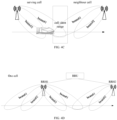
- FIG. 4A is a schematic diagram of SSB index-to-beam mapping in a bi-directional SFN in the disclosure.
- index information and/or TCI state (list) information of all RS such as CSI-RS, SSB, PRS, etc.
- RS such as CSI-RS, SSB, PRS, etc.
- Some beams/panels corresponding to an RRH share the same SSB index to repeatedly transmit a SSB signal, a beam index list is formed, and beam indexes corresponding to adjacent RRHs are repeated in order exactly as this set of beams indexes, such as, 0123 (the beam index list of RRH1), 0123 (the beam index list of RRH2), and 0123 (the beam index list of RRH3).
- SSB indexes are preconfigured, and the LTE can predict beam information, thereby improving the efficiency of switch and measurement.
- Some beams/panels corresponding to an RRH share the same SSB index to repeatedly transmit a SSB signal, a beam index list is formed, and indexes of adjacent beams of two adjacent RRHs are the same and are repeated, such as 0123 (the beam index list of RRH1), 3210 (the beam index list of RRH2), and 0123 (the beam index list of RRH2).
- SSB indexes are preconfigured, so that the terminal device can predict beam information, thereby improving the efficiency of switch and measurement.
- FIG. 4B is a schematic diagram of SSB index-to-beam mapping in a bi-directional SFN in the disclosure.
- Beams with the same SSB index are configured with the same TCI state information.
- a TCI state corresponding to an RS also needs to be switched and a delay threshold needs to be satisfied, which can be understood as satisfying a certain switch delay requirement.
- TCI state switch a conditional TCI state list is preconfigured.
- QCL-TypeD to a PRS/SSB in serving cell or non-serving cell.
- QCL-Type C to a SSB in serving cell or non-serving cell.
- QCL-TypeD is used for supporting FR2.
- QCL-TypeC is used for assisting estimating the timing of PRS.
- FIG. 4C is a schematic diagram of inter-cell switch in the disclosure.
- Case 1 The network device is limited to configure only one reference signal for performing continuous cell measurement.
- Case 2 Switch between SSB beam and CSI-RS beam for inter-cell switch measurement, where a beam index and/or a TCI state (conditional TCI state list) of a RS of a target cell is preconfigured.
- An auxiliary network signaling is introduced to indicate the deployment and the configuration of a current network of the LTE.
- a one-bit signaling is used to distinguish case 1/2.
- conditional TCI state list is preconfigured.
- the network device (pre)configures a TCI state pattern for some DL reference signals.
- the TCI state pattern is configured per cell (multiple UEs) per RS or configured per LTE.
- Case 1 Switch between beams corresponding to different RRHs in the same cell.
- Case 2 Switch between beams corresponding to different RRHs in different cells.
- the configuration of the TCI state pattern depends on a cell, an RRH, or a beam deployed by the network device. That is, the TCI state pattern is preconfigured for the LTE by the network according to the network topology on a traveling route.
- all beam indexes corresponding to a certain RRH are 12211221, which can correspond to various possible TCI state pattern configurations.
- beam indexes before and after switch between adjacent RRHs are reused, but the TCI state is not shared.
- TCI state pattern 1 corresponding to RRH1 is different from TCI state pattern 2 corresponding to RRH2.
- RRC layer 3 reconfiguration triggered by a DCI (layer 1) or a MAC (layer 2) indicates whether beam index reuse is supported for beams of a current cell or RRH, and the TCI state pattern is updated at the same time.
- FIG. 4D is a schematic diagram of beam switch in the disclosure.
- the terminal device performs beam switch or cell switch according to the beam configuration information.
- the terminal device may perform intra-cell beam switch or inter-cell beam switch according to the beam configuration information as follows.
- the terminal device When performing cell switch, the terminal device performs beam switch or transmission of the PDSCH or the PDCCH after switching to a target cell according to beam configuration information of a source cell or a non-serving cell, where the beam configuration information is indicated by an RRC connection release message or other network assistance information.
- the terminal device when performing the intra-cell beam switch, performs beam switch or transmission of the PDSCH or the PDCCH after switching to the target cell according to beam configuration information of a serving cell, where the beam configuration information is indicated by a DCI, a MAC-CE, or an RRC connection release message or other network assistance information.
- the beam switch may include switch between beams corresponding to different RRHs in a same cell or switch between beams corresponding to adjacent RRHs during inter-cell switch.
- the method further includes the following.
- the terminal device obtains a measurement result by performing signal measurement according to the beam configuration information.
- the terminal device reports the measurement result to the network device.
- the signal measurement includes: radio resource management (RRM) measurement, radio link monitoring (RLM) measurement, beam failure detection (BFD) measurement, or positioning reference signal (PRS) positioning measurement that are based on a SSB or a CSI-RS.
- RRM radio resource management
- RLM radio link monitoring
- BFD beam failure detection
- PRS positioning reference signal
- the method further includes the following.
- the terminal device sends a request for updating the beam configuration information to the network device, where the request includes an inter-cell switch request and an intra-cell switch request.
- the network device preconfigures or updates the beam configuration information.
- the terminal device receives updated beam configuration information sent by the network device.
- the TCI state, the TCI state list, or the TCI state pattern further includes: a QCL information type associated with a SSB, a CSI-RS, or a PRS in a serving cell or a non-serving cell, where the QCL information type at least includes QCL-type C or QCL-type D.
- the terminal device receives the beam configuration information sent by the network device, where the beam configuration information is used for transmission and reception of a PDSCH or a PDCCH, and the beam configuration information includes at least one of a TCI state ID, a TCI state list, or a TCI state pattern.
- the terminal device performs beam switch or cell switch according to the beam configuration information. Implementations of the disclosure are mainly applicable to the FR2 HST scenario. Since the traveling route of the terminal device is known, the deployment of network device such as the direction of beam scanning and beam transmission configuration is predictable.
- the excessive switch delay or interruption due to cell switch or beam switch can be reduced.
- Beam information is obtained by optimizing network (pre)configuration, for example, Rx beam sweeping can be sped up and measurement time extension due to switch can be reduced through repeated reception of multiple SSBs with the same index in one SSB burst. In this way, the efficiency of measurement and reporting by the terminal device can be improved and the probability of premature or delayed switch can be reduced. Further, through network pre-configuration or beam configuration information merging and repetition and the like, the efficiency of the terminal device in measurement and cell switch in the FR2 high-speed train scenario can be improved and premature or delayed switch can be avoided.
- FIG. 5 is a schematic diagram of an implementation of a terminal device in implementations of the disclosure.
- the terminal device includes a transceiver module 501 and a processing module 502.
- the transceiver module 501 is configured to receive beam configuration information sent by a network device, where the beam configuration information is used for transmission and reception of a PDSCH or a PDCCH, and the beam configuration information includes at least one of a TCI state ID, a TCI state list, or a TCI state pattern.
- the processing module 502 is configured to perform beam switch or cell switch according to the beam configuration information.
- the TCI state pattern is configured according to at least one of a cell, a RRH, or a beam deployed by the network device.
- the TCI state pattern corresponds to a set of TCI state IDs or a TCI state list configuration.
- the transceiver module 501 is specifically configured to: receive the beam configuration information sent by the network device, during RRC reconfiguration or RRC release; or receive the beam configuration information sent by the network device, through a DCI or a MAC.
- the PDSCH or the PDCCH is associated with beams with a same beam index and is configured with same TCI state information; or the PDSCH or the PDCCH is configured with two TCI states and is associated with beams with different beam indexes.
- the beam index is indicated by a reference signal index or a resource ID corresponding to the beam.
- the beam configuration information at least two beam indexes corresponding to a same RRH are reused, and beams corresponding to the TCI state pattern or the TCI state list are configured with a same TCI state; or in the beam configuration information, beam indexes corresponding to adjacent RRHs in a same cell or in different cells are reused, and beams corresponding to the TCI state pattern or the TCI state list are configured with a same TCI state.
- beams corresponding to the TCI state pattern or the TCI state list have a same TCI state, and the same TCI state at least includes a same TCI state ID and a same QCL type.
- the same TCI state includes a same or different QCL cell IDs, BWP IDs, or reference signals.
- TCI state patterns of different cells are reused; or TCI state lists or TCI state patterns corresponding to beams of different RRHs are reused; or TCI state lists or TCI state IDs corresponding to different beams with a same index are reused.
- the processing module 502 is further configured to trigger change in the beam configuration information and switch of a TCI state corresponding to the PDSCH or the PDCCH during the beam switch according to a DCI or a MAC-CE configured by the network.
- a delay threshold is satisfied when the terminal device performs the beam switch.
- the processing module 502 is specifically configured to: when performing cell switch, perform beam switch or transmission of the PDSCH or the PDCCH after switching to a target cell according to beam configuration information of a source cell or a non-serving cell, where the beam configuration information is indicated by an RRC connection release message; or when performing intra-cell beam switch, perform beam switch or transmission of the PDSCH or the PDCCH after switching to the target cell according to beam configuration information of a serving cell, where the beam configuration information is indicated by a DCI, a MAC-CE, or an RRC connection release message.
- the beam switch includes switch between beams corresponding to different RRHs in a same cell or switch between beams corresponding to adjacent RRHs during inter-cell switch.
- the processing module 502 is further configured to obtain a measurement result by performing signal measurement according to the beam configuration information; and the transceiver module 501 is further configured to report the measurement result to the network device.
- the signal measurement includes: RRM measurement, RLM measurement, BFD measurement, or PRS positioning measurement that are based on a SSB or a CSI-RS.
- the transceiver module 501 is further configured to: send a request for updating the beam configuration information to the network device, where the request includes an inter-cell switch request and an intra-cell switch request; and receive updated beam configuration information sent by the network device.
- the TCI state, the TCI state list, or the TCI state pattern further includes: a QCL information type associated with a SSB, a CSI-RS, or a PRS in a serving cell or a non-serving cell, where the QCL information type at least includes QCL-type C or QCL-type D.
- FIG. 6 is a schematic diagram of an implementation of a network device in implementations of the disclosure.
- the network device includes a transceiver module 601.
- the transceiver module 601 is configured to send beam configuration information to a terminal device, where the beam configuration information is used for transmission and reception of a PDSCH or a PDCCH, the beam configuration information includes at least one of a TCI state ID, a TCI state list, or a TCI state pattern, and the beam configuration information is used for the terminal device to perform beam switch or cell switch.
- the network device further includes a processing module 602.
- the processing module 602 is configured to configure the TCI state pattern according to at least one of a cell, a RRH, or a beam deployed.
- the TCI state pattern corresponds to a set of TCI state IDs or a TCI state list configuration.
- the transceiver module 601 is specifically configured to: send the beam configuration information to the terminal device during RRC reconfiguration or RRC release; or send the beam configuration information to the terminal device through a DCI or a MAC.
- the PDSCH or the PDCCH is associated with beams with a same beam index and is configured with same TCI state information; or the PDSCH or the PDCCH is configured with two TCI states and is associated with beams with different beam indexes.
- the beam index is indicated by a reference signal index or a resource ID corresponding to the beam.
- the beam configuration information at least two beam indexes corresponding to a same RRH are reused, and beams corresponding to the TCI state pattern or the TCI state list are configured with a same TCI state; or in the beam configuration information, beam indexes corresponding to adjacent RRHs in a same cell or in different cells are reused, and beams corresponding to the TCI state pattern or the TCI state list are configured with a same TCI state.
- beams corresponding to the TCI state pattern or the TCI state list have a same TCI state, and the same TCI state at least includes a same TCI state ID and a same QCL type.
- the same TCI state includes a same or different QCL cell IDs, BWP IDs, or reference signals.
- TCI state patterns of different cells are reused; or TCI state lists or TCI state patterns corresponding to beams of different RRHs are reused; or TCI state lists or TCI state IDs corresponding to different beams with a same index are reused.
- the beam switch includes switch between beams corresponding to different RRHs in a same cell or switch between beams corresponding to adjacent RRHs during inter-cell switch.
- the TCI state, the TCI state list, or the TCI state pattern further includes: a quasi co-location (QCL) information type associated with a synchronization signal/physical broadcast channel (PBCH) block (SSB), a channel state information reference signal (CSI-RS), or a positioning reference signal (PRS) in a serving cell or a non-serving cell, where the QCL information type at least includes QCL-type C or QCL-type D.
- QCL quasi co-location
- PBCH synchronization signal/physical broadcast channel
- CSI-RS channel state information reference signal
- PRS positioning reference signal
- FIG. 7 is a schematic diagram of another implementation of a terminal device in implementations of the disclosure.
- the terminal device is a mobile phone and may include a radio frequency (RF) circuit 710, a memory 720, an input unit 730, a display unit 740, a sensor 750, an audio circuit 760, a wireless fidelity (WiFi) module 770, a processor 780, a power supply 790, and other components.
- the radio frequency circuit 710 includes a receiver 714 and a transmitter 712.
- the mobile phone may include more or fewer components than illustrated and may combine some components or adopt different component arrangement.
- the RF circuit 710 is configured to transmit or receive information, or transmit or receive a signal during a call.
- the RF circuit 710 is configured to provide DL information to the processor 780 for processing after receiving the DL information from a base station, and transmit uplink (UL) data to the base station.
- the RF circuit 710 includes but is not limited to an antenna, at least one amplifier, a transceiver, a coupler, a low noise amplifier (LNA), a duplexer, and the like.
- the RF circuit 710 may also communicate with the network and other devices via wireless communication.
- the above wireless communication may use any communication standard or protocol, which includes but is not limited to global system of mobile communication (GSM), general packet radio service (GPRS), code division multiple access (CDMA), wideband code division multiple access (WCDMA), long term evolution (LTE), E-mail, short messaging service (SMS) and so on.
- GSM global system of mobile communication
- GPRS general packet radio service
- CDMA code division multiple access
- WCDMA wideband code division multiple access
- LTE long term evolution
- E-mail short messaging service
- SMS short messaging service
- the memory 720 is configured to store software programs and modules, and the processor 780 is configured to execute various function applications and data processing of the mobile phone by running the software programs and the modules stored in the memory 720.
- the memory 720 mainly includes a program storage area and a data storage area.
- the program storage area may store an operating system, and application programs required for at least one function (such as a sound playback function, an image playback function, etc.).
- the data storage area may store data (such as audio data, phonebook, etc.) created according to use of the mobile phone, and so on.
- the memory 720 may include a high-speed RAM, and may further include a non-volatile memory such as at least one disk storage device, a flash device, or other non-volatile solid storage devices.
- the input unit 730 may be configured to receive input digital or character information and generate key signal input associated with user setting and function control of the mobile phone.
- the input unit 730 may include a touch panel 731 and other input devices 732.
- the touch panel 731 which is also referred to as a touch screen, can collect a touch operation of the user on or near the touch panel 731 (for example, the user uses a finger, a stylus, and any other suitable object or attachment on or near the touch panel 731), and drive a corresponding connection device according to the preset programs.
- the touch panel 731 may include two parts, i.e., a touch detection device and a touch controller.
- the touch detection device detects the direction of the user's touch, detects a signal resulted from the touch operation, and transmits the signal to the touch controller.
- the touch controller receives information of the touch from the touch detection device, converts the information into a touch coordinate, and transmits the coordinate to the processor 780, and can receive and execute commands transmitted by the processor 780.
- the touch panel 731 can be implemented by utilizing capacitive, resistive, infrared, and surface acoustic wave technologies.
- the input unit 730 may also include other input devices 732.
- the other input devices 932 may include but are not limit to one or more of a physical key, a function key (such as a volume control key, a switch key, etc.), a trackball, a mouse, a joystick and the like.
- the display unit 740 is configured to display information input by the user or information provided for the user or various menus of the mobile phone.
- the display unit 740 may include a display panel 741, and alternatively, the display panel 741 may be in the form of a liquid crystal display (LCD), an organic light-emitting diode (OLED) and so on.
- the touch panel 731 may cover the display panel 741, and when the touch panel 731 detects a touch operation on or near the touch panel 731, the touch panel 731 transmits the touch operation to the processor 780 to determine the type of the touch event, and then the processor 780 provides a corresponding visual output on the display panel 741 according to the type of the touch event.
- touch panel 731 and the display panel 741 are illustrated as two separate components in FIG. 7 to realize the input and output functions of the mobile phone, in some implementations, the touch panel 731 may be integrated with the display panel 741 to implement the input and output functions of the mobile phone.
- the mobile phone may also include at least one sensor 750, such as a light sensor, a motion sensor, and other sensors.
- the light sensor may include an ambient light sensor and a proximity sensor, among which the ambient light sensor may adjust the brightness of the display panel 741 according to ambient lights, and the proximity sensor may turn off the display panel 741 and/or backlight when the mobile phone reaches nearby the ear.
- the accelerometer sensor can detect the magnitude of acceleration in all directions (typically three axes) and when the mobile phone is stationary, the accelerometer sensor can detect the magnitude and direction of gravity; the accelerometer sensor can also identify mobile-phone gestures related applications (such as vertical and horizontal screen switch, related games, magnetometer attitude calibration), or the accelerometer sensor can be used for vibration-recognition related functions (such as a pedometer, percussion) and so on.
- the mobile phone can also be equipped with a gyroscope, a barometer, a hygrometer, a thermometer, and infrared sensor and other sensors, and it will not be repeated herein.
- the audio circuit 760, the speaker 761, the microphone 762 may provide an audio interface between the user and the mobile phone.
- the audio circuit 760 may convert the received audio data into electrical signals and transfer the electrical signals to the speaker 761; thereafter the speaker 761 converts the electrical signals into sound signals to output.
- the microphone 762 converts the received sound signals into electrical signals, which will be received and converted into audio data by the audio circuit 760 to output.
- the audio data is then processed and transmitted by the processor 780 via a RF circuit 710 to another mobile phone for example, or, the audio data is output to the memory 720 for further processing.
- Wi-Fi belongs to a short-range wireless transmission technology.
- the mobile phone may assist the user in E-mail receiving and sending, webpage browsing, access to streaming media and the like.
- Wi-Fi provides users with wireless broadband Internet access.
- the Wi-Fi module 770 is illustrated in FIG. 7 , the Wi-Fi module 770 is not essential to the mobile phone and can be omitted according to actual needs without departing from the essential nature of the present disclosure.
- the processor 780 is the control center of the mobile phone and is configured to connect various parts of the whole mobile phone through various interfaces and lines, run or execute software programs and/or modules stored in the memory 720, and invoke data stored in the memory 720 to perform various functions of the mobile phone and process data, thereby monitoring the mobile phone as a whole.
- the processor 780 may include one or more processing units.
- the processor 780 may integrate an application processor and a modem processor, where the application processor is configured to handle the operating system, the user interface, the application, and so on, and the modem processor is mainly configured to process wireless communication. It will be understood that the above-mentioned modem processor may not be integrated into the processor 780.
- the mobile phone also includes a power supply 790 (e.g., a battery) that supplies power to various components.
- a power supply 790 may be logically connected to the processor 780 via a power management system to enable management of charging, discharging, and power consumption through the power management system.
- the mobile phone may include a camera, a Bluetooth module, etc., and the disclosure will not elaborate herein.
- the terminal device is applied in the high-speed train scenario.
- the RF circuit 710 is configured to receive beam configuration information sent by a network device, where the beam configuration information is used for transmission and reception of a PDSCH or a PDCCH, and the beam configuration information includes at least one of a TCI state ID, a TCI state list, or a TCI state pattern.
- the processor 780 is configured to perform beam switch or cell switch according to the beam configuration information.
- the TCI state pattern is configured according to at least one of a cell, a RRH, or a beam deployed by the network device.
- the TCI state pattern corresponds to a set of TCI state IDs or a TCI state list configuration.
- the RF circuit 710 is specifically configured to: receive the beam configuration information sent by the network device, during RRC reconfiguration or RRC release; or receive the beam configuration information sent by the network device, through a DCI or a MAC.
- the PDSCH or the PDCCH is associated with beams with a same beam index and is configured with same TCI state information; or the PDSCH or the PDCCH is configured with two TCI states and is associated with beams with different beam indexes.
- the beam index is indicated by a reference signal index or a resource ID corresponding to the beam.
- the beam configuration information at least two beam indexes corresponding to a same RRH are reused, and beams corresponding to the TCI state pattern or the TCI state list are configured with a same TCI state; or in the beam configuration information, beam indexes corresponding to adjacent RRHs in a same cell or in different cells are reused, and beams corresponding to the TCI state pattern or the TCI state list are configured with a same TCI state.
- beams corresponding to the TCI state pattern or the TCI state list have a same TCI state, and the same TCI state at least includes a same TCI state ID and a same QCL type.
- the same TCI state includes a same or different QCL cell IDs, BWP IDs, or reference signals.
- TCI state patterns of different cells are reused; or TCI state lists or TCI state patterns corresponding to beams of different RRHs are reused; or TCI state lists or TCI state IDs corresponding to different beams with a same index are reused.
- the processor 780 is further configured to: trigger change in the beam configuration information and switch of a TCI state corresponding to the PDSCH or the PDCCH during the beam switch according to a DCI or a MAC-CE configured by the network.
- a delay threshold is satisfied when the terminal device performs the beam switch.
- the processor 780 is specifically configured to: when performing cell switch, perform beam switch or transmission of the PDSCH or the PDCCH after switching to a target cell according to beam configuration information of a source cell or a non-serving cell, where the beam configuration information is indicated by an RRC connection release message; or when performing intra-cell beam switch, perform beam switch or transmission of the PDSCH or the PDCCH after switching to the target cell according to beam configuration information of a serving cell, where the beam configuration information is indicated by a DCI, a MAC-CE, or an RRC connection release message.
- the beam switch includes switch between beams corresponding to different RRHs in a same cell or switch between beams corresponding to adjacent RRHs during inter-cell switch.
- the processor 780 is further configured to obtain a measurement result by performing signal measurement according to the beam configuration information.
- the RF circuit 710 is further configured to report the measurement result to the network device.
- the signal measurement includes: RRM measurement, RLM measurement, BFD measurement, or PRS positioning measurement that are based on a SSB or a CSI-RS.
- the RF circuit 710 is further configured to send a request for updating the beam configuration information to the network device, where the request includes an inter-cell switch request and an intra-cell switch request; and receive updated beam configuration information sent by the network device.
- the TCI state, the TCI state list, or the TCI state pattern further includes: a QCL information type associated with a SSB, a CSI-RS, or a PRS in a serving cell or a non-serving cell, where the QCL information type at least includes QCL-type C or QCL-type D.
- FIG. 8 is a schematic diagram of another implementation of a network device in implementations of the disclosure.
- the network device is applied in the high-speed train scenario and includes a transceiver 801.
- the transceiver 801 is configured to send beam configuration information to a terminal device, where the beam configuration information is used for transmission and reception of a PDSCH or a PDCCH, the beam configuration information includes at least one of a TCI state ID, a TCI state list, or a TCI state pattern, and the beam configuration information is used for the terminal device to perform beam switch or cell switch.
- the network device further includes a processor 802.
- the processor 802 is configured to configure the TCI state pattern according to at least one of a cell, a RRH, or a beam deployed.
- the TCI state pattern corresponds to a set of TCI state IDs or a TCI state list configuration.
- the transceiver 801 is specifically configured to send the beam configuration information to the terminal device during RRC reconfiguration or RRC release; or send the beam configuration information to the terminal device through a DCI or a MAC.
- the PDSCH or the PDCCH is associated with beams with a same beam index and is configured with same TCI state information; or the PDSCH or the PDCCH is configured with two TCI states and is associated with beams with different beam indexes.
- the beam index is indicated by a reference signal index or a resource ID corresponding to the beam.
- the beam configuration information at least two beam indexes corresponding to a same RRH are reused, and beams corresponding to the TCI state pattern or the TCI state list are configured with a same TCI state; or in the beam configuration information, beam indexes corresponding to adjacent RRHs in a same cell or in different cells are reused, and beams corresponding to the TCI state pattern or the TCI state list are configured with a same TCI state.
- beams corresponding to the TCI state pattern or the TCI state list have a same TCI state, and the same TCI state at least includes a same TCI state ID and a same QCL type.
- the same TCI state includes a same or different QCL cell IDs, BWP IDs, or reference signals.
- TCI state patterns of different cells are reused; or TCI state lists or TCI state patterns corresponding to beams of different RRHs are reused; or TCI state lists or TCI state IDs corresponding to different beams with a same index are reused.
- the beam switch includes switch between beams corresponding to different RRHs in a same cell or switch between beams corresponding to adjacent RRHs during inter-cell switch.
- the TCI state, the TCI state list, or the TCI state pattern further includes: a QCL information type associated with a SSB, a CSI-RS, or a PRS in a serving cell or a non-serving cell, where the QCL information type at least includes QCL-type C or QCL-type D.
- the functions in implementations described above may be implemented in whole or in part through software, hardware, firmware, or any combination thereof.
- the functions may be implemented in whole or in part in a form of a computer program product.
- the computer program product includes one or more computer instructions.
- the computer may be a general-purpose computer, a special purpose computer, a computer network, or another programmable apparatus.
- the computer instructions may be stored in a computer-readable storage medium, or may be transmitted from one computer-readable storage medium to another computer-readable storage medium.
- the computer instructions may be transmitted from a website site, a computer, a server, or a data center to another website site, computer, server, or data center through a wired mode (e.g., a coaxial cable, an optical fiber, and a digital subscriber line (DSL)) or a wireless mode (e.g., infrared radiation, radio, and microwave.).
- a wired mode e.g., a coaxial cable, an optical fiber, and a digital subscriber line (DSL)
- a wireless mode e.g., infrared radiation, radio, and microwave.
- the computer-readable storage medium may be any available medium which a computer may access to, or a data storage device such as a server or data center that includes one or more available media integrated therein.
- the available medium may be a magnetic medium (e.g., a floppy disk, a hard disk, and a magnetic tape), an optical medium (e.g., a digital video disc (DVD)), or a semiconductor medium (e.g., a solid state disk (SSD)), or the like.
- a magnetic medium e.g., a floppy disk, a hard disk, and a magnetic tape
- an optical medium e.g., a digital video disc (DVD)
- DVD digital video disc
- SSD solid state disk
Landscapes
- Engineering & Computer Science (AREA)
- Computer Networks & Wireless Communication (AREA)
- Signal Processing (AREA)
- Mobile Radio Communication Systems (AREA)
Applications Claiming Priority (1)
| Application Number | Priority Date | Filing Date | Title |
|---|---|---|---|
| PCT/CN2021/083101 WO2022198599A1 (fr) | 2021-03-25 | 2021-03-25 | Procédé d'informations de configuration de faisceau, dispositif terminal, dispositif de réseau et support de stockage |
Publications (2)
| Publication Number | Publication Date |
|---|---|
| EP4307766A1 true EP4307766A1 (fr) | 2024-01-17 |
| EP4307766A4 EP4307766A4 (fr) | 2024-07-31 |
Family
ID=83396276
Family Applications (1)
| Application Number | Title | Priority Date | Filing Date |
|---|---|---|---|
| EP21932224.5A Pending EP4307766A4 (fr) | 2021-03-25 | 2021-03-25 | Procédé d'informations de configuration de faisceau, dispositif terminal, dispositif de réseau et support de stockage |
Country Status (4)
| Country | Link |
|---|---|
| US (1) | US20240007872A1 (fr) |
| EP (1) | EP4307766A4 (fr) |
| CN (1) | CN116982348A (fr) |
| WO (1) | WO2022198599A1 (fr) |
Cited By (1)
| Publication number | Priority date | Publication date | Assignee | Title |
|---|---|---|---|---|
| WO2025165192A1 (fr) * | 2024-02-02 | 2025-08-07 | 주식회사 케이티 | Procédé et appareil de réception de données de liaison descendante dans un système de communication mobile sans fil |
Families Citing this family (8)
| Publication number | Priority date | Publication date | Assignee | Title |
|---|---|---|---|---|
| EP4316054A1 (fr) * | 2021-03-30 | 2024-02-07 | Qualcomm Incorporated | Améliorations de la mobilité sur une couche inférieure pour un positionnement |
| US12438591B2 (en) * | 2021-08-05 | 2025-10-07 | Qualcomm Incorporated | Assistance information for beam mapping across different remote radio heads |
| EP4712564A1 (fr) * | 2023-05-12 | 2026-03-18 | Beijing Xiaomi Mobile Software Co., Ltd. | Procédé d'envoi d'informations de faisceau, procédé de réception d'informations de faisceau, dispositif de communication et support de stockage |
| WO2025010745A1 (fr) * | 2023-07-13 | 2025-01-16 | 北京小米移动软件有限公司 | Procédé et appareil de commande de communication, dispositif de communication, système de communication et support de stockage |
| CN119921820A (zh) * | 2023-10-31 | 2025-05-02 | 华为技术有限公司 | 一种通信方法及装置 |
| WO2025118202A1 (fr) * | 2023-12-06 | 2025-06-12 | 北京小米移动软件有限公司 | Procédé de communication, terminal, dispositif réseau et support de stockage |
| CN120499693A (zh) * | 2024-02-08 | 2025-08-15 | 北京紫光展锐通信技术有限公司 | 通信方法、通信装置及计算机可读存储介质 |
| CN121646947A (zh) * | 2024-07-02 | 2026-03-10 | 北京小米移动软件有限公司 | 通信方法、终端、网络设备及存储介质 |
Family Cites Families (6)
| Publication number | Priority date | Publication date | Assignee | Title |
|---|---|---|---|---|
| CN116112050A (zh) * | 2017-11-17 | 2023-05-12 | 华为技术有限公司 | 一种波束配置方法和装置 |
| CN110474751B (zh) * | 2018-05-11 | 2021-01-29 | 华为技术有限公司 | 用于指示控制信道的方法与装置 |
| CN111106907B (zh) * | 2018-10-26 | 2021-11-30 | 维沃移动通信有限公司 | 传输配置指示tci状态的指示方法及终端 |
| CN111757475B (zh) * | 2019-03-28 | 2022-04-05 | 华为技术有限公司 | 更新波束的方法与通信装置 |
| US11452011B2 (en) * | 2019-03-29 | 2022-09-20 | Huawei Technologies Co., Ltd. | User equipment-centric inter-cell mobility |
| US12563410B2 (en) * | 2019-08-27 | 2026-02-24 | Samsung Electronics Co., Ltd. | Method and apparatus for multi-beam operations |
-
2021
- 2021-03-25 EP EP21932224.5A patent/EP4307766A4/fr active Pending
- 2021-03-25 WO PCT/CN2021/083101 patent/WO2022198599A1/fr not_active Ceased
- 2021-03-25 CN CN202180095622.5A patent/CN116982348A/zh active Pending
-
2023
- 2023-09-18 US US18/469,179 patent/US20240007872A1/en active Pending
Cited By (1)
| Publication number | Priority date | Publication date | Assignee | Title |
|---|---|---|---|---|
| WO2025165192A1 (fr) * | 2024-02-02 | 2025-08-07 | 주식회사 케이티 | Procédé et appareil de réception de données de liaison descendante dans un système de communication mobile sans fil |
Also Published As
| Publication number | Publication date |
|---|---|
| WO2022198599A1 (fr) | 2022-09-29 |
| EP4307766A4 (fr) | 2024-07-31 |
| CN116982348A (zh) | 2023-10-31 |
| US20240007872A1 (en) | 2024-01-04 |
Similar Documents
| Publication | Publication Date | Title |
|---|---|---|
| US20240007872A1 (en) | Method for beam configuration information, terminal device, and network device | |
| US20230350003A1 (en) | Positioning measurement method, terminal device, network device | |
| US20230224836A1 (en) | Synchronization Signal Block (SSB) Transmission Method, Terminal Device and Network Device | |
| US20230134401A1 (en) | Method for confuguring measurement gap, network device, and terminal device | |
| US20230121866A1 (en) | Synchronization signal block (ssb) transmission method and terminal device | |
| US12610340B2 (en) | Method for reporting positioning capability, terminal device, and network device | |
| WO2022021445A1 (fr) | Procédé de mesure, dispositif terminal et dispositif de réseau | |
| US20240244500A1 (en) | Method of shutting down cell, terminal device, network device, and storage medium | |
| CN114424630B (zh) | 一种寻呼消息的检测方法、装置及通信设备 | |
| EP4213546A1 (fr) | Procédé d'accès au réseau, appareil d'accès au réseau, terminal, et dispositif côté réseau | |
| CN110999481A (zh) | 减少无线网络中上行链路信道与相邻信道的tdd传输之间干扰的技术 | |
| CN115443709B (zh) | 通信方法及终端设备 | |
| EP4266789A1 (fr) | Procédé permettant de configurer une ressource de transmission de signal srs, ainsi que dispositif terminal et dispositif de réseau | |
| US12309740B2 (en) | Handover of sidelink positioning session | |
| CN113316176A (zh) | 更新测量结果的方法,终端设备及存储介质 | |
| CN121056956A (zh) | 无线通信的方法及设备 | |
| US11917424B2 (en) | Signaling a quasi-colocation update with aperiodic reference signals | |
| CN117917179A (zh) | Ntn中终端设备上报定时提前的方法、终端设备及存储介质 | |
| US20230328599A1 (en) | Method for indicating slice information, terminal device and network device | |
| CN121418875A (zh) | 测量调整方法、终端设备和网络设备 | |
| US10028256B2 (en) | Apparatus | |
| CN116889096A (zh) | 无线通信的方法、终端设备和网络设备 | |
| CN115552977B (zh) | 一种监听物理下行控制信道pdcch的方法及终端设备 | |
| US12362876B2 (en) | Using aperiodic reference signals for a spatial relationship update | |
| CN118202758A (zh) | 传输上行信号的方法、终端设备、网络设备及存储介质 |
Legal Events
| Date | Code | Title | Description |
|---|---|---|---|
| STAA | Information on the status of an ep patent application or granted ep patent |
Free format text: STATUS: THE INTERNATIONAL PUBLICATION HAS BEEN MADE |
|
| PUAI | Public reference made under article 153(3) epc to a published international application that has entered the european phase |
Free format text: ORIGINAL CODE: 0009012 |
|
| STAA | Information on the status of an ep patent application or granted ep patent |
Free format text: STATUS: REQUEST FOR EXAMINATION WAS MADE |
|
| 17P | Request for examination filed |
Effective date: 20231013 |
|
| AK | Designated contracting states |
Kind code of ref document: A1 Designated state(s): AL AT BE BG CH CY CZ DE DK EE ES FI FR GB GR HR HU IE IS IT LI LT LU LV MC MK MT NL NO PL PT RO RS SE SI SK SM TR |
|
| REG | Reference to a national code |
Ref country code: DE Ref legal event code: R079 Free format text: PREVIOUS MAIN CLASS: H04W0036000000 Ipc: H04B0007060000 |
|
| RIC1 | Information provided on ipc code assigned before grant |
Ipc: H04W 76/30 20180101ALN20240404BHEP Ipc: H04W 76/20 20180101ALN20240404BHEP Ipc: H04W 72/044 20230101ALN20240404BHEP Ipc: H04W 36/32 20090101ALN20240404BHEP Ipc: H04W 36/08 20090101ALI20240404BHEP Ipc: H04W 36/00 20090101ALI20240404BHEP Ipc: H04B 7/06 20060101AFI20240404BHEP |
|
| DAV | Request for validation of the european patent (deleted) | ||
| DAX | Request for extension of the european patent (deleted) | ||
| A4 | Supplementary search report drawn up and despatched |
Effective date: 20240702 |
|
| RIC1 | Information provided on ipc code assigned before grant |
Ipc: H04W 76/30 20180101ALN20240626BHEP Ipc: H04W 76/20 20180101ALN20240626BHEP Ipc: H04W 72/044 20230101ALN20240626BHEP Ipc: H04W 36/32 20090101ALN20240626BHEP Ipc: H04W 36/08 20090101ALI20240626BHEP Ipc: H04W 36/00 20090101ALI20240626BHEP Ipc: H04B 7/06 20060101AFI20240626BHEP |