EP4311016A1 - Batterie secondaire ayant une structure de borne améliorée - Google Patents
Batterie secondaire ayant une structure de borne améliorée Download PDFInfo
- Publication number
- EP4311016A1 EP4311016A1 EP23753096.9A EP23753096A EP4311016A1 EP 4311016 A1 EP4311016 A1 EP 4311016A1 EP 23753096 A EP23753096 A EP 23753096A EP 4311016 A1 EP4311016 A1 EP 4311016A1
- Authority
- EP
- European Patent Office
- Prior art keywords
- terminal
- electrode terminal
- secondary battery
- negative electrode
- positive electrode
- Prior art date
- Legal status (The legal status is an assumption and is not a legal conclusion. Google has not performed a legal analysis and makes no representation as to the accuracy of the status listed.)
- Pending
Links
Images


Classifications
-
- H—ELECTRICITY
- H01—ELECTRIC ELEMENTS
- H01M—PROCESSES OR MEANS, e.g. BATTERIES, FOR THE DIRECT CONVERSION OF CHEMICAL ENERGY INTO ELECTRICAL ENERGY
- H01M50/00—Constructional details or processes of manufacture of the non-active parts of electrochemical cells other than fuel cells, e.g. hybrid cells
- H01M50/50—Current conducting connections for cells or batteries
- H01M50/572—Means for preventing undesired use or discharge
- H01M50/584—Means for preventing undesired use or discharge for preventing incorrect connections inside or outside the batteries
- H01M50/59—Means for preventing undesired use or discharge for preventing incorrect connections inside or outside the batteries characterised by the protection means
- H01M50/591—Covers
-
- H—ELECTRICITY
- H01—ELECTRIC ELEMENTS
- H01M—PROCESSES OR MEANS, e.g. BATTERIES, FOR THE DIRECT CONVERSION OF CHEMICAL ENERGY INTO ELECTRICAL ENERGY
- H01M50/00—Constructional details or processes of manufacture of the non-active parts of electrochemical cells other than fuel cells, e.g. hybrid cells
- H01M50/50—Current conducting connections for cells or batteries
- H01M50/543—Terminals
- H01M50/547—Terminals characterised by the disposition of the terminals on the cells
-
- H—ELECTRICITY
- H01—ELECTRIC ELEMENTS
- H01M—PROCESSES OR MEANS, e.g. BATTERIES, FOR THE DIRECT CONVERSION OF CHEMICAL ENERGY INTO ELECTRICAL ENERGY
- H01M50/00—Constructional details or processes of manufacture of the non-active parts of electrochemical cells other than fuel cells, e.g. hybrid cells
- H01M50/10—Primary casings; Jackets or wrappings
- H01M50/102—Primary casings; Jackets or wrappings characterised by their shape or physical structure
- H01M50/103—Primary casings; Jackets or wrappings characterised by their shape or physical structure prismatic or rectangular
-
- H—ELECTRICITY
- H01—ELECTRIC ELEMENTS
- H01M—PROCESSES OR MEANS, e.g. BATTERIES, FOR THE DIRECT CONVERSION OF CHEMICAL ENERGY INTO ELECTRICAL ENERGY
- H01M50/00—Constructional details or processes of manufacture of the non-active parts of electrochemical cells other than fuel cells, e.g. hybrid cells
- H01M50/10—Primary casings; Jackets or wrappings
- H01M50/147—Lids or covers
- H01M50/148—Lids or covers characterised by their shape
- H01M50/15—Lids or covers characterised by their shape for prismatic or rectangular cells
-
- H—ELECTRICITY
- H01—ELECTRIC ELEMENTS
- H01M—PROCESSES OR MEANS, e.g. BATTERIES, FOR THE DIRECT CONVERSION OF CHEMICAL ENERGY INTO ELECTRICAL ENERGY
- H01M50/00—Constructional details or processes of manufacture of the non-active parts of electrochemical cells other than fuel cells, e.g. hybrid cells
- H01M50/10—Primary casings; Jackets or wrappings
- H01M50/172—Arrangements of electric connectors penetrating the casing
- H01M50/174—Arrangements of electric connectors penetrating the casing adapted for the shape of the cells
- H01M50/176—Arrangements of electric connectors penetrating the casing adapted for the shape of the cells for prismatic or rectangular cells
-
- H—ELECTRICITY
- H01—ELECTRIC ELEMENTS
- H01M—PROCESSES OR MEANS, e.g. BATTERIES, FOR THE DIRECT CONVERSION OF CHEMICAL ENERGY INTO ELECTRICAL ENERGY
- H01M50/00—Constructional details or processes of manufacture of the non-active parts of electrochemical cells other than fuel cells, e.g. hybrid cells
- H01M50/30—Arrangements for facilitating escape of gases
- H01M50/342—Non-re-sealable arrangements
-
- H—ELECTRICITY
- H01—ELECTRIC ELEMENTS
- H01M—PROCESSES OR MEANS, e.g. BATTERIES, FOR THE DIRECT CONVERSION OF CHEMICAL ENERGY INTO ELECTRICAL ENERGY
- H01M50/00—Constructional details or processes of manufacture of the non-active parts of electrochemical cells other than fuel cells, e.g. hybrid cells
- H01M50/30—Arrangements for facilitating escape of gases
- H01M50/342—Non-re-sealable arrangements
- H01M50/3425—Non-re-sealable arrangements in the form of rupturable membranes or weakened parts, e.g. pierced with the aid of a sharp member
-
- H—ELECTRICITY
- H01—ELECTRIC ELEMENTS
- H01M—PROCESSES OR MEANS, e.g. BATTERIES, FOR THE DIRECT CONVERSION OF CHEMICAL ENERGY INTO ELECTRICAL ENERGY
- H01M50/00—Constructional details or processes of manufacture of the non-active parts of electrochemical cells other than fuel cells, e.g. hybrid cells
- H01M50/50—Current conducting connections for cells or batteries
- H01M50/543—Terminals
- H01M50/547—Terminals characterised by the disposition of the terminals on the cells
- H01M50/55—Terminals characterised by the disposition of the terminals on the cells on the same side of the cell
-
- H—ELECTRICITY
- H01—ELECTRIC ELEMENTS
- H01M—PROCESSES OR MEANS, e.g. BATTERIES, FOR THE DIRECT CONVERSION OF CHEMICAL ENERGY INTO ELECTRICAL ENERGY
- H01M50/00—Constructional details or processes of manufacture of the non-active parts of electrochemical cells other than fuel cells, e.g. hybrid cells
- H01M50/50—Current conducting connections for cells or batteries
- H01M50/543—Terminals
- H01M50/552—Terminals characterised by their shape
- H01M50/553—Terminals adapted for prismatic, pouch or rectangular cells
-
- H—ELECTRICITY
- H01—ELECTRIC ELEMENTS
- H01M—PROCESSES OR MEANS, e.g. BATTERIES, FOR THE DIRECT CONVERSION OF CHEMICAL ENERGY INTO ELECTRICAL ENERGY
- H01M50/00—Constructional details or processes of manufacture of the non-active parts of electrochemical cells other than fuel cells, e.g. hybrid cells
- H01M50/50—Current conducting connections for cells or batteries
- H01M50/543—Terminals
- H01M50/562—Terminals characterised by the material
-
- Y—GENERAL TAGGING OF NEW TECHNOLOGICAL DEVELOPMENTS; GENERAL TAGGING OF CROSS-SECTIONAL TECHNOLOGIES SPANNING OVER SEVERAL SECTIONS OF THE IPC; TECHNICAL SUBJECTS COVERED BY FORMER USPC CROSS-REFERENCE ART COLLECTIONS [XRACs] AND DIGESTS
- Y02—TECHNOLOGIES OR APPLICATIONS FOR MITIGATION OR ADAPTATION AGAINST CLIMATE CHANGE
- Y02E—REDUCTION OF GREENHOUSE GAS [GHG] EMISSIONS, RELATED TO ENERGY GENERATION, TRANSMISSION OR DISTRIBUTION
- Y02E60/00—Enabling technologies; Technologies with a potential or indirect contribution to GHG emissions mitigation
- Y02E60/10—Energy storage using batteries
Definitions
- the present invention relates to a secondary battery having a terminal structure that allows for an arrangement of a positive electrode terminal and/or a negative electrode terminal to be easily changed.
- Secondary batteries are rechargeable unlike primary batteries, and due to the possibility of compact size and high capacity, a lot of research on secondary batteries is being carried out. Due to developments in this technology, an increase in demand for mobile devices, and the emergence of electric vehicles and energy storage systems to address environmental concerns of the times, the demand for secondary batteries as energy sources is more rapidly increasing.
- Secondary batteries are classified into coin type batteries, cylindrical type batteries, prismatic type batteries, and pouch type batteries according to a shape of a battery case.
- an electrode assembly mounted in a battery case is a chargeable and dischargeable power generating device having a structure in which electrodes and a separator are stacked.
- An electrode assembly may be approximately classified into: a jelly-roll type electrode assembly, in which a separator is interposed between a positive electrode and a negative electrode, each of which is provided in the form of a sheet coated with an active material, and then, the positive electrode, the separator, and the negative electrode are wound; a stack type electrode assembly, in which a plurality of positive and negative electrodes with a separator interposed therebetween are sequentially stacked; and a stack/folding type electrode assembly, in which stack type unit cells are wound with a separation film having a long length.
- the prismatic secondary batteries have a positive electrode terminal and a negative electrode terminal disposed together on one surface, or one positive electrode terminal and one negative electrode terminal are each disposed on one of two surfaces facing each other.
- An arrangement of the positive and negative electrode terminals is determined by design specifications of various devices on which prismatic secondary batteries are mounted. Even in the same form factor, it is necessary to separately design the arrangement structure of the positive and negative electrode terminals for each design specification which can be time consuming and result in additional costs.
- Patent document 1 Korean Patent Publication No. 10-2019-0102816 (published on September 4, 2019 )
- the present invention is directed to providing a new prismatic secondary battery capable of easily changing an arrangement of a positive electrode terminal and a negative electrode terminal provided in a prismatic secondary battery without having to change the design of the prismatic secondary battery.
- the present invention relates to a secondary battery including: a positive electrode terminal and a negative electrode terminal disposed apart from each other on an upper surface of a battery case; and a terminal structure including a terminal body part and a terminal extension part, wherein the terminal structure covers at least one of the positive electrode terminal and the negative electrode terminal such that the respective positive electrode terminal or the negative electrode terminal is not exposed, wherein the terminal structure is coupled to an upper surface of the battery case and one or more side surfaces connected to the upper surface, and wherein the terminal extension part is electrically connected to the at least one of the positive electrode terminal and the negative electrode terminal, and is exposed at any one or more side surfaces of the terminal body part except the upper surface.
- the battery case may be a hexahedral battery case.
- the secondary battery of the present invention further includes an extension wire electrically connecting the terminal extension part to the positive electrode terminal or the negative electrode terminal, and the extension wire is covered by the terminal body part.
- the terminal body part is made of an insulating resin material, and the positive electrode terminal or the negative electrode terminal is not activated by the terminal body part.
- the terminal body part is coupled to the upper surface of the battery case and the one or more side surfaces connected to the upper surface of the battery case; and the terminal extension part is exposed at the one or more side surfaces connected to the upper surface.
- the terminal structure is connected to each of the positive electrode terminal and the negative electrode terminal.
- the terminal extension part of the terminal structure coupled to the positive electrode terminal is positioned on a first surface and the terminal extension part of the terminal structure coupled to the negative electrode terminal is positioned on a second surface.
- the first surface is different from the second surface.
- the first surface may be adjacent to the second surface, or the first surface may be opposite to the second surface.
- first surface and the second surface may be located on a common surface.
- the first surface may be separated from the second surface in a vertical direction on the common surface, or the first surface may be separated from the second surface in a horizontal direction on the common surface.
- the secondary battery of the present invention further includes a venting part on a surface of the battery case, wherein the terminal extension part may be positioned on a surface other than the surface comprising the venting part.
- the venting part may be positioned between the positive electrode terminal and the negative electrode terminal on the upper surface of the battery case.
- the terminal structure may be detachable from the battery case.
- an arrangement of a positive electrode terminal and/or a negative electrode terminal can be easily changed by coupling a terminal structure to an upper surface of the secondary battery, specifically to a corner of an upper surface of the secondary battery.
- a position of a terminal part can be freely controlled without changing an existing manufacturing process of the inside of a cell, thereby reducing the development and production costs of a prismatic secondary battery.
- a positive electrode terminal and a negative electrode terminal can be spaced apart from a venting part, thereby preventing damage when the venting part is broken and ensuring safety of the device without having to install a separate gas exhaust inductor or a barrier.
- the positions of the positive and negative electrode terminals disposed on a surface of the battery case, including the upper surface can be freely changed according to the needs of a user by applying the terminal structure to, and without changing the design of, the battery, thereby reducing production costs of the secondary battery.
- the secondary battery of the present invention includes: a positive electrode terminal and a negative electrode terminal disposed apart from each other on an upper surface of a battery case; and a terminal structure including a terminal body part and a terminal extension part, wherein the terminal structure covers at least one of the positive electrode terminal and the negative electrode terminal such that the respective positive electrode terminal or the negative electrode terminal is not exposed, wherein the terminal structure is coupled to the upper surface of the battery case and one or more side surfaces connected to the upper surface, and wherein the terminal extension part is electrically connected to the at least one of the positive electrode terminal and the negative electrode terminal, and is exposed at any one or more side surfaces of the terminal body part except the upper surface.
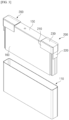
- FIG. 1 is a perspective view of a secondary battery 100 according to the present invention
- FIG. 2 is a perspective view of a coupling structure of the secondary battery 100 and a terminal structure 200 according to the present invention.
- the present invention relates to the secondary battery 100, and particularly, to a prismatic secondary battery 100 in which a positive electrode terminal 120 and a negative electrode terminal 130 are disposed apart from each other on an upper surface of a battery case 110 having a hexahedral shape.
- the prismatic secondary battery 100 shown in the drawings is merely an example, and a ratio of a length, a width, and a height thereof may vary.
- front and rear directions, and up, down, left, and right directions will be referred to with reference to the accompanying drawings.
- a surface on which the positive electrode terminal 120 and the negative electrode terminal 130 are disposed is referred to as an upper surface
- a surface facing the upper surface is referred to as a lower surface.
- the secondary battery 100 of the present invention includes the terminal structure 200.
- the terminal structure 200 is a hinge-like structure coupled to at least one corner of the upper surface of the battery case 110, and includes a terminal body part 210 and an terminal extension part 220.
- the terminal body part 210 refers to a body part of the terminal structure 200 that surrounds the positive electrode terminal 120 or the negative electrode terminal 130 such that the positive electrode terminal 120 or the negative electrode terminal 130, respectively, is not exposed, and is coupled to both the upper surface of the battery case 110 and one or more surfaces (side, or front and rear surfaces, etc.) connected to the upper surface.
- the terminal structure 200 may be coupled to only one of the positive electrode terminal 120 and the negative electrode terminal 130.
- the terminal extension part 220 is a connection terminal that is electrically connected to the positive electrode terminal 120 or the negative electrode terminal 130 and is exposed at any one surface of the terminal body part 210 excluding an upper surface thereof. That is, the terminal extension part 220 serves as a new positive electrode terminal 120 or negative electrode terminal 130 positioned on another surface other than the upper surface because the positive electrode terminal 120 or the negative electrode terminal 130 surrounded by the terminal body part 210 is not exposed.
- the positions of the positive electrode terminal 120 and the negative electrode terminal 130 disposed on the upper surface of the battery case 110 can be freely changed according to the needs of a user by applying the terminal structure 200 to the battery and without having to change the design of the battery. Accordingly, in the present invention, the positions of the positive electrode terminal 120 and the negative electrode terminal 130 can be easily changed using the terminal structure 200 for the prismatic secondary battery 100 having the same form factor, thereby reducing production costs of the secondary battery 100.
- the positive electrode terminal 120 or the negative electrode terminal 130 and the terminal extension part 220 are electrically connected through an extension wire 230, and the extension wire 230 is not exposed to the outside of the terminal body part 210. That is, the extension wire 230 is insulated from the outside.
- the extension wire 230 and the terminal extension part 220 may be embedded in the terminal body part 210 made of an insulating resin material through insert molding or the like. Thus, only the terminal extension part 220 is exposed to the outside, thereby preventing damage or short-circuit of the extension wire 230.
- the extension wire 230 and the terminal extension part 220 may be integrally formed or may be provided as separate parts to be coupled to the terminal body part 210.
- the terminal body part 210 is coupled to the upper surface of the battery case 110 and one side surface connected to the upper surface, and the terminal extension part 220 is exposed at the one side surface connected to the upper surface. Accordingly, the position of the positive electrode terminal 120 or the negative electrode terminal 130 positioned on the upper surface of the battery case 110 is moved to the side surface through the terminal extension part 220.
- the terminal structure 200 may be coupled to each of the positive electrode terminal 120 and the negative electrode terminal 130, and thus, each of the positive electrode terminal 120 and the negative electrode terminal 130 can be disposed on side surfaces facing each other. That is, each of the positive electrode terminal 120 and the negative electrode terminal 130 disposed together on the upper surface of the battery case 110 can be moved to an adjacent side surface, and thus, the initial prismatic secondary battery 100 designed as a unidirectional secondary battery 100 is changed into a bidirectional secondary battery 100.
- the vertical positions of the terminal extension parts 220 of the terminal structures 200 coupled to the positive electrode terminal 120 and the negative electrode terminal 130 may be different from each other. That is, the terminal extension parts 220 on left and right side surfaces may be designed to have bilateral asymmetry, and as described above, the terminal structure 200 can be applied to change an arrangement of the positive electrode terminal 120 and the negative electrode terminal 130 in many different ways in the secondary battery 100 of the present invention.
- the terminal structure 200 may be manufactured in various ways in which the terminal structure 200 is additionally attached to the completed secondary battery 100, or an electrode assembly 160 is attached to a cap plate 150 constituting the upper surface of the battery case 110, and then the terminal structure 200 coupled before the electrode assembly 160 is encapsulated in the battery case 110.
- electrode assembly 160 is described in the illustrated embodiment as being a stack-type assembly, the present invention is not limited thereto, and the illustrated embodiment may be applied to the prismatic secondary battery 100 that accommodates various types of electrode assemblies 160 such as a jelly-roll type electrode assembly.
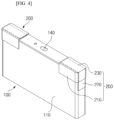
- FIG. 4 is a view of a secondary battery 100 according to another exemplary embodiment of the present invention.
- the second embodiment of FIG. 4 includes the same configuration as described above in the first embodiment, and also includes a venting part 140,
- the venting part 140 is a safety component of a battery, whereby when the internal pressure of the secondary battery 100 increases to a certain level or higher, the venting part 140 breaks to discharge gas and prevent explosion of the secondary battery 100.
- the venting part 140 may be formed through a method of forming a notch having a thickness that is less than the surrounding thickness in a surface of a battery case 110.
- the venting part 140 is positioned on an upper surface of the battery case 110 on which a positive electrode terminal 120 and a negative electrode terminal 130 are positioned, in particular, between the positive electrode terminal 120 and the negative electrode terminal 130.
- the venting part 140 is broken and internal gas is ejected, the positive electrode terminal 120 and the negative electrode terminal 130 are easily damaged by corrosion, ignition, and the like.
- the terminal structure 200 provided in the present invention allows the positive electrode terminal 120 and the negative electrode terminal 130 to be separated from the venting part 140 by being disposed on a different surface from the venting part 140, thereby also contributing to the prevention of damage to the electrode terminals due to gas ejection and flame propagation.
- the venting part 140 is provided on one surface, for example, an upper surface of the battery case 110, and a terminal extension part 220 of the terminal structure 200 is provided on a surface other than the surface, for example, a side surface on which the venting part 140 is provided. That is, the venting part 140 and the electrode terminals are physically separated by the terminal structure 200, thereby improving the safety of the secondary battery 100 and actively and quickly responding to various needs of a user.
- the present invention is suitable for rechargeable secondary batteries.
Landscapes
- Chemical & Material Sciences (AREA)
- Chemical Kinetics & Catalysis (AREA)
- Electrochemistry (AREA)
- General Chemical & Material Sciences (AREA)
- Connection Of Batteries Or Terminals (AREA)
- Gas Exhaust Devices For Batteries (AREA)
- Sealing Battery Cases Or Jackets (AREA)
Applications Claiming Priority (2)
| Application Number | Priority Date | Filing Date | Title |
|---|---|---|---|
| KR20220017171 | 2022-02-09 | ||
| PCT/KR2023/001683 WO2023153746A1 (fr) | 2022-02-09 | 2023-02-07 | Batterie secondaire ayant une structure de borne améliorée |
Publications (2)
| Publication Number | Publication Date |
|---|---|
| EP4311016A1 true EP4311016A1 (fr) | 2024-01-24 |
| EP4311016A4 EP4311016A4 (fr) | 2024-12-25 |
Family
ID=87520403
Family Applications (1)
| Application Number | Title | Priority Date | Filing Date |
|---|---|---|---|
| EP23753096.9A Pending EP4311016A4 (fr) | 2022-02-09 | 2023-02-07 | Batterie secondaire ayant une structure de borne améliorée |
Country Status (6)
| Country | Link |
|---|---|
| US (1) | US20230253689A1 (fr) |
| EP (1) | EP4311016A4 (fr) |
| JP (1) | JP7729914B2 (fr) |
| KR (2) | KR102662582B1 (fr) |
| CN (1) | CN117280540A (fr) |
| WO (1) | WO2023153746A1 (fr) |
Cited By (1)
| Publication number | Priority date | Publication date | Assignee | Title |
|---|---|---|---|---|
| EP4435960A4 (fr) * | 2022-10-28 | 2025-03-26 | LG Energy Solution, Ltd. | Batterie secondaire présentant une structure de borne améliorée |
Families Citing this family (1)
| Publication number | Priority date | Publication date | Assignee | Title |
|---|---|---|---|---|
| KR20240008184A (ko) * | 2022-07-11 | 2024-01-18 | 주식회사 엘지에너지솔루션 | 단자 구조가 개선된 이차전지 |
Family Cites Families (11)
| Publication number | Priority date | Publication date | Assignee | Title |
|---|---|---|---|---|
| US5283137A (en) * | 1991-04-29 | 1994-02-01 | Optima Batteries, Inc. | Cover assembly for rechargeable battery |
| KR100477752B1 (ko) * | 2002-12-26 | 2005-03-21 | 삼성에스디아이 주식회사 | 보호소자 및 이를 구비한 리튬 이차 전지 |
| KR100870349B1 (ko) * | 2007-03-16 | 2008-11-25 | 삼성에스디아이 주식회사 | 보호회로기판의 접속단자 및 그를 이용한 이차전지 |
| US8268478B2 (en) * | 2009-08-17 | 2012-09-18 | Sb Limotive Co., Ltd. | Rechargeable battery having anti-vibration member |
| KR101358425B1 (ko) * | 2012-02-29 | 2014-02-12 | (주)벡셀 | 이차전지의 커넥터 및 이차전지의 커넥터의 제조방법 |
| KR102408824B1 (ko) * | 2015-06-22 | 2022-06-13 | 삼성에스디아이 주식회사 | 이차 전지 및 이차 전지 모듈 |
| JP6658057B2 (ja) | 2016-02-17 | 2020-03-04 | 株式会社オートネットワーク技術研究所 | 蓄電モジュール |
| KR102425219B1 (ko) * | 2017-09-07 | 2022-07-26 | 삼성에스디아이 주식회사 | 이차 전지 |
| KR102578860B1 (ko) | 2018-02-27 | 2023-09-13 | 삼성에스디아이 주식회사 | 이차 전지 |
| KR102819179B1 (ko) * | 2019-09-30 | 2025-06-11 | 삼성에스디아이 주식회사 | 이차전지 |
| KR20220017171A (ko) | 2020-08-04 | 2022-02-11 | 엘지이노텍 주식회사 | 칩 온 필름용 연성 회로기판 및 이를 포함하는 칩 패키지, 및 이를 포함하는 전자 디바이스 |
-
2023
- 2023-02-07 CN CN202380011470.5A patent/CN117280540A/zh active Pending
- 2023-02-07 EP EP23753096.9A patent/EP4311016A4/fr active Pending
- 2023-02-07 JP JP2023565411A patent/JP7729914B2/ja active Active
- 2023-02-07 WO PCT/KR2023/001683 patent/WO2023153746A1/fr not_active Ceased
- 2023-02-07 KR KR1020230016001A patent/KR102662582B1/ko active Active
- 2023-02-07 US US18/106,826 patent/US20230253689A1/en active Pending
-
2024
- 2024-04-12 KR KR1020240049028A patent/KR20240052925A/ko active Pending
Cited By (1)
| Publication number | Priority date | Publication date | Assignee | Title |
|---|---|---|---|---|
| EP4435960A4 (fr) * | 2022-10-28 | 2025-03-26 | LG Energy Solution, Ltd. | Batterie secondaire présentant une structure de borne améliorée |
Also Published As
| Publication number | Publication date |
|---|---|
| JP2024515955A (ja) | 2024-04-11 |
| KR20240052925A (ko) | 2024-04-23 |
| CN117280540A (zh) | 2023-12-22 |
| KR20230120592A (ko) | 2023-08-17 |
| WO2023153746A1 (fr) | 2023-08-17 |
| US20230253689A1 (en) | 2023-08-10 |
| EP4311016A4 (fr) | 2024-12-25 |
| JP7729914B2 (ja) | 2025-08-26 |
| KR102662582B1 (ko) | 2024-05-03 |
Similar Documents
| Publication | Publication Date | Title |
|---|---|---|
| US12243975B2 (en) | Method for manufacturing secondary battery and pouch for secondary battery | |
| EP2849262B1 (fr) | Elément de batterie présentant une structure irreguliere et module de batterie le comprenant | |
| EP2966718B1 (fr) | Cellule de batterie comprenant une structure étagée | |
| KR20190040403A (ko) | 원통형 이차전지 모듈 및 원통형 이차전지 모듈 생산 방법 | |
| EP4311006A1 (fr) | Batterie secondaire comprenant une unité de ventilation | |
| EP4311016A1 (fr) | Batterie secondaire ayant une structure de borne améliorée | |
| KR20240120950A (ko) | 벤팅 홀을 포함하는 배터리 모듈 및 이를 포함하는 배터리 팩 | |
| JP2026053426A (ja) | 角型二次電池 | |
| EP4310968A1 (fr) | Structure d'électrode et batterie prismatique comprenant une structure d'électrode | |
| US20250266544A1 (en) | Battery and electric device | |
| KR20230091028A (ko) | 이차 전지 및 이를 포함하는 전지 모듈 | |
| EP4726880A1 (fr) | Module de batterie | |
| US20250141038A1 (en) | Secondary battery and manufacturing method thereof | |
| US20240372230A1 (en) | Electrode assembly, battery cell, battery and electric device | |
| EP4354625A1 (fr) | Batterie secondaire et module de batterie la comprenant | |
| EP4571963A2 (fr) | Batterie cylindrique, et batterie et véhicule le comprenant | |
| KR20240008184A (ko) | 단자 구조가 개선된 이차전지 | |
| WO2025102652A1 (fr) | Ensemble boîtier, élément de batterie, batterie et appareil électrique | |
| WO2025111861A1 (fr) | Élément de batterie, batterie et dispositif électrique | |
| CN120261929A (zh) | 电池单体、电池和用电装置 | |
| CN117616627A (zh) | 二次电池和包括该二次电池的电池模块 |
Legal Events
| Date | Code | Title | Description |
|---|---|---|---|
| STAA | Information on the status of an ep patent application or granted ep patent |
Free format text: STATUS: THE INTERNATIONAL PUBLICATION HAS BEEN MADE |
|
| PUAI | Public reference made under article 153(3) epc to a published international application that has entered the european phase |
Free format text: ORIGINAL CODE: 0009012 |
|
| STAA | Information on the status of an ep patent application or granted ep patent |
Free format text: STATUS: REQUEST FOR EXAMINATION WAS MADE |
|
| 17P | Request for examination filed |
Effective date: 20231016 |
|
| AK | Designated contracting states |
Kind code of ref document: A1 Designated state(s): AL AT BE BG CH CY CZ DE DK EE ES FI FR GB GR HR HU IE IS IT LI LT LU LV MC ME MK MT NL NO PL PT RO RS SE SI SK SM TR |
|
| A4 | Supplementary search report drawn up and despatched |
Effective date: 20241127 |
|
| RIC1 | Information provided on ipc code assigned before grant |
Ipc: H01M 50/591 20210101ALI20241121BHEP Ipc: H01M 50/176 20210101ALI20241121BHEP Ipc: H01M 50/103 20210101ALI20241121BHEP Ipc: H01M 50/15 20210101ALI20241121BHEP Ipc: H01M 50/342 20210101ALI20241121BHEP Ipc: H01M 50/55 20210101ALI20241121BHEP Ipc: H01M 50/553 20210101AFI20241121BHEP |
|
| DAV | Request for validation of the european patent (deleted) | ||
| DAX | Request for extension of the european patent (deleted) |