EP4311372A1 - Verfahren zur dynamischen föderation einer vielzahl von funkkommunikationsnetzen, computerprogramm und netzwerk dafür - Google Patents
Verfahren zur dynamischen föderation einer vielzahl von funkkommunikationsnetzen, computerprogramm und netzwerk dafür Download PDFInfo
- Publication number
- EP4311372A1 EP4311372A1 EP23186728.4A EP23186728A EP4311372A1 EP 4311372 A1 EP4311372 A1 EP 4311372A1 EP 23186728 A EP23186728 A EP 23186728A EP 4311372 A1 EP4311372 A1 EP 4311372A1
- Authority
- EP
- European Patent Office
- Prior art keywords
- network
- node
- plan
- master node
- nodes
- Prior art date
- Legal status (The legal status is an assumption and is not a legal conclusion. Google has not performed a legal analysis and makes no representation as to the accuracy of the status listed.)
- Pending
Links
- 238000000034 method Methods 0.000 title claims abstract description 47
- 238000004590 computer program Methods 0.000 title claims description 4
- 238000004891 communication Methods 0.000 claims abstract description 33
- 238000010276 construction Methods 0.000 claims abstract description 12
- 235000014510 cooky Nutrition 0.000 claims description 5
- 230000003068 static effect Effects 0.000 description 14
- 230000000295 complement effect Effects 0.000 description 7
- 238000007726 management method Methods 0.000 description 7
- 230000002457 bidirectional effect Effects 0.000 description 5
- 238000012545 processing Methods 0.000 description 3
- 238000011144 upstream manufacturing Methods 0.000 description 3
- 230000004913 activation Effects 0.000 description 2
- 238000004364 calculation method Methods 0.000 description 2
- 238000009792 diffusion process Methods 0.000 description 2
- 238000007689 inspection Methods 0.000 description 2
- 230000007246 mechanism Effects 0.000 description 2
- 230000011664 signaling Effects 0.000 description 2
- 238000013519 translation Methods 0.000 description 2
- 239000011449 brick Substances 0.000 description 1
- 230000008859 change Effects 0.000 description 1
- 230000006835 compression Effects 0.000 description 1
- 238000007906 compression Methods 0.000 description 1
- 230000001143 conditioned effect Effects 0.000 description 1
- 238000001914 filtration Methods 0.000 description 1
- 230000006870 function Effects 0.000 description 1
- 230000010354 integration Effects 0.000 description 1
- 238000002955 isolation Methods 0.000 description 1
- 230000015654 memory Effects 0.000 description 1
- 230000004048 modification Effects 0.000 description 1
- 238000012986 modification Methods 0.000 description 1
- 230000006855 networking Effects 0.000 description 1
- 238000005457 optimization Methods 0.000 description 1
- 230000008569 process Effects 0.000 description 1
- 230000009257 reactivity Effects 0.000 description 1
- 230000004043 responsiveness Effects 0.000 description 1
- 238000012546 transfer Methods 0.000 description 1
- 230000003936 working memory Effects 0.000 description 1
Images



Classifications
-
- H—ELECTRICITY
- H04—ELECTRIC COMMUNICATION TECHNIQUE
- H04W—WIRELESS COMMUNICATION NETWORKS
- H04W84/00—Network topologies
- H04W84/18—Self-organising networks, e.g. ad-hoc networks or sensor networks
-
- H—ELECTRICITY
- H04—ELECTRIC COMMUNICATION TECHNIQUE
- H04W—WIRELESS COMMUNICATION NETWORKS
- H04W84/00—Network topologies
- H04W84/18—Self-organising networks, e.g. ad-hoc networks or sensor networks
- H04W84/20—Leader-follower arrangements
Definitions
- the present invention relates to a method for dynamic federation of a plurality of radiocommunication networks.
- the invention also relates to a computer program comprising software instructions which, when executed by a computer, implement such a method of dynamic federation of a plurality of radiocommunication networks.
- the invention also relates to a radiocommunication network federated via said method.
- the field of the invention is the federation of a plurality of radiocommunication networks and, more particularly the obtaining of a configuration of the plurality of networks allowing them to interconnect and to implement the rules and protocols governing the interconnectivity between two networks.
- the federation of networks makes it possible to connect at least two distinct networks (possibly through another underlying network) and to configure these two networks so that they appear as a single extended network to their users.
- a radiocommunication network is a network of the “private mobile radiocommunications” type - PMR (“private mobile radiocommunications network”) or a network of the type respecting the 3G, 4G, 5G standard, or more, as defined by the 3GPP (“ 3rd Generation Partnership Project).
- private mobile radiocommunications network a network of the “private mobile radiocommunications” type - PMR (“private mobile radiocommunications network”) or a network of the type respecting the 3G, 4G, 5G standard, or more, as defined by the 3GPP (“ 3rd Generation Partnership Project).
- 3GPP 3rd Generation Partnership Project
- a radiocommunication network comprises a reception radio network ("Radio Access Network - RAN”), an infrastructure network ("Core Network - CN”) and advantageously a data center, preferably virtual (“ Software-defined data center - SDDC”).
- Radiocommunication networks can be of different types, depending in particular on their maximum capacity. So for example, in a military context, a radiocommunication network can for example fall under a first type, such as a network tactical with a maximum capacity of around ten users, of a second type, such as a theater data network with a maximum capacity of a few hundred users, or of a third type, such as a command network with a maximum capacity of a few thousand users.
- a first type such as a network tactical with a maximum capacity of around ten users
- a second type such as a theater data network with a maximum capacity of a few hundred users
- a third type such as a command network with a maximum capacity of a few thousand users.
- radiocommunication networks can be deployable and/or mobile. We are talking about field networks.
- tactical networks are essentially field networks.
- Radiocommunication networks in particular field networks when their geographical radio coverage zones overlap each other must be able to be federated automatically to offer, for example, flexibility of use (to adapt to the movement of field networks) , simplicity of implementation (to build an extended network with advanced functions such as slicing or sharing of data center application resources), increased security (to enable secure interconnection) , or even optimization of uses (to allow distribution of the load and application resources between networks once interconnected).
- network federation generally involves an upstream planning phase and/or a static configuration (i.e. non-reconfigurable) and/or one or more static radiocommunication equipment(s).
- a new configuration is required to configure at least part of the existing federated network in particular to declare the identities of the new incoming network.
- addressing protocols such as the RFC 3927 protocol allowing network addressing over a predetermined local network address range (169.254.0.0/16) and allows via an ARP address resolution protocol ( Address Resolution protocol ) to announce and detect IP ( Internet Protocol ) addressing conflicts on the network, without restriction on obtaining an address, which is not very secure.
- ARP address resolution protocol Address Resolution protocol
- IP Internet Protocol
- the multicast protocol (from English multicast ) for dynamic configuration of DHCP hosts (from English Dynamic Host Configuration Protocol ) requires a static server which requires that one of the networks to be federated permanently (ie always) carries this protocol to federate the other networks (ie bubbles, for example a tactical bubble).
- cluster federation is also currently implemented via manual configuration or via multicast configuration with a static multicast source.
- the current network federation based on upstream planning and the static configuration including the identities of the networks to be federated is thus based, in view of the aforementioned current examples, based on static addressing already carried out or implemented by static equipment.
- the aim of this invention is to solve this problem.
- the method according to the present invention by the specific sequence of the aforementioned steps makes it possible to dispense with planning and static configuration including identities of the networks to federate current solutions.
- Such a solution also makes it possible to interconnect networks dynamically, and without planning, without requiring one or more static devices for their connection.
- the solution makes it possible to federate several networks, that is to say to set up at least one communication plan between two network nodes, free, beforehand, of knowledge between them and of a configuration of predetermined IP addressing (i.e. the networks do not know each other beforehand).
- the invention also relates to a computer program comprising software instructions which, when executed by a computer, implement a method for dynamic federation of a plurality of networks, as defined above.
- the invention also relates to a federated network via said method.
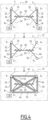
- FIG. 2 illustrates by way of example the dynamic federation between three distinct networks R 1 , R 2 and R 3 each represented respectively by a node N 1 , N 2 , and N 3 .
- each of the three distinct networks R 1 , R 2 and R 3 notably comprises a radio access network or RAN (from the English Radio Access Network ), integrating a plurality of access points or eNB (" e-Node B” in 4G).
- An eNB allows a user equipment UE (from the English User Equipment ) (ie a terminal) to connect, by means of a radio link, to the network in which it is integrated.
- Each of the three distinct networks R 1 , R 2 and R 3 also includes a core network or EPC ( Evolved Packet Core in 4G).
- EPC Evolved Packet Core in 4G
- the EPC classically includes a gateway with the RAN, a gateway with the IP world and a mobility management entity MME ( Mobility Management Unit ) specific to managing signaling between the terminals.
- MME Mobility Management Unit
- each of the three distinct networks R 1 , R 2 and R 3 further comprises a private network or SDDC ( Software-defined data center ) which is a secure network comprising several virtualized VM services, a routing element (ie router type), a firewall type security element ( Firewall ) for external communication, for example according to the IP protocol.
- SDDC Software-defined data center
- a routing element ie router type
- Firewall firewall type security element
- each of the three distinct networks R 1 , R 2 and R 3 further comprises respectively within each node N 1 , N 2 , and N 3 , a service orchestrator supervising a network controller (in particular of the SDN type of Software Defined Network ), a security controller and an IT controller.
- a network controller in particular of the SDN type of Software Defined Network
- the network controller controls the machines in the EPC to configure them according to the commands received from the service orchestrator. This involves, for example, configuring the routing of a certain type of data flow for an identified user to ensure bandwidth.
- the IT controller controls the SDDC machines to configure them according to the commands received from the service orchestrator. This involves, for example, instantiating a particular virtual application according to an identified need, reserving a certain memory and calculation resource for it, and possibly decommissioning it when it is no longer used.
- the security controller controls the machines on its network, including the firewall, to configure them according to the commands received from the service orchestrator. This involves, for example, filtering the circulation of an authenticated user's data based on their privileges associated with their profile.
- the service orchestrator therefore allows, through the controllers, the allocation of available physical and/or virtual resources according to the needs of the users (in accordance with their respective profiles).
- the service orchestrator includes predetermined orchestration logic and detailed subsequently, the predetermined orchestration logic defining the election method, the distributed mode (ie inter-node message), the control of the elements, services and configuration rules.
- the physical resources include for example calculation capacities of the SDDC, working memory capacities of the SDDC, bandwidth capacities on the network, network address translation capacities (from the English Network Address Translation - NAT) by firewall, etc.
- the virtual resources include for example virtualized bricks each corresponding to an application allowing particular processing to be carried out on specific data, such as for example a deep packet inspection application (from the English Deep Packet Inspection - DPI). ) by the firewall, an image processing application by the SDDC, or even a compression application of a data flow by the network.
- a deep packet inspection application from the English Deep Packet Inspection - DPI.
- OSS Operations Support System
- the first step 12 of discovery of the method 10 of dynamic federation of a plurality of radiocommunication networks of the figure 1 is represented on the figure 2 , by the view also identified by the reference 12.
- said discovery step 12 is implemented by each node N 1 , N 2 , and N 3 .
- the network R 1 represented by the node N 1 is for example connected via a bidirectional link 24 to a federation interface 26 corresponding for example to a star connection
- the network R 2 represented by the node N 2 is for example also connected via a bidirectional link 28 to the federation interface 26
- the network R 3 represented by the node N 3 is for example connected via a bidirectional link 30 to the federation interface 26.
- each of the nodes N 1 , N 2 , and N 3 which must be federated are then connected via a link 24, 28 or 30, of the Ethernet or LOS type (from the English Line of Sight ) at federation interface 26.
- node N 1 , of network R 1 via link 24 broadcasts (English broadcast ) a predetermined discovery message 32 to any node representative of another network also connected to the federation interface 26, including nodes N 2 and N 3 . It is the same for node N 2 , of network R 2 , via link 28, and for node N 3 , of network R 3 , via link 30.
- the discovery step 12 between the service orchestrators of the nodes N 1 , N 2 and N 3 consists of the exchange of a broadcast presence message (from the English broadcast ) between service orchestrators, through the links 24, 28 and 30 and the federation interface 26, in particular by implementation of the predetermined discovery protocol, for example depending on a mission carried out at within said network.
- the broadcast of such a discovery message 32 amounts to the automatic search for neighboring distinct network nodes capable of receiving said predetermined discovery message from the node considered broadcasting said message.
- the nodes “in the vicinity” of the node considered are suitable for receiving the discovery message from said node considered.
- said discovery step is implemented using an L2 type broadcast protocol (ie on network layer 2 of the English layer 2) corresponding to the network layer used to transfer data between the nodes N 1 , N 2 , and N 3 of the extended federated network).
- L2 type broadcast protocol ie on network layer 2 of the English layer 2 corresponding to the network layer used to transfer data between the nodes N 1 , N 2 , and N 3 of the extended federated network.
- the second step 14 of election of the method 10 of dynamic federation of a plurality of radiocommunication networks of the figure 1 is represented on the figure 2 , by the view also identified by the reference 14.
- Said election step 14 aims to elect from among the nodes N 1 , N 2 , and N 3 , the master node M of the federated network resulting from the federation of the networks R 1 , R 2 , and R 3 (ie bringing together the networks R 1 , R2 , and R3 ). More precisely, said election aims to choose the master service orchestrator, namely as represented on the figure 2 , the orchestrator of node N 3 representing the network R 3 , among the orchestrators of each of the nodes N 1 , N 2 , and N 3 , the nodes, N 1 and N 2 on the figure 2 , distinct from said node N 3 master M elected becoming slave nodes E.
- Such an election is in particular of type L2 (ie carried out on network layer 2 called L2 of the English Layer 2 ))
- said discovery message 32 represented in view 12 associated with discovery step 12, comprises a set of elements necessary for said subsequent election step 14 of the method according to 'invention.
- said election step is implemented using a weight and/or an age previously associated in a predetermined manner with each network node of said plurality of networks, and indicated for example in within said discovery message.
- each service orchestrator therefore memorizes an attribute taking the “master” value represented by M on the figure 2 , or “slave” represented by E on the figure 2 , when the radiocommunication network managed by the service orchestrator considered is part of a federated network, or "undefined” when said radiocommunication network is not part of a federated network as illustrated by N 1 , N 2 , and N 3 on view 12 of the figure 2 .
- the master service orchestrator M (for example of node N 3 ) has a global vision of the federated network. It is therefore capable of managing telecommunications services which extend between the three networks R 1 , R 2 , and R 3 .
- the master M therefore maintains a global state of the federated network resulting from the federation of the networks R 1 , R 2 , and R 3 . It receives requests, applies rules and generates commands whose scope concerns the federated network as a whole. If commands relate to services associated with the network that this master orchestrator managed before federation (the R 3 network in our example), these commands are transmitted to local controllers for execution.
- these commands relate to services associated with other networks that this master orchestrator did not manage before federation (the R 1 and R 2 networks in our example), these commands are transmitted and broadcast (from the English “broadcast”) to the slave orchestrators E of nodes R 1 and R 2 respectively of nodes N 1 and N 2 .
- the service orchestrators which become slave orchestrators E of the federated network place themselves in a mode of listening to commands from the master orchestrator M. When they receive a command from the master orchestrator M, they relay it to one or the other of the local controllers (those of the network R 1 or the network R 2 in our example). The slave service orchestrator E thus operates under the supervision of the master orchestrator M.
- the slave orchestrator E sends local information to the master orchestrator M allowing the master orchestrator M to maintain the part of the state of the federated network relating to this other network.
- the third step 16 of implementing IP addressing of the method 10 of dynamic federation of a plurality of radiocommunication networks of the figure 1 is represented on the figure 2 , by the view also identified by the reference 16.
- the sequence of discovery 12, election 14 and dynamic addressing 16 steps is specific to the present invention.
- Dynamic IP addressing 16 is notably implemented by the node N 3 master M previously elected.
- each node orchestrator carries with it a dynamic IP addressing service which is activated only once said node orchestrator is elected master, which makes it possible to avoid prior IP addressing configuration on one or more interfaces. (s) of federation 26, most often static and/or requiring a static addressing server (ie no IP addressing configuration is necessary on the federation interface(s) 26).
- the service corresponding to IP addressing becomes virtual with activation conditioned on the prior election as master of the orchestrator implementing it, so that the element implementing a addressing IP is no longer a static element of the network but a dynamic element capable of being modified by prior election of a network master orchestrator.
- Such virtual dynamic IP addressing makes it possible to dispense with planning and static configuration including the identities of the networks to be bring together current solutions.
- virtual dynamic IP addressing amounts to dynamic IP address allocation on network layer 3 (ie L3 ).
- said step 16 of implementing dynamic IP addressing by said master node is carried out by means of a DHCP protocol implemented by said master node M and activated following its prior election 14.
- a DHCP protocol implemented by said master node M and activated following its prior election 14.
- the master node N 2 M hosts (ie integrates) a DHCP addressing module 38.
- the master node N 2 M grants itself an IP address on a federation interface and regularly broadcasts (ie broadcast) its master identity 34.
- the other nodes N 1 and N 3 respectively representative of the networks R 1 and R 3 as slaves E broadcast according to the DHCP protocol (ie broadcast) according to arrow 36 an IP addressing request to the master node N 2 M, and each recover their IP addressing in this way.
- the fourth step 18 of the method 10 of dynamic federation of a plurality of radiocommunication networks of the figure 1 relates to the construction of a network federated by said master node, and is represented on the figure 2 , by the view also identified by the reference 18.
- the construction of the federated network is carried out by enrollment of said slave nodes E after their authentication 40 with the master node M.
- the arrow 40 of view 18 illustrates the fact that according to this step 18, each of the nodes slaves E joins or forms the network cluster (cluster) federated by the master node M in a secure manner via mutual authentication of the slave E and master M nodes, in particular of type L2 (i.e. on network layer 2) .
- said step 18 of constructing the federated network uses a secure connection for the authentication of each slave node E.
- the authentication necessary for said step 18 of construction of the federated network, is implemented by means of a cookie, also called magic cookie, corresponding by definition to an identifier without comprehensible meaning transmitted to a program by another program, for him enable one or more tasks to be accomplished in a secure manner, in particular by means of a secure connection via, for example, the SSL encryption security protocol ( Secure Sockets Layer ).
- a cookie also called magic cookie
- the SSL encryption security protocol Secure Sockets Layer
- the fifth step 20 of the method 10 of dynamic federation of a plurality of radiocommunication networks of the figure 1 relates to the establishment 20 of at least one communication plan between said master node M and said slave nodes E, and is represented on the figure 2 , by the view also identified by the reference 20.
- the master node M ensures the assembly of the aforementioned plan(s) inter -node of the federated network using a secure connection via, for example, the SSL encryption security protocol ( Secure Sockets Layer ).
- SSL encryption security protocol Secure Sockets Layer
- the master node N 2 M of the network R 2 as illustrated by the figure 2 transmits the federation context 42 to each slave node N 1 and N 3 of the networks R 1 and R 3 parties to the federated network resulting from the federation of the networks R 1 , R 2 , and R 3 .
- the federation context 42 comprises according to the present invention, all the information or technical data that the master node N 2 M used to set up the federation (list of known and federated nodes (including their identifiers, their reference (ie name of the node) in the federated network (ie cluster), the federation state, ..., the list of IP address allocations established via the DHCP addressing module 38, the security policies).
- list of known and federated nodes including their identifiers, their reference (ie name of the node) in the federated network (ie cluster), the federation state, ..., the list of IP address allocations established via the DHCP addressing module 38, the security policies.
- the method 10 according to the present invention further comprises an inter-node context sharing step implemented after (according to a variant not shown on the figure 2 ) or during said step 20 of establishing at least one communication plan between said master node N 2 M and said slave nodes E, said sharing accelerating an election of a next master node in the event of loss of the master node current, and accelerating the resumption of services ensuring federation (in particular dynamic IP addressing by the next master node).
- View 20 of the figure 2 illustrating step 20 of establishing at least one communication plan 44, also illustrates a complementary optional variant according to the present invention, namely, an inter-node transitive connection step according to which when two nodes are connected via said network federated, the connection of a new node to one of said two connected nodes results in the automatic connection of said new node to the other of said two connected nodes.
- the sixth step 22 of the method 10 of dynamic federation of a plurality of radiocommunication networks of the figure 1 relates to the configuration 22 of said federated network using said at least one communication plan established previously in step 20, and such a configuration step 22 is represented on the figure 2 , by the view also identified by the reference 22.
- This view 22 illustrates in particular the configuration 22 of the federated interconnection network between the participating networks R 1 , R 2 and R 3 by effective use of the plan(s) previously established during step 20, namely the plan control plan, the data plan, the orchestration plan, the management plan, the user plan.
- the implementation of the method according to the present invention involves the establishment, upstream of the federation interface 26, of the network elements of an orchestrator 46, within each network node N 1 , N 2 , and N 3 , namely the routing element (router R type), a security element (firewall type F), a control element 48 (ie network controller (in particular of the SDN type from the English Software Defined Network )) including logic orchestration (election method, distributed mode (inter node message), control of elements, services and configuration rules) in order to configure the federated network resulting from the federation of networks R 1 , R 2 , and R 3 to effectively use the plan(s) previously established during step 20, in particular the data plan 50.
- routing element router R type
- security element firewall type F
- control element 48 ie network controller (in particular of the SDN type from the English Software Defined Network )
- logic orchestration selection method, distributed mode (inter node message), control of elements, services and configuration rules
- the step of configuring said federated network using said at least one communication plan makes it possible to finalize the establishment of secure communication “tunnels” between the nodes N 1 , N 2 , and N 3 of the federated network (ie cluster) in particular on network layer 3 (ie L3), said tunnels making it possible to guarantee all flows, their security, and the guarantee of inter-node services.
- FIG. 3 illustrates the dynamic federation of a plurality of radiocommunication networks in the event of loss of a node representative of one of the networks of the federated network by means of the method according to the present invention and in the event of addition of a new node entering into said federated network.
- the election step 14 is then immediately reiterated, without repeating the method 10 as a whole (ie we go directly to the election step 14 without “re-discovery”), in particular thanks to the inter-node context sharing 42 implemented after or during said step 20 of establishing at least one communication plan illustrated by the figure 2 .
- the inter-node context sharing 42 implemented after or during said step 20 of establishing at least one communication plan illustrated by the figure 2 .
- it is then node N 3 of the network R 3 which then becomes master M of the federated network resulting from the remaining networks R 1 and R 3 .
- the DHCP addressing module 38 hosted by the master node N 3 M, and more generally by the network R 3 is activated to resume, if necessary, dynamic IP addressing in the event of entry of a new network in the federated network, and the regular broadcast (ie broadcast) of its master identity.
- the master node N 3 M updates the context 42 (ie the security policies) and in a manner not shown reshares this updated context to the entire federated network and in particular to the node N 1 of the network R 1 .
- view 52 of the Figure 3 also illustrates the addition (ie the arrival) of a new node N 4 representative of the network R 4 which connects via a bidirectional link 54 to the federation interface 26.
- the new node N 4 representative of the network R 4 will enter said federated network resulting from the remaining networks R 1 and R 3 , and to do this via the link 54 broadcasts (from the English broadcast ) a discovery message 32 predetermined to any node representative of another network also connected to the federation interface 26, including nodes N 1 and N 3 .
- the new node N 4 representative of the network R 4 implements the aforementioned discovery step 12 by connecting via link 54 to the federation interface 26, while the master node N 3 M broadcasts (ie broadcast) regularly his identity as master 24.
- the new node N 4 becomes slave E as shown in view 15, and the master node N 3 M then implements dynamic IP addressing 16 of the new slave node N 4 E, node N 4 slave E broadcasting, in particular according to the DHCP protocol (ie broadcast), an IP addressing request to node N 3 master M, and thereby recovering its IP addressing.
- the master node N 3 M implements dynamic IP addressing 16 of the new slave node N 4 E, node N 4 slave E broadcasting, in particular according to the DHCP protocol (ie broadcast), an IP addressing request to node N 3 master M, and thereby recovering its IP addressing.
- the orchestrator of the node N 3 master M implements the steps 18 of constructing the federated network by authentication, 20 of establishing communication plans, in particular the control plan 44 and the data plan 50 , 22 of aforementioned configuration to federate the new federated network resulting from the federation of the networks R 1 , R 3 and R 4 .
- FIG. 4 illustrates the interconnection of two distinct federated networks via the method according to the present invention.
- a first federated network is illustrated, results from the federation of the aforementioned networks R 1 and R 3 and illustrated previously in relation to the figure 2 And 3 , and is federated by node N 3 master M.
- a second federated network is illustrated, results from the federation of the networks R 5 and R 6 , and is federated by the master node N 6 M of the network R 6 .
- the node N 5 slave E is connected to the federation interface 60 via a bidirectional link 62, while the N 6 master M of the network R 6 is connected to it via link 64.
- connection interfaces 26 of the first federated network and 60 of the second federated network are connected (i.e. connected) by a link 66.
- control planes 68 and data planes 70 were established and configured as previously described.
- View 72 illustrates the result of a new election step 14 implemented following the connection 66 of the two federated networks, in order to elect the master node among the nodes N 3 of the network R 3 and the node N 6 of the network R6 .
- it is the node N 3 of the network R 3 which is elected master M of the extended federated network resulting from the networks R 1 , R 3 , R 5 and R 6 , while the node N 6 of the network R 6 then becomes slave E .
- View 74 illustrates the federation of the extended federated network resulting from the networks R 1 , R 3 , R 5 and R 6 after implementation of steps 18 of constructing the federated network by authentication, 20 of establishing communication plans, in particular the control plane 44 and the aforementioned configuration data plane 50, 22, and application of inter-node transitive connections.
- the present invention thus proposes a mechanism for neighborhood discovery and election of a master node from several network nodes to be federated.
- the master node can reposition itself on another node following the change of operational context (e.g. loss of node), and carries with it a dynamic IP addressing service which is then virtual and is no longer a static element of the network.
- the solution according to the present invention thus makes it possible to federate, that is to say to set up in particular a data and control plan authorized between at least two distinct network nodes, exempt from prior knowledge between them and 'a lack of IP address configuration on their federation link.
- the present solution can thus be used as a “plug and play” solution without planning and/or replanning, based on neighborhood discovery (Ethernet or LOS) and authentication between neighbors, which in particular allows network deployment federated type WAN ( Wide Area Network), or MAN (Metropolitan Area Network), or LAN ( Local Area Network), because it is easy to implement artwork.
- neighborhood discovery Ethernet or LOS
- MAN Micropolitan Area Network
- LAN Local Area Network
- such a dynamic network federation method facilitates the triggering in the inter-network operational exchange, for example for the sharing of telecom contexts in the ephemeral tactical bubble federation allowing mobility and offering flexibility to adapt to a pace of tactical maneuver.
- the present invention makes it possible to reconcile distributed systems (ie of the cluster type) and the reactivity of programmable networks (in particular with a network controller (in particular of the SDN type from the English Software Defined Network ) with security requirements.
Landscapes
- Engineering & Computer Science (AREA)
- Computer Networks & Wireless Communication (AREA)
- Signal Processing (AREA)
- Small-Scale Networks (AREA)
- Data Exchanges In Wide-Area Networks (AREA)
Applications Claiming Priority (1)
| Application Number | Priority Date | Filing Date | Title |
|---|---|---|---|
| FR2207465A FR3138254B1 (fr) | 2022-07-21 | 2022-07-21 | Procédé de fédération dynamique d'une plurialité de réseaux de radiocommunication, programme d'ordinateur et réseau associés |
Publications (1)
| Publication Number | Publication Date |
|---|---|
| EP4311372A1 true EP4311372A1 (de) | 2024-01-24 |
Family
ID=84331107
Family Applications (1)
| Application Number | Title | Priority Date | Filing Date |
|---|---|---|---|
| EP23186728.4A Pending EP4311372A1 (de) | 2022-07-21 | 2023-07-20 | Verfahren zur dynamischen föderation einer vielzahl von funkkommunikationsnetzen, computerprogramm und netzwerk dafür |
Country Status (2)
| Country | Link |
|---|---|
| EP (1) | EP4311372A1 (de) |
| FR (1) | FR3138254B1 (de) |
Citations (2)
| Publication number | Priority date | Publication date | Assignee | Title |
|---|---|---|---|---|
| FR2109229A5 (de) | 1970-10-01 | 1972-05-26 | Cepra | |
| US20160127193A1 (en) * | 2012-12-21 | 2016-05-05 | Airbus Ds Sas | D2hcp protocol in ad hoc networks: merging of sub-networks and address conflict resolution |
-
2022
- 2022-07-21 FR FR2207465A patent/FR3138254B1/fr active Active
-
2023
- 2023-07-20 EP EP23186728.4A patent/EP4311372A1/de active Pending
Patent Citations (2)
| Publication number | Priority date | Publication date | Assignee | Title |
|---|---|---|---|---|
| FR2109229A5 (de) | 1970-10-01 | 1972-05-26 | Cepra | |
| US20160127193A1 (en) * | 2012-12-21 | 2016-05-05 | Airbus Ds Sas | D2hcp protocol in ad hoc networks: merging of sub-networks and address conflict resolution |
Non-Patent Citations (3)
| Title |
|---|
| GRIGORAS D ET AL: "Simple self-management of Mobile Ad Hoc Networks", MOBILE WIRELESS COMMUNICATIONS NETWORKS, 2007 9TH IFIP INTERNATIONAL CONFERENCE ON, IEEE, PISCATAWAY, NJ, USA, 19 September 2007 (2007-09-19), pages 181 - 185, XP031398509, ISBN: 978-1-4244-1719-3 * |
| JING WANG ET AL: "Self-configuration in MANETs: Different Perspectives", 11 September 2007, SELF-ORGANIZING SYSTEMS; [LECTURE NOTES IN COMPUTER SCIENCE], SPRINGER BERLIN HEIDELBERG, BERLIN, HEIDELBERG, PAGE(S) 225 - 239, ISBN: 978-3-540-74916-5, XP019071270 * |
| SUNIL PATHAK ET AL: "An optimized stable clustering algorithm for mobile ad hoc networks", EURASIP JOURNAL ON WIRELESS COMMUNICATIONS AND NETWORKING, BIOMED CENTRAL LTD, LONDON, UK, vol. 2017, no. 1, 16 March 2017 (2017-03-16), pages 1 - 11, XP021242776, DOI: 10.1186/S13638-017-0832-4 * |
Also Published As
| Publication number | Publication date |
|---|---|
| FR3138254A1 (fr) | 2024-01-26 |
| FR3138254B1 (fr) | 2025-02-28 |
Similar Documents
| Publication | Publication Date | Title |
|---|---|---|
| US12388742B2 (en) | Cross datacenter communication using a mesh gateway | |
| US9124586B2 (en) | Confidential or protected access to a network of nodes distributed over a communication architecture with the aid of a topology server | |
| US20170142096A1 (en) | Endpoint privacy preservation with cloud conferencing | |
| WO2006097615A1 (fr) | Dispositif et procede de communication dans un reseau | |
| JP2018518862A (ja) | グローバル仮想ネットワーク(gvn)において仮想インタフェースとアドバンストスマートルーティングとを提供するためのシステム及び方法 | |
| WO2015130948A1 (en) | Substitute network services provided by an access network node | |
| US11647069B2 (en) | Secure remote computer network | |
| EP3787344B1 (de) | Verfahren zur konfiguration eines systems zur erweiterung der drahtlosen kommunikationsabdeckung, und system zur erweiterung der drahtlosen kommunikationsabdeckung, das dieses verfahren umsetzt | |
| FR3032078A1 (fr) | Architecture hybride de transmission d'informations avioniques et systeme correspondant | |
| EP3562188B1 (de) | Ein konfigurationsprozess und ein system um auf rückfallkommunikationsdienste zuzugreifen. | |
| US20250023627A1 (en) | Space cloud mesh architecture | |
| EP3433980B1 (de) | Kommunikationsnetzwerk | |
| EP4311372A1 (de) | Verfahren zur dynamischen föderation einer vielzahl von funkkommunikationsnetzen, computerprogramm und netzwerk dafür | |
| EP4145794B1 (de) | Verfahren zur dynamischen integration während der bildung eines verbunds von funkkommunikationsnetzen und computerprogrammprodukt | |
| US20240113899A1 (en) | Systems and methods for supporting network-based computing services | |
| EP3785463B1 (de) | Verfahren zur föderierung von mindestens zwei kommunikationsnetzen für mobile endgeräte und föderierfähiges netzwerk | |
| EP3735001B1 (de) | Kommunikationsnetz und verfahren zum dezentralisierten kommunikationsmanagement über das kommunikationsnetz | |
| EP4080923B1 (de) | Elektronische vorrichtung zur dezentralisierten verwaltung von kommunikationsgruppen | |
| WO2023115522A1 (en) | Systems and methods for enabling network-based reusable computing | |
| FR3131674A1 (fr) | Système de dissémination de contenus dans une fédération de réseaux ; Procédé de dissémination et produit programme d'ordinateur associés | |
| WO2025003098A1 (fr) | Procédés d'accès à un service et de fourniture de services, terminal, instance de service, et programmes d'ordinateur correspondants | |
| CN117014177A (zh) | 一种用于私有通信架构的元宇宙应用程序网关链接机制 | |
| FR2856540A1 (fr) | Architecture de reseau local sans fil |
Legal Events
| Date | Code | Title | Description |
|---|---|---|---|
| PUAI | Public reference made under article 153(3) epc to a published international application that has entered the european phase |
Free format text: ORIGINAL CODE: 0009012 |
|
| STAA | Information on the status of an ep patent application or granted ep patent |
Free format text: STATUS: THE APPLICATION HAS BEEN PUBLISHED |
|
| AK | Designated contracting states |
Kind code of ref document: A1 Designated state(s): AL AT BE BG CH CY CZ DE DK EE ES FI FR GB GR HR HU IE IS IT LI LT LU LV MC ME MK MT NL NO PL PT RO RS SE SI SK SM TR |
|
| STAA | Information on the status of an ep patent application or granted ep patent |
Free format text: STATUS: REQUEST FOR EXAMINATION WAS MADE |
|
| 17P | Request for examination filed |
Effective date: 20240628 |
|
| RBV | Designated contracting states (corrected) |
Designated state(s): AL AT BE BG CH CY CZ DE DK EE ES FI FR GB GR HR HU IE IS IT LI LT LU LV MC ME MK MT NL NO PL PT RO RS SE SI SK SM TR |