EP4319454A1 - Konfigurieren von benutzergeräten für den betrieb in einem zellularen netzwerk - Google Patents
Konfigurieren von benutzergeräten für den betrieb in einem zellularen netzwerk Download PDFInfo
- Publication number
- EP4319454A1 EP4319454A1 EP22189123.7A EP22189123A EP4319454A1 EP 4319454 A1 EP4319454 A1 EP 4319454A1 EP 22189123 A EP22189123 A EP 22189123A EP 4319454 A1 EP4319454 A1 EP 4319454A1
- Authority
- EP
- European Patent Office
- Prior art keywords
- cellular network
- network
- mac
- deactivation
- activity pattern
- Prior art date
- Legal status (The legal status is an assumption and is not a legal conclusion. Google has not performed a legal analysis and makes no representation as to the accuracy of the status listed.)
- Pending
Links
- 230000001413 cellular effect Effects 0.000 title claims abstract description 87
- 230000000694 effects Effects 0.000 claims abstract description 121
- 238000004891 communication Methods 0.000 claims abstract description 68
- 230000004913 activation Effects 0.000 claims description 67
- 230000009849 deactivation Effects 0.000 claims description 65
- 238000000034 method Methods 0.000 claims description 31
- 230000011664 signaling Effects 0.000 claims description 31
- 238000004590 computer program Methods 0.000 claims description 5
- 230000009977 dual effect Effects 0.000 description 10
- 230000005540 biological transmission Effects 0.000 description 8
- 230000004044 response Effects 0.000 description 7
- 230000002776 aggregation Effects 0.000 description 6
- 238000004220 aggregation Methods 0.000 description 6
- 238000013459 approach Methods 0.000 description 5
- 230000000737 periodic effect Effects 0.000 description 5
- 230000008901 benefit Effects 0.000 description 3
- 230000009471 action Effects 0.000 description 2
- 239000000872 buffer Substances 0.000 description 2
- 230000001960 triggered effect Effects 0.000 description 2
- 108700026140 MAC combination Proteins 0.000 description 1
- 230000003213 activating effect Effects 0.000 description 1
- 230000001174 ascending effect Effects 0.000 description 1
- 238000004364 calculation method Methods 0.000 description 1
- 230000020411 cell activation Effects 0.000 description 1
- 238000002513 implantation Methods 0.000 description 1
- 230000003993 interaction Effects 0.000 description 1
- 230000002045 lasting effect Effects 0.000 description 1
- 238000005259 measurement Methods 0.000 description 1
- 230000007246 mechanism Effects 0.000 description 1
- 238000012986 modification Methods 0.000 description 1
- 230000004048 modification Effects 0.000 description 1
Images




Classifications
-
- H—ELECTRICITY
- H04—ELECTRIC COMMUNICATION TECHNIQUE
- H04W—WIRELESS COMMUNICATION NETWORKS
- H04W24/00—Supervisory, monitoring or testing arrangements
- H04W24/02—Arrangements for optimising operational condition
-
- H—ELECTRICITY
- H04—ELECTRIC COMMUNICATION TECHNIQUE
- H04W—WIRELESS COMMUNICATION NETWORKS
- H04W76/00—Connection management
- H04W76/20—Manipulation of established connections
- H04W76/27—Transitions between radio resource control [RRC] states
-
- H—ELECTRICITY
- H04—ELECTRIC COMMUNICATION TECHNIQUE
- H04W—WIRELESS COMMUNICATION NETWORKS
- H04W76/00—Connection management
- H04W76/10—Connection setup
- H04W76/15—Setup of multiple wireless link connections
-
- H—ELECTRICITY
- H04—ELECTRIC COMMUNICATION TECHNIQUE
- H04L—TRANSMISSION OF DIGITAL INFORMATION, e.g. TELEGRAPHIC COMMUNICATION
- H04L1/00—Arrangements for detecting or preventing errors in the information received
- H04L1/12—Arrangements for detecting or preventing errors in the information received by using return channel
- H04L1/16—Arrangements for detecting or preventing errors in the information received by using return channel in which the return channel carries supervisory signals, e.g. repetition request signals
- H04L1/1607—Details of the supervisory signal
- H04L1/1614—Details of the supervisory signal using bitmaps
-
- H—ELECTRICITY
- H04—ELECTRIC COMMUNICATION TECHNIQUE
- H04W—WIRELESS COMMUNICATION NETWORKS
- H04W88/00—Devices specially adapted for wireless communication networks, e.g. terminals, base stations or access point devices
- H04W88/02—Terminal devices
- H04W88/06—Terminal devices adapted for operation in multiple networks or having at least two operational modes, e.g. multi-mode terminals
Definitions
- the disclosure concerns simultaneous operation of a User Equipment (UE) with a first cellular network as a first subscriber and with a second cellular network as a second, different subscriber. It also concerns configuring operation of a UE, for instance with more than one cell, for example, using Carrier Aggregation (CA) and/or Dual Connectivity (DC) operation. A suitably configured network entity and/or UE are also considered.
- UE User Equipment
- CA Carrier Aggregation
- DC Dual Connectivity
- SIM Subscriber Identity Module
- one SIM can be used for personal connection, while another SIM is used for business data.
- Another example is the use of one SIM for voice and another SIM for data services, each with different tariffs.
- 3GPP Third Generation Partnership Project
- Paging collision avoidance addresses the overlap of paging occasions on the networks for different SIMs on the same UE, when the UE is in "RRC_Idle” or “RRC_Inactive” states in both the networks associated with the respective SIM.
- the UE may determine potential paging collision on two networks and may trigger actions to prevent potential paging collision, specifically on Evolved Universal Mobile Telecommunications System (UMTS) Terrestrial Radio Access (E-UTRA) connected to Evolved Packet Core (EPC) or E-UTRA connected to 5G Core Network (5GC).
- UMTS Evolved Universal Mobile Telecommunications System
- E-UTRA Evolved Packet Core
- 5GC 5G Core Network
- IMSI International Mobile Subscriber Identity
- AS UE Access Stratum
- IMSI is used for the UE ID in paging offset calculation for the second network.
- NAS Non-Access Stratum
- each network can configure at most three gaps patterns for multi-SIM devices. These can include two periodic gap patterns and a single aperiodic gap pattern. Switching Gaps (periodic or aperiodic) are configured or released by Radio Resource Control (RRC) signalling (for example, a "RRCReconfiguration" message).
- RRC Radio Resource Control
- the UE provides assistance information to the gNB of the first network (NW A) in "Connected" state based on a configuration of a USIM for the second network (NW B). This allows the gNB to determine the switching parameters.
- the network decides which action to take based on UE assistance information.
- the UE can inform the network of its preference.
- the network can again make a decision on switching parameters, taking into account the UE preference.
- the gap pattern consists of a gap length (3, 4, 6, 10, 20 ms), gap repetition (20, 40, 80, 160, 320, 64, 1280, 2560, 5120 ms), gap offset (start point within gap repetition), gap starting SFN and whether the gap is periodic or aperiodic.
- the UE is allowed to enter "RRC_Idle” state if it does not receive response message from the network within a certain configured time period.
- a network entity for example, a Master Node, MN
- receives the communication activity pattern (which can come from a network entity, for instance a MN, of the second network or from the UE) and uses this to control the UE operation on the first network.
- the UE or the network entity of the second cellular network may communicate to a network entity of the first cellular network, information on a communication activity pattern for the UE with the second cellular network. This may hence allow the network entity of the first cellular network to configure operation of the UE with the first cellular network. Where the UE communicates the communication activity pattern, this may be in the form of preference for a temporary capability limitation.
- the UE is configured for simultaneous multi-cell operation with the first cellular network, for instance using a first cell and second cell.
- this may use a master cell group and a secondary cell group (in Dual Connectivity, DC, operation) or a primary cell (PCell) and a secondary cell (SCell) (in Carrier Aggregation, CA, operation).
- the configuring or control of UE operation may include controlling activation and/or deactivation of the second cell with the UE, based on the received communication activity pattern.
- the second cell may be deactivated in response to user data for transmission to the UE arriving at the second cellular network.
- RRC signalling may be used for this purpose (especially for SCG activation/deactivation), according to certain implementations.
- a Medium Access Control (MAC) Control Element (CE) can be used for controlling activation and/or deactivation of the second cell with the UE (especially for SCell activation/deactivation).
- the MAC CE may include Tracking Reference Signal (TRS) data and/or an extended Logical Channel ID (eLCID) portion.
- TRS Tracking Reference Signal
- eLCID Extended Logical Channel ID
- Sending the communication activity pattern for the UE may be triggered by identifying that user data for transmission to the UE has arrived at the second cellular network (for instance, because this is seen at the second cellular network or because the data is received at the UE).
- DC operation of a cellular network can be configured by controlling activation and/or deactivation of a SCG by communicating a MAC CE.
- This differs from the existing RRC signalling used for controlling SCG activation/deactivation and may allow dynamic control and/or control according to an activity pattern. This may be similar to the existing MAC CE for controlling SCell activation/deactivation.
- the MAC CE may comprise a portion (in terms of its structure and may equivalently be considered information) to instruct either activation or deactivation of the SCG.
- the MAC CE comprises an identifier for the SCG.
- the MAC CE may comprise a Logical Channel ID, LCID, portion and/or an extended LCID, eLCID, for identifying characteristics and/or a destination for data in the MAC CE.
- the MAC CE may indicate at least one time period for activation or deactivation of the SCG (or SCell). Indicating an activity time period (in advance) for the SCG or SCell may reduce signalling requirements, as an additional MAC CE is not needed for each activation and/or deactivation event. This may constitute an additional aspect of the disclosure (again, combinable with any other aspect).
- the MAC CE may indicate a plurality of time periods for activation or deactivation of the SCG (or SCell). This may be implemented by indicating a time period with reference to at least one radio frame and a rate of repetition for the time period.
- this aspect may be combined with other aspects.
- this aspect does not necessarily require the UE to be a multi-SIM device.
- the UE may be configured to operate with the cellular network as a first subscriber and further configured to operate simultaneously with a second cellular network as a second, different subscriber (that is, multi-SIM operation).
- a communication activity pattern for the UE can be defined. This advantageously indicates a start time and end time for the communication activity with reference to a period of at least one radio frame. This may allow the first and/or second networks to be configured for simultaneous communication with the UE during the time indicated by the communication activity pattern.
- the communication activity pattern can be used for indicating the communication activity to a network entity of the first cellular network (as discussed above, where the activity is of the UE with a second cellular network) or for controlling activation/deactivation of a second cell (SCG or SCell, for instance).
- the communication activity pattern may be provided in RRC signalling or MAC CE.
- the end time is optionally indicated by communication of a duration from the start time.
- the start time may be indicated with reference to both: a time from a start of a single radio frame (in seconds, a derivative or seconds, for instance milliseconds, or a number of sub-frames); and a number of a radio frame from a group of multiple radio frames (for instance, the number '1' indicating that the first activity is in the first radio frame).
- the communication activity pattern may repeat.
- the pattern may repeat every frame or every group of frames (for example, a pattern repeating every three frames).
- the repetition is beneficially indicated by communicating a number of radio frames for which the communication activity is repeated.
- the repetition may be indicated by communicating a duration of the period of at least one radio frame (that is, the number of radio frames over which the pattern is defined).
- the repetition may be indicated by communicating a bit map indicating radio frames for which the communication activity applies.
- the present disclosure describes a number of aspects, each of which can be considered individually.
- the combination of these aspects (or even just the combination of one more features from one aspect with another aspect) is also provided.
- 3GPP Rel-18 seeks to improve connectivity for multi-SIM UEs, especially in the "RRC_Connected” state. It is noted that certain features are not supported in 3GPP Rel-17.
- the UE is not allowed to enter the "RRC_Inactive” state if no response message is received from the network. Also, the UE must receive a response from the network for a configured time and leave "RRC_Connected” to perform switching.
- Multi-SIM UEs using multiple cells from the same network, such as Carrier Aggregation (CA) and Dual Connectivity (DC).
- CA Carrier Aggregation
- DC Dual Connectivity
- Autonomous gaps for Multi-SIM UEs are not supported. Only per UE level scheduling gap is supported for UEs not using DC.
- Gap support for Multi-SIM UEs using Multi-Radio DC (MR-DC) is also not supported.
- CA operation uses a Primary cell (PCell) and secondary cell (SCell) and DC operation uses a Master Cell Group (MCG) and a Secondary Cell Group (SCG).
- MCG Master Cell Group
- SCG Secondary Cell Group
- SCell or SCG may not be possible at the same time as simultaneous operation with two different networks. Deactivating and subsequently reactivating the second cell may therefore allow efficient multi-cell operation
- Activation and deactivation of SCell and SCG are both supported in existing network architecture. Activation/deactivation of SCell is possible with MAC layer signalling.
- the UE stops the sCellDeactivationTimer and bwp-InactivityTimer; deactivates any active Bandwidth Parts (BWPs), clears any configured downlink assignment and any configured uplink grant Type 2, clears any PUSCH resource for SPS CSI reporting, suspends any configured uplink grant Type 1, flushes all HARQ buffers, cancels triggered consistent listen-before-talk (LBT) failure.
- BWPs Bandwidth Parts
- SPS CSI reporting suspends any configured uplink grant Type 1
- flushes all HARQ buffers cancels triggered consistent listen-before-talk (LBT) failure.
- SRS, UL-SCH, RACH, PUCCH channels are not transmitted and PDCCH channel is not monitored and CSI is not reported. Therefore, the UE power is saved.
- the transmitter and receiver can be used
- the SCell in order to allow for fast SCell activation, can be kept in activated state with one BWP configured as a dormant BWP.
- CSI measurement can be performed on the dormant BWP but not reported. This means limited predictable activities are possible on the configured BWP.
- This configuration also saves the UE power and allows for fast activation of the SCell upon data arrival.
- Deactivated SCG is also possible in existing network architectures.
- the UE does not transmit SRS and CSI on the UL-SCH or PUCCH channels.
- the UE does not monitor the PDCCH channel and does not trigger Random Access. Therefore, the UE transmitter and receiver could again be shared among different networks, while the SCG is deactivated.
- a second cell for example, SCell or SCG
- the activation and/or deactivation of the second cell is based on a communication activity pattern for the multi-SIM UE with another (a second) network. This communication activity pattern can be obtained from the other network or from the UE.
- MAC layer signalling is preferred. This is because MAC signalling is faster compared to RRC signalling. Thus, the UE can be in an activated state quickly and the data delivery can be resumed fast.
- a MAC Control Element (CE) for activation and/or deactivation of a SCG is provided. This provides fast control.
- control of a second cell based on a communication activity pattern is provided. These will be described with reference to SCell control in CA, but can equivalently be implemented for SCG control in a DC configuration.
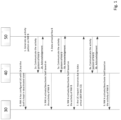
- Figure 1 there are schematically shown communication flows for a first implementation of this aspect. This shows flows between: a UE 30 having dual transmitters and dual receivers, a SIM for communication with a first network (NW A) and a SIM for communication with a second network (NW B); a Master Node of NW A 40; and a Master Node of NW B 50.
- a backhaul link (not shown) is provided between the first network NW A and the second network NWB.
- the first network NW A makes a decision on UE capability restriction depending on the activities on the second network NW B.
- the UE is connected to both the first network NW A and the second network NW B.
- the UE is configured with CA (PCell and Scell) in network A.
- CA PCell and Scell
- the Scell is kept in deactivated state and the activation of SCell is controlled according to the UE activities in the second network NW B.
- the second network NW B makes the decision on whether there is data transmission in NW B based on legacy mechanism Buffer Status Report (BSR), Downlink (DL) data arrival and configuration on NW B.
- NW B Buffer Status Report
- DL Downlink
- This implantation thereby achieves dynamic sharing of the UE transmitter and/or receiver in both the first network NW A and the second network NW B.
- the UE provides the activity pattern to NW A, rather than NW B.
- FIG 2 there are schematically shown communication flows for a second implementation according to this aspect. Where the same features and/or steps are shown as in Figure 1 , the same reference numerals are used.
- the UE 30 generates an activity pattern for its activity with NW B based on its configurations.
- the activity pattern on NW B is provided to the MN of NW A 40 by the UE 30.
- the UE 30 generates a UE preference on UE capability restriction based on the activities (based on the configuration from the second network NW B) and indicates the UE capability preference to the MN of the first network NW A4 40.
- the legacy procedure for activation/deactivation of SCell and activation/deactivation of SCG on NW A can used in all implementations according to this first aspect, to dynamically control the scheduling in NW A based on the UE activity on NW B.
- Control (activation/deactivation) of SCell is currently implemented by an existing MAC CE, as will be described below.
- Control (activation/deactivation) of SCG is currently implemented by RRC signalling.
- Control of SCell activation and/or deactivation by a MAC CE is described in 3GPP TS 38.321, v.17.1.0, section 6.1.3.10.
- SCell Activation/Deactivation MAC CEs there are two types.
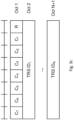
- FIG 3a there is depicted a first type of MAC CE for SCell activation and/or deactivation using one octet. This is identified by a MAC sub-header with a specific Logical Channel ID (LCID). It has a fixed size with seven C-fields and one R-field. If there is a SCell configured for the MAC entity with SCelllndex i, the C i field indicates the activation/deactivation status of that SCell.
- LCID Logical Channel ID
- the MAC entity ignores the respective C i field.
- the C i field is set to 1 to indicate that the SCell with SCelllndex i shall be activated.
- the C i field is set to 0 to indicate that the SCell with SCelllndex i shall be deactivated.
- MAC CE structure for SCell activation or deactivation of a second type using four octets and is identified by a MAC sub-header with specific LCID. It has a fixed size with 31 C-fields and one R-field.
- the SCell Activation/deactivation MAC CEs can be further enhanced to include a Tracking Reference Signal (TRS) ID field as discussed in 3GPP TS 38.321, v.17.1.0, section 6.1.3.55.
- TRS information provides Channel State Information - Reference Signal (CSI-RS) for tracking.
- CSI-RS Channel State Information - Reference Signal
- FIG. 3c there is depicted a MAC CE structure for such enhanced SCell activation or deactivation using one octet.
- the enhanced SCell Activation/Deactivation MAC CE is identified by a MAC sub-header with specific extended LCID (eLCID). It has a variable size and consists of C-fields, R-field and several TRS ID fields.
- Each TRS ID j corresponds to the i th SCell that shall be activated according to C i in ascending order of SCelllndex of the SCell and corresponding C i is set to 1. If TRS configuration ID in TRS ID j is set to a non-zero value, it indicates the corresponding TRS address by scellActivationRS-ld is activated. If TRS configuration ID in TRS ID j is set to zero, it indicates that no TRS is used for the corresponding SCell.
- a method for configuring operation of a UE with a first cellular network as a first subscriber, with the UE simultaneously operating with a second cellular network as a second, different subscriber comprises: receiving, at a network entity of the first cellular network, information on a communication activity pattern for the UE with the second cellular network; and configuring operation of the UE with the first cellular network based on the received communication activity pattern.
- the UE is configured for simultaneous operation with the first cellular network using both a master or primary cell (for dual connectivity operation a Master Cell Group, MCG and for carrier aggregation operation a primary cell, PCell) and a secondary cell (for dual connectivity operation a Secondary Cell Group, SCG and for carrier aggregation operation a secondary cell, SCell).
- the step of configuring operation of the UE with the first cellular network may comprise controlling activation and/or deactivation of the secondary cell with the UE based on the received communication activity pattern.
- controlling activation and/or deactivation of the SCG with the UE may comprise communicating RRC signalling, whereas for carrier aggregation operation, controlling activation and/or deactivation of the SCell with the UE may comprise communicating a MAC CE.
- the MAC CE may further include TRS data and/or comprise a eLCID portion.
- controlling activation and/or deactivation of the secondary cell of the first cellular network with the UE may be achieved by deactivating the secondary cell in response to user data for transmission to the UE arriving at the second cellular network.
- arrival of the user data at the second cellular network may prompt the communication of the information on a communication activity pattern for the UE with the second cellular network to the first cellular network. This may then prompt the first cellular network to deactivate the secondary cell.
- the information on a communication activity pattern for the UE with the second cellular network may be communicated from a network entity of the second cellular network to the network entity of the first cellular network. Additionally or alternatively, the information on a communication activity pattern for the UE may be communicated from the UE to the network entity of the first cellular network (for example, in the form of a UE preference for a temporary capability limitation).
- the method comprises communicating from the UE or from a network entity of the second cellular network to a network entity of the first cellular network, information on a communication activity pattern for the UE with the second cellular network, in order to allow the network entity of the first cellular network to configure operation of the UE with the first cellular network.
- the identifying may be at the second cellular network, but it could additionally or alternatively include receiving the user data at the UE.
- Implementations according to the above-described aspects may be in the form of a computer program (software), within a network entity of a cellular network or within a UE. Further generalised aspects and/or details will be discussed below. Before this, additional details of specific implementations will be described.
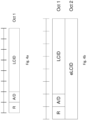
- a MAC CE structure for SCG activation or deactivation using one octet comprises: a reserved field (R); a SCG activation/deactivation field (A/D); and a LCID.
- R reserved field
- A/D SCG activation/deactivation field
- LCID LCID
- FIG. 4b illustrating a MAC CE structure for SCG activation or deactivation using two octets according to a second implementation of this aspect.
- this implementation uses an extended LCID (eLCID) field, so a two octet MAC CE is employed.
- eLCID extended LCID
- a method for configuring dual connectivity operation of a cellular network in which a UE simultaneously operates with the cellular network using both a MCG and a SCG.
- the method comprises controlling activation and/or deactivation of the SCG by communicating a MAC CE. This may improve the dynamic and efficient control of SCG activation and/or deactivation.
- This may be implemented as a computer program (software) or within a network entity of a cellular network.
- the MAC CE advantageously comprises a portion to instruct either activation or deactivation of the SCG.
- this portion in the form of a portion of the structure or a data element or information
- the MAC CE (and more preferably, its sub-header) comprises an identifier for the SCG. This allows the instruction in the MAC CE to be directed accordingly.
- the MAC CE comprises a LCID portion and/or a eLCID portion, for identifying characteristics and/or a destination for data in the MAC CE.
- the UE is preferably configured to operate with the cellular network as a first subscriber and further configured to operate simultaneously with a second cellular network as a second, different subscriber.
- this aspect is especially suited to use with multi-SIM UE devices.
- the activation and/or deactivation instructions could also be represented by an activation/deactivation pattern. This way the signalling overhead can be reduced without affecting the performance of the functionality.
- a MAC CE for controlling activation and/or deactivation of a SCG may further indicate at least one time period for activation or deactivation of the SCG. This may allow advance control of the SCG (or other second cell) activation and/or deactivation, to reduce the signalling overhead and improve the speed of operation.
- the MAC CE indicates a plurality of time periods for activation or deactivation of the SCG.
- the MAC CE may indicate a plurality of time periods for activation or deactivation of the SCG by indicating a time period with reference to at least one radio frame and a rate of repetition for the time period.
- the MAC CE may indicate that the SCG should be deactivated for every second sub-frame in alternate frames or indicate that the SCG should be deactivated for every fifth and sixth sub-frame in every fourth frame.
- Other patterns for activation and/or deactivation will be readily apparent based on these examples.
- the activity pattern comprises a two-frame repeating pattern starting from the first frame and repeating four times, in which the first frame comprises activity 5ms after the start of the radio frame and lasting 2ms.
- the parameter Nu could alternatively indicate the number of repetitions of the pattern, rather than the number of frames for which the pattern applies.
- a slight variant on this approach is to replace Re and SFN by a bitmap.
- the bitmap is designed to represent n number of radio frames. Each bit in the bitmap indicates whether there is any activity in the respective radio frame. If the bitmap indicates activity in the radio frame (for example, by a '1'), the parameters D and S apply and if the bitmap indicates no activity in the radio frame (for example, by a '0'), the second cell can be kept activated or deactivated, as required.
- the pattern indicated by the bitmap (and other parameters) can be repeated for configured number of times, for example by a further parameter, which may similar to Nu (but indicating a number of repetitions for the bitmap, rather than the number of frames).
- RRC signalling could be used to communicate the activity pattern.
- the UE may provide the activity pattern for its activity on the second network NW B to the first network NW A using RRC signalling. This could either be provided as a specific activity pattern on the second network NW B or as a UE preference for a temporary capability limitation on the first network NW A. As discussed above, this information can allow the first network NW A to configure an activity pattern for a second cell (SCell or SCG) for the UE.
- SCell or SCG second cell
- the same activity attributes described above can be used to configure, in advance, an activity pattern for the UE on the second cell (SCell or SCG) of the first network NW A.
- the second cell can be activated and deactivated in accordance with the communicated pattern.
- the activity pattern configured may be overruled by additional RRC signalling by the first network NW A at any time. If the activity pattern is disabled, the UE may wait for a new network command for configuration of the second cell (SCell or SCG) on the first network NW A.
- MAC signalling may be used to communicate the activity pattern.
- Use of MAC signalling has the advantage of faster delivery time when compared to the use of RRC signalling.
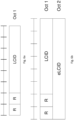
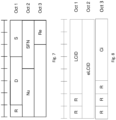
- FIG 6a there is illustrated a MAC CE one octet sub-header structure for indicating an activity pattern for a UE with a network. This comprises two reserved bits (R, set to 0) and a LCID.
- Figure 6b illustrating a MAC CE two octet sub-header structure for indicating an activity pattern for a UE with a network. This comprises two reserved bits (R), a LCID and a eLCID. Either the LCID or the eLCID can be used to represent the "activity" MAC CE.
- a MAC Protocol Data Unit comprises a MAC sub-header and a payload.
- the payload part of the MAC PDU is now discussed according to a fourth aspect of the disclosure.
- a MAC CE payload structure for indicating an activity pattern for a UE with a network. This comprises: a reserved bit (R), set to 0; and data corresponding with the activity pattern parameters identified above.
- the activity duration (D) represents the duration the activity, taking place within one radio frame.
- the duration typically takes values of 1, 2, 3, 4, 5, 6, 7 or 8 subframes/ms.
- the start point of activity duration with respect to the start of radio frame (S) typically takes values of 1, 2, 3, 4, 5, 6, 7 or 8 subframes/ms.
- the number of radio frames (Nu) indicates the number of radio frames over which the activity pattern is repeated.
- the Nu field typically takes values of 0, 1, 2, 3, ..., 15 radio frames.
- the system frame number (SFN) indicates the system frame where the activity pattern starts.
- the SFN field takes typically values of 0 to 1023.
- the activity repetition (Re) is given in radio frames.
- the Re field takes values of 0, 1,2,3 in radio frames.
- an activity pattern MAC CE could also be designed for communicating or instructing a SCell activity pattern.
- the payload format shown in Figure 7 could still be used. However, a different sub-header format might be employed. Referring next to Figure 8 , there is illustrated a three octet MAC CE sub-header structure for indicating an activity pattern for a secondary cell (SCell).
- This comprises: a first octet having two reserved bits (R) and a LCID; a second octet comprising a eLCID; and a third octet having three reserved bits (R) and the SCell identity (Ci) for which the SCell activity pattern MAC CE is applied. This allows the MAC CE to be directed correctly.
- a method for configuring operation in respect of a UE configured to operate with at least one cellular network comprises communicating a communication activity pattern for the UE.
- the communication activity pattern indicates a start time and end time for the communication activity with reference to a period of at least one radio frame, such that the at least one cellular network can be configured for communication with the UE during or excluding the time indicated by the communication activity pattern.
- This allows a time frame of an (optionally repeating) activity pattern to be communicated in an efficient way.
- Implementations according to this aspect may be in the form of a computer program (software), within a network entity of a cellular network or within a UE.
- the end time is indicated by communication of a duration from the start time. This may be more efficient than communicated an end time with reference to the start of a radio frame. Additionally or alternatively, it may allow an end time in a different radio frame from the start time.
- the start time is preferably indicated with reference to both: a time from a start of a single radio frame (for example, in terms of a number of seconds or ms or with reference to a number of sub-frames); and a number of a radio frame from a group of multiple radio frames (for example, indicating that the start is in the first radio frame of the group).
- the communication activity pattern may indicate a repetition of the communication activity with reference to the period of at least one radio frame. This period may be group of multiple radio frames discussed above.
- the repetition may be indicated by communicating a number of radio frames for which the communication activity is repeated (that is, the number of radio frames in the repeating group). Additionally or alternatively, the repetition may be indicated by communicating one of: a duration of the period of at least one radio frame; and a bit map indicating radio frames for which the communication activity applies.
- the communicating may be in the form of RRC signalling or a MAC CE.
- the at least one cellular network may include more than one cellular network.
- the UE may be configured to operate with a first cellular network as a first subscriber and to operate simultaneously with a second cellular network as a second, different subscriber.
- the communicating is to a network entity of the first cellular network to indicate activity of the UE with the second cellular network.
- the communicating may be from a network entity of the second cellular network or from the UE.
- the communicating may be from a network entity of the first cellular network to control operation of a second cell (for example, SCG or SCell, as discussed above).
- the UE may be configured for simultaneous operation with the first cellular network using both a master or primary cell and a secondary cell. Then, the communicating is from a network entity of the first cellular network to the secondary cell to control activation and/or deactivation of the secondary cell according to the communication activity pattern.
Landscapes
- Engineering & Computer Science (AREA)
- Computer Networks & Wireless Communication (AREA)
- Signal Processing (AREA)
- Mobile Radio Communication Systems (AREA)
Priority Applications (3)
| Application Number | Priority Date | Filing Date | Title |
|---|---|---|---|
| EP22189123.7A EP4319454A1 (de) | 2022-08-05 | 2022-08-05 | Konfigurieren von benutzergeräten für den betrieb in einem zellularen netzwerk |
| US18/362,851 US20240049337A1 (en) | 2022-08-05 | 2023-07-31 | Configuring User Equipment Operation in a Cellular Network |
| CN202310983013.4A CN117528569A (zh) | 2022-08-05 | 2023-08-04 | 在蜂窝网络中配置用户设备操作 |
Applications Claiming Priority (1)
| Application Number | Priority Date | Filing Date | Title |
|---|---|---|---|
| EP22189123.7A EP4319454A1 (de) | 2022-08-05 | 2022-08-05 | Konfigurieren von benutzergeräten für den betrieb in einem zellularen netzwerk |
Publications (1)
| Publication Number | Publication Date |
|---|---|
| EP4319454A1 true EP4319454A1 (de) | 2024-02-07 |
Family
ID=83149216
Family Applications (1)
| Application Number | Title | Priority Date | Filing Date |
|---|---|---|---|
| EP22189123.7A Pending EP4319454A1 (de) | 2022-08-05 | 2022-08-05 | Konfigurieren von benutzergeräten für den betrieb in einem zellularen netzwerk |
Country Status (3)
| Country | Link |
|---|---|
| US (1) | US20240049337A1 (de) |
| EP (1) | EP4319454A1 (de) |
| CN (1) | CN117528569A (de) |
Family Cites Families (13)
| Publication number | Priority date | Publication date | Assignee | Title |
|---|---|---|---|---|
| US8954065B2 (en) * | 2010-11-24 | 2015-02-10 | Lg Electronics Inc. | Method of communicating data based on an unlicensed band in a wireless communication system |
| US9338713B2 (en) * | 2013-10-03 | 2016-05-10 | Qualcomm Incorporated | Apparatus and method for enhanced tune-away operation |
| US9674758B2 (en) * | 2014-11-19 | 2017-06-06 | Mediatek Inc. | Multi-SIM user equipment and wireless communication method thereof |
| US10412780B2 (en) * | 2017-05-25 | 2019-09-10 | Apple Inc. | Adapting discontinuous reception cycles using scheduling requests |
| KR20230096009A (ko) * | 2020-10-22 | 2023-06-29 | 삼성전자주식회사 | 무선 네트워크에서 복수의 sim들을 포함하는 ue에 대한 갭 구성 |
| EP4265001A1 (de) * | 2020-12-16 | 2023-10-25 | Telefonaktiebolaget LM Ericsson (publ) | Mobilitätsverfahren für multi-sim |
| WO2022208348A1 (en) * | 2021-03-29 | 2022-10-06 | Telefonaktiebolaget Lm Ericsson (Publ) | Radio resource control for multi-sim |
| KR20240038969A (ko) * | 2021-07-31 | 2024-03-26 | 퀄컴 인코포레이티드 | 이중 접속 모드에서 msim(multi-subscriber identity module) 사용자 장비에서의 가입 공유를 위한 방법들 및 시스템들 |
| CN115943658A (zh) * | 2021-08-05 | 2023-04-07 | 苹果公司 | 多sim调度间隙 |
| US20230127705A1 (en) * | 2021-10-21 | 2023-04-27 | Qualcomm Incorporated | Link failure monitoring at a multi-sim device in a wireless network |
| KR20230084046A (ko) * | 2021-12-03 | 2023-06-12 | 아서스테크 컴퓨터 인코포레이션 | 무선 통신 시스템에서 다중-가입자 신원 모듈(sim)에 대한 전력 헤드룸 보고를 위한 방법 및 장치 |
| KR20230108212A (ko) * | 2022-01-10 | 2023-07-18 | 엘지전자 주식회사 | 무선 통신에서 설정 요청 |
| WO2023245469A1 (en) * | 2022-06-22 | 2023-12-28 | Apple Inc. | Measurement gaps with multi-subscriber identity module operation |
-
2022
- 2022-08-05 EP EP22189123.7A patent/EP4319454A1/de active Pending
-
2023
- 2023-07-31 US US18/362,851 patent/US20240049337A1/en active Pending
- 2023-08-04 CN CN202310983013.4A patent/CN117528569A/zh active Pending
Non-Patent Citations (3)
| Title |
|---|
| 3GPP TS 38.321 |
| RAN2 VC (NOKIA): "Moderator's summary for discussion [RAN94e-R18Prep-16] Multiple SIM (MUSIM) Enhancements", vol. RAN WG3, no. Electronic Meeting; 20211206 - 20211217, 2 November 2021 (2021-11-02), XP052073754, Retrieved from the Internet <URL:https://ftp.3gpp.org/tsg_ran/TSG_RAN/TSGR_94e/Inbox/RP-212676.zip RP-212676 RAN94e-R18Prep-16__Multiple_SIM__MUSIM__Enhancements-v0.0.6.pdf> [retrieved on 20211102] * |
| TECHNICAL SPECIFICATION (TS) 36.304, 3GPP |
Also Published As
| Publication number | Publication date |
|---|---|
| CN117528569A (zh) | 2024-02-06 |
| US20240049337A1 (en) | 2024-02-08 |
Similar Documents
| Publication | Publication Date | Title |
|---|---|---|
| US12069660B2 (en) | Infrastructure equipment for determining whether a communications device is within a radio coverage area | |
| US12035296B2 (en) | Delay timer for data transmission in inactive state | |
| CN105075148B (zh) | 提供tdd配置和确定上行链路传输定时的方法和装置 | |
| KR20210093766A (ko) | 무선 통신 시스템에서 랜덤 액세스 채널(rach) 기반 소규모 데이터 전송 절차를 위한 방법 및 장치 | |
| JP2022531228A (ja) | 複数のspsおよび構成済みグラント構成 | |
| KR102221332B1 (ko) | 이동 통신 시스템에서 파워 헤드룸 보고 및 하이브리드 자동 재전송을 제어하는 방법 및 장치 | |
| JP2017521880A (ja) | 無線通信システムで端末間の通信のための信号を送受信する方法及び装置 | |
| US20230217525A1 (en) | Method and apparatus for providing cell group activation or deactivation service in wireless communication system | |
| US20250317814A1 (en) | Fast Primary Cell Switching | |
| WO2021160150A1 (zh) | Iab网络的复用调度方法和iab节点 | |
| KR102644416B1 (ko) | 멀티-usim 중단 및 최적화된 재개 | |
| US20230292314A1 (en) | Method of uplink resource allocation and user equipment thereof | |
| US12604177B2 (en) | Configuring multiple subscriber operation | |
| EP4319453B1 (de) | Dual-konnektivitätsbetrieb eines zellularen netzwerks | |
| EP4319454A1 (de) | Konfigurieren von benutzergeräten für den betrieb in einem zellularen netzwerk | |
| WO2024105652A1 (en) | Aligning user equipment (ue) behavior to network energy saving states | |
| KR102472517B1 (ko) | 무선 이동 통신 시스템에서 다수의 랜덤 액세스 구성과 하나의 물리 하향링크 공용 채널 구성에 기반해서 랜덤 액세스를 수행하는 방법 및 장치 | |
| JP2026501062A (ja) | シングルdciによってスケジュールされた多重トランスポートブロックに対するharqフィードバックの有効化/無効化 | |
| CN120345342A (zh) | 用于在无线网络中进行多个drx管理的方法、装置和系统 | |
| KR20250007149A (ko) | 무선 이동 통신 시스템에서 기지국의 비연속 송신을 활성화하거나 비활성화하는 방법 및 장치 | |
| WO2025156256A1 (en) | Method and apparatus for performing beam indication and pathloss determination with uplink-only transmission reception point in a wireless communication system | |
| KR102503658B1 (ko) | 무선 이동 통신 시스템에서 랜덤 액세스를 위한 상향링크 캐리어를 선택하고 대역폭 부분을 전환하는 방법 및 장치 | |
| WO2024188204A1 (zh) | 一种被用于新无线系统中的方法和装置 | |
| WO2024171174A1 (en) | Scheduling request configuration |
Legal Events
| Date | Code | Title | Description |
|---|---|---|---|
| PUAI | Public reference made under article 153(3) epc to a published international application that has entered the european phase |
Free format text: ORIGINAL CODE: 0009012 |
|
| STAA | Information on the status of an ep patent application or granted ep patent |
Free format text: STATUS: THE APPLICATION HAS BEEN PUBLISHED |
|
| AK | Designated contracting states |
Kind code of ref document: A1 Designated state(s): AL AT BE BG CH CY CZ DE DK EE ES FI FR GB GR HR HU IE IS IT LI LT LU LV MC MK MT NL NO PL PT RO RS SE SI SK SM TR |
|
| STAA | Information on the status of an ep patent application or granted ep patent |
Free format text: STATUS: REQUEST FOR EXAMINATION WAS MADE |
|
| 17P | Request for examination filed |
Effective date: 20240718 |
|
| RBV | Designated contracting states (corrected) |
Designated state(s): AL AT BE BG CH CY CZ DE DK EE ES FI FR GB GR HR HU IE IS IT LI LT LU LV MC MK MT NL NO PL PT RO RS SE SI SK SM TR |