EP4324872A1 - Procédé de production d'un produit d'étanchéité à faible densité et conductivité thermique - Google Patents
Procédé de production d'un produit d'étanchéité à faible densité et conductivité thermique Download PDFInfo
- Publication number
- EP4324872A1 EP4324872A1 EP23189026.0A EP23189026A EP4324872A1 EP 4324872 A1 EP4324872 A1 EP 4324872A1 EP 23189026 A EP23189026 A EP 23189026A EP 4324872 A1 EP4324872 A1 EP 4324872A1
- Authority
- EP
- European Patent Office
- Prior art keywords
- polymer
- thermal conductivity
- density
- sealing product
- foaming agents
- Prior art date
- Legal status (The legal status is an assumption and is not a legal conclusion. Google has not performed a legal analysis and makes no representation as to the accuracy of the status listed.)
- Pending
Links
- 238000007789 sealing Methods 0.000 title claims abstract description 13
- 238000004519 manufacturing process Methods 0.000 title claims abstract description 11
- 239000004088 foaming agent Substances 0.000 claims abstract description 54
- 229920000642 polymer Polymers 0.000 claims abstract description 39
- 238000000034 method Methods 0.000 claims description 20
- 239000004005 microsphere Substances 0.000 claims description 12
- 239000000203 mixture Substances 0.000 claims description 9
- 239000000463 material Substances 0.000 claims description 7
- 239000004033 plastic Substances 0.000 claims description 5
- 229920003023 plastic Polymers 0.000 claims description 5
- 239000000565 sealant Substances 0.000 claims description 5
- 239000003963 antioxidant agent Substances 0.000 claims description 4
- 230000003078 antioxidant effect Effects 0.000 claims description 4
- 238000001816 cooling Methods 0.000 claims description 3
- 238000001125 extrusion Methods 0.000 claims description 3
- XLYOFNOQVPJJNP-UHFFFAOYSA-N water Substances O XLYOFNOQVPJJNP-UHFFFAOYSA-N 0.000 claims description 3
- 238000011049 filling Methods 0.000 claims description 2
- 229920001935 styrene-ethylene-butadiene-styrene Polymers 0.000 claims 1
- -1 styrene-ethylene-butylene-styrene Chemical class 0.000 abstract description 5
- 239000000126 substance Substances 0.000 description 20
- 239000007789 gas Substances 0.000 description 12
- 239000012212 insulator Substances 0.000 description 8
- 239000003795 chemical substances by application Substances 0.000 description 7
- 239000006260 foam Substances 0.000 description 7
- 210000004027 cell Anatomy 0.000 description 6
- 238000005187 foaming Methods 0.000 description 6
- 230000007423 decrease Effects 0.000 description 5
- 229920001971 elastomer Polymers 0.000 description 5
- IJGRMHOSHXDMSA-UHFFFAOYSA-N Atomic nitrogen Chemical compound N#N IJGRMHOSHXDMSA-UHFFFAOYSA-N 0.000 description 4
- CURLTUGMZLYLDI-UHFFFAOYSA-N Carbon dioxide Chemical compound O=C=O CURLTUGMZLYLDI-UHFFFAOYSA-N 0.000 description 4
- PPBRXRYQALVLMV-UHFFFAOYSA-N Styrene Chemical compound C=CC1=CC=CC=C1 PPBRXRYQALVLMV-UHFFFAOYSA-N 0.000 description 4
- 230000000694 effects Effects 0.000 description 4
- 239000000806 elastomer Substances 0.000 description 4
- 235000006708 antioxidants Nutrition 0.000 description 3
- 229930195733 hydrocarbon Natural products 0.000 description 3
- 150000002430 hydrocarbons Chemical class 0.000 description 3
- 239000011159 matrix material Substances 0.000 description 3
- 239000002861 polymer material Substances 0.000 description 3
- 238000002360 preparation method Methods 0.000 description 3
- 239000007787 solid Substances 0.000 description 3
- 229920002725 thermoplastic elastomer Polymers 0.000 description 3
- OZAIFHULBGXAKX-UHFFFAOYSA-N 2-(2-cyanopropan-2-yldiazenyl)-2-methylpropanenitrile Chemical compound N#CC(C)(C)N=NC(C)(C)C#N OZAIFHULBGXAKX-UHFFFAOYSA-N 0.000 description 2
- ATRRKUHOCOJYRX-UHFFFAOYSA-N Ammonium bicarbonate Chemical compound [NH4+].OC([O-])=O ATRRKUHOCOJYRX-UHFFFAOYSA-N 0.000 description 2
- XKRFYHLGVUSROY-UHFFFAOYSA-N Argon Chemical compound [Ar] XKRFYHLGVUSROY-UHFFFAOYSA-N 0.000 description 2
- 239000004604 Blowing Agent Substances 0.000 description 2
- 239000004433 Thermoplastic polyurethane Substances 0.000 description 2
- 239000000654 additive Substances 0.000 description 2
- 239000001099 ammonium carbonate Substances 0.000 description 2
- VJRITMATACIYAF-UHFFFAOYSA-N benzenesulfonohydrazide Chemical compound NNS(=O)(=O)C1=CC=CC=C1 VJRITMATACIYAF-UHFFFAOYSA-N 0.000 description 2
- 230000015572 biosynthetic process Effects 0.000 description 2
- 229910002092 carbon dioxide Inorganic materials 0.000 description 2
- 239000001569 carbon dioxide Substances 0.000 description 2
- 238000006243 chemical reaction Methods 0.000 description 2
- 239000013078 crystal Substances 0.000 description 2
- 238000000354 decomposition reaction Methods 0.000 description 2
- 239000000945 filler Substances 0.000 description 2
- 210000000497 foam cell Anatomy 0.000 description 2
- 238000005755 formation reaction Methods 0.000 description 2
- 238000002347 injection Methods 0.000 description 2
- 239000007924 injection Substances 0.000 description 2
- 239000007788 liquid Substances 0.000 description 2
- 230000014759 maintenance of location Effects 0.000 description 2
- 239000002923 metal particle Substances 0.000 description 2
- 229910052757 nitrogen Inorganic materials 0.000 description 2
- 239000002245 particle Substances 0.000 description 2
- 229920001169 thermoplastic Polymers 0.000 description 2
- 229920002803 thermoplastic polyurethane Polymers 0.000 description 2
- ULUZGMIUTMRARO-UHFFFAOYSA-N (carbamoylamino)urea Chemical compound NC(=O)NNC(N)=O ULUZGMIUTMRARO-UHFFFAOYSA-N 0.000 description 1
- 229910000013 Ammonium bicarbonate Inorganic materials 0.000 description 1
- 239000004156 Azodicarbonamide Substances 0.000 description 1
- UGFAIRIUMAVXCW-UHFFFAOYSA-N Carbon monoxide Chemical compound [O+]#[C-] UGFAIRIUMAVXCW-UHFFFAOYSA-N 0.000 description 1
- MWRWFPQBGSZWNV-UHFFFAOYSA-N Dinitrosopentamethylenetetramine Chemical compound C1N2CN(N=O)CN1CN(N=O)C2 MWRWFPQBGSZWNV-UHFFFAOYSA-N 0.000 description 1
- 229920000103 Expandable microsphere Polymers 0.000 description 1
- 239000004743 Polypropylene Substances 0.000 description 1
- UIIMBOGNXHQVGW-DEQYMQKBSA-M Sodium bicarbonate-14C Chemical compound [Na+].O[14C]([O-])=O UIIMBOGNXHQVGW-DEQYMQKBSA-M 0.000 description 1
- 229910000831 Steel Inorganic materials 0.000 description 1
- 238000005299 abrasion Methods 0.000 description 1
- 230000004913 activation Effects 0.000 description 1
- 150000001335 aliphatic alkanes Chemical class 0.000 description 1
- 150000001338 aliphatic hydrocarbons Chemical class 0.000 description 1
- 235000012538 ammonium bicarbonate Nutrition 0.000 description 1
- 235000012501 ammonium carbonate Nutrition 0.000 description 1
- 229910052786 argon Inorganic materials 0.000 description 1
- XOZUGNYVDXMRKW-AATRIKPKSA-N azodicarbonamide Chemical compound NC(=O)\N=N\C(N)=O XOZUGNYVDXMRKW-AATRIKPKSA-N 0.000 description 1
- 235000019399 azodicarbonamide Nutrition 0.000 description 1
- 229910052788 barium Inorganic materials 0.000 description 1
- UETLMBWMVIQIGU-UHFFFAOYSA-N calcium azide Chemical compound [Ca+2].[N-]=[N+]=[N-].[N-]=[N+]=[N-] UETLMBWMVIQIGU-UHFFFAOYSA-N 0.000 description 1
- 229910002091 carbon monoxide Inorganic materials 0.000 description 1
- 210000003850 cellular structure Anatomy 0.000 description 1
- 238000005253 cladding Methods 0.000 description 1
- 238000004581 coalescence Methods 0.000 description 1
- 238000009833 condensation Methods 0.000 description 1
- 230000005494 condensation Effects 0.000 description 1
- 239000011258 core-shell material Substances 0.000 description 1
- 239000007822 coupling agent Substances 0.000 description 1
- 238000004132 cross linking Methods 0.000 description 1
- 239000003431 cross linking reagent Substances 0.000 description 1
- 230000003247 decreasing effect Effects 0.000 description 1
- 238000001704 evaporation Methods 0.000 description 1
- 230000008020 evaporation Effects 0.000 description 1
- 238000009472 formulation Methods 0.000 description 1
- 239000011521 glass Substances 0.000 description 1
- 230000005484 gravity Effects 0.000 description 1
- 238000010438 heat treatment Methods 0.000 description 1
- 229920001903 high density polyethylene Polymers 0.000 description 1
- 239000004700 high-density polyethylene Substances 0.000 description 1
- 150000002484 inorganic compounds Chemical class 0.000 description 1
- 239000011256 inorganic filler Substances 0.000 description 1
- 229910003475 inorganic filler Inorganic materials 0.000 description 1
- 229910010272 inorganic material Inorganic materials 0.000 description 1
- 238000009413 insulation Methods 0.000 description 1
- 239000000314 lubricant Substances 0.000 description 1
- 238000002844 melting Methods 0.000 description 1
- 230000008018 melting Effects 0.000 description 1
- 239000012764 mineral filler Substances 0.000 description 1
- 239000002667 nucleating agent Substances 0.000 description 1
- 150000002894 organic compounds Chemical class 0.000 description 1
- 238000013021 overheating Methods 0.000 description 1
- 229920001155 polypropylene Polymers 0.000 description 1
- 238000003825 pressing Methods 0.000 description 1
- 238000003908 quality control method Methods 0.000 description 1
- 238000007493 shaping process Methods 0.000 description 1
- 239000010959 steel Substances 0.000 description 1
- 238000009827 uniform distribution Methods 0.000 description 1
Images
Classifications
-
- C—CHEMISTRY; METALLURGY
- C08—ORGANIC MACROMOLECULAR COMPOUNDS; THEIR PREPARATION OR CHEMICAL WORKING-UP; COMPOSITIONS BASED THEREON
- C08J—WORKING-UP; GENERAL PROCESSES OF COMPOUNDING; AFTER-TREATMENT NOT COVERED BY SUBCLASSES C08B, C08C, C08F, C08G or C08H
- C08J9/00—Working-up of macromolecular substances to porous or cellular articles or materials; After-treatment thereof
- C08J9/32—Working-up of macromolecular substances to porous or cellular articles or materials; After-treatment thereof from compositions containing microballoons, e.g. syntactic foams
-
- B—PERFORMING OPERATIONS; TRANSPORTING
- B29—WORKING OF PLASTICS; WORKING OF SUBSTANCES IN A PLASTIC STATE IN GENERAL
- B29C—SHAPING OR JOINING OF PLASTICS; SHAPING OF MATERIAL IN A PLASTIC STATE, NOT OTHERWISE PROVIDED FOR; AFTER-TREATMENT OF THE SHAPED PRODUCTS, e.g. REPAIRING
- B29C44/00—Shaping by internal pressure generated in the material, e.g. swelling or foaming ; Producing porous or cellular expanded plastics articles
- B29C44/34—Auxiliary operations
- B29C44/3442—Mixing, kneading or conveying the foamable material
- B29C44/3446—Feeding the blowing agent
-
- B—PERFORMING OPERATIONS; TRANSPORTING
- B29—WORKING OF PLASTICS; WORKING OF SUBSTANCES IN A PLASTIC STATE IN GENERAL
- B29K—INDEXING SCHEME ASSOCIATED WITH SUBCLASSES B29B, B29C OR B29D, RELATING TO MOULDING MATERIALS OR TO MATERIALS FOR MOULDS, REINFORCEMENTS, FILLERS OR PREFORMED PARTS, e.g. INSERTS
- B29K2009/00—Use of rubber derived from conjugated dienes, as moulding material
- B29K2009/06—SB polymers, i.e. butadiene-styrene polymers
-
- C—CHEMISTRY; METALLURGY
- C08—ORGANIC MACROMOLECULAR COMPOUNDS; THEIR PREPARATION OR CHEMICAL WORKING-UP; COMPOSITIONS BASED THEREON
- C08J—WORKING-UP; GENERAL PROCESSES OF COMPOUNDING; AFTER-TREATMENT NOT COVERED BY SUBCLASSES C08B, C08C, C08F, C08G or C08H
- C08J2201/00—Foams characterised by the foaming process
- C08J2201/02—Foams characterised by the foaming process characterised by mechanical pre- or post-treatments
- C08J2201/03—Extrusion of the foamable blend
-
- C—CHEMISTRY; METALLURGY
- C08—ORGANIC MACROMOLECULAR COMPOUNDS; THEIR PREPARATION OR CHEMICAL WORKING-UP; COMPOSITIONS BASED THEREON
- C08J—WORKING-UP; GENERAL PROCESSES OF COMPOUNDING; AFTER-TREATMENT NOT COVERED BY SUBCLASSES C08B, C08C, C08F, C08G or C08H
- C08J2203/00—Foams characterized by the expanding agent
- C08J2203/22—Expandable microspheres, e.g. Expancel®
-
- C—CHEMISTRY; METALLURGY
- C08—ORGANIC MACROMOLECULAR COMPOUNDS; THEIR PREPARATION OR CHEMICAL WORKING-UP; COMPOSITIONS BASED THEREON
- C08J—WORKING-UP; GENERAL PROCESSES OF COMPOUNDING; AFTER-TREATMENT NOT COVERED BY SUBCLASSES C08B, C08C, C08F, C08G or C08H
- C08J2353/00—Characterised by the use of block copolymers containing at least one sequence of a polymer obtained by reactions only involving carbon-to-carbon unsaturated bonds; Derivatives of such polymers
- C08J2353/02—Characterised by the use of block copolymers containing at least one sequence of a polymer obtained by reactions only involving carbon-to-carbon unsaturated bonds; Derivatives of such polymers of vinyl aromatic monomers and conjugated dienes
Definitions
- the invention relates to a production method developed to reduce the density and thermal conductivity of the polymer used as a sealant.
- the invention relates to a production method that enables the density and thermal conductivity of the styrene-ethylene-butylene-styrene polymer used as a sealing product to be reduced by using an exothermic foaming agent.
- Foaming agents in other words, blowing agents or expanding agents, are agents used to expand the polymer under suitable conditions to obtain a spongy polymer foam when added to the polymer. These agents reduce the density and thermal conductivity of polymers.
- Foaming agents are grouped under two main groups as physical foaming agents and chemical foaming agents.
- Physical foaming agents are organic agents that transform into a compressed gas form cellular structure during the melting stage.
- inorganic physical foaming agents are also known as evaporative type foaming agents because they tend to be volatile liquids.
- Physical foaming agents dissolve in the polymer matrix and form foam cells as a result of evaporation in the matrix.
- Physical foaming agents according to a widely applied technique, form foam cells within the polymer structure when the physical foaming agents are activated and expanded by applying low pressure to the mixture obtained by adding them to a molten polymer. While physical foaming agents, aliphatic hydrocarbon and halogenic hydrocarbons are in organic form, nitrogen, argon and carbon dioxide are inorganic.
- Chemical foaming agents are organic or inorganic compounds that have low molecular weight, are in solid or liquid form at room temperature, and release gases such as carbon monoxide, carbon dioxide or nitrogen to the environment when their structure is destroyed at a certain temperature.
- gases such as carbon monoxide, carbon dioxide or nitrogen to the environment when their structure is destroyed at a certain temperature.
- Sodium bicarbonate, ammonium carbonate, ammonium bicarbonate and calcium azide are some of the inorganic chemical foaming agents.
- organic chemical foaming agents examples include azodicarbonamide, hydrazocarbonamide, benzenesulfonyl hydrazide, dinitrosopentamethylene tetramine, toluenesulfonylhydrazide, benzenesulfonylhydrazide, azobisisobutyronitrile and barium azodicarboxylate.
- Chemical foaming agents are generally mixed with the solid polymer, and as a result of applying heat and pressure to the mixture, they add the gas in their structure into the granular structure of the polymer. Different chemical foaming agents are activated at different temperatures. Therefore, the choice of chemical foaming agent depends on the type of polymer to be used in the process, the process conditions and the size of the emitted gas cells.
- Chemical foaming agents are advantageous over physical foaming agents as they can be incorporated into the unheated polymer in a solid state.
- Chemical foaming agents are divided into exothermic and endothermic agents. Endothermic chemical foaming agents absorb heat during processing. Endothermic agents, which reach the required temperature by absorbing sufficient heat, decompose rapidly and release gas. When endothermic chemical foaming agents are heated by applying low temperatures, they extend the processing time as they reach the sufficient temperature late, and they stop the gas release when the temperature drops below the decomposition temperature. Exothermic chemical foaming agents, on the other hand, generate heat during the process, thus emitting both gas and heat energy to the environment. It is not always desirable for the exothermic foaming agent to give heat to the environment. Because this excess heat causes some parts of the steel surfaces used in the production phase to overheat. Due to the surface temperature differences caused by the overheating of these regions, it may cause quality problems in the foaming process or the injection process.
- foaming agent added to the polymer materials, a decrease in density and thermal conductivity is expected. Since the density of the reduced polymer will be more elastic, its strength is increased in shaping processes and during use. In addition, the polymer, whose thermal conductivity is reduced, exhibits an insulating property and reduces heat conduction.
- the crystal structures of the foaming agents used in order to provide these properties are also important. Foaming agents with microsphere crystal structure are sensitive foaming agents characterised by easy control of specific gravity, retention of closed cells, small sphere diameter and uniform distribution. Microsphere foaming agents are preferred because they can reach 60 times their own volume when activated, in addition to their highly controlled foaming, closed and smooth cell structure, protection against water ingress, creating internal pressure to combat shrinkage.
- Foaming agents made of expandable microspheres have a kind of core-shell structure, with a core consisting of a spherical plastic particle consisting of alkane gas and a shell structure consisting of a thermoplastic polymer capable of releasing hydrocarbons.
- Microsphere foaming agents increase their internal pressure by expanding the hydrocarbons in the shell structure by softening the hard polymer shells when heated. Thus, agents with increased volume achieve the foaming target.
- the polymer shell expands and softens when the microsphere foaming agents cool down, the expanding volume is preserved because it is in a hard structure.
- the microspheres which are more resistant to external pressure and have a flexible structure, become resistant to breakage as their density decreases.
- microsphere foaming agent reduces the density of the polymer, while decreasing the thermal conductivity accordingly. At the same time, it provides the improvement of permanent deformation and breaking strength. However, as the usage rate of microspherical foaming agents increases, it decreases the surface quality and makes the application of quality control methods more difficult as it reduces the strength of the material.
- thermoplastic elastomer foamed door seal strip characterised by being prepared from, to be prepared in portions by weight, 60 to 110 parts of styrene elastomer, 10 to 30 parts of high density polyethylene, 10 to 40 parts polypropylene, 60 to 60 parts 110 parts filler oil, 30 to 80 parts mineral filler, 1 to 5 parts lubricant, 1 to 5 parts of coupling agent, 0.1 to 2 parts of antioxidant, 0 to 5 parts of crosslinking agent and 1 to 8 parts of blowing agent materials, and a preparation method thereof are described.
- thermoplastic polyurethane elastomer particle especially suitable for plastic runway, comprising, by mass, thermoplastic polyurethane elastomer, 3-20% second polymer material, 5-60% inorganic filler, 2-15% third polymer material and 0.5-6% foaming agent and preparation method thereof are described.
- thermoplastic elastomer low density extrusion foam sealing strip material comprising 40-55% by mass of styrene elastomer, 20-36% processed oil, 5-14% plastic, 2-9% filler, 1-5% anti-oxidant and 0.5-1.5% microsphere foaming agent and preparation method thereof are described.
- the most important aim of the invention is to ensure that the density of the polymer has lower values than known values by using exothermic chemical foaming agent with microsphere structure.
- Another aim of the invention is to ensure that the thermal conductivity of the polymer has lower values than known values by using exothermic chemical foaming agent with microsphere structure.
- Another aim of the invention is to have a composition and process parameters determined so that the density and thermal conductivity of the polymer reach a lower level than the known value.
- Another aim of the invention is to keep the process parameters and production process under control by using exothermic chemical foaming agent in microsphere structure and accordingly to obtain a sealing product with homogeneous bubble content without quality problems. In this way, a sealing product without surface problems is obtained.
- Another aim of the invention is to improve the tensile strength and permanent deformation of the sealant produced using the chemical foaming technique.
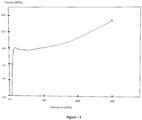
- FIGURE -1 is the drawing that gives the image of the graphic showing the breaking strength of the sealing product that is the subject of the invention.
- the invention relates to obtaining a sealed product by reducing the density and accordingly the thermal conductivity of the styrene-ethylene-butylene-styrene (SEBS) polymer by applying the chemical foaming technique by using a microsphere structured exothermic foaming agent.
- SEBS styrene-ethylene-butylene-styrene
- SEBS polymer Styrene-ethylene-butylene-styrene (SEBS) polymer is an important thermoplastic elastomer that behaves like rubber without changing its chemical structure by crosslinking reaction. SEBS polymer is used in various industries with its high thermal stability and high resistance to atmospheric or chemical abrasion, and its steamcleanable structure. The density of the SEBS polymer varies between 0.89 and 1.25 g/cm 3 .
- the exothermic foaming agent used is micro-spherical, insoluble in water and is activated at 60-100 °C.
- Sealant production method with low density and thermal conductivity comprises the process steps of
- Figure-1 shows the rupture-strength graph of the sealing product obtained with the production method given above.
- the breaking point (A) on the graph shows the percent elongation at the maximum force applied to the sealant. It is observed that the breaking strength of SEBS polymer increases with the use of foaming agent. The increase in the breaking strength of the SEBS polymer occurs with the increase in its elasticity. With the use of microspherical exothermic foaming agent, the density of the SEBS polymer is reduced, and its breaking strength and permanent deformation are higher as it is more elastic.
- the thermal conductivity value of the sealing product whose density and weight is reduced, obtained by the production parameters kept under control and the use of chemical foaming agent, is also reduced in direct proportion to the decrease in density.
- the density of the SEBS polymer is reduced to 0.45 g/cm 3 with the applied method, and the thermal conductivity value of the SEBS polymer is reduced to 0.075-0.045 W/m ⁇ K depending on the density decrease. In this way, a sealing product with increased impermeability is obtained.
Landscapes
- Chemical & Material Sciences (AREA)
- Engineering & Computer Science (AREA)
- Materials Engineering (AREA)
- Health & Medical Sciences (AREA)
- Chemical Kinetics & Catalysis (AREA)
- Medicinal Chemistry (AREA)
- Polymers & Plastics (AREA)
- Organic Chemistry (AREA)
- Manufacture Of Porous Articles, And Recovery And Treatment Of Waste Products (AREA)
Applications Claiming Priority (1)
| Application Number | Priority Date | Filing Date | Title |
|---|---|---|---|
| TR202212365 | 2022-08-04 |
Publications (1)
| Publication Number | Publication Date |
|---|---|
| EP4324872A1 true EP4324872A1 (fr) | 2024-02-21 |
Family
ID=87553922
Family Applications (1)
| Application Number | Title | Priority Date | Filing Date |
|---|---|---|---|
| EP23189026.0A Pending EP4324872A1 (fr) | 2022-08-04 | 2023-08-01 | Procédé de production d'un produit d'étanchéité à faible densité et conductivité thermique |
Country Status (1)
| Country | Link |
|---|---|
| EP (1) | EP4324872A1 (fr) |
Citations (3)
| Publication number | Priority date | Publication date | Assignee | Title |
|---|---|---|---|---|
| CN106589763A (zh) | 2016-12-30 | 2017-04-26 | 台橡(上海)实业有限公司 | 一种热塑性弹性体低密度挤出发泡密封条材料及其制造方法 |
| CN107501837A (zh) | 2017-09-13 | 2017-12-22 | 安徽万朗磁塑股份有限公司 | 一种热塑性弹性体发泡门封条其制备方法 |
| CN111303617A (zh) | 2018-12-12 | 2020-06-19 | 万华化学集团股份有限公司 | 用于塑胶跑道的低密度热塑性聚氨酯弹性体颗粒及其制品 |
-
2023
- 2023-08-01 EP EP23189026.0A patent/EP4324872A1/fr active Pending
Patent Citations (3)
| Publication number | Priority date | Publication date | Assignee | Title |
|---|---|---|---|---|
| CN106589763A (zh) | 2016-12-30 | 2017-04-26 | 台橡(上海)实业有限公司 | 一种热塑性弹性体低密度挤出发泡密封条材料及其制造方法 |
| CN107501837A (zh) | 2017-09-13 | 2017-12-22 | 安徽万朗磁塑股份有限公司 | 一种热塑性弹性体发泡门封条其制备方法 |
| CN111303617A (zh) | 2018-12-12 | 2020-06-19 | 万华化学集团股份有限公司 | 用于塑胶跑道的低密度热塑性聚氨酯弹性体颗粒及其制品 |
Similar Documents
| Publication | Publication Date | Title |
|---|---|---|
| US7803862B2 (en) | Composition for polyolefin resin foam, foam of the same, and process for producing foam | |
| US5348984A (en) | Expandable composition and process for extruded thermoplastic foams | |
| RU2459842C2 (ru) | Пенопласт из сополимера стирола и акрилонитрила с агентом, ослабляющим инфракрасное излучение | |
| JP3380816B2 (ja) | 超低密度ポリオレフィン発泡体、発泡可能なポリオレフィン組成物及びそれらを製造する方法 | |
| KR940019777A (ko) | 열가소성 발포형 제품 및 그것의 제조 방법 | |
| CN110003644B (zh) | 一种热塑性聚酰胺弹性体物理化学联合发泡材料及其制备方法 | |
| US6030696A (en) | Extruded polyolefin foam in thicker grades and plank and process therefor | |
| JP7727707B2 (ja) | 発泡性塩素化塩化ビニル系樹脂粒子、その発泡粒子、およびこれを用いた塩素化塩化ビニル系樹脂発泡成形体 | |
| EP3169723B1 (fr) | Auxiliaires de traitement sans cov pour une utilisation dans la fabrication de mousses utilisant des agents gonflants à faible potentiel d'effet de serre | |
| EP1055701B1 (fr) | Mousse en resine de polycarbonate et amortisseur utilisant cette mousse | |
| EP4324872A1 (fr) | Procédé de production d'un produit d'étanchéité à faible densité et conductivité thermique | |
| JP2001079916A (ja) | 熱可塑性樹脂の発泡成形方法 | |
| JP2002302567A (ja) | 生分解性を有するポリエステル系樹脂予備発泡粒子の連続製造方法 | |
| TR2022012365A2 (tr) | Düşük yoğunluk ve termal iletkenliğe sahip sızdırmazlık ürünü için üretim yöntemi. | |
| JP2001138377A (ja) | 熱可塑性樹脂の発泡成形方法 | |
| JP3526660B2 (ja) | 型内成型用発泡粒子及び型内発泡成型体 | |
| CA2398803C (fr) | Structure de caoutchouc et son procede de fabrication | |
| JP4576267B2 (ja) | 表面改質発泡性ポリスチレン系樹脂粒子とその製造方法、発泡成形体製造用ポリスチレン系樹脂発泡粒子及びポリスチレン系樹脂発泡成形体 | |
| JP3462775B2 (ja) | 発泡成形体 | |
| Weiser et al. | High temperature structural foam | |
| JP2000007809A (ja) | 制振性樹脂連続気泡体及びその製造方法 | |
| JP4733345B2 (ja) | 脂肪族ポリエステル系樹脂発泡体及びその製造方法 | |
| JPH10306173A (ja) | 発泡成形用プロピレン系樹脂粒子、発泡性プロピレン系樹脂粒子、プロピレン系樹脂予備発泡粒子及びプロピレン系樹脂発泡成形体 | |
| CN113321881B (zh) | 用作海上浮力材料的pvc泡沫及其制备方法 | |
| JP3281497B2 (ja) | ポリプロピレン系樹脂発泡体 |
Legal Events
| Date | Code | Title | Description |
|---|---|---|---|
| PUAI | Public reference made under article 153(3) epc to a published international application that has entered the european phase |
Free format text: ORIGINAL CODE: 0009012 |
|
| STAA | Information on the status of an ep patent application or granted ep patent |
Free format text: STATUS: THE APPLICATION HAS BEEN PUBLISHED |
|
| AK | Designated contracting states |
Kind code of ref document: A1 Designated state(s): AL AT BE BG CH CY CZ DE DK EE ES FI FR GB GR HR HU IE IS IT LI LT LU LV MC ME MK MT NL NO PL PT RO RS SE SI SK SM TR |
|
| STAA | Information on the status of an ep patent application or granted ep patent |
Free format text: STATUS: REQUEST FOR EXAMINATION WAS MADE |
|
| 17P | Request for examination filed |
Effective date: 20240326 |
|
| RBV | Designated contracting states (corrected) |
Designated state(s): AL AT BE BG CH CY CZ DE DK EE ES FI FR GB GR HR HU IE IS IT LI LT LU LV MC ME MK MT NL NO PL PT RO RS SE SI SK SM TR |