EP4328893A1 - Sicheres berechnungssystem, sichere berechnungsvorrichtung, verfahren und programm - Google Patents
Sicheres berechnungssystem, sichere berechnungsvorrichtung, verfahren und programm Download PDFInfo
- Publication number
- EP4328893A1 EP4328893A1 EP21937817.1A EP21937817A EP4328893A1 EP 4328893 A1 EP4328893 A1 EP 4328893A1 EP 21937817 A EP21937817 A EP 21937817A EP 4328893 A1 EP4328893 A1 EP 4328893A1
- Authority
- EP
- European Patent Office
- Prior art keywords
- secure computation
- vector
- permutation
- computation apparatus
- share
- Prior art date
- Legal status (The legal status is an assumption and is not a legal conclusion. Google has not performed a legal analysis and makes no representation as to the accuracy of the status listed.)
- Pending
Links
Images

Classifications
-
- H—ELECTRICITY
- H04—ELECTRIC COMMUNICATION TECHNIQUE
- H04L—TRANSMISSION OF DIGITAL INFORMATION, e.g. TELEGRAPHIC COMMUNICATION
- H04L9/00—Cryptographic mechanisms or cryptographic arrangements for secret or secure communications; Network security protocols
- H04L9/08—Key distribution or management, e.g. generation, sharing or updating, of cryptographic keys or passwords
- H04L9/0816—Key establishment, i.e. cryptographic processes or cryptographic protocols whereby a shared secret becomes available to two or more parties, for subsequent use
- H04L9/085—Secret sharing or secret splitting, e.g. threshold schemes
-
- G—PHYSICS
- G06—COMPUTING OR CALCULATING; COUNTING
- G06F—ELECTRIC DIGITAL DATA PROCESSING
- G06F21/00—Security arrangements for protecting computers, components thereof, programs or data against unauthorised activity
- G06F21/60—Protecting data
- G06F21/62—Protecting access to data via a platform, e.g. using keys or access control rules
- G06F21/6218—Protecting access to data via a platform, e.g. using keys or access control rules to a system of files or objects, e.g. local or distributed file system or database
- G06F21/6245—Protecting personal data, e.g. for financial or medical purposes
-
- G—PHYSICS
- G06—COMPUTING OR CALCULATING; COUNTING
- G06F—ELECTRIC DIGITAL DATA PROCESSING
- G06F21/00—Security arrangements for protecting computers, components thereof, programs or data against unauthorised activity
- G06F21/70—Protecting specific internal or peripheral components, in which the protection of a component leads to protection of the entire computer
-
- G—PHYSICS
- G06—COMPUTING OR CALCULATING; COUNTING
- G06F—ELECTRIC DIGITAL DATA PROCESSING
- G06F7/00—Methods or arrangements for processing data by operating upon the order or content of the data handled
- G06F7/58—Random or pseudo-random number generators
- G06F7/582—Pseudo-random number generators
-
- H—ELECTRICITY
- H04—ELECTRIC COMMUNICATION TECHNIQUE
- H04L—TRANSMISSION OF DIGITAL INFORMATION, e.g. TELEGRAPHIC COMMUNICATION
- H04L9/00—Cryptographic mechanisms or cryptographic arrangements for secret or secure communications; Network security protocols
- H04L9/06—Cryptographic mechanisms or cryptographic arrangements for secret or secure communications; Network security protocols the encryption apparatus using shift registers or memories for block-wise or stream coding, e.g. DES systems or RC4; Hash functions; Pseudorandom sequence generators
- H04L9/065—Encryption by serially and continuously modifying data stream elements, e.g. stream cipher systems, RC4, SEAL or A5/3
- H04L9/0656—Pseudorandom key sequence combined element-for-element with data sequence, e.g. one-time-pad [OTP] or Vernam's cipher
- H04L9/0662—Pseudorandom key sequence combined element-for-element with data sequence, e.g. one-time-pad [OTP] or Vernam's cipher with particular pseudorandom sequence generator
-
- H—ELECTRICITY
- H04—ELECTRIC COMMUNICATION TECHNIQUE
- H04W—WIRELESS COMMUNICATION NETWORKS
- H04W12/00—Security arrangements; Authentication; Protecting privacy or anonymity
- H04W12/02—Protecting privacy or anonymity, e.g. protecting personally identifiable information [PII]
-
- H—ELECTRICITY
- H04—ELECTRIC COMMUNICATION TECHNIQUE
- H04L—TRANSMISSION OF DIGITAL INFORMATION, e.g. TELEGRAPHIC COMMUNICATION
- H04L2209/00—Additional information or applications relating to cryptographic mechanisms or cryptographic arrangements for secret or secure communication H04L9/00
- H04L2209/08—Randomization, e.g. dummy operations or using noise
-
- H—ELECTRICITY
- H04—ELECTRIC COMMUNICATION TECHNIQUE
- H04L—TRANSMISSION OF DIGITAL INFORMATION, e.g. TELEGRAPHIC COMMUNICATION
- H04L2209/00—Additional information or applications relating to cryptographic mechanisms or cryptographic arrangements for secret or secure communication H04L9/00
- H04L2209/46—Secure multiparty computation, e.g. millionaire problem
Definitions
- the present invention relates to a secure computation system, a secure computation apparatus, a method, and a program.
- Secure computation is a useful technology that is known to perform various computations at high speed while concealing data.
- an operation of searching for and extracting data that matches specific conditions from a data set (vector) is important processing that is frequently used.
- an operation of searching becomes an operation of finding a location matching the conditions by simply searching for an entire vector in each reference since data reference while concealing search conditions (for example, a search keyword) is necessary, and there is a problem that a large amount of calculation and communication are required.
- Non Patent Literature 1 and Non Patent Literature 2 a technology capable of greatly reducing a reference cost by constructing a special data structure in advance using a permutation or sorting is known (for example, Non Patent Literature 1 and Non Patent Literature 2). How to construct and refer to such a data structure at high speed is important for data reference in secure computation.
- concealment permutation capable of rearranging a vector while concealing a permutation method for participants (parties) of secure computation plays an important role.
- Various methods are known as a method of realizing a concealment permutation, but a method of permutating a vector while concealing both the vector and the permutation, for example, under the premise that parties share a pre-concealed permutation and a random number sequence, is known.
- a method of concealing a vector for all parties under the premise that one party has a permutation as plaintext, and permutating the vector while concealing the permutation for parties other than the party having the permutation is known.
- Non Patent Literature 1 and Non Patent Literature 2 since random permutation (shuffle) or partial sorting of a vector is executed multiple times, there is a problem that actual efficiency is poor, or although actual efficiency is good, there is a vulnerability to unauthorized reference.
- An embodiment of the present invention has been made in view of the above points, and an object of the embodiment of the present invention is to perform efficient and safe concealed vector permutation in secure computation by three parties.
- a secure computation system is a secure computation system including a first secure computation apparatus, a second secure computation apparatus, and a third secure computation apparatus each having a tripartite share of a concealed input vector
- the first secure computation apparatus includes a first conversion unit configured to convert its own tripartite share into a bipartite share with the third secure computation apparatus; a first calculation unit configured to calculate a third vector obtained by subtracting, from a result of applying its own permutation to its own bipartite share, a result of applying a second permutation determined according to the permutation to a first vector determined by a predetermined method and a second vector determined by a predetermined method; and a first transmission unit configured to transmit the third vector and the second permutation to the second secure computation apparatus
- the third secure computation apparatus includes a second conversion unit configured to convert its own tripartite share into a bipartite share with the first secure computation apparatus; a second calculation unit configured to calculate a fourth vector obtained by adding the first
- a secure computation system 1 capable of performing efficient and secure concealed vector permutation by making information obtained by each party asymmetrical in secure computation by three parties will be described. Further, a case in which a construction of any data structure using a concealed vector permutation (a data structure in a vector format in which data and a reference position at the time of accessing the data are concealed (hereinafter also referred to as a reference position concealment vector)), and referring to data structure are performed by the secure computation system 1 according to the present embodiment will be described.
- a concealed vector permutation a data structure in a vector format in which data and a reference position at the time of accessing the data are concealed (hereinafter also referred to as a reference position concealment vector)
- P 1 is a party having a permutation.
- a result of concealing plaintext x and sharing the plaintext x between three parties is expressed by ⁇ x ⁇ 1 , ⁇ x ⁇ 2 , ⁇ x ⁇ 3 .
- these are represented as [x] 1 , [x] 2 , and [x] 3 , respectively.
- [x] i is assumed to be owned by party P i , but hereinafter, "x in a state shared by each party" is abstracted and simply expressed as [x].
- Each [x] i is called a fragment or share.
- the plaintext x can be restored using any two of the three shares [x] 1 , [x] 2 , and [x] 3 , and cannot be restored using one of the shares.
- Examples of a technology satisfying the above include secret sharing methods (for example, reference 1 and reference 2), but the present invention is not limited thereto, and any method can be used as long as the method satisfies the same function and security as the secret sharing method.
- Each of ⁇ x> 1 and ⁇ x> 2 is assumed to be owned by two parties among P 1 , P 2 , and P 3 , but such a state is abstracted and simply indicated as ⁇ x>. It is also assumed that conversion from [x] to ⁇ x> is possible without intervening communication between the parties.
- Examples of a technology satisfying the above include secret sharing methods (for example, reference 1 and reference 2), but the present invention is not limited thereto, and any method can be used as long as the method satisfies the same function and security as the secret sharing method.
- Random share generation Processing for generating a share [r] of a random number r without any party knowing the plaintext r is called random share generation.
- This processing can be realized, for example, with the technology described in Reference 3, and the like on the secret sharing method, but the present invention is not limited thereto, and any technology can be used as long as the technology satisfies the same function and security as such a technology.
- permutation for any vector having a length m (not based on secure computation) is represented by a bijection ⁇ : ⁇ 1, ..., m ⁇ 1, ..., m ⁇ , and a vector obtained by applying the permutation ⁇ to a vector A is represented by ⁇ A.
- A (A 1 , ..., A m )
- ⁇ A A ⁇ ⁇ 1 1 , ... , A ⁇ ⁇ 1 m .
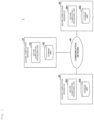
- Fig. 1 is a diagram illustrating an example of the overall configuration of the secure computation system 1 according to the present embodiment.
- the secure computation system 1 includes a secure computation apparatus 10, a secure computation apparatus 20, and a secure computation apparatus 30. Further, the secure computation apparatus 10, the secure computation apparatus 20, and the secure computation apparatus 30 are communicatively connected to each other via a communication network 40 such as the Internet.
- a communication network 40 such as the Internet.
- the secure computation apparatus 10 is a computer or computer system that functions as a party P 1 and includes a secure computation processing unit 101 and a storage unit 102.
- the secure computation processing unit 101 executes various processing for performing concealed vector permutation or construction of a reference position concealment vector.
- the storage unit 102 stores various types of information (for example, permutation or sharing of vectors) required for execution of various types of processing.
- the secure computation apparatus 20 is a computer or computer system that functions as the party P 2 and includes a secure computation processing unit 201 and a storage unit 202.
- the secure computation processing unit 101 executes various processing for performing concealed vector permutation, construction of a reference position concealment vector, and referencing thereof.
- the storage unit 202 stores various types of information (for example, shares of the vector) required for execution of the various types of processing.
- the secure computation apparatus 30 is a computer or computer system that functions as a party P 3 and includes a secure computation processing unit 301 and a storage unit 302.
- the secure computation processing unit 301 executes various processing for performing concealed vector permutation, construction of a reference position concealment vector, and referencing thereof.
- the storage unit 302 stores various types of information (for example, shares of the vector) required for execution of the various types of processing.
- the secure computation apparatus 10, the secure computation apparatus 20, and the secure computation apparatus 30 included in the secure computation system 1 according to the present embodiment will be described.
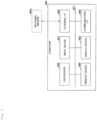
- the secure computation apparatus 10, the secure computation apparatus 20, and the secure computation apparatus 30 can be realized by, for example, a hardware configuration of a computer 500 illustrated in Fig. 2 .
- the computer 500 illustrated in Fig. 2 includes an input device 501, a display device 502, an external I/F 503, a communication I/F 504, a processor 505, and a memory device 506 as hardware.
- the respective pieces of hardware are communicatively connected via a bus 507.
- the input device 501 is, for example, a keyboard and a mouse, a touch panel, or the like.
- the display device 502 is, for example, a display.
- the computer 500 may not include at least one of the input device 501 and the display device 502.
- the external I/F 503 is an interface with an external device such as a recording medium 503a.
- Examples of the recording medium 503a include a compact disc (CD), a digital versatile disk (DVD), a secure digital memory card (SD memory card), and a universal serial bus (USB) memory card.
- the communication I/F 504 is an interface for connection to the communication network 40.
- the processor 505 is, for example, any of various arithmetic devices such as a central processing unit (CPU) and a graphics processing unit (GPU).
- the memory device 506 is, for example, any of various storage devices such as a hard disk drive (HDD), a solid state drive (SSD), a random access memory (RAM), a read only memory (ROM), and a flash memory.
- the secure computation apparatus 10, the secure computation apparatus 20, and the secure computation apparatus 30 according to the present embodiment can realize various processing to be described below by the hardware configuration of the computer 500 illustrated in Fig. 2 .
- the hardware configuration of the computer 500 illustrated in Fig. 2 is an example, and various hardware configurations may be adopted according to, for example, a use of a target to which the secure computation system 1 is applied.
- the secure computation processing unit 101 is realized by, for example, processing that one or more programs installed in the secure computation apparatus 10 cause the processor 505 of the computer 500 realizing the secure computation apparatus 10 to execute.
- the storage unit 102 is realized by the memory device 506 of the computer 500 realizing the secure computation apparatus 10, for example.
- the secure computation processing unit 201 is realized by, for example, processing that one or more programs installed in the secure computation apparatus 20 cause the processor 505 of the computer 500 realizing the secure computation apparatus 20 to execute.
- the storage unit 202 is realized by the memory device 506 of the computer 500 realizing the secure computation apparatus 20, for example.
- the secure computation processing unit 301 is realized by, for example, processing that one or more programs installed in the secure computation apparatus 30 cause the processor 505 of the computer 500 realizing the secure computation apparatus 30 to execute.
- the storage unit 302 is realized by the memory device 506 of the computer 500 realizing the secure computation apparatus 30, for example.
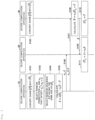
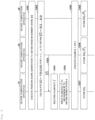
- Fig. 3 is a sequence diagram illustrating Example 1.
- the secure computation processing unit 101 of the secure computation apparatus 10 converts the share [ ⁇ D] into ⁇ ⁇ D> 1 (S101).
- the secure computation processing unit 301 of the secure computation apparatus 30 converts the share [ ⁇ D] into ⁇ ⁇ D> 2 (S102).
- P 1 has ⁇ ⁇ D> 1 and P 2 has ⁇ ⁇ D> 2
- P 1 may have ⁇ ⁇ D> 2
- P 2 may have ⁇ ⁇ D> 1
- P 1 has ⁇ ⁇ D> 1 and P 2 has ⁇ ⁇ D> 2 .
- the secure computation processing unit 101 of the secure computation apparatus 10 transmits ⁇ 2 and ⁇ A to the secure computation apparatus 20 (S106), and also transmits ⁇ 1 , -U and ⁇ V to the secure computation apparatus 30 (S107).
- any permutation can be applied to the concealed vector, and a secure reference position concealment vector can be obtained efficiently.
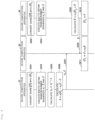
- Fig. 4 is a sequence diagram illustrating Example 2.
- P 1 and P 3 share a common pseudo-random number generator ⁇ and an input p thereof in advance.
- P 1 has a permutation ⁇ of any plaintext, and all parties have any concealed vector [ ⁇ D], as in Example 1.
- the secure computation processing unit 101 of the secure computation apparatus 10 executes ⁇ (p) to obtain random number sequences ⁇ 1 , ⁇ U, and ⁇ V (S203).
- the secure computation processing unit 301 of the secure computation apparatus 30 executes ⁇ (p) to obtain random number sequences ⁇ 1 , ⁇ U, and -V (S204). That is, P 1 and P 3 independently execute ⁇ (p) to obtain common random number sequences ⁇ 1 , ⁇ U, and ⁇ V.
- the secure computation processing unit 101 of the secure computation apparatus 10 transmits ⁇ 2 and ⁇ A to the secure computation apparatus 20 (S207).
- any update rule regarding p (for example, update p ⁇ p+1 is performed each time ⁇ (p) is executed) is shared between P 1 and P 3 , so that p or ⁇ can be executed repeatedly without re-sharing. This can reduce the amount of communication to 2 ⁇ (size of vector ⁇ ⁇ D>) + 2 ⁇ (size of permutation ⁇ ) bits and the number of rounds to 1.
- FIG. 5 is a sequence diagram illustrating Example 3. It should be noted that Examples 1 and 2 do not limit the method of generating permutation ⁇ .
- any pseudo-random function F capable of secure computation is shared among all parties in advance, and at least P 1 has any mechanism M that uniquely computes the permutation from a plaintext value of an output of F.
- the mechanism M is a device or algorithm that outputs bijection ⁇ : ⁇ 1, ..., m ⁇ ⁇ ⁇ 1, .,m ⁇ (here, n ⁇ m) when a vector (f 1 , ..., f n ) is input, and outputs ⁇ (i) when a value fi is input.
- the mechanism M it is possible to use, for example, cuckoo hashing described in Reference 5, but the present invention is not limited thereto, and it is possible to use any device or algorithm as long as the device or algorithm has properties similar to cuckoo hashing.
- a case in which an output of the pseudo-random function is multiple values f i (1) , ..., f i (l) (here, l is a lowercase letter of L), and an output when this is input to M is multiple values ⁇ (1) (i) , ..., ⁇ (l) (i) (here, l is a lowercase of L) is conceivable, but such a case can be used for the present example.
- k i functions as a search key for data reference described in Example 4, and that each D i has a different k i .
- * is any type, size, and number of data, but in principle, it is assumed to be a share.
- the secure computation processing unit 101 of the secure computation apparatus 10 execute random share generation to obtain a random number share [s] (S301) . That is, all parties execute the random share generation and P 1 , P 2 , and P 3 obtain shares [s] 1 , [s] 2 , and [s] 3 respectively.
- the secure computation processing unit 201 of the secure computation apparatus 20 transmits its own share [ ⁇ f] 2 to the secure computation apparatus 10
- the secure computation processing unit 301 of the secure computation apparatus 30 may transmit its own share [ ⁇ f] 3 to the secure computation apparatus 10. That is, either P 2 or P 3 may transmit its own share [ ⁇ f] to P 1 .
- the secure computation processing unit 101 of the secure computation apparatus 10 restores ⁇ f using its own share [ ⁇ f] 1 and the share [ ⁇ f] transmitted from the secure computation apparatus 20 (or the secure computation apparatus 30) (S304).
- the secure computation processing unit 101 of the secure computation apparatus 10 inputs the plaintext ⁇ f to the mechanism M to obtain the permutation ⁇ (S305).
- the secure computation processing unit 101 of the secure computation apparatus 10 executes the concealed vector permutation described in Example 1 or 2 (S306). Accordingly, P 2 obtains ⁇ ⁇ T> 1
- P 3 obtains ⁇ ⁇ T> 2 .
- a value range m of the bijection ⁇ is n ⁇ m
- a share of dummy data is added so that a length of [ ⁇ D] becomes m in all parties before the concealed vector permutation described in Example 1 or 2 is executed.
- the dummy data used here may have any value as long as the dummy data satisfies that "the search key is different from any k i included in ⁇ D".
- the secure computation processing unit 101 of the secure computation apparatus 10 stores [s] 1 in the storage unit 102 (S307). Further, the secure computation processing unit 201 of the secure computation apparatus 20 stores [s] 2 and ⁇ ⁇ T> 1 in the storage unit 202 (S308). Similarly, the secure computation processing unit 301 of the secure computation apparatus 30 stores [s] 3 and ⁇ ⁇ T> 2 in the storage unit 302 (S309).
- Fig. 6 is a sequence diagram illustrating Example 4. In the present example, it is assumed that a pseudo-random function F and a mechanism F that are substantially the same as those used in Example 3 are shared among all parties in advance.
- the secure computation processing unit 201 of the secure computation apparatus 20 and the secure computation processing unit 301 of the secure computation apparatus 30 mutually restore [f] to obtain a plaintext f (S402). That is, P 2 transmits [f] 2 of P 2 to P 3 . Similarly, P 3 transmits [f] 3 of P 3 to P 2 . P 2 restores f using [f] 2 of P 2 and [f] 3 transmitted from P 3 . Similarly, P 3 restores f using [f] 3 of P 3 and [f] 2 transmitted from P 2 .
- the secure computation processing unit 201 of the secure computation apparatus 20 inputs the plaintext f to the mechanism M to obtain a value q (S403).
- the secure computation processing unit 301 of the secure computation apparatus 30 inputs the plaintext f to the mechanism M to obtain the value q (S404). That is, P 2 and P 3 independently input the plaintext f to the mechanism M to obtain the value q.
- the secure computation processing unit 201 of the secure computation apparatus 20 outputs a q-th element ⁇ T q > 1 of ⁇ ⁇ T> 1 (S405).
- the secure computation processing unit 301 of the secure computation apparatus 30 outputs a q-th element ⁇ T q > 1 of ⁇ ⁇ T> 2 (S406) . That is, P 2 and P 3 independently output the q-th element ⁇ T q > of ⁇ -T>.
- the mechanism M always maps any output f of the pseudo-random function F to a value range ⁇ 1, ..., m ⁇ , any element T q ; q ⁇ 1, ..., m ⁇ of ⁇ T is also referred to for unauthorized reference such that k of the input is not included in an original data vector ⁇ D, and there is resistance to an attack attempting to identify an index by intentionally making unauthorized reference.
- asymmetry of information for each party indicates that the information is asymmetric between the party P 1 having the permutation for the vector and the parties P 2 and P 3 having the vector itself after the permutation. This also indicates that information is asymmetric between the parties P 2 and P 3 .
- a vector permutation method described in Reference 6 assumes that the permutation is concealed for all parties, whereas in the present embodiment, P 1 has any plaintext permutation ⁇ . Therefore, in Reference 6, it is necessary to allow an extra communication traffic cost or add a new process in order to perform any permutation not limited to random permutation, whereas in the present embodiment, it is possible to perform any permutation without any restrictions.
- a vector permutation method described in Reference 7 has a wide range of applicable permutation as in the present embodiment because one party has any plaintext permutation, whereas the party having permutation also obtains the vector after permutation. Therefore, in Reference 7, the reference position can be concealed for the parties having the permutation.
- the reference position can be concealed for the parties having the permutation.
Landscapes
- Engineering & Computer Science (AREA)
- Theoretical Computer Science (AREA)
- Computer Security & Cryptography (AREA)
- Physics & Mathematics (AREA)
- General Physics & Mathematics (AREA)
- Bioethics (AREA)
- General Engineering & Computer Science (AREA)
- General Health & Medical Sciences (AREA)
- Health & Medical Sciences (AREA)
- Computer Hardware Design (AREA)
- Software Systems (AREA)
- Computer Networks & Wireless Communication (AREA)
- Signal Processing (AREA)
- Medical Informatics (AREA)
- Databases & Information Systems (AREA)
- Pure & Applied Mathematics (AREA)
- Mathematical Analysis (AREA)
- Computational Mathematics (AREA)
- Mathematical Optimization (AREA)
- Storage Device Security (AREA)
- Management, Administration, Business Operations System, And Electronic Commerce (AREA)
Applications Claiming Priority (1)
| Application Number | Priority Date | Filing Date | Title |
|---|---|---|---|
| PCT/JP2021/015927 WO2022224319A1 (ja) | 2021-04-19 | 2021-04-19 | 秘密計算システム、秘密計算装置、方法、及びプログラム |
Publications (2)
| Publication Number | Publication Date |
|---|---|
| EP4328893A1 true EP4328893A1 (de) | 2024-02-28 |
| EP4328893A4 EP4328893A4 (de) | 2025-01-22 |
Family
ID=83722089
Family Applications (1)
| Application Number | Title | Priority Date | Filing Date |
|---|---|---|---|
| EP21937817.1A Pending EP4328893A4 (de) | 2021-04-19 | 2021-04-19 | Sicheres berechnungssystem, sichere berechnungsvorrichtung, verfahren und programm |
Country Status (5)
| Country | Link |
|---|---|
| US (1) | US12346478B2 (de) |
| EP (1) | EP4328893A4 (de) |
| JP (1) | JP7666588B2 (de) |
| CN (1) | CN117157690A (de) |
| WO (1) | WO2022224319A1 (de) |
Family Cites Families (9)
| Publication number | Priority date | Publication date | Assignee | Title |
|---|---|---|---|---|
| WO2010010430A2 (en) * | 2008-07-25 | 2010-01-28 | Lee Kok-Wah | Methods and systems to create big memorizable secrets and their applications in information engineering |
| EP3096310B1 (de) * | 2014-01-17 | 2018-08-01 | Nippon Telegraph And Telephone Corporation | Geheimnisberechnungsverfahren, geheimnisberechgnungssystem, zufallspermutationsvorrichtung und program |
| JP5889454B1 (ja) | 2015-02-23 | 2016-03-22 | 日本電信電話株式会社 | 分散値変換システム、分散値変換装置、分散値変換方法、およびプログラム |
| JP6006842B1 (ja) | 2015-07-22 | 2016-10-12 | 日本電信電話株式会社 | 秘密計算装置、その方法、およびプログラム |
| KR102635532B1 (ko) * | 2017-02-03 | 2024-02-08 | 삼성전자주식회사 | 폴라 코딩을 이용한 신호 송수신 방법 및 장치 |
| US11223478B2 (en) * | 2018-04-04 | 2022-01-11 | Sri International | Biometric authentication with template privacy and non-interactive re-enrollment |
| CN112313728B (zh) * | 2018-06-20 | 2024-04-19 | 日本电信电话株式会社 | 秘密结合系统、方法、秘密计算装置以及记录介质 |
| US11444638B2 (en) * | 2020-09-17 | 2022-09-13 | SK Hynix Inc. | Quality-based dynamic scheduling LDPC decoder |
| US11381253B1 (en) * | 2021-02-05 | 2022-07-05 | SK Hynix Inc. | Decoding codeword based on higher order information |
-
2021
- 2021-04-19 EP EP21937817.1A patent/EP4328893A4/de active Pending
- 2021-04-19 JP JP2023515903A patent/JP7666588B2/ja active Active
- 2021-04-19 CN CN202180097175.7A patent/CN117157690A/zh active Pending
- 2021-04-19 WO PCT/JP2021/015927 patent/WO2022224319A1/ja not_active Ceased
- 2021-04-19 US US18/552,075 patent/US12346478B2/en active Active
Also Published As
| Publication number | Publication date |
|---|---|
| US20240176908A1 (en) | 2024-05-30 |
| CN117157690A (zh) | 2023-12-01 |
| WO2022224319A1 (ja) | 2022-10-27 |
| US12346478B2 (en) | 2025-07-01 |
| EP4328893A4 (de) | 2025-01-22 |
| JP7666588B2 (ja) | 2025-04-22 |
| JPWO2022224319A1 (de) | 2022-10-27 |
Similar Documents
| Publication | Publication Date | Title |
|---|---|---|
| Bernstein | Grover vs. mceliece | |
| US20210243005A1 (en) | Fully homomorphic encryption method and device and computer readable storage medium | |
| US7853796B2 (en) | Method, system and computer program for polynomial based hashing and message authentication coding with separate generation of spectrums | |
| KR102445290B1 (ko) | 정보 처리 방법, 장치, 기기 및 판독 가능 저장매체 | |
| US20140233727A1 (en) | Method for secure substring search | |
| JP2007086170A (ja) | 汎用ハッシュ関数族計算装置、方法、プログラム、および共有鍵生成システム | |
| KR20150037913A (ko) | 공유 비밀키 생성 장치, 암호화 장치, 복호화 장치, 공유 비밀키 생성 방법, 암호화 방법, 복호화 방법, 및 프로그램 | |
| CN110197076B (zh) | 一种sm4加密算法的软件优化实现方法 | |
| EP4224785B1 (de) | Kryptographisches digitales signaturschema auf gitterbasis unter verwendung einer maskierung | |
| Bidoux et al. | Dual support decomposition in the head: Shorter signatures from rank SD and MinRank | |
| Gan et al. | Efficient and secure auditing scheme for outsourced big data with dynamicity in cloud | |
| Rawal et al. | Challenges and opportunities on the horizon of post-quantum cryptography | |
| Sankhyan et al. | Hybrid Security Protocols: bridging the gap between efficiency and security | |
| Lu et al. | Efficient {2PC} for Constant Round Secure Equality Testing and Comparison | |
| Battarbee et al. | Semidirect product key exchange: the state of play | |
| CN117938345A (zh) | 一种面向云计算的隐私保护外包计算方法 | |
| EP4328893A1 (de) | Sicheres berechnungssystem, sichere berechnungsvorrichtung, verfahren und programm | |
| CN115757624A (zh) | 数据处理方法、装置、电子设备和存储介质 | |
| Shin et al. | Privacy-preserving and updatable block-level data deduplication in cloud storage services | |
| JP2019200382A (ja) | 暗号化システム、暗号化装置、復号装置、暗号化方法、復号方法、及びプログラム | |
| Wang et al. | Security of two NIST candidates in the presence of randomness reuse | |
| EP3675089B1 (de) | Sichere berechnungsvorrichtung, sicheres berechnungsverfahren, programm und aufzeichnungsmedium | |
| CN119210721A (zh) | 一种国密混合同态加密方法及系统 | |
| Chavan et al. | Secure CRM cloud service using RC5 algorithm | |
| Babenko et al. | Application of algebraic cryptanalysis to Magma and Present block encryption standards |
Legal Events
| Date | Code | Title | Description |
|---|---|---|---|
| STAA | Information on the status of an ep patent application or granted ep patent |
Free format text: STATUS: THE INTERNATIONAL PUBLICATION HAS BEEN MADE |
|
| PUAI | Public reference made under article 153(3) epc to a published international application that has entered the european phase |
Free format text: ORIGINAL CODE: 0009012 |
|
| STAA | Information on the status of an ep patent application or granted ep patent |
Free format text: STATUS: REQUEST FOR EXAMINATION WAS MADE |
|
| 17P | Request for examination filed |
Effective date: 20230925 |
|
| AK | Designated contracting states |
Kind code of ref document: A1 Designated state(s): AL AT BE BG CH CY CZ DE DK EE ES FI FR GB GR HR HU IE IS IT LI LT LU LV MC MK MT NL NO PL PT RO RS SE SI SK SM TR |
|
| DAV | Request for validation of the european patent (deleted) | ||
| DAX | Request for extension of the european patent (deleted) | ||
| A4 | Supplementary search report drawn up and despatched |
Effective date: 20250102 |
|
| RIC1 | Information provided on ipc code assigned before grant |
Ipc: H04W 12/02 20090101ALI20241219BHEP Ipc: G06F 21/62 20130101ALI20241219BHEP Ipc: H04L 9/08 20060101ALI20241219BHEP Ipc: H04L 9/06 20060101ALI20241219BHEP Ipc: G09C 1/00 20060101AFI20241219BHEP |
|
| RAP3 | Party data changed (applicant data changed or rights of an application transferred) |
Owner name: NTT, INC. |