EP4330362B1 - Verwendung und verfahren zur herstellung von mono-rhamnolipiden - Google Patents
Verwendung und verfahren zur herstellung von mono-rhamnolipiden Download PDFInfo
- Publication number
- EP4330362B1 EP4330362B1 EP22725410.9A EP22725410A EP4330362B1 EP 4330362 B1 EP4330362 B1 EP 4330362B1 EP 22725410 A EP22725410 A EP 22725410A EP 4330362 B1 EP4330362 B1 EP 4330362B1
- Authority
- EP
- European Patent Office
- Prior art keywords
- rhamnolipid
- rhamnolipids
- mono
- enzyme
- rhamnosidase
- Prior art date
- Legal status (The legal status is an assumption and is not a legal conclusion. Google has not performed a legal analysis and makes no representation as to the accuracy of the status listed.)
- Active
Links
Images


Classifications
-
- C—CHEMISTRY; METALLURGY
- C11—ANIMAL OR VEGETABLE OILS, FATS, FATTY SUBSTANCES OR WAXES; FATTY ACIDS THEREFROM; DETERGENTS; CANDLES
- C11D—DETERGENT COMPOSITIONS; USE OF SINGLE SUBSTANCES AS DETERGENTS; SOAP OR SOAP-MAKING; RESIN SOAPS; RECOVERY OF GLYCEROL
- C11D1/00—Detergent compositions based essentially on surface-active compounds; Use of these compounds as a detergent
- C11D1/02—Anionic compounds
- C11D1/04—Carboxylic acids or salts thereof
- C11D1/06—Ether- or thioether carboxylic acids
-
- C—CHEMISTRY; METALLURGY
- C11—ANIMAL OR VEGETABLE OILS, FATS, FATTY SUBSTANCES OR WAXES; FATTY ACIDS THEREFROM; DETERGENTS; CANDLES
- C11D—DETERGENT COMPOSITIONS; USE OF SINGLE SUBSTANCES AS DETERGENTS; SOAP OR SOAP-MAKING; RESIN SOAPS; RECOVERY OF GLYCEROL
- C11D3/00—Other compounding ingredients of detergent compositions covered in group C11D1/00
- C11D3/16—Organic compounds
- C11D3/38—Products with no well-defined composition, e.g. natural products
- C11D3/386—Preparations containing enzymes, e.g. protease or amylase
- C11D3/38636—Preparations containing enzymes, e.g. protease or amylase containing enzymes other than protease, amylase, lipase, cellulase, oxidase or reductase
-
- C—CHEMISTRY; METALLURGY
- C12—BIOCHEMISTRY; BEER; SPIRITS; WINE; VINEGAR; MICROBIOLOGY; ENZYMOLOGY; MUTATION OR GENETIC ENGINEERING
- C12N—MICROORGANISMS OR ENZYMES; COMPOSITIONS THEREOF; PROPAGATING, PRESERVING, OR MAINTAINING MICROORGANISMS; MUTATION OR GENETIC ENGINEERING; CULTURE MEDIA
- C12N11/00—Carrier-bound or immobilised enzymes; Carrier-bound or immobilised microbial cells; Preparation thereof
-
- C—CHEMISTRY; METALLURGY
- C12—BIOCHEMISTRY; BEER; SPIRITS; WINE; VINEGAR; MICROBIOLOGY; ENZYMOLOGY; MUTATION OR GENETIC ENGINEERING
- C12N—MICROORGANISMS OR ENZYMES; COMPOSITIONS THEREOF; PROPAGATING, PRESERVING, OR MAINTAINING MICROORGANISMS; MUTATION OR GENETIC ENGINEERING; CULTURE MEDIA
- C12N9/00—Enzymes; Proenzymes; Compositions thereof; Processes for preparing, activating, inhibiting, separating or purifying enzymes
- C12N9/14—Hydrolases (3)
- C12N9/24—Hydrolases (3) acting on glycosyl compounds (3.2)
- C12N9/2402—Hydrolases (3) acting on glycosyl compounds (3.2) hydrolysing O- and S- glycosyl compounds (3.2.1)
-
- C—CHEMISTRY; METALLURGY
- C12—BIOCHEMISTRY; BEER; SPIRITS; WINE; VINEGAR; MICROBIOLOGY; ENZYMOLOGY; MUTATION OR GENETIC ENGINEERING
- C12P—FERMENTATION OR ENZYME-USING PROCESSES TO SYNTHESISE A DESIRED CHEMICAL COMPOUND OR COMPOSITION OR TO SEPARATE OPTICAL ISOMERS FROM A RACEMIC MIXTURE
- C12P19/00—Preparation of compounds containing saccharide radicals
- C12P19/02—Monosaccharides
-
- C—CHEMISTRY; METALLURGY
- C12—BIOCHEMISTRY; BEER; SPIRITS; WINE; VINEGAR; MICROBIOLOGY; ENZYMOLOGY; MUTATION OR GENETIC ENGINEERING
- C12P—FERMENTATION OR ENZYME-USING PROCESSES TO SYNTHESISE A DESIRED CHEMICAL COMPOUND OR COMPOSITION OR TO SEPARATE OPTICAL ISOMERS FROM A RACEMIC MIXTURE
- C12P19/00—Preparation of compounds containing saccharide radicals
- C12P19/14—Preparation of compounds containing saccharide radicals produced by the action of a carbohydrase (EC 3.2.x), e.g. by alpha-amylase, e.g. by cellulase, hemicellulase
-
- C—CHEMISTRY; METALLURGY
- C12—BIOCHEMISTRY; BEER; SPIRITS; WINE; VINEGAR; MICROBIOLOGY; ENZYMOLOGY; MUTATION OR GENETIC ENGINEERING
- C12P—FERMENTATION OR ENZYME-USING PROCESSES TO SYNTHESISE A DESIRED CHEMICAL COMPOUND OR COMPOSITION OR TO SEPARATE OPTICAL ISOMERS FROM A RACEMIC MIXTURE
- C12P19/00—Preparation of compounds containing saccharide radicals
- C12P19/44—Preparation of O-glycosides, e.g. glucosides
-
- C—CHEMISTRY; METALLURGY
- C12—BIOCHEMISTRY; BEER; SPIRITS; WINE; VINEGAR; MICROBIOLOGY; ENZYMOLOGY; MUTATION OR GENETIC ENGINEERING
- C12Y—ENZYMES
- C12Y302/00—Hydrolases acting on glycosyl compounds, i.e. glycosylases (3.2)
- C12Y302/01—Glycosidases, i.e. enzymes hydrolysing O- and S-glycosyl compounds (3.2.1)
- C12Y302/0104—Alpha-L-rhamnosidase (3.2.1.40)
Definitions
- the present invention concerns a process to produce mono-rhamnolipids, in particular mono-rhamnolipids suitable for use in the field of detergent compositions, in particular detergent compositions for the cleaning of articles in the home and personal care fields, in particular laundry detergents and hand dish-wash detergents.
- the present invention relates to a process to produce mono-rhamnolipids.
- Rhamnolipids are carboxylic acid containing anionic surfactants that consists of one or more alkyl chains connected via a beta hydroxy group to a rhamnose sugar. They may be produced by various bacterial species. Rhamnolipids are desirable as natural green surfactants, offering both sustainability benefits as well as application benefits such as good foaming profile, mildness on the skin and excellent sensorial benefits.
- Di-rhamnolipids rich mixtures can be produced from fermentation processes, for example disclosed in EP 2 787 065 A1 and EP 2 786 743 A1 .
- the di-rhamnolipids are much more easily accessible from fermentation compared to the mono-rhamnolipids.
- the mono-rhamnolipids are a particularly useful material in the field of detergent compositions because they produce improved cleaning in comparison to the di-rhamnolipids, see for example EP 2 596 087 A1 .
- the invention relates to a process to convert di-rhamnolipid to mono-rhamnolipid, wherein the process comprises the following process steps:-
- the ⁇ -L-rhamnosidase enzyme is from the genus Aspergillus, more preferably from Aspergillus niger , Aspergillus terreus, or Aspergillus lentulus, most preferably from Aspergillus niger, Aspergillus terreus.
- the enzyme is immobilised on a support using a technique selected from adsorption, covalent bonding, entrapment and/or crosslinking.
- the starting di-rhamnolipid material has a carbon alkyl length of from C 8 to C 14 , more preferably from C 8 -C 12 .
- the resulting mono-rhamnolipid material has a carbon alkyl length of from C 8 to C 14 , more preferably from C 8 -C 12 .
- the rhamnose by-product is removed from the enzymatic reaction mixture as the reaction progresses.
- the temperature during the reaction is from 10 to 60°C, preferably from 15 to 50°C, more preferably from 18 to 45°C, most preferably from 20 to 45°C.
- the pH during the reaction is from pH 5 to 10, preferably from pH 5 to 9, more preferably from pH 5.5 to 8.5, most preferably from pH 6 to 8.
- the di-rhamnolipid starting material can be selectively converted to mono-rhamnolipid material.
- indefinite article “a” or “an” and its corresponding definite article “the” as used herein means at least one, or one or more, unless specified otherwise.
- wt.% relates to the amount by weight of the ingredient based on the total weight of the composition.
- wt.% is calculated based on the protonated form of the surfactant.
- Rhamnolipid is a biosurfactant. These are a class of glycolipid. They are constructed of rhamnose combined with beta-hydroxy fatty acids. Rhamnose is a sugar. Fatty acids are ubiquitous in animals and plants.
- Rhamnolipids are discussed in Applied Microbiology and Biotechnology (2010) 86:1323-1336 by E. Deziel et al. Rhamnolipids are produced by Evonik, Stepan, Glycosurf, AGAE Technologies and Urumqi Unite Bio-Technology Co., Ltd. Rhamnolipids may be produced by strains of the bacteria Pseudomonas aeruginosa. There are two major groups of rhamnolipids; mono-rhamnolipids and di-rhamnolipids.
- Mono-rhamnolipids have a single rhamnose sugar ring.
- a typical mono-rhamnolipid produced by P. aeruginosa is L-rhamnosyl- ⁇ -hydroxydecanoyl- ⁇ -hydroxydecanoate (RhaC 10 C 10 ). It may be referred to as Rha-C 10 -C 10 , with a formula of C 26 H 48 O 9 .
- Mono-rhamnolipids have a single rhamnose sugar ring.
- the IUPAC Name is 3-[3-[(2R,3R,4R,5R,6S)-3,4,5-trihydroxy-6-methyloxan-2-yl]oxydecanoyloxy]decanoic acid.
- Di-rhamnolipids have two rhamnose sugar rings.
- a typical di-rhamnolipid is L-rhamnosyl-L-rhamnosyl- ⁇ -hydroxydecanoyl- ⁇ -hydroxydecanoate (Rha2C 10 C 10 ). It may be referred to as Rha-Rha-C- 10 -C- 10 , with a formula of C 32 H 58 O 13 .
- the IUPAC name is 3-[3-[4,5-dihydroxy-6-methyl-3-(3,4, 5-tri hydroxy-6-methyloxan-2-yl)oxyoxan-2-yl]oxydecanoyloxy]decanoic acid.
- R1 is mono-rhamnolipid and R2 is di-rhamnolipid.
- the rhamnolipid is a di-rhamnolipid of formula: Rha2C 8-14 C 8-14 .
- the preferred alkyl chain length is from C 8 to C 12 .
- the alkyl chain may be saturated or unsaturated.
- Rhamnolipids produced by P. aeruginosa (di-rhamnolipids): Rha-Rha-C8-C10, Rha-Rha-C8-C12:1, Rha-Rha-C10-C8, Rha-Rha-C10-C10, Rha-Rha-C10-C12:1, Rha- Rha-C-10-C-12, Rha-Rha-C-12-C-10, Rha-Rha-C-12:1-C-12, Rha-Rha-C-10-C14:1.
- Rhamnolipids produced by Burkholderia pseudomallei (di-rhamnolipids): Rha-Rha-C14-C14.
- Rhamnolipids produced by Burkholderia Pseudomonas
- plantarii di-rhamnolipids
- a typical di-rhamnolipid is L-rhamnosyl-L-rhamnosyl- ⁇ -hydroxydecanoyl- ⁇ -hydroxydecanoate (Rha 2 C 10 C 10 with a formula of C 32 H 58 O 13 ).
- the starting di-rhamnolipid material has a carbon alkyl length of from C 8 to C 14 , more preferably from C 8 -C 12 .
- the resulting mono-rhamnolipid is a mono-rhamnolipid of formula: RhaC 8-14 C 8-14 .
- the preferred alkyl chain length is from C 8 to C 12 .
- the alkyl chain may be saturated or unsaturated.
- a preferred mono-rhamnolipid material is L-rhamnosyl- ⁇ -hydroxydecanoyl- ⁇ -hydroxydecanoate (RhaC 10 C 10 with a formula of C 26 H 48 O 9 ).
- the resulting mono-rhamnolipid material has a carbon alkyl length of from C 8 to C 14 , more preferably from C 8 -C 12 .
- the di-rhamnolipid starting material can be selectively converted to mono-rhamnolipid material.
- the ⁇ -L-rhamnosidase enzyme is preferably from the genus Aspergillus.
- the ⁇ -L-rhamnosidase enzyme is from Aspergillus niger, Aspergillus terreus, or Aspergillus lentulus. More preferably the ⁇ -L-rhamnosidase enzyme is from Aspergillus niger, or Aspergillus terreus.
- the enzyme may suitably be immobilised.
- the invention relates to a process to convert di-rhamnolipid to mono-rhamnolipid comprising the following process steps:-
- the rhamnose by-product is removed from the enzymatic reaction mixture as the reaction progresses. This can result in higher conversion and/or yield or the mono-rhamnolipid product.
- the temperature during the reaction is from 10 to 60°C, preferably from 15 to 50°C, more preferably from 18 to 45°C, most preferably from 20 to 45°C.
- the pH during the reaction is from pH 5 to 10, preferably from pH 5 to 9, more preferably from pH 5.5 to 8.5, most preferably from pH 6 to 8.
- the ⁇ -L-rhamnosidase enzyme can potentially be immobilised to improve characteristics such as activity, selectivity and specificity, as well as enzyme stability.
- the immobilisation itself can be performed by a physical interaction between enzyme and matrix or through a chemical process such as covalent bond formation between the enzyme and support.
- the typical lab procedure may involve, but not be limited to adsorption, covalent bonding, entrapment, and crosslinking.
- the enzyme is immobilised on a support using a technique selected from adsorption, covalent bonding, entrapment and/or crosslinking.
- Preferred commercial enzyme immobilisation materials include Praesto TM and Lifetech TM available from Purolite.
- A. terreus rhamnosidase secreted in P. pastoris, was supplied in form of supernatant at total protein concentration of 1.7mg/mL, and the sample for analysis was purified on the nickel column using 50 mM sodium phosphate elution buffer containing 500 mM of imidazole, Sigma Aldrich (Gillingham, United Kingdom) at pH 6.5, and dialysed against the same buffer without imidazole.
- Rhamnolipid sample used in this study was obtained from Evonik (Witten, Germany), in form of 50% (w/v) water solution.
- the sample is a blend consisting of the various rhamnolipid congeners, with the major congener, (Rha-Rha-C10-C10), 2-O-alpha-L-rhamnosyl-alpha-L-rhamnosyl-3-hydroxydecanoyl-3-hydroxydecanoic acid and it will be referred hereafter as RL2.
- This sample also contains a minor amount of rhamnosyl-3-hydroxydecanoyl-3-hydroxydecanoate congener (Rha-C10:0/C10:0), which will be referred hereafter as RL1.
- the expected molecular weight of RL1 is 504.321 g*mol-1
- the expected molecular weight of RL2 is 649.378 g*mol-1.
- RL2 samples were diluted in acetonitrile to final concentration of 0.75 mM, filtered with 0.45 ⁇ m nitrocellulose syringe filter, and applied onto column for analysis. The fractions were collected in 30 sec rate per fraction and subjected to MALDI-TOF analysis. Next, RL2 were used as substrates for enzymes from A. terreus and A. niger, and naringinase.
- the enzymes were used in concentration 1.2 mg*mL -1 and substrate was used at 1 mM. Both reactions were performed in 50 mM MES buffer, pH 6.5. The total volume of the reaction mix was 1 mL. Both samples were incubated at 40 °C and 225 rpm for 24 hours in incubator shaker (Infors HT, Surrey). 100 ⁇ L of reaction mixture was diluted in acetonitrile at ratio 1:10, filtered with 0.45 ⁇ m nitrocellulose syringe filter, and applied onto the C18 column. The control sample (i.e. R2 benchmark) was not treated with any enzyme.
- Rhamnolipid analysis was carried out using a Dionex UltiMate 3000 system (Thermo Scientific, Dreieich, Germany) composed of an RS Dual Gradient pump, an RS Autosampler, an RS Column Compartment, an RS Diode Array Detector and a Corona Veo SD Charged-Aerosol Detector (CAD).
- CAD Corona Veo SD Charged-Aerosol Detector
- Chromatographic separation was performed using Accucore TM C18 LC Column (150 X 4.6mm, 2.6 ⁇ m) (Thermo Scientific, Dreieich, Germany) at ambient temperature. The flow rate was set to 1 mL/min. Mobile phase gradient consisting of 0.02% acetic acid/water (v/v) (A) and 100% acetonitrile (B) was used. The gradient was set to 70% B from 0 to 2 min, increased to 82% B from 2 to 4 min, remained constant for 1 min, and increased to 88% B from 5 to 8 min before it immediately decreased to 70% and remained constant for equilibration. Total run time was 12 min. The injection volume was 10 ⁇ L.
- Charged-aerosol detection was performed at ambient temperature with an acquisition rate of 10 Hz and a filter constant of 3.6.
- CAD nitrogen gas pressure was 35 psi.
- Chromeleon V7.2 software was used for general HPLC-control, data acquisition and analysis for CAD measurements.
- MALDI-TOF was used for analysis RL2 fractions collected as described above.
- the matrix solution was 2, 5-dihydroxybenzoic acid dissolved in 50% aqueous acetonitrile containing 0.1% trifluoroacetic acid (TFA).
- TFA trifluoroacetic acid
- 1 ⁇ L of HPLC fractionations, 1 ⁇ L of matrix solution and 2 ⁇ L of distilled water were mixed in an Eppendorf tube.
- 1 ⁇ L of the matrix-sample mixture was spotted onto the stainless-steel anchor chip. The spots were air-dried at room temperature and then analysed by MALDI TOF MS, using Ultraflexlll MALDI-TOF/TOF mass spectrometer (Bruker, Billerica, MA) operated with Smart beam laser system.
- the rhamnolipid MS spectra were attained in a positive mode reflector; the used parameters for RLs detection were: ion source 1, 25.08 kV and 2, 21.72 kV; reflector, 26.42 kV and 13.867 kV; lens, 9.28 kV.
- the LIFT mode was applied for MS/MS analysis, using the following considerations: ion source 1, 8.01 kV and 2, 7.21 kV; reflector, 29.50 kV and 2, 13.91 kV; lens, 3.61 kV; LIFT 1, 19.08 kV and LIFT 2, 2.71 kV.
- the used mass range for measurements was m/z 300-4000 Da and a maximum MS deviation of 0.5 Da.
- ⁇ -I-Rhamnosidase activity of enzyme from A. terreus and enzyme from A. niger was determined by a colorimetric method using p-nitrophenyl- ⁇ -I-rhamnopyranoside (pNPR) (See the chemical formula equation shown in Fig 1 ).
- the pNPR substrate was first dissolved in DMSO, with concentration adjusted to 200 ⁇ M in 100 mM sodium phosphate buffer pH 6.5. Enzymes were diluted to concentration of 20 ⁇ g/mL in 100 mM sodium phosphate buffer pH 6.5.
- the reaction was prepared by mixing the substrate solution with enzyme solution in 1:1 ratio.
- the activity assay was performed on 96-well Microtiter UV plate by Thermo Scientific (Waltham, MA USA). All reactions were done at pH 6.5 and in temperature 40 °C. The changes in absorbance were monitored at 405 nm for 60 minutes in Microplate reader Varioskan ® Flash.
- the reaction was prepared by mixing the substrate solution with enzyme solution in 1:1 ratio.
- the activity assay was performed on 96-well Microtiter UV plate by Thermo Scientific (Waltham, MA USA).
- the reactions were performed in 40 °C, and buffers of choice were: 100 mM sodium phosphate buffer pH 6.5, 100 mM Tris-HCl buffer pH 7.5, 100 mM Tris-HCl buffer pH 8.5, and 100 mM sodium carbonate buffer pH 10.5.
- the reactions were performed in 20°C and 40 °C, in 100 mM sodium phosphate buffer at pH 6.5.
- the changes in absorbance were monitored at 405 nm for 30 minutes in Microplate reader Varioskan ® Flash.
- the standard curve for the p-nitrophenol (pNP) release was prepared by measurement of absorbance at 405nm for series of pNP samples of different concentrations (in 100 mM of corresponding buffer).
- sequence of rhamnose concentrations were prepared in 100 mM sodium phosphate buffer pH 6.5: 0.6 mM, 1.2 mM, 1.8 mM, 2.4 mM, 3 mM.
- 240 ⁇ L of the total reaction mixture was prepared by adding the substrate solution, the enzyme solution and the rhamnose solution in 1:1:1 ratio.
- the activity assay was performed on 96-well Microtiter UV plate by Thermo Scientific (Waltham, MA USA). All reactions were done at pH 6.5 and in temperature 40 °C. The changes in absorbance were monitored at 405 nm for 30 minutes in Microplate reader Varioskan ® Flash.
- ⁇ -D-glucosidase activity of enzyme from A. terreus was determined by a colorimetric method using p-nitrophenyl- ⁇ -I-glucopyranoside (pNPG).
- the pNPG substrate was first dissolved in DMSO, with concentration adjusted to 200 ⁇ M in 100 mM sodium phosphate buffer pH 6.5.
- the pNPG was mixed with pNPR at 1:1 ratio, then dissolved in DMSO, and concentration of such mixture was adjusted to 200 ⁇ M in 100 mM sodium phosphate buffer pH 6.5.
- pNPR prepared as above, at concentration of 200 ⁇ M was used.
- the substrate sample was mixed with the studied enzyme at a concentration of 1mg/mL and reactions were performed at 40 °C, in pH 6.5 for 24 hours.
- R2 sample was mixed with buffer only.
- the reactions were analysed using RP-HPLC, and the control was additionally analysed using MAL-TOF, to confirm which peak corresponds to R1 and R2 congeners.
- the peak detected between 1 and 2 min of retention time corresponds to void.
- the peak detected at 6.5 min of the retention time corresponds to di-rhamnolipid fraction of the sample and the peak detected at 8.2 min of the retention time corresponds to the more hydrophobic mono-rhamnolipid fraction.
- the fractions were collected, and their molecular masses were analysed by MALDI-TOF.
- the chromatogram of the control sample presented two peaks at 6.5 min of retention time and 8.2 min of retention time (see Fig 2, A ).
- the MALDI-TOF analysis revealed that MW of the substance eluted after 6.5 min was corresponding to that of estimated MW for R2 and that MW of the substance eluted after 8.2 min was corresponding to that of estimated MW for R1 (data not included).
- the analysis of the samples after 24h of enzymatic treatment revealed changes in the chromatogram for each reaction.
- the relative activity of ⁇ -L-rhamnosidase from A. terreus and ⁇ -L-rhamnosidase from A . niger were measured against the p-NPR.
- the reaction was monitored in time at 40 °C and pH 6.5 (See Fig 3 ).
- the enzymes caused release of the product - 4-nitrophenol. Both enzymes showed different kinetic behaviour, with A. terreus enzyme acting faster, however, reaching plateau after 10 min at 70% of converted substrate.
- A. niger enzyme converted similar amount of substrate after 30 min., however, after that, the conversion did not reach plateau and this enzyme converted 10% more substrate than A. terreus after 60 min, with the kinetic curve suggesting that with longer time of reaction, the substrate could be fully converted.
- the 70% conversion of R2 is plenty sufficient for test purposes, therefore the enzyme with faster kinetics was used for further analysis.
- the relative activity of ⁇ -L-rhamnosidase from A. terreus was measured using pNPR substrate in the excess of rhamnose in the reaction mix. The analysis was performed in order to study product inhibition phenomenon. The monitoring of the enzyme activity in the reactions with various rhamnose concentrations has showed that the substrate conversion rate decreased in the reactions with increasing amount of rhamnose added (See Fig. 4 ). This result suggests that the rhamnose generated during the reaction time might cause enzyme inhibition, which in turn hampers the full substrate conversion, so that selective removal of the rhamnose from the reaction medium will enable improved conversion to the desired mono-rhamnolipid material.
- pNPG was used as a substrate to monitor ⁇ -D-glucosidase activity of enzyme from A . terreus
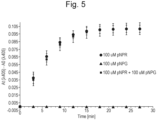
- the pNPR was used as a substrate showing ⁇ -I-rhamnopyranoside activity, and mixture of both substrates was used to determine substate preference (see Fig. 5 ).
- the analysis has shown that enzyme from A. terreus recognized only pNPR as a substrate.
- the absorbance signal was not detected for the reaction with pNPG, and the reaction kinetics observed for pNPR substrate was not impacted by presence of pNPG in the reaction with mixed substrates. This result shows that enzyme from A. terreus do not possesses ⁇ -D-glucosidase activity.
Landscapes
- Chemical & Material Sciences (AREA)
- Organic Chemistry (AREA)
- Life Sciences & Earth Sciences (AREA)
- Engineering & Computer Science (AREA)
- Wood Science & Technology (AREA)
- Zoology (AREA)
- Health & Medical Sciences (AREA)
- Bioinformatics & Cheminformatics (AREA)
- Genetics & Genomics (AREA)
- General Engineering & Computer Science (AREA)
- General Health & Medical Sciences (AREA)
- Biochemistry (AREA)
- Biotechnology (AREA)
- Microbiology (AREA)
- Chemical Kinetics & Catalysis (AREA)
- General Chemical & Material Sciences (AREA)
- Biomedical Technology (AREA)
- Oil, Petroleum & Natural Gas (AREA)
- Medicinal Chemistry (AREA)
- Molecular Biology (AREA)
- Preparation Of Compounds By Using Micro-Organisms (AREA)
- Immobilizing And Processing Of Enzymes And Microorganisms (AREA)
Claims (8)
- Verfahren zur Umwandlung von Di-Rhamnolipid in Mono-Rhamnolipid, das die folgenden Verfahrensschritte umfasst:(a) Inkontaktbringen eines Di-Rhamnolipid-Ausgangsmaterials mit einem α-L-Rhamnosidase-Enzym, das auf einem Träger immobilisiert ist;(b) Abtrennen des hergestellten Mono-Rhamnolipids von dem Reaktionsmedium und/oder Nebenprodukten;wobei das α-L-Rhamnosidase-Enzym keine β-D-Glucosidase-Aktivität aufweist.
- Verfahren nach Anspruch 1, wobei das α-L-Rhamnosidase-Enzym aus der Gattung Aspergillus, bevorzugt aus Aspergillus niger, Aspergillus terreus oder Aspergillus lentulus, höchst bevorzugt aus Aspergillus niger, Aspergillus terreus, stammt.
- Verfahren nach Anspruch 1 oder Anspruch 2, wobei bei dem Verfahren zur Herstellung von Mono-Rhamnolipiden das Enzym auf einem Träger unter Verwendung einer Technik immobilisiert wird, ausgewählt unter Adsorption, kovalenter Bindung, Einschluss und/oder Vernetzung.
- Verfahren nach einem vorhergehenden Anspruch, wobei das Di-Rhamnolipid-Ausgangsmaterial eine Kohlenstoffalkyllänge von C8 bis C14, bevorzugter von C8-C12, aufweist.
- Verfahren nach einem vorhergehenden Anspruch, wobei das erhaltene Mono-Rhamnolipid-Material eine Kohlenstoffalkyllänge von C8 bis C14, bevorzugter von C8-C12, aufweist.
- Verfahren nach einem vorhergehenden Anspruch, wobei bei dem Verfahren zur Herstellung von Mono-Rhamnolipiden das Rhamnose-Nebenprodukt mit fortschreitender Reaktion aus der enzymatischen Reaktionsmischung entfernt wird.
- Verfahren nach einem vorhergehenden Anspruch, wobei bei dem Verfahren zur Herstellung von Mono-Rhamnolipiden die Temperatur während der Reaktion 10 bis 60°C, bevorzugt 15 bis 50°C, bevorzugter 18 bis 45°C, höchst bevorzugt 20 bis 45°C, beträgt.
- Verfahren nach einem vorhergehenden Anspruch, wobei bei dem Verfahren zur Herstellung von Mono-Rhamnolipiden der pH-Wert während der Reaktion 5 bis 10, bevorzugt 5 bis 9, bevorzugter 5,5 bis 8,5 und höchst bevorzugt 6 bis 8 beträgt.
Applications Claiming Priority (2)
| Application Number | Priority Date | Filing Date | Title |
|---|---|---|---|
| EP21171230 | 2021-04-29 | ||
| PCT/EP2022/060823 WO2022229052A1 (en) | 2021-04-29 | 2022-04-25 | Process to produce mono-rhamnolipids |
Publications (3)
| Publication Number | Publication Date |
|---|---|
| EP4330362A1 EP4330362A1 (de) | 2024-03-06 |
| EP4330362C0 EP4330362C0 (de) | 2024-10-23 |
| EP4330362B1 true EP4330362B1 (de) | 2024-10-23 |
Family
ID=75746277
Family Applications (1)
| Application Number | Title | Priority Date | Filing Date |
|---|---|---|---|
| EP22725410.9A Active EP4330362B1 (de) | 2021-04-29 | 2022-04-25 | Verwendung und verfahren zur herstellung von mono-rhamnolipiden |
Country Status (5)
| Country | Link |
|---|---|
| US (1) | US12297474B2 (de) |
| EP (1) | EP4330362B1 (de) |
| CN (1) | CN117222728A (de) |
| BR (1) | BR112023022205A2 (de) |
| WO (1) | WO2022229052A1 (de) |
Families Citing this family (3)
| Publication number | Priority date | Publication date | Assignee | Title |
|---|---|---|---|---|
| EP4630526A1 (de) | 2022-12-05 | 2025-10-15 | The Procter & Gamble Company | Stoff- und haushaltspflegezusammensetzung mit einer polyalkylencarbonatverbindung |
| CN117554521A (zh) * | 2023-11-21 | 2024-02-13 | 湖南龙腾生物科技有限公司 | 一种测定鼠李糖脂含量的方法 |
| CN119464254B (zh) * | 2025-01-15 | 2025-04-11 | 南京工业大学 | 一种α-L-鼠李糖苷酶基因及其在生产L-鼠李糖中的应用 |
Family Cites Families (11)
| Publication number | Priority date | Publication date | Assignee | Title |
|---|---|---|---|---|
| CS257830B1 (sk) | 1985-12-09 | 1988-06-15 | Kveta Heinrichova | Spósob prlpravy imobilizovanej exopolygalakturonázy |
| US4971812A (en) | 1989-08-31 | 1990-11-20 | National Science Council | Immobilized penicillium sp. naringnase and its use in removing naringin and limonin from fruit juice |
| CN102449156A (zh) | 2009-03-17 | 2012-05-09 | 全技术公司 | 用于将木素纤维原料转化为发酵糖和由此生产的产品的组合物和方法 |
| CN103052704A (zh) | 2010-07-22 | 2013-04-17 | 荷兰联合利华有限公司 | 用于提高清洁的鼠李糖脂和酶的组合物 |
| DE102013205756A1 (de) | 2013-04-02 | 2014-10-02 | Evonik Industries Ag | Mischungszusammensetzung enthaltend Rhamnolipide |
| DE102013205755A1 (de) | 2013-04-02 | 2014-10-02 | Evonik Industries Ag | Waschmittelformulierung für Textilien enthaltend Rhamnolipide mit einem überwiegenden Gehalt an di-Rhamnolipiden |
| WO2015030702A2 (en) * | 2013-08-26 | 2015-03-05 | Keith Desanto | High purity rhamnolipid cosmetic application |
| US10344304B2 (en) | 2014-03-20 | 2019-07-09 | The University Of Akron | Materials derived from fermentation-produced rhamnolipids and methods of production |
| EP3061442A1 (de) * | 2015-02-27 | 2016-08-31 | Evonik Degussa GmbH | Zusammensetzung enthaltend Rhamnolipid und Siloxan |
| US10676495B2 (en) * | 2016-02-22 | 2020-06-09 | Evonik Operations Gmbh | Rhamnolipid esters as nonionic surfactants for cosmetic use |
| US10941173B2 (en) | 2016-02-22 | 2021-03-09 | Evonik Operations Gmbh | Rhamnolipid amides for hair scent retention |
-
2022
- 2022-04-25 BR BR112023022205A patent/BR112023022205A2/pt unknown
- 2022-04-25 EP EP22725410.9A patent/EP4330362B1/de active Active
- 2022-04-25 WO PCT/EP2022/060823 patent/WO2022229052A1/en not_active Ceased
- 2022-04-25 CN CN202280031348.XA patent/CN117222728A/zh active Pending
- 2022-04-25 US US18/286,791 patent/US12297474B2/en active Active
Also Published As
| Publication number | Publication date |
|---|---|
| BR112023022205A2 (pt) | 2023-12-19 |
| WO2022229052A1 (en) | 2022-11-03 |
| US20240084353A1 (en) | 2024-03-14 |
| EP4330362C0 (de) | 2024-10-23 |
| US12297474B2 (en) | 2025-05-13 |
| EP4330362A1 (de) | 2024-03-06 |
| CN117222728A (zh) | 2023-12-12 |
Similar Documents
| Publication | Publication Date | Title |
|---|---|---|
| EP4330418B1 (de) | Verwendung und verfahren zur herstellung von mono-rhamnolipiden | |
| US12297474B2 (en) | Process to produce mono-rhamnolipids | |
| Ma et al. | Substrate specificity of β-primeverosidase, a key enzyme in aroma formation during oolong tea and black tea manufacturing | |
| Sim et al. | Production and characterisation of a biosurfactant isolated from Pseudomonas aeruginosa UW-1 | |
| Haba et al. | Use of liquid chromatography-mass spectroscopy for studying the composition and properties of rhamnolipids produced by different strains of Pseudomonas aeruginosa | |
| EP2857496B1 (de) | D-glucarinsäure produzierendes bakterium sowie verfahren zur herstellung von d-glucarinsäure | |
| TWI911429B (zh) | 新穎槐糖脂質衍生物 | |
| FR3018821A1 (fr) | Nouveaux flavonoides o-alpha-glucosyles sur le cycle b, procede d'obtention et utilisations | |
| Kappes et al. | Synthesis and inhibitory properties of 2-acetamido-2-deoxynojirimycin (2-acetamido-5-amino-2, 5-dideoxy-D-glucopyranose, 1) and 2-acetamido-1, 2-dideoxynojirimycin (2-acetamido-1, 5-imino-1, 2, 5-trideoxy-D-glucitol, 2) | |
| Kühnel et al. | Chrysosporium lucknowense arabinohydrolases effectively degrade sugar beet arabinan | |
| Takahashi et al. | Identification of the fatty alcohol oxidase FAO1 from Starmerella bombicola and improved novel glycolipids production in an FAO1 knockout mutant | |
| Higham et al. | Direct 1H NMR evidence for conversion of β‐d‐cellobiose to cellobionolactone by cellobiose dehydrogenase from Phanerochaete chrysosporium | |
| van Uden et al. | The accumulation and isolation of coniferin from a high-producing cell suspension of Linum flavum L. | |
| EP2645987B1 (de) | Neue katalasen | |
| Takakura et al. | Purification, characterization, and molecular cloning of a pyranose oxidase from the fruit body of the basidiomycete, Tricholoma matsutake | |
| Sun et al. | Characterization of an epoxide hydrolase from the Florida red tide dinoflagellate, Karenia brevis | |
| Gabriel et al. | Pyranosone dehydratase from the basidiomycete Phanerochaete chrysosporium: improved purification, and identification of 6-deoxy-D-glucosone and D-xylosone reaction products | |
| Apparu et al. | Chemoenzymatic synthesis of 6ω-S-α-d-glucopyranosyl-6ω-thiomaltooligosaccharides: their binding to Aspergillus niger glucoamylase G1 and its starch-binding domain | |
| EP3440179B1 (de) | Glycolipopeptidbiotenside | |
| US10344304B2 (en) | Materials derived from fermentation-produced rhamnolipids and methods of production | |
| CN120187861A (zh) | 制备紫色杆菌素、其类似物和衍生物的遗传修饰的宿主细胞 | |
| Bavaro et al. | Regioselective deacetylation of disaccharides via immobilized aspergillus niger esterase (s)‐catalyzed hydrolysis in aqueous and non‐aqueous media | |
| Horsch et al. | Stereochemical requirements of chitin synthase for ligand binding at the allosteric site for N‐acetylglucosamine | |
| Fujikawa et al. | Novel glycolipid involved in membrane protein integration: Structure and mode of action | |
| Christova et al. | Chemical characterization and physical and biological activities of rhamnolipids produced by Pseudomonas aeruginosa BN10 |
Legal Events
| Date | Code | Title | Description |
|---|---|---|---|
| STAA | Information on the status of an ep patent application or granted ep patent |
Free format text: STATUS: UNKNOWN |
|
| STAA | Information on the status of an ep patent application or granted ep patent |
Free format text: STATUS: THE INTERNATIONAL PUBLICATION HAS BEEN MADE |
|
| PUAI | Public reference made under article 153(3) epc to a published international application that has entered the european phase |
Free format text: ORIGINAL CODE: 0009012 |
|
| STAA | Information on the status of an ep patent application or granted ep patent |
Free format text: STATUS: REQUEST FOR EXAMINATION WAS MADE |
|
| 17P | Request for examination filed |
Effective date: 20231012 |
|
| AK | Designated contracting states |
Kind code of ref document: A1 Designated state(s): AL AT BE BG CH CY CZ DE DK EE ES FI FR GB GR HR HU IE IS IT LI LT LU LV MC MK MT NL NO PL PT RO RS SE SI SK SM TR |
|
| GRAP | Despatch of communication of intention to grant a patent |
Free format text: ORIGINAL CODE: EPIDOSNIGR1 |
|
| STAA | Information on the status of an ep patent application or granted ep patent |
Free format text: STATUS: GRANT OF PATENT IS INTENDED |
|
| DAV | Request for validation of the european patent (deleted) | ||
| DAX | Request for extension of the european patent (deleted) | ||
| INTG | Intention to grant announced |
Effective date: 20240709 |
|
| GRAS | Grant fee paid |
Free format text: ORIGINAL CODE: EPIDOSNIGR3 |
|
| GRAA | (expected) grant |
Free format text: ORIGINAL CODE: 0009210 |
|
| STAA | Information on the status of an ep patent application or granted ep patent |
Free format text: STATUS: THE PATENT HAS BEEN GRANTED |
|
| AK | Designated contracting states |
Kind code of ref document: B1 Designated state(s): AL AT BE BG CH CY CZ DE DK EE ES FI FR GB GR HR HU IE IS IT LI LT LU LV MC MK MT NL NO PL PT RO RS SE SI SK SM TR |
|
| REG | Reference to a national code |
Ref country code: GB Ref legal event code: FG4D |
|
| REG | Reference to a national code |
Ref country code: CH Ref legal event code: EP |
|
| REG | Reference to a national code |
Ref country code: DE Ref legal event code: R096 Ref document number: 602022007090 Country of ref document: DE |
|
| REG | Reference to a national code |
Ref country code: IE Ref legal event code: FG4D |
|
| U01 | Request for unitary effect filed |
Effective date: 20241023 |
|
| U07 | Unitary effect registered |
Designated state(s): AT BE BG DE DK EE FI FR IT LT LU LV MT NL PT RO SE SI Effective date: 20241029 |
|
| PG25 | Lapsed in a contracting state [announced via postgrant information from national office to epo] |
Ref country code: IS Free format text: LAPSE BECAUSE OF FAILURE TO SUBMIT A TRANSLATION OF THE DESCRIPTION OR TO PAY THE FEE WITHIN THE PRESCRIBED TIME-LIMIT Effective date: 20250223 Ref country code: HR Free format text: LAPSE BECAUSE OF FAILURE TO SUBMIT A TRANSLATION OF THE DESCRIPTION OR TO PAY THE FEE WITHIN THE PRESCRIBED TIME-LIMIT Effective date: 20241023 |
|
| PG25 | Lapsed in a contracting state [announced via postgrant information from national office to epo] |
Ref country code: ES Free format text: LAPSE BECAUSE OF FAILURE TO SUBMIT A TRANSLATION OF THE DESCRIPTION OR TO PAY THE FEE WITHIN THE PRESCRIBED TIME-LIMIT Effective date: 20241023 |
|
| PG25 | Lapsed in a contracting state [announced via postgrant information from national office to epo] |
Ref country code: NO Free format text: LAPSE BECAUSE OF FAILURE TO SUBMIT A TRANSLATION OF THE DESCRIPTION OR TO PAY THE FEE WITHIN THE PRESCRIBED TIME-LIMIT Effective date: 20250123 |
|
| PG25 | Lapsed in a contracting state [announced via postgrant information from national office to epo] |
Ref country code: GR Free format text: LAPSE BECAUSE OF FAILURE TO SUBMIT A TRANSLATION OF THE DESCRIPTION OR TO PAY THE FEE WITHIN THE PRESCRIBED TIME-LIMIT Effective date: 20250124 |
|
| PG25 | Lapsed in a contracting state [announced via postgrant information from national office to epo] |
Ref country code: PL Free format text: LAPSE BECAUSE OF FAILURE TO SUBMIT A TRANSLATION OF THE DESCRIPTION OR TO PAY THE FEE WITHIN THE PRESCRIBED TIME-LIMIT Effective date: 20241023 |
|
| PG25 | Lapsed in a contracting state [announced via postgrant information from national office to epo] |
Ref country code: RS Free format text: LAPSE BECAUSE OF FAILURE TO SUBMIT A TRANSLATION OF THE DESCRIPTION OR TO PAY THE FEE WITHIN THE PRESCRIBED TIME-LIMIT Effective date: 20250123 |
|
| U20 | Renewal fee for the european patent with unitary effect paid |
Year of fee payment: 4 Effective date: 20250425 |
|
| PG25 | Lapsed in a contracting state [announced via postgrant information from national office to epo] |
Ref country code: SM Free format text: LAPSE BECAUSE OF FAILURE TO SUBMIT A TRANSLATION OF THE DESCRIPTION OR TO PAY THE FEE WITHIN THE PRESCRIBED TIME-LIMIT Effective date: 20241023 |
|
| PG25 | Lapsed in a contracting state [announced via postgrant information from national office to epo] |
Ref country code: SK Free format text: LAPSE BECAUSE OF FAILURE TO SUBMIT A TRANSLATION OF THE DESCRIPTION OR TO PAY THE FEE WITHIN THE PRESCRIBED TIME-LIMIT Effective date: 20241023 |
|
| PG25 | Lapsed in a contracting state [announced via postgrant information from national office to epo] |
Ref country code: CZ Free format text: LAPSE BECAUSE OF FAILURE TO SUBMIT A TRANSLATION OF THE DESCRIPTION OR TO PAY THE FEE WITHIN THE PRESCRIBED TIME-LIMIT Effective date: 20241023 |
|
| PLBE | No opposition filed within time limit |
Free format text: ORIGINAL CODE: 0009261 |
|
| STAA | Information on the status of an ep patent application or granted ep patent |
Free format text: STATUS: NO OPPOSITION FILED WITHIN TIME LIMIT |
|
| 26N | No opposition filed |
Effective date: 20250724 |
|
| REG | Reference to a national code |
Ref country code: CH Ref legal event code: H13 Free format text: ST27 STATUS EVENT CODE: U-0-0-H10-H13 (AS PROVIDED BY THE NATIONAL OFFICE) Effective date: 20251125 |
|
| PG25 | Lapsed in a contracting state [announced via postgrant information from national office to epo] |
Ref country code: MC Free format text: LAPSE BECAUSE OF FAILURE TO SUBMIT A TRANSLATION OF THE DESCRIPTION OR TO PAY THE FEE WITHIN THE PRESCRIBED TIME-LIMIT Effective date: 20241023 |
|
| PG25 | Lapsed in a contracting state [announced via postgrant information from national office to epo] |
Ref country code: CH Free format text: LAPSE BECAUSE OF NON-PAYMENT OF DUE FEES Effective date: 20250430 |
|
| U1N | Appointed representative for the unitary patent procedure changed after the registration of the unitary effect |
Representative=s name: UNILEVER PATENT GROUP; NL |
|
| PG25 | Lapsed in a contracting state [announced via postgrant information from national office to epo] |
Ref country code: IE Free format text: LAPSE BECAUSE OF NON-PAYMENT OF DUE FEES Effective date: 20250425 |