EP4331506A1 - Vorrichtung zum abbinden von gewebe - Google Patents
Vorrichtung zum abbinden von gewebe Download PDFInfo
- Publication number
- EP4331506A1 EP4331506A1 EP23194927.2A EP23194927A EP4331506A1 EP 4331506 A1 EP4331506 A1 EP 4331506A1 EP 23194927 A EP23194927 A EP 23194927A EP 4331506 A1 EP4331506 A1 EP 4331506A1
- Authority
- EP
- European Patent Office
- Prior art keywords
- wire
- flexible
- tubular element
- arms
- control wire
- Prior art date
- Legal status (The legal status is an assumption and is not a legal conclusion. Google has not performed a legal analysis and makes no representation as to the accuracy of the status listed.)
- Granted
Links
Images


Classifications
-
- A—HUMAN NECESSITIES
- A61—MEDICAL OR VETERINARY SCIENCE; HYGIENE
- A61B—DIAGNOSIS; SURGERY; IDENTIFICATION
- A61B17/00—Surgical instruments, devices or methods
- A61B17/12—Surgical instruments, devices or methods for ligaturing or otherwise compressing tubular parts of the body, e.g. blood vessels or umbilical cord
- A61B17/122—Clamps or clips, e.g. for the umbilical cord
-
- A—HUMAN NECESSITIES
- A61—MEDICAL OR VETERINARY SCIENCE; HYGIENE
- A61B—DIAGNOSIS; SURGERY; IDENTIFICATION
- A61B17/00—Surgical instruments, devices or methods
- A61B17/12—Surgical instruments, devices or methods for ligaturing or otherwise compressing tubular parts of the body, e.g. blood vessels or umbilical cord
- A61B17/128—Surgical instruments, devices or methods for ligaturing or otherwise compressing tubular parts of the body, e.g. blood vessels or umbilical cord for applying or removing clamps or clips
- A61B17/1285—Surgical instruments, devices or methods for ligaturing or otherwise compressing tubular parts of the body, e.g. blood vessels or umbilical cord for applying or removing clamps or clips for minimally invasive surgery
-
- A—HUMAN NECESSITIES
- A61—MEDICAL OR VETERINARY SCIENCE; HYGIENE
- A61B—DIAGNOSIS; SURGERY; IDENTIFICATION
- A61B17/00—Surgical instruments, devices or methods
- A61B17/00234—Surgical instruments, devices or methods for minimally invasive surgery
- A61B2017/00292—Surgical instruments, devices or methods for minimally invasive surgery mounted on or guided by flexible, e.g. catheter-like, means
- A61B2017/0034—Surgical instruments, devices or methods for minimally invasive surgery mounted on or guided by flexible, e.g. catheter-like, means adapted to be inserted through a working channel of an endoscope
-
- A—HUMAN NECESSITIES
- A61—MEDICAL OR VETERINARY SCIENCE; HYGIENE
- A61B—DIAGNOSIS; SURGERY; IDENTIFICATION
- A61B17/00—Surgical instruments, devices or methods
- A61B2017/00743—Type of operation; Specification of treatment sites
- A61B2017/00818—Treatment of the gastro-intestinal system
-
- A—HUMAN NECESSITIES
- A61—MEDICAL OR VETERINARY SCIENCE; HYGIENE
- A61B—DIAGNOSIS; SURGERY; IDENTIFICATION
- A61B90/00—Instruments, implements or accessories specially adapted for surgery or diagnosis and not covered by any of the groups A61B1/00 - A61B50/00, e.g. for luxation treatment or for protecting wound edges
- A61B90/03—Automatic limiting or abutting means, e.g. for safety
- A61B2090/037—Automatic limiting or abutting means, e.g. for safety with a frangible part, e.g. by reduced diameter
Definitions
- Embodiments of the present invention relate to a device for closing or ligating tissue at the inner wall of a hollow organ such as the digestive tract or other body lumens and hollow organs that is relatively simple to manufacture and to use.
- the examples of available devices feature tools of the type: “ Endoloop ® ” or “ Polyloop ® ”, with difficult positioning due to excessive flexibility of its loop and a complex tightening and separation system.
- the present invention therefore aims to remedy these drawbacks: to have a simple tool, which is used in the working channel of an endoscope.
- This device has two rigid arms allowing its easy positioning around the lesion or the target tissue area with a predefined clamping force allowing the closure or ligation of the target tissue in an effective and durable manner, it is used by simple introduction into the working channel of the endoscope.
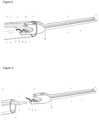
- This device comprises an elongated, flexible tubular element 1, used through a working channel of an endoscope, a proximal end of which remains external to the body, accessible to a user with a joystick (control handle) while a distal end 2 of the flexible element is inserted into the hollow organ after its introduction into the working channel of the endoscope to a location adjacent to the target tissue to be closed or ligated.
- Said device also comprises two control wires, a flexible control wire 9 and a rigid control wire 13 extending through the flexible element 1, the two wires being removably coupled to the device.
- Said device can be made of non-conductive insulating material of the electric current (plastic type), for example in the case of resection of ligated tissue with a coagulation section current, or of conductive material (of the electric current), for example in the case of resection of cold ligated tissue or in the case of using the device only for tissue closure.
- non-conductive insulating material of the electric current plastic type
- conductive material of the electric current
- This device comprises a first 3 and a second 4 arms of a predefined length, the distal end of the second arm 4 is connected by a flexible clamping wire 5 with a predefined length, said flexible clamping wire 5 being able to be made of predefined material absorbable or non-absorbable.
- the other end of the flexible clamping wire 5 is fixed on the external edge 6 of the distal end of the first arm 3, a loop 7 of said flexible clamping wire 5 passes on the external side into the slot 8 of the distal end of the first arm 3.
- the flexible wire 9 passes through a slot 10 at the proximal part of the device. Said wire 9 then passes through loop 7 of wire 5. Said wire 9 has at its end a loop 11 of predefined size. The loop 11 of the end of the flexible wire 9 is retained on a projection 12 at the proximal end of the device.
- the proximal part 18 of the device is fixed by the distal end 17 of the rigid control wire 13 positioned in a fragile connection 14.
- the projection 15 of curved shape retains the distal end 17 of the rigid control wire 13 in the fragile connection which fails when the device is completely out of the distal end 2 of the flexible element 1 to separate the device from the attachment of the rigid control wire 13.
- An actuator at the proximal end of the flexible element 1 coupled to the rigid control wire 13 and configured to move the device in the end of the flexible element 1 until the exit of the first 3 and second 4 arms of the device allowing an open position and its removal in the distal end of the flexible element 1 for a closed configuration.
- the first 3 and the second 4 arms of the device have a predefined proximal angulation 16 allowing the spacing of the two ends of the first 3 and the second 4 arms of the device once exited from the distal end of the flexible element 1.
- the distal ends of the first 3 and second 4 arms of the device are separated, allowing the device to be positioned on the target tissue area to be grasped.
- the first 3 and second 4 arms of the device contain a predefined number of claws oriented on the internal side allowing the attachment of the first 3 and second 4 arms to the target tissue.
- the first 3 arms and second 4 arms of the device are positioned on the target tissue area to be grasped.
- the application of a predefined force on the actuator (control handle) allows the withdrawal of the flexible control wire 9, carrying with it the loop 7 of the flexible clamping wire 5 through the slot 8 in the distal end of the first arm 3 [ Figure 4 ].
- the application of a traction force at the level of the control handle causes the movement of the wire 9 and the loop 7 of the flexible clamping wire 5 until it is fixed on the projection 12 at the level of the proximal end of the device, allowing the fixing of the loop 7 of the flexible clamping wire 5 in the traction position.
- This traction causes the distal ends of the first 3 and second 4 arms of the device to come together, thus allowing the closure or ligation of the target tissue.
- the continuation of the application of the predefined force of traction on the flexible wire 9 allows the release of the loop 11 from the distal end of the flexible wire 9 controlling the projection 12.
- the fragile connection 14 fails with the continuation of the application of the predefined force of traction on the flexible control wire 9, which allows the loop 11 of the flexible control wire 9 to pass over the projection 15, which causes the separation of the distal end of the wire 13 rigid of the fragile connection 14 [ Figure 2 ].
- the application of a pushing force at the level of the control handle of the proximal end of the flexible element 1 causes the complete exit of the device from the distal end 2 of the flexible tubular element 1 and its release [ Figure 3 ].
- the invention relates to a device for closing or ligating tissue at the internal wall of a hollow organ such as the digestive tract or other body lumens and hollow organs, characterized in that it comprises a part proximal, (said proximal part comprising a slot 10 and a fragile connection 14), a first 3 and a second 4 arm of a predefined length, the distal end of the second arm 4 of which is connected by a flexible clamping wire 5 ( of resorbable or non-resorbable material) with a predefined length, a flexible control wire 9 passing through said slot 10. Said flexible wire 9 then passes into the loop 7 of the flexible tightening wire 5 (of resorbable or non-resorbable material).
- Said wire 9 has at its end a loop 11 of predefined size.
- the loop 11 of the end of the flexible wire 9 is retained on a projection 12 at the proximal end of the device, said projection 12 making it possible to retain the loop 7 and allowing the fixing of the flexible clamping wire 5 in the traction position and a rigid control wire 13 positioned in said fragile connection 14.
- the rigid control wire 13 is configured to move the device in the end distal of a flexible tubular element 1 such that the first 3 and second 4 arms of said device can exit from the flexible tubular element 1 allowing an open position of said device and/or that the first 3 and second 4 arms of said device can be removed in the distal end of the flexible tubular element 1 allowing a closed position of said device.
- the proximal part of the device is fixed by the distal end of a rigid control wire 13 positioned in a fragile connection 14 on a projection 15 of curved shape which retains the end of the rigid wire 13 in the fragile connection 14 which fails to continuing the application of the predefined force of traction on the flexible control wire 9, which allows the loop 11 of the flexible control wire 9 to pass over the projection 15, which causes the separation of the distal end of the rigid wire 13 of the fragile connection 14 [ Figure 2 ].
- the application of a pushing force at the level of the control handle of the proximal end of the flexible element 1 causes the complete exit of the device from the distal end 2 of the flexible tubular element 1 [ Figure 3 ].
- the first 3 and second 4 arms of the device preferably have an angulation 16 [ Figure 1 ] predefined proximal allowing the spacing of the two ends of the first 3 and the second 4 arms of the device once exiting the distal end of the flexible tubular element 1 so that in the open position of said device, the distal ends of the first 3 and second 4 arms are separated, allowing said device to be positioned on the target tissue area to be grasped.
- the distal end of the second arm 4 is connected by a flexible tightening wire 5 with a predefined length, said flexible tightening wire 5 of predefined absorbable or non-absorbable material.
- the other end of said flexible clamping wire 5 is fixed on the external edge 6 of the distal end of the first arm 3, a loop 7 of said flexible clamping wire 5 passes from the external side into the slot 8 of the distal end of the first arm 3 [ Figure 4 ].
- the invention relates in one aspect to a device for closing or ligating tissue at the internal wall of a hollow organ such as the digestive tract or other body lumens and hollow organs characterized in that that he comprises an elongated and flexible tubular element 1, used through a working channel of an endoscope, a proximal end of which remains external to the body, accessible to a user with a joystick while a distal end 2 of the flexible tubular element 1 is inserted into the hollow organ after its introduction into the working channel of the endoscope to a location adjacent to the target tissue to be closed or ligated, said device also comprising two control wires, a flexible control wire 9 and a rigid control wire 13 extending through the flexible tubular element 1, the two control wires 9, 13 being removably coupled to the device, the device comprising a first 3 and a second 4 arms each of a predefined length , the distal end of the second arm 4 being connected by a flexible clamping wire 5 with a predefined length, the other end of the
- the device is therefore preferably designed so that at least part of the flexible control wire 9 extends along the first arm 3, close to the latter and away from the second arm 4.
- This is in particular made possible by the positioning of the slot (more precisely a through light here) 8, at the level of the first distal end 19 of the first bottom 3, through which the first loop 7 of the tightening wire 5 passes.
- This makes it possible to have a free space, devoid of wire (in particular flexible control wire 9, or flexible clamping wire 5), as seen in the figure 1 , this free space being intended to accommodate the target tissue to be closed or ligated.
- the first loop 7 is therefore advantageously located only in the vicinity of the first distal end 19, because it has not been stretched and therefore has a reduced or minimal size ( figures 1 And 4 ), while in the closed configuration, the first loop 7 advantageously extends all along the first arm 3 up to the proximal part 18 (and more precisely up to the first projection 12), because it has been stretched ( by the flexible control wire 9) and therefore has an enlarged or maximum size ( figures 2 and 3 , and particularly visible at the figure 5 ).
- Said first arm 3 preferably comprising, as illustrated, an internal side or edge 21 facing said second arm 4 as well as an external side or edge 6 opposite said internal side or edge 21 and therefore facing outwards.
- the first loop 7 therefore passes from the external side or edge 6 to find itself facing the internal side or edge 21, preferably between said first and second arms 3, 4, advantageously in the vicinity of the first distal end 19 of the first arm 3 (at less in open configuration).
- the device comprises a substantially elongated and flexible tubular element 1, intended to be used through a working channel of an endoscope, a proximal end of which remains external to the body and accessible to a user, for example with a joystick, the tubular element 1 thus comprising a distal end 2 intended to be inserted into the hollow organ after its introduction into the working channel of the endoscope to a location adjacent to the tissue target to be closed or ligated, said flexible control wire 9 extending through said tubular element 1.
- the device preferably comprises a rigid control wire or rod 13 extending through said tubular element 1 to said proximal part 18, said rigid control wire or rod 13 being designed to move the proximal part 18 within the tubular element 1, for example by application of a pushing or pulling force on said wire or rigid control rod 13, the pushing or pulling being preferably carried out relative to the proximal part 18 (push towards the proximal part 18, traction away from it).
- the rigid control wire or rod 18 preferably has its own mechanical strength, and in particular is not flaccid. On the contrary, the flexible control wires 9 and clamping wires 5 are advantageously flaccid, without their own mechanical strength, as illustrated in the figures.
- the transition from the initial configuration to the open configuration is preferably done by the application of a thrust force on the wire or rigid control rod 13 within the tubular element 1, said thrust force being transmitted by the rigid control wire or rod 13 to said proximal part 18.
- the rigid control wire or rod 13 is provided with a fourth distal end 17 designed to interact with said proximal part 18, and with a third proximal end (not illustrated, but preferably located outside the organ hollow) allowing a user to manipulate the movement of said wire or rigid control rod 13 within the tubular element 1, and in particular to push said wire or rigid control rod 13.
- said fourth distal end 17 abuts against the proximal part 18, in particular in initial configuration and/or in open configuration.
- the device is advantageously designed so that the application of a pushing force at the third proximal end of the rigid control wire or rod 13 causes the second assembly to completely exit the tubular element 1, as illustrated in Figure 1.
- Figure 3 (more precisely, between the figure 2 and 3 , there is the aforementioned thrust force that has been applied).
- Said second assembly advantageously remains at the location of ligation or closure of the tissue, while the first assembly is removed from the hollow organ and more generally from the patient's body.
- said proximal part 18 comprises an elastic return deformation means 16 making it possible to automatically position the first and second arms 3, 4 at a predefined angulation relative to each other.
- the first and second distal ends 19, 20 are therefore distant from each other, since said first and second arms 3, 4 have come out of the tubular element 1 and that the flexible tightening wire 5 is not stretched or pulled by the flexible control wire 9, in particular in the open configuration, which makes it possible to position said first and second arms 3, 4 at the level of the target tissue to be closed or to be ligated.
- the elastic return deformation means 16 makes it possible to automatically separate said first and second arms 3, 4, as long as they are not constrained and brought closer to each other by another force. , for example exerted by the tightening wire 5 (closed configuration, figures 2 and 3 ), or by an internal wall of the tubular element 1 (initial configuration, not illustrated here).
- said first loop 7 is positioned substantially between said first and second arms 3, 4.
- said first and second arms 3, 4 form a closable clamp, the opening of the clamp being carried out automatically, in open configuration, using a return means, for example a means elastic return deformation 16, while the closure of the clamp is carried out, in closed configuration, by the flexible clamping wire 5 which is held in tension to keep said first and second distal ends 19, 20 close to one of the other.
- a return means for example a means elastic return deformation 16
- the flexible clamping wire 5 which is held in tension to keep said first and second distal ends 19, 20 close to one of the other.
Landscapes
- Health & Medical Sciences (AREA)
- Surgery (AREA)
- Life Sciences & Earth Sciences (AREA)
- Heart & Thoracic Surgery (AREA)
- Nuclear Medicine, Radiotherapy & Molecular Imaging (AREA)
- Vascular Medicine (AREA)
- Engineering & Computer Science (AREA)
- Biomedical Technology (AREA)
- Reproductive Health (AREA)
- Medical Informatics (AREA)
- Molecular Biology (AREA)
- Animal Behavior & Ethology (AREA)
- General Health & Medical Sciences (AREA)
- Public Health (AREA)
- Veterinary Medicine (AREA)
- Surgical Instruments (AREA)
Applications Claiming Priority (1)
| Application Number | Priority Date | Filing Date | Title |
|---|---|---|---|
| FR2208854A FR3139271B1 (fr) | 2022-09-03 | 2022-09-03 | Dispositif pour ligature de tissu. |
Publications (2)
| Publication Number | Publication Date |
|---|---|
| EP4331506A1 true EP4331506A1 (de) | 2024-03-06 |
| EP4331506B1 EP4331506B1 (de) | 2025-01-22 |
Family
ID=86468762
Family Applications (1)
| Application Number | Title | Priority Date | Filing Date |
|---|---|---|---|
| EP23194927.2A Active EP4331506B1 (de) | 2022-09-03 | 2023-09-01 | Vorrichtung zum abbinden von gewebe |
Country Status (2)
| Country | Link |
|---|---|
| EP (1) | EP4331506B1 (de) |
| FR (1) | FR3139271B1 (de) |
Citations (3)
| Publication number | Priority date | Publication date | Assignee | Title |
|---|---|---|---|---|
| US20120116419A1 (en) * | 2010-11-09 | 2012-05-10 | Cook Medical Technologies Llc | Clip system having tether segments for closure |
| US20190105046A1 (en) * | 2017-10-11 | 2019-04-11 | Boston Scientific Scimed, Inc. | Reinforced mechanical hemostasis clip |
| FR3117327A1 (fr) * | 2020-12-13 | 2022-06-17 | Abdelkrim Kada | Dispositif pour l’hémostase ou la fermeture de tissu. |
-
2022
- 2022-09-03 FR FR2208854A patent/FR3139271B1/fr active Active
-
2023
- 2023-09-01 EP EP23194927.2A patent/EP4331506B1/de active Active
Patent Citations (3)
| Publication number | Priority date | Publication date | Assignee | Title |
|---|---|---|---|---|
| US20120116419A1 (en) * | 2010-11-09 | 2012-05-10 | Cook Medical Technologies Llc | Clip system having tether segments for closure |
| US20190105046A1 (en) * | 2017-10-11 | 2019-04-11 | Boston Scientific Scimed, Inc. | Reinforced mechanical hemostasis clip |
| FR3117327A1 (fr) * | 2020-12-13 | 2022-06-17 | Abdelkrim Kada | Dispositif pour l’hémostase ou la fermeture de tissu. |
Also Published As
| Publication number | Publication date |
|---|---|
| EP4331506B1 (de) | 2025-01-22 |
| FR3139271A1 (fr) | 2024-03-08 |
| FR3139271B1 (fr) | 2024-07-26 |
Similar Documents
| Publication | Publication Date | Title |
|---|---|---|
| US20220031305A1 (en) | Endoscopic suturing system having external instrument channel | |
| EP0369324B1 (de) | Chirurgisches Instrument | |
| EP0893969B1 (de) | Verfahren zum anbringen von verformbaren klemmen | |
| EP2345377B1 (de) | Vorrichtung zum abbinden anatomischer Strukturen | |
| US9867624B2 (en) | Endoscopic treatment instrument | |
| US20080114377A1 (en) | Clipping instrument for an endoscopic surgical device | |
| JP2022539372A (ja) | クランプ装置及びその挟持部 | |
| US8603111B2 (en) | Ligating apparatus | |
| JP2014531250A (ja) | 手動外科用結紮クリップアプライヤ | |
| FR2640131A1 (fr) | Ensemble a ligaturer pour chirurgie endoscopique, ligature et instrument de manipulation de ligature pour cet ensemble | |
| EP1011468A1 (de) | Chirurgisches instrument zum fixieren von weichem gewebe | |
| US11090041B2 (en) | Device and method for securing endoscope relative to suturing system | |
| JPWO2019066084A1 (ja) | 内視鏡用牽引クリップ | |
| EP3905970B1 (de) | System mit kurzer hämostatischer klammer | |
| TW202216084A (zh) | 自動抓取裝置 | |
| JPH10286224A (ja) | 結紮処置用内視鏡 | |
| EP4331506B1 (de) | Vorrichtung zum abbinden von gewebe | |
| JPH05212043A (ja) | クリップ装置 | |
| US20220096090A1 (en) | Repositionable closure device | |
| US20240423625A1 (en) | Devices, systems, and methods for securing tissue | |
| US20110270234A1 (en) | Endoscopic surgical instrument | |
| FR3117327A1 (fr) | Dispositif pour l’hémostase ou la fermeture de tissu. | |
| KR20230162693A (ko) | 순응성 메커니즘을 갖춘 오버 더 스코프 클립 | |
| JP2004121484A (ja) | 生体組織の結紮装置 | |
| KR20200042292A (ko) | 내시경용 결찰장치 |
Legal Events
| Date | Code | Title | Description |
|---|---|---|---|
| PUAI | Public reference made under article 153(3) epc to a published international application that has entered the european phase |
Free format text: ORIGINAL CODE: 0009012 |
|
| STAA | Information on the status of an ep patent application or granted ep patent |
Free format text: STATUS: THE APPLICATION HAS BEEN PUBLISHED |
|
| AK | Designated contracting states |
Kind code of ref document: A1 Designated state(s): AL AT BE BG CH CY CZ DE DK EE ES FI FR GB GR HR HU IE IS IT LI LT LU LV MC ME MK MT NL NO PL PT RO RS SE SI SK SM TR |
|
| STAA | Information on the status of an ep patent application or granted ep patent |
Free format text: STATUS: REQUEST FOR EXAMINATION WAS MADE |
|
| 17P | Request for examination filed |
Effective date: 20240719 |
|
| RBV | Designated contracting states (corrected) |
Designated state(s): AL AT BE BG CH CY CZ DE DK EE ES FI FR GB GR HR HU IE IS IT LI LT LU LV MC ME MK MT NL NO PL PT RO RS SE SI SK SM TR |
|
| GRAP | Despatch of communication of intention to grant a patent |
Free format text: ORIGINAL CODE: EPIDOSNIGR1 |
|
| STAA | Information on the status of an ep patent application or granted ep patent |
Free format text: STATUS: GRANT OF PATENT IS INTENDED |
|
| GRAS | Grant fee paid |
Free format text: ORIGINAL CODE: EPIDOSNIGR3 |
|
| RIC1 | Information provided on ipc code assigned before grant |
Ipc: A61B 90/00 20160101ALN20240906BHEP Ipc: A61B 17/00 20060101ALN20240906BHEP Ipc: A61B 17/128 20060101ALI20240906BHEP Ipc: A61B 17/122 20060101AFI20240906BHEP |
|
| INTG | Intention to grant announced |
Effective date: 20240920 |
|
| GRAA | (expected) grant |
Free format text: ORIGINAL CODE: 0009210 |
|
| STAA | Information on the status of an ep patent application or granted ep patent |
Free format text: STATUS: THE PATENT HAS BEEN GRANTED |
|
| AK | Designated contracting states |
Kind code of ref document: B1 Designated state(s): AL AT BE BG CH CY CZ DE DK EE ES FI FR GB GR HR HU IE IS IT LI LT LU LV MC ME MK MT NL NO PL PT RO RS SE SI SK SM TR |
|
| REG | Reference to a national code |
Ref country code: GB Ref legal event code: FG4D Free format text: NOT ENGLISH |
|
| REG | Reference to a national code |
Ref country code: CH Ref legal event code: EP |
|
| REG | Reference to a national code |
Ref country code: IE Ref legal event code: FG4D Free format text: LANGUAGE OF EP DOCUMENT: FRENCH |
|
| REG | Reference to a national code |
Ref country code: DE Ref legal event code: R096 Ref document number: 602023001761 Country of ref document: DE |
|
| REG | Reference to a national code |
Ref country code: NL Ref legal event code: MP Effective date: 20250122 |
|
| PG25 | Lapsed in a contracting state [announced via postgrant information from national office to epo] |
Ref country code: NL Free format text: LAPSE BECAUSE OF FAILURE TO SUBMIT A TRANSLATION OF THE DESCRIPTION OR TO PAY THE FEE WITHIN THE PRESCRIBED TIME-LIMIT Effective date: 20250122 |
|
| PG25 | Lapsed in a contracting state [announced via postgrant information from national office to epo] |
Ref country code: RS Free format text: LAPSE BECAUSE OF FAILURE TO SUBMIT A TRANSLATION OF THE DESCRIPTION OR TO PAY THE FEE WITHIN THE PRESCRIBED TIME-LIMIT Effective date: 20250422 |
|
| PG25 | Lapsed in a contracting state [announced via postgrant information from national office to epo] |
Ref country code: FI Free format text: LAPSE BECAUSE OF FAILURE TO SUBMIT A TRANSLATION OF THE DESCRIPTION OR TO PAY THE FEE WITHIN THE PRESCRIBED TIME-LIMIT Effective date: 20250122 |
|
| PG25 | Lapsed in a contracting state [announced via postgrant information from national office to epo] |
Ref country code: PL Free format text: LAPSE BECAUSE OF FAILURE TO SUBMIT A TRANSLATION OF THE DESCRIPTION OR TO PAY THE FEE WITHIN THE PRESCRIBED TIME-LIMIT Effective date: 20250122 |
|
| PG25 | Lapsed in a contracting state [announced via postgrant information from national office to epo] |
Ref country code: ES Free format text: LAPSE BECAUSE OF FAILURE TO SUBMIT A TRANSLATION OF THE DESCRIPTION OR TO PAY THE FEE WITHIN THE PRESCRIBED TIME-LIMIT Effective date: 20250122 |
|
| REG | Reference to a national code |
Ref country code: LT Ref legal event code: MG9D |
|
| PG25 | Lapsed in a contracting state [announced via postgrant information from national office to epo] |
Ref country code: NO Free format text: LAPSE BECAUSE OF FAILURE TO SUBMIT A TRANSLATION OF THE DESCRIPTION OR TO PAY THE FEE WITHIN THE PRESCRIBED TIME-LIMIT Effective date: 20250422 Ref country code: IS Free format text: LAPSE BECAUSE OF FAILURE TO SUBMIT A TRANSLATION OF THE DESCRIPTION OR TO PAY THE FEE WITHIN THE PRESCRIBED TIME-LIMIT Effective date: 20250522 |
|
| REG | Reference to a national code |
Ref country code: AT Ref legal event code: MK05 Ref document number: 1760850 Country of ref document: AT Kind code of ref document: T Effective date: 20250122 |
|
| PG25 | Lapsed in a contracting state [announced via postgrant information from national office to epo] |
Ref country code: HR Free format text: LAPSE BECAUSE OF FAILURE TO SUBMIT A TRANSLATION OF THE DESCRIPTION OR TO PAY THE FEE WITHIN THE PRESCRIBED TIME-LIMIT Effective date: 20250122 |
|
| PG25 | Lapsed in a contracting state [announced via postgrant information from national office to epo] |
Ref country code: LV Free format text: LAPSE BECAUSE OF FAILURE TO SUBMIT A TRANSLATION OF THE DESCRIPTION OR TO PAY THE FEE WITHIN THE PRESCRIBED TIME-LIMIT Effective date: 20250122 Ref country code: PT Free format text: LAPSE BECAUSE OF FAILURE TO SUBMIT A TRANSLATION OF THE DESCRIPTION OR TO PAY THE FEE WITHIN THE PRESCRIBED TIME-LIMIT Effective date: 20250522 |
|
| PG25 | Lapsed in a contracting state [announced via postgrant information from national office to epo] |
Ref country code: BG Free format text: LAPSE BECAUSE OF FAILURE TO SUBMIT A TRANSLATION OF THE DESCRIPTION OR TO PAY THE FEE WITHIN THE PRESCRIBED TIME-LIMIT Effective date: 20250122 Ref country code: GR Free format text: LAPSE BECAUSE OF FAILURE TO SUBMIT A TRANSLATION OF THE DESCRIPTION OR TO PAY THE FEE WITHIN THE PRESCRIBED TIME-LIMIT Effective date: 20250423 |
|
| PG25 | Lapsed in a contracting state [announced via postgrant information from national office to epo] |
Ref country code: AT Free format text: LAPSE BECAUSE OF FAILURE TO SUBMIT A TRANSLATION OF THE DESCRIPTION OR TO PAY THE FEE WITHIN THE PRESCRIBED TIME-LIMIT Effective date: 20250122 |
|
| PG25 | Lapsed in a contracting state [announced via postgrant information from national office to epo] |
Ref country code: SE Free format text: LAPSE BECAUSE OF FAILURE TO SUBMIT A TRANSLATION OF THE DESCRIPTION OR TO PAY THE FEE WITHIN THE PRESCRIBED TIME-LIMIT Effective date: 20250122 |
|
| PG25 | Lapsed in a contracting state [announced via postgrant information from national office to epo] |
Ref country code: SM Free format text: LAPSE BECAUSE OF FAILURE TO SUBMIT A TRANSLATION OF THE DESCRIPTION OR TO PAY THE FEE WITHIN THE PRESCRIBED TIME-LIMIT Effective date: 20250122 |
|
| PG25 | Lapsed in a contracting state [announced via postgrant information from national office to epo] |
Ref country code: DK Free format text: LAPSE BECAUSE OF FAILURE TO SUBMIT A TRANSLATION OF THE DESCRIPTION OR TO PAY THE FEE WITHIN THE PRESCRIBED TIME-LIMIT Effective date: 20250122 |
|
| PGFP | Annual fee paid to national office [announced via postgrant information from national office to epo] |
Ref country code: DE Payment date: 20250602 Year of fee payment: 5 |
|
| PG25 | Lapsed in a contracting state [announced via postgrant information from national office to epo] |
Ref country code: IT Free format text: LAPSE BECAUSE OF FAILURE TO SUBMIT A TRANSLATION OF THE DESCRIPTION OR TO PAY THE FEE WITHIN THE PRESCRIBED TIME-LIMIT Effective date: 20250122 |
|
| PG25 | Lapsed in a contracting state [announced via postgrant information from national office to epo] |
Ref country code: EE Free format text: LAPSE BECAUSE OF FAILURE TO SUBMIT A TRANSLATION OF THE DESCRIPTION OR TO PAY THE FEE WITHIN THE PRESCRIBED TIME-LIMIT Effective date: 20250122 Ref country code: CZ Free format text: LAPSE BECAUSE OF FAILURE TO SUBMIT A TRANSLATION OF THE DESCRIPTION OR TO PAY THE FEE WITHIN THE PRESCRIBED TIME-LIMIT Effective date: 20250122 |
|
| REG | Reference to a national code |
Ref country code: DE Ref legal event code: R097 Ref document number: 602023001761 Country of ref document: DE |
|
| PG25 | Lapsed in a contracting state [announced via postgrant information from national office to epo] |
Ref country code: RO Free format text: LAPSE BECAUSE OF FAILURE TO SUBMIT A TRANSLATION OF THE DESCRIPTION OR TO PAY THE FEE WITHIN THE PRESCRIBED TIME-LIMIT Effective date: 20250122 |
|
| PG25 | Lapsed in a contracting state [announced via postgrant information from national office to epo] |
Ref country code: SK Free format text: LAPSE BECAUSE OF FAILURE TO SUBMIT A TRANSLATION OF THE DESCRIPTION OR TO PAY THE FEE WITHIN THE PRESCRIBED TIME-LIMIT Effective date: 20250122 |
|
| PLBE | No opposition filed within time limit |
Free format text: ORIGINAL CODE: 0009261 |
|
| STAA | Information on the status of an ep patent application or granted ep patent |
Free format text: STATUS: NO OPPOSITION FILED WITHIN TIME LIMIT |
|
| 26N | No opposition filed |
Effective date: 20251023 |
|
| PGFP | Annual fee paid to national office [announced via postgrant information from national office to epo] |
Ref country code: IE Payment date: 20251130 Year of fee payment: 3 |