EP4331629A1 - Ultraviolettlichtemissionsvorrichtung, verfahren zur verwendung der ultraviolettlichtemissionsvorrichtung und ultraviolettlichtemissionsverfahren - Google Patents
Ultraviolettlichtemissionsvorrichtung, verfahren zur verwendung der ultraviolettlichtemissionsvorrichtung und ultraviolettlichtemissionsverfahren Download PDFInfo
- Publication number
- EP4331629A1 EP4331629A1 EP22795282.7A EP22795282A EP4331629A1 EP 4331629 A1 EP4331629 A1 EP 4331629A1 EP 22795282 A EP22795282 A EP 22795282A EP 4331629 A1 EP4331629 A1 EP 4331629A1
- Authority
- EP
- European Patent Office
- Prior art keywords
- light
- irradiation device
- ultraviolet
- ultraviolet irradiation
- ultraviolet light
- Prior art date
- Legal status (The legal status is an assumption and is not a legal conclusion. Google has not performed a legal analysis and makes no representation as to the accuracy of the status listed.)
- Withdrawn
Links
Images



Classifications
-
- G—PHYSICS
- G02—OPTICS
- G02B—OPTICAL ELEMENTS, SYSTEMS OR APPARATUS
- G02B27/00—Optical systems or apparatus not provided for by any of the groups G02B1/00 - G02B26/00, G02B30/00
- G02B27/09—Beam shaping, e.g. changing the cross-sectional area, not otherwise provided for
- G02B27/0938—Using specific optical elements
- G02B27/095—Refractive optical elements
- G02B27/0955—Lenses
-
- A—HUMAN NECESSITIES
- A61—MEDICAL OR VETERINARY SCIENCE; HYGIENE
- A61L—METHODS OR APPARATUS FOR STERILISING MATERIALS OR OBJECTS IN GENERAL; DISINFECTION, STERILISATION OR DEODORISATION OF AIR; CHEMICAL ASPECTS OF BANDAGES, DRESSINGS, ABSORBENT PADS OR SURGICAL ARTICLES; MATERIALS FOR BANDAGES, DRESSINGS, ABSORBENT PADS OR SURGICAL ARTICLES
- A61L2/00—Disinfection or sterilisation of materials or objects, in general; Accessories therefor
- A61L2/02—Disinfection or sterilisation of materials or objects, in general; Accessories therefor using physical processes
- A61L2/08—Radiation
- A61L2/10—Ultraviolet [UV] radiation
-
- A—HUMAN NECESSITIES
- A61—MEDICAL OR VETERINARY SCIENCE; HYGIENE
- A61L—METHODS OR APPARATUS FOR STERILISING MATERIALS OR OBJECTS IN GENERAL; DISINFECTION, STERILISATION OR DEODORISATION OF AIR; CHEMICAL ASPECTS OF BANDAGES, DRESSINGS, ABSORBENT PADS OR SURGICAL ARTICLES; MATERIALS FOR BANDAGES, DRESSINGS, ABSORBENT PADS OR SURGICAL ARTICLES
- A61L9/00—Disinfection, sterilisation or deodorisation of air
- A61L9/16—Disinfection, sterilisation or deodorisation of air using physical phenomena
- A61L9/18—Radiation
- A61L9/20—Ultraviolet radiation
-
- G—PHYSICS
- G02—OPTICS
- G02B—OPTICAL ELEMENTS, SYSTEMS OR APPARATUS
- G02B19/00—Condensers, e.g. light collectors or similar non-imaging optics
- G02B19/0033—Condensers, e.g. light collectors or similar non-imaging optics characterised by the use
- G02B19/0047—Condensers, e.g. light collectors or similar non-imaging optics characterised by the use for use with a light source
-
- G—PHYSICS
- G02—OPTICS
- G02B—OPTICAL ELEMENTS, SYSTEMS OR APPARATUS
- G02B19/00—Condensers, e.g. light collectors or similar non-imaging optics
- G02B19/0033—Condensers, e.g. light collectors or similar non-imaging optics characterised by the use
- G02B19/0095—Condensers, e.g. light collectors or similar non-imaging optics characterised by the use for use with ultraviolet radiation
-
- A—HUMAN NECESSITIES
- A61—MEDICAL OR VETERINARY SCIENCE; HYGIENE
- A61L—METHODS OR APPARATUS FOR STERILISING MATERIALS OR OBJECTS IN GENERAL; DISINFECTION, STERILISATION OR DEODORISATION OF AIR; CHEMICAL ASPECTS OF BANDAGES, DRESSINGS, ABSORBENT PADS OR SURGICAL ARTICLES; MATERIALS FOR BANDAGES, DRESSINGS, ABSORBENT PADS OR SURGICAL ARTICLES
- A61L2202/00—Aspects relating to methods or apparatus for disinfecting or sterilising materials or objects
- A61L2202/10—Apparatus features
- A61L2202/11—Apparatus for generating biocidal substances, e.g. vaporisers, UV lamps
-
- A—HUMAN NECESSITIES
- A61—MEDICAL OR VETERINARY SCIENCE; HYGIENE
- A61L—METHODS OR APPARATUS FOR STERILISING MATERIALS OR OBJECTS IN GENERAL; DISINFECTION, STERILISATION OR DEODORISATION OF AIR; CHEMICAL ASPECTS OF BANDAGES, DRESSINGS, ABSORBENT PADS OR SURGICAL ARTICLES; MATERIALS FOR BANDAGES, DRESSINGS, ABSORBENT PADS OR SURGICAL ARTICLES
- A61L2209/00—Aspects relating to disinfection, sterilisation or deodorisation of air
- A61L2209/10—Apparatus features
- A61L2209/12—Lighting means
-
- F—MECHANICAL ENGINEERING; LIGHTING; HEATING; WEAPONS; BLASTING
- F21—LIGHTING
- F21V—FUNCTIONAL FEATURES OR DETAILS OF LIGHTING DEVICES OR SYSTEMS THEREOF; STRUCTURAL COMBINATIONS OF LIGHTING DEVICES WITH OTHER ARTICLES, NOT OTHERWISE PROVIDED FOR
- F21V33/00—Structural combinations of lighting devices with other articles, not otherwise provided for
- F21V33/0064—Health, life-saving or fire-fighting equipment
-
- G—PHYSICS
- G02—OPTICS
- G02B—OPTICAL ELEMENTS, SYSTEMS OR APPARATUS
- G02B19/00—Condensers, e.g. light collectors or similar non-imaging optics
- G02B19/0004—Condensers, e.g. light collectors or similar non-imaging optics characterised by the optical means employed
- G02B19/0009—Condensers, e.g. light collectors or similar non-imaging optics characterised by the optical means employed having refractive surfaces only
- G02B19/0014—Condensers, e.g. light collectors or similar non-imaging optics characterised by the optical means employed having refractive surfaces only at least one surface having optical power
-
- G—PHYSICS
- G02—OPTICS
- G02B—OPTICAL ELEMENTS, SYSTEMS OR APPARATUS
- G02B19/00—Condensers, e.g. light collectors or similar non-imaging optics
- G02B19/0033—Condensers, e.g. light collectors or similar non-imaging optics characterised by the use
- G02B19/0047—Condensers, e.g. light collectors or similar non-imaging optics characterised by the use for use with a light source
- G02B19/0052—Condensers, e.g. light collectors or similar non-imaging optics characterised by the use for use with a light source the light source comprising a laser diode
- G02B19/0057—Condensers, e.g. light collectors or similar non-imaging optics characterised by the use for use with a light source the light source comprising a laser diode in the form of a laser diode array, e.g. laser diode bar
-
- G—PHYSICS
- G02—OPTICS
- G02B—OPTICAL ELEMENTS, SYSTEMS OR APPARATUS
- G02B19/00—Condensers, e.g. light collectors or similar non-imaging optics
- G02B19/0033—Condensers, e.g. light collectors or similar non-imaging optics characterised by the use
- G02B19/0047—Condensers, e.g. light collectors or similar non-imaging optics characterised by the use for use with a light source
- G02B19/0061—Condensers, e.g. light collectors or similar non-imaging optics characterised by the use for use with a light source the light source comprising a LED
-
- G—PHYSICS
- G02—OPTICS
- G02B—OPTICAL ELEMENTS, SYSTEMS OR APPARATUS
- G02B19/00—Condensers, e.g. light collectors or similar non-imaging optics
- G02B19/0033—Condensers, e.g. light collectors or similar non-imaging optics characterised by the use
- G02B19/0047—Condensers, e.g. light collectors or similar non-imaging optics characterised by the use for use with a light source
- G02B19/0061—Condensers, e.g. light collectors or similar non-imaging optics characterised by the use for use with a light source the light source comprising a LED
- G02B19/0066—Condensers, e.g. light collectors or similar non-imaging optics characterised by the use for use with a light source the light source comprising a LED in the form of an LED array
-
- H—ELECTRICITY
- H01—ELECTRIC ELEMENTS
- H01J—ELECTRIC DISCHARGE TUBES OR DISCHARGE LAMPS
- H01J65/00—Lamps without any electrode inside the vessel; Lamps with at least one main electrode outside the vessel
- H01J65/04—Lamps in which a gas filling is excited to luminesce by an external electromagnetic field or by external corpuscular radiation, e.g. for indicating plasma display panels
- H01J65/042—Lamps in which a gas filling is excited to luminesce by an external electromagnetic field or by external corpuscular radiation, e.g. for indicating plasma display panels by an external electromagnetic field
- H01J65/046—Lamps in which a gas filling is excited to luminesce by an external electromagnetic field or by external corpuscular radiation, e.g. for indicating plasma display panels by an external electromagnetic field the field being produced by using capacitive means around the vessel
Definitions
- the present invention relates to an ultraviolet irradiation device, a method for using the ultraviolet irradiation device, and an ultraviolet irradiation method.
- pathogens such as bacteria, fungi, and viruses have an absorption maximum around a wavelength of 260 nm. Therefore, there has been conventionally known a technique of inactivating a pathogen by emitting an object surface or a space where the pathogen is present with ultraviolet light having a high emission spectrum around a wavelength of 254 nm using a low-pressure mercury lamp.
- Patent Document 1 describes that a sterilization lamp that emits ultraviolet light is attached to a kitchen or the like to sterilize the kitchen.
- Patent Document 2 describes an action of sterilization by emitting ultraviolet light to bacteria and viruses floating in a room.
- ultraviolet irradiation devices described in Patent Documents 1 and 2 use ultraviolet light in a wavelength band harmful to a human body. Therefore, measures are taken such as giving directivity to the emitted ultraviolet light so that the ultraviolet light is not directed to the human body.
- pathogens such as bacteria, fungi and viruses are present in every part of the space.
- Pathogens are often contained in airborne droplets released from the mouths or noses of humans and spread through expired air or saliva or by coughing or sneezing, or contained in aerosol.
- the airborne droplets containing the pathogens adhere to a human body surface (for example, skin and hair) or an object surface with which a person comes into contact (for example, furniture and office equipment).
- the aerosol containing the pathogens floats and diffuses in the space.
- the conventional ultraviolet irradiation device Due to the risk of emitting the harmful ultraviolet light to the human body, the conventional ultraviolet irradiation device emits ultraviolet light only in a direction where people are not present. Therefore, the conventional ultraviolet irradiation device has a limit in inactivation of the pathogens.
- the present invention provides an ultraviolet irradiation device that can effectively inactivate pathogens while ensuring safety, a method for using the ultraviolet irradiation device, and an ultraviolet irradiation method.
- An ultraviolet irradiation device includes:
- the ultraviolet light can be emitted over a wide range. Therefore, the ultraviolet light can be emitted to every corner of the space where the floating pathogens possibly exist.
- the cost effect is excellent from the viewpoint that a region where microorganisms are desired to be inactivated can be covered by a small number of ultraviolet irradiation devices.
- the ultraviolet light does not present harmfulness to the human body in all wavelength bands. It has been reported that ultraviolet light having a wavelength of 240 nm or more is harmful to human cells and animal cells, but ultraviolet light having a wavelength band shorter than the wavelength band of the above ultraviolet light has a small penetrating force to human cells and animal cells, and therefore has extremely low harmfulness to humans and animals.
- the present inventor has made it possible to emit the ultraviolet light in a direction where humans and animal are present by using ultraviolet light having a wavelength of 190 nm or more and less than 240 nm having extremely low harmfulness. This enables inactivation of the pathogens while the safety is ensured.
- activation refers to a concept that includes killing bacteria or viruses or making infectivity or toxicity of bacteria or viruses lost.
- a target product covered by the present invention can provide sterilization and virus inactivation performance intrinsic to the ultraviolet light without causing erythema or keratitis on the skin or eyes of humans or animals.
- the target product of the present invention has a characteristic that it can be used in a manned environment unlike the conventional ultraviolet light source.
- Goal 3 ensure healthy lives and promote well-being for all at all ages” included in the Sustainable Development Goals (SDGs) led by the United Nations, and will greatly contribute to the goal target 3.3 "By 2030, end the epidemics of AIDS, tuberculosis, malaria and neglected tropical diseases and combat hepatitis, water-borne diseases and other communicable diseases”.
- irradiance light intensity
- an irradiation dose integrated light quantity
- a threshold limit value TLV dependent on wavelength.
- TLV threshold limit value
- the harmfulness of ultraviolet light having a wavelength of 190 nm or more and less than 240 nm is extremely low, but in order to perform safe operation, it is desirable to limit the irradiance and the irradiation dose of the ultraviolet light emitted per predetermined time so as not to exceed the threshold limit value.
- the irradiance of ultraviolet light emitted from the ultraviolet irradiation device is not uniform but exhibits a biased alignment distribution (includes unevenness). Therefore, in setting the operation of the ultraviolet irradiation device in consideration of the TLV, it is necessary to set the upper limit of the irradiation dose (integrated light quantity) of the ultraviolet light in accordance with the region locally receiving a strong light. This causes the irradiation dose of the ultraviolet light in the region locally receiving a weak light to be restricted more than necessary.
- the diverging optical system by using the diverging optical system, it is possible to diverge the locally strong light beam to make the alignment distribution of the light intensity uniform.
- the upper limit of the ultraviolet light irradiation dose is less likely to be restricted. Therefore, by using the diverging optical system, it is possible to ensure safety at a higher level and to be less likely to be restricted by the upper limit of the ultraviolet light irradiation dose.
- the local maximum irradiance of ultraviolet light (irradiance in a local region to which the most intense light is emitted) may be suppressed by the diverging optical system.
- the local maximum irradiance of ultraviolet light on a light-emitting surface of the diverging optical system may be suppressed to 3 mW/cm 2 or less, and further, 1 mW/cm 2 or less.
- the diverging optical system has characteristics that attenuation of light is small and emission efficiency is improved.
- the diverging optical system can have an optical design aiming at a desired light distribution angle.
- An optical filter that transmits the ultraviolet light having the main emission wavelength belonging to the wavelength band from 190 nm to 240 nm and does not substantially transmit the ultraviolet light having the wavelength band from 240 nm to 280 nm may be provided on the incident side of the diverging optical system. This reliably suppresses the ultraviolet light in the wavelength band that possibly affect the human body from leaking to the outside of the housing, and the safety of the irradiation device with respect to the human body is further improved. Furthermore, even in a case where the light distribution angle is reduced using the optical filter, a large light distribution angle can be obtained by disposing the diverging optical system on the emission side of the optical filter.
- a separation distance between the optical filter and the diverging optical system may be 0 mm or more and 3 mm or less.
- the emission light of the optical filter can be effectively incident on the diverging optical system, and the emission efficiency can be enhanced.
- the diverging optical system may include a lens array.
- the light source may include at least one excimer lamp,
- a method for using the ultraviolet irradiation device according to the present invention includes disposing the ultraviolet irradiation device such that at least a part of the emitted ultraviolet light is emitted toward a space, and causing the ultraviolet irradiation device to emit the ultraviolet light.
- An ultraviolet irradiation device includes:
- An ultraviolet irradiation method includes:
- a traveling direction of a light beam of emitted ultraviolet light on an optical axis is defined as the +X direction
- a plane orthogonal to the X direction is defined as a YZ plane.
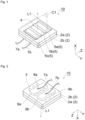
- FIG. 1 and 2 are perspective views schematically illustrating the appearance of the ultraviolet irradiation device.
- Fig. 3 is a perspective view illustrating only a light source and an electrode block extracted from the ultraviolet irradiation device.
- An ultraviolet irradiation device 10 of the present embodiment includes excimer lamps 3 that emit ultraviolet light (see Figs. 2 and 3 ), a housing 2 that accommodates the excimer lamp 3, an extraction part 4 that extracts the ultraviolet light emitted from the excimer lamp 3 to the outside of the housing 2 in the +X direction, a diverging optical system 5 that causes the ultraviolet light to diverge, and an optical filter described later.
- an arrow L1 indicates an optical axis of ultraviolet light emitted from the excimer lamps 3 and a traveling direction of a light beam on the optical axis.
- the housing 2 includes a first frame 2a having an opening that functions as the extraction part 4 in the center and a second frame 2b having no opening.
- the second frame 2b and the first frame 2a are fitted to each other to form an internal space surrounded by the housing 2.
- the excimer lamps 3 and two electrode blocks (9a, 9b) that supplies power to the excimer lamps 3 are disposed.
- the frame constituting the housing 2 may include three or more frames.
- the two electrode blocks (9a, 9b) are fixed to the inner surface of the second frame 2b (see Fig. 2 ).
- Two connection terminals (8a, 8b) are provided on the outer surface of the second frame 2b (see Fig. 2 ).
- the two connection terminals (8a, 8b) are respectively electrically connected to the electrode blocks (9a, 9b) with the second frame 2b interposed therebetween.
- the two connection terminals (8a, 8b) are respectively connected to power feeding lines (7a, 7b) fed with power from an external power supply (not illustrated).
- the present embodiment is provided with three pieces of the excimer lamps 3 (3a, 3b, 3c) arranged so as to be separated from each other in the Z direction.
- the two electrode blocks (9a, 9b) are in contact with the outer surface of a light-emitting tube of each of the excimer lamps 3 (3a, 3b, 3c). This allows the excimer lamps 3 to be powered and turned on.
- the excimer lamp 3 that is used is a KrCI excimer lamp having a light-emitting tube filled with a light-emitting gas containing KrCI. Therefore, the excimer lamp 3 emits ultraviolet light having a wavelength of 190 nm to 240 nm. In particular, the KrCI excimer lamp emits ultraviolet light having a main peak wavelength of around 222 nm.
- the excimer lamp 3 is not limited to the KrCI excimer lamp.
- a KrBr excimer lamp may be used which has a light-emitting tube filled with a light-emitting gas containing KrBr.
- the KrBr excimer lamp emits ultraviolet light having a main peak wavelength of around 207 nm.
- the "main emission wavelength” indicates, in a case where a wavelength range Z( ⁇ ) of ⁇ 10 nm with respect to a certain wavelength ⁇ is defined on an emission spectrum, a wavelength ⁇ i in a wavelength range Z(Ai) showing integrated intensity of 40% or more with respect to the total integrated intensity in the emission spectrum.
- a wavelength having the highest relative irradiance may be usually regarded as the main emission wavelength.
- a length in the tube axis direction (Y direction) is preferably 15 mm or more and 200 mm or less, and an outer diameter is preferably 2 mm or more and 16 mm or less.
- the number of excimer lamps 3 may be one, two, or four or more.
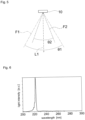
- Fig. 4 is a schematic cross-sectional view taken along a plane C1 (plane parallel to the XZ plane) of the ultraviolet irradiation device 10 in Fig. 1 .
- the diverging optical system 5 and an optical filter 6 are disposed in the extraction part 4 that extracts the ultraviolet light to the outside of the housing 2.
- the state in which the diverging optical system 5 or the optical filter 6 is disposed in the extraction part 4 includes a state in which the diverging optical system 5 or the optical filter 6 is inserted into the opening of the housing 2 constituting the extraction part 4 or a state in which the diverging optical system 5 or the optical filter 6 covers the opening of the housing 2.
- the diverging optical system 5 or the optical filter 6 may be disposed at a position spaced apart from the outer surface of the first frame 2a by a minute distance (for example, within 30 mm) in the X direction.
- the diverging optical system 5 has a function of increasing the light distribution angle of the ultraviolet light passing through the extraction part 4. As can be seen from a light beam flux F1 illustrated in Fig. 4 , the light beam flux F1 transmitted through the diverging optical system 5 diverges, and the light distribution angle of the emitted light is enlarged.
- a light beam flux F2 of the ultraviolet light is emitted from the ultraviolet irradiation device 10 at a light distribution angle ⁇ 2 around the optical axis (arrow L1).
- the light beam flux F1 of the ultraviolet light is emitted at a light distribution angle ⁇ 1.
- the light distribution angle ⁇ 1 in the case of having the diverging optical system 5 is larger than the light distribution angle ⁇ 2 in the case of not having the diverging optical system.
- the light distribution angle ( ⁇ 1, ⁇ 2) is defined as an angle formed by outermost opposing light beams farthest from the optical axis of the light beam flux (F1, F2) spreading around the optical axis. Note that the light beam flux (F1, F2) spreads around the optical axis as the center and is defined as a flux of light beams having luminance of 1/2 or more with respect to the luminance of the light beam on the optical axis L1 indicating the maximum luminance of the light beam.
- the ultraviolet irradiation device 10 can emit the ultraviolet light over a wide range. Further, a locally strong light beam is diverged by the diverging optical system 5 to cause the alignment distribution of the light intensity to be uniform.
- the diverging optical system 5 of the present embodiment includes an optical lens.
- the optical lens quartz glass or sapphire glass having high transmittance with respect to the ultraviolet light is preferably used.
- the optical lens can also be designed such that the light distribution angle belongs to a desired range.
- a mirror may be used for all or a part of the diverging optical system 5.
- the optical lens constituting the diverging optical system 5 is constituted by a lens array in which a plurality of small lenses (5a, 5b, 5c) is arranged in the Z direction.
- Each of the small lenses (5a, 5b, 5c) is constituted of a biconcave lens having a cylindrical surface (surface curved in a columnar shape).
- the longitudinal direction of each of the small lenses (5a, 5b, 5c) (direction in which the cylinder extends) is along the longitudinal direction of the excimer lamp (3a, 3b, 3c).
- the number of small lenses (5a, 5b, 5c) constituting the lens array is the same as the number of excimer lamps (3a, 3b, 3c).
- the excimer lamp 3a and the small lens 5a are arranged side by side in the X direction.
- the excimer lamps (3b, 3c) and the small lenses (5b, 5c) are arranged side by side in the X direction. This causes each of the small lenses (5a, 5b, 5c) to effectively diverge the light emitted from each of the excimer lamps (3a, 3b, 3c).
- the lens array may be a lens having a configuration in which a plurality of small lenses are arranged in each of the Z direction and the Y direction.
- other lens shapes such as a plano-concave lens and a concave meniscus lens may be used as long as the lens has a diverging function.
- the small lenses constituting the lens array are arranged at an optional pitch.
- the arrangement pitch of the small lenses is more preferably set to be equal to the arrangement pitch of the excimer lamp.
- the optical filter 6 is disposed on the incident side of the diverging optical system 5.
- the optical filter 6 functions as a wavelength selection filter (band pass filter) that transmits ultraviolet light in a specific wavelength band and does not substantially transmit ultraviolet light in a specific wavelength band.
- the optical filter 6 of the present embodiment transmits the ultraviolet light in a wavelength band of 190 nm or more and less than 240 nm and does not substantially transmit the ultraviolet light in a wavelength band of 240 nm or more and 280 nm or less.
- the ultraviolet light having a wavelength of 240 nm or more and 280 nm or less is substantially prevented from being transmitted. This reliably suppresses the ultraviolet light in the wavelength band that possibly affect the human body from leaking to the outside of the housing 2, and the safety of the irradiation device with respect to the human body is further improved.
- the ultraviolet light emitted from a light source unit be within a wavelength range of 190 nm or more and 237 nm or less, more preferably within a wavelength range of 190 nm or more and 235 nm or less, and particularly preferably within a wavelength range of 190 nm or more and 230 nm or less.
- the ultraviolet light having a wavelength of less than 190 nm is absorbed into oxygen in the air, and this results in generation of ozone.
- a peak wavelength of the ultraviolet light emitted from the light source unit be within a wavelength range of 200 nm or more and 237 nm or less, more preferably within a wavelength range of 200 nm or more and 235 nm and less, and further preferably within a wavelength range of 200 nm or more and 230 nm or less.
- the phrase "does not substantially transmit ultraviolet light” means that the ultraviolet light in a main light beam direction is suppressed to an ultraviolet light intensity of at least 5% or less with respect to an ultraviolet light intensity of a peak wavelength in a specific wavelength band.
- the intensity of the ultraviolet light of 240 nm or more and 300 nm or less is shielded to 5% or less with respect to the intensity of the peak wavelength.
- the intensity of the ultraviolet light transmitted through the optical filter 6 is preferably suppressed to 2% or less of the intensity of the peak wavelength. It is more preferable that the intensity of the ultraviolet light transmitted through the optical filter 6 be suppressed to 1% or less with respect to the intensity of the peak wavelength.
- the optical filter 6 may have any form as long as the optical filter functions as a band pass filter that does not transmit the ultraviolet light in a specific wavelength band, and the arrangement place and form are not limited. As shown in Fig. 4 , in addition to the optical filter 6 being arranged separated from the light source, the optical filter 6 may be configured so as to be in contact with the light source (as a specific example, the optical filter 6 may be laminated on a glass seal of the excimer lamp 3).
- the optical filter 6 is formed by, for example, forming a dielectric multilayer film in which dielectric films having different refractive indexes are alternately laminated.
- the dielectric multilayer film include a dielectric multilayer film in which hafnium oxide (HfOz) layers and silicon dioxide (SiO 2 ) layers are alternately laminated, and a dielectric multilayer film in which SiO 2 layers and aluminum oxide (Al 2 O 3 ) layers are alternately laminated.
- the dielectric multilayer film in which the HfOz layers and the SiO 2 layers are alternately laminated can reduce the number of layers for obtaining the same wavelength-selective characteristics as compared to the dielectric multilayer film in which the SiO 2 layers and the Al 2 O 3 layers are alternately laminated, and thus can increase the transmittance of the selected ultraviolet light.
- the optical filter 6 is constituted of the plurality of dielectric multilayer films having different refractive indices.
- the optical filter 6 constituted of the dielectric multilayer film has the transmittance inevitably changed depending on the incident angle of the ultraviolet light.
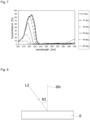
- Fig. 7 is a graph illustrating an example of a transmission spectrum of the optical filter 6 for each incident angle when the ultraviolet light is incident on the optical filter 6.
- the optical filter 6 is designed assuming a case where the light-emitting gas of the excimer lamp 3 contains KrCl, that is, a case where the excimer lamp 3 emits the ultraviolet light whose main peak wavelength is 222 nm.
- Each curve in the graph is obtained by plotting a ratio of the intensity of light incident on the optical filter 6 to the intensity of light emitted from the optical filter 6 for each of the different wavelengths.
- an incident angle is defined by an angle ⁇ 3 between a normal line 6N to the incident surface of the optical filter 6 and ultraviolet light L2 incident on the incident surface of the optical filter 6.
- the optical filter 6 easily transmits a light component having a small incident angle (angle ⁇ 3) but does not easily transmit a light component having a large incident angle.
- the light component having a large incident angle does not enter the optical filter 6 and is reflected.
- the light emitted from the optical filter 6 has a higher ratio of a light component having a smaller incident angle than that of the light incident on the optical filter 6, and has a smaller light distribution angle. In other words, the optical filter 6 reduces the light distribution angle.
- the above-described diverging optical system 5 can obtain a particularly remarkable effect in a case where the optical filter 6 that reduces the light distribution angle is used. Furthermore, even in a case where the light distribution angle is reduced by using the optical filter 6, the ultraviolet irradiation device 10 can obtain a large light distribution angle by disposing the diverging optical system 5 on the emission side of the optical filter 6.
- a separation distance between the optical filter 6 and the diverging optical system 5 may be 0 mm or more and 3 mm or less. By setting the separation distance within the above range, the emission light of the optical filter 6 can be effectively incident on the diverging optical system 5, and the emission efficiency can be enhanced.
- the separation distance is represented by the shortest distance between the optical filter 6 and the diverging optical system 5. In the ultraviolet irradiation device 10 illustrated in Fig. 4 , because the optical filter 6 is disposed so as to be in contact with a portion other than the concave surface of the diverging optical system 5, the separation distance is 0 mm.
- a surface 9r (see Fig. 3 ) of the electrode blocks (9a, 9b) facing the excimer lamp 3 function as a reflection surface of the ultraviolet light.
- the surface 9r is constituted of a plane inclined with respect to the surface of the extraction part 4.
- the surface 9r may be a curved surface.
- the divergence angle from the excimer lamp 3 can be further directed, and the emission efficiency can be enhanced.
- Al, an Al alloy, or stainless steel may be used for the electrode blocks (9a, 9b). These materials are conductive and have high reflectance of ultraviolet light.
- a part of the surface constituting the electrode blocks (9a, 9b) having a power feeding function functions as a reflection surface.
- a material having a reflection function different from that of the electrode blocks (9a, 9b) may be disposed on the surface of the electrode blocks (9a, 9b).
- a first modification of the ultraviolet irradiation device is described with reference to Fig. 9 .
- An ultraviolet irradiation device 20 does not include an optical filter that functions as a wavelength selection filter.
- the ultraviolet irradiation device 20 may not include the optical filter.
- a second modification of the ultraviolet irradiation device is described with reference to Fig. 10 .
- the diverging optical system 5 does not include the lens array in which the plurality of small lenses is aligned, but includes a single lens.
- a biconcave lens having a cylindrical surface surface curved in a columnar shape
- lenses having other shapes such as a plano-concave lens and a concave meniscus lens may be used as long as the lens has a diverging function.
- the ultraviolet irradiation device can be disposed so that the emitted ultraviolet light is emitted toward a manned space to allow the ultraviolet irradiation device to emit the ultraviolet light.
- the manned space means a space that a person can enter regardless of whether or not a person is actually present.
- the manned space includes, for example, a space in a building such as a house, an office, a school, a hospital, or a theater, or a space in a vehicle such as an automobile, a bus, a train, or an airplane.
- the ultraviolet irradiation device 10 is disposed on a ceiling, a wall, a column, a floor, or the like facing the manned space so that the extraction part 4 faces the manned space. Then, the ultraviolet irradiation device 10 is turned on to emit the ultraviolet light to the manned space.
- the ultraviolet irradiation device may be incorporated in a lighting facility such as a fluorescent lamp or a light-emitting diode (LED).
- a lighting facility such as a fluorescent lamp or a light-emitting diode (LED).
- the diverging optical system 5 used in the ultraviolet irradiation device may be shared with the diverging optical system for visible light used in the lighting facility.
- An outline of a second embodiment of an ultraviolet irradiation device is described with reference to Fig. 11 .
- the second embodiment can be implemented in the similar manner as the first embodiment except for the following points.
- An ultraviolet irradiation device 60 of the second embodiment includes excimer lamps 3 (3a, 3b, 3c) that emit ultraviolet light of 190 nm to 240 nm, a housing 2 that accommodates the excimer lamps 3, and an extraction part 4 that extracts the ultraviolet light emitted from the excimer lamp 3 to the outside of the housing 2.
- the ultraviolet irradiation device 60 includes, in the extraction part 4, an optical filter 6 that transmits the ultraviolet light in a wavelength band of 190 nm or more and 240 nm or less and does not substantially transmit the ultraviolet light in a wavelength band of 240 nm or more and 280 nm or less.
- the optical filter 6 is not an essential component for the ultraviolet irradiation device 60.
- the ultraviolet irradiation device 60 of the present embodiment does not include a diverging optical system 5.
- the housing 2 has attachment parts 51 for attaching the diverging optical system 5 so that the diverging optical system 5 can be retrofitted to the ultraviolet irradiation device 60.
- each of the attachment parts 51 is a screw hole.
- the mode of the attachment part 51 of the diverging optical system 5 is an example, and various modes such as a hook and a hook-and-loop fastener can be applied.
- the present invention is not limited to the above-described embodiments at all, and various modifications or improvements can be made to the above-described embodiments without departing from the gist of the present invention.
- the excimer lamp 3 is used as the light source
- a solid-state light source including a laser diode (LD) or an LED may be used as the light source.
- an optical filter that transmits ultraviolet light in a wavelength band of 200 nm to 230 nm and does not substantially transmit a wavelength band of less than 200 nm and 230 nm to 280 nm may be used.
- a wavelength band of less than 200 nm to the ultraviolet light that is not substantially transmitted, generation of ozone is suppressed, and the safety for the human body is further enhanced.
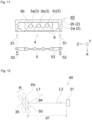
- FIG. 12 is a schematic view of a measurement facility 40 for measuring the light distribution angle of the ultraviolet irradiation device.
- the measurement facility 40 includes an ultraviolet irradiation device 50, a rotary stage 35 on which the ultraviolet irradiation device 10 is placed, and an irradiance meter 31.
- UV POWER METOR C8026 manufactured by Hamamatsu Photonics K.K. is used as the irradiance meter 31.
- the measurement facility 40 includes the rotary stage 35, the ultraviolet irradiation device 50 placed on the rotary stage 35, and the irradiance meter 31 disposed at a position separated from the ultraviolet irradiation device 50 by a distance d1: 300 (mm).
- the position of the rotary stage 35 when the ultraviolet irradiation device 10 is arranged to face the irradiance meter 31 so that the irradiance meter 31 is positioned on the optical axis L1 of the ultraviolet irradiation device 50 is defined as an initial position P0.
- the rotary stage 35 is rotated from the initial position P0 in a rotation direction R illustrated in Fig. 12 .
- the rotary stage 35 and the ultraviolet irradiation device 50 at the initial position P0 are indicated by dotted lines, and the rotary stage 35 and the ultraviolet irradiation device 50 after being rotated in the rotation direction R for a predetermined time are indicated by solid lines.
- An angle ⁇ 4 formed between the optical axis L1 of the ultraviolet irradiation device 50 and the light beam L3 incident on the irradiance meter 31 from the ultraviolet irradiation device 50 represents a rotation angle.
- the irradiance was measured with the irradiance meter 31 while the ultraviolet irradiation device was emitted from the ultraviolet irradiation device 50, and meanwhile, the rotation angle ⁇ 4 was increased from the initial position P0 at which the rotation angle ⁇ 4 was 0 degrees (deg) (the rotary stage 35 was rotated) until the rotation angle ⁇ 4 reached 80 degrees (deg).
- the ultraviolet irradiation device 50 has the same structure as the ultraviolet irradiation device 10 illustrated in Fig. 4 . However, in the prepared ultraviolet irradiation device, four KrCI excimer lamps 3 are arranged in the Z direction. Three (S1, S2, S3) of the ultraviolet irradiation devices 50 were prepared. However, the diverging optical systems 5 of the three ultraviolet irradiation devices (S1, S2, S3) each satisfy the following conditions.
- the diverging optical system 5 of the ultraviolet irradiation device S1 is configured by arranging four small lenses (biconcave lenses having a cylindrical surface) in the Z direction.
- the diverging optical system 5 has the following dimensions.
- the diverging optical system 5 of the ultraviolet irradiation device S2 is configured by arranging four small lenses (biconcave lenses of a cylindrical type) in the Z direction.
- the diverging optical system 5 has the following dimensions.
- the optical lens of the lens array used in the diverging optical system 5 of the ultraviolet irradiation device S2 has a larger radius of curvature than the optical lens used in the diverging optical system 5 of the ultraviolet irradiation device S1. That is, a refractive power of the optical lens of the ultraviolet irradiation device S1 is larger than a refractive power of the optical lens of the ultraviolet irradiation device S2.
- the ultraviolet irradiation device S3 is an ultraviolet irradiation device without the diverging optical system 5 and is illustrated as a comparative example.
- the relative irradiance was obtained based on the measured irradiance results.
- the relative irradiance is obtained by dividing an irradiance measurement value at an arbitrary rotation angle by the irradiance measurement value at a rotation angle of 0 degrees (deg). That is, the relative irradiance is a relative value of the irradiance of the light beam traveling at an arbitrary angle in a case where the irradiance of the light beam traveling in the optical axis direction is 1.
- Fig. 14 is a graph illustrating the relative irradiance with respect to a change in rotation angle.
- the ultraviolet irradiation devices (S1, S2) included in the diverging optical system 5 exhibit a higher relative irradiance with respect to a wide angle range than the ultraviolet irradiation device S3 without the diverging optical system 5.
- the ultraviolet irradiation device S1 has an angle of about 44 degrees (deg)
- the ultraviolet irradiation device S2 has an angle of about 42 degrees
- the ultraviolet irradiation device S3 has an angle of only about 26 degrees.
- the light distribution angle is obtained at twice the rotation angle at which the relative irradiance is 0.50, it can be said that the light distribution angle is enlarged by about 36 degrees by providing the diverging optical system in the ultraviolet irradiation device S1, and the light distribution angle is enlarged by about 32 degrees by providing the diverging optical system in the ultraviolet irradiation device S2.
- the ultraviolet irradiation device S1 is compared with the ultraviolet irradiation device S2.
- the ultraviolet irradiation device S1 including the optical lens having a large refractive power the relative irradiance of the light beam at an angle of about 15 degrees from the optical axis exceeds the relative irradiance of the light beam on the optical axis by about 0.2 points.
- the ultraviolet irradiation device S2 including the optical lens having a small refractive power there is no light beam in which the relative irradiance of the light beam exceeds 1.1. That is, the ultraviolet irradiation device S2 has a more uniform orientation distribution than the ultraviolet irradiation device S1. Therefore, as described at the beginning, the ultraviolet irradiation device S2 having a more uniform alignment distribution can ensure the safety at a higher level than the ultraviolet irradiation device S1, and is less likely to be restricted by the upper limit of the ultraviolet light emission amount.
- the ultraviolet irradiation device can be efficiently used.
- the radius of curvature is preferably 10 mm or more, and more preferably 13 mm or more from the above-described experimental results.
- the radius of curvature is more preferably equal to or less than the pitch at which the light sources are arranged.
Landscapes
- Physics & Mathematics (AREA)
- Health & Medical Sciences (AREA)
- General Physics & Mathematics (AREA)
- Optics & Photonics (AREA)
- Epidemiology (AREA)
- Life Sciences & Earth Sciences (AREA)
- Animal Behavior & Ethology (AREA)
- General Health & Medical Sciences (AREA)
- Public Health (AREA)
- Veterinary Medicine (AREA)
- Apparatus For Disinfection Or Sterilisation (AREA)
- Disinfection, Sterilisation Or Deodorisation Of Air (AREA)
Applications Claiming Priority (2)
| Application Number | Priority Date | Filing Date | Title |
|---|---|---|---|
| JP2021077022A JP7015485B1 (ja) | 2021-04-30 | 2021-04-30 | 紫外光照射装置、紫外光照射装置の使用方法、及び紫外光の照射方法 |
| PCT/JP2022/009419 WO2022230359A1 (ja) | 2021-04-30 | 2022-03-04 | 紫外光照射装置、紫外光照射装置の使用方法、及び紫外光の照射方法 |
Publications (2)
| Publication Number | Publication Date |
|---|---|
| EP4331629A1 true EP4331629A1 (de) | 2024-03-06 |
| EP4331629A4 EP4331629A4 (de) | 2024-11-20 |
Family
ID=80808959
Family Applications (1)
| Application Number | Title | Priority Date | Filing Date |
|---|---|---|---|
| EP22795282.7A Withdrawn EP4331629A4 (de) | 2021-04-30 | 2022-03-04 | Ultraviolettlichtemissionsvorrichtung, verfahren zur verwendung der ultraviolettlichtemissionsvorrichtung und ultraviolettlichtemissionsverfahren |
Country Status (4)
| Country | Link |
|---|---|
| US (1) | US20240207470A1 (de) |
| EP (1) | EP4331629A4 (de) |
| JP (1) | JP7015485B1 (de) |
| WO (1) | WO2022230359A1 (de) |
Families Citing this family (5)
| Publication number | Priority date | Publication date | Assignee | Title |
|---|---|---|---|---|
| JP6950522B2 (ja) * | 2017-12-27 | 2021-10-13 | ウシオ電機株式会社 | 微生物の不活化処理装置および細胞活性化処理装置、並びに微生物の不活化処理方法 |
| JP7634849B2 (ja) * | 2022-03-24 | 2025-02-25 | トヨタ紡織株式会社 | 紫外線照射装置 |
| JP2023147372A (ja) * | 2022-03-30 | 2023-10-13 | ウシオ電機株式会社 | 紫外光照射装置 |
| JPWO2024181116A1 (de) * | 2023-02-27 | 2024-09-06 | ||
| JP2024132415A (ja) * | 2023-03-17 | 2024-10-01 | ウシオ電機株式会社 | 紫外光照射装置 |
Family Cites Families (20)
| Publication number | Priority date | Publication date | Assignee | Title |
|---|---|---|---|---|
| JPS5781255A (en) * | 1980-11-10 | 1982-05-21 | Toshiba Corp | Transmission type projection screen |
| JPS63187221U (de) | 1987-05-26 | 1988-11-30 | ||
| JPH06129995A (ja) * | 1992-10-16 | 1994-05-13 | Nippon Steel Corp | 光学式表面欠陥検査装置 |
| JPH08338990A (ja) * | 1995-06-12 | 1996-12-24 | Omron Corp | 表示素子及びその製造方法並びに液晶表示装置 |
| JPH11386A (ja) * | 1997-06-10 | 1999-01-06 | Shinei Kk | 紫外線殺菌ユニット |
| JP4803142B2 (ja) | 2007-08-28 | 2011-10-26 | パナソニック電工株式会社 | 消臭殺菌照明装置 |
| JP5601092B2 (ja) | 2010-08-27 | 2014-10-08 | セイコーエプソン株式会社 | 照明装置及びプロジェクター |
| JP6025756B2 (ja) | 2011-03-07 | 2016-11-16 | ザ トラスティーズ オブ コロンビア ユニバーシティ イン ザ シティ オブ ニューヨーク | 殺菌装置、及び、殺菌装置の作動方法 |
| KR101288390B1 (ko) * | 2011-10-24 | 2013-07-22 | 전자부품연구원 | 자외선 발광 다이오드를 이용한 램프 |
| CA2931403C (en) * | 2012-12-06 | 2020-03-31 | Xenex Disinfection Services, Llc. | Systems which determine operating parameters and disinfection schedules for germicidal devices and germicidal lamp apparatuses including lens systems |
| JP2017018442A (ja) | 2015-07-13 | 2017-01-26 | エネフォレスト株式会社 | 室内殺菌装置 |
| US10195300B2 (en) * | 2016-02-25 | 2019-02-05 | Ralph Birchard Lloyd | System and method for disinfecting an occupied area using germicidal radiation based on eye protection worn by persons in the area |
| JP2018191840A (ja) | 2017-05-16 | 2018-12-06 | 株式会社エンプラス | 紫外線照射装置 |
| JP6950522B2 (ja) * | 2017-12-27 | 2021-10-13 | ウシオ電機株式会社 | 微生物の不活化処理装置および細胞活性化処理装置、並びに微生物の不活化処理方法 |
| US11071799B2 (en) * | 2018-02-20 | 2021-07-27 | Freestyle Partners, LLC | Portable and disposable UV device |
| WO2019182073A1 (ja) * | 2018-03-20 | 2019-09-26 | Agc株式会社 | ホモジェナイザ、照明光学系および照明装置 |
| KR102250587B1 (ko) * | 2018-07-25 | 2021-05-12 | 엘지전자 주식회사 | 살균 모듈 및 그를 포함하는 홈 어플라이언스 |
| KR102238915B1 (ko) * | 2019-03-14 | 2021-04-12 | (주)에스에치테크놀로지 | 자외선 led를 이용한 마개형 살균 장치 및 이를 이용한 음료살균 방법 |
| JP6861976B1 (ja) | 2020-10-12 | 2021-04-21 | 株式会社アビックス | 紫外線照射装置及び紫外線照射構造 |
| EP4325546A4 (de) * | 2021-04-14 | 2024-10-16 | Ushio Denki Kabushiki Kaisha | Uv-lichtbestrahlungsvorrichtung |
-
2021
- 2021-04-30 JP JP2021077022A patent/JP7015485B1/ja active Active
-
2022
- 2022-03-04 WO PCT/JP2022/009419 patent/WO2022230359A1/ja not_active Ceased
- 2022-03-04 US US18/557,811 patent/US20240207470A1/en active Pending
- 2022-03-04 EP EP22795282.7A patent/EP4331629A4/de not_active Withdrawn
Also Published As
| Publication number | Publication date |
|---|---|
| WO2022230359A1 (ja) | 2022-11-03 |
| JP2022170807A (ja) | 2022-11-11 |
| US20240207470A1 (en) | 2024-06-27 |
| EP4331629A4 (de) | 2024-11-20 |
| JP7015485B1 (ja) | 2022-02-03 |
Similar Documents
| Publication | Publication Date | Title |
|---|---|---|
| EP4331629A1 (de) | Ultraviolettlichtemissionsvorrichtung, verfahren zur verwendung der ultraviolettlichtemissionsvorrichtung und ultraviolettlichtemissionsverfahren | |
| JP2022082620A (ja) | 紫外光照射装置及び紫外光照射装置の使用方法 | |
| KR102923278B1 (ko) | 자외광 조사 장치, 자외광 조사 장치의 사용 방법, 및 자외광의 조사 방법 | |
| KR20210052526A (ko) | 광조사 장치 | |
| US20230293745A1 (en) | Inactivation device for bacteria and/or viruses | |
| ES2147914T3 (es) | Un aparato de iluminacion. | |
| JP7759546B2 (ja) | 紫外光照射装置、紫外光照射装置の使用方法、及び紫外光の照射方法 | |
| US20240123103A1 (en) | Ultraviolet light irradiation device | |
| EP4325546A1 (de) | Uv-lichtbestrahlungsvorrichtung | |
| EP4460338B1 (de) | Strahlungserzeugungssystem mit einer optischen anordnung für eine fern-uv-lichtquelle zur minimierung der auswirkungen ungefilterter unerwünschter wellenlängen | |
| US20240350698A1 (en) | Transparent disinfecting lighting device | |
| WO2023026691A1 (ja) | 紫外光照射装置 | |
| JP2023124381A (ja) | 紫外光照射装置 | |
| JP2023057668A (ja) | 紫外光照射装置及び紫外光照射方法 | |
| CN113694240A (zh) | 一种人机共存的空气病毒灭活装置 | |
| WO2024195231A1 (ja) | 紫外光照射装置 | |
| EP4348108B1 (de) | Beleuchtungsvorrichtung mit doppelreflektor | |
| US20240377056A1 (en) | Disinfecting lighting device with improved safety and lighting perception | |
| JP2023001511A (ja) | 不活化システムおよび不活化方法 | |
| JP2022054721A (ja) | 紫外線照射装置 | |
| WO2023239981A1 (en) | Far ultraviolet lamp and system with optical diffuser | |
| WO2024202314A1 (ja) | 紫外線照射装置 | |
| JP2023120691A (ja) | 紫外光照射装置 | |
| JP2023008493A (ja) | 紫外光放射装置 |
Legal Events
| Date | Code | Title | Description |
|---|---|---|---|
| STAA | Information on the status of an ep patent application or granted ep patent |
Free format text: STATUS: THE INTERNATIONAL PUBLICATION HAS BEEN MADE |
|
| PUAI | Public reference made under article 153(3) epc to a published international application that has entered the european phase |
Free format text: ORIGINAL CODE: 0009012 |
|
| STAA | Information on the status of an ep patent application or granted ep patent |
Free format text: STATUS: REQUEST FOR EXAMINATION WAS MADE |
|
| 17P | Request for examination filed |
Effective date: 20231120 |
|
| AK | Designated contracting states |
Kind code of ref document: A1 Designated state(s): AL AT BE BG CH CY CZ DE DK EE ES FI FR GB GR HR HU IE IS IT LI LT LU LV MC MK MT NL NO PL PT RO RS SE SI SK SM TR |
|
| DAV | Request for validation of the european patent (deleted) | ||
| DAX | Request for extension of the european patent (deleted) | ||
| A4 | Supplementary search report drawn up and despatched |
Effective date: 20241017 |
|
| RIC1 | Information provided on ipc code assigned before grant |
Ipc: H01J 61/40 20060101ALN20241011BHEP Ipc: H01J 61/02 20060101ALI20241011BHEP Ipc: G02B 27/09 20060101ALI20241011BHEP Ipc: G02B 19/00 20060101ALI20241011BHEP Ipc: A61L 9/20 20060101ALI20241011BHEP Ipc: A61L 2/10 20060101AFI20241011BHEP |
|
| STAA | Information on the status of an ep patent application or granted ep patent |
Free format text: STATUS: THE APPLICATION HAS BEEN WITHDRAWN |
|
| 18W | Application withdrawn |
Effective date: 20241122 |