EP4332700A1 - Bearbeitungszentrum für werkstücke, ausgestattet mit einem system zur erfassung des reinigungsstatus von komponenten des bearbeitungszentrums und betriebsverfahren dafür - Google Patents
Bearbeitungszentrum für werkstücke, ausgestattet mit einem system zur erfassung des reinigungsstatus von komponenten des bearbeitungszentrums und betriebsverfahren dafür Download PDFInfo
- Publication number
- EP4332700A1 EP4332700A1 EP23194400.0A EP23194400A EP4332700A1 EP 4332700 A1 EP4332700 A1 EP 4332700A1 EP 23194400 A EP23194400 A EP 23194400A EP 4332700 A1 EP4332700 A1 EP 4332700A1
- Authority
- EP
- European Patent Office
- Prior art keywords
- working
- reference element
- code
- working center
- sub
- Prior art date
- Legal status (The legal status is an assumption and is not a legal conclusion. Google has not performed a legal analysis and makes no representation as to the accuracy of the status listed.)
- Pending
Links
Images

Classifications
-
- G—PHYSICS
- G05—CONTROLLING; REGULATING
- G05B—CONTROL OR REGULATING SYSTEMS IN GENERAL; FUNCTIONAL ELEMENTS OF SUCH SYSTEMS; MONITORING OR TESTING ARRANGEMENTS FOR SUCH SYSTEMS OR ELEMENTS
- G05B19/00—Program-control systems
- G05B19/02—Program-control systems electric
- G05B19/18—Numerical control [NC], i.e. automatically operating machines, in particular machine tools, e.g. in a manufacturing environment, so as to execute positioning, movement or co-ordinated operations by means of program data in numerical form
- G05B19/401—Numerical control [NC], i.e. automatically operating machines, in particular machine tools, e.g. in a manufacturing environment, so as to execute positioning, movement or co-ordinated operations by means of program data in numerical form characterised by control arrangements for measuring, e.g. calibration and initialisation, measuring workpiece for machining purposes
-
- G—PHYSICS
- G05—CONTROLLING; REGULATING
- G05B—CONTROL OR REGULATING SYSTEMS IN GENERAL; FUNCTIONAL ELEMENTS OF SUCH SYSTEMS; MONITORING OR TESTING ARRANGEMENTS FOR SUCH SYSTEMS OR ELEMENTS
- G05B2219/00—Program-control systems
- G05B2219/30—Nc systems
- G05B2219/36—Nc in input of data, input key till input tape
- G05B2219/36371—Barcode reader
Definitions
- the present invention relates to a working center for working pieces, provided with a system for detecting the cleaning status of components of the working center and operation method thereof.
- the present invention also relates to the operation method of the working center.
- the present invention relates to a numerically controlled working center for working pieces in wood, ceramic, plastic, glass, fiberglass and the like, in which said working center is provided with supporting bars for the workpieces and with movable elements, such as for example suction cups or clamps, coupled to the supporting bars, for fixing said pieces on said supporting bars.
- said working center is provided with supporting bars for the workpieces and with movable elements, such as for example suction cups or clamps, coupled to the supporting bars, for fixing said pieces on said supporting bars.
- said movable elements are movable fixing means which can be coupled/uncoupled to/from a supporting bar and sliding on said supporting bar.
- Said working center comprises a base and a plurality of supporting bars, as well as a detecting system for detecting the cleaning status of components of the working center.
- the detecting system is configured to detect the cleaning status of reference elements or positioning codes for the position of the supporting bars with respect to the base and the cleaning status of further reference elements or further positioning codes for the position of said movable elements along said supporting bars with respect to the supporting bars themselves.
- the detecting system can be used to detect the position of any component of a working center, for which it is necessary to detect the cleaning status.
- reference elements or “positioning codes” more simply called “codes” will be used interchangeably, and the description will be directed to a numerically controlled working center provided with supporting bars and movable elements (such as example suction cups or clamps) for machining wooden panels, in which the supporting bars are moved manually by an operator with respect to the base and the movable elements positioned on a respective supporting bar are moved manually by an operator with respect to said supporting bar.
- movable elements such as example suction cups or clamps
- Numerically controlled working centers are known for carrying out milling and drilling mainly on wood and on materials with similar physical characteristics.
- Said working centers comprise a working plane, on which the workpieces are fixed, and one or more working groups provided with a working unit, capable of having up to 5 interpolating axes.
- Said working centers are provided with tool storages and automatic systems for replacing tools, making the machining process of the pieces completely automatic.
- the working plane comprises a plurality of bars.
- Suction cups or clamps can be slidably coupled to each bar to fix a workpiece on said bar.
- Said bars are provided with channels to generate a depression, so as to block the workpiece on one or more suction cups.
- suction cups or clamps can be mounted on each bar of the working plane. Said suction cups or clamps can be decoupled from a bar and subsequently coupled onto said bar in a different position with respect to the position from which they were decoupled, based on the machining to be performed on the workpiece.
- the bars are manually positioned along the base of the working center and the suction cups or clamps are manually positioned along said bars.
- Detecting systems are currently known for detecting the position of the bars along the base and the position of the suction cups or clamps along said bars.
- These detecting systems provide for the use of reference elements (such as codes, magnetic linear gauges or magnetostrictives) which are coupled to the base and to the bars, a plurality of sensors arranged on the bars and on the suction cups or clamps, and processing means capable of detecting and determining the position of the bars and of the suction cups or clamps with respect to said reference elements.
- reference elements such as codes, magnetic linear gauges or magnetostrictives
- the aim of the present invention is to provide a working center in which the reference elements or positioning codes for the position of supporting bars with respect to the base of said working center and further reference elements or further positioning codes for the position of movable elements (such as suction cups and clamps) with respect to a respective support bar have a cleaning status such as to allow detection of the correct position of said supporting bars and said movable elements.
- a further aim of the present invention is to provide a working center comprising at least one cleaning device for cleaning said reference elements and said further reference elements, so as to restore an optimal cleaning status of said reference elements and of said further reference elements.
- Another aim of the present invention is to provide a operation method of the working center.
- the present invention also relates to an operation method of said working center.
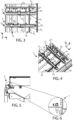
- the working center C is described for working pieces in wood, ceramic, plastic, glass, fiberglass and the like, according to the present invention.
- Said working center C essentially comprises:
- Said base 1 has an elongated shape, the main dimension of which extends mainly according to a development direction parallel to an axis X of a Cartesian reference system X, Y, Z associated with said working center C.
- Said working plane 2 is coupled to said base 1 and has an elongated shape, the main dimension of which extends mainly according to a development direction parallel to the X axis.
- Said working plane 2 comprises a plurality of supporting bars 21 a,b,...k,...n for supporting workpieces.
- Each supporting bar 21 k of said plurality of supporting bars 21 a,b,...k,...n is slidably coupled to said base 1 by means of a first guide 22 and a second guide 23, wherein said first guide 22 and said second guide 23 are integral with said base 1.
- Each supporting bar 21 k of said plurality of supporting bars 21 a,b,...k,...n can be moved manually by an operator with respect to the base 1 along the X axis, through said first guide 22 and said second guide 23 of said base 1.
- Each supporting bar 21 k of said plurality of supporting bars 21 a,b,...k,...n is arranged along an axis Y, orthogonal to said X axis.
- each supporting bar 21 k of said plurality of supporting bars 21 a,b,...k,...n is arranged in a direction parallel to a Y axis orthogonal to the X axis.
- a respective plurality of movable elements 24 a,b,...k,...n such as suction cups or clamps, for fixing one or more workpieces, is slidably mounted on each supporting bar 21 k so that said workpieces are stably positioned on said movable elements 24 a,b,...k,...n during the machining of said pieces by said working unit 3.
- Each of said movable elements of said plurality of movable elements 24 a,b,...k,...n can be moved manually by an operator on respective supporting bars of said plurality of supporting bars 21 a,b,...k,...n along the Y axis.
- said working plane 2 comprises at least a first reference element 41 associated with a reference position for at least one supporting bar 21 K , i.e. a first code 41, and/or a plurality of second reference elements 42 a,b,...k,...n , each of which is associated with a reference position of a respective movable element (for example suction cup or clamp), i.e. a plurality of second codes 42 a,b,...k,...n , as well as a plurality of sensors 43 a,b,...k,...n , such as optical sensors or encoders able to decode said codes.
- a first reference element 41 associated with a reference position for at least one supporting bar 21 K
- a first code 41 i.e. a first code 41
- second reference elements 42 a,b,...k,...n each of which is associated with a reference position of a respective movable element (for example suction cup or clamp)
- Said sensors 43 a,b,...k,...n can be provided with a reception and transmission module in wireless mode.
- said first reference element 41 is arranged on the base 1 and each second reference element 42 a,b,...k,...n is arranged on a respective supporting bar 21 a,b,...k,...n .
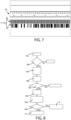
- Figure 7 shows a detail referring to a part of said first code 41.
- Said first code 41 comprises a first part or upper part A containing information on the cleaning status of said first code 41 and a second part or lower part B containing information on the position of the supporting bar with respect to the base 1.
- Said first part A and said second part comprise a respective indicator.
- each indicator comprises black marks and white marks alternating with each other, so as to form a bar code.
- said first code 41 can be of the QR-code type.
- a graduated scale of GS values is arranged in the proximity of said first code 41 to allow an operator to manually position a supporting bar with respect to the base 1.
- each second code 42k of said plurality of second codes 42 a,b,...k,...n comprises a first part or upper part A containing information on the status of the cleaning of the second code and a second part or lower part B containing information on the position of a movable element with respect to a supporting bar.
- Said first part A and said second part B comprise a respective indicator.
- Each indicator comprises black marks and white marks alternating with each other, so as to form a barcode.
- Each second code 42 a,b,...k,...n of said plurality of second codes 42 a,b,...k,...n can be of the QR-code type.
- a graduated scale of values is arranged in the proximity of each second code 42 a,b,...k,...n to allow an operator to manually position a movable element with respect to the supporting bar on which it is arranged.
- Said detecting system 4 is adapted to detect the position of the supporting bars 21 a,b,...k,...n along said base 1 and the position of each of the movable elements 24 a,b,...k,...n along the respective supporting bars 21 a,b,...k,...n .
- said detecting system 4 is adapted to detect the cleaning status of said first code 41 and/or of each second code 42 k of said plurality of second codes 42 a,b,...k,...n , providing a quality index I P .
- said first code 41 is of the binary type, has a longitudinal development along said axis X from a first end 41 a , called zero point or reference point, to a second end 41 b , and is arranged along all or part of said first guide 22 or said second guide 23.
- said first code 41 can be arranged on any portion of said base 1, according to a direction parallel to the axis X, between a first lateral end of the base 1 and a lateral end of the base 1 (opposite said first lateral end), or even on both said lateral ends.
- Said first code 41 contains coded information.
- the first code 41 contains information on the current position of said plurality of supporting bars 21 a,b,...k,...n with respect to the base 1
- the second codes 42 a,b,...k,...n contain information on the position current of the movable elements 24 a,b,...k,...n with respect to the supporting bar 21 a,b,...k,...n on which these movable elements 24 a,b,...k,...n are positioned.
- the first code 41 and said second codes 42 a,b,...k,...n can contain further redundancy information.
- the position of a supporting bar 21 a,b,...k,...n with respect to the base 1 is the distance expressed in millimeters between each supporting bar 21 k and the first end 41 a of said first code 41.
- This position is a main piece of information encoded in said first code 41.
- said first code 41 is binary and is formed by 2" bits or marks where the n tuple unambiguously defines the position of each supporting bar 21k with respect to said base 1.
- said first code 41 is mainly used to identify the exact position, expressed in millimetres, of each supporting bar 21 k along said base 1, with respect to the first end 41 a of said code 41, as will be described in detail below.
- Each second code 42 k of said plurality of second codes 42 a,b,...k,...n is arranged on a respective supporting bar 21 k and has the same structure as said first code 41 (i.e. the structure of said second code 42 a,b,...k,...n comprises a first part or upper part A and a second part or lower part A as mentioned above).
- each second code 42 k of said plurality of second codes 42 a,b,...k,...n has a first end 42', called zero point or reference point, and a second end 42".
- Each second code 42 k of said plurality of second codes 42 a,b,...k,...n is arranged along all or along part of a respective supporting bar.
- Each second code 42 k is used to mainly identify the exact position of each movable element 24 k with respect to the respective supporting bar 21 k on which said movable element 24 k is mounted, as will be described in detail below.
- Each sensor 43 k of said plurality of sensors 43 a,b,...k,...n is installed on respective supporting bars 21 k and on a respective movable element 24 k .
- each supporting bar 21 k of said plurality of supporting bars 21 a,b,...,k,...n is provided with at least one sensor 43 k adapted to rea said first code 41.
- Each mobile element 24 k of said plurality of movable elements 24 a,b,...k,...n , mounted on a respective supporting bar 21 k is provided with at least one sensor 43 k adapted to read the second code 42 k arranged on said supporting bar 21 k .
- Said plurality of sensors 43 a,b,...k,...n can also comprise further sensors, for example sensors to improve the code reading function or sensors for energy saving.
- the configurations of the working plane 2 necessary to carry out the machining on the workpieces are stored in said logic control unit U and said control logic unit actuates the components of the working center C on the basis of the different machining to be performed.
- Configurations of the working plane 2 means the exact position of said plurality of supporting bars 21 a,b,...k,...n with respect to said base 1 and the exact position of each movable element 24 k of said plurality of movable elements 24 a,b,...k,...n with respect to the respective supporting bar 21 a,b,...,k,...n .
- Said logic control unit U also comprises a wireless reception and transmission module.
- Each supporting bar 21 k and each movable element 24 k can comprise displaying means for displaying information relating to the information contained in the signals sent by the logic control unit U (i.e. information to indicate the direction in which to move a supporting bar and/or a movable element so that it is/are positioned correctly or to indicate the correct position), and/or feedback means for indicating to an operator the cleaning status of the codes, as well as preferably alarm means for generating an alarm signal when it is need to clear said codes.
- Said feedback means can be configured to generate acoustic signals or tactile signals (for example when said feedback means comprises a vibrating element).
- Said displaying means, said feedback means and preferably said alarm means are configured to receive the signals sent by said logic control unit U and provide an indication to an operator.
- said displaying means, said feedback means and preferably said alarm means can be arranged on a control panel of said working center C.
- the signals generated by said feedback means can be sent to mobile devices, such as tablets, smartphones, or wearable devices, via a wireless connection.
- Said first code 41 can be serigraph printed on said base 1 and each second code of said plurality of second codes 42 a,b,...k,...n can be s serigraph printed on the respective supporting bar 21 a,b,...,k,...n , or applied by means of an adhesive layer.
- said working center C further comprises at least one cleaning device 5 for cleaning the codes.
- said cleaning device 5 is a respective nozzle integrally arranged on each supporting bar of said plurality of supporting bars 21 a,b,...k,...n , facing the first code 41 and therefore capable to convey blows of air on the respective first code 41, when the respective supporting bar 21 k slides along the respective first guide 22 or second guide 23, or when the respective supporting bar 21 k does not slide along the respective first guide 22 or second guide 23.
- said cleaning device is a respective nozzle arranged integrally on each supporting bar of said plurality of supporting bars 21 a,b,...k,...n , facing the second code 42 k and therefore capable of conveying blows of air onto the respective second code 42 k arranged on the supporting bar itself.
- said cleaning device is a respective shuttle slidably coupled to each supporting bar of said plurality of supporting bars 21 a,b,...k,...n capable of conveying blows of air on the respective second code 42 k arranged on the supporting bar itself.
- said cleaning device is a respective shuttle slidably coupled to each supporting bar of said plurality of supporting bars 21 a,b,...k,...n comprising a brush capable of cleaning the respective second code 42 k arranged on the supporting bar itself.
- a respective cleaning device can be associated with said first code 41 and with each second code 42 k .
- each sensor 43 k positioned on each supporting bar 21 k detects an image of the first part A of said first code 41 at which it is located.
- the sensor 43 k detects a portion of the first upper A of the first code 41 placed on the base 1 at the supporting bar 21 K on which said sensor 43 K is located.
- the senor 43 k is positioned on the supporting bar at a certain distance from the first code 41 and is capable of detecting a portion of the first code 41 itself.
- Said logic control unit U performs a method for determining a quality index I P of the cleaning status of the first code 41.
- the same method is used to determine a quality index I P of the cleaning status of each second code 42 a,b,...k,...n .
- waste materials such as machining chips, dust, stains, or dirt
- the presence of waste materials (such as machining chips, dust, stains, or dirt) on the first code 41 causes a change in the cleaning status of the first code 41.
- a detected or ideal image corresponds to a matrix of pixels.
- the sensor 43 K detects each pixel of a black and white image.
- a certain number of bits per pixel for example 8, is associated with each pixel.
- the values can be normalized to a range of values between 0 and 1.
- the senor can also detect a color image and/or the number of bits per pixel can be less or greater than 8.
- An ideal image i.e. an image of a clean code or in optimal cleaning conditions (and therefore free of dirt) is associated with a square wave, which regularly alternates between a maximum value and a minimum value.
- the alternating of maximum values and minimum values is associated with the ideal visual appearance that the first part A of the first 41 code should have.
- the white marks of an image are associated with a maximum value, i.e. 255 (or 1 if normalized), and black marks are associated with a minimum value, i.e. 0.
- the corresponding square wave can have maximum and/or minimum values with a normalized value that varies between 1 and 0.
- the square wave corresponding to the detection of the real image of the alternating black and white marks of the first code 41 can present a different trend from that of an ideal square wave, for example the square wave can present an alternation of intermediate values between 0 and 1 (or 255).
- the sensor 43 K detects an image of a portion of the first part A of said first code 41 and said logic control unit U acquires said images and performs a cross-correlation between a square wave associated with an ideal image and a square wave associated with an image of the portion of the first part A of said first code 41.
- the cross-correlation generates a sinusoidal waveform or sinusoidal function having maximum and minimum values in module equal to 1, with period equal to the distance between a white (or black) mark and the following white (or black) mark of the first code 41, for example 2mm.
- the sinusoidal function taken into account for the method has values between a maximum value equal to 1 and a minimum value equal to 0.
- the extrema having a high value in terms of module (or amplitude) will have a value that tends to 1 or 0, while the extrema having a low value in terms of module (or amplitude) will have a value that tends to 0.5.
- a verification step 200 of the method subsequent to the analysis step 100, the number of detected extrema is verified in order to verify whether the first code 41 is readable.
- a first condition to be verified for an extremum to be considered detected is that there is at least one relative maximum or minimum point for the cross-correlation sinusoidal function.
- a second condition that the method can apply in the present step is that the value of a relative maximum of the cross-correlation function is higher than a respective threshold value or that the value of a relative minimum of the cross-correlation function is lower than a respective threshold value.
- the method can verify that the distance between the abscissas of successive extrema is actually equal to the distance that actually exists between the marks present in the first code 41.
- the method is able to detect that an extremum detected by the sensor 43 K in a certain position actually corresponds to a white mark alternating with a black mark (or vice versa) of the first code 41, wherein the distance between said white mark and said black mark is 1mm, so as to avoid detection errors due to accumulation of dirt or in general residues.
- said readability threshold value is between 20 and 30, which is an experimental value to ensure that the position detected along the first code 41, through the second part B of the first code 41, is sufficiently accurate.
- the readability threshold value corresponds to a minimum number of extrema that the sensor 43 K must be able to detect in order to minimize the risk of applying the method on an image of the first code 41 which has not been correctly detected (for example because the first code 41 is excessively dirty).
- said readability threshold value can also have a different value.
- the method comprises a respective comparison step 300 between the value of an extremum and a value corresponding to a predetermined value associated with a cleaning level for each transition from a white mark to a black mark of the first code 41 (or vice versa), wherein said white mark and said black mark are present in the first part A of the first code 41.
- this comparison step 300 allows to verify whether the amplitude of an extremum is lower than said predetermined value associated with the cleaning level.
- the method can include a verification step to verify that the difference between the value of one extremum and the value of the next extremum is greater than a threshold value.
- This threshold value can be, for example, a value (for example measured experimentally or predetermined) corresponding to a cleaning level of the first code 41 considered acceptable.
- the method comprises a step to replace the value of one or more extrema for which the result of the verification is negative with a predetermined value to be used in the subsequent steps of the method.
- This predetermined value is chosen in such a way that each of said one or more extrema has a sufficiently low value, and therefore is associated with a dirty or poorly readable code.
- the method comprises a calculation step 400 for calculating said quality index I P , i.e. the index of the cleaning status and therefore the degree of dirt.
- this calculation includes the operation of linearly combining the maximum and minimum values, i.e. the extrema, of the cross-correlation to estimate the image quality.
- the coefficients of the linear combination have a value equal to 1, so as to consider the effective contribution of each extremum.
- coefficients other than 1 for example to compensate for any distortions or aberrations (optical or otherwise) present in the detected images, due to the sensor 43 K or other detection devices or data transmission devices.
- the result of the linear combination is a number representing said cleaning index I P associated with the first code 41.
- the calculation step 400 can optionally comprises the step of normalizing the result of the linear combination in a range from 0 to 10, so that if the cleaning index I P tends to the value 0, the image quality is considered poor and therefore the first code 41 will be considered dirty, while if the cleaning index I P tends to the value 10 the image quality is considered acceptable and therefore the first code 41 will be considered clean.
- the method comprises a verification step 401 to verify that the obtained cleaning index I P is greater than a predetermined value, so that the sensor 43 K detects the second part B of the first code 41 containing a information on the position of the supporting bar 21 K with respect to the first code 41.
- the method comprises a detection step 402, in which an image of a further portion of the second part B of the first code 41 is detected by the sensor 43 K and a waveform corresponding to said detected image (which is a real image) is associated with a succession of white marks and black marks of the first code 41 detected by said sensor 43 K .
- the method comprises a conversion step 403 for converting the maximum values and minimum values of said waveform into a binary sequence associated with a position of the supporting bar 21 K (on which said sensor 43 K is mounted).
- the method preferably comprises a verification step 404 for verifying whether said binary sequence is present among the binary sequences stored in the control logic unit U, each of which is associated with a respective position of the supporting bar 21 K .
- the method If an error is detected, the method generates an output A to indicate that the first code 41 is not readable.
- the method If no error is detected, the method generates an output B to indicate that the first code 41 is readable and therefore the position of the supporting bar 21 K with respect to the base 1 is correctly identified.
- said first code 41 and each second code 42 k are maximum length codes called MLS ( Maximum Length Sequence ) codes.
- the first part A of each code comprises white marks alternating with black marks in a regular manner and the second part B of each code comprises white marks alternating with black marks irregularly.
- the second part B can include more black marks side by side and more white marks side by side.
- the senor 43 K is configured to distinguish individual marks of the same colour even if those same-coloured marks are side by side.
- Each mark (regardless of colour) has a predetermined width, for example 1mm.
- a respective value detected by the sensor 43 K and tending to 1 is associated with each white mark of the part B of the code, and a respective value detected by the sensor 43 K and tending to 0 is associated with each black mark of the part B of the code.
- a succession of white marks and black marks present in the part B of the code is associated with a sequence of bits contained in the MLS code.
- the sensor 43 K will detect a real image corresponding to a waveform whose maximum and minimum values will not regularly alternate between them, but will be arranged in an irregular succession.
- the succession of marks of the second part B of the code is such that the detected image corresponds uniquely to a single position along the code.
- Each bit corresponds to a black or white mark of the code.
- each supporting bar 21 k and of each movable element 24 k In order for the respective position of each supporting bar 21 k and of each movable element 24 k to be unambiguously detected by the detecting system 4, the string of bits included in the respective code must be unambiguously associated with a linear position.
- the coding is such that, having read the code in any point of the 32768mm associated with the sequence of 32768 bits, the string of 15 bits is unique in the sequence of 32768 bits and therefore also in the entire length of the 32768mm of the code.
- the string of 15 bits is used as an access index of a decoding table to one of the 32768 values is associated with a respective real position of a supporting bar or a movable element identified by the respective code.
- the string of 15 bit is converted to base 10 to be used as an access index to the decoding table.
- the string of 15 bits of the MLS code associated with a code (which can be the first code 41 or a second code 42 K ) is decoded to obtain the only position in 32768mm corresponding to said string of 15 bits.
- a verification step 404 After converting the read position into a value expressed in mm, it is preferable to carry out a verification step 404 to verify the correctness of the read code.
- the decoding result is a position of a supporting bar or of a movable element different from the its real position.
- the output A of the method indicates that the code is not readable.
- the output B of the method indicates that the code is readable and therefore the position of the supporting bar or the movable element is correctly identified.
- Said logic control unit U can be configured to acquire said cleaning index I P and send corresponding signals to said displaying means and/or to said feedback means so that an operator knows the cleaning status of the supporting bars 21 a,b,...,k,...n and of the movable elements 24 a,b,...k,...n and can activate said cleaning device 5, if the cleaning index I P is lower than a predetermined value, for example 5.
- Said logic control unit U and said plurality of supporting bars 21 a,b,...,k,...n communicate with each other via the wireless protocol, in particular Bluetooth, Bluetooth low energy, or wi-fi, or through a cable connection.
- the wireless protocol in particular Bluetooth, Bluetooth low energy, or wi-fi, or through a cable connection.
- said logic control unit U and said plurality of movable elements 24 a,b,...k,...n communicate with each other by means of the wireless protocol, in particular Bluetooth, Bluetooth low energy, or wi-fi, or through a cable connection.
- the wireless protocol in particular Bluetooth, Bluetooth low energy, or wi-fi, or through a cable connection.
- said plurality of supporting bars 21 a,b,...,k,...n and plurality of movable elements 24 a,b,...k,...n communicate with each other by means of the wireless protocol, in particular Bluetooth, Bluetooth low energy, or wi-fi, or through a cable connection.
- Said detecting system 4 can be used on a plurality of working centers where it is necessary to use several working centers to carry out a specific machining.
- said logic control unit U can be configured to send the output of the method described above to said displaying means and/or to said feedback means so that an operator understands whether the code is readable or not.
- the working center object of the present invention, allows an operator to manually move one or more supporting bars 21 a,b,...,k,...n with respect to the base 1 until each supporting bar is correctly positioned with respect to the base 1 and/or one or more movable elements 24 a,b,...k,...n (arranged on said one or more supporting bars 21 a,b,...,k,...n ) with respect to a respective supporting bar until said one or more movable elements 24 a,b,...k,...n is correctly positioned with respect to said respective supporting bar, through the aid of a detecting system 4 that is simple, effective and of limited cost.
Landscapes
- Engineering & Computer Science (AREA)
- Human Computer Interaction (AREA)
- Manufacturing & Machinery (AREA)
- Physics & Mathematics (AREA)
- General Physics & Mathematics (AREA)
- Automation & Control Theory (AREA)
- Machine Tool Sensing Apparatuses (AREA)
Applications Claiming Priority (1)
| Application Number | Priority Date | Filing Date | Title |
|---|---|---|---|
| IT102022000017757A IT202200017757A1 (it) | 2022-08-30 | 2022-08-30 | Centro di lavoro per la lavorazione di pezzi in legno, provvisto di un sistema di rilevamento dello stato di pulizia di componenti del centro di lavoro e metodo di funzionamento relativo. |
Publications (1)
| Publication Number | Publication Date |
|---|---|
| EP4332700A1 true EP4332700A1 (de) | 2024-03-06 |
Family
ID=84463183
Family Applications (1)
| Application Number | Title | Priority Date | Filing Date |
|---|---|---|---|
| EP23194400.0A Pending EP4332700A1 (de) | 2022-08-30 | 2023-08-30 | Bearbeitungszentrum für werkstücke, ausgestattet mit einem system zur erfassung des reinigungsstatus von komponenten des bearbeitungszentrums und betriebsverfahren dafür |
Country Status (2)
| Country | Link |
|---|---|
| EP (1) | EP4332700A1 (de) |
| IT (1) | IT202200017757A1 (de) |
Citations (7)
| Publication number | Priority date | Publication date | Assignee | Title |
|---|---|---|---|---|
| JPH0645211B2 (ja) * | 1988-06-01 | 1994-06-15 | ボブス・ソシエテ・アノニム | 要素を支持体に基準レイアウトに従い位置決めするテーブル形ジグ |
| JPH11201777A (ja) * | 1998-01-08 | 1999-07-30 | Nemikon Kk | リニアエンコーダ |
| EP2587325A2 (de) * | 2011-10-28 | 2013-05-01 | SCM Group S.p.A. | Verfahren und Vorrichtung zur Holzbearbeitung |
| JP2013113634A (ja) * | 2011-11-25 | 2013-06-10 | Okuma Corp | リニアエンコーダ |
| US20210142458A1 (en) * | 2019-11-13 | 2021-05-13 | Fanuc Corporation | Device, cleaning system, and method of determining whether or not to clean work area of machine tool |
| CN112845475A (zh) * | 2021-01-26 | 2021-05-28 | 深圳市大复科技有限公司 | 一种玻璃板双面清洗设备 |
| CN114433514A (zh) * | 2020-11-02 | 2022-05-06 | 长鑫存储技术有限公司 | 机台清洁装置 |
Family Cites Families (6)
| Publication number | Priority date | Publication date | Assignee | Title |
|---|---|---|---|---|
| DE102006020203B3 (de) * | 2006-05-02 | 2008-01-10 | Venjakob Maschinenbau Gmbh & Co. Kg | Vorrichtung und Verfahren zur Stabilisierung von Werkstücken während eines Reinigungsvorgangs |
| CN103158127A (zh) * | 2011-12-14 | 2013-06-19 | 苏州工业园区高登威科技有限公司 | 机台 |
| CN108579416B (zh) * | 2018-05-18 | 2020-02-18 | 重庆市机电设计研究院 | 用于废气处理催化剂净化工控机工作方法 |
| CN111530852B (zh) * | 2020-04-01 | 2021-12-10 | 厦门理工学院 | 一种激光清洗装置及其激光清洗方法 |
| CN214732231U (zh) * | 2021-03-19 | 2021-11-16 | 深圳市奥迈视自动化科技有限公司 | 一种条码在线追溯剔重设备 |
| CN114119535A (zh) * | 2021-11-24 | 2022-03-01 | 上海航翼高新技术发展研究院有限公司 | 基于视觉检测的激光清洗效果在线监测方法 |
-
2022
- 2022-08-30 IT IT102022000017757A patent/IT202200017757A1/it unknown
-
2023
- 2023-08-30 EP EP23194400.0A patent/EP4332700A1/de active Pending
Patent Citations (7)
| Publication number | Priority date | Publication date | Assignee | Title |
|---|---|---|---|---|
| JPH0645211B2 (ja) * | 1988-06-01 | 1994-06-15 | ボブス・ソシエテ・アノニム | 要素を支持体に基準レイアウトに従い位置決めするテーブル形ジグ |
| JPH11201777A (ja) * | 1998-01-08 | 1999-07-30 | Nemikon Kk | リニアエンコーダ |
| EP2587325A2 (de) * | 2011-10-28 | 2013-05-01 | SCM Group S.p.A. | Verfahren und Vorrichtung zur Holzbearbeitung |
| JP2013113634A (ja) * | 2011-11-25 | 2013-06-10 | Okuma Corp | リニアエンコーダ |
| US20210142458A1 (en) * | 2019-11-13 | 2021-05-13 | Fanuc Corporation | Device, cleaning system, and method of determining whether or not to clean work area of machine tool |
| CN114433514A (zh) * | 2020-11-02 | 2022-05-06 | 长鑫存储技术有限公司 | 机台清洁装置 |
| CN112845475A (zh) * | 2021-01-26 | 2021-05-28 | 深圳市大复科技有限公司 | 一种玻璃板双面清洗设备 |
Also Published As
| Publication number | Publication date |
|---|---|
| IT202200017757A1 (it) | 2024-03-01 |
Similar Documents
| Publication | Publication Date | Title |
|---|---|---|
| TWI548960B (zh) | 線性位置測量系統 | |
| JPS644129B2 (de) | ||
| EP2438402B1 (de) | Positionsmesseinrichtung und zugehöriges betriebsverfahren | |
| EP3696631B1 (de) | Bearbeitungszentrum mit einem messsystem zur bearbeitung von holzstücken | |
| US7461464B2 (en) | Position measuring arrangement | |
| JP5079644B2 (ja) | 位置測定装置 | |
| CN100346137C (zh) | 测定绝对位置的方法及位置测量装置 | |
| CN1292082A (zh) | 用于工件的线性尺寸检查的测头、系统和方法 | |
| EP0290140B1 (de) | Vorrichtung zur Messung von Höhendifferenzen | |
| CN1067311A (zh) | 光学和容性结合的绝对位置测定仪和方法 | |
| CN101101223A (zh) | 位移检测编码器 | |
| JP2000099621A (ja) | バ―コ―ドリ―ダ―駆動方法 | |
| EP2937671A1 (de) | Absolutcodierer | |
| EP0039921B1 (de) | Codiergerät und Verfahren zu seiner Verwendung | |
| CN101750108A (zh) | 绝对位置编码器 | |
| CN103134532A (zh) | 一种基于绝对位置判定的圆周码道编解码方法 | |
| US20230296375A1 (en) | Measuring panel for vehicle measurement | |
| CN101718516A (zh) | 一种用于检测移动物体速度与位置的装置 | |
| CN206944927U (zh) | 一种基于固定轨道运行的移动设备的位置检测装置 | |
| US20190347460A1 (en) | Optical information reading apparatus and optical information reading method | |
| KR100575124B1 (ko) | 긴 구간용으로 사용가능한 위치 검출용 선형 엔코더 | |
| CN111439552B (zh) | 一种输送线载码识别装置及方法 | |
| CN104515534B (zh) | 绝对位置测量方法 | |
| EP4487991A2 (de) | Fernpositionierungssystem für holzbearbeitungsmaschinen | |
| CN102954777A (zh) | 用于测量结构的系统和方法 |
Legal Events
| Date | Code | Title | Description |
|---|---|---|---|
| PUAI | Public reference made under article 153(3) epc to a published international application that has entered the european phase |
Free format text: ORIGINAL CODE: 0009012 |
|
| STAA | Information on the status of an ep patent application or granted ep patent |
Free format text: STATUS: THE APPLICATION HAS BEEN PUBLISHED |
|
| AK | Designated contracting states |
Kind code of ref document: A1 Designated state(s): AL AT BE BG CH CY CZ DE DK EE ES FI FR GB GR HR HU IE IS IT LI LT LU LV MC ME MK MT NL NO PL PT RO RS SE SI SK SM TR |
|
| STAA | Information on the status of an ep patent application or granted ep patent |
Free format text: STATUS: REQUEST FOR EXAMINATION WAS MADE |
|
| 17P | Request for examination filed |
Effective date: 20240903 |
|
| RBV | Designated contracting states (corrected) |
Designated state(s): AL AT BE BG CH CY CZ DE DK EE ES FI FR GB GR HR HU IE IS IT LI LT LU LV MC ME MK MT NL NO PL PT RO RS SE SI SK SM TR |