EP4333075A1 - Halbleiteranordnung - Google Patents
Halbleiteranordnung Download PDFInfo
- Publication number
- EP4333075A1 EP4333075A1 EP22795744.6A EP22795744A EP4333075A1 EP 4333075 A1 EP4333075 A1 EP 4333075A1 EP 22795744 A EP22795744 A EP 22795744A EP 4333075 A1 EP4333075 A1 EP 4333075A1
- Authority
- EP
- European Patent Office
- Prior art keywords
- layer
- crystalline oxide
- semiconductor device
- semiconductor layer
- semiconductor
- Prior art date
- Legal status (The legal status is an assumption and is not a legal conclusion. Google has not performed a legal analysis and makes no representation as to the accuracy of the status listed.)
- Pending
Links
Images




Classifications
-
- H—ELECTRICITY
- H10—SEMICONDUCTOR DEVICES; ELECTRIC SOLID-STATE DEVICES NOT OTHERWISE PROVIDED FOR
- H10D—INORGANIC ELECTRIC SEMICONDUCTOR DEVICES
- H10D12/00—Bipolar devices controlled by the field effect, e.g. insulated-gate bipolar transistors [IGBT]
-
- H—ELECTRICITY
- H10—SEMICONDUCTOR DEVICES; ELECTRIC SOLID-STATE DEVICES NOT OTHERWISE PROVIDED FOR
- H10D—INORGANIC ELECTRIC SEMICONDUCTOR DEVICES
- H10D30/00—Field-effect transistors [FET]
- H10D30/60—Insulated-gate field-effect transistors [IGFET]
-
- H—ELECTRICITY
- H10—SEMICONDUCTOR DEVICES; ELECTRIC SOLID-STATE DEVICES NOT OTHERWISE PROVIDED FOR
- H10D—INORGANIC ELECTRIC SEMICONDUCTOR DEVICES
- H10D30/00—Field-effect transistors [FET]
- H10D30/60—Insulated-gate field-effect transistors [IGFET]
- H10D30/63—Vertical IGFETs
- H10D30/635—Vertical IGFETs having no inversion channels, e.g. vertical accumulation channel FETs [ACCUFET] or normally-on vertical IGFETs
-
- H—ELECTRICITY
- H10—SEMICONDUCTOR DEVICES; ELECTRIC SOLID-STATE DEVICES NOT OTHERWISE PROVIDED FOR
- H10D—INORGANIC ELECTRIC SEMICONDUCTOR DEVICES
- H10D30/00—Field-effect transistors [FET]
- H10D30/60—Insulated-gate field-effect transistors [IGFET]
- H10D30/64—Double-diffused metal-oxide semiconductor [DMOS] FETs
- H10D30/66—Vertical DMOS [VDMOS] FETs
-
- H—ELECTRICITY
- H10—SEMICONDUCTOR DEVICES; ELECTRIC SOLID-STATE DEVICES NOT OTHERWISE PROVIDED FOR
- H10D—INORGANIC ELECTRIC SEMICONDUCTOR DEVICES
- H10D30/00—Field-effect transistors [FET]
- H10D30/60—Insulated-gate field-effect transistors [IGFET]
- H10D30/64—Double-diffused metal-oxide semiconductor [DMOS] FETs
- H10D30/66—Vertical DMOS [VDMOS] FETs
- H10D30/668—Vertical DMOS [VDMOS] FETs having trench gate electrodes, e.g. UMOS transistors
-
- H—ELECTRICITY
- H10—SEMICONDUCTOR DEVICES; ELECTRIC SOLID-STATE DEVICES NOT OTHERWISE PROVIDED FOR
- H10D—INORGANIC ELECTRIC SEMICONDUCTOR DEVICES
- H10D62/00—Semiconductor bodies, or regions thereof, of devices having potential barriers
- H10D62/10—Shapes, relative sizes or dispositions of the regions of the semiconductor bodies; Shapes of the semiconductor bodies
- H10D62/17—Semiconductor regions connected to electrodes not carrying current to be rectified, amplified or switched, e.g. channel regions
- H10D62/213—Channel regions of field-effect devices
- H10D62/221—Channel regions of field-effect devices of FETs
- H10D62/235—Channel regions of field-effect devices of FETs of IGFETs
-
- H—ELECTRICITY
- H10—SEMICONDUCTOR DEVICES; ELECTRIC SOLID-STATE DEVICES NOT OTHERWISE PROVIDED FOR
- H10D—INORGANIC ELECTRIC SEMICONDUCTOR DEVICES
- H10D62/00—Semiconductor bodies, or regions thereof, of devices having potential barriers
- H10D62/10—Shapes, relative sizes or dispositions of the regions of the semiconductor bodies; Shapes of the semiconductor bodies
- H10D62/17—Semiconductor regions connected to electrodes not carrying current to be rectified, amplified or switched, e.g. channel regions
- H10D62/393—Body regions of DMOS transistors or IGBTs
-
- H—ELECTRICITY
- H10—SEMICONDUCTOR DEVICES; ELECTRIC SOLID-STATE DEVICES NOT OTHERWISE PROVIDED FOR
- H10D—INORGANIC ELECTRIC SEMICONDUCTOR DEVICES
- H10D62/00—Semiconductor bodies, or regions thereof, of devices having potential barriers
- H10D62/40—Crystalline structures
-
- H—ELECTRICITY
- H10—SEMICONDUCTOR DEVICES; ELECTRIC SOLID-STATE DEVICES NOT OTHERWISE PROVIDED FOR
- H10D—INORGANIC ELECTRIC SEMICONDUCTOR DEVICES
- H10D62/00—Semiconductor bodies, or regions thereof, of devices having potential barriers
- H10D62/40—Crystalline structures
- H10D62/405—Orientations of crystalline planes
-
- H—ELECTRICITY
- H10—SEMICONDUCTOR DEVICES; ELECTRIC SOLID-STATE DEVICES NOT OTHERWISE PROVIDED FOR
- H10D—INORGANIC ELECTRIC SEMICONDUCTOR DEVICES
- H10D62/00—Semiconductor bodies, or regions thereof, of devices having potential barriers
- H10D62/80—Semiconductor bodies, or regions thereof, of devices having potential barriers characterised by the materials
-
- H—ELECTRICITY
- H10—SEMICONDUCTOR DEVICES; ELECTRIC SOLID-STATE DEVICES NOT OTHERWISE PROVIDED FOR
- H10D—INORGANIC ELECTRIC SEMICONDUCTOR DEVICES
- H10D62/00—Semiconductor bodies, or regions thereof, of devices having potential barriers
- H10D62/80—Semiconductor bodies, or regions thereof, of devices having potential barriers characterised by the materials
- H10D62/82—Heterojunctions
- H10D62/8271—Heterojunctions comprising only oxide semiconductor materials heterojunctions, e.g. IGZO/IZO
-
- H—ELECTRICITY
- H10—SEMICONDUCTOR DEVICES; ELECTRIC SOLID-STATE DEVICES NOT OTHERWISE PROVIDED FOR
- H10P—GENERIC PROCESSES OR APPARATUS FOR THE MANUFACTURE OR TREATMENT OF DEVICES COVERED BY CLASS H10
- H10P14/00—Formation of materials, e.g. in the shape of layers or pillars
- H10P14/20—Formation of materials, e.g. in the shape of layers or pillars of semiconductor materials
- H10P14/24—Formation of materials, e.g. in the shape of layers or pillars of semiconductor materials using chemical vapour deposition [CVD]
-
- H—ELECTRICITY
- H10—SEMICONDUCTOR DEVICES; ELECTRIC SOLID-STATE DEVICES NOT OTHERWISE PROVIDED FOR
- H10P—GENERIC PROCESSES OR APPARATUS FOR THE MANUFACTURE OR TREATMENT OF DEVICES COVERED BY CLASS H10
- H10P14/00—Formation of materials, e.g. in the shape of layers or pillars
- H10P14/20—Formation of materials, e.g. in the shape of layers or pillars of semiconductor materials
- H10P14/26—Formation of materials, e.g. in the shape of layers or pillars of semiconductor materials using liquid deposition
- H10P14/265—Formation of materials, e.g. in the shape of layers or pillars of semiconductor materials using liquid deposition using solutions
-
- H—ELECTRICITY
- H10—SEMICONDUCTOR DEVICES; ELECTRIC SOLID-STATE DEVICES NOT OTHERWISE PROVIDED FOR
- H10P—GENERIC PROCESSES OR APPARATUS FOR THE MANUFACTURE OR TREATMENT OF DEVICES COVERED BY CLASS H10
- H10P14/00—Formation of materials, e.g. in the shape of layers or pillars
- H10P14/20—Formation of materials, e.g. in the shape of layers or pillars of semiconductor materials
- H10P14/34—Deposited materials, e.g. layers
- H10P14/3402—Deposited materials, e.g. layers characterised by the chemical composition
- H10P14/3434—Deposited materials, e.g. layers characterised by the chemical composition being oxide semiconductor materials
-
- H—ELECTRICITY
- H10—SEMICONDUCTOR DEVICES; ELECTRIC SOLID-STATE DEVICES NOT OTHERWISE PROVIDED FOR
- H10P—GENERIC PROCESSES OR APPARATUS FOR THE MANUFACTURE OR TREATMENT OF DEVICES COVERED BY CLASS H10
- H10P14/00—Formation of materials, e.g. in the shape of layers or pillars
- H10P14/20—Formation of materials, e.g. in the shape of layers or pillars of semiconductor materials
- H10P14/34—Deposited materials, e.g. layers
- H10P14/3438—Doping during depositing
- H10P14/3441—Conductivity type
- H10P14/3442—N-type
-
- H—ELECTRICITY
- H10—SEMICONDUCTOR DEVICES; ELECTRIC SOLID-STATE DEVICES NOT OTHERWISE PROVIDED FOR
- H10P—GENERIC PROCESSES OR APPARATUS FOR THE MANUFACTURE OR TREATMENT OF DEVICES COVERED BY CLASS H10
- H10P14/00—Formation of materials, e.g. in the shape of layers or pillars
- H10P14/20—Formation of materials, e.g. in the shape of layers or pillars of semiconductor materials
- H10P14/34—Deposited materials, e.g. layers
- H10P14/3438—Doping during depositing
- H10P14/3441—Conductivity type
- H10P14/3444—P-type
-
- H—ELECTRICITY
- H10—SEMICONDUCTOR DEVICES; ELECTRIC SOLID-STATE DEVICES NOT OTHERWISE PROVIDED FOR
- H10D—INORGANIC ELECTRIC SEMICONDUCTOR DEVICES
- H10D62/00—Semiconductor bodies, or regions thereof, of devices having potential barriers
- H10D62/80—Semiconductor bodies, or regions thereof, of devices having potential barriers characterised by the materials
- H10D62/82—Heterojunctions
-
- H—ELECTRICITY
- H10—SEMICONDUCTOR DEVICES; ELECTRIC SOLID-STATE DEVICES NOT OTHERWISE PROVIDED FOR
- H10P—GENERIC PROCESSES OR APPARATUS FOR THE MANUFACTURE OR TREATMENT OF DEVICES COVERED BY CLASS H10
- H10P14/00—Formation of materials, e.g. in the shape of layers or pillars
- H10P14/20—Formation of materials, e.g. in the shape of layers or pillars of semiconductor materials
- H10P14/29—Formation of materials, e.g. in the shape of layers or pillars of semiconductor materials characterised by the substrates
- H10P14/2901—Materials
- H10P14/2918—Materials being semiconductor metal oxides
-
- H—ELECTRICITY
- H10—SEMICONDUCTOR DEVICES; ELECTRIC SOLID-STATE DEVICES NOT OTHERWISE PROVIDED FOR
- H10P—GENERIC PROCESSES OR APPARATUS FOR THE MANUFACTURE OR TREATMENT OF DEVICES COVERED BY CLASS H10
- H10P14/00—Formation of materials, e.g. in the shape of layers or pillars
- H10P14/20—Formation of materials, e.g. in the shape of layers or pillars of semiconductor materials
- H10P14/29—Formation of materials, e.g. in the shape of layers or pillars of semiconductor materials characterised by the substrates
- H10P14/2901—Materials
- H10P14/2921—Materials being crystalline insulating materials
Definitions
- the disclosure relates to a semiconductor device useful for power devices, and others.
- Gallium oxide (Ga 2 O 3 ) is a transparent semiconductor having a wide bandgap from 4.8 to 5.3 eV at room temperature and absorbs very little visible light and ultraviolet light. For this reason, gallium oxide is a promising material for use particularly in opto-electronic devices to operate in a deep ultraviolet light region or in transparent electronics. In recent years, developments are under way on photodetectors, light-emitting diodes (LEDs), and transistors based on gallium oxide (Ga 2 O 3 ) (see Non-Patent Literature 1).
- this gallium oxide becomes controllable in bandgap by using indium or aluminum alone, or a mixed crystal of a combination of indium and aluminum, and forms an extremely attractive family of materials as InAlGaO-based semiconductors.
- Gallium oxide (Ga 2 O 3 ) has five crystal structures of ⁇ , ⁇ , ⁇ , ⁇ , and ⁇ , and generally has ⁇ -Ga 2 O 3 as the most stable structure. Meanwhile, ⁇ -Ga 2 O 3 is a ⁇ -Gallia structure, and hence, unlike a crystal system generally used in electronic materials, etc., application to semiconductor devices is not always preferred. Furthermore, as growth of a ⁇ -Ga 2 O 3 thin film requires a high substrate temperature and a high degree of vacuum, a problem of increased manufacturing cost is also caused.
- Non-Patent Literature 2 in the case of ⁇ -Ga 2 O 3 , even a dopant (Si) of a high concentration (equal to or greater than 1 ⁇ 10 19 /cm 3 , for example) is still prohibited from being used as a donor unless an annealing process is performed at a high temperature from 800 to 1100°C after ion implantation.
- ⁇ -Ga 2 O 3 has the same crystal structure as a sapphire substrate already used for general purpose, it is used preferably in opto-electronic devices. Moreover, as ⁇ -Ga 2 O 3 has a wider bandgap than ⁇ -Ga 2 O 3 , it is useful, particularly for power devices. Thus, a semiconductor device using ⁇ -Ga 2 O 3 as semiconductor is being desired.
- Patent Literature 1 discloses a vertical MOSFET comprising a Ga 2 O 3 -based crystal layer containing a donor and an N-doped region formed in at least a part of the Ga 2 O 3 -based crystal layer, wherein the N-doped region is a current blocking region having an opening region including a channel region or forming a current path.
- this device has not been confirmed to actually operate as a vertical MOSFET and has not achieved results in terms of reliability such as withstand voltage.
- Patent Literature 1 Japanese Patent Application Laid-Open No. 2018-186246
- the disclosure is intended to provide a semiconductor device with an excellent withstand voltage.
- a semiconductor device including at least: a crystalline oxide semiconductor layer including a channel layer and a drift layer; and a gate electrode arranged over the channel layer across a gate insulating film, and having a current blocking layer between the channel layer and the drift layer, the drift layer containing a first crystalline oxide as a major component, the current blocking layer containing a second crystalline oxide as a major component, the first crystalline oxide and the second crystalline oxide having different compositions, withstand voltage performance is improved compared to a configuration without such a crystal defect region. Then, the present inventors have acquired knowledge that the semiconductor device obtained in this way is capable of solving the above-described conventional problem.
- the disclosure relates to the followings.
- a semiconductor device includes at least: a crystalline oxide semiconductor layer including a channel layer and a drift layer; and a gate electrode arranged over the channel layer across a gate insulating film, and has a current blocking layer between the channel layer and the drift layer.
- the semiconductor device is characterized in that the drift layer contains a first crystalline oxide as a major component, the current blocking layer contains a second crystalline oxide as a major component, and the first crystalline oxide and the second crystalline oxide have different compositions.
- the crystalline oxide semiconductor layer is not particularly limited unless it interferes with the present disclosure.
- the crystalline oxide semiconductor layer preferably contains a crystalline oxide semiconductor as a major component.
- the crystalline oxide semiconductor is a metal oxide containing one or two or more types of metals selected from aluminum, gallium, indium, iron, chromium, vanadium, titanium, rhodium, nickel, cobalt, and iridium.
- the crystalline oxide semiconductor layer preferably contains at least one type of metal selected from aluminum, indium, and gallium, more preferably, contains at least gallium, most preferably, contains ⁇ -Ga 2 O 3 or a mixed crystal of ⁇ -Ga 2 O 3 .
- the crystal structure of the crystalline oxide semiconductor layer is also free from particular limitation unless it interferes with the present disclosure.
- Examples of the crystal structure of the crystalline oxide semiconductor layer include a corundum structure, a ⁇ -Gallia structure, a hexagonal crystal structure (for example, ⁇ -type structure), an orthorhombic crystal structure (for example, x-type structure), a cubic crystal structure, and a tetragonal crystal structure.
- the crystalline oxide semiconductor layer preferably has a corundum structure, a ⁇ -Gallia structure, or a hexagonal crystal structure (for example, ⁇ -type structure), more preferably, has a corundum structure.
- major component means that the crystalline oxide semiconductor has a content in terms of an atomic ratio that is equal to or greater than 50% preferably to all components in the crystalline oxide semiconductor layer, means that the content is more preferably equal to or greater than 70%, still more preferably, equal to or greater than 90%, and means that the content may be 100%.
- the gallium oxide is simply required to be contained as a crystalline oxide semiconductor in the crystalline oxide semiconductor layer in such a manner that gallium has an atomic ratio that is equal to or greater than 0.5 in all metal elements in the crystalline oxide semiconductor layer.
- the atomic ratio of gallium in all the metal elements in the crystalline oxide semiconductor layer is preferably equal to or greater than 0.7, more preferably, equal to or greater than 0.9.
- the thickness of the crystalline oxide semiconductor layer is not particularly limited but may be equal to or less than 1 ⁇ m or may be equal to or greater than 1 ⁇ m. According to an embodiment of the disclosure, this thickness is preferably equal to or greater than 5 ⁇ m, more preferably, equal to or greater than 10 ⁇ m.
- the surface area of the semiconductor layer is not particularly limited, it may be equal to or greater than 1 mm 2 or equal to or less than 1 mm 2 . Meanwhile, this surface area is preferably from 10 to 300 mm 2 , more preferably, from 10 to 100 mm 2 .
- the crystalline oxide semiconductor layer is generally a single crystal, it may be a poly crystal.
- the crystalline oxide semiconductor layer generally includes two or more semiconductor layers.
- the crystalline oxide semiconductor layer includes at least an n + -type semiconductor layer, a drift layer (n - -type semiconductor layer), a channel layer, and a source region (n + -type semiconductor layer), for example.
- carrier density in the crystalline oxide semiconductor layer is properly settable by adjusting a doping quantity.
- the crystalline oxide semiconductor layer preferably contains a dopant.
- the dopant is not particularly limited but may be a publicly-known dopant.
- preferred examples of the dopant include n-type dopants such as tin, germanium, silicon, titanium, zirconium, vanadium, and niobium, and p-type dopants such as Mg, H, Li, Na, K, Rb, Cs, Fr, Be, Ca, Sr, Ba, Ra, Mn, Fe, Co, Ni, Pd, Cu, Ag, Au, Zn, Cd, Hg, Ti, Pb, N, and P.
- n-type dopants such as tin, germanium, silicon, titanium, zirconium, vanadium, and niobium
- p-type dopants such as Mg, H, Li, Na, K, Rb, Cs, Fr, Be, Ca, Sr, Ba, Ra, Mn, Fe, Co, Ni, Pd, Cu, Ag,
- the n-type dopant is preferably at least one type selected from Sn, Ge, and Si.
- the content of the dopant is preferably equal to or greater than 0.00001 atomic% in the composition of the semiconductor layer, more preferably, from 0.00001 to 20 atomic%, most preferably, from 0.00001 to 10 atomic%.
- the concentration of the dopant may generally be from 1 ⁇ 10 16 to 1 ⁇ 10 22 /cm 3 approximately.
- the concentration of the dopant may be set to a low concentration that is equal to or less than 1 ⁇ 10 17 /cm 3 approximately, for example.
- the dopant may be contained at a high concentration that is equal to or greater than about 1 ⁇ 10 20 /cm 3 .
- the crystalline oxide semiconductor layer includes a channel layer, and a gate electrode is arranged over the channel layer across the gate insulating film.
- a constituent material for the channel layer may be similar to the constituent material for the crystalline oxide semiconductor layer described above.
- the conductivity type of the channel layer is also free from particular limitation and may be an n-type or a p-type. If the conductivity type of the channel layer is an n-type, a constituent material for the channel layer is preferably ⁇ -Ga 2 O 3 or a mixed crystal of ⁇ -Ga 2 O 3 , for example.
- examples of the constituent material for the channel layer preferably include ⁇ -Ga 2 O 3 or a mixed crystal of ⁇ -Ga 2 O 3 containing a p-type dopant, a metal oxide containing at least one type of metal selected from Group 6 of the periodic table (for example, ⁇ -Cr 2 O 3 ), and a metal oxide containing at least one type of metal selected from Group 9 of the periodic table (for example, ⁇ -Ir 2 O 3 , ⁇ -Cr 2 O 3 , ⁇ -Rh 2 O 3 ).
- the metal oxide containing at least one type of metal selected from Group 6 of the periodic table or the metal oxide containing at least one type of metal selected from Group 9 of the periodic table may be a mixed crystal with another metal oxide (for example, Ga 2 O 3 ).
- a constituent material for the gate insulating film is not particularly limited but may be a publicly-known material.
- the material for the gate insulating film include an SiO 2 film, a phosphorated SiO 2 film (PSG film), a boron-doped SiO 2 film, and a phosphorated boron-doped SiO 2 film (BPSG film).
- Examples of a method of forming the gate insulating film include CVD method, atmospheric CVD method, plasma CVD method, and mist CVD method. According to an embodiment of the disclosure, the method of forming the gate insulating film is preferably mist CVD method or atmospheric CVD method.
- a constituent material for the gate electrode is not particularly limited but may be a publicly-known electrode material.
- Examples of the constituent material for the gate electrode include the constituent materials for the source electrode described below.
- a method of forming the gate electrode is not particularly limited. Specific examples of the method of forming the gate electrode include dry method and wet method. Examples of the dry method include sputtering, vacuum evaporation, and CVD. Examples of the wet method include screen printing and die coating.
- the drift layer is not particularly limited as long as it contains a first crystalline oxide as a major component.
- the first crystalline oxide may be the constituent material for the crystalline oxide semiconductor layer described above, for example.
- the first crystalline oxide preferably contains at least one type of metal selected from aluminum, indium, and gallium, more preferably, contains at least gallium, most preferably, contains ⁇ -Ga 2 O 3 or a mixed crystal of ⁇ -Ga 2 O 3 .
- the conductivity type of the drift layer is preferably an n-type.
- the term "major component" mentioned herein means that Ga 2 O 3 is simply required to be contained as the first crystalline oxide in the drift layer in such a manner that gallium has an atomic ratio that is equal to or greater than 50% in all metal elements in the drift layer. According to an embodiment of the disclosure, that Ga 2 O 3 is contained as the first crystalline oxide in the drift layer in such a manner that gallium has an atomic ratio that is preferably equal to or greater than 70% in all the metal elements in the drift layer, more preferably in such a manner that this atomic ratio is equal to or greater than 90%.
- the crystal structure of the first crystalline oxide is also free from particular limitation unless it interferes with the present disclosure.
- the crystal structure of the first crystalline oxide examples include a corundum structure, a ⁇ -Gallia structure, a hexagonal crystal structure (for example, ⁇ -type structure), an orthorhombic crystal structure (for example, ⁇ -type structure), a cubic crystal structure, and a tetragonal crystal structure.
- the first crystalline oxide preferably has a corundum structure, a ⁇ -Gallia structure, or a hexagonal crystal structure (for example, ⁇ -type structure), more preferably, has a corundum structure.
- a constituent material for the drift layer may be the constituent material for the crystalline oxide semiconductor layer described above, for example.
- the semiconductor device MOSFET, for example
- the current blocking layer is not particularly limited as long as it is provided between the channel layer and the drift layer in the semiconductor device and contains a second crystalline oxide as a major component. According to an embodiment of the disclosure, the current blocking layer may be provided in the drift layer or on the drift layer.
- the second crystalline oxide is not particularly limited as long as it has a different composition from the first crystalline oxide and unless it interferes with the present disclosure.
- the second crystalline oxide is a metal oxide containing at least one type of metal selected from Group 6 to Group 10 of the periodic table. Examples of a metal in Group 6 of the periodic table include one or two or more types of metals selected from chromium (Cr), molybdenum (Mo), and tungsten (W).
- Examples of a metal in Group 7 of the periodic table include one or two or more types of metals selected from manganese (Mn), technetium (Tc), and rhenium (Re).
- Examples of a metal in Group 8 of the periodic table include one or two or more types of metals selected from iron (Fe), ruthenium (Ru), and osmium (Os).
- Examples of a metal in Group 9 of the periodic table include one or two or more types of metals selected from cobalt (Co), rhodium (Rh), and iridium (Ir).
- the second crystalline oxide is preferably a mixed crystal containing at least one type of metal selected from Group 7 to Group 10 of the periodic table and at least a metal in Group 13 of the periodic table.
- the bandgap of the second crystalline oxide is preferably equal to or greater than 3.0 eV, more preferably, equal to or greater than 3.5 eV
- the second crystalline oxide is preferably a mixed crystal containing at least a metal in Group 9 of the periodic table and a metal in Group 13 of the periodic table, more preferably, a mixed crystal containing iridium and gallium.
- the conductivity type of the current blocking layer is not particularly limited. According to an embodiment of the disclosure, the conductivity type of the current blocking layer is preferably a p-type. This preferred configuration allows further improvement of avalanche tolerance.
- the source region is not particularly limited as long as it includes an n + -type semiconductor layer.
- the source region preferably includes at least an n + -type semiconductor layer, and an n ++ -type semiconductor layer arranged on the n + -type semiconductor layer and having larger carrier density than the n + -type semiconductor layer.
- the carrier density is obtainable through a publicly-known method. Examples of the method of obtaining the carrier density include SIMS (secondary ion mass spectrometry), SMC (scanning capacitance microscopy), SMM (scanning microwave microscopy), and SRA (spreading resistance analysis).
- a major component in the n + -type semiconductor layer and a major component in the n ++ -type semiconductor layer may be the same or different from each other.
- the major component in the n + -type semiconductor layer and the major component in the n ++ -type semiconductor layer are preferably the same.
- the n + -type semiconductor layer and the n ++ -type semiconductor layer preferably have the same crystal structure, more preferably, the n + -type semiconductor layer and the n ++ -type semiconductor layer have a corundum structure.
- the term "major component” mentioned herein means that gallium is simply required to have a content in terms of an atomic ratio that is equal to or greater than 50% in all metal elements in the n + -type semiconductor layer.
- gallium has an atomic ratio in all the metal elements in the n + -type semiconductor layer that is preferably equal to or greater than 70%, more preferably, equal to or greater than 90%, and may be 100%.
- the n ++ -type semiconductor layer is preferably an epitaxial layer, and the n ++ -type semiconductor layer is more preferably epitaxially doped.
- n + -type semiconductor layer and/or the n ++ -type semiconductor layer is at least one type of n-type dopant selected from tin, germanium, silicon, titanium, zirconium, vanadium, and niobium, for example.
- the n-type dopant is preferably at least one type selected from Sn, Ge, and Si.
- Carrier density in the n ++ -type semiconductor layer is not particularly limited as long as it is larger than carrier density in the n + -type semiconductor layer.
- the carrier density in the n ++ -type semiconductor layer is preferably equal to or greater than 1.0 ⁇ 10 19 /cm 3 , more preferably, equal to or greater than 6.0 ⁇ 10 19 /cm 3 . Setting the carrier density in the n ++ -type semiconductor layer to such a preferred value makes it possible to reduce a contact resistance more favorably.
- the carrier density in the n + -type semiconductor layer is also free from particular limitation.
- the carrier density in the n + -type semiconductor layer is preferably within a range equal to or greater than 1.0 ⁇ 10 17 /cm 3 and less than 1.0 ⁇ 10 19 /cm 3 . Setting the carrier density in the n + -type semiconductor layer within such a preferred range makes it possible to reduce a source resistance more favorably.
- a method of doping the n + -type semiconductor layer is not particularly limited but may be diffusion or ion implantation, or may be an epitaxial growth method.
- mobility in the n + -type semiconductor layer is preferably greater than mobility in the n ++ -type semiconductor layer.
- the thickness of the n ++ -type semiconductor layer is not particularly limited unless it interferes with the present disclosure. According to an embodiment of the disclosure, the thickness of the n ++ -type semiconductor layer is preferably within a range from 1 nm to 1 ⁇ m, more preferably, within a range from 10 nm to 100 nm. According to an embodiment of the disclosure, the thickness of the n + -type semiconductor layer is preferably larger than that of the n ++ -type semiconductor layer.
- the crystalline oxide semiconductor layer (hereinafter also called “oxide semiconductor layer,” “semiconductor film,” or “semiconductor layer”) may be formed using publicly-known means.
- the means of forming the crystalline oxide semiconductor layer include CVD method, MOCVD method, MOVPE method, mist CVD method, mist epitaxy method, MBE method, HVPE method, pulse growth method, and ALD method.
- the means of forming the semiconductor layer is preferably MOCVD method, mist CVD method, mist epitaxy method, or HVPE method, and preferably mist CVD method or mist epitaxy method.
- a raw material solution is atomized (atomization step)
- droplets are caused to float
- resultant atomized droplets are carried onto a base with a carrier gas after the atomization (carrying step)
- a thermal reaction of the atomized droplets is generated in the vicinity of the base to deposit a semiconductor film containing a crystalline oxide semiconductor as a major component on the base (deposition step), thereby forming the semiconductor layer.
- the raw material solution is atomized.
- Means of atomizing the raw material solution is not particularly limited but may be publicly-known means as long as it is available for atomization of the raw material solution.
- atomization means using ultrasonic waves is preferred.
- the atomized droplets obtained by using ultrasonic waves are preferred as they have a zero initial velocity and float in air. These atomized droplets are free from damage due to collision energy, so they are considerably preferred as they are a mist that floats in space and carriable as a gas, not to be blown like a spray, for example.
- the droplet size is not particularly limited but the droplets may be droplets of several millimeters. Preferably, the droplet size is equal to or less than 50 ⁇ m, more preferably, from 100 nm to 10 ⁇ m.
- the raw material solution is not particularly limited as long as it contains a raw material capable of being atomized or formed into droplets and available for forming a semiconductor film, and may be an inorganic material or an organic material.
- the raw material is preferably metal or a metal compound, more preferably, contains one or two or more types of metals selected from aluminum, gallium, indium, iron, chromium, vanadium, titanium, rhodium, nickel, cobalt, and iridium.
- a solution containing the metal, in a form of complex or salt, dissolved or dispersed in an organic solvent or water may be used preferably as the raw material solution.
- the form of the complex include an acetylacetonate complex, a carbonyl complex, an ammine complex, and a hydride complex.
- the form of the salt include an organic metal salt (e.g., metal acetate, metal oxalate, metal citrate, etc.), metal sulfide, metal nitrate, phosphorylated metal, and metal halide (e.g., metal chloride, metal bromide, metal iodide, etc.).
- the raw material solution contains a mixed additive such as hydrohalic acid or an oxidant.
- a mixed additive such as hydrohalic acid or an oxidant.
- the hydrohalic acid include hydrobromic acid, hydrochloric acid, and hydroiodic acid.
- hydrobromic acid or hydroiodic acid is preferred, as they are capable of reducing the occurrence of an abnormal particle more efficiently.
- oxidant examples include peroxides such as hydrogen peroxide (H 2 O 2 ), sodium peroxide (Na 2 O 2 ), barium peroxide (BaO 2 ), and benzoyl peroxide (C 6 H 5 CO) 2 O 2 , hypochlorous acid (HClO), perchloric acid, nitric acid, ozone water, and organic peroxides such as peracetic acid and nitrobenzene.
- peroxides such as hydrogen peroxide (H 2 O 2 ), sodium peroxide (Na 2 O 2 ), barium peroxide (BaO 2 ), and benzoyl peroxide (C 6 H 5 CO) 2 O 2 , hypochlorous acid (HClO), perchloric acid, nitric acid, ozone water, and organic peroxides such as peracetic acid and nitrobenzene.
- the raw material solution may contain a dopant. Incorporating the dopant into the raw material solution makes it possible to perform doping favorably.
- the dopant is not particularly limited unless it interferes with the present disclosure.
- Examples of the dopant include n-type dopants such as tin, germanium, silicon, titanium, zirconium, vanadium and niobium, and p-type dopants such as Mg, H, Li, Na, K, Rb, Cs, Fr, Be, Ca, Sr, Ba, Ra, Mn, Fe, Co, Ni, Pd, Cu, Ag, Au, Zn, Cd, Hg, Ti, Pb, N, and P.
- the content of the dopant is set appropriately using a calibration curve indicating a relationship of the concentration of the dopant in the raw material with intended carrier density.
- a solvent of the raw material solution is not particularly limited but may be an inorganic solvent such as water, an organic solvent such as alcohol, or a mixed solvent of the inorganic solvent and the organic solvent.
- the solvent preferably includes water, more preferably, is water or a mixed solvent of water and alcohol.
- the atomized droplets are carried into a deposition chamber by using a carrier gas.
- the carrier gas is not particularly limited unless it interferes with the disclosure.
- Preferred examples of the carrier gas include oxygen, ozone, inert gases such as nitrogen and argon, and reduction gases such as hydrogen gas and forming gas.
- the carrier gas may have one or two or more types.
- a diluted gas (e.g., 10-fold diluted gas) and the like reduced in flow rate may be further used as a second carrier gas.
- a location for supplying the carrier gas is not limited to one but the carrier gas may be supplied from two or more locations.
- the flow rate of the carrier gas is not particularly limited, it is preferably from 0.01 to 20 L/min., more preferably, from 1 to 10 L/min.
- the flow rate of the diluted gas is preferably from 0.001 to 2 L/min., more preferably, from 0.1 to 1 L/min.
- a thermal reaction of the atomized droplets is generated in the vicinity of the base to deposit the semiconductor film on the base.
- the thermal reaction is simply required to be a reaction of the atomized droplets generated using heat. Conditions, etc. for the reaction are also free from particular limitation unless they interfere with the present disclosure.
- the thermal reaction is generally generated at a temperature equal to or higher than an evaporation temperature of a solvent. Preferably, this temperature does not exceed an excessively high temperature (1000°C, for example) and more preferably, it is equal to or less than 650°C, most preferably, from 300 to 650°C.
- the thermal reaction may be generated in any of atmospheres including vacuum, non-oxygen atmosphere (such as inert gas atmosphere, for example), reducing gas atmosphere, and oxygen atmosphere unless they interfere with the present disclosure.
- the thermal reaction is generated under inert gas atmosphere or oxygen atmosphere.
- the thermal reaction may be generated under any of conditions including atmospheric pressure, increased pressure, and reduced pressure. According to an embodiment of the disclosure, the thermal reaction is preferably generated under atmospheric pressure.
- a thickness is settable through adjustment of a period of the deposition.
- the base is not particularly limited as long as it is available for supporting the semiconductor film.
- a material for the base is also free from particular limitation and the base may be a publicly-known base unless it interferes with the present disclosure.
- the material may be an organic compound or an inorganic compound.
- Any shape is applicable as the shape of the base.
- the base is effective for every type of shape. Examples of the shape include plate-like shapes such as flat plates and circular plates, fibrous shapes, rod shapes, circular columnar shapes, prism shapes, tubular shapes, spiral shapes, spherical shapes, and ring shapes.
- a substrate is preferred.
- the thickness of the substrate is not particularly limited.
- the substrate is not particularly limited as long as it has a plate-like shape and functions as a support for the semiconductor film.
- the substrate may be an insulator substrate, a semiconductor substrate, a metal substrate, or a conductive substrate
- the substrate is preferably an insulator substrate or is also preferably a substrate with a metal film formed on its surface.
- the substrate include a base substrate containing a substrate material having a corundum structure as a major component, a base substrate containing a substrate material having a ⁇ -Gallia structure as a major component, and a base substrate containing a substrate material having a hexagonal crystal structure as a major component.
- major component herein means that the substrate material having the above-described specific crystal structure has a content in terms of an atomic ratio that is equal to or greater than 50% preferably to all components in the substrate material, means that the content is more preferably equal to or greater than 70%, still more preferably, equal to or greater than 90%, and may be 100%.
- the substrate material is not particularly limited but may be a publicly-known material unless it interferes with the present disclosure.
- Preferred examples of the above-described substrate material having a corundum structure include ⁇ -Al 2 O 3 (sapphire substrate) and ⁇ -Ga 2 O 3 . More preferred examples thereof include an a-plane sapphire substrate, an m-plane sapphire substrate, an r-plane sapphire substrate, a c-plane sapphire substrate, and an ⁇ -type gallium oxide substrate (a-plane, m-plane, or r-plane).
- Examples of the base substrate containing the substrate material having a ⁇ -Gallia structure as a major component include a ⁇ -Ga 2 O 3 substrate and a mixed crystal substrate containing Ga 2 O 3 and Al 2 O 3 in which Al 2 O 3 is greater than 0 wt% and equal to or less than 60 wt%.
- Examples of the base substrate containing the substrate material having a hexagonal crystal structure as a major component include an SiC substrate, a ZnO substrate, and a GaN substrate.
- annealing process may be performed after the deposition step.
- a processing temperature of the annealing is not particularly limited unless it interferes with the present disclosure. This temperature is generally from 300 to 650°C, preferably, from 350 to 550°C.
- a processing period of the annealing is generally from 1 minute to 48 hours, preferably, from 10 minutes to 24 hours, more preferably, from 30 minutes to 12 hours.
- the annealing process may be performed in any atmosphere unless it interferes with the present disclosure.
- the annealing process may be performed in non-oxygen atmosphere or oxygen atmosphere. Examples of the non-oxygen atmosphere include inert gas atmosphere (for example, nitrogen atmosphere) and reducing gas atmosphere. According to an embodiment of the disclosure, inert gas atmosphere is preferred and nitrogen atmosphere is more preferred.
- the semiconductor film may be provided directly on the base.
- the semiconductor film may be provided across a different layer such as a stress relaxing layer (such as a buffer layer or an ELO layer, for example) or a separation sacrificial layer.
- a stress relaxing layer such as a buffer layer or an ELO layer, for example
- a separation sacrificial layer e.g., a separation sacrificial layer.
- Means of forming each layer is not particularly limited but may be publicly-known means. According to an embodiment of the disclosure, mist CVD method is preferred.
- the semiconductor film may be subjected to publicly-known means such as separation from the base, etc., and then may be used as the semiconductor layer in a semiconductor device.
- the semiconductor film may be used as it is as the semiconductor layer in a semiconductor device.
- the source electrode is not particularly limited as long as it has conductive properties and unless it interferes with the present disclosure.
- a constituent material for the source electrode may be a conductive inorganic material or a conductive organic material.
- the material for the source electrode is preferably metal.
- the metal is at least one type of metal selected from Group 4 to Group 10 of the periodic table, for example. Examples of a metal in Group 4 of the periodic table include titanium (Ti), zirconium (Zr), and hafnium (Hf). Examples of a metal in Group 5 of the periodic table include vanadium (V), niobium (Nb), and tantalum (Ta).
- Examples of a metal in Group 6 of the periodic table include chromium (Cr), molybdenum (Mo), and tungsten (W).
- Examples of a metal in Group 7 of the periodic table include manganese (Mn), technetium (Tc), and rhenium (Re).
- Examples of a metal in Group 8 of the periodic table include iron (Fe), ruthenium (Ru), and osmium (Os).
- Examples of a metal in Group 9 of the periodic table include cobalt (Co), rhodium (Rh), and iridium (Ir).
- Examples of a metal in Group 10 of the periodic table include nickel (Ni), palladium (Pd), and platinum (Pt).
- the source electrode preferably contains at least one type of metal selected from titanium (Ti), tantalum (Ta), and tungsten (W).
- the source electrode may contain a conductive metal oxide.
- the conductive metal oxide contained in the source electrode include metal oxide conductive films such as tin oxide, zinc oxide, indium oxide, indium tin oxide (ITO), and indium zinc oxide (IZO).
- the source electrode may be configured as a single layer or may have a plurality of metal layers.
- the source electrode has a plurality of metal layers, it is preferable that a metal in Group 4 of the periodic table be used in a first layer and a third layer, and a metal in Group 13 of the periodic table (such as Al, for example) be used in a second layer between the first layer and the third layer.
- a metal in Group 13 of the periodic table such as Al, for example
- a method of forming the source electrode is not particularly limited. Specific examples of the method of forming the source electrode include dry method and wet method. Examples of the dry method include sputtering, vacuum evaporation, and CVD. Examples of the wet method include screen printing and die coating.
- the source electrode preferably forms a contact with the current blocking layer. More preferably, the source electrode directly forms a contact with the current blocking layer. Providing such a preferred configuration makes it possible to improve the responsiveness of the semiconductor device further.
- the semiconductor device according to the disclosure is useful for various semiconductor elements, particularly for power devices.
- the semiconductor element is categorizable into a lateral element (lateral device) where an electrode is formed on one side of a semiconductor layer and a current flows in a direction vertical to a thickness direction of the semiconductor layer, and a vertical element (vertical device) where an electrode is provided on each of a front side and a back side of a semiconductor layer and a current flows in a thickness direction of the semiconductor layer.
- the semiconductor element is used preferably both as the lateral device and the vertical device.
- the semiconductor element is used preferably as the vertical device.
- the semiconductor element examples include a metal-semiconductor field-effect transistor (MESFET), a high-electron-mobility transistor (HEMT), a metal-oxide-semiconductor field-effect transistor (MOSFET), a static induction transistor (SIT), a junction field-effect transistor (JFEET), and an insulated gate bipolar transistor (IGBT).
- the semiconductor device is preferably a MOSFET, an SIT, a JFET, or an IGBT, more preferably, a MOSFET or an IGBT.
- semiconductor devices described below as examples may include additional different layers (such as insulator layers, semi-insulator layers, conductor layers, semiconductor layers, buffering layers, or other intermediate layers), or buffering layers (buffer layers) may be omitted, if appropriate, unless they interfere with the present disclosure.
- additional different layers such as insulator layers, semi-insulator layers, conductor layers, semiconductor layers, buffering layers, or other intermediate layers
- buffering layers buffer layers
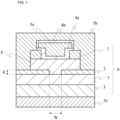
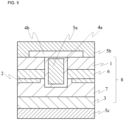
- FIG. 1 illustrates a principal part of a metal-oxide-semiconductor field-effect transistor (MOSFET) according to one preferred embodiment of the disclosure.
- the MOSFET in FIG. 1 includes a drain electrode 5c, an n + -type semiconductor layer 3, an n - -type semiconductor layer 7 as a drift layer, a current blocking layer (current blocking region) 2, a channel layer 6, a source region (n + -type semiconductor layer) 1, a gate insulating film 4a, an interlayer insulating film 4b, a gate electrode 5a, and a source electrode 5b.
- FIG. 1 in the MOSFET in FIG.
- the n + -type semiconductor layer 3, the n - -type semiconductor layer (drift layer) 7, the current blocking layer 2, the channel layer 6, and the n + -type semiconductor layer (source layer) 1 are formed in this order over the drain electrode 5c.
- the n + -type semiconductor layer 3, the n - -type semiconductor layer 7, the channel layer 6, the current blocking layer 2, and the n + -type semiconductor layer 1 form a crystalline oxide semiconductor layer 8.
- the current blocking layer 2 is formed on the drift layer 7 through epitaxial growth. The current blocking layer overlaps the source electrode in a plan view and overlaps a part of the channel layer in a plan view as viewed in a thickness direction of the crystalline oxide semiconductor layer 8.
- the current blocking layer is configured not to overlap a part of the channel layer as viewed in the thickness direction of the crystalline oxide semiconductor layer 8. With this configuration, a current path is ensured while current blocking effect is maintained.
- a width W of the current path is not particularly limited unless it interferes with the present disclosure. In particular, according to an embodiment of the disclosure, if a material of a large bandgap such as gallium oxide is used in the drift layer, the width W of the current path is preferably equal to or less than 2 ⁇ m.
- a thickness d of the current blocking layer is also free from particular limitation unless it interferes with the present disclosure.
- the thickness d of the current blocking layer is preferably equal to or greater than 0.15 ⁇ m, more preferably, equal to or greater than 0.2 ⁇ m.
- the first crystalline oxide as a major component in the drift layer 7 and the second crystalline oxide as a major component in the current blocking layer have different compositions. This makes it possible to improve withstand voltage performance further while maintaining the MOSFET operation of the semiconductor device (normally-off operation).
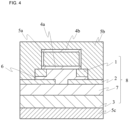
- the source region (n + -type semiconductor layer) 1 may be buried at least partially in the channel layer 6.
- FIG. 4 illustrates an example of a case where the source region (n + -type semiconductor layer) 1 is buried in the channel layer 6. In the configuration illustrated in FIG. 4 , electric field concentration of an electric field applied to the gate insulating film is unlikely to occur, making it possible to improve the reliability of the gate insulating film further.
- FIG. 5 illustrates a principal part of a metal-oxide-semiconductor field-effect transistor (MOSFET) according to one preferred embodiment of the disclosure.
- the MOSFET in FIG. 5 differs from the MOSFET in FIG. 1 in that the crystalline oxide semiconductor layer 8 has a trench penetrating at least the channel layer 6, and the current blocking layer 2 is located directly under the channel layer 6.
- the thickness of the current blocking layer 2 is preferably equal to or less than 0.2 ⁇ m, more preferably, equal to or less than 0.1 ⁇ m. Setting to such a preferred thickness makes it possible to fulfil current blocking effect while suppressing influence on a rising voltage of the MOSFET (Vth).
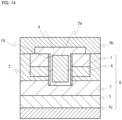
- FIGS. 13 and 14 each illustrate a principal part of a metal-oxide-semiconductor field-effect transistor (MOSFET) according to one preferred embodiment of the disclosure.
- the MOSFET in FIG. 13 differs from the MOSFET in FIG. 5 in that the current blocking layer 2 has a bottom reaching as far as a gate insulating film 4, at least a part of the current blocking layer contacts the gate insulating film (trench), and the current blocking layer 2 directly contacts the source electrode 5b. By doing so, a potential at an end of the current blocking layer 2 contacting the gate insulating film is fixed at a potential at the source electrode to achieve reliable switching operation without fluctuation in a gate threshold voltage.
- the n + -type semiconductor layer 3, the n - -type semiconductor layer (drift layer) 7, the current blocking layer 2, the channel layer 6, and the n + -type semiconductor layer (source layer) 1 are formed in this order over the drain electrode 5c.
- a trench is provided that penetrates the n + -type semiconductor layer (source layer) 1 and the channel layer 6 and reaches the n - -type semiconductor layer (drift layer) 7, and the gate electrode 5a is provided in the trench across the gate insulating film 4.
- the current blocking layer 2 is possible for the current blocking layer 2 to achieve its effect favorably while increase in on resistance is suppressed in the semiconductor device.
- the channel layer 6 is omissible from the MOSFET in FIG. 13 .
- the MOSFET in FIG. 14 further includes a second semiconductor layer (buried semiconductor layer) 10 buried in the trench in addition to the configuration of the MOSFET in FIG. 13 . More specifically, in the MOSFET in FIG. 14 , the n + -type semiconductor layer 3, the first semiconductor layer (drift layer) 7, the current blocking layer 2, the channel layer 6, and the n + -type semiconductor layer (source layer) 1 are formed in this order over the drain electrode 5c.
- a trench is provided that penetrates the source layer 1 and the channel layer 6 and reaches the first semiconductor layer (drift layer) 7.
- the gate electrode 5a is provided in the trench across the gate insulating film 4.
- the second semiconductor layer 10 is provided between the gate insulating film 4 and at least a part of a side wall of the trench.
- the second semiconductor layer (buried semiconductor layer) 10 may be an n-type semiconductor layer or a p-type semiconductor layer.
- the "p-type" semiconductor layer means a semiconductor layer where the density of positive holes (holes) is higher than the density of electrons, and is not limited to a semiconductor layer confirmable to be a p-type through hole effect measurement.
- the p-type semiconductor layer is used as a channel, for example, this semiconductor layer is categorized in the "p-type" as long as it functions as a channel during voltage application.
- carrier density in the current blocking layer 2 may be equal to or greater than 1.0 ⁇ 10 18 /cm 3 .
- the channel layer 6 is omissible from the MOSFET in FIG. 14 .
- Carrier density in the second semiconductor layer is lower than carrier density in the source layer 1.
- a semiconductor device that is novel and useful, and may be regarded as one of other embodiments of the disclosure is a semiconductor device including at least: a crystalline oxide semiconductor layer having a multilayer structure where the first semiconductor layer (drift layer) 7, the current blocking layer 2, the channel layer 6, and the source layer 1 are stacked in this order; the trench penetrating the source layer, the channel layer, and the current blocking layer and reaching the drift layer; and the gate electrode 5a provided in the trench across the gate insulating film 4.
- the second semiconductor layer 10 is provided between the gate insulating film 4 and at least a part of the channel layer and at least a part of the current blocking layer on the side wall of the trench.
- the first semiconductor layer 7 contains a first crystalline oxide semiconductor as a major component and the second semiconductor layer 10 contains a second crystalline oxide semiconductor as a major component.
- This configuration achieves excellent withstand voltage performance while reducing an on resistance in the semiconductor device further.
- the semiconductor device may or may not include the current blocking layer 2.
- the first crystalline oxide semiconductor and the second crystalline oxide semiconductor, or the first or second crystalline oxide semiconductor may be the same as the crystalline oxide semiconductor described above.
- the first crystalline oxide semiconductor and the second crystalline oxide semiconductor may have the same composition or may have compositions differing from each other.
- the first semiconductor layer and the second semiconductor layer may contain the same dopant or may contain dopants differing from each other.
- the second crystalline oxide semiconductor is preferably a material given as an example of the constituent material for the current blocking layer described above.
- the second crystalline oxide semiconductor may be a mixed crystal containing indium and gallium having high mobility or may be a mixed crystal containing iridium and gallium facilitating formation of a p-type.
- Means of forming each layer in FIGS. 1 , 4 , 5 , 13 , and 14 is not particularly limited but may be publicly-known means unless it interferes with the present disclosure.
- Examples of the means include means of performing patterning using photolithography method after deposition through vacuum evaporation method, CVD method, sputtering method, or various types of coating technology, and means of performing patterning directly using technology such as printing.
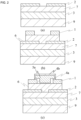
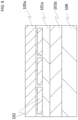
- FIG. 2(a) illustrates a multilayer structure where the n + -type semiconductor layer 3, the drift layer (n - -type semiconductor layer) 7, and the current blocking layer (current blocking region) 2 are stacked in this order over a substrate 9.
- the current blocking layer 2 is formed into a pattern using publicly-known patterning technology.
- the channel layer 6 and the n + -type semiconductor layer 1 as a source region are formed over the multilayer structure in FIG. 2(a) , thereby providing a multilayer structure in FIG. 2(b) .
- the n + -type semiconductor layer 1 is formed into a pattern by depositing a film using epitaxial growth method such as mist CVD method and then performing etching using publicly-known etching technology, for example.
- the gate insulating film 4a and the gate electrode 5a are formed over the multilayer structure in FIG. 2(b) , and the interlayer insulating film 4b and a contact hole are further formed, thereby providing a multilayer structure in FIG. 2(c) .
- Each of the gate insulating film 4a and the gate electrode 5a may be processed into the shape illustrated in FIG. 2(c) by depositing a film using a publicly-known deposition method and then performing etching using publicly-known etching technology.
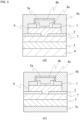
- the source electrode 5b is formed on the multilayer structure in FIG. 2(c) using a publicly-known deposition method to provide a multilayer structure in FIG. 3(d) .
- a method of depositing the source electrode 5b may be the dry method or the wet method described above.
- the substrate 9 is removed from the multilayer structure in FIG. 3(d) and then the drain electrode 5c is formed using a publicly-known deposition method, thereby providing a semiconductor device in FIG. 3(e) .
- the first crystalline oxide as a major component in the drift layer and the second crystalline oxide as a major component in the current blocking layer have different compositions as described above, so that more excellent withstand voltage performance is provided while MOSFET operation is maintained.
- a semiconductor device having a configuration illustrated in FIG. 6 was prepared as a prototype.
- the configuration of the example is as follows. An n - -type semiconductor layer composed of tin-doped ⁇ -Ga 2 O 3 was used as an n - -type semiconductor layer 3, and an n + -type semiconductor layer composed of tin-doped ⁇ -Ga 2 O 3 was used as an n + -type semiconductor layer 1a. Furthermore, IrGaO (Ir ratio of 10%) was used as a current blocking layer.
- FIG. 7 illustrates results on I-V measurement on the semiconductor device prepared as the example 1.
- the semiconductor device according to an embodiment of the disclosure has a withstand voltage exceeding 1400 V, showing that it has excellent withstand voltage performance.
- a withstand voltage in the comparative example is about 600 V
- withstand voltage performance is improved in the semiconductor device according to an embodiment of the disclosure. This is new knowledge obtained only after preparing the semiconductor device using gallium oxide (in particular, ⁇ -Ga 2 O 3 ) as a prototype.
- the semiconductor device described above according to an embodiment of the disclosure is applicable to a power converter such as an inverter or a converter in order to fulfill the foregoing function. More specifically, the semiconductor device is applicable as a thyristor, a power transistor, an IGBT (insulated gate bipolar transistor), or an MOSFET (metal-oxide-semiconductor field effect transistor) as a switching element, for example.
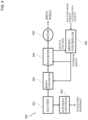
- FIG. 9 is a block configuration view illustrating an example of a control system that uses a semiconductor device according to an embodiment of the disclosure.
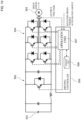
- FIG. 10 is a circuit diagram of this control system. This control system is suitable particularly for mounting on an electric vehicle.
- a control system 500 has a battery (power supply) 501, a boost converter 502, a step-down converter 503, an inverter 504, a motor (driving target) 505, and a driving controller 506. These devices are mounted on an electric vehicle.
- the battery 501 is composed of a storage battery such as a nickel hydrogen battery or a lithium ion battery, for example, and capable of storing power by being charged at a charging station or using regenerative energy generated during deceleration and outputting a direct-current voltage required for operation of a traveling system or an electric component system of the electric vehicle.
- the boost converter 502 is a voltage converter equipped with a chopper circuit, for example, and is capable of boosting a direct-current voltage such as 200 V, for example, supplied from the battery 501 to 650 V, for example, through switching operation of the chopper circuit, and outputting the resultant voltage to a traveling system such as a motor.
- the step-down converter 503 is also a voltage converter equipped with a chopper circuit.
- the step-down converter 503 is capable of stepping down a direct-current voltage such as 200 V, for example, supplied from the battery 501 to about 12 V, for example, thereby outputting the resultant voltage to an electric component system including a power window, a power steering, or vehicle-mounted electric equipment, etc.
- the inverter 504 performs switching operation to convert a direct-current voltage supplied from the boost converter 502 to a three-phase alternating-current voltage, and outputs the resultant voltage to the motor 505.
- the motor 505 is a three-phase alternating-current motor forming the traveling system of the electric vehicle.
- the motor 505 is driven to rotate by the three-phase alternating-current voltage output from the inverter 504, and transmits resultant rotary driving power to a wheel of the electric vehicle via a transmission, etc. not illustrated in the drawings.
- the driving controller 506 has a function as a controller including an operation unit such as a CPU (central processing unit) and a data storage unit such as a memory.
- the driving controller 506 generates a control signal using the input measurement signals and outputs the generated control signal as a feedback signal to the inverter 504, thereby controlling switching operation by the switching element.
- an alternating-current voltage to be applied from the inverter 504 to the motor 505 is corrected momentarily to allow driving control over the electric vehicle to be implemented correctly, thereby realizing safe and comfortable operation of the electric vehicle. It is possible to control an output voltage to the inverter 504 by applying the feedback signal from the driving controller 506 to the boost converter 502.
- FIG. 10 illustrates a circuit configuration defined by omitting the step-down converter 503 from FIG. 9 , namely, a circuit configuration illustrating only a configuration for driving the motor 505.
- the semiconductor device according to the disclosure becomes available for switching control by being used as a Schottky barrier diode, for example, in the boost converter 502 and the inverter 504.
- the semiconductor device is incorporated in the chopper circuit in the boost converter 502 to control the chopper, and is incorporated in a switching circuit including an IGBT in the inverter 504 to control switching.
- An inductor (such as a coil) is interposed in the output of the battery 501 to encourage current stabilization.
- a capacitor (such as an electrolytic capacitor) is interposed between corresponding ones of the battery 501, the boost converter 502, and the inverter 504 to encourage voltage stabilization.
- an operation unit 507 composed of a CPU (central processing unit) and a storage unit 508 composed of a nonvolatile memory are provided in the driving controller 506.
- a signal input to the driving controller 506 is applied to the operation unit 507 and the operation unit 507 performs necessary operation, thereby generating a feedback signal directed to each semiconductor element.
- the storage unit 508 temporarily retains results of the operation by the operation unit 507, and stores physical constants, functions, etc. in the form of a table necessary for driving control and outputs such constants or functions to the operation unit 507, as appropriate.
- the operation unit 507 and the storage unit 508 may have publicly-known configurations and are arbitrarily selectable in terms of processing performance, etc.
- diodes or thyristors, power transistors, IGBTs, or MOSFETs as switching elements are used for the switching operations of the boost converter 502, the step-down converter 503, and the inverter 504.
- gallium oxide (Ga 2 O 3 ), particularly corundum-type gallium oxide ( ⁇ -Ga 2 O 3 ) as a material for these semiconductor elements improves switching characteristics significantly.
- employing the semiconductor device, etc. according to the disclosure is expected to achieve extremely favorable switching characteristics and allows size reduction or cost reduction of the control system 500 to a greater extent.
- each of the boost converter 502, the step-down converter 503, and the inverter 504 is expected to achieve the effect of the disclosure so the effect of the disclosure is expected to be achieved by any one or a combination of any two or more of these devices, or by a configuration defined by incorporating the driving controller 506.
- the control system 500 described above realizes application of the semiconductor device according to the disclosure not only to a control system for an electric vehicle but also to control systems for a variety of purposes such as boosting and stepping down of power from a direct-current power supply and conversion of direct-current power to alternating-current power. Moreover, a power supply such as a solar cell is applicable as a battery.
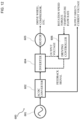
- FIG. 11 is a block configuration view illustrating another example of a control system that uses a semiconductor device according to an embodiment of the disclosure.
- FIG. 12 is a circuit diagram of this control system. This control system is suitable for mounting on infrastructure equipment or consumer electronics equipment that is operated by power from an alternating-current power supply.
- a control system 600 receives power supplied from an external three-phase alternating-current power supply (power supply) 601, for example.
- the control system 600 has an AC/DC converter 602, an inverter 604, a motor (driving target) 605, and a driving controller 606, and these devices are mountable on various types of equipment (described later).
- the three-phase alternating-current power supply 601 is a power generating facility (such as thermal power plant, hydropower plant, geothermal power plant, or nuclear power plant) of an electric power company, for example. Output from the three-phase alternating-current power supply 601 is supplied as an alternating-current voltage while being stepped down through a substation.
- the three-phase alternating-current power supply 601 is installed in a form such as a private power generator in a building or in a neighboring facility, and output therefrom is supplied through a power cable.
- the AC/DC converter 602 is a voltage converter to convert an alternating-current voltage to a direct-current voltage, and converts an alternating-current voltage such as 100 V or 200 V supplied from the three-phase alternating-current power supply 601 to a predetermined direct-current voltage.
- the alternating-current voltage is converted by the voltage conversion to an intended direct-current voltage generally used such as 3.3 V, 5 V, or 12 V If a driving target is a motor, the voltage is converted to 12 V
- an intended direct-current voltage generally used such as 3.3 V, 5 V, or 12 V
- the voltage is converted to 12 V
- a single-phase alternating-current power supply is applicable instead of the three-phase alternating-current power supply.
- a comparable system configuration may be formed by using an AC/DC converter for single-phase input.
- the inverter 604 performs switching operation to convert a direct-current voltage supplied from the AC/DC converter 602 to a three-phase alternating-current voltage, and outputs the resultant voltage to the motor 605.
- the motor 605 has a configuration that changes in response to a control target, and is a three-phase alternating-current motor for driving a wheel if the control target is a train, for driving a pump or various types of power sources if the control target is a plant facility, and for driving a compressor and others if the control target is consumer electronics equipment.
- the motor 605 is driven to rotate by a three-phase alternating-current voltage output from the inverter 604, and transmits resultant rotary driving power to a driving target not illustrated in the drawings.
- the inverter 604 becomes unnecessary in the control system 600 and a direct-current voltage is supplied from the AC/DC converter 602 to such a driving target, as illustrated in FIG. 11 .
- a direct-current voltage of 3.3 V is supplied to a personal computer and a direct-current voltage of 5 V is supplied to LED lighting equipment, for example.
- measured values such as the rotation speed or torque of a driving target, or a temperature, a flow rate, etc. in an environment surrounding the driving target are obtained using various types of sensors not illustrated in the drawings, and these measurement signals are input to the driving controller 606.
- an output voltage value from the inverter 604 is also input to the driving controller 606.
- the driving controller 606 applies a feedback signal to the inverter 604 to control switching operation by the switching element.
- an alternating-current voltage to be applied from the inverter 604 to the motor 605 is corrected momentarily to allow driving control over the driving target to be implemented correctly, thereby realizing stable operation of the driving target.
- the driving target is capable of being driven by a direct-current voltage, it is possible to implement feedback control over the AC/DC converter 602 instead of giving a feedback to the inverter.
- FIG. 12 illustrates a circuit configuration in FIG. 11 .
- the semiconductor device according to the disclosure becomes available for switching control by being used as a Schottky barrier diode, for example, in the AC/DC converter 602 and the inverter 604.
- the AC/DC converter 602 to be used has a circuit configuration composed of Schottky barrier diodes in a bridge pattern, for example, and makes direct-current conversion through rectification by converting a negative voltage part of an input voltage to a positive voltage.
- the semiconductor device is incorporated in a switching circuit in an IGBT to control switching.
- a capacitor (such as an electrolytic capacitor) is interposed between the AC/DC converter 602 and the inverter 604 to encourage voltage stabilization.
- an operation unit 607 composed of a CPU and a storage unit 608 composed of a nonvolatile memory are provided in the driving controller 606.
- a signal input to the driving controller 606 is applied to the operation unit 607 and the operation unit 607 performs necessary operation, thereby generating a feedback signal directed to each semiconductor element.
- the storage unit 608 temporarily retains results of the operation by the operation unit 607, and stores physical constants, functions, etc. in the form of a table necessary for driving control and outputs such constants or functions to the operation unit 607, as appropriate.
- the operation unit 607 and the storage unit 608 may have publicly-known configurations and are arbitrarily selectable in terms of processing performance, etc.
- diodes or thyristors, power transistors, IGBTs, or MOSFETs as switching elements are used for the rectifying operations or switching operations of the AC/DC converter 602 and the inverter 604.
- gallium oxide (Ga 2 O 3 ) particularly corundum-type gallium oxide ( ⁇ -Ga 2 O 3 ) as a material for these semiconductor elements improves switching characteristics.
- employing the semiconductor film or the semiconductor device according to the disclosure is expected to achieve extremely favorable switching characteristics and allows size reduction or cost reduction of the control system 600 to a greater extent.
- each of the AC/DC converter 602 and the inverter 604 is expected to achieve the effect of the disclosure so the effect of the disclosure is expected to be achieved by either one or a combination of these devices, or by a configuration defined by incorporating the driving controller 606.
- the control system 600 is applicable as long as it drives a driving target to receive power from an alternating-current power supply, and is mountable for driving control over equipment including infrastructure equipment (such as power systems in buildings, plants, etc., communication equipment, traffic control equipment, water and sewage processing equipment, system equipment, labor-saving equipment, and trains, for example) and consumer electronics equipment (refrigerators, washers, personal computers, LED liquating equipment, video equipment, and acoustic equipment, for example).
- infrastructure equipment such as power systems in buildings, plants, etc., communication equipment, traffic control equipment, water and sewage processing equipment, system equipment, labor-saving equipment, and trains, for example
- consumer electronics equipment refrigerators, washers, personal computers, LED liquating equipment, video equipment, and acoustic equipment, for example.
- the semiconductor device according to the disclosure is available in any field including semiconductors (compound semiconductor electronic devices, for example), electronic parts, electric equipment parts, optical electrophotographic related apparatuses, industrial members, and especially useful for power devices.
- semiconductors compound semiconductor electronic devices, for example
- electronic parts electronic parts, electric equipment parts, optical electrophotographic related apparatuses, industrial members, and especially useful for power devices.
Landscapes
- Chemical Vapour Deposition (AREA)
- Thin Film Transistor (AREA)
- Crystals, And After-Treatments Of Crystals (AREA)
- Insulated Gate Type Field-Effect Transistor (AREA)
- Chemical & Material Sciences (AREA)
- Crystallography & Structural Chemistry (AREA)
Applications Claiming Priority (2)
| Application Number | Priority Date | Filing Date | Title |
|---|---|---|---|
| JP2021074519 | 2021-04-26 | ||
| PCT/JP2022/018787 WO2022230831A1 (ja) | 2021-04-26 | 2022-04-25 | 半導体装置 |
Publications (2)
| Publication Number | Publication Date |
|---|---|
| EP4333075A1 true EP4333075A1 (de) | 2024-03-06 |
| EP4333075A4 EP4333075A4 (de) | 2025-04-30 |
Family
ID=83848091
Family Applications (1)
| Application Number | Title | Priority Date | Filing Date |
|---|---|---|---|
| EP22795744.6A Pending EP4333075A4 (de) | 2021-04-26 | 2022-04-25 | Halbleiteranordnung |
Country Status (5)
| Country | Link |
|---|---|
| US (1) | US20240055471A1 (de) |
| EP (1) | EP4333075A4 (de) |
| JP (1) | JPWO2022230831A1 (de) |
| CN (1) | CN117441234A (de) |
| WO (1) | WO2022230831A1 (de) |
Families Citing this family (2)
| Publication number | Priority date | Publication date | Assignee | Title |
|---|---|---|---|---|
| CN115732566B (zh) * | 2022-12-06 | 2025-09-12 | 中国科学院苏州纳米技术与纳米仿生研究所 | Umosfet器件及提高umosfet器件性能的方法 |
| CN117012836B (zh) * | 2023-10-07 | 2024-06-28 | 深圳市港祥辉电子有限公司 | 一种纵向氧化镓mosfet器件及其制备方法 |
Family Cites Families (6)
| Publication number | Priority date | Publication date | Assignee | Title |
|---|---|---|---|---|
| JP5211472B2 (ja) * | 2006-02-09 | 2013-06-12 | 日産自動車株式会社 | 半導体装置及びその製造方法 |
| US9379190B2 (en) * | 2014-05-08 | 2016-06-28 | Flosfia, Inc. | Crystalline multilayer structure and semiconductor device |
| US10636663B2 (en) * | 2017-03-29 | 2020-04-28 | Toyoda Gosei Co., Ltd. | Method of manufacturing semiconductor device including implanting impurities into an implanted region of a semiconductor layer and annealing the implanted region |
| JP7008293B2 (ja) | 2017-04-27 | 2022-01-25 | 国立研究開発法人情報通信研究機構 | Ga2O3系半導体素子 |
| JP6360239B2 (ja) * | 2017-07-24 | 2018-07-18 | ルネサスエレクトロニクス株式会社 | 半導体装置の製造方法および半導体装置 |
| JP7325073B2 (ja) * | 2018-06-18 | 2023-08-14 | 国立研究開発法人情報通信研究機構 | 半導体基板及びその製造方法、結晶積層構造体及びその製造方法、並びに半導体デバイス |
-
2022
- 2022-04-25 JP JP2023517524A patent/JPWO2022230831A1/ja active Pending
- 2022-04-25 EP EP22795744.6A patent/EP4333075A4/de active Pending
- 2022-04-25 CN CN202280031264.6A patent/CN117441234A/zh active Pending
- 2022-04-25 WO PCT/JP2022/018787 patent/WO2022230831A1/ja not_active Ceased
-
2023
- 2023-10-26 US US18/384,031 patent/US20240055471A1/en active Pending
Also Published As
| Publication number | Publication date |
|---|---|
| WO2022230831A1 (ja) | 2022-11-03 |
| EP4333075A4 (de) | 2025-04-30 |
| CN117441234A (zh) | 2024-01-23 |
| US20240055471A1 (en) | 2024-02-15 |
| JPWO2022230831A1 (de) | 2022-11-03 |
| TW202249287A (zh) | 2022-12-16 |
Similar Documents
| Publication | Publication Date | Title |
|---|---|---|
| EP3509090A1 (de) | P-artiger oxidhalbleiter und verfahren zur herstellung davon | |
| US12289917B2 (en) | Semiconductor device | |
| US20240055471A1 (en) | Semiconductor device | |
| WO2019098295A1 (ja) | p型酸化物半導体膜及びその形成方法 | |
| WO2022230830A1 (ja) | 半導体装置 | |
| JP7823290B2 (ja) | 半導体素子および半導体装置 | |
| US11855135B2 (en) | Semiconductor device | |
| US20250133757A1 (en) | Semiconductor device and method for producing semiconductor device | |
| US12107137B2 (en) | Semiconductor device | |
| EP4333076A1 (de) | Halbleiteranordnung | |
| JP7823289B2 (ja) | 半導体素子および半導体装置 | |
| JP2022187481A (ja) | 半導体装置 | |
| JP7708348B2 (ja) | 結晶性酸化物膜および半導体装置 | |
| TWI915548B (zh) | 半導體裝置、電力轉換裝置及控制系統 | |
| WO2022230834A1 (ja) | 半導体装置 | |
| US20240363695A1 (en) | Semiconductor device | |
| WO2022210615A1 (ja) | 半導体装置 | |
| JP2022187480A (ja) | 半導体装置 | |
| CN118613921A (zh) | 层叠结构体、半导体元件和半导体装置 | |
| CN118743031A (zh) | 层叠结构体、半导体元件和半导体装置 |
Legal Events
| Date | Code | Title | Description |
|---|---|---|---|
| STAA | Information on the status of an ep patent application or granted ep patent |
Free format text: STATUS: THE INTERNATIONAL PUBLICATION HAS BEEN MADE |
|
| PUAI | Public reference made under article 153(3) epc to a published international application that has entered the european phase |
Free format text: ORIGINAL CODE: 0009012 |
|
| STAA | Information on the status of an ep patent application or granted ep patent |
Free format text: STATUS: REQUEST FOR EXAMINATION WAS MADE |
|
| 17P | Request for examination filed |
Effective date: 20231123 |
|
| AK | Designated contracting states |
Kind code of ref document: A1 Designated state(s): AL AT BE BG CH CY CZ DE DK EE ES FI FR GB GR HR HU IE IS IT LI LT LU LV MC MK MT NL NO PL PT RO RS SE SI SK SM TR |
|
| DAV | Request for validation of the european patent (deleted) | ||
| DAX | Request for extension of the european patent (deleted) | ||
| REG | Reference to a national code |
Ref country code: DE Ref legal event code: R079 Free format text: PREVIOUS MAIN CLASS: H01L0029780000 Ipc: H10D0062170000 |
|
| A4 | Supplementary search report drawn up and despatched |
Effective date: 20250401 |
|
| RIC1 | Information provided on ipc code assigned before grant |
Ipc: H10D 30/63 20250101ALI20250326BHEP Ipc: H10D 30/66 20250101ALI20250326BHEP Ipc: H10D 62/80 20250101ALI20250326BHEP Ipc: H10D 62/82 20250101ALI20250326BHEP Ipc: H10D 62/17 20250101AFI20250326BHEP |