EP4335554A1 - Verfahren zur beschichtung einer platte - Google Patents
Verfahren zur beschichtung einer platte Download PDFInfo
- Publication number
- EP4335554A1 EP4335554A1 EP22195098.3A EP22195098A EP4335554A1 EP 4335554 A1 EP4335554 A1 EP 4335554A1 EP 22195098 A EP22195098 A EP 22195098A EP 4335554 A1 EP4335554 A1 EP 4335554A1
- Authority
- EP
- European Patent Office
- Prior art keywords
- board
- melt glue
- coating
- glue
- hot
- Prior art date
- Legal status (The legal status is an assumption and is not a legal conclusion. Google has not performed a legal analysis and makes no representation as to the accuracy of the status listed.)
- Withdrawn
Links
- 238000000576 coating method Methods 0.000 title claims abstract description 45
- 239000011248 coating agent Substances 0.000 title claims abstract description 43
- 238000000034 method Methods 0.000 title claims description 29
- 239000003292 glue Substances 0.000 claims abstract description 63
- 239000012943 hotmelt Substances 0.000 claims abstract description 36
- 239000000463 material Substances 0.000 claims abstract description 21
- 239000002023 wood Substances 0.000 claims abstract description 16
- 238000004519 manufacturing process Methods 0.000 claims abstract description 10
- 238000010438 heat treatment Methods 0.000 claims description 18
- 229920002635 polyurethane Polymers 0.000 claims description 11
- 239000004814 polyurethane Substances 0.000 claims description 11
- 239000004952 Polyamide Substances 0.000 claims description 6
- 239000004698 Polyethylene Substances 0.000 claims description 6
- 229920002647 polyamide Polymers 0.000 claims description 6
- 229920000573 polyethylene Polymers 0.000 claims description 6
- 229920001971 elastomer Polymers 0.000 claims description 3
- 239000004417 polycarbonate Substances 0.000 claims description 3
- 229920000515 polycarbonate Polymers 0.000 claims description 3
- -1 polyethylene Polymers 0.000 claims description 3
- 229920002554 vinyl polymer Polymers 0.000 claims description 3
- 239000010410 layer Substances 0.000 description 15
- 238000003892 spreading Methods 0.000 description 6
- 239000000126 substance Substances 0.000 description 5
- 230000000007 visual effect Effects 0.000 description 3
- 238000004026 adhesive bonding Methods 0.000 description 2
- 230000015572 biosynthetic process Effects 0.000 description 2
- 239000011093 chipboard Substances 0.000 description 2
- 239000002131 composite material Substances 0.000 description 2
- 239000007888 film coating Substances 0.000 description 2
- 238000009501 film coating Methods 0.000 description 2
- 239000007921 spray Substances 0.000 description 2
- XLYOFNOQVPJJNP-UHFFFAOYSA-N water Substances O XLYOFNOQVPJJNP-UHFFFAOYSA-N 0.000 description 2
- 235000017166 Bambusa arundinacea Nutrition 0.000 description 1
- 235000017491 Bambusa tulda Nutrition 0.000 description 1
- 241001330002 Bambuseae Species 0.000 description 1
- 229910000669 Chrome steel Inorganic materials 0.000 description 1
- 241000196324 Embryophyta Species 0.000 description 1
- 239000004831 Hot glue Substances 0.000 description 1
- 235000015334 Phyllostachys viridis Nutrition 0.000 description 1
- 239000000853 adhesive Substances 0.000 description 1
- 230000002411 adverse Effects 0.000 description 1
- 239000011425 bamboo Substances 0.000 description 1
- 230000009286 beneficial effect Effects 0.000 description 1
- 239000003795 chemical substances by application Substances 0.000 description 1
- 239000011247 coating layer Substances 0.000 description 1
- 230000001419 dependent effect Effects 0.000 description 1
- 230000000694 effects Effects 0.000 description 1
- 239000000835 fiber Substances 0.000 description 1
- 230000009970 fire resistant effect Effects 0.000 description 1
- 238000009408 flooring Methods 0.000 description 1
- 239000012530 fluid Substances 0.000 description 1
- 229920005610 lignin Polymers 0.000 description 1
- 239000002184 metal Substances 0.000 description 1
- 239000003595 mist Substances 0.000 description 1
- 238000012986 modification Methods 0.000 description 1
- 230000004048 modification Effects 0.000 description 1
- 238000010422 painting Methods 0.000 description 1
- 239000000123 paper Substances 0.000 description 1
- 239000011120 plywood Substances 0.000 description 1
- 229920000642 polymer Polymers 0.000 description 1
- 238000005086 pumping Methods 0.000 description 1
- 239000011090 solid board Substances 0.000 description 1
- 239000000758 substrate Substances 0.000 description 1
Images


Classifications
-
- B—PERFORMING OPERATIONS; TRANSPORTING
- B05—SPRAYING OR ATOMISING IN GENERAL; APPLYING FLUENT MATERIALS TO SURFACES, IN GENERAL
- B05D—PROCESSES FOR APPLYING FLUENT MATERIALS TO SURFACES, IN GENERAL
- B05D7/00—Processes, other than flocking, specially adapted for applying liquids or other fluent materials to particular surfaces or for applying particular liquids or other fluent materials
- B05D7/06—Processes, other than flocking, specially adapted for applying liquids or other fluent materials to particular surfaces or for applying particular liquids or other fluent materials to wood
-
- B—PERFORMING OPERATIONS; TRANSPORTING
- B05—SPRAYING OR ATOMISING IN GENERAL; APPLYING FLUENT MATERIALS TO SURFACES, IN GENERAL
- B05D—PROCESSES FOR APPLYING FLUENT MATERIALS TO SURFACES, IN GENERAL
- B05D1/00—Processes for applying liquids or other fluent materials
- B05D1/28—Processes for applying liquids or other fluent materials performed by transfer from the surfaces of elements carrying the liquid or other fluent material, e.g. brushes, pads, rollers
-
- B—PERFORMING OPERATIONS; TRANSPORTING
- B05—SPRAYING OR ATOMISING IN GENERAL; APPLYING FLUENT MATERIALS TO SURFACES, IN GENERAL
- B05D—PROCESSES FOR APPLYING FLUENT MATERIALS TO SURFACES, IN GENERAL
- B05D5/00—Processes for applying liquids or other fluent materials to surfaces to obtain special surface effects, finishes or structures
- B05D5/02—Processes for applying liquids or other fluent materials to surfaces to obtain special surface effects, finishes or structures to obtain a matt or rough surface
Definitions
- the invention relates to coating boards comprising wood materials. More particularly, the invention relates to coating boards made of using wood as base material, typically veneer boards, chipboards and blockboards. Specifically the invention relates to forming an anti-slip and wear resistance coating on such boards.
- the surface of the board may be used to give a desired visual appearance or a functional surface. Coating of the surface of the board is used to give the board desired properties, the most common surface coating being simple painting or varnishing of the surface. However, if high wear resistance, specific frictional properties, hardness, resistance to chemicals or moisture or other properties not inherent for wood boards are needed, specific coating materials and methods have to be used.
- the coating usually also improves the visual appearance of the board surface. There are several methods for applying a coating. Spray application may be the simplest one. However, film coatings usually provide wider variety of uses and applications.
- One traditional film coating type is an impregnated paper that is fixed on the surface of the board by applying heat and pressure. A wide range of polymer and composite sheets or even metal sheets or films may be applied on the surface. These are often adhered to the surface by gluing.
- Coating of a wooden board is a widely used practice. Therefore there are many combinations of coating materials, production methods and base boards. Some of these are described in following publications: US 2018/0320388 discloses a multilayer covering panel, US 2018/0111360 discloses a PVC composite flooring panel, US 2017/0121982 discloses a laminated fire resistant panel, US 2014/1238593 describes a shaped body covered with a film-shaped substrate, JP2002210710 discloses a wood material coated with a hydrophilic adhesive agent and CN 202969824U discloses a bamboo veneer coated with a PUR hot melt adhesive.
- a method for producing a board comprising wood material and a coating of hot melt glue wherein the hot melt glue is spread on the surface the of the board by a rotating roller so that the film layer applied on the surface of the board is split between the rotating roller and the surface of the board to form protrusion on the coating.
- a board comprising wood material and a coating of hot melt glue having random protrusions on the surface.
- the hot melt glue is spread using a roller having a rubber surface.
- the hot melt glue is PUR hot melt glue.
- the splitting action of the film layer is controlled by altering one of the variables of: a gap between the applicator roll and the surface of the board, the relative speed between the applicator roll and the board, the viscosity of the applied hot melt glue.
- the splitting action of the film layer is controlled by adjusting the gap between the applicator roll and the heating roll and/or the speed difference between surfaces of said rolls.
- wood comprises material from stems of trees and wood-stemmed plants. Usually wood is referred to be made of cellulosic fibers embedded in lignin.
- the board of wood material in this context refers to solid boards for constructional purposes such as plywood boards, chipboards and blockboards.
- the method uses a substance usually intended for gluing pieces for preparing a coating.
- a substance usually intended for gluing pieces for preparing a coating is PUR-hot melt glue.
- the surface of a wood board is coated in order to protect it against water, chemicals and wear.
- the coating may also enhance the visual properties of the wood board.
- the board is coated with a hot melt type glue so that a required amount of glue is melted on the board.
- This coating forms a protecting layer against moisture, chemicals and wear.
- the method enables production of coated wood board for floor structures where good friction and grip is required, for example in vehicles.
- the method provides a special surface structure having high friction and thus a good grip on the surface.
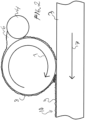
- FIGURE 1 illustrates schematically a method in accordance with at least some embodiments of the present invention.
- the board 3 to be coated is passed through a nip formed between a counter roll 1 or similar support system and an applicator roll 2.
- a heating roll 4 is arranged to form a measuring nip with the applicator roll 2.
- a feed pipe 5 or pipes (see FIGURE 2 ) is arranged to feed glue to a slot formed by the applicator roll 2 and the heating roll 4 on top of the nip formed by said rolls.
- the heating roll 4 is used to keep the glue fluid.
- the pumping and feed pipes 5 are heated for same purpose.
- the board 3 to be coated is supported on the incoming side and exit side of the nip of a counter roll 1 and the applicator roll 2. Rolls, roll bars, bearing rolls, a transporter or any support structure the manufacturer of the apparatus desires to use, may accomplish the support. This kind of glue application apparatuses are readily available commercially.
- the board In order to form a coating on the board, the board is fed into the nip between the counter roll 1 or similar support system and the applicator roll 2.
- the support structures on opposite side of the applicator roll 2 carry the board 3.
- a gap is formed between the applicator roll 2 and the surface of the board 3 ( FIGURE 2 ).
- the width of this gap is one of the variables used to adjust the coat weight of the applied glue on the surface of the board and the formation of the top surface of the coating.
- the amount of the glue applied on the applicator roll 2 is adjusted by setting the gap (the nip) between the applicator roll 2 and the heating roll 4.
- the relative rotation directions of the applicator roll and the heating roll 4 affect the spreading of the glue on the applicator roll 2 and thus may have a role on the type of surface achieved on the final coating on the board.
- the viscosity of the glue relates the spreading action and application closely. The viscosity can be effected by adjusting the temperature of the applied glue by using the heating capability of the heating roll 4 and heating elements related to the feeding pipe 5.
- the apparatuses described above are used for application of glue for fixing layers of material together.
- the glue has to be spread evenly or as a desired pattern between the layers.
- the aim is to obtain a coating surface of a desired type.
- the purpose is to provide protrusions on the surface of the coating.
- the spreading action has to be adjusted so that the applied glue film splits between the applicator roll 2 and the surface of the board as seen in FIGURE 2 . The splitting leaves peaks on the surface of the coating that is spread on the board.
- the desired type of coating can be obtained by setting the process to run using one initial setting and thereafter adjusting one or more variables until splitting of the applied film and final surface having protrusions on the coating is obtained.
- the random splitting action of the glue film provides random protrusions on the top surface of the coating.
- a hot-melt glue sets rather rapidly. This maintains the rough structure of the surface of the coating as the glue doesn't have sufficient time to flow to a smooth even layer.
- the setting up of the process can be started, for example, by choosing the glue that is applied and production speed for the coated board.
- the choice of glue gives a recommended temperature range and viscosity and the operation instructions of the apparatus used sets limits for production speed.
- the gap between the applicator roll 2 and the board can be changed or the relative speed between the board and the surface of the applicator roll 2 can be changed until splitting occurs. This can be done by changing speed of the board 3, rotation speed of the applicator roll or even the rotation direction of the applicator roll 3.
- One setting providing the splitting includes rotating the applicator roll 2 (arrow 1) in the same direction as the board travels (arrow 7). In this way the surfaces of the roll 2 and the board 3 form an opening gap where the surfaces move away from each other and stretch the coating layer therebetween.
- One part 8 of the coating attached to the surface of the board and remaining part 9 follows the surface of the applicator roll 2 back to the glue puddle 6.
- the stretching action and uneven surface 10 is illustrated in FIGURE 2 .
- Another factor that can be altered is the temperature of the applied glue.
- the final adjustment of the temperature is made by changing the heating power of the heating roll 4.
- One suitable material for the surface of the applicator roll is rubber.
- the surface of the roll is preferably smooth.
- the heating roll 4 is preferably a chromed steel roll.
- the gap between the applicator roll 2 and the heating roll 4 may be adjusted and/or the speed difference between said rolls.
- the process can be repeated for following batches directly. This enables producing even small batches rapidly as settings can be rapidly changes once they have been established by using the above guidelines.
- Suitable materials for coating are hot-melt glues.
- the glue is chosen according to the requirements of the intended purpose of the coated board.
- the glue may be polyamide (PA), ethylene-vinyl asetate (EVA), polyurethane (PUR), polyethylene (PE), polycarbonate (PC).
- Particularly suitable glues are reactive hot-melt glues, for example PUR-hot-melt glues.
- PUR-hot-melt glues is TECHNOMELT PUR 9622-02 UV from HENKEL AG & KGaA. This TECHNOMELT glue is applied in melted state and it sets when exposed to moisture. The required moisture can be provided from ambient moisture, moisture of the substance to be coated or by adding water as mist, vapour or spray.
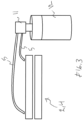
- FIGURE 3 shows a glue feeding system for the apparatus of FIGURE 1 .
- the apparatus includes a hotmelt drum 12 for hotmelt glue.
- a pump and heating system 11 is mounted on the hotmelt drum 12 and connected to feed pipes 5 that lead to spreading roller system 2, 4, the applicator roll 2 and the heating roll 4 of FIGURES 1 and 2 .
- the purpose of the glue feeding system is to fluidize the hot-melt glue, maintain a desired temperature and feed a desired measured amount of glue to the spreading roller system 2, 4.
- FIGURE 4 illustrates an example of a coated veneer board.
- the board is coated with a PUR-hot-melt glue by using above described method.
- the uneven surface 10 comprising the protrusions according to the invention can be seen on the surface.
- FIGURE 4 shows the board in cross section.
- the coating can be seen as the top layer 13 of the cross section.
- the protrusions can be observed on the top of the layer.
- FIGURE 4 shows a gap between the board 3 and the top layer 13. This gap is for illustrative purposes only, actually the top layer 13 is attached to the board 3.
- a precoat layer is applied on the board before application of the top layer.
- Such precoat increases cost of manufacture and may effect adversely on formation of the slitting phenomenon. Therefore, the precoat must be carefully chosen and used only if needed for obtaining specific functional properties for the product.
- This method is not limited to boards having certain length as the coating process is continuous.
- the width of the board is limited only by the largest width of the production apparatus that is used.
- the method can be easily reproduced. Some beneficial properties of the products made by the method are, for example: good grip and high friction, good wear resistance, good durability under moisture, pleasant appearance.
- the method is easy to implement and enables producing various sizes of wooden boards even in small batches. One can contemplate that both sides of the board are coated.
- the board to be coated should have a sufficient thickness so that it maintains its rigidity during coating without continuous support.
- the support provided is usually a set of rolls and the counter roll 1.
- the random splitting action requires sufficient amount of material to be spread on the surface of the board.
- the amount of coating on the board should be 100 g/m 2 or higher, for example within a range of 100 g/m 2 - 800 g/m 2 , preferably 200 g/m 2 - 600 g/m 2 and most preferably 400 g/m 2 - 600 g/m 2 .
- the surface of the board should be evenly covered with a uniform layer without any gaps or holes. However, one can contemplate that a patterned applicator roll is used to obtain patterned coating providing partial exposure to the surface of the board. Such products may have use in special limited applications.
- the invention can be used for manufacture of coated wooden boards.
Landscapes
- Life Sciences & Earth Sciences (AREA)
- Engineering & Computer Science (AREA)
- Wood Science & Technology (AREA)
- Application Of Or Painting With Fluid Materials (AREA)
Priority Applications (1)
| Application Number | Priority Date | Filing Date | Title |
|---|---|---|---|
| EP22195098.3A EP4335554A1 (de) | 2022-09-12 | 2022-09-12 | Verfahren zur beschichtung einer platte |
Applications Claiming Priority (1)
| Application Number | Priority Date | Filing Date | Title |
|---|---|---|---|
| EP22195098.3A EP4335554A1 (de) | 2022-09-12 | 2022-09-12 | Verfahren zur beschichtung einer platte |
Publications (1)
| Publication Number | Publication Date |
|---|---|
| EP4335554A1 true EP4335554A1 (de) | 2024-03-13 |
Family
ID=84043767
Family Applications (1)
| Application Number | Title | Priority Date | Filing Date |
|---|---|---|---|
| EP22195098.3A Withdrawn EP4335554A1 (de) | 2022-09-12 | 2022-09-12 | Verfahren zur beschichtung einer platte |
Country Status (1)
| Country | Link |
|---|---|
| EP (1) | EP4335554A1 (de) |
Citations (6)
| Publication number | Priority date | Publication date | Assignee | Title |
|---|---|---|---|---|
| JP2002210710A (ja) | 2001-01-12 | 2002-07-30 | Mamoru Tatsuta | 加工木材 |
| WO2006087085A2 (de) * | 2005-02-17 | 2006-08-24 | Karl W. Niemann Gmbh + Co. Kg | Verfahren zum beschichten von werkstücken mit rutschfestem belag |
| CN202969824U (zh) | 2012-12-25 | 2013-06-05 | 安吉恒丰竹木产品有限公司 | 一种柔性重组竹装饰材料 |
| US20170121982A1 (en) | 2015-10-28 | 2017-05-04 | Armstrong World Industries, Inc. | Fire performance for wood veneer laminated ceiling tile |
| US20180111360A1 (en) | 2016-10-21 | 2018-04-26 | Wenhui Xiao | Pvc composite flooring |
| US20180320388A1 (en) | 2015-09-17 | 2018-11-08 | Beaulieu International Group Nv | Custom-Made Covering Panels by Digital Printing of Base Panels |
-
2022
- 2022-09-12 EP EP22195098.3A patent/EP4335554A1/de not_active Withdrawn
Patent Citations (6)
| Publication number | Priority date | Publication date | Assignee | Title |
|---|---|---|---|---|
| JP2002210710A (ja) | 2001-01-12 | 2002-07-30 | Mamoru Tatsuta | 加工木材 |
| WO2006087085A2 (de) * | 2005-02-17 | 2006-08-24 | Karl W. Niemann Gmbh + Co. Kg | Verfahren zum beschichten von werkstücken mit rutschfestem belag |
| CN202969824U (zh) | 2012-12-25 | 2013-06-05 | 安吉恒丰竹木产品有限公司 | 一种柔性重组竹装饰材料 |
| US20180320388A1 (en) | 2015-09-17 | 2018-11-08 | Beaulieu International Group Nv | Custom-Made Covering Panels by Digital Printing of Base Panels |
| US20170121982A1 (en) | 2015-10-28 | 2017-05-04 | Armstrong World Industries, Inc. | Fire performance for wood veneer laminated ceiling tile |
| US20180111360A1 (en) | 2016-10-21 | 2018-04-26 | Wenhui Xiao | Pvc composite flooring |
Similar Documents
| Publication | Publication Date | Title |
|---|---|---|
| US6896971B2 (en) | System and method for two sided sheet treating | |
| RU2690920C2 (ru) | Способ изготовления панели, включающей в себя армирующий лист, и половая панель | |
| JP6672333B2 (ja) | 構造化された表面を生成するための方法、およびそのような方法で構造化された物品 | |
| CA2468182A1 (en) | Articles and methods for applying color on surfaces | |
| EP2382362A2 (de) | Bodentafel, verfahren zur herstellung von laminattafeln und verfahren zur bearbeitung von aus diesen tafeln hergestellten materialbahnen | |
| NL8101032A (nl) | Plaat uit meerdere lagen en met een lakoppervlak alsmede werkwijze voor het vervaardigen en toepassen daarvan. | |
| CN105189867B (zh) | 用于制造单层或多层的能印刷的材料幅的方法、按该方法制造的材料幅和用于制造这种材料幅的相关设备 | |
| DE102008031958A1 (de) | Verfahren zum Laminieren von Hochglanzoberflächen | |
| HUT57835A (en) | Leather material, as well as process and device for producing same | |
| EP4335554A1 (de) | Verfahren zur beschichtung einer platte | |
| EP0930945B1 (de) | Herstellung familialer, nichtmodularer, pluraler farbmuster auf ein bewegendes substrat | |
| US6835413B2 (en) | Surface coating for insulation pack | |
| AT408733B (de) | Laminat-werkstoff, verfahren zu dessen herstellung sowie vorrichtung zur durchführung des verfahrens | |
| EP2248677B1 (de) | Herstellungsverfahren einer mehrschichtigen Beschichtung zur Dekoration von Oberflächen | |
| CA2463304C (en) | System and method for two sided sheet treating | |
| US20130105059A1 (en) | Method and system of manufacturing multilayer coating for decoration of surfaces | |
| US20120279407A1 (en) | Paper coater apparatus and process | |
| EP3954515A1 (de) | Vorrichtung und verfahren zum beschichten eines plattenförmigen werkstücks | |
| CA2709492A1 (en) | Composite blind slat and method of making the same | |
| CN116096504A (zh) | 用于基材的黏性结合的方法和系统 | |
| KR20050072717A (ko) | 멜라민수지를 이용한 무늬목 판넬 제조방법 | |
| JPH11138094A (ja) | 意匠性プレコート金属板の製造方法 | |
| CA2755636A1 (en) | Method and plant for manufacturing multilayer coating for decoration of surfaces |
Legal Events
| Date | Code | Title | Description |
|---|---|---|---|
| PUAI | Public reference made under article 153(3) epc to a published international application that has entered the european phase |
Free format text: ORIGINAL CODE: 0009012 |
|
| STAA | Information on the status of an ep patent application or granted ep patent |
Free format text: STATUS: THE APPLICATION HAS BEEN PUBLISHED |
|
| AK | Designated contracting states |
Kind code of ref document: A1 Designated state(s): AL AT BE BG CH CY CZ DE DK EE ES FI FR GB GR HR HU IE IS IT LI LT LU LV MC MK MT NL NO PL PT RO RS SE SI SK SM TR |
|
| STAA | Information on the status of an ep patent application or granted ep patent |
Free format text: STATUS: THE APPLICATION IS DEEMED TO BE WITHDRAWN |
|
| 18D | Application deemed to be withdrawn |
Effective date: 20240914 |