EP4335582A1 - Kugelpositionierungsverfahren für kugellager, kugellagerherstellungsverfahren und -herstellungsvorrichtung sowie maschine und fahrzeugherstellungsverfahren - Google Patents
Kugelpositionierungsverfahren für kugellager, kugellagerherstellungsverfahren und -herstellungsvorrichtung sowie maschine und fahrzeugherstellungsverfahren Download PDFInfo
- Publication number
- EP4335582A1 EP4335582A1 EP23783705.9A EP23783705A EP4335582A1 EP 4335582 A1 EP4335582 A1 EP 4335582A1 EP 23783705 A EP23783705 A EP 23783705A EP 4335582 A1 EP4335582 A1 EP 4335582A1
- Authority
- EP
- European Patent Office
- Prior art keywords
- ball
- balls
- annular space
- ball bearing
- jig
- Prior art date
- Legal status (The legal status is an assumption and is not a legal conclusion. Google has not performed a legal analysis and makes no representation as to the accuracy of the status listed.)
- Granted
Links
Images






Classifications
-
- B—PERFORMING OPERATIONS; TRANSPORTING
- B23—MACHINE TOOLS; METAL-WORKING NOT OTHERWISE PROVIDED FOR
- B23P—METAL-WORKING NOT OTHERWISE PROVIDED FOR; COMBINED OPERATIONS; UNIVERSAL MACHINE TOOLS
- B23P19/00—Machines for simply fitting together or separating metal parts or objects, or metal and non-metal parts, whether or not involving some deformation; Tools or devices therefor so far as not provided for in other classes
- B23P19/04—Machines for simply fitting together or separating metal parts or objects, or metal and non-metal parts, whether or not involving some deformation; Tools or devices therefor so far as not provided for in other classes for assembling or disassembling parts
-
- F—MECHANICAL ENGINEERING; LIGHTING; HEATING; WEAPONS; BLASTING
- F16—ENGINEERING ELEMENTS AND UNITS; GENERAL MEASURES FOR PRODUCING AND MAINTAINING EFFECTIVE FUNCTIONING OF MACHINES OR INSTALLATIONS; THERMAL INSULATION IN GENERAL
- F16C—SHAFTS; FLEXIBLE SHAFTS; ELEMENTS OR CRANKSHAFT MECHANISMS; ROTARY BODIES OTHER THAN GEARING ELEMENTS; BEARINGS
- F16C43/00—Assembling bearings
- F16C43/04—Assembling rolling-contact bearings
- F16C43/06—Placing rolling bodies in cages or bearings
-
- F—MECHANICAL ENGINEERING; LIGHTING; HEATING; WEAPONS; BLASTING
- F16—ENGINEERING ELEMENTS AND UNITS; GENERAL MEASURES FOR PRODUCING AND MAINTAINING EFFECTIVE FUNCTIONING OF MACHINES OR INSTALLATIONS; THERMAL INSULATION IN GENERAL
- F16C—SHAFTS; FLEXIBLE SHAFTS; ELEMENTS OR CRANKSHAFT MECHANISMS; ROTARY BODIES OTHER THAN GEARING ELEMENTS; BEARINGS
- F16C19/00—Bearings with rolling contact, for exclusively rotary movement
- F16C19/02—Bearings with rolling contact, for exclusively rotary movement with bearing balls essentially of the same size in one or more circular rows
- F16C19/04—Bearings with rolling contact, for exclusively rotary movement with bearing balls essentially of the same size in one or more circular rows for radial load mainly
- F16C19/06—Bearings with rolling contact, for exclusively rotary movement with bearing balls essentially of the same size in one or more circular rows for radial load mainly with a single row or balls
Definitions
- the present invention relates to a ball arrangement method for a ball bearing, a manufacturing method and a manufacturing device for a ball bearing, and a manufacturing method for a machine and a vehicle.
- a production technique such as a transfer machine, in which a large number of processing positions are provided, processing (assembly work) performed at one processing position is reduced, and products are successively conveyed to a downstream processing position.
- a production technique there is a method of arranging a plurality of balls at equal intervals between an inner ring and an outer ring of a ball bearing.
- a ball collecting step of collecting a plurality of balls accommodated between the inner ring and the outer ring in one region in a circumferential direction is performed between a ball insertion step of inserting balls between the inner ring and the outer ring and a ball dividing step of arranging the balls at equal intervals in the circumferential direction. For this reason, a ball rubbing motion that occurs at the time of the ball collecting step is the cause of occurrence of ball damage.
- Patent Literature 1 discloses a technique for manufacturing a ball bearing in which a ball collecting step is eliminated by holding balls after a ball insertion step in the ball bearing in one region between an inner ring and an outer ring instead of being scattered, and it is possible to shift from the ball insertion step to the ball dividing step at the same position by changing the tilt of the entire facility.
- Patent Literature 1 JP2019-209475A
- a tilting operation function is provided to control a tilt angle of the entire manufacturing device. Accordingly, it is possible to process, at one position, the ball insertion step and the ball dividing step in which tilt angles of a conveying surface are different. Therefore, after the ball insertion step, the balls are held in one region between the inner ring and the outer ring without being scattered, and then by sequentially inserting tip ends of a plurality of work arrows corresponding to the number of balls in an axial direction, the plurality of balls can be arranged at equal intervals in the circumferential direction.
- the present invention has the following configuration.
- a ball bearing of the present invention friction, deformation, and the like of a member is reduced so as to prevent occurrence of ball damage, a ball bearing having a large number of balls can be dealt with, and a tact time can be shortened.
- Fig. 1 is a schematic side view showing a configuration of a manufacturing device for a ball bearing according to the embodiment.
- Fig. 2 is a schematic side view showing an operation of the manufacturing device for a ball bearing shown in Fig. 1 .
- a manufacturing device for a ball bearing 100 includes a ball arranging unit 15 installed on a base 13 via a rotation shaft 14.
- the ball arranging unit 15 includes a workpiece holding table 17, an inner ring moving mechanism 18, a ball inserting portion 19, a tilting operation mechanism 21, a flow stop and block dividing mechanism 23, and a ball dividing portion 25.
- the ball arranging unit 15 is swung by the tilting operation mechanism 21 between a horizontal state (a state in Fig. 1 ) in which the workpiece holding table 17 provided at an upper portion of the ball arranging unit 15 is horizontally arranged and a tilted state (a state in Fig. 2 ) in which the workpiece holding table 17 is tilted at a tilt angle ⁇ with respect to a horizontal surface.
- the workpiece holding table 17 holds a workpiece W at the upper portion of the ball arranging unit 15.
- the workpiece holding table 17 includes a holding portion 41.
- the workpiece W is fitted into the holding portion 41 from above.
- the workpiece holding table 17 is provided with a lock member 43 that moves in a direction approaching and separating from the holding portion 41.
- the workpiece W is fixed to the workpiece holding table 17 by being pressed by the lock member 43 in a state of being fitted into the holding portion 41.
- Fig. 3 is a perspective view of a workpiece that is a ball bearing.
- the workpiece W includes an inner ring 1, an outer ring 3, and a plurality of (in this example, 13) balls 7 that are rolling elements.
- the plurality of balls 7 are arranged in a circumferential direction at equal intervals in an annular space 5 between the inner ring 1 and the outer ring 3.
- the balls 7 are held by a cage (not shown). That is, a ball bearing 9 is formed by assembling the workpiece W.
- the plurality of balls 7 can be inserted into the annular space 5 between the inner ring 1 and the outer ring 3, and the plurality of balls 7 can be arranged at equal intervals in the circumferential direction.
- the inner ring moving mechanism 18 shown in Figs. 1 and 2 has an inner ring support shaft 39.
- the inner ring support shaft 39 is fitted into the inner ring 1 of the workpiece W held by the holding portion 41 of the workpiece holding table 17 from below.
- the inner ring support shaft 39 is tilted together with a tilting operation of the ball arranging unit 15, and is always disposed coaxially with an axis of the workpiece W.
- the ball inserting portion 19 is supported by a support portion 45 provided on an upper surface of the ball arranging unit 15.
- the support portion 45 includes a column portion 47 standing on the upper surface of the ball arranging unit 15 and an arm portion 49 extending from an upper end of the column portion 47 toward the workpiece holding table 17.
- the ball inserting portion 19 is supported by a tip end of the arm portion 49.
- the ball inserting portion 19 is used to insert the plurality of balls 7 into an annular space 5 (see Fig. 3 ) between the inner ring 1 and the outer ring 3 in the workpiece W held by the holding portion 41 of the workpiece holding table 17.
- the flow stop and block dividing mechanism 23 is supported by the tip end of the arm portion 49 of the support portion 45.
- the flow stop and block dividing mechanism 23 includes a flow stop jig 51 and a block dividing jig 52 that move up and down with respect to the workpiece holding table 17. By being driven downward, tip end portions of the flow stop jig 51 and the block dividing jig 52 are inserted into the annular space 5 (see Fig. 3 ) between the inner ring 1 and the outer ring 3 in the workpiece W held by the holding portion 41 of the workpiece holding table 17.
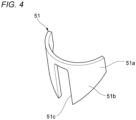
- Fig. 4 is a perspective view showing the flow stop jig 51.
- the flow stop jig 51 is formed in a plate shape that forms a portion of a circular tubular shape curving along the circumferential direction of the annular space 5 and that narrows along an insertion direction (downward in Fig. 4 ) into the annular space 5.
- the flow stop jig 51 is formed by connecting a main body portion 51a having a partial cylindrical shape and a tapered portion 51b joined to a lower end of the main body portion 51a with the same curvature and narrowing downward from the main body portion 51a.
- a notch 51c extending straight from a lower end of the tapered portion 51b toward the main body portion 51a is formed.
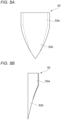
- Fig. 5A is a front view of the block dividing jig 52.
- Fig. 5B is a side view of the block dividing jig 52.
- Fig. 5C is a bottom view of the block dividing jig 52.
- the block dividing jig 52 is also formed in a plate shape that curves along the circumferential direction of the annular space 5 and that narrows along the insertion direction (downward in Figs. 5A and 5B ) into the annular space 5.
- the block dividing jig 52 is formed by connecting a main body portion 52a having a partial cylindrical shape and a tapered portion 52b extending toward a lower end (tip end in the insertion direction) of the main body portion 52a with the same curvature as that of the main body portion 52a and narrowing toward the lower end.
- a length of the flow stop jig 51 in an upper-lower direction is longer than a length of the block dividing jig 52 in the upper-lower direction.
- Fig. 6 is a perspective view of the ball dividing portion 25.
- the ball dividing portion 25 is formed by connecting a base portion 61 formed in an annular shape and a plurality of work arrows 63 having different lengths.
- the work arrows 63 are erected on the base portion 61 and are arranged at equal intervals in the circumferential direction.
- the ball dividing portion 25 includes the same number (13 in this embodiment) of work arrows 63 as the number of balls 7.
- the plurality of work arrows 63 include one reference work arrow 63A.
- the other work arrows 63 are arranged in a positional relationship symmetrical along the circumferential direction with reference to the reference work arrow 63A.
- the work arrows 63 having the same shape and height are arranged at corresponding circumferential positions (circumferential positions where distances from the reference work arrow 63A are equal) along one side and the other side in the circumferential direction.
- the reference work arrow 63A is longer than the work arrow 63 on both sides thereof.
- the work arrows 63 which are arranged at symmetrical positions with respect to each other along both sides of the reference work arrow 63A in the circumferential direction, gradually increase in axial length as the work arrows move away from the reference work arrow 63A within a range of ⁇ 90 degrees in central angle from the reference work arrow 63A, and gradually decrease in axial length as the work arrows move away from the reference work arrow 63A beyond the range of ⁇ 90 degrees in central angle from the reference work arrow 63A.
- a tip end portion of the reference work arrow 63A has a planar shape substantially perpendicular to a protruding direction from the base portion 61.
- a tip end portion of the work arrow 63 arranged within ⁇ 90 degrees of the central angle from the reference work arrow 63A is an inclined surface facing the reference work arrow 63A along the circumferential direction, and a tip end portion of the work arrow 63 arranged beyond ⁇ 90 degrees of the central angle from the reference work arrow 63A is an inclined surface facing an opposite side to the reference work arrow 63A along the circumferential direction.
- Each of the work arrows 63 in a symmetrical positional relationship with respect to the reference work arrow 63A preferably has a shape that is a mirror image with respect to a plane passing through the center of the reference work arrow 63A and an axis of the ball dividing portion 25, but may not necessarily be the same.
- the flow stop jig 51 and the block dividing jig 52 of the flow stop and block dividing mechanism 23 and the ball dividing portion 25 are disposed in the upper-lower direction with the workpiece W held by the holding portion 41 of the workpiece holding table 17 sandwiched therebetween.
- the flow stop jig 51 and the block dividing jig 52 are disposed above the workpiece W, and the ball dividing portion 25 is disposed below the workpiece W.
- the tilted state the state in Fig.
- the reference work arrow 63A of the ball dividing portion 25 is disposed so as to be on a lower side of the tilt of the workpiece W.
- the ball dividing portion 25 may be disposed above the workpiece W, and the flow stop jig 51 and the block dividing jig 52 may be disposed below the workpiece W.
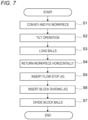
- the conveyed work W is held by the holding portion 41 of the workpiece holding table 17 with respect to the ball arranging unit 15 in the horizontal state (step S1).
- the inner ring 1 is supported by the inner ring support shaft 39 inserted into an inner circumference thereof, and the outer ring 3 is fixed to the holding portion 41 by the lock member 43.
- the tilting operation mechanism 21 turns the ball arranging unit 15 into the tilted state in which the workpiece holding table 17 is tilted at the tilt angle ⁇ with respect to the horizontal surface (step S2).
- the inner ring support shaft 39 of the inner ring moving mechanism 18 is tilted together with the tilting operation of the ball arranging unit 15.
- a central axis of the inner ring support shaft 39 of the inner ring moving mechanism 18 is disposed at a position displaced to a lower side (left side in Fig. 2 ) of the tilt in a plane orthogonal to a central axis of the workpiece W.
- the center of the inner ring 1 is eccentric to the lower side of the tilt with respect to the center of the outer ring 3.
- the annular space 5 between the inner ring 1 and the outer ring 3 narrows on the lower side of the tilt and widens in a radial direction in a region on an upper side of the tilt (see Fig. 8A ).
- Fig. 8A is a view illustrating the ball insertion step, and is a perspective view of the workpiece before a ball is inserted.
- Fig. 8B is a view illustrating the ball insertion step, and is a perspective view of the workpiece after the balls are inserted.
- the balls 7 are inserted into the annular space 5 between the inner ring 1 and the outer ring 3 held by the workpiece holding table 17 (see Figs. 1 and 2 ) from the ball inserting portion 19 (step S3).
- the annular space 5 is in a state where an upper side of the tilt is widened, and the balls 7 can be easily and smoothly inserted into the annular space 5 by the ball inserting portion 19.
- the balls 7 roll and move to the left and right due to its own weight without remaining at a inserting location.
- the already inserted ball 7 does not get in the way.
- the balls 7 inserted into the annular space 5 are accommodated in a state of being collected in a widened region on the upper side of the tilt. That is, the balls 7 inserted in the annular space 5 are accommodated in a collected state in one region along the circumferential direction of the annular space 5.
- the tilting operation mechanism 21 turns the ball arranging unit 15 into the horizontal state (the state of Fig. 1 ) in which the workpiece holding table 17 is horizontal (step S4). At this time, the central axis of the inner ring support shaft 39 is moved to a position coaxial with the axis of the workpiece W. As a result, the centers of the outer ring 3 and the inner ring 1 coincide with each other, and the annular space 5 becomes a uniform gap in the circumferential direction.
- Fig. 9A is a view showing a state in which the balls are accommodated in the annular space, and is a plan view of the workpiece having no deformation allowance for holding the balls between the inner ring and the outer ring.
- Fig. 9B is a view showing a state in which the balls are accommodated in the annular space, and is a plan view of the workpiece having a deformation allowance for holding the balls between the inner ring and the outer ring.
- a region (central angle) ⁇ of the space is in a range of 180° or more.
- a region (central angle) ⁇ of the space without the balls 7 in the outside in the circumferential direction than the one region is in a range of less than 180°.
- Figs. 10A, 10B, and 10C are perspective views of the workpiece W, the flow stop jig 51, and the block dividing jig 52 illustrating the flow stop step and a block dividing step.
- the flow stop jig 51 of the flow stop and block dividing mechanism 23 ( Fig. 1 ) is inserted into the space without the balls 7 in the annular space 5 of the workpiece W along the axial direction of the inner ring 1 and the outer ring 3 from above (step S5).
- the balls 7 collected in the one region can roll and move to the space without the balls 7.
- the flow stop jig 51 since the flow stop jig 51 is inserted into the annular space 5, the movement of the inserted balls 7 can be restricted and the balls 7 can be kept in the one region.
- the block dividing jig 52 is inserted into the annular space 5 of the workpiece W on a side facing the flow stop jig 51 in the radial direction (step S6).
- the flow stop jig 51 is moved in a removing direction (the counter-insertion direction).
- a circumferential length of the tapered portion 52b of the block dividing jig 52 in the annular space 5 is increased, and a circumferential length of the tapered portion 51b of the flow stop jig 51 in the annular space 5 is decreased.
- the block dividing jig 52 is allowed to be inserted into the annular space 5, and the balls 7 move in the circumferential direction while being sandwiched between the flow stop jig 51 and the block dividing jig 52. In this manner, the balls 7 are divided into two groups in the annular space 5 by the flow stop jig 51 and the block dividing jig 52.
- the operation of inserting the flow stop jig 51 and the block dividing jig 52 into the annular space 5 is performed in accordance with the horizontal operation in which the ball arranging unit 15 is returned horizontally and the inner ring 1 is moved to align the centers of the outer ring 3 and the inner ring 1.
- the operation may be performed after the ball arranging unit 15 is made horizontally.
- the longest work arrow 63 other than the reference work arrow 63A enters between the flow stop jig 51 and the block dividing jig 52.
- the flow stop jig 51 has the tapered portion 51b and the block dividing jig 52 has the tapered portion 52b, so that an upper end of the longest work arrow 63 is prevented from interfering with the flow stop jig 51 and the block dividing jig 52.
- the reference work arrow 63A enters and is accommodated in the notch 51c of the flow stop jig 51, so that the reference work arrow 63A does not interfere with the flow stop jig 51.
- step S7 As the ball dividing portion 25 is raised, between the balls 7 arranged in the annular space 5 and divided into two groups, tip ends of the plurality of work arrows 63 protruded in accordance with the number of the balls 7 are sequentially inserted in the axial direction, and the plurality of balls 7 are arranged at equal intervals in the circumferential direction (step S7).
- a raising speed of the flow stop jig 51 and the block dividing jig 52 is substantially the same as that of the ball dividing portion 25. Therefore, when the flow stop jig 51, the block dividing jig 52, and the ball dividing portion 25 are raised, a relative position of the flow stop jig 51 and the ball dividing portion 25 hardly changes. That is, the relative positions of the flow stop jig 51 and the block dividing jig 52, the ball dividing portion 25, and the balls 7 change. That is, as the flow stop jig 51 and the block dividing jig 52 are retracted, the ball dividing portion 25 enters and the work arrows 63 are allowed to enter between the balls 7.
- the work arrows 63 of the ball dividing portion 25 enters between the balls 7 accommodated in the annular space 5, respectively, and the plurality of balls 7 are arranged at equal intervals in the circumferential direction.
- the ball arrangement method for a ball bearing includes the "tilting operation” of changing the tilt angle of the entire device, the “flow stop step” of preventing the balls from scattering at the time of ball inserting, the “block dividing step” of distributing the balls to two regions from the state where the balls are collected in one region between the inner ring and the outer ring after the ball inserting, and the “block ball dividing step” of sequentially inserting the work arrows into the plurality of balls distributed to the two regions to arrange the balls at equal intervals in the circumferential direction.
- the flow stop step it is possible to shift to the ball dividing step in the state where the balls inserted between the inner ring and the outer ring are held in one location without being scattered, so that the ball collecting step in the related art becomes unnecessary.
- the ball insertion step and the ball dividing step in which the tilt angles of the conveying surface are different can be processed at one position without horizontally moving the inner ring and the outer ring.
- the problem that in the case of a ball bearing having a large number of balls, the work arrows are elongated and lowered in rigidity, and friction and deformation are likely to occur is solved. Further, it is possible to assemble a workpiece without a snap allowance by the same method. Further, the balls 7 are distributed to two regions, and the tip ends of the plurality of work arrows 63 protruded in accordance with the number of balls 7 in each region are sequentially inserted in the axial direction to arrange the plurality of balls 7 at equal intervals in the circumferential direction. As a result, it is possible to reduce abrasion and deformation of the ball dividing portion 25, and the occurrence of damage of the balls 7, and to shorten a working time.
- the present embodiment by eliminating the ball rubbing motion in the ball collecting step, the occurrence of ball damage can be reduced. Further, by the block dividing step and the block ball dividing step, even if the number of balls is large, the work arrows 63 can be made relatively short and highly rigid, and friction and deformation can be reduced. Further, by distributing the balls 7 into the two regions, an insertion load of the work arrow 63 can be reduced, the damage of the ball 7 and the deformation of the ball dividing portion 25 can be reduced, and a ball dividing time can be shortened.
- workability can be improved by reducing the number of man-hours for arranging the balls in the ball bearing. Further, by eliminating the ball rubbing motion in the ball collecting step, a risk of occurrence of ball damage can be reduced. In addition, by continuously performing the ball dividing step from the ball insertion step, assembling can be easily performed even for a ball bearing without a deformation allowance for holding the balls 7 between the inner ring 1 and the outer ring 3.
- the inner ring 1 is moved to the side opposite to the one region with respect to the outer ring 3, and the annular space 5 is expanded in the radial direction in the one region to load the balls 7. As a result, the balls can be smoothly inserted into the annular space 5.
- the flow stop jig 51 is inserted into the annular space 5 along the axial direction of the inner ring 1 and the outer ring 3. Therefore, movement of the balls 7 collected in the one region is restricted by the flow stop jig 51, thereby preventing the balls 7 from being scattered. As a result, the plurality of balls 7 inserted into the annular space 5 can be divided while being held in one location without being scattered.
- the block dividing jig 52 is inserted into the annular space 5 along the axial direction of the inner ring 1 and the outer ring 3.
- the plurality of balls 7 can be divided into two groups, and lengths of the work arrows 63 can be shortened.
- the inner ring 1 and the outer ring 3 are tilted with the one region upward from the horizontal plane. Therefore, the balls 7 inserted into the one region of the annular space 5 move downward under its own weight and are arranged in order. As a result, the ball insertion step can be smoothly performed.
- the ball insertion step of inserting the plurality of balls 7 in one region along the circumferential direction of the annular space 5 by the ball inserting portion 19 and the ball dividing step of arranging the balls 7 at equal intervals in the circumferential direction by the work arrows 63 of the ball dividing portion 25 can be continuously performed.
- the ball collecting step of collecting the balls 7 inserted into the annular space 5 in the ball insertion step at one place can be omitted. Accordingly, workability can be improved by reducing the number of man-hours for arranging the balls in the ball bearing. Further, by eliminating the ball rubbing motion in the ball collecting step, the occurrence of ball damage can be reduced.
- assembling can be easily performed even for a ball bearing without a deformation allowance for holding the balls between the inner ring and the outer ring.
- the tilting operation mechanism 21 tilts axial vertical surfaces of the inner ring 1 and the outer ring 3 held by the workpiece holding table 17, so that the balls 7 inserted into the one region of the annular space 5 move downward by its own weight and are arranged in this order. As a result, the ball inserting work by the ball inserting portion 19 can be smoothly performed.
- the flow stop jig 51 and the block dividing jig 52 are formed in a plate shape that curves along the circumferential direction of the annular space 5 and narrows along the insertion direction into the annular space 5. As a result, the movement of the balls 7 in the annular space 5 can be favorably restricted by the flow stop jig 51 and the block dividing jig 52.
- tapered portions 51b and 52b smoothly contact the balls 7 in the annular space 5 when the flow stop jig 51 and the block dividing jig 52 are inserted into and removed from the annular space 5, it is possible to prevent the occurrence of ball damage due to the contact between the flow stop jig 51 and the block dividing jig 52 and the balls 7.
- the present invention is not limited to the above-described embodiments, and combinations of the respective configurations of the embodiments and changes and modifications made by those skilled in the art based on the descriptions in the description and the well-known technique are intended by the present invention and are thus also included within the scope of the present invention to be protected.
- the manufacturing method for a ball bearing described above can also be applied to the manufacture of various machines (including manual powered machines) including a ball bearing.
- the present invention can be applied to a linear motion guide device such as a rail or a slider, a ball screw device or a screw device such as a screw shaft or a nut, a linear motion device such as a device in which a linear motion guide bearing and a ball screw are combined, or an actuator such as an XY table.
- the present invention can be applied to steering devices such as a steering column, a universal joint, an intermediate gear, a rack-and-pinion, an electric power steering device, a worm reduction gear, and a torque sensor.
- the present invention can be widely applied to vehicles including the machine, a steering device, and the like, machine tools, household appliances, and the like. According to the machine, the vehicle, and the like obtained by this method, it is possible to achieve a high-quality configuration at a lower cost than in the related art.
- a bearing obtained by the manufacturing method for a ball bearing described above can be applied to, for example, bearings 200A and 200B that support a rotation shaft 73 of a motor 71 shown in Fig. 12 .
- the motor 71 is a brushless motor and includes a center housing 75 having a cylindrical shape, and a front housing 77 having a substantially circular plate shape that closes one opening of the center housing 75. Inside the center housing 75, the rotatable rotation shaft 73 is supported along an axial center of the center housing 75 via the bearings 200A and 200B disposed at a bottom of the front housing 77 and the center housing 75.
- Amotor-driving rotor 79 is provided around the rotation shaft 73, and a stator 81 is fixed to an inner peripheral surface of the center housing 75.
- the motor 71 configured as described above is generally mounted on a machine or vehicle, and rotates the rotation shaft 73 supported by the bearings 200A and 200B.
- the bearing of this configuration can be suitably applied to a location where relative rotation occurs, which can lead to an improvement in product quality.
Landscapes
- Engineering & Computer Science (AREA)
- General Engineering & Computer Science (AREA)
- Mechanical Engineering (AREA)
- Automatic Assembly (AREA)
- Mounting Of Bearings Or Others (AREA)
- Rolling Contact Bearings (AREA)
Applications Claiming Priority (2)
| Application Number | Priority Date | Filing Date | Title |
|---|---|---|---|
| JP2022098114 | 2022-06-17 | ||
| PCT/JP2023/006162 WO2023243148A1 (ja) | 2022-06-17 | 2023-02-21 | 玉軸受の玉配置方法、玉軸受の製造方法及び製造装置、並びに機械及び車両の製造方法 |
Publications (3)
| Publication Number | Publication Date |
|---|---|
| EP4335582A1 true EP4335582A1 (de) | 2024-03-13 |
| EP4335582A4 EP4335582A4 (de) | 2024-11-13 |
| EP4335582B1 EP4335582B1 (de) | 2026-03-18 |
Family
ID=88917855
Family Applications (1)
| Application Number | Title | Priority Date | Filing Date |
|---|---|---|---|
| EP23783705.9A Active EP4335582B1 (de) | 2022-06-17 | 2023-02-21 | Kugelpositionierungsverfahren für kugellager, kugellagerherstellungsverfahren und -herstellungsvorrichtung sowie maschine und fahrzeugherstellungsverfahren |
Country Status (4)
| Country | Link |
|---|---|
| US (1) | US20250341235A1 (de) |
| EP (1) | EP4335582B1 (de) |
| JP (1) | JP7388603B1 (de) |
| CN (1) | CN119343204A (de) |
Families Citing this family (1)
| Publication number | Priority date | Publication date | Assignee | Title |
|---|---|---|---|---|
| KR102906583B1 (ko) * | 2025-05-27 | 2025-12-31 | 주식회사 지씨에이 | 베어링 조립용 볼 정렬 분할 장치 |
Family Cites Families (9)
| Publication number | Priority date | Publication date | Assignee | Title |
|---|---|---|---|---|
| JP2008200789A (ja) * | 2007-02-19 | 2008-09-04 | Nsk Ltd | 玉軸受の玉等配方法及び玉分け治具 |
| CN201526615U (zh) * | 2009-11-10 | 2010-07-14 | 无锡市博阳精密机械制造有限公司 | 集球头 |
| JP6064795B2 (ja) * | 2013-06-05 | 2017-01-25 | 日本精工株式会社 | 玉分配装置 |
| CN206386402U (zh) * | 2017-01-03 | 2017-08-08 | 无锡市利钧轴承有限公司 | 一种双列球轴承自动装球工装 |
| WO2018128174A1 (ja) * | 2017-01-05 | 2018-07-12 | 日本精工株式会社 | 転がり軸受の転動体等配方法、並びに転がり軸受、機械、及び車両の製造方法 |
| US11255378B2 (en) * | 2018-05-30 | 2022-02-22 | Nsk Ltd. | Ball arrangement method for ball bearing, ball bearing manufacturing method and manufacturing device, and machine and vehicle manufacturing method |
| EP3674574B1 (de) * | 2018-05-30 | 2023-05-17 | NSK Ltd. | Kugelanordnungsverfahren für kugellager, kugellagerherstellungsverfahren und -herstellungsvorrichtung und maschine und fahrzeugherstellungsverfahren |
| CN109296655B (zh) * | 2018-09-30 | 2020-11-03 | 安徽工程大学 | 集分珠、定珠功能于一体的轴承装配用设备及其使用方法 |
| JP7404904B2 (ja) * | 2020-02-03 | 2023-12-26 | 日本精工株式会社 | 転がり軸受の製造方法、並びに機械及び車両の製造方法 |
-
2023
- 2023-02-21 JP JP2023546148A patent/JP7388603B1/ja active Active
- 2023-02-21 US US18/864,323 patent/US20250341235A1/en active Pending
- 2023-02-21 EP EP23783705.9A patent/EP4335582B1/de active Active
- 2023-02-21 CN CN202380045446.3A patent/CN119343204A/zh active Pending
Also Published As
| Publication number | Publication date |
|---|---|
| EP4335582B1 (de) | 2026-03-18 |
| EP4335582A4 (de) | 2024-11-13 |
| JP7388603B1 (ja) | 2023-11-29 |
| JPWO2023243148A1 (de) | 2023-12-21 |
| US20250341235A1 (en) | 2025-11-06 |
| CN119343204A (zh) | 2025-01-21 |
Similar Documents
| Publication | Publication Date | Title |
|---|---|---|
| EP3674574B1 (de) | Kugelanordnungsverfahren für kugellager, kugellagerherstellungsverfahren und -herstellungsvorrichtung und maschine und fahrzeugherstellungsverfahren | |
| EP3483462B1 (de) | Einheitliches wälzkörperanordnungsverfahren für wälzlager | |
| US11255378B2 (en) | Ball arrangement method for ball bearing, ball bearing manufacturing method and manufacturing device, and machine and vehicle manufacturing method | |
| EP4335582A1 (de) | Kugelpositionierungsverfahren für kugellager, kugellagerherstellungsverfahren und -herstellungsvorrichtung sowie maschine und fahrzeugherstellungsverfahren | |
| CN106573380B (zh) | 并联连杆机器人和并联连杆结构 | |
| JP5523429B2 (ja) | ロボット装置 | |
| JPH0899243A (ja) | 縦横移動旋回テーブル機構 | |
| WO2001091967A1 (en) | Centerless grinding machine | |
| JP7452486B2 (ja) | プレス加工方法及び機械装置の製造方法 | |
| US12209614B2 (en) | Bearing element manufacturing method, bearing manufacturing method, machine manufacturing method, vehicle manufacturing method, bearing element, bearing, machine, and vehicle | |
| JP6201604B2 (ja) | 揺動テーブル装置及び円弧加工装置 | |
| JP2013096542A (ja) | 円筒ころ軸受用保持器の製造方法、保持器、および円弧ブローチ加工ユニット | |
| JP2011062785A (ja) | ローラ組立体の組立方法および組立用治具 | |
| WO2023243148A1 (ja) | 玉軸受の玉配置方法、玉軸受の製造方法及び製造装置、並びに機械及び車両の製造方法 | |
| WO2021186634A1 (ja) | 車輪、及び、車輪の製造方法 | |
| JP2782160B2 (ja) | プレス金型用ダイセット及び直動機械要素 | |
| JP5954062B2 (ja) | ステアリング装置及びその製造方法 | |
| CN222998867U (zh) | 一种用于辗环机的合模结构 | |
| CN119551491A (zh) | 调节件和极片输送装置 | |
| JPH1177459A (ja) | 主軸頭移動型工作機械 | |
| JP2024135078A (ja) | プレス加工装置 | |
| JP2549692Y2 (ja) | 一定量送り装置の転がり軸受 | |
| CN120921029A (zh) | 一种球笼组件加工方法及系统 | |
| JP2012166281A (ja) | 加工装置 | |
| JP2025165618A (ja) | モータケースの製造方法 |
Legal Events
| Date | Code | Title | Description |
|---|---|---|---|
| STAA | Information on the status of an ep patent application or granted ep patent |
Free format text: STATUS: UNKNOWN |
|
| STAA | Information on the status of an ep patent application or granted ep patent |
Free format text: STATUS: THE INTERNATIONAL PUBLICATION HAS BEEN MADE |
|
| PUAI | Public reference made under article 153(3) epc to a published international application that has entered the european phase |
Free format text: ORIGINAL CODE: 0009012 |
|
| STAA | Information on the status of an ep patent application or granted ep patent |
Free format text: STATUS: REQUEST FOR EXAMINATION WAS MADE |
|
| 17P | Request for examination filed |
Effective date: 20231013 |
|
| AK | Designated contracting states |
Kind code of ref document: A1 Designated state(s): AL AT BE BG CH CY CZ DE DK EE ES FI FR GB GR HR HU IE IS IT LI LT LU LV MC ME MK MT NL NO PL PT RO RS SE SI SK SM TR |
|
| A4 | Supplementary search report drawn up and despatched |
Effective date: 20241016 |
|
| RIC1 | Information provided on ipc code assigned before grant |
Ipc: F16C 19/06 20060101ALI20241010BHEP Ipc: B23P 19/04 20060101ALI20241010BHEP Ipc: F16C 43/06 20060101ALI20241010BHEP Ipc: B23P 21/00 20060101AFI20241010BHEP |
|
| STAA | Information on the status of an ep patent application or granted ep patent |
Free format text: STATUS: EXAMINATION IS IN PROGRESS |
|
| 17Q | First examination report despatched |
Effective date: 20250519 |
|
| DAV | Request for validation of the european patent (deleted) | ||
| DAX | Request for extension of the european patent (deleted) | ||
| GRAP | Despatch of communication of intention to grant a patent |
Free format text: ORIGINAL CODE: EPIDOSNIGR1 |
|
| STAA | Information on the status of an ep patent application or granted ep patent |
Free format text: STATUS: GRANT OF PATENT IS INTENDED |
|
| INTG | Intention to grant announced |
Effective date: 20251006 |
|
| GRAS | Grant fee paid |
Free format text: ORIGINAL CODE: EPIDOSNIGR3 |
|
| GRAA | (expected) grant |
Free format text: ORIGINAL CODE: 0009210 |
|
| STAA | Information on the status of an ep patent application or granted ep patent |
Free format text: STATUS: THE PATENT HAS BEEN GRANTED |
|
| AK | Designated contracting states |
Kind code of ref document: B1 Designated state(s): AL AT BE BG CH CY CZ DE DK EE ES FI FR GB GR HR HU IE IS IT LI LT LU LV MC ME MK MT NL NO PL PT RO RS SE SI SK SM TR |
|
| REG | Reference to a national code |
Ref country code: CH Ref legal event code: F10 Free format text: ST27 STATUS EVENT CODE: U-0-0-F10-F00 (AS PROVIDED BY THE NATIONAL OFFICE) Effective date: 20260318 Ref country code: GB Ref legal event code: FG4D |
|
| REG | Reference to a national code |
Ref country code: DE Ref legal event code: R096 Ref document number: 602023013851 Country of ref document: DE |
|
| REG | Reference to a national code |
Ref country code: IE Ref legal event code: FG4D |