EP4335936A1 - Procédé de production de tôle d'acier électromagnétique à grains orientés - Google Patents
Procédé de production de tôle d'acier électromagnétique à grains orientés Download PDFInfo
- Publication number
- EP4335936A1 EP4335936A1 EP22811426.0A EP22811426A EP4335936A1 EP 4335936 A1 EP4335936 A1 EP 4335936A1 EP 22811426 A EP22811426 A EP 22811426A EP 4335936 A1 EP4335936 A1 EP 4335936A1
- Authority
- EP
- European Patent Office
- Prior art keywords
- steel sheet
- heating process
- grain
- oriented electrical
- annealing
- Prior art date
- Legal status (The legal status is an assumption and is not a legal conclusion. Google has not performed a legal analysis and makes no representation as to the accuracy of the status listed.)
- Pending
Links
Images


Classifications
-
- C—CHEMISTRY; METALLURGY
- C21—METALLURGY OF IRON
- C21D—MODIFYING THE PHYSICAL STRUCTURE OF FERROUS METALS; GENERAL DEVICES FOR HEAT TREATMENT OF FERROUS OR NON-FERROUS METALS OR ALLOYS; MAKING METAL MALLEABLE, e.g. BY DECARBURISATION OR TEMPERING
- C21D1/00—General methods or devices for heat treatment, e.g. annealing, hardening, quenching or tempering
- C21D1/26—Methods of annealing
-
- C—CHEMISTRY; METALLURGY
- C21—METALLURGY OF IRON
- C21D—MODIFYING THE PHYSICAL STRUCTURE OF FERROUS METALS; GENERAL DEVICES FOR HEAT TREATMENT OF FERROUS OR NON-FERROUS METALS OR ALLOYS; MAKING METAL MALLEABLE, e.g. BY DECARBURISATION OR TEMPERING
- C21D8/00—Modifying the physical properties of ferrous metals or ferrous alloys by deformation combined with, or followed by, heat treatment
- C21D8/12—Modifying the physical properties of ferrous metals or ferrous alloys by deformation combined with, or followed by, heat treatment during manufacturing of articles with special electromagnetic properties
- C21D8/1205—Modifying the physical properties of ferrous metals or ferrous alloys by deformation combined with, or followed by, heat treatment during manufacturing of articles with special electromagnetic properties involving particular fabrication steps or treatments of ingots or slabs
- C21D8/1211—Rapid solidification; Thin strip casting
-
- H—ELECTRICITY
- H01—ELECTRIC ELEMENTS
- H01F—MAGNETS; INDUCTANCES; TRANSFORMERS; SELECTION OF MATERIALS FOR THEIR MAGNETIC PROPERTIES
- H01F1/00—Magnets or magnetic bodies characterised by the magnetic materials therefor; Selection of materials for their magnetic properties
- H01F1/01—Magnets or magnetic bodies characterised by the magnetic materials therefor; Selection of materials for their magnetic properties of inorganic materials
- H01F1/03—Magnets or magnetic bodies characterised by the magnetic materials therefor; Selection of materials for their magnetic properties of inorganic materials characterised by their coercivity
- H01F1/12—Magnets or magnetic bodies characterised by the magnetic materials therefor; Selection of materials for their magnetic properties of inorganic materials characterised by their coercivity of soft-magnetic materials
- H01F1/14—Magnets or magnetic bodies characterised by the magnetic materials therefor; Selection of materials for their magnetic properties of inorganic materials characterised by their coercivity of soft-magnetic materials metals or alloys
- H01F1/16—Magnets or magnetic bodies characterised by the magnetic materials therefor; Selection of materials for their magnetic properties of inorganic materials characterised by their coercivity of soft-magnetic materials metals or alloys in the form of sheets
-
- C—CHEMISTRY; METALLURGY
- C21—METALLURGY OF IRON
- C21D—MODIFYING THE PHYSICAL STRUCTURE OF FERROUS METALS; GENERAL DEVICES FOR HEAT TREATMENT OF FERROUS OR NON-FERROUS METALS OR ALLOYS; MAKING METAL MALLEABLE, e.g. BY DECARBURISATION OR TEMPERING
- C21D8/00—Modifying the physical properties of ferrous metals or ferrous alloys by deformation combined with, or followed by, heat treatment
- C21D8/02—Modifying the physical properties of ferrous metals or ferrous alloys by deformation combined with, or followed by, heat treatment during manufacturing of plates or strips
- C21D8/0221—Modifying the physical properties of ferrous metals or ferrous alloys by deformation combined with, or followed by, heat treatment during manufacturing of plates or strips characterised by the working steps
- C21D8/0226—Hot rolling
-
- C—CHEMISTRY; METALLURGY
- C21—METALLURGY OF IRON
- C21D—MODIFYING THE PHYSICAL STRUCTURE OF FERROUS METALS; GENERAL DEVICES FOR HEAT TREATMENT OF FERROUS OR NON-FERROUS METALS OR ALLOYS; MAKING METAL MALLEABLE, e.g. BY DECARBURISATION OR TEMPERING
- C21D8/00—Modifying the physical properties of ferrous metals or ferrous alloys by deformation combined with, or followed by, heat treatment
- C21D8/02—Modifying the physical properties of ferrous metals or ferrous alloys by deformation combined with, or followed by, heat treatment during manufacturing of plates or strips
- C21D8/0221—Modifying the physical properties of ferrous metals or ferrous alloys by deformation combined with, or followed by, heat treatment during manufacturing of plates or strips characterised by the working steps
- C21D8/0236—Cold rolling
-
- C—CHEMISTRY; METALLURGY
- C21—METALLURGY OF IRON
- C21D—MODIFYING THE PHYSICAL STRUCTURE OF FERROUS METALS; GENERAL DEVICES FOR HEAT TREATMENT OF FERROUS OR NON-FERROUS METALS OR ALLOYS; MAKING METAL MALLEABLE, e.g. BY DECARBURISATION OR TEMPERING
- C21D8/00—Modifying the physical properties of ferrous metals or ferrous alloys by deformation combined with, or followed by, heat treatment
- C21D8/02—Modifying the physical properties of ferrous metals or ferrous alloys by deformation combined with, or followed by, heat treatment during manufacturing of plates or strips
- C21D8/0247—Modifying the physical properties of ferrous metals or ferrous alloys by deformation combined with, or followed by, heat treatment during manufacturing of plates or strips characterised by the heat treatment
- C21D8/0268—Modifying the physical properties of ferrous metals or ferrous alloys by deformation combined with, or followed by, heat treatment during manufacturing of plates or strips characterised by the heat treatment between cold rolling steps
-
- C—CHEMISTRY; METALLURGY
- C21—METALLURGY OF IRON
- C21D—MODIFYING THE PHYSICAL STRUCTURE OF FERROUS METALS; GENERAL DEVICES FOR HEAT TREATMENT OF FERROUS OR NON-FERROUS METALS OR ALLOYS; MAKING METAL MALLEABLE, e.g. BY DECARBURISATION OR TEMPERING
- C21D8/00—Modifying the physical properties of ferrous metals or ferrous alloys by deformation combined with, or followed by, heat treatment
- C21D8/12—Modifying the physical properties of ferrous metals or ferrous alloys by deformation combined with, or followed by, heat treatment during manufacturing of articles with special electromagnetic properties
- C21D8/1216—Modifying the physical properties of ferrous metals or ferrous alloys by deformation combined with, or followed by, heat treatment during manufacturing of articles with special electromagnetic properties characterised by the working steps
- C21D8/1222—Hot rolling
-
- C—CHEMISTRY; METALLURGY
- C21—METALLURGY OF IRON
- C21D—MODIFYING THE PHYSICAL STRUCTURE OF FERROUS METALS; GENERAL DEVICES FOR HEAT TREATMENT OF FERROUS OR NON-FERROUS METALS OR ALLOYS; MAKING METAL MALLEABLE, e.g. BY DECARBURISATION OR TEMPERING
- C21D8/00—Modifying the physical properties of ferrous metals or ferrous alloys by deformation combined with, or followed by, heat treatment
- C21D8/12—Modifying the physical properties of ferrous metals or ferrous alloys by deformation combined with, or followed by, heat treatment during manufacturing of articles with special electromagnetic properties
- C21D8/1216—Modifying the physical properties of ferrous metals or ferrous alloys by deformation combined with, or followed by, heat treatment during manufacturing of articles with special electromagnetic properties characterised by the working steps
- C21D8/1233—Cold rolling
-
- C—CHEMISTRY; METALLURGY
- C21—METALLURGY OF IRON
- C21D—MODIFYING THE PHYSICAL STRUCTURE OF FERROUS METALS; GENERAL DEVICES FOR HEAT TREATMENT OF FERROUS OR NON-FERROUS METALS OR ALLOYS; MAKING METAL MALLEABLE, e.g. BY DECARBURISATION OR TEMPERING
- C21D8/00—Modifying the physical properties of ferrous metals or ferrous alloys by deformation combined with, or followed by, heat treatment
- C21D8/12—Modifying the physical properties of ferrous metals or ferrous alloys by deformation combined with, or followed by, heat treatment during manufacturing of articles with special electromagnetic properties
- C21D8/1244—Modifying the physical properties of ferrous metals or ferrous alloys by deformation combined with, or followed by, heat treatment during manufacturing of articles with special electromagnetic properties characterised by the heat treatment
-
- C—CHEMISTRY; METALLURGY
- C21—METALLURGY OF IRON
- C21D—MODIFYING THE PHYSICAL STRUCTURE OF FERROUS METALS; GENERAL DEVICES FOR HEAT TREATMENT OF FERROUS OR NON-FERROUS METALS OR ALLOYS; MAKING METAL MALLEABLE, e.g. BY DECARBURISATION OR TEMPERING
- C21D8/00—Modifying the physical properties of ferrous metals or ferrous alloys by deformation combined with, or followed by, heat treatment
- C21D8/12—Modifying the physical properties of ferrous metals or ferrous alloys by deformation combined with, or followed by, heat treatment during manufacturing of articles with special electromagnetic properties
- C21D8/1244—Modifying the physical properties of ferrous metals or ferrous alloys by deformation combined with, or followed by, heat treatment during manufacturing of articles with special electromagnetic properties characterised by the heat treatment
- C21D8/1272—Final recrystallisation annealing
-
- C—CHEMISTRY; METALLURGY
- C21—METALLURGY OF IRON
- C21D—MODIFYING THE PHYSICAL STRUCTURE OF FERROUS METALS; GENERAL DEVICES FOR HEAT TREATMENT OF FERROUS OR NON-FERROUS METALS OR ALLOYS; MAKING METAL MALLEABLE, e.g. BY DECARBURISATION OR TEMPERING
- C21D9/00—Heat treatment, e.g. annealing, hardening, quenching or tempering, adapted for particular articles; Furnaces therefor
- C21D9/46—Heat treatment, e.g. annealing, hardening, quenching or tempering, adapted for particular articles; Furnaces therefor for sheet metals
-
- C—CHEMISTRY; METALLURGY
- C22—METALLURGY; FERROUS OR NON-FERROUS ALLOYS; TREATMENT OF ALLOYS OR NON-FERROUS METALS
- C22C—ALLOYS
- C22C38/00—Ferrous alloys, e.g. steel alloys
- C22C38/02—Ferrous alloys, e.g. steel alloys containing silicon
-
- C—CHEMISTRY; METALLURGY
- C23—COATING METALLIC MATERIAL; COATING MATERIAL WITH METALLIC MATERIAL; CHEMICAL SURFACE TREATMENT; DIFFUSION TREATMENT OF METALLIC MATERIAL; COATING BY VACUUM EVAPORATION, BY SPUTTERING, BY ION IMPLANTATION OR BY CHEMICAL VAPOUR DEPOSITION, IN GENERAL; INHIBITING CORROSION OF METALLIC MATERIAL OR INCRUSTATION IN GENERAL
- C23C—COATING METALLIC MATERIAL; COATING MATERIAL WITH METALLIC MATERIAL; SURFACE TREATMENT OF METALLIC MATERIAL BY DIFFUSION INTO THE SURFACE, BY CHEMICAL CONVERSION OR SUBSTITUTION; COATING BY VACUUM EVAPORATION, BY SPUTTERING, BY ION IMPLANTATION OR BY CHEMICAL VAPOUR DEPOSITION, IN GENERAL
- C23C22/00—Chemical surface treatment of metallic material by reaction of the surface with a reactive liquid, leaving reaction products of surface material in the coating, e.g. conversion coatings, passivation of metals
- C23C22/05—Chemical surface treatment of metallic material by reaction of the surface with a reactive liquid, leaving reaction products of surface material in the coating, e.g. conversion coatings, passivation of metals using aqueous solutions
- C23C22/06—Chemical surface treatment of metallic material by reaction of the surface with a reactive liquid, leaving reaction products of surface material in the coating, e.g. conversion coatings, passivation of metals using aqueous solutions using aqueous acidic solutions with pH less than 6
- C23C22/07—Chemical surface treatment of metallic material by reaction of the surface with a reactive liquid, leaving reaction products of surface material in the coating, e.g. conversion coatings, passivation of metals using aqueous solutions using aqueous acidic solutions with pH less than 6 containing phosphates
-
- H—ELECTRICITY
- H01—ELECTRIC ELEMENTS
- H01F—MAGNETS; INDUCTANCES; TRANSFORMERS; SELECTION OF MATERIALS FOR THEIR MAGNETIC PROPERTIES
- H01F1/00—Magnets or magnetic bodies characterised by the magnetic materials therefor; Selection of materials for their magnetic properties
- H01F1/01—Magnets or magnetic bodies characterised by the magnetic materials therefor; Selection of materials for their magnetic properties of inorganic materials
- H01F1/03—Magnets or magnetic bodies characterised by the magnetic materials therefor; Selection of materials for their magnetic properties of inorganic materials characterised by their coercivity
- H01F1/12—Magnets or magnetic bodies characterised by the magnetic materials therefor; Selection of materials for their magnetic properties of inorganic materials characterised by their coercivity of soft-magnetic materials
- H01F1/14—Magnets or magnetic bodies characterised by the magnetic materials therefor; Selection of materials for their magnetic properties of inorganic materials characterised by their coercivity of soft-magnetic materials metals or alloys
- H01F1/147—Alloys characterised by their composition
-
- C—CHEMISTRY; METALLURGY
- C21—METALLURGY OF IRON
- C21D—MODIFYING THE PHYSICAL STRUCTURE OF FERROUS METALS; GENERAL DEVICES FOR HEAT TREATMENT OF FERROUS OR NON-FERROUS METALS OR ALLOYS; MAKING METAL MALLEABLE, e.g. BY DECARBURISATION OR TEMPERING
- C21D1/00—General methods or devices for heat treatment, e.g. annealing, hardening, quenching or tempering
- C21D1/56—General methods or devices for heat treatment, e.g. annealing, hardening, quenching or tempering characterised by the quenching agents
- C21D1/60—Aqueous agents
-
- C—CHEMISTRY; METALLURGY
- C21—METALLURGY OF IRON
- C21D—MODIFYING THE PHYSICAL STRUCTURE OF FERROUS METALS; GENERAL DEVICES FOR HEAT TREATMENT OF FERROUS OR NON-FERROUS METALS OR ALLOYS; MAKING METAL MALLEABLE, e.g. BY DECARBURISATION OR TEMPERING
- C21D1/00—General methods or devices for heat treatment, e.g. annealing, hardening, quenching or tempering
- C21D1/74—Methods of treatment in inert gas, controlled atmosphere, vacuum or pulverulent material
- C21D1/76—Adjusting the composition of the atmosphere
-
- C—CHEMISTRY; METALLURGY
- C21—METALLURGY OF IRON
- C21D—MODIFYING THE PHYSICAL STRUCTURE OF FERROUS METALS; GENERAL DEVICES FOR HEAT TREATMENT OF FERROUS OR NON-FERROUS METALS OR ALLOYS; MAKING METAL MALLEABLE, e.g. BY DECARBURISATION OR TEMPERING
- C21D2201/00—Treatment for obtaining particular effects
- C21D2201/05—Grain orientation
-
- C—CHEMISTRY; METALLURGY
- C22—METALLURGY; FERROUS OR NON-FERROUS ALLOYS; TREATMENT OF ALLOYS OR NON-FERROUS METALS
- C22C—ALLOYS
- C22C38/00—Ferrous alloys, e.g. steel alloys
- C22C38/001—Ferrous alloys, e.g. steel alloys containing N
-
- C—CHEMISTRY; METALLURGY
- C22—METALLURGY; FERROUS OR NON-FERROUS ALLOYS; TREATMENT OF ALLOYS OR NON-FERROUS METALS
- C22C—ALLOYS
- C22C38/00—Ferrous alloys, e.g. steel alloys
- C22C38/008—Ferrous alloys, e.g. steel alloys containing tin
-
- C—CHEMISTRY; METALLURGY
- C22—METALLURGY; FERROUS OR NON-FERROUS ALLOYS; TREATMENT OF ALLOYS OR NON-FERROUS METALS
- C22C—ALLOYS
- C22C38/00—Ferrous alloys, e.g. steel alloys
- C22C38/04—Ferrous alloys, e.g. steel alloys containing manganese
-
- C—CHEMISTRY; METALLURGY
- C22—METALLURGY; FERROUS OR NON-FERROUS ALLOYS; TREATMENT OF ALLOYS OR NON-FERROUS METALS
- C22C—ALLOYS
- C22C38/00—Ferrous alloys, e.g. steel alloys
- C22C38/06—Ferrous alloys, e.g. steel alloys containing aluminium
-
- C—CHEMISTRY; METALLURGY
- C22—METALLURGY; FERROUS OR NON-FERROUS ALLOYS; TREATMENT OF ALLOYS OR NON-FERROUS METALS
- C22C—ALLOYS
- C22C38/00—Ferrous alloys, e.g. steel alloys
- C22C38/08—Ferrous alloys, e.g. steel alloys containing nickel
-
- C—CHEMISTRY; METALLURGY
- C22—METALLURGY; FERROUS OR NON-FERROUS ALLOYS; TREATMENT OF ALLOYS OR NON-FERROUS METALS
- C22C—ALLOYS
- C22C38/00—Ferrous alloys, e.g. steel alloys
- C22C38/10—Ferrous alloys, e.g. steel alloys containing cobalt
-
- C—CHEMISTRY; METALLURGY
- C22—METALLURGY; FERROUS OR NON-FERROUS ALLOYS; TREATMENT OF ALLOYS OR NON-FERROUS METALS
- C22C—ALLOYS
- C22C38/00—Ferrous alloys, e.g. steel alloys
- C22C38/12—Ferrous alloys, e.g. steel alloys containing tungsten, tantalum, molybdenum, vanadium, or niobium
-
- C—CHEMISTRY; METALLURGY
- C22—METALLURGY; FERROUS OR NON-FERROUS ALLOYS; TREATMENT OF ALLOYS OR NON-FERROUS METALS
- C22C—ALLOYS
- C22C38/00—Ferrous alloys, e.g. steel alloys
- C22C38/14—Ferrous alloys, e.g. steel alloys containing titanium or zirconium
-
- C—CHEMISTRY; METALLURGY
- C22—METALLURGY; FERROUS OR NON-FERROUS ALLOYS; TREATMENT OF ALLOYS OR NON-FERROUS METALS
- C22C—ALLOYS
- C22C38/00—Ferrous alloys, e.g. steel alloys
- C22C38/16—Ferrous alloys, e.g. steel alloys containing copper
-
- C—CHEMISTRY; METALLURGY
- C22—METALLURGY; FERROUS OR NON-FERROUS ALLOYS; TREATMENT OF ALLOYS OR NON-FERROUS METALS
- C22C—ALLOYS
- C22C38/00—Ferrous alloys, e.g. steel alloys
- C22C38/18—Ferrous alloys, e.g. steel alloys containing chromium
- C22C38/32—Ferrous alloys, e.g. steel alloys containing chromium with boron
-
- C—CHEMISTRY; METALLURGY
- C22—METALLURGY; FERROUS OR NON-FERROUS ALLOYS; TREATMENT OF ALLOYS OR NON-FERROUS METALS
- C22C—ALLOYS
- C22C38/00—Ferrous alloys, e.g. steel alloys
- C22C38/18—Ferrous alloys, e.g. steel alloys containing chromium
- C22C38/34—Ferrous alloys, e.g. steel alloys containing chromium with more than 1.5% by weight of silicon
-
- C—CHEMISTRY; METALLURGY
- C22—METALLURGY; FERROUS OR NON-FERROUS ALLOYS; TREATMENT OF ALLOYS OR NON-FERROUS METALS
- C22C—ALLOYS
- C22C38/00—Ferrous alloys, e.g. steel alloys
- C22C38/60—Ferrous alloys, e.g. steel alloys containing lead, selenium, tellurium, or antimony, or more than 0.04% by weight of sulfur
-
- C—CHEMISTRY; METALLURGY
- C23—COATING METALLIC MATERIAL; COATING MATERIAL WITH METALLIC MATERIAL; CHEMICAL SURFACE TREATMENT; DIFFUSION TREATMENT OF METALLIC MATERIAL; COATING BY VACUUM EVAPORATION, BY SPUTTERING, BY ION IMPLANTATION OR BY CHEMICAL VAPOUR DEPOSITION, IN GENERAL; INHIBITING CORROSION OF METALLIC MATERIAL OR INCRUSTATION IN GENERAL
- C23C—COATING METALLIC MATERIAL; COATING MATERIAL WITH METALLIC MATERIAL; SURFACE TREATMENT OF METALLIC MATERIAL BY DIFFUSION INTO THE SURFACE, BY CHEMICAL CONVERSION OR SUBSTITUTION; COATING BY VACUUM EVAPORATION, BY SPUTTERING, BY ION IMPLANTATION OR BY CHEMICAL VAPOUR DEPOSITION, IN GENERAL
- C23C22/00—Chemical surface treatment of metallic material by reaction of the surface with a reactive liquid, leaving reaction products of surface material in the coating, e.g. conversion coatings, passivation of metals
- C23C22/05—Chemical surface treatment of metallic material by reaction of the surface with a reactive liquid, leaving reaction products of surface material in the coating, e.g. conversion coatings, passivation of metals using aqueous solutions
- C23C22/06—Chemical surface treatment of metallic material by reaction of the surface with a reactive liquid, leaving reaction products of surface material in the coating, e.g. conversion coatings, passivation of metals using aqueous solutions using aqueous acidic solutions with pH less than 6
- C23C22/07—Chemical surface treatment of metallic material by reaction of the surface with a reactive liquid, leaving reaction products of surface material in the coating, e.g. conversion coatings, passivation of metals using aqueous solutions using aqueous acidic solutions with pH less than 6 containing phosphates
- C23C22/08—Orthophosphates
-
- C—CHEMISTRY; METALLURGY
- C23—COATING METALLIC MATERIAL; COATING MATERIAL WITH METALLIC MATERIAL; CHEMICAL SURFACE TREATMENT; DIFFUSION TREATMENT OF METALLIC MATERIAL; COATING BY VACUUM EVAPORATION, BY SPUTTERING, BY ION IMPLANTATION OR BY CHEMICAL VAPOUR DEPOSITION, IN GENERAL; INHIBITING CORROSION OF METALLIC MATERIAL OR INCRUSTATION IN GENERAL
- C23C—COATING METALLIC MATERIAL; COATING MATERIAL WITH METALLIC MATERIAL; SURFACE TREATMENT OF METALLIC MATERIAL BY DIFFUSION INTO THE SURFACE, BY CHEMICAL CONVERSION OR SUBSTITUTION; COATING BY VACUUM EVAPORATION, BY SPUTTERING, BY ION IMPLANTATION OR BY CHEMICAL VAPOUR DEPOSITION, IN GENERAL
- C23C22/00—Chemical surface treatment of metallic material by reaction of the surface with a reactive liquid, leaving reaction products of surface material in the coating, e.g. conversion coatings, passivation of metals
- C23C22/73—Chemical surface treatment of metallic material by reaction of the surface with a reactive liquid, leaving reaction products of surface material in the coating, e.g. conversion coatings, passivation of metals characterised by the process
- C23C22/74—Chemical surface treatment of metallic material by reaction of the surface with a reactive liquid, leaving reaction products of surface material in the coating, e.g. conversion coatings, passivation of metals characterised by the process for obtaining burned-in conversion coatings
-
- Y—GENERAL TAGGING OF NEW TECHNOLOGICAL DEVELOPMENTS; GENERAL TAGGING OF CROSS-SECTIONAL TECHNOLOGIES SPANNING OVER SEVERAL SECTIONS OF THE IPC; TECHNICAL SUBJECTS COVERED BY FORMER USPC CROSS-REFERENCE ART COLLECTIONS [XRACs] AND DIGESTS
- Y02—TECHNOLOGIES OR APPLICATIONS FOR MITIGATION OR ADAPTATION AGAINST CLIMATE CHANGE
- Y02P—CLIMATE CHANGE MITIGATION TECHNOLOGIES IN THE PRODUCTION OR PROCESSING OF GOODS
- Y02P10/00—Technologies related to metal processing
- Y02P10/20—Recycling
Definitions
- This disclosure relates to a method of manufacturing a grain-oriented electrical steel sheet.
- An electrical steel sheet is a material widely used as an iron core of a transformer, a motor, and the like. Electrical steel sheets are broadly classified into grain-oriented electrical steel sheets and non-oriented electrical steel sheets. A grain-oriented electrical steel sheet is characterized by having a texture in which ⁇ 001> orientation, which is the easy magnetization axis of iron, is highly accorded with the rolling direction of the steel sheet.
- Such a texture is formed by secondary recrystallization in final annealing.
- the secondary recrystallization refers to a phenomenon in which crystal grains with ⁇ 110 ⁇ 001> orientation, which is called Goss orientation, preferentially grow into large grains by utilizing grain boundary energy.
- JP S40-15644 B (PTL 1) describes a method of using AlN and MnS
- JP S51-13469 B (PTL 2) describes a method of using MnS and MnSe, as techniques of using inhibitors, and both methods have been put into practical use industrially.
- the method of using inhibitors has been widely used in the manufacture of grain-oriented electrical steel sheets because the method can stably develop secondary recrystallized grains.
- the inhibitor-less method is a technique that uses highly purified steel and controls the texture to cause secondary recrystallization. Specifically, this technique elicits the dependency of grain boundary energy of primary recrystallized grains on the grain boundary misorientation angle, to cause the secondary recrystallization of crystal grains with Goss orientation without using inhibitors. This effect is called a texture inhibition effect.
- the inhibitor-less method does not require to finely disperse the inhibitors in the steel, thus eliminating the need for high-temperature slab heating, which is essential when using inhibitors. Therefore, the inhibitor-less method has significant advantages not only in terms of manufacturing cost but also in terms of maintenance of manufacturing equipment.
- a grain-oriented electrical steel sheet was manufactured by the following processes.
- a steel slab for grain-oriented electrical steel sheet containing, in mass%, 0.080 % of C, 3.55 % of Si, and 0.12 % of Mn was heated.
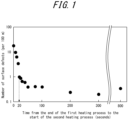
- the steel slab was first heated to 1200 °C (first heating process) and then heated to 1400 °C (second heating process). The time from the end of the first heating process to the start of the second heating process was varied.
- the oxygen concentration in the furnace was controlled to 0.1 % or less for both the first heating process and the second heating process.
- the surface of the steel slab for grain-oriented electrical steel sheet was subjected to water cooling for about 5 seconds at a cooling rate of 15 °C/s to lower the surface temperature of the steel slab by about 75 °C.
- the steel slab after the water cooling was subjected to hot rolling, which included rough rolling and finish rolling, to obtain a hot-rolled steel sheet with a thickness of 2.4 mm.
- pickling was performed to remove scale on the surface of the hot-rolled steel sheet.
- the hot-rolled steel sheet after the pickling was subjected to first cold rolling to obtain a thickness of 0.65 mm, and it was subjected to intermediate annealing at 1100 °C for 180 seconds and then to second cold rolling to obtain a cold-rolled steel sheet with a thickness of 0.27 mm.
- decarburization annealing was performed under conditions of 840 °C ⁇ 100 seconds, 50 % H 2 + 50 % N 2 , and a dew point of 54 °C.
- the surface of the steel sheet was applied with an annealing separator containing MgO as a main component, and the steel sheet was subjected to final annealing at 1200 °C for 20 hours in a H 2 atmosphere.
- a coating solution containing phosphate as a main component was applied, and the steel sheet was subjected to flattening annealing to bake the coating and flatten the steel sheet.
- the conditions for the flattening annealing were a temperature of 800 °C and an annealing time of 100 seconds.
- the number of surface defects, such as scratches, on the surface of the obtained grain-oriented electrical steel sheet was measured using an eddy current sensor. The measurement was performed on both sides of the grain-oriented electrical steel sheet and for the entire length and width, and the number of surface defects per 100 m length of the grain-oriented electrical steel sheet was determined.
- FIG. 1 illustrates the relationship between the time from the end of the first heating process to the start of the second heating process during the slab heating and the number of surface defects.
- the results in FIG. 1 indicate that the number of surface defects is significantly reduced when the time is 20 seconds or longer.
- a steel slab for grain-oriented electrical steel sheet containing, in mass%, 0.073 % of C, 2.89 % of Si, 0.09 % of Mn, and 0.022 % of Se was heated.
- the steel slab was first heated to 1250 °C (first heating process) and then heated to 1415 °C (second heating process).
- the time from the end of the first heating process to the start of the second heating process was 120 seconds, the oxygen concentration in the furnace in the first heating process was 0.2 %, and the oxygen concentration in the furnace in the second heating process was varied.
- the surface of the steel slab for grain-oriented electrical steel sheet was subjected to water cooling for about 7 seconds at a cooling rate of 5 °C/s to lower the surface temperature of the steel slab by about 35 °C.
- the steel slab after the water cooling was subjected to hot rolling, which included rough rolling and finish rolling, to obtain a hot-rolled steel sheet with a thickness of 2.4 mm.
- the obtained hot-rolled steel sheet was subjected to hot-rolled sheet annealing at 1000 °C for 15 seconds, and then pickling was performed to remove scale on the surface of the hot-rolled steel sheet.
- the hot-rolled steel sheet after the pickling was subjected to first cold rolling to obtain a thickness of 0.50 mm, and it was subjected to intermediate annealing at 1100 °C for 100 seconds and then to second cold rolling to obtain a cold-rolled steel sheet with a thickness of 0.23 mm.
- decarburization annealing was performed under conditions of 840 °C ⁇ 100 seconds, 55 % H 2 + 45 % N 2 , and a dew point of 62 °C.
- the surface of the steel sheet was applied with an annealing separator containing MgO as a main component, and the steel sheet was subjected to final annealing at 1250 °C for 5 hours in a H 2 atmosphere.
- a coating solution containing phosphate as a main component was applied, and the steel sheet was subjected to flattening annealing to bake the coating and flatten the steel sheet.
- the conditions for the flattening annealing were a temperature of 860 °C and an annealing time of 20 seconds.
- the number of surface defects, such as scratches, on the surface of the obtained grain-oriented electrical steel sheet was measured with the same method as in Experiment 1 above, and the number of surface defects per 100 m length of the grain-oriented electrical steel sheet was determined.
- FIG. 2 illustrates the relationship between the oxygen concentration in the atmosphere in the second heating process and the number of surface defects. The results in FIG. 2 indicate that the number of surface defects is significantly reduced when the oxygen concentration is 1.0 % or less.
- a steel slab for grain-oriented electrical steel sheet containing, in mass%, 0.073 % of C, 2.89 % of Si, 0.09 % of Mn, 0.019 % of Al, 0.006 % of N, and 0.018 % of Se was heated.
- the steel slab was first heated to 1150 °C (first heating process) and then heated to 1420 °C (second heating process). The time from the end of the first heating process to the start of the second heating process was 300 seconds.
- the oxygen concentration in the furnace was 0.05 % for both the first heating process and the second heating process.
- the surface of the steel slab for grain-oriented electrical steel sheet was subjected to water cooling for about 3 seconds at various cooling rates.
- the steel slab after the water cooling was subjected to hot rolling, which included rough rolling and finish rolling, to obtain a hot-rolled steel sheet with a thickness of 2.2 mm.
- the obtained hot-rolled steel sheet was subjected to hot-rolled sheet annealing at 1100 °C for 120 seconds, and then pickling was performed to remove scale on the surface of the hot-rolled steel sheet.
- the hot-rolled steel sheet after the pickling was subjected to first cold rolling to obtain a thickness of 1.8 mm, and it was subjected to intermediate annealing at 1100 °C for 120 seconds and then to second cold rolling to obtain a cold-rolled steel sheet with a thickness of 0.23 mm.
- decarburization annealing was performed under conditions of 840 °C ⁇ 180 seconds, 55 % H 2 + 45 % N 2 , and a dew point of 60 °C.
- the surface of the steel sheet was applied with an annealing separator containing MgO as a main component, and the steel sheet was subjected to final annealing at 1200 °C for 25 hours in a H 2 atmosphere.
- a coating solution containing phosphate as a main component was applied, and the steel sheet was subjected to flattening annealing to bake the coating and flatten the steel sheet.
- the conditions for the flattening annealing were a temperature of 850 °C and an annealing time of 120 seconds.
- the number of surface defects, such as scratches, on the surface of the obtained grain-oriented electrical steel sheet was measured with the same method as in Experiments 1 and 2 above, and the number of surface defects per 100 m length of the grain-oriented electrical steel sheet was determined.
- the magnetic flux density Bs (magnetic flux density when excited at a magnetizing force of 800 A/m) of the obtained grain-oriented electrical steel sheet was measured with a method in accordance with JIS C2550-1 (2011).
- FIG. 3 illustrates the relationship between the cooling rate in the water cooling performed after the second heating process and before the hot rolling, and the number of surface defects and B 8 . According to the results in FIG. 3 , it can be said that good magnetic properties and surface conditions can be obtained when the cooling rate is 3.0 °C/s or higher.
- the number of surface defects can be effectively reduced by dividing the heating of the steel slab into a first heating process and a second heating process, and by controlling the time from the end of the first heating process to the start of the second heating process and the oxygen concentration in the atmosphere in the second heating process. Further, it is found that good magnetic properties can be obtained by subjecting the surface of the steel slab for grain-oriented electrical steel sheet to water cooling at a cooling rate of 3.0 °C/s or higher after the second heating process and before the hot rolling.
- the surface of the steel slab is subjected to water cooling after the second heating process and before the hot rolling, which removes scale from the surface of the slab.
- the water cooling also keeps the grain size in the surface layer of the slab fine and increases the grain boundary compared to a case where the slab is not cooled. Strain tends to accumulate at the grain boundaries due to processing such as hot rolling, and the accumulation of strain promotes recrystallization during subsequent annealing, which is thought to improve the recrystallized texture before secondary recrystallization and improve the magnetic properties.
- the cooling rate is low, the amount of coolant is small, and the discharge rate is also low. As a result, the scale cannot be sufficiently removed, and surface defects increase.
- the structure of the surface layer of the slab is coarsened, and a band-like structure with little strain is formed after hot rolling, which is thought to suppress recrystallization and deteriorate the recrystallized texture. It is considered that in this case, the Goss orientation selectivity during secondary recrystallization is reduced, resulting in a reduced magnetic flux density.
- the number of surface defects in a grain-oriented electrical steel sheet can be reduced.
- a steel slab for grain-oriented electrical steel sheet (hereinafter may be simply referred to as "steel slab") is used as a starting material.
- the steel slab may be a steel slab of any chemical composition without particular limitation.
- the steel slab preferably contains the following components.
- “%” refers to “mass%” and “ppm” refers to “mass ppm”, respectively, unless otherwise specified.
- the C content is more than 0.10 %, it is difficult to reduce the C content in steel to 0.0035 % or less, where magnetic aging does not occur, even if decarburization annealing is performed. Therefore, the C content is preferably 0.10 % or less. The C content is more preferably 0.06 % or less. On the other hand, when the C content is less than 0.01 %, the grain boundary strengthening effect of C is lost, and defects such as cracks occur in the steel slab, which may hinder the operation. Therefore, the C content is preferably 0.01 % or more. The C content is more preferably 0.03 % or more.
- Si 2.0 % or more and 5.0 % or less
- Si is an effective element for increasing the specific resistance of steel and improving the iron loss properties.
- the Si content is preferably 2.0 % or more.
- the Si content is more preferably 3.0 % or more.
- the Si content is preferably 5.0 % or less.
- the Si content is more preferably 3.6 % or less.
- Mn 0.01 % or more and 0.50 % or less
- Mn is an effective element for improving hot workability.
- the Mn content is preferably 0.01 % or more.
- the Mn content is more preferably 0.03 % or more.
- the Mn content is more preferably 0.15 % or less.
- the chemical composition of the steel slab may further contain either or both of S and Se in a total amount of 0.005 % or more and 0.10 % or less.
- the chemical composition of the steel slab may further contain Al: 0.01 % or more and 0.04 % or less, and N: 0.003 % or more and 0.012 % or less.
- the contents of these elements are preferably as low as possible. Therefore, the lower limit of the contents of these elements may be 0 %.
- the contents of Al, N, S, and Se are more preferably in the following ranges.
- the chemical composition may further optionally contain at least one selected from the group consisting of
- the lower limit of the content is set to 0 %. However, from the viewpoint of increasing the effect of adding these elements, it is preferable to set the content of each of the elements equal to or higher than the following lower limit.
- the method of manufacturing the steel slab is not particularly limited, and the steel slab may be manufactured with any method.
- the steel slab can be manufactured by ingot casting or continuous casting using molten steel whose chemical composition has been adjusted to a predetermined chemical composition. It is also possible to manufacture a thin slab or thinner cast steel with a thickness of 100 mm or less by direct casting, and the thin slab or thinner cast steel can then be used as the steel slab.
- the steel slab for grain-oriented electrical steel sheet is heated.
- the heating of the steel slab for grain-oriented electrical steel sheet should include a first heating process of heating the steel slab for grain-oriented electrical steel sheet to a temperature of lower than 1300 °C, and a second heating process of heating the steel slab for grain-oriented electrical steel sheet to a temperature of 1300 °C or higher, where the time from the end of the first heating process to the start of the second heating process is 20 seconds or longer.
- the time from the end of the first heating process to the start of the second heating process is shorter than 20 seconds, the number of surface defects cannot be sufficiently reduced.
- the lower limit of the heating temperature in the first heating process is not particularly limited, but it is preferable to set the temperature to 1100 °C or higher to obtain a uniform microstructure.
- the upper limit of the heating temperature in the second heating process is not particularly limited, but it is preferable to set the temperature to 1460 °C or lower because the slab begins to melt when the temperature exceeds the melting point.
- the upper limit of the time from the end of the first heating process to the start of the second heating process is not particularly limited, it is preferable to set the time to 1200 seconds or shorter to suppress a drop in temperature and reduce the load of the second heating process.
- the oxygen concentration in the atmosphere in the second heating process should be 1.0 % or less.
- the oxygen concentration is desirably as low as possible. Therefore, the lower limit of the oxygen concentration is not particularly limited, and it may be 0 %.
- the oxygen concentration in the atmosphere in the first heating process is not particularly limited, the oxygen concentration in the atmosphere in the first heating process is also preferably 1.0 % or less from the viewpoint of further suppressing the occurrence of surface defect.
- the oxygen concentration is desirably as low as possible. Therefore, the lower limit of the oxygen concentration is not particularly limited, and it may be 0 %.
- the steel slab for grain-oriented electrical steel sheet is preferably arranged so that the under surface of the steel slab for grain-oriented electrical steel sheet in the first heating process is not the under surface in the second heating process.
- the steel slab is supported from the underside by a support member, such as a transfer skid, during the heating process. Therefore, surface defects are likely to occur on the under surface of the steel slab which is in contact with the support member.
- a support member such as a transfer skid
- the surface of the steel slab for grain-oriented electrical steel sheet is subjected to water cooling at a cooling rate of 3.0 °C/s or higher.
- the cooling rate is desirably as high as possible from the viewpoint of reducing surface defects and improving magnetic properties, so that the upper limit of the cooling rate is not particularly limited.
- the cooling rate is preferably 300 °C/s or lower from the viewpoint of equipment cost.
- the time for water cooling is not particularly limited, but it is preferably 0.5 seconds or longer from the viewpoint of enhancing the effect of water cooling. Water cooling for longer than 15.0 seconds may excessively cool the surface temperature of the slab and cause cracks. Therefore, the time for water cooling is preferably 15.0 seconds or shorter.
- the range of decrease in the surface temperature of the steel slab during the water cooling is not particularly limited. However, from the viewpoint of reducing the load in the subsequent hot rolling, it is preferably 200 °C or less, more preferably 150 °C or less, and even more preferably 100 °C or less.
- the steel slab is subjected to hot rolling to obtain a hot-rolled steel sheet.
- the hot rolling can be performed under any conditions. From the viewpoint of controlling the microstructure of the hot-rolled steel sheet, it is preferable to perform at least one pass of rough rolling at 1100 °C or higher and 1300 °C or lower and then perform at least two passes of finish rolling at 800 °C or higher and 1100 °C or lower during the hot rolling.
- the obtained hot-rolled steel sheet may be coiled into a coil shape.
- the coiling temperature is preferably 400 °C or higher during the coiling.
- the coiling temperature is preferably 750 °C or lower.
- the coiling temperature is more preferably 500 °C or higher.
- the coiling temperature is more preferably 700 °C or lower.
- the annealing temperature is preferably 800 °C or higher during the hot-rolled sheet annealing.
- the annealing temperature is preferably 1250 °C or lower.
- the annealing temperature is more preferably 900 °C or higher.
- the annealing temperature is more preferably 1150 °C or lower.
- the holding time is preferably 5 seconds or longer.
- the holding time is more preferably 10 seconds or longer.
- the holding time is more preferably 180 seconds or shorter.
- the steel sheet may be cooled.
- the cooling rate in a temperature range of 800 °C to 350 °C is preferably 5 °C/s or higher.
- the cooling rate is preferably 100 °C/s or lower.
- the cooling rate is more preferably 15 °C/s or higher.
- the cooling rate is more preferably 45 °C/s or lower.
- the method of descaling is not particularly limited, and any method may be used. Examples thereof include a method using heated acid and a method of mechanically removing scale.
- the hot-rolled steel sheet is subjected to cold rolling once, or twice or more with intermediate annealing performed therebetween, to obtain a cold-rolled steel sheet.
- the cold rolling can be performed under any conditions.
- the total rolling reduction in the last cold rolling of the cold rolling process (hereinafter referred to as "final cold rolling") is preferably 50 % or more.
- the total rolling reduction is preferably 92 % or less.
- the cooling rate from 800 °C to 350 °C is preferably 5 °C/s or higher during cooling after the holding.
- the cooling rate is preferably 100 °C/s or lower.
- the cooling rate is more preferably 15 °C/s or higher.
- the cooling rate is more preferably 45 °C/s or lower.
- the rolled steel sheet may be coated with rolling oil. Therefore, in the case of performing intermediate annealing, it is preferable to perform degreasing prior to the intermediate annealing to remove the rolling oil. After the intermediate annealing, it is preferable to perform descaling to remove the scale formed on the surface of the steel sheet.
- the method of descaling is not particularly limited, and any method may be used. Examples thereof include a method using heated acid and a method of mechanically removing scale.
- the obtained cold-rolled steel sheet is preferably subjected to either or both of degreasing and pickling prior to the subsequent decarburization annealing to clean the surface.
- the decarburization annealing can be performed under any conditions. In the decarburization annealing, it is preferable to hold the steel sheet in a temperature range of 750 °C or higher and 950 °C or lower for at least 10 seconds, and it is more preferable to hold the steel sheet in a temperature range of 800 °C or higher and 900 °C or lower for at least 10 seconds.
- the decarburization annealing is preferably performed in a wet atmosphere containing H 2 and N 2 . In part or all of the decarburization annealing, the dew point of the wet atmosphere is preferably 20 °C or higher. The dew point is preferably 80 °C or lower. The dew point is more preferably 40 °C or higher. The dew point is more preferably 70 °C or lower.
- an annealing separator is applied to the surface of the cold-rolled steel sheet after the decarburization annealing.
- Any annealing separator may be used without any particular limitation.
- the annealing separator is preferably, for example, an annealing separator containing MgO, and it is more preferably an annealing separator containing MgO as a main component.
- the content of MgO in the annealing separator is preferably 60 mass% or more.
- the application of the annealing separator is not particularly limited, it is generally preferable to apply it to both surfaces of the cold-rolled steel sheet.
- the amount of the annealing separator applied is not particularly limited, but the amount of the annealing separator applied to each surface is preferably 2.5 g/m 2 or more.
- the upper limit of the amount is not particularly limited, but the amount of the annealing separator applied to each surface is preferably 15.0 g/m 2 or less.
- the annealing separator may be applied with a wet method or a dry method.
- a wet method for example, a slurry containing MgO can be applied.
- the annealing separator can be applied by electrostatic coating.
- the cold-rolled steel sheet applied with the annealing separator is subjected to final annealing to develop secondary recrystallized grains and form a forsterite film.
- the final annealing can be performed under any conditions.
- the final annealing is typically performed with the cold-rolled steel sheet, on which the annealing separator has been applied, coiled. Since the final annealing generally takes a long time, it is preferable to upend the coil during the annealing. As used herein, the "upend" means that the central axis of the coil is made in the vertical direction. Further, it is preferable to wind a band or the like around the coil to prevent the coil from unwinding during the annealing.
- the annealing temperature in the final annealing is preferably 800 °C or higher. Further, from the viewpoint of sufficient formation of forsterite film, the annealing temperature is preferably 1050 °C or higher. On the other hand, the upper limit of the annealing temperature in the final annealing is not particularly limited. However, the annealing temperature is preferably 1300 °C or lower from the viewpoint of preventing coil buckling.
- the final annealing can also serve as purification annealing to remove inhibitor-forming elements and other substances from the steel.
- the steel sheet is preferable to hold the steel sheet at an annealing temperature of 1050 °C or higher and 1300 °C or lower for at least 3 hours. In this case, it is preferable to introduce an atmosphere containing H 2 in part or all of the temperature range of 800 °C or higher.
- the annealing separator can be removed by, for example, water washing, brushing, or pickling.
- the grain-oriented electrical steel sheet it is preferable to further subject the grain-oriented electrical steel sheet to flattening annealing after the final annealing.
- the insulating coating is preferably a tension coating capable of imparting tension to the steel sheet.
- the method of forming the insulating coating is not particularly limited, and any method may be used.
- an insulating coating can be formed by applying a coating solution to the surface of the grain-oriented electrical steel sheet and baking it.
- the coating solution may be applied before flattening annealing and baked by flattening annealing.
- the insulating coating may be provided via a binder. From the same point of view, it is also possible to vapor-deposit an inorganic material on the surface layer of the steel sheet with a physical vapor deposition method or a chemical vapor deposition method to form an insulating coating.
- a steel slab for grain-oriented electrical steel sheet containing, in mass%, 0.055 % of C, 3.08 % of Si, 0.05 % of Mn, and 0.025 % of Se was heated.
- the steel slab was first heated to 1270 °C (first heating process) and then heated to 1430 °C (second heating process).
- the time from the end of the first heating process to the start of the second heating process was varied as listed in Table 1.
- the oxygen concentration in the atmosphere in the first heating process was 0.04 %, and the oxygen concentration in the atmosphere in the second heating process was varied as listed in Table 1.
- the surface of the steel slab for grain-oriented electrical steel sheet was subjected to water cooling for about 3 seconds.
- the water cooling was performed at various cooling rates as listed in Table 1.
- the steel slab after the water cooling was subjected to hot rolling, which included rough rolling and finish rolling, to obtain a hot-rolled steel sheet with a thickness of 2.0 mm.
- pickling was performed to remove scale on the surface of the hot-rolled steel sheet.
- the hot-rolled steel sheet after the pickling was subjected to first cold rolling to obtain a thickness of 0.48 mm, and it was subjected to intermediate annealing at 1020 °C for 180 seconds and then to second cold rolling to obtain a cold-rolled steel sheet with a thickness of 0.23 mm.
- the cold-rolled steel sheet was subjected to decarburization annealing under conditions of 840 °C ⁇ 120 seconds, 45 % H 2 + 55 % N 2 , and a dew point of 50 °C.
- the surface of the steel sheet was applied with an annealing separator containing MgO as a main component, and the steel sheet was subjected to final annealing at 1200 °C for 10 hours in a H 2 atmosphere.
- a coating solution mainly composed of phosphate was applied, and the steel sheet was subjected to flattening annealing to bake the coating and flatten the steel sheet.
- the conditions for the flattening annealing were an annealing temperature of 870 °C and an annealing time of 20 seconds.
- the number of surface defects, such as scratches, on the surface of the obtained grain-oriented electrical steel sheet was measured using an eddy current sensor. The measurement was performed for the entire length and width of the grain-oriented electrical steel sheet, and the number of surface defects per 100 m length of the grain-oriented electrical steel sheet was determined. The measurement results are listed in Table 1.
- the magnetic flux density Bs (magnetic flux density when excited at a magnetizing force of 800 A/m) of the obtained grain-oriented electrical steel sheet was measured with a method in accordance with JIS C2550-1 (2011). The measurement results are listed in Table 1.
- a steel slab for grain-oriented electrical steel sheet containing, in mass%, 0.027 % of C, 3.25 % of Si, 0.10 % of Mn, 0.009 % of Se, 0.005 % of S, 0.025 % of Al, and 0.009 % of N was heated.
- the steel slab was first heated to 1200 °C (first heating process) and then heated to 1400 °C (second heating process).
- the time from the end of the first heating process to the start of the second heating process was varied as listed in Table 2.
- the oxygen concentration in the atmosphere in the first heating process was 0.04 %, and the oxygen concentration in the atmosphere in the second heating process was 0.03 %.
- Examples No. 37 to 41 the direction of the steel slab was not changed between the first heating process and the second heating process.
- the steel slab was arranged so that the under surface of the steel slab in the first heating process was also the under surface in the second heating process.
- the direction of the steel slab was changed between the first heating process and the second heating process. Specifically, the steel slab was arranged so that the under surface of the steel slab in the first heating process became the side surface in the second heating process.
- the surface of the steel slab for grain-oriented electrical steel sheet was subjected to water cooling for 1.5 seconds at a cooling rate of 100 °C/s.
- the steel slab after the water cooling was subjected to hot rolling, which included rough rolling and finish rolling, to obtain a hot-rolled steel sheet with a thickness of 3.0 mm.
- pickling was performed to remove scale on the surface of the hot-rolled steel sheet, and then hot-rolled sheet annealing was performed at 975 °C for 10 seconds.
- the hot-rolled steel sheet after the pickling was subjected to first cold rolling to obtain a thickness of 1.6 mm, and it was subjected to intermediate annealing at 1150 °C for 20 seconds and then to second cold rolling to obtain a cold-rolled steel sheet with a thickness of 0.23 mm.
- decarburization annealing was performed under conditions of 840 °C ⁇ 9 seconds, 50 % H 2 + 50 % N 2 , and a dew point of 50 °C.
- the surface of the steel sheet was applied with an annealing separator containing MgO as a main component, and the steel sheet was subjected to final annealing at 1200 °C for 10 hours in a H 2 atmosphere.
- a coating solution mainly composed of phosphate was applied, and the steel sheet was subjected to flattening annealing at 870 °C for 20 seconds to bake the coating and flatten the steel sheet.
- the number of surface defects and the magnetic flux density Bs of the obtained grain-oriented electrical steel sheet were measured in the same manner as in Example 1. The measurement results are listed in Table 2.
- the results listed in Table 2 indicate that according to the method of the present disclosure, it is possible to obtain a grain-oriented electrical steel sheet with excellent magnetic properties and few surface defects. Especially, it is understood that, when the steel slab for grain-oriented electrical steel sheet is arranged so that the under surface of the steel slab for grain-oriented electrical steel sheet in the first heating process is not the under surface in the second heating process, the number of surface defects can be further reduced.
Landscapes
- Chemical & Material Sciences (AREA)
- Engineering & Computer Science (AREA)
- Physics & Mathematics (AREA)
- Metallurgy (AREA)
- Organic Chemistry (AREA)
- Mechanical Engineering (AREA)
- Materials Engineering (AREA)
- Crystallography & Structural Chemistry (AREA)
- Thermal Sciences (AREA)
- Electromagnetism (AREA)
- Manufacturing & Machinery (AREA)
- Dispersion Chemistry (AREA)
- Power Engineering (AREA)
- General Chemical & Material Sciences (AREA)
- Chemical Kinetics & Catalysis (AREA)
- Manufacturing Of Steel Electrode Plates (AREA)
- Soft Magnetic Materials (AREA)
Applications Claiming Priority (2)
| Application Number | Priority Date | Filing Date | Title |
|---|---|---|---|
| JP2021090680 | 2021-05-28 | ||
| PCT/JP2022/021831 WO2022250158A1 (fr) | 2021-05-28 | 2022-05-27 | Procédé de production de tôle d'acier électromagnétique à grains orientés |
Publications (2)
| Publication Number | Publication Date |
|---|---|
| EP4335936A1 true EP4335936A1 (fr) | 2024-03-13 |
| EP4335936A4 EP4335936A4 (fr) | 2024-10-30 |
Family
ID=84228952
Family Applications (1)
| Application Number | Title | Priority Date | Filing Date |
|---|---|---|---|
| EP22811426.0A Pending EP4335936A4 (fr) | 2021-05-28 | 2022-05-27 | Procédé de production de tôle d'acier électromagnétique à grains orientés |
Country Status (6)
| Country | Link |
|---|---|
| US (1) | US20240368717A1 (fr) |
| EP (1) | EP4335936A4 (fr) |
| JP (1) | JP7264322B1 (fr) |
| KR (1) | KR20230169261A (fr) |
| CN (1) | CN117377784A (fr) |
| WO (1) | WO2022250158A1 (fr) |
Family Cites Families (13)
| Publication number | Priority date | Publication date | Assignee | Title |
|---|---|---|---|---|
| DE1252220B (fr) | 1963-04-05 | 1968-04-25 | ||
| JPS5113469B2 (fr) | 1972-10-13 | 1976-04-28 | ||
| JPS60145318A (ja) * | 1984-01-09 | 1985-07-31 | Kawasaki Steel Corp | 方向性けい素鋼スラブの加熱方法 |
| JPS61284522A (ja) * | 1985-06-10 | 1986-12-15 | Kawasaki Steel Corp | 表面性状の優れた低鉄損一方向性珪素鋼板の製造方法 |
| JP2863351B2 (ja) * | 1991-08-19 | 1999-03-03 | 新日本製鐵株式会社 | 方向性電磁鋼スラブの加熱方法 |
| JPH0818045B2 (ja) * | 1991-08-19 | 1996-02-28 | 新日本製鐵株式会社 | 方向性電磁鋼スラブの熱間圧延方法 |
| JPH06207221A (ja) * | 1993-01-07 | 1994-07-26 | Kawasaki Steel Corp | 表面性状の優れた方向性けい素鋼板の製造方法 |
| JP3612717B2 (ja) * | 1993-08-05 | 2005-01-19 | Jfeスチール株式会社 | 方向性けい素鋼板の製造方法 |
| JP3707268B2 (ja) | 1998-10-28 | 2005-10-19 | Jfeスチール株式会社 | 方向性電磁鋼板の製造方法 |
| JP2002129238A (ja) * | 2000-10-25 | 2002-05-09 | Nippon Steel Corp | 一方向性電磁鋼板の安定製造方法 |
| JP4085975B2 (ja) * | 2003-12-17 | 2008-05-14 | Jfeスチール株式会社 | 熱間圧延方法 |
| JP4015644B2 (ja) | 2004-05-31 | 2007-11-28 | 株式会社ソニー・コンピュータエンタテインメント | 画像処理装置及び画像処理方法 |
| EP3913092B1 (fr) * | 2019-01-16 | 2024-04-10 | Nippon Steel Corporation | Tôle d'acier électrique à grains orientés et son procédé de fabrication |
-
2022
- 2022-05-27 US US18/561,053 patent/US20240368717A1/en active Pending
- 2022-05-27 CN CN202280037044.4A patent/CN117377784A/zh active Pending
- 2022-05-27 WO PCT/JP2022/021831 patent/WO2022250158A1/fr not_active Ceased
- 2022-05-27 JP JP2022571892A patent/JP7264322B1/ja active Active
- 2022-05-27 EP EP22811426.0A patent/EP4335936A4/fr active Pending
- 2022-05-27 KR KR1020237038674A patent/KR20230169261A/ko active Pending
Also Published As
| Publication number | Publication date |
|---|---|
| JPWO2022250158A1 (fr) | 2022-12-01 |
| WO2022250158A1 (fr) | 2022-12-01 |
| CN117377784A (zh) | 2024-01-09 |
| JP7264322B1 (ja) | 2023-04-25 |
| KR20230169261A (ko) | 2023-12-15 |
| EP4335936A4 (fr) | 2024-10-30 |
| US20240368717A1 (en) | 2024-11-07 |
Similar Documents
| Publication | Publication Date | Title |
|---|---|---|
| KR102254944B1 (ko) | 방향성 전자 강판의 제조 방법 | |
| KR102251592B1 (ko) | 방향성 전자 강판의 제조 방법 | |
| US11286538B2 (en) | Method for manufacturing grain-oriented electrical steel sheet | |
| JP7338812B1 (ja) | 方向性電磁鋼板の製造方法 | |
| JP7517472B2 (ja) | 方向性電磁鋼板の製造方法 | |
| EP4353849A1 (fr) | Procédé de fabrication de feuille d'acier électromagnétique à grains orientés | |
| JP7226678B1 (ja) | 方向性電磁鋼板の製造方法 | |
| WO2020149351A1 (fr) | Procédé de fabrication de tôle d'acier électrique à grains orientés | |
| JP6418226B2 (ja) | 方向性電磁鋼板の製造方法 | |
| EP4335936A1 (fr) | Procédé de production de tôle d'acier électromagnétique à grains orientés | |
| JP2018090851A (ja) | 方向性電磁鋼板の製造方法 | |
| JP5310510B2 (ja) | 方向性電磁鋼板の製造方法 | |
| EP4335935A1 (fr) | Procédé de production de tôle d'acier électromagnétique à grains orientés | |
| JP6607176B2 (ja) | 方向性電磁鋼板の製造方法 | |
| JP7255761B1 (ja) | 方向性電磁鋼板の製造方法 | |
| JPH10251754A (ja) | 無方向性電磁鋼板の製造方法 | |
| EP4335939A1 (fr) | Procédé destiné à la fabrication d'une tôle d'acier électrique à grains orientés | |
| EP4335937A1 (fr) | Procédé de production d'une feuille d'acier électrique à grains orientés | |
| KR20240004678A (ko) | 방향성 전자 강판의 제조 방법 | |
| CN118176311A (zh) | 取向性电磁钢板的制造方法和取向性电磁钢板 |
Legal Events
| Date | Code | Title | Description |
|---|---|---|---|
| STAA | Information on the status of an ep patent application or granted ep patent |
Free format text: STATUS: THE INTERNATIONAL PUBLICATION HAS BEEN MADE |
|
| PUAI | Public reference made under article 153(3) epc to a published international application that has entered the european phase |
Free format text: ORIGINAL CODE: 0009012 |
|
| STAA | Information on the status of an ep patent application or granted ep patent |
Free format text: STATUS: REQUEST FOR EXAMINATION WAS MADE |
|
| 17P | Request for examination filed |
Effective date: 20231207 |
|
| AK | Designated contracting states |
Kind code of ref document: A1 Designated state(s): AL AT BE BG CH CY CZ DE DK EE ES FI FR GB GR HR HU IE IS IT LI LT LU LV MC MK MT NL NO PL PT RO RS SE SI SK SM TR |
|
| DAV | Request for validation of the european patent (deleted) | ||
| DAX | Request for extension of the european patent (deleted) | ||
| A4 | Supplementary search report drawn up and despatched |
Effective date: 20241001 |
|
| RIC1 | Information provided on ipc code assigned before grant |
Ipc: C23C 22/74 20060101ALN20240925BHEP Ipc: C23C 22/08 20060101ALN20240925BHEP Ipc: C22C 38/60 20060101ALN20240925BHEP Ipc: C22C 38/34 20060101ALN20240925BHEP Ipc: C22C 38/32 20060101ALN20240925BHEP Ipc: C22C 38/16 20060101ALN20240925BHEP Ipc: C22C 38/14 20060101ALN20240925BHEP Ipc: C22C 38/12 20060101ALN20240925BHEP Ipc: C22C 38/10 20060101ALN20240925BHEP Ipc: C22C 38/08 20060101ALN20240925BHEP Ipc: C22C 38/06 20060101ALN20240925BHEP Ipc: C22C 38/04 20060101ALN20240925BHEP Ipc: C22C 38/02 20060101ALN20240925BHEP Ipc: C22C 38/00 20060101ALN20240925BHEP Ipc: H01F 1/16 20060101ALI20240925BHEP Ipc: C21D 9/46 20060101ALI20240925BHEP Ipc: C21D 1/76 20060101ALI20240925BHEP Ipc: C21D 8/12 20060101AFI20240925BHEP |