EP4336419A1 - Dispositif d'entraînement, procédé d'entraînement, et programme d'entraînement - Google Patents
Dispositif d'entraînement, procédé d'entraînement, et programme d'entraînement Download PDFInfo
- Publication number
- EP4336419A1 EP4336419A1 EP21946062.3A EP21946062A EP4336419A1 EP 4336419 A1 EP4336419 A1 EP 4336419A1 EP 21946062 A EP21946062 A EP 21946062A EP 4336419 A1 EP4336419 A1 EP 4336419A1
- Authority
- EP
- European Patent Office
- Prior art keywords
- learning
- model
- parameter
- noise
- data
- Prior art date
- Legal status (The legal status is an assumption and is not a legal conclusion. Google has not performed a legal analysis and makes no representation as to the accuracy of the status listed.)
- Pending
Links
Images




Classifications
-
- G—PHYSICS
- G06—COMPUTING OR CALCULATING; COUNTING
- G06N—COMPUTING ARRANGEMENTS BASED ON SPECIFIC COMPUTATIONAL MODELS
- G06N3/00—Computing arrangements based on biological models
- G06N3/02—Neural networks
- G06N3/08—Learning methods
- G06N3/094—Adversarial learning
-
- G—PHYSICS
- G06—COMPUTING OR CALCULATING; COUNTING
- G06N—COMPUTING ARRANGEMENTS BASED ON SPECIFIC COMPUTATIONAL MODELS
- G06N20/00—Machine learning
-
- G—PHYSICS
- G06—COMPUTING OR CALCULATING; COUNTING
- G06N—COMPUTING ARRANGEMENTS BASED ON SPECIFIC COMPUTATIONAL MODELS
- G06N3/00—Computing arrangements based on biological models
- G06N3/02—Neural networks
- G06N3/04—Architecture, e.g. interconnection topology
- G06N3/047—Probabilistic or stochastic networks
-
- G—PHYSICS
- G06—COMPUTING OR CALCULATING; COUNTING
- G06N—COMPUTING ARRANGEMENTS BASED ON SPECIFIC COMPUTATIONAL MODELS
- G06N3/00—Computing arrangements based on biological models
- G06N3/02—Neural networks
- G06N3/08—Learning methods
- G06N3/088—Non-supervised learning, e.g. competitive learning
-
- G—PHYSICS
- G06—COMPUTING OR CALCULATING; COUNTING
- G06N—COMPUTING ARRANGEMENTS BASED ON SPECIFIC COMPUTATIONAL MODELS
- G06N3/00—Computing arrangements based on biological models
- G06N3/02—Neural networks
- G06N3/08—Learning methods
- G06N3/09—Supervised learning
-
- G—PHYSICS
- G06—COMPUTING OR CALCULATING; COUNTING
- G06N—COMPUTING ARRANGEMENTS BASED ON SPECIFIC COMPUTATIONAL MODELS
- G06N7/00—Computing arrangements based on specific mathematical models
- G06N7/01—Probabilistic graphical models, e.g. probabilistic networks
Definitions
- the present invention relates to a learning device, a learning method, and a learning program for a model.
- the model learned in the adversarial training has a problem that the generalization performance is low. This is due to the fact that a loss landscape (the shape of a loss function) is sharpened to a weight of the model learned by the adversarial training. Accordingly, in order to flatten the loss landscape, there is a technique of adding noise (perturbation) to a weight in a direction in which a loss of a model is maximized.
- a loss landscape the shape of a loss function
- a task of the present invention is to solve the foregoing problem and learn a method capable of predicting data with no noise with high accuracy while guaranteeing robustness against an adversarial example.
- a learning device includes: a data acquisition unit configured to acquire learning data of a model predicting a label of input data including an adversarial example; and a learning unit configured to perform learning of the model using a loss function that flattens a loss landscape with respect to a parameter by adding noise in which KL divergence of a loss value in the model becomes maximum to the parameter and learning data including the adversarial example when the noise is added to the parameter of the model and when the noise is not added.
- a learning device executes a model of predicting a label of input data using data including an adversarial example (data to which noise is added).
- the learning device uses a loss function that flattens a loss landscape with respect to a parameter by adding noise in which KL divergence of a loss value in the model becomes maximum to the parameter when the noise is added to the parameter of a model serving as a loss function used for learning a model and when the noise is not added.
- the learning device can learn a model capable of predicting a label with high accuracy even for data with no noise while guaranteeing robustness against an adversarial example.
- the learning device 10 includes, for example, an input unit 11, an output unit 12, a communication control unit 13, a storage unit 14, and a control unit 15.
- the input unit 11 is an interface that receives an input of various types of data.
- the input unit 11 accepts an input of data used for learning processing and prediction processing to be described below.
- the output unit 12 is an interface that outputs various types of data.
- the output unit 12 outputs a label of data predicted by the control unit 15.
- the communication control unit 13 is implemented as a network interface card (NIC) or the like and controls communication with the control unit 15 and an external device such as a server via a network.
- the communication control unit 13 controls communication between the control unit 15 and a management device which manages learning target data.
- the storage unit 14 is implemented by a semiconductor memory device such as a random access memory (RAM) or a flash memory, or a storage device such as a hard disk or an optical disc, and stores a parameter and the like of a model learned by learning processing to be described below.
- a semiconductor memory device such as a random access memory (RAM) or a flash memory
- a storage device such as a hard disk or an optical disc
- the control unit 15 is implemented, for example, using a central processing unit (CPU) or the like and executes a processing program stored in the storage unit 14. Accordingly, as exemplified in Fig. 1 , the control unit 15 functions as an acquisition unit 15a, a learning unit 15b, and a prediction unit 15c.
- CPU central processing unit
- the control unit 15 functions as an acquisition unit 15a, a learning unit 15b, and a prediction unit 15c.
- the acquisition unit 15a acquires data used for learning processing and detection processing to be described below via the input unit 11 or the communication control unit 13.
- the learning unit 15b learns a model predicting a label of input data by using data including an adversarial example as learning data.
- the learning unit 15b uses, as a loss function used for learning of a model, a loss function that flattens a loss landscape with respect to a parameter by adding noise in which KL divergence of a loss value in the model becomes maximum to the parameter when the noise is added to the parameter of the model and when the noise is not added.
- a learning target model is a model indicating a probability distribution of a label y of data x and is indicated by Expression (1) using a parameter ⁇ .
- f denotes a vector indicating a label output by the model.
- the learning unit 15b performs learning of the model by determining the parameter ⁇ of the model such that a value of a loss function expressed in Expression (2) decreases.
- l x y ⁇ p y
- the learning unit 15b learns the model so that the label can be correctly predicted even for an adversarial example (see Expression (3)) in which the data x has noise ⁇ . That is, the learning unit 15b performs adversarial training expressed in Expression (4).
- [Math. 3] max ⁇ E x , y ⁇ p x y l x + ⁇ , y ; ⁇
- [Math. 4] min ⁇ max ⁇ E x , y ⁇ p x y l x + ⁇ , y ; ⁇
- a is defined as in the following Expression (7) so that noise (perturbation) in the scale of w for each filter is obtained.
- k is an index of the filter.
- the Fisher information matrix Since the Fisher information matrix is huge, it takes too much time to divide eigenvalues into negative numbers. Therefore, the maximum eigenvalue is calculated, for example, using power iteration. When the Fisher information matrix is calculated, it is necessary to calculate the following. ⁇ ⁇ w log p ⁇ y
- the learning unit 15b learns a model for predicting a label of input data using learning data including an adversarial example and the loss function. That is, the learning unit 15b obtains the parameter ⁇ of a model for minimizing a loss calculated by the foregoing loss function using the learning data.
- the prediction unit 15c predicts the label of the input data using the learned model. For example, the prediction unit 15c calculate a probability of each label of newly acquired data by applying the learned parameter ⁇ to Expression (1) and outputs the label with the highest probability. Accordingly, the learning device 10 can output a correct label, for example, even when the input data is an adversarial example.
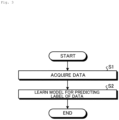
- FIG. 3 An example of a learning processing procedure by the learning device 10 according to the present embodiment will be described with reference to Fig. 3 .
- the processing illustrated in Fig. 3 starts at a timing at which an input operation of giving an instruction to start the learning processing is performed.
- the acquisition unit 15a acquires learning data including an adversarial example (S1). Then, the learning unit 15b learns a model indicating a probability distribution of the label of the input data using the learning data and the loss function (S2).
- the loss function is a loss function that flattens a loss landscape with respect to a parameter by adding noise in which KL divergence of a loss value in the model becomes maximum to the parameter when the noise is added to the parameter of the model and when the noise is not added.
- the learning unit 15b stores the parameter of the model learned in S2 in the storage unit 14.
- FIG. 4 An example of prediction processing of the label of the input data by the learning device 10 will be described with reference to Fig. 4 .
- the processing illustrated in Fig. 4 starts, for example, at a timing at which an input operation of giving an instruction to start the prediction processing is performed.
- the acquisition unit 15a acquires data of a label prediction target (S11).
- the prediction unit 15c predicts the label of the data acquired in S11 using the model learned by the learning unit 15b (S12).
- the prediction unit 15c calculates p (x') of data x' acquired in S11 by applying the learned parameter ⁇ to Expression (1) and outputs a label with the highest probability.
- the learning device 10 can output a correct label.
- the learning device 10 may be applied to data abnormality detection.
- An application example of this case will be described with reference to Fig. 5 .
- a case where the function of the prediction unit 15c is installed in the detection device 20 will be described as an example.
- the learning device 10 performs model learning (adversarial training) using teacher data (learning data) acquired from a data acquisition device and the loss function. After that, when acquiring new data x from the data acquisition device, the detection device 20 calculates p (x') of the data x by using the learned model. Then, the detection device 20 outputs a report regarding whether the data x is abnormal data or not on the basis of the label having the highest probability.
- a result of an evaluation experiment for prediction accuracy of a label by the model learned by the learning device 10 according to the embodiment is illustrated in Fig. 6 .
- robust acc and natural acc were evaluated for the model learned by the learning device 10 according to the embodiment.
- robust acc is a value indicating classification accuracy (prediction accuracy of the label of the data) of data with adversarial example.
- natural acc is a value indicating classification accuracy of data with no noise. Both robust acc and natural acc take a value of 0 to 100.
- Comparison targets are a model learned by AT and a model a model learned by AWP. Experiment conditions are as follows.
- the model learned by the learning device 10 has higher values of robust acc and natural acc than those of a model learned by AT.
- the model learned by the learning device 10 according to the embodiment has a slightly lower value of robust acc and a considerably higher value of natural acc than those of the model learned by AWP.
- the model learned by the learning device 10 is a model capable of accurately predicting even data with no noise while guaranteeing robustness against the adversarial example.
- each constituent of each of the illustrated units is simply functionally conceptual and need not necessarily be physically configured as illustrated in the drawings. That is, specific forms of distribution and integration of each device are not limited to the form illustrated in the drawings, and some or all of the forms be functionally or physically distributed or integrated in any unit depending on various loads, usage situations, or the like. Further, some or all of the units of each processing function performed in each device can be implemented by a CPU and a program executed by the CPU, or can be implemented as hardware by a wired logic.
- the foregoing learning device 10 can be implemented by installing a program as package software or on-line software in a desired computer. For example, by causing an information processing device to execute the foregoing program, the information processing device can be caused to function as the learning device 10.
- the information processing device mentioned here includes a desktop or laptop personal computer.
- the information processing device includes a mobile communication terminal such as a smartphone, a mobile phone, and a personal handyphone system (PHS) and a terminal such as a personal digital assistant (PDA) in the category.
- PHS personal handyphone system
- PDA personal digital assistant
- the learning device 10 can also be implemented as a server device that uses a terminal device used by a user as a client and provides services related to the foregoing processing to the client.
- the server device may be implemented as a web server or may be implemented as a cloud that provides services related to the foregoing processes by outsourcing.
- FIG. 7 is a diagram illustrating an example of a computer that executes a learning program.
- a computer 1000 includes, for example, a memory 1010 and a CPU 1020.
- the computer 1000 also includes a hard disk drive interface 1030, a disk drive interface 1040, a serial port interface 1050, a video adapter 1060, and a network interface 1070. These units are connected to each other via a bus 1080.
- the memory 1010 includes a read only memory (ROM) 1011 and a random access memory (RAM) 1012.
- the ROM 1011 stores, for example, a boot program such as a Basic Input Output System (BIOS).
- BIOS Basic Input Output System
- the hard disk drive interface 1030 is connected to the hard disk drive 1090.
- the disk drive interface 1040 is connected to a disk drive 1100.
- a removable storage medium such as a magnetic disk or an optical disc is inserted into the disk drive 1100.
- the serial port interface 1050 is connected to, for example, a mouse 1110 and a keyboard 1120.
- the video adapter 1060 is connected to, for example, a display 1130.
- the hard disk drive 1090 stores, for example, an OS 1091, an application program 1092, a program module 1093, and program data 1094. That is, a program defining each processing executed by the foregoing learning device 10 is mounted as the program module 1093 in which codes that can be executed by a computer are described.
- the program module 1093 is stored in, for example, the hard disk drive 1090.
- the program module 1093 executing similar processing to the functional configuration of the learning device 10 is stored in the hard disk drive 1090.
- the hard disk drive 1090 may be replaced with a solid-state drive (SSD).
- Data used for the processing of the above-described embodiment is stored, for example, in the memory 1010 or the hard disk drive 1090 as the program data 1094.
- the CPU 1020 reads the program module 1093 and the program data 1094 stored in the memory 1010 or the hard disk drive 1090 onto the RAM 1012 and executes them as necessary.
- the program module 1093 and the program data 1094 are not limited to being stored in the hard disk drive 1090 and may also be stored in, for example, a removable storage medium and may be read out by the CPU 1020 via the disk drive 1100 or the like. Alternatively, the program module 1093 and the program data 1094 may be stored in another computer connected via a network (a local area network (LAN)), a wide area network (WAN), or the like). The program module 1093 and the program data 1094 may be read by the CPU 1020 from the other computer via the network interface 1070.
- LAN local area network
- WAN wide area network
Landscapes
- Engineering & Computer Science (AREA)
- Theoretical Computer Science (AREA)
- Physics & Mathematics (AREA)
- Software Systems (AREA)
- General Physics & Mathematics (AREA)
- Computing Systems (AREA)
- Artificial Intelligence (AREA)
- Mathematical Physics (AREA)
- Data Mining & Analysis (AREA)
- Evolutionary Computation (AREA)
- General Engineering & Computer Science (AREA)
- Computational Linguistics (AREA)
- Molecular Biology (AREA)
- General Health & Medical Sciences (AREA)
- Biophysics (AREA)
- Biomedical Technology (AREA)
- Life Sciences & Earth Sciences (AREA)
- Health & Medical Sciences (AREA)
- Computer Vision & Pattern Recognition (AREA)
- Medical Informatics (AREA)
- Probability & Statistics with Applications (AREA)
- Algebra (AREA)
- Computational Mathematics (AREA)
- Mathematical Analysis (AREA)
- Mathematical Optimization (AREA)
- Pure & Applied Mathematics (AREA)
- Management, Administration, Business Operations System, And Electronic Commerce (AREA)
- Machine Translation (AREA)
- Percussion Or Vibration Massage (AREA)
- Electrically Operated Instructional Devices (AREA)
- Cable Transmission Systems, Equalization Of Radio And Reduction Of Echo (AREA)
Applications Claiming Priority (1)
| Application Number | Priority Date | Filing Date | Title |
|---|---|---|---|
| PCT/JP2021/023123 WO2022264387A1 (fr) | 2021-06-17 | 2021-06-17 | Dispositif d'entraînement, procédé d'entraînement, et programme d'entraînement |
Publications (2)
| Publication Number | Publication Date |
|---|---|
| EP4336419A1 true EP4336419A1 (fr) | 2024-03-13 |
| EP4336419A4 EP4336419A4 (fr) | 2025-03-12 |
Family
ID=84526966
Family Applications (1)
| Application Number | Title | Priority Date | Filing Date |
|---|---|---|---|
| EP21946062.3A Pending EP4336419A4 (fr) | 2021-06-17 | 2021-06-17 | Dispositif d'entraînement, procédé d'entraînement, et programme d'entraînement |
Country Status (6)
| Country | Link |
|---|---|
| US (1) | US20240152822A1 (fr) |
| EP (1) | EP4336419A4 (fr) |
| JP (1) | JP7529159B2 (fr) |
| CN (1) | CN117546183A (fr) |
| AU (1) | AU2021451244B2 (fr) |
| WO (1) | WO2022264387A1 (fr) |
Families Citing this family (3)
| Publication number | Priority date | Publication date | Assignee | Title |
|---|---|---|---|---|
| CN113313233A (zh) * | 2021-05-17 | 2021-08-27 | 成都时识科技有限公司 | 应对器件失配的神经网络配置参数训练和部署方法与装置 |
| CN120122642B (zh) * | 2025-02-20 | 2026-03-03 | 酷睿程(北京)科技有限公司 | 控制方法、训练方法、电子设备、芯片、车辆及介质 |
| CN121234215B (zh) * | 2025-12-04 | 2026-05-08 | 苏州工学院 | 一种sql注入预测模型训练方法、系统及存储介质 |
Family Cites Families (7)
| Publication number | Priority date | Publication date | Assignee | Title |
|---|---|---|---|---|
| US20190147320A1 (en) * | 2017-11-15 | 2019-05-16 | Uber Technologies, Inc. | "Matching Adversarial Networks" |
| CN110879254B (zh) * | 2018-09-05 | 2021-09-17 | 哈尔滨工业大学 | 一种基于改进最小二乘生成式对抗网络的钢轨裂纹声发射信号检测方法 |
| US11507878B2 (en) * | 2019-04-10 | 2022-11-22 | Adobe Inc. | Adversarial training for event sequence analysis |
| EP3767536B1 (fr) * | 2019-07-17 | 2025-02-19 | Naver Corporation | Code latent pour adaptation de domaines non supervisée |
| US11657153B2 (en) * | 2019-12-16 | 2023-05-23 | Robert Bosch Gmbh | System and method for detecting an adversarial attack |
| CN114936639A (zh) * | 2019-12-31 | 2022-08-23 | 北京航空航天大学 | 一种渐进式的对抗训练方法及装置 |
| US20230164298A1 (en) * | 2021-12-20 | 2023-05-25 | Meta Platforms, Inc. | Generating and modifying video calling and extended-reality environment applications |
-
2021
- 2021-06-17 CN CN202180099182.0A patent/CN117546183A/zh active Pending
- 2021-06-17 EP EP21946062.3A patent/EP4336419A4/fr active Pending
- 2021-06-17 JP JP2023528902A patent/JP7529159B2/ja active Active
- 2021-06-17 WO PCT/JP2021/023123 patent/WO2022264387A1/fr not_active Ceased
- 2021-06-17 AU AU2021451244A patent/AU2021451244B2/en active Active
- 2021-06-17 US US18/567,779 patent/US20240152822A1/en active Pending
Also Published As
| Publication number | Publication date |
|---|---|
| AU2021451244A1 (en) | 2023-12-07 |
| EP4336419A4 (fr) | 2025-03-12 |
| WO2022264387A1 (fr) | 2022-12-22 |
| JPWO2022264387A1 (fr) | 2022-12-22 |
| CN117546183A (zh) | 2024-02-09 |
| AU2021451244B2 (en) | 2024-09-26 |
| US20240152822A1 (en) | 2024-05-09 |
| JP7529159B2 (ja) | 2024-08-06 |
Similar Documents
| Publication | Publication Date | Title |
|---|---|---|
| US11861478B2 (en) | Machine learning model training method and apparatus, server, and storage medium | |
| Lei et al. | GCN-GAN: A non-linear temporal link prediction model for weighted dynamic networks | |
| US10936949B2 (en) | Training machine learning models using task selection policies to increase learning progress | |
| US11481617B2 (en) | Generating trained neural networks with increased robustness against adversarial attacks | |
| US11004012B2 (en) | Assessment of machine learning performance with limited test data | |
| US11816243B2 (en) | Preserving user-entity differential privacy in natural language modeling | |
| US9224104B2 (en) | Generating data from imbalanced training data sets | |
| US11410073B1 (en) | Systems and methods for robust feature selection | |
| US11481647B1 (en) | Determining high impact features for a prediction of a machine learning model | |
| US20240152822A1 (en) | Training device, training method, and training program | |
| US20220253426A1 (en) | Explaining outliers in time series and evaluating anomaly detection methods | |
| EP2506167A1 (fr) | Procédé et système pour comparer des documents sur la base de différents procédés de calcul de similarité de documents utilisant une pondération adaptée | |
| KR102152081B1 (ko) | 딥러닝 기반의 가치 평가 방법 및 그 장치 | |
| US11042880B1 (en) | Authenticating users in the presence of small transaction volumes | |
| JP6859247B2 (ja) | 学習装置、分析システム、学習方法および学習プログラム | |
| JP7063237B2 (ja) | 分類装置、分類方法および分類プログラム | |
| US12159206B1 (en) | Totally corrective boosting with cardinality penalization | |
| US20230038463A1 (en) | Detection device, detection method, and detection program | |
| US20220207367A1 (en) | Method and Device for Classifying Data | |
| Adragni et al. | Grassmannoptim: An R package for Grassmann manifold optimization | |
| US11227231B2 (en) | Computational efficiency in symbolic sequence analytics using random sequence embeddings | |
| US20210117476A1 (en) | Method and apparatus for selecting key information for each group in graph data | |
| US20250124289A1 (en) | Incremental Sparsification of Machine Learning Model | |
| JP7655398B2 (ja) | 学習装置、学習方法、および、学習プログラム | |
| US20250355973A1 (en) | Systems and methods for predicting the value of a continuous output |
Legal Events
| Date | Code | Title | Description |
|---|---|---|---|
| STAA | Information on the status of an ep patent application or granted ep patent |
Free format text: STATUS: THE INTERNATIONAL PUBLICATION HAS BEEN MADE |
|
| PUAI | Public reference made under article 153(3) epc to a published international application that has entered the european phase |
Free format text: ORIGINAL CODE: 0009012 |
|
| STAA | Information on the status of an ep patent application or granted ep patent |
Free format text: STATUS: REQUEST FOR EXAMINATION WAS MADE |
|
| 17P | Request for examination filed |
Effective date: 20231205 |
|
| AK | Designated contracting states |
Kind code of ref document: A1 Designated state(s): AL AT BE BG CH CY CZ DE DK EE ES FI FR GB GR HR HU IE IS IT LI LT LU LV MC MK MT NL NO PL PT RO RS SE SI SK SM TR |
|
| DAV | Request for validation of the european patent (deleted) | ||
| DAX | Request for extension of the european patent (deleted) | ||
| A4 | Supplementary search report drawn up and despatched |
Effective date: 20250211 |
|
| RIC1 | Information provided on ipc code assigned before grant |
Ipc: G06N 3/094 20230101ALI20250205BHEP Ipc: G06N 3/09 20230101ALI20250205BHEP Ipc: G06N 20/00 20190101AFI20250205BHEP |
|
| RAP3 | Party data changed (applicant data changed or rights of an application transferred) |
Owner name: NTT, INC. |
|
| STAA | Information on the status of an ep patent application or granted ep patent |
Free format text: STATUS: EXAMINATION IS IN PROGRESS |
|
| 17Q | First examination report despatched |
Effective date: 20251127 |
|
| GRAP | Despatch of communication of intention to grant a patent |
Free format text: ORIGINAL CODE: EPIDOSNIGR1 |
|
| STAA | Information on the status of an ep patent application or granted ep patent |
Free format text: STATUS: GRANT OF PATENT IS INTENDED |
|
| INTG | Intention to grant announced |
Effective date: 20260622 |