EP4339320A1 - Expandierbare beschichtungen zur verankerung an verbundsubstraten - Google Patents
Expandierbare beschichtungen zur verankerung an verbundsubstraten Download PDFInfo
- Publication number
- EP4339320A1 EP4339320A1 EP23195692.1A EP23195692A EP4339320A1 EP 4339320 A1 EP4339320 A1 EP 4339320A1 EP 23195692 A EP23195692 A EP 23195692A EP 4339320 A1 EP4339320 A1 EP 4339320A1
- Authority
- EP
- European Patent Office
- Prior art keywords
- composite article
- expansive
- voids
- void
- alloy
- Prior art date
- Legal status (The legal status is an assumption and is not a legal conclusion. Google has not performed a legal analysis and makes no representation as to the accuracy of the status listed.)
- Pending
Links
- 239000002131 composite material Substances 0.000 title claims abstract description 105
- 238000000576 coating method Methods 0.000 title claims abstract description 74
- 238000004873 anchoring Methods 0.000 title description 3
- 239000000758 substrate Substances 0.000 title description 2
- 239000011248 coating agent Substances 0.000 claims abstract description 67
- 238000000034 method Methods 0.000 claims abstract description 36
- 239000011800 void material Substances 0.000 claims abstract description 33
- 229910045601 alloy Inorganic materials 0.000 claims abstract description 22
- 239000000956 alloy Substances 0.000 claims abstract description 22
- 238000007751 thermal spraying Methods 0.000 claims abstract description 7
- 238000009713 electroplating Methods 0.000 claims abstract description 6
- 238000007772 electroless plating Methods 0.000 claims abstract description 5
- 239000000463 material Substances 0.000 claims description 19
- PXHVJJICTQNCMI-UHFFFAOYSA-N Nickel Chemical compound [Ni] PXHVJJICTQNCMI-UHFFFAOYSA-N 0.000 claims description 14
- 229910017052 cobalt Inorganic materials 0.000 claims description 10
- 239000010941 cobalt Substances 0.000 claims description 10
- -1 cobalt-phosphorous Chemical compound 0.000 claims description 10
- WFKWXMTUELFFGS-UHFFFAOYSA-N tungsten Chemical compound [W] WFKWXMTUELFFGS-UHFFFAOYSA-N 0.000 claims description 10
- 229910052721 tungsten Inorganic materials 0.000 claims description 10
- 239000010937 tungsten Substances 0.000 claims description 10
- RYGMFSIKBFXOCR-UHFFFAOYSA-N Copper Chemical compound [Cu] RYGMFSIKBFXOCR-UHFFFAOYSA-N 0.000 claims description 8
- 229910052802 copper Inorganic materials 0.000 claims description 8
- 239000010949 copper Substances 0.000 claims description 8
- 229910052759 nickel Inorganic materials 0.000 claims description 7
- 229920000642 polymer Polymers 0.000 claims description 6
- 239000000843 powder Substances 0.000 claims description 6
- 229910001152 Bi alloy Inorganic materials 0.000 claims description 5
- 229910000684 Cobalt-chrome Inorganic materials 0.000 claims description 5
- GUTLYIVDDKVIGB-UHFFFAOYSA-N cobalt atom Chemical compound [Co] GUTLYIVDDKVIGB-UHFFFAOYSA-N 0.000 claims description 5
- 239000010952 cobalt-chrome Substances 0.000 claims description 5
- 238000005530 etching Methods 0.000 claims description 5
- MOWMLACGTDMJRV-UHFFFAOYSA-N nickel tungsten Chemical compound [Ni].[W] MOWMLACGTDMJRV-UHFFFAOYSA-N 0.000 claims description 5
- 238000003486 chemical etching Methods 0.000 claims description 4
- 239000000919 ceramic Substances 0.000 claims description 3
- 238000010288 cold spraying Methods 0.000 claims description 3
- 239000011521 glass Substances 0.000 claims description 3
- 230000009477 glass transition Effects 0.000 claims description 3
- 238000005476 soldering Methods 0.000 claims description 3
- 238000004381 surface treatment Methods 0.000 description 12
- 239000012768 molten material Substances 0.000 description 3
- 238000007747 plating Methods 0.000 description 3
- 239000000126 substance Substances 0.000 description 3
- 238000005422 blasting Methods 0.000 description 2
- 238000001816 cooling Methods 0.000 description 2
- 230000001788 irregular Effects 0.000 description 2
- 238000012986 modification Methods 0.000 description 2
- 230000004048 modification Effects 0.000 description 2
- 230000001681 protective effect Effects 0.000 description 2
- 239000007921 spray Substances 0.000 description 2
- VYZAMTAEIAYCRO-UHFFFAOYSA-N Chromium Chemical compound [Cr] VYZAMTAEIAYCRO-UHFFFAOYSA-N 0.000 description 1
- ATJFFYVFTNAWJD-UHFFFAOYSA-N Tin Chemical compound [Sn] ATJFFYVFTNAWJD-UHFFFAOYSA-N 0.000 description 1
- 238000005299 abrasion Methods 0.000 description 1
- 230000002378 acidificating effect Effects 0.000 description 1
- 230000001464 adherent effect Effects 0.000 description 1
- 239000003513 alkali Substances 0.000 description 1
- QVGXLLKOCUKJST-UHFFFAOYSA-N atomic oxygen Chemical compound [O] QVGXLLKOCUKJST-UHFFFAOYSA-N 0.000 description 1
- 239000011153 ceramic matrix composite Substances 0.000 description 1
- 229910052804 chromium Inorganic materials 0.000 description 1
- 239000011651 chromium Substances 0.000 description 1
- 150000001875 compounds Chemical class 0.000 description 1
- 239000013078 crystal Substances 0.000 description 1
- 230000006378 damage Effects 0.000 description 1
- 230000007547 defect Effects 0.000 description 1
- 230000000694 effects Effects 0.000 description 1
- 230000001747 exhibiting effect Effects 0.000 description 1
- 239000000446 fuel Substances 0.000 description 1
- 238000000227 grinding Methods 0.000 description 1
- 238000010286 high velocity air fuel Methods 0.000 description 1
- 238000010329 laser etching Methods 0.000 description 1
- 238000003754 machining Methods 0.000 description 1
- 238000004519 manufacturing process Methods 0.000 description 1
- 238000003801 milling Methods 0.000 description 1
- 229910052760 oxygen Inorganic materials 0.000 description 1
- 239000001301 oxygen Substances 0.000 description 1
- 238000005498 polishing Methods 0.000 description 1
- 238000012805 post-processing Methods 0.000 description 1
- 239000011253 protective coating Substances 0.000 description 1
- 229910052709 silver Inorganic materials 0.000 description 1
- 239000004332 silver Substances 0.000 description 1
- 229910000679 solder Inorganic materials 0.000 description 1
- 230000003746 surface roughness Effects 0.000 description 1
- 229920001169 thermoplastic Polymers 0.000 description 1
- 229920001187 thermosetting polymer Polymers 0.000 description 1
- 239000004416 thermosoftening plastic Substances 0.000 description 1
Images



Classifications
-
- C—CHEMISTRY; METALLURGY
- C23—COATING METALLIC MATERIAL; COATING MATERIAL WITH METALLIC MATERIAL; CHEMICAL SURFACE TREATMENT; DIFFUSION TREATMENT OF METALLIC MATERIAL; COATING BY VACUUM EVAPORATION, BY SPUTTERING, BY ION IMPLANTATION OR BY CHEMICAL VAPOUR DEPOSITION, IN GENERAL; INHIBITING CORROSION OF METALLIC MATERIAL OR INCRUSTATION IN GENERAL
- C23C—COATING METALLIC MATERIAL; COATING MATERIAL WITH METALLIC MATERIAL; SURFACE TREATMENT OF METALLIC MATERIAL BY DIFFUSION INTO THE SURFACE, BY CHEMICAL CONVERSION OR SUBSTITUTION; COATING BY VACUUM EVAPORATION, BY SPUTTERING, BY ION IMPLANTATION OR BY CHEMICAL VAPOUR DEPOSITION, IN GENERAL
- C23C18/00—Chemical coating by decomposition of either liquid compounds or solutions of the coating forming compounds, without leaving reaction products of surface material in the coating; Contact plating
- C23C18/16—Chemical coating by decomposition of either liquid compounds or solutions of the coating forming compounds, without leaving reaction products of surface material in the coating; Contact plating by reduction or substitution, e.g. electroless plating
- C23C18/1601—Process or apparatus
- C23C18/1633—Process of electroless plating
- C23C18/1646—Characteristics of the product obtained
- C23C18/165—Multilayered product
-
- C—CHEMISTRY; METALLURGY
- C23—COATING METALLIC MATERIAL; COATING MATERIAL WITH METALLIC MATERIAL; CHEMICAL SURFACE TREATMENT; DIFFUSION TREATMENT OF METALLIC MATERIAL; COATING BY VACUUM EVAPORATION, BY SPUTTERING, BY ION IMPLANTATION OR BY CHEMICAL VAPOUR DEPOSITION, IN GENERAL; INHIBITING CORROSION OF METALLIC MATERIAL OR INCRUSTATION IN GENERAL
- C23C—COATING METALLIC MATERIAL; COATING MATERIAL WITH METALLIC MATERIAL; SURFACE TREATMENT OF METALLIC MATERIAL BY DIFFUSION INTO THE SURFACE, BY CHEMICAL CONVERSION OR SUBSTITUTION; COATING BY VACUUM EVAPORATION, BY SPUTTERING, BY ION IMPLANTATION OR BY CHEMICAL VAPOUR DEPOSITION, IN GENERAL
- C23C18/00—Chemical coating by decomposition of either liquid compounds or solutions of the coating forming compounds, without leaving reaction products of surface material in the coating; Contact plating
- C23C18/16—Chemical coating by decomposition of either liquid compounds or solutions of the coating forming compounds, without leaving reaction products of surface material in the coating; Contact plating by reduction or substitution, e.g. electroless plating
- C23C18/31—Coating with metals
- C23C18/38—Coating with copper
-
- C—CHEMISTRY; METALLURGY
- C23—COATING METALLIC MATERIAL; COATING MATERIAL WITH METALLIC MATERIAL; CHEMICAL SURFACE TREATMENT; DIFFUSION TREATMENT OF METALLIC MATERIAL; COATING BY VACUUM EVAPORATION, BY SPUTTERING, BY ION IMPLANTATION OR BY CHEMICAL VAPOUR DEPOSITION, IN GENERAL; INHIBITING CORROSION OF METALLIC MATERIAL OR INCRUSTATION IN GENERAL
- C23C—COATING METALLIC MATERIAL; COATING MATERIAL WITH METALLIC MATERIAL; SURFACE TREATMENT OF METALLIC MATERIAL BY DIFFUSION INTO THE SURFACE, BY CHEMICAL CONVERSION OR SUBSTITUTION; COATING BY VACUUM EVAPORATION, BY SPUTTERING, BY ION IMPLANTATION OR BY CHEMICAL VAPOUR DEPOSITION, IN GENERAL
- C23C18/00—Chemical coating by decomposition of either liquid compounds or solutions of the coating forming compounds, without leaving reaction products of surface material in the coating; Contact plating
- C23C18/16—Chemical coating by decomposition of either liquid compounds or solutions of the coating forming compounds, without leaving reaction products of surface material in the coating; Contact plating by reduction or substitution, e.g. electroless plating
- C23C18/1601—Process or apparatus
- C23C18/1633—Process of electroless plating
-
- C—CHEMISTRY; METALLURGY
- C23—COATING METALLIC MATERIAL; COATING MATERIAL WITH METALLIC MATERIAL; CHEMICAL SURFACE TREATMENT; DIFFUSION TREATMENT OF METALLIC MATERIAL; COATING BY VACUUM EVAPORATION, BY SPUTTERING, BY ION IMPLANTATION OR BY CHEMICAL VAPOUR DEPOSITION, IN GENERAL; INHIBITING CORROSION OF METALLIC MATERIAL OR INCRUSTATION IN GENERAL
- C23C—COATING METALLIC MATERIAL; COATING MATERIAL WITH METALLIC MATERIAL; SURFACE TREATMENT OF METALLIC MATERIAL BY DIFFUSION INTO THE SURFACE, BY CHEMICAL CONVERSION OR SUBSTITUTION; COATING BY VACUUM EVAPORATION, BY SPUTTERING, BY ION IMPLANTATION OR BY CHEMICAL VAPOUR DEPOSITION, IN GENERAL
- C23C18/00—Chemical coating by decomposition of either liquid compounds or solutions of the coating forming compounds, without leaving reaction products of surface material in the coating; Contact plating
- C23C18/16—Chemical coating by decomposition of either liquid compounds or solutions of the coating forming compounds, without leaving reaction products of surface material in the coating; Contact plating by reduction or substitution, e.g. electroless plating
- C23C18/1601—Process or apparatus
- C23C18/1633—Process of electroless plating
- C23C18/1689—After-treatment
-
- C—CHEMISTRY; METALLURGY
- C23—COATING METALLIC MATERIAL; COATING MATERIAL WITH METALLIC MATERIAL; CHEMICAL SURFACE TREATMENT; DIFFUSION TREATMENT OF METALLIC MATERIAL; COATING BY VACUUM EVAPORATION, BY SPUTTERING, BY ION IMPLANTATION OR BY CHEMICAL VAPOUR DEPOSITION, IN GENERAL; INHIBITING CORROSION OF METALLIC MATERIAL OR INCRUSTATION IN GENERAL
- C23C—COATING METALLIC MATERIAL; COATING MATERIAL WITH METALLIC MATERIAL; SURFACE TREATMENT OF METALLIC MATERIAL BY DIFFUSION INTO THE SURFACE, BY CHEMICAL CONVERSION OR SUBSTITUTION; COATING BY VACUUM EVAPORATION, BY SPUTTERING, BY ION IMPLANTATION OR BY CHEMICAL VAPOUR DEPOSITION, IN GENERAL
- C23C18/00—Chemical coating by decomposition of either liquid compounds or solutions of the coating forming compounds, without leaving reaction products of surface material in the coating; Contact plating
- C23C18/16—Chemical coating by decomposition of either liquid compounds or solutions of the coating forming compounds, without leaving reaction products of surface material in the coating; Contact plating by reduction or substitution, e.g. electroless plating
- C23C18/31—Coating with metals
-
- C—CHEMISTRY; METALLURGY
- C23—COATING METALLIC MATERIAL; COATING MATERIAL WITH METALLIC MATERIAL; CHEMICAL SURFACE TREATMENT; DIFFUSION TREATMENT OF METALLIC MATERIAL; COATING BY VACUUM EVAPORATION, BY SPUTTERING, BY ION IMPLANTATION OR BY CHEMICAL VAPOUR DEPOSITION, IN GENERAL; INHIBITING CORROSION OF METALLIC MATERIAL OR INCRUSTATION IN GENERAL
- C23C—COATING METALLIC MATERIAL; COATING MATERIAL WITH METALLIC MATERIAL; SURFACE TREATMENT OF METALLIC MATERIAL BY DIFFUSION INTO THE SURFACE, BY CHEMICAL CONVERSION OR SUBSTITUTION; COATING BY VACUUM EVAPORATION, BY SPUTTERING, BY ION IMPLANTATION OR BY CHEMICAL VAPOUR DEPOSITION, IN GENERAL
- C23C18/00—Chemical coating by decomposition of either liquid compounds or solutions of the coating forming compounds, without leaving reaction products of surface material in the coating; Contact plating
- C23C18/16—Chemical coating by decomposition of either liquid compounds or solutions of the coating forming compounds, without leaving reaction products of surface material in the coating; Contact plating by reduction or substitution, e.g. electroless plating
- C23C18/31—Coating with metals
- C23C18/32—Coating with nickel, cobalt or mixtures thereof with phosphorus or boron
-
- C—CHEMISTRY; METALLURGY
- C23—COATING METALLIC MATERIAL; COATING MATERIAL WITH METALLIC MATERIAL; CHEMICAL SURFACE TREATMENT; DIFFUSION TREATMENT OF METALLIC MATERIAL; COATING BY VACUUM EVAPORATION, BY SPUTTERING, BY ION IMPLANTATION OR BY CHEMICAL VAPOUR DEPOSITION, IN GENERAL; INHIBITING CORROSION OF METALLIC MATERIAL OR INCRUSTATION IN GENERAL
- C23C—COATING METALLIC MATERIAL; COATING MATERIAL WITH METALLIC MATERIAL; SURFACE TREATMENT OF METALLIC MATERIAL BY DIFFUSION INTO THE SURFACE, BY CHEMICAL CONVERSION OR SUBSTITUTION; COATING BY VACUUM EVAPORATION, BY SPUTTERING, BY ION IMPLANTATION OR BY CHEMICAL VAPOUR DEPOSITION, IN GENERAL
- C23C24/00—Coating starting from inorganic powder
- C23C24/08—Coating starting from inorganic powder by application of heat or pressure and heat
-
- C—CHEMISTRY; METALLURGY
- C23—COATING METALLIC MATERIAL; COATING MATERIAL WITH METALLIC MATERIAL; CHEMICAL SURFACE TREATMENT; DIFFUSION TREATMENT OF METALLIC MATERIAL; COATING BY VACUUM EVAPORATION, BY SPUTTERING, BY ION IMPLANTATION OR BY CHEMICAL VAPOUR DEPOSITION, IN GENERAL; INHIBITING CORROSION OF METALLIC MATERIAL OR INCRUSTATION IN GENERAL
- C23C—COATING METALLIC MATERIAL; COATING MATERIAL WITH METALLIC MATERIAL; SURFACE TREATMENT OF METALLIC MATERIAL BY DIFFUSION INTO THE SURFACE, BY CHEMICAL CONVERSION OR SUBSTITUTION; COATING BY VACUUM EVAPORATION, BY SPUTTERING, BY ION IMPLANTATION OR BY CHEMICAL VAPOUR DEPOSITION, IN GENERAL
- C23C24/00—Coating starting from inorganic powder
- C23C24/08—Coating starting from inorganic powder by application of heat or pressure and heat
- C23C24/082—Coating starting from inorganic powder by application of heat or pressure and heat without intermediate formation of a liquid in the layer
-
- C—CHEMISTRY; METALLURGY
- C23—COATING METALLIC MATERIAL; COATING MATERIAL WITH METALLIC MATERIAL; CHEMICAL SURFACE TREATMENT; DIFFUSION TREATMENT OF METALLIC MATERIAL; COATING BY VACUUM EVAPORATION, BY SPUTTERING, BY ION IMPLANTATION OR BY CHEMICAL VAPOUR DEPOSITION, IN GENERAL; INHIBITING CORROSION OF METALLIC MATERIAL OR INCRUSTATION IN GENERAL
- C23C—COATING METALLIC MATERIAL; COATING MATERIAL WITH METALLIC MATERIAL; SURFACE TREATMENT OF METALLIC MATERIAL BY DIFFUSION INTO THE SURFACE, BY CHEMICAL CONVERSION OR SUBSTITUTION; COATING BY VACUUM EVAPORATION, BY SPUTTERING, BY ION IMPLANTATION OR BY CHEMICAL VAPOUR DEPOSITION, IN GENERAL
- C23C28/00—Coating for obtaining at least two superposed coatings either by methods not provided for in a single one of groups C23C2/00 - C23C26/00 or by combinations of methods provided for in subclasses C23C and C25C or C25D
- C23C28/02—Coating for obtaining at least two superposed coatings either by methods not provided for in a single one of groups C23C2/00 - C23C26/00 or by combinations of methods provided for in subclasses C23C and C25C or C25D only coatings only including layers of metallic material
-
- C—CHEMISTRY; METALLURGY
- C23—COATING METALLIC MATERIAL; COATING MATERIAL WITH METALLIC MATERIAL; CHEMICAL SURFACE TREATMENT; DIFFUSION TREATMENT OF METALLIC MATERIAL; COATING BY VACUUM EVAPORATION, BY SPUTTERING, BY ION IMPLANTATION OR BY CHEMICAL VAPOUR DEPOSITION, IN GENERAL; INHIBITING CORROSION OF METALLIC MATERIAL OR INCRUSTATION IN GENERAL
- C23C—COATING METALLIC MATERIAL; COATING MATERIAL WITH METALLIC MATERIAL; SURFACE TREATMENT OF METALLIC MATERIAL BY DIFFUSION INTO THE SURFACE, BY CHEMICAL CONVERSION OR SUBSTITUTION; COATING BY VACUUM EVAPORATION, BY SPUTTERING, BY ION IMPLANTATION OR BY CHEMICAL VAPOUR DEPOSITION, IN GENERAL
- C23C28/00—Coating for obtaining at least two superposed coatings either by methods not provided for in a single one of groups C23C2/00 - C23C26/00 or by combinations of methods provided for in subclasses C23C and C25C or C25D
- C23C28/02—Coating for obtaining at least two superposed coatings either by methods not provided for in a single one of groups C23C2/00 - C23C26/00 or by combinations of methods provided for in subclasses C23C and C25C or C25D only coatings only including layers of metallic material
- C23C28/021—Coating for obtaining at least two superposed coatings either by methods not provided for in a single one of groups C23C2/00 - C23C26/00 or by combinations of methods provided for in subclasses C23C and C25C or C25D only coatings only including layers of metallic material including at least one metal alloy layer
-
- C—CHEMISTRY; METALLURGY
- C23—COATING METALLIC MATERIAL; COATING MATERIAL WITH METALLIC MATERIAL; CHEMICAL SURFACE TREATMENT; DIFFUSION TREATMENT OF METALLIC MATERIAL; COATING BY VACUUM EVAPORATION, BY SPUTTERING, BY ION IMPLANTATION OR BY CHEMICAL VAPOUR DEPOSITION, IN GENERAL; INHIBITING CORROSION OF METALLIC MATERIAL OR INCRUSTATION IN GENERAL
- C23C—COATING METALLIC MATERIAL; COATING MATERIAL WITH METALLIC MATERIAL; SURFACE TREATMENT OF METALLIC MATERIAL BY DIFFUSION INTO THE SURFACE, BY CHEMICAL CONVERSION OR SUBSTITUTION; COATING BY VACUUM EVAPORATION, BY SPUTTERING, BY ION IMPLANTATION OR BY CHEMICAL VAPOUR DEPOSITION, IN GENERAL
- C23C28/00—Coating for obtaining at least two superposed coatings either by methods not provided for in a single one of groups C23C2/00 - C23C26/00 or by combinations of methods provided for in subclasses C23C and C25C or C25D
- C23C28/02—Coating for obtaining at least two superposed coatings either by methods not provided for in a single one of groups C23C2/00 - C23C26/00 or by combinations of methods provided for in subclasses C23C and C25C or C25D only coatings only including layers of metallic material
- C23C28/023—Coating for obtaining at least two superposed coatings either by methods not provided for in a single one of groups C23C2/00 - C23C26/00 or by combinations of methods provided for in subclasses C23C and C25C or C25D only coatings only including layers of metallic material only coatings of metal elements only
-
- C—CHEMISTRY; METALLURGY
- C23—COATING METALLIC MATERIAL; COATING MATERIAL WITH METALLIC MATERIAL; CHEMICAL SURFACE TREATMENT; DIFFUSION TREATMENT OF METALLIC MATERIAL; COATING BY VACUUM EVAPORATION, BY SPUTTERING, BY ION IMPLANTATION OR BY CHEMICAL VAPOUR DEPOSITION, IN GENERAL; INHIBITING CORROSION OF METALLIC MATERIAL OR INCRUSTATION IN GENERAL
- C23C—COATING METALLIC MATERIAL; COATING MATERIAL WITH METALLIC MATERIAL; SURFACE TREATMENT OF METALLIC MATERIAL BY DIFFUSION INTO THE SURFACE, BY CHEMICAL CONVERSION OR SUBSTITUTION; COATING BY VACUUM EVAPORATION, BY SPUTTERING, BY ION IMPLANTATION OR BY CHEMICAL VAPOUR DEPOSITION, IN GENERAL
- C23C4/00—Coating by spraying the coating material in the molten state, e.g. by flame, plasma or electric discharge
- C23C4/02—Pretreatment of the material to be coated, e.g. for coating on selected surface areas
-
- C—CHEMISTRY; METALLURGY
- C23—COATING METALLIC MATERIAL; COATING MATERIAL WITH METALLIC MATERIAL; CHEMICAL SURFACE TREATMENT; DIFFUSION TREATMENT OF METALLIC MATERIAL; COATING BY VACUUM EVAPORATION, BY SPUTTERING, BY ION IMPLANTATION OR BY CHEMICAL VAPOUR DEPOSITION, IN GENERAL; INHIBITING CORROSION OF METALLIC MATERIAL OR INCRUSTATION IN GENERAL
- C23C—COATING METALLIC MATERIAL; COATING MATERIAL WITH METALLIC MATERIAL; SURFACE TREATMENT OF METALLIC MATERIAL BY DIFFUSION INTO THE SURFACE, BY CHEMICAL CONVERSION OR SUBSTITUTION; COATING BY VACUUM EVAPORATION, BY SPUTTERING, BY ION IMPLANTATION OR BY CHEMICAL VAPOUR DEPOSITION, IN GENERAL
- C23C4/00—Coating by spraying the coating material in the molten state, e.g. by flame, plasma or electric discharge
- C23C4/04—Coating by spraying the coating material in the molten state, e.g. by flame, plasma or electric discharge characterised by the coating material
- C23C4/06—Metallic material
-
- C—CHEMISTRY; METALLURGY
- C23—COATING METALLIC MATERIAL; COATING MATERIAL WITH METALLIC MATERIAL; CHEMICAL SURFACE TREATMENT; DIFFUSION TREATMENT OF METALLIC MATERIAL; COATING BY VACUUM EVAPORATION, BY SPUTTERING, BY ION IMPLANTATION OR BY CHEMICAL VAPOUR DEPOSITION, IN GENERAL; INHIBITING CORROSION OF METALLIC MATERIAL OR INCRUSTATION IN GENERAL
- C23C—COATING METALLIC MATERIAL; COATING MATERIAL WITH METALLIC MATERIAL; SURFACE TREATMENT OF METALLIC MATERIAL BY DIFFUSION INTO THE SURFACE, BY CHEMICAL CONVERSION OR SUBSTITUTION; COATING BY VACUUM EVAPORATION, BY SPUTTERING, BY ION IMPLANTATION OR BY CHEMICAL VAPOUR DEPOSITION, IN GENERAL
- C23C4/00—Coating by spraying the coating material in the molten state, e.g. by flame, plasma or electric discharge
- C23C4/04—Coating by spraying the coating material in the molten state, e.g. by flame, plasma or electric discharge characterised by the coating material
- C23C4/06—Metallic material
- C23C4/08—Metallic material containing only metal elements
-
- C—CHEMISTRY; METALLURGY
- C23—COATING METALLIC MATERIAL; COATING MATERIAL WITH METALLIC MATERIAL; CHEMICAL SURFACE TREATMENT; DIFFUSION TREATMENT OF METALLIC MATERIAL; COATING BY VACUUM EVAPORATION, BY SPUTTERING, BY ION IMPLANTATION OR BY CHEMICAL VAPOUR DEPOSITION, IN GENERAL; INHIBITING CORROSION OF METALLIC MATERIAL OR INCRUSTATION IN GENERAL
- C23C—COATING METALLIC MATERIAL; COATING MATERIAL WITH METALLIC MATERIAL; SURFACE TREATMENT OF METALLIC MATERIAL BY DIFFUSION INTO THE SURFACE, BY CHEMICAL CONVERSION OR SUBSTITUTION; COATING BY VACUUM EVAPORATION, BY SPUTTERING, BY ION IMPLANTATION OR BY CHEMICAL VAPOUR DEPOSITION, IN GENERAL
- C23C4/00—Coating by spraying the coating material in the molten state, e.g. by flame, plasma or electric discharge
- C23C4/12—Coating by spraying the coating material in the molten state, e.g. by flame, plasma or electric discharge characterised by the method of spraying
- C23C4/129—Flame spraying
-
- C—CHEMISTRY; METALLURGY
- C23—COATING METALLIC MATERIAL; COATING MATERIAL WITH METALLIC MATERIAL; CHEMICAL SURFACE TREATMENT; DIFFUSION TREATMENT OF METALLIC MATERIAL; COATING BY VACUUM EVAPORATION, BY SPUTTERING, BY ION IMPLANTATION OR BY CHEMICAL VAPOUR DEPOSITION, IN GENERAL; INHIBITING CORROSION OF METALLIC MATERIAL OR INCRUSTATION IN GENERAL
- C23C—COATING METALLIC MATERIAL; COATING MATERIAL WITH METALLIC MATERIAL; SURFACE TREATMENT OF METALLIC MATERIAL BY DIFFUSION INTO THE SURFACE, BY CHEMICAL CONVERSION OR SUBSTITUTION; COATING BY VACUUM EVAPORATION, BY SPUTTERING, BY ION IMPLANTATION OR BY CHEMICAL VAPOUR DEPOSITION, IN GENERAL
- C23C4/00—Coating by spraying the coating material in the molten state, e.g. by flame, plasma or electric discharge
- C23C4/18—After-treatment
-
- C—CHEMISTRY; METALLURGY
- C25—ELECTROLYTIC OR ELECTROPHORETIC PROCESSES; APPARATUS THEREFOR
- C25D—PROCESSES FOR THE ELECTROLYTIC OR ELECTROPHORETIC PRODUCTION OF COATINGS; ELECTROFORMING; APPARATUS THEREFOR
- C25D3/00—Electroplating: Baths therefor
- C25D3/02—Electroplating: Baths therefor from solutions
- C25D3/56—Electroplating: Baths therefor from solutions of alloys
-
- C—CHEMISTRY; METALLURGY
- C25—ELECTROLYTIC OR ELECTROPHORETIC PROCESSES; APPARATUS THEREFOR
- C25D—PROCESSES FOR THE ELECTROLYTIC OR ELECTROPHORETIC PRODUCTION OF COATINGS; ELECTROFORMING; APPARATUS THEREFOR
- C25D7/00—Electroplating characterised by the article coated
-
- C—CHEMISTRY; METALLURGY
- C25—ELECTROLYTIC OR ELECTROPHORETIC PROCESSES; APPARATUS THEREFOR
- C25D—PROCESSES FOR THE ELECTROLYTIC OR ELECTROPHORETIC PRODUCTION OF COATINGS; ELECTROFORMING; APPARATUS THEREFOR
- C25D5/00—Electroplating characterised by the process; Pretreatment or after-treatment of workpieces
- C25D5/48—After-treatment of electroplated surfaces
Definitions
- the present disclosure relates generally to composite articles and more particularly to application of metallic coatings thereupon.
- Electroplating techniques are not able to produce strongly adherent coatings on composites. Thermal spray processes are generally too hot and can degrade certain types of composite articles.
- Current pre-plating surface treatment techniques for composite substrates rely on creation of an anchoring mechanism via chemical or mechanical means (e.g., abrasion, grit blasting, chemical etching, etc.) to alter the article surface to provide areas which are more susceptible to intermolecular bonding. Such techniques are considered satisfactory for their intended purpose. However, a need exists for improved techniques resulting in stronger adhesion of plating materials to composite articles.
- a method of forming a coated composite article comprises treating a surface of a composite article to form a treated composite article having a plurality of voids in the surface, applying an expansive interface coating to the surface and plurality of voids of the treated composite article to form an intermediate composite article, the expansive interface coating comprising an expansive alloy, and applying a metallic coating to the intermediate composite article using one of electroless plating, electrolytic plating, and thermal spraying.
- Each void of at least a subset of the plurality of voids comprises an opening at the surface that is narrower than an inward dimension of the respective void.
- a treated composite article comprises an outer surface and a plurality of voids formed in the outer surface.
- Each void of at least a subset of the plurality of voids comprises an opening at the outer surface that is narrower than an inward dimension of the respective void.
- a method of producing a composite article with a metallic coating includes treating the article's surface to form voids therein, coating the treated surface with an expansive interface coating, and applying a protective and/or decorative metallic coating over the expansive interface coating.
- FIG. 1 is a method flowchart illustrating steps 12-18 of method 10 for producing a coated composite article.
- FIGS. 2 and 3 are simplified cross-sectional views of a composite article after a surface treatment.
- FIGS. 4 and 5 are simplified cross-sectional views of the composite article after an alternative surface treatment.
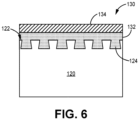
- FIG. 6 is a simplified cross-sectional view of a coated composite article based on the surface treatment of FIG. 2 .
- FIG. 7 is a simplified cross-sectional view of a coated composite article based on the surface treatment of FIG. 4 .
- FIGS. 2-7 are discussed together with steps 12-18 of method 10.
- the composite article (e.g., composite articles 120, 220 shown and labeled in FIGS. 2 and 4 , respectively) can be formed from a polymer-based material (e.g., thermosets, thermoplastics, etc.) in an exemplary embodiment. Other types of composites (e.g., ceramic, glass, etc.) are contemplated herein.
- the composite article can undergo a surface treatment to create surface roughness or voids.
- Surface treatment can involve the use of a chemical etchant (e.g., acidic or alkali), a mechanical etching process (e.g., routing, milling, grit blasting, laser etching, stamping, etc.), or a combination of the two.
- Surface treatment can be broadly applied to the article surface, or to targeted regions.
- FIG. 2 is a simplified cross-sectional view of composite article 120 after surface treatment step 12 (i.e., a treated composite article).
- FIG. 3 is a close-up view of area A3 of FIG. 2 .
- article 120 includes outer surface 122 and voids 124 formed in surface 122.
- Voids 124 can be defined by variously disposed straight walls 126 normal to or at an angle relative to surface 122, forming columnar or angled geometries, respectively.
- An exemplary void 124 includes opening 128, defined herein as the location at which void 124 meets surface 122.
- Void 124 can include a first dimension D1, represented by a dashed line and taken at opening 128.
- Void 124 can further include at least a second dimension D2, also represented by a dashed line and taken inward, based on the orientation of FIGS. 2 and 3 , from dimension D1.
- Dimension D2 can be greater than dimension D1, such that dimension D1 is narrower than at least a section of void 124 inward from opening 128.
- dimension D2 is the widest dimension of void 124 and dimension D1 is the narrowest.
- dimensions D1 and D2 can be, for example, a width (i.e., for more quadrilateral shapes), or a diameter (i.e., for circular or elliptical shapes).
- Voids 124 can be formed using a mechanical etching process discussed above with respect to step 12. More specifically, voids 124 can be formed via mechanical etching using a tool or laser capable of creating more uniform and repeatable voids 124.
- FIG. 4 is a simplified cross-sectional view of alternative composite article 220 after surface treatment step 12, in particular, employing a chemical etchant.
- FIG. 5 is a close-up view of area A5 of FIG. 4 .
- Article 220 is substantially similar to article 120, having outer surface 222 and voids 224 formed therein.
- Article 220 differs in the more irregular shape of voids 224, having walls 226 that can include one or a combination of curved and straight segments.
- Chemical etching can lead to more irregular voids 224 because etchants tend to follow defects and/or grains within surface 222 of article 220.
- Voids 224 can further be highly variable with respect to other voids 224 in surface 222.
- Voids 224 can include opening 228 flush with surface 222.
- Such voids 224 can accordingly include dimension D3 taken at opening 228, and dimension D4 taken inward of opening 228, based on the orientation of FIGS. 4 and 5 .
- Dimension D4 can be greater than dimension D3, such that dimension D3 is narrower than at least a section of void 224 inward from opening 228.
- dimension D4 is the widest dimension of void 224 and dimension D3 is the narrowest.
- Other geometries for voids 124 and/or 224 are contemplated herein.
- an expansive interface coating can be applied to the treated composite article (e.g., articles 120 and/or 220), forming an intermediate composite article.
- Suitable coatings can be conductive compounds forming spacious crystal lattices (e.g., with tetrahedral coordination) such that they expand upon cooling to room temperature.
- Exemplary coating materials can include SAC305 (an alloy of 95.5 % tin, 3% silver, and 0. 5% copper), bismuth alloys, and other expansive solder alloys, to name a few non-limiting examples.
- Expansive interface coating material can be applied to the treated surface by soldering using a wire of the coating material, by pouring a molten material onto the surface, by cold spraying using a powder of the coating material, or by thermal spraying of a powder of the coating material, to name a few, non-limiting examples.
- molten materials should be below the glass transition temperature (T g ) of the composite to avoid composite destruction.
- T g glass transition temperature
- higher temperature regimes may be reached with the molten materials of the expansive interface coating.
- the coating material ideally fills voids (i.e., voids 124, 224) in the surface and also coats the surface.
- the material Upon cooling, the material expands, exerting a force on the walls of the voids creating an interference fit between the expansive interface coating and the composite article. Because the voids tend to be narrower at the opening than elsewhere within the void, the expansive interface coating essentially becomes anchored to the composite article by its voids. It should be understood that the expansive interface coating need not occupy each void in the surface, nor does it need to fully occupy individual voids to have the intended anchoring effect.
- the intermediate composite article can be coated with a protective and/or decorative metallic coating (i.e., plating).
- a protective and/or decorative metallic coating i.e., plating
- Such coating can be applied using an electroless or electrolytic plating technique, thermal spray (e.g., high velocity oxygen fuel or high velocity air fuel), etc.
- Exemplary coatings can include one or a combination of chromium, cobalt, cobalt-phosphorous, copper, nickel, nickel-phosphorous, nickel-tungsten, tungsten carbide-cobalt, tungsten carbide-cobalt chromium, etc., in a single or multi-layer arrangement.
- the expansive interface coating of the intermediate composite article creates a more attractive (i.e., conductive) surface, relative to the composite material, upon which the metallic coating materials can deposit.
- FIG. 6 is a cross-sectional view of coated composite article 130, derived from composite article 120 of FIGS. 2 and 3 .
- composite article 130 can include expansive interface coating 132 occupying voids 124 and formed upon surface 122 of composite article 120.
- Coated composite article 130 can further include metallic coating 134 applied over expansive interface coating 132.
- Coatings 132 and 134 can be formed from any of the materials discussed above with respect to steps 14 and 16, respectively.
- expansive coating 132 can occupy voids 124, while some or all of surface 122 remains uncoated by expansive coating 132.
- an intermediate, or bridging coating e.g., copper, nickel, nickel-phosphorous, etc.
- metallic coating 134 can then be applied over the bridging coating.
- FIG. 7 is a cross-sectional view of coated composite article 230, derived from composite article 220 of FIGS. 3 and 4 .
- Coated composite article 230 can include expansive interface coating 232 occupying voids 224 and formed upon surface 222 of composite article 220.
- Coated composite article 230 can further include metallic coating 234 applied over expansive interface coating 232.
- Coatings 232 and 234 can be formed from any of the materials discussed above with respect to steps 14 and 16, respectively.
- expansive coating 232 can mainly occupy voids 224 in an alternative embodiment, and a bridging coating of copper, nickel, nickel-phosphorous, etc. can be applied over surface 222 prior to the application of metallic coating 234.
- any desired, but optional post-processing operations can be carried out on the coated article (e.g., coated articles 130, 230). Such operations can include grinding, lapping, machining, and polishing of the metallic coating, the application of additional protective coatings, etc.
- the disclosed method can be used to coat composites for various purposes, including aerospace, industrial, and other transportation applications.
- a method of forming a coated composite article comprises treating a surface of a composite article to form a treated composite article having a plurality of voids in the surface, applying an expansive interface coating to the surface and plurality of voids of the treated composite article to form an intermediate composite article, the expansive interface coating comprising an expansive alloy, and applying a metallic coating to the intermediate composite article using one of electroless plating, electrolytic plating, and thermal spraying.
- Each void of at least a subset of the plurality of voids comprises an opening at the surface that is narrower than an inward dimension of the respective void.
- the method of the preceding paragraph can optionally include, additionally and/or alternatively, any one or more of the following features, configurations and/or additional components:
- the step of treating the surface can include at least one of a chemical etching process and a mechanical etching process.
- the step of applying the expansive interface coating can include one of soldering using a wire of the expansive alloy, pouring the expansive alloy in a molten form, cold spraying the expansive alloy as a powder, and thermal spraying the expansive alloy as a powder.
- a temperature of the expansive alloy in the molten form can be less than a glass transition temperature of the composite article.
- the step of applying the expansive interface coating can further include allowing the expansive interface coating to cool such that it expands and exerts a force against walls of each of the plurality of voids.
- the expansive alloy can include SAC305 or a bismuth alloy.
- the metallic coating can include one or a combination of cobalt, cobalt-phosphorous, copper, nickel, nickel-phosphorous, nickel-tungsten, tungsten carbide-cobalt, or tungsten carbide-cobalt chromium.
- the composite article can be formed from a polymer-based material.
- a treated composite article comprises an outer surface and a plurality of voids formed in the outer surface.
- Each void of at least a subset of the plurality of voids comprises an opening at the outer surface that is narrower than an inward dimension of the respective void.
- the treated composite article of the preceding paragraph can optionally include, additionally and/or alternatively, any one or more of the following features, configurations and/or additional components:
- each void of at least the subset of the plurality of voids can further include at least one straight wall normal to or at an angle relative to the outer surface.
- each void of at least the subset of the plurality of voids can have a columnar geometry.
- each void of at least the subset of the plurality of voids can further include at least one curved wall.
- each void of at least the subset of the plurality of voids can have a different geometry than a remainder of the plurality of voids.
- the composite can be a polymer-based material.
- the composite can be a ceramic or glass material.
- An intermediate composite article can include any of the above treated composite articles and an expansive interface coating applied to the outer surface and the plurality of voids.
- the expansive interface coating can include an expansive alloy.
- the expansive interface coating can exert force on at least one wall of each of the plurality of voids.
- the expansive alloy can include SAC305 or a bismuth alloy.
- a coated composite article can include any of the above intermediate composite articles and a metallic coating applied to the expansive interface coating.
- the metallic coating can include cobalt, cobalt-phosphorous, copper, nickel, nickel-phosphorous, nickel-tungsten, tungsten carbide-cobalt, or tungsten carbide-cobalt chromium.
Landscapes
- Chemical & Material Sciences (AREA)
- Engineering & Computer Science (AREA)
- Metallurgy (AREA)
- Chemical Kinetics & Catalysis (AREA)
- Materials Engineering (AREA)
- Organic Chemistry (AREA)
- Mechanical Engineering (AREA)
- General Chemical & Material Sciences (AREA)
- Physics & Mathematics (AREA)
- Plasma & Fusion (AREA)
- Electrochemistry (AREA)
- Other Surface Treatments For Metallic Materials (AREA)
- Chemically Coating (AREA)
Applications Claiming Priority (1)
| Application Number | Priority Date | Filing Date | Title |
|---|---|---|---|
| US17/941,646 US20240084457A1 (en) | 2022-09-09 | 2022-09-09 | Expansive coatings for anchoring to composite substrates |
Publications (1)
| Publication Number | Publication Date |
|---|---|
| EP4339320A1 true EP4339320A1 (de) | 2024-03-20 |
Family
ID=87933579
Family Applications (1)
| Application Number | Title | Priority Date | Filing Date |
|---|---|---|---|
| EP23195692.1A Pending EP4339320A1 (de) | 2022-09-09 | 2023-09-06 | Expandierbare beschichtungen zur verankerung an verbundsubstraten |
Country Status (2)
| Country | Link |
|---|---|
| US (1) | US20240084457A1 (de) |
| EP (1) | EP4339320A1 (de) |
Citations (3)
| Publication number | Priority date | Publication date | Assignee | Title |
|---|---|---|---|---|
| US3615734A (en) * | 1968-11-01 | 1971-10-26 | Du Pont | Brazeable compositions |
| JPH01179767A (ja) * | 1988-01-06 | 1989-07-17 | Hitachi Ltd | セラミックスのはんだ付方法 |
| JP2004292233A (ja) * | 2003-03-26 | 2004-10-21 | Matsushita Electric Works Ltd | セラミックと金属のロウ付け方法 |
Family Cites Families (9)
| Publication number | Priority date | Publication date | Assignee | Title |
|---|---|---|---|---|
| US993195A (en) * | 1910-03-22 | 1911-05-23 | Walter J Phelps | Apparatus for soldering side seams of can-bodies. |
| USRE17179E (en) * | 1926-03-19 | 1929-01-01 | Pbintino fobm and method of producing same | |
| DE9305806U1 (de) * | 1993-04-19 | 1993-06-09 | Hoechst Ag, 6230 Frankfurt | Druckwalze mit einer Hülse aus thermisch gewickelten faserverstärkten Thermoplasten und einer plasmagespritzten Kupfer- oder Kupferlegierungsbeschichtung |
| US6834956B2 (en) * | 2002-12-27 | 2004-12-28 | International Polarizer, Inc. | Thermoformable polarized lens with substrate having adjusted glass transition temperature |
| US7223695B2 (en) * | 2004-09-30 | 2007-05-29 | Intel Corporation | Methods to deposit metal alloy barrier layers |
| US8313958B2 (en) * | 2010-05-12 | 2012-11-20 | Intel Corporation | Magnetic microelectronic device attachment |
| WO2014144152A1 (en) * | 2013-03-15 | 2014-09-18 | Rolls-Royce Corporation | Improved coating interface |
| TW201901887A (zh) * | 2017-05-24 | 2019-01-01 | 以色列商奧寶科技股份有限公司 | 於未事先圖樣化基板上電器互連電路元件 |
| EP3453510B1 (de) * | 2017-09-08 | 2022-03-02 | Apple Inc. | Verbinden von polymermaterial mit eloxiertem metall mittels aussparungen |
-
2022
- 2022-09-09 US US17/941,646 patent/US20240084457A1/en not_active Abandoned
-
2023
- 2023-09-06 EP EP23195692.1A patent/EP4339320A1/de active Pending
Patent Citations (3)
| Publication number | Priority date | Publication date | Assignee | Title |
|---|---|---|---|---|
| US3615734A (en) * | 1968-11-01 | 1971-10-26 | Du Pont | Brazeable compositions |
| JPH01179767A (ja) * | 1988-01-06 | 1989-07-17 | Hitachi Ltd | セラミックスのはんだ付方法 |
| JP2004292233A (ja) * | 2003-03-26 | 2004-10-21 | Matsushita Electric Works Ltd | セラミックと金属のロウ付け方法 |
Also Published As
| Publication number | Publication date |
|---|---|
| US20240084457A1 (en) | 2024-03-14 |
Similar Documents
| Publication | Publication Date | Title |
|---|---|---|
| US20020102360A1 (en) | Thermal barrier coating applied with cold spray technique | |
| US11421313B2 (en) | Article and a method of making an article | |
| US6706319B2 (en) | Mixed powder deposition of components for wear, erosion and abrasion resistant applications | |
| US8444042B2 (en) | Method for producing steel pipe plated with metal by thermal spraying | |
| US20040079033A1 (en) | Abrasive article and manufacturing method thereof | |
| WO2013042635A1 (ja) | 積層体及び積層体の製造方法 | |
| KR20070029094A (ko) | 내플라즈마 부식성이 우수한 용사 피막 피복 부재 및 그제조 방법 | |
| US20050036892A1 (en) | Method for applying metallurgical coatings to gas turbine components | |
| JP2008115467A (ja) | 構成部品の接合面に充填材を堆積させる方法 | |
| WO2012128327A1 (ja) | 積層体、導電材料および積層体の製造方法 | |
| WO2012137950A1 (ja) | 積層体および積層体の製造方法 | |
| JPS6137955A (ja) | 溶融金属溶用ロール及びその製造方法 | |
| EP4339320A1 (de) | Expandierbare beschichtungen zur verankerung an verbundsubstraten | |
| US6472014B1 (en) | Uniform surface texturing for PVD/CVD hardware | |
| WO2005012589A1 (en) | Method of thermal spraying metal | |
| WO2013061934A1 (ja) | 複合材料の製造方法及び複合材料 | |
| EP3587621B1 (de) | Verfahren zur herstellung einer aluminiumleiterplatte | |
| US9481922B2 (en) | Process for forming porous metal coating on surfaces | |
| JP2001207252A (ja) | アーク溶射成形品及びその製造方法 | |
| JPS6284976A (ja) | 研削砥石用回転式形直しもしくは目直し工具の製造方法 | |
| JP4546448B2 (ja) | 耐プラズマエロージョン性に優れる溶射皮膜被覆部材およびその製造方法 | |
| JP2006303158A (ja) | 真空装置用部品 | |
| US11313041B2 (en) | Manufactured metal objects with hollow channels and method for fabrication thereof | |
| JP2013010148A (ja) | 超砥粒工具およびその製造方法 | |
| KR101922805B1 (ko) | 박리방지를 위한 용사코팅층 제조방법 및 이를 이용한 용사코팅층 |
Legal Events
| Date | Code | Title | Description |
|---|---|---|---|
| PUAI | Public reference made under article 153(3) epc to a published international application that has entered the european phase |
Free format text: ORIGINAL CODE: 0009012 |
|
| STAA | Information on the status of an ep patent application or granted ep patent |
Free format text: STATUS: THE APPLICATION HAS BEEN PUBLISHED |
|
| AK | Designated contracting states |
Kind code of ref document: A1 Designated state(s): AL AT BE BG CH CY CZ DE DK EE ES FI FR GB GR HR HU IE IS IT LI LT LU LV MC ME MK MT NL NO PL PT RO RS SE SI SK SM TR |
|
| STAA | Information on the status of an ep patent application or granted ep patent |
Free format text: STATUS: REQUEST FOR EXAMINATION WAS MADE |
|
| 17P | Request for examination filed |
Effective date: 20240919 |
|
| RBV | Designated contracting states (corrected) |
Designated state(s): AL AT BE BG CH CY CZ DE DK EE ES FI FR GB GR HR HU IE IS IT LI LT LU LV MC ME MK MT NL NO PL PT RO RS SE SI SK SM TR |